BUDGETING,
DISCIPLINE &
RECRUITMENT
Budget supplies the mechanism for translation
fiscal objective into the projected monthly
spending pattern.
Fiscal planning and decision-making.
Controllable and uncontrollable cost areas.
Useful format for communication fiscal
objective.
Feedback of utilization of budget
Identify problem areas and facilities for
effective solution.
For measuring and recording financial success
with the objective of the institution.
PURPOSES
TYPES:
Budget
Personal Budget
Operating Budget
Capital budget
It should be flexible
It should synthesis of past, present
and future
It should be product joint venture,
cooperation of executive
It should have a support at top
management through the period
of its planning and
implementation
FEATURES OF BUDJET
Budget should provide sounds financial
management by focusing on the
requirement of the organization
Budget should focus objects and
policies of the organization.
Budgeting should include coordinating
efforts of various departments
establishing a frame of
Reference for managerial decisions.
PRINCIPLE OF BUDGET
 Budget period must be appropriate to the
nature of business or service and to the type
of budget. Budget the prepared under
direction and supervision of the administrator
or financial officer.
 Budget is to be prepared and interpreted
consistently
 Throughout the organization in the
communication of the planning process.
 Budget necessitates a review of the
performance of the previous year and an
evaluation of its adequacy both in quantity
and quality.
Cont….
Identifies the importance of and develops
short a long range fiscal plan that reflects
unit needs
Articulate and documents units need
effectively to higher administrative levels
Assess the internal and external environment
of the
Organization in forecasting to identify
driving forces and barriers of fiscal planning
Demonstrate knowledge of budgeting and
uses appropriate technique.
FUNCTION OF BUDGET IN NURSING
Provide opportunities for subordinate to
participant in relevant fiscal planning.
Coordinates unit level fiscal planning to be
congruent with organizational goals and
objective.
Accurately assesses personal needs using
predetermined standards or an established
patient classification system.
Coordinates the monitoring aspects of
budget control.
Ensure that documentation of clients need
for services to clear and complete for
facilitating organizational reimbursement.
Cont…
Budget for College of Nursing is designed
to support the college staff and students to
carry-out various activities and to protect
money from being misused or wasted.
In a government setting the financial
sources available to college are less or very
limited. Out of which about 60% of the
budget allocated is required to be spent on
salaries and wages and remaining 40% of
the budget spent in stores, supplies and
equipments.
BUDGET PLANNING FOR
COLLEGE OF NURSING
 Salaries for professional, clinical and domestic
staff
 Stipends for students
 New equipments and repair
 Linen and other household supplies
 Office supplies, including stationary and
postage
 Maintenance of transportation and cost of
petrol
 Maintenance of library
 Funds doe educational tours, professional
activities, capping and graduation ceremony,
etc.
Preparation of Budget
 To create & maintain desirable conditions in
the teaching-learning situation & thus to
achieve the objectives.
 To create favorable attitude towards the
establishment & maintenance of conditions
essential to effective work, in order to
achieve the desired objectives.
 To assist the development of self-control &
cooperation which are regarded as essential
traits in the daily living as well as professional
functioning.
AIMS OF DISCIPLINE
a) In harmony with the total goals of
education
b) Based on and controlled by love and
not by feat
c) Positive & constructive.
d) Ensure quality of justice to all, respect
for individual rights & dignity and a
humanitarian treatment of the same.
e) Mean for successful implementation of
the educational program
PRINCIPLES OF DISCIPLINE
 Have rules and remind them often
 Keep rules short and simple
 Be nice to teacher and classmates
 Raise hand to speak
 Be silent or whisper
 Resist giving attention to the disruptor
'Someone is disturbing the class.
Classroom Discipline for Students
 Elements of uniformity despite several
differences in formal behaviour.
 Indiscipline not following the rules
and regulation of an organization.
Indiscipline
 Faulty disciplinary actions taken by the
authorities may lead to indiscipline
 Neglect of employees grievances
 Wrong placeriplit and promotion or
remunerations also leads to indiscipline
 Deficiency of well-defined code of discipline
 Divide and rule policy
 Improper attitude towards employee's
problem Il-equipped supervisor may cause
indiscipline.
Causes of Indiscipline
See Pamplets……
PRINCIPLES
OF
MAINTAINING DISCIPLINE
RECRUITMENT
TYPES
OF
RECRUITMENT:
recRUITMENT
Planned
Anticipated
Unexpected
 Discovery and cultivation of the
employment market for post in the public
service
 Use of the attractive recruitment literature
and publicity Use of the scientific tests for
determining abilities of the candidate
 Tapping capable candidates from within
the services
 Placement program which assigns the
right man to the right job.
 A follow up probationally program as an
integral process
Basic Elements of Sound Recruitment
Policy
Determine the present and future requirements
of the organization in conjunction with the
personnel planning and job analysis activities.
Increase the pool of job candidates with
minimum cost.
Help increase the success rate of the selection
process reducing the number of obviously
under qualified or over qualified job applicants
Help reduce the probability that job applicants,
once recruited and selected will leave the
organization only after short period of time
Purposes and Importance
 Meet the organization's legal and social
obligations regarding the composition
of its work force.
 Start identifying and preparing
potential job applicants who will be
appropriate candidates.
 Increase organizational and individual
effectiveness in the short and long term
 Evaluate the effectiveness of various
recruiting techniques and sources for all
types of job application
Cont…
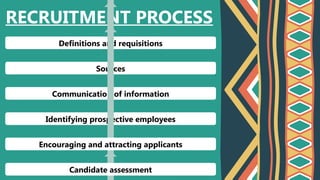
RECRUITMENT PROCESS
Definitions and requisitions
Sources
Communication of information
Identifying prospective employees
Encouraging and attracting applicants
Candidate assessment
 To attract people with multi-dimensional
skills and experiences that suits the
present and future organizational
strategies.
 To induct outsiders with new perspective
to lead the company.
 To develop an organizational culture that
attracts competent people to the company.
 To search or heat hunt/ head pouch people
whose skills fit the company's values.
Objectives of Recruitment
 To device methodologies for assessing
psychological traits.
 To seek out non-conventional
development grounds of talent.
 To search for talent globally and not
just within the company.
 To design entry pay that competes on
quality but not on quantum.
 To anticipate and find people for
positions that does not exist yet.
Cont….
Elements Of Recruitment Process
Elemen
ts
It specifies the objectives of recruitment and
provides a framework for the implementation of
the recruitment programme it involves:
 Enriching the organisation's human resources by
filling vacancies with the best qualified people
 Attitudes towards recruiting handicaps, minority
groups, women, friends and relatives of present
employees.
 Promotion from within.
 Development of organizational system for
implementing the recruitment programme and
procedures to be employed.
Recruitment Policy:
 To find and employ the best
qualified persons for each job.
 To retain the most promising of
those hired.
 To offer promising opportunities
for the life time working careers.
 To provide facilities and
opportunities for personal growth
on the job.
General Principles
Factors affecting recruitment policy:
 Organizational objectives
 Personnel policies of the Organization and its competitors
 Government policies on reservations
 Preferred sources of recruitment
 Organization's recruitment needs
 Recruitment costs
 Financial implications
 Selection criteria and preferences, etc
Recruitment Organization:
➤Centralized
recruitment
➤Decentralized
recruitment
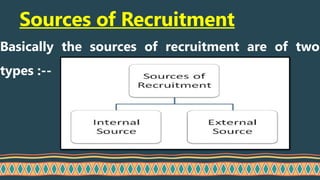
Basically the sources of recruitment are of two
types :--
Sources of Recruitment
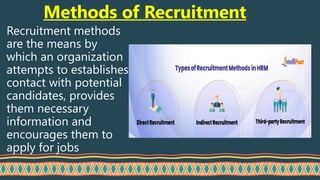
Recruitment methods
are the means by
which an organization
attempts to establishes
contact with potential
candidates, provides
them necessary
information and
encourages them to
apply for jobs
Methods of Recruitment
 Under this method scouting, manned exhibits
and waiting lists are used.
 Scouting-where an company representatives
may be sent to educational and training
institutions.
 Manned exhibits- Where representatives sent
to seminars and conventions where they can
establish their mobile offices to go to desired
centers.
 Waiting lists of candidates who have
indicated their interest in jobs in person
through mail over phone
Direct Methods:
Advertisements in
newspapers and
journals, radio,
television used to
publicize vacancies. This
helps to enable the
candidates to assess
their suitability so that
only those possessing
the requisite
qualifications will apply.
Indirect method
Third party methods:
Various agencies, public employment
exchanges and private consulting firms
are used to recruit personnel. In
addition friends and relations of
existing staff deputation can be used.
Recruitment for students
…….See Leaflets
……Thank You

Budgeting presentation for nursing management

  • 1.
  • 3.
    Budget supplies themechanism for translation fiscal objective into the projected monthly spending pattern. Fiscal planning and decision-making. Controllable and uncontrollable cost areas. Useful format for communication fiscal objective. Feedback of utilization of budget Identify problem areas and facilities for effective solution. For measuring and recording financial success with the objective of the institution. PURPOSES
  • 4.
  • 5.
    It should beflexible It should synthesis of past, present and future It should be product joint venture, cooperation of executive It should have a support at top management through the period of its planning and implementation FEATURES OF BUDJET
  • 6.
    Budget should providesounds financial management by focusing on the requirement of the organization Budget should focus objects and policies of the organization. Budgeting should include coordinating efforts of various departments establishing a frame of Reference for managerial decisions. PRINCIPLE OF BUDGET
  • 7.
     Budget periodmust be appropriate to the nature of business or service and to the type of budget. Budget the prepared under direction and supervision of the administrator or financial officer.  Budget is to be prepared and interpreted consistently  Throughout the organization in the communication of the planning process.  Budget necessitates a review of the performance of the previous year and an evaluation of its adequacy both in quantity and quality. Cont….
  • 8.
    Identifies the importanceof and develops short a long range fiscal plan that reflects unit needs Articulate and documents units need effectively to higher administrative levels Assess the internal and external environment of the Organization in forecasting to identify driving forces and barriers of fiscal planning Demonstrate knowledge of budgeting and uses appropriate technique. FUNCTION OF BUDGET IN NURSING
  • 9.
    Provide opportunities forsubordinate to participant in relevant fiscal planning. Coordinates unit level fiscal planning to be congruent with organizational goals and objective. Accurately assesses personal needs using predetermined standards or an established patient classification system. Coordinates the monitoring aspects of budget control. Ensure that documentation of clients need for services to clear and complete for facilitating organizational reimbursement. Cont…
  • 10.
    Budget for Collegeof Nursing is designed to support the college staff and students to carry-out various activities and to protect money from being misused or wasted. In a government setting the financial sources available to college are less or very limited. Out of which about 60% of the budget allocated is required to be spent on salaries and wages and remaining 40% of the budget spent in stores, supplies and equipments. BUDGET PLANNING FOR COLLEGE OF NURSING
  • 11.
     Salaries forprofessional, clinical and domestic staff  Stipends for students  New equipments and repair  Linen and other household supplies  Office supplies, including stationary and postage  Maintenance of transportation and cost of petrol  Maintenance of library  Funds doe educational tours, professional activities, capping and graduation ceremony, etc. Preparation of Budget
  • 13.
     To create& maintain desirable conditions in the teaching-learning situation & thus to achieve the objectives.  To create favorable attitude towards the establishment & maintenance of conditions essential to effective work, in order to achieve the desired objectives.  To assist the development of self-control & cooperation which are regarded as essential traits in the daily living as well as professional functioning. AIMS OF DISCIPLINE
  • 14.
    a) In harmonywith the total goals of education b) Based on and controlled by love and not by feat c) Positive & constructive. d) Ensure quality of justice to all, respect for individual rights & dignity and a humanitarian treatment of the same. e) Mean for successful implementation of the educational program PRINCIPLES OF DISCIPLINE
  • 15.
     Have rulesand remind them often  Keep rules short and simple  Be nice to teacher and classmates  Raise hand to speak  Be silent or whisper  Resist giving attention to the disruptor 'Someone is disturbing the class. Classroom Discipline for Students
  • 16.
     Elements ofuniformity despite several differences in formal behaviour.  Indiscipline not following the rules and regulation of an organization. Indiscipline
  • 17.
     Faulty disciplinaryactions taken by the authorities may lead to indiscipline  Neglect of employees grievances  Wrong placeriplit and promotion or remunerations also leads to indiscipline  Deficiency of well-defined code of discipline  Divide and rule policy  Improper attitude towards employee's problem Il-equipped supervisor may cause indiscipline. Causes of Indiscipline
  • 18.
  • 19.
  • 20.
  • 21.
     Discovery andcultivation of the employment market for post in the public service  Use of the attractive recruitment literature and publicity Use of the scientific tests for determining abilities of the candidate  Tapping capable candidates from within the services  Placement program which assigns the right man to the right job.  A follow up probationally program as an integral process Basic Elements of Sound Recruitment Policy
  • 22.
    Determine the presentand future requirements of the organization in conjunction with the personnel planning and job analysis activities. Increase the pool of job candidates with minimum cost. Help increase the success rate of the selection process reducing the number of obviously under qualified or over qualified job applicants Help reduce the probability that job applicants, once recruited and selected will leave the organization only after short period of time Purposes and Importance
  • 23.
     Meet theorganization's legal and social obligations regarding the composition of its work force.  Start identifying and preparing potential job applicants who will be appropriate candidates.  Increase organizational and individual effectiveness in the short and long term  Evaluate the effectiveness of various recruiting techniques and sources for all types of job application Cont…
  • 24.
    RECRUITMENT PROCESS Definitions andrequisitions Sources Communication of information Identifying prospective employees Encouraging and attracting applicants Candidate assessment
  • 25.
     To attractpeople with multi-dimensional skills and experiences that suits the present and future organizational strategies.  To induct outsiders with new perspective to lead the company.  To develop an organizational culture that attracts competent people to the company.  To search or heat hunt/ head pouch people whose skills fit the company's values. Objectives of Recruitment
  • 26.
     To devicemethodologies for assessing psychological traits.  To seek out non-conventional development grounds of talent.  To search for talent globally and not just within the company.  To design entry pay that competes on quality but not on quantum.  To anticipate and find people for positions that does not exist yet. Cont….
  • 27.
    Elements Of RecruitmentProcess Elemen ts
  • 28.
    It specifies theobjectives of recruitment and provides a framework for the implementation of the recruitment programme it involves:  Enriching the organisation's human resources by filling vacancies with the best qualified people  Attitudes towards recruiting handicaps, minority groups, women, friends and relatives of present employees.  Promotion from within.  Development of organizational system for implementing the recruitment programme and procedures to be employed. Recruitment Policy:
  • 29.
     To findand employ the best qualified persons for each job.  To retain the most promising of those hired.  To offer promising opportunities for the life time working careers.  To provide facilities and opportunities for personal growth on the job. General Principles
  • 30.
    Factors affecting recruitmentpolicy:  Organizational objectives  Personnel policies of the Organization and its competitors  Government policies on reservations  Preferred sources of recruitment  Organization's recruitment needs  Recruitment costs  Financial implications  Selection criteria and preferences, etc
  • 31.
  • 32.
    Basically the sourcesof recruitment are of two types :-- Sources of Recruitment
  • 33.
    Recruitment methods are themeans by which an organization attempts to establishes contact with potential candidates, provides them necessary information and encourages them to apply for jobs Methods of Recruitment
  • 34.
     Under thismethod scouting, manned exhibits and waiting lists are used.  Scouting-where an company representatives may be sent to educational and training institutions.  Manned exhibits- Where representatives sent to seminars and conventions where they can establish their mobile offices to go to desired centers.  Waiting lists of candidates who have indicated their interest in jobs in person through mail over phone Direct Methods:
  • 35.
    Advertisements in newspapers and journals,radio, television used to publicize vacancies. This helps to enable the candidates to assess their suitability so that only those possessing the requisite qualifications will apply. Indirect method
  • 36.
    Third party methods: Variousagencies, public employment exchanges and private consulting firms are used to recruit personnel. In addition friends and relations of existing staff deputation can be used.

  • 37.

  • 39.