MEM 612 Project Management
Chapter 4
Budgeting the Project
MEM 612 Project Management
Introduction
• Budgets are plans for allocating
organizational resources to project
activities.
– forecasting required resources, quantities
needed, when needed, and costs
• Budgets help tie project to overall
organizational objectives.
• Budgets can be used as tool by upper
management to monitor and guide projects.
MEM 612 Project Management
METHODS OF BUDGETING
MEM 612 Project Management
Top-Down Budgeting
• Based on collective judgements and
experiences of top and middle managers.
• Overall project cost estimated by
estimating costs of major tasks
• Advantages
– accuracy of estimating overall budget
– errors in funding small tasks need not be
individually identified
MEM 612 Project Management
Bottom-Up Budgeting
• WBS or action plan identifies elemental
tasks
• Those responsible for executing these
tasks estimate resource requirements
• Advantage
– more accurate in the detailed tasks
• Disadvantage
– risk of overlooking tasks
MEM 612 Project Management
COST ESTIMATING
MEM 612 Project Management
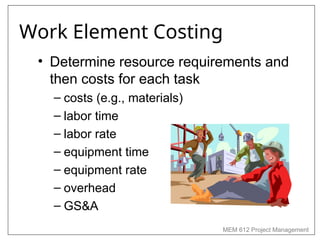
Work Element Costing
• Determine resource requirements and
then costs for each task
– costs (e.g., materials)
– labor time
– labor rate
– equipment time
– equipment rate
– overhead
– GS&A
MEM 612 Project Management
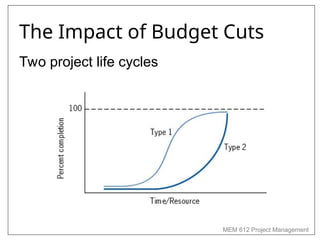
The Impact of Budget Cuts
Two project life cycles
MEM 612 Project Management
Activity Versus Program
Budgeting
• Activity oriented budgets are based on
historical data accumulated through an
activity-based accounting system.
– expenses assigned to basic budget lines
• With program budgets, each project has
its own budget.
– expenses by task and time period are shown
MEM 612 Project Management
IMPROVING COST
ESTIMATES
MEM 612 Project Management
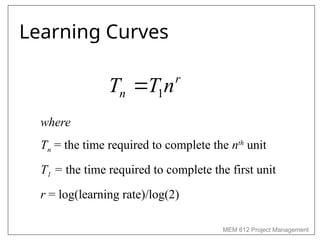
Learning Curves
r
n n
T
T 1

where
Tn = the time required to complete the nth
unit
T1 = the time required to complete the first unit
r = log(learning rate)/log(2)
MEM 612 Project Management
Tracking Signals
• Used to determine if there is a systematic
bias in cost or other estimates
MEM 612 Project Management
Other Factors
• Changes in resource prices
– Increase all estimates by same percentage
– Estimate rate of price change individually
for inputs that have significant impact on
costs
• Waste and spoilage
• Team member turnover
• “Mythical man-month”
• Organization climate
MEM 612 Project Management
BUDGET UNCERTAINTY AND
RISK MANAGEMENT
MEM 612 Project Management
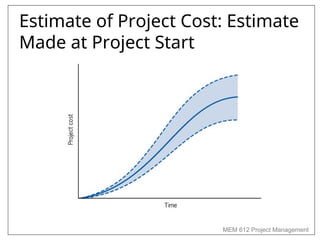
Estimate of Project Cost: Estimate
Made at Project Start
MEM 612 Project Management
Three Basic Causes for Change
in Projects
• Errors made by cost estimator about how
to achieve tasks.
• New knowledge about the nature of the
performance goal or setting.
• A mandate.
MEM 612 Project Management
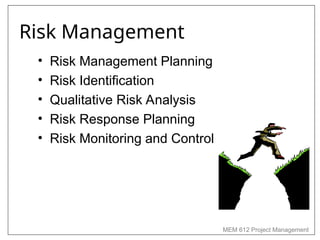
Risk Management
• Risk Management Planning
• Risk Identification
• Qualitative Risk Analysis
• Risk Response Planning
• Risk Monitoring and Control
MEM 612 Project Management
Failure Mode and Effect Analysis
(FMEA)
• List ways project might fail
• Evaluate severity (S) of each failure
• Estimate likelihood (L) of each failure
occurring
• Estimate ability to detect each failure (D)
• Calculate Risk Priority Number (RPN)
• Sort potential failures by their RPNs
MEM 612 Project Management
Other Approaches
• Game theory
• Expected value
• Simulation
MEM 612 Project Management
Copyright
Copyright John Wiley & Sons, Inc.
All rights reserved. Reproduction or translation of this work
beyond that permitted in Section 117 of the 1976 United
States Copyright Act without express permission of the
copyright owner is unlawful. Request for further
information should be addressed to the Permissions
Department, John Wiley & Sons, Inc. The purchaser may
make back-up copies for his/her own use only and not for
distribution or resale. The Publisher assumes no
responsibility for errors, omissions, or damages, caused
by the use of these programs or from the use of the
information herein.

budgeting in project management introduction

  • 1.
    MEM 612 ProjectManagement Chapter 4 Budgeting the Project
  • 2.
    MEM 612 ProjectManagement Introduction • Budgets are plans for allocating organizational resources to project activities. – forecasting required resources, quantities needed, when needed, and costs • Budgets help tie project to overall organizational objectives. • Budgets can be used as tool by upper management to monitor and guide projects.
  • 3.
    MEM 612 ProjectManagement METHODS OF BUDGETING
  • 4.
    MEM 612 ProjectManagement Top-Down Budgeting • Based on collective judgements and experiences of top and middle managers. • Overall project cost estimated by estimating costs of major tasks • Advantages – accuracy of estimating overall budget – errors in funding small tasks need not be individually identified
  • 5.
    MEM 612 ProjectManagement Bottom-Up Budgeting • WBS or action plan identifies elemental tasks • Those responsible for executing these tasks estimate resource requirements • Advantage – more accurate in the detailed tasks • Disadvantage – risk of overlooking tasks
  • 6.
    MEM 612 ProjectManagement COST ESTIMATING
  • 7.
    MEM 612 ProjectManagement Work Element Costing • Determine resource requirements and then costs for each task – costs (e.g., materials) – labor time – labor rate – equipment time – equipment rate – overhead – GS&A
  • 8.
    MEM 612 ProjectManagement The Impact of Budget Cuts Two project life cycles
  • 9.
    MEM 612 ProjectManagement Activity Versus Program Budgeting • Activity oriented budgets are based on historical data accumulated through an activity-based accounting system. – expenses assigned to basic budget lines • With program budgets, each project has its own budget. – expenses by task and time period are shown
  • 10.
    MEM 612 ProjectManagement IMPROVING COST ESTIMATES
  • 11.
    MEM 612 ProjectManagement Learning Curves r n n T T 1  where Tn = the time required to complete the nth unit T1 = the time required to complete the first unit r = log(learning rate)/log(2)
  • 12.
    MEM 612 ProjectManagement Tracking Signals • Used to determine if there is a systematic bias in cost or other estimates
  • 13.
    MEM 612 ProjectManagement Other Factors • Changes in resource prices – Increase all estimates by same percentage – Estimate rate of price change individually for inputs that have significant impact on costs • Waste and spoilage • Team member turnover • “Mythical man-month” • Organization climate
  • 14.
    MEM 612 ProjectManagement BUDGET UNCERTAINTY AND RISK MANAGEMENT
  • 15.
    MEM 612 ProjectManagement Estimate of Project Cost: Estimate Made at Project Start
  • 16.
    MEM 612 ProjectManagement Three Basic Causes for Change in Projects • Errors made by cost estimator about how to achieve tasks. • New knowledge about the nature of the performance goal or setting. • A mandate.
  • 17.
    MEM 612 ProjectManagement Risk Management • Risk Management Planning • Risk Identification • Qualitative Risk Analysis • Risk Response Planning • Risk Monitoring and Control
  • 18.
    MEM 612 ProjectManagement Failure Mode and Effect Analysis (FMEA) • List ways project might fail • Evaluate severity (S) of each failure • Estimate likelihood (L) of each failure occurring • Estimate ability to detect each failure (D) • Calculate Risk Priority Number (RPN) • Sort potential failures by their RPNs
  • 19.
    MEM 612 ProjectManagement Other Approaches • Game theory • Expected value • Simulation
  • 20.
    MEM 612 ProjectManagement Copyright Copyright John Wiley & Sons, Inc. All rights reserved. Reproduction or translation of this work beyond that permitted in Section 117 of the 1976 United States Copyright Act without express permission of the copyright owner is unlawful. Request for further information should be addressed to the Permissions Department, John Wiley & Sons, Inc. The purchaser may make back-up copies for his/her own use only and not for distribution or resale. The Publisher assumes no responsibility for errors, omissions, or damages, caused by the use of these programs or from the use of the information herein.