MBA- INFRASTRUCTURE MANAGEMENT
UPES- DEHRADUN
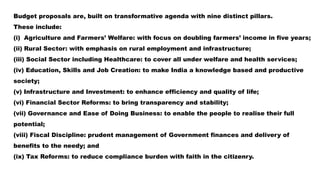
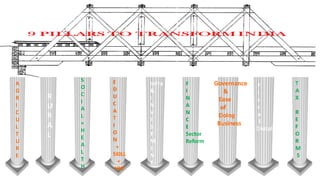
Budget proposals are, built on transformative agenda with nine distinct pillars.
These include:
(i) Agriculture and Farmers’ Welfare: with focus on doubling farmers’ income in five years;
(ii) Rural Sector: with emphasis on rural employment and infrastructure;
(iii) Social Sector including Healthcare: to cover all under welfare and health services;
(iv) Education, Skills and Job Creation: to make India a knowledge based and productive
society;
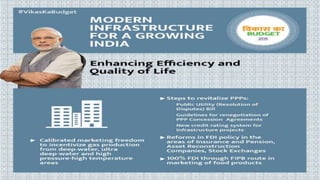
(v) Infrastructure and Investment: to enhance efficiency and quality of life;
(vi) Financial Sector Reforms: to bring transparency and stability;
(vii) Governance and Ease of Doing Business: to enable the people to realise their full
potential;
(viii) Fiscal Discipline: prudent management of Government finances and delivery of
benefits to the needy; and
(ix) Tax Reforms: to reduce compliance burden with faith in the citizenry.
A
G
R
I
C
U
L
T
U
R
E
R
U
R
A
L
S
O
C
I
A
L
+
H
E
A
L
T
H
E
D
U
C
A
T
I
O
N
+
SKILL
+
JOB
InFra
&
I
N
V
E
S
T
M
E
N
T
F
I
N
A
N
C
E
Sector
Reform
Governance
&
Ease
of
Doing
Business
F
I
s
c
a
l
Discipline
T
A
X
R
E
F
O
R
M
S
Agriculture
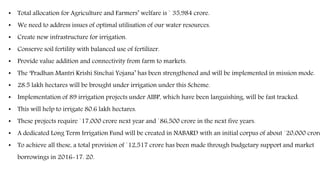
• Total allocation for Agriculture and Farmers’ welfare is ` 35,984 crore.
• We need to address issues of optimal utilisation of our water resources.
• Create new infrastructure for irrigation.
• Conserve soil fertility with balanced use of fertilizer.
• Provide value addition and connectivity from farm to markets.
• The ‘Pradhan Mantri Krishi Sinchai Yojana’ has been strengthened and will be implemented in mission mode.
• 28.5 lakh hectares will be brought under irrigation under this Scheme.
• Implementation of 89 irrigation projects under AIBP, which have been languishing, will be fast tracked.
• This will help to irrigate 80.6 lakh hectares.
• These projects require `17,000 crore next year and `86,500 crore in the next five years.
• A dedicated Long Term Irrigation Fund will be created in NABARD with an initial corpus of about `20,000 crore
• To achieve all these, a total provision of `12,517 crore has been made through budgetary support and market
borrowings in 2016-17. 20.
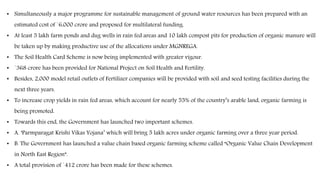
• Simultaneously a major programme for sustainable management of ground water resources has been prepared with an
estimated cost of `6,000 crore and proposed for multilateral funding.
• At least 5 lakh farm ponds and dug wells in rain fed areas and 10 lakh compost pits for production of organic manure will
be taken up by making productive use of the allocations under MGNREGA.
• The Soil Health Card Scheme is now being implemented with greater vigour.
• `368 crore has been provided for National Project on Soil Health and Fertility.
• Besides, 2,000 model retail outlets of Fertilizer companies will be provided with soil and seed testing facilities during the
next three years.
• To increase crop yields in rain fed areas, which account for nearly 55% of the country’s arable land, organic farming is
being promoted.
• Towards this end, the Government has launched two important schemes.
• A. ‘Parmparagat Krishi Vikas Yojana’ which will bring 5 lakh acres under organic farming over a three year period.
• B. The Government has launched a value chain based organic farming scheme called “Organic Value Chain Development
in North East Region”.
• A total provision of `412 crore has been made for these schemes.
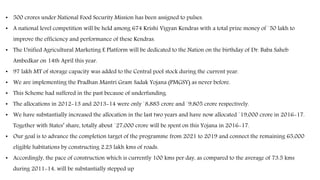
• 500 crores under National Food Security Mission has been assigned to pulses.
• A national level competition will be held among 674 Krishi Vigyan Kendras with a total prize money of `50 lakh to
improve the efficiency and performance of these Kendras.
• The Unified Agricultural Marketing E Platform will be dedicated to the Nation on the birthday of Dr. Baba Saheb
Ambedkar on 14th April this year.
• 97 lakh MT of storage capacity was added to the Central pool stock during the current year.
• We are implementing the Pradhan Mantri Gram Sadak Yojana (PMGSY) as never before.
• This Scheme had suffered in the past because of underfunding.
• The allocations in 2012-13 and 2013-14 were only `8,885 crore and `9,805 crore respectively.
• We have substantially increased the allocation in the last two years and have now allocated `19,000 crore in 2016-17.
Together with States’ share, totally about `27,000 crore will be spent on this Yojana in 2016-17.
• Our goal is to advance the completion target of the programme from 2021 to 2019 and connect the remaining 65,000
eligible habitations by constructing 2.23 lakh kms of roads.
• Accordingly, the pace of construction which is currently 100 kms per day, as compared to the average of 73.5 kms
during 2011-14, will be substantially stepped up
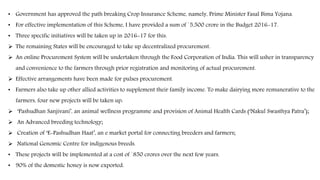
• Government has approved the path breaking Crop Insurance Scheme, namely, Prime Minister Fasal Bima Yojana.
• For effective implementation of this Scheme, I have provided a sum of `5,500 crore in the Budget 2016-17.
• Three specific initiatives will be taken up in 2016-17 for this.
 The remaining States will be encouraged to take up decentralized procurement.
 An online Procurement System will be undertaken through the Food Corporation of India. This will usher in transparency
and convenience to the farmers through prior registration and monitoring of actual procurement.
 Effective arrangements have been made for pulses procurement.
• Farmers also take up other allied activities to supplement their family income. To make dairying more remunerative to the
farmers, four new projects will be taken up:
 ‘Pashudhan Sanjivani’, an animal wellness programme and provision of Animal Health Cards (‘Nakul Swasthya Patra’);
 An Advanced breeding technology;
 Creation of ‘E-Pashudhan Haat’, an e market portal for connecting breeders and farmers;
 National Genomic Centre for indigenous breeds.
• These projects will be implemented at a cost of `850 crores over the next few years.
• 90% of the domestic honey is now exported.
RURAL
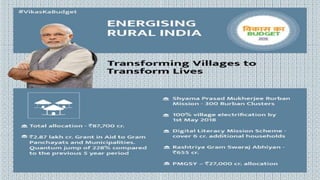
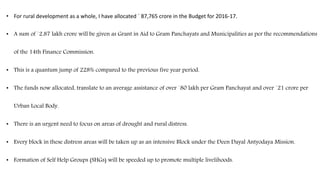
• For rural development as a whole, I have allocated ` 87,765 crore in the Budget for 2016-17.
• A sum of `2.87 lakh crore will be given as Grant in Aid to Gram Panchayats and Municipalities as per the recommendations
of the 14th Finance Commission.
• This is a quantum jump of 228% compared to the previous five year period.
• The funds now allocated, translate to an average assistance of over `80 lakh per Gram Panchayat and over `21 crore per
Urban Local Body.
• There is an urgent need to focus on areas of drought and rural distress.
• Every block in these distress areas will be taken up as an intensive Block under the Deen Dayal Antyodaya Mission.
• Formation of Self Help Groups (SHGs) will be speeded up to promote multiple livelihoods.
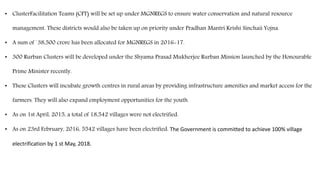
• ClusterFacilitation Teams (CFT) will be set up under MGNREGS to ensure water conservation and natural resource
management. These districts would also be taken up on priority under Pradhan Mantri Krishi Sinchaii Yojna.
• A sum of `38,500 crore has been allocated for MGNREGS in 2016-17.
• 300 Rurban Clusters will be developed under the Shyama Prasad Mukherjee Rurban Mission launched by the Honourable
Prime Minister recently.
• These Clusters will incubate growth centres in rural areas by providing infrastructure amenities and market access for the
farmers. They will also expand employment opportunities for the youth.
• As on 1st April, 2015, a total of 18,542 villages were not electrified.
• As on 23rd February, 2016, 5542 villages have been electrified. The Government is committed to achieve 100% village
electrification by 1 st May, 2018.
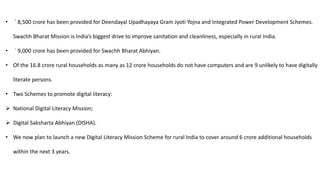
• ` 8,500 crore has been provided for Deendayal Upadhayaya Gram Jyoti Yojna and Integrated Power Development Schemes.
Swachh Bharat Mission is India’s biggest drive to improve sanitation and cleanliness, especially in rural India.
• ` 9,000 crore has been provided for Swachh Bharat Abhiyan.
• Of the 16.8 crore rural households as many as 12 crore households do not have computers and are 9 unlikely to have digitally
literate persons.
• Two Schemes to promote digital literacy:
 National Digital Literacy Mission;
 Digital Saksharta Abhiyan (DISHA).
• We now plan to launch a new Digital Literacy Mission Scheme for rural India to cover around 6 crore additional households
within the next 3 years.
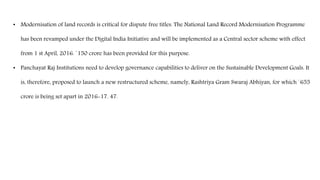
• Modernisation of land records is critical for dispute free titles. The National Land Record Modernisation Programme
has been revamped under the Digital India Initiative and will be implemented as a Central sector scheme with effect
from 1 st April, 2016. `150 crore has been provided for this purpose.
• Panchayat Raj Institutions need to develop governance capabilities to deliver on the Sustainable Development Goals. It
is, therefore, proposed to launch a new restructured scheme, namely, Rashtriya Gram Swaraj Abhiyan, for which `655
crore is being set apart in 2016-17. 47.
SOCIAL SECTOR
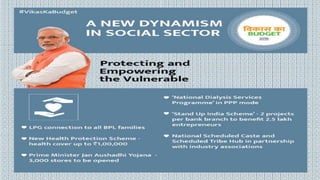
• In our country, cooking gas cylinders were considered an upper middle class luxury. Gradually it spread to the
middle class.
• But the poor do not have access to cooking gas.
• We have decided to embark upon on a massive mission to provide LPG connection in the name of women
members of poor households.
• I have set aside a sum of `2,000 crore in this year’s Budget to meet the initial cost of providing these LPG
connections.
• This will benefit about 1 crore 50 lakh households below the poverty line in 2016-17.
• The Scheme will be continued for at least two more years to cover a total of 5 crore BPL households.

• This will ensure universal coverage of cooking gas in the country.
• The Government will launch a new health protection scheme which will provide health cover up to Rs.One lakh per family.
• For senior citizens of age 60 years and above belonging to this category, an additional top-up package up to `30,000 will be
provided.
• Making quality medicines available at affordable prices has been a key challenge.
• We will reinvigorate the supply of generic drugs. 3,000 Stores under Prime Minister’s Jan Aushadhi Yojana will be opened
during 2016-17.
• About 2.2 lakh new patients of End Stage Renal Disease get added in India every year resulting in additional demand for 3.4
crore dialysis sessions.
• With approximately 4,950 dialysis centres in India, largely in the private sector and concentrated in the major towns, the
demand is only half met.
• I propose to start a ‘National Dialysis Services Programme’.
• Funds will be made available through PPP mode under the National Health Mission, to provide dialysis services in all district
hospitals.
• To reduce the cost, I propose to exempt certain parts of dialysis equipment from basic customs duty, excise/CVD and SAD.
• Scheduled Caste and Scheduled Tribe entrepreneurs are beginning to show great promise in starting and running successful
business enterprises.
• I am happy to inform you that the Union Cabinet has approved the “Stand Up India Scheme” to promote entrepreneurship
among SC/ST and women. ` 500 crore has been provided for this purpose.
• The Scheme will facilitate at least two such projects per bank branch, one for each category of entrepreneur.
• This will benefit at least 2.5 lakh entrepreneurs.
• We are celebrating the 125th Birth Anniversary of Dr. B.R. Ambedkar.
• This must become the Year of Economic Empowerment for SC/ST entrepreneurs.
• We have extensively interacted with the Dalit India Chamber of Commerce and Industry on building an entrepreneurship
eco- system.
• It is proposed to constitute a National Scheduled Caste and Scheduled Tribe Hub in the MSME Ministry in partnership with
industry associations.
• This Hub will provide professional support to Scheduled Caste and Scheduled Tribe entrepreneurs to fulfil the obligations
under the Central Government procurement policy 2012, adopt global best practices and leverage the Stand Up India
initiative.
• The schemes for welfare and skill development for Minorities such as Multi-sectoral Development Programme and USTAAD
shall be implemented effectively
Education:
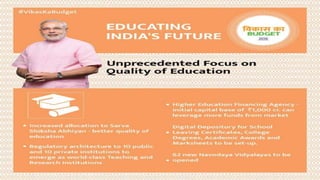
• After universalisation of primary education throughout the country, we want to take the next big step forward
by focusing on the quality of education.
• An increasing share of allocation under Sarva Shiksha Abhiyan will be allocated for this.
• Further, new Navodaya Vidyalayas will be opened in the remaining uncovered districts over the next two years.
• It is our commitment to empower Higher Educational Institutions to help them become world class teaching and
research institutions.
• An enabling regulatory architecture will be provided to ten public and ten private institutions to emerge as
world-class Teaching and Research Institutions.
• This will enhance affordable access to high quality education for ordinary Indians.
• A detailed scheme will be formulated.
• We have decided to set up a Higher Education Financing Agency (HEFA) with an initial capital base of `1,000 crores.
• The HEFA will be a 12 not-for-profit organisation that will leverage funds from the market and supplement them with
donations and CSR funds.
• These funds will be used to finance improvement in infrastructure in our top institutions and will be serviced through
internal accruals.
• To help Students, Higher Education Institutions and Employers to access degree certificates of candidates, it is proposed to
establish a Digital Depository for School Leaving Certificates, College Degrees, Academic Awards and Mark sheets, on the
pattern of a Securities Depository.
• This will help validate their authenticity, safe storage and easy retrieval.
SKILL DEVELOPMENT:
• “Skill India” mission seeks to capitalise our demographic advantage.
• Since its launch, the National Skill Development Mission has created an elaborate skilling eco-system and imparted training
to 76 lakh youth.
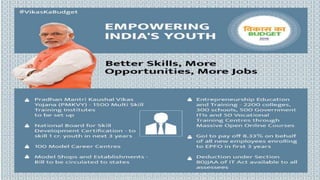
• We want to bring entrepreneurship to the doorsteps of youth through Pradhan Mantri Kaushal Vikas Yojana (PMKVY).
• We have decided to set up 1500 Multi Skill Training Institutes across the country.
• I am setting aside an amount of `1,700 crore for these initiatives.
• We have decided to set up a National Board for Skill Development Certification in partnership with the industry and
academia.
• We propose to further scale up Pradhan Mantri Kaushal Vikas Yojna to skill one crore youth over the next three years.
Entrepreneurship Education and Training will be provided in 2200 colleges, 300 schools, 500 Government ITIs and 50
Vocational Training Centres through Massive Open Online Courses.
Job Creation:
• In order to incentivize creation of new jobs in the formal sector, Government of India will pay the Employee Pension
Scheme contribution of 8.33% for all new employees enrolling in EPFO for the first three years of their employment.
• This will incentivize the employers to recruit unemployed persons and also to bring into the books the informal employees.
• In order to channelize this intervention towards the target group of semi-skilled and unskilled workers, the scheme will be
applicable to those with salary up to `15,000 per month.
• I have made a budget provision of `1,000 crore for this scheme.
• Further, the Finance Bill, 2016 proposes to broaden and liberalize the scope of the employment generation incentive
available under Section 80JJAA of the Income Tax Act.
• The deduction will be available not only to assessees deriving income from manufacture of goods in a factory but to all
assessees who are subject to statutory audit under the Act.
• Thus, a deduction of 30% of the emoluments paid to such employees can be claimed for three years.
• The minimum number of days for which they should be employed during the year is proposed to be reduced from 300 to
240 days.
• No deduction will, however, be admissible in respect of employees whose monthly emoluments exceed `25,000.
• Also, no deduction will be admissible in respect of employees for whom the Government is paying the entire EPS
contribution.
• A National Career Service was launched in July, 2015. Already 35 million jobs seekers have registered on this platform. We
propose to make 100 Model Career Centres operational by the end of 2016-17.
• We also propose to inter-link State Employment Exchanges with the National Career Service platform.
• Retail Trade is the largest service sector employer in the country.
• Many more jobs can be created in this sector, provided the regulations are simplified.
• If Shopping Malls are kept open all seven days of the week, why not the small and medium shops?
• These shops should be given the choice to remain open on all seven days of the week on voluntary basis.
• The interest of the workers in terms of mandatory weekly holiday, number of working hours per day, etc., of course, have to
be protected.
• We propose to circulate a Model Shops and Establishments Bill which can be adopted by the State Governments on
voluntary basis.
INFRASTRUCTURE AND INVESTMENT
Infrastructure and Investment
• In the road sector, there were more than 70 projects that were languishing at the beginning of the year, due to legacy factors.
Aggregate length of these projects was about 8,300 kms involving more than `1 lakh crore investment.
• With exemplary and proactive interventions, nearly 85% of these projects have been put back on track.
• India’s highest ever kilometres of new highways were awarded in 2015.
• At the same time, India’s highest ever production of motor vehicles was achieved in 2015.
• This is a sign of growth in the economy; but it 14 presents a challenge also.
• Therefore, we have speeded up the process of road construction.
• I have proposed an allocation of `55,000 crore in the Budget for Roads and Highways.
• This will be further topped up by additional `15,000 crore to be raised by NHAI through bonds.
• Thus the total investment in the road sector, including PMGSY allocation, would be `97,000 crore during 2016-17. 74.
• Together with the capital expenditure of the Railways, the total outlay on roads and railways will be `2,18,000 crore in
2016-17. We further expect to approve nearly 10,000 kms of National Highways in 2016-17.
• This will be much higher than in the two previous years.
• The pace of completion of road projects will also rise to nearly 10,000 kms in 2016-17.
• In addition, nearly 50,000 kms of State highways will also be taken up for up-gradation as National Highways.
• The total outlay for infrastructure in BE 2016-17 stands at `2,21,246 crore.
• Government will enact necessary amendments in the Motor Vehicles Act and open up the road transport sector in the
passenger segment.
• An enabling eco-system will be provided for the States which will have the choice of adopting the new legal framework.
Entrepreneurs will be able to operate buses on various routes, subject to certain efficiency and safety norms.
• The major benefits of this game changing initiative will be provision of more efficient public transport facilities, greater
public convenience, new investment in this moribund sector, creation of new jobs for our youth, growth of start-up
entrepreneurs and other multiplier effects.
• In 2015, India’s major ports have handled the highest ever quality of cargo.
• We have started a series of measures for modernizing the ports and increasing their efficiency.
• The Sagarmala project has already been rolled out.
• We are planning to develop new greenfield ports both in the eastern and western coasts of the country. The work on the
National Waterways is also being expedited.
• `800 crore has been provided for these initiatives.
• In the civil aviation sector, the Government is drawing up an action plan for revival of unserved and underserved airports.
• There are about 160 airports and air strips with State Governments which can be revived at an indicative cost of `50 crore
to `100 crore each.
• We will partner with the State Governments to develop some of these airports for regional connectivity. Similarly, 10 of the
25 non-functional air strips with the Airport Authority of India will also be developed.
• As part of our drive towards self-sufficiency, the Government is considering to incentivise gas production from deep-water,
ultra deep-water and high pressure-high temperature areas, which are presently not exploited on account of higher cost
and higher risks.
• A proposal is under consideration for new discoveries and areas which are yet to commence production, first, to provide
calibrated marketing freedom; and second, to do so at a pre-determined ceiling price to be discovered on the principle of
landed price of alternative fuels.
• In the other segments of the infrastructure sector, our Government has achieved the highest coal production growth in over
two decades, highest ever capacity addition in generation, highest ever increase in transmission lines and in distribution of
LED bulbs.
• In the power sector, we need to diversify the sources of power generation for long term stability.
• Government is drawing up a comprehensive plan, spanning next 15 to 20 years, to augment the investment in nuclear
power generation. Budgetary allocation up to `3,000 crore per annum, together with public sector investments, will be
leveraged to facilitate the required investment for this purpose.
• To augment infrastructure spending further, Government will permit mobilisation of additional finances to the extent of
`31,300 crore by NHAI, PFC, REC, IREDA, NABARD and Inland Water Authority through raising of Bonds during 2016-17.
• Our private sector plays an important role in the development of infrastructure, many of which are implemented in the
Public Private Partnership (PPP) mode.
• I would like to announce three new initiatives to reinvigorate this sector.
• A Public Utility (Resolution of Disputes) Bill will be introduced during 2016-17 to streamline institutional 16 arrangements
for resolution of disputes in infrastructure related construction contracts, PPP and public utility contracts;
• Guidelines for renegotiation of PPP Concession Agreements will be issued, keeping in view the long term nature of such
contracts and potential uncertainties of the real economy, without compromising transparency;
• A new credit rating system for infrastructure projects which gives emphasis to various in-built credit enhancement
structures will be developed, instead of relying upon a standard perception of risk which often result in mispriced loans.
• I would like to announce further reforms in our FDI policy.
• The changes proposed are in the areas of insurance and pension, Asset Reconstruction Companies, Stock Exchanges, etc.
Details of the changes are given in Annex I of the Budget Speech.
• The duty drawback scheme has been widened and deepened to include more products and countries. The Government will
continue to take measures to support the export sector.
• Our FDI policy has to address the requirements of farmers and food processing industry.
• A lot of fruits and vegetables grown by our farmers either do not fetch the right prices or fail to reach the markets.
• Food processing industry and trade should be more efficient.
• 100% FDI will be allowed through FIPB route in marketing of food products produced and manufactured in India.
• A new policy for management of Government investment in Public Sector Enterprises, including disinvestment and strategic
sale, has been approved.
• We will encourage CPSEs to divest individual assets like land, manufacturing units, etc. to release their asset value for making
investment in new projects.
• We will adopt a comprehensive approach for efficient management of Government investment in CPSEs by addressing issues
such as capital restructuring, dividend, bonus shares, etc.
• The Department of Disinvestment is being re-named as the “Department of Investment and Public Asset Management
(DIPAM)”.
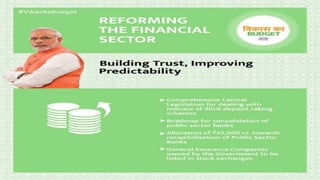
FINANCIAL SECTOR
Financial Sector Reforms :
• A vibrant financial sector is of critical importance to the growth of every economy.
• INITIATIVES ANNOUNCED:
• A systemic vacuum exists with regard to bankruptcy situations in financial firms. A comprehensive Code on Resolution of
Financial Firms will be introduced as a Bill in the Parliament during 2016-17.
• This Code will provide a specialised resolution mechanism to deal with bankruptcy situations in banks, insurance companies
and financial sector entities.
• This Code, together with the Insolvency and Bankruptcy Code 2015, when enacted, will provide a comprehensive resolution
mechanism for our economy.
• The RBI Act 1934, is being amended to provide statutory basis for a Monetary Policy Framework and a Monetary Policy
Committee through the Finance Bill 2016. A committee-based approach will add lot of value and transparency to monetary
policy decisions.
• A Financial Data Management Centre under the aegis of the Financial Stability Development Council (FSDC) will be set up to
facilitate integrated data aggregation and analysis in the financial sector.
• To improve greater retail participation in Government securities, RBI will facilitate their participation in the primary and
secondary markets through stock exchanges and access to NDS-OM trading platform.
• New derivative products will be developed by SEBI in the Commodity Derivatives market.
• To facilitate deepening of corporate bond market, a number of measures will be undertaken, details of which are given in
Annex II of the Budget Speech.
• The enactment of Insolvency and Bankruptcy Code would provide a major boost to the development of the corporate bond
market.
• To tackle the problem of stressed assets in the banking sector, Asset Reconstruction Companies (ARCs) have a very important
role.
• I therefore, propose to make necessary amendments in the SARFAESI Act 2002 to enable the sponsor of an ARC to hold up to
100% stake in the ARC and permit non-institutional investors to invest in Securitization Receipts.
• In the recent past, there have been rising instances of people in various parts of the country being defrauded by illicit deposit
taking schemes.
• We already have a comprehensive ‘Plan For Revamping of Public Sector Banks’, INDRADHANUSH, which is under
implementation.
• We are now confronted with the problem of stressed assets in Public Sector Banks, which is a legacy from the past. Several
steps have already been taken in this regard. We are not interfering in lending and personnel matters of the Banks.
• To support the Banks in these efforts as well as to support credit growth, I have proposed an allocation of `25,000 crore in BE
2016-17 towards recapitalisation of Public Sector Banks.
• The process of transformation of IDBI Bank has already started. Government will take it forward and also consider the option
of reducing its stake to below 50%.
• For speedier resolution of stressed assets, the Debt Recovery Tribunals will be strengthened with focus on improving the
existing infrastructure, including computerised processing of court cases, to support reduction in the number of hearings
and faster disposal of cases.
• The Pradhan Mantri Mudra Yojana (PMMY) was launched for the benefit of bottom of the pyramid entrepreneurs.
• Banks and NBFC-MFIs have reported that the amount sanctioned under PMMY had reached about Rs.One lakh crore to over
2.5 crore borrowers by early February this year.
• To provide better access to financial services, especially in rural areas, we will undertake a massive nationwide rollout of
ATMs and Micro ATMs in Post Offices over the next three years.
• Public shareholding in Government-owned companies is a means of ensuring higher levels of transparency and
accountability.
• To promote this objective, the general insurance companies owned by the Government will be listed in the stock exchanges.
GOVERNANCE & EASE OF DOING BUSINESS
Governance and Ease of Doing Business:
• Our Government is giving unparalleled emphasis to good governance with special focus on process reforms, IT-enabled
Government processes, etc. The whole idea is to remove the irritants for the public in their interface with Government
agencies. A Task Force has been constituted for rationalisation of human resources in various Ministries. A comprehensive
review and rationalisation of autonomous bodies is also underway.
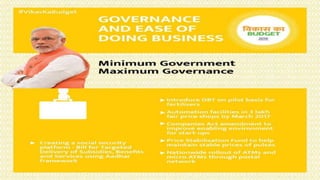
• A critical component of minimum Government and maximum governance is to ensure targeted disbursement of Government
subsidies and financial assistance to the actual beneficiaries.
• Public money should reach the poor and the deserving without any leakage.
• Three specific initiatives are proposed to achieve this objective.
• First, we will introduce a bill for Targeted Delivery of Financial and Other Subsidies, Benefits and Services by using the
Aadhar framework. The bill will be introduced in the current Budget Session of the Parliament.
• The Aadhar number or authentication shall not, however, confer any right of citizenship or domicile.
• A social security platform will be developed using Aadhar to accurately target beneficiaries.
• This will be a transformative piece of legislation which will benefit the poor and the vulnerable.
• Second, we have already introduced Direct Benefit Transfer in LPG.
• Based on this successful experience, we propose to introduce DBT on pilot basis for fertilizer in a few districts across the
country, with a view to improving the quality of service delivery to farmers.
• Third, of the 5.35 lakh Fair Price Shops in the country, automation facilities will be provided in 3 lakh Fair Price Shops by
March 2017.
• We have to bring more transparency and efficiency in Government procurement of goods and services.
• The Director General of Supplies and Disposal (DGS&D) will establish a technology driven platform to facilitate procurement
of goods and services by various Ministries and agencies of the Government.
• To remove the difficulties and impediments to ease of doing business, we will introduce a bill to amend the Companies Act,
2013 in the current Budget Session of the Parliament.
• The Bill would also improve the enabling environment for start-ups. The registration of companies will also be done in one
day.
• Monitoring of prices of essential commodities is a key element of good governance. A number of measures have been taken
to deal with the problem of abrupt increase in prices of pulses.
• Government has approved creation of buffer stock of pulses through procurement at Minimum Support Price and at
market price through Price Stabilisation Fund.
• This Fund has been provided with a corpus of `900 crore to support market interventions.
• To strengthen understanding of each other, it is proposed to create a closer engagement between different States and
Districts in a structured manner.
• “Ek Bharat Shreshtha Bharat” programme will be launched to link States and Districts in an annual programme that connects
people through exchanges in areas of language, trade, culture, travel and tourism.
• We will do this through mutual agreement with participating States and Districts.
• In 2017, the country will celebrate 70th Anniversary of our Independence. We will chalk out milestones for nation’s journey
beyond the 70th Anniversary of Independence.
• Dr. Toynbee, the historian, had observed that “a chapter which had a Western beginning will have to have an Indian
ending…..”.
• My belief is that the year 2017 will unfold the great historian’s dream. Our scheme of “Ek Bharat Shreshtha Bharat” is part
of this vision.
Fiscal Discipline
• While preparing this Budget, I have received conflicting suggestions about the FRBM roadmap.
• Different schools of thought have argued either in favour of fiscal consolidation and stability or for a less aggressive 21
consolidation and for boosting growth.
• I have weighed the policy options and decided that prudence lies in adhering to the fiscal targets.
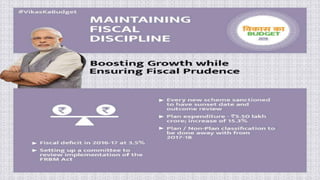
• Consequently, the fiscal deficit in RE 2015-16 and BE 2016-17 have been retained at 3.9% and 3.5% of GDP respectively.
• While doing so, I have ensured that the development agenda has not been compromised.
• The total expenditure in the Budget for 2016-17 has been projected at `19.78 lakh crore, consisting of `5.50 lakh crore under
Plan and `14.28 lakh crore under Non-Plan.
• The increase in Plan expenditure is in the order of 15.3% over current year BE.
• Plan Allocations have given special emphasis to sectors like agriculture, irrigation, social sector including health, women and
child development, welfare of Scheduled Castes and Scheduled Tribes, minorities, infrastructure, etc.
• Continuing with the policy of higher empowering States, the total resources being transferred to States are `99,681 crore
more over RE 2015-16 and `2,46,024 crore more over Actuals of 2014-15.
• Successive committees have questioned the merit in having Plan and Non-Plan classification of Government expenditure.
• A broad understanding over the years has been that Plan expenditures are good and Non-Plan expenditures are bad.
• This results in skewed allocations in the Budget. We need to correct this and give greater focus to Revenue and Capital
classification of Government expenditure.
• We have, therefore, decided that the Plan-Non-Plan classification will be done away with from fiscal 2017-18.
• The Finance Ministry will closely work with the State Finance Departments to align Central and State Budgets in this matter.
• To improve the quality of Government expenditure, every new scheme being sanctioned by Government will have a sunset
date and outcome review.
• A redeeming feature of this year’s Budget is that we have improved upon the Revenue Deficit target from 2.8% to 2.5% of
GDP in RE 2015-16.
• The FRBM Act has been under implementation for more than a decade.
• Both Central and State Governments have made significant gains from the implementation of this Act.
• There is now a school of thought which believes that instead of fixed numbers as fiscal deficit targets, it may be better to have
a fiscal deficit range as the target, which would give necessary policy space to the Government to deal with dynamic
situations.
• While remaining committed to fiscal prudence and consolidation, a time has come to review the working of the FRBM Act,
especially in the context of the uncertainty and volatility which have become the new norms of global economy.
• I, therefore, propose to constitute a Committee to review the implementation of the FRBM Act and give its recommendations
on the way forward.
• I have also allocated initial sums of `100 crore each for celebrating the Birth Centenary of Pandit Deen Dayal Upadhyay and
the 350th Birth Anniversary of Guru Gobind Singh.
Tax Reforms
Taxation is a major tool available to Government for removing poverty and inequality from the society.
The thrust of my tax proposals this year falls in nine categories:-
(1) Relief to small tax payers.
(2) Measures to boost growth and employment generation.
(3) Incentivizing domestic value addition to help Make in India.
(4) Measures for moving towards a pensioned society.
(5) Measures for promoting affordable housing.
(6) Additional resource mobilization for agriculture, rural economy and clean environment. (7) Reducing litigation and
providing certainty in taxation.
(8) Simplification and rationalization of taxation.
(9) Use of Technology for creating accountability.
Relief to small tax payers :
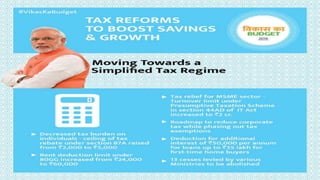
• In order to lessen tax burden on individuals with income not exceeding `5 lakhs, I propose to raise the ceiling of tax rebate
under section 87A from `2,000 to `5,000.
• There are 2 crore tax payers in this category who will get a relief of `3,000 in their tax liability.
• The people who do not have any house of their own and also do not get any house rent allowance from any employer today
get a deduction of `24,000 per annum from their income to compensate them for the rent they pay.
• I propose to increase the limit of deduction in respect of rent paid under section 80GG from `24,000 per annum to `60,000 per
annum, which should provide relief to those who live in rented houses.
• Presumptive taxation scheme under section 44AD of the Income Tax Act is available for small and medium enterprises i.e non
corporate businesses with turnover or gross receipts not exceeding one crore rupees.
• I also propose to extend the presumptive taxation scheme to professionals with gross receipts up to `50 lakh with the
presumption of profit being 50% of the gross receipts
Measures to boost growth and employment generation:
The highlights are as follows:-
(a) The accelerated depreciation provided under IT Act will be limited to maximum 40% from 1.4.2017.
(b) The benefit of deductions for Research would be limited to 150% from 1.4.2017 and 100% from 1.4.2020.
(c) The benefit of section 10AA to new SEZ units will be available to those units which commence activity before 31.3.2020.
(d) The weighted deduction under section 35CCD for skill development will continue up to 1.4.2020. 123.
(e) The reduction in corporate tax rate has to be calibrated with additional revenue expected from the incentives being phased
out.
The benefits from phasing out of exemptions are available to Government only gradually. In the first phase, therefore, I propose
the following two changes in corporate income-tax rates:-
(a) The new manufacturing companies which are incorporated on or after 1.3.2016 are proposed to be given an option to be
taxed at 25% + surcharge and cess provided they do not claim profit linked or investment linked deductions and do not avail
of investment allowance and accelerated depreciation.
(b) I also propose to lower the corporate income tax rate for the next financial year of relatively small enterprises i.e companies
with turnover not exceeding `5 crore (in the financial year ending March 2015), to 29% plus surcharge and cess.
• Startups generate employment, bring innovation and are expected to be key partners in Make in India programme. I propose
to assist their propagation through 100% deduction of profits for 3 out of 5 years for startups set up during April 2016 to
March 2019.
• Research is the driver of innovation and innovation provides a thrust to economic growth. I propose a special patent regime
with 10% rate of tax on income from worldwide exploitation of patents developed and registered in India.
• In order to get more investment in Asset Reconstruction Companies (ARCs) which play a very important role in resolution of
bad debts, I propose to provide complete pass through of income-tax to securitization trusts including trusts of ARCs.
• The income will be taxed in the hands of the investors instead of the trust. However, the trust will be liable to deduct tax at
source.
• The period for getting benefit of long term capital gain regime in case of unlisted companies is proposed to be reduced from
three to two years. Non-banking financial companies shall be eligible for deduction to the extent of 5% of its income in
respect of provision for bad and doubtful debts.
• The determination of residency of foreign company on the basis of Place of Effective Management (POEM) is proposed to be
deferred by one year.
• In order to meet with our commitment to BEPS initiative of OECD and G-20, the Finance Bill, 2016 includes provision for
requirement of country by country reporting for companies with a consolidated revenue of more than Euro 750 million.
• I propose to exempt service tax on services provided under Deen Dayal Upadhyay Grameen Kaushalya Yojana and services
provided by Assessing Bodies empanelled by Ministry of Skill Development & Entrepreneurship.
• I propose to exempt service tax on general insurance services provided under ‘Niramaya’ Health Insurance Scheme launched
by National Trust for the Welfare of Persons with Autism, Cerebral Palsy, Mental Retardation and Multiple Disability.
• To promote use of refrigerated containers, I propose to reduce the basic custom and excise duty on them to 5% and 6%
respectively.
• A number of assistive devices, rehabilitation aids and other goods for differently abled (Divyang) persons attract Nil basic
customs duty. I propose to extend this exemption to Braille paper.
Incentivising domestic value addition: To help Make in India.
• Customs and excise duty structure plays an important role in incentivizing domestic value addition towards Make in India
campaign of our Government.
• In line with that, I propose to make suitable changes in customs and excise duty rates on certain inputs, raw materials,
intermediaries and components and certain other goods and simplify procedures, so as to reduce costs and improve
competitiveness of domestic industry in sectors like Information technology hardware, capital goods, defence production,
textiles, mineral fuels & mineral oils, chemicals & petrochemicals, paper, paperboard & newsprint, Maintenance repair and
overhauling [MRO] of aircrafts and ship repair etc. Details of such changes are given in the Annexure to Budget Speech.
Measures for moving towards a pensioned society:
• Pension schemes offer financial protection to senior citizens.
• I believe that the tax treatment should be uniform for defined benefit and defined contribution pension plans.
• I propose to make withdrawal up to 40% of the corpus at the time of retirement tax exempt in the case of National Pension
Scheme.
• In case of superannuation funds and recognized provident funds, including EPF, the same norm of 40% of corpus to be tax
free will apply in respect of corpus created out of contributions made after 1.4.2016.
• Further, the annuity fund which goes to the legal heir after the death of pensioner will not be taxable in all three cases.
• Also, we are proposing a monetary limit for contribution of employer in recognized Provident and Superannuation Fund of
`1.5 lakh per annum for taking tax benefit.
• I propose to exempt from service tax the Annuity services provided by the National Pension System (NPS) and Services provided by EPFO to
employees. I also propose to reduce service tax on Single premium Annuity (Insurance) Policies from 3.5% to 1.4% of the premium paid in
certain cases.
Measures for promoting affordable housing:
• Pradhan Mantri Awas Yojna embodies the assurance of the Government to address the housing needs of all and more
specifically the poor, in a time bound manner.
• Construction of houses creates considerable employment opportunities as well.
• In order to fuel activity in the housing sector, I propose to give 100% deduction for profits to an undertaking from a housing
project for flats upto 30 sq. metres in four metro cities and 60 sq. metres in other cities, approved during June 2016 to March
2019, and is completed within three years of the approval.
• Minimum Alternate Tax will, however, apply to these undertakings.
• For the ‘first – home buyers’, I propose to give deduction for additional interest of `50,000 per annum for loans up to `35 lakh
sanctioned during the next financial year, provided the value of the house does not exceed `50 lakh.
• Another proposal to stimulate housing activity is to facilitate investments in Real Estate Investment Trusts.
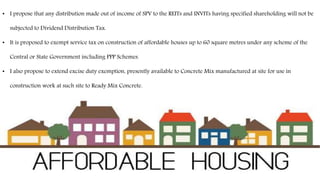
• I propose that any distribution made out of income of SPV to the REITs and INVITs having specified shareholding will not be
subjected to Dividend Distribution Tax.
• It is proposed to exempt service tax on construction of affordable houses up to 60 square metres under any scheme of the
Central or State Government including PPP Schemes.
• I also propose to extend excise duty exemption, presently available to Concrete Mix manufactured at site for use in
construction work at such site to Ready Mix Concrete.
Additional resource mobilization for agriculture, rural economy and clean environment:
• Dividend Distribution Tax (DDT) uniformly applies to all investors irrespective of their income slabs.
• This is perceived to distort the fairness and progressive nature of taxes.
• Persons with relatively higher income can bear a higher tax cost.
• I, therefore, propose that in addition to DDT paid by the companies, tax at the rate of 10% of gross amount of dividend will be
payable by the recipients, that is, individuals, HUFs and firms receiving dividend in excess of `10 lakh per annum.
• I also propose to raise the surcharge from 12% to 15% on persons, other than companies, firms and cooperative societies
having income above `1 crore.
• I also propose to collect tax at source at the rate of 1% on purchase of luxury cars exceeding value of Rs.ten lakh and purchase
of goods and services in cash exceeding Rs.two lakh.
• For compliant tax payers with resources, this levy not only advances collection of tax when the expenditure is incurred, but
it provides data to the tax authorities to identify the persons who incur such expenditure, but may be missing from the tax
base.
• Farmers and notified class of persons will have an option of giving a form by which TCS will not be charged.
• Rate of Securities Transaction tax in case of ‘Options’ is proposed to be increased from .017% to .05%.
• In order to tap tax on income accruing to foreign e-commerce companies from India, it is proposed that a person making
payment to a non-resident, who does not have a permanent establishment, exceeding in aggregate `1 lakh in a year, as
consideration for online advertisement, will withhold tax at 6% of gross amount paid, as Equalization levy.
• The levy will only apply to B2B transactions.
• I propose to impose a Cess, called the Krishi Kalyan Cess, @ 0.5% on all taxable services, proceeds of which would be
exclusively used for financing initiatives relating to improvement of agriculture and welfare of farmers.
• The pollution and traffic situation in Indian cities is a matter of concern. I propose to levy an infrastructure cess, of 1% on
small petrol, LPG, CNG cars, 2.5% on diesel cars of certain capacity and 4% on other higher engine capacity vehicles and SUVs.
• I also propose to impose an excise duty of ‘1% without input tax credit or 12.5% with input tax credit’ on articles of jewellery
[excluding silver jewellery, other than studded with diamonds and some other precious stones], with a higher exemption and
eligibility limits of ` 6 crores and ` 12 crores respectively.
• Necessary steps will also be taken to enable the new taxpayers to comply with this levy without any difficulty.
• I propose to change the excise duty on branded readymade garments and made up articles of textiles with a retail sale price
of `1,000 and above from ‘Nil without input tax credit or 6%/12.5% with input tax credit’ to ‘2% without input tax credit or
12.5% with input tax credit’.
Reducing litigation and providing certainty in taxation:
• We are moving towards a lower tax regime with non-litigious approach.
• Thus, while compliant taxpayers can expect a supportive interface with the department, tax evasion will be countered
strongly. Capability of the tax department to detect tax evasion has improved because of enhanced access to information
and availability of technology driven analytical tools to process such information.
• I want to give an opportunity to the earlier non- compliant to move to the category of compliant.
• I propose a limited period Compliance Window for domestic taxpayers to declare undisclosed income or income
represented in the form of any asset and clear up their past tax transgressions by paying tax at 30%, and surcharge at 7.5%
and penalty at 7.5%, which is a total of 45% of the undisclosed income.
• There will be no scrutiny or enquiry regarding income declared in these declarations under the Income Tax Act or the
Wealth Tax Act and the declarants will have immunity from prosecution.
• Immunity from Benami Transaction (Prohibition) Act, 1988 is also proposed subject to certain conditions.
• The surcharge levied at 7.5% of undisclosed income will be called Krishi Kalyan surcharge to be used for agriculture and
rural economy.
• We plan to open the window under this Income Disclosure Scheme from 1st June to 30th September, 2016 with an option to
pay amount due within two months of declaration.
• Our Government is fully committed to remove black money from the economy.
• Having given one opportunity for evaded income to be declared once, we would then like to focus all our resources for
bringing people with black money to books.
• Litigation is a scourge for a tax friendly regime and creates an environment of distrust in addition to increasing the
compliance cost of the tax payers and administrative cost for the Government.
• There are about 3 lakh tax cases pending with the 1st Appellate Authority with disputed amount 30 being 5.5 lakh crores.
• In order to reduce this number, I propose a new Dispute Resolution Scheme (DRS).
• A taxpayer who has an appeal pending as of today before the Commissioner (Appeals) can settle his case by paying the
disputed tax and interest up to the date of assessment.
• No penalty in respect of Income-tax cases with disputed tax up to ` 10 lakh will be levied.
• Cases with disputed tax exceeding ` 10 lakh will be subjected to only 25% of the minimum of the imposable penalty for both
direct and indirect taxes.
• Any pending appeal against a penalty order can also be settled by paying 25% of the minimum of the imposable penalty.
• Certain categories of persons including those who are charged with criminal offences under specific Acts are proposed to be
barred from availing this scheme.
Simplification and rationalization of taxation:
• The Government has already accepted many recommendations of Tax Administration Reform Committee and I propose to
accept a number of recommendations of Justice Easwar Committee in this Budget.
• To reduce multiplicity of taxes, associated cascading and to reduce cost of collection, I propose to abolish 13 cesses, levied by
various Ministries in which revenue collection is less than `50 crore in a year.
• To improve the cash flow position of small tax payers who get their funds blocked due to current TDS provision, I propose to
rationalize TDS provisions for Income Tax as per Annexure.
• Non-residents without PAN are currently subjected to a higher rate of TDS. It is proposed to amend the relevant provision to
provide that on furnishing of alternative documents, the higher rate will not apply.
• The facility for revision of return, hitherto available to a service tax assessee only, is being extended to Central Excise assesses
also.
• I propose to provide additional options to banking companies and financial institutions, including non-banking financial
companies, for reversal of input tax credits with respect to non-taxable services provided by them by way of extending
deposits, loans and advances.
• Our Government has taken a number of steps to reduce the cargo release time and the transaction costs of EXIM trade.
• I propose to amend the Customs Act to provide for deferred payment of customs duties for importers and exporters with
proven track record.
• In 2014-15 Budget, I had announced the intent to implement Indian Customs Single Window Project. We have made
significant progress in this and it would be implemented at major ports and airports starting from beginning of next financial
year.
• The customs Baggage Rules for international passengers are being simplified so as to increase the free baggage allowance.
The filing of baggage declaration will be required only for those passengers who carry dutiable goods.
Use of Technology for creating accountability:
• Technology is a boon for mankind. We plan to use technology in taxation Department in a big way to make life simpler for a
law abiding citizen, and also for data mining to track tax evaders.
• A pilot was run in 2015-16 for e-assessment to obviate the requirement for tax payers to visit the Income-tax offices. I propose
to expand the scope of e-assessments to all assesses in 7 mega cities in the coming years.
• The cases selected for scrutiny will be scrutinized in e-environment whereby unless the assesse himself wants to be heard, or
for special reasons to be recorded, the assessing officer wants to hear the party, there will be no face to face contact of IT
Department with assesse.
• Income-tax Department (ITD) will fully expand the pilot initiative of ‘e-Sahyog’ with a view to reduce compliance cost,
especially for small 33 taxpayers. The objective of the ‘e-Sahyog’ pilot project is to provide an online mechanism to resolve
mismatches in Income-tax returns without requiring taxpayers to attend the Income-tax office.
• I propose that in matters pertaining to Income-tax Act, Government will pay interest at the rate of 9% p.a against normal rate
of 6% p.a in case there is delay in giving effect to Appellate order beyond ninety days.
• The officers who delay it, will be accountable for this loss to Government.
• I also propose to change the procedure to provide for a shift from physical control to record based control for customs bonded
warehouses, supported by sophisticated IT systems.
• Madam Speaker, my direct tax proposals would result in revenue loss of ` 1,060 crore and my indirect proposals are expected
to yield `20,670 crores.
• Thus the net impact of all tax proposals would be revenue gain of `19,610 crores.
Union budget

Union budget

  • 1.
  • 2.
    Budget proposals are,built on transformative agenda with nine distinct pillars. These include: (i) Agriculture and Farmers’ Welfare: with focus on doubling farmers’ income in five years; (ii) Rural Sector: with emphasis on rural employment and infrastructure; (iii) Social Sector including Healthcare: to cover all under welfare and health services; (iv) Education, Skills and Job Creation: to make India a knowledge based and productive society; (v) Infrastructure and Investment: to enhance efficiency and quality of life; (vi) Financial Sector Reforms: to bring transparency and stability; (vii) Governance and Ease of Doing Business: to enable the people to realise their full potential; (viii) Fiscal Discipline: prudent management of Government finances and delivery of benefits to the needy; and (ix) Tax Reforms: to reduce compliance burden with faith in the citizenry.
  • 3.
  • 4.
  • 6.
    • Total allocationfor Agriculture and Farmers’ welfare is ` 35,984 crore. • We need to address issues of optimal utilisation of our water resources. • Create new infrastructure for irrigation. • Conserve soil fertility with balanced use of fertilizer. • Provide value addition and connectivity from farm to markets. • The ‘Pradhan Mantri Krishi Sinchai Yojana’ has been strengthened and will be implemented in mission mode. • 28.5 lakh hectares will be brought under irrigation under this Scheme. • Implementation of 89 irrigation projects under AIBP, which have been languishing, will be fast tracked. • This will help to irrigate 80.6 lakh hectares. • These projects require `17,000 crore next year and `86,500 crore in the next five years. • A dedicated Long Term Irrigation Fund will be created in NABARD with an initial corpus of about `20,000 crore • To achieve all these, a total provision of `12,517 crore has been made through budgetary support and market borrowings in 2016-17. 20.
  • 7.
    • Simultaneously amajor programme for sustainable management of ground water resources has been prepared with an estimated cost of `6,000 crore and proposed for multilateral funding. • At least 5 lakh farm ponds and dug wells in rain fed areas and 10 lakh compost pits for production of organic manure will be taken up by making productive use of the allocations under MGNREGA. • The Soil Health Card Scheme is now being implemented with greater vigour. • `368 crore has been provided for National Project on Soil Health and Fertility. • Besides, 2,000 model retail outlets of Fertilizer companies will be provided with soil and seed testing facilities during the next three years. • To increase crop yields in rain fed areas, which account for nearly 55% of the country’s arable land, organic farming is being promoted. • Towards this end, the Government has launched two important schemes. • A. ‘Parmparagat Krishi Vikas Yojana’ which will bring 5 lakh acres under organic farming over a three year period. • B. The Government has launched a value chain based organic farming scheme called “Organic Value Chain Development in North East Region”. • A total provision of `412 crore has been made for these schemes.
  • 8.
    • 500 croresunder National Food Security Mission has been assigned to pulses. • A national level competition will be held among 674 Krishi Vigyan Kendras with a total prize money of `50 lakh to improve the efficiency and performance of these Kendras. • The Unified Agricultural Marketing E Platform will be dedicated to the Nation on the birthday of Dr. Baba Saheb Ambedkar on 14th April this year. • 97 lakh MT of storage capacity was added to the Central pool stock during the current year. • We are implementing the Pradhan Mantri Gram Sadak Yojana (PMGSY) as never before. • This Scheme had suffered in the past because of underfunding. • The allocations in 2012-13 and 2013-14 were only `8,885 crore and `9,805 crore respectively. • We have substantially increased the allocation in the last two years and have now allocated `19,000 crore in 2016-17. Together with States’ share, totally about `27,000 crore will be spent on this Yojana in 2016-17. • Our goal is to advance the completion target of the programme from 2021 to 2019 and connect the remaining 65,000 eligible habitations by constructing 2.23 lakh kms of roads. • Accordingly, the pace of construction which is currently 100 kms per day, as compared to the average of 73.5 kms during 2011-14, will be substantially stepped up
  • 9.
    • Government hasapproved the path breaking Crop Insurance Scheme, namely, Prime Minister Fasal Bima Yojana. • For effective implementation of this Scheme, I have provided a sum of `5,500 crore in the Budget 2016-17. • Three specific initiatives will be taken up in 2016-17 for this.  The remaining States will be encouraged to take up decentralized procurement.  An online Procurement System will be undertaken through the Food Corporation of India. This will usher in transparency and convenience to the farmers through prior registration and monitoring of actual procurement.  Effective arrangements have been made for pulses procurement. • Farmers also take up other allied activities to supplement their family income. To make dairying more remunerative to the farmers, four new projects will be taken up:  ‘Pashudhan Sanjivani’, an animal wellness programme and provision of Animal Health Cards (‘Nakul Swasthya Patra’);  An Advanced breeding technology;  Creation of ‘E-Pashudhan Haat’, an e market portal for connecting breeders and farmers;  National Genomic Centre for indigenous breeds. • These projects will be implemented at a cost of `850 crores over the next few years. • 90% of the domestic honey is now exported.
  • 10.
  • 12.
    • For ruraldevelopment as a whole, I have allocated ` 87,765 crore in the Budget for 2016-17. • A sum of `2.87 lakh crore will be given as Grant in Aid to Gram Panchayats and Municipalities as per the recommendations of the 14th Finance Commission. • This is a quantum jump of 228% compared to the previous five year period. • The funds now allocated, translate to an average assistance of over `80 lakh per Gram Panchayat and over `21 crore per Urban Local Body. • There is an urgent need to focus on areas of drought and rural distress. • Every block in these distress areas will be taken up as an intensive Block under the Deen Dayal Antyodaya Mission. • Formation of Self Help Groups (SHGs) will be speeded up to promote multiple livelihoods.
  • 13.
    • ClusterFacilitation Teams(CFT) will be set up under MGNREGS to ensure water conservation and natural resource management. These districts would also be taken up on priority under Pradhan Mantri Krishi Sinchaii Yojna. • A sum of `38,500 crore has been allocated for MGNREGS in 2016-17. • 300 Rurban Clusters will be developed under the Shyama Prasad Mukherjee Rurban Mission launched by the Honourable Prime Minister recently. • These Clusters will incubate growth centres in rural areas by providing infrastructure amenities and market access for the farmers. They will also expand employment opportunities for the youth. • As on 1st April, 2015, a total of 18,542 villages were not electrified. • As on 23rd February, 2016, 5542 villages have been electrified. The Government is committed to achieve 100% village electrification by 1 st May, 2018.
  • 14.
    • ` 8,500crore has been provided for Deendayal Upadhayaya Gram Jyoti Yojna and Integrated Power Development Schemes. Swachh Bharat Mission is India’s biggest drive to improve sanitation and cleanliness, especially in rural India. • ` 9,000 crore has been provided for Swachh Bharat Abhiyan. • Of the 16.8 crore rural households as many as 12 crore households do not have computers and are 9 unlikely to have digitally literate persons. • Two Schemes to promote digital literacy:  National Digital Literacy Mission;  Digital Saksharta Abhiyan (DISHA). • We now plan to launch a new Digital Literacy Mission Scheme for rural India to cover around 6 crore additional households within the next 3 years.
  • 15.
    • Modernisation ofland records is critical for dispute free titles. The National Land Record Modernisation Programme has been revamped under the Digital India Initiative and will be implemented as a Central sector scheme with effect from 1 st April, 2016. `150 crore has been provided for this purpose. • Panchayat Raj Institutions need to develop governance capabilities to deliver on the Sustainable Development Goals. It is, therefore, proposed to launch a new restructured scheme, namely, Rashtriya Gram Swaraj Abhiyan, for which `655 crore is being set apart in 2016-17. 47.
  • 16.
  • 18.
    • In ourcountry, cooking gas cylinders were considered an upper middle class luxury. Gradually it spread to the middle class. • But the poor do not have access to cooking gas. • We have decided to embark upon on a massive mission to provide LPG connection in the name of women members of poor households. • I have set aside a sum of `2,000 crore in this year’s Budget to meet the initial cost of providing these LPG connections. • This will benefit about 1 crore 50 lakh households below the poverty line in 2016-17. • The Scheme will be continued for at least two more years to cover a total of 5 crore BPL households. • This will ensure universal coverage of cooking gas in the country.
  • 19.
    • The Governmentwill launch a new health protection scheme which will provide health cover up to Rs.One lakh per family. • For senior citizens of age 60 years and above belonging to this category, an additional top-up package up to `30,000 will be provided. • Making quality medicines available at affordable prices has been a key challenge. • We will reinvigorate the supply of generic drugs. 3,000 Stores under Prime Minister’s Jan Aushadhi Yojana will be opened during 2016-17. • About 2.2 lakh new patients of End Stage Renal Disease get added in India every year resulting in additional demand for 3.4 crore dialysis sessions. • With approximately 4,950 dialysis centres in India, largely in the private sector and concentrated in the major towns, the demand is only half met.
  • 20.
    • I proposeto start a ‘National Dialysis Services Programme’. • Funds will be made available through PPP mode under the National Health Mission, to provide dialysis services in all district hospitals. • To reduce the cost, I propose to exempt certain parts of dialysis equipment from basic customs duty, excise/CVD and SAD. • Scheduled Caste and Scheduled Tribe entrepreneurs are beginning to show great promise in starting and running successful business enterprises. • I am happy to inform you that the Union Cabinet has approved the “Stand Up India Scheme” to promote entrepreneurship among SC/ST and women. ` 500 crore has been provided for this purpose. • The Scheme will facilitate at least two such projects per bank branch, one for each category of entrepreneur. • This will benefit at least 2.5 lakh entrepreneurs. • We are celebrating the 125th Birth Anniversary of Dr. B.R. Ambedkar.
  • 21.
    • This mustbecome the Year of Economic Empowerment for SC/ST entrepreneurs. • We have extensively interacted with the Dalit India Chamber of Commerce and Industry on building an entrepreneurship eco- system. • It is proposed to constitute a National Scheduled Caste and Scheduled Tribe Hub in the MSME Ministry in partnership with industry associations. • This Hub will provide professional support to Scheduled Caste and Scheduled Tribe entrepreneurs to fulfil the obligations under the Central Government procurement policy 2012, adopt global best practices and leverage the Stand Up India initiative. • The schemes for welfare and skill development for Minorities such as Multi-sectoral Development Programme and USTAAD shall be implemented effectively
  • 23.
    Education: • After universalisationof primary education throughout the country, we want to take the next big step forward by focusing on the quality of education. • An increasing share of allocation under Sarva Shiksha Abhiyan will be allocated for this. • Further, new Navodaya Vidyalayas will be opened in the remaining uncovered districts over the next two years. • It is our commitment to empower Higher Educational Institutions to help them become world class teaching and research institutions. • An enabling regulatory architecture will be provided to ten public and ten private institutions to emerge as world-class Teaching and Research Institutions. • This will enhance affordable access to high quality education for ordinary Indians.
  • 24.
    • A detailedscheme will be formulated. • We have decided to set up a Higher Education Financing Agency (HEFA) with an initial capital base of `1,000 crores. • The HEFA will be a 12 not-for-profit organisation that will leverage funds from the market and supplement them with donations and CSR funds. • These funds will be used to finance improvement in infrastructure in our top institutions and will be serviced through internal accruals. • To help Students, Higher Education Institutions and Employers to access degree certificates of candidates, it is proposed to establish a Digital Depository for School Leaving Certificates, College Degrees, Academic Awards and Mark sheets, on the pattern of a Securities Depository. • This will help validate their authenticity, safe storage and easy retrieval.
  • 26.
    SKILL DEVELOPMENT: • “SkillIndia” mission seeks to capitalise our demographic advantage. • Since its launch, the National Skill Development Mission has created an elaborate skilling eco-system and imparted training to 76 lakh youth. • We want to bring entrepreneurship to the doorsteps of youth through Pradhan Mantri Kaushal Vikas Yojana (PMKVY). • We have decided to set up 1500 Multi Skill Training Institutes across the country. • I am setting aside an amount of `1,700 crore for these initiatives. • We have decided to set up a National Board for Skill Development Certification in partnership with the industry and academia. • We propose to further scale up Pradhan Mantri Kaushal Vikas Yojna to skill one crore youth over the next three years. Entrepreneurship Education and Training will be provided in 2200 colleges, 300 schools, 500 Government ITIs and 50 Vocational Training Centres through Massive Open Online Courses.
  • 27.
    Job Creation: • Inorder to incentivize creation of new jobs in the formal sector, Government of India will pay the Employee Pension Scheme contribution of 8.33% for all new employees enrolling in EPFO for the first three years of their employment. • This will incentivize the employers to recruit unemployed persons and also to bring into the books the informal employees. • In order to channelize this intervention towards the target group of semi-skilled and unskilled workers, the scheme will be applicable to those with salary up to `15,000 per month. • I have made a budget provision of `1,000 crore for this scheme. • Further, the Finance Bill, 2016 proposes to broaden and liberalize the scope of the employment generation incentive available under Section 80JJAA of the Income Tax Act. • The deduction will be available not only to assessees deriving income from manufacture of goods in a factory but to all assessees who are subject to statutory audit under the Act.
  • 28.
    • Thus, adeduction of 30% of the emoluments paid to such employees can be claimed for three years. • The minimum number of days for which they should be employed during the year is proposed to be reduced from 300 to 240 days. • No deduction will, however, be admissible in respect of employees whose monthly emoluments exceed `25,000. • Also, no deduction will be admissible in respect of employees for whom the Government is paying the entire EPS contribution. • A National Career Service was launched in July, 2015. Already 35 million jobs seekers have registered on this platform. We propose to make 100 Model Career Centres operational by the end of 2016-17. • We also propose to inter-link State Employment Exchanges with the National Career Service platform.
  • 29.
    • Retail Tradeis the largest service sector employer in the country. • Many more jobs can be created in this sector, provided the regulations are simplified. • If Shopping Malls are kept open all seven days of the week, why not the small and medium shops? • These shops should be given the choice to remain open on all seven days of the week on voluntary basis. • The interest of the workers in terms of mandatory weekly holiday, number of working hours per day, etc., of course, have to be protected. • We propose to circulate a Model Shops and Establishments Bill which can be adopted by the State Governments on voluntary basis.
  • 30.
  • 32.
    Infrastructure and Investment •In the road sector, there were more than 70 projects that were languishing at the beginning of the year, due to legacy factors. Aggregate length of these projects was about 8,300 kms involving more than `1 lakh crore investment. • With exemplary and proactive interventions, nearly 85% of these projects have been put back on track. • India’s highest ever kilometres of new highways were awarded in 2015. • At the same time, India’s highest ever production of motor vehicles was achieved in 2015. • This is a sign of growth in the economy; but it 14 presents a challenge also. • Therefore, we have speeded up the process of road construction. • I have proposed an allocation of `55,000 crore in the Budget for Roads and Highways. • This will be further topped up by additional `15,000 crore to be raised by NHAI through bonds.
  • 33.
    • Thus thetotal investment in the road sector, including PMGSY allocation, would be `97,000 crore during 2016-17. 74. • Together with the capital expenditure of the Railways, the total outlay on roads and railways will be `2,18,000 crore in 2016-17. We further expect to approve nearly 10,000 kms of National Highways in 2016-17. • This will be much higher than in the two previous years. • The pace of completion of road projects will also rise to nearly 10,000 kms in 2016-17. • In addition, nearly 50,000 kms of State highways will also be taken up for up-gradation as National Highways. • The total outlay for infrastructure in BE 2016-17 stands at `2,21,246 crore. • Government will enact necessary amendments in the Motor Vehicles Act and open up the road transport sector in the passenger segment. • An enabling eco-system will be provided for the States which will have the choice of adopting the new legal framework. Entrepreneurs will be able to operate buses on various routes, subject to certain efficiency and safety norms.
  • 34.
    • The majorbenefits of this game changing initiative will be provision of more efficient public transport facilities, greater public convenience, new investment in this moribund sector, creation of new jobs for our youth, growth of start-up entrepreneurs and other multiplier effects. • In 2015, India’s major ports have handled the highest ever quality of cargo. • We have started a series of measures for modernizing the ports and increasing their efficiency. • The Sagarmala project has already been rolled out. • We are planning to develop new greenfield ports both in the eastern and western coasts of the country. The work on the National Waterways is also being expedited. • `800 crore has been provided for these initiatives. • In the civil aviation sector, the Government is drawing up an action plan for revival of unserved and underserved airports.
  • 35.
    • There areabout 160 airports and air strips with State Governments which can be revived at an indicative cost of `50 crore to `100 crore each. • We will partner with the State Governments to develop some of these airports for regional connectivity. Similarly, 10 of the 25 non-functional air strips with the Airport Authority of India will also be developed. • As part of our drive towards self-sufficiency, the Government is considering to incentivise gas production from deep-water, ultra deep-water and high pressure-high temperature areas, which are presently not exploited on account of higher cost and higher risks. • A proposal is under consideration for new discoveries and areas which are yet to commence production, first, to provide calibrated marketing freedom; and second, to do so at a pre-determined ceiling price to be discovered on the principle of landed price of alternative fuels.
  • 36.
    • In theother segments of the infrastructure sector, our Government has achieved the highest coal production growth in over two decades, highest ever capacity addition in generation, highest ever increase in transmission lines and in distribution of LED bulbs. • In the power sector, we need to diversify the sources of power generation for long term stability. • Government is drawing up a comprehensive plan, spanning next 15 to 20 years, to augment the investment in nuclear power generation. Budgetary allocation up to `3,000 crore per annum, together with public sector investments, will be leveraged to facilitate the required investment for this purpose. • To augment infrastructure spending further, Government will permit mobilisation of additional finances to the extent of `31,300 crore by NHAI, PFC, REC, IREDA, NABARD and Inland Water Authority through raising of Bonds during 2016-17. • Our private sector plays an important role in the development of infrastructure, many of which are implemented in the Public Private Partnership (PPP) mode.
  • 37.
    • I wouldlike to announce three new initiatives to reinvigorate this sector. • A Public Utility (Resolution of Disputes) Bill will be introduced during 2016-17 to streamline institutional 16 arrangements for resolution of disputes in infrastructure related construction contracts, PPP and public utility contracts; • Guidelines for renegotiation of PPP Concession Agreements will be issued, keeping in view the long term nature of such contracts and potential uncertainties of the real economy, without compromising transparency; • A new credit rating system for infrastructure projects which gives emphasis to various in-built credit enhancement structures will be developed, instead of relying upon a standard perception of risk which often result in mispriced loans. • I would like to announce further reforms in our FDI policy. • The changes proposed are in the areas of insurance and pension, Asset Reconstruction Companies, Stock Exchanges, etc. Details of the changes are given in Annex I of the Budget Speech. • The duty drawback scheme has been widened and deepened to include more products and countries. The Government will continue to take measures to support the export sector.
  • 38.
    • Our FDIpolicy has to address the requirements of farmers and food processing industry. • A lot of fruits and vegetables grown by our farmers either do not fetch the right prices or fail to reach the markets. • Food processing industry and trade should be more efficient. • 100% FDI will be allowed through FIPB route in marketing of food products produced and manufactured in India. • A new policy for management of Government investment in Public Sector Enterprises, including disinvestment and strategic sale, has been approved. • We will encourage CPSEs to divest individual assets like land, manufacturing units, etc. to release their asset value for making investment in new projects. • We will adopt a comprehensive approach for efficient management of Government investment in CPSEs by addressing issues such as capital restructuring, dividend, bonus shares, etc. • The Department of Disinvestment is being re-named as the “Department of Investment and Public Asset Management (DIPAM)”.
  • 39.
  • 41.
    Financial Sector Reforms: • A vibrant financial sector is of critical importance to the growth of every economy. • INITIATIVES ANNOUNCED: • A systemic vacuum exists with regard to bankruptcy situations in financial firms. A comprehensive Code on Resolution of Financial Firms will be introduced as a Bill in the Parliament during 2016-17. • This Code will provide a specialised resolution mechanism to deal with bankruptcy situations in banks, insurance companies and financial sector entities. • This Code, together with the Insolvency and Bankruptcy Code 2015, when enacted, will provide a comprehensive resolution mechanism for our economy. • The RBI Act 1934, is being amended to provide statutory basis for a Monetary Policy Framework and a Monetary Policy Committee through the Finance Bill 2016. A committee-based approach will add lot of value and transparency to monetary policy decisions.
  • 42.
    • A FinancialData Management Centre under the aegis of the Financial Stability Development Council (FSDC) will be set up to facilitate integrated data aggregation and analysis in the financial sector. • To improve greater retail participation in Government securities, RBI will facilitate their participation in the primary and secondary markets through stock exchanges and access to NDS-OM trading platform. • New derivative products will be developed by SEBI in the Commodity Derivatives market. • To facilitate deepening of corporate bond market, a number of measures will be undertaken, details of which are given in Annex II of the Budget Speech. • The enactment of Insolvency and Bankruptcy Code would provide a major boost to the development of the corporate bond market.
  • 43.
    • To tacklethe problem of stressed assets in the banking sector, Asset Reconstruction Companies (ARCs) have a very important role. • I therefore, propose to make necessary amendments in the SARFAESI Act 2002 to enable the sponsor of an ARC to hold up to 100% stake in the ARC and permit non-institutional investors to invest in Securitization Receipts. • In the recent past, there have been rising instances of people in various parts of the country being defrauded by illicit deposit taking schemes. • We already have a comprehensive ‘Plan For Revamping of Public Sector Banks’, INDRADHANUSH, which is under implementation. • We are now confronted with the problem of stressed assets in Public Sector Banks, which is a legacy from the past. Several steps have already been taken in this regard. We are not interfering in lending and personnel matters of the Banks.
  • 44.
    • To supportthe Banks in these efforts as well as to support credit growth, I have proposed an allocation of `25,000 crore in BE 2016-17 towards recapitalisation of Public Sector Banks. • The process of transformation of IDBI Bank has already started. Government will take it forward and also consider the option of reducing its stake to below 50%. • For speedier resolution of stressed assets, the Debt Recovery Tribunals will be strengthened with focus on improving the existing infrastructure, including computerised processing of court cases, to support reduction in the number of hearings and faster disposal of cases. • The Pradhan Mantri Mudra Yojana (PMMY) was launched for the benefit of bottom of the pyramid entrepreneurs. • Banks and NBFC-MFIs have reported that the amount sanctioned under PMMY had reached about Rs.One lakh crore to over 2.5 crore borrowers by early February this year.
  • 45.
    • To providebetter access to financial services, especially in rural areas, we will undertake a massive nationwide rollout of ATMs and Micro ATMs in Post Offices over the next three years. • Public shareholding in Government-owned companies is a means of ensuring higher levels of transparency and accountability. • To promote this objective, the general insurance companies owned by the Government will be listed in the stock exchanges.
  • 46.
    GOVERNANCE & EASEOF DOING BUSINESS
  • 48.
    Governance and Easeof Doing Business: • Our Government is giving unparalleled emphasis to good governance with special focus on process reforms, IT-enabled Government processes, etc. The whole idea is to remove the irritants for the public in their interface with Government agencies. A Task Force has been constituted for rationalisation of human resources in various Ministries. A comprehensive review and rationalisation of autonomous bodies is also underway. • A critical component of minimum Government and maximum governance is to ensure targeted disbursement of Government subsidies and financial assistance to the actual beneficiaries. • Public money should reach the poor and the deserving without any leakage. • Three specific initiatives are proposed to achieve this objective. • First, we will introduce a bill for Targeted Delivery of Financial and Other Subsidies, Benefits and Services by using the Aadhar framework. The bill will be introduced in the current Budget Session of the Parliament.
  • 49.
    • The Aadharnumber or authentication shall not, however, confer any right of citizenship or domicile. • A social security platform will be developed using Aadhar to accurately target beneficiaries. • This will be a transformative piece of legislation which will benefit the poor and the vulnerable. • Second, we have already introduced Direct Benefit Transfer in LPG. • Based on this successful experience, we propose to introduce DBT on pilot basis for fertilizer in a few districts across the country, with a view to improving the quality of service delivery to farmers. • Third, of the 5.35 lakh Fair Price Shops in the country, automation facilities will be provided in 3 lakh Fair Price Shops by March 2017. • We have to bring more transparency and efficiency in Government procurement of goods and services. • The Director General of Supplies and Disposal (DGS&D) will establish a technology driven platform to facilitate procurement of goods and services by various Ministries and agencies of the Government.
  • 50.
    • To removethe difficulties and impediments to ease of doing business, we will introduce a bill to amend the Companies Act, 2013 in the current Budget Session of the Parliament. • The Bill would also improve the enabling environment for start-ups. The registration of companies will also be done in one day. • Monitoring of prices of essential commodities is a key element of good governance. A number of measures have been taken to deal with the problem of abrupt increase in prices of pulses. • Government has approved creation of buffer stock of pulses through procurement at Minimum Support Price and at market price through Price Stabilisation Fund. • This Fund has been provided with a corpus of `900 crore to support market interventions. • To strengthen understanding of each other, it is proposed to create a closer engagement between different States and Districts in a structured manner.
  • 51.
    • “Ek BharatShreshtha Bharat” programme will be launched to link States and Districts in an annual programme that connects people through exchanges in areas of language, trade, culture, travel and tourism. • We will do this through mutual agreement with participating States and Districts. • In 2017, the country will celebrate 70th Anniversary of our Independence. We will chalk out milestones for nation’s journey beyond the 70th Anniversary of Independence. • Dr. Toynbee, the historian, had observed that “a chapter which had a Western beginning will have to have an Indian ending…..”. • My belief is that the year 2017 will unfold the great historian’s dream. Our scheme of “Ek Bharat Shreshtha Bharat” is part of this vision.
  • 53.
    Fiscal Discipline • Whilepreparing this Budget, I have received conflicting suggestions about the FRBM roadmap. • Different schools of thought have argued either in favour of fiscal consolidation and stability or for a less aggressive 21 consolidation and for boosting growth. • I have weighed the policy options and decided that prudence lies in adhering to the fiscal targets. • Consequently, the fiscal deficit in RE 2015-16 and BE 2016-17 have been retained at 3.9% and 3.5% of GDP respectively. • While doing so, I have ensured that the development agenda has not been compromised. • The total expenditure in the Budget for 2016-17 has been projected at `19.78 lakh crore, consisting of `5.50 lakh crore under Plan and `14.28 lakh crore under Non-Plan. • The increase in Plan expenditure is in the order of 15.3% over current year BE. • Plan Allocations have given special emphasis to sectors like agriculture, irrigation, social sector including health, women and child development, welfare of Scheduled Castes and Scheduled Tribes, minorities, infrastructure, etc.
  • 54.
    • Continuing withthe policy of higher empowering States, the total resources being transferred to States are `99,681 crore more over RE 2015-16 and `2,46,024 crore more over Actuals of 2014-15. • Successive committees have questioned the merit in having Plan and Non-Plan classification of Government expenditure. • A broad understanding over the years has been that Plan expenditures are good and Non-Plan expenditures are bad. • This results in skewed allocations in the Budget. We need to correct this and give greater focus to Revenue and Capital classification of Government expenditure. • We have, therefore, decided that the Plan-Non-Plan classification will be done away with from fiscal 2017-18. • The Finance Ministry will closely work with the State Finance Departments to align Central and State Budgets in this matter. • To improve the quality of Government expenditure, every new scheme being sanctioned by Government will have a sunset date and outcome review. • A redeeming feature of this year’s Budget is that we have improved upon the Revenue Deficit target from 2.8% to 2.5% of GDP in RE 2015-16.
  • 55.
    • The FRBMAct has been under implementation for more than a decade. • Both Central and State Governments have made significant gains from the implementation of this Act. • There is now a school of thought which believes that instead of fixed numbers as fiscal deficit targets, it may be better to have a fiscal deficit range as the target, which would give necessary policy space to the Government to deal with dynamic situations. • While remaining committed to fiscal prudence and consolidation, a time has come to review the working of the FRBM Act, especially in the context of the uncertainty and volatility which have become the new norms of global economy. • I, therefore, propose to constitute a Committee to review the implementation of the FRBM Act and give its recommendations on the way forward. • I have also allocated initial sums of `100 crore each for celebrating the Birth Centenary of Pandit Deen Dayal Upadhyay and the 350th Birth Anniversary of Guru Gobind Singh.
  • 57.
    Tax Reforms Taxation isa major tool available to Government for removing poverty and inequality from the society. The thrust of my tax proposals this year falls in nine categories:- (1) Relief to small tax payers. (2) Measures to boost growth and employment generation. (3) Incentivizing domestic value addition to help Make in India. (4) Measures for moving towards a pensioned society. (5) Measures for promoting affordable housing. (6) Additional resource mobilization for agriculture, rural economy and clean environment. (7) Reducing litigation and providing certainty in taxation. (8) Simplification and rationalization of taxation. (9) Use of Technology for creating accountability.
  • 58.
    Relief to smalltax payers : • In order to lessen tax burden on individuals with income not exceeding `5 lakhs, I propose to raise the ceiling of tax rebate under section 87A from `2,000 to `5,000. • There are 2 crore tax payers in this category who will get a relief of `3,000 in their tax liability. • The people who do not have any house of their own and also do not get any house rent allowance from any employer today get a deduction of `24,000 per annum from their income to compensate them for the rent they pay. • I propose to increase the limit of deduction in respect of rent paid under section 80GG from `24,000 per annum to `60,000 per annum, which should provide relief to those who live in rented houses. • Presumptive taxation scheme under section 44AD of the Income Tax Act is available for small and medium enterprises i.e non corporate businesses with turnover or gross receipts not exceeding one crore rupees. • I also propose to extend the presumptive taxation scheme to professionals with gross receipts up to `50 lakh with the presumption of profit being 50% of the gross receipts
  • 59.
    Measures to boostgrowth and employment generation: The highlights are as follows:- (a) The accelerated depreciation provided under IT Act will be limited to maximum 40% from 1.4.2017. (b) The benefit of deductions for Research would be limited to 150% from 1.4.2017 and 100% from 1.4.2020. (c) The benefit of section 10AA to new SEZ units will be available to those units which commence activity before 31.3.2020. (d) The weighted deduction under section 35CCD for skill development will continue up to 1.4.2020. 123. (e) The reduction in corporate tax rate has to be calibrated with additional revenue expected from the incentives being phased out. The benefits from phasing out of exemptions are available to Government only gradually. In the first phase, therefore, I propose the following two changes in corporate income-tax rates:- (a) The new manufacturing companies which are incorporated on or after 1.3.2016 are proposed to be given an option to be taxed at 25% + surcharge and cess provided they do not claim profit linked or investment linked deductions and do not avail of investment allowance and accelerated depreciation. (b) I also propose to lower the corporate income tax rate for the next financial year of relatively small enterprises i.e companies with turnover not exceeding `5 crore (in the financial year ending March 2015), to 29% plus surcharge and cess.
  • 60.
    • Startups generateemployment, bring innovation and are expected to be key partners in Make in India programme. I propose to assist their propagation through 100% deduction of profits for 3 out of 5 years for startups set up during April 2016 to March 2019. • Research is the driver of innovation and innovation provides a thrust to economic growth. I propose a special patent regime with 10% rate of tax on income from worldwide exploitation of patents developed and registered in India. • In order to get more investment in Asset Reconstruction Companies (ARCs) which play a very important role in resolution of bad debts, I propose to provide complete pass through of income-tax to securitization trusts including trusts of ARCs. • The income will be taxed in the hands of the investors instead of the trust. However, the trust will be liable to deduct tax at source. • The period for getting benefit of long term capital gain regime in case of unlisted companies is proposed to be reduced from three to two years. Non-banking financial companies shall be eligible for deduction to the extent of 5% of its income in respect of provision for bad and doubtful debts.
  • 61.
    • The determinationof residency of foreign company on the basis of Place of Effective Management (POEM) is proposed to be deferred by one year. • In order to meet with our commitment to BEPS initiative of OECD and G-20, the Finance Bill, 2016 includes provision for requirement of country by country reporting for companies with a consolidated revenue of more than Euro 750 million. • I propose to exempt service tax on services provided under Deen Dayal Upadhyay Grameen Kaushalya Yojana and services provided by Assessing Bodies empanelled by Ministry of Skill Development & Entrepreneurship. • I propose to exempt service tax on general insurance services provided under ‘Niramaya’ Health Insurance Scheme launched by National Trust for the Welfare of Persons with Autism, Cerebral Palsy, Mental Retardation and Multiple Disability. • To promote use of refrigerated containers, I propose to reduce the basic custom and excise duty on them to 5% and 6% respectively. • A number of assistive devices, rehabilitation aids and other goods for differently abled (Divyang) persons attract Nil basic customs duty. I propose to extend this exemption to Braille paper.
  • 62.
    Incentivising domestic valueaddition: To help Make in India. • Customs and excise duty structure plays an important role in incentivizing domestic value addition towards Make in India campaign of our Government. • In line with that, I propose to make suitable changes in customs and excise duty rates on certain inputs, raw materials, intermediaries and components and certain other goods and simplify procedures, so as to reduce costs and improve competitiveness of domestic industry in sectors like Information technology hardware, capital goods, defence production, textiles, mineral fuels & mineral oils, chemicals & petrochemicals, paper, paperboard & newsprint, Maintenance repair and overhauling [MRO] of aircrafts and ship repair etc. Details of such changes are given in the Annexure to Budget Speech.
  • 63.
    Measures for movingtowards a pensioned society: • Pension schemes offer financial protection to senior citizens. • I believe that the tax treatment should be uniform for defined benefit and defined contribution pension plans. • I propose to make withdrawal up to 40% of the corpus at the time of retirement tax exempt in the case of National Pension Scheme. • In case of superannuation funds and recognized provident funds, including EPF, the same norm of 40% of corpus to be tax free will apply in respect of corpus created out of contributions made after 1.4.2016. • Further, the annuity fund which goes to the legal heir after the death of pensioner will not be taxable in all three cases. • Also, we are proposing a monetary limit for contribution of employer in recognized Provident and Superannuation Fund of `1.5 lakh per annum for taking tax benefit. • I propose to exempt from service tax the Annuity services provided by the National Pension System (NPS) and Services provided by EPFO to employees. I also propose to reduce service tax on Single premium Annuity (Insurance) Policies from 3.5% to 1.4% of the premium paid in certain cases.
  • 64.
    Measures for promotingaffordable housing: • Pradhan Mantri Awas Yojna embodies the assurance of the Government to address the housing needs of all and more specifically the poor, in a time bound manner. • Construction of houses creates considerable employment opportunities as well. • In order to fuel activity in the housing sector, I propose to give 100% deduction for profits to an undertaking from a housing project for flats upto 30 sq. metres in four metro cities and 60 sq. metres in other cities, approved during June 2016 to March 2019, and is completed within three years of the approval. • Minimum Alternate Tax will, however, apply to these undertakings. • For the ‘first – home buyers’, I propose to give deduction for additional interest of `50,000 per annum for loans up to `35 lakh sanctioned during the next financial year, provided the value of the house does not exceed `50 lakh. • Another proposal to stimulate housing activity is to facilitate investments in Real Estate Investment Trusts.
  • 65.
    • I proposethat any distribution made out of income of SPV to the REITs and INVITs having specified shareholding will not be subjected to Dividend Distribution Tax. • It is proposed to exempt service tax on construction of affordable houses up to 60 square metres under any scheme of the Central or State Government including PPP Schemes. • I also propose to extend excise duty exemption, presently available to Concrete Mix manufactured at site for use in construction work at such site to Ready Mix Concrete.
  • 66.
    Additional resource mobilizationfor agriculture, rural economy and clean environment: • Dividend Distribution Tax (DDT) uniformly applies to all investors irrespective of their income slabs. • This is perceived to distort the fairness and progressive nature of taxes. • Persons with relatively higher income can bear a higher tax cost. • I, therefore, propose that in addition to DDT paid by the companies, tax at the rate of 10% of gross amount of dividend will be payable by the recipients, that is, individuals, HUFs and firms receiving dividend in excess of `10 lakh per annum. • I also propose to raise the surcharge from 12% to 15% on persons, other than companies, firms and cooperative societies having income above `1 crore. • I also propose to collect tax at source at the rate of 1% on purchase of luxury cars exceeding value of Rs.ten lakh and purchase of goods and services in cash exceeding Rs.two lakh.
  • 67.
    • For complianttax payers with resources, this levy not only advances collection of tax when the expenditure is incurred, but it provides data to the tax authorities to identify the persons who incur such expenditure, but may be missing from the tax base. • Farmers and notified class of persons will have an option of giving a form by which TCS will not be charged. • Rate of Securities Transaction tax in case of ‘Options’ is proposed to be increased from .017% to .05%. • In order to tap tax on income accruing to foreign e-commerce companies from India, it is proposed that a person making payment to a non-resident, who does not have a permanent establishment, exceeding in aggregate `1 lakh in a year, as consideration for online advertisement, will withhold tax at 6% of gross amount paid, as Equalization levy. • The levy will only apply to B2B transactions.
  • 68.
    • I proposeto impose a Cess, called the Krishi Kalyan Cess, @ 0.5% on all taxable services, proceeds of which would be exclusively used for financing initiatives relating to improvement of agriculture and welfare of farmers. • The pollution and traffic situation in Indian cities is a matter of concern. I propose to levy an infrastructure cess, of 1% on small petrol, LPG, CNG cars, 2.5% on diesel cars of certain capacity and 4% on other higher engine capacity vehicles and SUVs. • I also propose to impose an excise duty of ‘1% without input tax credit or 12.5% with input tax credit’ on articles of jewellery [excluding silver jewellery, other than studded with diamonds and some other precious stones], with a higher exemption and eligibility limits of ` 6 crores and ` 12 crores respectively. • Necessary steps will also be taken to enable the new taxpayers to comply with this levy without any difficulty. • I propose to change the excise duty on branded readymade garments and made up articles of textiles with a retail sale price of `1,000 and above from ‘Nil without input tax credit or 6%/12.5% with input tax credit’ to ‘2% without input tax credit or 12.5% with input tax credit’.
  • 69.
    Reducing litigation andproviding certainty in taxation: • We are moving towards a lower tax regime with non-litigious approach. • Thus, while compliant taxpayers can expect a supportive interface with the department, tax evasion will be countered strongly. Capability of the tax department to detect tax evasion has improved because of enhanced access to information and availability of technology driven analytical tools to process such information. • I want to give an opportunity to the earlier non- compliant to move to the category of compliant. • I propose a limited period Compliance Window for domestic taxpayers to declare undisclosed income or income represented in the form of any asset and clear up their past tax transgressions by paying tax at 30%, and surcharge at 7.5% and penalty at 7.5%, which is a total of 45% of the undisclosed income. • There will be no scrutiny or enquiry regarding income declared in these declarations under the Income Tax Act or the Wealth Tax Act and the declarants will have immunity from prosecution.
  • 70.
    • Immunity fromBenami Transaction (Prohibition) Act, 1988 is also proposed subject to certain conditions. • The surcharge levied at 7.5% of undisclosed income will be called Krishi Kalyan surcharge to be used for agriculture and rural economy. • We plan to open the window under this Income Disclosure Scheme from 1st June to 30th September, 2016 with an option to pay amount due within two months of declaration. • Our Government is fully committed to remove black money from the economy. • Having given one opportunity for evaded income to be declared once, we would then like to focus all our resources for bringing people with black money to books. • Litigation is a scourge for a tax friendly regime and creates an environment of distrust in addition to increasing the compliance cost of the tax payers and administrative cost for the Government.
  • 71.
    • There areabout 3 lakh tax cases pending with the 1st Appellate Authority with disputed amount 30 being 5.5 lakh crores. • In order to reduce this number, I propose a new Dispute Resolution Scheme (DRS). • A taxpayer who has an appeal pending as of today before the Commissioner (Appeals) can settle his case by paying the disputed tax and interest up to the date of assessment. • No penalty in respect of Income-tax cases with disputed tax up to ` 10 lakh will be levied. • Cases with disputed tax exceeding ` 10 lakh will be subjected to only 25% of the minimum of the imposable penalty for both direct and indirect taxes. • Any pending appeal against a penalty order can also be settled by paying 25% of the minimum of the imposable penalty. • Certain categories of persons including those who are charged with criminal offences under specific Acts are proposed to be barred from availing this scheme.
  • 72.
    Simplification and rationalizationof taxation: • The Government has already accepted many recommendations of Tax Administration Reform Committee and I propose to accept a number of recommendations of Justice Easwar Committee in this Budget. • To reduce multiplicity of taxes, associated cascading and to reduce cost of collection, I propose to abolish 13 cesses, levied by various Ministries in which revenue collection is less than `50 crore in a year. • To improve the cash flow position of small tax payers who get their funds blocked due to current TDS provision, I propose to rationalize TDS provisions for Income Tax as per Annexure. • Non-residents without PAN are currently subjected to a higher rate of TDS. It is proposed to amend the relevant provision to provide that on furnishing of alternative documents, the higher rate will not apply. • The facility for revision of return, hitherto available to a service tax assessee only, is being extended to Central Excise assesses also.
  • 73.
    • I proposeto provide additional options to banking companies and financial institutions, including non-banking financial companies, for reversal of input tax credits with respect to non-taxable services provided by them by way of extending deposits, loans and advances. • Our Government has taken a number of steps to reduce the cargo release time and the transaction costs of EXIM trade. • I propose to amend the Customs Act to provide for deferred payment of customs duties for importers and exporters with proven track record. • In 2014-15 Budget, I had announced the intent to implement Indian Customs Single Window Project. We have made significant progress in this and it would be implemented at major ports and airports starting from beginning of next financial year. • The customs Baggage Rules for international passengers are being simplified so as to increase the free baggage allowance. The filing of baggage declaration will be required only for those passengers who carry dutiable goods.
  • 74.
    Use of Technologyfor creating accountability: • Technology is a boon for mankind. We plan to use technology in taxation Department in a big way to make life simpler for a law abiding citizen, and also for data mining to track tax evaders. • A pilot was run in 2015-16 for e-assessment to obviate the requirement for tax payers to visit the Income-tax offices. I propose to expand the scope of e-assessments to all assesses in 7 mega cities in the coming years. • The cases selected for scrutiny will be scrutinized in e-environment whereby unless the assesse himself wants to be heard, or for special reasons to be recorded, the assessing officer wants to hear the party, there will be no face to face contact of IT Department with assesse. • Income-tax Department (ITD) will fully expand the pilot initiative of ‘e-Sahyog’ with a view to reduce compliance cost, especially for small 33 taxpayers. The objective of the ‘e-Sahyog’ pilot project is to provide an online mechanism to resolve mismatches in Income-tax returns without requiring taxpayers to attend the Income-tax office.
  • 75.
    • I proposethat in matters pertaining to Income-tax Act, Government will pay interest at the rate of 9% p.a against normal rate of 6% p.a in case there is delay in giving effect to Appellate order beyond ninety days. • The officers who delay it, will be accountable for this loss to Government. • I also propose to change the procedure to provide for a shift from physical control to record based control for customs bonded warehouses, supported by sophisticated IT systems. • Madam Speaker, my direct tax proposals would result in revenue loss of ` 1,060 crore and my indirect proposals are expected to yield `20,670 crores. • Thus the net impact of all tax proposals would be revenue gain of `19,610 crores.