KHYBER MEDICAL UNIVERSITY
YEAR ONE STUDY GUIDE
(SEMESTER 1)
16 Weeks Activity Planner
GENERIC B.SC NURSING CURRICULUM
CENTRAL CURRICULUM & ASSESSMENT COMMITTEE FOR
NURSING, REHABILITATION SCIENCES & ALLIED HEALTH SCIENCES
2021-22
CENTRAL CURRICULUM & ASSESSMENT COMMITTEE
Table of Contents
INTRODUCTION
1. KMU VISION 2
2. KMU MISSION 2
3. CENTRAL CURRICULUM COMMITTEE 2
BSN PROGRAM
4. INTRODUCTION 3
5. OBJECTIVES 3
6. FIRST SEMESTER SUBJECTS 4
FUNDAMENTAL OF NURSING
7. INTRODUCTION 6
8. GENERAL LEARNING OUTCOMES 6
9. TOS 7
MICROBIOLOGY
10. INTRODUCTION 13
11. GENERAL LEARNING OUTCOMES 13
12. TOS 14
GENERIC B.SC NURSING CURRICULUM iii
CENTRAL CURRICULUM & ASSESSMENT COMMITTEE
ANATOMY AND PHYSIOLOGY-I
13. INTRODUCTION 18
14. GENERAL LEARNING OUTCOMES 18
15. TOS 19
BIOCHEMISTRY FOR NURSES
16. INTRODUCTION 24
17. GENERAL LEARNING OUTCOMES 24
18. TOS 25
ENGLISH-I
19. INTRODUCTION 30
20. GENERAL LEARNING OUTCOMES 30
21. TOS 31
COMPUTER SKILLS
22. INTRODUCTION 34
23. GENERAL LEARNING OUTCOMES 34
24. TOS 35
RECOMENDED BOOKS
25. FUNDAMENTAL OF NURSING 39
26. MICROBIOLOGY 39
iv GENERIC B.SC NURSING CURRICULUM
CENTRAL CURRICULUM & ASSESSMENT COMMITTEE
27. ANATOMY AND PHYSIOLOGY-I 39
28. BIOCHEMISTRY FOR NURSING 39
29. ENGLISH 39
30. COMPUTER SKILLS 40
GENERIC B.SC NURSING CURRICULUM v
CENTRAL CURRICULUM & ASSESSMENT COMMITTEE
GENERIC B.SC NURSING CURRICULUM
1
Introduction
CENTRAL CURRICULUM & ASSESSMENT COMMITTEE
2 GENERIC B.SC NURSING
CURRICULUM
KMU VISION
Khyber Medical University will be the global leader in health sciences
academics and research for efficient and compassionate health care.
KMU MISSION
Khyber Medical University aims to promote professional competence
through learning and innovation for providing comprehensive quality health care
to the nation.
CENTRAL CURRICULUM COMMITTEE
Opened new door, for the beginning of new era under the supervision of Prof
Dr. Zia ul Haq, VC Khyber Medical University and Dr. Brekhna Jamil Director
IHPE&R the Central Curriculum & Assessment Committe has been formulated.
This is first step taken to change the dynamics of Allied Health Sciences and
Nursing Education in Pakistan. Committee by using a craft man approach has
developed study guide which will provide pathways for other to follow and KMU
will preserve the leadership in providing quality education across Pakistan and
will be a reference point of quality in future. Committe has developed curricula
to promote inter-professional learning, enhancing and improving the quality of
life for people by discovering, teaching and applying knowledge related to
Nursing, rehabilitation Sciences & Allied Health sciences.
High-quality education is relevant to patient needs and the changing
patterns of skills that are demanded by modern health care and aligning
assessment and providing quality training to students will definitely will be the
CENTRAL CURRICULUM & ASSESSMENT COMMITTEE
GENERIC B.SC NURSING CURRICULUM
3
outcome. Which will strengthen and enhance quality of Health System across
Pakistan.
The Central Curriculum & Assessment Committee is as
follows:
Dr. Brekhna Jamil Chairperson Director
Institute of Health Professions
Education & Research, KMU
Prof. Dr. Zia Ul Islam Member Professor
ENT
Dr. Syed Hafeez Ahmad Member Addl. Controller of Examination
Khyber Medical University
Dr. Danish Ali Khan Member Director/ Principal
Northwest Institute of Health
Sciences
Sardar Ali Member Assistant Professor
Institute of Nursing Khyber Medical
University
Muhammad Asif Zeb Member Lecturer
Institute of ParaMedical Sciences
Khyber Medical University
Nazish A Qadir Member Lecturer
Institute of Physical Medicine &
Rehabilitation Khyber Medical
University
Syed Amin Ullah Secretary Assistant Director
Academics
Khyber Medical University
CENTRAL CURRICULUM & ASSESSMENT COMMITTEE
4 GENERIC B.SC NURSING CURRICULUM
INTRODUCTION
The B.S (Generic) Nursing Programme aspires to prepare nurses in a
multidisciplinary environment enabling them to work in an ever changing
complex health care delivery system and to attain their true potentials in
becoming competent, caring, and inquisitive members of the health care teams
for improving the health status of individuals, families and the society at large.
B.S Nursing is a 4-years programme that prepares graduates to provide safe,
competent and compassionate nursing care grounded in theory and professional
standards. The curriculum is based on the concepts of relational practice,
leadership, critical nursing inquiry and ethics of care. The curriculum further gives
an opportunity to the students to acquire a good deal of experience to work at
various levels of health organizations including basic health units, rural health
centers, community clinics, specialized and tertiary health care settings.
OBJECTIVES
By the end of this program, students should be able to:.
1. Develop nursing graduates skilled with progressive theoretical as well as
practical knowledge and skills
2. Educate nurses working with different capacities and various roles in health
care institutions/organizations
3. Train nurses for giving care with leadership, management, problem solving
and decision making skills
4. Integrate logics and reasoning in complex situations or settings while
providing holistic care to patients
CENTRAL CURRICULUM & ASSESSMENT COMMITTEE
GENERIC B.SC NURSING CURRICULUM 5
5. Prepare nurses with analytical, critical thinking and research skills to promote
evidenced based care
FIRST SEMESTER SUBJECTS
S.No Subjects Duration
1 NU-101 FUNDAMENTALS OF NURSING-I 4(2-2) 16 weeks
2 NU-102 MICROBIOLOGY 3(2.5-.5) 16 weeks
3 NU-103 ANATOMY AND PHYSIOLOGY-I 3(3-0) 16 weeks
4 NU-104 BIOCHEMISTRY FOR NURSES 3(2-1) 16 weeks
5 NU-105 ENGLISH 2(2-0) 16 weeks
6 NU-106 COMPUTER SKILLS 1(1-0) 16 weeks
CENTRAL CURRICULUM & ASSESSMENT COMMITTEE
6 GENERIC B.SC NURSING CURRICULUM
1st
Semester
CENTRAL CURRICULUM & ASSESSMENT COMMITTEE
GENERIC B.SC NURSING CURRICULUM 1
NU-101 FUNDAMENTALS OF
NURSING-I 4(2-2)
Course Description
This course introduces the student to nursing as a professional discipline.
The concept of a professional nurse is addressed through a brief overview of
nursing historical development, definitions of nursing, nursing education, the
practice, roles of the nurse and nurse’s accountability. The conceptual basis for
nursing practice is presented as the relationship which exists among human
needs, adoption and homeostasis, alterations in health, voluntary and involuntary
processes, and nursing intervention. The position of nurses in the health care
delivery system of the Country is explained through a description of its
organization and administration, facilities, and personnel. International health
and nursing organizations are discussed.
Cognitive Domain
By the end of this subject, students should be able to:
1. Describe the Early Nursing Leaders and historical development of
Health care and Nursing.
2. Compare requirements and advantages of different Nursing
Educational Programs.
3. Compare and contrast definitions of nursing by different Nursing
Scholars.
4. Describe the roles of a professional Nursing.
5. Describe the relationship among Human needs, Adoption Homeostasis,
alterations in Health, Voluntary and Involuntary Process and nursing
Intervention
6. Explain the content and purposes of Code of Ethics, and Standards of
Nursing practice.
7. Discuss the purposes and activities of the World Health Organization
and the International Council of Nurses.
Skills Domain
By the end of this subject, students should be able to:
1. Demonstrate therapeutic communication techniques while taking
patient history.
2. Demonstrate to take pulse rate of the patient.
3. Perform to count and document the respiration rate of an adult client.
4. Demonstrate to measure the Blood Pressure of an adult patient.
5. Demonstrate nursing interventions to prevent decubitus ulcer.
6. Perform health teaching at the clinical site.
7. Perform the procedure of cardiopulmonary resuscitation on dummy in
lab.
8. Perform to measure height and weight of the patient of the patient.
9. Demonstrate to prepare occupied and unoccupied bed making for the
patient.
10. Demonstrate to admit a patient in the nursing unit.
11. Demonstrate to prepare a discharge plan for the patient.
Affective Domain
By the end of this subject, students should be able to:
1. Follow the specified norms of the IL, SGD teaching & learning.
2. Demonstrate the humbleness and use the socially acceptable language
during academic and social interactions with human models, colleagues
and teachers.
3. Demonstrate ethically competent decisions when confronted with an
ethical, social or moral problem related to professional or personal life.
CENTRAL CURRICULUM & ASSESSMENT COMMITTEE
2 GENERIC B.SC NURSING CURRICULUM
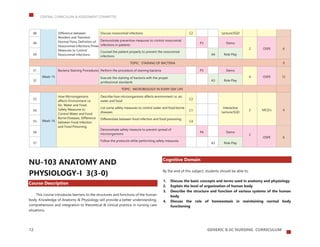
TOS -NU-101 FUNDAMENTALS OF NURSING-I 4(2-
2)
S.No Weeks Content Learning Outcome
Domain
MIT’s
Time/
Hours Assesment
No of
Items
C P A
TOPIC: HISTORY OF HEALTH CARE AND NURSING
1
Week-1
Summary of Ancient
Cultures, Site of Health Care
in Ancient Cultures, Islam
and
Nursing, The Founder of
Nursing, Historical
Perspective, Nursing in
Mogual Period, Nursing
Defined by Different
Scholars, Definition of
Nursing by WHO,
Educational Programs,
History of Nursing
Education
in Pakistan
Discuss the summarized form of health care concepts and
sites in ancient cultures
C2
Interactive
Lecture/SGD 6 MCQ’s 13
2 Discuss the philosophical work of the founders in Nursing C3
3 Relate the concepts of care in Islam and nursing C3
4
Explain the historical perspectives regarding the foundation
of nursing
C2
5
Discuss the concepts of health care and nursing in Mughal
era
C2
6
Compare the definitions of nursing by different nursing
scholars
C4
7
Define nursing with the perspective of World Health
Organization
C1
8 Describe the various educational programs in nursing
briefly.
C2
9 Explain the history of nursing education in Pakistan C2
TOPIC: ROLES OF THE NURSE IN HEALTH CARE
10
Week-2
Profession, Characteristics
of a Profession, Role of the
Professional Nurse,
Description of Career
Roles,
Description of Role as
Communicator, A Teacher,
A Counselor
Define a Profession C1
Interactive
Lecture/SGD
6 MCQ’s 13
11 Enlist the characteristics of a profession C1
12 Describe the role of a professional nurse C2
13 Discuss the career roles in nursing profession C2
14
Describe the role of a nurses as a communicator, teacher
and as a counselor
C2
TOPIC: GOALS OF NURSING AND RELATED CONCEPTS
15
Week-3
Description of Human
Needs, Basis of Nursing
Practice, World Health
Organization, Model of
Conceptual Framework for
Generic BSN Program,
Define basic human needs C1
Interactive
Lecture/SGD
6 MCQ’s 13
16 Discuss basis of nursing practice C2
17 Define World Health Organization C1
18
Explain model of conceptual framework for Generic BS
Nursing program.
C2
CENTRAL CURRICULUM & ASSESSMENT COMMITTEE
GENERIC B.SC NURSING CURRICULUM 3
19 Nursing and Nursing
Practice. Goal of Nursing
Process, Historical
Perspective of the Nursing
Process
Explore nursing and nursing practices C3
20 Define goal of nursing process C1
21 Discuss the historical perspective of the nursing process C2
S.No Weeks Content Learning Outcome
Domain
MIT’s
Time/
Hours Assesment
No of
Items
C P A
TOPIC: COMMUNICATION
22
Week-4
Definition and Elements of
Communication, Types of
Communication Ways of
Communication, Charac-
teristics of Effective Verbal
Communication, Factors
and Techniques that
facilitates and interfere with
the effective
communication,
Therapeutic and Non-
Therapeutic Responses,
Legal Aspects of
Documents
Define communication, elements of communication, ways
of communication
C1
Interactive
Lecture/SGD
1 MCQ’s 2
23
Identify the characteristics of the effective verbal
communication
C1
24
Describe factors that’s facilitates and interfere with the
effective communication
C2
25
Discuss techniques that facilitate and interfere with
effective communication
C2
26
Define ways to respond therapeutically and non
therapeutically
C1
27 Relate the legal aspects of documentations C3
28
Demonstrate therapeutic communication techniques while
taking patient history
P4 Demo
OSPE 6
5
29 Respect the patient needs and concerns while taking
history of the patient
A3 Role Play
TOPIC: NURSING SKILLS (VITAL SIGNS)
30
Week-5
Define Vital Signs and the
Related Terms, Physiological
Concept of Temperature,
Respiration And Blood
Pressure, Principles and
Mechanisms for Normal
Thermoregulation, Ways of
Heat Production And Heat
Loss, Types of Body
Temperature according to
Its Characteristics, Sign and
Symptoms of Fever,
Define vital signs and the relevant terms C1
Interactive
Lecture/SGD
3 MCQ’s 7
31
Describe the physiological concept of temperature,
respiration and blood pressure
C2
32
Describe the principles and mechanisms for normal
thermoregulation in the body.
C2
33
Relate the ways that affect heat production and heat loss in
the body.
C3
34
Define types of body temperature according to its
characteristics.
C1
35 Identify the sign and symptoms of fever. C1
36 Perform to Measure the body temperature of the patient P4 Demo OSPE 3
CENTRAL CURRICULUM & ASSESSMENT COMMITTEE
4 GENERIC B.SC NURSING CURRICULUM
37
Follow the standard and professional norms while taking
temperature of patient
A5 Role Play
3
S.No Weeks Content Learning Outcome
Domain
MIT’s
Time/
Hours Assesment
No of
Items
C P A
38
Week-6
Normal Ranges and Factors
affecting Temperature,
Pulse, Respiration and
Blood Pressure,
Characteristics of Pulse and
Respiration, Factors
Responsible for Maintaining
Normal
Blood Pressure,
Discuss the normal ranges for temperature, pulse,
respiration and blood pressure.
C2
Interactive
Lecture/SGD
3 MCQ’s 7
39 List the factors affecting temperature, pulse, respiration. C1
40 Describe the characteristics of pulse and respiration. C2
41
Relate factors responsible for maintaining normal blood
pressure.
C3
42
Describe various methods and sites used to measure T.P &
B.P.
C2
43 Recognize the signs of alert while taking TPR and B.P. C1
44
Demonstrate to measure the Blood Pressure of an adult
patient
P4 Demo
OSPE 3
3
45 Counsel the patient for any variations in the blood pressure
readings
A5 Role Play
46
Week-7
Various Methods and Sites
Used to Measure T.P & B.P,
Demonstrate to take pulse rate of the patient P4 Demo
OSPE 7
47
Respect the patient needs and concern while taking heart
rate of the patient
A3 Role Play
6
50
Week-8
Signs of Alert while Taking
TPR and B.P.
Perform to count and document the respiration rate of an
adult client
P4 Demo
OSPE 7
51
Provide morally acceptable assistance and care while
assessing respiratory rate
A5 Role Play
6
TOPIC: SKIN MANAGEMENT
52
Week-9
Definition, Causes and
Risk Factors of Decubetic
Ulcer (Bed Sore), Nursing
Interventions to Prevent
Decubetic Ulcer.
Define decubitus ulcer (bed sore) C1 Interactive
Lecture/SGD 1 MCQ’s 2
53 Relate the causes and risk factors of decubitus ulcer C3
54
Demonstrate nursing interventions to prevent decubitus
ulcer.
P4 Demo
OSPE 6
55
Provide morally acceptable care to the patient with
decubitus ulcer
A5 Role Play
5
TOPIC: CONCEPT OF SAFETY: RISK MANAGEMENT
CENTRAL CURRICULUM & ASSESSMENT COMMITTEE
GENERIC B.SC NURSING CURRICULUM 5
S.No Weeks Content Learning Outcome
Domain
MIT’s
Time/
Hours Assesment
No of
Items
C P A
56
Week-
10
Definition of Safety,
Characteristics of Safety,
Physical and Microbial
Hazards in Environment,
Ways to Minimize Hazards,
Environmental Safety,
Physical and Microbial
Hazards in the Hospital
Environment interacting
with Patients, Preventive
Measures for Safe
Environment for Health
Members and Patient,
People at Risk for Safety
Dysfunction
Define safety C1
Interactive
Lecture/SGD
1 MCQ’s 2
57 Describe the characteristics of safety C2
58 Identify physical and microbial hazards in environment C1
59 Discuss various ways to minimize hazards C2
60 Discuss the assessment for environmental safety C2
61
Analyze physical and microbial hazards in hospital setting,
interfere with safety
C4
62
Identify people at risk for safety dysfunction based on
hospital assessment
C1
63
Perform preventive measures for safe environment for
health members and patient independently
P4 Demo
OSPE 6
64
Follow the professional norms while performing different
preventive measures of safe environment
A5 Role Play
5
TOPIC: CONCEPT OF TEACHING & LEARNING
65
Week-
11
Learning Needs of Patient,
Teaching Learning Plan,
Health Teaching
Assess the learning needs of the patient at the clinical site C5 Interactive
Lecture/SGD 1 MCQ’s 2
66 Develop teaching learning plan C3
67 Perform health teaching at the clinical site P4 Demo
OSPE 6
68
Follow the professional norms while teaching the client at
clinical site
A5 Role Play
5
TOPIC: OXYGENATION: RESPIRATORY FUNCTION & CARDIOVASCULAR SYSTEM
S.No Weeks Content Learning Outcome
Domain
MIT’s
Time/
Hours Assesment
No of
Items
C P A
69
Week-12
Factors Interfere with
Effective Oxygenation,
Manifestations, Lifespan-
related Changes and
Problems of
Altered Respiratory and
Cardiovascular Function,
Ensure a Patient Airway,
Emergencies, Nursing
Process and Teaching Plan
to Respiratory and
Relate factors that can interfere with effective oxygenation
of body tissues.
C3
Interactive
Lecture/SGD
1 MCQ’s 2
70
Describe manifestations of altered respiratory and
cardiovascular function.
C2
71
Discuss lifespan changes/ problems in respiratory /
cardiovascular functions
C2
72 Describe nursing measures to ensure a patient airway. C2
73
Apply nursing process for a altered respiratory and
cardiovascular system
C3
CENTRAL CURRICULUM & ASSESSMENT COMMITTEE
6 GENERIC B.SC NURSING CURRICULUM
74
Cardiovascular System,
Infection
Prevention, Medical and
Surgical Asepsis
Recognize the emergencies related to respiratory and
cardiovascular system.
C1
75
Explain ways that caregivers can decrease exposure of
clients to infection
C2
76 Differentiate between medical and surgical asepsis. C4
77
Perform the procedure of cardiopulmonary resuscitation on
dummy in lab
P3 Demo
OSPE 6
5
78 Follow the professional norms while performing the CPR
Procedure
A3 Role Play
TOPIC: OXYGENATION: ACTIVITY AND EXERCISE PATTERN
79
Week-13
Definitions of Terms
Mobility, Joint Mobility,
Body
Alignments and Body Me-
chanics, Benefits of Activity
and Exercise, Principles of
Gravity affecting Balance,
Factors Affecting Mobility,
Effects of Immobility,
Define terms mobility, joint mobility, body alignments and
body mechanics
C1
Interactive
Lecture/SGD
1 MCQ’s 2
80 Discuss the benefits of activity and exercise C2
81 Identify the principles of gravity that affects balance C1
82 Discuss factors affecting mobility C2
83 Discuss the effects of immobility on human body C2
84
Review A&P of skeletal system and characteristics of
normal movement.
C1
85 Demonstrate various Range of motion for general mobility P4 Demo
OSPE 6
5
86 Follow proper norms while performing ROM A5 Role Play
S.No Weeks Content Learning Outcome
Domain
MIT’s
Time/
Hours Assesment
No of
Items
C P A
87
Week-
14
A&P and Movements of
Musculo-Skeletal System,
Impact of Immobility,
Nursing Process of
Musculo-Skeletal Disorders
Describe impact of immobility on Physiological and
Psychological functions
C1
Interactive
Lecture/SGD
1 MCQ’s 2
88
Apply nursing process while planning for altered
musculoskeletal system
C3
89
Perform bath to a patient with musculoskeletal system
disorder on bed
P4 Demo
OSPE 7
90
Follow the professional norms while giving bath to the
patient on bed
A5 Role Play
5
91 Perform to measure height and weight of the patient of
the patient
P4 Demo
CENTRAL CURRICULUM & ASSESSMENT COMMITTEE
GENERIC B.SC NURSING CURRICULUM 7
92
Provide acceptable/ethical assistance during height and
weight measurement
A5 Role Play
TOPIC: PROCESS OF HOSPITALIZATION
93
Week-
15
Definitions, Procedure and
Nursing Responsibilities
During Admission, Transfer
and Discharge, Nurse Role
in Discharge Planning,
Define the team admission, transfer and discharge C1
Interactive
Lecture/SGD
1 MCQ’s 2
94
Discuss the procedure for admission, transfer and
discharge
C2
95
Identify nursing responsibility during admission, transfer
and discharge
C1
96
Discuss nurse role in preparing patients and family for
discharge
C2
97 Discuss the normal reaction of patient being hospitalized C2
98
Normal Reaction of Patient
being Hospitalized.
Demonstrate to prepare occupied and unoccupied bed
making for the patient P4 Demo
OSPE 6
99
Provide morally acceptable care to the patient while
making bed for patients
A5 Role Play
5
100
Week-
16
Normal Reaction of Patient
being Hospitalized.
Demonstrate to admit a patient in the nursing unit P3 Demo
OSPE 7
101
Respect patients’ needs and concerns during admission of
patient in the unit
A3 Role Play
102 Demonstrate to prepare a discharge plan for the patient P3 Demo 6
103
Respect the patient needs while preparing the patient for
discharge planning
A3 Role Play
NU-102 MICROBIOLOGY 3(2.5-.5)
1.
2.
Demonstrate punctuality. Follow the specified norms of the IL, SGD
teaching & learning.
Demonstrate the humbleness and use the socially acceptable language
during academic and social interactions with human models, colleagues
Course Description and teachers.
This course is designed to furnish the learners with the knowledge of basic
concepts and scientific principles of Microbiology. It facilitates the learners to
learn the application of principles of Microbiology in hospital and community
environment.
3. Demonstrate ethically competent decisions when confronted with an
ethical, social or moral problem or personal life.
Cognitive Domain
By the end of this subject, students should be able to:
CENTRAL CURRICULUM & ASSESSMENT COMMITTEE
8 GENERIC B.SC NURSING CURRICULUM
1. Explain the necessity of the knowledge of Microbiology needed when providing
nursing care to the clients.
2. Use basic principles of Microbiology in nursing practice, in a hospital and
community environment.
3. Demonstrate the skills learnt in the laboratory to carryout simple laboratory
experiments.
Skills Domain
By the end of this subject, students should be able to:
1. Demonstrate the safe handling of chemical and equipment’s in lab
2. Demonstrate and make use of operating a microscope
3. Perform the procedure to prepare slides of culture media
4. Demonstrate the preventive measures during various types of isolation
5. Demonstrate preventive measures to control nosocomial infections in patients
6. Perform the procedure of staining bacteria
Affective Domain
By the end of this subject, students should be able to:
TOS -NU-102 MICROBIOLOGY 3(2.5-.5)
S.No Weeks Content Learning Outcome
Domain
MIT’s
Time/
Hours Assesment
No of
Items
C P A
TOPIC: INTRODUCTION TO MICROBIOLOGY
1
Week-1
Definition and Importance
of Microbiology, Properties
of Viruses and
Microorganisms,
Contribution of A. V.
Leeunvenhork, F. Redi,
L. Pasteur and R. Koch to
Microbiology, Difference
between Eukaryotic and
Prokaryotic Cell, Nutritional
Requirements of
Microorganisms,
Define Microbiology C1
Interactive
Lecture/SGD
4 MCQ’s 7
2 Enlist some of the basic properties of viruses C2
3
Explain the basic nutritional requirements of
microorganisms
C2
4
Discuss the contribution of different scientists in the
field of microbiology
C2
CENTRAL CURRICULUM & ASSESSMENT COMMITTEE
GENERIC B.SC NURSING CURRICULUM 9
5
Week-2
Classification of Bacteria
based on Nutritional
Requirement/ Morphology
Classify of bacteria based on nutritional requirement and
morphology
C3
Interactive
Lecture/SGD
4 MCQ’s 7
6 Distinguish between eukaryotic and prokaryotic cell C4
7 Explain the importance of microbiology in nursing practice C2
TOPIC: SAFE USE OF LAB
8
Week-3
Safe Use of Chemicals and
Equipments in Lab
Demonstrate the safe handling of chemical and equipments
in lab
P3 Demo
OSPE 12
4
9 Follow professional norms of handling the chemical and
equipments in lab safely
A3 Role Play
TOPIC: CONTROL OF MICROORGANISM
10
Week-4
Importance, Physical and
Chemical Methods of the
Control of Microbial
Growth, Terms
Definitions
(Sterilization, Antiseptic,
Asepsis, Aseptic,
Macrobiotic, Microbiocidal,
Antibiotic etc), Difference
between Broad and Narrow
Spectrum antibiotics,
Microbial Genetics, Gram
Staining
Define sterilization, antiseptic, asepsis, macrobiotic,
microbiocidal, antibiotic
C1
Interactive
Lecture/SGD
4 MCQ’s 7
11
Describe some physical and chemical methods to control
microbial growth
C2
12 Explain importance of the control of microbial growth C2
13
Differentiate between broad spectrum and narrow
spectrum antibiotics
C3
TOPIC: MICROSCOPE USE
S.No Weeks Content Learning Outcome
Domain
MIT’s
Time/
Hours Assesment
No of
Items
C P A
14
Week-5
How to Use a Microscope
in Lab
Demonstrate and make use of operating a microscope P3 Demo
OSPE 12
15
Follow the professional attributes and norms while using a
microscope
A3 Role Play
4
TOPIC: DEFENCE MECHANISMS OF THE BODY
16
Week-6
Definitions of Resistance,
Non-Specific Resistance
and Susceptibility,
Definitions of Specific
Resistance, Innate
Define resistance and susceptibility C1
Interactive
Lecture/SGD
4 MCQ’s 7
17 Explain nonspecific resistance C2
18
Discuss the specific resistance, innate resistance and
immunity
C2
CENTRAL CURRICULUM & ASSESSMENT COMMITTEE
10 GENERIC B.SC NURSING CURRICULUM
19
Resistance and Immunity,
Types of Acquired
Immunity, Definitions of
Antigens and Antibodies,
Discuss antigens and antibodies
C2
20
Week-7
Role of the Skin and
Mucous Membrane in Non
Specific Resistance,
Five Classes of
Antibodies and their
Functions, Role of
Memory,
Explain the five classes of antibodies and their functions C2
Interactive
Lecture/SGD
4 MCQ’s 7
21 Discuss hypersensitivity C2
22
Describe the role of the skin and mucous membrane in
non specific resistance
C2
23
Week-8
Role of Good Health in
Protection against the
Microbial Infection, Process
of Phagocytosis,
Discuss the role of good health in protection against the
microbial infection.
C2
Interactive
Lecture/SGD
4 MCQ’s 7
24 Explain the process of Phagocytosis C2
25 Explain four types of acquired immunity C2
26
Explain the role of memory, tolerance and specificity in
immunity
C2
27
Week-9
Difference between
Humoral and Cell
Mediated Immunity,
Difference between
Primary and Secondary
Immune Response,
Tolerance and Specificity in
Immunity, Hypersensitivity,
Difference between
Delayed and Immediate
Hypersensitivity.
Differentiate between humoral and cell mediated immunity
C4
Interactive
Lecture/SGD
4 MCQ’s 7
28
Distinguish between primary and secondary immune
response
C4
29
Differentiate between delayed and immediate
hypersensitivity
C4
TOPIC: MEDICAL & SURGICAL ASEPSIS
S.No Weeks Content Learning Outcome
Domain
MIT’s
Time/
Hours Assesment
No of
Items
C P A
30
Week-10
Six Components of Chain
of Infection, Examples of
Ways that Infection may
Occur, Factors that Increase
the Risk of Infection in
Define the terms infection, infection control and
inflammation
C1
Interactive
Lecture/SGD
2 MCQ’s 4
31 Discuss the six components of chain of infection C2
32
Explain the ways, methods and reasons of spread of
infections with examples C2
CENTRAL CURRICULUM & ASSESSMENT COMMITTEE
GENERIC B.SC NURSING CURRICULUM 11
33
Various Settings, Role of
Health Care Personnel and
Health in Infection Control
Describe the factors that increase the risk of infection in
various settings
C2
34
Employ the role of health care personnel and health in
infection control
C3
35
Demonstrate the role of Healthcare personal in infection
control inedependently
P4 Demo
2 OSPE 6
36 Follow the protocols of infection control propoerly A5 Role Play
TOPIC: CULTURE MEDIA SLIDES
37
Week-11
Culture Media and Slides
Preparation
Perform the procedure to prepare slides of culture media P3 Demo
OSPE 12
38
Follow the professional norms to prepare slides of culture
media
A3 Role Play
4
TOPIC: CONCEPT OF ISOLATION
39
Week-12
Definition and Types of
Isolation, Relationship of
Isolation to the Chain of
Infection Cycle, Nursing
Responsibilities in Each
Type of Isolation.
Define Isolation C1
Interactive
Lecture/SGD
2 MCQ’s 4
40 Explain the types of Isolation. C2
41 Relate isolation to the chain of infection cycle C3
42
Demonstrate the preventive measures during various types
of isolation
P3 Demo
OSPE 6
2
43 Perform various nursing interventions professionally in
each type of isolation
A4 Role Play
TOPIC: HUMAN AND MICROBIAL INTERACTION
44
Week-13
Definition of Normal Flora,
Three Beneficial Role of
Normal Flora, Description
of Some Pathogenic
Microbes and Diseases i.e.
Tetanus, Typhoid, Cholera,
Diphtheria, Tuberculosis,
Pertusis, Mumps, Measles,
Polio, Influenza Ascariasis,
Teaniasis and
Dermatomycosis.
Define normal flora of the body C1
Interactive
Lecture/SGD
4 MCQ’s 7
45 Enlist at least three beneficial role of normal flora C1
46
Discuss some pathogenic microbes and diseases
(tetanus,typhoid,cholera, diphtheria, tuberculosis, pertusis,
mumps, measles, polio, influenza ascariasis, and teaniasis
and dermatomycosis C2
S.No Weeks Content Learning Outcome
Domain
MIT’s
Time/
Hours Assesment
No of
Items
C P A
47 Week-14 Differentiate between resident and transient normal flora C4 Interactive 2 MCQ’s 4
CENTRAL CURRICULUM & ASSESSMENT COMMITTEE
12 GENERIC B.SC NURSING CURRICULUM
48 Difference between
Resident and Transient
Normal Flora, Definition of
Nosocomial Infections,Three
Measures to Control
Nosocomial Infections.
Discuss nosocomial infections C2 Lecture/SGD
49
Demonstrate preventive measures to control nosocomial
infections in patients
P3 Demo
2 OSPE 6
50
Counsel the patient properly to prevent the nosocomial
infections
A4 Role Play
TOPIC: STAINING OF BACTERIA 9
51
Week-15
Bacteria Staining Procedures Perform the procedure of staining bacteria P3 Demo
4 OSPE 12
52
Execute the staining of bacteria with the proper
professional standards
A3 Role Play
TOPIC: MICROBIOLOGY IN EVERY DAY LIFE
53
Week-16
How Microorganisms
affects Environment i.e.
Air, Water and Food,
Safety Measures to
Control Water and Food
Borne Diseases, Difference
between Food Infection
and Food Poisoning.
Describe how microorganisms affects environment i.e. air,
water and food
C2
Interactive
Lecture/SGD
2 MCQ’s 4
54
List some safety measures to control water and food borne
diseases.
C1
55
Differentiate between food infection and food poisoning.
C4
56
Demonstrate safety measure to prevent spread of
microorganisms
P4 Demo
2
OSPE 6
57
Follow the protocols while performing safety measures
A3 Role Play
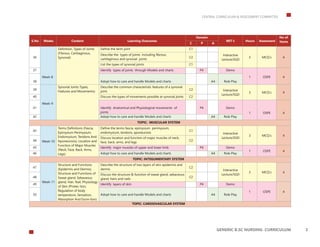
NU-103 ANATOMY AND
PHYSIOLOGY-I 3(3-0)
Course Description
This course introduces learners to the structures and functions of the human
body. Knowledge of Anatomy & Physiology will provide a better understanding,
comprehension and integration to theoretical & clinical practice in nursing care
situations.
Cognitive Domain
By the end of this subject, students should be able to:
1. Discuss the basic concepts and terms used in anatomy and physiology
2. Explain the level of organization of human body
3. Describe the structure and function of various systems of the human
body
4. Discuss the role of homeostasis in maintaining normal body
functioning
CENTRAL CURRICULUM & ASSESSMENT COMMITTEE
GENERIC B.SC NURSING CURRICULUM 13
5. Relate the basic anatomy & physiology concepts to the nursing care of
clients.
Skills Domain
By the end of this subject, students should be able to:
1. Observe levels of organization of body through different anatomical
structures
2. Demonstrate to locate abdominal pelvic regions and quadrants
through a model
3. Demonstrate how to locate the organs present in nine abdomino pelvic
regions.
4. Locate and name the organelles of a cell through a structural model
5. Perform to give descriptions of the bones of axial & appendicular
skeleton
6. Perform to describe skull, vertebral column, rib cage, pelvic girdle &
pelvic girdle
7. Demonstrate to explain the blood flow through the heart via heart
model or chart
8. Demonstrate how to name the various organs of digestive system in a
model.
Affective Domain
By the end of this subject, students should be able to:
1. Demonstrate punctuality. Follow the specified norms of the IL, SGD
teaching & learning.
2. Demonstrate the humbleness and use the socially acceptable language
during academic and social interactions with human models, colleagues
and teachers.
3. Make ethically competent decisions when confronted with an ethical,
social or moral problem related to professional or personal life.
CENTRAL CURRICULUM & ASSESSMENT COMMITTEE
GENERIC B.SC NURSING CURRICULUM 1
TOS -NU-103 ANATOMY AND PHYSIOLOGY-I 3(3-0)
CENTRAL CURRICULUM & ASSESSMENT COMMITTEE
2 GENERIC B.SC NURSING CURRICULUM
S.No Weeks Content Learning Outcomes
Domain
MIT’s Hours Assesment
No of
Items
C P A
20
Week-4
Structure and Function of
Cell, Cell Division (Mitosis
and Meiosis) Its Process
and Importance
Discuss the process of cell division i.e. mitosis and meiosis. C2
Interactive
Lecture/SGD
3 MCQ’s 4
21
Explain and evaluate the importance of the process of
mitosis & meiosis
C3
22
Locate and name the organelles of a cell through a
structural model
P3 Demo
OSPE 4
1
23 Locate and name organelles of a cell through a structural
model with proper norms
A3 Role Play
24
Week-5
Classification, Structure,
Location and Functions, of
Tissues (Epithelial Tissue,
Connective Tissue, Muscle
Tissue and Nervous Tissue)
Discuss the epithelial, connective, muscle and nervous
tissues of the body on the basis of their structures,
locations and functions
C2
Interactive
Lecture/SGD
3 MCQ’s 4
25
Identify location & type of tissue through Models and
charts
P4 Demo
1 OSPE 4
26 Adopt how to care and handle Models and charts A4 Role Play
TOPIC: SKELETAL SYSTEM
27
Week-6
Definition, Structure, Types
and Functions of Bone,
Physiology of Skeletal
System,
Define the skeletal system C1
Interactive
Lecture/SGD
3 MCQ’s 4
28 Discuss the structure, types and functions of bone C2
29 List the functions of the skeletal system C1
30 Discuss the various markings on the surface of bones C2
31
Perform to give descriptions of the bones of axial &
appendicular skeleton
P3 Demo
1 OSPE 4
32 Describe the bones of axial & appendicular skeleton with
proper professional norms
A3 Role Play
33
Week-7
Axial and Appendicular
Skeleton, Bone Description
(Skull, Vertebral column,
The Rib Cage, Pectoral
Girdle and Upper Extremity,
Pelvic Girdle and Lower
Extremity, Male and Female
Pelvis
Discuss the difference between male and female pelvis C2
Interactive
Lecture/SGD
3 MCQ’s 4
34
Perform to describe skull, vertebral column, rib cage,
pelvic girdle & pelvic girdle
P3 Demo
OSPE 4
35
Give value to describe skull, vertebral column, rib cage,
pelvic girdle & pelvic girdle
A3 Role Play
1
TOPIC: JOINTS
CENTRAL CURRICULUM & ASSESSMENT COMMITTEE
GENERIC B.SC NURSING CURRICULUM 3
S.No Weeks Content Learning Outcomes
Domain
MIT’s Hours Assesment
No of
Items
C P A
36
Week-8
Definition, Types of Joints
(Fibrous, Cartilaginous,
Synovial)
Define the term joint C1
Interactive
Lecture/SGD
3 MCQ’s 4
Describe the types of joints including fibrous,
cartilaginous and synovial joints
C2
List the types of synovial joints C1
37 Identify types of joints through Models and charts P4 Demo
1 OSPE 4
38 Adopt how to care and handle Models and charts A4 Role Play
39
Week-9
Synovial Joints Types,
Features and Movements)
Describe the common characteristic features of a synovial
joint.
C2 Interactive
Lecture/SGD
3 MCQ’s 4
40 Discuss the types of movements possible at synovial joints C2
41 Identify Anatomical and Physiological movements of
joints
P4 Demo
1 OSPE 4
42 Adopt how to care and handle Models and charts A4 Role Play
TOPIC: MUSCULAR SYSTEM
43
Week-10
Terms Definitions (Fascia,
Epimysium Perimysium,
Endomysium, Tendons And
Aponeurosis), Location and
Function of Major Muscles
(Neck, Face, Back, Arms,
Legs)
Define the terms fascia, epimysium perimysium,
endomysium, tendons, aponeurosis
C1
Interactive
Lecture/SGD
3 MCQ’s 4
44
Discuss location and function of major muscles of neck,
face, back, arms, and legs
C2
45 Identify major muscles of upper and lower limb P4 Demo
1 OSPE 4
46 Adopt how to care and handle Models and charts A4 Role Play
TOPIC: INTEGUMENTARY SYSTEM
47
Week-11
Structure and Functions
(Epidermis and Dermis),
Structure and Functions of
Sweat gland, Sebaceous
gland, Hair, Nail, Physiology
of Skin (Protec-tion,
Regulation of body
temperature, Sensation,
Absorption And Excre-tion)
Describe the structure of two layers of skin epidermis and
dermis
C2
Interactive
Lecture/SGD
3 MCQ’s 4
48
Discuss the structure & function of sweat gland, sebaceous
gland, hairs and nails
C2
49 Identify layers of skin P4 Demo
1 OSPE 4
50 Adopt how to care and handle Models and charts A4 Role Play
TOPIC: CARDIOVASCULAR SYSTEM
CENTRAL CURRICULUM & ASSESSMENT COMMITTEE
4 GENERIC B.SC NURSING CURRICULUM
S.No Weeks Content Learning Outcomes
Domain
MIT’s Hours Assesment
No of
Items
C P A
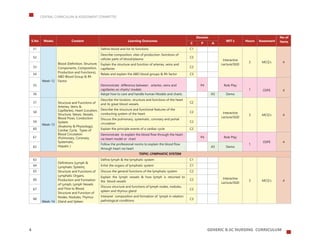
51
Week-12
Blood (Definition, Structure,
Components, Composition,
Production and Functions),
ABO Blood Group & Rh
Factor.
Define blood and list its functions C1
Interactive
Lecture/SGD
3 MCQ’s 4
52
Describe composition, sites of production ,functions of
cellular parts of blood/plasma
C2
53
Explain the structure and function of arteries, veins and
capillaries
C2
54 Relate and explain the ABO blood groups & Rh factor C3
55 Demonstrate difference between arteries, veins and
capillaries on charts/ models
P4 Role Play
1 OSPE 4
56 Adopt how to care and handle human Models and charts A5 Demo
57
Week-13
Structure and Functions of
Arteries, Veins &
Capillaries), Heart (Location,
Structure, Valves, Vessels,
Blood Flow), Conduction
System
(Anatomy & Physiology),
Cardiac Cycle, Types of
Blood Circulation
(Pulmonary, Coronary,
Systematic,
Hepatic )
Describe the location, structure and functions of the heart
and its great blood vessels.
C2
Interactive
Lecture/SGD
3 MCQ’s 4
58
Describe the structure and functional features of the
conducting system of the heart.
C2
59
Discuss the pulmonary, systematic, coronary and portal
circulation
C2
60 Explain the principle events of a cardiac cycle C2
61
Demonstrate to explain the blood flow through the heart
via heart model or chart
P4 Role Play
OSPE 4
62
Follow the professional norms to explain the blood flow
through heart via heart
A5 Demo
1
TOPIC: LYMPHATIC SYSTEM
63
Week-14
Definitions (Lymph &
Lymphatic System),
Structure and Functions of
Lymphatic Organs,
Production and Formation
of Lymph, Lymph Vessels
and Flow to Blood,
Structure and Function of
Nodes, Nodules, Thymus
Gland and Spleen
Define lymph & the lymphatic system C1
Interactive
Lecture/SGD
3 MCQ’s 4
64 Enlist the organs of lymphatic system C1
65 Discuss the general functions of the lymphatic system C2
66
Explain the lymph vessels & how lymph is returned to
the blood vessels
C2
67
Discuss structure and functions of lymph nodes, nodules,
spleen and thymus gland
C2
68
Interpret composition and formation of lymph in relation
pathological conditions
C3
CENTRAL CURRICULUM & ASSESSMENT COMMITTEE
GENERIC B.SC NURSING CURRICULUM 5
69 Draw lymphatic flow on chart P4 Role Play
OSPE 4
1
70 Adopt how to care and handle human Models and charts A5 Demo
TOPIC: DIGESTIVE SYSTEM
S.No Weeks Content Learning Outcomes
Domain
MIT’s Hours Assesment
No of
Items
C P A
71
Week-15
Definition, Structure and
Functions of Digestive
System, Anatomy and
Physiology of Digestive
Organ, Accessory Organs
of Digestive System
Define the digestive system and list its functions C1
Interactive
Lecture/SGD
3 MCQ’s 4
72 Describe the anatomy & physiology of digestive organs C2
73 Discuss the role of accessory organs in digestion C2
74
Demonstrate how to name the various organs of digestive
system in a model
P3 Demo
OSPE 4
75
Name various organs of digestive system in a model with
proper professional norms
A3 Role Play
1
76
Week-16
Process of Digestion in
Mouth, Stomach, Small &
Large Intestines), Process
of Nutrients Absorption,
Process of Defecation
Explain digestion of food in mouth, stomach, small
intestines & large intestines with the chemical processes of
enzymes
C2
Interactive
Lecture/SGD
3 MCQ’s 4
77
Explain the absorption of various nutrients in the digestive
system
C2
78 Discuss the process of defecation. C2
79 Identify digestive organs from human Models and charts P4 Demo
1 OSPE 4
80 Adopt how to care and handle human Models and charts A4 Role Play
CENTRAL CURRICULUM & ASSESSMENT COMMITTEE
6 GENERIC B.SC NURSING CURRICULUM
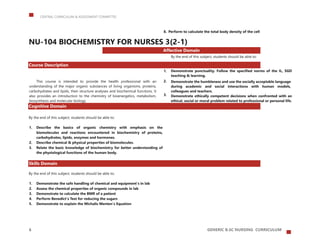
8. Perform to calculate the total body density of the cell
NU-104 BIOCHEMISTRY FOR NURSES 3(2-1)
Affective Domain
By the end of this subject, students should be able to:
Course Description
This course is intended to provide the health professional with an
understanding of the major organic substances of living organisms, proteins,
carbohydrates and lipids, their structure analyses and biochemical functions. It
also provides an introduction to the chemistry of bioenergetics, metabolism,
biosynthesis and molecular biology.
1.
2.
3.
Demonstrate punctuality. Follow the specified norms of the IL, SGD
teaching & learning.
Demonstrate the humbleness and use the socially acceptable language
during academic and social interactions with human models,
colleagues and teachers.
Demonstrate ethically competent decisions when confronted with an
ethical, social or moral problem related to professional or personal life.
Cognitive Domain
By the end of this subject, students should be able to:
1. Describe the basics of organic chemistry with emphasis on the
biomolecules and reactions encountered in biochemistry of proteins,
carbohydrates, lipids, enzymes and hormones.
2. Describe chemical & physical properties of biomolecules.
3. Relate the basic knowledge of biochemistry for better understanding of
the physiological functions of the human body.
Skills Domain
By the end of this subject, students should be able to:
1. Demonstrate the safe handling of chemical and equipment’s in lab
2. Assess the chemical properties of organic compounds in lab
3. Demonstrate to calculate the BMR of a patient
4. Perform Benedict’s Test for reducing the sugars
5. Demonstrate to explain the Michalis Menten’s Equation
CENTRAL CURRICULUM & ASSESSMENT COMMITTEE
GENERIC B.SC NURSING CURRICULUM 7
6. Perform the Emulsion Test in Lab
7. Demonstrate the Ninhydrin Test
TOS -NU-104 BIOCHEMISTRY FOR NURSES 3(2-1)
S.No Weeks Content Learning Outcome
Domain
MIT’s
Time/
Hours Assesment
No of
Items
C P A
TOPIC: CONCEPTS OF CHEMISTRY
1
Week-1
Importance of Chemistry in
Nursing, Matter, Elements
Mixtures & Compound,
Structure of Atom
(Periodic Table), Chemical
formula, Chemical
Reactions, Equations,
Bonding, Redox
Reaction and Acid Base,
Safe Handling of Chemical
and Equipments,
Environment
Review concepts of matter, element, mixture, compound,
reaction, equation, bonding
C1 Interactive
Lecture/SGD
1 MCQ’s 2
2 Discuss acid base and redox reactions C2
3
Demonstrate the safe handling of chemical and equipments
in lab
P3 Demo
OSPE 7
4
Follow the professional standards of handling of chemical
and equipments in lab
A3 Role Play
3
TOPIC: BASIC CONCEPTS OF ORGANIC CHEMISTRY
5
Week-2
Definition of Organic
Chemistry & Compounds,
Classification of Organic
compound, Properties of
Organic compound
Recognize the importance of organic compounds C1
Interactive
Lecture/SGD
1 MCQ’s 2
6 Compare properties of organic and inorganic compounds C4
7 Describe the classification of organic compounds C2
8 Perform to classify the organic compounds through charts P3 Demo
OSPE 7
9
Follow professional norms to classify the organic compunds
through charts in lab
A3 Role Play
3
10
Week-3
Molecular composition
and type of hydrocarbons,
International Union
Nomenclature of Alpha
Compounds (IUPAC), Hydro
Carbons, Alkanes, Alkenes
Differentiate the type of saturated and unsaturated
hydrocarbons
C4
Interactive
Lecture/SGD
1 MCQ’s 2
11
Describe the molecular composition of carbohydrates, Fats,
Proteins and nucleic acid
C2
12
List groups of alcohol, ethers aldehyde, ketones, acids,
esters, amines, a.acids, amides.
C1
13
Draw equations of alkanes, aldehydes, ketones, acids,
esters, amines & amide
P3 Demo 3 OSPE 7
CENTRAL CURRICULUM & ASSESSMENT COMMITTEE
8 GENERIC B.SC NURSING CURRICULUM
S.No Weeks Content Learning Outcome
Domain
MIT’s
Time/
Hours Assesment
No of
Items
C P A
14
Week-4
Amines, Alkenes & Alkynes
Isomerism, Functional
Groups, Macromolecule of
Human Body
Discuss the biologic importance of aldehydes, ketones,
acids, esters, amines, amides
C2
Interactive
Lecture/SGD
1 MCQ’s 2
15
Distinguish between primary, secondary and tertiary
amines
C4
16 Relate isomerism with at least two examples C3
17
Assess the chemical properties of organic compounds in
lab
P3 Demo
OSPE 7
3
18 Follow professional norms to assess chemical properties of
organic compounds in lab
A3 Role Play
TOPIC: METABOLISM
19
Week-5
Definitions of Metabolism,
Anabolism, Catabolism,
Adeno-Tri-Phosphatase
(ATP) Adenosine
Triphosphalic relationship
with Catabolism and
Anabolism, Definitions of
Gluconeogenesis,
Glycogenesis,
Glycogenolysis,
Transamination,
Deamination & Ketosis,
Carbohydrate, Protein &
Fats in Terms of Glycolysis,
Krebs Cycle, Electron
Transport and BMR
Calculation.
Define metabolism, anabolism, catabolism C1
Interactive
Lecture/SGD
1 MCQ’s 2
20 Define Adenosine Triphosphalic (ATP) C1
21
Discuss Adenosine Triphosphalic relationship with
catabolism and anabolism
C2
22
Define gluconeogenesis/glycogenesis/glycogenolysis/trans
& de-amination, ketosis
C1
23
Discuss carbohydrate, protein & fats in terms of Glycolysis,
Krebs Cycle, Electron Trans.
C2
24 Demonstrate to calculate the BMR of a patient P4 Demo
OSPE 7
25
Provide acceptable assistance and explanation to patient
during the calculation of BMR
A5 Role Play
3
TOPIC: CHEMISTRY OF CARBOHYDRATES
26
Week-6
Structure of Carbohydrates,
Classification of
Carbohydrates, Properties of
Carbohydrates, Biological
significance of
Carbohydrates, Major
Classes; Monosaccharide,
Disaccharide &
Define carbohydrates C1
Interactive
Lecture/SGD
1 MCQ’s 2
27 Describe the general structure of carbohydrates C2
28 Explain the classification of carbohydrate. C2
29
Compare three classes of carbohydrates; monosaccharide,
disaccharide & polysaccharide
C3
30 Discuss the biological significance of carbohydrates C2
CENTRAL CURRICULUM & ASSESSMENT COMMITTEE
GENERIC B.SC NURSING CURRICULUM 9
31 Polysaccharide, Significance
of Carbohydrates.
Perform Benedict’s Test for
Reducing the Sugars
Perform Benedict's Test for reducing the sugars P3 Demo
OSPE 7
32
Follow professional norms while performing the Benedict's
Test for reducing the sugars A3 Role Play
3
TOPIC: CHEMISTRY OF LIPIDS
S.No Weeks Content Learning Outcome
Domain
MIT’s
Time/
Hours Assesment
No of
Items
C P A
33
Week-7
Structure of Lipids,
Properties of Lipids,
Biological Significance of
Lipid Classification, Simple
and
Compound Lipids, Derived
Lipids, Fatty Acids, Fats &
Oil, Saturated and
Unsaturated Fatty Acids,
Uses of Fats in the Body ,
Physical and Chemical
Properties of Fats.
Describes the structure and general properties of lipids
and fatty acids
C2
Interactive
Lecture/SGD
2 MCQ’s 5
34
Discuss the classification of lipids that is simple, compound
& derived lipids
C2
35
Draw the difference between saturated and unsaturated
fats through charts
P3 Demo 2 OSPE 5
36
Week-8
Distinguish between soap and detergents C4
Interactive
Lecture/SGD
4 MCQ’s 9
37 Discuss the role of phospholipids in cell membranes C2
38 Explain the role of steroids (cholesterol) C2
TOPIC: CHEMISTRY OF PROTEINS
39
Week-9
General Chemistry
Composition, Amphoteric
Nature, Dipeptides of
Amino Acids
Structure of Primary,
Secondary and Tertiary
Proteins, Quaternary,
Functions of Proteins,
Biological importance of
Proteins, Classification of
Proteins on the basis of
Solubility, Composition,
Biological
Functions, Properties of
Proteins (Colloidal Nature,
Denaturation of Protein)
Discuss the general structure of amino acids C2
Interactive
Lecture/SGD
4 MCQ’s 9
40
Discuss essential, non-essential amino acid, polar, non-
polar amino acid-Zwitter ion
C2
41
Classify proteins according to solubility, composition,
function and shape
C3
42 Explain the significance of protein Denaturation C2
43 Discuss the structure of dipeptides and tripeptides C2
44
Describe the primary, secondary, tertiary and quaternary
structure of protein
C2
CENTRAL CURRICULUM & ASSESSMENT COMMITTEE
10 GENERIC B.SC NURSING CURRICULUM
TOPIC: NUCLEIC ACID & NUCLEOTIDE
45
Week-10
Review of the Cell,
Structure of Nucleic Acid,
Chemistry of Nucleic Acid,
Nucle-osides and
Nucleotides, Structure of
DNA & RNA, Functions of
Nucleic Acid, Biological
importance of Nucleotides
Describe the main structural features of nucleotide. C2
Interactive
Lecture/SGD
4 MCQ’s 9
46 Explain the structure of RNA & DNA C2
47 Construct the main differences between DNA & RNA C3
48
Discuss the biological importance of nucleotides
C2
TOPIC: ENZYMOLOGY
S.No Weeks Content Learning Outcome
Domain
MIT’s
Time/
Hours Assesment
No of
Items
C P A
49
Week-11
Importance of Enzymes,
Enzyme as Protein
Properties of Enzymes,
Enzyme
Specificity, Mechanism of
Enzyme Action, Activators
and Inhibitors, Factors
affecting Enzymes
Activity (Concentration,
Ph, Temperature, Time), Co-
Enzymes & its Classification,
Enzymes in Clinical
Medicines, Perform and
Explain Michalis Menten’s
Equation
Discuss the importance of enzymes. C2
Interactive
Lecture/SGD
1 MCQ’s 2
50 Explain the mode of enzyme activity. C2
51 Distinguish between apoenzymes, coenzymes & co factors C4
52 Distinguish between activators and inhibitors C4
53
Understand inhibition of enzyme activity in competitive,
non & un competitive states
C1
54 Describe the classification of enzymes C2
55 Explain the factors affecting the enzyme activity. C2
56 Demonstrate to explain the Michalis Menten's Equation P3 Demo
OSPE 7
57
Follow the professional and ethical norms to explain the
Michalis Menten's Equation
A3 Role Play
3
TOPIC: BIO-ENERGETIC AND METABOLISM
58
Week-12
Definition of Bioenergetics,
Biogenetic Metabolism,
Biological Oxidation, Oxida-
tion
Electron Transport Chain,
Electron Carriers, Biological
Redox Reaction
Define Bioenergetics C1
Interactive
Lecture/SGD
4 MCQ’s 9
59 Briefly discuss the concept of free energy C2
60
Explain the role of ATP in Linking Catabolism and
anabolism
C2
61 Discuss the biological oxidation and reduction reaction C2
CENTRAL CURRICULUM & ASSESSMENT COMMITTEE
GENERIC B.SC NURSING CURRICULUM 11
62
Differentiate electron transport chain and oxidative
phosphorylation
C3
TOPIC: METABOLISM OF CARBOHYDRATES
63
Week-13
Metabolism of
Carbohydrates, Importance
of Glucose in Blood,
Glycogensis and
Glycogenolysis, Role of
Oxidative Glucose
Catabolism in the Citric Acid
Cycle, Role of
Gluconeogenesis, Scheme
of Carbohydrate
Metabolism.
Describe the importance of glucose in blood and its
dependency by various
C2
Interactive
Lecture/SGD
4 MCQ’s 9
64 Discuss the glycogenesis and glycogenolysis C2
65
Describe the role of oxidative glucose catabolism in the
citric acid cycle.
C2
66 Describe the role of Gluconeogenesis C2
67 Discuss the overall scheme of carbohydrate metabolism C2
TOPIC: METABOLISM OF FATS
S.No Weeks Content Learning Outcome
Domain
MIT’s
Time/
Hours Assesment
No of
Items
C P A
68
Week-14
Mechanism of Fatty Acid
Oxidation, Energy Produced
during the Oxidation of a
Fat,
Significance of the Role of
Ketones Bodies.
Perform Emulsion Test in
Lab
Describe the mechanism of fatty acid oxidation C2
Interactive
Lecture/SGD
1 MCQ’s 2
69
Discuss the amount of energy produced during the
oxidation of a fat.
C2
70 Explain the significance of the role of ketones bodies C2
71 Perform the Emulsion Test in Lab P3 Demo
OSPE 7
72
Give value to the professional norms while performing the
Emulsion Test in Lab
A3 Role Play
3
TOPIC: METABOLISM OF PROTEIN
73
Week-15
Review the Digestion and
Absorption of Proteins,
General Pathway of Protein
Metabolism, De-Amination,
Significance of Nitrogen
Balance, Synthesis of
Protein, Transamination and
Review the digestion and absorption of protein. C1
Interactive
Lecture/SGD
1 MCQ’s 2
74 Explain the significance of nitrogen balance C2
75 Describe the synthesis of protein C2
76
Differentiate the transamination, deamination and
decarboxylation
C3
77 Discuss the formation of urea and ammonia disposal C2
CENTRAL CURRICULUM & ASSESSMENT COMMITTEE
12 GENERIC B.SC NURSING CURRICULUM
78 Decaboxylation, Formation
of Urea and Ammonia
Disposal
Perform Ninhydrin Test
Demonstrate the Ninhydrin Test P3 Demo
OSPE 7
79
Give value to professional and ethical norms while
performing Ninhydrin Test A3 Role Play
3
TOPIC: HORMONES COMMUNICATION CELLS/TISSUE
80
Week-16
Classification of Hormone,
Function of Steroid &
Peptides Hormones, Cardiac,
Pineal and Gastrointestinal
Hormones.
Describes the classification of hormone C2
Interactive
Lecture/SGD
1 MCQ’s 2
81
Discuss the mode function of steroid & peptides hormones.
C2
82
Interpret to become familiar with cardiac, pineal and
gastrointestinal hormones
C3
83 Perform to calculate the total body density of the cell P3 Demo
OSPE 7
84
Follow the professional norms while calculating the total
body density of the cell
A3 Role Play
3
NU-105 ENGLISH-I 2(2-0)
Course Description
This course is designed to acquaint students to build students’ conversation
confidence. It provides them with speaking models that will help them in
exchange of greetings, ideas, thought and feelings. it focuses on building
students’ confidence to speak fluently and persuasively before an audience. It
also aims at establishing the importance of presentation skills in clinical context.
it build students verbal skills by making them aware of different categories of
lexical items and enabling students to make appropriate use of specified
grammatical items.
This course enabling students to read and comprehend fairly complex,
unfamiliar, nursing and non-nursing, authentic texts with appropriate speed and
adequate understanding. Help students with an evaluation criterion for writing
correct and informative field visit reports.
Cognitive Domain
By the end of this subject, students should be able to:
1. Describe basic concept of basic grammar
2. Explain Parts of Speech its types and discuss that how same words use
as different parts of speech.
3. Explain Parts of Speech its types and discuss that how same words use
as different parts of speech.
4. justify critical thinking and conversational skills
5. Understand the Do’s and Don’ts in Presentation
6. Distinguish Descriptive, narrative, expository and Narrative Paragraphs
Skills Domain
By the end of this subject, students should be able to:
1. Practice on general topics and every-day conversation with questions
answers sessions.
CENTRAL CURRICULUM & ASSESSMENT COMMITTEE
GENERIC B.SC NURSING CURRICULUM 13
2. Give presentations individually and in groups to showcase the latent
talent
3. Organize the procedure to improve their communication skills
Affective Domain
By the end of this subject, students should be able to:
1. punctuality. Follow the specified norms of the IL, SGD teaching &
learning.
2. Demonstrate the humbleness and use the socially acceptable language
during academic and social interactions with human models, colleagues
and teachers.
3. Demonstrate ethically competent decisions when confronted with an
ethical, social or moral problem related to professional or personal life.
TOS -NU-105 ENGlISH-I 2(2-0)
S.No Weeks Content Learning Outcome
Domain
MIT’s
Time/
Hours Assesment
No of
Items
C P A
TOPIC: ORAL COMMUNICATION
1
Week-1
Greet People, Telephone
Conversation, Giving
Compliments, Congratula-
tions/ Sympathy, Express
feeling, Ask for
Information/Explanation, Ex-
change Opinions and Ideas,
Suggest/Advise/
Persuade/Insist Etc.
Discuss an effective greeting approach C2
Interactive
Lecture/SGD
2 MCQ’s 5
2 Start and finish a conversation C2
3 Relate how to engage in a telephonic conversation C3
4 Choose proper wording for complements C3
5
Week-2
Learn how to extend congratulation and sympathy C1
Interactive
Lecture/SGD
2
MCQ’s 5
6 Discuss how to express the feelings C2
7 Learn how to ask for an information or explanation C1
8
Week-3
Learn that how to express opinions and ideas C1
Interactive
Lecture/SGD
2 MCQ’s 5
9
Learn that how to give suggestion, advise, persuade and
insist etc,
C1
TOPIC: ORAL PRESENTATIONS
11
Week-4
Elements of a Good
Presentation, Topics Of
Common Interest, Prepare
and Organize a Good
Identify elements of a good presentation. C1
Interactive
Lecture/SGD
2 MCQ’s 5
12
Enlist and Select topics of common interest and share
useful information
C1
CENTRAL CURRICULUM & ASSESSMENT COMMITTEE
14 GENERIC B.SC NURSING CURRICULUM
13
Week-5
Presentation With Multiple
Strategies, Handle
Questions , Thought-
Provoking
Discussions, Key Points
Prepare a good presentation using a variety of strategies/
modes to convey ideas
P4 Demo
2
MCQ’s 5
14
Follow the standard and professional norms to have a
good presentation
A Role Play
15
Discuss that how to express thoughts while handling
questions directed from the audience
C2
Interactive
Lecture/SGD
16
Week-6
Discuss how to extend thought-provoking discussions. C2 Interactive
Lecture/SGD 2 MCQ’s 5
17 Discuss to wrap up convincingly, restating the key points. C2
TOPIC: VOCABULARY
S.No Weeks Content Learning Outcome
Domain
MIT’s
Time/
Hours Assesment
No of
Items
C P A
18
Week-7
Use of Dictionary, Parts of
Speech, Root Words,
Common Suffixes and
Prefixes Used in Medical
Terminology, Use Of
Idiomatic Phrases, Used to
Describe Physical Ailments,
Idioms and Phrasal Verbs in
General
Learn that how to use the dictionary C1
Interactive
Lecture/SGD
2 MCQ’s 5
19 Identify various parts of speech C1
20 Discuss how to enhance the knowledge of root words C2
21
Week-8
Learn some of the common suffixes and prefixes used in
medical terminology
C1
Interactive
Lecture/SGD
2 MCQ’s 5
22
Discuss uses of idiomatic phrases used to describe
physical ailments
C2
23
Discuss how to extend the knowledge of idioms and
phrasal verbs in general.
C2
TOPIC: GRAMMAR
24
Week-9
Tenses, Sentences and
Paragraphs, Verbs, Word
Order, Active & Passive,
Direct and Indirect Speech,
Use of Definite and
Indefinite Article,
Prepositions
Learn to use sentences and paragraphs using appropriate
form of present and past tense
C1
Interactive
Lecture/SGD
2 MCQ’s 5
25
Differentiate between present perfect and past simple
tenses
C4
26 Understand the subject verb agreement in sentences C1
27
Week-10
Write sentences using the correct word order C2
Interactive
Lecture/SGD 2 MCQ’s 5
28
Learn to convert active sentences into passive and vice
versa
C1
29 Explain that how to change direct speech into indirect
speech and vice versa
C2
CENTRAL CURRICULUM & ASSESSMENT COMMITTEE
GENERIC B.SC NURSING CURRICULUM 15
30
Week-11
Use the definite and indefinite articles correctly C3 Interactive
Lecture/SGD 2 MCQ’s 5
31 Insert correct prepositions of time and place in sentences. C4
TOPIC: READING COMPREHENSION
32
Week-12
Content, Text Through
Titles, Subtitles, Non-
Linguistic Devices,
Skimming, Information
Through Scanning,
Inferring Meaning of
Words, Cohesive Devices,
Questions of Literal
Comprehension, Respond
to Questions Involving Re-
Interpretation, Respond
to Questions Of Personal
Response
Discuss how to predict content of text through titles,
subtitles, non-linguistic devices
C3 Interactive
Lecture/SGD
2 MCQ’s 5
33 Interpret the main idea through skimming C3
34
Week-13
Explain how to locate specific points of information
through scanning
C2
Interactive
Lecture/SGD
2 MCQ’s 5
35
Develop the skill of inferring meaning of a word by
considering its context
C3
36 Recognize cohesive devices. C1
37
Week-14
Discuss questions of literal comprehension C2
Interactive
Lecture/SGD
2 MCQ’s 5
38 Explain questions involving re-interpretation and inference C2
39 Explain questions of personal response. C2
S.No Weeks Content Learning Outcome
Domain
MIT’s
Time/
Hours Assesment
No of
Items
C P A
TOPIC: REPORT WRITING
40
Week-15
Provide Biographical
Information, Document
Obser-
vations Critically, Establish
Purpose and Functions,
Writing Legible and Logical
Report
Enlist biographical information of the field C1 Interactive
Lecture/SGD 2 MCQ’s 5
41 Illustrate observations critically C4
42
Week-16
Establish purpose and function of the visit C5
Interactive
Lecture/SGD
2 MCQ’s 5
43
Write a legible report with ideas following logically from
one point to another
C1
CENTRAL CURRICULUM & ASSESSMENT COMMITTEE
GENERIC B.SC NURSING CURRICULUM 1
NU-106 COMPUTER SKILLS 1(1-0)
Course Description
The purpose of this course is to give the learners a basic understanding of
computers and describe the use of information technology in the modern world.
Learners will learn how to use the software programmes which include Word,
Excel, Access, PowerPoint, and Outlook. The course is intended to augment the
computer skills required in clinical and scholastic settings. Learners will study
computer applications in nursing education and practice. A large focus will be on
utilizing these technologies are shaping today’s health care information system.
Cognitive Domain
By the end of this subject, students should be able to:
1. Discuss computer skills, application and how it affects nursing practice,
and education.
2. Discuss skills in the use of a word processor (Microsoft Word),
spreadsheet/data base (Microsoft Excel).
3. Describe skills in preparing materials for presentation by slide,
overhead, or computer projection (multimedia) using presentation
software (PowerPoint).
4. Discuss skills in accessing national/international networks, engines and
databases using a virtual private network.
5. Verbalize understanding of Internet and its use, value, and efficacy in
communicating nursing knowledge.
6. Identify the use of computers in our own area of nursing practice
7. Illustrate the effective use of computer and its software’s in nursing
where necessary.
Skills Domain
By the end of this subject, students should be able to:
1. Demonstrate step by step antivirus installation and up gradation.
2. Perform to use internet and email.
3. Demonstrate how to use search engines.
4. Demonstrate to use office button, save, save as and quick access
toolbar.
5. Perform how to cut, copy, paste, bold, italic, font type and size the text.
6. Observe text alignment, bullets, borders, shading and sorting.
7. Prepare tables, pictures, clip arts, shapes, headers & footers, smart art
charts.
8. Perform to make text box, word art, drop cap and symbols.
9. Perform water mark, page color and page boarders on a document.
10. Prepare MS Power Point and its Interface.
11. Prepare tables, pictures, clip arts, shapes, smart art and charts.
12. Prepare background styles and hide background graphics.
13. Demonstrate slide show tab its groups and commands.
14. Observe how to merge cell, conditional formatting as table.
15. Observe automatic series generation, automatic calculations.
Affective Domain
By the end of this subject, students should be able to:
1. Demonstrate punctuality. Follow the specified norms of the IL, SGD
teaching & learning.
2. Demonstrate the humbleness and use the socially acceptable language
during academic and social interactions with human models, colleagues
and teachers.
3. Demonstrate ethically competent decisions when confronted with an
ethical, social or moral problem related to professional or personal life.
TOS -NU-106 COMPUTER SKILLS 1(1-0)
S.No Weeks Content Learning Outcome Domain MIT’s Assesment
CENTRAL CURRICULUM & ASSESSMENT COMMITTEE
2 GENERIC B.SC NURSING CURRICULUM
C P A Time/
Hours
No of
Items
TOPIC: INTRODUCTION TO COMPUTER
1
Week-1
Definitions of Computer
and related Terms,
Definition and Description
of Data (Numerical,
Alphabetic and Alpha
Numeric Data)
Define Computer C1
Interactive
Lecture/SGD
1 MCQ’s 5
2 Define Data C1
3
Explain numerical, alphabetic, and alpha numeric data
C2
TOPIC: DATA AND INFORMATION
4
Week-2
Definition of Information,
Difference between Data
and Information, Data
Processing in Computer.
Define Information C1
Interactive
Lecture/SGD
1 MCQ’s 5
5 Distinguish between data and information C4
6 Explain data processing C2
TOPIC: BASIC UNITS OF COMPUTER
7
Week-3
Definitions of Input and
Output Unit, Computer
Memory, Arithmetic Logic
Unit – ALU, Control Unit
Distinguish among input, output unit and memory C4
Interactive
Lecture/SGD
1 MCQ’s 5
8 Explain Arithmetic Logic Unit – ALU C2
9 Discuss control unit C2
TOPIC: LANGUAGE AND NUMBER SYSTEM
10
Week-4
Characteristics of Computer,
Languages in Computer,
The Number System.
Enlist characteristics of computer C1
Interactive
Lecture/SGD
1 MCQ’s 5
11 Define Languages in computer C2
12 Discuss the number system C2
TOPIC: SYSTEM AND APPLICATION SOFTWARE
13
Week-5
Definition of Software and
its Types, Types of System
Software Including
Operating System and
Translators, Application
Software i.e. General and
Specific
Purpose Softwares
Discuss software and its types including operating system
& translators
C2
Interactive
Lecture/SGD
1 MCQ’s 5
14
Employ the application software i.e. general and specific
purpose softwares
C3
TOPIC: INTERNET AND SECURITY
CENTRAL CURRICULUM & ASSESSMENT COMMITTEE
GENERIC B.SC NURSING CURRICULUM 3
15
Week-6
Computer Virus and its
Types, Step by Step
Antivirus Installation
and
Up Gradation, Computer
Network and Its Types, Use
Internet and Email, Use
Search Engines.
Explain computer virus and its types C2
Interactive
Lecture/SGD
1
MCQ’s
5
16 Discuss step by step antivirus installation and up gradation C2
17 Define computer network and its types C2
18 Discuss use internet and email C2
19 Discuss how to use search engines C2
S.No Weeks Content Learning Outcome
Domain
MIT’s
Time/
Hours Assesment
No of
Items
C P A
TOPIC: MS WORD
20
Week-7
MS Word and its Interface,
Ribbon and its Parts, Use
Office Button, Save, Save as
and Quick Access Toolbar,
Home Tab, Its Groups and
Commands, How to Cut,
Copy, Paste, Bold, Italic,
Font Type and Size the Text,
Define MS word and its interface C1
Interactive
Lecture/SGD
1 MCQ’s 5
21 Discuss ribbon and its parts C2
22
Discuss to use office button, save, save as and quick
access toolbar C2
23 Describe home tab, its groups and commands C2
24
Discuss how to cut, copy, paste, bold, italic, font type and
size the text C2
25
Week-8
Text Highlighting, Text
Color and Text Formatting,
Text Alignment, Bullets,
Borders, Shading and
Sorting, The Insert Tab, Its
Groups and Commands,
Make (Cover Page, Blank
Page, Page Break, Page
Numbers), Preparation
(Tables, Pictures, Clip Arts,
Shapes, Headers And
Footers, Smart Art And
Charts),
Understand text highlighting, text color and text formatting
C1
Interactive
Lecture/SGD
1 MCQ’s 5
26
Discuss text alignment, bullets, borders, shading and
sorting
C2
27
Discuss text alignment, bullets, borders, shading and
sorting professionally
C2
28 Understand how to insert tab, its groups and commands C1
29
Learn that how to make cover page, blank page, page
break, page numbers
C1
30
Explain and Prepare tables, pictures, clip arts, shapes,
headers & footers, smart art charts
C2
CENTRAL CURRICULUM & ASSESSMENT COMMITTEE
4 GENERIC B.SC NURSING CURRICULUM
31
Week-9
How to Make Text Box,
Word Art, Drop Cap and
Symbols, How to Make
Page Layout Tab Its Groups
and Commands,
Make (Themes, Colors,
Fonts and Effects Margins,
Orientations, Size and
Columns) and How to Put
Water Mark, Page Color and
Page Boarders on a
Document.
Discuss how to make text box, word art, drop cap and
symbols
C2
Interactive
Lecture/SGD
1 MCQ’s 5
32 Explain page layout tab its groups and commands C2
33
Understand that how to make theme, colors, fonts, effects
margins, columns
C1
34
Discuss how to water mark, page color and page boarders
on a document
c2
TOPIC: MS POWER POINT
S.No Weeks Content Learning Outcome
Domain
MIT’s
Time/
Hours Assesment
No of
Items
C P A
35
Week-10
Preparation of MS Power
Point and its Interface,
Home Tab, Its Groups and
Commands, Preparing New
Slide, Reset and Delete
Slide.
Discuss MS Power Point and its Interface C2
Interactive
Lecture/SGD
1 MCQ’s 5
36
Discuss MS PowerPoint and Its Interface with acceptable
standards
C2
37 Describe home tab, its groups and commands C2
38 Learn to prepare new slide, reset and delete slide C1
39
Week-11
Putting Tables, Pictures,
Clip Arts, Shapes, Smart Art
and Charts, Insert Text Box,
Header, Footer, Word Art,
Movie and Sound, Tab Its
Groups and Command,
Prepare tables, pictures, clip arts, shapes, smart art and
charts
P3 Demo
1
MCQ’s 5
40
Follow professional standards while making the tables, clip
art or charts
A3 Role Play
41
Learn how to Insert text box, header, footer, word art,
movie and sound
C1
Interactive
Lecture/SGD
42 Discuss tab its groups and command C2
43
Week-12
Page Setup, Slide
Orientations and Themes,
Background Styles and
Hide Background Graphics,
Animation Tab Its Groups
and Commands.
Distinguish that how to insert page setup, slide
orientations and themes
C4
Interactive
Lecture/SGD
MCQ’s 5
44 Prepare background styles and hide background graphics P3 Demo
1
45
Follow standard to prepare background styles and hide
background graphics
A3 Role Play
46
Learn to insert animation tab its groups and commands
C1
Interactive
Lecture/SGD
47 Week-13 Custom Animations and Discuss custom animations and transitions C2 Interactive MCQ’s 5
CENTRAL CURRICULUM & ASSESSMENT COMMITTEE
GENERIC B.SC NURSING CURRICULUM 5
48 Transitions, Put Transition’s
Sound and Speed, Slide
Show Tab Its Groups and
Commands.
Comprehend to put transition's sound and speed C2 Lecture/SGD
49 Demonstrate slide show tab its groups and commands P4 Demo 1
50
Follow the instructions to demonstrate the show on
powerpoint slides
A5 Role Play
51
Week-14
Slide Show from
Beginning, From Current
Slide and Custom Slide
Show,
Slide Show and Hide Slides.
Learn the slide show from beginning, from current slide &
custom show
C1
Interactive
Lecture/SGD
1 MCQ’s 5
52 Understand the setup of slide show and hide slides C1
TOPIC: MS EXCEL
53
Week-15
Definitions of Cell, Rows,
Columns and Sheets,
Formula, How to Merge
Cells, Conditional
Formatting, Format as
Table.
Define cell, rows, columns and sheets C1
Interactive
Lecture/SGD
MCQ’s 4
54 Explain formula C2
55
Observe how to merge cells, conditional formatting, format
as table
P1 Demo
1
56
Observe process of merging cells and conditional format
as table properly
A1 Role Play
S.No Weeks Content Learning Outcome
Domain
MIT’s
Time/
Hours Assesment
No of
Items
C P A
57
Week-
16
Cell Styles, Sort and Filter,
Find and Select, Automatic
Series Generation,
Automatic Calculations,
How to Create DMCs and
Merit Lists
Discuss cell styles, sort and filter, find and select
C2
Interactive
Lecture/SGD
MCQ’s 5
58
Observe automatic series generation, automatic
calculations
P1 Demo
1
59
Properly follow the instruction while observing automatic
series genera-tion
A1 Role Play
60 Discuss how to create DMCs and merit lists C2 Interactive
Lecture/SGD
CENTRAL CURRICULUM & ASSESSMENT COMMITTEE
GENERIC B.SC NURSING CURRICULUM 1
Recommended Text Books
FUNDAMENTALS OF NURSING-I
 Carpinito L. J. (2009). Nursing Care Plans & Documentation: Nursing Diagnosis
and Collaborative Problem (5th Ed.) Philadelphia: Lippincott  Craven, R. F., &
Hirnle, C. J. (2013). Fundamentals of Nursing: Human Health and Function. (7th
Ed.). New York: Lippincott.  Delaune, S. C., & Ladner, P. K. (2011). Fundamentals
of Nursing: Standards and Practice.  Erb, G. K., B. (2000). Fundamentals of
Nursing: Concepts, Process and Practice (5th Ed.) Addison: Wesley.  Potter, P. A
& Perry, A. G. (2007). Basic Nursing: Essentials for Practice (6th ed.) St. Louis:
Mosby.
MICROBIOLOGY
 Atlas, M, R. (1989). Microbiology. New York: McMillan Publishing.  Bocock, J. E.
(1972). Microbiology for Nurses. London: Bailliere Tindall.  Colee, J. G. (1981).
Applied Medical Microbiology. New York: Blackwell Scientific.  Gladwin, M. (2019).
Clinical Microbiology made ridiculously simple. 7th ed Singapore: Med Master.
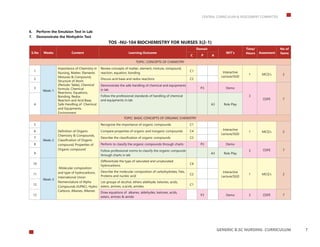
 Gupte, S. (1990). Practice Microbiology. New Delhi: Jaypee Brothers Medical. 
Hare, R. (1980). Bacteriology and Immunity for Nurses. London: Longman
Group.
 Inglis, J. J. T. (2007). Microbiology and Infection.3rd ed, New York: Churchill
Livingstone.
 Jawetz, R. Medical Microbiology. London: Appleton and Lange 28th Ed. 
Parker, M. J. (1991). Microbiology for Nurses. 6th Ed London: Bailliere Tindall.
 Stucke, A. V. (1993). Microbiology for Nurses. London: Bailliere Tindal.
ANATOMY AND PHYSIOLOGY-I
 Ross & Wilson.(2018) Anatomy and Physiology in Health & Illness; Edinburgh:
Churchill, 13th Edition  Guyton, A. C. (2021). Medical Physiology (14th ed)
Washington: Kirokawa.  Tortora, G. J. (2019). Principles of Human Anatomy and Physiology
(14th ed). New York: Happer & Row
BIOCHEMISTRY FOR NURSES 3(2-1)
 Jacob A. (2008). Biochemistry for Nurses, 2nd Ed. New-Delhi: Jaypee Brothers.
 Chatterjea MN. (2009) Textbook of Biochemistry for Dental /Nursing / Pharmacy
Students 3rd Ed, New Delhi Jaypee.
 Sackhiem, G. I. (1994).In Chemistry for the Health Science, 7th Ed, New York:
Macmillan.  Tortora, G. J. (2019). Principles of Human Anatomy and Physiology (14th
ed). New York: Happer & RowYork: Harper & Row.
 Lehninger N. I (1997) Principles of Biochemistry, 2nd Ed, New York: Worth.
ENGLISH
 Barnet, S., & Bedan, H. (1996). Current issues and enduring questions: A
guide to critical thinking argument with reading (4th ed.). Boston: Bedford.
 Davidson, G. (2005). Get your message across: Improve your spelling.
London: Penguin.  Eastwood, J. (2004). Oxford practice grammar. Karachi:
Oxford University
Press. .
 Howe, D. H., Kirkpatrick, T. A., & Kirkpatrick, D. L. (2004). English for
undergraduates. Karachi: Oxford University Press.  Maker, J., & Lenie, M.
(1996). Academic reading with active critical thinking. Cambridge:
Wadsworth.
 Murphy, R. (2004). Murphy’s English Grammar (3rd ed.). New Delhi:
Cambridge University Press.
 Kirkpatrick, B. (2004). English for social interaction: Social expressions.
Singapore: Learners Publishing.
 Seaton, A. (2004). Understanding spelling: Making sense of the rules,
exceptions, and word formation. Singapore: Learners Publishing.
COMPUTER SKILLS 1
 Arnold, J. M., & Pearson, G. A. (1992). Computer Applications in Nursing
Education and Practice. New York: National League of Nursing.  Saba, V. K., &
CENTRAL CURRICULUM & ASSESSMENT COMMITTEE
2 GENERIC B.SC NURSING CURRICULUM
McCormick, K. A. (1995). Essentials of Computers for Nurses. New York: McGraw
Hill.  Thede. L. Q. (1999). Computers in Nursing: Bridges to the Future.
Philadelphia:
Lippincott.
Phase 5 Hayatabad Peshawar Tel: 091-9217703, 9217696-9 fax:091-9217704 Website:www.kmu.edu.pk

BSN 1st.docx

  • 1.
    KHYBER MEDICAL UNIVERSITY YEARONE STUDY GUIDE (SEMESTER 1) 16 Weeks Activity Planner GENERIC B.SC NURSING CURRICULUM CENTRAL CURRICULUM & ASSESSMENT COMMITTEE FOR NURSING, REHABILITATION SCIENCES & ALLIED HEALTH SCIENCES
  • 2.
  • 4.
    CENTRAL CURRICULUM &ASSESSMENT COMMITTEE Table of Contents INTRODUCTION 1. KMU VISION 2 2. KMU MISSION 2 3. CENTRAL CURRICULUM COMMITTEE 2 BSN PROGRAM 4. INTRODUCTION 3 5. OBJECTIVES 3 6. FIRST SEMESTER SUBJECTS 4 FUNDAMENTAL OF NURSING 7. INTRODUCTION 6 8. GENERAL LEARNING OUTCOMES 6 9. TOS 7 MICROBIOLOGY
  • 5.
    10. INTRODUCTION 13 11.GENERAL LEARNING OUTCOMES 13 12. TOS 14 GENERIC B.SC NURSING CURRICULUM iii CENTRAL CURRICULUM & ASSESSMENT COMMITTEE ANATOMY AND PHYSIOLOGY-I 13. INTRODUCTION 18 14. GENERAL LEARNING OUTCOMES 18 15. TOS 19 BIOCHEMISTRY FOR NURSES 16. INTRODUCTION 24 17. GENERAL LEARNING OUTCOMES 24 18. TOS 25 ENGLISH-I 19. INTRODUCTION 30
  • 6.
    20. GENERAL LEARNINGOUTCOMES 30 21. TOS 31 COMPUTER SKILLS 22. INTRODUCTION 34 23. GENERAL LEARNING OUTCOMES 34 24. TOS 35 RECOMENDED BOOKS 25. FUNDAMENTAL OF NURSING 39 26. MICROBIOLOGY 39 iv GENERIC B.SC NURSING CURRICULUM CENTRAL CURRICULUM & ASSESSMENT COMMITTEE 27. ANATOMY AND PHYSIOLOGY-I 39 28. BIOCHEMISTRY FOR NURSING 39 29. ENGLISH 39 30. COMPUTER SKILLS 40
  • 7.
  • 9.
    CENTRAL CURRICULUM &ASSESSMENT COMMITTEE GENERIC B.SC NURSING CURRICULUM 1 Introduction
  • 10.
    CENTRAL CURRICULUM &ASSESSMENT COMMITTEE 2 GENERIC B.SC NURSING CURRICULUM KMU VISION Khyber Medical University will be the global leader in health sciences academics and research for efficient and compassionate health care. KMU MISSION Khyber Medical University aims to promote professional competence through learning and innovation for providing comprehensive quality health care to the nation. CENTRAL CURRICULUM COMMITTEE Opened new door, for the beginning of new era under the supervision of Prof Dr. Zia ul Haq, VC Khyber Medical University and Dr. Brekhna Jamil Director IHPE&R the Central Curriculum & Assessment Committe has been formulated. This is first step taken to change the dynamics of Allied Health Sciences and Nursing Education in Pakistan. Committee by using a craft man approach has developed study guide which will provide pathways for other to follow and KMU will preserve the leadership in providing quality education across Pakistan and will be a reference point of quality in future. Committe has developed curricula to promote inter-professional learning, enhancing and improving the quality of life for people by discovering, teaching and applying knowledge related to Nursing, rehabilitation Sciences & Allied Health sciences. High-quality education is relevant to patient needs and the changing patterns of skills that are demanded by modern health care and aligning assessment and providing quality training to students will definitely will be the
  • 11.
    CENTRAL CURRICULUM &ASSESSMENT COMMITTEE GENERIC B.SC NURSING CURRICULUM 3 outcome. Which will strengthen and enhance quality of Health System across Pakistan. The Central Curriculum & Assessment Committee is as follows: Dr. Brekhna Jamil Chairperson Director Institute of Health Professions Education & Research, KMU Prof. Dr. Zia Ul Islam Member Professor ENT Dr. Syed Hafeez Ahmad Member Addl. Controller of Examination Khyber Medical University Dr. Danish Ali Khan Member Director/ Principal Northwest Institute of Health Sciences Sardar Ali Member Assistant Professor Institute of Nursing Khyber Medical University Muhammad Asif Zeb Member Lecturer Institute of ParaMedical Sciences Khyber Medical University Nazish A Qadir Member Lecturer Institute of Physical Medicine & Rehabilitation Khyber Medical University Syed Amin Ullah Secretary Assistant Director Academics Khyber Medical University
  • 12.
    CENTRAL CURRICULUM &ASSESSMENT COMMITTEE 4 GENERIC B.SC NURSING CURRICULUM INTRODUCTION The B.S (Generic) Nursing Programme aspires to prepare nurses in a multidisciplinary environment enabling them to work in an ever changing complex health care delivery system and to attain their true potentials in becoming competent, caring, and inquisitive members of the health care teams for improving the health status of individuals, families and the society at large. B.S Nursing is a 4-years programme that prepares graduates to provide safe, competent and compassionate nursing care grounded in theory and professional standards. The curriculum is based on the concepts of relational practice, leadership, critical nursing inquiry and ethics of care. The curriculum further gives an opportunity to the students to acquire a good deal of experience to work at various levels of health organizations including basic health units, rural health centers, community clinics, specialized and tertiary health care settings. OBJECTIVES By the end of this program, students should be able to:. 1. Develop nursing graduates skilled with progressive theoretical as well as practical knowledge and skills 2. Educate nurses working with different capacities and various roles in health care institutions/organizations 3. Train nurses for giving care with leadership, management, problem solving and decision making skills 4. Integrate logics and reasoning in complex situations or settings while providing holistic care to patients
  • 13.
    CENTRAL CURRICULUM &ASSESSMENT COMMITTEE GENERIC B.SC NURSING CURRICULUM 5 5. Prepare nurses with analytical, critical thinking and research skills to promote evidenced based care FIRST SEMESTER SUBJECTS S.No Subjects Duration 1 NU-101 FUNDAMENTALS OF NURSING-I 4(2-2) 16 weeks 2 NU-102 MICROBIOLOGY 3(2.5-.5) 16 weeks 3 NU-103 ANATOMY AND PHYSIOLOGY-I 3(3-0) 16 weeks 4 NU-104 BIOCHEMISTRY FOR NURSES 3(2-1) 16 weeks 5 NU-105 ENGLISH 2(2-0) 16 weeks 6 NU-106 COMPUTER SKILLS 1(1-0) 16 weeks
  • 14.
    CENTRAL CURRICULUM &ASSESSMENT COMMITTEE 6 GENERIC B.SC NURSING CURRICULUM 1st Semester
  • 15.
    CENTRAL CURRICULUM &ASSESSMENT COMMITTEE GENERIC B.SC NURSING CURRICULUM 1 NU-101 FUNDAMENTALS OF NURSING-I 4(2-2) Course Description This course introduces the student to nursing as a professional discipline. The concept of a professional nurse is addressed through a brief overview of nursing historical development, definitions of nursing, nursing education, the practice, roles of the nurse and nurse’s accountability. The conceptual basis for nursing practice is presented as the relationship which exists among human needs, adoption and homeostasis, alterations in health, voluntary and involuntary processes, and nursing intervention. The position of nurses in the health care delivery system of the Country is explained through a description of its organization and administration, facilities, and personnel. International health and nursing organizations are discussed. Cognitive Domain By the end of this subject, students should be able to: 1. Describe the Early Nursing Leaders and historical development of Health care and Nursing. 2. Compare requirements and advantages of different Nursing Educational Programs. 3. Compare and contrast definitions of nursing by different Nursing Scholars. 4. Describe the roles of a professional Nursing. 5. Describe the relationship among Human needs, Adoption Homeostasis, alterations in Health, Voluntary and Involuntary Process and nursing Intervention 6. Explain the content and purposes of Code of Ethics, and Standards of Nursing practice. 7. Discuss the purposes and activities of the World Health Organization and the International Council of Nurses. Skills Domain By the end of this subject, students should be able to: 1. Demonstrate therapeutic communication techniques while taking patient history. 2. Demonstrate to take pulse rate of the patient. 3. Perform to count and document the respiration rate of an adult client. 4. Demonstrate to measure the Blood Pressure of an adult patient. 5. Demonstrate nursing interventions to prevent decubitus ulcer. 6. Perform health teaching at the clinical site. 7. Perform the procedure of cardiopulmonary resuscitation on dummy in lab. 8. Perform to measure height and weight of the patient of the patient. 9. Demonstrate to prepare occupied and unoccupied bed making for the patient. 10. Demonstrate to admit a patient in the nursing unit. 11. Demonstrate to prepare a discharge plan for the patient. Affective Domain By the end of this subject, students should be able to: 1. Follow the specified norms of the IL, SGD teaching & learning. 2. Demonstrate the humbleness and use the socially acceptable language during academic and social interactions with human models, colleagues and teachers. 3. Demonstrate ethically competent decisions when confronted with an ethical, social or moral problem related to professional or personal life.
  • 16.
    CENTRAL CURRICULUM &ASSESSMENT COMMITTEE 2 GENERIC B.SC NURSING CURRICULUM TOS -NU-101 FUNDAMENTALS OF NURSING-I 4(2- 2) S.No Weeks Content Learning Outcome Domain MIT’s Time/ Hours Assesment No of Items C P A TOPIC: HISTORY OF HEALTH CARE AND NURSING 1 Week-1 Summary of Ancient Cultures, Site of Health Care in Ancient Cultures, Islam and Nursing, The Founder of Nursing, Historical Perspective, Nursing in Mogual Period, Nursing Defined by Different Scholars, Definition of Nursing by WHO, Educational Programs, History of Nursing Education in Pakistan Discuss the summarized form of health care concepts and sites in ancient cultures C2 Interactive Lecture/SGD 6 MCQ’s 13 2 Discuss the philosophical work of the founders in Nursing C3 3 Relate the concepts of care in Islam and nursing C3 4 Explain the historical perspectives regarding the foundation of nursing C2 5 Discuss the concepts of health care and nursing in Mughal era C2 6 Compare the definitions of nursing by different nursing scholars C4 7 Define nursing with the perspective of World Health Organization C1 8 Describe the various educational programs in nursing briefly. C2 9 Explain the history of nursing education in Pakistan C2 TOPIC: ROLES OF THE NURSE IN HEALTH CARE 10 Week-2 Profession, Characteristics of a Profession, Role of the Professional Nurse, Description of Career Roles, Description of Role as Communicator, A Teacher, A Counselor Define a Profession C1 Interactive Lecture/SGD 6 MCQ’s 13 11 Enlist the characteristics of a profession C1 12 Describe the role of a professional nurse C2 13 Discuss the career roles in nursing profession C2 14 Describe the role of a nurses as a communicator, teacher and as a counselor C2 TOPIC: GOALS OF NURSING AND RELATED CONCEPTS 15 Week-3 Description of Human Needs, Basis of Nursing Practice, World Health Organization, Model of Conceptual Framework for Generic BSN Program, Define basic human needs C1 Interactive Lecture/SGD 6 MCQ’s 13 16 Discuss basis of nursing practice C2 17 Define World Health Organization C1 18 Explain model of conceptual framework for Generic BS Nursing program. C2
  • 17.
    CENTRAL CURRICULUM &ASSESSMENT COMMITTEE GENERIC B.SC NURSING CURRICULUM 3 19 Nursing and Nursing Practice. Goal of Nursing Process, Historical Perspective of the Nursing Process Explore nursing and nursing practices C3 20 Define goal of nursing process C1 21 Discuss the historical perspective of the nursing process C2 S.No Weeks Content Learning Outcome Domain MIT’s Time/ Hours Assesment No of Items C P A TOPIC: COMMUNICATION 22 Week-4 Definition and Elements of Communication, Types of Communication Ways of Communication, Charac- teristics of Effective Verbal Communication, Factors and Techniques that facilitates and interfere with the effective communication, Therapeutic and Non- Therapeutic Responses, Legal Aspects of Documents Define communication, elements of communication, ways of communication C1 Interactive Lecture/SGD 1 MCQ’s 2 23 Identify the characteristics of the effective verbal communication C1 24 Describe factors that’s facilitates and interfere with the effective communication C2 25 Discuss techniques that facilitate and interfere with effective communication C2 26 Define ways to respond therapeutically and non therapeutically C1 27 Relate the legal aspects of documentations C3 28 Demonstrate therapeutic communication techniques while taking patient history P4 Demo OSPE 6 5 29 Respect the patient needs and concerns while taking history of the patient A3 Role Play TOPIC: NURSING SKILLS (VITAL SIGNS) 30 Week-5 Define Vital Signs and the Related Terms, Physiological Concept of Temperature, Respiration And Blood Pressure, Principles and Mechanisms for Normal Thermoregulation, Ways of Heat Production And Heat Loss, Types of Body Temperature according to Its Characteristics, Sign and Symptoms of Fever, Define vital signs and the relevant terms C1 Interactive Lecture/SGD 3 MCQ’s 7 31 Describe the physiological concept of temperature, respiration and blood pressure C2 32 Describe the principles and mechanisms for normal thermoregulation in the body. C2 33 Relate the ways that affect heat production and heat loss in the body. C3 34 Define types of body temperature according to its characteristics. C1 35 Identify the sign and symptoms of fever. C1 36 Perform to Measure the body temperature of the patient P4 Demo OSPE 3
  • 18.
    CENTRAL CURRICULUM &ASSESSMENT COMMITTEE 4 GENERIC B.SC NURSING CURRICULUM 37 Follow the standard and professional norms while taking temperature of patient A5 Role Play 3 S.No Weeks Content Learning Outcome Domain MIT’s Time/ Hours Assesment No of Items C P A 38 Week-6 Normal Ranges and Factors affecting Temperature, Pulse, Respiration and Blood Pressure, Characteristics of Pulse and Respiration, Factors Responsible for Maintaining Normal Blood Pressure, Discuss the normal ranges for temperature, pulse, respiration and blood pressure. C2 Interactive Lecture/SGD 3 MCQ’s 7 39 List the factors affecting temperature, pulse, respiration. C1 40 Describe the characteristics of pulse and respiration. C2 41 Relate factors responsible for maintaining normal blood pressure. C3 42 Describe various methods and sites used to measure T.P & B.P. C2 43 Recognize the signs of alert while taking TPR and B.P. C1 44 Demonstrate to measure the Blood Pressure of an adult patient P4 Demo OSPE 3 3 45 Counsel the patient for any variations in the blood pressure readings A5 Role Play 46 Week-7 Various Methods and Sites Used to Measure T.P & B.P, Demonstrate to take pulse rate of the patient P4 Demo OSPE 7 47 Respect the patient needs and concern while taking heart rate of the patient A3 Role Play 6 50 Week-8 Signs of Alert while Taking TPR and B.P. Perform to count and document the respiration rate of an adult client P4 Demo OSPE 7 51 Provide morally acceptable assistance and care while assessing respiratory rate A5 Role Play 6 TOPIC: SKIN MANAGEMENT 52 Week-9 Definition, Causes and Risk Factors of Decubetic Ulcer (Bed Sore), Nursing Interventions to Prevent Decubetic Ulcer. Define decubitus ulcer (bed sore) C1 Interactive Lecture/SGD 1 MCQ’s 2 53 Relate the causes and risk factors of decubitus ulcer C3 54 Demonstrate nursing interventions to prevent decubitus ulcer. P4 Demo OSPE 6 55 Provide morally acceptable care to the patient with decubitus ulcer A5 Role Play 5 TOPIC: CONCEPT OF SAFETY: RISK MANAGEMENT
  • 19.
    CENTRAL CURRICULUM &ASSESSMENT COMMITTEE GENERIC B.SC NURSING CURRICULUM 5 S.No Weeks Content Learning Outcome Domain MIT’s Time/ Hours Assesment No of Items C P A 56 Week- 10 Definition of Safety, Characteristics of Safety, Physical and Microbial Hazards in Environment, Ways to Minimize Hazards, Environmental Safety, Physical and Microbial Hazards in the Hospital Environment interacting with Patients, Preventive Measures for Safe Environment for Health Members and Patient, People at Risk for Safety Dysfunction Define safety C1 Interactive Lecture/SGD 1 MCQ’s 2 57 Describe the characteristics of safety C2 58 Identify physical and microbial hazards in environment C1 59 Discuss various ways to minimize hazards C2 60 Discuss the assessment for environmental safety C2 61 Analyze physical and microbial hazards in hospital setting, interfere with safety C4 62 Identify people at risk for safety dysfunction based on hospital assessment C1 63 Perform preventive measures for safe environment for health members and patient independently P4 Demo OSPE 6 64 Follow the professional norms while performing different preventive measures of safe environment A5 Role Play 5 TOPIC: CONCEPT OF TEACHING & LEARNING 65 Week- 11 Learning Needs of Patient, Teaching Learning Plan, Health Teaching Assess the learning needs of the patient at the clinical site C5 Interactive Lecture/SGD 1 MCQ’s 2 66 Develop teaching learning plan C3 67 Perform health teaching at the clinical site P4 Demo OSPE 6 68 Follow the professional norms while teaching the client at clinical site A5 Role Play 5 TOPIC: OXYGENATION: RESPIRATORY FUNCTION & CARDIOVASCULAR SYSTEM S.No Weeks Content Learning Outcome Domain MIT’s Time/ Hours Assesment No of Items C P A 69 Week-12 Factors Interfere with Effective Oxygenation, Manifestations, Lifespan- related Changes and Problems of Altered Respiratory and Cardiovascular Function, Ensure a Patient Airway, Emergencies, Nursing Process and Teaching Plan to Respiratory and Relate factors that can interfere with effective oxygenation of body tissues. C3 Interactive Lecture/SGD 1 MCQ’s 2 70 Describe manifestations of altered respiratory and cardiovascular function. C2 71 Discuss lifespan changes/ problems in respiratory / cardiovascular functions C2 72 Describe nursing measures to ensure a patient airway. C2 73 Apply nursing process for a altered respiratory and cardiovascular system C3
  • 20.
    CENTRAL CURRICULUM &ASSESSMENT COMMITTEE 6 GENERIC B.SC NURSING CURRICULUM 74 Cardiovascular System, Infection Prevention, Medical and Surgical Asepsis Recognize the emergencies related to respiratory and cardiovascular system. C1 75 Explain ways that caregivers can decrease exposure of clients to infection C2 76 Differentiate between medical and surgical asepsis. C4 77 Perform the procedure of cardiopulmonary resuscitation on dummy in lab P3 Demo OSPE 6 5 78 Follow the professional norms while performing the CPR Procedure A3 Role Play TOPIC: OXYGENATION: ACTIVITY AND EXERCISE PATTERN 79 Week-13 Definitions of Terms Mobility, Joint Mobility, Body Alignments and Body Me- chanics, Benefits of Activity and Exercise, Principles of Gravity affecting Balance, Factors Affecting Mobility, Effects of Immobility, Define terms mobility, joint mobility, body alignments and body mechanics C1 Interactive Lecture/SGD 1 MCQ’s 2 80 Discuss the benefits of activity and exercise C2 81 Identify the principles of gravity that affects balance C1 82 Discuss factors affecting mobility C2 83 Discuss the effects of immobility on human body C2 84 Review A&P of skeletal system and characteristics of normal movement. C1 85 Demonstrate various Range of motion for general mobility P4 Demo OSPE 6 5 86 Follow proper norms while performing ROM A5 Role Play S.No Weeks Content Learning Outcome Domain MIT’s Time/ Hours Assesment No of Items C P A 87 Week- 14 A&P and Movements of Musculo-Skeletal System, Impact of Immobility, Nursing Process of Musculo-Skeletal Disorders Describe impact of immobility on Physiological and Psychological functions C1 Interactive Lecture/SGD 1 MCQ’s 2 88 Apply nursing process while planning for altered musculoskeletal system C3 89 Perform bath to a patient with musculoskeletal system disorder on bed P4 Demo OSPE 7 90 Follow the professional norms while giving bath to the patient on bed A5 Role Play 5 91 Perform to measure height and weight of the patient of the patient P4 Demo
  • 21.
    CENTRAL CURRICULUM &ASSESSMENT COMMITTEE GENERIC B.SC NURSING CURRICULUM 7 92 Provide acceptable/ethical assistance during height and weight measurement A5 Role Play TOPIC: PROCESS OF HOSPITALIZATION 93 Week- 15 Definitions, Procedure and Nursing Responsibilities During Admission, Transfer and Discharge, Nurse Role in Discharge Planning, Define the team admission, transfer and discharge C1 Interactive Lecture/SGD 1 MCQ’s 2 94 Discuss the procedure for admission, transfer and discharge C2 95 Identify nursing responsibility during admission, transfer and discharge C1 96 Discuss nurse role in preparing patients and family for discharge C2 97 Discuss the normal reaction of patient being hospitalized C2 98 Normal Reaction of Patient being Hospitalized. Demonstrate to prepare occupied and unoccupied bed making for the patient P4 Demo OSPE 6 99 Provide morally acceptable care to the patient while making bed for patients A5 Role Play 5 100 Week- 16 Normal Reaction of Patient being Hospitalized. Demonstrate to admit a patient in the nursing unit P3 Demo OSPE 7 101 Respect patients’ needs and concerns during admission of patient in the unit A3 Role Play 102 Demonstrate to prepare a discharge plan for the patient P3 Demo 6 103 Respect the patient needs while preparing the patient for discharge planning A3 Role Play NU-102 MICROBIOLOGY 3(2.5-.5) 1. 2. Demonstrate punctuality. Follow the specified norms of the IL, SGD teaching & learning. Demonstrate the humbleness and use the socially acceptable language during academic and social interactions with human models, colleagues Course Description and teachers. This course is designed to furnish the learners with the knowledge of basic concepts and scientific principles of Microbiology. It facilitates the learners to learn the application of principles of Microbiology in hospital and community environment. 3. Demonstrate ethically competent decisions when confronted with an ethical, social or moral problem or personal life. Cognitive Domain By the end of this subject, students should be able to:
  • 22.
    CENTRAL CURRICULUM &ASSESSMENT COMMITTEE 8 GENERIC B.SC NURSING CURRICULUM 1. Explain the necessity of the knowledge of Microbiology needed when providing nursing care to the clients. 2. Use basic principles of Microbiology in nursing practice, in a hospital and community environment. 3. Demonstrate the skills learnt in the laboratory to carryout simple laboratory experiments. Skills Domain By the end of this subject, students should be able to: 1. Demonstrate the safe handling of chemical and equipment’s in lab 2. Demonstrate and make use of operating a microscope 3. Perform the procedure to prepare slides of culture media 4. Demonstrate the preventive measures during various types of isolation 5. Demonstrate preventive measures to control nosocomial infections in patients 6. Perform the procedure of staining bacteria Affective Domain By the end of this subject, students should be able to: TOS -NU-102 MICROBIOLOGY 3(2.5-.5) S.No Weeks Content Learning Outcome Domain MIT’s Time/ Hours Assesment No of Items C P A TOPIC: INTRODUCTION TO MICROBIOLOGY 1 Week-1 Definition and Importance of Microbiology, Properties of Viruses and Microorganisms, Contribution of A. V. Leeunvenhork, F. Redi, L. Pasteur and R. Koch to Microbiology, Difference between Eukaryotic and Prokaryotic Cell, Nutritional Requirements of Microorganisms, Define Microbiology C1 Interactive Lecture/SGD 4 MCQ’s 7 2 Enlist some of the basic properties of viruses C2 3 Explain the basic nutritional requirements of microorganisms C2 4 Discuss the contribution of different scientists in the field of microbiology C2
  • 23.
    CENTRAL CURRICULUM &ASSESSMENT COMMITTEE GENERIC B.SC NURSING CURRICULUM 9 5 Week-2 Classification of Bacteria based on Nutritional Requirement/ Morphology Classify of bacteria based on nutritional requirement and morphology C3 Interactive Lecture/SGD 4 MCQ’s 7 6 Distinguish between eukaryotic and prokaryotic cell C4 7 Explain the importance of microbiology in nursing practice C2 TOPIC: SAFE USE OF LAB 8 Week-3 Safe Use of Chemicals and Equipments in Lab Demonstrate the safe handling of chemical and equipments in lab P3 Demo OSPE 12 4 9 Follow professional norms of handling the chemical and equipments in lab safely A3 Role Play TOPIC: CONTROL OF MICROORGANISM 10 Week-4 Importance, Physical and Chemical Methods of the Control of Microbial Growth, Terms Definitions (Sterilization, Antiseptic, Asepsis, Aseptic, Macrobiotic, Microbiocidal, Antibiotic etc), Difference between Broad and Narrow Spectrum antibiotics, Microbial Genetics, Gram Staining Define sterilization, antiseptic, asepsis, macrobiotic, microbiocidal, antibiotic C1 Interactive Lecture/SGD 4 MCQ’s 7 11 Describe some physical and chemical methods to control microbial growth C2 12 Explain importance of the control of microbial growth C2 13 Differentiate between broad spectrum and narrow spectrum antibiotics C3 TOPIC: MICROSCOPE USE S.No Weeks Content Learning Outcome Domain MIT’s Time/ Hours Assesment No of Items C P A 14 Week-5 How to Use a Microscope in Lab Demonstrate and make use of operating a microscope P3 Demo OSPE 12 15 Follow the professional attributes and norms while using a microscope A3 Role Play 4 TOPIC: DEFENCE MECHANISMS OF THE BODY 16 Week-6 Definitions of Resistance, Non-Specific Resistance and Susceptibility, Definitions of Specific Resistance, Innate Define resistance and susceptibility C1 Interactive Lecture/SGD 4 MCQ’s 7 17 Explain nonspecific resistance C2 18 Discuss the specific resistance, innate resistance and immunity C2
  • 24.
    CENTRAL CURRICULUM &ASSESSMENT COMMITTEE 10 GENERIC B.SC NURSING CURRICULUM 19 Resistance and Immunity, Types of Acquired Immunity, Definitions of Antigens and Antibodies, Discuss antigens and antibodies C2 20 Week-7 Role of the Skin and Mucous Membrane in Non Specific Resistance, Five Classes of Antibodies and their Functions, Role of Memory, Explain the five classes of antibodies and their functions C2 Interactive Lecture/SGD 4 MCQ’s 7 21 Discuss hypersensitivity C2 22 Describe the role of the skin and mucous membrane in non specific resistance C2 23 Week-8 Role of Good Health in Protection against the Microbial Infection, Process of Phagocytosis, Discuss the role of good health in protection against the microbial infection. C2 Interactive Lecture/SGD 4 MCQ’s 7 24 Explain the process of Phagocytosis C2 25 Explain four types of acquired immunity C2 26 Explain the role of memory, tolerance and specificity in immunity C2 27 Week-9 Difference between Humoral and Cell Mediated Immunity, Difference between Primary and Secondary Immune Response, Tolerance and Specificity in Immunity, Hypersensitivity, Difference between Delayed and Immediate Hypersensitivity. Differentiate between humoral and cell mediated immunity C4 Interactive Lecture/SGD 4 MCQ’s 7 28 Distinguish between primary and secondary immune response C4 29 Differentiate between delayed and immediate hypersensitivity C4 TOPIC: MEDICAL & SURGICAL ASEPSIS S.No Weeks Content Learning Outcome Domain MIT’s Time/ Hours Assesment No of Items C P A 30 Week-10 Six Components of Chain of Infection, Examples of Ways that Infection may Occur, Factors that Increase the Risk of Infection in Define the terms infection, infection control and inflammation C1 Interactive Lecture/SGD 2 MCQ’s 4 31 Discuss the six components of chain of infection C2 32 Explain the ways, methods and reasons of spread of infections with examples C2
  • 25.
    CENTRAL CURRICULUM &ASSESSMENT COMMITTEE GENERIC B.SC NURSING CURRICULUM 11 33 Various Settings, Role of Health Care Personnel and Health in Infection Control Describe the factors that increase the risk of infection in various settings C2 34 Employ the role of health care personnel and health in infection control C3 35 Demonstrate the role of Healthcare personal in infection control inedependently P4 Demo 2 OSPE 6 36 Follow the protocols of infection control propoerly A5 Role Play TOPIC: CULTURE MEDIA SLIDES 37 Week-11 Culture Media and Slides Preparation Perform the procedure to prepare slides of culture media P3 Demo OSPE 12 38 Follow the professional norms to prepare slides of culture media A3 Role Play 4 TOPIC: CONCEPT OF ISOLATION 39 Week-12 Definition and Types of Isolation, Relationship of Isolation to the Chain of Infection Cycle, Nursing Responsibilities in Each Type of Isolation. Define Isolation C1 Interactive Lecture/SGD 2 MCQ’s 4 40 Explain the types of Isolation. C2 41 Relate isolation to the chain of infection cycle C3 42 Demonstrate the preventive measures during various types of isolation P3 Demo OSPE 6 2 43 Perform various nursing interventions professionally in each type of isolation A4 Role Play TOPIC: HUMAN AND MICROBIAL INTERACTION 44 Week-13 Definition of Normal Flora, Three Beneficial Role of Normal Flora, Description of Some Pathogenic Microbes and Diseases i.e. Tetanus, Typhoid, Cholera, Diphtheria, Tuberculosis, Pertusis, Mumps, Measles, Polio, Influenza Ascariasis, Teaniasis and Dermatomycosis. Define normal flora of the body C1 Interactive Lecture/SGD 4 MCQ’s 7 45 Enlist at least three beneficial role of normal flora C1 46 Discuss some pathogenic microbes and diseases (tetanus,typhoid,cholera, diphtheria, tuberculosis, pertusis, mumps, measles, polio, influenza ascariasis, and teaniasis and dermatomycosis C2 S.No Weeks Content Learning Outcome Domain MIT’s Time/ Hours Assesment No of Items C P A 47 Week-14 Differentiate between resident and transient normal flora C4 Interactive 2 MCQ’s 4
  • 26.
    CENTRAL CURRICULUM &ASSESSMENT COMMITTEE 12 GENERIC B.SC NURSING CURRICULUM 48 Difference between Resident and Transient Normal Flora, Definition of Nosocomial Infections,Three Measures to Control Nosocomial Infections. Discuss nosocomial infections C2 Lecture/SGD 49 Demonstrate preventive measures to control nosocomial infections in patients P3 Demo 2 OSPE 6 50 Counsel the patient properly to prevent the nosocomial infections A4 Role Play TOPIC: STAINING OF BACTERIA 9 51 Week-15 Bacteria Staining Procedures Perform the procedure of staining bacteria P3 Demo 4 OSPE 12 52 Execute the staining of bacteria with the proper professional standards A3 Role Play TOPIC: MICROBIOLOGY IN EVERY DAY LIFE 53 Week-16 How Microorganisms affects Environment i.e. Air, Water and Food, Safety Measures to Control Water and Food Borne Diseases, Difference between Food Infection and Food Poisoning. Describe how microorganisms affects environment i.e. air, water and food C2 Interactive Lecture/SGD 2 MCQ’s 4 54 List some safety measures to control water and food borne diseases. C1 55 Differentiate between food infection and food poisoning. C4 56 Demonstrate safety measure to prevent spread of microorganisms P4 Demo 2 OSPE 6 57 Follow the protocols while performing safety measures A3 Role Play NU-103 ANATOMY AND PHYSIOLOGY-I 3(3-0) Course Description This course introduces learners to the structures and functions of the human body. Knowledge of Anatomy & Physiology will provide a better understanding, comprehension and integration to theoretical & clinical practice in nursing care situations. Cognitive Domain By the end of this subject, students should be able to: 1. Discuss the basic concepts and terms used in anatomy and physiology 2. Explain the level of organization of human body 3. Describe the structure and function of various systems of the human body 4. Discuss the role of homeostasis in maintaining normal body functioning
  • 27.
    CENTRAL CURRICULUM &ASSESSMENT COMMITTEE GENERIC B.SC NURSING CURRICULUM 13 5. Relate the basic anatomy & physiology concepts to the nursing care of clients. Skills Domain By the end of this subject, students should be able to: 1. Observe levels of organization of body through different anatomical structures 2. Demonstrate to locate abdominal pelvic regions and quadrants through a model 3. Demonstrate how to locate the organs present in nine abdomino pelvic regions. 4. Locate and name the organelles of a cell through a structural model 5. Perform to give descriptions of the bones of axial & appendicular skeleton 6. Perform to describe skull, vertebral column, rib cage, pelvic girdle & pelvic girdle 7. Demonstrate to explain the blood flow through the heart via heart model or chart 8. Demonstrate how to name the various organs of digestive system in a model. Affective Domain By the end of this subject, students should be able to: 1. Demonstrate punctuality. Follow the specified norms of the IL, SGD teaching & learning. 2. Demonstrate the humbleness and use the socially acceptable language during academic and social interactions with human models, colleagues and teachers. 3. Make ethically competent decisions when confronted with an ethical, social or moral problem related to professional or personal life.
  • 29.
    CENTRAL CURRICULUM &ASSESSMENT COMMITTEE GENERIC B.SC NURSING CURRICULUM 1 TOS -NU-103 ANATOMY AND PHYSIOLOGY-I 3(3-0)
  • 30.
    CENTRAL CURRICULUM &ASSESSMENT COMMITTEE 2 GENERIC B.SC NURSING CURRICULUM S.No Weeks Content Learning Outcomes Domain MIT’s Hours Assesment No of Items C P A 20 Week-4 Structure and Function of Cell, Cell Division (Mitosis and Meiosis) Its Process and Importance Discuss the process of cell division i.e. mitosis and meiosis. C2 Interactive Lecture/SGD 3 MCQ’s 4 21 Explain and evaluate the importance of the process of mitosis & meiosis C3 22 Locate and name the organelles of a cell through a structural model P3 Demo OSPE 4 1 23 Locate and name organelles of a cell through a structural model with proper norms A3 Role Play 24 Week-5 Classification, Structure, Location and Functions, of Tissues (Epithelial Tissue, Connective Tissue, Muscle Tissue and Nervous Tissue) Discuss the epithelial, connective, muscle and nervous tissues of the body on the basis of their structures, locations and functions C2 Interactive Lecture/SGD 3 MCQ’s 4 25 Identify location & type of tissue through Models and charts P4 Demo 1 OSPE 4 26 Adopt how to care and handle Models and charts A4 Role Play TOPIC: SKELETAL SYSTEM 27 Week-6 Definition, Structure, Types and Functions of Bone, Physiology of Skeletal System, Define the skeletal system C1 Interactive Lecture/SGD 3 MCQ’s 4 28 Discuss the structure, types and functions of bone C2 29 List the functions of the skeletal system C1 30 Discuss the various markings on the surface of bones C2 31 Perform to give descriptions of the bones of axial & appendicular skeleton P3 Demo 1 OSPE 4 32 Describe the bones of axial & appendicular skeleton with proper professional norms A3 Role Play 33 Week-7 Axial and Appendicular Skeleton, Bone Description (Skull, Vertebral column, The Rib Cage, Pectoral Girdle and Upper Extremity, Pelvic Girdle and Lower Extremity, Male and Female Pelvis Discuss the difference between male and female pelvis C2 Interactive Lecture/SGD 3 MCQ’s 4 34 Perform to describe skull, vertebral column, rib cage, pelvic girdle & pelvic girdle P3 Demo OSPE 4 35 Give value to describe skull, vertebral column, rib cage, pelvic girdle & pelvic girdle A3 Role Play 1 TOPIC: JOINTS
  • 31.
    CENTRAL CURRICULUM &ASSESSMENT COMMITTEE GENERIC B.SC NURSING CURRICULUM 3 S.No Weeks Content Learning Outcomes Domain MIT’s Hours Assesment No of Items C P A 36 Week-8 Definition, Types of Joints (Fibrous, Cartilaginous, Synovial) Define the term joint C1 Interactive Lecture/SGD 3 MCQ’s 4 Describe the types of joints including fibrous, cartilaginous and synovial joints C2 List the types of synovial joints C1 37 Identify types of joints through Models and charts P4 Demo 1 OSPE 4 38 Adopt how to care and handle Models and charts A4 Role Play 39 Week-9 Synovial Joints Types, Features and Movements) Describe the common characteristic features of a synovial joint. C2 Interactive Lecture/SGD 3 MCQ’s 4 40 Discuss the types of movements possible at synovial joints C2 41 Identify Anatomical and Physiological movements of joints P4 Demo 1 OSPE 4 42 Adopt how to care and handle Models and charts A4 Role Play TOPIC: MUSCULAR SYSTEM 43 Week-10 Terms Definitions (Fascia, Epimysium Perimysium, Endomysium, Tendons And Aponeurosis), Location and Function of Major Muscles (Neck, Face, Back, Arms, Legs) Define the terms fascia, epimysium perimysium, endomysium, tendons, aponeurosis C1 Interactive Lecture/SGD 3 MCQ’s 4 44 Discuss location and function of major muscles of neck, face, back, arms, and legs C2 45 Identify major muscles of upper and lower limb P4 Demo 1 OSPE 4 46 Adopt how to care and handle Models and charts A4 Role Play TOPIC: INTEGUMENTARY SYSTEM 47 Week-11 Structure and Functions (Epidermis and Dermis), Structure and Functions of Sweat gland, Sebaceous gland, Hair, Nail, Physiology of Skin (Protec-tion, Regulation of body temperature, Sensation, Absorption And Excre-tion) Describe the structure of two layers of skin epidermis and dermis C2 Interactive Lecture/SGD 3 MCQ’s 4 48 Discuss the structure & function of sweat gland, sebaceous gland, hairs and nails C2 49 Identify layers of skin P4 Demo 1 OSPE 4 50 Adopt how to care and handle Models and charts A4 Role Play TOPIC: CARDIOVASCULAR SYSTEM
  • 32.
    CENTRAL CURRICULUM &ASSESSMENT COMMITTEE 4 GENERIC B.SC NURSING CURRICULUM S.No Weeks Content Learning Outcomes Domain MIT’s Hours Assesment No of Items C P A 51 Week-12 Blood (Definition, Structure, Components, Composition, Production and Functions), ABO Blood Group & Rh Factor. Define blood and list its functions C1 Interactive Lecture/SGD 3 MCQ’s 4 52 Describe composition, sites of production ,functions of cellular parts of blood/plasma C2 53 Explain the structure and function of arteries, veins and capillaries C2 54 Relate and explain the ABO blood groups & Rh factor C3 55 Demonstrate difference between arteries, veins and capillaries on charts/ models P4 Role Play 1 OSPE 4 56 Adopt how to care and handle human Models and charts A5 Demo 57 Week-13 Structure and Functions of Arteries, Veins & Capillaries), Heart (Location, Structure, Valves, Vessels, Blood Flow), Conduction System (Anatomy & Physiology), Cardiac Cycle, Types of Blood Circulation (Pulmonary, Coronary, Systematic, Hepatic ) Describe the location, structure and functions of the heart and its great blood vessels. C2 Interactive Lecture/SGD 3 MCQ’s 4 58 Describe the structure and functional features of the conducting system of the heart. C2 59 Discuss the pulmonary, systematic, coronary and portal circulation C2 60 Explain the principle events of a cardiac cycle C2 61 Demonstrate to explain the blood flow through the heart via heart model or chart P4 Role Play OSPE 4 62 Follow the professional norms to explain the blood flow through heart via heart A5 Demo 1 TOPIC: LYMPHATIC SYSTEM 63 Week-14 Definitions (Lymph & Lymphatic System), Structure and Functions of Lymphatic Organs, Production and Formation of Lymph, Lymph Vessels and Flow to Blood, Structure and Function of Nodes, Nodules, Thymus Gland and Spleen Define lymph & the lymphatic system C1 Interactive Lecture/SGD 3 MCQ’s 4 64 Enlist the organs of lymphatic system C1 65 Discuss the general functions of the lymphatic system C2 66 Explain the lymph vessels & how lymph is returned to the blood vessels C2 67 Discuss structure and functions of lymph nodes, nodules, spleen and thymus gland C2 68 Interpret composition and formation of lymph in relation pathological conditions C3
  • 33.
    CENTRAL CURRICULUM &ASSESSMENT COMMITTEE GENERIC B.SC NURSING CURRICULUM 5 69 Draw lymphatic flow on chart P4 Role Play OSPE 4 1 70 Adopt how to care and handle human Models and charts A5 Demo TOPIC: DIGESTIVE SYSTEM S.No Weeks Content Learning Outcomes Domain MIT’s Hours Assesment No of Items C P A 71 Week-15 Definition, Structure and Functions of Digestive System, Anatomy and Physiology of Digestive Organ, Accessory Organs of Digestive System Define the digestive system and list its functions C1 Interactive Lecture/SGD 3 MCQ’s 4 72 Describe the anatomy & physiology of digestive organs C2 73 Discuss the role of accessory organs in digestion C2 74 Demonstrate how to name the various organs of digestive system in a model P3 Demo OSPE 4 75 Name various organs of digestive system in a model with proper professional norms A3 Role Play 1 76 Week-16 Process of Digestion in Mouth, Stomach, Small & Large Intestines), Process of Nutrients Absorption, Process of Defecation Explain digestion of food in mouth, stomach, small intestines & large intestines with the chemical processes of enzymes C2 Interactive Lecture/SGD 3 MCQ’s 4 77 Explain the absorption of various nutrients in the digestive system C2 78 Discuss the process of defecation. C2 79 Identify digestive organs from human Models and charts P4 Demo 1 OSPE 4 80 Adopt how to care and handle human Models and charts A4 Role Play
  • 34.
    CENTRAL CURRICULUM &ASSESSMENT COMMITTEE 6 GENERIC B.SC NURSING CURRICULUM 8. Perform to calculate the total body density of the cell NU-104 BIOCHEMISTRY FOR NURSES 3(2-1) Affective Domain By the end of this subject, students should be able to: Course Description This course is intended to provide the health professional with an understanding of the major organic substances of living organisms, proteins, carbohydrates and lipids, their structure analyses and biochemical functions. It also provides an introduction to the chemistry of bioenergetics, metabolism, biosynthesis and molecular biology. 1. 2. 3. Demonstrate punctuality. Follow the specified norms of the IL, SGD teaching & learning. Demonstrate the humbleness and use the socially acceptable language during academic and social interactions with human models, colleagues and teachers. Demonstrate ethically competent decisions when confronted with an ethical, social or moral problem related to professional or personal life. Cognitive Domain By the end of this subject, students should be able to: 1. Describe the basics of organic chemistry with emphasis on the biomolecules and reactions encountered in biochemistry of proteins, carbohydrates, lipids, enzymes and hormones. 2. Describe chemical & physical properties of biomolecules. 3. Relate the basic knowledge of biochemistry for better understanding of the physiological functions of the human body. Skills Domain By the end of this subject, students should be able to: 1. Demonstrate the safe handling of chemical and equipment’s in lab 2. Assess the chemical properties of organic compounds in lab 3. Demonstrate to calculate the BMR of a patient 4. Perform Benedict’s Test for reducing the sugars 5. Demonstrate to explain the Michalis Menten’s Equation
  • 35.
    CENTRAL CURRICULUM &ASSESSMENT COMMITTEE GENERIC B.SC NURSING CURRICULUM 7 6. Perform the Emulsion Test in Lab 7. Demonstrate the Ninhydrin Test TOS -NU-104 BIOCHEMISTRY FOR NURSES 3(2-1) S.No Weeks Content Learning Outcome Domain MIT’s Time/ Hours Assesment No of Items C P A TOPIC: CONCEPTS OF CHEMISTRY 1 Week-1 Importance of Chemistry in Nursing, Matter, Elements Mixtures & Compound, Structure of Atom (Periodic Table), Chemical formula, Chemical Reactions, Equations, Bonding, Redox Reaction and Acid Base, Safe Handling of Chemical and Equipments, Environment Review concepts of matter, element, mixture, compound, reaction, equation, bonding C1 Interactive Lecture/SGD 1 MCQ’s 2 2 Discuss acid base and redox reactions C2 3 Demonstrate the safe handling of chemical and equipments in lab P3 Demo OSPE 7 4 Follow the professional standards of handling of chemical and equipments in lab A3 Role Play 3 TOPIC: BASIC CONCEPTS OF ORGANIC CHEMISTRY 5 Week-2 Definition of Organic Chemistry & Compounds, Classification of Organic compound, Properties of Organic compound Recognize the importance of organic compounds C1 Interactive Lecture/SGD 1 MCQ’s 2 6 Compare properties of organic and inorganic compounds C4 7 Describe the classification of organic compounds C2 8 Perform to classify the organic compounds through charts P3 Demo OSPE 7 9 Follow professional norms to classify the organic compunds through charts in lab A3 Role Play 3 10 Week-3 Molecular composition and type of hydrocarbons, International Union Nomenclature of Alpha Compounds (IUPAC), Hydro Carbons, Alkanes, Alkenes Differentiate the type of saturated and unsaturated hydrocarbons C4 Interactive Lecture/SGD 1 MCQ’s 2 11 Describe the molecular composition of carbohydrates, Fats, Proteins and nucleic acid C2 12 List groups of alcohol, ethers aldehyde, ketones, acids, esters, amines, a.acids, amides. C1 13 Draw equations of alkanes, aldehydes, ketones, acids, esters, amines & amide P3 Demo 3 OSPE 7
  • 36.
    CENTRAL CURRICULUM &ASSESSMENT COMMITTEE 8 GENERIC B.SC NURSING CURRICULUM S.No Weeks Content Learning Outcome Domain MIT’s Time/ Hours Assesment No of Items C P A 14 Week-4 Amines, Alkenes & Alkynes Isomerism, Functional Groups, Macromolecule of Human Body Discuss the biologic importance of aldehydes, ketones, acids, esters, amines, amides C2 Interactive Lecture/SGD 1 MCQ’s 2 15 Distinguish between primary, secondary and tertiary amines C4 16 Relate isomerism with at least two examples C3 17 Assess the chemical properties of organic compounds in lab P3 Demo OSPE 7 3 18 Follow professional norms to assess chemical properties of organic compounds in lab A3 Role Play TOPIC: METABOLISM 19 Week-5 Definitions of Metabolism, Anabolism, Catabolism, Adeno-Tri-Phosphatase (ATP) Adenosine Triphosphalic relationship with Catabolism and Anabolism, Definitions of Gluconeogenesis, Glycogenesis, Glycogenolysis, Transamination, Deamination & Ketosis, Carbohydrate, Protein & Fats in Terms of Glycolysis, Krebs Cycle, Electron Transport and BMR Calculation. Define metabolism, anabolism, catabolism C1 Interactive Lecture/SGD 1 MCQ’s 2 20 Define Adenosine Triphosphalic (ATP) C1 21 Discuss Adenosine Triphosphalic relationship with catabolism and anabolism C2 22 Define gluconeogenesis/glycogenesis/glycogenolysis/trans & de-amination, ketosis C1 23 Discuss carbohydrate, protein & fats in terms of Glycolysis, Krebs Cycle, Electron Trans. C2 24 Demonstrate to calculate the BMR of a patient P4 Demo OSPE 7 25 Provide acceptable assistance and explanation to patient during the calculation of BMR A5 Role Play 3 TOPIC: CHEMISTRY OF CARBOHYDRATES 26 Week-6 Structure of Carbohydrates, Classification of Carbohydrates, Properties of Carbohydrates, Biological significance of Carbohydrates, Major Classes; Monosaccharide, Disaccharide & Define carbohydrates C1 Interactive Lecture/SGD 1 MCQ’s 2 27 Describe the general structure of carbohydrates C2 28 Explain the classification of carbohydrate. C2 29 Compare three classes of carbohydrates; monosaccharide, disaccharide & polysaccharide C3 30 Discuss the biological significance of carbohydrates C2
  • 37.
    CENTRAL CURRICULUM &ASSESSMENT COMMITTEE GENERIC B.SC NURSING CURRICULUM 9 31 Polysaccharide, Significance of Carbohydrates. Perform Benedict’s Test for Reducing the Sugars Perform Benedict's Test for reducing the sugars P3 Demo OSPE 7 32 Follow professional norms while performing the Benedict's Test for reducing the sugars A3 Role Play 3 TOPIC: CHEMISTRY OF LIPIDS S.No Weeks Content Learning Outcome Domain MIT’s Time/ Hours Assesment No of Items C P A 33 Week-7 Structure of Lipids, Properties of Lipids, Biological Significance of Lipid Classification, Simple and Compound Lipids, Derived Lipids, Fatty Acids, Fats & Oil, Saturated and Unsaturated Fatty Acids, Uses of Fats in the Body , Physical and Chemical Properties of Fats. Describes the structure and general properties of lipids and fatty acids C2 Interactive Lecture/SGD 2 MCQ’s 5 34 Discuss the classification of lipids that is simple, compound & derived lipids C2 35 Draw the difference between saturated and unsaturated fats through charts P3 Demo 2 OSPE 5 36 Week-8 Distinguish between soap and detergents C4 Interactive Lecture/SGD 4 MCQ’s 9 37 Discuss the role of phospholipids in cell membranes C2 38 Explain the role of steroids (cholesterol) C2 TOPIC: CHEMISTRY OF PROTEINS 39 Week-9 General Chemistry Composition, Amphoteric Nature, Dipeptides of Amino Acids Structure of Primary, Secondary and Tertiary Proteins, Quaternary, Functions of Proteins, Biological importance of Proteins, Classification of Proteins on the basis of Solubility, Composition, Biological Functions, Properties of Proteins (Colloidal Nature, Denaturation of Protein) Discuss the general structure of amino acids C2 Interactive Lecture/SGD 4 MCQ’s 9 40 Discuss essential, non-essential amino acid, polar, non- polar amino acid-Zwitter ion C2 41 Classify proteins according to solubility, composition, function and shape C3 42 Explain the significance of protein Denaturation C2 43 Discuss the structure of dipeptides and tripeptides C2 44 Describe the primary, secondary, tertiary and quaternary structure of protein C2
  • 38.
    CENTRAL CURRICULUM &ASSESSMENT COMMITTEE 10 GENERIC B.SC NURSING CURRICULUM TOPIC: NUCLEIC ACID & NUCLEOTIDE 45 Week-10 Review of the Cell, Structure of Nucleic Acid, Chemistry of Nucleic Acid, Nucle-osides and Nucleotides, Structure of DNA & RNA, Functions of Nucleic Acid, Biological importance of Nucleotides Describe the main structural features of nucleotide. C2 Interactive Lecture/SGD 4 MCQ’s 9 46 Explain the structure of RNA & DNA C2 47 Construct the main differences between DNA & RNA C3 48 Discuss the biological importance of nucleotides C2 TOPIC: ENZYMOLOGY S.No Weeks Content Learning Outcome Domain MIT’s Time/ Hours Assesment No of Items C P A 49 Week-11 Importance of Enzymes, Enzyme as Protein Properties of Enzymes, Enzyme Specificity, Mechanism of Enzyme Action, Activators and Inhibitors, Factors affecting Enzymes Activity (Concentration, Ph, Temperature, Time), Co- Enzymes & its Classification, Enzymes in Clinical Medicines, Perform and Explain Michalis Menten’s Equation Discuss the importance of enzymes. C2 Interactive Lecture/SGD 1 MCQ’s 2 50 Explain the mode of enzyme activity. C2 51 Distinguish between apoenzymes, coenzymes & co factors C4 52 Distinguish between activators and inhibitors C4 53 Understand inhibition of enzyme activity in competitive, non & un competitive states C1 54 Describe the classification of enzymes C2 55 Explain the factors affecting the enzyme activity. C2 56 Demonstrate to explain the Michalis Menten's Equation P3 Demo OSPE 7 57 Follow the professional and ethical norms to explain the Michalis Menten's Equation A3 Role Play 3 TOPIC: BIO-ENERGETIC AND METABOLISM 58 Week-12 Definition of Bioenergetics, Biogenetic Metabolism, Biological Oxidation, Oxida- tion Electron Transport Chain, Electron Carriers, Biological Redox Reaction Define Bioenergetics C1 Interactive Lecture/SGD 4 MCQ’s 9 59 Briefly discuss the concept of free energy C2 60 Explain the role of ATP in Linking Catabolism and anabolism C2 61 Discuss the biological oxidation and reduction reaction C2
  • 39.
    CENTRAL CURRICULUM &ASSESSMENT COMMITTEE GENERIC B.SC NURSING CURRICULUM 11 62 Differentiate electron transport chain and oxidative phosphorylation C3 TOPIC: METABOLISM OF CARBOHYDRATES 63 Week-13 Metabolism of Carbohydrates, Importance of Glucose in Blood, Glycogensis and Glycogenolysis, Role of Oxidative Glucose Catabolism in the Citric Acid Cycle, Role of Gluconeogenesis, Scheme of Carbohydrate Metabolism. Describe the importance of glucose in blood and its dependency by various C2 Interactive Lecture/SGD 4 MCQ’s 9 64 Discuss the glycogenesis and glycogenolysis C2 65 Describe the role of oxidative glucose catabolism in the citric acid cycle. C2 66 Describe the role of Gluconeogenesis C2 67 Discuss the overall scheme of carbohydrate metabolism C2 TOPIC: METABOLISM OF FATS S.No Weeks Content Learning Outcome Domain MIT’s Time/ Hours Assesment No of Items C P A 68 Week-14 Mechanism of Fatty Acid Oxidation, Energy Produced during the Oxidation of a Fat, Significance of the Role of Ketones Bodies. Perform Emulsion Test in Lab Describe the mechanism of fatty acid oxidation C2 Interactive Lecture/SGD 1 MCQ’s 2 69 Discuss the amount of energy produced during the oxidation of a fat. C2 70 Explain the significance of the role of ketones bodies C2 71 Perform the Emulsion Test in Lab P3 Demo OSPE 7 72 Give value to the professional norms while performing the Emulsion Test in Lab A3 Role Play 3 TOPIC: METABOLISM OF PROTEIN 73 Week-15 Review the Digestion and Absorption of Proteins, General Pathway of Protein Metabolism, De-Amination, Significance of Nitrogen Balance, Synthesis of Protein, Transamination and Review the digestion and absorption of protein. C1 Interactive Lecture/SGD 1 MCQ’s 2 74 Explain the significance of nitrogen balance C2 75 Describe the synthesis of protein C2 76 Differentiate the transamination, deamination and decarboxylation C3 77 Discuss the formation of urea and ammonia disposal C2
  • 40.
    CENTRAL CURRICULUM &ASSESSMENT COMMITTEE 12 GENERIC B.SC NURSING CURRICULUM 78 Decaboxylation, Formation of Urea and Ammonia Disposal Perform Ninhydrin Test Demonstrate the Ninhydrin Test P3 Demo OSPE 7 79 Give value to professional and ethical norms while performing Ninhydrin Test A3 Role Play 3 TOPIC: HORMONES COMMUNICATION CELLS/TISSUE 80 Week-16 Classification of Hormone, Function of Steroid & Peptides Hormones, Cardiac, Pineal and Gastrointestinal Hormones. Describes the classification of hormone C2 Interactive Lecture/SGD 1 MCQ’s 2 81 Discuss the mode function of steroid & peptides hormones. C2 82 Interpret to become familiar with cardiac, pineal and gastrointestinal hormones C3 83 Perform to calculate the total body density of the cell P3 Demo OSPE 7 84 Follow the professional norms while calculating the total body density of the cell A3 Role Play 3 NU-105 ENGLISH-I 2(2-0) Course Description This course is designed to acquaint students to build students’ conversation confidence. It provides them with speaking models that will help them in exchange of greetings, ideas, thought and feelings. it focuses on building students’ confidence to speak fluently and persuasively before an audience. It also aims at establishing the importance of presentation skills in clinical context. it build students verbal skills by making them aware of different categories of lexical items and enabling students to make appropriate use of specified grammatical items. This course enabling students to read and comprehend fairly complex, unfamiliar, nursing and non-nursing, authentic texts with appropriate speed and adequate understanding. Help students with an evaluation criterion for writing correct and informative field visit reports. Cognitive Domain By the end of this subject, students should be able to: 1. Describe basic concept of basic grammar 2. Explain Parts of Speech its types and discuss that how same words use as different parts of speech. 3. Explain Parts of Speech its types and discuss that how same words use as different parts of speech. 4. justify critical thinking and conversational skills 5. Understand the Do’s and Don’ts in Presentation 6. Distinguish Descriptive, narrative, expository and Narrative Paragraphs Skills Domain By the end of this subject, students should be able to: 1. Practice on general topics and every-day conversation with questions answers sessions.
  • 41.
    CENTRAL CURRICULUM &ASSESSMENT COMMITTEE GENERIC B.SC NURSING CURRICULUM 13 2. Give presentations individually and in groups to showcase the latent talent 3. Organize the procedure to improve their communication skills Affective Domain By the end of this subject, students should be able to: 1. punctuality. Follow the specified norms of the IL, SGD teaching & learning. 2. Demonstrate the humbleness and use the socially acceptable language during academic and social interactions with human models, colleagues and teachers. 3. Demonstrate ethically competent decisions when confronted with an ethical, social or moral problem related to professional or personal life. TOS -NU-105 ENGlISH-I 2(2-0) S.No Weeks Content Learning Outcome Domain MIT’s Time/ Hours Assesment No of Items C P A TOPIC: ORAL COMMUNICATION 1 Week-1 Greet People, Telephone Conversation, Giving Compliments, Congratula- tions/ Sympathy, Express feeling, Ask for Information/Explanation, Ex- change Opinions and Ideas, Suggest/Advise/ Persuade/Insist Etc. Discuss an effective greeting approach C2 Interactive Lecture/SGD 2 MCQ’s 5 2 Start and finish a conversation C2 3 Relate how to engage in a telephonic conversation C3 4 Choose proper wording for complements C3 5 Week-2 Learn how to extend congratulation and sympathy C1 Interactive Lecture/SGD 2 MCQ’s 5 6 Discuss how to express the feelings C2 7 Learn how to ask for an information or explanation C1 8 Week-3 Learn that how to express opinions and ideas C1 Interactive Lecture/SGD 2 MCQ’s 5 9 Learn that how to give suggestion, advise, persuade and insist etc, C1 TOPIC: ORAL PRESENTATIONS 11 Week-4 Elements of a Good Presentation, Topics Of Common Interest, Prepare and Organize a Good Identify elements of a good presentation. C1 Interactive Lecture/SGD 2 MCQ’s 5 12 Enlist and Select topics of common interest and share useful information C1
  • 42.
    CENTRAL CURRICULUM &ASSESSMENT COMMITTEE 14 GENERIC B.SC NURSING CURRICULUM 13 Week-5 Presentation With Multiple Strategies, Handle Questions , Thought- Provoking Discussions, Key Points Prepare a good presentation using a variety of strategies/ modes to convey ideas P4 Demo 2 MCQ’s 5 14 Follow the standard and professional norms to have a good presentation A Role Play 15 Discuss that how to express thoughts while handling questions directed from the audience C2 Interactive Lecture/SGD 16 Week-6 Discuss how to extend thought-provoking discussions. C2 Interactive Lecture/SGD 2 MCQ’s 5 17 Discuss to wrap up convincingly, restating the key points. C2 TOPIC: VOCABULARY S.No Weeks Content Learning Outcome Domain MIT’s Time/ Hours Assesment No of Items C P A 18 Week-7 Use of Dictionary, Parts of Speech, Root Words, Common Suffixes and Prefixes Used in Medical Terminology, Use Of Idiomatic Phrases, Used to Describe Physical Ailments, Idioms and Phrasal Verbs in General Learn that how to use the dictionary C1 Interactive Lecture/SGD 2 MCQ’s 5 19 Identify various parts of speech C1 20 Discuss how to enhance the knowledge of root words C2 21 Week-8 Learn some of the common suffixes and prefixes used in medical terminology C1 Interactive Lecture/SGD 2 MCQ’s 5 22 Discuss uses of idiomatic phrases used to describe physical ailments C2 23 Discuss how to extend the knowledge of idioms and phrasal verbs in general. C2 TOPIC: GRAMMAR 24 Week-9 Tenses, Sentences and Paragraphs, Verbs, Word Order, Active & Passive, Direct and Indirect Speech, Use of Definite and Indefinite Article, Prepositions Learn to use sentences and paragraphs using appropriate form of present and past tense C1 Interactive Lecture/SGD 2 MCQ’s 5 25 Differentiate between present perfect and past simple tenses C4 26 Understand the subject verb agreement in sentences C1 27 Week-10 Write sentences using the correct word order C2 Interactive Lecture/SGD 2 MCQ’s 5 28 Learn to convert active sentences into passive and vice versa C1 29 Explain that how to change direct speech into indirect speech and vice versa C2
  • 43.
    CENTRAL CURRICULUM &ASSESSMENT COMMITTEE GENERIC B.SC NURSING CURRICULUM 15 30 Week-11 Use the definite and indefinite articles correctly C3 Interactive Lecture/SGD 2 MCQ’s 5 31 Insert correct prepositions of time and place in sentences. C4 TOPIC: READING COMPREHENSION 32 Week-12 Content, Text Through Titles, Subtitles, Non- Linguistic Devices, Skimming, Information Through Scanning, Inferring Meaning of Words, Cohesive Devices, Questions of Literal Comprehension, Respond to Questions Involving Re- Interpretation, Respond to Questions Of Personal Response Discuss how to predict content of text through titles, subtitles, non-linguistic devices C3 Interactive Lecture/SGD 2 MCQ’s 5 33 Interpret the main idea through skimming C3 34 Week-13 Explain how to locate specific points of information through scanning C2 Interactive Lecture/SGD 2 MCQ’s 5 35 Develop the skill of inferring meaning of a word by considering its context C3 36 Recognize cohesive devices. C1 37 Week-14 Discuss questions of literal comprehension C2 Interactive Lecture/SGD 2 MCQ’s 5 38 Explain questions involving re-interpretation and inference C2 39 Explain questions of personal response. C2 S.No Weeks Content Learning Outcome Domain MIT’s Time/ Hours Assesment No of Items C P A TOPIC: REPORT WRITING 40 Week-15 Provide Biographical Information, Document Obser- vations Critically, Establish Purpose and Functions, Writing Legible and Logical Report Enlist biographical information of the field C1 Interactive Lecture/SGD 2 MCQ’s 5 41 Illustrate observations critically C4 42 Week-16 Establish purpose and function of the visit C5 Interactive Lecture/SGD 2 MCQ’s 5 43 Write a legible report with ideas following logically from one point to another C1
  • 45.
    CENTRAL CURRICULUM &ASSESSMENT COMMITTEE GENERIC B.SC NURSING CURRICULUM 1 NU-106 COMPUTER SKILLS 1(1-0) Course Description The purpose of this course is to give the learners a basic understanding of computers and describe the use of information technology in the modern world. Learners will learn how to use the software programmes which include Word, Excel, Access, PowerPoint, and Outlook. The course is intended to augment the computer skills required in clinical and scholastic settings. Learners will study computer applications in nursing education and practice. A large focus will be on utilizing these technologies are shaping today’s health care information system. Cognitive Domain By the end of this subject, students should be able to: 1. Discuss computer skills, application and how it affects nursing practice, and education. 2. Discuss skills in the use of a word processor (Microsoft Word), spreadsheet/data base (Microsoft Excel). 3. Describe skills in preparing materials for presentation by slide, overhead, or computer projection (multimedia) using presentation software (PowerPoint). 4. Discuss skills in accessing national/international networks, engines and databases using a virtual private network. 5. Verbalize understanding of Internet and its use, value, and efficacy in communicating nursing knowledge. 6. Identify the use of computers in our own area of nursing practice 7. Illustrate the effective use of computer and its software’s in nursing where necessary. Skills Domain By the end of this subject, students should be able to: 1. Demonstrate step by step antivirus installation and up gradation. 2. Perform to use internet and email. 3. Demonstrate how to use search engines. 4. Demonstrate to use office button, save, save as and quick access toolbar. 5. Perform how to cut, copy, paste, bold, italic, font type and size the text. 6. Observe text alignment, bullets, borders, shading and sorting. 7. Prepare tables, pictures, clip arts, shapes, headers & footers, smart art charts. 8. Perform to make text box, word art, drop cap and symbols. 9. Perform water mark, page color and page boarders on a document. 10. Prepare MS Power Point and its Interface. 11. Prepare tables, pictures, clip arts, shapes, smart art and charts. 12. Prepare background styles and hide background graphics. 13. Demonstrate slide show tab its groups and commands. 14. Observe how to merge cell, conditional formatting as table. 15. Observe automatic series generation, automatic calculations. Affective Domain By the end of this subject, students should be able to: 1. Demonstrate punctuality. Follow the specified norms of the IL, SGD teaching & learning. 2. Demonstrate the humbleness and use the socially acceptable language during academic and social interactions with human models, colleagues and teachers. 3. Demonstrate ethically competent decisions when confronted with an ethical, social or moral problem related to professional or personal life. TOS -NU-106 COMPUTER SKILLS 1(1-0) S.No Weeks Content Learning Outcome Domain MIT’s Assesment
  • 46.
    CENTRAL CURRICULUM &ASSESSMENT COMMITTEE 2 GENERIC B.SC NURSING CURRICULUM C P A Time/ Hours No of Items TOPIC: INTRODUCTION TO COMPUTER 1 Week-1 Definitions of Computer and related Terms, Definition and Description of Data (Numerical, Alphabetic and Alpha Numeric Data) Define Computer C1 Interactive Lecture/SGD 1 MCQ’s 5 2 Define Data C1 3 Explain numerical, alphabetic, and alpha numeric data C2 TOPIC: DATA AND INFORMATION 4 Week-2 Definition of Information, Difference between Data and Information, Data Processing in Computer. Define Information C1 Interactive Lecture/SGD 1 MCQ’s 5 5 Distinguish between data and information C4 6 Explain data processing C2 TOPIC: BASIC UNITS OF COMPUTER 7 Week-3 Definitions of Input and Output Unit, Computer Memory, Arithmetic Logic Unit – ALU, Control Unit Distinguish among input, output unit and memory C4 Interactive Lecture/SGD 1 MCQ’s 5 8 Explain Arithmetic Logic Unit – ALU C2 9 Discuss control unit C2 TOPIC: LANGUAGE AND NUMBER SYSTEM 10 Week-4 Characteristics of Computer, Languages in Computer, The Number System. Enlist characteristics of computer C1 Interactive Lecture/SGD 1 MCQ’s 5 11 Define Languages in computer C2 12 Discuss the number system C2 TOPIC: SYSTEM AND APPLICATION SOFTWARE 13 Week-5 Definition of Software and its Types, Types of System Software Including Operating System and Translators, Application Software i.e. General and Specific Purpose Softwares Discuss software and its types including operating system & translators C2 Interactive Lecture/SGD 1 MCQ’s 5 14 Employ the application software i.e. general and specific purpose softwares C3 TOPIC: INTERNET AND SECURITY
  • 47.
    CENTRAL CURRICULUM &ASSESSMENT COMMITTEE GENERIC B.SC NURSING CURRICULUM 3 15 Week-6 Computer Virus and its Types, Step by Step Antivirus Installation and Up Gradation, Computer Network and Its Types, Use Internet and Email, Use Search Engines. Explain computer virus and its types C2 Interactive Lecture/SGD 1 MCQ’s 5 16 Discuss step by step antivirus installation and up gradation C2 17 Define computer network and its types C2 18 Discuss use internet and email C2 19 Discuss how to use search engines C2 S.No Weeks Content Learning Outcome Domain MIT’s Time/ Hours Assesment No of Items C P A TOPIC: MS WORD 20 Week-7 MS Word and its Interface, Ribbon and its Parts, Use Office Button, Save, Save as and Quick Access Toolbar, Home Tab, Its Groups and Commands, How to Cut, Copy, Paste, Bold, Italic, Font Type and Size the Text, Define MS word and its interface C1 Interactive Lecture/SGD 1 MCQ’s 5 21 Discuss ribbon and its parts C2 22 Discuss to use office button, save, save as and quick access toolbar C2 23 Describe home tab, its groups and commands C2 24 Discuss how to cut, copy, paste, bold, italic, font type and size the text C2 25 Week-8 Text Highlighting, Text Color and Text Formatting, Text Alignment, Bullets, Borders, Shading and Sorting, The Insert Tab, Its Groups and Commands, Make (Cover Page, Blank Page, Page Break, Page Numbers), Preparation (Tables, Pictures, Clip Arts, Shapes, Headers And Footers, Smart Art And Charts), Understand text highlighting, text color and text formatting C1 Interactive Lecture/SGD 1 MCQ’s 5 26 Discuss text alignment, bullets, borders, shading and sorting C2 27 Discuss text alignment, bullets, borders, shading and sorting professionally C2 28 Understand how to insert tab, its groups and commands C1 29 Learn that how to make cover page, blank page, page break, page numbers C1 30 Explain and Prepare tables, pictures, clip arts, shapes, headers & footers, smart art charts C2
  • 48.
    CENTRAL CURRICULUM &ASSESSMENT COMMITTEE 4 GENERIC B.SC NURSING CURRICULUM 31 Week-9 How to Make Text Box, Word Art, Drop Cap and Symbols, How to Make Page Layout Tab Its Groups and Commands, Make (Themes, Colors, Fonts and Effects Margins, Orientations, Size and Columns) and How to Put Water Mark, Page Color and Page Boarders on a Document. Discuss how to make text box, word art, drop cap and symbols C2 Interactive Lecture/SGD 1 MCQ’s 5 32 Explain page layout tab its groups and commands C2 33 Understand that how to make theme, colors, fonts, effects margins, columns C1 34 Discuss how to water mark, page color and page boarders on a document c2 TOPIC: MS POWER POINT S.No Weeks Content Learning Outcome Domain MIT’s Time/ Hours Assesment No of Items C P A 35 Week-10 Preparation of MS Power Point and its Interface, Home Tab, Its Groups and Commands, Preparing New Slide, Reset and Delete Slide. Discuss MS Power Point and its Interface C2 Interactive Lecture/SGD 1 MCQ’s 5 36 Discuss MS PowerPoint and Its Interface with acceptable standards C2 37 Describe home tab, its groups and commands C2 38 Learn to prepare new slide, reset and delete slide C1 39 Week-11 Putting Tables, Pictures, Clip Arts, Shapes, Smart Art and Charts, Insert Text Box, Header, Footer, Word Art, Movie and Sound, Tab Its Groups and Command, Prepare tables, pictures, clip arts, shapes, smart art and charts P3 Demo 1 MCQ’s 5 40 Follow professional standards while making the tables, clip art or charts A3 Role Play 41 Learn how to Insert text box, header, footer, word art, movie and sound C1 Interactive Lecture/SGD 42 Discuss tab its groups and command C2 43 Week-12 Page Setup, Slide Orientations and Themes, Background Styles and Hide Background Graphics, Animation Tab Its Groups and Commands. Distinguish that how to insert page setup, slide orientations and themes C4 Interactive Lecture/SGD MCQ’s 5 44 Prepare background styles and hide background graphics P3 Demo 1 45 Follow standard to prepare background styles and hide background graphics A3 Role Play 46 Learn to insert animation tab its groups and commands C1 Interactive Lecture/SGD 47 Week-13 Custom Animations and Discuss custom animations and transitions C2 Interactive MCQ’s 5
  • 49.
    CENTRAL CURRICULUM &ASSESSMENT COMMITTEE GENERIC B.SC NURSING CURRICULUM 5 48 Transitions, Put Transition’s Sound and Speed, Slide Show Tab Its Groups and Commands. Comprehend to put transition's sound and speed C2 Lecture/SGD 49 Demonstrate slide show tab its groups and commands P4 Demo 1 50 Follow the instructions to demonstrate the show on powerpoint slides A5 Role Play 51 Week-14 Slide Show from Beginning, From Current Slide and Custom Slide Show, Slide Show and Hide Slides. Learn the slide show from beginning, from current slide & custom show C1 Interactive Lecture/SGD 1 MCQ’s 5 52 Understand the setup of slide show and hide slides C1 TOPIC: MS EXCEL 53 Week-15 Definitions of Cell, Rows, Columns and Sheets, Formula, How to Merge Cells, Conditional Formatting, Format as Table. Define cell, rows, columns and sheets C1 Interactive Lecture/SGD MCQ’s 4 54 Explain formula C2 55 Observe how to merge cells, conditional formatting, format as table P1 Demo 1 56 Observe process of merging cells and conditional format as table properly A1 Role Play S.No Weeks Content Learning Outcome Domain MIT’s Time/ Hours Assesment No of Items C P A 57 Week- 16 Cell Styles, Sort and Filter, Find and Select, Automatic Series Generation, Automatic Calculations, How to Create DMCs and Merit Lists Discuss cell styles, sort and filter, find and select C2 Interactive Lecture/SGD MCQ’s 5 58 Observe automatic series generation, automatic calculations P1 Demo 1 59 Properly follow the instruction while observing automatic series genera-tion A1 Role Play 60 Discuss how to create DMCs and merit lists C2 Interactive Lecture/SGD
  • 51.
    CENTRAL CURRICULUM &ASSESSMENT COMMITTEE GENERIC B.SC NURSING CURRICULUM 1 Recommended Text Books FUNDAMENTALS OF NURSING-I  Carpinito L. J. (2009). Nursing Care Plans & Documentation: Nursing Diagnosis and Collaborative Problem (5th Ed.) Philadelphia: Lippincott  Craven, R. F., & Hirnle, C. J. (2013). Fundamentals of Nursing: Human Health and Function. (7th Ed.). New York: Lippincott.  Delaune, S. C., & Ladner, P. K. (2011). Fundamentals of Nursing: Standards and Practice.  Erb, G. K., B. (2000). Fundamentals of Nursing: Concepts, Process and Practice (5th Ed.) Addison: Wesley.  Potter, P. A & Perry, A. G. (2007). Basic Nursing: Essentials for Practice (6th ed.) St. Louis: Mosby. MICROBIOLOGY  Atlas, M, R. (1989). Microbiology. New York: McMillan Publishing.  Bocock, J. E. (1972). Microbiology for Nurses. London: Bailliere Tindall.  Colee, J. G. (1981). Applied Medical Microbiology. New York: Blackwell Scientific.  Gladwin, M. (2019). Clinical Microbiology made ridiculously simple. 7th ed Singapore: Med Master.  Gupte, S. (1990). Practice Microbiology. New Delhi: Jaypee Brothers Medical.  Hare, R. (1980). Bacteriology and Immunity for Nurses. London: Longman Group.  Inglis, J. J. T. (2007). Microbiology and Infection.3rd ed, New York: Churchill Livingstone.  Jawetz, R. Medical Microbiology. London: Appleton and Lange 28th Ed.  Parker, M. J. (1991). Microbiology for Nurses. 6th Ed London: Bailliere Tindall.  Stucke, A. V. (1993). Microbiology for Nurses. London: Bailliere Tindal. ANATOMY AND PHYSIOLOGY-I  Ross & Wilson.(2018) Anatomy and Physiology in Health & Illness; Edinburgh: Churchill, 13th Edition  Guyton, A. C. (2021). Medical Physiology (14th ed) Washington: Kirokawa.  Tortora, G. J. (2019). Principles of Human Anatomy and Physiology (14th ed). New York: Happer & Row BIOCHEMISTRY FOR NURSES 3(2-1)  Jacob A. (2008). Biochemistry for Nurses, 2nd Ed. New-Delhi: Jaypee Brothers.  Chatterjea MN. (2009) Textbook of Biochemistry for Dental /Nursing / Pharmacy Students 3rd Ed, New Delhi Jaypee.  Sackhiem, G. I. (1994).In Chemistry for the Health Science, 7th Ed, New York: Macmillan.  Tortora, G. J. (2019). Principles of Human Anatomy and Physiology (14th ed). New York: Happer & RowYork: Harper & Row.  Lehninger N. I (1997) Principles of Biochemistry, 2nd Ed, New York: Worth. ENGLISH  Barnet, S., & Bedan, H. (1996). Current issues and enduring questions: A guide to critical thinking argument with reading (4th ed.). Boston: Bedford.  Davidson, G. (2005). Get your message across: Improve your spelling. London: Penguin.  Eastwood, J. (2004). Oxford practice grammar. Karachi: Oxford University Press. .  Howe, D. H., Kirkpatrick, T. A., & Kirkpatrick, D. L. (2004). English for undergraduates. Karachi: Oxford University Press.  Maker, J., & Lenie, M. (1996). Academic reading with active critical thinking. Cambridge: Wadsworth.  Murphy, R. (2004). Murphy’s English Grammar (3rd ed.). New Delhi: Cambridge University Press.  Kirkpatrick, B. (2004). English for social interaction: Social expressions. Singapore: Learners Publishing.  Seaton, A. (2004). Understanding spelling: Making sense of the rules, exceptions, and word formation. Singapore: Learners Publishing. COMPUTER SKILLS 1  Arnold, J. M., & Pearson, G. A. (1992). Computer Applications in Nursing Education and Practice. New York: National League of Nursing.  Saba, V. K., &
  • 52.
    CENTRAL CURRICULUM &ASSESSMENT COMMITTEE 2 GENERIC B.SC NURSING CURRICULUM McCormick, K. A. (1995). Essentials of Computers for Nurses. New York: McGraw Hill.  Thede. L. Q. (1999). Computers in Nursing: Bridges to the Future. Philadelphia: Lippincott.
  • 53.
    Phase 5 HayatabadPeshawar Tel: 091-9217703, 9217696-9 fax:091-9217704 Website:www.kmu.edu.pk