Emergency Preparedness
Merit Badge
Troop 344 and 9344
Pemberville, OH
Emergency Preparedness Requirements
1. Earn the First Aid Merit Badge.
2. Do the following:
a. Discuss with your counselor the aspects of emergency
preparedness:
1. Prevention
2. Protection
3. Mitigation
4. Response
5. Recovery
Include in your discussion the kinds of questions that are important
to ask yourself as you consider each of these.
2. Do the following:
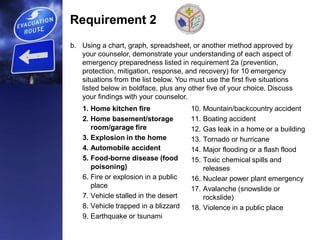
b. Using a chart, graph, spreadsheet, or another method approved
by your counselor, demonstrate your understanding of each
aspect of emergency preparedness listed in requirement 2a
(prevention, protection, mitigation, response, and recovery) for
10 emergency situations from the list below. You must use the
first five situations listed below in boldface, plus any other five of
your choice. Discuss your findings with your counselor.
1. Home kitchen fire
2. Home basement/storage room/garage fire
3. Explosion in the home
4. Automobile accident
5. Food-borne disease (food poisoning)
6. Fire or explosion in a public place
7. Vehicle stalled in the desert
8. Vehicle trapped in a blizzard
9. Earthquake or tsunami
Emergency Preparedness Requirements
2. Do the following:
b. Using a chart, graph, spreadsheet, or another method approved
by your counselor, demonstrate your understanding of each
aspect of emergency preparedness listed in requirement 2a
(prevention, protection, mitigation, response, and recovery) for
10 emergency situations from the list below. You must use the
first five situations listed below in boldface, plus any other five of
your choice. Discuss your findings with your counselor.
10.Mountain/backcountry accident
11.Boating accident
12.Gas leak in a home or a building
13.Tornado or hurricane
14.Major flooding or a flash flood
15.Toxic chemical spills and releases
16.Nuclear power plant emergency
17.Avalanche (snowslide or rockslide)
18.Violence in a public place
Emergency Preparedness Requirements
2. Do the following:
c. Meet with and teach your family how to get or build a kit, make
a plan, and be informed for the situations on the chart you
created for requirement 2b. Complete a family plan. Then meet
with your counselor and report on your family meeting, discuss
their responses, and share your family plan.
3. Show how you could safely save a person from the following:
a. Touching a live household electric wire.
b. A structure filled with carbon monoxide
c. Clothes on fire.
d. Drowning using nonswimming rescues (including accidents on
ice).
4. Show three ways of attracting and communicating with rescue
planes/aircraft.
Emergency Preparedness Requirements
5. With another person, show a good way to transport an injured
person out of a remote and/or rugged area, conserving the energy
of rescuers while ensuring the well-being and protection of the
injured person.
6. Do the following:
a. Take part in an emergency service project, either a real one or
a practice drill, with a Scouting unit or a community agency.
b. Prepare a written plan for mobilizing your troop when needed to
do emergency service. If there is already a plan, explain it. Tell
your part in making it work.
Emergency Preparedness Requirements
7. Do the following:
a. Describe the National Incident Management System (NIMS) and the
Incident Command System (ICS)
b. Identify the local government or community agencies that normally handle
and prepare for emergency services similar to those of the NIMS
or ICS. Explain to your counselor
1. How the NIMS/ICS can assist a Boy Scout troop when responding in
a disaster
2. How a group of Scouts could volunteer to help in the event of these
types of emergencies.
c. Find out who is your community's emergency management director and
learn what this person does to prevent, protect, mitigate, respond to, and
recover from emergency situations in your community. Discuss this
information with your counselor, utilizing the information you learned from
requirement 2b
Requirement 2
8. Do the following:
a. Tell the things a group of Scouts should be prepared to do, the
training they need , and the safety precautions they should take
for the following emergency services:
1. Crowd and traffic control
2. Messenger service and communication.
3. Collection and distribution services.
4. Group feeding, shelter, and sanitation.
b. Prepare a personal emergency service pack for a mobilization
call. Prepare a family kit (suitcase or waterproof box) for use by
your family in case an emergency evacuation is needed.
Explain the needs and uses of the contents.
Emergency Preparedness Requirements
9. Do ONE of the following:
a. Using a safety checklist approved by your counselor, inspect
your home for potential hazards. Explain the hazards you find
and how they can be corrected.
b. Review or develop a plan of escape for your family in case of
fire in your home.
c. Develop an accident prevention program for five family activities
outside the home (such as taking a picnic or seeing a movie)
that includes an analysis of possible hazards, a proposed plan
to correct those hazards, and the reasons for the corrections
you propose.
Emergency Preparedness Requirements
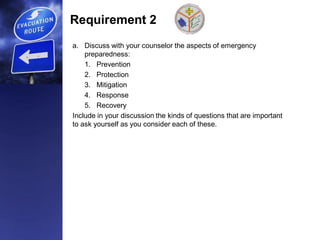
Requirement 1
Earn the First Aid Merit Badge.
Requirement 2
a. Discuss with your counselor the aspects of emergency
preparedness:
1. Prevention
2. Protection
3. Mitigation
4. Response
5. Recovery
Include in your discussion the kinds of questions that are important
to ask yourself as you consider each of these.
5 Aspects of Emergency Preparedness
• The 5 aspects of emergency preparedness are Prevention,
Protection, Mitigation, Response, and Recovery.
• They were first established by the Federal Emergency Management
Agency (FEMA), as a way to improve our national response when
facing different types of disasters.
• By using the 5 preparedness aspects effectively, you can lessen the
damages caused by an emergency, or even prevent it entirely.
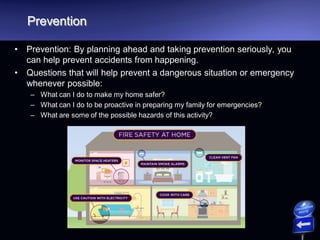
Prevention
• Prevention: By planning ahead and taking prevention seriously, you
can help prevent accidents from happening.
• Questions that will help prevent a dangerous situation or emergency
whenever possible:
– What can I do to make my home safer?
– What can I do to be proactive in preparing my family for emergencies?
– What are some of the possible hazards of this activity?
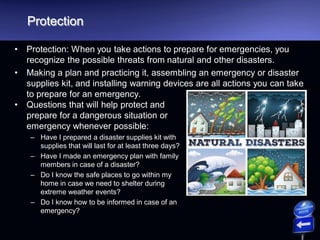
Protection
• Protection: When you take actions to prepare for emergencies, you
recognize the possible threats from natural and other disasters.
• Making a plan and practicing it, assembling an emergency or disaster
supplies kit, and installing warning devices are all actions you can take
to prepare for an emergency.
• Questions that will help protect and
prepare for a dangerous situation or
emergency whenever possible:
– Have I prepared a disaster supplies kit with
supplies that will last for at least three days?
– Have I made an emergency plan with family
members in case of a disaster?
– Do I know the safe places to go within my
home in case we need to shelter during
extreme weather events?
– Do I know how to be informed in case of an
emergency?
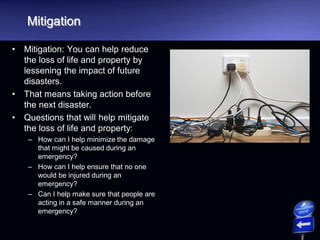
Mitigation
• Mitigation: You can help reduce
the loss of life and property by
lessening the impact of future
disasters.
• That means taking action before
the next disaster.
• Questions that will help mitigate
the loss of life and property:
– How can I help minimize the damage
that might be caused during an
emergency?
– How can I help ensure that no one
would be injured during an
emergency?
– Can I help make sure that people are
acting in a safe manner during an
emergency?
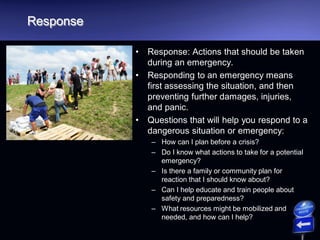
Response
• Response: Actions that should be taken
during an emergency.
• Responding to an emergency means
first assessing the situation, and then
preventing further damages, injuries,
and panic.
• Questions that will help you respond to a
dangerous situation or emergency:
– How can I plan before a crisis?
– Do I know what actions to take for a potential
emergency?
– Is there a family or community plan for
reaction that I should know about?
– Can I help educate and train people about
safety and preparedness?
– What resources might be mobilized and
needed, and how can I help?
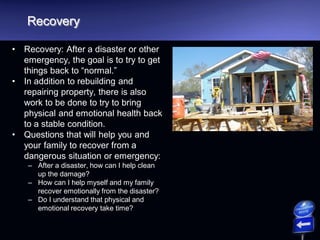
Recovery
• Recovery: After a disaster or other
emergency, the goal is to try to get
things back to “normal.”
• In addition to rebuilding and
repairing property, there is also
work to be done to try to bring
physical and emotional health back
to a stable condition.
• Questions that will help you and
your family to recover from a
dangerous situation or emergency:
– After a disaster, how can I help clean
up the damage?
– How can I help myself and my family
recover emotionally from the disaster?
– Do I understand that physical and
emotional recovery take time?
1. Home kitchen fire
2. Home basement/storage
room/garage fire
3. Explosion in the home
4. Automobile accident
5. Food-borne disease (food
poisoning)
6. Fire or explosion in a public
place
7. Vehicle stalled in the desert
8. Vehicle trapped in a blizzard
9. Earthquake or tsunami
10. Mountain/backcountry accident
11. Boating accident
12. Gas leak in a home or a building
13. Tornado or hurricane
14. Major flooding or a flash flood
15. Toxic chemical spills and
releases
16. Nuclear power plant emergency
17. Avalanche (snowslide or
rockslide)
18. Violence in a public place
b. Using a chart, graph, spreadsheet, or another method approved by
your counselor, demonstrate your understanding of each aspect of
emergency preparedness listed in requirement 2a (prevention,
protection, mitigation, response, and recovery) for 10 emergency
situations from the list below. You must use the first five situations
listed below in boldface, plus any other five of your choice. Discuss
your findings with your counselor.
Requirement 2
Emergency Preparedness
Prevention Protection Mitigation Response Recovery
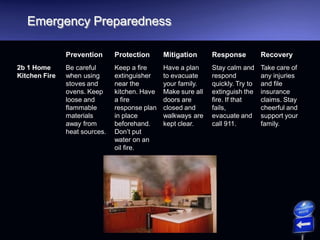
2b 1 Home
Kitchen Fire
Be careful
when using
stoves and
ovens. Keep
loose and
flammable
materials
away from
heat sources.
Keep a fire
extinguisher
near the
kitchen. Have
a fire
response plan
in place
beforehand.
Don’t put
water on an
oil fire.
Have a plan
to evacuate
your family.
Make sure all
doors are
closed and
walkways are
kept clear.
Stay calm and
respond
quickly. Try to
extinguish the
fire. If that
fails,
evacuate and
call 911.
Take care of
any injuries
and file
insurance
claims. Stay
cheerful and
support your
family.
Emergency Preparedness
Prevention Protection Mitigation Response Recovery
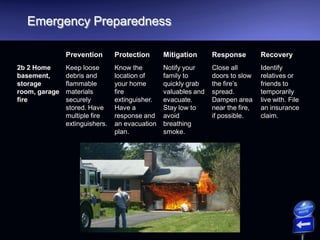
2b 2 Home
basement,
storage
room, garage
fire
Keep loose
debris and
flammable
materials
securely
stored. Have
multiple fire
extinguishers.
Know the
location of
your home
fire
extinguisher.
Have a
response and
an evacuation
plan.
Notify your
family to
quickly grab
valuables and
evacuate.
Stay low to
avoid
breathing
smoke.
Close all
doors to slow
the fire’s
spread.
Dampen area
near the fire,
if possible.
Identify
relatives or
friends to
temporarily
live with. File
an insurance
claim.
Emergency Preparedness
Prevention Protection Mitigation Response Recovery
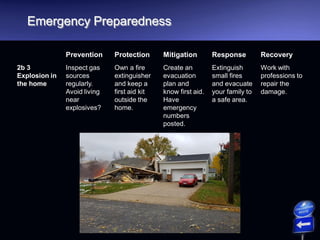
2b 3
Explosion in
the home
Inspect gas
sources
regularly.
Avoid living
near
explosives?
Own a fire
extinguisher
and keep a
first aid kit
outside the
home.
Create an
evacuation
plan and
know first aid.
Have
emergency
numbers
posted.
Extinguish
small fires
and evacuate
your family to
a safe area.
Work with
professions to
repair the
damage.
Emergency Preparedness
Prevention Protection Mitigation Response Recovery
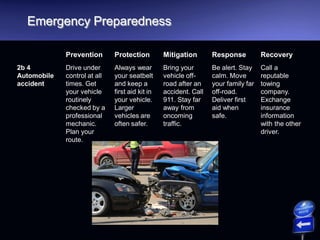
2b 4
Automobile
accident
Drive under
control at all
times. Get
your vehicle
routinely
checked by a
professional
mechanic.
Plan your
route.
Always wear
your seatbelt
and keep a
first aid kit in
your vehicle.
Larger
vehicles are
often safer.
Bring your
vehicle off-
road after an
accident. Call
911. Stay far
away from
oncoming
traffic.
Be alert. Stay
calm. Move
your family far
off-road.
Deliver first
aid when
safe.
Call a
reputable
towing
company.
Exchange
insurance
information
with the other
driver.
Emergency Preparedness
Prevention Protection Mitigation Response Recovery
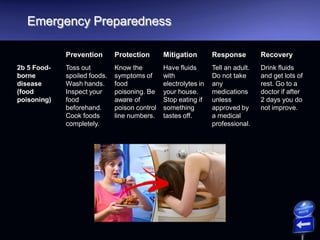
2b 5 Food-
borne
disease
(food
poisoning)
Toss out
spoiled foods.
Wash hands.
Inspect your
food
beforehand.
Cook foods
completely.
Know the
symptoms of
food
poisoning. Be
aware of
poison control
line numbers.
Have fluids
with
electrolytes in
your house.
Stop eating if
something
tastes off.
Tell an adult.
Do not take
any
medications
unless
approved by
a medical
professional.
Drink fluids
and get lots of
rest. Go to a
doctor if after
2 days you do
not improve.
Emergency Preparedness
Prevention Protection Mitigation Response Recovery
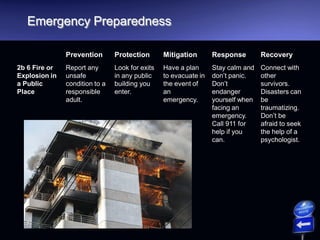
2b 6 Fire or
Explosion in
a Public
Place
Report any
unsafe
condition to a
responsible
adult.
Look for exits
in any public
building you
enter.
Have a plan
to evacuate in
the event of
an
emergency.
Stay calm and
don’t panic.
Don’t
endanger
yourself when
facing an
emergency.
Call 911 for
help if you
can.
Connect with
other
survivors.
Disasters can
be
traumatizing.
Don’t be
afraid to seek
the help of a
psychologist.
Emergency Preparedness
Prevention Protection Mitigation Response Recovery
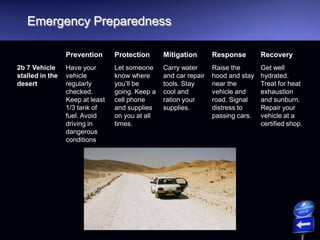
2b 7 Vehicle
stalled in the
desert
Have your
vehicle
regularly
checked.
Keep at least
1/3 tank of
fuel. Avoid
driving in
dangerous
conditions
Let someone
know where
you’ll be
going. Keep a
cell phone
and supplies
on you at all
times.
Carry water
and car repair
tools. Stay
cool and
ration your
supplies.
Raise the
hood and stay
near the
vehicle and
road. Signal
distress to
passing cars.
Get well
hydrated.
Treat for heat
exhaustion
and sunburn.
Repair your
vehicle at a
certified shop.
Emergency Preparedness
Prevention Protection Mitigation Response Recovery
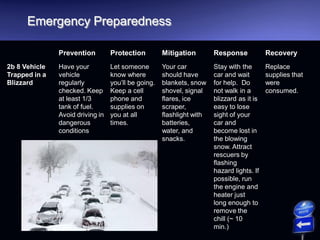
2b 8 Vehicle
Trapped in a
Blizzard
Have your
vehicle
regularly
checked. Keep
at least 1/3
tank of fuel.
Avoid driving in
dangerous
conditions
Let someone
know where
you’ll be going.
Keep a cell
phone and
supplies on
you at all
times.
Your car
should have
blankets, snow
shovel, signal
flares, ice
scraper,
flashlight with
batteries,
water, and
snacks.
Stay with the
car and wait
for help. Do
not walk in a
blizzard as it is
easy to lose
sight of your
car and
become lost in
the blowing
snow. Attract
rescuers by
flashing
hazard lights. If
possible, run
the engine and
heater just
long enough to
remove the
chill (~ 10
min.)
Replace
supplies that
were
consumed.
Emergency Preparedness
Prevention Protection Mitigation Response Recovery
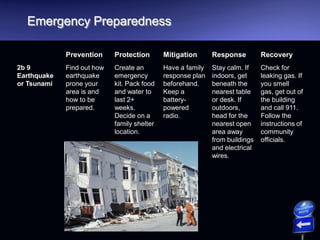
2b 9
Earthquake
or Tsunami
Find out how
earthquake
prone your
area is and
how to be
prepared.
Create an
emergency
kit. Pack food
and water to
last 2+
weeks.
Decide on a
family shelter
location.
Have a family
response plan
beforehand.
Keep a
battery-
powered
radio.
Stay calm. If
indoors, get
beneath the
nearest table
or desk. If
outdoors,
head for the
nearest open
area away
from buildings
and electrical
wires.
Check for
leaking gas. If
you smell
gas, get out of
the building
and call 911.
Follow the
instructions of
community
officials.
Emergency Preparedness
Prevention Protection Mitigation Response Recovery
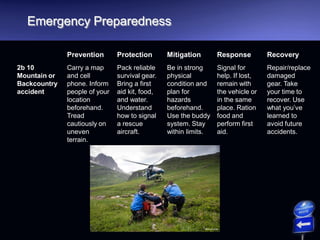
2b 10
Mountain or
Backcountry
accident
Carry a map
and cell
phone. Inform
people of your
location
beforehand.
Tread
cautiously on
uneven
terrain.
Pack reliable
survival gear.
Bring a first
aid kit, food,
and water.
Understand
how to signal
a rescue
aircraft.
Be in strong
physical
condition and
plan for
hazards
beforehand.
Use the buddy
system. Stay
within limits.
Signal for
help. If lost,
remain with
the vehicle or
in the same
place. Ration
food and
perform first
aid.
Repair/replace
damaged
gear. Take
your time to
recover. Use
what you’ve
learned to
avoid future
accidents.
Emergency Preparedness
Prevention Protection Mitigation Response Recovery
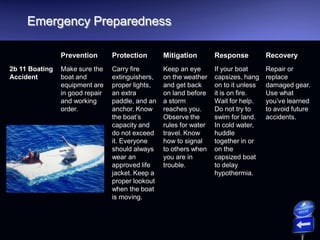
2b 11 Boating
Accident
Make sure the
boat and
equipment are
in good repair
and working
order.
Carry fire
extinguishers,
proper lights,
an extra
paddle, and an
anchor. Know
the boat’s
capacity and
do not exceed
it. Everyone
should always
wear an
approved life
jacket. Keep a
proper lookout
when the boat
is moving.
Keep an eye
on the weather
and get back
on land before
a storm
reaches you.
Observe the
rules for water
travel. Know
how to signal
to others when
you are in
trouble.
If your boat
capsizes, hang
on to it unless
it is on fire.
Wait for help.
Do not try to
swim for land.
In cold water,
huddle
together in or
on the
capsized boat
to delay
hypothermia.
Repair or
replace
damaged gear.
Use what
you’ve learned
to avoid future
accidents.
Emergency Preparedness
Prevention Protection Mitigation Response Recovery
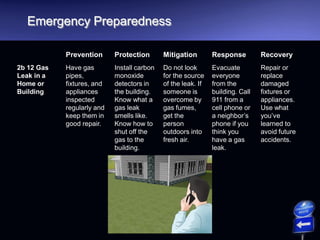
2b 12 Gas
Leak in a
Home or
Building
Have gas
pipes,
fixtures, and
appliances
inspected
regularly and
keep them in
good repair.
Install carbon
monoxide
detectors in
the building.
Know what a
gas leak
smells like.
Know how to
shut off the
gas to the
building.
Do not look
for the source
of the leak. If
someone is
overcome by
gas fumes,
get the
person
outdoors into
fresh air.
Evacuate
everyone
from the
building. Call
911 from a
cell phone or
a neighbor’s
phone if you
think you
have a gas
leak.
Repair or
replace
damaged
fixtures or
appliances.
Use what
you’ve
learned to
avoid future
accidents.
Emergency Preparedness
Prevention Protection Mitigation Response Recovery
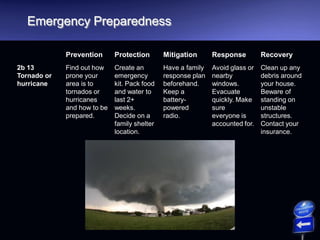
2b 13
Tornado or
hurricane
Find out how
prone your
area is to
tornados or
hurricanes
and how to be
prepared.
Create an
emergency
kit. Pack food
and water to
last 2+
weeks.
Decide on a
family shelter
location.
Have a family
response plan
beforehand.
Keep a
battery-
powered
radio.
Avoid glass or
nearby
windows.
Evacuate
quickly. Make
sure
everyone is
accounted for.
Clean up any
debris around
your house.
Beware of
standing on
unstable
structures.
Contact your
insurance.
Emergency Preparedness
Prevention Protection Mitigation Response Recovery
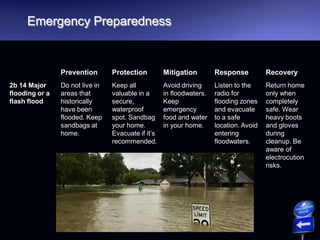
2b 14 Major
flooding or a
flash flood
Do not live in
areas that
historically
have been
flooded. Keep
sandbags at
home.
Keep all
valuable in a
secure,
waterproof
spot. Sandbag
your home.
Evacuate if it’s
recommended.
Avoid driving
in floodwaters.
Keep
emergency
food and water
in your home.
Listen to the
radio for
flooding zones
and evacuate
to a safe
location. Avoid
entering
floodwaters.
Return home
only when
completely
safe. Wear
heavy boots
and gloves
during
cleanup. Be
aware of
electrocution
risks.
Emergency Preparedness
Prevention Protection Mitigation Response Recovery
2b 15 Toxic
chemical
spills and
releases
Find out what
toxic
chemicals are
manufactured
or stored in
your area and
how to be
prepared in
the event of a
spill or
release.
Find out about
the local
government’s
response
program for
hazardous
materials spills
and releases.
Know what the
community
warning
system is to
notify
residents
when an
emergency
occurs.
Evacuate
when told to. If
directed to
shelter in
place, go
inside and
close all doors
and windows.
Turn off any
ventilation
systems that
draw in
outside air.
If anyone is
feeling ill,
having trouble
breathing, or
complaining of
burning
sensations,
get them to the
hospital.
When local
authorities
declare the
event over and
it is safe, you
can go about
your normal
business.
Emergency Preparedness
Prevention Protection Mitigation Response Recovery
2b 16
Nuclear
Power Plant
Emergency
Find out if a
nuclear power
plant is in
your area and
how to be
prepared in
the event of
an
emergency.
Find out
about the
local
government’s
response
program
nuclear
emergencies.
Know what
the
community
warning
system is to
notify
residents
when an
emergency
occurs. Know
evacuation
routes.
Evacuate
when told to.
If directed to
shelter in
place, go
inside and
close all
doors and
windows.
Turn off any
ventilation
systems that
draw in
outside air.
Stay until you
are told it is
safe to leave
Stay calm.
When
outdoors,
cover your
nose and
mouth with a
handkerchief.
When you go
back indoors,
change your
clothes and
shower.
Dispose of
clothing in a
sealed plastic
bag.
Authorities
will monitor
radiation
release and
will let the
public know
when any
danger has
passed.
Emergency Preparedness
Prevention Protection Mitigation Response Recovery
2b 17
Avalanche
(Snowslide or
Rockslide)
Avoid places
where
snowslides or
rockslides
might occur.
Avoid climbing
or skiing in
dangerous high
country without
an experienced
guide. Stay out
of the
mountains after
heavy snowfall.
Do not hike,
stand, or camp
in the fall zone
of a cliff. If
traveling in
mountainous
areas, carry a
rescue beacon.
Experienced
alpine skiers
tie a 30-yd.
red cord to
the belts and
trail this
behind them
as the ski. If
they are
caught in a
snowslide,
the cord will
float to the
surface
where
rescuers can
spot it.
If you are
caught in a
snowslide,
move your
arms and legs
in a swimming
motion to try to
keep your
head above
the surface.
Push snow
away from
your face to
form an air
pocket that will
allow you to
breathe.
If you see
someone
caught in a
snowslide,
watch carefully
so you will be
able to tell
rescuers the
general area
where they
disappeared.
Keep an eye
out for a
second slide
which often
follows the
first.
Emergency Preparedness
Prevention Protection Mitigation Response Recovery
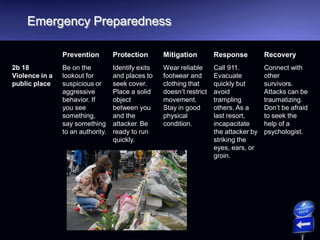
2b 18
Violence in a
public place
Be on the
lookout for
suspicious or
aggressive
behavior. If
you see
something,
say something
to an authority.
Identify exits
and places to
seek cover.
Place a solid
object
between you
and the
attacker. Be
ready to run
quickly.
Wear reliable
footwear and
clothing that
doesn’t restrict
movement.
Stay in good
physical
condition.
Call 911.
Evacuate
quickly but
avoid
trampling
others. As a
last resort,
incapacitate
the attacker by
striking the
eyes, ears, or
groin.
Connect with
other
survivors.
Attacks can be
traumatizing.
Don’t be afraid
to seek the
help of a
psychologist.
Requirement 2
c. Meet with and teach your family how to get or build a kit, make
a plan, and be informed for the situations on the chart you
created for requirement 2b. Complete a family plan. Then meet
with your counselor and report on your family meeting, discuss
their responses, and share your family plan.
Emergency Supply Kit
 Water (1 gallon per day, per
person)
 Food (Non-perishables like
MRE’s, canned goods, dried
foods)
 A can opener
 Eating utensils
 A first aid kit
 A flashlight
 A radio
 Matches in a waterproof
container
 Blankets
 Extra clothing
 Dust masks
 Soap, wipes, or antibacterial gel
 Toilet paper
 Emergency toilet
 Prescription medication
 Batteries
 Important documents and
insurance
 Cash and coins
 Books, games, and other
personal comfort items
 A whistle
 Sunscreen and insect repellant
 Trash bags
• Keep a box of emergency supplies to meet your family’s needs
for a few days or a week.
• Some of the things you’ll need in your emergency supply kit
include:
Family Emergency Plan
• In this, your family will decide on what to do and where you’ll all meet
if an emergency occurs.
• To learn how to write your family emergency plan, watch the official
FEMA planning video by clicking on the picture below:
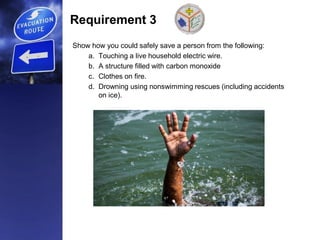
Requirement 3
Show how you could safely save a person from the following:
a. Touching a live household electric wire.
b. A structure filled with carbon monoxide
c. Clothes on fire.
d. Drowning using nonswimming rescues (including accidents
on ice).
Requirement 3
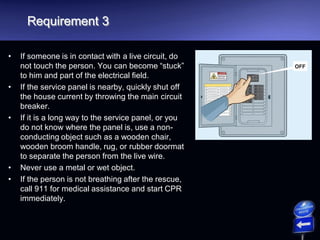
• If someone is in contact with a live circuit, do
not touch the person. You can become “stuck”
to him and part of the electrical field.
• If the service panel is nearby, quickly shut off
the house current by throwing the main circuit
breaker.
• If it is a long way to the service panel, or you
do not know where the panel is, use a non-
conducting object such as a wooden chair,
wooden broom handle, rug, or rubber doormat
to separate the person from the live wire.
• Never use a metal or wet object.
• If the person is not breathing after the rescue,
call 911 for medical assistance and start CPR
immediately.
Structure Filled with Carbon Monoxide (CO)
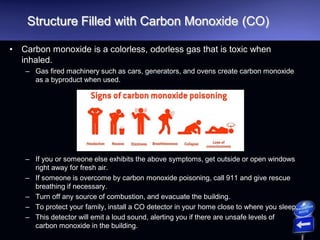
• Carbon monoxide is a colorless, odorless gas that is toxic when
inhaled.
– Gas fired machinery such as cars, generators, and ovens create carbon monoxide
as a byproduct when used.
– If you or someone else exhibits the above symptoms, get outside or open windows
right away for fresh air.
– If someone is overcome by carbon monoxide poisoning, call 911 and give rescue
breathing if necessary.
– Turn off any source of combustion, and evacuate the building.
– To protect your family, install a CO detector in your home close to where you sleep.
– This detector will emit a loud sound, alerting you if there are unsafe levels of
carbon monoxide in the building.
Clothes on Fire
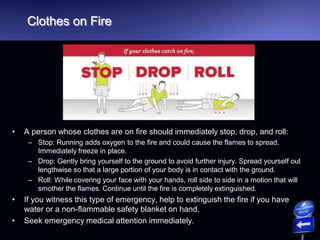
• A person whose clothes are on fire should immediately stop, drop, and roll:
– Stop: Running adds oxygen to the fire and could cause the flames to spread.
Immediately freeze in place.
– Drop: Gently bring yourself to the ground to avoid further injury. Spread yourself out
lengthwise so that a large portion of your body is in contact with the ground.
– Roll: While covering your face with your hands, roll side to side in a motion that will
smother the flames. Continue until the fire is completely extinguished.
• If you witness this type of emergency, help to extinguish the fire if you have
water or a non-flammable safety blanket on hand.
• Seek emergency medical attention immediately.
Drowning Using Non-Swimming Rescues
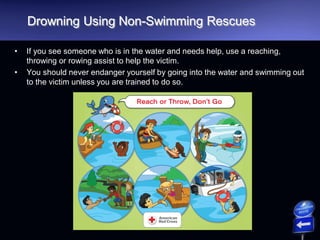
• If you see someone who is in the water and needs help, use a reaching,
throwing or rowing assist to help the victim.
• You should never endanger yourself by going into the water and swimming out
to the victim unless you are trained to do so.
Drowning Using Non-Swimming Rescues
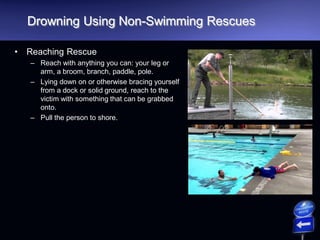
• Reaching Rescue
– Reach with anything you can: your leg or
arm, a broom, branch, paddle, pole.
– Lying down on or otherwise bracing yourself
from a dock or solid ground, reach to the
victim with something that can be grabbed
onto.
– Pull the person to shore.
Drowning Using Non-Swimming Rescues
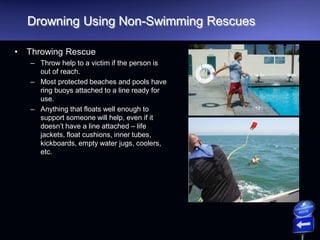
• Throwing Rescue
– Throw help to a victim if the person is
out of reach.
– Most protected beaches and pools have
ring buoys attached to a line ready for
use.
– Anything that floats well enough to
support someone will help, even if it
doesn’t have a line attached – life
jackets, float cushions, inner tubes,
kickboards, empty water jugs, coolers,
etc.
Drowning Using Non-Swimming Rescues
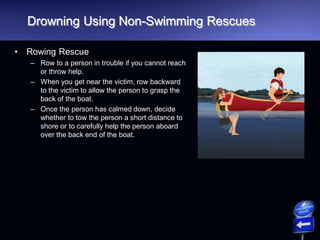
• Rowing Rescue
– Row to a person in trouble if you cannot reach
or throw help.
– When you get near the victim, row backward
to the victim to allow the person to grasp the
back of the boat.
– Once the person has calmed down, decide
whether to tow the person a short distance to
shore or to carefully help the person aboard
over the back end of the boat.
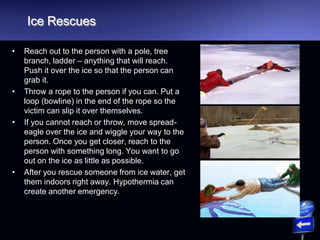
Ice Rescues
• Reach out to the person with a pole, tree
branch, ladder – anything that will reach.
Push it over the ice so that the person can
grab it.
• Throw a rope to the person if you can. Put a
loop (bowline) in the end of the rope so the
victim can slip it over themselves.
• If you cannot reach or throw, move spread-
eagle over the ice and wiggle your way to the
person. Once you get closer, reach to the
person with something long. You want to go
out on the ice as little as possible.
• After you rescue someone from ice water, get
them indoors right away. Hypothermia can
create another emergency.
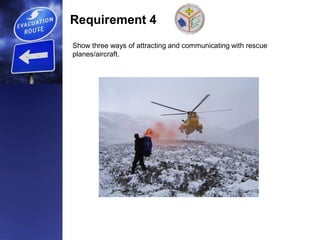
Requirement 4
Show three ways of attracting and communicating with rescue
planes/aircraft.
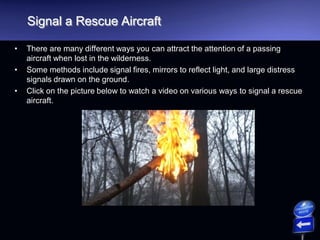
Signal a Rescue Aircraft
• There are many different ways you can attract the attention of a passing
aircraft when lost in the wilderness.
• Some methods include signal fires, mirrors to reflect light, and large distress
signals drawn on the ground.
• Click on the picture below to watch a video on various ways to signal a rescue
aircraft.
Plane Signals
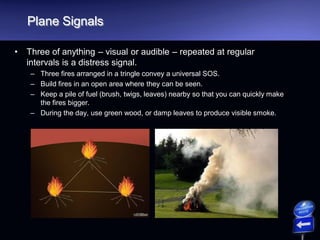
• Three of anything – visual or audible – repeated at regular
intervals is a distress signal.
– Three fires arranged in a tringle convey a universal SOS.
– Build fires in an open area where they can be seen.
– Keep a pile of fuel (brush, twigs, leaves) nearby so that you can quickly make
the fires bigger.
– During the day, use green wood, or damp leaves to produce visible smoke.
Plane Signals
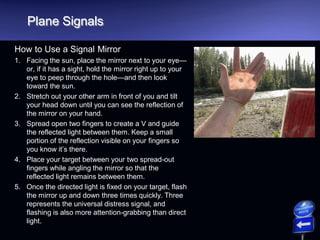
How to Use a Signal Mirror
1. Facing the sun, place the mirror next to your eye—
or, if it has a sight, hold the mirror right up to your
eye to peep through the hole—and then look
toward the sun.
2. Stretch out your other arm in front of you and tilt
your head down until you can see the reflection of
the mirror on your hand.
3. Spread open two fingers to create a V and guide
the reflected light between them. Keep a small
portion of the reflection visible on your fingers so
you know it’s there.
4. Place your target between your two spread-out
fingers while angling the mirror so that the
reflected light remains between them.
5. Once the directed light is fixed on your target, flash
the mirror up and down three times quickly. Three
represents the universal distress signal, and
flashing is also more attention-grabbing than direct
light.
Ground to Air Symbols
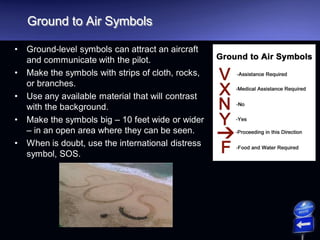
• Ground-level symbols can attract an aircraft
and communicate with the pilot.
• Make the symbols with strips of cloth, rocks,
or branches.
• Use any available material that will contrast
with the background.
• Make the symbols big – 10 feet wide or wider
– in an open area where they can be seen.
• When is doubt, use the international distress
symbol, SOS.
Requirement 5
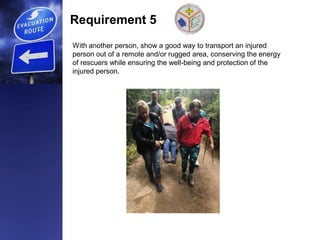
With another person, show a good way to transport an injured
person out of a remote and/or rugged area, conserving the energy
of rescuers while ensuring the well-being and protection of the
injured person.
Method 1: Using the Human Crutch
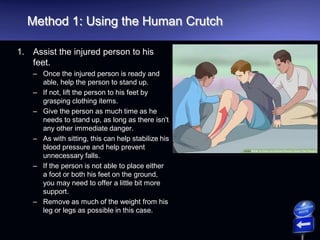
1. Assist the injured person to his
feet.
– Once the injured person is ready and
able, help the person to stand up.
– If not, lift the person to his feet by
grasping clothing items.
– Give the person as much time as he
needs to stand up, as long as there isn't
any other immediate danger.
– As with sitting, this can help stabilize his
blood pressure and help prevent
unnecessary falls.
– If the person is not able to place either
a foot or both his feet on the ground,
you may need to offer a little bit more
support.
– Remove as much of the weight from his
leg or legs as possible in this case.
Method 1: Using the Human Crutch
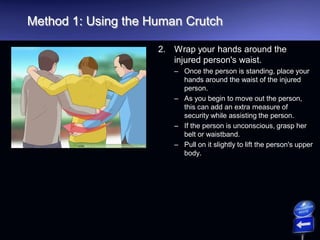
2. Wrap your hands around the
injured person's waist.
– Once the person is standing, place your
hands around the waist of the injured
person.
– As you begin to move out the person,
this can add an extra measure of
security while assisting the person.
– If the person is unconscious, grasp her
belt or waistband.
– Pull on it slightly to lift the person's upper
body.
Method 1: Using the Human Crutch
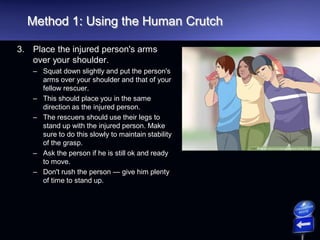
3. Place the injured person's arms
over your shoulder.
– Squat down slightly and put the person's
arms over your shoulder and that of your
fellow rescuer.
– This should place you in the same
direction as the injured person.
– The rescuers should use their legs to
stand up with the injured person. Make
sure to do this slowly to maintain stability
of the grasp.
– Ask the person if he is still ok and ready
to move.
– Don't rush the person — give him plenty
of time to stand up.
Method 1: Using the Human Crutch
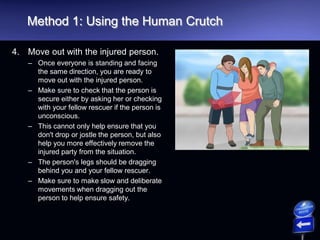
4. Move out with the injured person.
– Once everyone is standing and facing
the same direction, you are ready to
move out with the injured person.
– Make sure to check that the person is
secure either by asking her or checking
with your fellow rescuer if the person is
unconscious.
– This cannot only help ensure that you
don't drop or jostle the person, but also
help you more effectively remove the
injured party from the situation.
– The person's legs should be dragging
behind you and your fellow rescuer.
– Make sure to make slow and deliberate
movements when dragging out the
person to help ensure safety.
Method 2: Improvised Stretcher
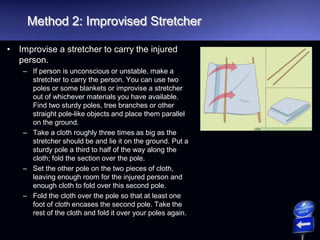
• Improvise a stretcher to carry the injured
person.
– If person is unconscious or unstable, make a
stretcher to carry the person. You can use two
poles or some blankets or improvise a stretcher
out of whichever materials you have available.
Find two sturdy poles, tree branches or other
straight pole-like objects and place them parallel
on the ground.
– Take a cloth roughly three times as big as the
stretcher should be and lie it on the ground. Put a
sturdy pole a third to half of the way along the
cloth; fold the section over the pole.
– Set the other pole on the two pieces of cloth,
leaving enough room for the injured person and
enough cloth to fold over this second pole.
– Fold the cloth over the pole so that at least one
foot of cloth encases the second pole. Take the
rest of the cloth and fold it over your poles again.
Method 2: Improvised Stretcher
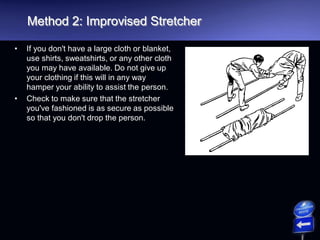
• If you don't have a large cloth or blanket,
use shirts, sweatshirts, or any other cloth
you may have available. Do not give up
your clothing if this will in any way
hamper your ability to assist the person.
• Check to make sure that the stretcher
you've fashioned is as secure as possible
so that you don't drop the person.
Method 3: Two Handed Seat Carry
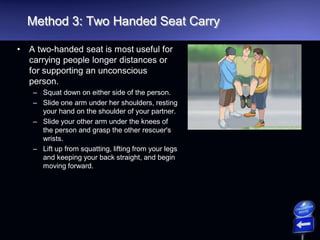
• A two-handed seat is most useful for
carrying people longer distances or
for supporting an unconscious
person.
– Squat down on either side of the person.
– Slide one arm under her shoulders, resting
your hand on the shoulder of your partner.
– Slide your other arm under the knees of
the person and grasp the other rescuer's
wrists.
– Lift up from squatting, lifting from your legs
and keeping your back straight, and begin
moving forward.
Requirement 6
a. Take part in an emergency service project, either a real one or a
practice drill, with a Scouting unit or a community agency.
Emergency Service Project
Lost Child Project
• Scouts are often called on to help find people who are lost and you can help
train your troop on how to do it.
1. Scouts are called together through a troop mobilization plan.
2. For the project, make a “lost child” dummy from a burlap sack stuffed with straw.
a. Put a shirt on it so that the searchers will recognize it along with a card outlining
minor injuries they will have to treat.
3. Before the mobilization call, place the dummy somewhere in the search territory.
a. Position it an area that will prove challenging.
b. Test the searchers’ powers of observation by planting some barely noticeable
“evidence” (such as clothing) of the lost child.
4. After the Scouts have been assembled by the mobilization call, organize them into
search parties and use the lost person search method found on the next two slides.
5. Mark the search area on maps that are distributed to the scouts.
6. Agree on recall signals so the search does not continue after the lost child has been
found.
7. Once found, the lost child should be properly treated for any injuries and transported
safely to the starting point.
Emergency Service Project
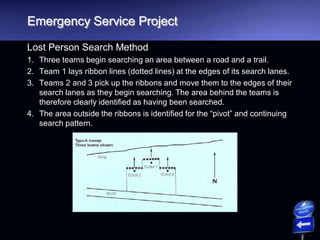
Lost Person Search Method
1. Three teams begin searching an area between a road and a trail.
2. Team 1 lays ribbon lines (dotted lines) at the edges of its search lanes.
3. Teams 2 and 3 pick up the ribbons and move them to the edges of their
search lanes as they begin searching. The area behind the teams is
therefore clearly identified as having been searched.
4. The area outside the ribbons is identified for the “pivot” and continuing
search pattern.
Emergency Service Project
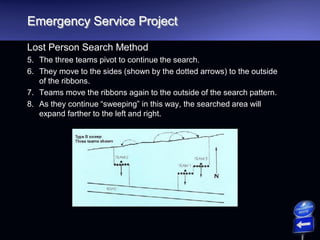
Lost Person Search Method
5. The three teams pivot to continue the search.
6. They move to the sides (shown by the dotted arrows) to the outside
of the ribbons.
7. Teams move the ribbons again to the outside of the search pattern.
8. As they continue “sweeping” in this way, the searched area will
expand farther to the left and right.
Requirement 6
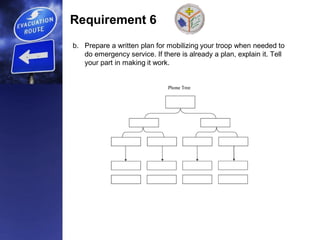
b. Prepare a written plan for mobilizing your troop when needed to
do emergency service. If there is already a plan, explain it. Tell
your part in making it work.
Mobilization Plan
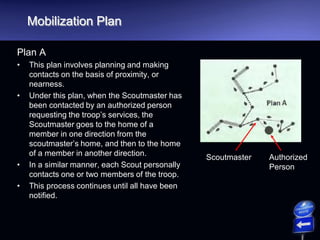
Plan A
• This plan involves planning and making
contacts on the basis of proximity, or
nearness.
• Under this plan, when the Scoutmaster has
been contacted by an authorized person
requesting the troop’s services, the
Scoutmaster goes to the home of a
member in one direction from the
scoutmaster’s home, and then to the home
of a member in another direction.
• In a similar manner, each Scout personally
contacts one or two members of the troop.
• This process continues until all have been
notified.
Scoutmaster Authorized
Person
Mobilization Plan
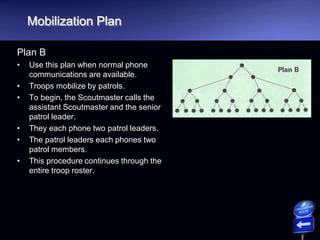
Plan B
• Use this plan when normal phone
communications are available.
• Troops mobilize by patrols.
• To begin, the Scoutmaster calls the
assistant Scoutmaster and the senior
patrol leader.
• They each phone two patrol leaders.
• The patrol leaders each phones two
patrol members.
• This procedure continues through the
entire troop roster.
Requirement 7
a. Describe the National Incident Management System (NIMS) and
the Incident Command System (ICS)
National Incident Management System (NIMS)
• The purpose of the National Incident
Management System is to provide
citizens with a routine that can be used
by the whole community for managing
emergency situations.
• This systematic approach helps guide
individuals groups. And government
agencies in working together to cope
with a range of threats and hazards.
• The principal goal is to prevent loss of
life, reduce property damage, and avert
harm to the environment.
• By using NIMS, communities can more
effectively respond to and manage
emergency situations and utilize
resources such as personnel, food,
water, and shelter more efficiently.
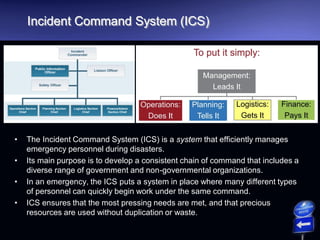
Incident Command System (ICS)
• The Incident Command System (ICS) is a system that efficiently manages
emergency personnel during disasters.
• Its main purpose is to develop a consistent chain of command that includes a
diverse range of government and non-governmental organizations.
• In an emergency, the ICS puts a system in place where many different types
of personnel can quickly begin work under the same command.
• ICS ensures that the most pressing needs are met, and that precious
resources are used without duplication or waste.
Requirement 7
b. Identify the local government or community agencies that
normally handle and prepare for emergency services similar to
those of the NIMS or ICS. Explain to your counselor
1. How the NIMS/ICS can assist a Boy Scout troop when
responding in a disaster
2. How a group of Scouts could volunteer to help in the
event of these types of emergencies.
FEMA
• The Federal Emergency Management Agency (FEMA) is an
organization in charge of preparing for and responding to, disasters.
• Created under the department of homeland security, FEMA operates
sub-agencies in all 50 states.
• You can view FEMA’s official website to locate the FEMA agencies
and offices within your own state.
Wood County Emergency Management Agency
• Website Link: Wood County Emergency Management Agency
• Wood County Courthouse & Office Building
One Courthouse Square Bowling Green, Ohio 43402
• Office Hours: Monday - Friday 8:30 a.m. – 4:30 p.m.
• Office Phone: 419-354-9269
• Office Email: woodcountyema@woodcountyohio.gov
American Red Cross
• The American Red Cross is a humanitarian organization which
provides relief to victims of disasters and helps people prepare for,
respond to, recover from and prevent emergencies.
• Visit the website of The American Red Cross of Northwest Ohio for
more information.
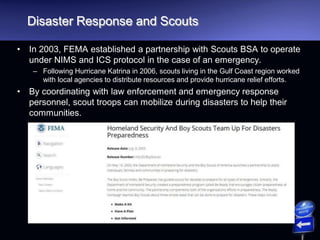
Disaster Response and Scouts
• In 2003, FEMA established a partnership with Scouts BSA to operate
under NIMS and ICS protocol in the case of an emergency.
– Following Hurricane Katrina in 2006, scouts living in the Gulf Coast region worked
with local agencies to distribute resources and provide hurricane relief efforts.
• By coordinating with law enforcement and emergency response
personnel, scout troops can mobilize during disasters to help their
communities.
Requirement 7
c. Find out who is your community's emergency management
director and learn what this person does to prevent, protect,
mitigate, respond to, and recover from emergency situations in
your community. Discuss this information with your counselor,
utilizing the information you learned from requirement 2b
Wood County Emergency Management Agency
• You can find out who your community emergency management
director is by visiting the following website: Wood County
Emergency Management Agency
– Wood County Courthouse & Office Building
One Courthouse Square Bowling Green, Ohio 43402
– Office Hours: Monday through Friday 8:30 a.m. – 4:30 p.m.
– Office Phone: 419-354-9269
– Office Email: woodcountyema@woodcountyohio.gov
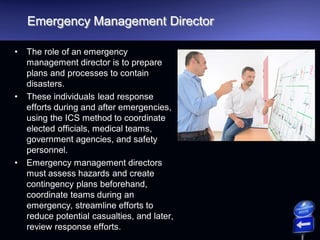
Emergency Management Director
• The role of an emergency
management director is to prepare
plans and processes to contain
disasters.
• These individuals lead response
efforts during and after emergencies,
using the ICS method to coordinate
elected officials, medical teams,
government agencies, and safety
personnel.
• Emergency management directors
must assess hazards and create
contingency plans beforehand,
coordinate teams during an
emergency, streamline efforts to
reduce potential casualties, and later,
review response efforts.
Requirement 8
a. Tell the things a group of Scouts should be prepared to do, the
training they need, and the safety precautions they should take
for the following emergency services:
1. Crowd and traffic control
2. Messenger service and communication.
3. Collection and distribution services.
4. Group feeding, shelter, and sanitation.
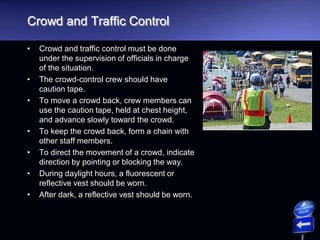
Crowd and Traffic Control
• Crowd and traffic control must be done
under the supervision of officials in charge
of the situation.
• The crowd-control crew should have
caution tape.
• To move a crowd back, crew members can
use the caution tape, held at chest height,
and advance slowly toward the crowd.
• To keep the crowd back, form a chain with
other staff members.
• To direct the movement of a crowd, indicate
direction by pointing or blocking the way.
• During daylight hours, a fluorescent or
reflective vest should be worn.
• After dark, a reflective vest should be worn.
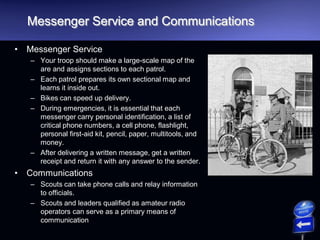
Messenger Service and Communications
• Messenger Service
– Your troop should make a large-scale map of the
are and assigns sections to each patrol.
– Each patrol prepares its own sectional map and
learns it inside out.
– Bikes can speed up delivery.
– During emergencies, it is essential that each
messenger carry personal identification, a list of
critical phone numbers, a cell phone, flashlight,
personal first-aid kit, pencil, paper, multitools, and
money.
– After delivering a written message, get a written
receipt and return it with any answer to the sender.
• Communications
– Scouts can take phone calls and relay information
to officials.
– Scouts and leaders qualified as amateur radio
operators can serve as a primary means of
communication
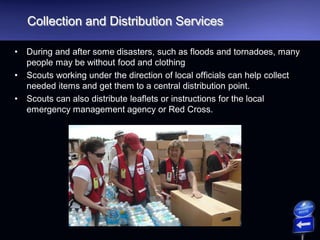
Collection and Distribution Services
• During and after some disasters, such as floods and tornadoes, many
people may be without food and clothing
• Scouts working under the direction of local officials can help collect
needed items and get them to a central distribution point.
• Scouts can also distribute leaflets or instructions for the local
emergency management agency or Red Cross.
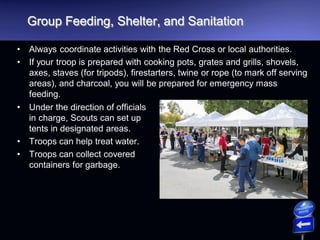
Group Feeding, Shelter, and Sanitation
• Always coordinate activities with the Red Cross or local authorities.
• If your troop is prepared with cooking pots, grates and grills, shovels,
axes, staves (for tripods), firestarters, twine or rope (to mark off serving
areas), and charcoal, you will be prepared for emergency mass
feeding.
• Under the direction of officials
in charge, Scouts can set up
tents in designated areas.
• Troops can help treat water.
• Troops can collect covered
containers for garbage.
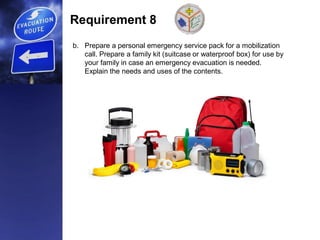
Requirement 8
b. Prepare a personal emergency service pack for a mobilization
call. Prepare a family kit (suitcase or waterproof box) for use by
your family in case an emergency evacuation is needed.
Explain the needs and uses of the contents.
Personal Emergency Service Pack
Be prepared for a mobilization call with a personal emergency service pack.
 Poncho or raincoat
 Change of underwear and socks
 Small bag with toothbrush,
toothpaste, soap, comb, needle,
thread, shoelaces, and toilet paper
 Sleeping bag and waterproof
ground cloth
 Maps of areas where your troop is
likely to serve
 50 feet of Para cord
 Pocket knife, ax, saw
 Water treatment equipment
 Cook kit and canteen
 Flashlight
 Battery-powered radio
 Extra batteries
 Hard hat
 Other equipment as determined by
weather conditions (winter jacket,
rubber boots, gloves, etc.)
 Personal first-aid kit
 Matches in a waterproof container
 Emergency ration (energy bars)
 Pencil and small notebook
 Bandanna
 Compass and map of the area
 Watch (unless you usually wear
one)
 Kleenex
 Work gloves
 Dust masks
 Boots, long-sleeved shirt, long
pants, and safety glasses
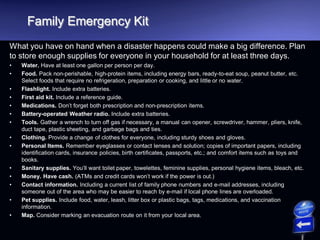
Family Emergency Kit
What you have on hand when a disaster happens could make a big difference. Plan
to store enough supplies for everyone in your household for at least three days.
• Water. Have at least one gallon per person per day.
• Food. Pack non-perishable, high-protein items, including energy bars, ready-to-eat soup, peanut butter, etc.
Select foods that require no refrigeration, preparation or cooking, and little or no water.
• Flashlight. Include extra batteries.
• First aid kit. Include a reference guide.
• Medications. Don’t forget both prescription and non-prescription items.
• Battery-operated Weather radio. Include extra batteries.
• Tools. Gather a wrench to turn off gas if necessary, a manual can opener, screwdriver, hammer, pliers, knife,
duct tape, plastic sheeting, and garbage bags and ties.
• Clothing. Provide a change of clothes for everyone, including sturdy shoes and gloves.
• Personal Items. Remember eyeglasses or contact lenses and solution; copies of important papers, including
identification cards, insurance policies, birth certificates, passports, etc.; and comfort items such as toys and
books.
• Sanitary supplies. You’ll want toilet paper, towelettes, feminine supplies, personal hygiene items, bleach, etc.
• Money. Have cash. (ATMs and credit cards won’t work if the power is out.)
• Contact information. Including a current list of family phone numbers and e-mail addresses, including
someone out of the area who may be easier to reach by e-mail if local phone lines are overloaded.
• Pet supplies. Include food, water, leash, litter box or plastic bags, tags, medications, and vaccination
information.
• Map. Consider marking an evacuation route on it from your local area.
Requirement 9
Do ONE of the following:
a. Using a safety checklist approved by your counselor,
inspect your home for potential hazards. Explain the
hazards you find and how they can be corrected.
b. Review or develop a plan of escape for your family in case
of fire in your home.
c. Develop an accident prevention program for five family
activities outside the home (such as taking a picnic or
seeing a movie) that includes an analysis of possible
hazards, a proposed plan to correct those hazards, and the
reasons for the corrections you propose.
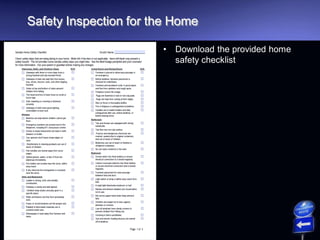
Safety Inspection for the Home
• Download the provided home
safety checklist
Requirement 9
Do ONE of the following:
a. Using a safety checklist approved by your counselor,
inspect your home for potential hazards. Explain the
hazards you find and how they can be corrected.
b. Review or develop a plan of escape for your family in case
of fire in your home.
c. Develop an accident prevention program for five family
activities outside the home (such as taking a picnic or
seeing a movie) that includes an analysis of possible
hazards, a proposed plan to correct those hazards, and the
reasons for the corrections you propose.
Home Fire Escape Plan
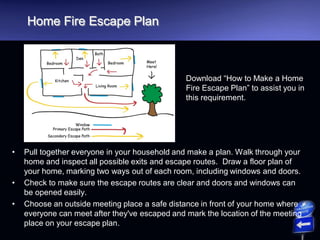
• Pull together everyone in your household and make a plan. Walk through your
home and inspect all possible exits and escape routes. Draw a floor plan of
your home, marking two ways out of each room, including windows and doors.
• Check to make sure the escape routes are clear and doors and windows can
be opened easily.
• Choose an outside meeting place a safe distance in front of your home where
everyone can meet after they've escaped and mark the location of the meeting
place on your escape plan.
Download “How to Make a Home
Fire Escape Plan” to assist you in
this requirement.
Home Fire Escape Plan
• Be fully prepared for a real fire by practicing at
least twice a year.
• Have everyone memorize the emergency
phone number of the fire department to be able
to call them from a neighbor's home or a
cellular phone once safely outside.
• If there are infants, older adults, or family
members with mobility limitations, make sure
that someone is assigned to assist them in the
event of an emergency. Assign a backup
person too, in case the designee is not home
during the emergency
• When a smoke alarm sounds, get out
immediately. Once you're out, stay out! Never
go back into a burning building. If someone is
missing, inform the fire department when you
call. Firefighters have the skills and equipment
to perform rescues.
Requirement 9
Do ONE of the following:
a. Using a safety checklist approved by your counselor,
inspect your home for potential hazards. Explain the
hazards you find and how they can be corrected.
b. Review or develop a plan of escape for your family in case
of fire in your home.
c. Develop an accident prevention program for five family
activities outside the home (such as taking a picnic or
seeing a movie) that includes an analysis of possible
hazards, a proposed plan to correct those hazards, and the
reasons for the corrections you propose.
Family Accident Prevention Program
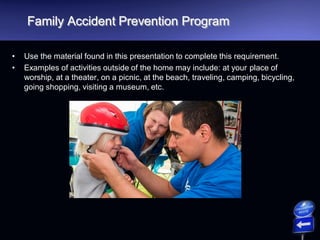
• Use the material found in this presentation to complete this requirement.
• Examples of activities outside of the home may include: at your place of
worship, at a theater, on a picnic, at the beach, traveling, camping, bicycling,
going shopping, visiting a museum, etc.

bsa Emergency Preparation Merit badge pdf

  • 1.
    Emergency Preparedness Merit Badge Troop344 and 9344 Pemberville, OH
  • 2.
    Emergency Preparedness Requirements 1.Earn the First Aid Merit Badge. 2. Do the following: a. Discuss with your counselor the aspects of emergency preparedness: 1. Prevention 2. Protection 3. Mitigation 4. Response 5. Recovery Include in your discussion the kinds of questions that are important to ask yourself as you consider each of these.
  • 3.
    2. Do thefollowing: b. Using a chart, graph, spreadsheet, or another method approved by your counselor, demonstrate your understanding of each aspect of emergency preparedness listed in requirement 2a (prevention, protection, mitigation, response, and recovery) for 10 emergency situations from the list below. You must use the first five situations listed below in boldface, plus any other five of your choice. Discuss your findings with your counselor. 1. Home kitchen fire 2. Home basement/storage room/garage fire 3. Explosion in the home 4. Automobile accident 5. Food-borne disease (food poisoning) 6. Fire or explosion in a public place 7. Vehicle stalled in the desert 8. Vehicle trapped in a blizzard 9. Earthquake or tsunami Emergency Preparedness Requirements
  • 4.
    2. Do thefollowing: b. Using a chart, graph, spreadsheet, or another method approved by your counselor, demonstrate your understanding of each aspect of emergency preparedness listed in requirement 2a (prevention, protection, mitigation, response, and recovery) for 10 emergency situations from the list below. You must use the first five situations listed below in boldface, plus any other five of your choice. Discuss your findings with your counselor. 10.Mountain/backcountry accident 11.Boating accident 12.Gas leak in a home or a building 13.Tornado or hurricane 14.Major flooding or a flash flood 15.Toxic chemical spills and releases 16.Nuclear power plant emergency 17.Avalanche (snowslide or rockslide) 18.Violence in a public place Emergency Preparedness Requirements
  • 5.
    2. Do thefollowing: c. Meet with and teach your family how to get or build a kit, make a plan, and be informed for the situations on the chart you created for requirement 2b. Complete a family plan. Then meet with your counselor and report on your family meeting, discuss their responses, and share your family plan. 3. Show how you could safely save a person from the following: a. Touching a live household electric wire. b. A structure filled with carbon monoxide c. Clothes on fire. d. Drowning using nonswimming rescues (including accidents on ice). 4. Show three ways of attracting and communicating with rescue planes/aircraft. Emergency Preparedness Requirements
  • 6.
    5. With anotherperson, show a good way to transport an injured person out of a remote and/or rugged area, conserving the energy of rescuers while ensuring the well-being and protection of the injured person. 6. Do the following: a. Take part in an emergency service project, either a real one or a practice drill, with a Scouting unit or a community agency. b. Prepare a written plan for mobilizing your troop when needed to do emergency service. If there is already a plan, explain it. Tell your part in making it work. Emergency Preparedness Requirements
  • 7.
    7. Do thefollowing: a. Describe the National Incident Management System (NIMS) and the Incident Command System (ICS) b. Identify the local government or community agencies that normally handle and prepare for emergency services similar to those of the NIMS or ICS. Explain to your counselor 1. How the NIMS/ICS can assist a Boy Scout troop when responding in a disaster 2. How a group of Scouts could volunteer to help in the event of these types of emergencies. c. Find out who is your community's emergency management director and learn what this person does to prevent, protect, mitigate, respond to, and recover from emergency situations in your community. Discuss this information with your counselor, utilizing the information you learned from requirement 2b Requirement 2
  • 8.
    8. Do thefollowing: a. Tell the things a group of Scouts should be prepared to do, the training they need , and the safety precautions they should take for the following emergency services: 1. Crowd and traffic control 2. Messenger service and communication. 3. Collection and distribution services. 4. Group feeding, shelter, and sanitation. b. Prepare a personal emergency service pack for a mobilization call. Prepare a family kit (suitcase or waterproof box) for use by your family in case an emergency evacuation is needed. Explain the needs and uses of the contents. Emergency Preparedness Requirements
  • 9.
    9. Do ONEof the following: a. Using a safety checklist approved by your counselor, inspect your home for potential hazards. Explain the hazards you find and how they can be corrected. b. Review or develop a plan of escape for your family in case of fire in your home. c. Develop an accident prevention program for five family activities outside the home (such as taking a picnic or seeing a movie) that includes an analysis of possible hazards, a proposed plan to correct those hazards, and the reasons for the corrections you propose. Emergency Preparedness Requirements
  • 10.
    Requirement 1 Earn theFirst Aid Merit Badge.
  • 11.
    Requirement 2 a. Discusswith your counselor the aspects of emergency preparedness: 1. Prevention 2. Protection 3. Mitigation 4. Response 5. Recovery Include in your discussion the kinds of questions that are important to ask yourself as you consider each of these.
  • 12.
    5 Aspects ofEmergency Preparedness • The 5 aspects of emergency preparedness are Prevention, Protection, Mitigation, Response, and Recovery. • They were first established by the Federal Emergency Management Agency (FEMA), as a way to improve our national response when facing different types of disasters. • By using the 5 preparedness aspects effectively, you can lessen the damages caused by an emergency, or even prevent it entirely.
  • 13.
    Prevention • Prevention: Byplanning ahead and taking prevention seriously, you can help prevent accidents from happening. • Questions that will help prevent a dangerous situation or emergency whenever possible: – What can I do to make my home safer? – What can I do to be proactive in preparing my family for emergencies? – What are some of the possible hazards of this activity?
  • 14.
    Protection • Protection: Whenyou take actions to prepare for emergencies, you recognize the possible threats from natural and other disasters. • Making a plan and practicing it, assembling an emergency or disaster supplies kit, and installing warning devices are all actions you can take to prepare for an emergency. • Questions that will help protect and prepare for a dangerous situation or emergency whenever possible: – Have I prepared a disaster supplies kit with supplies that will last for at least three days? – Have I made an emergency plan with family members in case of a disaster? – Do I know the safe places to go within my home in case we need to shelter during extreme weather events? – Do I know how to be informed in case of an emergency?
  • 15.
    Mitigation • Mitigation: Youcan help reduce the loss of life and property by lessening the impact of future disasters. • That means taking action before the next disaster. • Questions that will help mitigate the loss of life and property: – How can I help minimize the damage that might be caused during an emergency? – How can I help ensure that no one would be injured during an emergency? – Can I help make sure that people are acting in a safe manner during an emergency?
  • 16.
    Response • Response: Actionsthat should be taken during an emergency. • Responding to an emergency means first assessing the situation, and then preventing further damages, injuries, and panic. • Questions that will help you respond to a dangerous situation or emergency: – How can I plan before a crisis? – Do I know what actions to take for a potential emergency? – Is there a family or community plan for reaction that I should know about? – Can I help educate and train people about safety and preparedness? – What resources might be mobilized and needed, and how can I help?
  • 17.
    Recovery • Recovery: Aftera disaster or other emergency, the goal is to try to get things back to “normal.” • In addition to rebuilding and repairing property, there is also work to be done to try to bring physical and emotional health back to a stable condition. • Questions that will help you and your family to recover from a dangerous situation or emergency: – After a disaster, how can I help clean up the damage? – How can I help myself and my family recover emotionally from the disaster? – Do I understand that physical and emotional recovery take time?
  • 18.
    1. Home kitchenfire 2. Home basement/storage room/garage fire 3. Explosion in the home 4. Automobile accident 5. Food-borne disease (food poisoning) 6. Fire or explosion in a public place 7. Vehicle stalled in the desert 8. Vehicle trapped in a blizzard 9. Earthquake or tsunami 10. Mountain/backcountry accident 11. Boating accident 12. Gas leak in a home or a building 13. Tornado or hurricane 14. Major flooding or a flash flood 15. Toxic chemical spills and releases 16. Nuclear power plant emergency 17. Avalanche (snowslide or rockslide) 18. Violence in a public place b. Using a chart, graph, spreadsheet, or another method approved by your counselor, demonstrate your understanding of each aspect of emergency preparedness listed in requirement 2a (prevention, protection, mitigation, response, and recovery) for 10 emergency situations from the list below. You must use the first five situations listed below in boldface, plus any other five of your choice. Discuss your findings with your counselor. Requirement 2
  • 19.
    Emergency Preparedness Prevention ProtectionMitigation Response Recovery 2b 1 Home Kitchen Fire Be careful when using stoves and ovens. Keep loose and flammable materials away from heat sources. Keep a fire extinguisher near the kitchen. Have a fire response plan in place beforehand. Don’t put water on an oil fire. Have a plan to evacuate your family. Make sure all doors are closed and walkways are kept clear. Stay calm and respond quickly. Try to extinguish the fire. If that fails, evacuate and call 911. Take care of any injuries and file insurance claims. Stay cheerful and support your family.
  • 20.
    Emergency Preparedness Prevention ProtectionMitigation Response Recovery 2b 2 Home basement, storage room, garage fire Keep loose debris and flammable materials securely stored. Have multiple fire extinguishers. Know the location of your home fire extinguisher. Have a response and an evacuation plan. Notify your family to quickly grab valuables and evacuate. Stay low to avoid breathing smoke. Close all doors to slow the fire’s spread. Dampen area near the fire, if possible. Identify relatives or friends to temporarily live with. File an insurance claim.
  • 21.
    Emergency Preparedness Prevention ProtectionMitigation Response Recovery 2b 3 Explosion in the home Inspect gas sources regularly. Avoid living near explosives? Own a fire extinguisher and keep a first aid kit outside the home. Create an evacuation plan and know first aid. Have emergency numbers posted. Extinguish small fires and evacuate your family to a safe area. Work with professions to repair the damage.
  • 22.
    Emergency Preparedness Prevention ProtectionMitigation Response Recovery 2b 4 Automobile accident Drive under control at all times. Get your vehicle routinely checked by a professional mechanic. Plan your route. Always wear your seatbelt and keep a first aid kit in your vehicle. Larger vehicles are often safer. Bring your vehicle off- road after an accident. Call 911. Stay far away from oncoming traffic. Be alert. Stay calm. Move your family far off-road. Deliver first aid when safe. Call a reputable towing company. Exchange insurance information with the other driver.
  • 23.
    Emergency Preparedness Prevention ProtectionMitigation Response Recovery 2b 5 Food- borne disease (food poisoning) Toss out spoiled foods. Wash hands. Inspect your food beforehand. Cook foods completely. Know the symptoms of food poisoning. Be aware of poison control line numbers. Have fluids with electrolytes in your house. Stop eating if something tastes off. Tell an adult. Do not take any medications unless approved by a medical professional. Drink fluids and get lots of rest. Go to a doctor if after 2 days you do not improve.
  • 24.
    Emergency Preparedness Prevention ProtectionMitigation Response Recovery 2b 6 Fire or Explosion in a Public Place Report any unsafe condition to a responsible adult. Look for exits in any public building you enter. Have a plan to evacuate in the event of an emergency. Stay calm and don’t panic. Don’t endanger yourself when facing an emergency. Call 911 for help if you can. Connect with other survivors. Disasters can be traumatizing. Don’t be afraid to seek the help of a psychologist.
  • 25.
    Emergency Preparedness Prevention ProtectionMitigation Response Recovery 2b 7 Vehicle stalled in the desert Have your vehicle regularly checked. Keep at least 1/3 tank of fuel. Avoid driving in dangerous conditions Let someone know where you’ll be going. Keep a cell phone and supplies on you at all times. Carry water and car repair tools. Stay cool and ration your supplies. Raise the hood and stay near the vehicle and road. Signal distress to passing cars. Get well hydrated. Treat for heat exhaustion and sunburn. Repair your vehicle at a certified shop.
  • 26.
    Emergency Preparedness Prevention ProtectionMitigation Response Recovery 2b 8 Vehicle Trapped in a Blizzard Have your vehicle regularly checked. Keep at least 1/3 tank of fuel. Avoid driving in dangerous conditions Let someone know where you’ll be going. Keep a cell phone and supplies on you at all times. Your car should have blankets, snow shovel, signal flares, ice scraper, flashlight with batteries, water, and snacks. Stay with the car and wait for help. Do not walk in a blizzard as it is easy to lose sight of your car and become lost in the blowing snow. Attract rescuers by flashing hazard lights. If possible, run the engine and heater just long enough to remove the chill (~ 10 min.) Replace supplies that were consumed.
  • 27.
    Emergency Preparedness Prevention ProtectionMitigation Response Recovery 2b 9 Earthquake or Tsunami Find out how earthquake prone your area is and how to be prepared. Create an emergency kit. Pack food and water to last 2+ weeks. Decide on a family shelter location. Have a family response plan beforehand. Keep a battery- powered radio. Stay calm. If indoors, get beneath the nearest table or desk. If outdoors, head for the nearest open area away from buildings and electrical wires. Check for leaking gas. If you smell gas, get out of the building and call 911. Follow the instructions of community officials.
  • 28.
    Emergency Preparedness Prevention ProtectionMitigation Response Recovery 2b 10 Mountain or Backcountry accident Carry a map and cell phone. Inform people of your location beforehand. Tread cautiously on uneven terrain. Pack reliable survival gear. Bring a first aid kit, food, and water. Understand how to signal a rescue aircraft. Be in strong physical condition and plan for hazards beforehand. Use the buddy system. Stay within limits. Signal for help. If lost, remain with the vehicle or in the same place. Ration food and perform first aid. Repair/replace damaged gear. Take your time to recover. Use what you’ve learned to avoid future accidents.
  • 29.
    Emergency Preparedness Prevention ProtectionMitigation Response Recovery 2b 11 Boating Accident Make sure the boat and equipment are in good repair and working order. Carry fire extinguishers, proper lights, an extra paddle, and an anchor. Know the boat’s capacity and do not exceed it. Everyone should always wear an approved life jacket. Keep a proper lookout when the boat is moving. Keep an eye on the weather and get back on land before a storm reaches you. Observe the rules for water travel. Know how to signal to others when you are in trouble. If your boat capsizes, hang on to it unless it is on fire. Wait for help. Do not try to swim for land. In cold water, huddle together in or on the capsized boat to delay hypothermia. Repair or replace damaged gear. Use what you’ve learned to avoid future accidents.
  • 30.
    Emergency Preparedness Prevention ProtectionMitigation Response Recovery 2b 12 Gas Leak in a Home or Building Have gas pipes, fixtures, and appliances inspected regularly and keep them in good repair. Install carbon monoxide detectors in the building. Know what a gas leak smells like. Know how to shut off the gas to the building. Do not look for the source of the leak. If someone is overcome by gas fumes, get the person outdoors into fresh air. Evacuate everyone from the building. Call 911 from a cell phone or a neighbor’s phone if you think you have a gas leak. Repair or replace damaged fixtures or appliances. Use what you’ve learned to avoid future accidents.
  • 31.
    Emergency Preparedness Prevention ProtectionMitigation Response Recovery 2b 13 Tornado or hurricane Find out how prone your area is to tornados or hurricanes and how to be prepared. Create an emergency kit. Pack food and water to last 2+ weeks. Decide on a family shelter location. Have a family response plan beforehand. Keep a battery- powered radio. Avoid glass or nearby windows. Evacuate quickly. Make sure everyone is accounted for. Clean up any debris around your house. Beware of standing on unstable structures. Contact your insurance.
  • 32.
    Emergency Preparedness Prevention ProtectionMitigation Response Recovery 2b 14 Major flooding or a flash flood Do not live in areas that historically have been flooded. Keep sandbags at home. Keep all valuable in a secure, waterproof spot. Sandbag your home. Evacuate if it’s recommended. Avoid driving in floodwaters. Keep emergency food and water in your home. Listen to the radio for flooding zones and evacuate to a safe location. Avoid entering floodwaters. Return home only when completely safe. Wear heavy boots and gloves during cleanup. Be aware of electrocution risks.
  • 33.
    Emergency Preparedness Prevention ProtectionMitigation Response Recovery 2b 15 Toxic chemical spills and releases Find out what toxic chemicals are manufactured or stored in your area and how to be prepared in the event of a spill or release. Find out about the local government’s response program for hazardous materials spills and releases. Know what the community warning system is to notify residents when an emergency occurs. Evacuate when told to. If directed to shelter in place, go inside and close all doors and windows. Turn off any ventilation systems that draw in outside air. If anyone is feeling ill, having trouble breathing, or complaining of burning sensations, get them to the hospital. When local authorities declare the event over and it is safe, you can go about your normal business.
  • 34.
    Emergency Preparedness Prevention ProtectionMitigation Response Recovery 2b 16 Nuclear Power Plant Emergency Find out if a nuclear power plant is in your area and how to be prepared in the event of an emergency. Find out about the local government’s response program nuclear emergencies. Know what the community warning system is to notify residents when an emergency occurs. Know evacuation routes. Evacuate when told to. If directed to shelter in place, go inside and close all doors and windows. Turn off any ventilation systems that draw in outside air. Stay until you are told it is safe to leave Stay calm. When outdoors, cover your nose and mouth with a handkerchief. When you go back indoors, change your clothes and shower. Dispose of clothing in a sealed plastic bag. Authorities will monitor radiation release and will let the public know when any danger has passed.
  • 35.
    Emergency Preparedness Prevention ProtectionMitigation Response Recovery 2b 17 Avalanche (Snowslide or Rockslide) Avoid places where snowslides or rockslides might occur. Avoid climbing or skiing in dangerous high country without an experienced guide. Stay out of the mountains after heavy snowfall. Do not hike, stand, or camp in the fall zone of a cliff. If traveling in mountainous areas, carry a rescue beacon. Experienced alpine skiers tie a 30-yd. red cord to the belts and trail this behind them as the ski. If they are caught in a snowslide, the cord will float to the surface where rescuers can spot it. If you are caught in a snowslide, move your arms and legs in a swimming motion to try to keep your head above the surface. Push snow away from your face to form an air pocket that will allow you to breathe. If you see someone caught in a snowslide, watch carefully so you will be able to tell rescuers the general area where they disappeared. Keep an eye out for a second slide which often follows the first.
  • 36.
    Emergency Preparedness Prevention ProtectionMitigation Response Recovery 2b 18 Violence in a public place Be on the lookout for suspicious or aggressive behavior. If you see something, say something to an authority. Identify exits and places to seek cover. Place a solid object between you and the attacker. Be ready to run quickly. Wear reliable footwear and clothing that doesn’t restrict movement. Stay in good physical condition. Call 911. Evacuate quickly but avoid trampling others. As a last resort, incapacitate the attacker by striking the eyes, ears, or groin. Connect with other survivors. Attacks can be traumatizing. Don’t be afraid to seek the help of a psychologist.
  • 37.
    Requirement 2 c. Meetwith and teach your family how to get or build a kit, make a plan, and be informed for the situations on the chart you created for requirement 2b. Complete a family plan. Then meet with your counselor and report on your family meeting, discuss their responses, and share your family plan.
  • 38.
    Emergency Supply Kit Water (1 gallon per day, per person)  Food (Non-perishables like MRE’s, canned goods, dried foods)  A can opener  Eating utensils  A first aid kit  A flashlight  A radio  Matches in a waterproof container  Blankets  Extra clothing  Dust masks  Soap, wipes, or antibacterial gel  Toilet paper  Emergency toilet  Prescription medication  Batteries  Important documents and insurance  Cash and coins  Books, games, and other personal comfort items  A whistle  Sunscreen and insect repellant  Trash bags • Keep a box of emergency supplies to meet your family’s needs for a few days or a week. • Some of the things you’ll need in your emergency supply kit include:
  • 39.
    Family Emergency Plan •In this, your family will decide on what to do and where you’ll all meet if an emergency occurs. • To learn how to write your family emergency plan, watch the official FEMA planning video by clicking on the picture below:
  • 40.
    Requirement 3 Show howyou could safely save a person from the following: a. Touching a live household electric wire. b. A structure filled with carbon monoxide c. Clothes on fire. d. Drowning using nonswimming rescues (including accidents on ice).
  • 41.
    Requirement 3 • Ifsomeone is in contact with a live circuit, do not touch the person. You can become “stuck” to him and part of the electrical field. • If the service panel is nearby, quickly shut off the house current by throwing the main circuit breaker. • If it is a long way to the service panel, or you do not know where the panel is, use a non- conducting object such as a wooden chair, wooden broom handle, rug, or rubber doormat to separate the person from the live wire. • Never use a metal or wet object. • If the person is not breathing after the rescue, call 911 for medical assistance and start CPR immediately.
  • 42.
    Structure Filled withCarbon Monoxide (CO) • Carbon monoxide is a colorless, odorless gas that is toxic when inhaled. – Gas fired machinery such as cars, generators, and ovens create carbon monoxide as a byproduct when used. – If you or someone else exhibits the above symptoms, get outside or open windows right away for fresh air. – If someone is overcome by carbon monoxide poisoning, call 911 and give rescue breathing if necessary. – Turn off any source of combustion, and evacuate the building. – To protect your family, install a CO detector in your home close to where you sleep. – This detector will emit a loud sound, alerting you if there are unsafe levels of carbon monoxide in the building.
  • 43.
    Clothes on Fire •A person whose clothes are on fire should immediately stop, drop, and roll: – Stop: Running adds oxygen to the fire and could cause the flames to spread. Immediately freeze in place. – Drop: Gently bring yourself to the ground to avoid further injury. Spread yourself out lengthwise so that a large portion of your body is in contact with the ground. – Roll: While covering your face with your hands, roll side to side in a motion that will smother the flames. Continue until the fire is completely extinguished. • If you witness this type of emergency, help to extinguish the fire if you have water or a non-flammable safety blanket on hand. • Seek emergency medical attention immediately.
  • 44.
    Drowning Using Non-SwimmingRescues • If you see someone who is in the water and needs help, use a reaching, throwing or rowing assist to help the victim. • You should never endanger yourself by going into the water and swimming out to the victim unless you are trained to do so.
  • 45.
    Drowning Using Non-SwimmingRescues • Reaching Rescue – Reach with anything you can: your leg or arm, a broom, branch, paddle, pole. – Lying down on or otherwise bracing yourself from a dock or solid ground, reach to the victim with something that can be grabbed onto. – Pull the person to shore.
  • 46.
    Drowning Using Non-SwimmingRescues • Throwing Rescue – Throw help to a victim if the person is out of reach. – Most protected beaches and pools have ring buoys attached to a line ready for use. – Anything that floats well enough to support someone will help, even if it doesn’t have a line attached – life jackets, float cushions, inner tubes, kickboards, empty water jugs, coolers, etc.
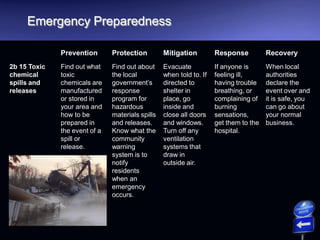
  • 47.
    Drowning Using Non-SwimmingRescues • Rowing Rescue – Row to a person in trouble if you cannot reach or throw help. – When you get near the victim, row backward to the victim to allow the person to grasp the back of the boat. – Once the person has calmed down, decide whether to tow the person a short distance to shore or to carefully help the person aboard over the back end of the boat.
  • 48.
    Ice Rescues • Reachout to the person with a pole, tree branch, ladder – anything that will reach. Push it over the ice so that the person can grab it. • Throw a rope to the person if you can. Put a loop (bowline) in the end of the rope so the victim can slip it over themselves. • If you cannot reach or throw, move spread- eagle over the ice and wiggle your way to the person. Once you get closer, reach to the person with something long. You want to go out on the ice as little as possible. • After you rescue someone from ice water, get them indoors right away. Hypothermia can create another emergency.
  • 49.
    Requirement 4 Show threeways of attracting and communicating with rescue planes/aircraft.
  • 50.
    Signal a RescueAircraft • There are many different ways you can attract the attention of a passing aircraft when lost in the wilderness. • Some methods include signal fires, mirrors to reflect light, and large distress signals drawn on the ground. • Click on the picture below to watch a video on various ways to signal a rescue aircraft.
  • 51.
    Plane Signals • Threeof anything – visual or audible – repeated at regular intervals is a distress signal. – Three fires arranged in a tringle convey a universal SOS. – Build fires in an open area where they can be seen. – Keep a pile of fuel (brush, twigs, leaves) nearby so that you can quickly make the fires bigger. – During the day, use green wood, or damp leaves to produce visible smoke.
  • 52.
    Plane Signals How toUse a Signal Mirror 1. Facing the sun, place the mirror next to your eye— or, if it has a sight, hold the mirror right up to your eye to peep through the hole—and then look toward the sun. 2. Stretch out your other arm in front of you and tilt your head down until you can see the reflection of the mirror on your hand. 3. Spread open two fingers to create a V and guide the reflected light between them. Keep a small portion of the reflection visible on your fingers so you know it’s there. 4. Place your target between your two spread-out fingers while angling the mirror so that the reflected light remains between them. 5. Once the directed light is fixed on your target, flash the mirror up and down three times quickly. Three represents the universal distress signal, and flashing is also more attention-grabbing than direct light.
  • 53.
    Ground to AirSymbols • Ground-level symbols can attract an aircraft and communicate with the pilot. • Make the symbols with strips of cloth, rocks, or branches. • Use any available material that will contrast with the background. • Make the symbols big – 10 feet wide or wider – in an open area where they can be seen. • When is doubt, use the international distress symbol, SOS.
  • 54.
    Requirement 5 With anotherperson, show a good way to transport an injured person out of a remote and/or rugged area, conserving the energy of rescuers while ensuring the well-being and protection of the injured person.
  • 55.
    Method 1: Usingthe Human Crutch 1. Assist the injured person to his feet. – Once the injured person is ready and able, help the person to stand up. – If not, lift the person to his feet by grasping clothing items. – Give the person as much time as he needs to stand up, as long as there isn't any other immediate danger. – As with sitting, this can help stabilize his blood pressure and help prevent unnecessary falls. – If the person is not able to place either a foot or both his feet on the ground, you may need to offer a little bit more support. – Remove as much of the weight from his leg or legs as possible in this case.
  • 56.
    Method 1: Usingthe Human Crutch 2. Wrap your hands around the injured person's waist. – Once the person is standing, place your hands around the waist of the injured person. – As you begin to move out the person, this can add an extra measure of security while assisting the person. – If the person is unconscious, grasp her belt or waistband. – Pull on it slightly to lift the person's upper body.
  • 57.
    Method 1: Usingthe Human Crutch 3. Place the injured person's arms over your shoulder. – Squat down slightly and put the person's arms over your shoulder and that of your fellow rescuer. – This should place you in the same direction as the injured person. – The rescuers should use their legs to stand up with the injured person. Make sure to do this slowly to maintain stability of the grasp. – Ask the person if he is still ok and ready to move. – Don't rush the person — give him plenty of time to stand up.
  • 58.
    Method 1: Usingthe Human Crutch 4. Move out with the injured person. – Once everyone is standing and facing the same direction, you are ready to move out with the injured person. – Make sure to check that the person is secure either by asking her or checking with your fellow rescuer if the person is unconscious. – This cannot only help ensure that you don't drop or jostle the person, but also help you more effectively remove the injured party from the situation. – The person's legs should be dragging behind you and your fellow rescuer. – Make sure to make slow and deliberate movements when dragging out the person to help ensure safety.
  • 59.
    Method 2: ImprovisedStretcher • Improvise a stretcher to carry the injured person. – If person is unconscious or unstable, make a stretcher to carry the person. You can use two poles or some blankets or improvise a stretcher out of whichever materials you have available. Find two sturdy poles, tree branches or other straight pole-like objects and place them parallel on the ground. – Take a cloth roughly three times as big as the stretcher should be and lie it on the ground. Put a sturdy pole a third to half of the way along the cloth; fold the section over the pole. – Set the other pole on the two pieces of cloth, leaving enough room for the injured person and enough cloth to fold over this second pole. – Fold the cloth over the pole so that at least one foot of cloth encases the second pole. Take the rest of the cloth and fold it over your poles again.
  • 60.
    Method 2: ImprovisedStretcher • If you don't have a large cloth or blanket, use shirts, sweatshirts, or any other cloth you may have available. Do not give up your clothing if this will in any way hamper your ability to assist the person. • Check to make sure that the stretcher you've fashioned is as secure as possible so that you don't drop the person.
  • 61.
    Method 3: TwoHanded Seat Carry • A two-handed seat is most useful for carrying people longer distances or for supporting an unconscious person. – Squat down on either side of the person. – Slide one arm under her shoulders, resting your hand on the shoulder of your partner. – Slide your other arm under the knees of the person and grasp the other rescuer's wrists. – Lift up from squatting, lifting from your legs and keeping your back straight, and begin moving forward.
  • 62.
    Requirement 6 a. Takepart in an emergency service project, either a real one or a practice drill, with a Scouting unit or a community agency.
  • 63.
    Emergency Service Project LostChild Project • Scouts are often called on to help find people who are lost and you can help train your troop on how to do it. 1. Scouts are called together through a troop mobilization plan. 2. For the project, make a “lost child” dummy from a burlap sack stuffed with straw. a. Put a shirt on it so that the searchers will recognize it along with a card outlining minor injuries they will have to treat. 3. Before the mobilization call, place the dummy somewhere in the search territory. a. Position it an area that will prove challenging. b. Test the searchers’ powers of observation by planting some barely noticeable “evidence” (such as clothing) of the lost child. 4. After the Scouts have been assembled by the mobilization call, organize them into search parties and use the lost person search method found on the next two slides. 5. Mark the search area on maps that are distributed to the scouts. 6. Agree on recall signals so the search does not continue after the lost child has been found. 7. Once found, the lost child should be properly treated for any injuries and transported safely to the starting point.
  • 64.
    Emergency Service Project LostPerson Search Method 1. Three teams begin searching an area between a road and a trail. 2. Team 1 lays ribbon lines (dotted lines) at the edges of its search lanes. 3. Teams 2 and 3 pick up the ribbons and move them to the edges of their search lanes as they begin searching. The area behind the teams is therefore clearly identified as having been searched. 4. The area outside the ribbons is identified for the “pivot” and continuing search pattern.
  • 65.
    Emergency Service Project LostPerson Search Method 5. The three teams pivot to continue the search. 6. They move to the sides (shown by the dotted arrows) to the outside of the ribbons. 7. Teams move the ribbons again to the outside of the search pattern. 8. As they continue “sweeping” in this way, the searched area will expand farther to the left and right.
  • 66.
    Requirement 6 b. Preparea written plan for mobilizing your troop when needed to do emergency service. If there is already a plan, explain it. Tell your part in making it work.
  • 67.
    Mobilization Plan Plan A •This plan involves planning and making contacts on the basis of proximity, or nearness. • Under this plan, when the Scoutmaster has been contacted by an authorized person requesting the troop’s services, the Scoutmaster goes to the home of a member in one direction from the scoutmaster’s home, and then to the home of a member in another direction. • In a similar manner, each Scout personally contacts one or two members of the troop. • This process continues until all have been notified. Scoutmaster Authorized Person
  • 68.
    Mobilization Plan Plan B •Use this plan when normal phone communications are available. • Troops mobilize by patrols. • To begin, the Scoutmaster calls the assistant Scoutmaster and the senior patrol leader. • They each phone two patrol leaders. • The patrol leaders each phones two patrol members. • This procedure continues through the entire troop roster.
  • 69.
    Requirement 7 a. Describethe National Incident Management System (NIMS) and the Incident Command System (ICS)
  • 70.
    National Incident ManagementSystem (NIMS) • The purpose of the National Incident Management System is to provide citizens with a routine that can be used by the whole community for managing emergency situations. • This systematic approach helps guide individuals groups. And government agencies in working together to cope with a range of threats and hazards. • The principal goal is to prevent loss of life, reduce property damage, and avert harm to the environment. • By using NIMS, communities can more effectively respond to and manage emergency situations and utilize resources such as personnel, food, water, and shelter more efficiently.
  • 71.
    Incident Command System(ICS) • The Incident Command System (ICS) is a system that efficiently manages emergency personnel during disasters. • Its main purpose is to develop a consistent chain of command that includes a diverse range of government and non-governmental organizations. • In an emergency, the ICS puts a system in place where many different types of personnel can quickly begin work under the same command. • ICS ensures that the most pressing needs are met, and that precious resources are used without duplication or waste.
  • 72.
    Requirement 7 b. Identifythe local government or community agencies that normally handle and prepare for emergency services similar to those of the NIMS or ICS. Explain to your counselor 1. How the NIMS/ICS can assist a Boy Scout troop when responding in a disaster 2. How a group of Scouts could volunteer to help in the event of these types of emergencies.
  • 73.
    FEMA • The FederalEmergency Management Agency (FEMA) is an organization in charge of preparing for and responding to, disasters. • Created under the department of homeland security, FEMA operates sub-agencies in all 50 states. • You can view FEMA’s official website to locate the FEMA agencies and offices within your own state.
  • 74.
    Wood County EmergencyManagement Agency • Website Link: Wood County Emergency Management Agency • Wood County Courthouse & Office Building One Courthouse Square Bowling Green, Ohio 43402 • Office Hours: Monday - Friday 8:30 a.m. – 4:30 p.m. • Office Phone: 419-354-9269 • Office Email: woodcountyema@woodcountyohio.gov
  • 75.
    American Red Cross •The American Red Cross is a humanitarian organization which provides relief to victims of disasters and helps people prepare for, respond to, recover from and prevent emergencies. • Visit the website of The American Red Cross of Northwest Ohio for more information.
  • 76.
    Disaster Response andScouts • In 2003, FEMA established a partnership with Scouts BSA to operate under NIMS and ICS protocol in the case of an emergency. – Following Hurricane Katrina in 2006, scouts living in the Gulf Coast region worked with local agencies to distribute resources and provide hurricane relief efforts. • By coordinating with law enforcement and emergency response personnel, scout troops can mobilize during disasters to help their communities.
  • 77.
    Requirement 7 c. Findout who is your community's emergency management director and learn what this person does to prevent, protect, mitigate, respond to, and recover from emergency situations in your community. Discuss this information with your counselor, utilizing the information you learned from requirement 2b
  • 78.
    Wood County EmergencyManagement Agency • You can find out who your community emergency management director is by visiting the following website: Wood County Emergency Management Agency – Wood County Courthouse & Office Building One Courthouse Square Bowling Green, Ohio 43402 – Office Hours: Monday through Friday 8:30 a.m. – 4:30 p.m. – Office Phone: 419-354-9269 – Office Email: woodcountyema@woodcountyohio.gov
  • 79.
    Emergency Management Director •The role of an emergency management director is to prepare plans and processes to contain disasters. • These individuals lead response efforts during and after emergencies, using the ICS method to coordinate elected officials, medical teams, government agencies, and safety personnel. • Emergency management directors must assess hazards and create contingency plans beforehand, coordinate teams during an emergency, streamline efforts to reduce potential casualties, and later, review response efforts.
  • 80.
    Requirement 8 a. Tellthe things a group of Scouts should be prepared to do, the training they need, and the safety precautions they should take for the following emergency services: 1. Crowd and traffic control 2. Messenger service and communication. 3. Collection and distribution services. 4. Group feeding, shelter, and sanitation.
  • 81.
    Crowd and TrafficControl • Crowd and traffic control must be done under the supervision of officials in charge of the situation. • The crowd-control crew should have caution tape. • To move a crowd back, crew members can use the caution tape, held at chest height, and advance slowly toward the crowd. • To keep the crowd back, form a chain with other staff members. • To direct the movement of a crowd, indicate direction by pointing or blocking the way. • During daylight hours, a fluorescent or reflective vest should be worn. • After dark, a reflective vest should be worn.
  • 82.
    Messenger Service andCommunications • Messenger Service – Your troop should make a large-scale map of the are and assigns sections to each patrol. – Each patrol prepares its own sectional map and learns it inside out. – Bikes can speed up delivery. – During emergencies, it is essential that each messenger carry personal identification, a list of critical phone numbers, a cell phone, flashlight, personal first-aid kit, pencil, paper, multitools, and money. – After delivering a written message, get a written receipt and return it with any answer to the sender. • Communications – Scouts can take phone calls and relay information to officials. – Scouts and leaders qualified as amateur radio operators can serve as a primary means of communication
  • 83.
    Collection and DistributionServices • During and after some disasters, such as floods and tornadoes, many people may be without food and clothing • Scouts working under the direction of local officials can help collect needed items and get them to a central distribution point. • Scouts can also distribute leaflets or instructions for the local emergency management agency or Red Cross.
  • 84.
    Group Feeding, Shelter,and Sanitation • Always coordinate activities with the Red Cross or local authorities. • If your troop is prepared with cooking pots, grates and grills, shovels, axes, staves (for tripods), firestarters, twine or rope (to mark off serving areas), and charcoal, you will be prepared for emergency mass feeding. • Under the direction of officials in charge, Scouts can set up tents in designated areas. • Troops can help treat water. • Troops can collect covered containers for garbage.
  • 85.
    Requirement 8 b. Preparea personal emergency service pack for a mobilization call. Prepare a family kit (suitcase or waterproof box) for use by your family in case an emergency evacuation is needed. Explain the needs and uses of the contents.
  • 86.
    Personal Emergency ServicePack Be prepared for a mobilization call with a personal emergency service pack.  Poncho or raincoat  Change of underwear and socks  Small bag with toothbrush, toothpaste, soap, comb, needle, thread, shoelaces, and toilet paper  Sleeping bag and waterproof ground cloth  Maps of areas where your troop is likely to serve  50 feet of Para cord  Pocket knife, ax, saw  Water treatment equipment  Cook kit and canteen  Flashlight  Battery-powered radio  Extra batteries  Hard hat  Other equipment as determined by weather conditions (winter jacket, rubber boots, gloves, etc.)  Personal first-aid kit  Matches in a waterproof container  Emergency ration (energy bars)  Pencil and small notebook  Bandanna  Compass and map of the area  Watch (unless you usually wear one)  Kleenex  Work gloves  Dust masks  Boots, long-sleeved shirt, long pants, and safety glasses
  • 87.
    Family Emergency Kit Whatyou have on hand when a disaster happens could make a big difference. Plan to store enough supplies for everyone in your household for at least three days. • Water. Have at least one gallon per person per day. • Food. Pack non-perishable, high-protein items, including energy bars, ready-to-eat soup, peanut butter, etc. Select foods that require no refrigeration, preparation or cooking, and little or no water. • Flashlight. Include extra batteries. • First aid kit. Include a reference guide. • Medications. Don’t forget both prescription and non-prescription items. • Battery-operated Weather radio. Include extra batteries. • Tools. Gather a wrench to turn off gas if necessary, a manual can opener, screwdriver, hammer, pliers, knife, duct tape, plastic sheeting, and garbage bags and ties. • Clothing. Provide a change of clothes for everyone, including sturdy shoes and gloves. • Personal Items. Remember eyeglasses or contact lenses and solution; copies of important papers, including identification cards, insurance policies, birth certificates, passports, etc.; and comfort items such as toys and books. • Sanitary supplies. You’ll want toilet paper, towelettes, feminine supplies, personal hygiene items, bleach, etc. • Money. Have cash. (ATMs and credit cards won’t work if the power is out.) • Contact information. Including a current list of family phone numbers and e-mail addresses, including someone out of the area who may be easier to reach by e-mail if local phone lines are overloaded. • Pet supplies. Include food, water, leash, litter box or plastic bags, tags, medications, and vaccination information. • Map. Consider marking an evacuation route on it from your local area.
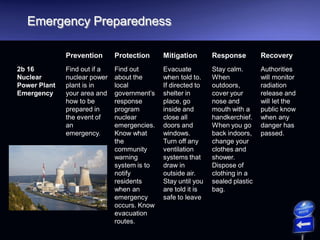
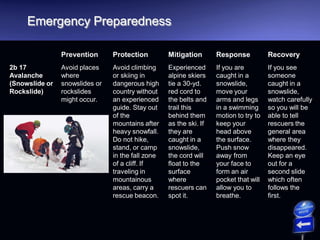
  • 88.
    Requirement 9 Do ONEof the following: a. Using a safety checklist approved by your counselor, inspect your home for potential hazards. Explain the hazards you find and how they can be corrected. b. Review or develop a plan of escape for your family in case of fire in your home. c. Develop an accident prevention program for five family activities outside the home (such as taking a picnic or seeing a movie) that includes an analysis of possible hazards, a proposed plan to correct those hazards, and the reasons for the corrections you propose.
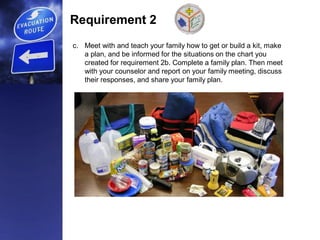
  • 89.
    Safety Inspection forthe Home • Download the provided home safety checklist
  • 90.
    Requirement 9 Do ONEof the following: a. Using a safety checklist approved by your counselor, inspect your home for potential hazards. Explain the hazards you find and how they can be corrected. b. Review or develop a plan of escape for your family in case of fire in your home. c. Develop an accident prevention program for five family activities outside the home (such as taking a picnic or seeing a movie) that includes an analysis of possible hazards, a proposed plan to correct those hazards, and the reasons for the corrections you propose.
  • 91.
    Home Fire EscapePlan • Pull together everyone in your household and make a plan. Walk through your home and inspect all possible exits and escape routes. Draw a floor plan of your home, marking two ways out of each room, including windows and doors. • Check to make sure the escape routes are clear and doors and windows can be opened easily. • Choose an outside meeting place a safe distance in front of your home where everyone can meet after they've escaped and mark the location of the meeting place on your escape plan. Download “How to Make a Home Fire Escape Plan” to assist you in this requirement.
  • 92.
    Home Fire EscapePlan • Be fully prepared for a real fire by practicing at least twice a year. • Have everyone memorize the emergency phone number of the fire department to be able to call them from a neighbor's home or a cellular phone once safely outside. • If there are infants, older adults, or family members with mobility limitations, make sure that someone is assigned to assist them in the event of an emergency. Assign a backup person too, in case the designee is not home during the emergency • When a smoke alarm sounds, get out immediately. Once you're out, stay out! Never go back into a burning building. If someone is missing, inform the fire department when you call. Firefighters have the skills and equipment to perform rescues.
  • 93.
    Requirement 9 Do ONEof the following: a. Using a safety checklist approved by your counselor, inspect your home for potential hazards. Explain the hazards you find and how they can be corrected. b. Review or develop a plan of escape for your family in case of fire in your home. c. Develop an accident prevention program for five family activities outside the home (such as taking a picnic or seeing a movie) that includes an analysis of possible hazards, a proposed plan to correct those hazards, and the reasons for the corrections you propose.
  • 94.
    Family Accident PreventionProgram • Use the material found in this presentation to complete this requirement. • Examples of activities outside of the home may include: at your place of worship, at a theater, on a picnic, at the beach, traveling, camping, bicycling, going shopping, visiting a museum, etc.