Spring IoC
Timothy Spann (spannt)
HP Blog:
http://blogs.hp.com/agiledev/
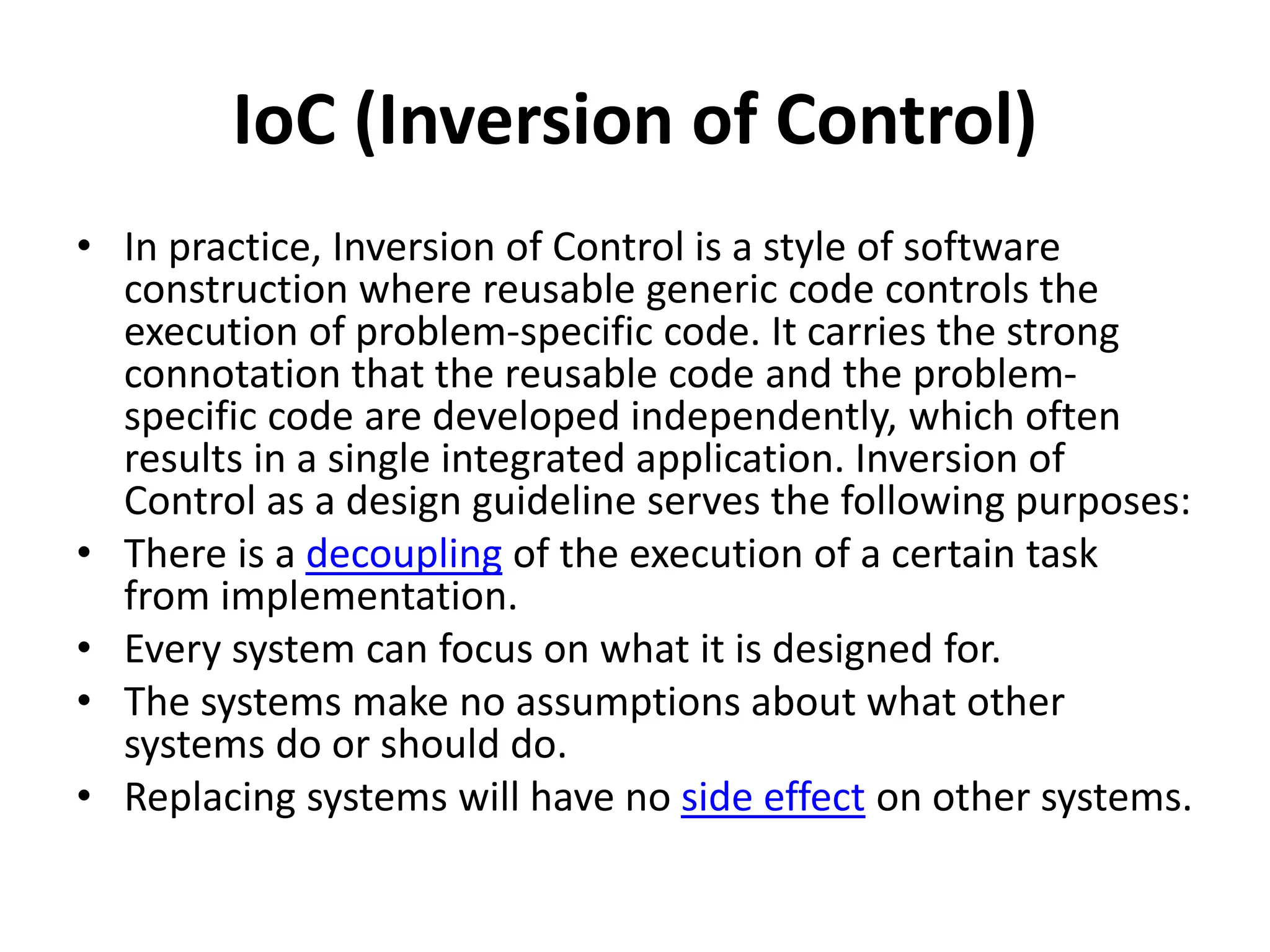
IoC (Inversion of Control)
• In practice, Inversion of Control is a style of software
construction where reusable generic code controls the
execution of problem-specific code. It carries the strong
connotation that the reusable code and the problem-
specific code are developed independently, which often
results in a single integrated application. Inversion of
Control as a design guideline serves the following purposes:
• There is a decoupling of the execution of a certain task
from implementation.
• Every system can focus on what it is designed for.
• The systems make no assumptions about what other
systems do or should do.
• Replacing systems will have no side effect on other systems.
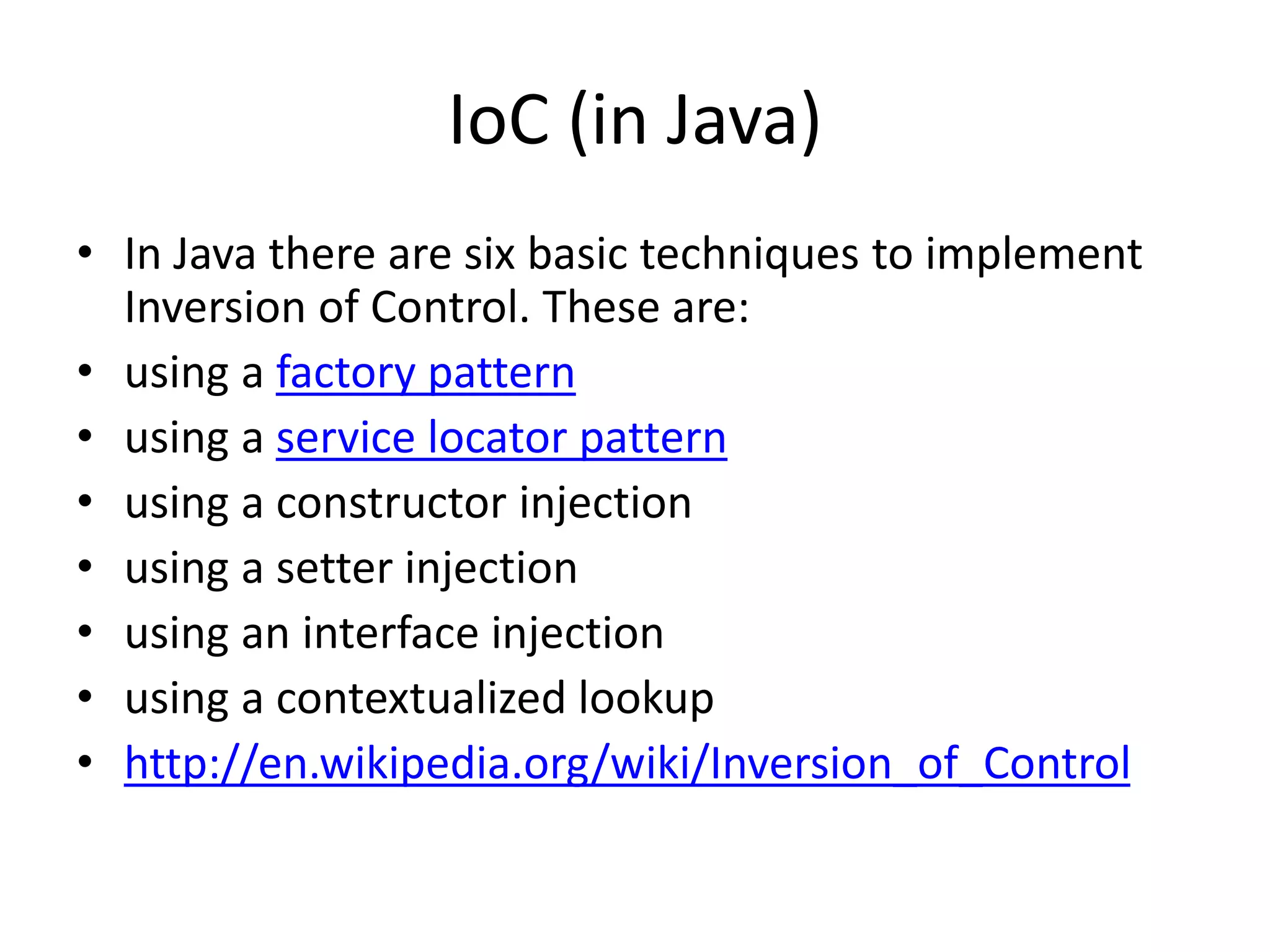
IoC (in Java)
• In Java there are six basic techniques to implement
Inversion of Control. These are:
• using a factory pattern
• using a service locator pattern
• using a constructor injection
• using a setter injection
• using an interface injection
• using a contextualized lookup
• http://en.wikipedia.org/wiki/Inversion_of_Control
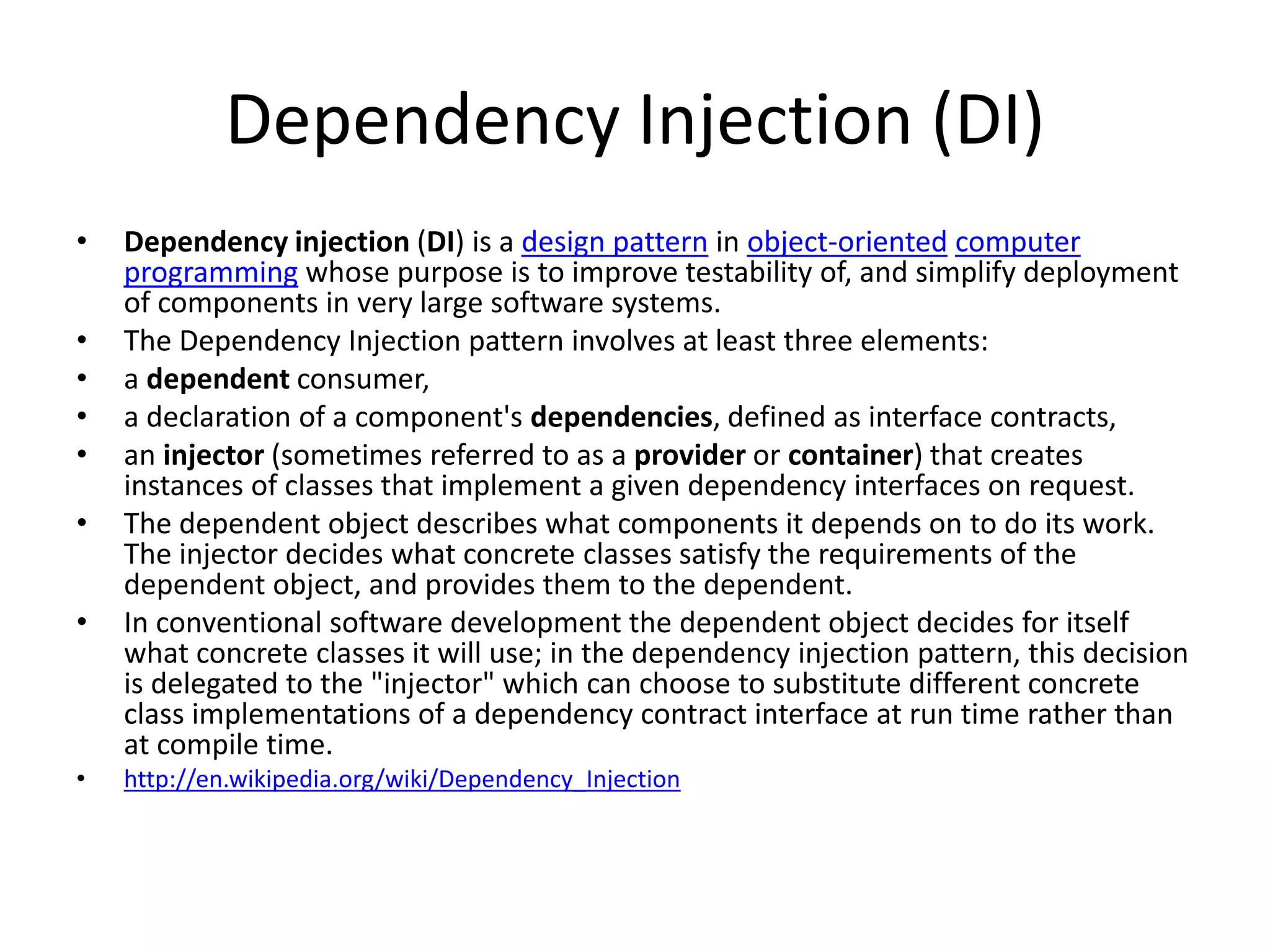
Dependency Injection (DI)
• Dependency injection (DI) is a design pattern in object-oriented computer
programming whose purpose is to improve testability of, and simplify deployment
of components in very large software systems.
• The Dependency Injection pattern involves at least three elements:
• a dependent consumer,
• a declaration of a component's dependencies, defined as interface contracts,
• an injector (sometimes referred to as a provider or container) that creates
instances of classes that implement a given dependency interfaces on request.
• The dependent object describes what components it depends on to do its work.
The injector decides what concrete classes satisfy the requirements of the
dependent object, and provides them to the dependent.
• In conventional software development the dependent object decides for itself
what concrete classes it will use; in the dependency injection pattern, this decision
is delegated to the "injector" which can choose to substitute different concrete
class implementations of a dependency contract interface at run time rather than
at compile time.
• http://en.wikipedia.org/wiki/Dependency_Injection
Spring IoC
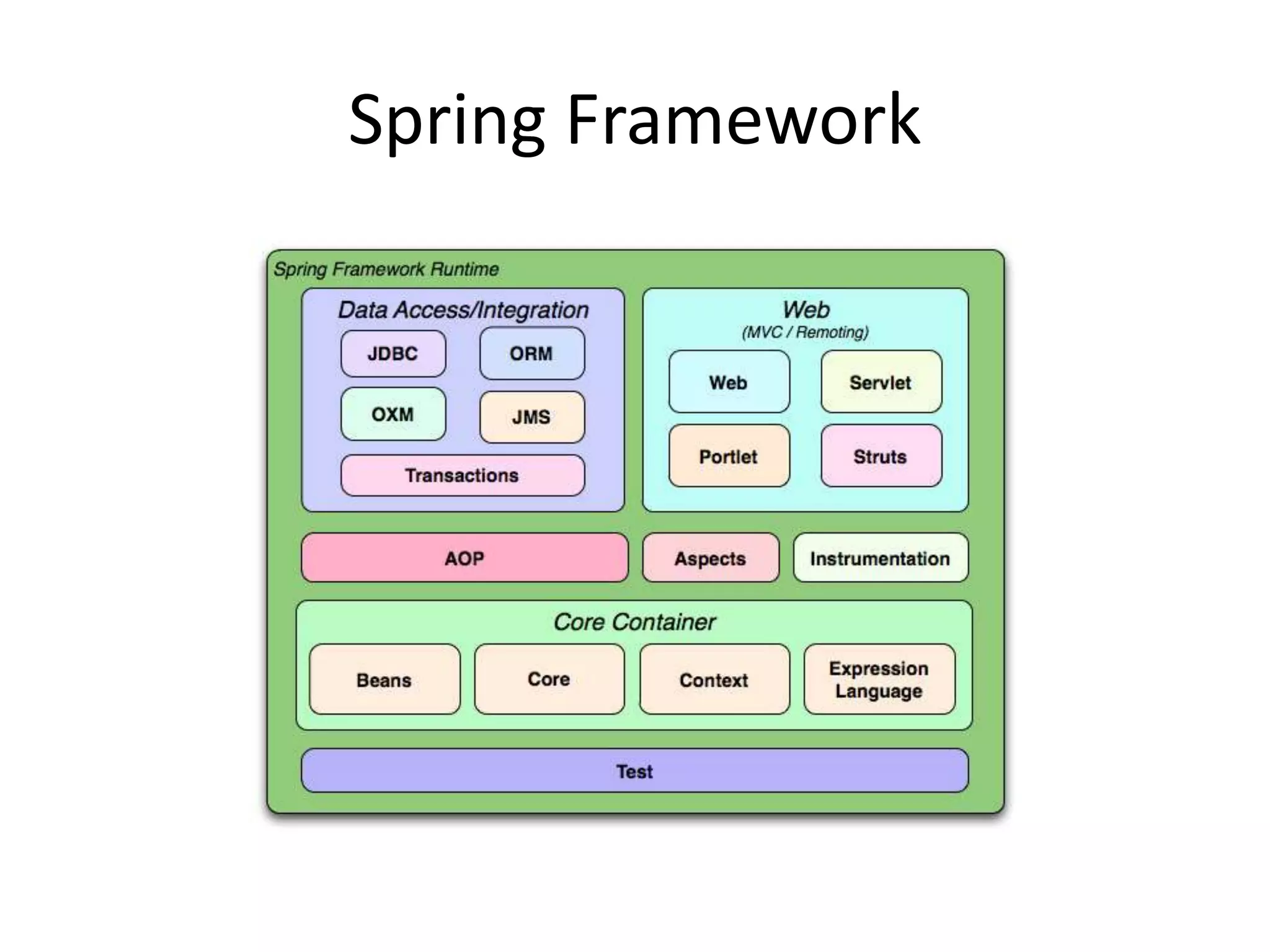
• The org.springframework.beans and org.springframework.context packages are
the basis for Spring Framework's IoC container. The BeanFactory interface provides
an advanced configuration mechanism capable of managing any type of
object. ApplicationContext is a sub-interface of BeanFactory. It adds easier
integration with Spring's AOP features; message resource handling (for use in
internationalization), event publication; and application-layer specific contexts
such as the WebApplicationContext for use in web applications.
• In short, the BeanFactory provides the configuration framework and basic
functionality, and the ApplicationContext adds more enterprise-specific
functionality. The ApplicationContext is a complete superset of the BeanFactory,
and is used exclusively in this chapter in descriptions of Spring's IoC container. For
more information on using the BeanFactory instead of
theApplicationContext, refer to Section 3.14, “The BeanFactory”.
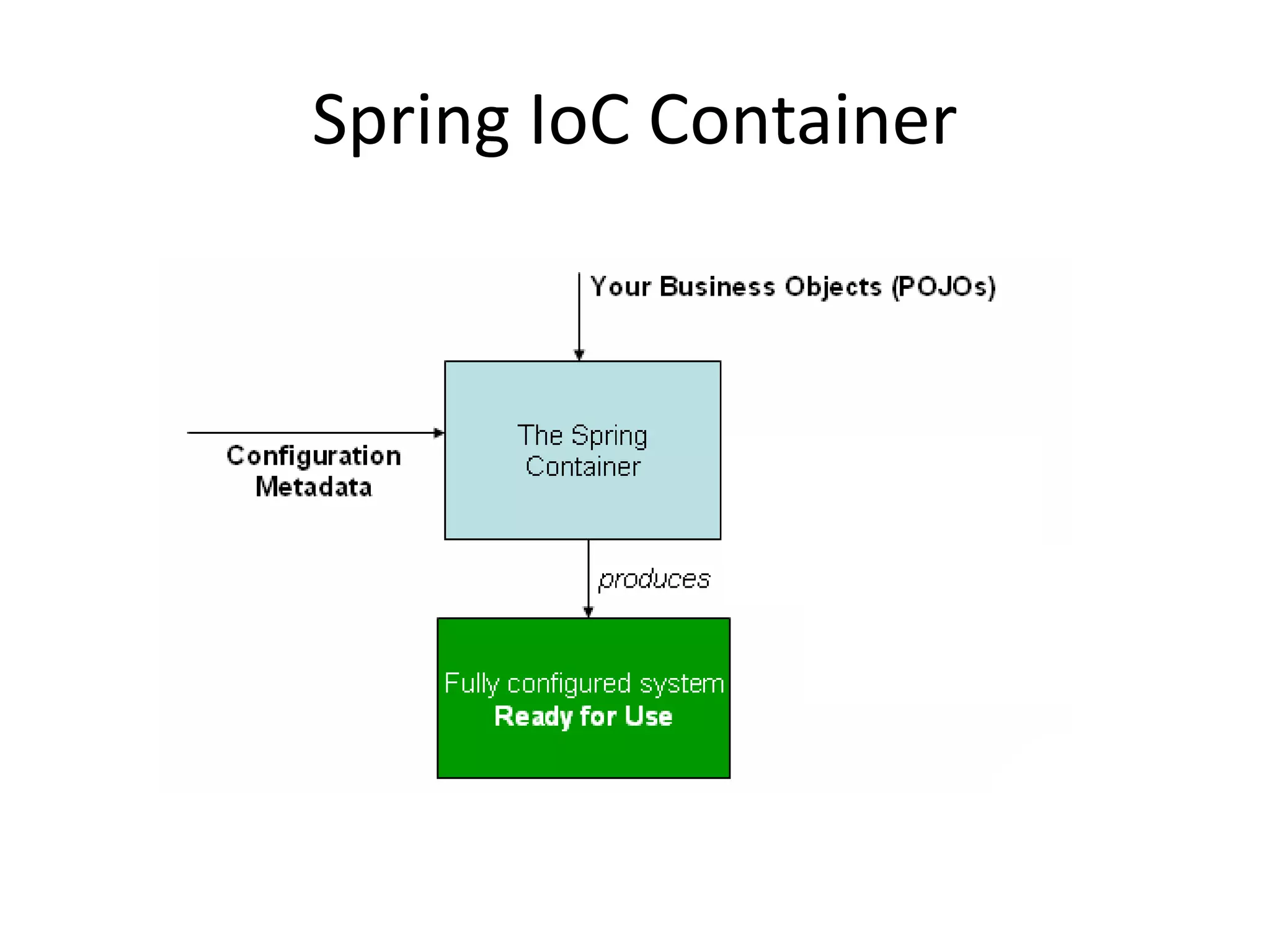
• In Spring, the objects that form the backbone of your application and that are
managed by the Spring IoC container are called beans. A bean is an object that is
instantiated, assembled, and otherwise managed by a Spring IoC container.
Otherwise, a bean is simply one of many objects in your application. Beans, and
the dependencies among them, are reflected in the configuration metadata used
by a container.
Spring IoC Container
Spring Framework
Spring DI
• DI exists in two major variants, Constructor-
based dependency injection and Setter-based
dependency injection.
Spring Dependency Injection Style
(Part 1)
• http://www.youtube.com/watch?v=3flORdmpxhk
Spring Dependency Injection Style
(Part 2)
• http://www.youtube.com/watch?v=exUR1KwKlUg
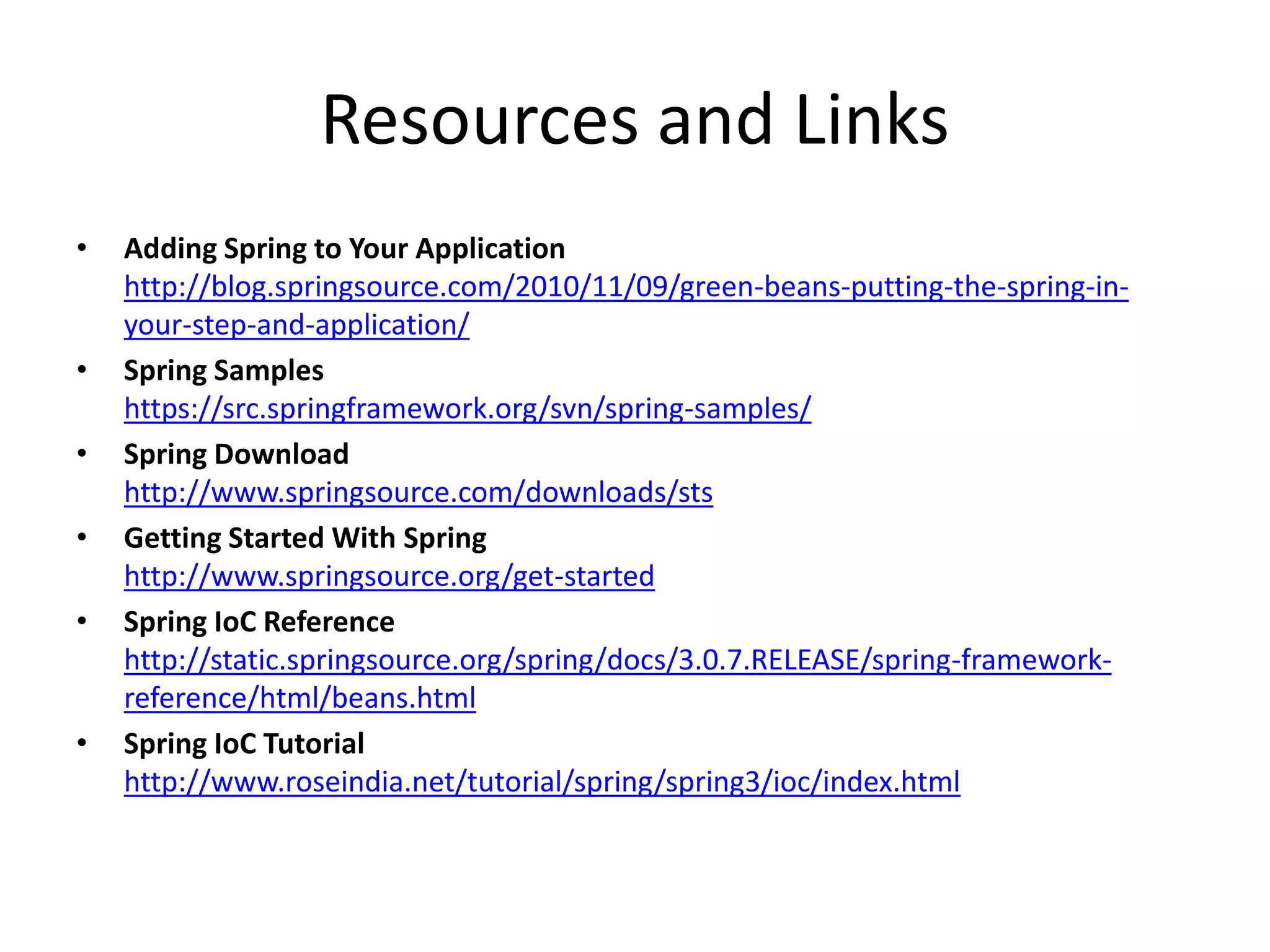
Resources and Links
• Adding Spring to Your Application
http://blog.springsource.com/2010/11/09/green-beans-putting-the-spring-in-
your-step-and-application/
• Spring Samples
https://src.springframework.org/svn/spring-samples/
• Spring Download
http://www.springsource.com/downloads/sts
• Getting Started With Spring
http://www.springsource.org/get-started
• Spring IoC Reference
http://static.springsource.org/spring/docs/3.0.7.RELEASE/spring-framework-
reference/html/beans.html
• Spring IoC Tutorial
http://www.roseindia.net/tutorial/spring/spring3/ioc/index.html
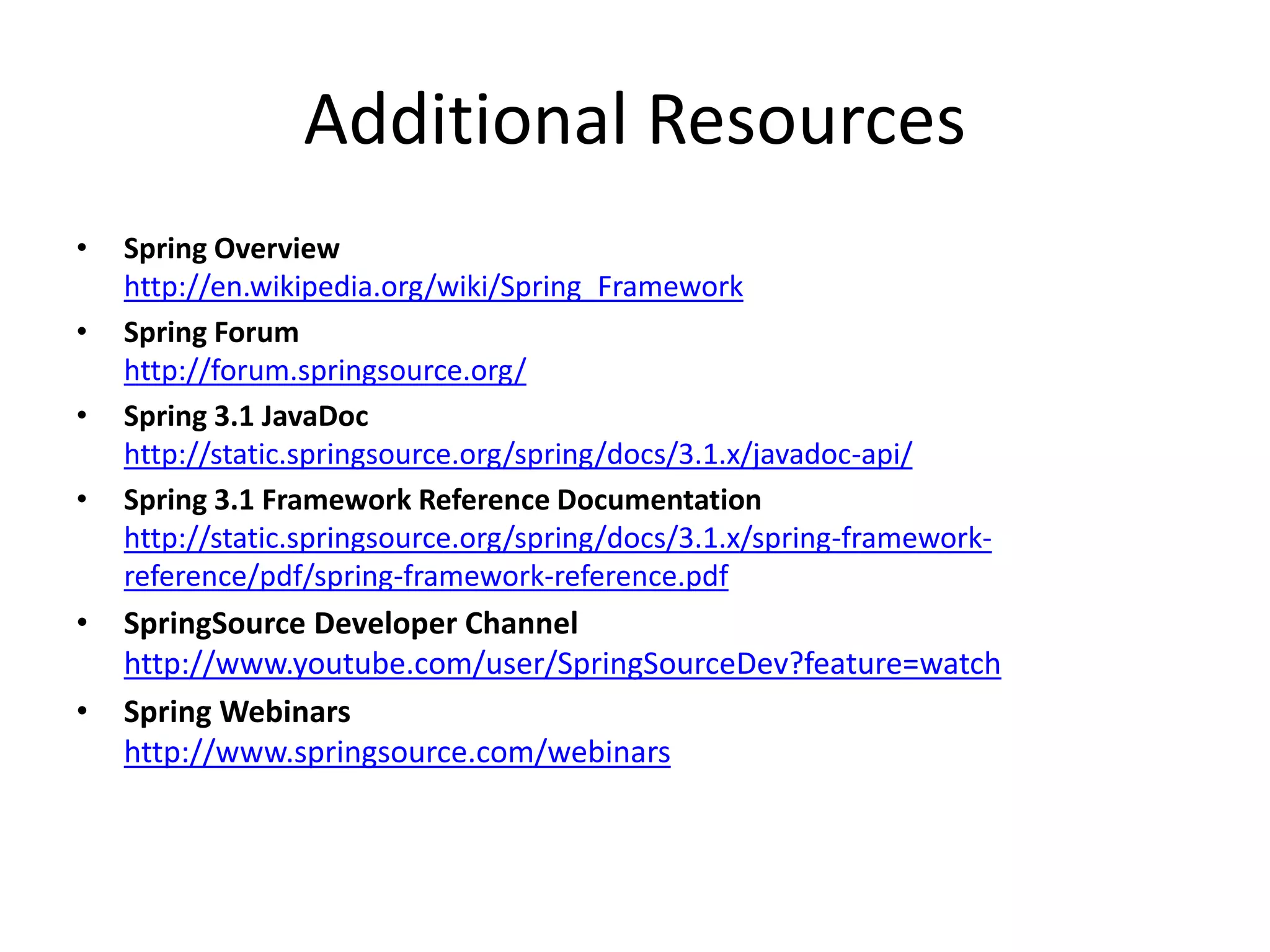
Additional Resources
• Spring Overview
http://en.wikipedia.org/wiki/Spring_Framework
• Spring Forum
http://forum.springsource.org/
• Spring 3.1 JavaDoc
http://static.springsource.org/spring/docs/3.1.x/javadoc-api/
• Spring 3.1 Framework Reference Documentation
http://static.springsource.org/spring/docs/3.1.x/spring-framework-
reference/pdf/spring-framework-reference.pdf
• SpringSource Developer Channel
http://www.youtube.com/user/SpringSourceDev?feature=watch
• Spring Webinars
http://www.springsource.com/webinars

Brownbag001 spring ioc from 2012

  • 1.
    Spring IoC Timothy Spann(spannt) HP Blog: http://blogs.hp.com/agiledev/
  • 2.
    IoC (Inversion ofControl) • In practice, Inversion of Control is a style of software construction where reusable generic code controls the execution of problem-specific code. It carries the strong connotation that the reusable code and the problem- specific code are developed independently, which often results in a single integrated application. Inversion of Control as a design guideline serves the following purposes: • There is a decoupling of the execution of a certain task from implementation. • Every system can focus on what it is designed for. • The systems make no assumptions about what other systems do or should do. • Replacing systems will have no side effect on other systems.
  • 3.
    IoC (in Java) •In Java there are six basic techniques to implement Inversion of Control. These are: • using a factory pattern • using a service locator pattern • using a constructor injection • using a setter injection • using an interface injection • using a contextualized lookup • http://en.wikipedia.org/wiki/Inversion_of_Control
  • 4.
    Dependency Injection (DI) •Dependency injection (DI) is a design pattern in object-oriented computer programming whose purpose is to improve testability of, and simplify deployment of components in very large software systems. • The Dependency Injection pattern involves at least three elements: • a dependent consumer, • a declaration of a component's dependencies, defined as interface contracts, • an injector (sometimes referred to as a provider or container) that creates instances of classes that implement a given dependency interfaces on request. • The dependent object describes what components it depends on to do its work. The injector decides what concrete classes satisfy the requirements of the dependent object, and provides them to the dependent. • In conventional software development the dependent object decides for itself what concrete classes it will use; in the dependency injection pattern, this decision is delegated to the "injector" which can choose to substitute different concrete class implementations of a dependency contract interface at run time rather than at compile time. • http://en.wikipedia.org/wiki/Dependency_Injection
  • 5.
    Spring IoC • Theorg.springframework.beans and org.springframework.context packages are the basis for Spring Framework's IoC container. The BeanFactory interface provides an advanced configuration mechanism capable of managing any type of object. ApplicationContext is a sub-interface of BeanFactory. It adds easier integration with Spring's AOP features; message resource handling (for use in internationalization), event publication; and application-layer specific contexts such as the WebApplicationContext for use in web applications. • In short, the BeanFactory provides the configuration framework and basic functionality, and the ApplicationContext adds more enterprise-specific functionality. The ApplicationContext is a complete superset of the BeanFactory, and is used exclusively in this chapter in descriptions of Spring's IoC container. For more information on using the BeanFactory instead of theApplicationContext, refer to Section 3.14, “The BeanFactory”. • In Spring, the objects that form the backbone of your application and that are managed by the Spring IoC container are called beans. A bean is an object that is instantiated, assembled, and otherwise managed by a Spring IoC container. Otherwise, a bean is simply one of many objects in your application. Beans, and the dependencies among them, are reflected in the configuration metadata used by a container.
  • 6.
  • 7.
  • 8.
    Spring DI • DIexists in two major variants, Constructor- based dependency injection and Setter-based dependency injection.
  • 9.
    Spring Dependency InjectionStyle (Part 1) • http://www.youtube.com/watch?v=3flORdmpxhk
  • 10.
    Spring Dependency InjectionStyle (Part 2) • http://www.youtube.com/watch?v=exUR1KwKlUg
  • 11.
    Resources and Links •Adding Spring to Your Application http://blog.springsource.com/2010/11/09/green-beans-putting-the-spring-in- your-step-and-application/ • Spring Samples https://src.springframework.org/svn/spring-samples/ • Spring Download http://www.springsource.com/downloads/sts • Getting Started With Spring http://www.springsource.org/get-started • Spring IoC Reference http://static.springsource.org/spring/docs/3.0.7.RELEASE/spring-framework- reference/html/beans.html • Spring IoC Tutorial http://www.roseindia.net/tutorial/spring/spring3/ioc/index.html
  • 12.
    Additional Resources • SpringOverview http://en.wikipedia.org/wiki/Spring_Framework • Spring Forum http://forum.springsource.org/ • Spring 3.1 JavaDoc http://static.springsource.org/spring/docs/3.1.x/javadoc-api/ • Spring 3.1 Framework Reference Documentation http://static.springsource.org/spring/docs/3.1.x/spring-framework- reference/pdf/spring-framework-reference.pdf • SpringSource Developer Channel http://www.youtube.com/user/SpringSourceDev?feature=watch • Spring Webinars http://www.springsource.com/webinars