BROOKLYN MADE
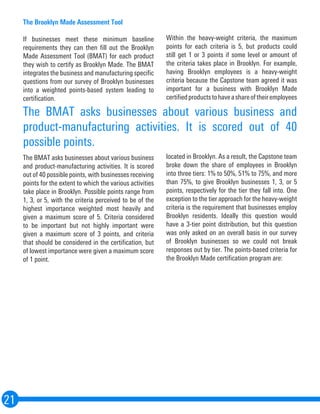
Certification Program
May 2014
NYU Wagner Capstone Team
Scilla Albanese
Emmett Mehan
Jaleesa Murrell
Yusuf Siddiquee
Patrick Yacco
Executive Summary
Introduction
Background Research
Economic Trends
Other Certification Programs
Brooklyn Manufacturing Sector Research: Methods and Findings
In-Depth Interviews
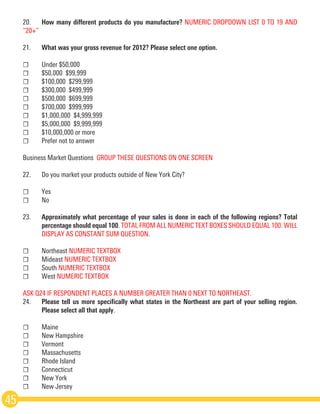
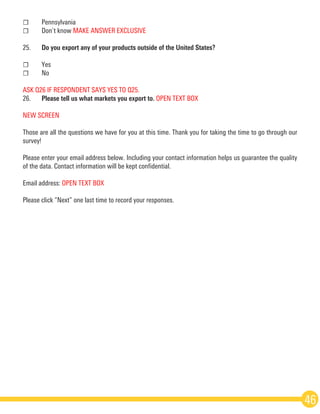
Survey of Brooklyn Businesses
Industrial & Manufacturing Coalition Presentation
Proposed Brooklyn Made Certification Framework
Baseline Certification Criteria
The Brooklyn Made Assessment Tool
The Development of the BMAT
Certification Results from the Survey
Expanding the BMAT
Recommendations on Implementation and Management
Management of the Certification Program
Incentivizing Business to Apply for Certification
Promoting the Brooklyn Made Certificaiton
Appendices
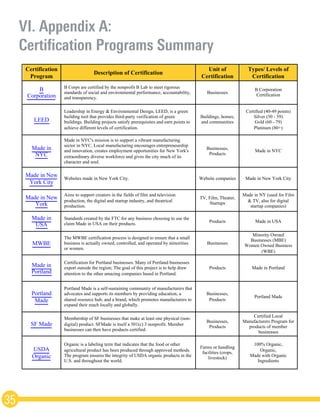
Certification Programs Summary
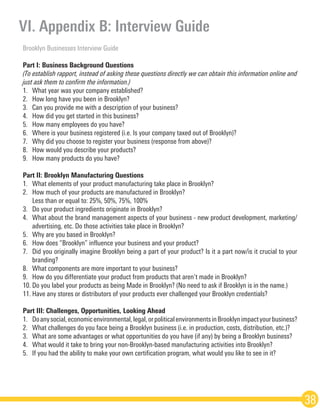
Interview Guide
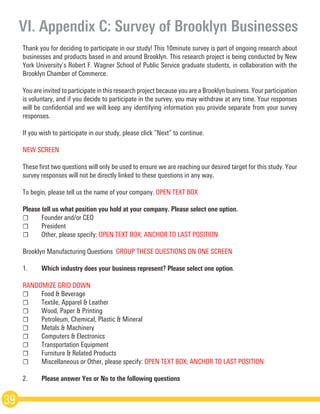
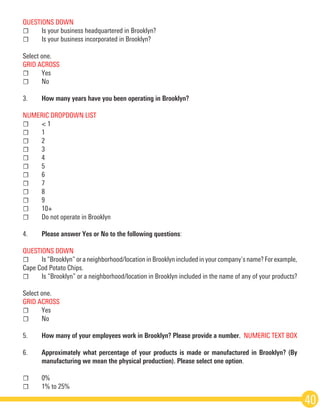
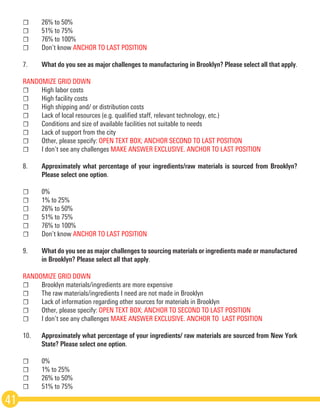
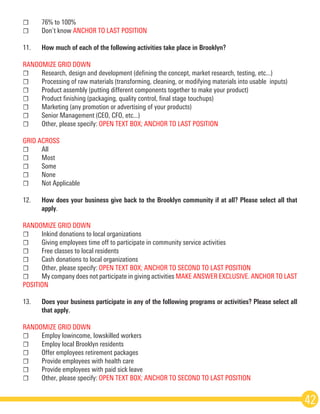
Survey of Brooklyn Business
Survey Results
Brooklyn Made Assessment Tool
Percent of Surveyed Businesses That Fit Each Certification Criteria
Works Cited
Table of Contents
2
4
35
29
19
9
5
59
1
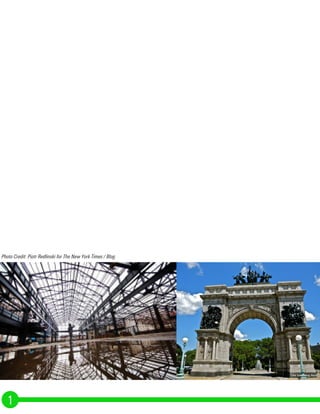
Photo Credit: Piotr Redlinski for The New York Times / Blog
T
he term “Brooklyn” has become a valued
brand commonly associated with things
that are trendy, and artisanal. Numerous
businesses use either the borough name (e.g.
Brooklyn Salsa, Brooklyn Winery, Brooklyn
Industries, Brooklyn Cured) or a specific Brooklyn
neighborhood (e.g. Red Hook Winery, Bed|Stu) in
the name of their company or their products. In light
of the success of Brooklyn’s manufacturing sector
and influence as a culture hub, makers outside of
the borough have attempted to benefit from it as
well, some going as far as to include “Brooklyn”
in the name of their product even with little or no
affiliation with the borough. The Brooklyn Made
certification is an opportunity for businesses that
manufacture products within Brooklyn to market
their authenticity, differentiating themselves from
those that use the borough exclusively for branding
purposes.
The Brooklyn Chamber of Commerce engaged
the NYU Capstone team to develop a framework
for the Brooklyn Made certification, and to make
recommendations on the ongoing management
andstrategyoftheprogram.Drawingfromresearch
conducted on other certification programs –
including regional certifications like Portland Made
and SFMade as well as non-regional certifications
like LEED and B-Corporation – the Capstone team
developed the Brooklyn Made Assessment Tool
(BMAT). The BMAT was further refined using
data collected from a survey of 117 Brooklyn
manufacturers, which painted a picture of the
industrial landscape in Brooklyn and allowed us to
test the implications of using certain components
of production to determine eligibility (for example,
product assembly and the processing of raw
materials). This dual approach to the development
of the BMAT was critical to ensure that the
Brooklyn Made certification is both competitive –
in that the expectation of authenticity required for
eligibility is high relative to other programs – but
alsoviablewithintheBrooklynmarketinthatitisnot
disproportionately difficult for products to become
certified. The BMAT uses a points-based system to
determine whether individual products are eligible
for Brooklyn Made certification. The points-based
scale was inspired by the B-Corporation model and
allows for the greatest flexibility in determining
how stringent the requirements for eligibility
are. In other words, the Chamber can easily raise
and lower the threshold to adjust the number of
products that qualify for certification without
changingtheprocessbywhichpointsaremeasured
and allocated. This flexible framework allows the
Chamber to adjust the eligibility requirements from
year to year based on the size of the applicant pool
and changes in the market without the need for an
entirely new foundation.
Finally, the Capstone team developed a series of
recommendations on how to manage and grow the
Brooklyn Made program. These recommendations
are broken into three categories. The first focuses
on the effective management of the application and
certification process and the allocation of resources
in support of the program. The second lays out
strategies to incentivize Brooklyn businesses
to apply for certification. The third suggests
methods to promote the certification in a way that
communicates the authenticity of Brooklyn Made
products both within Brooklyn and to new markets.
The Brooklyn Made Assessment Tool allows the
certification to be more sophisticated and complex
than comparable programs. Given the nascent
growth in the Brooklyn manufacturing sector, we
believe that there is an opportunity to leverage this
sophistication to reward and encourage businesses
whose production processes are located in
Brooklyn, and potentially spark additional growth
in the sector.
Executive Summary
2
3
Photo Credit: Adventure Student Travel / Reuters
I. Introduction
T
he name “Brooklyn” has become a valued
brand associated with things that are trendy,
and artisanal. Numerous businesses use
either the borough (e.g. Brooklyn Salsa, Brooklyn
Winery, Brooklyn Industries, Brooklyn Cured)
or a specific Brooklyn neighborhood (e.g. Red
Hook Winery, Bed|Stu) in naming their business
or products. In light of the success of Brooklyn’s
manufacturing sector and influence as a culture
hub, makers outside of the borough have attempted
to benefit from it as well, going as far as to include
“Brooklyn” in the name of their product with little
to no production occurring within the borough.
Absolut Brooklyn vodka is an example. Although
Absolut Brooklyn’s “locally inspired” flavors and
bottle design was done by Brooklyn resident Spike
Lee and inspired by “Brooklyn stoop life,” some
have argued that the multinational liquor company
is taking advantage of the Brooklyn trend. Clearly
identifying products that are actually manufactured
locally would help shift the benefits of this trend to
Brooklyn-based businesses. This is where a data-
driven urban manufacturing certification program
based in Brooklyn can help interested local
businesses differentiate themselves from other
firms who use the borough simply as a branding
tool. In addition, a program like this can be used
as a marketing and promotional tool for local
businesses domestically and internationally.
To this end, the Brooklyn Chamber of Commerce
sought to develop a standard that allows customers
to differentiate which products are actually made
in Brooklyn because unassociated products are
using the borough name or claiming to support
the local economy. The Brooklyn Chamber of
Commerce started with the launch of its “Made in
Brooklyn” awards this year and used three criteria
for this recognition: the percentage of production,
the amount of product development, and amount
of product assembly in Brooklyn. The Chamber
recognizes, however, that these measures may be
imperfect in some cases. For example, a retailer
rejected at least one Brooklyn product because
most of it was manufactured outside Brooklyn.
Establishing a clear definition of what it means
for a product to be made in Brooklyn will ensure
clear expectations for customers and retailers.
The objectives of this report are to provide
the Chamber with recommendations on how
to differentiate Brooklyn products through a
framework of defining characteristics under
a voluntary, market-driven, and independent
certification structure entitled “Brooklyn Made,”
and to recommend an organizational structure by
which this certification program can be executed
and grown over time.
4
II. Background Research
5
Economic Trends
B
rooklyn, NY is the most populous borough of
New York City, with 2.5 million residents as of
June 20131
. Even with a growing population
and a 16% increase in the number of jobs between
2000 and 2011, Brooklyn’s manufacturing sector
experienced a loss of 24,000 jobs in that time period2
.
In New York City, the total number of manufacturing
jobs halved from 150,000 in 2001 to just over 75,000 in
2012. This downward turn in manufacturing jobs was
experienced nationwide: from 2002 to 2012, the U.S.
experienced a 21.7% decrease in manufacturing jobs.
There has been a downward trend in manufacturing
jobs since the 1960s. However, from 2010 to 2013,
there was an upswing in the manufacturing sector in
Brooklyn. From 2010 to 2012, Brooklyn was the only
borough that experienced any increase in the number
of manufacturing jobs3
(a net gain of 39 jobs), while
theotherfourboroughsexperiencedadecreaseduring
the same time period. Between July and August
2013, there has been an increase in manufacturing
jobs in New York City by 1,400, mostly in Brooklyn4
.
Historically, manufacturing thrived in New York City
because of its close proximity to ports and railroad
infrastructure, and a steady flow of immigrant labor
force. Now, instead of mass-producing one or two
products, manufacturers are paying attention to
consumption patterns and producing goods that are
locally sourced to satisfy recent consumer appetite
for regional, specialty products (e.g. Made in New
York, influx of food markets). This reveals that there
is a demand for some type of branding or certification
for Brooklyn-made products on the consumers’ end
to accommodate the changing face of manufacturing.
Alargeportionofthemanufacturingsectorisemployed
in Brooklyn. The number of people employed in the
manufacturing sector in Brooklyn is 19,900, about
27% of the total employed in the manufacturing sector
citywide. In 2012, the average annual salary for the
1,740 manufacturing establishments in Brooklyn’s
manufacturing sector was $37,000, the lowest in the
manufacturingsectorcitywide.Accordingtothefederal
standard measurement, North American Industry
Classification System (NAICS), a manufacturing
establishment is one “engaged in the mechanical,
physical, or chemical transformation of materials,
substances, or components into new products”.
Although establishments in the manufacturing sector
are often described as “plants, factories, or mills and
characteristically use power-drive machines and
materials-handling equipment”,any establishment
that “transforms materials or substances into new
products by hand or in the worker’s home and those
engaged in selling to the general public products
made on the same premises from which they are sold,
such as bakeries, candy stores, and custom tailors”
may also be included in this sector. Manufacturing
establishments may also “process materials or may
contract with other establishments to process their
materials for them”.
	
With the rise in the cost of rent and of conducting
business in New York City, many large manufacturing
firms have left, but small firms remain. According
to results from the NYC Economic Development
Corporation’s 1,000 Business Survey, the average
manufacturing firm in New York City is now
smallsize (majority has less than 10 workers), well-
BrooklynwastheonlyboroughinNewYorkCitytoexperience
a percent increase in the number of manufacturing jobs.
6
established (60% have operated for more than 20
years), renter (60% lease their space), and family-
owned (about 75% of firms are family-owned). The
manufacturingsubsectorsare:Food&Beverage(which
is highly concentrated in Brooklyn), Textile, Apparel &
Leather;Wood,Paper&Printing,Petroleum,Chemical,
Plastic & Mineral, Metals & Machinery, Computers &
Electronics, Transportation Equipment, Furniture &
Related Products (which is historically concentrated
in Brooklyn), and Miscellaneous. Although these
subsectors are experiencing a downward trend in
jobs, Food & Beverage is the only subsector in New
York City that is growing. From 2011 to 2012, Food
& Beverage added 1,041 jobs to the manufacturing
sector5
.
Recent efforts to stimulate more growth in Brooklyn’s
manufacturing community include initiatives such
as the New Lab, a public and private collaboration
that brings community-manufacturing space to the
Brooklyn Navy Yard in order to share laser cutters
and 3D printers that are too expensive for individual
businessestopurchaseontheirown.Anotherinitiative
to help stimulate growth in the manufacturing
sector was the establishment of Industrial Business
Zones (IBZ). In 2005, the Bloomberg administration
established Industrial Business Zones to stabilize
industry areas in the Bronx, Brooklyn, and Queens.
One main purpose for IBZs is to foster industrial
growth by establishing real estate certainty. IBZs have
lower rents ($13.50/sq. ft. per month compared to the
New York City average of $14.03/sq. ft. per month)
and lower vacancy rates. As of 2013, there are 20,000
acres of manufacturing districts in New York City,
about 15% of total New York City land. Industrial rent
rates in New York City are the highest in Manhattan
at $30.00/ sq. ft. per month, while in Brooklyn, the
industrial rent rate is $15.64/ sq. ft. per month, the
second highest in New York City. With IBZs lower
rents of $13.50/ sq.ft. per month, this initiative has
helped foster industrial growth in Brooklyn.
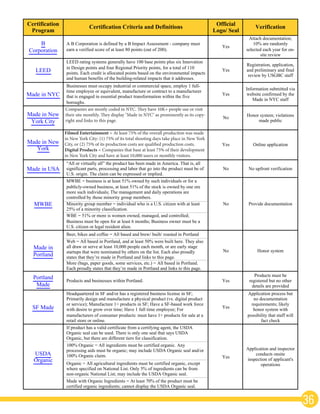
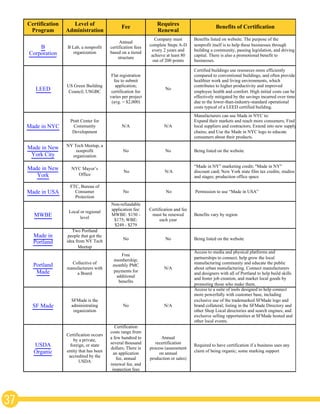
Other Certification Programs
The Capstone team researched an array of comparable
local and regional programs, including SFMade (San
Francisco), Portland Made, Made in NY, Made in
NYC, and Made in USA. In addition, we researched
a number of non-regional certification programs,
including USDA Organic, Leadership in Energy &
Environmental Design (LEED) and B Corporation to
understand the mechanics of a larger certification
program. From this research, we observed that a
certification program usually has a definition, a
verification process, an application fee associated
with being certified, benefits associated with being
certified, and an administrative body.
Certain programs stood out for their unique, value-
adding components. SFMade operates as a nonprofit
organization. It excels in identifying incentives for
businesses to certify their products, including strong
brand recognition and strategic business consulting.
SFMade defines their certification using the business
rather than the product as the unit of analysis. Eligible
businesses are headquartered in San Francisco
and/or have a registered business license in San
Francisco; primarily design and manufacture at least
one product (versus a digital product or a service)
within San Francisco; have a San Francisco-based
work force with the desire to grow over time; have
one full-time employee; and for manufacturers of
consumer products, have one or more products for
sale at a retail store or online.
7
Benefits associated with the SFMade certification
include access to a suite of tools to help local
manufacturers connect more powerfully with their
customer base, including exclusive use of the
trademarked SFMade logo and brand collateral;
listing in the SFMade directory and other Shop
Local directories and search engines; and exclusive
selling opportunities at SFMade hosted events
and other local events. There is no application
fee or required documentation to be certified,
with verification done by the SFMade staff.
Portland Made, another regional certification
program,hasdevelopedastrongmember-sustained
collective, where members share resources,
advocate for one another and educate the public on
benefits of buying local. It also has an operational
side that connects consumers to local designers,
retailers and manufacturers. The only criterion for
the free membership is that the business has to be
“based in Portland” (i.e. they do not specifically
define what this means). The benefits associated
with membership include access to media and
physical platforms and partnerships to help grow
the local manufacturing community and educate
the public about manufacturing, connecting
manufacturers and designers to build skills and
fosterjobcreation,marketingoflocalgoodsthrough
promotion, and rewarding shoppers for buying
locally through their partnership with Supportland.
B Corporation and LEED, two examples of non-
regionalcertificationprograms,havebyfarthemost
sophisticated certification criteria. They are both
points-based,whichallowsforthegreatestflexibility
and adaptability for a diverse market. In a points-
based system, businesses that wish to become
certified must submit substantial documentation
in order to verify their qualifications in certain
areas. Points are then awarded for each successful
verification. B Corporation is a certification
program for sustainable businesses, where a
business is defined by a “B Impact Assessment”
and must earn a verified score of at least 80
points out of 200. The benefits associated with a
B Corporation certification include differentiation
from “pretenders,” access to services, attracting
and engaging talent, helping to lead a movement
towards businesses taking accountability for
their impact on the world, generating press,
participating in the "B the Change" campaign,
partnering with peers, and helping to protect the
business's mission.
Points-based certification
allows for the greatest
flexibility and adaptability in
a diverse market.
8
LEED, which is administered by the U.S. Green Building Council (USGBC), certifies green buildings through
a ratings system of 100 base points. Each credit is allocated based on the environmental impacts and
human benefits of the building-related impacts that it addresses. The rating system is: certified (40 - 49
points), silver (50 - 59 points), gold (60 - 79 points), and platinum (80+ points). Because LEED’s verification
process is so extensive, the certification and registration fee is high compared to the other certification
programs (on average $2,000 per project). There is a flat registration fee that is paid up front at the time of
registration. The certification fee is based on the size of the project and the rating system that the project
was registered under. Certification fees are paid at the time a project team submits their application for
review.
In addition to these four certification programs - which were most influential in creating the Brooklyn Made
certification program - we also looked at the following programs (a more detailed description of each can
be found in Appendix A):
•	 Made in New York City: certifies website companies made in New York City
•	 Made in NY: an initiative from the NYC Mayor’s Office mainly geared at Film & TV productions and
technology companies
•	 Made in NYC: Pratt Center’s initiative that certifies manufacturers
•	 Made in USA: a federal law that requires “all or most” of a product to be made in the USA before being
labeled as such
•	 Made in Portland: certifies Portland-based beer, bikes, coffee, and websites
•	 Minority- or Women-Owned Business Enterprise (M/WBE): ensures that a small business is actually
owned, controlled, or operated by minorities or women
•	 USDA Organic: labeling that indicates a food or other agricultural product has been produced through
approved methods
Many of the programs examined certified the business rather than products. The certification programs
varied greatly in their sophistication, with B Corporation and LEED being the most sophisticated programs
we researched. Most of the regional certification programs did not clearly define important terms, such as
“manufacturing” or were vague in regards to how much of a product’s manufacturing should take place
in the region in order to get certified. A majority of the regional certification programs verified based on
an honor system, while non-regional certification programs like MWBE, B Corporation and LEED verified
eligibility via tax documents, site visits, and a thorough verification process. The certification programs are
mostly owned or run by nonprofit organizations. Among the certification programs looked at, a business’s
certification either requires annual reviews (e.g. LEED) or is permanent (e.g. Portland Made).
Based on the team's findings, it was decided that the Brooklyn Made certification program would be points-
based, with the components of the eligibility criteria derived from our survey of Brooklyn businesses.
III. Brooklyn Manufacturing Sector Research:
Methods and Findings
9
In-Depth Interviews
T
he Chamber prepared a list of businesses
that could represent specific industries and
discuss both the qualities of Brooklyn’s diverse
manufacturing sector and offer input into the
certificationprogram.TheCapstoneteaminterviewed
five different businesses throughout November
2013, and conducted an additional interview with
one retailer in February 2014. This information
was then used to shape a survey distributed to a
wider pool of manufacturers. Interviewees were
asked approximately 20 questions during a one-
hour session regarding the demographics of their
business (number of employees, years in business,
number of products manufactured), why and how
Brooklyn was important to their business (what
aspects of production were essential to being
located in Brooklyn, if/how being located in
Brooklyn influenced marketing), and opportunities
and challenges faced due to operating in Brooklyn.
(The Interview Guide can be found in Appendix B).
Key takeaways were relatively consistent across
these conversations. Interviewees believed that
the certification program must exclude products
with no true connection to the borough. For
example, one interviewee mentioned that they
source ingredients locally to the extent that they
are available, and all labor and equipment takes
place within Brooklyn. In contrast, one of their
competitors actually uses “Brooklyn” as part of their
branding, though the only local ingredient is water.
Thus, the certification program must somehow
recognize businesses with a large portion of
their manufacturing conducted in Brooklyn,
while eliminating those who are “Brooklyn in
name only.”Several interviewees recognized the
challenge of capturing the “craftsmanship” that
takes place in Brooklyn. One individual stated that
Brooklyn manufacturers were beginning to develop
a reputation for unprofessional working conditions
and selling wares at venues with a low threshold
for entry. More specifically, these types of products
were identified as “being made in a bathtub and sold
at farmers’ markets.” Therefore, there must be some
sort of criteria that separates those businesses that
are serious about their trade from makers that treat
their craft as a hobby.
Nearly all interviewees expressed concern about
the value added by a certification program. For
example, interviewees wondered about what type
of extra visibility the certification would provide.
They believed that the organization managing the
program should offer benefits such as advertising.
Furthermore, while the certification could be
designed in order to benefit smaller businesses,
larger firms need to join the program to add
credibility to the certification itself. Additionally,
a number of interviewees highlighted the need to
provide networking opportunities among businesses
themselves, as well as develop some type of
lobbying mechanism to advocate for better benefits
for Brooklyn manufacturers in general.
There must be some sort of criteria that separates those
businesses that are serious about their trade from makers
that treat their craft as a hobby.
10
Someintervieweeswentsofarastosuggestspecific
criteria by which to measure a business's stake in
Brooklyn. These included where ingredients were
sourced from, how much, if any, production (i.e.
transforming raw materials into useable parts) took
placeinBrooklyn,howmuchproductassemblytook
place in Brooklyn, share of employees located
in Brooklyn, and whether or not the firm was
headquartered in Brooklyn. Additionally, some
makers believed that it was important for
manufacturers to give back to the Brooklyn
community, either by hiring workers from Brooklyn
or donating a portion of their profits to local
organizations.
Overall, it was clear that a certification program
should recognize products that were created
primarily in Brooklyn, as well as firms that
implemented processes and procedures that
showed a seriousness towards owning and
operating a business. In order to encompass these
requirements and based on additional feedback
from our interviews, our survey asked a mix of
questions about where a firm was located and how
much production, design, and assembly took place
in Brooklyn, as well as the size of the company’s
Brooklyn-based staff. Additionally, those surveyed
would be asked what resources they would need to
further their business interests, which could then
be possible incentives to pursue Brooklyn Made
certification.
11
Survey of Brooklyn Businesses
	Methodology
Drawingoninsightsgainedfromtheinterviews,the
team used the research software Qualtrics to build
an online survey that gauged how much product
manufacturing and business operations occur in
Brooklyn,aswellascapturebusinessdemographics
and trends. We worked in consultation with Judy
Polyne, an NYU expert on survey methods, and
submitted the survey for review to a small pilot
group that included Chamber staff members and
the initial group of interviewees. After a final
revision, a link to the survey was emailed in mid-
January 2014 to over 1,000 businesses and related
contacts through the Chamber’s network of both
members and non-members. The team ended the
4-week period with 117 responses.
Survey questions were similar to those asked of
businesses in the in-depth interviews and included
inquiries into labor demographics, location of
each step in the production process, and ideas
to improve the manufacturing sector in Brooklyn.
Most importantly, the survey split production into
six components: Marketing, Senior Management,
Processing of Raw Materials, Research, Design,
and Development, Product Assembly, and Product
Finishing (the full survey can be found in Appendix
C).
	Results
Becauseofouremphasisonproductmanufacturing,
the Capstone team analyzed survey results
looking at the entire survey sample as well as a
smaller subset of companies we could identify as
manufacturers (in our sample, non-manufacturing
meant service industry, restaurants, or software
companies). However, the results were almost
identical so the full survey results (N=117) are
reported here. Below we have summarized the
findings and called out the most relevant survey
results (see Appendix D for additional graphs of
survey questions not shown below).
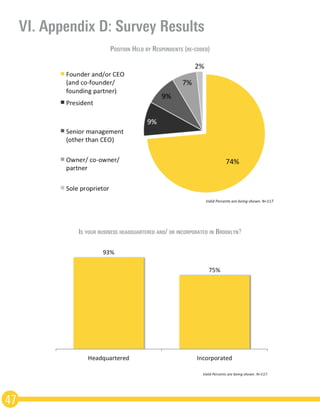
Respondent Profile: 74% of respondents identified
as Founder/CEO, co-founder, or founding partner of
their organization while everyone else held a senior
management or ownership role. Respondents
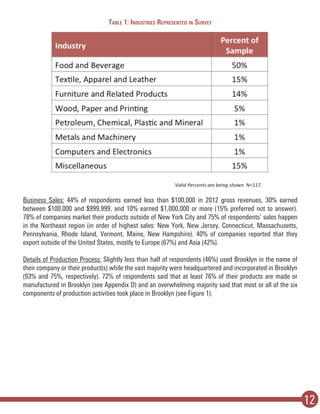
clustered around a few industries: 50% worked
in Food and Beverage, 15% worked in Textiles,
Apparel and Leather, 14% were Furniture and
Related Product, and 5% worked in Wood, Paper,
and Printing. Petroleum, Chemical, Plastic and
Mineral; Metals and Machinery; and Computers
and Electronics each represented 1% (see Table
1). A majority were small businesses (less than
ten employees) operating for less than five years,
although a significant portion (23%) have been
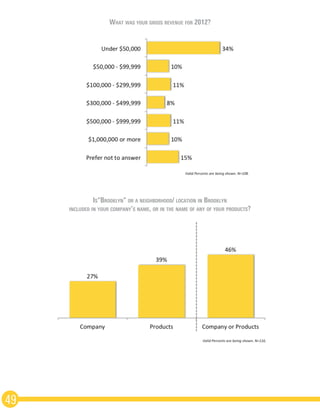
operating for more than ten years.
12
Table 1: Industries Represented in Survey
Business Sales: 44% of respondents earned less than $100,000 in 2012 gross revenues, 30% earned
between $100,000 and $999,999, and 10% earned $1,000,000 or more (15% preferred not to answer).
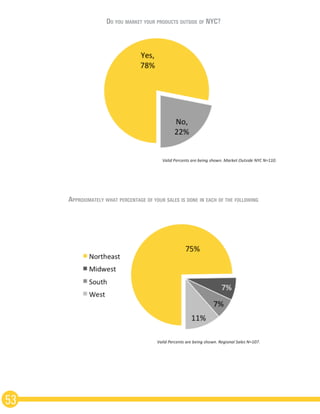
78% of companies market their products outside of New York City and 75% of respondents’ sales happen
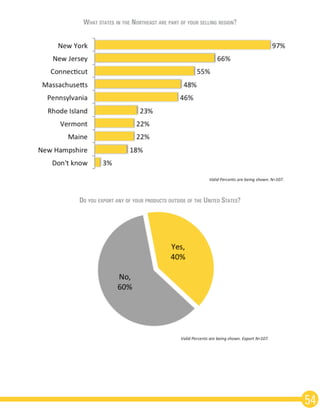
in the Northeast region (in order of highest sales: New York, New Jersey, Connecticut, Massachusetts,
Pennsylvania, Rhode Island, Vermont, Maine, New Hampshire). 40% of companies reported that they
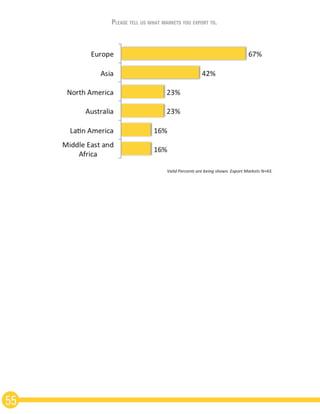
export outside of the United States, mostly to Europe (67%) and Asia (42%).
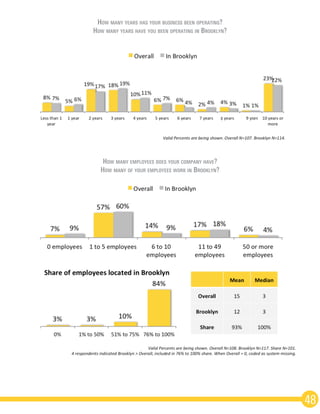
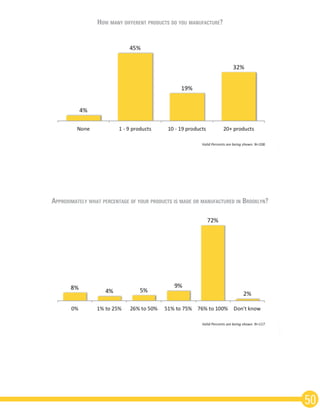
Details of Production Process: Slightly less than half of respondents (46%) used Brooklyn in the name of
their company or their product(s) while the vast majority were headquartered and incorporated in Brooklyn
(93% and 75%, respectively). 72% of respondents said that at least 76% of their products are made or
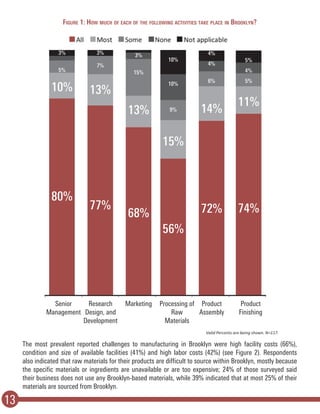
manufactured in Brooklyn (see Appendix D) and an overwhelming majority said that most or all of the six
components of production activities took place in Brooklyn (see Figure 1).
Figure 1: How much of each of the following activities take place in Brooklyn?
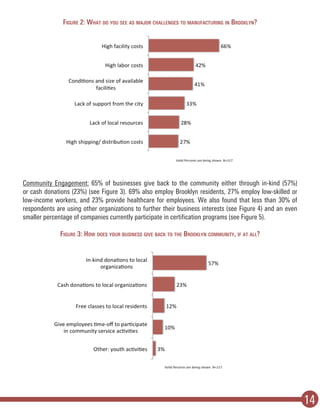
The most prevalent reported challenges to manufacturing in Brooklyn were high facility costs (66%),
condition and size of available facilities (41%) and high labor costs (42%) (see Figure 2). Respondents
also indicated that raw materials for their products are difficult to source within Brooklyn, mostly because
the specific materials or ingredients are unavailable or are too expensive; 24% of those surveyed said
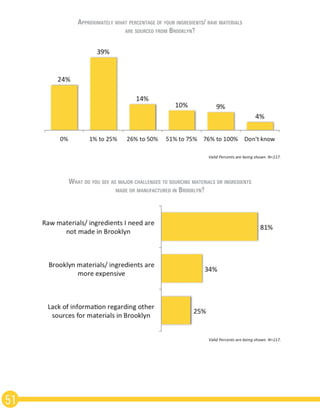
their business does not use any Brooklyn-based materials, while 39% indicated that at most 25% of their
materials are sourced from Brooklyn.
13
13%
68%
15%
10%
80%
5%
3%
15%
56%
9%
10%
10%
13%
77%
7%
3%
14%
72%
6%
4%
4%
11%
74%
5%
4%
5%
3%
Senior
Management
Research
Design, and
Development
Product
Finishing
Product
Assembly
Processing of
Raw
Materials
Marketing
Figure 2: What do you see as major challenges to manufacturing in Brooklyn?
Community Engagement: 65% of businesses give back to the community either through in-kind (57%)
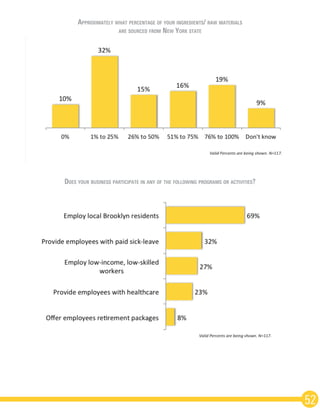
or cash donations (23%) (see Figure 3). 69% also employ Brooklyn residents, 27% employ low-skilled or
low-income workers, and 23% provide healthcare for employees. We also found that less than 30% of
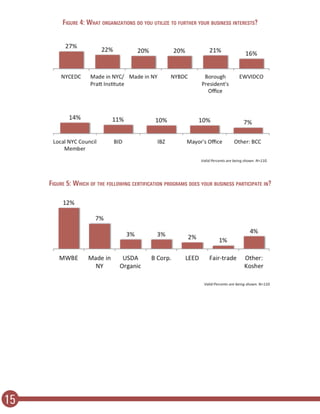
respondents are using other organizations to further their business interests (see Figure 4) and an even
smaller percentage of companies currently participate in certification programs (see Figure 5).
Figure 3: How does your business give back to the Brooklyn community, if at all?
14
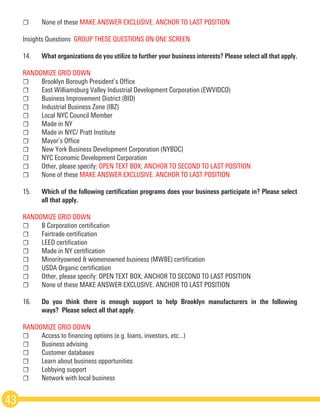
Figure 4: What organizations do you utilize to further your business interests?
Figure 5: Which of the following certification programs does your business participate in?
15
16
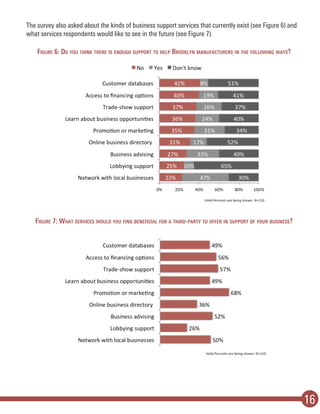
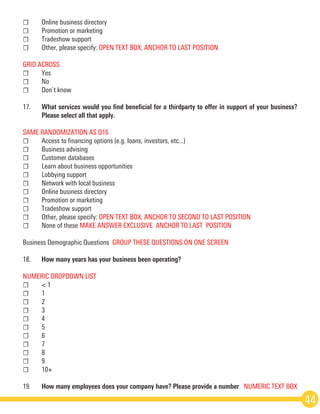
Figure 6: Do you think there is enough support to help Brooklyn manufacturers in the following ways?
Figure 7: What services would you find beneficial for a third-party to offer in support of your business?
The survey also asked about the kinds of business support services that currently exist (see Figure 6) and
what services respondents would like to see in the future (see Figure 7).
17
	Analysis
With the exception of Processing of Raw Materials,
68-80%ofrespondentsindicatedthat“All”production
components take place in Brooklyn (for raw materials
processing it was 56%). While our survey sample may
not be a representative sample of all businesses in
Brooklyn, we do believe that it demonstrates strong
interest in a Brooklyn Made certification program or
at the very least more support from the Chamber and
beyond. The data also allows us to extrapolate that
a certification structured around the six components
we named would be viable since a strong subset of
businesses and products would be able to fulfill much
of the criteria. We also learned that these particular
respondents used a variety of organizations to
further business interests (including NYC Economic
Development Corporation, Brooklyn Borough
President’s Office, and BID), but no one organization
stood out, indicating additional market potential
for Brooklyn Made. Our sample of businesses also
participates overwhelmingly in charitable donations,
which suggests a strong sense of community among
these respondents, a characteristic that we believe
will help support Brooklyn Made.
Furthermore, most respondents indicated that they
would benefit from a variety of business services
such as better access to financing options, customer
databases, trade-show support, marketing, or
business advising, further highlighting the need
for small to medium business support services.
While the Chamber already provides some of these
benefits, these results suggest an outstanding need
for more. We also learned that many businesses
market and export their product(s) outside of New
York City and outside of the United States, which
is relevant when considering the impact of an
official certification beyond New York City, where
it is much harder for consumers to distinguish the
details of a product’s manufacturing. For example,
at the Chamber’s Industrial and Manufacturing
Coalition meeting in February (described next), it
was confirmed that there is significant demand
for Brooklyn made or Brooklyn-labeled products in
Japan and China – a Brooklyn Made certification
could allow businesses to capitalize on this demand.
	Limitations
While the survey covered many of the challenges
Brooklyn makers face, it failed to capture a very
large number of businesses and products, notably
those not in the food and beverage sector and those
operating for longer periods of time in less central,
perhaps less developed neighborhoods. The survey
also excluded restaurants and software companies
for the most part, which are responsible for a lot of
economic activity in Brooklyn but are not well suited
for this certification. The survey sample is also biased
towards those businesses that have relationships
or membership with the Brooklyn Chamber of
Commerce. Even though many respondents were
not Chamber members, all of our initial interviewees
were members recommended to us by the Chamber
because of their interest in the idea of a certification.
In terms of measuring the production criteria, we
asked respondents to indicate whether “All,” “Most,”
or “Some” of the production components occurred
in Brooklyn, which left some room for error or
misinterpretation. It is also true that this framework
may not apply as evenly to a beverage distributor as
it would to an apparel maker, so some adjustments
may need to be made when establishing a scoring
system (see certification criteria discussion below).
The results also showed some inconsistencies within
the data, such as a business reporting more Brooklyn
employees than its total employees or indicating
they have zero employees—presumably because
many CEOs or founders do not consider themselves
as “employees” of the company.
18
Finally, the Capstone team acknowledges that we may not have imagined every possible criterion that is
relevant in identifying a Brooklyn Made product, especially so early in our research process. Some questions
that might have clarified the viability and perceived benefit of the program are:
•	 Do you participate in Brooklyn Eats or Brooklyn Designs?
•	 Would you be willing to pay for a certification program? If so, how much?
•	 How many Brooklyn residents do you employ?
•	 How much of your sales stay in Brooklyn?
Industrial&ManufacturingCoalitionPresentation
After compiling and analyzing the data, the
Capstone team presented its survey findings to the
Chamber’s Industrial and Manufacturing Coalition
on February 12, 2014. Approximately forty business
owners (mostly Food and Beverage) and three
Chamber staff members were in attendance. After
the presentation, attendees asked questions about
the Brooklyn Made certification and were also
asked to write down their response to the question
“What does Made in Brooklyn mean to you?” The
team received a total of 11 responses.
In both verbal feedback and written responses,
meeting attendees highlighted the need to certify
products and businesses that conducted as much
of their processes within the borough. They
emphasized the need for certified businesses
to employ Brooklyn residents as well as build
up Brooklyn as a bustling manufacturing hub.
Attendees also expressed concern over the
transparency of the certification program and how
it would continually evaluate products to ensure
that certified products maintained their Brooklyn
Made status. Overall, the business representatives
that attended this meeting seemed proud of their
work in Brooklyn, interested in the team’s results,
and eager to see how the program would continue
to develop.
IV. Proposed Brooklyn Made Certification
Framework
19
T
o make the Brooklyn Made certification
program market-driven, the Capstone team
used the survey of Brooklyn businesses
to determine the viability of each certification
criteria. Since different products within a business
can vary significantly in terms of how and where
they are manufactured, the Brooklyn Made
certification program is product-specific, allowing
businesses to certify some of their products that
meet manufacturing requirements, without being
penalized for products that do not meet the criteria.
As described in an earlier chapter, most regional
certification programs like Portland Made and
SFMade lack sophistication. As a result, the
Capstone team used the B Corporation certification
program as the inspiration for Brooklyn Made. At
theheartofthecertificationprogramistheBrooklyn
Made Assessment Tool (BMAT) developed from
the manufacturing-specific questions of the survey
and informed by the results.
To get the Brooklyn Made certification for
products, businesses must meet minimum baseline
requirements and complete the Brooklyn Made
Assessment Tool. The BMAT is points-based and
includes several criteria weighted by importance
that will give a product a composite score, referred
to as the Brooklyn Made Score (BMS). Several of
the criteria in the BMAT relate to overall business
activities, for example, a business’s location
of senior management. However, many of the
criteria are product-specific, for example, where
the product is assembled or finished, allowing for
certification at the product level.
The Brooklyn Made Score is what determines a
product’s eligibility for certification. By setting a
threshold for certification, any product that meets
the threshold score becomes certified as Brooklyn
Made. The Capstone team decided on the mean
BMS as the threshold score, consistent with the
B Corporation model. The qualifying score for the
B Corporation certification turned out to be the
average score from their assessment. This is not
to say that the B Corporation specifically chose
the average score as their qualifying bar. As they
indicate on their website, their threshold is “a
work in progress” and other factors went into
making the designation. However, the Capstone
team felt comfortable making the mean score the
cut-off because it allowed for impartiality in the
certification process, and it was consistent with
the goal of having the Brooklyn Made certification
program be data and market driven.
AttheheartofthecertificationprogramistheBrooklynMade
AssessmentTool(BMAT)developedfromthemanufacturing-
specific questions of the survey and informed by the results.
20
Baseline Certification Criteria
As baseline criteria, all businesses wishing to have
their products certified as Brooklyn Made must be
a legal business entity headquartered in Brooklyn,
and make or manufacture one or more physical
products. Businesses seeking certification would
have to provide legal or tax documents indicating
theyfitintooneofthefollowingbusinessstructures:
an incorporated business, sole proprietorship,
limited liability company (LLC), cooperative, or
partnership. For the purpose of Brooklyn Made,
headquarters is “the chief administrative office of
an organization” as defined by Merriam-Webster.
The Capstone team chose these baseline criteria
because they are not too stringent that it would
deter Brooklyn businesses from applying for the
certification, but it would still set a minimum
standard for certification. Since our survey of
Brooklyn businesses did not ask respondents about
their legal business structure, we did not exclude
any survey respondents based on this criterion and
worked with the assumption that all businesses
in our survey were registered legal entities.
75% of survey respondents indicated they were
incorporated in Brooklyn specifically so we thought
it would be fair to assume registered Brooklyn
businesses made up our survey sample. A strong
majority of survey respondents (93%) indicated
they were headquartered in Brooklyn, and based
on survey responses and additional research, the
Capstone team determined that 84% of surveyed
businesses make or manufacture a physical
product, which resulted in 89 businesses meeting
our baseline certification criteria.
•	 Business must be a legal business entity registered as: an incorporated business, a sole proprietorship,
a limited liability company, cooperative, or partnership
•	 Businesses must be headquartered in Brooklyn
•	 Businesses must make or manufacture one or more physical products.
21
The Brooklyn Made Assessment Tool
If businesses meet these minimum baseline
requirements they can then fill out the Brooklyn
Made Assessment Tool (BMAT) for each product
they wish to certify as Brooklyn Made. The BMAT
integrates the business and manufacturing specific
questions from our survey of Brooklyn businesses
into a weighted points-based system leading to
certification.
The BMAT asks businesses about various business
and product-manufacturing activities. It is scored
out of 40 possible points, with businesses receiving
points for the extent to which the various activities
take place in Brooklyn. Possible points range from
1, 3, or 5, with the criteria perceived to be of the
highest importance weighted most heavily and
given a maximum score of 5. Criteria considered
to be important but not highly important were
given a maximum score of 3 points, and criteria
that should be considered in the certification, but
of lowest importance were given a maximum score
of 1 point.
Within the heavy-weight criteria, the maximum
points for each criteria is 5, but products could
still get 1 or 3 points if some level or amount of
the criteria takes place in Brooklyn. For example,
having Brooklyn employees is a heavy-weight
criteria because the Capstone team agreed it was
important for a business with Brooklyn Made
certifiedproductstohaveashareoftheiremployees
located in Brooklyn. As a result, the Capstone team
broke down the share of employees in Brooklyn
into three tiers: 1% to 50%, 51% to 75%, and more
than 75%, to give Brooklyn businesses 1, 3, or 5
points, respectively for the tier they fall into. One
exception to the tier approach for the heavy-weight
criteria is the requirement that businesses employ
Brooklyn residents. Ideally this question would
have a 3-tier point distribution, but this question
was only asked on an overall basis in our survey
of Brooklyn businesses so we could not break
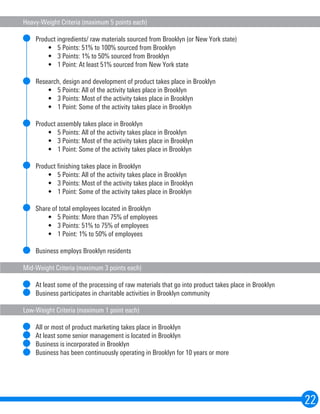
responses out by tier. The points-based criteria for
the Brooklyn Made certification program are:
The BMAT asks businesses about various business and
product-manufacturing activities. It is scored out of 40
possible points.
22
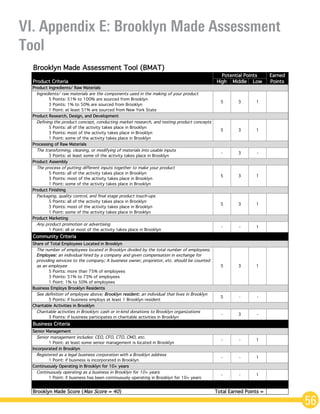
Heavy-Weight Criteria (maximum 5 points each)
Product ingredients/ raw materials sourced from Brooklyn (or New York state)
•	 5 Points: 51% to 100% sourced from Brooklyn
•	 3 Points: 1% to 50% sourced from Brooklyn
•	 1 Point: At least 51% sourced from New York state
Research, design and development of product takes place in Brooklyn
•	 5 Points: All of the activity takes place in Brooklyn
•	 3 Points: Most of the activity takes place in Brooklyn
•	 1 Point: Some of the activity takes place in Brooklyn
Product assembly takes place in Brooklyn
•	 5 Points: All of the activity takes place in Brooklyn
•	 3 Points: Most of the activity takes place in Brooklyn
•	 1 Point: Some of the activity takes place in Brooklyn
Product finishing takes place in Brooklyn
•	 5 Points: All of the activity takes place in Brooklyn
•	 3 Points: Most of the activity takes place in Brooklyn
•	 1 Point: Some of the activity takes place in Brooklyn
Share of total employees located in Brooklyn
•	 5 Points: More than 75% of employees
•	 3 Points: 51% to 75% of employees
•	 1 Point: 1% to 50% of employees
Business employs Brooklyn residents
Mid-Weight Criteria (maximum 3 points each)
At least some of the processing of raw materials that go into product takes place in Brooklyn
Business participates in charitable activities in Brooklyn community
Low-Weight Criteria (maximum 1 point each)
All or most of product marketing takes place in Brooklyn
At least some senior management is located in Brooklyn
Business is incorporated in Brooklyn
Business has been continuously operating in Brooklyn for 10 years or more
Each criterion within the BMAT will include clear definitions so that businesses taking the assessment will
know exactly what is meant by each activity, and businesses can answer questions with the same context.
The definitions for each criterion are as follows:
•	 Ingredients/raw materials: the components used in the making of a product
•	 Research, design and development: defining the product concept, conducting market research, and
testing product concepts
•	 Assembly: the process of putting different inputs together to make your product
•	 Finishing: packaging, quality control, and final stage product touch-ups
•	 Employee: an individual hired by a company and given compensation in exchange for providing services
to a company; for the purpose of this certification, a business owner, proprietor, etc. can be included
as an employee
•	 Brooklyn resident: an individual that lives in Brooklyn
•	 Share of total employs located in Brooklyn: the number of employees located in Brooklyn divided by the
total number of employees
•	 Processing of raw materials: the transforming, cleaning, or modifying of materials into usable inputs
•	 Charitable activities: cash or in-kind donations to Brooklyn organizations
•	 Marketing: any product promotion or advertising
•	 Senior management: CEO, CFO, CTO, CMO, etc.
•	 Incorporated in Brooklyn: registered as a legal business corporation with a Brooklyn address
A mock-up of the Brooklyn Made Assessment Tool can be found in Appendix E.
23
24
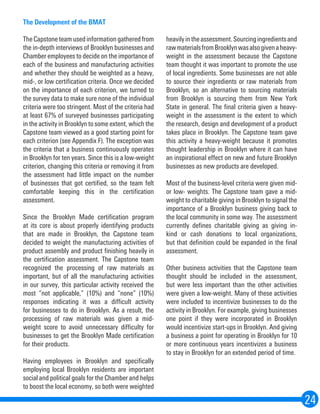
The Development of the BMAT
The Capstone team used information gathered from
the in-depth interviews of Brooklyn businesses and
Chamber employees to decide on the importance of
each of the business and manufacturing activities
and whether they should be weighted as a heavy,
mid-, or low certification criteria. Once we decided
on the importance of each criterion, we turned to
the survey data to make sure none of the individual
criteria were too stringent. Most of the criteria had
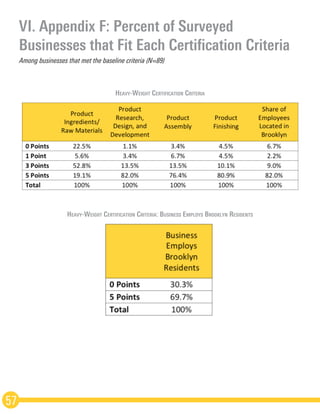
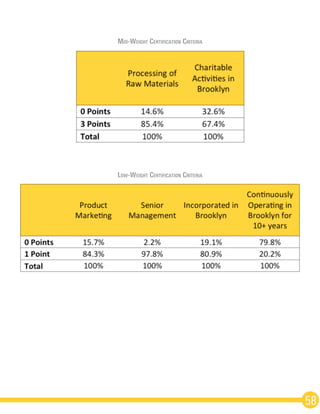
at least 67% of surveyed businesses participating
in the activity in Brooklyn to some extent, which the
Capstone team viewed as a good starting point for
each criterion (see Appendix F). The exception was
the criteria that a business continuously operates
in Brooklyn for ten years. Since this is a low-weight
criterion, changing this criteria or removing it from
the assessment had little impact on the number
of businesses that got certified, so the team felt
comfortable keeping this in the certification
assessment.
	
Since the Brooklyn Made certification program
at its core is about properly identifying products
that are made in Brooklyn, the Capstone team
decided to weight the manufacturing activities of
product assembly and product finishing heavily in
the certification assessment. The Capstone team
recognized the processing of raw materials as
important, but of all the manufacturing activities
in our survey, this particular activity received the
most “not applicable,” (10%) and “none” (10%)
responses indicating it was a difficult activity
for businesses to do in Brooklyn. As a result, the
processing of raw materials was given a mid-
weight score to avoid unnecessary difficulty for
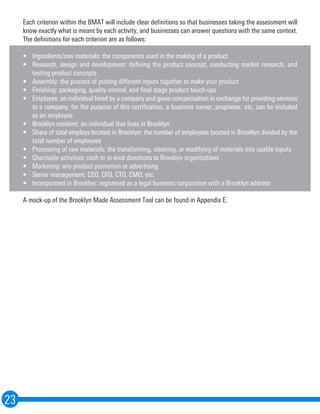
businesses to get the Brooklyn Made certification
for their products.
Having employees in Brooklyn and specifically
employing local Brooklyn residents are important
social and political goals for the Chamber and helps
to boost the local economy, so both were weighted
heavilyintheassessment.Sourcingingredientsand
rawmaterialsfromBrooklynwasalsogivenaheavy-
weight in the assessment because the Capstone
team thought it was important to promote the use
of local ingredients. Some businesses are not able
to source their ingredients or raw materials from
Brooklyn, so an alternative to sourcing materials
from Brooklyn is sourcing them from New York
State in general. The final criteria given a heavy-
weight in the assessment is the extent to which
the research, design and development of a product
takes place in Brooklyn. The Capstone team gave
this activity a heavy-weight because it promotes
thought leadership in Brooklyn where it can have
an inspirational effect on new and future Brooklyn
businesses as new products are developed.
Most of the business-level criteria were given mid-
or low- weights. The Capstone team gave a mid-
weight to charitable giving in Brooklyn to signal the
importance of a Brooklyn business giving back to
the local community in some way. The assessment
currently defines charitable giving as giving in-
kind or cash donations to local organizations,
but that definition could be expanded in the final
assessment.
Other business activities that the Capstone team
thought should be included in the assessment,
but were less important than the other activities
were given a low-weight. Many of these activities
were included to incentivize businesses to do the
activity in Brooklyn. For example, giving businesses
one point if they were incorporated in Brooklyn
would incentivize start-ups in Brooklyn. And giving
a business a point for operating in Brooklyn for 10
or more continuous years incentivizes a business
to stay in Brooklyn for an extended period of time.
25
Certification Results from the Survey
The Capstone team used the BMAT on the survey
of Brooklyn businesses to determine what the
mean Brooklyn Made Score would be and see
how many businesses in the sample would get
certified under the criteria we developed. It
is worth mentioning that even though the final
certification program developed here will be
product specific, the survey data the Capstone
team used to create the certification criteria was
not – most questions were asked about business
activities overall, or products in general. As a result,
the certification results from the survey of Brooklyn
businesses will have to be viewed on the business
level. Additionally, the survey data that informed
the certification program was self-reported, and
businesses might have answered some questions
differently than they would a formal application
for certification. Despite these limitations, the
Capstone team has developed a framework for
the certification that will easily transition to the
product level when the Chamber administers it.
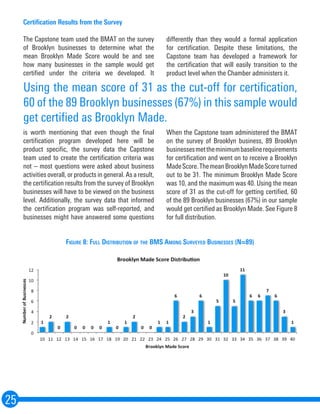
When the Capstone team administered the BMAT
on the survey of Brooklyn business, 89 Brooklyn
businessesmettheminimumbaselinerequirements
for certification and went on to receive a Brooklyn
MadeScore.ThemeanBrooklynMadeScoreturned
out to be 31. The minimum Brooklyn Made Score
was 10, and the maximum was 40. Using the mean
score of 31 as the cut-off for getting certified, 60
of the 89 Brooklyn businesses (67%) in our sample
would get certified as Brooklyn Made. See Figure 8
for full distribution.
Figure 8: Full Distribution of the BMS Among Surveyed Businesses (N=89)
Using the mean score of 31 as the cut-off for certification,
60 of the 89 Brooklyn businesses (67%) in this sample would
get certified as Brooklyn Made.
26
The Capstone team took a deep-dive look at
Brooklyn businesses that received a Brooklyn
Made Score between 26 and 30 to see if these
businesses struggled with any single certification
criteria. Eighteen businesses fell between
5-points of the mean Brooklyn Made Score. A
strong majority of these businesses received
the highest possible score on most certification
criteria including: product R&D, processing of raw
materials, product assembly, product finishing, and
product marketing. A majority of these businesses
also had a share of their workforce in Brooklyn and
used ingredients and/ or raw materials sourced
from Brooklyn or New York State. The businesses
were roughly evenly split, and had a difficult time
meeting the criteria of charitable giving within the
Brooklyn community, and employing local Brooklyn
residents. Only 50% of these 18 businesses said
they gave back to the community, while 44%
indicated they employed a local Brooklyn resident.
The Capstone team also looked at whether getting
certified varied based on business characteristics
such as size or industry. Very small businesses (1
to 5 employees) received a mean Brooklyn Made
Score of 30.4, while the mean score for businesses
with over 5 employees was 33.8. The two BMSs
were statistically different from each other at a
95% confidence level, and the mean score for a
small business was just slightly below the cut-off
(six-tenths of a point) for certification indicating
that size could affect whether a business gets its
products certified. While a strong majority of small
businesses received the highest possible points for
all the product-specific manufacturing criteria of
the BMAT, a smaller majority of these businesses
(about 60%) participated in charitable activities in
Brooklyn and employed Brooklyn residents. Small
businesses also tended to be newer, with only 6%
indicating they’ve been operating in Brooklyn for
10 or more years. To ensure that the final BMAT
does not penalize small businesses, the Chamber
can make revisions to the current BMAT framework
(see Expanding the Brooklyn Made Assessment
Tool). Additionally, as will be discussed in the next
section, the Advisory Board that will be established
for the management of the Brooklyn Made
certification program can make judgment calls on
product certification for small businesses that fall
just short of getting certified.
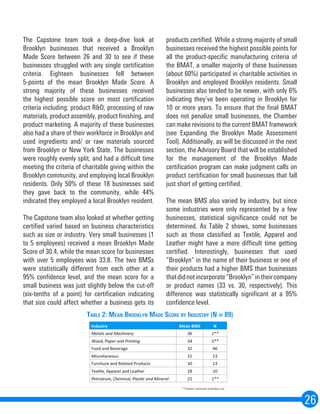
The mean BMS also varied by industry, but since
some industries were only represented by a few
businesses, statistical significance could not be
determined. As Table 2 shows, some businesses
such as those classified as Textile, Apparel and
Leather might have a more difficult time getting
certified. Interestingly, businesses that used
“Brooklyn” in the name of their business or one of
their products had a higher BMS than businesses
thatdidnotincorporate“Brooklyn”intheircompany
or product names (33 vs. 30, respectively). This
difference was statistically significant at a 95%
confidence level.
Table 2: Mean Brooklyn Made Score by Industry (N = 89)
Expanding The BMAT
The current version of the BMAT was developed using only questions asked of Brooklyn businesses during
the initial survey so that we could create a mean score for the sample of Brooklyn businesses and study the
distribution of the Brooklyn Made Score within the sample. The Chamber does not have to adhere to these
individual criteria, and could even add or remove criteria with the final BMAT. As the Capstone team was
developing the current tool, we thought of several additional criteria that may be important to include in
the future assessments. For example, the Chamber might want to consider making the criteria of employing
Brooklyn residents into a tier-distribution to reward different levels. Other potential criteria include:
•	 Percent of sales occurring in Brooklyn (mid-weight)
•	 Participation in Brooklyn business activities such as Smorgasburg, Brooklyn Flea Market, Brooklyn Eats,
or others (low-weight)
•	 Working out of a Brooklyn manufacturing facility (low-weight)
27
TheChambermightwanttoexpandthecertification
as the program matures and there are more
applicants to collect data from. If the Chamber
chooses to expand the assessment tool, the current
framework for the certification program can still be
used. Rather than using the current mean score
of 31 from our survey sample, the Chamber would
simply have to calculate the mean Brooklyn Made
Score from the applicant pool for the certification
program. As Brooklyn Made expands, it would also
be possible for the certification criteria to have
different levels of certification, similar to the LEED
certification program, which has four levels of
certification (certified, silver, gold, and platinum)
determined by the points earned for the project.
Similarly, if the Chamber would like to change
the weighting of any of the current criteria in the
assessmenttool,theyhavetheflexibilitytodosoand
create a new maximum and mean Brooklyn Made
Score. Finally, since we saw that small businesses
and businesses in certain industries might have a
more difficult time getting their products certified
with the current framework, the Chamber might
want to create a different frameworks or calculate
various BMS thresholds depending on business
size or industry. The B Corporation certification
program actually has different versions of its
assessment tool tailored to five different industries
and six different business sizes.
As Brooklyn Made expands, The flexibility of the BMAT
allows for the certification criteria to have different levels of
certification, or different thresholds for businesses based on
size or industry.
28
Photo Credit: 4Images Gallery / Tom Fruin’s Mosaic Sculpture ‘Watertower’ overlooks the Manhattan Bridge, Robert Banat
I
n contrast to comparable regional certification programs researched as part of this report, Brooklyn Made
has a more robust framework, with detailed criteria that allows for the greatest degree of adaptability in
terms of the production components that the Chamber chooses to encourage. Additionally, our research
indicates that there is a viable market for this program: production is already happening in Brooklyn, all that
is missing is the recognition.
While we believe the opportunities outweigh the risks, the risks are still present. The greatest threats to
long-term success of the Brooklyn Made certification program involve participation in the program (i.e. the
volume of applications), as well as the Chamber’s ability to leverage the certification program as an effective
branding platform. Even a sophisticated certification that effectively recognizes locally manufactured
products is only useful if its value is clear enough to drive demand for certified products.
We believe that strategically addressing three key priority areas upon launching Brooklyn Made will help to
mitigate these risks and set the Chamber up for success as they take the program to the next level. These
areas of focus include:
•	 The effective management and oversight of the certification program
•	 Incentivizing businesses to apply for certification
•	 Promotion of the certification both within the Brooklyn business community as well as to external
audiences
The recommendations laid out in this section are based on the strategies of comparable certification
programs, and tested against the needs and preferences of Brooklyn manufacturers as indicated in the
survey. Those strategies that we perceive to be the most successful for other certifications, along with
some new ones, have been adapted to fit within the context of the Brooklyn industrial community and to
align with the Chamber’s priorities.
V. Recommendations on Implementation and
Management
29
I
n contrast to comparable regional certification
programs researched as part of this report,
Brooklyn Made has a more robust framework,
with detailed criteria that allows for the greatest
degree of adaptability in terms of the production
components that the Chamber chooses to
encourage. Additionally, research indicates that
there is a viable market for this program: production
is already happening in Brooklyn, all that is missing
is the recognition.
WhiletheCapstoneteambelievestheopportunities
outweigh the risks, the risks are still present.
The greatest threats to long-term success of the
Brooklyn Made certification program involve
participation in the program (i.e. the volume of
applications), as well as the Chamber’s ability to
leverage the certification program as an effective
brandingplatform.Evenasophisticatedcertification
that effectively recognizes locally manufactured
products is only useful if its value is clear enough
to drive demand for certified products.
We believe that strategically addressing three key
priority areas upon launching Brooklyn Made will
help to mitigate these risks and set the Chamber
up for success as they take the program to the next
level. These areas of focus include:
30
Management of the Certification Program
Success depends on the effective allocation of time and resources to the Brooklyn Made certification
program. Certification must be consistent and transparent yet flexible to ensure buy-in, and must incorporate
strategies for long-term sustainability. The Capstone team recommends that the Chamber take the following
steps:
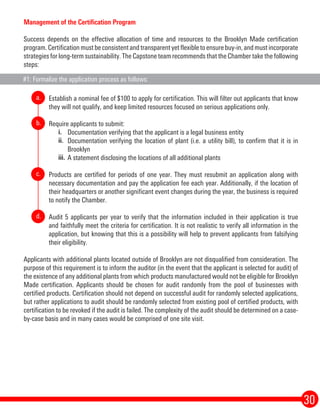
Establish a nominal fee of $100 to apply for certification. This will filter out applicants that know
they will not qualify, and keep limited resources focused on serious applications only.
Require applicants to submit:
Documentation verifying that the applicant is a legal business entity
Documentation verifying the location of plant (i.e. a utility bill), to confirm that it is in
Brooklyn
A statement disclosing the locations of all additional plants
Products are certified for periods of one year. They must resubmit an application along with
necessary documentation and pay the application fee each year. Additionally, if the location of
their headquarters or another significant event changes during the year, the business is required
to notify the Chamber.
Audit 5 applicants per year to verify that the information included in their application is true
and faithfully meet the criteria for certification. It is not realistic to verify all information in the
application, but knowing that this is a possibility will help to prevent applicants from falsifying
their eligibility.
Applicants with additional plants located outside of Brooklyn are not disqualified from consideration. The
purpose of this requirement is to inform the auditor (in the event that the applicant is selected for audit) of
the existence of any additional plants from which products manufactured would not be eligible for Brooklyn
Made certification. Applicants should be chosen for audit randomly from the pool of businesses with
certified products. Certification should not depend on successful audit for randomly selected applications,
but rather applications to audit should be randomly selected from existing pool of certified products, with
certification to be revoked if the audit is failed. The complexity of the audit should be determined on a case-
by-case basis and in many cases would be comprised of one site visit.
i.
ii.
iii.
a.
b.
c.
d.
#1: Formalize the application process as follows:
#2: Employ one full-time employee or full-time equivalent (FTE) dedicated to Brooklyn Made program
management,fundedbyacombinationofapplicationfeesandcorporatesponsorship.Primaryresponsibilities
should include:
Overseeing the application submission process
Serving as staff representative on the Advisory Board (discussed in detail below), including voting
power
Securing corporate sponsorship of the certification program
Reviewing and approving address verification documents from applicants
Conducting the annual audit of 5 applicants
Managing all marketing and communication activities of the program
#3: Establish an Advisory Board of 2 community leaders, 2 leaders of businesses with certified products,
and 1 Chamber staff member.
While the criteria framework provides a strong starting point, there are nuances and gray areas. Success will
require a human touch as a failsafe. The Advisory Board should review applications and allocate points as
directed, but then should invoke their knowledge of the Brooklyn manufacturing context and circumstances
of applicants to debate and ultimately vote on the approval of each application.
There is also an opportunity here to ensure buy-in and trust from the Brooklyn community by building
credibility into the Advisory Board. Gaia DiLoreto of ByBrooklyn and Dan Kopf of Real Brooklyn, for example,
lend both credibility and continuity to Brooklyn Made. And having two members with certified products will
add a critical perspective to the debate. To this end, we recommend that the Chamber, with the mandate
that board members will self-manage going forward, appoint the inaugural members. This self-management
should include the creation of by-laws to establish term limits and a process by which new members are
voted onto the Board.
31
a.
b.
c.
d.
e.
f.
32
Incentivizing Businesses to Apply for Certification
Brooklyn Made will only be as successful as the number of products it certifies. While the Chamber will
have the ability to adjust the stringency of the criteria if they find a disproportionate number of applicants
to be ineligible, providing value-adding business incentives as part of certification, in contrast, is about
increasing the raw number of applicants.
We recommend that the Chamber explore the feasibility of the following:
#1: Apply the $100 Brooklyn Made application fee toward the Chamber membership fee.
This incentivizes Chamber membership as well, and uses all existing business incentives provided to member
businesses to encourage certification of Brooklyn Made products. Similarly, the Chamber might waive the
Brooklyn Made application fee for current members. Both of these position the Brooklyn Made certification
and Chamber membership as complementary to one another.
#2: Offer select business incentives - currently offered to members only - to businesses with certified
products.
There are a few examples of specialized services, currently offered to Chamber members only that may
be of unique interest to businesses with certified products. The target group here is businesses that are
manufacturing in Brooklyn but may not want to opt for full Chamber membership, either because they are
not large or sophisticated enough to afford the membership dues or because they do not see the value in
the full suite of incentives and services offered to members. For example, the Chamber offers to connect
members with incubator and special purpose sites including the Brooklyn Army Terminal, Brooklyn Navy
Yard and the Greenpoint Manufacturing and Design Center. Small, Brooklyn-based operations that are
seeking to grow but would not be able to sustain their production within Brooklyn without assistance might
be particularly interested in this and find it well worth the $100 application fee.
Additionally, of the businesses surveyed as part of this study, 56% indicated that the greatest barrier to
relocating all or part of their production process to Brooklyn was access to loans and/or financing options
to support the move and higher cost of production. The Chamber offers assistance to member businesses
in connecting with city and state government savings programs targeted for Brooklyn’s commercial and
industrial business community. Offering select services such as these to nonmembers will, if chosen
correctly, be valuable enough to encourage certification without compromising the integrity of the benefits
that come with full membership, and is worth considering.
#3: Offer exclusive promotion of Brooklyn Made products on trade missions to new markets.
When asked what types of support services would be most beneficial to receive from a third party, 69%
of businesses surveyed said promotion or marketing. The Chamber is in the process of opening up trade
discussions in new domestic and international markets. The Chamber has an opportunity to leverage the
detailed framework, which differentiates products certified as Brooklyn Made, to sell the guarantee of
authenticity. Meanwhile, access to these new markets will serve as an incentive for businesses to apply
for certification. Just the promise of promotion offers such a unique value and high potential return that
we expect it could even encourage the movement of manufacturing and production processes to Brooklyn
as businesses seek new avenues for distribution – sparking not only interest in the certification but real
growth of the Brooklyn industrial community.
The exclusivity of the promotion of certified products applies only to new trade missions, and should
therefore not conflict with any promotional services already offered to Chamber members. The promise
would be to promote the certification and certified products generally – not specific products or the
individual businesses that make them.
#4: Create a community manufacturing plant for the production of certified products.
When asked to choose the greatest barrier to manufacturing in Brooklyn, 65% of businesses surveyed said
high facility cost. This recommendation is likely a medium- to long-term strategy for the Chamber, as it will
require a strong network of businesses with certified products that might be willing to pool resources. It is,
however, a significant need and therefore worth considering.
A few examples exist that we can learn from, from Open Manufacturing – a nascent, member-run initiative
in Portland utilizing donated legacy equipment – to an industrial launch pad in Arizona that incubates
early stage manufacturing startups called Conscious Manufacturing. Given the average size and general
predilections of much of the Brooklyn manufacturing community, we recommend that the Chamber explore
NY Tech Meetup as a possible model. NYCEDC further offers community-oriented and affordable incubators,
lab space and workspace, and could be a strong potential partner in this initiative.
33
for Made in NYC certification, products would be
dually certified and therefore benefit from any and
all of Pratt’s efforts to promote Made in NYC.
34
A partnership with a complementary certification
program – such as Made in NYC – could be useful
for Brooklyn Made. Made in NYC (which is a project
of the Pratt Center for Community Development, of
thePrattInstitute)couldeasilyeducateitsmembers
about the Brooklyn Made certification, unlocking
new sources of applicants. Additionally, since all
Brooklyn Made products should also be eligible
#3: Partner with other certifications to combine promotional efforts.
#2: Secure buy-in from at least one corporate vendor to carry and push Brooklyn Made products.
Promoting the Brooklyn Made Certification
Providing incentives to businesses with Brooklyn Made certified products encourages new applications
through the promise of unique value. It is equally important, however, that the certification, the value it
provides businesses, and the authenticity it guarantees to consumers is made clear inside and outside of
the Brooklyn manufacturing community.
#1: Consult with a brand strategist to develop key messaging and a stronger visual identity for Brooklyn
Made.
A compelling visual identity is critical to the success of the Brooklyn Made program. It will shape the way
sponsors, trade partners, businesses and consumers perceive and evaluate the certification, and certified
products by proxy. The Chamber and its stakeholders will need to speak about Brooklyn Made in a single,
unified voice in order to maximize its value.
An effective brand strategy will require interviews with a range of Brooklyn Made stakeholders – from
consumers to vendors to current and potential applicants. It will also require a competitive audit of the
visual identity and positioning of other certification programs – particularly those mentioned in this report.
A marketing consultant or team of consultants can conduct this discovery research, develop key messages
for both general and specific audiences, provide recommendations to change or keep the existing Brooklyn
Made logo and train Chamber staff and stakeholders on utilizing the brand strategy.
There are options to get this done pro bono. The Taproot Foundation is a good resource – they offer their
own marketing projects with very tightly defined scopes that may meet this need. If not, they also have
online tools to identify alternative pro bono providers, including organizations known for providing pro bono
marketing and branding services, as well as individuals with the right skills within Chamber staff LinkedIn
networks that can be approached directly.
The promise of a well-known vendor to carry Brooklyn Made products, or to provide an endorsement for
the certification, could mean all the difference for Brooklyn Made. Whole Foods, with their new Brooklyn
location, is an ideal target. Whole Foods places a high value on carrying local products – and their team
includes a staff of “foragers” dedicated to seeking out locally-produced goods within all of their local
markets. Alternative options include Fresh Direct and Fairway.
VI. Appendix A:
Certification Programs Summary
35
Certification
Program
Description of Certification
Unit of
Certification
Types/ Levels of
Certification
B
Corporation
B Corps are certified by the nonprofit B Lab to meet rigorous
standards of social and environmental performance, accountability,
and transparency.
Businesses
B Corporation
Certification
LEED
Leadership in Energy & Environmental Design, LEED, is a green
building tool that provides third-party verification of green
buildings. Building projects satisfy prerequisites and earn points to
achieve different levels of certification.
Buildings, homes,
and communities
Certified (40-49 points)
Silver (50 - 59)
Gold (60 - 79)
Platinum (80+)
Made in
NYC
Made in NYC's mission is to support a vibrant manufacturing
sector in NYC. Local manufacturing encourages entrepreneurship
and innovation, creates employment opportunities for New York's
extraordinary diverse workforce and gives the city much of its
character and soul.
Businesses,
Products
Made in NYC
Made in New
York City
Websites made in New York City. Website companies Made in New York City
Made in New
York
Aims to support creators in the fields of film and television
production, the digital and startup industry, and theatrical
production.
TV, Film, Theater,
Startups
Made in NY (used for Film
& TV, also for digital
startup companies)
Made in
USA
Standards created by the FTC for any business choosing to use the
claim Made in USA on their products.
Products Made in USA
MWBE
The MWBE certification process is designed to ensure that a small
business is actually owned, controlled, and operated by minorities
or women.
Businesses
Minority Owned
Businesses (MBE)
Women Owned Business
(WBE)
Made in
Portland
Certification for Portland businesses. Many of Portland businesses
export outside the region; The goal of this project is to help draw
attention to the other amazing companies based in Portland.
Products Made in Portland
Portland
Made
Portland Made is a self-sustaining community of manufacturers that
advocates and supports its members by providing education, a
shared resource hub, and a brand, which promotes manufacturers to
expand their reach locally and globally.
Businesses,
Products
Portland Made
SF Made
Membership of SF businesses that make at least one physical (non-
digital) product. SFMade is itself a 501(c) 3 nonprofit. Member
businesses can then have products certified.
Businesses,
Products
Certified Local
Manufacturers Program for
products of member
businesses
USDA
Organic
Organic is a labeling term that indicates that the food or other
agricultural product has been produced through approved methods.
The program ensures the integrity of USDA organic products in the
U.S. and throughout the world.
Farms or handling
facilities (crops,
livestock)
100% Organic,
Organic,
Made with Organic
Ingredients
	
  
36
Certification
Program
Certification Criteria and Definitions
Official
Logo/ Seal
Verification
B
Corporation
A B Corporation is defined by a B Impact Assessment - company must
earn a verified score of at least 80 points (out of 200).
Yes
Attach documentation;
10% are randomly
selected each year for on-
site review
LEED
LEED rating systems generally have 100 base points plus six Innovation
in Design points and four Regional Priority points, for a total of 110
points. Each credit is allocated points based on the environmental impacts
and human benefits of the building-related impacts that it addresses.
Yes
Registration, application,
and preliminary and final
review by USGBC staff
Made in NYC
Businesses must occupy industrial or commercial space, employ 1 full-
time employee or equivalent, manufacture or contract to a manufacturer
that is engaged in essential product transformation within the five
boroughs.
Yes
Information submitted via
website confirmed by the
Made in NYC staff
Made in New
York City
Companies are mostly coded in NYC (question: was the majority of the
codebase for your company made (coded) in NYC? - yes or no). They
have 10K+ people use or visit their site monthly. They display "Made in
NYC" as prominently as its copyright and links to this page.
No
Honor system; violations
made public
Made in New
York
At least 75% of the overall production was made in New York City: (1)
75% of its total shooting days take place in New York City, or (2) 75% of
its production costs are qualified production costs. Yes Online application
Digital companies that base at least 75% of their development in New
York City and have at least 10,000 users or monthly visitors.
Made in USA
“All or virtually all” the product has been made in America. That is, all
significant parts, processing and labor that go into the product must be of
U.S. origin. The claim can be expressed or implied.
No No upfront verification
MWBE
MWBE = business is at least 51% owned by such individuals or for a
publicly-owned business, at least 51% of the stock is owned by one ore
more such individuals; The management and daily operations are
controlled by those minority group members.
No Provide documentationMinority group member = individual who is a U.S. citizen with at least
25% of a minority classification.
WBE = 51% or more is women owned, managed, and controlled;
Business must be open for at least 6 months; Business owner must be a
U.S. citizen or legal resident alien.
Made in
Portland
Beer, bikes and coffee = All based and brew/ built/ roasted in Portland
No Honor system
Web = All based in Portland, and at least 50% were built here. They also
all draw or serve at least 10,000 people each month, or are early stage
startups that were nominated by others on the list. Each also proudly
states that they’re made in Portland and links to this page.
More (bags, paper goods, some services, etc.) = All based in Portland.
Each proudly states that they’re made in Portland and links to this page.
Portland
Made
Products and businesses within Portland. Yes
Products must be
registered but no other
details are provided
SF Made
Headquartered in SF and/or has a registered business license in SF;
Primarily design and manufacture a physical product (vs. digital product
or service); Manufacture 1+ products in SF; Have a SF-based work force
with desire to grow over time; Have 1 full time employee; For
manufacturers of consumer products: must have 1+ products for sale at a
retail store or online.
Yes
Application process but
no documentation
requirements; likely
honor system with
possibility that staff will
fact check
USDA
Organic
If product has a valid certificate from a certifying agent, the USDA
Organic seal can be used. There is only one seal that says USDA
Organic, but there are different tiers for classification.
Yes
Application and inspector
conducts onsite
inspection of applicant's
operations
100% Organic = All ingredients must be certified organic. Any
processing aids must be organic; may include USDA Organic seal and/or
100% Organic claim.
Organic = All agricultural ingredients must be certified organic, except
where specified on National List. Only 5% of ingredients can be from
non-organic National List; may include the USDA Organic seal.
Made with Organic Ingredients = At least 70% of the product must be
certified organic ingredients; cannot display the USDA Organic seal.
	
  
Companies are mostly coded in NYC. They have 10K+ people use or visit
their site monthly. They display "Made in NYC" as prominently as its copy-
right and links to this page.
Filmed Entertainment = At least 75% of the overall production was made
in New York City: (1) 75% of its total shooting days take place in New York
City, or (2) 75% of its production costs are qualified production costs.
Digital Products = Companies that base at least 75% of their development
in New York City and have at least 10,000 users or monthly visitors.
37
Certification
Program
Level of
Administration
Fee
Requires
Renewal
Benefits of Certification
B
Corporation
B Lab, a nonprofit
organization
Annual
certification fees
based on a tiered
structure
Company must
complete Steps A-D
every 2 years and
achieve at least 80
out of 200 points
Benefits listed on website. The purpose of the
nonprofit itself is to help these businesses through
building a community, passing legislation, and driving
capital. There is also a promotional benefit to
businesses.
LEED
US Green Building
Council, USGBC
Flat registration
fee to submit
application;
certification fee
varies per project
(avg. = $2,000)
No
Certified buildings use resources more efficiently
compared to conventional buildings, and often provide
healthier work and living environments, which
contributes to higher productivity and improved
employee health and comfort. High initial costs can be
effectively mitigated by the savings incurred over time
due to the lower-than-industry-standard operational
costs typical of a LEED certified building.
Made in NYC
Pratt Center for
Community
Development
N/A N/A
Manufacturers can use Made in NYC to:
Expand their markets and reach more consumers; Find
local suppliers and contractors; Extend into new supply
chains; and Use the Made in NYC logo to educate
consumers about their products.
Made in New
York City
NY Tech Meetup, a
nonprofit
organization
No No Being listed on the website
Made in New
York
NYC Mayor’s
Office
No N/A
“Made in NY” marketing credit; "Made in NY"
discount card; New York state film tax credits; studios
and stages; production office space
Made in USA
FTC, Bureau of
Consumer
Protection
No No Permission to use “Made in USA”
MWBE
Local or regional
level
Non-refundable
application fee:
MWBE: $150 -
$175; WBE:
$249 - $279
Certification and fee
must be renewed
each year
Benefits vary by region
Made in
Portland
Two Portland
people that got the
idea from NY Tech
Meetup
No No Being listed on the website
Portland
Made
Collective of
manufacturers with
a Board
Free
membership;
monthly PMC
payments for
additional
benefits
N/A
Access to media and physical platforms and
partnerships to connect, help grow the local
manufacturing community and educate the public
about urban manufacturing. Connect manufacturers
and designers with all of Portland to help build skills
and foster job creation, and market local goods by
promoting those who make them.
SF Made
SFMade is the
administrating
organization
No N/A
Access to a suite of tools designed to help connect
more powerfully with customer base, including
exclusive use of the trademarked SFMade logo and
brand collateral; listing in the SFMade Directory and
other Shop Local directories and search engines; and
exclusive selling opportunities at SFMade hosted and
other local events.
USDA
Organic
Certification occurs
by a private,
foreign, or state
entity that has been
accredited by the
USDA
Certification
costs range from
a few hundred to
several thousand
dollars; There is
an application
fee, annual
renewal fee, and
inspection fees
Annual
recertification
process (assessment
on annual
production or sales)
Required to have certification if a business uses any
claim of being organic; some marking support
	
  
Part III: Challenges, Opportunities, Looking Ahead
1.	 Doanysocial,economicenvironmental,legal,orpoliticalenvironmentsinBrooklynimpactyourbusiness?
2.	 What challenges do you face being a Brooklyn business (i.e. in production, costs, distribution, etc.)?
3.	 What are some advantages or what opportunities do you have (if any) by being a Brooklyn business?
4.	 What would it take to bring your non-Brooklyn-based manufacturing activities into Brooklyn?
5.	 If you had the ability to make your own certification program, what would you like to see in it?
Part II: Brooklyn Manufacturing Questions
1.	 What elements of your product manufacturing take place in Brooklyn?
2.	 How much of your products are manufactured in Brooklyn?
Less than or equal to: 25%, 50%, 75%, 100%
3.	 Do your product ingredients originate in Brooklyn?
4.	 What about the brand management aspects of your business - new product development, marketing/
advertising, etc. Do those activities take place in Brooklyn?
5.	 Why are you based in Brooklyn?
6.	 How does “Brooklyn” influence your business and your product?
7.	 Did you originally imagine Brooklyn being a part of your product? Is it a part now/is it crucial to your
branding?
8.	 What components are more important to your business?
9.	 How do you differentiate your product from products that aren’t made in Brooklyn?
10.	Do you label your products as being Made in Brooklyn? (No need to ask if Brooklyn is in the name.)
11.	Have any stores or distributors of your products ever challenged your Brooklyn credentials?
Brooklyn Businesses Interview Guide
Part I: Business Background Questions
(To establish rapport, instead of asking these questions directly we can obtain this information online and
just ask them to confirm the information.)
1.	 What year was your company established?
2.	 How long have you been in Brooklyn?
3.	 Can you provide me with a description of your business?
4.	 How did you get started in this business?
5.	 How many employees do you have?
6.	 Where is your business registered (i.e. Is your company taxed out of Brooklyn)?
7.	 Why did you choose to register your business (response from above)?
8.	 How would you describe your products?
9.	 How many products do you have?
VI. Appendix B: Interview Guide
38
Thank you for deciding to participate in our study! This 10­minute survey is part of ongoing research about
businesses and products based in and around Brooklyn. This research project is being conducted by New
York University’s Robert F. Wagner School of Public Service graduate students, in collaboration with the
Brooklyn Chamber of Commerce.
You are invited to participate in this research project because you are a Brooklyn business. Your participation
is voluntary, and if you decide to participate in the survey, you may withdraw at any time. Your responses
will be confidential and we will keep any identifying information you provide separate from your survey
responses.
If you wish to participate in our study, please click “Next” to continue.
NEW SCREEN
These first two questions will only be used to ensure we are reaching our desired target for this study. Your
survey responses will not be directly linked to these questions in any way.
To begin, please tell us the name of your company. OPEN TEXT BOX

Please tell us what position you hold at your company. Please select one option.
☐	 Founder and/or CEO
☐	President
☐	 Other, please specify: OPEN TEXT BOX; ANCHOR TO LAST POSITION 

Brooklyn Manufacturing Questions ­GROUP THESE QUESTIONS ON ONE SCREEN
1.	 Which industry does your business represent? Please select one option. 

RANDOMIZE GRID DOWN
☐	 Food & Beverage
☐	 Textile, Apparel & Leather
☐	 Wood, Paper & Printing
☐	 Petroleum, Chemical, Plastic & Mineral
☐	 Metals & Machinery
☐	 Computers & Electronics
☐	 Transportation Equipment
☐	 Furniture & Related Products
☐	 Miscellaneous or Other, please specify: OPEN TEXT BOX; ANCHOR TO LAST POSITION
2.	 Please answer Yes or No to the following questions
VI. Appendix C: Survey of Brooklyn Businesses
39
QUESTIONS DOWN
☐	 Is your business headquartered in Brooklyn?
☐	 Is your business incorporated in Brooklyn?
Select one.
GRID ACROSS
☐	Yes
☐	No
3.	 How many years have you been operating in Brooklyn?
NUMERIC DROP­DOWN LIST
☐	 < 1
☐	1
☐	2
☐	3
☐	4
☐	5
☐	6
☐	7
☐	8
☐	9
☐	10+
☐	 Do not operate in Brooklyn
4.	 Please answer Yes or No to the following questions: 

QUESTIONS DOWN 

☐	 Is “Brooklyn” or a neighborhood/location in Brooklyn included in your company’s name? For example,
Cape Cod Potato Chips. 

☐	 Is “Brooklyn” or a neighborhood/location in Brooklyn included in the name of any of your products?
Select one.
GRID ACROSS
☐	Yes
☐	No
5.	 How many of your employees work in Brooklyn? Please provide a number. 
NUMERIC TEXT BOX
6.	 Approximately what percentage of your products is made or manufactured in Brooklyn? (By
	 manufacturing we mean the physical production). Please select one option.
☐	0%
☐	 1% to 25%
40
☐	 26% to 50%
☐	 51% to 75%
☐	 76% to 100%
☐	 Don’t know ANCHOR TO LAST POSITION
7.	 What do you see as major challenges to manufacturing in Brooklyn? Please select all that apply.

RANDOMIZE GRID DOWN
☐	 High labor costs
☐	 High facility costs
☐	 High shipping and/ or distribution costs
☐	 Lack of local resources (e.g. qualified staff, relevant technology, etc.)
☐	 Conditions and size of available facilities not suitable to needs
☐	 Lack of support from the city
☐	 Other, please specify: OPEN TEXT BOX; ANCHOR SECOND TO LAST POSITION
☐	 I don’t see any challenges MAKE ANSWER EXCLUSIVE. ANCHOR TO LAST POSITION
8.	 Approximately what percentage of your ingredients/raw materials is sourced from Brooklyn?
	 Please select one option.
☐	0%
☐	 1% to 25%
☐	 26% to 50%
☐	 51% to 75%
☐	 76% to 100%
☐	 Don’t know ANCHOR TO LAST POSITION
9.	 What do you see as major challenges to sourcing materials or ingredients made or manufactured
	 in Brooklyn? Please select all that apply. 

RANDOMIZE GRID DOWN
☐	 Brooklyn materials/ingredients are more expensive
☐	 The raw materials/ingredients I need are not made in Brooklyn
☐	 Lack of information regarding other sources for materials in Brooklyn
☐	 Other, please specify: OPEN TEXT BOX; ANCHOR TO SECOND TO LAST POSITION 

☐	 I don’t see any challenges MAKE ANSWER EXCLUSIVE. ANCHOR TO 
LAST POSITION
10.	 Approximately what percentage of your ingredients/ raw materials are sourced from New York
	 State? Please select one option.
☐	0%
☐	 1% to 25%
☐	 26% to 50%
☐	 51% to 75%
41
☐	 76% to 100%
☐	 Don’t know ANCHOR TO LAST POSITION 

11.	 How much of each of the following activities take place in Brooklyn? 

RANDOMIZE GRID DOWN
☐	 Research, design and development (defining the concept, market research, testing, etc...)
☐	 Processing of raw materials (transforming, cleaning, or modifying materials into usable 
inputs)
☐	 Product assembly (putting different components together to make your product)
☐	 Product finishing (packaging, quality control, final stage touch­ups)
☐	 Marketing (any promotion or advertising of your products)
☐	 Senior Management (CEO, CFO, etc...)
☐	 Other, please specify: OPEN TEXT BOX; ANCHOR TO LAST POSITION 

GRID ACROSS
☐	All
☐	Most
☐	Some
☐	None
☐	 Not Applicable
12.	 How does your business give back to the Brooklyn community if at all? Please select all that
	apply. 

RANDOMIZE GRID DOWN
☐	 In­kind donations to local organizations
☐	 Giving employees time off to participate in community service activities
☐	 Free classes to local residents
☐	 Cash donations to local organizations
☐	 Other, please specify: OPEN TEXT BOX; ANCHOR TO SECOND TO LAST POSITION
☐	 My company does not participate in giving activities MAKE ANSWER EXCLUSIVE. ANCHOR TO LAST
POSITION


13.	 Does your business participate in any of the following programs or activities? Please select all
	 that apply. 

RANDOMIZE GRID DOWN
☐	 Employ low­income, low­skilled workers
☐	 Employ local Brooklyn residents
☐	 Offer employees retirement packages
☐	 Provide employees with health care
☐	 Provide employees with paid sick leave
☐	 Other, please specify: OPEN TEXT BOX; ANCHOR TO SECOND TO LAST POSITION
42
☐	 None of these MAKE ANSWER EXCLUSIVE. ANCHOR TO LAST POSITION
Insights Questions ­GROUP THESE QUESTIONS ON ONE SCREEN

14.	 What organizations do you utilize to further your business interests? Please select all that apply.
RANDOMIZE GRID DOWN
☐	 Brooklyn Borough President’s Office
☐	 East Williamsburg Valley Industrial Development Corporation (EWVIDCO)
☐	 Business Improvement District (BID)
☐	 Industrial Business Zone (IBZ)
☐	 Local NYC Council Member
☐	 Made in NY
☐	 Made in NYC/ Pratt Institute
☐	 Mayor’s Office
☐	 New York Business Development Corporation (NYBDC)
☐	 NYC Economic Development Corporation
☐	 Other, please specify: OPEN TEXT BOX; ANCHOR TO SECOND TO LAST POSITION 

☐	 None of these MAKE ANSWER EXCLUSIVE. ANCHOR TO LAST POSITION
15.	 Which of the following certification programs does your business participate in? Please select
	 all that apply. 

RANDOMIZE GRID DOWN
☐	 B Corporation certification
☐	 Fair­trade certification
☐	 LEED certification
☐	 Made in NY certification
☐	 Minority­owned & women­owned business (MWBE) certification
☐	 USDA Organic certification
☐	 Other, please specify: OPEN TEXT BOX; ANCHOR TO SECOND TO LAST POSITION

☐	 None of these MAKE ANSWER EXCLUSIVE. ANCHOR TO LAST POSITION
16.	 Do you think there is enough support to help Brooklyn manufacturers in the following
	 ways? 
Please select all that apply. 

RANDOMIZE GRID DOWN
☐	 Access to financing options (e.g. loans, investors, etc...)
☐	 Business advising
☐	 Customer databases
☐	 Learn about business opportunities
☐	 Lobbying support
☐	 Network with local business
43
☐	 Online business directory
☐	 Promotion or marketing
☐	 Trade­show support
☐	 Other, please specify: OPEN TEXT BOX; ANCHOR TO LAST POSITION
GRID ACROSS
☐	Yes
☐	No
☐	 Don’t know 

17.	 What services would you find beneficial for a third­party to offer in support of your business?
	 Please select all that apply. 

SAME RANDOMIZATION AS Q16
☐	 Access to financing options (e.g. loans, investors, etc...)
☐	 Business advising
☐	 Customer databases
☐	 Learn about business opportunities
☐	 Lobbying support
☐	 Network with local business
☐	 Online business directory
☐	 Promotion or marketing
☐	 Trade­show support
☐	 Other, please specify: OPEN TEXT BOX; ANCHOR TO SECOND TO LAST POSITION 

☐	 None of these MAKE ANSWER EXCLUSIVE. ANCHOR TO LAST 
POSITION
Business Demographic Questions ­GROUP THESE QUESTIONS ON ONE SCREEN 

18.	 How many years has your business been operating?

NUMERIC DROP­DOWN LIST
☐	 < 1
☐	1
☐	2
☐	3
☐	4
☐	5
☐	6
☐	7
☐	8
☐	9
☐	10+
19.	 How many employees does your company have? Please provide a number. 
NUMERIC TEXT BOX

44
20.	 How many different products do you manufacture? NUMERIC DROP­DOWN LIST 0 TO 19 AND
“20+”
21.	 What was your gross revenue for 2012? Please select one option.
☐	 Under $50,000
☐	 $50,000 ­$99,999
☐	 $100,000 ­$299,999
☐	 $300,000 ­$499,999
☐	 $500,000 ­$699,999
☐	 $700,000 ­$999,999
☐	 $1,000,000 ­$4,999,999
☐	 $5,000,000 ­$9,999,999
☐	 $10,000,000 or more
☐	 Prefer not to answer
Business Market Questions ­GROUP THESE QUESTIONS ON ONE SCREEN
22.	 Do you market your products outside of New York City?
☐	Yes
☐	No
23.	 Approximately what percentage of your sales is done in each of the following regions? Total
	 percentage should equal 100. TOTAL FROM ALL NUMERIC TEXT BOXES SHOULD EQUAL 100. WILL
	 DISPLAY AS CONSTANT SUM QUESTION.
☐	Northeast NUMERIC TEXT­BOX
☐	Mideast NUMERIC TEXT­BOX
☐	South NUMERIC TEXT­BOX
☐	West NUMERIC TEXT­BOX
ASK Q24 IF RESPONDENT PLACES A NUMBER GREATER THAN 0 NEXT TO NORTHEAST.

24.	 Please tell us more specifically what states in the Northeast are part of your selling region.
	 Please select all that apply.
☐	Maine
☐	 New Hampshire
☐	Vermont
☐	Massachusetts
☐	 Rhode Island
☐	Connecticut
☐	 New York
☐	 New Jersey
45
☐	Pennsylvania
☐	 Don’t know MAKE ANSWER EXCLUSIVE
25.	 Do you export any of your products outside of the United States?
☐	Yes
☐	No

ASK Q26 IF RESPONDENT SAYS YES TO Q25.
26.	 Please tell us what markets you export to. OPEN TEXT BOX
NEW SCREEN
Those are all the questions we have for you at this time. Thank you for taking the time to go through our
survey!
Please enter your email address below. Including your contact information helps us guarantee the quality
of the data. Contact information will be kept confidential.
Email address: OPEN TEXT BOX

Please click “Next” one last time to record your responses.
46
VI. Appendix D: Survey Results
47
Position Held by Respondents (re-coded)
Is your business headquartered and/ or incorporated in Brooklyn?
48
How many years has your business been operating?
How many years have you been operating in Brooklyn?
How many employees does your company have?
How many of your employees work in Brooklyn?
8 years
49
What was your gross revenue for 2012?
Is“Brooklyn” or a neighborhood/ location in Brooklyn
included in your company’s name, or in the name of any of your products?
50
How many different products do you manufacture?
Approximately what percentage of your products is made or manufactured in Brooklyn?
51
Approximately what percentage of your ingredients/ raw materials
are sourced from Brooklyn?
What do you see as major challenges to sourcing materials or ingredients
made or manufactured in Brooklyn?
52
Approximately what percentage of your ingredients/ raw materials
are sourced from New York state
Does your business participate in any of the following programs or activities?
53
Do you market your products outside of NYC?
Approximately what percentage of your sales is done in each of the following
54
What states in the Northeast are part of your selling region?
Do you export any of your products outside of the United States?
55
Please tell us what markets you export to.
VI. Appendix E: Brooklyn Made Assessment
Tool
56
High Middle Low
Ingredients/ raw materials are the components used in the making of your product
5 Points: 51% to 100% are sourced from Brooklyn
3 Points: 1% to 50% are sourced from Brooklyn
1 Point: at least 51% are sourced from New York State
Defining the product concept, conducting market research, and testing product concepts
5 Points: all of the activity takes place in Brooklyn
3 Points: most of the activity takes place in Brooklyn
1 Point: some of the activity takes place in Brooklyn
The transforming, cleaning, or modifying of materials into usable inputs
3 Points: at least some of the activity takes place in Brooklyn
The process of putting different inputs together to make your product
5 Points: all of the activity takes place in Brooklyn
3 Points: most of the activity takes place in Brooklyn
1 Point: some of the activity takes place in Brooklyn
Packaging, quality control, and final stage product touch-ups
5 Points: all of the activity takes place in Brooklyn
3 Points: most of the activity takes place in Brooklyn
1 Point: some of the activity takes place in Brooklyn
Any product promotion or advertising
1 Point: all or most of the activity takes place in Brooklyn
Community Criteria
The number of employees located in Brooklyn divided by the total number of employees;
Employee: an individual hired by a company and given compensation in exchange for
providing services to the company; A business owner, proprietor, etc. should be counted
as an employee
5 Points: more than 75% of employees
3 Points: 51% to 75% of employees
1 Point: 1% to 50% of employees
See definition of employee above; Brooklyn resident: an individual that lives in Brooklyn
5 Points: if business employs at least 1 Brooklyn resident
Charitable activities in Brooklyn: cash or in-kind donations to Brooklyn organizations
3 Points: if business participates in charitable activities in Brooklyn
Business Criteria
Senior management includes: CEO, CFO, CTO, CMO, etc.
1 Point: at least some senior management is located in Brooklyn
Registered as a legal business corporation with a Brooklyn address
1 Point: if business is incorporated in Brooklyn
Continuously operating as a business in Brooklyn for 10+ years
1 Point: if business has been continuously operating in Brooklyn for 10+ years
Brooklyn Made Score (Max Score = 40) Total Earned Points =
Brooklyn Made Assessment Tool (BMAT)
Potential Points Earned
PointsProduct Criteria
Product Ingredients/ Raw Materials
135
Product Marketing
Product Finishing
Product Assembly
Processing of Raw Materials
Product Research, Design, and Development
135
- 3 -
5 3 1
5 3 1
- - 1
Share of Total Employees Located in Brooklyn
Charitable Activities in Brooklyn
Senior Management
Incorporated in Brooklyn
-3-
- - 1
--5
135
Business Employs Brooklyn Residents
- - 1
- - 1
Continuously Operating in Brooklyn for 10+ years
VI. Appendix F: Percent of Surveyed
Businesses that Fit Each Certification Criteria
57
Among businesses that met the baseline criteria (N=89)
Heavy-Weight Certification Criteria
Heavy-Weight Certification Criteria: Business Employs Brooklyn Residents
58
Mid-Weight Certification Criteria
Low-Weight Certification Criteria
B Corporation. http://www.bcorporation.net
B Corporation. “B Impact Assessment | Preview the Assessment.”
http://b-lab.force.com/bcorp/impactassessmentdemo
B Corporation. “The B Impact Score | B Impact Assessment.”
http://bimpactassessment.net/how-it-works/frequently-asked-questions/the-b-impact-score
5
Bureau of Labor and Statistics. “Manufacturing: NAICS 31-33.” http://www.bls.gov/iag/tgs/iag31-33.htm
2Center for an Urban Future. “Is Manufacturing Back in Brooklyn?” March 2013. http://nycfuture.org/data/
info/is-manufacturing-back-in-brooklyn
Goodyear, Sarah. “The Trendification of Brooklyn and the Perils of a Successful Urban Brand.” The Atlantic
Cities. http://www.theatlanticcities.com/neighborhoods/2012/08/trendification-brooklyn-and-perils-
successful-urban-brand/2973/
LEED. “Overview.” http://www.usgbc.org/leed#certification
Made in New York City. http://nytm.org/made-in-nyc
Made in NY. “Made in New York – The Office of Film, Theatre, and Broadcasting.” http://www.nyc.gov/
html/film/html/home/home.shtml
Made in NYC. http://madeinnyc.org
Made in Portland. http://madeinportland.org
Made in San Francisco. http://www.sfmade.org
Merriam-Webster. "headquarters." Merriam-Webster.com.
http://www.merriam-webster.com/dictionary/headquarters
MWBE. http://www.mwbe.com/cert/certification.htm
1
NYCEDC. “Borough Trends and Insights: Brooklyn Update June 2013.” http://www.nycedc.com/sites/
default/files/filemanager/Resources/Economic_Data/borough_update/BrooklynBoroUpdate_June2013.
pdf
4
NYCEDC. “Labor Force and Payroll.”
http://www.nycedc.com/economic-data/labor-force-and-payroll
VII. Works Cited
59
3
NYCEDC. “State of Local Manufacturing: A NYCEDC Special Report October 2013.” NYCrafted. http://
www.nycedc.com/sites/default/files/filemanager/State_of_Local_Manufacturing_Oct_2013.pdf
Portland Made. http://www.portlandmade.com
Risen, Clay. “How Spike Lee and Absolut Vodka Sold Out Brooklyn.” The Atlantic. http://www.theatlantic.
com/health/archive/2010/11/how-spike-lee-and-absolut-vodka-sold-out-brooklyn/66328/
U.S. Small Business Administration. “Choose Your Business Structure.” http://www.sba.gov/category/
navigation-structure/starting-managing-business/starting-business/choose-your-business-stru
USDA Organic. “National Organic Program.” http://www.ams.usda.gov/AMSv1.0/ams.fetchTemplateData.
do?template=TemplateA&navID=NationalOrganicProgram&leftNav=NationalOrganicProgram&page=NOP
NationalOrganicProgramHome&acct=AMSPW.
60
DESIGNED BY: Natalie Devine
natkat.devine@gmail.com
Brooklyn Made Certification Program

Brooklyn Made Certification Program

  • 1.
    BROOKLYN MADE Certification Program May2014 NYU Wagner Capstone Team Scilla Albanese Emmett Mehan Jaleesa Murrell Yusuf Siddiquee Patrick Yacco
  • 5.
    Executive Summary Introduction Background Research EconomicTrends Other Certification Programs Brooklyn Manufacturing Sector Research: Methods and Findings In-Depth Interviews Survey of Brooklyn Businesses Industrial & Manufacturing Coalition Presentation Proposed Brooklyn Made Certification Framework Baseline Certification Criteria The Brooklyn Made Assessment Tool The Development of the BMAT Certification Results from the Survey Expanding the BMAT Recommendations on Implementation and Management Management of the Certification Program Incentivizing Business to Apply for Certification Promoting the Brooklyn Made Certificaiton Appendices Certification Programs Summary Interview Guide Survey of Brooklyn Business Survey Results Brooklyn Made Assessment Tool Percent of Surveyed Businesses That Fit Each Certification Criteria Works Cited Table of Contents 2 4 35 29 19 9 5 59
  • 6.
    1 Photo Credit: PiotrRedlinski for The New York Times / Blog
  • 7.
    T he term “Brooklyn”has become a valued brand commonly associated with things that are trendy, and artisanal. Numerous businesses use either the borough name (e.g. Brooklyn Salsa, Brooklyn Winery, Brooklyn Industries, Brooklyn Cured) or a specific Brooklyn neighborhood (e.g. Red Hook Winery, Bed|Stu) in the name of their company or their products. In light of the success of Brooklyn’s manufacturing sector and influence as a culture hub, makers outside of the borough have attempted to benefit from it as well, some going as far as to include “Brooklyn” in the name of their product even with little or no affiliation with the borough. The Brooklyn Made certification is an opportunity for businesses that manufacture products within Brooklyn to market their authenticity, differentiating themselves from those that use the borough exclusively for branding purposes. The Brooklyn Chamber of Commerce engaged the NYU Capstone team to develop a framework for the Brooklyn Made certification, and to make recommendations on the ongoing management andstrategyoftheprogram.Drawingfromresearch conducted on other certification programs – including regional certifications like Portland Made and SFMade as well as non-regional certifications like LEED and B-Corporation – the Capstone team developed the Brooklyn Made Assessment Tool (BMAT). The BMAT was further refined using data collected from a survey of 117 Brooklyn manufacturers, which painted a picture of the industrial landscape in Brooklyn and allowed us to test the implications of using certain components of production to determine eligibility (for example, product assembly and the processing of raw materials). This dual approach to the development of the BMAT was critical to ensure that the Brooklyn Made certification is both competitive – in that the expectation of authenticity required for eligibility is high relative to other programs – but alsoviablewithintheBrooklynmarketinthatitisnot disproportionately difficult for products to become certified. The BMAT uses a points-based system to determine whether individual products are eligible for Brooklyn Made certification. The points-based scale was inspired by the B-Corporation model and allows for the greatest flexibility in determining how stringent the requirements for eligibility are. In other words, the Chamber can easily raise and lower the threshold to adjust the number of products that qualify for certification without changingtheprocessbywhichpointsaremeasured and allocated. This flexible framework allows the Chamber to adjust the eligibility requirements from year to year based on the size of the applicant pool and changes in the market without the need for an entirely new foundation. Finally, the Capstone team developed a series of recommendations on how to manage and grow the Brooklyn Made program. These recommendations are broken into three categories. The first focuses on the effective management of the application and certification process and the allocation of resources in support of the program. The second lays out strategies to incentivize Brooklyn businesses to apply for certification. The third suggests methods to promote the certification in a way that communicates the authenticity of Brooklyn Made products both within Brooklyn and to new markets. The Brooklyn Made Assessment Tool allows the certification to be more sophisticated and complex than comparable programs. Given the nascent growth in the Brooklyn manufacturing sector, we believe that there is an opportunity to leverage this sophistication to reward and encourage businesses whose production processes are located in Brooklyn, and potentially spark additional growth in the sector. Executive Summary 2
  • 8.
    3 Photo Credit: AdventureStudent Travel / Reuters
  • 9.
    I. Introduction T he name“Brooklyn” has become a valued brand associated with things that are trendy, and artisanal. Numerous businesses use either the borough (e.g. Brooklyn Salsa, Brooklyn Winery, Brooklyn Industries, Brooklyn Cured) or a specific Brooklyn neighborhood (e.g. Red Hook Winery, Bed|Stu) in naming their business or products. In light of the success of Brooklyn’s manufacturing sector and influence as a culture hub, makers outside of the borough have attempted to benefit from it as well, going as far as to include “Brooklyn” in the name of their product with little to no production occurring within the borough. Absolut Brooklyn vodka is an example. Although Absolut Brooklyn’s “locally inspired” flavors and bottle design was done by Brooklyn resident Spike Lee and inspired by “Brooklyn stoop life,” some have argued that the multinational liquor company is taking advantage of the Brooklyn trend. Clearly identifying products that are actually manufactured locally would help shift the benefits of this trend to Brooklyn-based businesses. This is where a data- driven urban manufacturing certification program based in Brooklyn can help interested local businesses differentiate themselves from other firms who use the borough simply as a branding tool. In addition, a program like this can be used as a marketing and promotional tool for local businesses domestically and internationally. To this end, the Brooklyn Chamber of Commerce sought to develop a standard that allows customers to differentiate which products are actually made in Brooklyn because unassociated products are using the borough name or claiming to support the local economy. The Brooklyn Chamber of Commerce started with the launch of its “Made in Brooklyn” awards this year and used three criteria for this recognition: the percentage of production, the amount of product development, and amount of product assembly in Brooklyn. The Chamber recognizes, however, that these measures may be imperfect in some cases. For example, a retailer rejected at least one Brooklyn product because most of it was manufactured outside Brooklyn. Establishing a clear definition of what it means for a product to be made in Brooklyn will ensure clear expectations for customers and retailers. The objectives of this report are to provide the Chamber with recommendations on how to differentiate Brooklyn products through a framework of defining characteristics under a voluntary, market-driven, and independent certification structure entitled “Brooklyn Made,” and to recommend an organizational structure by which this certification program can be executed and grown over time. 4
  • 10.
    II. Background Research 5 EconomicTrends B rooklyn, NY is the most populous borough of New York City, with 2.5 million residents as of June 20131 . Even with a growing population and a 16% increase in the number of jobs between 2000 and 2011, Brooklyn’s manufacturing sector experienced a loss of 24,000 jobs in that time period2 . In New York City, the total number of manufacturing jobs halved from 150,000 in 2001 to just over 75,000 in 2012. This downward turn in manufacturing jobs was experienced nationwide: from 2002 to 2012, the U.S. experienced a 21.7% decrease in manufacturing jobs. There has been a downward trend in manufacturing jobs since the 1960s. However, from 2010 to 2013, there was an upswing in the manufacturing sector in Brooklyn. From 2010 to 2012, Brooklyn was the only borough that experienced any increase in the number of manufacturing jobs3 (a net gain of 39 jobs), while theotherfourboroughsexperiencedadecreaseduring the same time period. Between July and August 2013, there has been an increase in manufacturing jobs in New York City by 1,400, mostly in Brooklyn4 . Historically, manufacturing thrived in New York City because of its close proximity to ports and railroad infrastructure, and a steady flow of immigrant labor force. Now, instead of mass-producing one or two products, manufacturers are paying attention to consumption patterns and producing goods that are locally sourced to satisfy recent consumer appetite for regional, specialty products (e.g. Made in New York, influx of food markets). This reveals that there is a demand for some type of branding or certification for Brooklyn-made products on the consumers’ end to accommodate the changing face of manufacturing. Alargeportionofthemanufacturingsectorisemployed in Brooklyn. The number of people employed in the manufacturing sector in Brooklyn is 19,900, about 27% of the total employed in the manufacturing sector citywide. In 2012, the average annual salary for the 1,740 manufacturing establishments in Brooklyn’s manufacturing sector was $37,000, the lowest in the manufacturingsectorcitywide.Accordingtothefederal standard measurement, North American Industry Classification System (NAICS), a manufacturing establishment is one “engaged in the mechanical, physical, or chemical transformation of materials, substances, or components into new products”. Although establishments in the manufacturing sector are often described as “plants, factories, or mills and characteristically use power-drive machines and materials-handling equipment”,any establishment that “transforms materials or substances into new products by hand or in the worker’s home and those engaged in selling to the general public products made on the same premises from which they are sold, such as bakeries, candy stores, and custom tailors” may also be included in this sector. Manufacturing establishments may also “process materials or may contract with other establishments to process their materials for them”. With the rise in the cost of rent and of conducting business in New York City, many large manufacturing firms have left, but small firms remain. According to results from the NYC Economic Development Corporation’s 1,000 Business Survey, the average manufacturing firm in New York City is now smallsize (majority has less than 10 workers), well- BrooklynwastheonlyboroughinNewYorkCitytoexperience a percent increase in the number of manufacturing jobs.
  • 11.
    6 established (60% haveoperated for more than 20 years), renter (60% lease their space), and family- owned (about 75% of firms are family-owned). The manufacturingsubsectorsare:Food&Beverage(which is highly concentrated in Brooklyn), Textile, Apparel & Leather;Wood,Paper&Printing,Petroleum,Chemical, Plastic & Mineral, Metals & Machinery, Computers & Electronics, Transportation Equipment, Furniture & Related Products (which is historically concentrated in Brooklyn), and Miscellaneous. Although these subsectors are experiencing a downward trend in jobs, Food & Beverage is the only subsector in New York City that is growing. From 2011 to 2012, Food & Beverage added 1,041 jobs to the manufacturing sector5 . Recent efforts to stimulate more growth in Brooklyn’s manufacturing community include initiatives such as the New Lab, a public and private collaboration that brings community-manufacturing space to the Brooklyn Navy Yard in order to share laser cutters and 3D printers that are too expensive for individual businessestopurchaseontheirown.Anotherinitiative to help stimulate growth in the manufacturing sector was the establishment of Industrial Business Zones (IBZ). In 2005, the Bloomberg administration established Industrial Business Zones to stabilize industry areas in the Bronx, Brooklyn, and Queens. One main purpose for IBZs is to foster industrial growth by establishing real estate certainty. IBZs have lower rents ($13.50/sq. ft. per month compared to the New York City average of $14.03/sq. ft. per month) and lower vacancy rates. As of 2013, there are 20,000 acres of manufacturing districts in New York City, about 15% of total New York City land. Industrial rent rates in New York City are the highest in Manhattan at $30.00/ sq. ft. per month, while in Brooklyn, the industrial rent rate is $15.64/ sq. ft. per month, the second highest in New York City. With IBZs lower rents of $13.50/ sq.ft. per month, this initiative has helped foster industrial growth in Brooklyn. Other Certification Programs The Capstone team researched an array of comparable local and regional programs, including SFMade (San Francisco), Portland Made, Made in NY, Made in NYC, and Made in USA. In addition, we researched a number of non-regional certification programs, including USDA Organic, Leadership in Energy & Environmental Design (LEED) and B Corporation to understand the mechanics of a larger certification program. From this research, we observed that a certification program usually has a definition, a verification process, an application fee associated with being certified, benefits associated with being certified, and an administrative body. Certain programs stood out for their unique, value- adding components. SFMade operates as a nonprofit organization. It excels in identifying incentives for businesses to certify their products, including strong brand recognition and strategic business consulting. SFMade defines their certification using the business rather than the product as the unit of analysis. Eligible businesses are headquartered in San Francisco and/or have a registered business license in San Francisco; primarily design and manufacture at least one product (versus a digital product or a service) within San Francisco; have a San Francisco-based work force with the desire to grow over time; have one full-time employee; and for manufacturers of consumer products, have one or more products for sale at a retail store or online.
  • 12.
    7 Benefits associated withthe SFMade certification include access to a suite of tools to help local manufacturers connect more powerfully with their customer base, including exclusive use of the trademarked SFMade logo and brand collateral; listing in the SFMade directory and other Shop Local directories and search engines; and exclusive selling opportunities at SFMade hosted events and other local events. There is no application fee or required documentation to be certified, with verification done by the SFMade staff. Portland Made, another regional certification program,hasdevelopedastrongmember-sustained collective, where members share resources, advocate for one another and educate the public on benefits of buying local. It also has an operational side that connects consumers to local designers, retailers and manufacturers. The only criterion for the free membership is that the business has to be “based in Portland” (i.e. they do not specifically define what this means). The benefits associated with membership include access to media and physical platforms and partnerships to help grow the local manufacturing community and educate the public about manufacturing, connecting manufacturers and designers to build skills and fosterjobcreation,marketingoflocalgoodsthrough promotion, and rewarding shoppers for buying locally through their partnership with Supportland. B Corporation and LEED, two examples of non- regionalcertificationprograms,havebyfarthemost sophisticated certification criteria. They are both points-based,whichallowsforthegreatestflexibility and adaptability for a diverse market. In a points- based system, businesses that wish to become certified must submit substantial documentation in order to verify their qualifications in certain areas. Points are then awarded for each successful verification. B Corporation is a certification program for sustainable businesses, where a business is defined by a “B Impact Assessment” and must earn a verified score of at least 80 points out of 200. The benefits associated with a B Corporation certification include differentiation from “pretenders,” access to services, attracting and engaging talent, helping to lead a movement towards businesses taking accountability for their impact on the world, generating press, participating in the "B the Change" campaign, partnering with peers, and helping to protect the business's mission. Points-based certification allows for the greatest flexibility and adaptability in a diverse market.
  • 13.
    8 LEED, which isadministered by the U.S. Green Building Council (USGBC), certifies green buildings through a ratings system of 100 base points. Each credit is allocated based on the environmental impacts and human benefits of the building-related impacts that it addresses. The rating system is: certified (40 - 49 points), silver (50 - 59 points), gold (60 - 79 points), and platinum (80+ points). Because LEED’s verification process is so extensive, the certification and registration fee is high compared to the other certification programs (on average $2,000 per project). There is a flat registration fee that is paid up front at the time of registration. The certification fee is based on the size of the project and the rating system that the project was registered under. Certification fees are paid at the time a project team submits their application for review. In addition to these four certification programs - which were most influential in creating the Brooklyn Made certification program - we also looked at the following programs (a more detailed description of each can be found in Appendix A): • Made in New York City: certifies website companies made in New York City • Made in NY: an initiative from the NYC Mayor’s Office mainly geared at Film & TV productions and technology companies • Made in NYC: Pratt Center’s initiative that certifies manufacturers • Made in USA: a federal law that requires “all or most” of a product to be made in the USA before being labeled as such • Made in Portland: certifies Portland-based beer, bikes, coffee, and websites • Minority- or Women-Owned Business Enterprise (M/WBE): ensures that a small business is actually owned, controlled, or operated by minorities or women • USDA Organic: labeling that indicates a food or other agricultural product has been produced through approved methods Many of the programs examined certified the business rather than products. The certification programs varied greatly in their sophistication, with B Corporation and LEED being the most sophisticated programs we researched. Most of the regional certification programs did not clearly define important terms, such as “manufacturing” or were vague in regards to how much of a product’s manufacturing should take place in the region in order to get certified. A majority of the regional certification programs verified based on an honor system, while non-regional certification programs like MWBE, B Corporation and LEED verified eligibility via tax documents, site visits, and a thorough verification process. The certification programs are mostly owned or run by nonprofit organizations. Among the certification programs looked at, a business’s certification either requires annual reviews (e.g. LEED) or is permanent (e.g. Portland Made). Based on the team's findings, it was decided that the Brooklyn Made certification program would be points- based, with the components of the eligibility criteria derived from our survey of Brooklyn businesses.
  • 14.
    III. Brooklyn ManufacturingSector Research: Methods and Findings 9 In-Depth Interviews T he Chamber prepared a list of businesses that could represent specific industries and discuss both the qualities of Brooklyn’s diverse manufacturing sector and offer input into the certificationprogram.TheCapstoneteaminterviewed five different businesses throughout November 2013, and conducted an additional interview with one retailer in February 2014. This information was then used to shape a survey distributed to a wider pool of manufacturers. Interviewees were asked approximately 20 questions during a one- hour session regarding the demographics of their business (number of employees, years in business, number of products manufactured), why and how Brooklyn was important to their business (what aspects of production were essential to being located in Brooklyn, if/how being located in Brooklyn influenced marketing), and opportunities and challenges faced due to operating in Brooklyn. (The Interview Guide can be found in Appendix B). Key takeaways were relatively consistent across these conversations. Interviewees believed that the certification program must exclude products with no true connection to the borough. For example, one interviewee mentioned that they source ingredients locally to the extent that they are available, and all labor and equipment takes place within Brooklyn. In contrast, one of their competitors actually uses “Brooklyn” as part of their branding, though the only local ingredient is water. Thus, the certification program must somehow recognize businesses with a large portion of their manufacturing conducted in Brooklyn, while eliminating those who are “Brooklyn in name only.”Several interviewees recognized the challenge of capturing the “craftsmanship” that takes place in Brooklyn. One individual stated that Brooklyn manufacturers were beginning to develop a reputation for unprofessional working conditions and selling wares at venues with a low threshold for entry. More specifically, these types of products were identified as “being made in a bathtub and sold at farmers’ markets.” Therefore, there must be some sort of criteria that separates those businesses that are serious about their trade from makers that treat their craft as a hobby. Nearly all interviewees expressed concern about the value added by a certification program. For example, interviewees wondered about what type of extra visibility the certification would provide. They believed that the organization managing the program should offer benefits such as advertising. Furthermore, while the certification could be designed in order to benefit smaller businesses, larger firms need to join the program to add credibility to the certification itself. Additionally, a number of interviewees highlighted the need to provide networking opportunities among businesses themselves, as well as develop some type of lobbying mechanism to advocate for better benefits for Brooklyn manufacturers in general. There must be some sort of criteria that separates those businesses that are serious about their trade from makers that treat their craft as a hobby.
  • 15.
    10 Someintervieweeswentsofarastosuggestspecific criteria by whichto measure a business's stake in Brooklyn. These included where ingredients were sourced from, how much, if any, production (i.e. transforming raw materials into useable parts) took placeinBrooklyn,howmuchproductassemblytook place in Brooklyn, share of employees located in Brooklyn, and whether or not the firm was headquartered in Brooklyn. Additionally, some makers believed that it was important for manufacturers to give back to the Brooklyn community, either by hiring workers from Brooklyn or donating a portion of their profits to local organizations. Overall, it was clear that a certification program should recognize products that were created primarily in Brooklyn, as well as firms that implemented processes and procedures that showed a seriousness towards owning and operating a business. In order to encompass these requirements and based on additional feedback from our interviews, our survey asked a mix of questions about where a firm was located and how much production, design, and assembly took place in Brooklyn, as well as the size of the company’s Brooklyn-based staff. Additionally, those surveyed would be asked what resources they would need to further their business interests, which could then be possible incentives to pursue Brooklyn Made certification.
  • 16.
    11 Survey of BrooklynBusinesses Methodology Drawingoninsightsgainedfromtheinterviews,the team used the research software Qualtrics to build an online survey that gauged how much product manufacturing and business operations occur in Brooklyn,aswellascapturebusinessdemographics and trends. We worked in consultation with Judy Polyne, an NYU expert on survey methods, and submitted the survey for review to a small pilot group that included Chamber staff members and the initial group of interviewees. After a final revision, a link to the survey was emailed in mid- January 2014 to over 1,000 businesses and related contacts through the Chamber’s network of both members and non-members. The team ended the 4-week period with 117 responses. Survey questions were similar to those asked of businesses in the in-depth interviews and included inquiries into labor demographics, location of each step in the production process, and ideas to improve the manufacturing sector in Brooklyn. Most importantly, the survey split production into six components: Marketing, Senior Management, Processing of Raw Materials, Research, Design, and Development, Product Assembly, and Product Finishing (the full survey can be found in Appendix C). Results Becauseofouremphasisonproductmanufacturing, the Capstone team analyzed survey results looking at the entire survey sample as well as a smaller subset of companies we could identify as manufacturers (in our sample, non-manufacturing meant service industry, restaurants, or software companies). However, the results were almost identical so the full survey results (N=117) are reported here. Below we have summarized the findings and called out the most relevant survey results (see Appendix D for additional graphs of survey questions not shown below). Respondent Profile: 74% of respondents identified as Founder/CEO, co-founder, or founding partner of their organization while everyone else held a senior management or ownership role. Respondents clustered around a few industries: 50% worked in Food and Beverage, 15% worked in Textiles, Apparel and Leather, 14% were Furniture and Related Product, and 5% worked in Wood, Paper, and Printing. Petroleum, Chemical, Plastic and Mineral; Metals and Machinery; and Computers and Electronics each represented 1% (see Table 1). A majority were small businesses (less than ten employees) operating for less than five years, although a significant portion (23%) have been operating for more than ten years.
  • 17.
    12 Table 1: IndustriesRepresented in Survey Business Sales: 44% of respondents earned less than $100,000 in 2012 gross revenues, 30% earned between $100,000 and $999,999, and 10% earned $1,000,000 or more (15% preferred not to answer). 78% of companies market their products outside of New York City and 75% of respondents’ sales happen in the Northeast region (in order of highest sales: New York, New Jersey, Connecticut, Massachusetts, Pennsylvania, Rhode Island, Vermont, Maine, New Hampshire). 40% of companies reported that they export outside of the United States, mostly to Europe (67%) and Asia (42%). Details of Production Process: Slightly less than half of respondents (46%) used Brooklyn in the name of their company or their product(s) while the vast majority were headquartered and incorporated in Brooklyn (93% and 75%, respectively). 72% of respondents said that at least 76% of their products are made or manufactured in Brooklyn (see Appendix D) and an overwhelming majority said that most or all of the six components of production activities took place in Brooklyn (see Figure 1).
  • 18.
    Figure 1: Howmuch of each of the following activities take place in Brooklyn? The most prevalent reported challenges to manufacturing in Brooklyn were high facility costs (66%), condition and size of available facilities (41%) and high labor costs (42%) (see Figure 2). Respondents also indicated that raw materials for their products are difficult to source within Brooklyn, mostly because the specific materials or ingredients are unavailable or are too expensive; 24% of those surveyed said their business does not use any Brooklyn-based materials, while 39% indicated that at most 25% of their materials are sourced from Brooklyn. 13 13% 68% 15% 10% 80% 5% 3% 15% 56% 9% 10% 10% 13% 77% 7% 3% 14% 72% 6% 4% 4% 11% 74% 5% 4% 5% 3% Senior Management Research Design, and Development Product Finishing Product Assembly Processing of Raw Materials Marketing
  • 19.
    Figure 2: Whatdo you see as major challenges to manufacturing in Brooklyn? Community Engagement: 65% of businesses give back to the community either through in-kind (57%) or cash donations (23%) (see Figure 3). 69% also employ Brooklyn residents, 27% employ low-skilled or low-income workers, and 23% provide healthcare for employees. We also found that less than 30% of respondents are using other organizations to further their business interests (see Figure 4) and an even smaller percentage of companies currently participate in certification programs (see Figure 5). Figure 3: How does your business give back to the Brooklyn community, if at all? 14
  • 20.
    Figure 4: Whatorganizations do you utilize to further your business interests? Figure 5: Which of the following certification programs does your business participate in? 15
  • 21.
    16 Figure 6: Doyou think there is enough support to help Brooklyn manufacturers in the following ways? Figure 7: What services would you find beneficial for a third-party to offer in support of your business? The survey also asked about the kinds of business support services that currently exist (see Figure 6) and what services respondents would like to see in the future (see Figure 7).
  • 22.
    17 Analysis With the exceptionof Processing of Raw Materials, 68-80%ofrespondentsindicatedthat“All”production components take place in Brooklyn (for raw materials processing it was 56%). While our survey sample may not be a representative sample of all businesses in Brooklyn, we do believe that it demonstrates strong interest in a Brooklyn Made certification program or at the very least more support from the Chamber and beyond. The data also allows us to extrapolate that a certification structured around the six components we named would be viable since a strong subset of businesses and products would be able to fulfill much of the criteria. We also learned that these particular respondents used a variety of organizations to further business interests (including NYC Economic Development Corporation, Brooklyn Borough President’s Office, and BID), but no one organization stood out, indicating additional market potential for Brooklyn Made. Our sample of businesses also participates overwhelmingly in charitable donations, which suggests a strong sense of community among these respondents, a characteristic that we believe will help support Brooklyn Made. Furthermore, most respondents indicated that they would benefit from a variety of business services such as better access to financing options, customer databases, trade-show support, marketing, or business advising, further highlighting the need for small to medium business support services. While the Chamber already provides some of these benefits, these results suggest an outstanding need for more. We also learned that many businesses market and export their product(s) outside of New York City and outside of the United States, which is relevant when considering the impact of an official certification beyond New York City, where it is much harder for consumers to distinguish the details of a product’s manufacturing. For example, at the Chamber’s Industrial and Manufacturing Coalition meeting in February (described next), it was confirmed that there is significant demand for Brooklyn made or Brooklyn-labeled products in Japan and China – a Brooklyn Made certification could allow businesses to capitalize on this demand. Limitations While the survey covered many of the challenges Brooklyn makers face, it failed to capture a very large number of businesses and products, notably those not in the food and beverage sector and those operating for longer periods of time in less central, perhaps less developed neighborhoods. The survey also excluded restaurants and software companies for the most part, which are responsible for a lot of economic activity in Brooklyn but are not well suited for this certification. The survey sample is also biased towards those businesses that have relationships or membership with the Brooklyn Chamber of Commerce. Even though many respondents were not Chamber members, all of our initial interviewees were members recommended to us by the Chamber because of their interest in the idea of a certification. In terms of measuring the production criteria, we asked respondents to indicate whether “All,” “Most,” or “Some” of the production components occurred in Brooklyn, which left some room for error or misinterpretation. It is also true that this framework may not apply as evenly to a beverage distributor as it would to an apparel maker, so some adjustments may need to be made when establishing a scoring system (see certification criteria discussion below). The results also showed some inconsistencies within the data, such as a business reporting more Brooklyn employees than its total employees or indicating they have zero employees—presumably because many CEOs or founders do not consider themselves as “employees” of the company.
  • 23.
    18 Finally, the Capstoneteam acknowledges that we may not have imagined every possible criterion that is relevant in identifying a Brooklyn Made product, especially so early in our research process. Some questions that might have clarified the viability and perceived benefit of the program are: • Do you participate in Brooklyn Eats or Brooklyn Designs? • Would you be willing to pay for a certification program? If so, how much? • How many Brooklyn residents do you employ? • How much of your sales stay in Brooklyn? Industrial&ManufacturingCoalitionPresentation After compiling and analyzing the data, the Capstone team presented its survey findings to the Chamber’s Industrial and Manufacturing Coalition on February 12, 2014. Approximately forty business owners (mostly Food and Beverage) and three Chamber staff members were in attendance. After the presentation, attendees asked questions about the Brooklyn Made certification and were also asked to write down their response to the question “What does Made in Brooklyn mean to you?” The team received a total of 11 responses. In both verbal feedback and written responses, meeting attendees highlighted the need to certify products and businesses that conducted as much of their processes within the borough. They emphasized the need for certified businesses to employ Brooklyn residents as well as build up Brooklyn as a bustling manufacturing hub. Attendees also expressed concern over the transparency of the certification program and how it would continually evaluate products to ensure that certified products maintained their Brooklyn Made status. Overall, the business representatives that attended this meeting seemed proud of their work in Brooklyn, interested in the team’s results, and eager to see how the program would continue to develop.
  • 24.
    IV. Proposed BrooklynMade Certification Framework 19 T o make the Brooklyn Made certification program market-driven, the Capstone team used the survey of Brooklyn businesses to determine the viability of each certification criteria. Since different products within a business can vary significantly in terms of how and where they are manufactured, the Brooklyn Made certification program is product-specific, allowing businesses to certify some of their products that meet manufacturing requirements, without being penalized for products that do not meet the criteria. As described in an earlier chapter, most regional certification programs like Portland Made and SFMade lack sophistication. As a result, the Capstone team used the B Corporation certification program as the inspiration for Brooklyn Made. At theheartofthecertificationprogramistheBrooklyn Made Assessment Tool (BMAT) developed from the manufacturing-specific questions of the survey and informed by the results. To get the Brooklyn Made certification for products, businesses must meet minimum baseline requirements and complete the Brooklyn Made Assessment Tool. The BMAT is points-based and includes several criteria weighted by importance that will give a product a composite score, referred to as the Brooklyn Made Score (BMS). Several of the criteria in the BMAT relate to overall business activities, for example, a business’s location of senior management. However, many of the criteria are product-specific, for example, where the product is assembled or finished, allowing for certification at the product level. The Brooklyn Made Score is what determines a product’s eligibility for certification. By setting a threshold for certification, any product that meets the threshold score becomes certified as Brooklyn Made. The Capstone team decided on the mean BMS as the threshold score, consistent with the B Corporation model. The qualifying score for the B Corporation certification turned out to be the average score from their assessment. This is not to say that the B Corporation specifically chose the average score as their qualifying bar. As they indicate on their website, their threshold is “a work in progress” and other factors went into making the designation. However, the Capstone team felt comfortable making the mean score the cut-off because it allowed for impartiality in the certification process, and it was consistent with the goal of having the Brooklyn Made certification program be data and market driven. AttheheartofthecertificationprogramistheBrooklynMade AssessmentTool(BMAT)developedfromthemanufacturing- specific questions of the survey and informed by the results.
  • 25.
    20 Baseline Certification Criteria Asbaseline criteria, all businesses wishing to have their products certified as Brooklyn Made must be a legal business entity headquartered in Brooklyn, and make or manufacture one or more physical products. Businesses seeking certification would have to provide legal or tax documents indicating theyfitintooneofthefollowingbusinessstructures: an incorporated business, sole proprietorship, limited liability company (LLC), cooperative, or partnership. For the purpose of Brooklyn Made, headquarters is “the chief administrative office of an organization” as defined by Merriam-Webster. The Capstone team chose these baseline criteria because they are not too stringent that it would deter Brooklyn businesses from applying for the certification, but it would still set a minimum standard for certification. Since our survey of Brooklyn businesses did not ask respondents about their legal business structure, we did not exclude any survey respondents based on this criterion and worked with the assumption that all businesses in our survey were registered legal entities. 75% of survey respondents indicated they were incorporated in Brooklyn specifically so we thought it would be fair to assume registered Brooklyn businesses made up our survey sample. A strong majority of survey respondents (93%) indicated they were headquartered in Brooklyn, and based on survey responses and additional research, the Capstone team determined that 84% of surveyed businesses make or manufacture a physical product, which resulted in 89 businesses meeting our baseline certification criteria. • Business must be a legal business entity registered as: an incorporated business, a sole proprietorship, a limited liability company, cooperative, or partnership • Businesses must be headquartered in Brooklyn • Businesses must make or manufacture one or more physical products.
  • 26.
    21 The Brooklyn MadeAssessment Tool If businesses meet these minimum baseline requirements they can then fill out the Brooklyn Made Assessment Tool (BMAT) for each product they wish to certify as Brooklyn Made. The BMAT integrates the business and manufacturing specific questions from our survey of Brooklyn businesses into a weighted points-based system leading to certification. The BMAT asks businesses about various business and product-manufacturing activities. It is scored out of 40 possible points, with businesses receiving points for the extent to which the various activities take place in Brooklyn. Possible points range from 1, 3, or 5, with the criteria perceived to be of the highest importance weighted most heavily and given a maximum score of 5. Criteria considered to be important but not highly important were given a maximum score of 3 points, and criteria that should be considered in the certification, but of lowest importance were given a maximum score of 1 point. Within the heavy-weight criteria, the maximum points for each criteria is 5, but products could still get 1 or 3 points if some level or amount of the criteria takes place in Brooklyn. For example, having Brooklyn employees is a heavy-weight criteria because the Capstone team agreed it was important for a business with Brooklyn Made certifiedproductstohaveashareoftheiremployees located in Brooklyn. As a result, the Capstone team broke down the share of employees in Brooklyn into three tiers: 1% to 50%, 51% to 75%, and more than 75%, to give Brooklyn businesses 1, 3, or 5 points, respectively for the tier they fall into. One exception to the tier approach for the heavy-weight criteria is the requirement that businesses employ Brooklyn residents. Ideally this question would have a 3-tier point distribution, but this question was only asked on an overall basis in our survey of Brooklyn businesses so we could not break responses out by tier. The points-based criteria for the Brooklyn Made certification program are: The BMAT asks businesses about various business and product-manufacturing activities. It is scored out of 40 possible points.
  • 27.
    22 Heavy-Weight Criteria (maximum5 points each) Product ingredients/ raw materials sourced from Brooklyn (or New York state) • 5 Points: 51% to 100% sourced from Brooklyn • 3 Points: 1% to 50% sourced from Brooklyn • 1 Point: At least 51% sourced from New York state Research, design and development of product takes place in Brooklyn • 5 Points: All of the activity takes place in Brooklyn • 3 Points: Most of the activity takes place in Brooklyn • 1 Point: Some of the activity takes place in Brooklyn Product assembly takes place in Brooklyn • 5 Points: All of the activity takes place in Brooklyn • 3 Points: Most of the activity takes place in Brooklyn • 1 Point: Some of the activity takes place in Brooklyn Product finishing takes place in Brooklyn • 5 Points: All of the activity takes place in Brooklyn • 3 Points: Most of the activity takes place in Brooklyn • 1 Point: Some of the activity takes place in Brooklyn Share of total employees located in Brooklyn • 5 Points: More than 75% of employees • 3 Points: 51% to 75% of employees • 1 Point: 1% to 50% of employees Business employs Brooklyn residents Mid-Weight Criteria (maximum 3 points each) At least some of the processing of raw materials that go into product takes place in Brooklyn Business participates in charitable activities in Brooklyn community Low-Weight Criteria (maximum 1 point each) All or most of product marketing takes place in Brooklyn At least some senior management is located in Brooklyn Business is incorporated in Brooklyn Business has been continuously operating in Brooklyn for 10 years or more
  • 28.
    Each criterion withinthe BMAT will include clear definitions so that businesses taking the assessment will know exactly what is meant by each activity, and businesses can answer questions with the same context. The definitions for each criterion are as follows: • Ingredients/raw materials: the components used in the making of a product • Research, design and development: defining the product concept, conducting market research, and testing product concepts • Assembly: the process of putting different inputs together to make your product • Finishing: packaging, quality control, and final stage product touch-ups • Employee: an individual hired by a company and given compensation in exchange for providing services to a company; for the purpose of this certification, a business owner, proprietor, etc. can be included as an employee • Brooklyn resident: an individual that lives in Brooklyn • Share of total employs located in Brooklyn: the number of employees located in Brooklyn divided by the total number of employees • Processing of raw materials: the transforming, cleaning, or modifying of materials into usable inputs • Charitable activities: cash or in-kind donations to Brooklyn organizations • Marketing: any product promotion or advertising • Senior management: CEO, CFO, CTO, CMO, etc. • Incorporated in Brooklyn: registered as a legal business corporation with a Brooklyn address A mock-up of the Brooklyn Made Assessment Tool can be found in Appendix E. 23
  • 29.
    24 The Development ofthe BMAT The Capstone team used information gathered from the in-depth interviews of Brooklyn businesses and Chamber employees to decide on the importance of each of the business and manufacturing activities and whether they should be weighted as a heavy, mid-, or low certification criteria. Once we decided on the importance of each criterion, we turned to the survey data to make sure none of the individual criteria were too stringent. Most of the criteria had at least 67% of surveyed businesses participating in the activity in Brooklyn to some extent, which the Capstone team viewed as a good starting point for each criterion (see Appendix F). The exception was the criteria that a business continuously operates in Brooklyn for ten years. Since this is a low-weight criterion, changing this criteria or removing it from the assessment had little impact on the number of businesses that got certified, so the team felt comfortable keeping this in the certification assessment. Since the Brooklyn Made certification program at its core is about properly identifying products that are made in Brooklyn, the Capstone team decided to weight the manufacturing activities of product assembly and product finishing heavily in the certification assessment. The Capstone team recognized the processing of raw materials as important, but of all the manufacturing activities in our survey, this particular activity received the most “not applicable,” (10%) and “none” (10%) responses indicating it was a difficult activity for businesses to do in Brooklyn. As a result, the processing of raw materials was given a mid- weight score to avoid unnecessary difficulty for businesses to get the Brooklyn Made certification for their products. Having employees in Brooklyn and specifically employing local Brooklyn residents are important social and political goals for the Chamber and helps to boost the local economy, so both were weighted heavilyintheassessment.Sourcingingredientsand rawmaterialsfromBrooklynwasalsogivenaheavy- weight in the assessment because the Capstone team thought it was important to promote the use of local ingredients. Some businesses are not able to source their ingredients or raw materials from Brooklyn, so an alternative to sourcing materials from Brooklyn is sourcing them from New York State in general. The final criteria given a heavy- weight in the assessment is the extent to which the research, design and development of a product takes place in Brooklyn. The Capstone team gave this activity a heavy-weight because it promotes thought leadership in Brooklyn where it can have an inspirational effect on new and future Brooklyn businesses as new products are developed. Most of the business-level criteria were given mid- or low- weights. The Capstone team gave a mid- weight to charitable giving in Brooklyn to signal the importance of a Brooklyn business giving back to the local community in some way. The assessment currently defines charitable giving as giving in- kind or cash donations to local organizations, but that definition could be expanded in the final assessment. Other business activities that the Capstone team thought should be included in the assessment, but were less important than the other activities were given a low-weight. Many of these activities were included to incentivize businesses to do the activity in Brooklyn. For example, giving businesses one point if they were incorporated in Brooklyn would incentivize start-ups in Brooklyn. And giving a business a point for operating in Brooklyn for 10 or more continuous years incentivizes a business to stay in Brooklyn for an extended period of time.
  • 30.
    25 Certification Results fromthe Survey The Capstone team used the BMAT on the survey of Brooklyn businesses to determine what the mean Brooklyn Made Score would be and see how many businesses in the sample would get certified under the criteria we developed. It is worth mentioning that even though the final certification program developed here will be product specific, the survey data the Capstone team used to create the certification criteria was not – most questions were asked about business activities overall, or products in general. As a result, the certification results from the survey of Brooklyn businesses will have to be viewed on the business level. Additionally, the survey data that informed the certification program was self-reported, and businesses might have answered some questions differently than they would a formal application for certification. Despite these limitations, the Capstone team has developed a framework for the certification that will easily transition to the product level when the Chamber administers it. When the Capstone team administered the BMAT on the survey of Brooklyn business, 89 Brooklyn businessesmettheminimumbaselinerequirements for certification and went on to receive a Brooklyn MadeScore.ThemeanBrooklynMadeScoreturned out to be 31. The minimum Brooklyn Made Score was 10, and the maximum was 40. Using the mean score of 31 as the cut-off for getting certified, 60 of the 89 Brooklyn businesses (67%) in our sample would get certified as Brooklyn Made. See Figure 8 for full distribution. Figure 8: Full Distribution of the BMS Among Surveyed Businesses (N=89) Using the mean score of 31 as the cut-off for certification, 60 of the 89 Brooklyn businesses (67%) in this sample would get certified as Brooklyn Made.
  • 31.
    26 The Capstone teamtook a deep-dive look at Brooklyn businesses that received a Brooklyn Made Score between 26 and 30 to see if these businesses struggled with any single certification criteria. Eighteen businesses fell between 5-points of the mean Brooklyn Made Score. A strong majority of these businesses received the highest possible score on most certification criteria including: product R&D, processing of raw materials, product assembly, product finishing, and product marketing. A majority of these businesses also had a share of their workforce in Brooklyn and used ingredients and/ or raw materials sourced from Brooklyn or New York State. The businesses were roughly evenly split, and had a difficult time meeting the criteria of charitable giving within the Brooklyn community, and employing local Brooklyn residents. Only 50% of these 18 businesses said they gave back to the community, while 44% indicated they employed a local Brooklyn resident. The Capstone team also looked at whether getting certified varied based on business characteristics such as size or industry. Very small businesses (1 to 5 employees) received a mean Brooklyn Made Score of 30.4, while the mean score for businesses with over 5 employees was 33.8. The two BMSs were statistically different from each other at a 95% confidence level, and the mean score for a small business was just slightly below the cut-off (six-tenths of a point) for certification indicating that size could affect whether a business gets its products certified. While a strong majority of small businesses received the highest possible points for all the product-specific manufacturing criteria of the BMAT, a smaller majority of these businesses (about 60%) participated in charitable activities in Brooklyn and employed Brooklyn residents. Small businesses also tended to be newer, with only 6% indicating they’ve been operating in Brooklyn for 10 or more years. To ensure that the final BMAT does not penalize small businesses, the Chamber can make revisions to the current BMAT framework (see Expanding the Brooklyn Made Assessment Tool). Additionally, as will be discussed in the next section, the Advisory Board that will be established for the management of the Brooklyn Made certification program can make judgment calls on product certification for small businesses that fall just short of getting certified. The mean BMS also varied by industry, but since some industries were only represented by a few businesses, statistical significance could not be determined. As Table 2 shows, some businesses such as those classified as Textile, Apparel and Leather might have a more difficult time getting certified. Interestingly, businesses that used “Brooklyn” in the name of their business or one of their products had a higher BMS than businesses thatdidnotincorporate“Brooklyn”intheircompany or product names (33 vs. 30, respectively). This difference was statistically significant at a 95% confidence level. Table 2: Mean Brooklyn Made Score by Industry (N = 89)
  • 32.
    Expanding The BMAT Thecurrent version of the BMAT was developed using only questions asked of Brooklyn businesses during the initial survey so that we could create a mean score for the sample of Brooklyn businesses and study the distribution of the Brooklyn Made Score within the sample. The Chamber does not have to adhere to these individual criteria, and could even add or remove criteria with the final BMAT. As the Capstone team was developing the current tool, we thought of several additional criteria that may be important to include in the future assessments. For example, the Chamber might want to consider making the criteria of employing Brooklyn residents into a tier-distribution to reward different levels. Other potential criteria include: • Percent of sales occurring in Brooklyn (mid-weight) • Participation in Brooklyn business activities such as Smorgasburg, Brooklyn Flea Market, Brooklyn Eats, or others (low-weight) • Working out of a Brooklyn manufacturing facility (low-weight) 27 TheChambermightwanttoexpandthecertification as the program matures and there are more applicants to collect data from. If the Chamber chooses to expand the assessment tool, the current framework for the certification program can still be used. Rather than using the current mean score of 31 from our survey sample, the Chamber would simply have to calculate the mean Brooklyn Made Score from the applicant pool for the certification program. As Brooklyn Made expands, it would also be possible for the certification criteria to have different levels of certification, similar to the LEED certification program, which has four levels of certification (certified, silver, gold, and platinum) determined by the points earned for the project. Similarly, if the Chamber would like to change the weighting of any of the current criteria in the assessmenttool,theyhavetheflexibilitytodosoand create a new maximum and mean Brooklyn Made Score. Finally, since we saw that small businesses and businesses in certain industries might have a more difficult time getting their products certified with the current framework, the Chamber might want to create a different frameworks or calculate various BMS thresholds depending on business size or industry. The B Corporation certification program actually has different versions of its assessment tool tailored to five different industries and six different business sizes. As Brooklyn Made expands, The flexibility of the BMAT allows for the certification criteria to have different levels of certification, or different thresholds for businesses based on size or industry.
  • 33.
    28 Photo Credit: 4ImagesGallery / Tom Fruin’s Mosaic Sculpture ‘Watertower’ overlooks the Manhattan Bridge, Robert Banat
  • 34.
    I n contrast tocomparable regional certification programs researched as part of this report, Brooklyn Made has a more robust framework, with detailed criteria that allows for the greatest degree of adaptability in terms of the production components that the Chamber chooses to encourage. Additionally, our research indicates that there is a viable market for this program: production is already happening in Brooklyn, all that is missing is the recognition. While we believe the opportunities outweigh the risks, the risks are still present. The greatest threats to long-term success of the Brooklyn Made certification program involve participation in the program (i.e. the volume of applications), as well as the Chamber’s ability to leverage the certification program as an effective branding platform. Even a sophisticated certification that effectively recognizes locally manufactured products is only useful if its value is clear enough to drive demand for certified products. We believe that strategically addressing three key priority areas upon launching Brooklyn Made will help to mitigate these risks and set the Chamber up for success as they take the program to the next level. These areas of focus include: • The effective management and oversight of the certification program • Incentivizing businesses to apply for certification • Promotion of the certification both within the Brooklyn business community as well as to external audiences The recommendations laid out in this section are based on the strategies of comparable certification programs, and tested against the needs and preferences of Brooklyn manufacturers as indicated in the survey. Those strategies that we perceive to be the most successful for other certifications, along with some new ones, have been adapted to fit within the context of the Brooklyn industrial community and to align with the Chamber’s priorities. V. Recommendations on Implementation and Management 29 I n contrast to comparable regional certification programs researched as part of this report, Brooklyn Made has a more robust framework, with detailed criteria that allows for the greatest degree of adaptability in terms of the production components that the Chamber chooses to encourage. Additionally, research indicates that there is a viable market for this program: production is already happening in Brooklyn, all that is missing is the recognition. WhiletheCapstoneteambelievestheopportunities outweigh the risks, the risks are still present. The greatest threats to long-term success of the Brooklyn Made certification program involve participation in the program (i.e. the volume of applications), as well as the Chamber’s ability to leverage the certification program as an effective brandingplatform.Evenasophisticatedcertification that effectively recognizes locally manufactured products is only useful if its value is clear enough to drive demand for certified products. We believe that strategically addressing three key priority areas upon launching Brooklyn Made will help to mitigate these risks and set the Chamber up for success as they take the program to the next level. These areas of focus include:
  • 35.
    30 Management of theCertification Program Success depends on the effective allocation of time and resources to the Brooklyn Made certification program. Certification must be consistent and transparent yet flexible to ensure buy-in, and must incorporate strategies for long-term sustainability. The Capstone team recommends that the Chamber take the following steps: Establish a nominal fee of $100 to apply for certification. This will filter out applicants that know they will not qualify, and keep limited resources focused on serious applications only. Require applicants to submit: Documentation verifying that the applicant is a legal business entity Documentation verifying the location of plant (i.e. a utility bill), to confirm that it is in Brooklyn A statement disclosing the locations of all additional plants Products are certified for periods of one year. They must resubmit an application along with necessary documentation and pay the application fee each year. Additionally, if the location of their headquarters or another significant event changes during the year, the business is required to notify the Chamber. Audit 5 applicants per year to verify that the information included in their application is true and faithfully meet the criteria for certification. It is not realistic to verify all information in the application, but knowing that this is a possibility will help to prevent applicants from falsifying their eligibility. Applicants with additional plants located outside of Brooklyn are not disqualified from consideration. The purpose of this requirement is to inform the auditor (in the event that the applicant is selected for audit) of the existence of any additional plants from which products manufactured would not be eligible for Brooklyn Made certification. Applicants should be chosen for audit randomly from the pool of businesses with certified products. Certification should not depend on successful audit for randomly selected applications, but rather applications to audit should be randomly selected from existing pool of certified products, with certification to be revoked if the audit is failed. The complexity of the audit should be determined on a case- by-case basis and in many cases would be comprised of one site visit. i. ii. iii. a. b. c. d. #1: Formalize the application process as follows:
  • 36.
    #2: Employ onefull-time employee or full-time equivalent (FTE) dedicated to Brooklyn Made program management,fundedbyacombinationofapplicationfeesandcorporatesponsorship.Primaryresponsibilities should include: Overseeing the application submission process Serving as staff representative on the Advisory Board (discussed in detail below), including voting power Securing corporate sponsorship of the certification program Reviewing and approving address verification documents from applicants Conducting the annual audit of 5 applicants Managing all marketing and communication activities of the program #3: Establish an Advisory Board of 2 community leaders, 2 leaders of businesses with certified products, and 1 Chamber staff member. While the criteria framework provides a strong starting point, there are nuances and gray areas. Success will require a human touch as a failsafe. The Advisory Board should review applications and allocate points as directed, but then should invoke their knowledge of the Brooklyn manufacturing context and circumstances of applicants to debate and ultimately vote on the approval of each application. There is also an opportunity here to ensure buy-in and trust from the Brooklyn community by building credibility into the Advisory Board. Gaia DiLoreto of ByBrooklyn and Dan Kopf of Real Brooklyn, for example, lend both credibility and continuity to Brooklyn Made. And having two members with certified products will add a critical perspective to the debate. To this end, we recommend that the Chamber, with the mandate that board members will self-manage going forward, appoint the inaugural members. This self-management should include the creation of by-laws to establish term limits and a process by which new members are voted onto the Board. 31 a. b. c. d. e. f.
  • 37.
    32 Incentivizing Businesses toApply for Certification Brooklyn Made will only be as successful as the number of products it certifies. While the Chamber will have the ability to adjust the stringency of the criteria if they find a disproportionate number of applicants to be ineligible, providing value-adding business incentives as part of certification, in contrast, is about increasing the raw number of applicants. We recommend that the Chamber explore the feasibility of the following: #1: Apply the $100 Brooklyn Made application fee toward the Chamber membership fee. This incentivizes Chamber membership as well, and uses all existing business incentives provided to member businesses to encourage certification of Brooklyn Made products. Similarly, the Chamber might waive the Brooklyn Made application fee for current members. Both of these position the Brooklyn Made certification and Chamber membership as complementary to one another. #2: Offer select business incentives - currently offered to members only - to businesses with certified products. There are a few examples of specialized services, currently offered to Chamber members only that may be of unique interest to businesses with certified products. The target group here is businesses that are manufacturing in Brooklyn but may not want to opt for full Chamber membership, either because they are not large or sophisticated enough to afford the membership dues or because they do not see the value in the full suite of incentives and services offered to members. For example, the Chamber offers to connect members with incubator and special purpose sites including the Brooklyn Army Terminal, Brooklyn Navy Yard and the Greenpoint Manufacturing and Design Center. Small, Brooklyn-based operations that are seeking to grow but would not be able to sustain their production within Brooklyn without assistance might be particularly interested in this and find it well worth the $100 application fee. Additionally, of the businesses surveyed as part of this study, 56% indicated that the greatest barrier to relocating all or part of their production process to Brooklyn was access to loans and/or financing options to support the move and higher cost of production. The Chamber offers assistance to member businesses in connecting with city and state government savings programs targeted for Brooklyn’s commercial and industrial business community. Offering select services such as these to nonmembers will, if chosen correctly, be valuable enough to encourage certification without compromising the integrity of the benefits that come with full membership, and is worth considering.
  • 38.
    #3: Offer exclusivepromotion of Brooklyn Made products on trade missions to new markets. When asked what types of support services would be most beneficial to receive from a third party, 69% of businesses surveyed said promotion or marketing. The Chamber is in the process of opening up trade discussions in new domestic and international markets. The Chamber has an opportunity to leverage the detailed framework, which differentiates products certified as Brooklyn Made, to sell the guarantee of authenticity. Meanwhile, access to these new markets will serve as an incentive for businesses to apply for certification. Just the promise of promotion offers such a unique value and high potential return that we expect it could even encourage the movement of manufacturing and production processes to Brooklyn as businesses seek new avenues for distribution – sparking not only interest in the certification but real growth of the Brooklyn industrial community. The exclusivity of the promotion of certified products applies only to new trade missions, and should therefore not conflict with any promotional services already offered to Chamber members. The promise would be to promote the certification and certified products generally – not specific products or the individual businesses that make them. #4: Create a community manufacturing plant for the production of certified products. When asked to choose the greatest barrier to manufacturing in Brooklyn, 65% of businesses surveyed said high facility cost. This recommendation is likely a medium- to long-term strategy for the Chamber, as it will require a strong network of businesses with certified products that might be willing to pool resources. It is, however, a significant need and therefore worth considering. A few examples exist that we can learn from, from Open Manufacturing – a nascent, member-run initiative in Portland utilizing donated legacy equipment – to an industrial launch pad in Arizona that incubates early stage manufacturing startups called Conscious Manufacturing. Given the average size and general predilections of much of the Brooklyn manufacturing community, we recommend that the Chamber explore NY Tech Meetup as a possible model. NYCEDC further offers community-oriented and affordable incubators, lab space and workspace, and could be a strong potential partner in this initiative. 33
  • 39.
    for Made inNYC certification, products would be dually certified and therefore benefit from any and all of Pratt’s efforts to promote Made in NYC. 34 A partnership with a complementary certification program – such as Made in NYC – could be useful for Brooklyn Made. Made in NYC (which is a project of the Pratt Center for Community Development, of thePrattInstitute)couldeasilyeducateitsmembers about the Brooklyn Made certification, unlocking new sources of applicants. Additionally, since all Brooklyn Made products should also be eligible #3: Partner with other certifications to combine promotional efforts. #2: Secure buy-in from at least one corporate vendor to carry and push Brooklyn Made products. Promoting the Brooklyn Made Certification Providing incentives to businesses with Brooklyn Made certified products encourages new applications through the promise of unique value. It is equally important, however, that the certification, the value it provides businesses, and the authenticity it guarantees to consumers is made clear inside and outside of the Brooklyn manufacturing community. #1: Consult with a brand strategist to develop key messaging and a stronger visual identity for Brooklyn Made. A compelling visual identity is critical to the success of the Brooklyn Made program. It will shape the way sponsors, trade partners, businesses and consumers perceive and evaluate the certification, and certified products by proxy. The Chamber and its stakeholders will need to speak about Brooklyn Made in a single, unified voice in order to maximize its value. An effective brand strategy will require interviews with a range of Brooklyn Made stakeholders – from consumers to vendors to current and potential applicants. It will also require a competitive audit of the visual identity and positioning of other certification programs – particularly those mentioned in this report. A marketing consultant or team of consultants can conduct this discovery research, develop key messages for both general and specific audiences, provide recommendations to change or keep the existing Brooklyn Made logo and train Chamber staff and stakeholders on utilizing the brand strategy. There are options to get this done pro bono. The Taproot Foundation is a good resource – they offer their own marketing projects with very tightly defined scopes that may meet this need. If not, they also have online tools to identify alternative pro bono providers, including organizations known for providing pro bono marketing and branding services, as well as individuals with the right skills within Chamber staff LinkedIn networks that can be approached directly. The promise of a well-known vendor to carry Brooklyn Made products, or to provide an endorsement for the certification, could mean all the difference for Brooklyn Made. Whole Foods, with their new Brooklyn location, is an ideal target. Whole Foods places a high value on carrying local products – and their team includes a staff of “foragers” dedicated to seeking out locally-produced goods within all of their local markets. Alternative options include Fresh Direct and Fairway.
  • 40.
    VI. Appendix A: CertificationPrograms Summary 35 Certification Program Description of Certification Unit of Certification Types/ Levels of Certification B Corporation B Corps are certified by the nonprofit B Lab to meet rigorous standards of social and environmental performance, accountability, and transparency. Businesses B Corporation Certification LEED Leadership in Energy & Environmental Design, LEED, is a green building tool that provides third-party verification of green buildings. Building projects satisfy prerequisites and earn points to achieve different levels of certification. Buildings, homes, and communities Certified (40-49 points) Silver (50 - 59) Gold (60 - 79) Platinum (80+) Made in NYC Made in NYC's mission is to support a vibrant manufacturing sector in NYC. Local manufacturing encourages entrepreneurship and innovation, creates employment opportunities for New York's extraordinary diverse workforce and gives the city much of its character and soul. Businesses, Products Made in NYC Made in New York City Websites made in New York City. Website companies Made in New York City Made in New York Aims to support creators in the fields of film and television production, the digital and startup industry, and theatrical production. TV, Film, Theater, Startups Made in NY (used for Film & TV, also for digital startup companies) Made in USA Standards created by the FTC for any business choosing to use the claim Made in USA on their products. Products Made in USA MWBE The MWBE certification process is designed to ensure that a small business is actually owned, controlled, and operated by minorities or women. Businesses Minority Owned Businesses (MBE) Women Owned Business (WBE) Made in Portland Certification for Portland businesses. Many of Portland businesses export outside the region; The goal of this project is to help draw attention to the other amazing companies based in Portland. Products Made in Portland Portland Made Portland Made is a self-sustaining community of manufacturers that advocates and supports its members by providing education, a shared resource hub, and a brand, which promotes manufacturers to expand their reach locally and globally. Businesses, Products Portland Made SF Made Membership of SF businesses that make at least one physical (non- digital) product. SFMade is itself a 501(c) 3 nonprofit. Member businesses can then have products certified. Businesses, Products Certified Local Manufacturers Program for products of member businesses USDA Organic Organic is a labeling term that indicates that the food or other agricultural product has been produced through approved methods. The program ensures the integrity of USDA organic products in the U.S. and throughout the world. Farms or handling facilities (crops, livestock) 100% Organic, Organic, Made with Organic Ingredients  
  • 41.
    36 Certification Program Certification Criteria andDefinitions Official Logo/ Seal Verification B Corporation A B Corporation is defined by a B Impact Assessment - company must earn a verified score of at least 80 points (out of 200). Yes Attach documentation; 10% are randomly selected each year for on- site review LEED LEED rating systems generally have 100 base points plus six Innovation in Design points and four Regional Priority points, for a total of 110 points. Each credit is allocated points based on the environmental impacts and human benefits of the building-related impacts that it addresses. Yes Registration, application, and preliminary and final review by USGBC staff Made in NYC Businesses must occupy industrial or commercial space, employ 1 full- time employee or equivalent, manufacture or contract to a manufacturer that is engaged in essential product transformation within the five boroughs. Yes Information submitted via website confirmed by the Made in NYC staff Made in New York City Companies are mostly coded in NYC (question: was the majority of the codebase for your company made (coded) in NYC? - yes or no). They have 10K+ people use or visit their site monthly. They display "Made in NYC" as prominently as its copyright and links to this page. No Honor system; violations made public Made in New York At least 75% of the overall production was made in New York City: (1) 75% of its total shooting days take place in New York City, or (2) 75% of its production costs are qualified production costs. Yes Online application Digital companies that base at least 75% of their development in New York City and have at least 10,000 users or monthly visitors. Made in USA “All or virtually all” the product has been made in America. That is, all significant parts, processing and labor that go into the product must be of U.S. origin. The claim can be expressed or implied. No No upfront verification MWBE MWBE = business is at least 51% owned by such individuals or for a publicly-owned business, at least 51% of the stock is owned by one ore more such individuals; The management and daily operations are controlled by those minority group members. No Provide documentationMinority group member = individual who is a U.S. citizen with at least 25% of a minority classification. WBE = 51% or more is women owned, managed, and controlled; Business must be open for at least 6 months; Business owner must be a U.S. citizen or legal resident alien. Made in Portland Beer, bikes and coffee = All based and brew/ built/ roasted in Portland No Honor system Web = All based in Portland, and at least 50% were built here. They also all draw or serve at least 10,000 people each month, or are early stage startups that were nominated by others on the list. Each also proudly states that they’re made in Portland and links to this page. More (bags, paper goods, some services, etc.) = All based in Portland. Each proudly states that they’re made in Portland and links to this page. Portland Made Products and businesses within Portland. Yes Products must be registered but no other details are provided SF Made Headquartered in SF and/or has a registered business license in SF; Primarily design and manufacture a physical product (vs. digital product or service); Manufacture 1+ products in SF; Have a SF-based work force with desire to grow over time; Have 1 full time employee; For manufacturers of consumer products: must have 1+ products for sale at a retail store or online. Yes Application process but no documentation requirements; likely honor system with possibility that staff will fact check USDA Organic If product has a valid certificate from a certifying agent, the USDA Organic seal can be used. There is only one seal that says USDA Organic, but there are different tiers for classification. Yes Application and inspector conducts onsite inspection of applicant's operations 100% Organic = All ingredients must be certified organic. Any processing aids must be organic; may include USDA Organic seal and/or 100% Organic claim. Organic = All agricultural ingredients must be certified organic, except where specified on National List. Only 5% of ingredients can be from non-organic National List; may include the USDA Organic seal. Made with Organic Ingredients = At least 70% of the product must be certified organic ingredients; cannot display the USDA Organic seal.   Companies are mostly coded in NYC. They have 10K+ people use or visit their site monthly. They display "Made in NYC" as prominently as its copy- right and links to this page. Filmed Entertainment = At least 75% of the overall production was made in New York City: (1) 75% of its total shooting days take place in New York City, or (2) 75% of its production costs are qualified production costs. Digital Products = Companies that base at least 75% of their development in New York City and have at least 10,000 users or monthly visitors.
  • 42.
    37 Certification Program Level of Administration Fee Requires Renewal Benefits ofCertification B Corporation B Lab, a nonprofit organization Annual certification fees based on a tiered structure Company must complete Steps A-D every 2 years and achieve at least 80 out of 200 points Benefits listed on website. The purpose of the nonprofit itself is to help these businesses through building a community, passing legislation, and driving capital. There is also a promotional benefit to businesses. LEED US Green Building Council, USGBC Flat registration fee to submit application; certification fee varies per project (avg. = $2,000) No Certified buildings use resources more efficiently compared to conventional buildings, and often provide healthier work and living environments, which contributes to higher productivity and improved employee health and comfort. High initial costs can be effectively mitigated by the savings incurred over time due to the lower-than-industry-standard operational costs typical of a LEED certified building. Made in NYC Pratt Center for Community Development N/A N/A Manufacturers can use Made in NYC to: Expand their markets and reach more consumers; Find local suppliers and contractors; Extend into new supply chains; and Use the Made in NYC logo to educate consumers about their products. Made in New York City NY Tech Meetup, a nonprofit organization No No Being listed on the website Made in New York NYC Mayor’s Office No N/A “Made in NY” marketing credit; "Made in NY" discount card; New York state film tax credits; studios and stages; production office space Made in USA FTC, Bureau of Consumer Protection No No Permission to use “Made in USA” MWBE Local or regional level Non-refundable application fee: MWBE: $150 - $175; WBE: $249 - $279 Certification and fee must be renewed each year Benefits vary by region Made in Portland Two Portland people that got the idea from NY Tech Meetup No No Being listed on the website Portland Made Collective of manufacturers with a Board Free membership; monthly PMC payments for additional benefits N/A Access to media and physical platforms and partnerships to connect, help grow the local manufacturing community and educate the public about urban manufacturing. Connect manufacturers and designers with all of Portland to help build skills and foster job creation, and market local goods by promoting those who make them. SF Made SFMade is the administrating organization No N/A Access to a suite of tools designed to help connect more powerfully with customer base, including exclusive use of the trademarked SFMade logo and brand collateral; listing in the SFMade Directory and other Shop Local directories and search engines; and exclusive selling opportunities at SFMade hosted and other local events. USDA Organic Certification occurs by a private, foreign, or state entity that has been accredited by the USDA Certification costs range from a few hundred to several thousand dollars; There is an application fee, annual renewal fee, and inspection fees Annual recertification process (assessment on annual production or sales) Required to have certification if a business uses any claim of being organic; some marking support  
  • 43.
    Part III: Challenges,Opportunities, Looking Ahead 1. Doanysocial,economicenvironmental,legal,orpoliticalenvironmentsinBrooklynimpactyourbusiness? 2. What challenges do you face being a Brooklyn business (i.e. in production, costs, distribution, etc.)? 3. What are some advantages or what opportunities do you have (if any) by being a Brooklyn business? 4. What would it take to bring your non-Brooklyn-based manufacturing activities into Brooklyn? 5. If you had the ability to make your own certification program, what would you like to see in it? Part II: Brooklyn Manufacturing Questions 1. What elements of your product manufacturing take place in Brooklyn? 2. How much of your products are manufactured in Brooklyn? Less than or equal to: 25%, 50%, 75%, 100% 3. Do your product ingredients originate in Brooklyn? 4. What about the brand management aspects of your business - new product development, marketing/ advertising, etc. Do those activities take place in Brooklyn? 5. Why are you based in Brooklyn? 6. How does “Brooklyn” influence your business and your product? 7. Did you originally imagine Brooklyn being a part of your product? Is it a part now/is it crucial to your branding? 8. What components are more important to your business? 9. How do you differentiate your product from products that aren’t made in Brooklyn? 10. Do you label your products as being Made in Brooklyn? (No need to ask if Brooklyn is in the name.) 11. Have any stores or distributors of your products ever challenged your Brooklyn credentials? Brooklyn Businesses Interview Guide Part I: Business Background Questions (To establish rapport, instead of asking these questions directly we can obtain this information online and just ask them to confirm the information.) 1. What year was your company established? 2. How long have you been in Brooklyn? 3. Can you provide me with a description of your business? 4. How did you get started in this business? 5. How many employees do you have? 6. Where is your business registered (i.e. Is your company taxed out of Brooklyn)? 7. Why did you choose to register your business (response from above)? 8. How would you describe your products? 9. How many products do you have? VI. Appendix B: Interview Guide 38
  • 44.
    Thank you fordeciding to participate in our study! This 10­minute survey is part of ongoing research about businesses and products based in and around Brooklyn. This research project is being conducted by New York University’s Robert F. Wagner School of Public Service graduate students, in collaboration with the Brooklyn Chamber of Commerce. You are invited to participate in this research project because you are a Brooklyn business. Your participation is voluntary, and if you decide to participate in the survey, you may withdraw at any time. Your responses will be confidential and we will keep any identifying information you provide separate from your survey responses. If you wish to participate in our study, please click “Next” to continue. NEW SCREEN These first two questions will only be used to ensure we are reaching our desired target for this study. Your survey responses will not be directly linked to these questions in any way. To begin, please tell us the name of your company. OPEN TEXT BOX
 Please tell us what position you hold at your company. Please select one option. ☐ Founder and/or CEO ☐ President ☐ Other, please specify: OPEN TEXT BOX; ANCHOR TO LAST POSITION 
 Brooklyn Manufacturing Questions ­GROUP THESE QUESTIONS ON ONE SCREEN 1. Which industry does your business represent? Please select one option. 
 RANDOMIZE GRID DOWN ☐ Food & Beverage ☐ Textile, Apparel & Leather ☐ Wood, Paper & Printing ☐ Petroleum, Chemical, Plastic & Mineral ☐ Metals & Machinery ☐ Computers & Electronics ☐ Transportation Equipment ☐ Furniture & Related Products ☐ Miscellaneous or Other, please specify: OPEN TEXT BOX; ANCHOR TO LAST POSITION 2. Please answer Yes or No to the following questions VI. Appendix C: Survey of Brooklyn Businesses 39
  • 45.
    QUESTIONS DOWN ☐ Isyour business headquartered in Brooklyn? ☐ Is your business incorporated in Brooklyn? Select one. GRID ACROSS ☐ Yes ☐ No 3. How many years have you been operating in Brooklyn? NUMERIC DROP­DOWN LIST ☐ < 1 ☐ 1 ☐ 2 ☐ 3 ☐ 4 ☐ 5 ☐ 6 ☐ 7 ☐ 8 ☐ 9 ☐ 10+ ☐ Do not operate in Brooklyn 4. Please answer Yes or No to the following questions: 
 QUESTIONS DOWN 
 ☐ Is “Brooklyn” or a neighborhood/location in Brooklyn included in your company’s name? For example, Cape Cod Potato Chips. 
 ☐ Is “Brooklyn” or a neighborhood/location in Brooklyn included in the name of any of your products? Select one. GRID ACROSS ☐ Yes ☐ No 5. How many of your employees work in Brooklyn? Please provide a number. 
NUMERIC TEXT BOX 6. Approximately what percentage of your products is made or manufactured in Brooklyn? (By manufacturing we mean the physical production). Please select one option. ☐ 0% ☐ 1% to 25% 40
  • 46.
    ☐ 26% to50% ☐ 51% to 75% ☐ 76% to 100% ☐ Don’t know ANCHOR TO LAST POSITION 7. What do you see as major challenges to manufacturing in Brooklyn? Please select all that apply.
 RANDOMIZE GRID DOWN ☐ High labor costs ☐ High facility costs ☐ High shipping and/ or distribution costs ☐ Lack of local resources (e.g. qualified staff, relevant technology, etc.) ☐ Conditions and size of available facilities not suitable to needs ☐ Lack of support from the city ☐ Other, please specify: OPEN TEXT BOX; ANCHOR SECOND TO LAST POSITION ☐ I don’t see any challenges MAKE ANSWER EXCLUSIVE. ANCHOR TO LAST POSITION 8. Approximately what percentage of your ingredients/raw materials is sourced from Brooklyn? Please select one option. ☐ 0% ☐ 1% to 25% ☐ 26% to 50% ☐ 51% to 75% ☐ 76% to 100% ☐ Don’t know ANCHOR TO LAST POSITION 9. What do you see as major challenges to sourcing materials or ingredients made or manufactured in Brooklyn? Please select all that apply. 
 RANDOMIZE GRID DOWN ☐ Brooklyn materials/ingredients are more expensive ☐ The raw materials/ingredients I need are not made in Brooklyn ☐ Lack of information regarding other sources for materials in Brooklyn ☐ Other, please specify: OPEN TEXT BOX; ANCHOR TO SECOND TO LAST POSITION 
 ☐ I don’t see any challenges MAKE ANSWER EXCLUSIVE. ANCHOR TO 
LAST POSITION 10. Approximately what percentage of your ingredients/ raw materials are sourced from New York State? Please select one option. ☐ 0% ☐ 1% to 25% ☐ 26% to 50% ☐ 51% to 75% 41
  • 47.
    ☐ 76% to100% ☐ Don’t know ANCHOR TO LAST POSITION 
 11. How much of each of the following activities take place in Brooklyn? 
 RANDOMIZE GRID DOWN ☐ Research, design and development (defining the concept, market research, testing, etc...) ☐ Processing of raw materials (transforming, cleaning, or modifying materials into usable 
inputs) ☐ Product assembly (putting different components together to make your product) ☐ Product finishing (packaging, quality control, final stage touch­ups) ☐ Marketing (any promotion or advertising of your products) ☐ Senior Management (CEO, CFO, etc...) ☐ Other, please specify: OPEN TEXT BOX; ANCHOR TO LAST POSITION 
 GRID ACROSS ☐ All ☐ Most ☐ Some ☐ None ☐ Not Applicable 12. How does your business give back to the Brooklyn community if at all? Please select all that apply. 
 RANDOMIZE GRID DOWN ☐ In­kind donations to local organizations ☐ Giving employees time off to participate in community service activities ☐ Free classes to local residents ☐ Cash donations to local organizations ☐ Other, please specify: OPEN TEXT BOX; ANCHOR TO SECOND TO LAST POSITION ☐ My company does not participate in giving activities MAKE ANSWER EXCLUSIVE. ANCHOR TO LAST POSITION 
 13. Does your business participate in any of the following programs or activities? Please select all that apply. 
 RANDOMIZE GRID DOWN ☐ Employ low­income, low­skilled workers ☐ Employ local Brooklyn residents ☐ Offer employees retirement packages ☐ Provide employees with health care ☐ Provide employees with paid sick leave ☐ Other, please specify: OPEN TEXT BOX; ANCHOR TO SECOND TO LAST POSITION 42
  • 48.
    ☐ None ofthese MAKE ANSWER EXCLUSIVE. ANCHOR TO LAST POSITION Insights Questions ­GROUP THESE QUESTIONS ON ONE SCREEN
 14. What organizations do you utilize to further your business interests? Please select all that apply. RANDOMIZE GRID DOWN ☐ Brooklyn Borough President’s Office ☐ East Williamsburg Valley Industrial Development Corporation (EWVIDCO) ☐ Business Improvement District (BID) ☐ Industrial Business Zone (IBZ) ☐ Local NYC Council Member ☐ Made in NY ☐ Made in NYC/ Pratt Institute ☐ Mayor’s Office ☐ New York Business Development Corporation (NYBDC) ☐ NYC Economic Development Corporation ☐ Other, please specify: OPEN TEXT BOX; ANCHOR TO SECOND TO LAST POSITION 
 ☐ None of these MAKE ANSWER EXCLUSIVE. ANCHOR TO LAST POSITION 15. Which of the following certification programs does your business participate in? Please select all that apply. 
 RANDOMIZE GRID DOWN ☐ B Corporation certification ☐ Fair­trade certification ☐ LEED certification ☐ Made in NY certification ☐ Minority­owned & women­owned business (MWBE) certification ☐ USDA Organic certification ☐ Other, please specify: OPEN TEXT BOX; ANCHOR TO SECOND TO LAST POSITION
 ☐ None of these MAKE ANSWER EXCLUSIVE. ANCHOR TO LAST POSITION 16. Do you think there is enough support to help Brooklyn manufacturers in the following ways? 
Please select all that apply. 
 RANDOMIZE GRID DOWN ☐ Access to financing options (e.g. loans, investors, etc...) ☐ Business advising ☐ Customer databases ☐ Learn about business opportunities ☐ Lobbying support ☐ Network with local business 43
  • 49.
    ☐ Online businessdirectory ☐ Promotion or marketing ☐ Trade­show support ☐ Other, please specify: OPEN TEXT BOX; ANCHOR TO LAST POSITION GRID ACROSS ☐ Yes ☐ No ☐ Don’t know 
 17. What services would you find beneficial for a third­party to offer in support of your business? Please select all that apply. 
 SAME RANDOMIZATION AS Q16 ☐ Access to financing options (e.g. loans, investors, etc...) ☐ Business advising ☐ Customer databases ☐ Learn about business opportunities ☐ Lobbying support ☐ Network with local business ☐ Online business directory ☐ Promotion or marketing ☐ Trade­show support ☐ Other, please specify: OPEN TEXT BOX; ANCHOR TO SECOND TO LAST POSITION 
 ☐ None of these MAKE ANSWER EXCLUSIVE. ANCHOR TO LAST 
POSITION Business Demographic Questions ­GROUP THESE QUESTIONS ON ONE SCREEN 
 18. How many years has your business been operating?
 NUMERIC DROP­DOWN LIST ☐ < 1 ☐ 1 ☐ 2 ☐ 3 ☐ 4 ☐ 5 ☐ 6 ☐ 7 ☐ 8 ☐ 9 ☐ 10+ 19. How many employees does your company have? Please provide a number. 
NUMERIC TEXT BOX
 44
  • 50.
    20. How manydifferent products do you manufacture? NUMERIC DROP­DOWN LIST 0 TO 19 AND “20+” 21. What was your gross revenue for 2012? Please select one option. ☐ Under $50,000 ☐ $50,000 ­$99,999 ☐ $100,000 ­$299,999 ☐ $300,000 ­$499,999 ☐ $500,000 ­$699,999 ☐ $700,000 ­$999,999 ☐ $1,000,000 ­$4,999,999 ☐ $5,000,000 ­$9,999,999 ☐ $10,000,000 or more ☐ Prefer not to answer Business Market Questions ­GROUP THESE QUESTIONS ON ONE SCREEN 22. Do you market your products outside of New York City? ☐ Yes ☐ No 23. Approximately what percentage of your sales is done in each of the following regions? Total percentage should equal 100. TOTAL FROM ALL NUMERIC TEXT BOXES SHOULD EQUAL 100. WILL DISPLAY AS CONSTANT SUM QUESTION. ☐ Northeast NUMERIC TEXT­BOX ☐ Mideast NUMERIC TEXT­BOX ☐ South NUMERIC TEXT­BOX ☐ West NUMERIC TEXT­BOX ASK Q24 IF RESPONDENT PLACES A NUMBER GREATER THAN 0 NEXT TO NORTHEAST.
 24. Please tell us more specifically what states in the Northeast are part of your selling region. Please select all that apply. ☐ Maine ☐ New Hampshire ☐ Vermont ☐ Massachusetts ☐ Rhode Island ☐ Connecticut ☐ New York ☐ New Jersey 45
  • 51.
    ☐ Pennsylvania ☐ Don’t knowMAKE ANSWER EXCLUSIVE 25. Do you export any of your products outside of the United States? ☐ Yes ☐ No
 ASK Q26 IF RESPONDENT SAYS YES TO Q25. 26. Please tell us what markets you export to. OPEN TEXT BOX NEW SCREEN Those are all the questions we have for you at this time. Thank you for taking the time to go through our survey! Please enter your email address below. Including your contact information helps us guarantee the quality of the data. Contact information will be kept confidential. Email address: OPEN TEXT BOX
 Please click “Next” one last time to record your responses. 46
  • 52.
    VI. Appendix D:Survey Results 47 Position Held by Respondents (re-coded) Is your business headquartered and/ or incorporated in Brooklyn?
  • 53.
    48 How many yearshas your business been operating? How many years have you been operating in Brooklyn? How many employees does your company have? How many of your employees work in Brooklyn? 8 years
  • 54.
    49 What was yourgross revenue for 2012? Is“Brooklyn” or a neighborhood/ location in Brooklyn included in your company’s name, or in the name of any of your products?
  • 55.
    50 How many differentproducts do you manufacture? Approximately what percentage of your products is made or manufactured in Brooklyn?
  • 56.
    51 Approximately what percentageof your ingredients/ raw materials are sourced from Brooklyn? What do you see as major challenges to sourcing materials or ingredients made or manufactured in Brooklyn?
  • 57.
    52 Approximately what percentageof your ingredients/ raw materials are sourced from New York state Does your business participate in any of the following programs or activities?
  • 58.
    53 Do you marketyour products outside of NYC? Approximately what percentage of your sales is done in each of the following
  • 59.
    54 What states inthe Northeast are part of your selling region? Do you export any of your products outside of the United States?
  • 60.
    55 Please tell uswhat markets you export to.
  • 61.
    VI. Appendix E:Brooklyn Made Assessment Tool 56 High Middle Low Ingredients/ raw materials are the components used in the making of your product 5 Points: 51% to 100% are sourced from Brooklyn 3 Points: 1% to 50% are sourced from Brooklyn 1 Point: at least 51% are sourced from New York State Defining the product concept, conducting market research, and testing product concepts 5 Points: all of the activity takes place in Brooklyn 3 Points: most of the activity takes place in Brooklyn 1 Point: some of the activity takes place in Brooklyn The transforming, cleaning, or modifying of materials into usable inputs 3 Points: at least some of the activity takes place in Brooklyn The process of putting different inputs together to make your product 5 Points: all of the activity takes place in Brooklyn 3 Points: most of the activity takes place in Brooklyn 1 Point: some of the activity takes place in Brooklyn Packaging, quality control, and final stage product touch-ups 5 Points: all of the activity takes place in Brooklyn 3 Points: most of the activity takes place in Brooklyn 1 Point: some of the activity takes place in Brooklyn Any product promotion or advertising 1 Point: all or most of the activity takes place in Brooklyn Community Criteria The number of employees located in Brooklyn divided by the total number of employees; Employee: an individual hired by a company and given compensation in exchange for providing services to the company; A business owner, proprietor, etc. should be counted as an employee 5 Points: more than 75% of employees 3 Points: 51% to 75% of employees 1 Point: 1% to 50% of employees See definition of employee above; Brooklyn resident: an individual that lives in Brooklyn 5 Points: if business employs at least 1 Brooklyn resident Charitable activities in Brooklyn: cash or in-kind donations to Brooklyn organizations 3 Points: if business participates in charitable activities in Brooklyn Business Criteria Senior management includes: CEO, CFO, CTO, CMO, etc. 1 Point: at least some senior management is located in Brooklyn Registered as a legal business corporation with a Brooklyn address 1 Point: if business is incorporated in Brooklyn Continuously operating as a business in Brooklyn for 10+ years 1 Point: if business has been continuously operating in Brooklyn for 10+ years Brooklyn Made Score (Max Score = 40) Total Earned Points = Brooklyn Made Assessment Tool (BMAT) Potential Points Earned PointsProduct Criteria Product Ingredients/ Raw Materials 135 Product Marketing Product Finishing Product Assembly Processing of Raw Materials Product Research, Design, and Development 135 - 3 - 5 3 1 5 3 1 - - 1 Share of Total Employees Located in Brooklyn Charitable Activities in Brooklyn Senior Management Incorporated in Brooklyn -3- - - 1 --5 135 Business Employs Brooklyn Residents - - 1 - - 1 Continuously Operating in Brooklyn for 10+ years
  • 62.
    VI. Appendix F:Percent of Surveyed Businesses that Fit Each Certification Criteria 57 Among businesses that met the baseline criteria (N=89) Heavy-Weight Certification Criteria Heavy-Weight Certification Criteria: Business Employs Brooklyn Residents
  • 63.
  • 64.
    B Corporation. http://www.bcorporation.net BCorporation. “B Impact Assessment | Preview the Assessment.” http://b-lab.force.com/bcorp/impactassessmentdemo B Corporation. “The B Impact Score | B Impact Assessment.” http://bimpactassessment.net/how-it-works/frequently-asked-questions/the-b-impact-score 5 Bureau of Labor and Statistics. “Manufacturing: NAICS 31-33.” http://www.bls.gov/iag/tgs/iag31-33.htm 2Center for an Urban Future. “Is Manufacturing Back in Brooklyn?” March 2013. http://nycfuture.org/data/ info/is-manufacturing-back-in-brooklyn Goodyear, Sarah. “The Trendification of Brooklyn and the Perils of a Successful Urban Brand.” The Atlantic Cities. http://www.theatlanticcities.com/neighborhoods/2012/08/trendification-brooklyn-and-perils- successful-urban-brand/2973/ LEED. “Overview.” http://www.usgbc.org/leed#certification Made in New York City. http://nytm.org/made-in-nyc Made in NY. “Made in New York – The Office of Film, Theatre, and Broadcasting.” http://www.nyc.gov/ html/film/html/home/home.shtml Made in NYC. http://madeinnyc.org Made in Portland. http://madeinportland.org Made in San Francisco. http://www.sfmade.org Merriam-Webster. "headquarters." Merriam-Webster.com. http://www.merriam-webster.com/dictionary/headquarters MWBE. http://www.mwbe.com/cert/certification.htm 1 NYCEDC. “Borough Trends and Insights: Brooklyn Update June 2013.” http://www.nycedc.com/sites/ default/files/filemanager/Resources/Economic_Data/borough_update/BrooklynBoroUpdate_June2013. pdf 4 NYCEDC. “Labor Force and Payroll.” http://www.nycedc.com/economic-data/labor-force-and-payroll VII. Works Cited 59
  • 65.
    3 NYCEDC. “State ofLocal Manufacturing: A NYCEDC Special Report October 2013.” NYCrafted. http:// www.nycedc.com/sites/default/files/filemanager/State_of_Local_Manufacturing_Oct_2013.pdf Portland Made. http://www.portlandmade.com Risen, Clay. “How Spike Lee and Absolut Vodka Sold Out Brooklyn.” The Atlantic. http://www.theatlantic. com/health/archive/2010/11/how-spike-lee-and-absolut-vodka-sold-out-brooklyn/66328/ U.S. Small Business Administration. “Choose Your Business Structure.” http://www.sba.gov/category/ navigation-structure/starting-managing-business/starting-business/choose-your-business-stru USDA Organic. “National Organic Program.” http://www.ams.usda.gov/AMSv1.0/ams.fetchTemplateData. do?template=TemplateA&navID=NationalOrganicProgram&leftNav=NationalOrganicProgram&page=NOP NationalOrganicProgramHome&acct=AMSPW. 60
  • 66.
    DESIGNED BY: NatalieDevine natkat.devine@gmail.com