CERTIFIED DATA CENTRE SPECIALIST
Introduction
With few exceptions, enterprises today rely on IT for the
delivery of business-critical services - often directly to the end
consumer. It is therefore vital that the mission-critical data
centre is designed, maintained and operated with high-availability
and efficiency in mind. However, the fact is most data centres
do not meet the full availability, capacity, safety or efficiency
requirements that are often demanded.
The Certified Data Centre Specialist is a three-day course
designed to bring participants to the level of a suitable sparring
partner with suppliers. They will be able to verify offers
provided by vendors for correctness, effectiveness and
efficiency. CDCS® is a must-have certification for professional
data centre managers and personnel. CDCS® is a pre-requisite
for individuals wishing to achieve the elite CDCE® (Certified
Data Centre Expert) status.
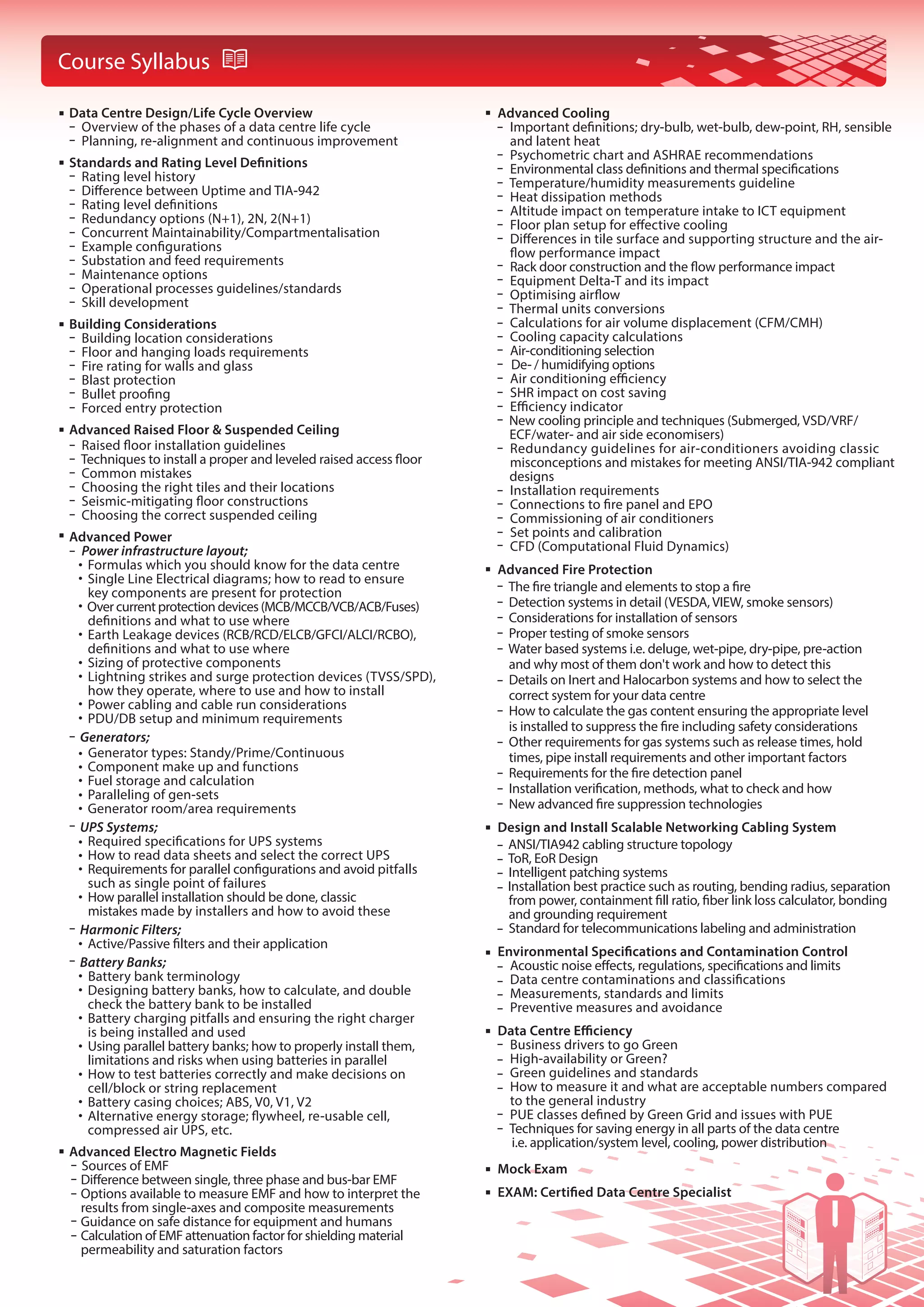
Roadmap
Audience
The primary audience for this course is an IT, facilities or
data centre operations professional working in and
around the data centre and having the responsibility to
achieve and improve high-availability and manageability
of the data centre.
Prerequisites
Participants must hold a valid CDCP® certificate in order
to be able to register for the CDCS® class.
Global Accreditation & Recognition
Understand the design life cycle of data centres and the
stages involved
Discuss the data centre requirements in great level of
detail with vendors, suppliers and contractors to ensure
that these requirements are met
Validate design plans, quotes and offers proposed by
vendors/contractors
Understand redundancy levels for both the data centre
design/setup and maintenance
Understand the various building considerations such as
bullet proofing, mitigation of seismic activity, fire ratings
and thermal stability
Understand how to install a raised floor that meets
requirements, avoiding misalignment, level differences
and leakage
Understand how to read a Single Line Electrical Diagram
to identify and avoid the most common design issues
Choose the correct UPS and parallel configuration, learn
and avoid classic parallel installation mistakes
Understand how to calculate battery banks, validate
offered configurations to ensure they meet requirements
Understand what distance to keep to avoid EMF issues for
human safety and equipment disturbances
Understand the fundamental cooling setup, CFM, Delta-T
and other important factors
Understand contamination factors and limitations
Understand full details of fire suppression options, how to
calculate gas content and verify installations
Understand how to measure data centre energy efficiency
and how to improve it
Course Benefits
After completion of the course the participant will be able to:
Certified Data Centre Expert
Certified Data Centre Specialist
Certified Data Centre Professional
Course Syllabus
Data Centre Design/Life Cycle Overview
Overview of the phases of a data centre life cycle
Planning, re-alignment and continuous improvement
Standards and Rating Level Definitions
Rating level history
Difference between Uptime and TIA-942
Rating level definitions
Redundancy options (N+1), 2N, 2(N+1)
Concurrent Maintainability/Compartmentalisation
Example configurations
Substation and feed requirements
Maintenance options
Operational processes guidelines/standards
Skill development
Building Considerations
Building location considerations
Floor and hanging loads requirements
Fire rating for walls and glass
Blast protection
Bullet proofing
Forced entry protection
Advanced Raised Floor & Suspended Ceiling
Raised floor installation guidelines
Techniques to install a proper and leveled raised access floor
Common mistakes
Choosing the right tiles and their locations
Seismic-mitigating floor constructions
Choosing the correct suspended ceiling
Advanced Power
Power infrastructure layout;
Formulas which you should know for the data centre
Single Line Electrical diagrams; how to read to ensure
key components are present for protection
Over current protection devices (MCB/MCCB/VCB/ACB/Fuses)
definitions and what to use where
Earth Leakage devices (RCB/RCD/ELCB/GFCI/ALCI/RCBO),
definitions and what to use where
Sizing of protective components
Lightning strikes and surge protection devices (TVSS/SPD),
how they operate, where to use and how to install
Power cabling and cable run considerations
PDU/DB setup and minimum requirements
Generators;
Generator types: Standy/Prime/Continuous
Component make up and functions
Fuel storage and calculation
Paralleling of gen-sets
Generator room/area requirements
UPS Systems;
Required specifications for UPS systems
How to read data sheets and select the correct UPS
Requirements for parallel configurations and avoid pitfalls
such as single point of failures
How parallel installation should be done, classic
mistakes made by installers and how to avoid these
Harmonic Filters;
Active/Passive filters and their application
Battery Banks;
Battery bank terminology
Designing battery banks, how to calculate, and double
check the battery bank to be installed
Battery charging pitfalls and ensuring the right charger
is being installed and used
Using parallel battery banks; how to properly install them,
limitations and risks when using batteries in parallel
How to test batteries correctly and make decisions on
cell/block or string replacement
Battery casing choices; ABS, V0, V1, V2
Alternative energy storage; flywheel, re-usable cell,
compressed air UPS, etc.
Advanced Electro Magnetic Fields
Sources of EMF
Difference between single, three phase and bus-bar EMF
Options available to measure EMF and how to interpret the
results from single-axes and composite measurements
Guidance on safe distance for equipment and humans
Calculation of EMF attenuation factor for shielding material
permeability and saturation factors
Advanced Cooling
Important definitions; dry-bulb, wet-bulb, dew-point, RH, sensible
and latent heat
Psychometric chart and ASHRAE recommendations
Environmental class definitions and thermal specifications
Temperature/humidity measurements guideline
Heat dissipation methods
Altitude impact on temperature intake to ICT equipment
Floor plan setup for effective cooling
Differences in tile surface and supporting structure and the air-
flow performance impact
Rack door construction and the flow performance impact
Equipment Delta-T and its impact
Optimising airflow
Thermal units conversions
Calculations for air volume displacement (CFM/CMH)
Cooling capacity calculations
Air-conditioning selection
De- / humidifying options
Air conditioning efficiency
SHR impact on cost saving
Efficiency indicator
New cooling principle and techniques (Submerged, VSD/VRF/
ECF/water- and air side economisers)
Redundancy guidelines for air-conditioners avoiding classic
misconceptions and mistakes for meeting ANSI/TIA-942 compliant
designs
Installation requirements
Connections to fire panel and EPO
Commissioning of air conditioners
Set points and calibration
CFD (Computational Fluid Dynamics)
Advanced Fire Protection
The fire triangle and elements to stop a fire
Detection systems in detail (VESDA, VIEW, smoke sensors)
Considerations for installation of sensors
Proper testing of smoke sensors
Water based systems i.e. deluge, wet-pipe, dry-pipe, pre-action
and why most of them don't work and how to detect this
Details on Inert and Halocarbon systems and how to select the
correct system for your data centre
How to calculate the gas content ensuring the appropriate level
is installed to suppress the fire including safety considerations
Other requirements for gas systems such as release times, hold
times, pipe install requirements and other important factors
Requirements for the fire detection panel
Installation verification, methods, what to check and how
New advanced fire suppression technologies
Design and Install Scalable Networking Cabling System
ANSI/TIA942 cabling structure topology
ToR, EoR Design
Intelligent patching systems
Installation best practice such as routing, bending radius, separation
from power, containment fill ratio, fiber link loss calculator, bonding
and grounding requirement
Standard for telecommunications labeling and administration
Environmental Specifications and Contamination Control
Acoustic noise effects, regulations, specifications and limits
Data centre contaminations and classifications
Measurements, standards and limits
Preventive measures and avoidance
Data Centre Efficiency
Business drivers to go Green
High-availability or Green?
Green guidelines and standards
How to measure it and what are acceptable numbers compared
to the general industry
PUE classes defined by Green Grid and issues with PUE
Techniques for saving energy in all parts of the data centre
i.e. application/system level, cooling, power distribution
Mock Exam
EXAM: Certified Data Centre Specialist
Delivery structure
EPI courses are lectured by certified trainers. CDCS® is an
instructor-led course that uses a combination of lectures and
question-and-answer sessions, to discuss participants'
specific needs and issues experienced in their own
environment. Participants are able to tap into the trainer’s
extensive experience to enable them to solve practical
problems in their current environment, thus adding
tremendous value.
Examination
Certication exams are administered at the end of the last
training day by an authorised training partner, either
using paper-based or online format, depending on the
country in which the course is delivered. The exam is a
90-minute closed book exam, with 60 multiple-choice
questions. The candidate requires a minimum of 45
correct answers to pass the exam. Online exam results
are known immediately and paper-based exam results
will be known within one week.
Certification
Candidates who successfully pass the exam will receive
the official ‘Certified Data Centre Specialist’ certificate.
The certification is valid for three years after which the
student needs to re-certify. More information is available on
the EPI corporate website at www.epi-ap.com.
Global Accreditation & Recognition
EXIN, is a global, independent and not-for-profit examination
provider. EXIN's mission is to improve the quality of the
IT and data centre sectors, the proficiency of IT and data
centre professionals and the IT users, by means of
independent testing and certification. EXIN offers
candidates the opportunity to take examinations at a
time and place of their choice. Every day, EXIN examinations
are taken in more than 125 countries on six continents,
and in more than 15 languages.
Recommended next course
Candidates with a desire to become a data centre expert
are recommended to take the CDCE® course. CDCE®
prepares participants to manage a project which covers
scope, plan, design, implement, and retire or move a
mission critical data centre up to the highest redundancy
level. CDCE® builds upon knowledge gained in CDCP®
and CDCS® courses. Participants who pass the exam will
join the industries’ elite data centre project design
experts. Participants must possess a valid CDCS® certificate
for admission to the CDCE® course. Data centre professionals
who desire to pursue additional specialisations on data
centre competencies are recommended to refer to the
EPI Data Centre Training Framework©
on the EPI website at
www.epi-ap.com.
Course schedule
Our courses are available in over 50 countries across all
continents. For a comprehensive course schedule, visit
the EPI corporate website at www.epi-ap.com or contact
your local authorised reseller/partner.
Authorised Reseller/Partner:R15-01
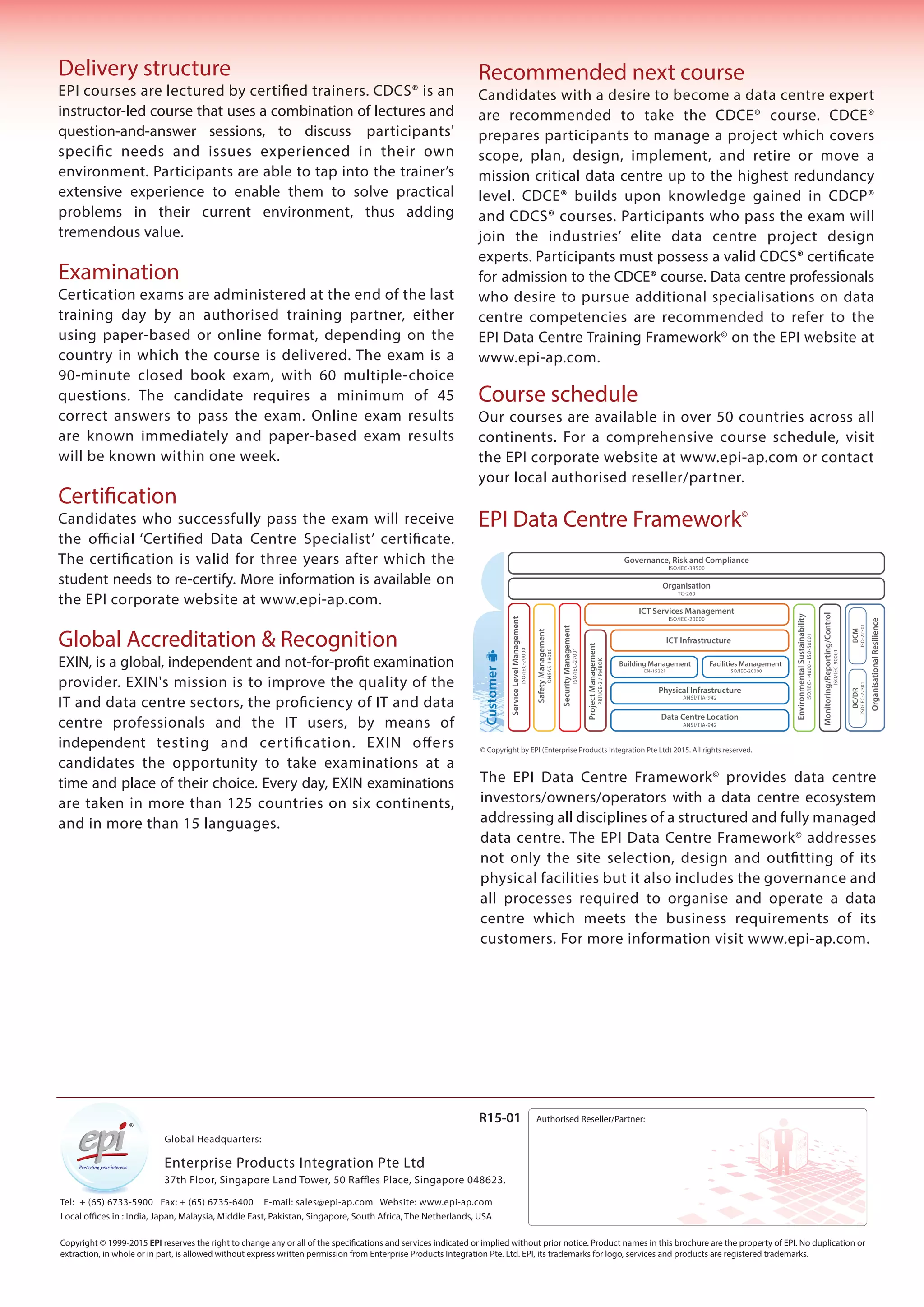
EPI Data Centre Framework©
The EPI Data Centre Framework©
provides data centre
investors/owners/operators with a data centre ecosystem
addressing all disciplines of a structured and fully managed
data centre. The EPI Data Centre Framework©
addresses
not only the site selection, design and outfitting of its
physical facilities but it also includes the governance and
all processes required to organise and operate a data
centre which meets the business requirements of its
customers. For more information visit www.epi-ap.com.
Copyright © 1999-2015 EPI reserves the right to change any or all of the specifications and services indicated or implied without prior notice. Product names in this brochure are the property of EPI. No duplication or
extraction, in whole or in part, is allowed without express written permission from Enterprise Products Integration Pte. Ltd. EPI, its trademarks for logo, services and products are registered trademarks.
Global Headquarters:
Enterprise Products Integration Pte Ltd
37th Floor, Singapore Land Tower, 50 Raffles Place, Singapore 048623.
Tel: + (65) 6733-5900 Fax: + (65) 6735-6400 E-mail: sales@epi-ap.com Website: www.epi-ap.com
Local offices in : India, Japan, Malaysia, Middle East, Pakistan, Singapore, South Africa, The Netherlands, USA
© Copyright by EPI (Enterprise Products Integration Pte Ltd) 2015. All rights reserved.
The Company
EPI is a company of European origin operating world-wide in over 50 countries through direct operations and a large partner
network. EPI offers an extensive range of data centre services on consultancy, auditing, certification and training. EPI’s focus is
on mission-critical, high-availability environments. Established in 1987, EPI has developed an international reputation for
delivering high quality technical expertise, with flexible and innovative solutions, techniques and methodologies.
All our services are aimed at helping our customers to:
Increase Availability of their mission-critical infrastructure
Improve Efficiency, Effectiveness and Manageability
Minimise risk of business interruption
Our Clients share a common need to protect their valuable data, run their mission-critical infrastructure efficiently and to be
protected on a 24 x 7 basis. By protecting the interests of our customers, EPI is committed to an intensive program of comprehensive
services development backed by engineering and support excellence.
Quality Systems and Procedures have always been at the heart of every stage of our service delivery to ensure consistent and
high quality services. We are known for our thoroughness, flexibility and responsiveness in our project management. We focus
on providing solutions that fit each organisation and each project with a drive to deliver quality on time, every time.
Let us put our expertise to work for you!
Audit and Certification
- ANSI/TIA-942
- SS507
- ISO/IEC-27001
- ISO/IEC-20000
Survey and Assessment
- Power Quality
- Cooling
- EMF
- Thermo Scanning
- Physical Security
- Customised Surveys
Consultation
- Data Centre Design Validation
- Data Centre Design Evaluation
- Data Centre Review/
Independent Second Opinion
Data Centre Services
The EPI Data Centre Training Framework©
provides a structured course curriculum for individuals working in and around data
centre facilities and data centre operational management. It addresses the various disciplines required to design and manage
a high-availability, efficient data centre. EPI’s data centre course curriculum is not only the first in the world, it is also by far the
largest in the industry. Many companies have specified these courses as prerequisites for their staff working in and around the
data centre and use them as part of their career planning initiatives. Recognised globally, these certifications add value
to both companies and individuals.
© Copyright by EPI (Enterprise Products Integration Pte Ltd) 2015. All rights reserved.
EPI Data Centre Training Framework
©
Design/Build Governance/Operations Standards/Compliance

CERTIFIED DATA CENTRE SPECIALIST

  • 1.
    CERTIFIED DATA CENTRESPECIALIST Introduction With few exceptions, enterprises today rely on IT for the delivery of business-critical services - often directly to the end consumer. It is therefore vital that the mission-critical data centre is designed, maintained and operated with high-availability and efficiency in mind. However, the fact is most data centres do not meet the full availability, capacity, safety or efficiency requirements that are often demanded. The Certified Data Centre Specialist is a three-day course designed to bring participants to the level of a suitable sparring partner with suppliers. They will be able to verify offers provided by vendors for correctness, effectiveness and efficiency. CDCS® is a must-have certification for professional data centre managers and personnel. CDCS® is a pre-requisite for individuals wishing to achieve the elite CDCE® (Certified Data Centre Expert) status. Roadmap Audience The primary audience for this course is an IT, facilities or data centre operations professional working in and around the data centre and having the responsibility to achieve and improve high-availability and manageability of the data centre. Prerequisites Participants must hold a valid CDCP® certificate in order to be able to register for the CDCS® class. Global Accreditation & Recognition Understand the design life cycle of data centres and the stages involved Discuss the data centre requirements in great level of detail with vendors, suppliers and contractors to ensure that these requirements are met Validate design plans, quotes and offers proposed by vendors/contractors Understand redundancy levels for both the data centre design/setup and maintenance Understand the various building considerations such as bullet proofing, mitigation of seismic activity, fire ratings and thermal stability Understand how to install a raised floor that meets requirements, avoiding misalignment, level differences and leakage Understand how to read a Single Line Electrical Diagram to identify and avoid the most common design issues Choose the correct UPS and parallel configuration, learn and avoid classic parallel installation mistakes Understand how to calculate battery banks, validate offered configurations to ensure they meet requirements Understand what distance to keep to avoid EMF issues for human safety and equipment disturbances Understand the fundamental cooling setup, CFM, Delta-T and other important factors Understand contamination factors and limitations Understand full details of fire suppression options, how to calculate gas content and verify installations Understand how to measure data centre energy efficiency and how to improve it Course Benefits After completion of the course the participant will be able to: Certified Data Centre Expert Certified Data Centre Specialist Certified Data Centre Professional
  • 2.
    Course Syllabus Data CentreDesign/Life Cycle Overview Overview of the phases of a data centre life cycle Planning, re-alignment and continuous improvement Standards and Rating Level Definitions Rating level history Difference between Uptime and TIA-942 Rating level definitions Redundancy options (N+1), 2N, 2(N+1) Concurrent Maintainability/Compartmentalisation Example configurations Substation and feed requirements Maintenance options Operational processes guidelines/standards Skill development Building Considerations Building location considerations Floor and hanging loads requirements Fire rating for walls and glass Blast protection Bullet proofing Forced entry protection Advanced Raised Floor & Suspended Ceiling Raised floor installation guidelines Techniques to install a proper and leveled raised access floor Common mistakes Choosing the right tiles and their locations Seismic-mitigating floor constructions Choosing the correct suspended ceiling Advanced Power Power infrastructure layout; Formulas which you should know for the data centre Single Line Electrical diagrams; how to read to ensure key components are present for protection Over current protection devices (MCB/MCCB/VCB/ACB/Fuses) definitions and what to use where Earth Leakage devices (RCB/RCD/ELCB/GFCI/ALCI/RCBO), definitions and what to use where Sizing of protective components Lightning strikes and surge protection devices (TVSS/SPD), how they operate, where to use and how to install Power cabling and cable run considerations PDU/DB setup and minimum requirements Generators; Generator types: Standy/Prime/Continuous Component make up and functions Fuel storage and calculation Paralleling of gen-sets Generator room/area requirements UPS Systems; Required specifications for UPS systems How to read data sheets and select the correct UPS Requirements for parallel configurations and avoid pitfalls such as single point of failures How parallel installation should be done, classic mistakes made by installers and how to avoid these Harmonic Filters; Active/Passive filters and their application Battery Banks; Battery bank terminology Designing battery banks, how to calculate, and double check the battery bank to be installed Battery charging pitfalls and ensuring the right charger is being installed and used Using parallel battery banks; how to properly install them, limitations and risks when using batteries in parallel How to test batteries correctly and make decisions on cell/block or string replacement Battery casing choices; ABS, V0, V1, V2 Alternative energy storage; flywheel, re-usable cell, compressed air UPS, etc. Advanced Electro Magnetic Fields Sources of EMF Difference between single, three phase and bus-bar EMF Options available to measure EMF and how to interpret the results from single-axes and composite measurements Guidance on safe distance for equipment and humans Calculation of EMF attenuation factor for shielding material permeability and saturation factors Advanced Cooling Important definitions; dry-bulb, wet-bulb, dew-point, RH, sensible and latent heat Psychometric chart and ASHRAE recommendations Environmental class definitions and thermal specifications Temperature/humidity measurements guideline Heat dissipation methods Altitude impact on temperature intake to ICT equipment Floor plan setup for effective cooling Differences in tile surface and supporting structure and the air- flow performance impact Rack door construction and the flow performance impact Equipment Delta-T and its impact Optimising airflow Thermal units conversions Calculations for air volume displacement (CFM/CMH) Cooling capacity calculations Air-conditioning selection De- / humidifying options Air conditioning efficiency SHR impact on cost saving Efficiency indicator New cooling principle and techniques (Submerged, VSD/VRF/ ECF/water- and air side economisers) Redundancy guidelines for air-conditioners avoiding classic misconceptions and mistakes for meeting ANSI/TIA-942 compliant designs Installation requirements Connections to fire panel and EPO Commissioning of air conditioners Set points and calibration CFD (Computational Fluid Dynamics) Advanced Fire Protection The fire triangle and elements to stop a fire Detection systems in detail (VESDA, VIEW, smoke sensors) Considerations for installation of sensors Proper testing of smoke sensors Water based systems i.e. deluge, wet-pipe, dry-pipe, pre-action and why most of them don't work and how to detect this Details on Inert and Halocarbon systems and how to select the correct system for your data centre How to calculate the gas content ensuring the appropriate level is installed to suppress the fire including safety considerations Other requirements for gas systems such as release times, hold times, pipe install requirements and other important factors Requirements for the fire detection panel Installation verification, methods, what to check and how New advanced fire suppression technologies Design and Install Scalable Networking Cabling System ANSI/TIA942 cabling structure topology ToR, EoR Design Intelligent patching systems Installation best practice such as routing, bending radius, separation from power, containment fill ratio, fiber link loss calculator, bonding and grounding requirement Standard for telecommunications labeling and administration Environmental Specifications and Contamination Control Acoustic noise effects, regulations, specifications and limits Data centre contaminations and classifications Measurements, standards and limits Preventive measures and avoidance Data Centre Efficiency Business drivers to go Green High-availability or Green? Green guidelines and standards How to measure it and what are acceptable numbers compared to the general industry PUE classes defined by Green Grid and issues with PUE Techniques for saving energy in all parts of the data centre i.e. application/system level, cooling, power distribution Mock Exam EXAM: Certified Data Centre Specialist
  • 3.
    Delivery structure EPI coursesare lectured by certified trainers. CDCS® is an instructor-led course that uses a combination of lectures and question-and-answer sessions, to discuss participants' specific needs and issues experienced in their own environment. Participants are able to tap into the trainer’s extensive experience to enable them to solve practical problems in their current environment, thus adding tremendous value. Examination Certication exams are administered at the end of the last training day by an authorised training partner, either using paper-based or online format, depending on the country in which the course is delivered. The exam is a 90-minute closed book exam, with 60 multiple-choice questions. The candidate requires a minimum of 45 correct answers to pass the exam. Online exam results are known immediately and paper-based exam results will be known within one week. Certification Candidates who successfully pass the exam will receive the official ‘Certified Data Centre Specialist’ certificate. The certification is valid for three years after which the student needs to re-certify. More information is available on the EPI corporate website at www.epi-ap.com. Global Accreditation & Recognition EXIN, is a global, independent and not-for-profit examination provider. EXIN's mission is to improve the quality of the IT and data centre sectors, the proficiency of IT and data centre professionals and the IT users, by means of independent testing and certification. EXIN offers candidates the opportunity to take examinations at a time and place of their choice. Every day, EXIN examinations are taken in more than 125 countries on six continents, and in more than 15 languages. Recommended next course Candidates with a desire to become a data centre expert are recommended to take the CDCE® course. CDCE® prepares participants to manage a project which covers scope, plan, design, implement, and retire or move a mission critical data centre up to the highest redundancy level. CDCE® builds upon knowledge gained in CDCP® and CDCS® courses. Participants who pass the exam will join the industries’ elite data centre project design experts. Participants must possess a valid CDCS® certificate for admission to the CDCE® course. Data centre professionals who desire to pursue additional specialisations on data centre competencies are recommended to refer to the EPI Data Centre Training Framework© on the EPI website at www.epi-ap.com. Course schedule Our courses are available in over 50 countries across all continents. For a comprehensive course schedule, visit the EPI corporate website at www.epi-ap.com or contact your local authorised reseller/partner. Authorised Reseller/Partner:R15-01 EPI Data Centre Framework© The EPI Data Centre Framework© provides data centre investors/owners/operators with a data centre ecosystem addressing all disciplines of a structured and fully managed data centre. The EPI Data Centre Framework© addresses not only the site selection, design and outfitting of its physical facilities but it also includes the governance and all processes required to organise and operate a data centre which meets the business requirements of its customers. For more information visit www.epi-ap.com. Copyright © 1999-2015 EPI reserves the right to change any or all of the specifications and services indicated or implied without prior notice. Product names in this brochure are the property of EPI. No duplication or extraction, in whole or in part, is allowed without express written permission from Enterprise Products Integration Pte. Ltd. EPI, its trademarks for logo, services and products are registered trademarks. Global Headquarters: Enterprise Products Integration Pte Ltd 37th Floor, Singapore Land Tower, 50 Raffles Place, Singapore 048623. Tel: + (65) 6733-5900 Fax: + (65) 6735-6400 E-mail: sales@epi-ap.com Website: www.epi-ap.com Local offices in : India, Japan, Malaysia, Middle East, Pakistan, Singapore, South Africa, The Netherlands, USA © Copyright by EPI (Enterprise Products Integration Pte Ltd) 2015. All rights reserved.
  • 4.
    The Company EPI isa company of European origin operating world-wide in over 50 countries through direct operations and a large partner network. EPI offers an extensive range of data centre services on consultancy, auditing, certification and training. EPI’s focus is on mission-critical, high-availability environments. Established in 1987, EPI has developed an international reputation for delivering high quality technical expertise, with flexible and innovative solutions, techniques and methodologies. All our services are aimed at helping our customers to: Increase Availability of their mission-critical infrastructure Improve Efficiency, Effectiveness and Manageability Minimise risk of business interruption Our Clients share a common need to protect their valuable data, run their mission-critical infrastructure efficiently and to be protected on a 24 x 7 basis. By protecting the interests of our customers, EPI is committed to an intensive program of comprehensive services development backed by engineering and support excellence. Quality Systems and Procedures have always been at the heart of every stage of our service delivery to ensure consistent and high quality services. We are known for our thoroughness, flexibility and responsiveness in our project management. We focus on providing solutions that fit each organisation and each project with a drive to deliver quality on time, every time. Let us put our expertise to work for you! Audit and Certification - ANSI/TIA-942 - SS507 - ISO/IEC-27001 - ISO/IEC-20000 Survey and Assessment - Power Quality - Cooling - EMF - Thermo Scanning - Physical Security - Customised Surveys Consultation - Data Centre Design Validation - Data Centre Design Evaluation - Data Centre Review/ Independent Second Opinion Data Centre Services The EPI Data Centre Training Framework© provides a structured course curriculum for individuals working in and around data centre facilities and data centre operational management. It addresses the various disciplines required to design and manage a high-availability, efficient data centre. EPI’s data centre course curriculum is not only the first in the world, it is also by far the largest in the industry. Many companies have specified these courses as prerequisites for their staff working in and around the data centre and use them as part of their career planning initiatives. Recognised globally, these certifications add value to both companies and individuals. © Copyright by EPI (Enterprise Products Integration Pte Ltd) 2015. All rights reserved. EPI Data Centre Training Framework © Design/Build Governance/Operations Standards/Compliance