Broadcasting to the masses or
   building communities:
Polish political parties’ online performance during
    2011 elections in international perspective

      Karolina Koc-Michalska (Science-Po, France)
     Darren G. Lilleker (Bournemouth University, UK)
Web campaigning in context
• Largely an adjunct of offline campaigning
  – Top-down, broadcasting model
  – Shovelware/Brochureware (Foot & Schneider,
    2006; Kluver et al, 2007; Ward et al, 2008)
• Parties/Candidates avoid interactivity to:
  – Prevent adaptation of the message
  – Avoid having to be specific (Stromer-Galley, 2000)
The Obama Effect
• A new model of web campaigning?
• Huge opportunities to co-create
• Focus though on mobilisation and
  crowdsourcing brand ambassadors
• Parties in Germany 2009 and UK 2010
  replicated in part some of the tools with less
  real-time interaction allowed (Lilleker &
  Jackson, 2011)
New platforms for campaigns
• Social networking platforms offer new spaces
  for corporate and political communication
• Spaces where the people are (the agora or
  town hall of the future?)
• Within these platforms communities can grow
• Community size can be a factor of the
  communication frequency (Lilleker & Koc-
  Michalska, 2012)
The Elections 2.0 project
• Mapped the use of the Internet 2007 onwards
• Baseline studies France 2007 (Lilleker & Malagon,
  2010); US 2008 & UK 2010 (Lilleker & Jackson,
  2011); Germany 2009 (Lilleker, Jackson &
  Schweitzer, 2011)
• Extended to Poland 2011 and France 2012
• Coding and categorisation of website features
  and links
• This paper uses the data that is common for the
  coding sheets of the post-Obama contests.
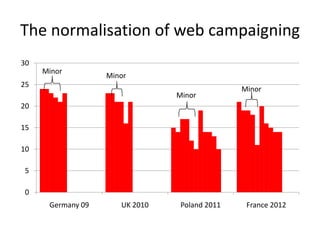
The normalisation of web campaigning
30
     Minor
                   Minor
25
                                               Minor
                                Minor
20

15

10

5

0
      Germany 09      UK 2010    Poland 2011    France 2012
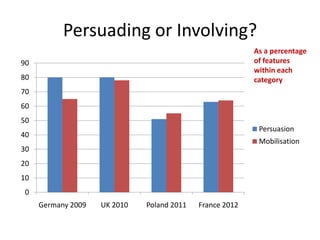
Persuading or Involving?
                                                          As a percentage
90                                                        of features
                                                          within each
80                                                        category
70
60
50
                                                           Persuasion
40
                                                           Mobilisation
30
20
10
0
     Germany 2009   UK 2010   Poland 2011   France 2012
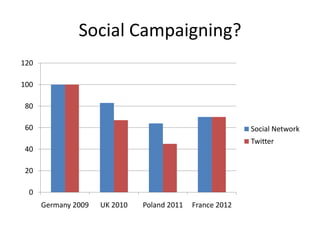
Social Campaigning?
120

100

80

60                                                         Social Network
                                                           Twitter
40

20

 0
      Germany 2009   UK 2010   Poland 2011   France 2012
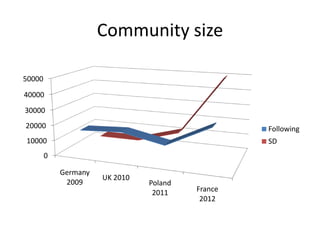
Community size

50000
40000
30000
20000                                             Following
10000                                             SD
        0

            Germany
                      UK 2010
             2009               Poland
                                 2011    France
                                          2012
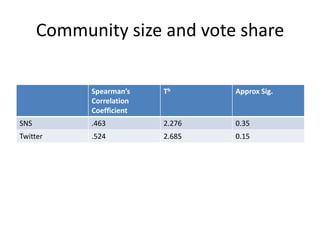
Community size and vote share

            Spearman’s    Tb      Approx Sig.
            Correlation
            Coefficient
SNS         .463          2.276   0.35
Twitter     .524          2.685   0.15
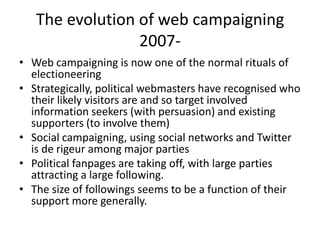
The evolution of web campaigning
                 2007-
• Web campaigning is now one of the normal rituals of
  electioneering
• Strategically, political webmasters have recognised who
  their likely visitors are and so target involved
  information seekers (with persuasion) and existing
  supporters (to involve them)
• Social campaigning, using social networks and Twitter
  is de rigeur among major parties
• Political fanpages are taking off, with large parties
  attracting a large following.
• The size of followings seems to be a function of their
  support more generally.
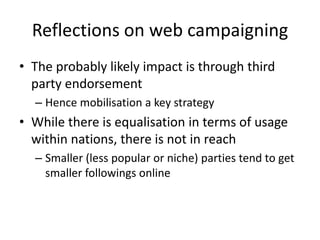
Reflections on web campaigning
• The probably likely impact is through third
  party endorsement
  – Hence mobilisation a key strategy
• While there is equalisation in terms of usage
  within nations, there is not in reach
  – Smaller (less popular or niche) parties tend to get
    smaller followings online

Broadcasting to the masses or building communities

  • 1.
    Broadcasting to themasses or building communities: Polish political parties’ online performance during 2011 elections in international perspective Karolina Koc-Michalska (Science-Po, France) Darren G. Lilleker (Bournemouth University, UK)
  • 2.
    Web campaigning incontext • Largely an adjunct of offline campaigning – Top-down, broadcasting model – Shovelware/Brochureware (Foot & Schneider, 2006; Kluver et al, 2007; Ward et al, 2008) • Parties/Candidates avoid interactivity to: – Prevent adaptation of the message – Avoid having to be specific (Stromer-Galley, 2000)
  • 3.
    The Obama Effect •A new model of web campaigning? • Huge opportunities to co-create • Focus though on mobilisation and crowdsourcing brand ambassadors • Parties in Germany 2009 and UK 2010 replicated in part some of the tools with less real-time interaction allowed (Lilleker & Jackson, 2011)
  • 4.
    New platforms forcampaigns • Social networking platforms offer new spaces for corporate and political communication • Spaces where the people are (the agora or town hall of the future?) • Within these platforms communities can grow • Community size can be a factor of the communication frequency (Lilleker & Koc- Michalska, 2012)
  • 5.
    The Elections 2.0project • Mapped the use of the Internet 2007 onwards • Baseline studies France 2007 (Lilleker & Malagon, 2010); US 2008 & UK 2010 (Lilleker & Jackson, 2011); Germany 2009 (Lilleker, Jackson & Schweitzer, 2011) • Extended to Poland 2011 and France 2012 • Coding and categorisation of website features and links • This paper uses the data that is common for the coding sheets of the post-Obama contests.
  • 6.
    The normalisation ofweb campaigning 30 Minor Minor 25 Minor Minor 20 15 10 5 0 Germany 09 UK 2010 Poland 2011 France 2012
  • 7.
    Persuading or Involving? As a percentage 90 of features within each 80 category 70 60 50 Persuasion 40 Mobilisation 30 20 10 0 Germany 2009 UK 2010 Poland 2011 France 2012
  • 8.
    Social Campaigning? 120 100 80 60 Social Network Twitter 40 20 0 Germany 2009 UK 2010 Poland 2011 France 2012
  • 9.
    Community size 50000 40000 30000 20000 Following 10000 SD 0 Germany UK 2010 2009 Poland 2011 France 2012
  • 10.
    Community size andvote share Spearman’s Tb Approx Sig. Correlation Coefficient SNS .463 2.276 0.35 Twitter .524 2.685 0.15
  • 11.
    The evolution ofweb campaigning 2007- • Web campaigning is now one of the normal rituals of electioneering • Strategically, political webmasters have recognised who their likely visitors are and so target involved information seekers (with persuasion) and existing supporters (to involve them) • Social campaigning, using social networks and Twitter is de rigeur among major parties • Political fanpages are taking off, with large parties attracting a large following. • The size of followings seems to be a function of their support more generally.
  • 12.
    Reflections on webcampaigning • The probably likely impact is through third party endorsement – Hence mobilisation a key strategy • While there is equalisation in terms of usage within nations, there is not in reach – Smaller (less popular or niche) parties tend to get smaller followings online