Broadcast Media
Unit 2: Planning and Management of Broadcast Media
1. Discuss the procedure for establishing goals for
broadcast media
2. Explain developing and administering the
programme of broadcast media; and
3. Specify the financing procedure of broadcast
media
Failing to plan is planning to fail. The more high stake/
sessions nature of programme. Planning definition:
The more rigorous planning requires.
 Planning involves:
 Determining the objectives of the programme
course/ project or campaign of broadcast media.
 Assessing the need and requirements of such an
activity.
 Determi9ning timeline
 A needs assessment is a process used by
organizations to determine priorities, make
organizational improvements, or allocate resources.
 It involves determining the needs, or gaps, between
where the organization envisions itself in the future
and the organization's current state.
 We then develop a plan of action to address the
needs (or closing the gaps) to bring the organization
closer to its desired future state.
 Exploration and identification
 Data gathering and analysis
 Utilization
Survey questionnaires,
Opinionnaires and interviews
are the most used tools for
doing need assessment in our
context
 Very briefly, it's a way of asking group or
community members what they see as the
most important needs of that group or
community.The results of the survey then
guide future action. Generally, the needs that
are rated most important are the ones that
get addressed.
Valid and Reliable needs assessment surveys have
some common characteristics:
 They have a pre-set list of questions to be
answered
 They have a pre-determined sample of the
number and types of people to answer these
questions chosen in advance
 They are done by personal interview, phone, or
by written response (e.g., a mail-in survey)
 The results of the survey are tabulated,
summarized, distributed, discussed, and finally
used for planning a new program of BM
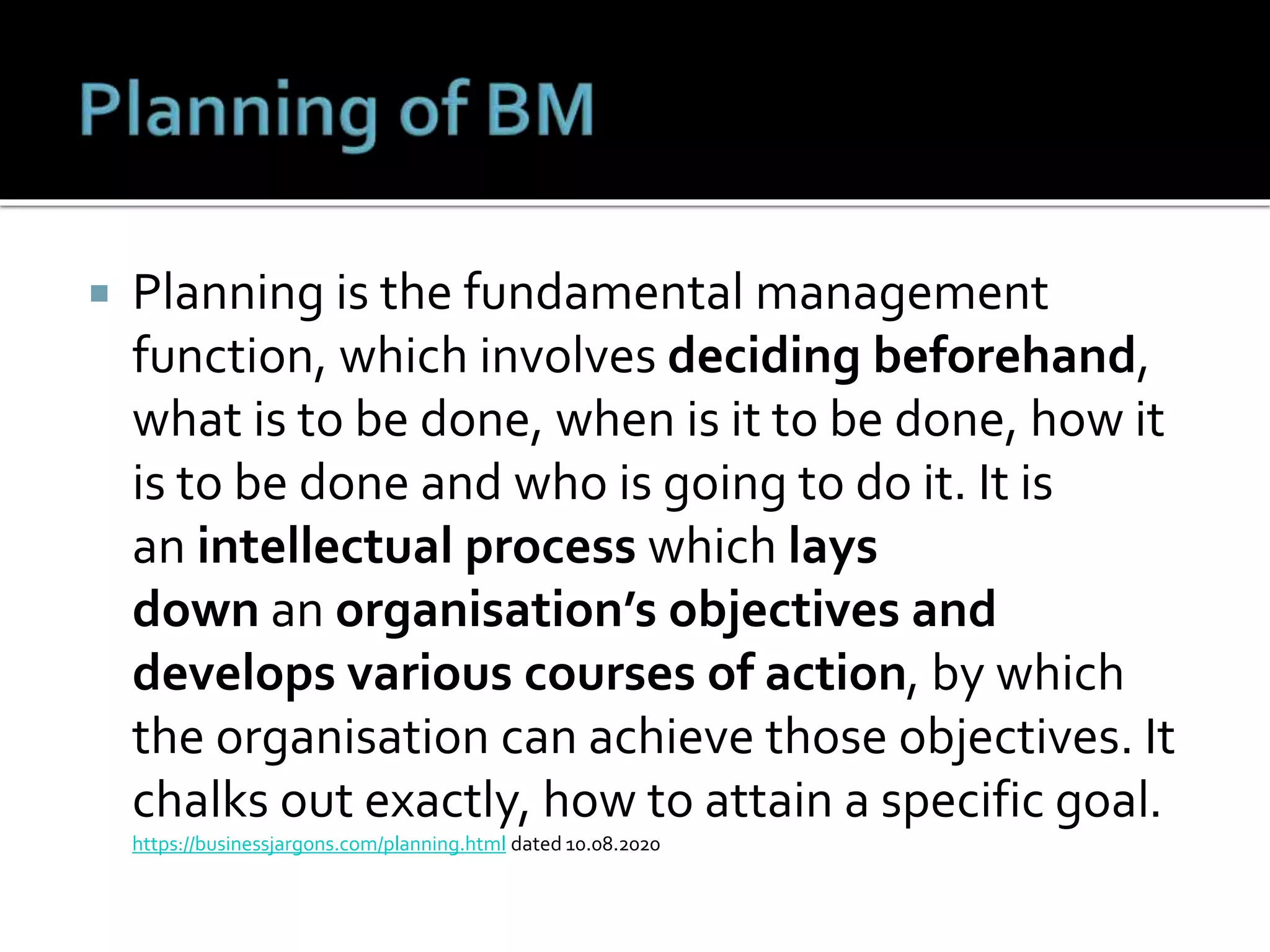
 Planning is the fundamental management
function, which involves deciding beforehand,
what is to be done, when is it to be done, how it
is to be done and who is going to do it. It is
an intellectual process which lays
down an organisation’s objectives and
develops various courses of action, by which
the organisation can achieve those objectives. It
chalks out exactly, how to attain a specific goal.
https://businessjargons.com/planning.html dated 10.08.2020
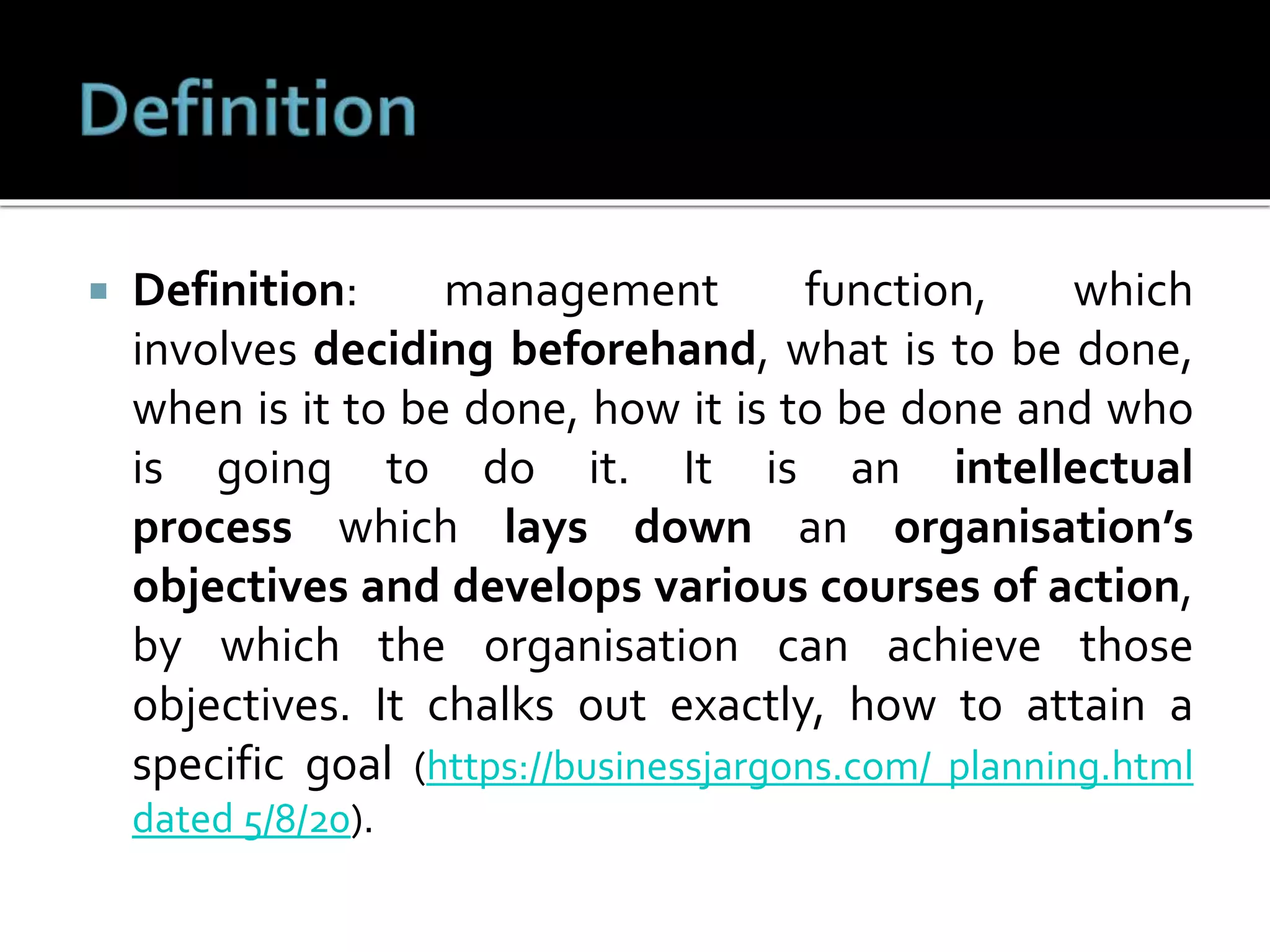
 Definition: management function, which
involves deciding beforehand, what is to be done,
when is it to be done, how it is to be done and who
is going to do it. It is an intellectual
process which lays down an organisation’s
objectives and develops various courses of action,
by which the organisation can achieve those
objectives. It chalks out exactly, how to attain a
specific goal (https://businessjargons.com/ planning.html
dated 5/8/20).
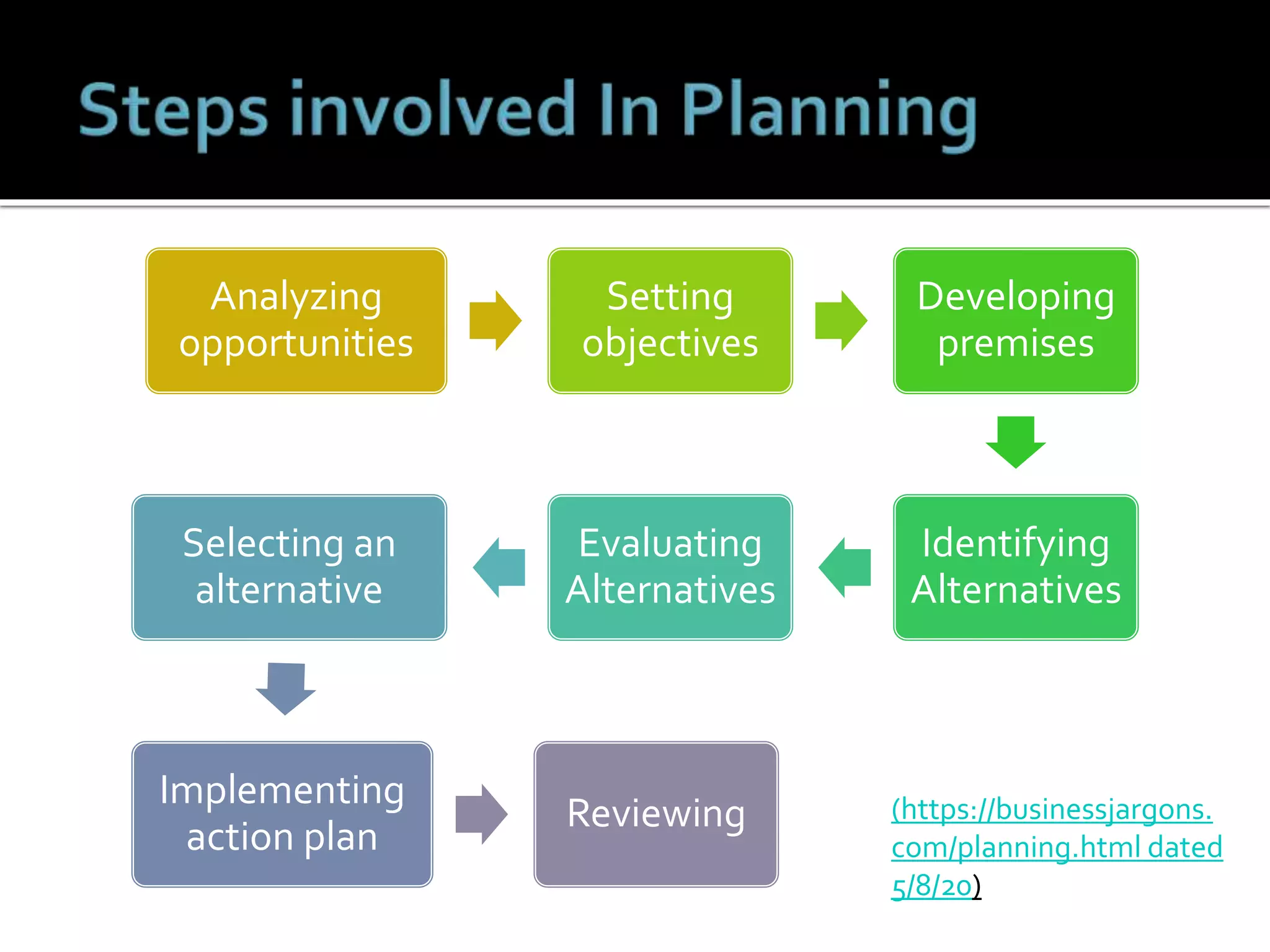
Analyzing
opportunities
Setting
objectives
Developing
premises
Identifying
Alternatives
Evaluating
Alternatives
Selecting an
alternative
Implementing
action plan
Reviewing (https://businessjargons.
com/planning.html dated
5/8/20)
 A good way to begin the plan is with the
background information that serves as
benchmark data leading to some
assumptions and knowledge of the broadcast
plan.The plan should then review broadcast
objectives the station wishes to accomplish
 The target audience/ public must be defined
so that the most appropriate program
formats or tools can be selected. Finally the
broadcast plan must include an explanation
of how the activities will be scheduled and
carried out within a given timetable.
 Also important is to know the strategy of
broadcasting in creating the greatest
program appeal possible, to attract a wide
range of audience.These audiences can have
a variety of broadcast program formats to
choose from.
 Broadcast requires a careful planned
approach which is based on the identification
and formulation of objectives, strategies,
tactics.To begin a process, one must have a
clear understanding of the nature of
broadcast station, specifically the attributes
of the media such as radio and television.
 Will its use support formal education?
 Will it be used as a part of non-formal education/
distance education programme?
 Will it be used as part of a literacy campaign?
 How much time will be allocated for broadcast
media sessions?
 Which days/ hours will be much suitable?
 How many time slots will be used?
 Who will write the script?
 Who will assess/evaluate the script?
 How selection of the script will be done?
 Who will broadcast the script?
 Whether full programme be offered through
broadcast?
 Whether a course be offered?
 Whether some units of a course or different courses
will be offered?
 Next, how many courses the programme may
consist of and same way how many units a course
may have and what will be the components of each
units.
 Name the components of a unit of a typical course
of AIOU.
 Estimating initial project cost development
recurring cost and cost of evaluating the projects.
 No and types of personnel to be required or hired.
 How to develop lessons/ courses or programme.
 How to pilot test the courses or programme.
 When and how to implement the courses or
proramme (simultaneously or phase wise)
Purposes to;
 identify the needs of the community
 find gaps between the current situation and desired
situation
 understand the ground realities
 support in planning and developing a feasible and
result oriented project/ programme of broadcast
media
 Whether it is required at national or local level?
 Whether it is regarding opening of a new radio or
television external or to launch a programme or
project?
 Whether it is time bound/ limited time project or
whether it is long lasting?
 Are professional experts of broadcast media and/or
researcher an available to conduct need assessment
study?
 What types of instruments/ tools for collection of
data have been used?
 Whether they are appropriate to seek the required type of
data?
 How these have been developed?
 How there have been administered?
 Whether the administrators were trained in this regard?
 How sampling will be done to cover the target population?
 How data will be collected?
 How data will be analyzed?
 Who will do the analysis and who will write the report?
 Who will study the need assessment to plan and manage the
broadcast media?
 Decisions regarding planning of a programme.
 Decision regarding planning of a particular session.
 Selection or development of topic content.
 Writing the script for radio/ television.
 Evaluating the script
 Broadcasting the script
 Making compatible with the system
 Making required sound/ music effect
 Assess the delivery of the session
 Improve the session after receiving feedback
 Finalize the session for permanent use
Includes:
 Developing infrastructure central building, regional
centers, community centers, television station/
radio station, installations of softwares/ matches/
cameras, lights, computers, recording rooms, etc.
 Hiring or training of staff
 Development of programme/ courses/ sessions
 Scheduling of the programmes
 Educational broadcasting requires large
investments of time, energy, and scarce resources
by low-income countries. These investments are
being made with minimal information concerning
(1) the effectiveness of educational television
compared to other educational improvements, and
(2) the economic returns to increasing the number
of children schooled through educational television.
 Previously stated facts:
 Innovations will improve average exam scores of
students and
 Lead to an increased number of school graduates
without a decrease in the quality of their education,
and
 There is a substantial economic payoff both to
improving individuals cognitive skills, as measured
by school tests, and graduating more students from
higher levels of the education system
Investment in distance education through broadcast media though
does not result in gains/ effects as per size of investment, and thus it
usually not considered cost effective. However, its comprehensive
analysis reveals that interventions through broadcast media are long-
term and their results are multi dimensional.These are:
 As signatory of MGD, fulfilling commitments of MDG 2 is must
MGD 2: Achieve Universal Primary Education and STD 4 Ensuring
access to inclusive, equitable quality education to all.
 Ensuring the obligations lain down by constitution
 Articles 25-A requires "The State shall provide free and
compulsory education to all children of the age of five to sixteen
years in such manner as may be determined by law.
 Enhancing literacy rate
 Provision of equitable facilities of education to each part of the
country as obligation of welfare country
 Taking education to the door steps of students of
those community for whom formal education is still
not acceptable/ feasible
 Provision of last chance/ second chance of receiving
education
 Reducing burden on formal education
 Enhancing employability
 Handling covid-19 like situation (money does not
matter)
 Contribution Of BM: AIOU, 14 million, Tele school
million
 Community and country development
 The present comparisons of cost effectiveness of
teaching through broadcast media as compared
with traditional method of education are not valid
and realistic. It can be done only if we can be done
only if we can estimate what would be the
traditional cost of formal education to educate and
train so many thousands of people that were done
through distance education.
 Cost effectiveness can also be considered in terms of social benefits that
penetrates in the society. Example of two villages
 The objectives of distance education are many fold :
 primary as well as secondary
 Broadcast media can also be used for teachers’ training and in such case
its cost will be much reduced as comparison of training face to face a
large population of teachers.
 In most of the remote and far flung areas of Pakistan, it is difficult to
make available highly qualified and competent teachers. Through
broadcast media, we can use a few best teachers whose lessons will be
made available on air.
 Finally, if we consider academic achievement of students taught through
broadcast media/ distance education, cost will much higher but if we
consider indirect benefits or long term impact of such students on
society, it is cost effective.
 Questions

Broadcast media-unit 2-planning and management of broadcast media

  • 1.
    Broadcast Media Unit 2:Planning and Management of Broadcast Media
  • 2.
    1. Discuss theprocedure for establishing goals for broadcast media 2. Explain developing and administering the programme of broadcast media; and 3. Specify the financing procedure of broadcast media
  • 3.
    Failing to planis planning to fail. The more high stake/ sessions nature of programme. Planning definition: The more rigorous planning requires.  Planning involves:  Determining the objectives of the programme course/ project or campaign of broadcast media.  Assessing the need and requirements of such an activity.  Determi9ning timeline
  • 4.
     A needsassessment is a process used by organizations to determine priorities, make organizational improvements, or allocate resources.  It involves determining the needs, or gaps, between where the organization envisions itself in the future and the organization's current state.  We then develop a plan of action to address the needs (or closing the gaps) to bring the organization closer to its desired future state.
  • 5.
     Exploration andidentification  Data gathering and analysis  Utilization
  • 6.
    Survey questionnaires, Opinionnaires andinterviews are the most used tools for doing need assessment in our context
  • 7.
     Very briefly,it's a way of asking group or community members what they see as the most important needs of that group or community.The results of the survey then guide future action. Generally, the needs that are rated most important are the ones that get addressed.
  • 8.
    Valid and Reliableneeds assessment surveys have some common characteristics:  They have a pre-set list of questions to be answered  They have a pre-determined sample of the number and types of people to answer these questions chosen in advance  They are done by personal interview, phone, or by written response (e.g., a mail-in survey)  The results of the survey are tabulated, summarized, distributed, discussed, and finally used for planning a new program of BM
  • 9.
     Planning isthe fundamental management function, which involves deciding beforehand, what is to be done, when is it to be done, how it is to be done and who is going to do it. It is an intellectual process which lays down an organisation’s objectives and develops various courses of action, by which the organisation can achieve those objectives. It chalks out exactly, how to attain a specific goal. https://businessjargons.com/planning.html dated 10.08.2020
  • 10.
     Definition: managementfunction, which involves deciding beforehand, what is to be done, when is it to be done, how it is to be done and who is going to do it. It is an intellectual process which lays down an organisation’s objectives and develops various courses of action, by which the organisation can achieve those objectives. It chalks out exactly, how to attain a specific goal (https://businessjargons.com/ planning.html dated 5/8/20).
  • 11.
  • 12.
     A goodway to begin the plan is with the background information that serves as benchmark data leading to some assumptions and knowledge of the broadcast plan.The plan should then review broadcast objectives the station wishes to accomplish
  • 13.
     The targetaudience/ public must be defined so that the most appropriate program formats or tools can be selected. Finally the broadcast plan must include an explanation of how the activities will be scheduled and carried out within a given timetable.
  • 14.
     Also importantis to know the strategy of broadcasting in creating the greatest program appeal possible, to attract a wide range of audience.These audiences can have a variety of broadcast program formats to choose from.
  • 15.
     Broadcast requiresa careful planned approach which is based on the identification and formulation of objectives, strategies, tactics.To begin a process, one must have a clear understanding of the nature of broadcast station, specifically the attributes of the media such as radio and television.
  • 16.
     Will itsuse support formal education?  Will it be used as a part of non-formal education/ distance education programme?  Will it be used as part of a literacy campaign?  How much time will be allocated for broadcast media sessions?  Which days/ hours will be much suitable?  How many time slots will be used?
  • 17.
     Who willwrite the script?  Who will assess/evaluate the script?  How selection of the script will be done?  Who will broadcast the script?
  • 18.
     Whether fullprogramme be offered through broadcast?  Whether a course be offered?  Whether some units of a course or different courses will be offered?  Next, how many courses the programme may consist of and same way how many units a course may have and what will be the components of each units.  Name the components of a unit of a typical course of AIOU.
  • 19.
     Estimating initialproject cost development recurring cost and cost of evaluating the projects.  No and types of personnel to be required or hired.  How to develop lessons/ courses or programme.  How to pilot test the courses or programme.  When and how to implement the courses or proramme (simultaneously or phase wise)
  • 20.
    Purposes to;  identifythe needs of the community  find gaps between the current situation and desired situation  understand the ground realities  support in planning and developing a feasible and result oriented project/ programme of broadcast media
  • 21.
     Whether itis required at national or local level?  Whether it is regarding opening of a new radio or television external or to launch a programme or project?  Whether it is time bound/ limited time project or whether it is long lasting?  Are professional experts of broadcast media and/or researcher an available to conduct need assessment study?  What types of instruments/ tools for collection of data have been used?
  • 22.
     Whether theyare appropriate to seek the required type of data?  How these have been developed?  How there have been administered?  Whether the administrators were trained in this regard?  How sampling will be done to cover the target population?  How data will be collected?  How data will be analyzed?  Who will do the analysis and who will write the report?  Who will study the need assessment to plan and manage the broadcast media?
  • 23.
     Decisions regardingplanning of a programme.  Decision regarding planning of a particular session.  Selection or development of topic content.  Writing the script for radio/ television.  Evaluating the script  Broadcasting the script  Making compatible with the system  Making required sound/ music effect  Assess the delivery of the session  Improve the session after receiving feedback  Finalize the session for permanent use
  • 24.
    Includes:  Developing infrastructurecentral building, regional centers, community centers, television station/ radio station, installations of softwares/ matches/ cameras, lights, computers, recording rooms, etc.  Hiring or training of staff  Development of programme/ courses/ sessions  Scheduling of the programmes
  • 25.
     Educational broadcastingrequires large investments of time, energy, and scarce resources by low-income countries. These investments are being made with minimal information concerning (1) the effectiveness of educational television compared to other educational improvements, and (2) the economic returns to increasing the number of children schooled through educational television.
  • 26.
     Previously statedfacts:  Innovations will improve average exam scores of students and  Lead to an increased number of school graduates without a decrease in the quality of their education, and  There is a substantial economic payoff both to improving individuals cognitive skills, as measured by school tests, and graduating more students from higher levels of the education system
  • 27.
    Investment in distanceeducation through broadcast media though does not result in gains/ effects as per size of investment, and thus it usually not considered cost effective. However, its comprehensive analysis reveals that interventions through broadcast media are long- term and their results are multi dimensional.These are:  As signatory of MGD, fulfilling commitments of MDG 2 is must MGD 2: Achieve Universal Primary Education and STD 4 Ensuring access to inclusive, equitable quality education to all.  Ensuring the obligations lain down by constitution  Articles 25-A requires "The State shall provide free and compulsory education to all children of the age of five to sixteen years in such manner as may be determined by law.  Enhancing literacy rate  Provision of equitable facilities of education to each part of the country as obligation of welfare country
  • 28.
     Taking educationto the door steps of students of those community for whom formal education is still not acceptable/ feasible  Provision of last chance/ second chance of receiving education  Reducing burden on formal education  Enhancing employability  Handling covid-19 like situation (money does not matter)
  • 29.
     Contribution OfBM: AIOU, 14 million, Tele school million  Community and country development  The present comparisons of cost effectiveness of teaching through broadcast media as compared with traditional method of education are not valid and realistic. It can be done only if we can be done only if we can estimate what would be the traditional cost of formal education to educate and train so many thousands of people that were done through distance education.
  • 30.
     Cost effectivenesscan also be considered in terms of social benefits that penetrates in the society. Example of two villages  The objectives of distance education are many fold :  primary as well as secondary  Broadcast media can also be used for teachers’ training and in such case its cost will be much reduced as comparison of training face to face a large population of teachers.  In most of the remote and far flung areas of Pakistan, it is difficult to make available highly qualified and competent teachers. Through broadcast media, we can use a few best teachers whose lessons will be made available on air.  Finally, if we consider academic achievement of students taught through broadcast media/ distance education, cost will much higher but if we consider indirect benefits or long term impact of such students on society, it is cost effective.
  • 31.