Introduction of Distance
Education and Non Broadcast
Media
&
The Choice of Media
OBJECTIVES OF THE SESSION
After reading the material, it is hoped that you
will be able to:
1. Elaborate the concept of non-broadcast media;
2. Discuss the scope of non-broadcast media;
3. Differentiate the hardware and software;
4. State the significance of non-broadcast media
in distance education; and
5. Analyse the role of non-broadcast media in
distance education.
Distance Education Delivered
A wide range of technological options are
available to distance education. They fall into
four major categories:
1. Voice: Instructional audio include the
interactive technologies of telephone, audio
conferencing and a short-wave, radio, passive
(i.e. one-way) audio tools include tapes and
radio
Counti----
2. Video: Instructional video tools include stile images such
as slides, pre-produced moving images (e.g., films, video
tape) and real time moving images combined with audio
conferencing one-way video or two-way video with two-
way audio.
3. Data: Computer sends and received information
electronically for this reason, the term ‘data’ is used to
described this brood category of instructional tools.
Computer application for distance education are varied and
include computer-assisted instruction (CAT), computer-
managed instruction (CMT) and computer-medicated
education (CME).
Counti--
4. Print: Print is a foundational elements of
distance educator programmes the basis from
which all other delivery system have evolved-
various print formats are available including;
textbooks, study guides, worked books, course
syllabus and case studies.
Formats of Print Material
Various print formats are available, includes:
Text Books
 Study Guide
 Work Book
Course Syllabus
 Case Studies
Counti-
Instructional Material
Instructional materials are the tools used in
educational lesson, which include active
learning and assessment.
Types of Instructional Materials (ITMS)
1. Printed and Duplicated Materials
2. Non-projected Display Material
3. Still-projected Display Material
4. Technological Instructional Material
Counti—
1-Printed and Duplicated Materials
The combination of printed and audio-visual
material in the classroom is nothing new. It
is so common that most of us are probably not
aware of it. Textbooks are full of illustration,
and story books would be interesting without
pictures.
Counti---
2-Demonstration Material
The traditional division between printed materials
and audio-visual materials is no historical. We all
know that man communicated by gestures and by
drawings long before he invented the spoken
language. We do not know how many thousands
of years the spoken language was dominant
before a written language was invented to make it
more permanent and to extends the range of
communication.
Count--
3-Audio Visual Materials
It would be a mistake, however, to think that
pictures, for example, are always understandable.
On the contrary, children need to be taught to
“read” pictures. As evidence of this, most pictures
contain captions to help explain them. A picture
of a highway accident published in the local
newspaper without any verbal explanation would
be almost meaningless to the readers, hey would
want to know where it occurred and who was
involved.
Counti---
4-Project Display Material
There is a further consideration which makes the
division between printed and audiovisual material
less distinct. Some visual material are said to be
close to “reality”. Now,
in truth, no photograph is an exact reproduction of
reality, because every photographer
has to take a point of view before aiming his
camera.
Counti---
5-Technological Instruction Material
As evidence of this, there are new materials
which are clearly designed to be sued
together. For many years, we have had
filmstrips based on story-books. Once of the
leading producers of teaching films and
filmstrips bases them on textbooks published by
the same company.
Broadcast and Non-Broadcast Media
Broadcast audio is a transmission. For example, Radio
and Television. The reason why these are BROADCAST
elements is because they are live material and also
because they cannot in anyway shape or form be fast
forwarded, paused, stopped or rewound. You have to sit
through the adverts and boring scenes or songs on the
TV and Radio so you
can hear your favourite song on the radio or watch your
favourite TV programme. Some of the general public
may argue that this can also be non-broadcast, as you
can pause and rewind live television on a Sky+ player or
another satellite media device.
Importance of Broadcast Media
(a) TV (Television):
Television is an in escapablepart of modern culture. We
depend on TV for entertainment,news, education, culture,
weather, sports–and even music.
Educational Program:
Now most of the TV has or is broadcasting or telecasting
education program for making talented or intellectual general
people or student such as debate program, computer education,
BBC Janala, Mina Carton and Sisum Pur for children as well
as people can
know how to save them at the time of natural disaster those are
living in costal area or risky area, even they can learn
precaution about earth quick and Suname from TV and Radio.
The students can see for themselves
how science has advanced:
(1) Educational television is capable of making available
many needed and so far
learning experiences.
(2) Educational television brings about continuing co-
operative planning by
teachers, supervisors, learning materials exports and
skilful production teams.
(3) Good and effective educational television broadcasts result
from the outgrowth
of planning, of content analysis and of the selection of this
most appropriate
instructional
Counti-
(4) It can use a variety of audio-visual aids, motion pictures, film-
strips, slides, recording drawings, maps and other projected and
non-projected aids can be demonstrated through Television.
Video-tapes and recordings on television
bring us the launching of space rock t, of political and social
events.
(5) Educational television brings us a new kind of1eaching team
into existence.
(6) It can acquaint the children with past culture, history and social
life.
(7) It can motivate both children and adults, because not only it is
educative but also
Counti---
(8) The televised-lectures are more thrilling as they bring to
the listeners not only verbal - information and the
instruction of the speaker but also the whole of his
personality engage in the task.
(9) National problems like those of population and poverty
and illiteracy are often and discussed over the television.
(10) It plays an important role to play in educating the
children on the history and culture of our country. It
gives a very good idea of the history of the country by
telecasting various programmes through dances, short
films on historical places, museums etc.
Counti---
(b) Radio:
Radio acts as the medium of mass-
communication. It is used mainly to broadcast
events to far and wide places of the world. It is
also a very important source of
entertainment.
Counti---
(c) The Press:
The Press covers the entire printed matter.
These printed matters are books, magazines
journals or newspapers. Reading matter has
vast potentialities. It exerts good influence or
the individuals. It acts on the intelligence and
emotions of the individuals in shaping out
attitudes and philosophies of life.
Counti---
(d) Mobiles:
Mobile is the way of faster communication. By
the use of mobile, people can
communicate in real tme and having seen
picture between people and can be
teleconference meeting from long distance
such as from Bangladesh to America without
going out both side party from their own
office. Mobile is just like internet.
UNIT-2
THE CHOICE OF MEDIA
After going through this unit, students will be able
to:
1. Describe media, its uses for teaching learning
process and criteria for media
selection.
2. . Understand the factors affecting the media
selection.
3. . Differentiate among optional and essential
media and discuss their characteristics.
4. . Specify the procedures of media utilization.
What is Media?
A medium can be defined as “a channel of
communication, information, or
entertainment” (Mish 1989, 455). In this paper,
media and technology are used
interchangeably. Media includes technology such
as print, radio, audio-cassettes, videocassettes,
broadcast TV, satellite cable TV, multimedia CDs,
computer-based learning,
and online instruction over the Internet.
The Advantages of Using Media:
1. Many media sources (feature films, music videos, visualizations,
news sto have
very high production quality capable of showcasing complex ideas
in a period of
time. This helps develop quantitative reasoning. Learn more about
U technique
using the Teaching Quantitative Reasoning with the News module.
2. Media offers both cognitive and affective experiences. It can
provoke discussion,
an assessment of one's values, and an assessment of self if the
scenes have
emotional content.
Counti---
3. The uses of media sources help connect learners with
events that are cu relevant. As a result, a positive
consequence of utilizing media is that i must keep their
materials and examples up-to-date.
4. News stories can be used to connect theories taught in
the classroom wi h real world events and policies.
5. Popular media (films, music, YouTube) are a familiar
medium to students that helps gain attention and
maintain student interest in the theories and concept
under discussion. Students can see the theories and
concepts in action. In more than a figurative sense,
theories and concepts leap from the screen.
Counti---
6. Students can hone their analytical skills by
analyzing media using the and concepts
they are studying.
7. The use of media in the classroom enables
students to see concepts and n examples
when they are watching television, listening to
music, or are at the mo with friends
8. Students can experience worlds beyond their
own, especially if the media i sharply
different from their local environment
Criteria for Media Selection
In an international setting, media can be selected and
evaluated based on the following:
Cost – Is the medium cost effective? Can it reach a
wide enough audience? What
technology infrastructure is currently available?
Accessibility – Is the medium accessible? Does it
facilitate distribution? Is it convenient
to use? Is it user-friendly?
Social-Political Suitability – Is the medium socially and
politically suitable? Does its
use coincide with social and political agencies agendas
of governing bodies?
Counti---
Cultural Friendliness – Is the medium culturally
appropriate? Does it coincide with the
culture's traditional way of learning?
Openness/Flexibility – Is the medium flexible?
Does it foster collaboration? Does it
foster different ways of teaching?
Interactivity – Is the medium interactive? Does it
promote learner-learner and learnerinstructor
interaction? Does it facilitate timely and quality
feedback from instructors and
tutors?
Counti---
Motivational Value – Is the medium
motivating? Does it encourage learners to
study harder and longer?
Effectiveness – Is the medium effective? Does
it help students learn content faster (i.e., more
efficiently)?
Audio Visual Aids
Audi visual material must be seen in their
relationship to teaching as a whole and to the
learning process as a whole, until the teacher
understands the relationship between audio visual
material and teaching learning process.
Audio visual materials are produced, distributed
and used as planned components of educational
programs. It helps the process of learning that is
motivation, classification and stimulation. A.V.
aids are multisensory materials which motivate
and stimulate the individual.
Counti---
Need of Audio visual Aids in Teaching Learning
Process:
Following points highlight the need of audio visual aids
in teaching learning process.
1. An opportunity to students to participate
effectively: Use of these aids makes the lesson
dynamic. It brings change in the traditional teaching
and gives an opportunity to students to participate
effectively. The children get opportunity to laugh, to
talk and to ask questions from the teacher and to learn
in an effective way without any fear.
Counti--
2. To motivate the children: These aids
motivate the children to learn effectively and
thus to acquire permanent knowledge. It
arouses students’ curiosity to learn more than
more and to know that would follow in the
lesson. In this way audio visual aids develop
educational interest among the students to
attain knowledge about some subjects
Counti--
3. According to human self-expression: Linguists have been expressing their
ideas in the form of drawings since olden times
4. To supplement direct experiences: These aids help in getting direct
experiences from real things.
5. Develop attractions: Audio visual aids develop attraction and interest in
the process of teaching learning.
6. Education for life: It is said life is for education and education is for life.
Education makes the life happier and meaningful.
7. Direct experiences: The knowledge with the student get through direct
experiences is everlasting because of involvement of the sense organs like
eyes, ears and nose etc
8. To help in meaningful experiences: These aids provide meaningful
experiences
with the use of more and more sense, which is the foundation of
educational
process
Counti---
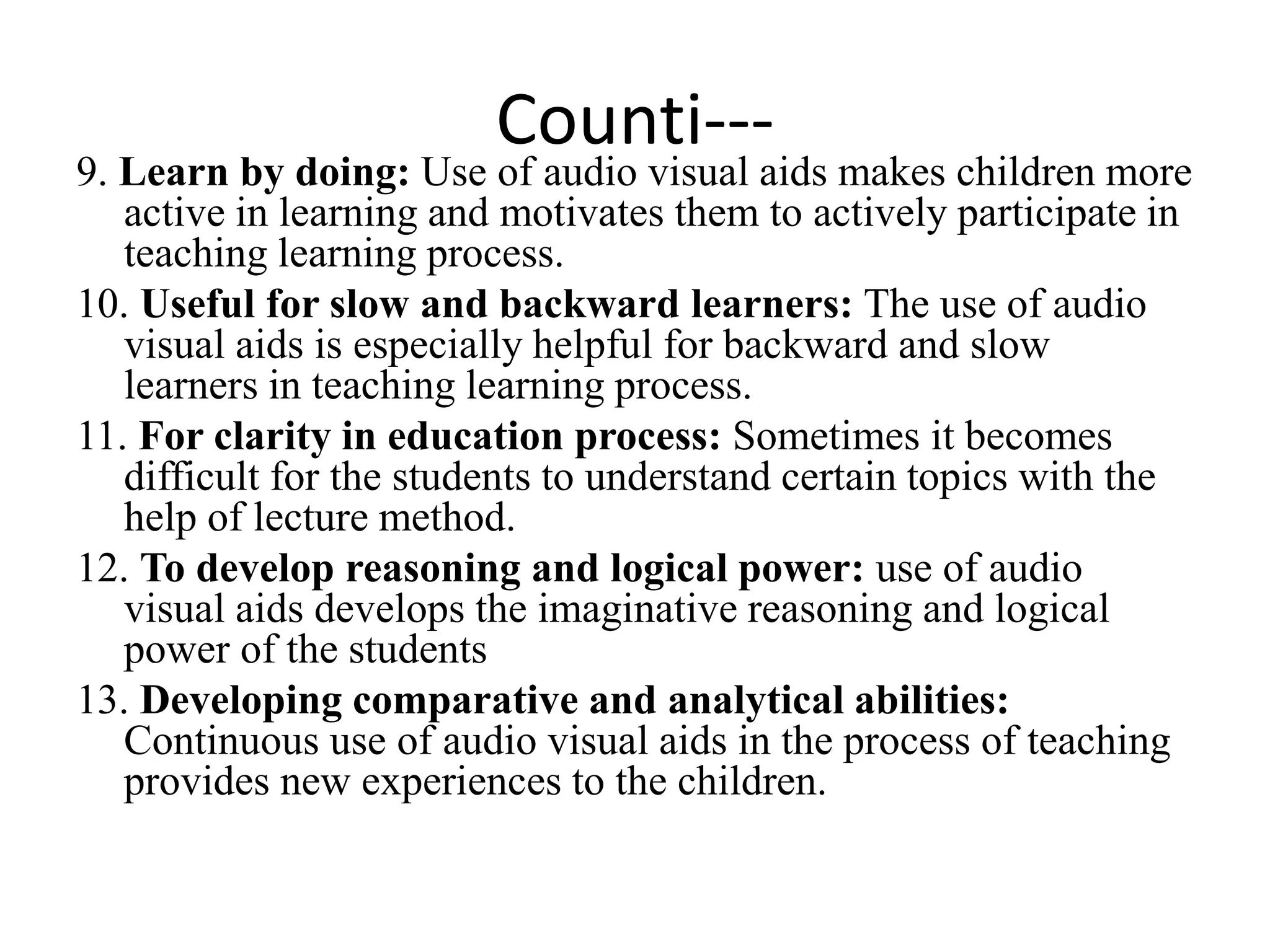
9. Learn by doing: Use of audio visual aids makes children more
active in learning and motivates them to actively participate in
teaching learning process.
10. Useful for slow and backward learners: The use of audio
visual aids is especially helpful for backward and slow
learners in teaching learning process.
11. For clarity in education process: Sometimes it becomes
difficult for the students to understand certain topics with the
help of lecture method.
12. To develop reasoning and logical power: use of audio
visual aids develops the imaginative reasoning and logical
power of the students
13. Developing comparative and analytical abilities:
Continuous use of audio visual aids in the process of teaching
provides new experiences to the children.
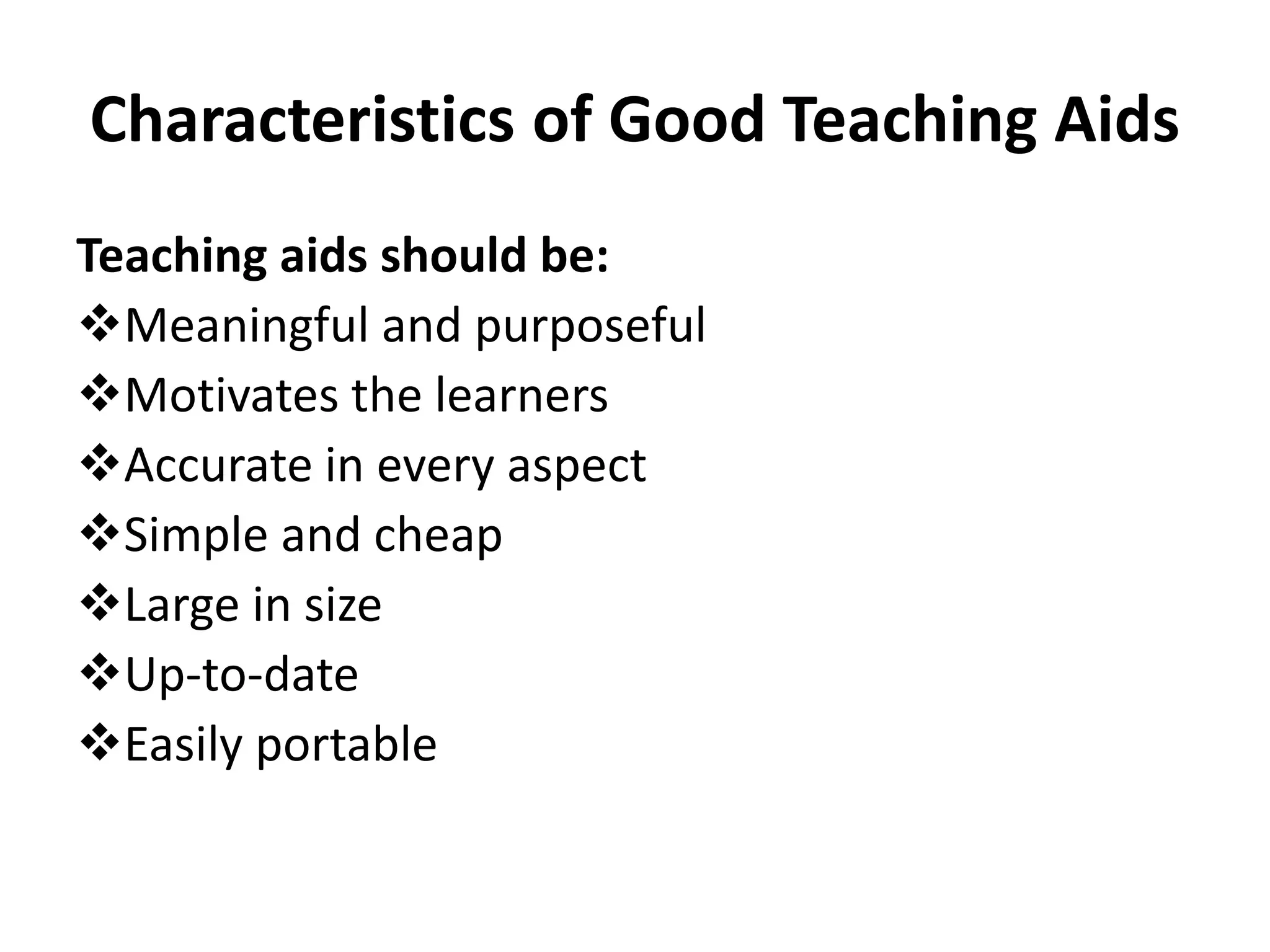
Characteristics of Good Teaching Aids
Teaching aids should be:
Meaningful and purposeful
Motivates the learners
Accurate in every aspect
Simple and cheap
Large in size
Up-to-date
Easily portable
End...........

NON-BROADCAST MEDIA - INTRODUCATION OF DISTANCE EDUCATION AND NON-BROADCAST MEDIA (UNIT 1) - THE CHOICE OF MEDIA (UNIT 2) - B.ED - 8622 - AIOU

  • 1.
    Introduction of Distance Educationand Non Broadcast Media & The Choice of Media
  • 2.
    OBJECTIVES OF THESESSION After reading the material, it is hoped that you will be able to: 1. Elaborate the concept of non-broadcast media; 2. Discuss the scope of non-broadcast media; 3. Differentiate the hardware and software; 4. State the significance of non-broadcast media in distance education; and 5. Analyse the role of non-broadcast media in distance education.
  • 3.
    Distance Education Delivered Awide range of technological options are available to distance education. They fall into four major categories: 1. Voice: Instructional audio include the interactive technologies of telephone, audio conferencing and a short-wave, radio, passive (i.e. one-way) audio tools include tapes and radio
  • 4.
    Counti---- 2. Video: Instructionalvideo tools include stile images such as slides, pre-produced moving images (e.g., films, video tape) and real time moving images combined with audio conferencing one-way video or two-way video with two- way audio. 3. Data: Computer sends and received information electronically for this reason, the term ‘data’ is used to described this brood category of instructional tools. Computer application for distance education are varied and include computer-assisted instruction (CAT), computer- managed instruction (CMT) and computer-medicated education (CME).
  • 5.
    Counti-- 4. Print: Printis a foundational elements of distance educator programmes the basis from which all other delivery system have evolved- various print formats are available including; textbooks, study guides, worked books, course syllabus and case studies.
  • 6.
    Formats of PrintMaterial Various print formats are available, includes: Text Books  Study Guide  Work Book Course Syllabus  Case Studies
  • 7.
    Counti- Instructional Material Instructional materialsare the tools used in educational lesson, which include active learning and assessment. Types of Instructional Materials (ITMS) 1. Printed and Duplicated Materials 2. Non-projected Display Material 3. Still-projected Display Material 4. Technological Instructional Material
  • 8.
    Counti— 1-Printed and DuplicatedMaterials The combination of printed and audio-visual material in the classroom is nothing new. It is so common that most of us are probably not aware of it. Textbooks are full of illustration, and story books would be interesting without pictures.
  • 9.
    Counti--- 2-Demonstration Material The traditionaldivision between printed materials and audio-visual materials is no historical. We all know that man communicated by gestures and by drawings long before he invented the spoken language. We do not know how many thousands of years the spoken language was dominant before a written language was invented to make it more permanent and to extends the range of communication.
  • 10.
    Count-- 3-Audio Visual Materials Itwould be a mistake, however, to think that pictures, for example, are always understandable. On the contrary, children need to be taught to “read” pictures. As evidence of this, most pictures contain captions to help explain them. A picture of a highway accident published in the local newspaper without any verbal explanation would be almost meaningless to the readers, hey would want to know where it occurred and who was involved.
  • 11.
    Counti--- 4-Project Display Material Thereis a further consideration which makes the division between printed and audiovisual material less distinct. Some visual material are said to be close to “reality”. Now, in truth, no photograph is an exact reproduction of reality, because every photographer has to take a point of view before aiming his camera.
  • 12.
    Counti--- 5-Technological Instruction Material Asevidence of this, there are new materials which are clearly designed to be sued together. For many years, we have had filmstrips based on story-books. Once of the leading producers of teaching films and filmstrips bases them on textbooks published by the same company.
  • 13.
    Broadcast and Non-BroadcastMedia Broadcast audio is a transmission. For example, Radio and Television. The reason why these are BROADCAST elements is because they are live material and also because they cannot in anyway shape or form be fast forwarded, paused, stopped or rewound. You have to sit through the adverts and boring scenes or songs on the TV and Radio so you can hear your favourite song on the radio or watch your favourite TV programme. Some of the general public may argue that this can also be non-broadcast, as you can pause and rewind live television on a Sky+ player or another satellite media device.
  • 14.
    Importance of BroadcastMedia (a) TV (Television): Television is an in escapablepart of modern culture. We depend on TV for entertainment,news, education, culture, weather, sports–and even music. Educational Program: Now most of the TV has or is broadcasting or telecasting education program for making talented or intellectual general people or student such as debate program, computer education, BBC Janala, Mina Carton and Sisum Pur for children as well as people can know how to save them at the time of natural disaster those are living in costal area or risky area, even they can learn precaution about earth quick and Suname from TV and Radio.
  • 15.
    The students cansee for themselves how science has advanced: (1) Educational television is capable of making available many needed and so far learning experiences. (2) Educational television brings about continuing co- operative planning by teachers, supervisors, learning materials exports and skilful production teams. (3) Good and effective educational television broadcasts result from the outgrowth of planning, of content analysis and of the selection of this most appropriate instructional
  • 16.
    Counti- (4) It canuse a variety of audio-visual aids, motion pictures, film- strips, slides, recording drawings, maps and other projected and non-projected aids can be demonstrated through Television. Video-tapes and recordings on television bring us the launching of space rock t, of political and social events. (5) Educational television brings us a new kind of1eaching team into existence. (6) It can acquaint the children with past culture, history and social life. (7) It can motivate both children and adults, because not only it is educative but also
  • 17.
    Counti--- (8) The televised-lecturesare more thrilling as they bring to the listeners not only verbal - information and the instruction of the speaker but also the whole of his personality engage in the task. (9) National problems like those of population and poverty and illiteracy are often and discussed over the television. (10) It plays an important role to play in educating the children on the history and culture of our country. It gives a very good idea of the history of the country by telecasting various programmes through dances, short films on historical places, museums etc.
  • 18.
    Counti--- (b) Radio: Radio actsas the medium of mass- communication. It is used mainly to broadcast events to far and wide places of the world. It is also a very important source of entertainment.
  • 19.
    Counti--- (c) The Press: ThePress covers the entire printed matter. These printed matters are books, magazines journals or newspapers. Reading matter has vast potentialities. It exerts good influence or the individuals. It acts on the intelligence and emotions of the individuals in shaping out attitudes and philosophies of life.
  • 20.
    Counti--- (d) Mobiles: Mobile isthe way of faster communication. By the use of mobile, people can communicate in real tme and having seen picture between people and can be teleconference meeting from long distance such as from Bangladesh to America without going out both side party from their own office. Mobile is just like internet.
  • 21.
    UNIT-2 THE CHOICE OFMEDIA After going through this unit, students will be able to: 1. Describe media, its uses for teaching learning process and criteria for media selection. 2. . Understand the factors affecting the media selection. 3. . Differentiate among optional and essential media and discuss their characteristics. 4. . Specify the procedures of media utilization.
  • 22.
    What is Media? Amedium can be defined as “a channel of communication, information, or entertainment” (Mish 1989, 455). In this paper, media and technology are used interchangeably. Media includes technology such as print, radio, audio-cassettes, videocassettes, broadcast TV, satellite cable TV, multimedia CDs, computer-based learning, and online instruction over the Internet.
  • 23.
    The Advantages ofUsing Media: 1. Many media sources (feature films, music videos, visualizations, news sto have very high production quality capable of showcasing complex ideas in a period of time. This helps develop quantitative reasoning. Learn more about U technique using the Teaching Quantitative Reasoning with the News module. 2. Media offers both cognitive and affective experiences. It can provoke discussion, an assessment of one's values, and an assessment of self if the scenes have emotional content.
  • 24.
    Counti--- 3. The usesof media sources help connect learners with events that are cu relevant. As a result, a positive consequence of utilizing media is that i must keep their materials and examples up-to-date. 4. News stories can be used to connect theories taught in the classroom wi h real world events and policies. 5. Popular media (films, music, YouTube) are a familiar medium to students that helps gain attention and maintain student interest in the theories and concept under discussion. Students can see the theories and concepts in action. In more than a figurative sense, theories and concepts leap from the screen.
  • 25.
    Counti--- 6. Students canhone their analytical skills by analyzing media using the and concepts they are studying. 7. The use of media in the classroom enables students to see concepts and n examples when they are watching television, listening to music, or are at the mo with friends 8. Students can experience worlds beyond their own, especially if the media i sharply different from their local environment
  • 26.
    Criteria for MediaSelection In an international setting, media can be selected and evaluated based on the following: Cost – Is the medium cost effective? Can it reach a wide enough audience? What technology infrastructure is currently available? Accessibility – Is the medium accessible? Does it facilitate distribution? Is it convenient to use? Is it user-friendly? Social-Political Suitability – Is the medium socially and politically suitable? Does its use coincide with social and political agencies agendas of governing bodies?
  • 27.
    Counti--- Cultural Friendliness –Is the medium culturally appropriate? Does it coincide with the culture's traditional way of learning? Openness/Flexibility – Is the medium flexible? Does it foster collaboration? Does it foster different ways of teaching? Interactivity – Is the medium interactive? Does it promote learner-learner and learnerinstructor interaction? Does it facilitate timely and quality feedback from instructors and tutors?
  • 28.
    Counti--- Motivational Value –Is the medium motivating? Does it encourage learners to study harder and longer? Effectiveness – Is the medium effective? Does it help students learn content faster (i.e., more efficiently)?
  • 29.
    Audio Visual Aids Audivisual material must be seen in their relationship to teaching as a whole and to the learning process as a whole, until the teacher understands the relationship between audio visual material and teaching learning process. Audio visual materials are produced, distributed and used as planned components of educational programs. It helps the process of learning that is motivation, classification and stimulation. A.V. aids are multisensory materials which motivate and stimulate the individual.
  • 30.
    Counti--- Need of Audiovisual Aids in Teaching Learning Process: Following points highlight the need of audio visual aids in teaching learning process. 1. An opportunity to students to participate effectively: Use of these aids makes the lesson dynamic. It brings change in the traditional teaching and gives an opportunity to students to participate effectively. The children get opportunity to laugh, to talk and to ask questions from the teacher and to learn in an effective way without any fear.
  • 31.
    Counti-- 2. To motivatethe children: These aids motivate the children to learn effectively and thus to acquire permanent knowledge. It arouses students’ curiosity to learn more than more and to know that would follow in the lesson. In this way audio visual aids develop educational interest among the students to attain knowledge about some subjects
  • 32.
    Counti-- 3. According tohuman self-expression: Linguists have been expressing their ideas in the form of drawings since olden times 4. To supplement direct experiences: These aids help in getting direct experiences from real things. 5. Develop attractions: Audio visual aids develop attraction and interest in the process of teaching learning. 6. Education for life: It is said life is for education and education is for life. Education makes the life happier and meaningful. 7. Direct experiences: The knowledge with the student get through direct experiences is everlasting because of involvement of the sense organs like eyes, ears and nose etc 8. To help in meaningful experiences: These aids provide meaningful experiences with the use of more and more sense, which is the foundation of educational process
  • 33.
    Counti--- 9. Learn bydoing: Use of audio visual aids makes children more active in learning and motivates them to actively participate in teaching learning process. 10. Useful for slow and backward learners: The use of audio visual aids is especially helpful for backward and slow learners in teaching learning process. 11. For clarity in education process: Sometimes it becomes difficult for the students to understand certain topics with the help of lecture method. 12. To develop reasoning and logical power: use of audio visual aids develops the imaginative reasoning and logical power of the students 13. Developing comparative and analytical abilities: Continuous use of audio visual aids in the process of teaching provides new experiences to the children.
  • 34.
    Characteristics of GoodTeaching Aids Teaching aids should be: Meaningful and purposeful Motivates the learners Accurate in every aspect Simple and cheap Large in size Up-to-date Easily portable
  • 35.