MCS3103 : e-Learning Concepts
and Technologies
Upekha Vandebona
Index No : 13440722
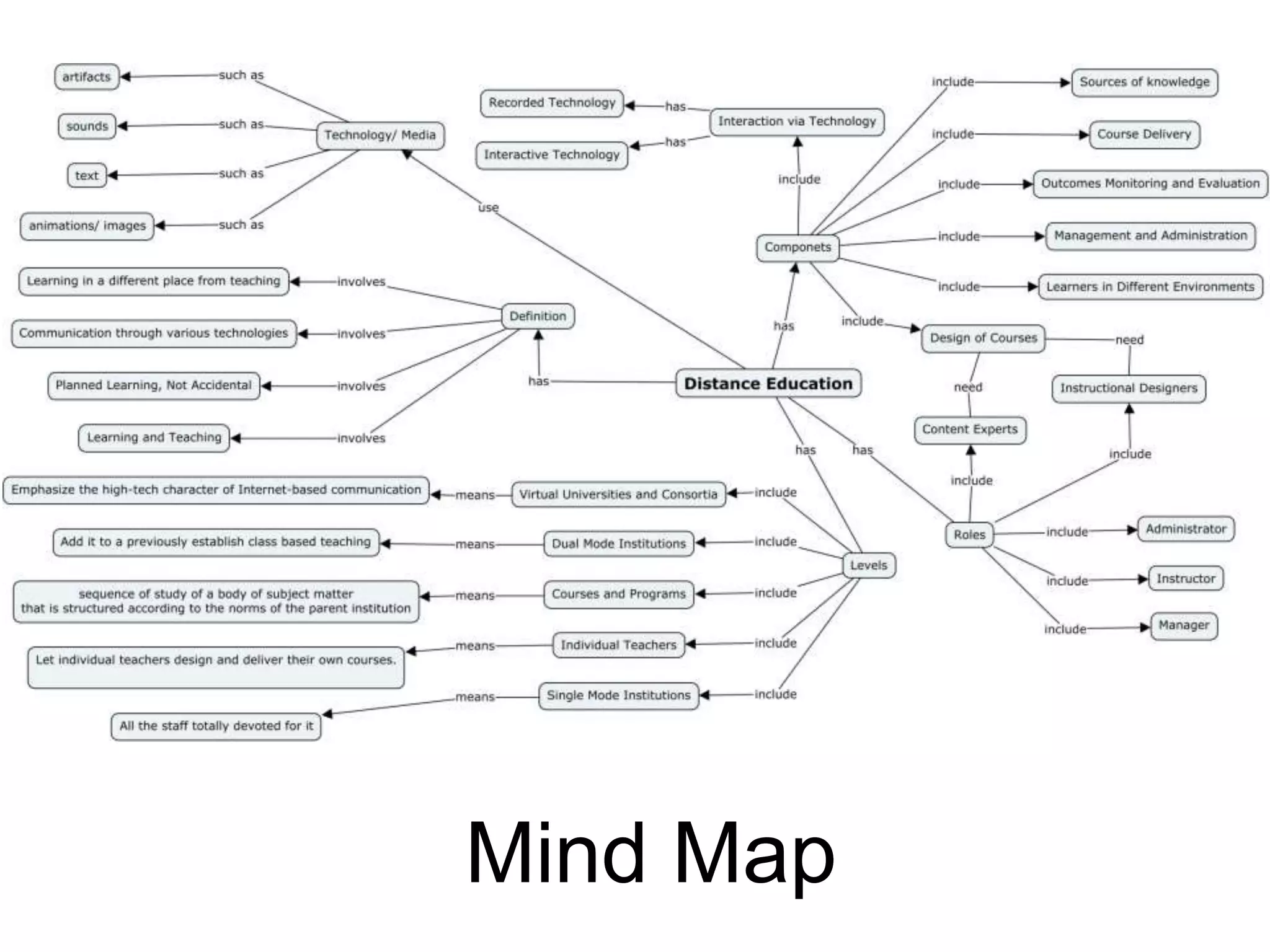
Mind Map
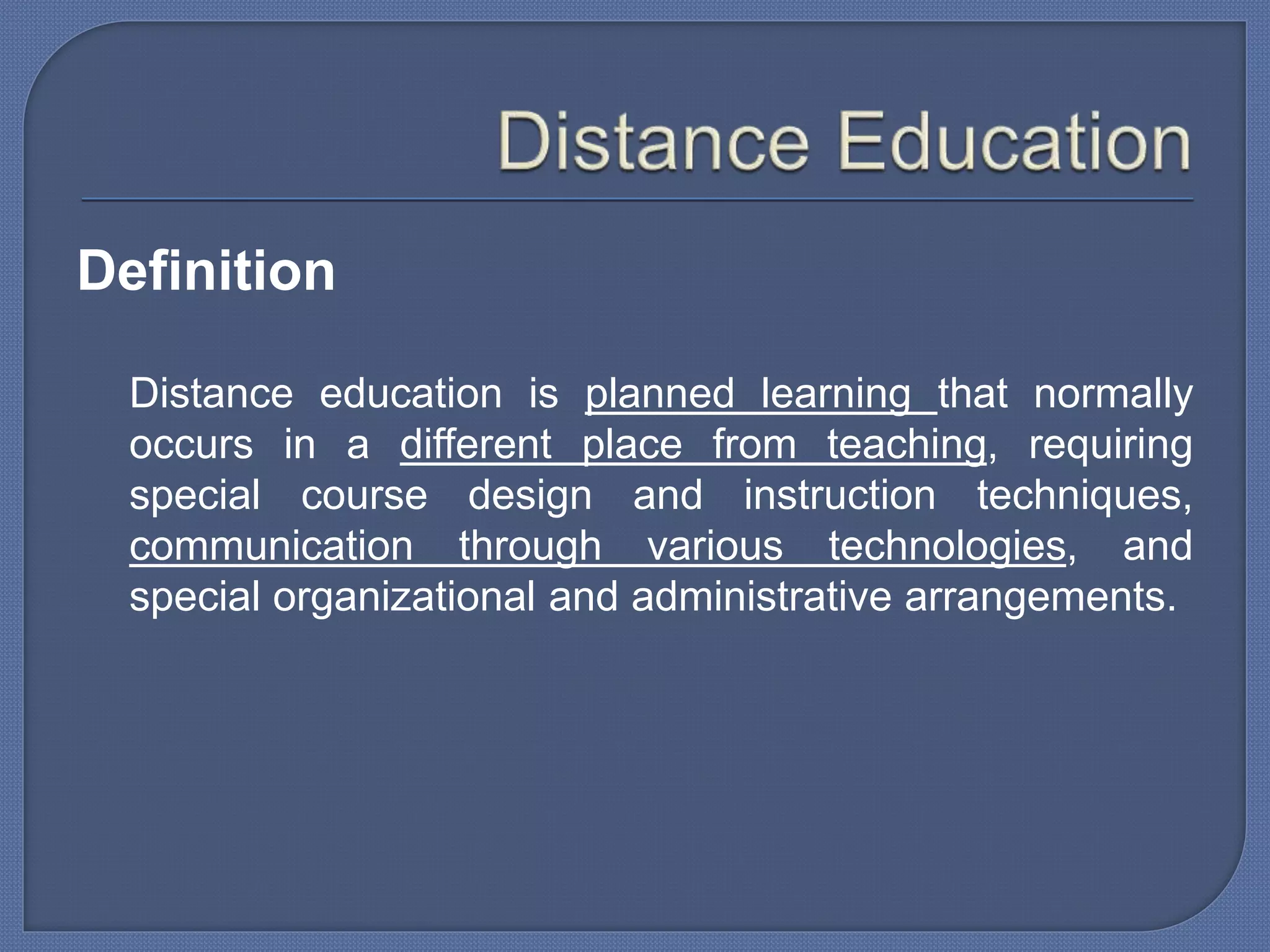
Definition
Distance education is planned learning that normally
occurs in a different place from teaching, requiring
special course design and instruction techniques,
communication through various technologies, and
special organizational and administrative arrangements.
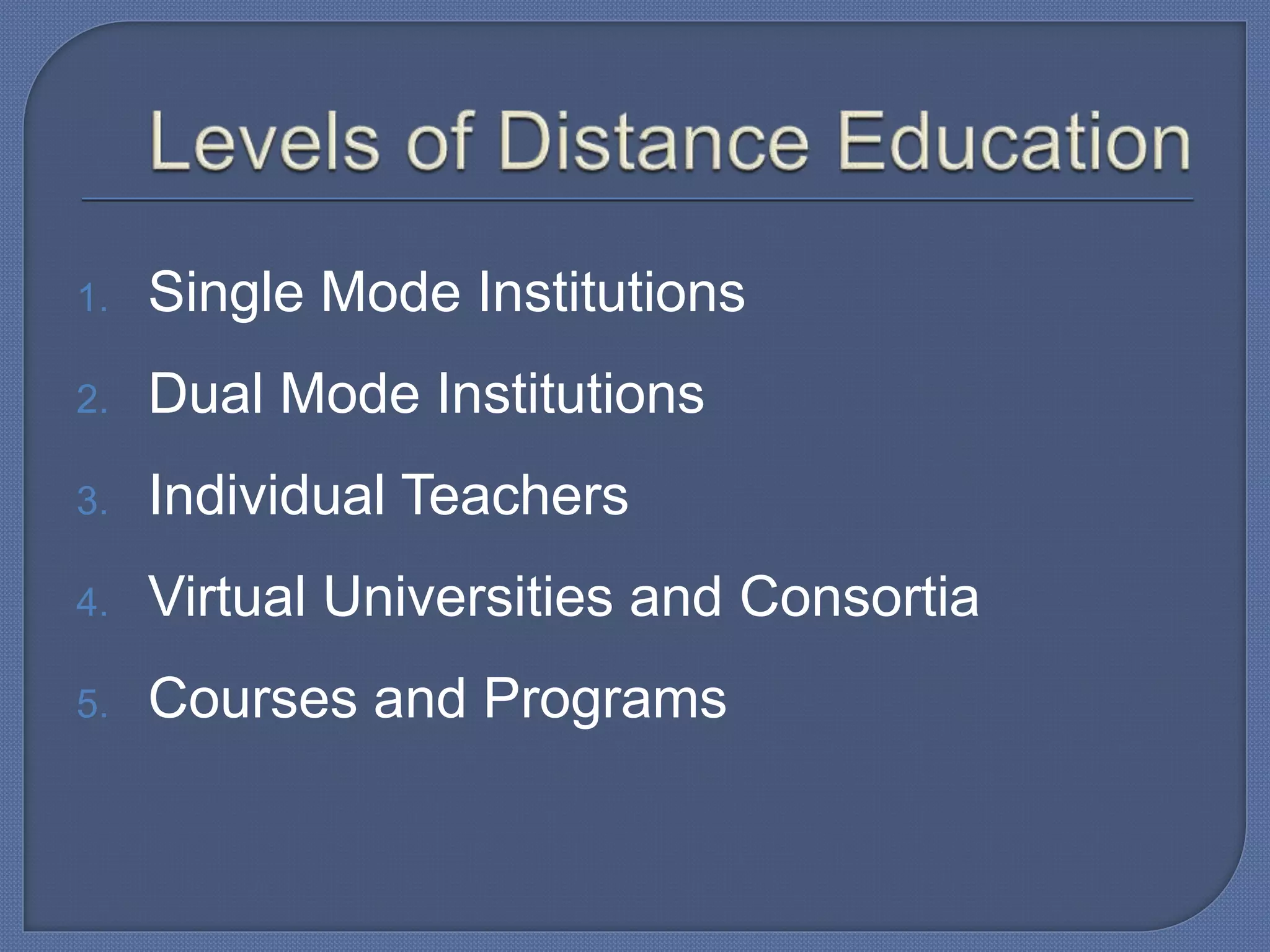
1. Single Mode Institutions
2. Dual Mode Institutions
3. Individual Teachers
4. Virtual Universities and Consortia
5. Courses and Programs
All the faculty and staff of the institution are
exclusively devoted to distance education;
Adds distance education to its previously
established campus and class-based
teaching.
Let individual teachers design and deliver
their own courses.
Emphasize the high-tech character of
Internet-based communication.
Both dual and single mode institutions use
"virtuality" to sell distance education as a
more exciting hightech enterprise than
older textbook-based methods.
Sequence of study of a body of subject
matter that is structured according to the
norms of the institution
Technology is the vehicle for
communicating messages, and the
messages are represented in a medium.
Kinds of media
• text
• images /animations
• sounds
• artifacts
Most learners do not yet have technology
Lack of quality of the media produced for
distribution via the technology.
Over invest in a particular technology, and
to attempt to load more of the media on
that technology than it can optimally carry.
Overuse of online communications
 Increasing access to learning and training opportunities
 Providing opportunities for updating skills
 Improving the cost effectiveness of educational resources
 Supporting the quality of existing educational structures
 Enhancing the capacity of the educational system
 Balancing inequalities between age groups
 Delivering educational campaigns to specific target audiences
 Providing emergency training for key target groups
 Expanding the capacity for education in new subject areas
 Offering combination of education with work and family life
 Adding an international dimension to the educational experience
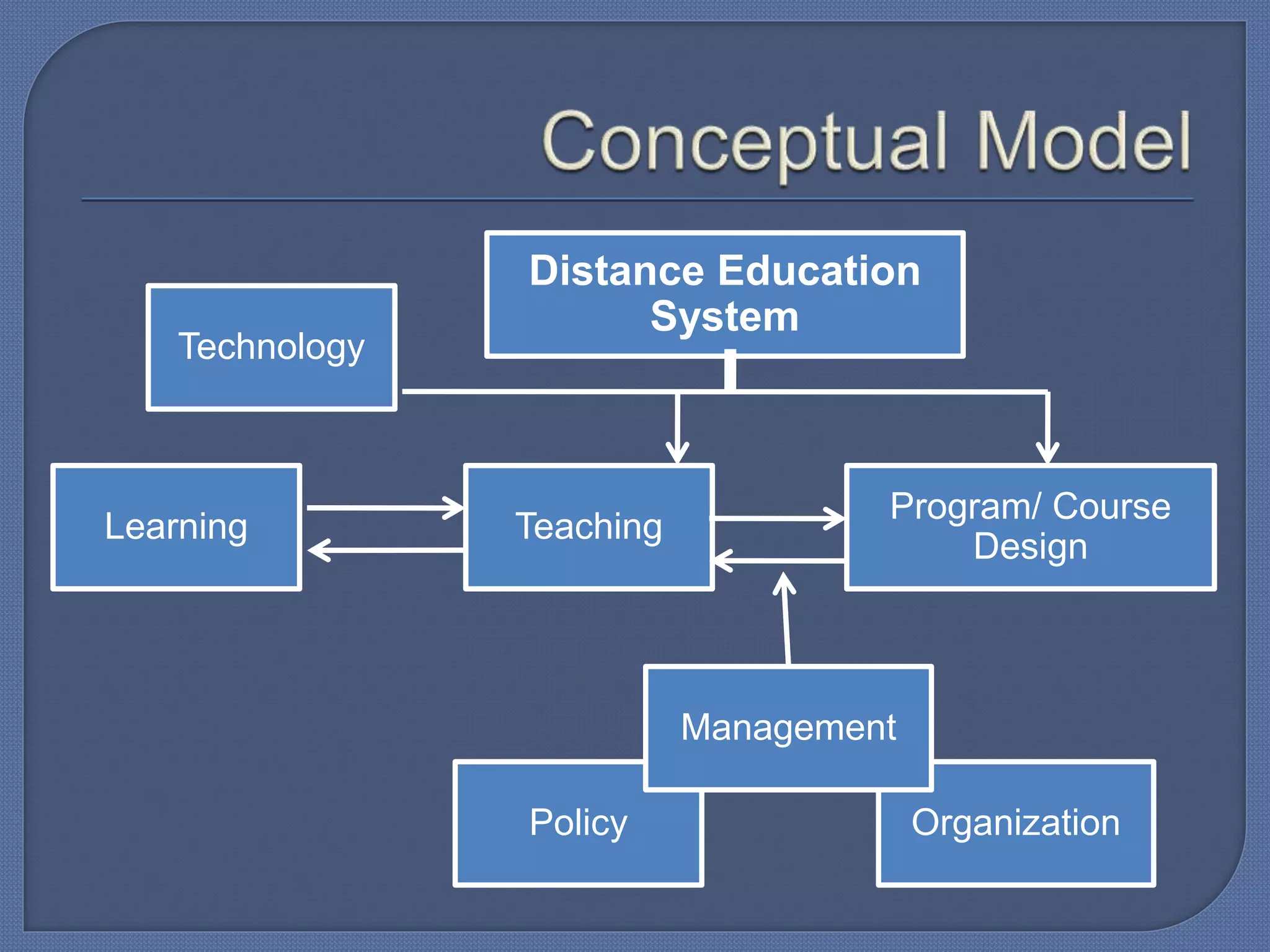
Organization
Distance Education
System
Learning Teaching
Program/ Course
Design
Technology
Policy
Management
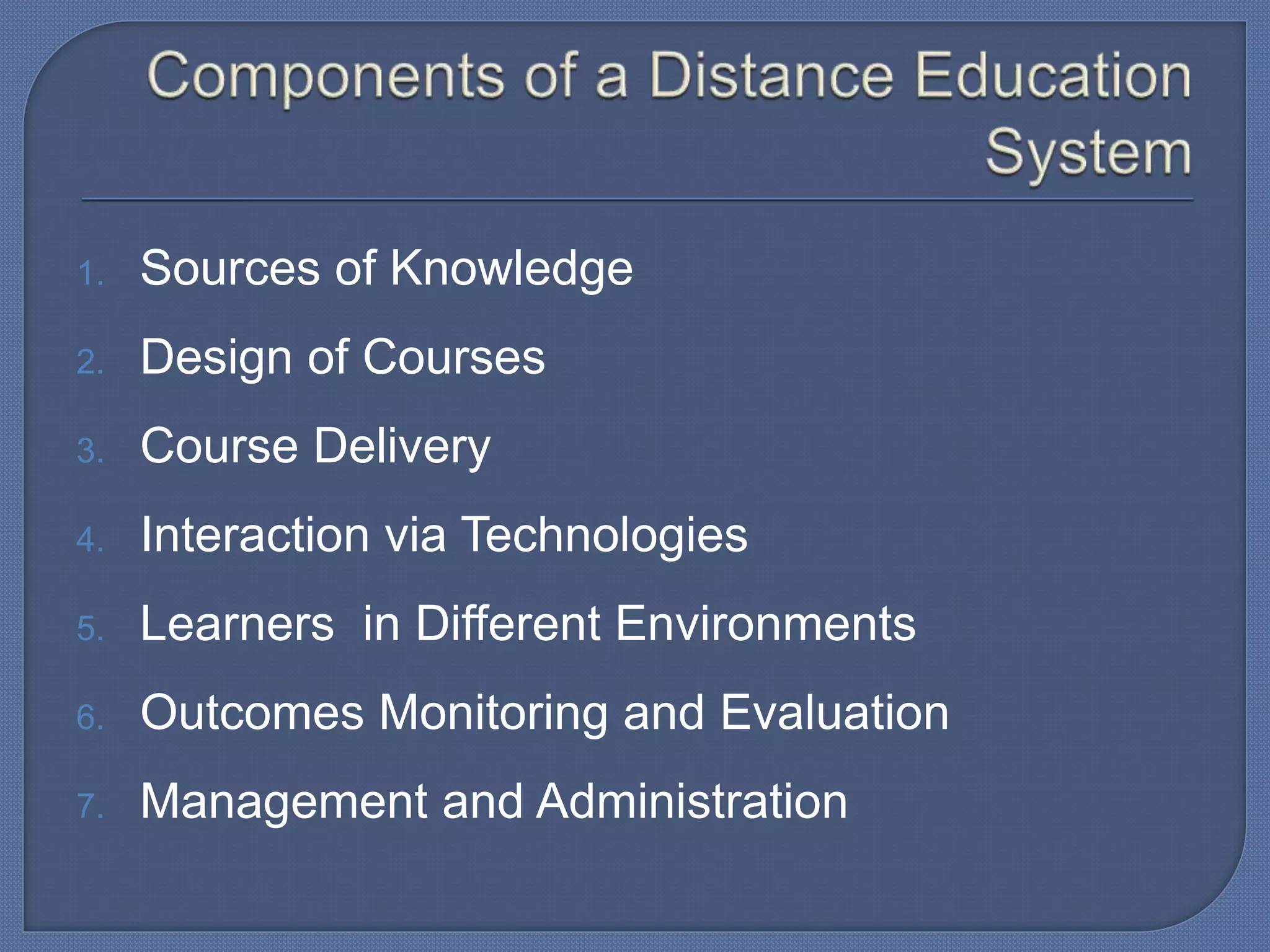
1. Sources of Knowledge
2. Design of Courses
3. Course Delivery
4. Interaction via Technologies
5. Learners in Different Environments
6. Outcomes Monitoring and Evaluation
7. Management and Administration
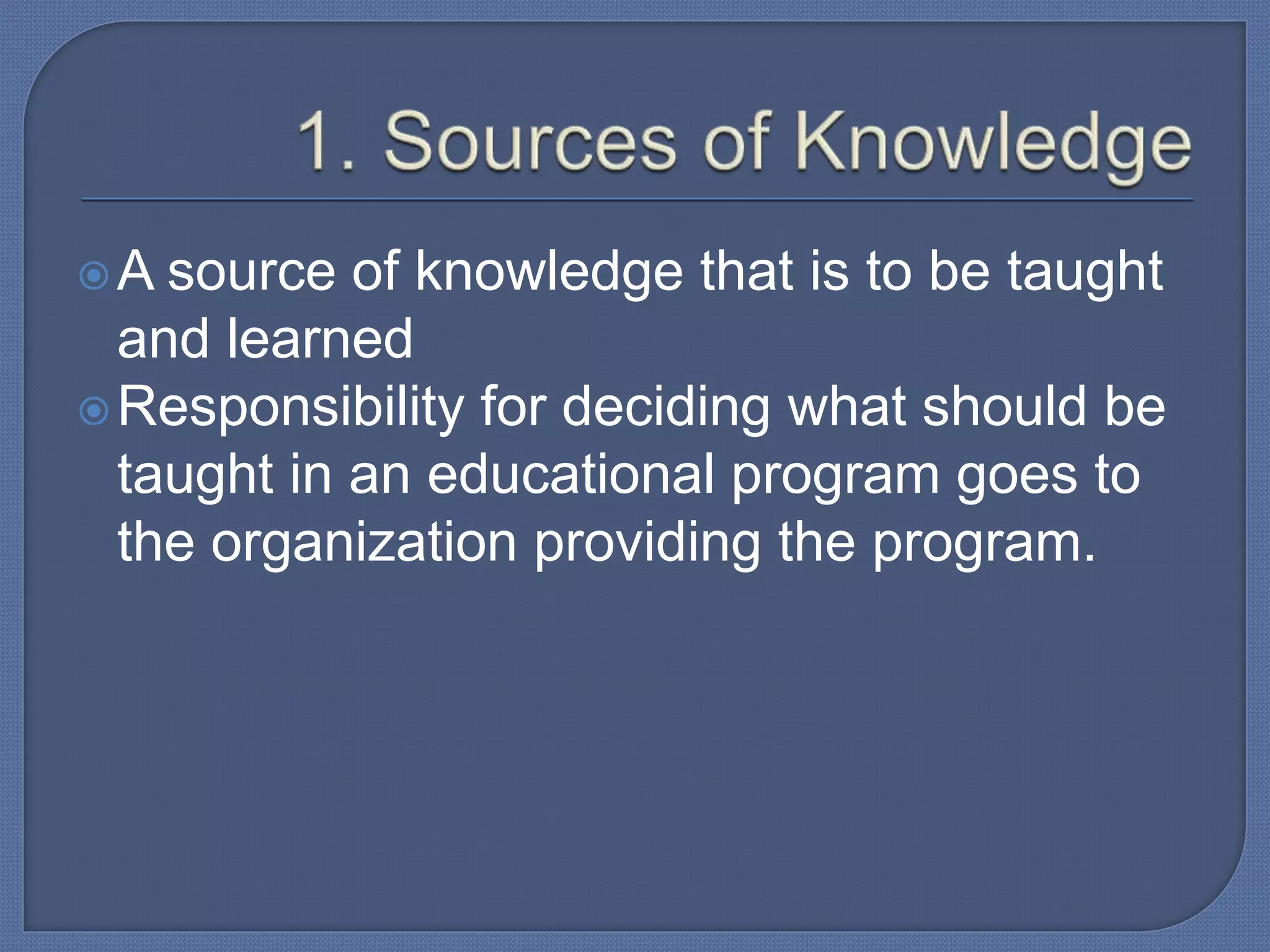
A source of knowledge that is to be taught
and learned
Responsibility for deciding what should be
taught in an educational program goes to
the organization providing the program.
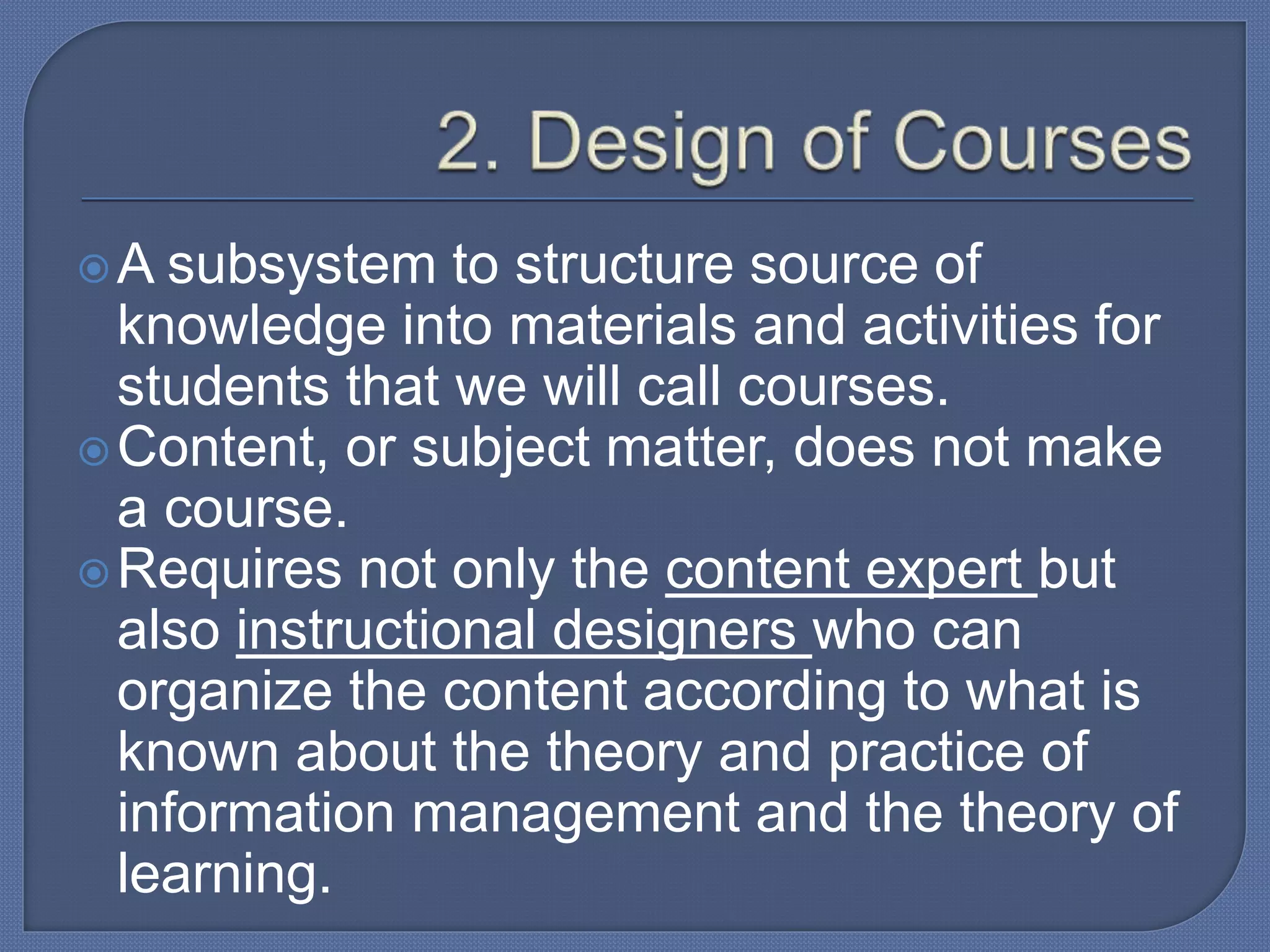
A subsystem to structure source of
knowledge into materials and activities for
students that we will call courses.
Content, or subject matter, does not make
a course.
Requires not only the content expert but
also instructional designers who can
organize the content according to what is
known about the theory and practice of
information management and the theory of
learning.
Another subsystem that delivers the
courses to learners
No single technology is optimal for delivery
of every kind of message to all learners in
all locations.
 Classification of Technology
• Recorded technologies
 CD-ROM
• Interactive technologies
 Audio-conference
 Always desirable to have at least one
recorded technology
 The interactions between instructors and
students will be based on issues and
questions determined by the course
designers.
Students must consciously train
themselves in disciplined study habits.
They must find their own times and places
where they can study comfortably by
scheduling.
Most designers believe that courses
should be organized into short, self-
contained segments, with frequent
summaries and overviews.
A subsystem that monitors and evaluates
outcomes so that interventions are
possible where failures occur
Feedback and evaluation mechanisms are
vital because if any part of the system
breaks down, the whole system is in
jeopardy; potential problems have to be
identified before the breakdown occurs.
 An organization with a policy and a management
structure to link these different pieces.
 Managers are responsible for all the subsystems
that lead to the design, delivery, and implementation
of the program.
 Courses have to be designed a considerable time in
advance of the actual teaching of the course
 Administrators must ensure that money, personnel,
and time are managed so that courses are produced
on time and numerous work tasks fit together.
Changes in one component of a distance
education system have immediate effects
on all of the other components.
Investing in technology without regard to
the other subsystems is not a good
suggestion.
INPUT OUTPUT
 Student characteristics including knowing
how to study at a distance
 Instructor experience of distance teaching
 Understanding of administrative staff about
distance learners
 Quality of course design skills
 Quality of course production
 Cost of course design and production
 Technology chosen for the course
 Accessibility of support services
 Frequency and quality of evaluation data
 Financial investment
 Student satisfaction ratings
 Student achievement scores
 Student completion rates
 Total enrollments
 Quality assessments
 Accreditation results
 Tuition and other revenue
 Staff reputation and turnover
 More people are obtaining access more easily to better
learning resources than they could in the past.
 Rural and inner city students, can take courses from the
same institutions and same faculty that were previously
only available to students in privileged, mainly suburban
areas.
 Handicapped and disabled students can also have
access to the same courses as everyone else.
 Can take courses without having to be away from home
or their current jobs.
 Students in one country can learn from teachers and
fellow students in others.
 Courses can be accessed whenever the student wants at
his or her preferred pace, from almost any location.
Instructors :
• preparing materials
Managers :
• find appropriate positions for those teachers who
want to be content specialists, those who prefer to
provide interactive support to students, and those
who are good at designing and producing
mediated communications.
Administrators :
• ensuring that the various resources are available-
and often in distant location

Basic Concepts in Distance Education

  • 1.
    MCS3103 : e-LearningConcepts and Technologies Upekha Vandebona Index No : 13440722
  • 2.
  • 3.
    Definition Distance education isplanned learning that normally occurs in a different place from teaching, requiring special course design and instruction techniques, communication through various technologies, and special organizational and administrative arrangements.
  • 4.
    1. Single ModeInstitutions 2. Dual Mode Institutions 3. Individual Teachers 4. Virtual Universities and Consortia 5. Courses and Programs
  • 5.
    All the facultyand staff of the institution are exclusively devoted to distance education;
  • 6.
    Adds distance educationto its previously established campus and class-based teaching.
  • 7.
    Let individual teachersdesign and deliver their own courses.
  • 8.
    Emphasize the high-techcharacter of Internet-based communication. Both dual and single mode institutions use "virtuality" to sell distance education as a more exciting hightech enterprise than older textbook-based methods.
  • 9.
    Sequence of studyof a body of subject matter that is structured according to the norms of the institution
  • 10.
    Technology is thevehicle for communicating messages, and the messages are represented in a medium. Kinds of media • text • images /animations • sounds • artifacts
  • 11.
    Most learners donot yet have technology Lack of quality of the media produced for distribution via the technology. Over invest in a particular technology, and to attempt to load more of the media on that technology than it can optimally carry. Overuse of online communications
  • 12.
     Increasing accessto learning and training opportunities  Providing opportunities for updating skills  Improving the cost effectiveness of educational resources  Supporting the quality of existing educational structures  Enhancing the capacity of the educational system  Balancing inequalities between age groups  Delivering educational campaigns to specific target audiences  Providing emergency training for key target groups  Expanding the capacity for education in new subject areas  Offering combination of education with work and family life  Adding an international dimension to the educational experience
  • 13.
  • 14.
    1. Sources ofKnowledge 2. Design of Courses 3. Course Delivery 4. Interaction via Technologies 5. Learners in Different Environments 6. Outcomes Monitoring and Evaluation 7. Management and Administration
  • 15.
    A source ofknowledge that is to be taught and learned Responsibility for deciding what should be taught in an educational program goes to the organization providing the program.
  • 16.
    A subsystem tostructure source of knowledge into materials and activities for students that we will call courses. Content, or subject matter, does not make a course. Requires not only the content expert but also instructional designers who can organize the content according to what is known about the theory and practice of information management and the theory of learning.
  • 17.
    Another subsystem thatdelivers the courses to learners No single technology is optimal for delivery of every kind of message to all learners in all locations.
  • 18.
     Classification ofTechnology • Recorded technologies  CD-ROM • Interactive technologies  Audio-conference  Always desirable to have at least one recorded technology  The interactions between instructors and students will be based on issues and questions determined by the course designers.
  • 19.
    Students must consciouslytrain themselves in disciplined study habits. They must find their own times and places where they can study comfortably by scheduling. Most designers believe that courses should be organized into short, self- contained segments, with frequent summaries and overviews.
  • 20.
    A subsystem thatmonitors and evaluates outcomes so that interventions are possible where failures occur Feedback and evaluation mechanisms are vital because if any part of the system breaks down, the whole system is in jeopardy; potential problems have to be identified before the breakdown occurs.
  • 21.
     An organizationwith a policy and a management structure to link these different pieces.  Managers are responsible for all the subsystems that lead to the design, delivery, and implementation of the program.  Courses have to be designed a considerable time in advance of the actual teaching of the course  Administrators must ensure that money, personnel, and time are managed so that courses are produced on time and numerous work tasks fit together.
  • 22.
    Changes in onecomponent of a distance education system have immediate effects on all of the other components. Investing in technology without regard to the other subsystems is not a good suggestion.
  • 23.
    INPUT OUTPUT  Studentcharacteristics including knowing how to study at a distance  Instructor experience of distance teaching  Understanding of administrative staff about distance learners  Quality of course design skills  Quality of course production  Cost of course design and production  Technology chosen for the course  Accessibility of support services  Frequency and quality of evaluation data  Financial investment  Student satisfaction ratings  Student achievement scores  Student completion rates  Total enrollments  Quality assessments  Accreditation results  Tuition and other revenue  Staff reputation and turnover
  • 24.
     More peopleare obtaining access more easily to better learning resources than they could in the past.  Rural and inner city students, can take courses from the same institutions and same faculty that were previously only available to students in privileged, mainly suburban areas.  Handicapped and disabled students can also have access to the same courses as everyone else.  Can take courses without having to be away from home or their current jobs.  Students in one country can learn from teachers and fellow students in others.  Courses can be accessed whenever the student wants at his or her preferred pace, from almost any location.
  • 25.
    Instructors : • preparingmaterials Managers : • find appropriate positions for those teachers who want to be content specialists, those who prefer to provide interactive support to students, and those who are good at designing and producing mediated communications. Administrators : • ensuring that the various resources are available- and often in distant location