Northwest Georgia Rural
Broadband Advisory Committee
Northwest Georgia Regional Commission
Lloyd Frasier, Executive Director
NADO Annual Training Conference, October 2018
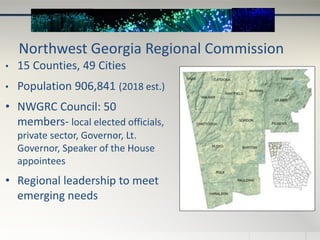
Northwest Georgia Regional Commission
• 15 Counties, 49 Cities
• Population 906,841 (2018 est.)
• NWGRC Council: 50
members- local elected officials,
private sector, Governor, Lt.
Governor, Speaker of the House
appointees
• Regional leadership to meet
emerging needs
Broadband Service and Speed
 FCC 2018 Broadband Report: “High-quality” telecommunications capability
that allow users to “originate and receive high-quality voice, data, graphics,
and video services”
 25 Mbps download /3 Mbps upload speed for fixed terrestrial broadband
 FCC 2018 Broadband Report: “92.3% of all Americans have access to fixed
terrestrial broadband at 25 Mbps/ 3 Mbps…Nonetheless, 24 million
Americans still lack fixed broadband of 25 Mbps/ 3 Mbps (FCC, 2018).”
 In rural areas, 68.6% have access to both fixed and cell-based services;
only 61% have access to fixed broadband in rural areas.
 USDA: Modern, reliable, high-speed internet service in rural America
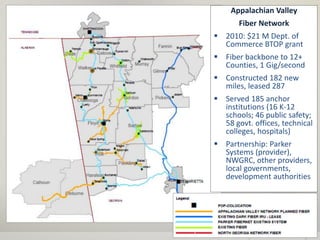
Appalachian Valley
Fiber Network
 2010: $21 M Dept. of
Commerce BTOP grant
 Fiber backbone to 12+
Counties, 1 Gig/second
 Constructed 182 new
miles, leased 287
 Served 185 anchor
institutions (16 K-12
schools; 46 public safety;
58 govt. offices, technical
colleges, hospitals)
 Partnership: Parker
Systems (provider),
NWGRC, other providers,
local governments,
development authorities
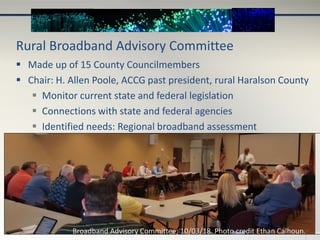
Rural Broadband Advisory Committee
 Made up of 15 County Councilmembers
 Chair: H. Allen Poole, ACCG past president, rural Haralson County
 Monitor current state and federal legislation
 Connections with state and federal agencies
 Identified needs: Regional broadband assessment
Broadband Advisory Committee; 10/03/18. Photo credit Ethan Calhoun.
Rural Broadband Needs are Increasing
 Technology is available but connectivity is limited
 Education: Schools issue tablets but students lack internet at
home; parents bring them back to the school in the evening to
use the school’s network
• Healthcare: Mobile healthcare
providers find that indigent patients
don’t have internet to connect with
the doctor
Rural Connectivity Needs
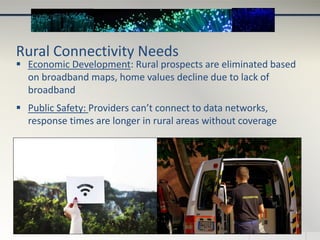
 Economic Development: Rural prospects are eliminated based
on broadband maps, home values decline due to lack of
broadband
 Public Safety: Providers can’t connect to data networks,
response times are longer in rural areas without coverage
Regional Broadband Needs Assessment
 Application for 2018 Appalachian Regional Commission funds
 Work with Georgia’s Broadband Ready Community program
 The study would:
1. Survey resident-reported availability of
broadband, and speeds if available
2. Partner with Schools, Chambers of
Commerce, Cities and Counties to
publicize the survey for full response
3. Map resident-reported service and speed
data to show current areas of need
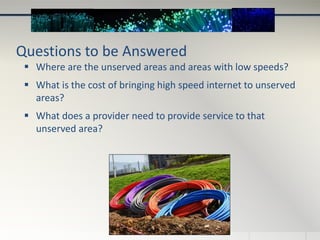
Questions to be Answered
 Where are the unserved areas and areas with low speeds?
 What is the cost of bringing high speed internet to unserved
areas?
 What does a provider need to provide service to that
unserved area?
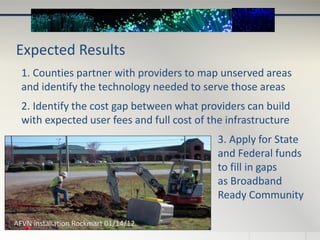
Expected Results
1. Counties partner with providers to map unserved areas
and identify the technology needed to serve those areas
2. Identify the cost gap between what providers can build
with expected user fees and full cost of the infrastructure
3. Apply for State
and Federal funds
to fill in gaps
as Broadband
Ready Community
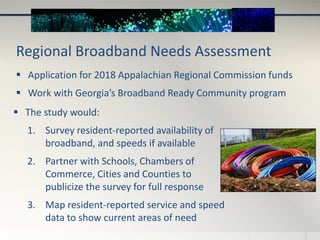
AFVN installation Rockmart 01/14/12.
Contact Information:
Lloyd Frasier
Executive Director
lfrasier@nwgrc.org
(706) 295-6485
Northwest Georgia Regional Commission
PO Box 1798 503 West Waugh St.
Rome, Georgia 30162- 1798 Dalton, Georgia 30720
www.nwgrc.org

Broadband Planning to Support Economic Development: Lloyd

  • 1.
    Northwest Georgia Rural BroadbandAdvisory Committee Northwest Georgia Regional Commission Lloyd Frasier, Executive Director NADO Annual Training Conference, October 2018
  • 2.
    Northwest Georgia RegionalCommission • 15 Counties, 49 Cities • Population 906,841 (2018 est.) • NWGRC Council: 50 members- local elected officials, private sector, Governor, Lt. Governor, Speaker of the House appointees • Regional leadership to meet emerging needs
  • 3.
    Broadband Service andSpeed  FCC 2018 Broadband Report: “High-quality” telecommunications capability that allow users to “originate and receive high-quality voice, data, graphics, and video services”  25 Mbps download /3 Mbps upload speed for fixed terrestrial broadband  FCC 2018 Broadband Report: “92.3% of all Americans have access to fixed terrestrial broadband at 25 Mbps/ 3 Mbps…Nonetheless, 24 million Americans still lack fixed broadband of 25 Mbps/ 3 Mbps (FCC, 2018).”  In rural areas, 68.6% have access to both fixed and cell-based services; only 61% have access to fixed broadband in rural areas.  USDA: Modern, reliable, high-speed internet service in rural America
  • 4.
    Appalachian Valley Fiber Network 2010: $21 M Dept. of Commerce BTOP grant  Fiber backbone to 12+ Counties, 1 Gig/second  Constructed 182 new miles, leased 287  Served 185 anchor institutions (16 K-12 schools; 46 public safety; 58 govt. offices, technical colleges, hospitals)  Partnership: Parker Systems (provider), NWGRC, other providers, local governments, development authorities
  • 5.
    Rural Broadband AdvisoryCommittee  Made up of 15 County Councilmembers  Chair: H. Allen Poole, ACCG past president, rural Haralson County  Monitor current state and federal legislation  Connections with state and federal agencies  Identified needs: Regional broadband assessment Broadband Advisory Committee; 10/03/18. Photo credit Ethan Calhoun.
  • 6.
    Rural Broadband Needsare Increasing  Technology is available but connectivity is limited  Education: Schools issue tablets but students lack internet at home; parents bring them back to the school in the evening to use the school’s network • Healthcare: Mobile healthcare providers find that indigent patients don’t have internet to connect with the doctor
  • 7.
    Rural Connectivity Needs Economic Development: Rural prospects are eliminated based on broadband maps, home values decline due to lack of broadband  Public Safety: Providers can’t connect to data networks, response times are longer in rural areas without coverage
  • 8.
    Regional Broadband NeedsAssessment  Application for 2018 Appalachian Regional Commission funds  Work with Georgia’s Broadband Ready Community program  The study would: 1. Survey resident-reported availability of broadband, and speeds if available 2. Partner with Schools, Chambers of Commerce, Cities and Counties to publicize the survey for full response 3. Map resident-reported service and speed data to show current areas of need
  • 9.
    Questions to beAnswered  Where are the unserved areas and areas with low speeds?  What is the cost of bringing high speed internet to unserved areas?  What does a provider need to provide service to that unserved area?
  • 10.
    Expected Results 1. Countiespartner with providers to map unserved areas and identify the technology needed to serve those areas 2. Identify the cost gap between what providers can build with expected user fees and full cost of the infrastructure 3. Apply for State and Federal funds to fill in gaps as Broadband Ready Community AFVN installation Rockmart 01/14/12.
  • 11.
    Contact Information: Lloyd Frasier ExecutiveDirector lfrasier@nwgrc.org (706) 295-6485 Northwest Georgia Regional Commission PO Box 1798 503 West Waugh St. Rome, Georgia 30162- 1798 Dalton, Georgia 30720 www.nwgrc.org

Editor's Notes

  • #4 FCC 2018 Broadband Report:“high-quality” telecommunications capability that allow users to “originate and receive high-quality voice, data, graphics, and video services” Internet access through fixed terrestrial service (cable, fiber optic or wireless), satellite and cell phone technology. FCC says cell service is not full substitute for fixed services . FCC 2018 Broadband Report: “92% of US population has access to both fixed terrestrial services at 25 Mbps/3 Mbps and mobile LTE at speeds of 5 Mbps/1 Mbps. In rural areas, 68.6% have access to both services, as opposed to 97.9% in urban areas.” Only 61% have access to fixed broadband in rural areas. In 2016, “92.3% of all Americans have access to fixed terrestrial broadband at speeds of 25 Mbps/3 Mbps…Nonetheless, over 24 million Americans still lack fixed terrestrial broadband at speeds of 25 Mbps/3 Mbps (FCC, 2018).” Outside large cities, a less dense population and larger distances means a higher cost to provide the technology infrastructure to fewer customers Cost, speed, and type of service available can be barriers as much as availability