NCGA House Select
Committee on
COVID19, Education
Jeff Sural
Director
5/14/2020
Definitions
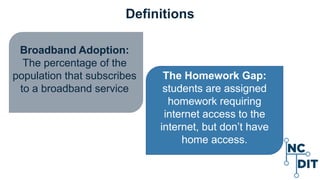
Broadband Adoption:
The percentage of the
population that subscribes
to a broadband service
The Homework Gap:
students are assigned
homework requiring
internet access to the
internet, but don’t have
home access.
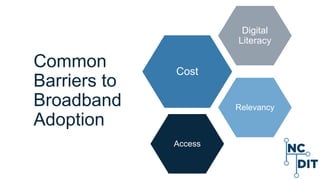
Common
Barriers to
Broadband
Adoption
Cost
Digital
Literacy
Relevancy
Access
Measuring the Digital Divide
Broadband and Digital Equity Data to Know
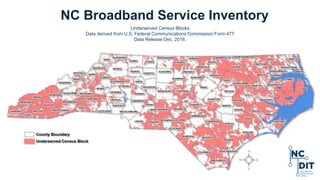
NC Broadband Service Inventory
Underserved Census Blocks
Data derived from U.S. Federal Communications Commission Form 477
Data Release Dec. 2018.
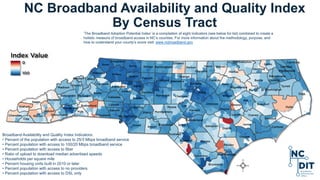
NC Broadband Availability and Quality Index
By Census Tract
Broadband Availability and Quality Index Indicators:
• Percent of the population with access to 25/3 Mbps broadband service
• Percent population with access to 100/20 Mbps broadband service
• Percent population with access to fiber
• Ratio of upload to download median advertised speeds
• Households per square mile
• Percent housing units built in 2010 or later
• Percent population with access to no providers
• Percent population with access to DSL only
’The Broadband Adoption Potential Index’ is a compilation of eight indicators (see below for list) combined to create a
holistic measure of broadband access in NC’s counties. For more information about the methodology, purpose, and
how to understand your county’s score visit: www.ncbroadband.gov
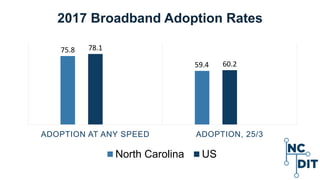
75.8
59.4
78.1
60.2
ADOPTION AT ANY SPEED ADOPTION, 25/3
North Carolina US
2017 Broadband Adoption Rates
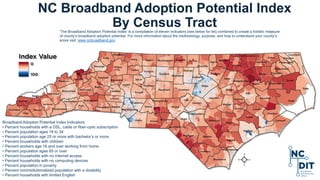
NC Broadband Adoption Potential Index
By Census Tract
Broadband Adoption Potential Index Indicators:
• Percent households with a DSL, cable or fiber-optic subscription
• Percent population ages 18 to 34
• Percent population age 25 or more with bachelor’s or more
• Percent households with children
• Percent workers age 16 and over working from home
• Percent population ages 65 or over
• Percent households with no internet access
• Percent households with no computing devices
• Percent population in poverty
• Percent noninstitutionalized population with a disability
• Percent households with limited English
’The Broadband Adoption Potential Index’ is a compilation of eleven indicators (see below for list) combined to create a holistic measure
of county’s broadband adoption potential. For more information about the methodology, purpose, and how to understand your county’s
score visit: www.ncbroadband.gov
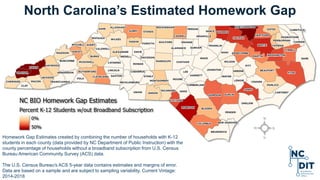
North Carolina’s Estimated Homework Gap
Homework Gap Estimates created by combining the number of households with K-12
students in each county (data provided by NC Department of Public Instruction) with the
county percentage of households without a broadband subscription from U.S. Census
Bureau American Community Survey (ACS) data.
The U.S. Census Bureau's ACS 5-year data contains estimates and margins of error.
Data are based on a sample and are subject to sampling variability. Current Vintage:
2014-2018
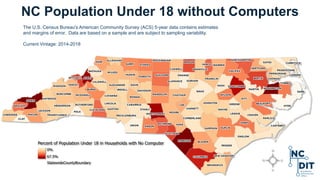
NC Population Under 18 without Computers
The U.S. Census Bureau's American Community Survey (ACS) 5-year data contains estimates
and margins of error. Data are based on a sample and are subject to sampling variability.
Current Vintage: 2014-2018
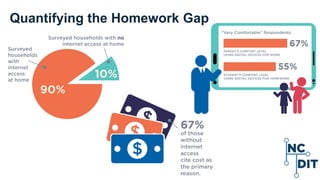
Quantifying the Homework Gap
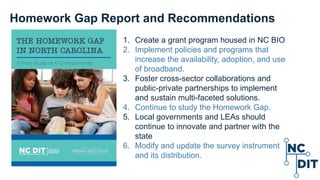
Homework Gap Report and Recommendations
1. Create a grant program housed in NC BIO
2. Implement policies and programs that
increase the availability, adoption, and use
of broadband.
3. Foster cross-sector collaborations and
public-private partnerships to implement
and sustain multi-faceted solutions.
4. Continue to study the Homework Gap.
5. Local governments and LEAs should
continue to innovate and partner with the
state
6. Modify and update the survey instrument
and its distribution.
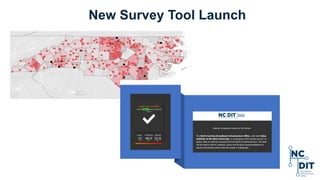
New Survey Tool Launch
Closing the Digital Divide
Through Programs, Policy & Tools
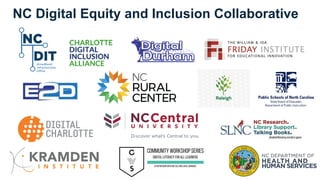
NC Digital Equity and Inclusion Collaborative
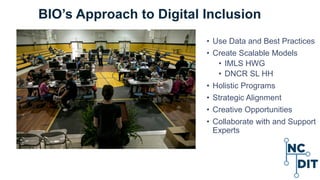
BIO’s Approach to Digital Inclusion
• Use Data and Best Practices
• Create Scalable Models
• IMLS HWG
• DNCR SL HH
• Holistic Programs
• Strategic Alignment
• Creative Opportunities
• Collaborate with and Support
Experts
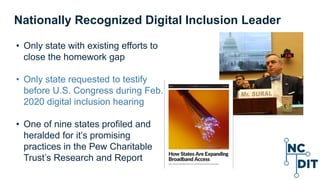
Nationally Recognized Digital Inclusion Leader
• Only state with existing efforts to
close the homework gap
• Only state requested to testify
before U.S. Congress during Feb.
2020 digital inclusion hearing
• One of nine states profiled and
heralded for it’s promising
practices in the Pew Charitable
Trust’s Research and Report
COVID-19:
NCDIT Immediate Response
Immediate Response
• FCC Pledge: don’t terminate service; waive late fees; open Wi-Fi hotspots
• Governor Cooper and Secretary Doaks call with NC internet service providers
o Most above and beyond FCC pledge
• Interactive map, website listing free and reduced-price internet offerings and public
Wi-Fi access locations: ncbroadband.gov/covid19broadband/
• Identify resources to procure school bus equipment to support WiFi access
• Providing LEAs and DPI with guidance and support on convenience contracts for
cellular service, tablets, hot spots and laptops, and negotiate better prices for duration
of emergency; NCDIT Cybersecurity support
• Interagency Coordination/Communication: DPI, DHHS, EM, Counties, COGs
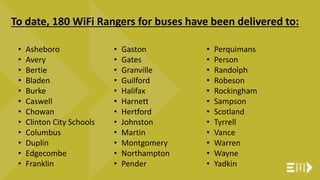
To date, 180 WiFi Rangers for buses have been delivered to:
• Asheboro
• Avery
• Bertie
• Bladen
• Burke
• Caswell
• Chowan
• Clinton City Schools
• Columbus
• Duplin
• Edgecombe
• Franklin
• Gaston
• Gates
• Granville
• Guilford
• Halifax
• Harnett
• Hertford
• Johnston
• Martin
• Montgomery
• Northampton
• Pender
• Perquimans
• Person
• Randolph
• Robeson
• Rockingham
• Sampson
• Scotland
• Tyrrell
• Vance
• Warren
• Wayne
• Yadkin
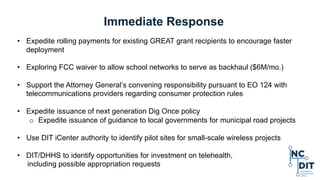
Immediate Response
• Expedite rolling payments for existing GREAT grant recipients to encourage faster
deployment
• Exploring FCC waiver to allow school networks to serve as backhaul ($6M/mo.)
• Support the Attorney General’s convening responsibility pursuant to EO 124 with
telecommunications providers regarding consumer protection rules
• Expedite issuance of next generation Dig Once policy
o Expedite issuance of guidance to local governments for municipal road projects
• Use DIT iCenter authority to identify pilot sites for small-scale wireless projects
• DIT/DHHS to identify opportunities for investment on telehealth,
including possible appropriation requests
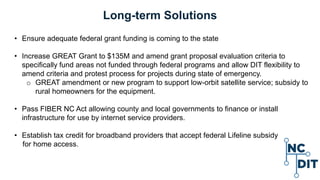
Long-term Solutions
• Ensure adequate federal grant funding is coming to the state
• Increase GREAT Grant to $135M and amend grant proposal evaluation criteria to
specifically fund areas not funded through federal programs and allow DIT flexibility to
amend criteria and protest process for projects during state of emergency.
o GREAT amendment or new program to support low-orbit satellite service; subsidy to
rural homeowners for the equipment.
• Pass FIBER NC Act allowing county and local governments to finance or install
infrastructure for use by internet service providers.
• Establish tax credit for broadband providers that accept federal Lifeline subsidy
for home access.
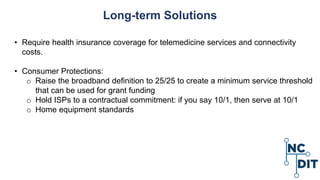
Long-term Solutions
• Require health insurance coverage for telemedicine services and connectivity
costs.
• Consumer Protections:
o Raise the broadband definition to 25/25 to create a minimum service threshold
that can be used for grant funding
o Hold ISPs to a contractual commitment: if you say 10/1, then serve at 10/1
o Home equipment standards

Homework gap presentation

  • 1.
    NCGA House Select Committeeon COVID19, Education Jeff Sural Director 5/14/2020
  • 2.
    Definitions Broadband Adoption: The percentageof the population that subscribes to a broadband service The Homework Gap: students are assigned homework requiring internet access to the internet, but don’t have home access.
  • 3.
  • 4.
    Measuring the DigitalDivide Broadband and Digital Equity Data to Know
  • 5.
    NC Broadband ServiceInventory Underserved Census Blocks Data derived from U.S. Federal Communications Commission Form 477 Data Release Dec. 2018.
  • 6.
    NC Broadband Availabilityand Quality Index By Census Tract Broadband Availability and Quality Index Indicators: • Percent of the population with access to 25/3 Mbps broadband service • Percent population with access to 100/20 Mbps broadband service • Percent population with access to fiber • Ratio of upload to download median advertised speeds • Households per square mile • Percent housing units built in 2010 or later • Percent population with access to no providers • Percent population with access to DSL only ’The Broadband Adoption Potential Index’ is a compilation of eight indicators (see below for list) combined to create a holistic measure of broadband access in NC’s counties. For more information about the methodology, purpose, and how to understand your county’s score visit: www.ncbroadband.gov
  • 7.
    75.8 59.4 78.1 60.2 ADOPTION AT ANYSPEED ADOPTION, 25/3 North Carolina US 2017 Broadband Adoption Rates
  • 8.
    NC Broadband AdoptionPotential Index By Census Tract Broadband Adoption Potential Index Indicators: • Percent households with a DSL, cable or fiber-optic subscription • Percent population ages 18 to 34 • Percent population age 25 or more with bachelor’s or more • Percent households with children • Percent workers age 16 and over working from home • Percent population ages 65 or over • Percent households with no internet access • Percent households with no computing devices • Percent population in poverty • Percent noninstitutionalized population with a disability • Percent households with limited English ’The Broadband Adoption Potential Index’ is a compilation of eleven indicators (see below for list) combined to create a holistic measure of county’s broadband adoption potential. For more information about the methodology, purpose, and how to understand your county’s score visit: www.ncbroadband.gov
  • 9.
    North Carolina’s EstimatedHomework Gap Homework Gap Estimates created by combining the number of households with K-12 students in each county (data provided by NC Department of Public Instruction) with the county percentage of households without a broadband subscription from U.S. Census Bureau American Community Survey (ACS) data. The U.S. Census Bureau's ACS 5-year data contains estimates and margins of error. Data are based on a sample and are subject to sampling variability. Current Vintage: 2014-2018
  • 10.
    NC Population Under18 without Computers The U.S. Census Bureau's American Community Survey (ACS) 5-year data contains estimates and margins of error. Data are based on a sample and are subject to sampling variability. Current Vintage: 2014-2018
  • 11.
  • 12.
    Homework Gap Reportand Recommendations 1. Create a grant program housed in NC BIO 2. Implement policies and programs that increase the availability, adoption, and use of broadband. 3. Foster cross-sector collaborations and public-private partnerships to implement and sustain multi-faceted solutions. 4. Continue to study the Homework Gap. 5. Local governments and LEAs should continue to innovate and partner with the state 6. Modify and update the survey instrument and its distribution.
  • 13.
  • 14.
    Closing the DigitalDivide Through Programs, Policy & Tools
  • 15.
    NC Digital Equityand Inclusion Collaborative
  • 16.
    BIO’s Approach toDigital Inclusion • Use Data and Best Practices • Create Scalable Models • IMLS HWG • DNCR SL HH • Holistic Programs • Strategic Alignment • Creative Opportunities • Collaborate with and Support Experts
  • 17.
    Nationally Recognized DigitalInclusion Leader • Only state with existing efforts to close the homework gap • Only state requested to testify before U.S. Congress during Feb. 2020 digital inclusion hearing • One of nine states profiled and heralded for it’s promising practices in the Pew Charitable Trust’s Research and Report
  • 18.
  • 19.
    Immediate Response • FCCPledge: don’t terminate service; waive late fees; open Wi-Fi hotspots • Governor Cooper and Secretary Doaks call with NC internet service providers o Most above and beyond FCC pledge • Interactive map, website listing free and reduced-price internet offerings and public Wi-Fi access locations: ncbroadband.gov/covid19broadband/ • Identify resources to procure school bus equipment to support WiFi access • Providing LEAs and DPI with guidance and support on convenience contracts for cellular service, tablets, hot spots and laptops, and negotiate better prices for duration of emergency; NCDIT Cybersecurity support • Interagency Coordination/Communication: DPI, DHHS, EM, Counties, COGs
  • 20.
    To date, 180WiFi Rangers for buses have been delivered to: • Asheboro • Avery • Bertie • Bladen • Burke • Caswell • Chowan • Clinton City Schools • Columbus • Duplin • Edgecombe • Franklin • Gaston • Gates • Granville • Guilford • Halifax • Harnett • Hertford • Johnston • Martin • Montgomery • Northampton • Pender • Perquimans • Person • Randolph • Robeson • Rockingham • Sampson • Scotland • Tyrrell • Vance • Warren • Wayne • Yadkin
  • 21.
    Immediate Response • Expediterolling payments for existing GREAT grant recipients to encourage faster deployment • Exploring FCC waiver to allow school networks to serve as backhaul ($6M/mo.) • Support the Attorney General’s convening responsibility pursuant to EO 124 with telecommunications providers regarding consumer protection rules • Expedite issuance of next generation Dig Once policy o Expedite issuance of guidance to local governments for municipal road projects • Use DIT iCenter authority to identify pilot sites for small-scale wireless projects • DIT/DHHS to identify opportunities for investment on telehealth, including possible appropriation requests
  • 22.
    Long-term Solutions • Ensureadequate federal grant funding is coming to the state • Increase GREAT Grant to $135M and amend grant proposal evaluation criteria to specifically fund areas not funded through federal programs and allow DIT flexibility to amend criteria and protest process for projects during state of emergency. o GREAT amendment or new program to support low-orbit satellite service; subsidy to rural homeowners for the equipment. • Pass FIBER NC Act allowing county and local governments to finance or install infrastructure for use by internet service providers. • Establish tax credit for broadband providers that accept federal Lifeline subsidy for home access.
  • 23.
    Long-term Solutions • Requirehealth insurance coverage for telemedicine services and connectivity costs. • Consumer Protections: o Raise the broadband definition to 25/25 to create a minimum service threshold that can be used for grant funding o Hold ISPs to a contractual commitment: if you say 10/1, then serve at 10/1 o Home equipment standards