BUSINESS REGULATORY
FRAMEWORK
SUBHASH KUMAR
ASSISTANT PROFESOR(GUEST)
DEPT. OF COMMERCE
CMB COLLEGE DEORH GHOGHARDIHA
(MADHUBANI)
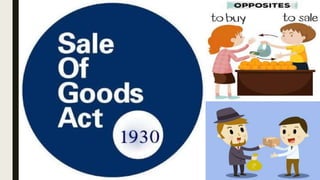
SALE OF GOOD ACT -1930
B.COM 2ND YR, HONOURS PAPER-III, UNIT-II, LEC-01
Sale of Goods Act,1930
The Sale of Goods Act is a kind of Indian ContractAct.
It came into existence on 1 July 1930.
It is a contract whereby the seller transfers or agrees to transfer the title
(ownership) in the goods to the buyer forconsideration.
It is applicable all over India, except Jammu andKashmir.
The goods are sold from owner to buyer for a certain price and at a given period
of time.
The act has 66 Sections and VII Chapter.
Sale & Agreement to
sell
Section 4 of Sale of Goods Act define the term "Sale" and "agreement to sell" as follows-
As per Section 4 (1): “Acontract of sale of goods is a contract whereby the seller transfers or agrees
to transfer the property in goods to the buyer for a price. There may be a contract of sale between
one part-owner andanother.”
As per Section 4 (2), “Acontract of sale may be absolute or conditional.”
As per Section 4 (3), “Where under a contract of sale the property in the goods is transferred from
the seller to the buyer
, the contract is called a sale, but where the transfer of the property in the
goods is to take place at a future time or subject to some condition thereafter to be fulfilled, the
contract is called an agreement to sell.”
As per Section 4 (a), “An agreement to sell becomes a sale when the time elapses or the conditions
are fulfilled subject to which the property in the goods is to be transferred.”
Essential elements of a Contractof Sale:
1. T
woparties: There must be 2 distinct parties i.e. a buyer and a seller, to affect a contract
of sale and they must be competentto contract.
2.Goods: There must be some goods the property in which is or is to be transferred from
the seller to the buyer.The goods which form the subject-matter of the contract of sale
must be movable. Transfer of immovable property is not regulated by the Sale of Goods Act.
3.Price: Price is an essential ingredient for all transactions of sale and in the absence of
the price or the consideration, the transfer is not regarded as a sale. The transfer by way of
sale must be in exchange for aprice.
4. Transfer of general property: There must be a transfer of general property as
distinguishes from special property in goodsfrom the seller to the buyer.
5. Essential elements of a valid contract:All essential elements of a valid contract must be
present in the contract ofsale.
Sale Vs Agreement toSell
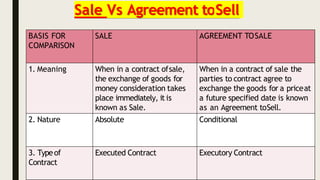
BASIS FOR
COMPARISON
SALE AGREEMENT TOSALE
1. Meaning When in a contract ofsale,
the exchange of goods for
money consideration takes
place immediately, it is
known as Sale.
When in a contract of sale the
parties to contract agree to
exchange the goods for a priceat
a future specified date is known
as an Agreement toSell.
2. Nature Absolute Conditional
3. Typeof
Contract
Executed Contract Executory Contract
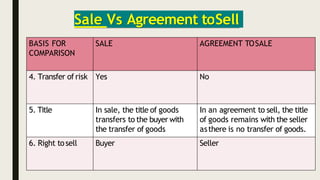
Sale Vs Agreement toSell
BASIS FOR
COMPARISON
SALE AGREEMENT TOSALE
4. Transfer of risk Yes No
5. Title In sale, the title of goods
transfers to the buyer with
the transfer of goods
In an agreement to sell, the title
of goods remains with the seller
asthere is no transfer of goods.
6. Right tosell Buyer Seller
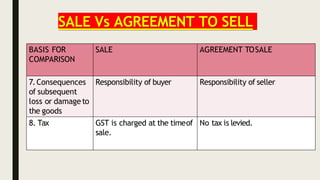
SALE Vs AGREEMENT TO SELL
BASIS FOR
COMPARISON
SALE AGREEMENT TOSALE
7.Consequences
of subsequent
loss or damage to
the goods
Responsibility of buyer Responsibility of seller
8. Tax GST is charged at the timeof
sale.
No tax is levied.
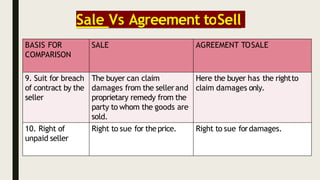
Sale Vs Agreement toSell
BASIS FOR
COMPARISON
SALE AGREEMENT TOSALE
9. Suit for breach
of contract by the
seller
The buyer can claim
damages from the sellerand
proprietary remedy from the
party to whom the goods are
sold.
Here the buyer has the rightto
claim damages only.
10. Right of
unpaid seller
Right to sue for theprice. Right to sue fordamages.
LECTURE-01 COMPLETE
THANK YOU

BRF (SGA-1930, LEC-1).pptx

  • 1.
    BUSINESS REGULATORY FRAMEWORK SUBHASH KUMAR ASSISTANTPROFESOR(GUEST) DEPT. OF COMMERCE CMB COLLEGE DEORH GHOGHARDIHA (MADHUBANI)
  • 2.
    SALE OF GOODACT -1930 B.COM 2ND YR, HONOURS PAPER-III, UNIT-II, LEC-01
  • 4.
    Sale of GoodsAct,1930 The Sale of Goods Act is a kind of Indian ContractAct. It came into existence on 1 July 1930. It is a contract whereby the seller transfers or agrees to transfer the title (ownership) in the goods to the buyer forconsideration. It is applicable all over India, except Jammu andKashmir. The goods are sold from owner to buyer for a certain price and at a given period of time. The act has 66 Sections and VII Chapter.
  • 5.
    Sale & Agreementto sell Section 4 of Sale of Goods Act define the term "Sale" and "agreement to sell" as follows- As per Section 4 (1): “Acontract of sale of goods is a contract whereby the seller transfers or agrees to transfer the property in goods to the buyer for a price. There may be a contract of sale between one part-owner andanother.” As per Section 4 (2), “Acontract of sale may be absolute or conditional.” As per Section 4 (3), “Where under a contract of sale the property in the goods is transferred from the seller to the buyer , the contract is called a sale, but where the transfer of the property in the goods is to take place at a future time or subject to some condition thereafter to be fulfilled, the contract is called an agreement to sell.” As per Section 4 (a), “An agreement to sell becomes a sale when the time elapses or the conditions are fulfilled subject to which the property in the goods is to be transferred.”
  • 6.
    Essential elements ofa Contractof Sale: 1. T woparties: There must be 2 distinct parties i.e. a buyer and a seller, to affect a contract of sale and they must be competentto contract. 2.Goods: There must be some goods the property in which is or is to be transferred from the seller to the buyer.The goods which form the subject-matter of the contract of sale must be movable. Transfer of immovable property is not regulated by the Sale of Goods Act. 3.Price: Price is an essential ingredient for all transactions of sale and in the absence of the price or the consideration, the transfer is not regarded as a sale. The transfer by way of sale must be in exchange for aprice. 4. Transfer of general property: There must be a transfer of general property as distinguishes from special property in goodsfrom the seller to the buyer. 5. Essential elements of a valid contract:All essential elements of a valid contract must be present in the contract ofsale.
  • 8.
    Sale Vs AgreementtoSell BASIS FOR COMPARISON SALE AGREEMENT TOSALE 1. Meaning When in a contract ofsale, the exchange of goods for money consideration takes place immediately, it is known as Sale. When in a contract of sale the parties to contract agree to exchange the goods for a priceat a future specified date is known as an Agreement toSell. 2. Nature Absolute Conditional 3. Typeof Contract Executed Contract Executory Contract
  • 9.
    Sale Vs AgreementtoSell BASIS FOR COMPARISON SALE AGREEMENT TOSALE 4. Transfer of risk Yes No 5. Title In sale, the title of goods transfers to the buyer with the transfer of goods In an agreement to sell, the title of goods remains with the seller asthere is no transfer of goods. 6. Right tosell Buyer Seller
  • 10.
    SALE Vs AGREEMENTTO SELL BASIS FOR COMPARISON SALE AGREEMENT TOSALE 7.Consequences of subsequent loss or damage to the goods Responsibility of buyer Responsibility of seller 8. Tax GST is charged at the timeof sale. No tax is levied.
  • 11.
    Sale Vs AgreementtoSell BASIS FOR COMPARISON SALE AGREEMENT TOSALE 9. Suit for breach of contract by the seller The buyer can claim damages from the sellerand proprietary remedy from the party to whom the goods are sold. Here the buyer has the rightto claim damages only. 10. Right of unpaid seller Right to sue for theprice. Right to sue fordamages.
  • 12.