This ppt consists of details regarding breastfeeding contraindications and problems faced by mothers during breastfeeding as well as how to tackle these problems
CONTENT
Contraindications ofbreastfeeding
Problems of breastfeeding
The who do not suck
The baby who refuse on breast
Inverted nipple
Sore nipple
Breast engorgement
Breast absess
Working mother
3.
CONTRAINDICATIONS OF BREASTFEEDING
Thetrue contraindication of breastfeeding are
phenylketonuria and galactosemia.
Maternal conditions which can be considered as REAL
coritraindications are Radiotherapy Ergot Therapy,
Antimetabolites therapy and Lithium Therapy.
Maternal illness should not result in interruption of
breastfeeding.
Expressed Breast milk can be given to the baby whenever
needed, from the mother or mothers substitute.
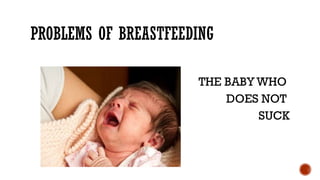
PROBLEMS OF BREASTFEEDING
THEBABY WHO DOES NOT SUCK
No unneeded drugs to be given to breastfeeding mothers.
No artificial food or water to be given to the baby.
Breastfeeding to be given when the baby is alert and ready
Milk to be expressed into the nipple just prior to feed the baby
Nipple should be placed slightly upward towards the roof of
the baby’s mouth.
Keeping the baby’s nose free during breastfeeding.
6.
THE BABY WHOREFUSE ON
BREASTFEEDING
Baby should be hold in comfortable position with
good attachment to the breast and should be kept
dry and warm.
Avoiding pressure on potentially painful areas
during feeding
Express breast milk to maintain lactation in both
breast
Allowing the baby to feed only one breast.
7.
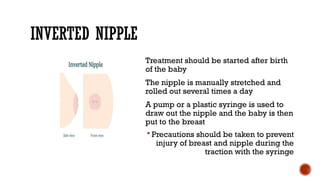
INVERTED NIPPLE
Treatment shouldbe started after birth
of the baby
The nipple is manually stretched and
rolled out several times a day
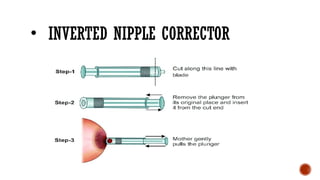
A pump or a plastic syringe is used to
draw out the nipple and the baby is then
put to the breast
Precautions should be taken to prevent
injury of breast and nipple during the
traction with the syringe
SORE NIPPLE
Correct positioningand latching of the baby to the breast.
Frequent washing with soap and water should be avoided.
Baby should not be pull off the breast while still sucking.
Hind milk to be applied to the nipple after a feeding.
Nipples should be aired and allowed to heal in between
feeds.
10.
BREAST ENGORGEMENT
Frequent feedingand correct attachment of the baby to the
breast during feeding to be done to prevent engorgement.
Treatment of this condition to be done with local warm
packs and analgesics to the mother to relieve the pain.
Milk should be expressed gently to soften the breast and
then baby to be put to the breast with good latching.
11.
BREAST ABSESS
Treatment tobe done with analgesics and
antibiotics.
Abscess may need incision and drainage.
Breastfeeding must be continued.
12.
WORKING MOTHER
Mother shouldexpress her milk in a clean, wide mouthed
container and this milk should be fed to her baby by the
caretaker, in the absence of the mother.
Express breast milk can be stored at room temperature for 8
hours and in the refrigerator for 24 hrs.
EBM feeding should be given with cup/bati and spoon.
Expression of milk should be done by hands which more
easier.
13.
SUMMARY
Contraindications ofbreastfeeding
Problems of breastfeeding
The baby who does not suck
The baby who refuse on breastfeeding
Inverted nipple.
Sore nipple
Breast engorgement
Breast absess
Working mother


![Hypothalamus short notes on location, function and disorders by Dr. Neha [PT]...](https://cdn.slidesharecdn.com/ss_thumbnails/hypothalamusbydr-260124142231-2b48143d-thumbnail.jpg?width=640&height=640&fit=bounds)


