B
                                           R
                                           E
                                           A
  BREAST CANCER IS AN UNCONTROLLED         S
  GROWTH OF BREAST CELL                    T

MAINLY TWO TYPES                           C
 DUCTAL CANCER (85-90%)                   A
 LOBULAR CANCER ( almost 8%)              N
                                           C
MOST FREQUENT CANCER AMONG WOMEN AND 2nd   E
             RANK IN WORLD
                                           R
B
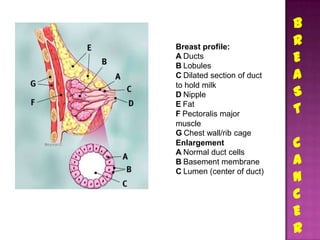
Breast profile:
                            R
A Ducts
B Lobules
                            E
C Dilated section of duct   A
to hold milk
D Nipple                    S
E Fat
F Pectoralis major          T
muscle
G Chest wall/rib cage
Enlargement                 C
A Normal duct cells
B Basement membrane         A
                            N
C Lumen (center of duct)


                            C
                            E
                            R
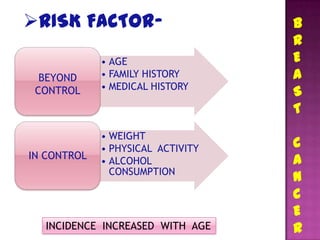
RISK FACTOR-                      B
                                   R
             • AGE                 E
  BEYOND     • FAMILY HISTORY      A
             • MEDICAL HISTORY
 CONTROL                           S
                                   T
             • WEIGHT
             • PHYSICAL ACTIVITY   C
IN CONTROL   • ALCOHOL             A
               CONSUMPTION
                                   N
                                   C
                                   E
  INCIDENCE INCREASED WITH AGE     R
E
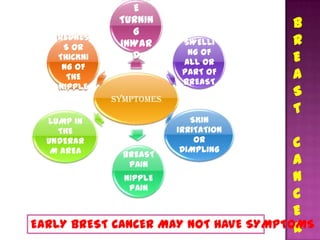
               TURNIN                  B
                 G
    REDNES
     S OR      INWAR       SWELLI      R
                            NG OF
    THICKNI      D
                           ALL OR      E
     NG OF
      THE
                           PART OF
                           BREAST
                                       A
    NIPPLE
              SYMPTOMES
                                       S
                                       T
  LUMP IN                    SKIN
    THE                   IRRITATION
  UNDERAR
   M AREA
                              OR
                           DIMPLING
                                      C
              BREAST
               PAIN                   A
              NIPPLE                  N
               PAIN
                                      C
                                      E
EARLY BREST CANCER MAY NOT HAVE SYMPTOMS
                                      R
B
                                                                   R
                                                                   E
                                                                   A
                                                                   S
                                                                   T

                                                                   C
                                                                   A
                                                                   N
                                                                   C
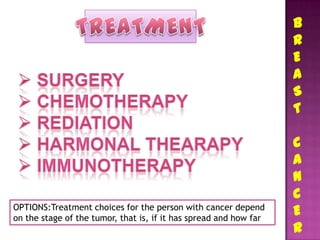
OPTIONS:Treatment choices for the person with cancer depend
on the stage of the tumor, that is, if it has spread and how far
                                                                   E
                                                                   R
 PARP -           [poly (ADP-ribose) polymer]               inhibitor        B
                                                                              R
                                                                              E
       It is a group of pharmacological inhibitor of the enzyme PARP
                                                                              A
OLAPARIB                    M.O.A                                            S
 it is a chemotherrapeutic agent                                             T
 kills cells that divides rapidly

 Patient with BRCA 1 and BRCA 2 mutation are also In risk of devloping       C
breast cancer
                                                                              A
 they are often resistance other form of breast cancer treatment
                                                                              N
 so it increases the reliance on PARP torepair their DNA.                    C
 so the PARP inhibitor significantly benefits in patient whose cancers are   E
Susceptible to treatment.
                                                                              R
B
                   R
                   E
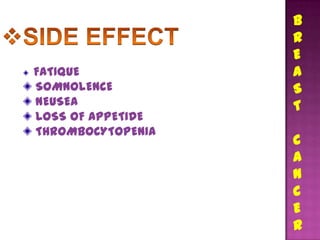
FATIQUE            A
SOMNOLENCE         S
NEUSEA             T
LOSS OF APPETIDE
THROMBOCYTOPENIA
                   C
                   A
                   N
                   C
                   E
                   R
B
                                                                       R
                                                                       E
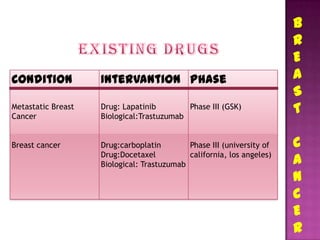
Condition           Intervantion Phase                                 A
                                                                       S
Metastatic Breast
Cancer
                    Drug: Lapatinib
                    Biological:Trastuzumab
                                           Phase III (GSK)             T

Breast cancer       Drug:carboplatin        Phase III (university of   C
                    Drug:Docetaxel          california, los angeles)
                    Biological: Trastuzumab                            A
                                                                       N
                                                                       C
                                                                       E
                                                                       R
B
                                                           R
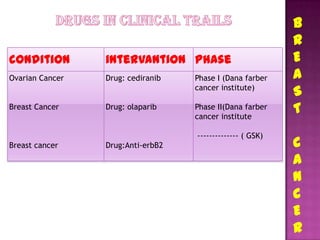
condition        intervantion phase                        E
Ovarian Cancer   Drug: cediranib   Phase I (Dana farber    A
                                   cancer institute)
                                                           S
Breast Cancer    Drug: olaparib    Phase II(Dana farber
                                   cancer institute
                                                           T
                                   -------------- ( GSK)
Breast cancer    Drug:Anti-erbB2                           C
                                                           A
                                                           N
                                                           C
                                                           E
                                                           R
Breast cancer

Breast cancer

  • 1.
    B R E A BREAST CANCER IS AN UNCONTROLLED S GROWTH OF BREAST CELL T MAINLY TWO TYPES C  DUCTAL CANCER (85-90%) A  LOBULAR CANCER ( almost 8%) N C MOST FREQUENT CANCER AMONG WOMEN AND 2nd E RANK IN WORLD R
  • 2.
    B Breast profile: R A Ducts B Lobules E C Dilated section of duct A to hold milk D Nipple S E Fat F Pectoralis major T muscle G Chest wall/rib cage Enlargement C A Normal duct cells B Basement membrane A N C Lumen (center of duct) C E R
  • 3.
    RISK FACTOR- B R • AGE E BEYOND • FAMILY HISTORY A • MEDICAL HISTORY CONTROL S T • WEIGHT • PHYSICAL ACTIVITY C IN CONTROL • ALCOHOL A CONSUMPTION N C E INCIDENCE INCREASED WITH AGE R
  • 4.
    E TURNIN B G REDNES S OR INWAR SWELLI R NG OF THICKNI D ALL OR E NG OF THE PART OF BREAST A NIPPLE SYMPTOMES S T LUMP IN SKIN THE IRRITATION UNDERAR M AREA OR DIMPLING C BREAST PAIN A NIPPLE N PAIN C E EARLY BREST CANCER MAY NOT HAVE SYMPTOMS R
  • 5.
    B R E A S T C A N C OPTIONS:Treatment choices for the person with cancer depend on the stage of the tumor, that is, if it has spread and how far E R
  • 6.
     PARP - [poly (ADP-ribose) polymer] inhibitor B R E It is a group of pharmacological inhibitor of the enzyme PARP A OLAPARIB M.O.A S  it is a chemotherrapeutic agent T  kills cells that divides rapidly  Patient with BRCA 1 and BRCA 2 mutation are also In risk of devloping C breast cancer A  they are often resistance other form of breast cancer treatment N  so it increases the reliance on PARP torepair their DNA. C  so the PARP inhibitor significantly benefits in patient whose cancers are E Susceptible to treatment. R
  • 7.
    B R E FATIQUE A SOMNOLENCE S NEUSEA T LOSS OF APPETIDE THROMBOCYTOPENIA C A N C E R
  • 8.
    B R E Condition Intervantion Phase A S Metastatic Breast Cancer Drug: Lapatinib Biological:Trastuzumab Phase III (GSK) T Breast cancer Drug:carboplatin Phase III (university of C Drug:Docetaxel california, los angeles) Biological: Trastuzumab A N C E R
  • 9.
    B R condition intervantion phase E Ovarian Cancer Drug: cediranib Phase I (Dana farber A cancer institute) S Breast Cancer Drug: olaparib Phase II(Dana farber cancer institute T -------------- ( GSK) Breast cancer Drug:Anti-erbB2 C A N C E R