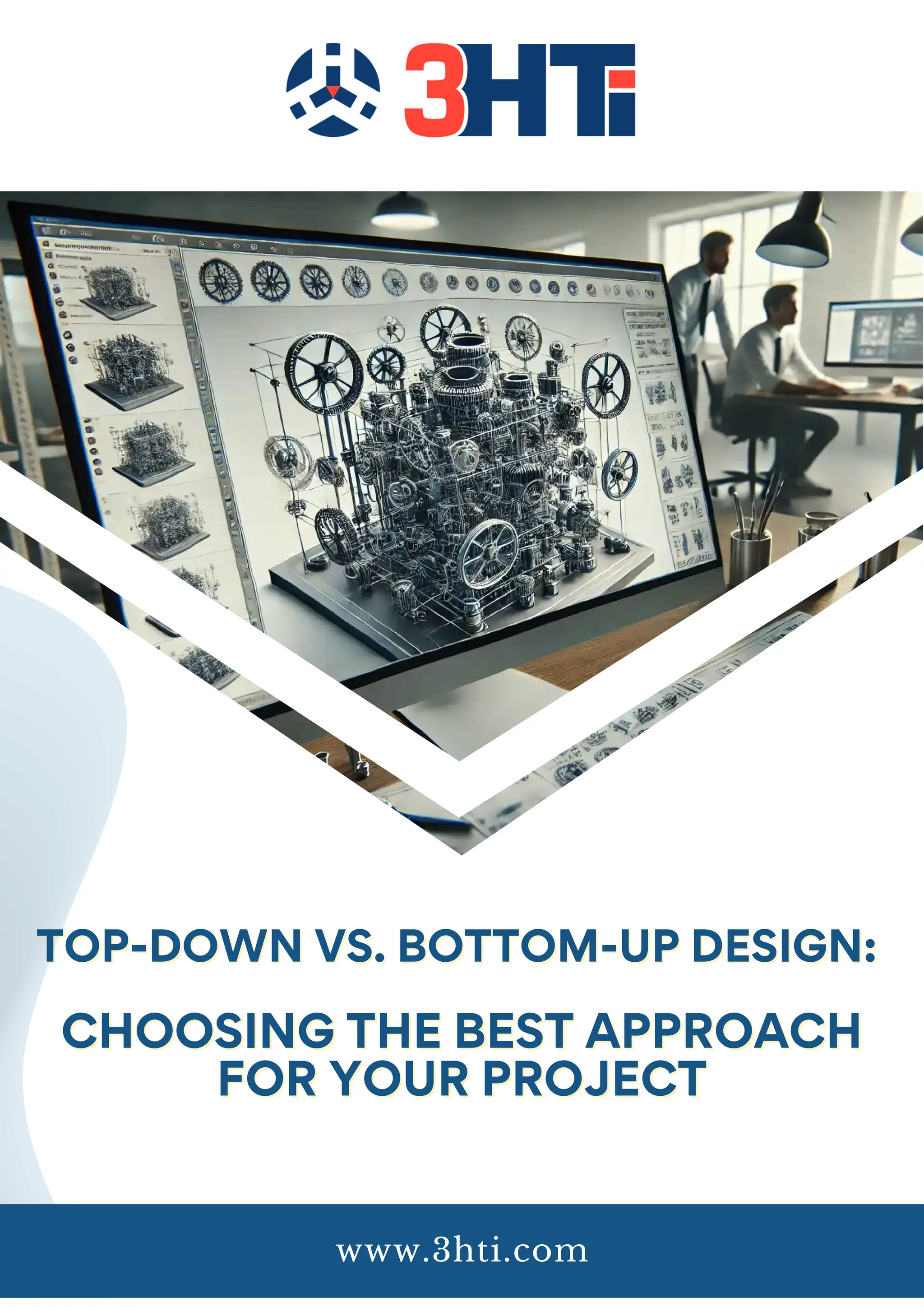
TOP-DOWN VS. BOTTOM-UP DESIGN:
www.3hti.com
CHOOSING THE BEST APPROACH
FOR YOUR PROJECT
FOR YOUR PROJECT
In working with clients that span
multiple industries, we have found
that designers and engineering
departments for most mid-sized to
small companies in Discrete
Manufacturing are more focused on
hitting deadlines and don’t have the
time to change or update their
process or the way they work.
However, adopting a Top-Down
design process (rather than Bottom-
Up) for your PTC CREO CAD models
can save a lot of time downstream
from building a better parametric
model.
www.3hti.com
Here is the difference between a
Bottom-Up design process and a
Top-Down process.
www.3hti.com
A Bottom-Up process focuses on
the individual parts that make up
an assembly. Each part is designed
independently and in isolation
from the other parts. They are then
combined into an assembly as the
last step.
A Top-Down design process
focuses on the entire assembly
from the start. Individual parts are
modeled referencing the assembly
with each parts geometry tied
back to the assembly.
So, when does it make sense to
use one process over the other?
www.3hti.com
The Bottom-Up design is
ideally suited when most of the
parts or components are off the
shelf items. In this scenario it is
much more difficult to adjust or
change the individual
components.
Top-Down design is ideal for
designs where the components
are not “off the shelf” and their
dimension or function is driven
from the assembly itself.
www.3hti.com
There is also a hybrid approach that
uses both Top-Down and Bottom-
Up, which is more common when
modeling very large CAD
assemblies (assemblies with a lot of
parts). In this case the top-level
assembly is generally Bottom-Up
but the critical unique sub-
assemblies use Top-Down design.
How can PTC Creo CAD software
help with Top-Down and/or
Bottom-Up modeling processes? If
you are manufacturing/designing
simple component type parts and or
assemblies.
www.3hti.com
Using the Bottom-Up method, then
Creo Design Essentials package is
the best solution for you since it’s
the basic license of Creo, but very
feature rich.
If you are manufacturing larger
assemblies or hybrid assemblies
using the Top-Down approach you
will want to utilize the capabilities of
Creo’s Advanced Assembly
Extension (AAX). Creo’s Advanced
Assembly Extension does more than
just Top-down design and skeleton
models. Advanced Assembly also
improves communication regarding
design criteria.
www.3hti.com
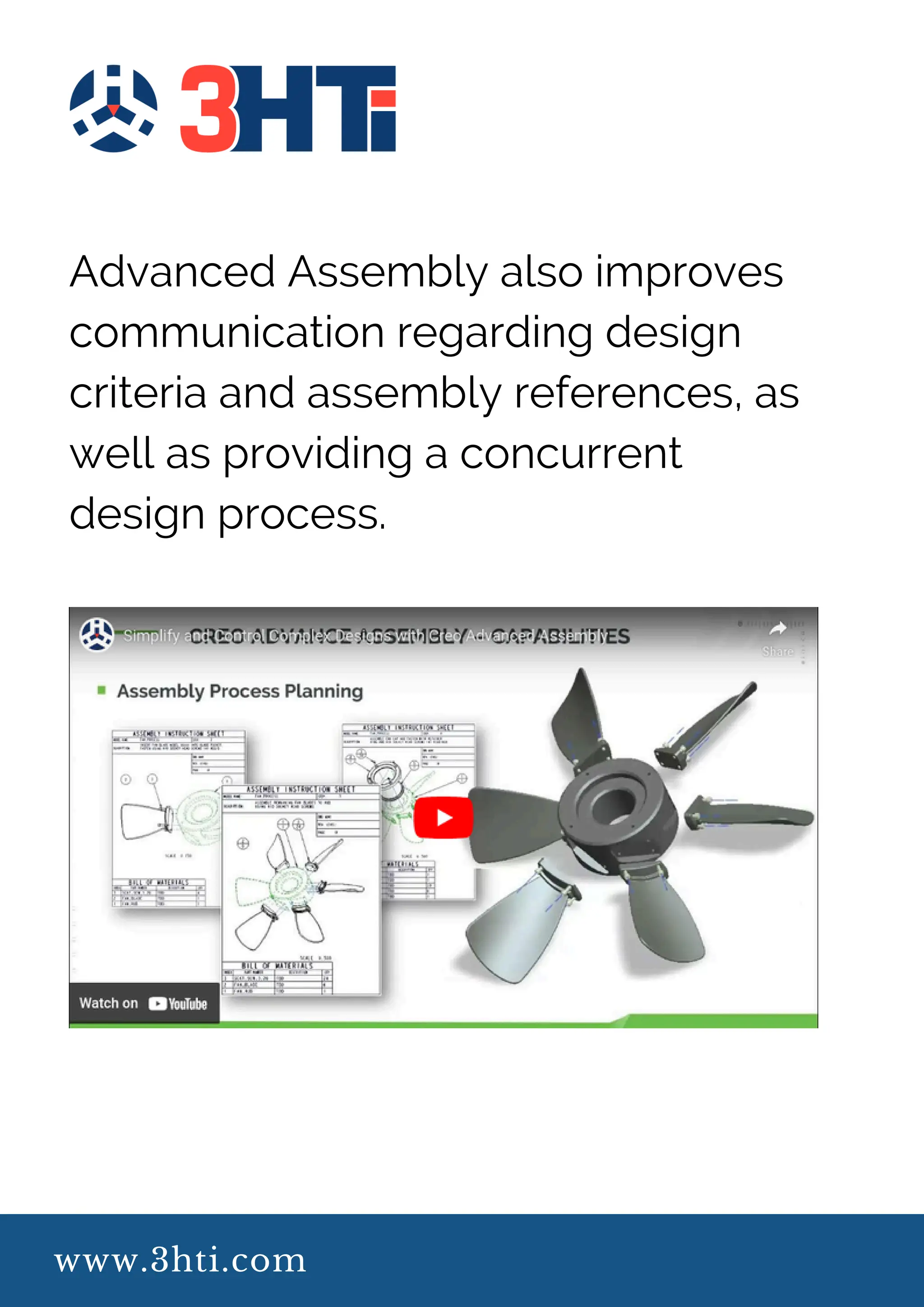
Advanced Assembly also improves
communication regarding design
criteria and assembly references, as
well as providing a concurrent
design process.
Let's Socialize
3000 ATRIUM WAY #296
MT. LAUREL, NJ 08054
866-624-3484
Company Bio
Do you have questions or
comments?
Let us know what's on your
mind and how we can help
www.3hti.com

Bottom Up vs. Top Down Design – What Approach is better.pdf

  • 1.
    TOP-DOWN VS. BOTTOM-UPDESIGN: TOP-DOWN VS. BOTTOM-UP DESIGN: www.3hti.com CHOOSING THE BEST APPROACH CHOOSING THE BEST APPROACH FOR YOUR PROJECT FOR YOUR PROJECT
  • 2.
    In working withclients that span multiple industries, we have found that designers and engineering departments for most mid-sized to small companies in Discrete Manufacturing are more focused on hitting deadlines and don’t have the time to change or update their process or the way they work. However, adopting a Top-Down design process (rather than Bottom- Up) for your PTC CREO CAD models can save a lot of time downstream from building a better parametric model. www.3hti.com
  • 3.
    Here is thedifference between a Bottom-Up design process and a Top-Down process. www.3hti.com A Bottom-Up process focuses on the individual parts that make up an assembly. Each part is designed independently and in isolation from the other parts. They are then combined into an assembly as the last step. A Top-Down design process focuses on the entire assembly from the start. Individual parts are modeled referencing the assembly with each parts geometry tied back to the assembly.
  • 4.
    So, when doesit make sense to use one process over the other? www.3hti.com The Bottom-Up design is ideally suited when most of the parts or components are off the shelf items. In this scenario it is much more difficult to adjust or change the individual components. Top-Down design is ideal for designs where the components are not “off the shelf” and their dimension or function is driven from the assembly itself.
  • 5.
    www.3hti.com There is alsoa hybrid approach that uses both Top-Down and Bottom- Up, which is more common when modeling very large CAD assemblies (assemblies with a lot of parts). In this case the top-level assembly is generally Bottom-Up but the critical unique sub- assemblies use Top-Down design. How can PTC Creo CAD software help with Top-Down and/or Bottom-Up modeling processes? If you are manufacturing/designing simple component type parts and or assemblies.
  • 6.
    www.3hti.com Using the Bottom-Upmethod, then Creo Design Essentials package is the best solution for you since it’s the basic license of Creo, but very feature rich. If you are manufacturing larger assemblies or hybrid assemblies using the Top-Down approach you will want to utilize the capabilities of Creo’s Advanced Assembly Extension (AAX). Creo’s Advanced Assembly Extension does more than just Top-down design and skeleton models. Advanced Assembly also improves communication regarding design criteria.
  • 7.
    www.3hti.com Advanced Assembly alsoimproves communication regarding design criteria and assembly references, as well as providing a concurrent design process.
  • 8.
    Let's Socialize 3000 ATRIUMWAY #296 MT. LAUREL, NJ 08054 866-624-3484 Company Bio Do you have questions or comments? Let us know what's on your mind and how we can help www.3hti.com