The development and
implementation of
European regulations
for traceability
John Bostock
Institute of Aquaculture
University of Stirling, UK
Why regulate for traceability?
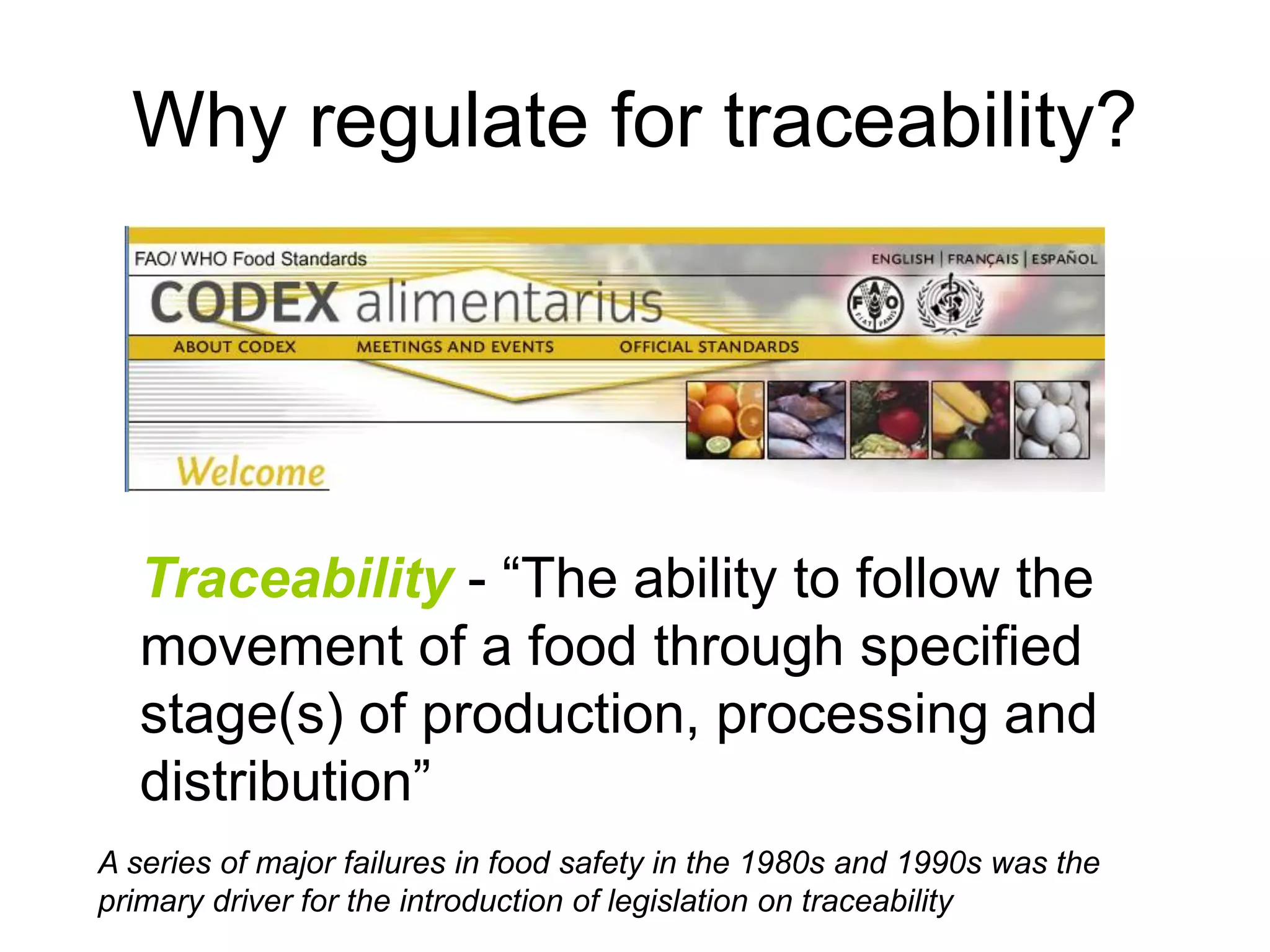
Traceability - “The ability to follow the
movement of a food through specified
stage(s) of production, processing and
distribution”
A series of major failures in food safety in the 1980s and 1990s was the
primary driver for the introduction of legislation on traceability
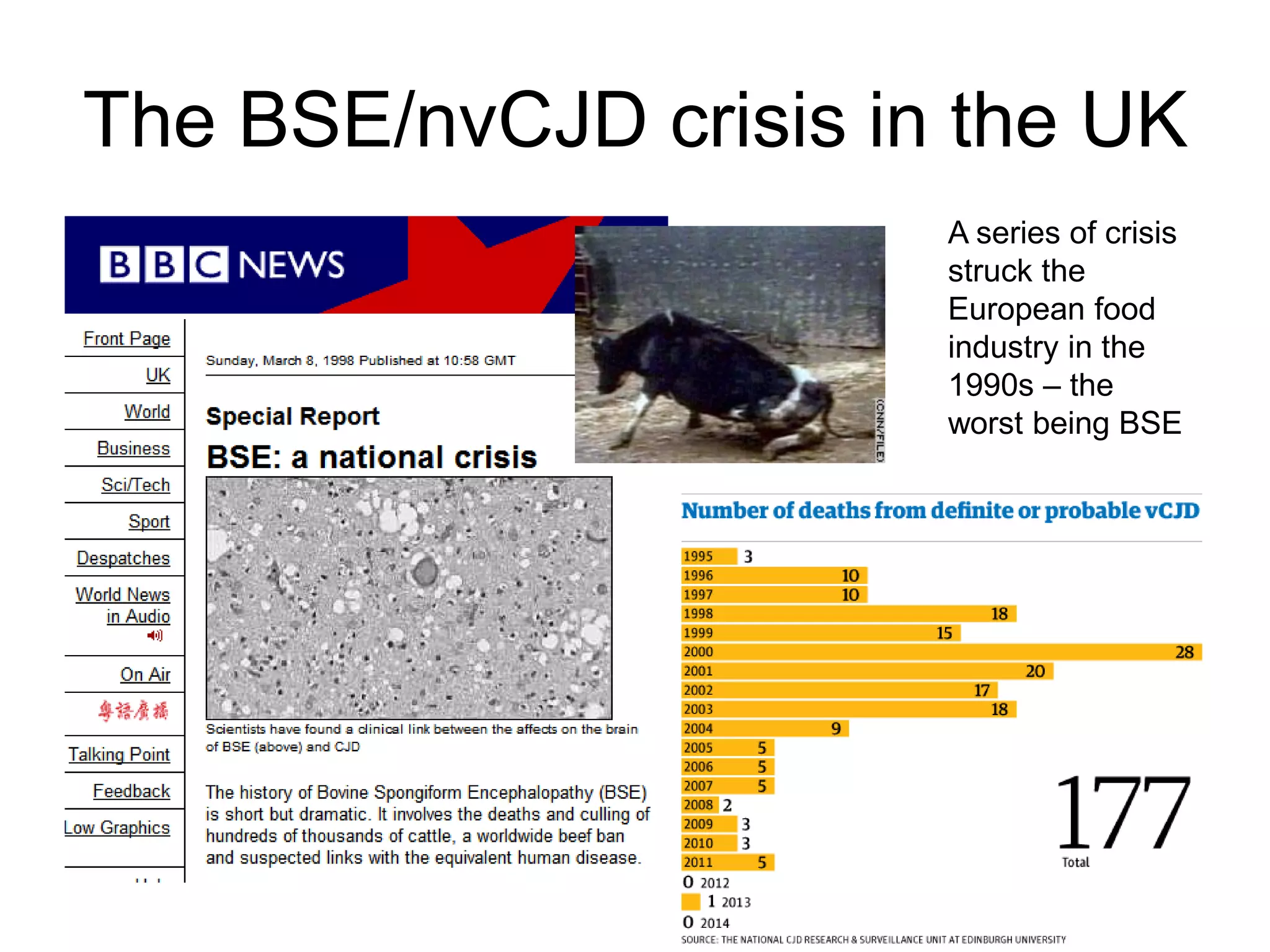
The BSE/nvCJD crisis in the UK
A series of crisis
struck the
European food
industry in the
1990s – the
worst being BSE
UK impacts and actions
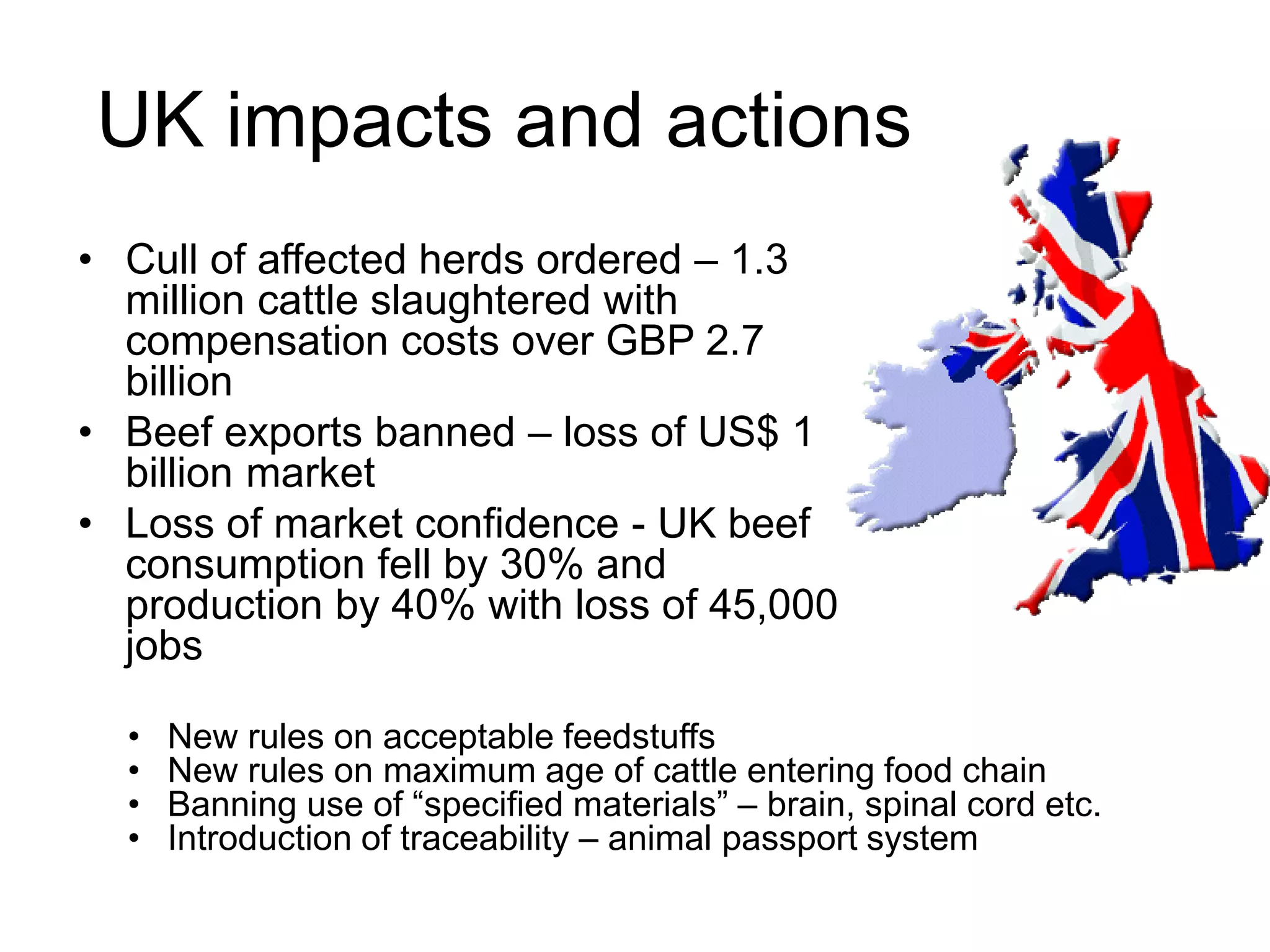
• Cull of affected herds ordered – 1.3
million cattle slaughtered with
compensation costs over GBP 2.7
billion
• Beef exports banned – loss of US$ 1
billion market
• Loss of market confidence - UK beef
consumption fell by 30% and
production by 40% with loss of 45,000
jobs
• New rules on acceptable feedstuffs
• New rules on maximum age of cattle entering food chain
• Banning use of “specified materials” – brain, spinal cord etc.
• Introduction of traceability – animal passport system
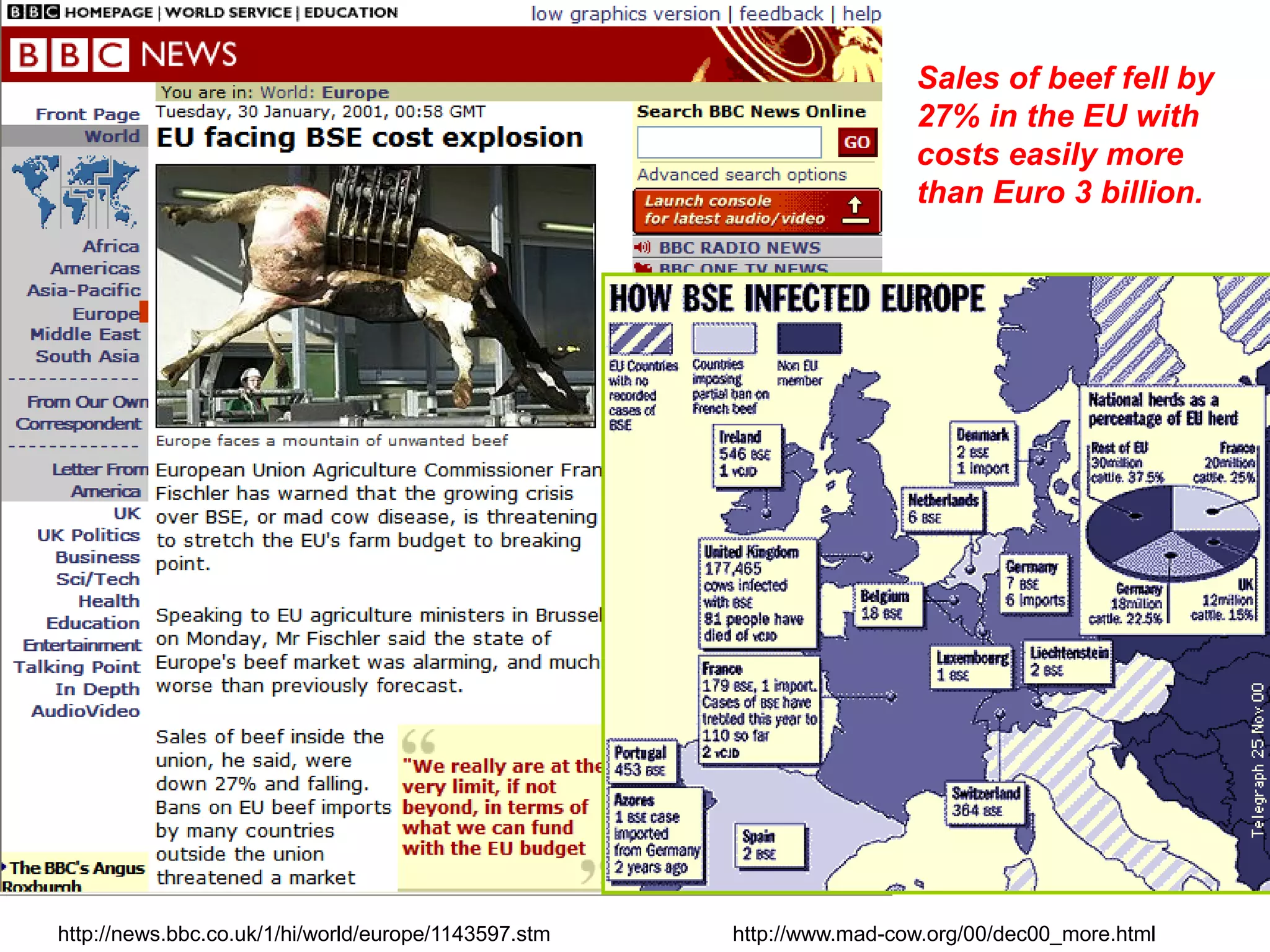
http://news.bbc.co.uk/1/hi/world/europe/1143597.stm http://www.mad-cow.org/00/dec00_more.html
Sales of beef fell by
27% in the EU with
costs easily more
than Euro 3 billion.
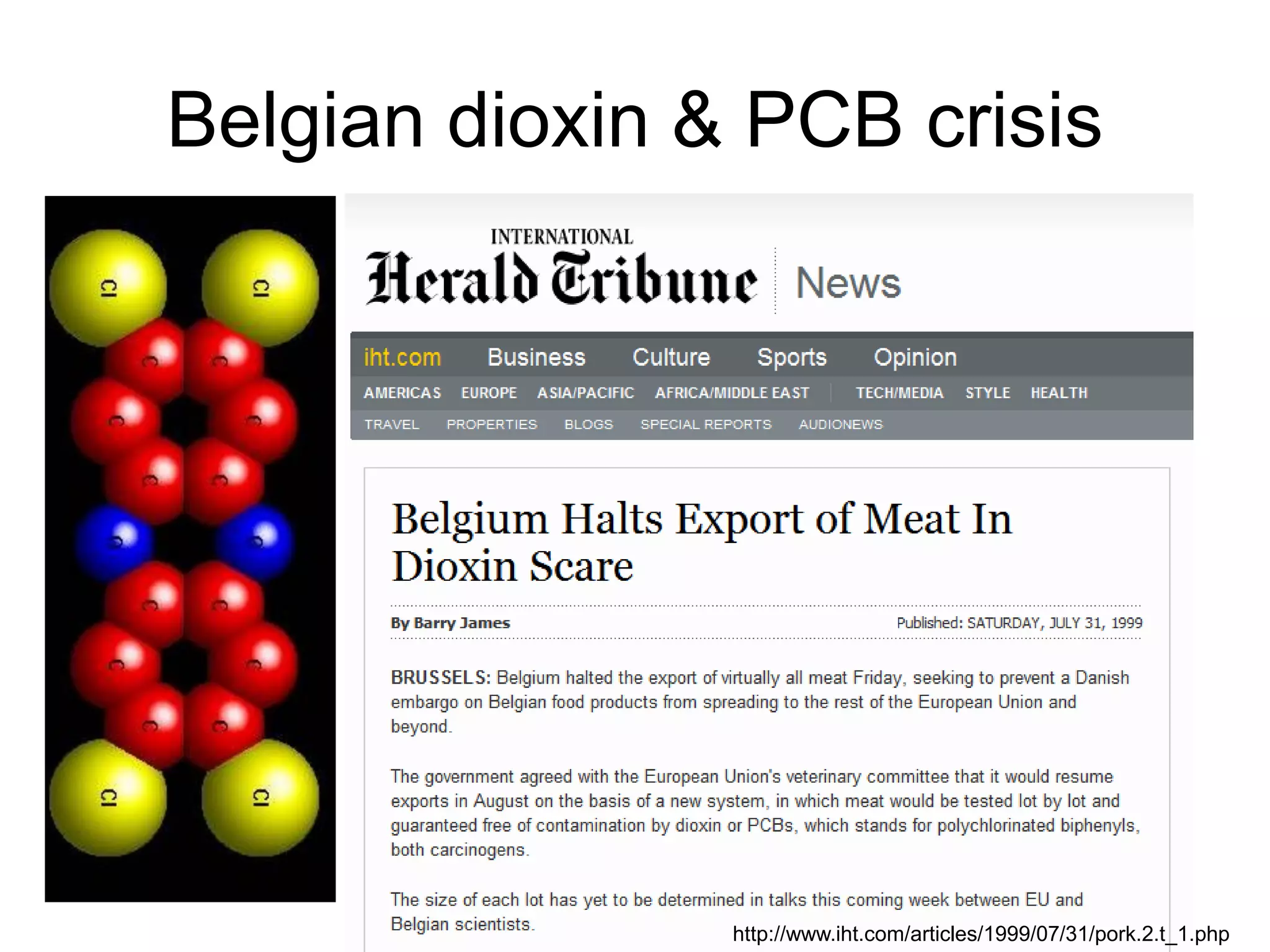
Belgian dioxin & PCB crisis
http://www.iht.com/articles/1999/07/31/pork.2.t_1.php
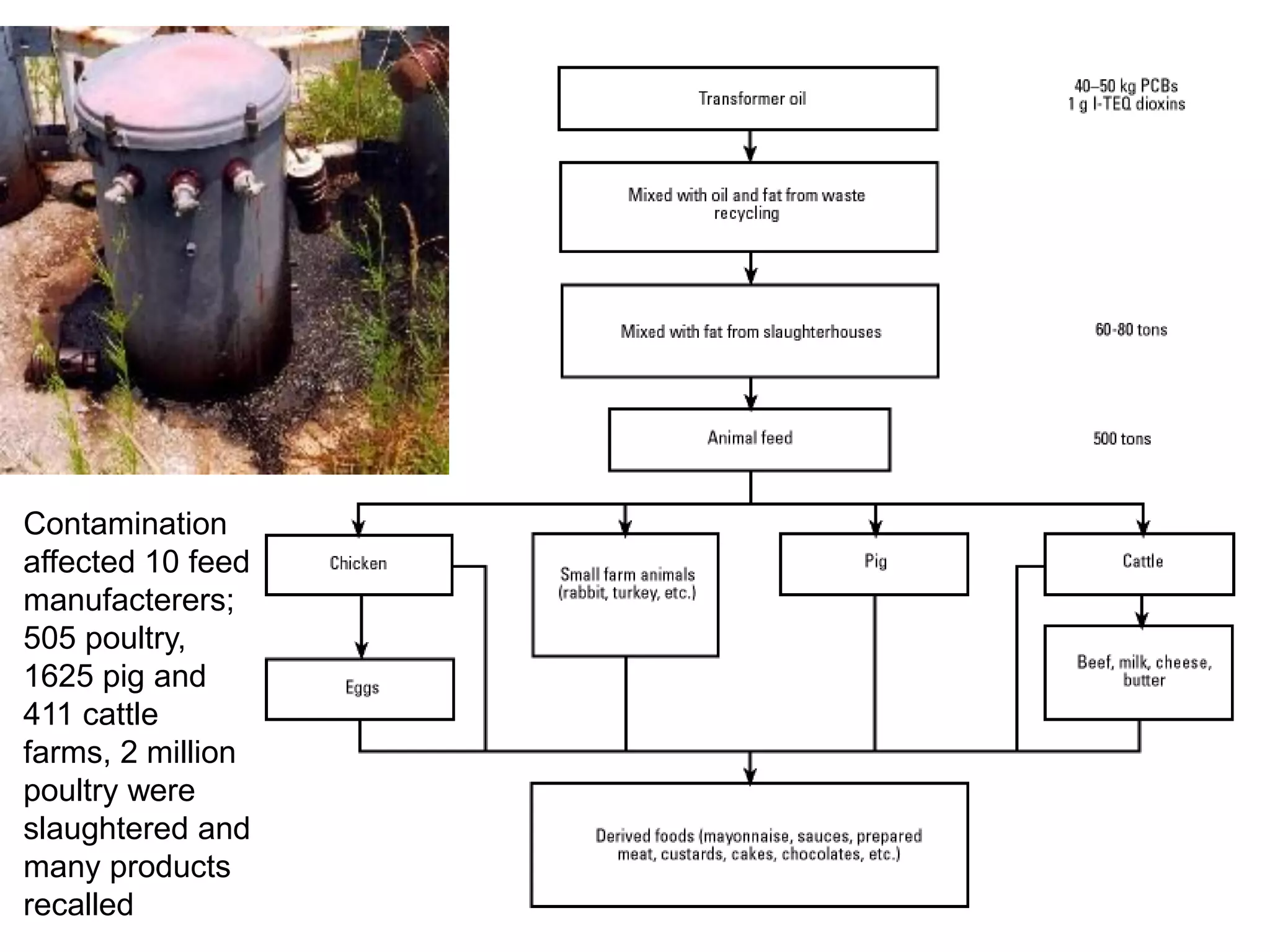
Contamination
affected 10 feed
manufacterers;
505 poultry,
1625 pig and
411 cattle
farms, 2 million
poultry were
slaughtered and
many products
recalled
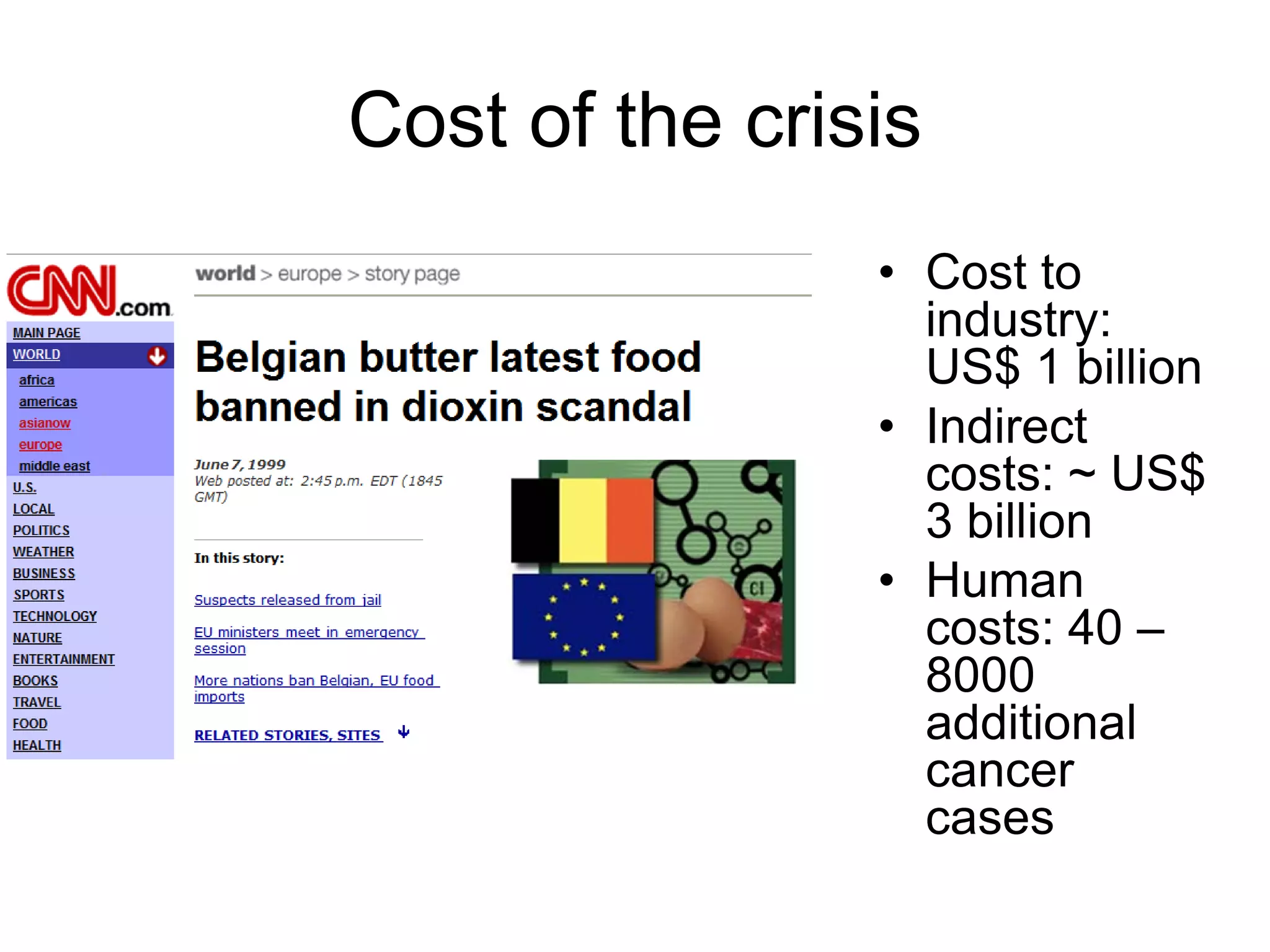
Cost of the crisis
• Cost to
industry:
US$ 1 billion
• Indirect
costs: ~ US$
3 billion
• Human
costs: 40 –
8000
additional
cancer
cases
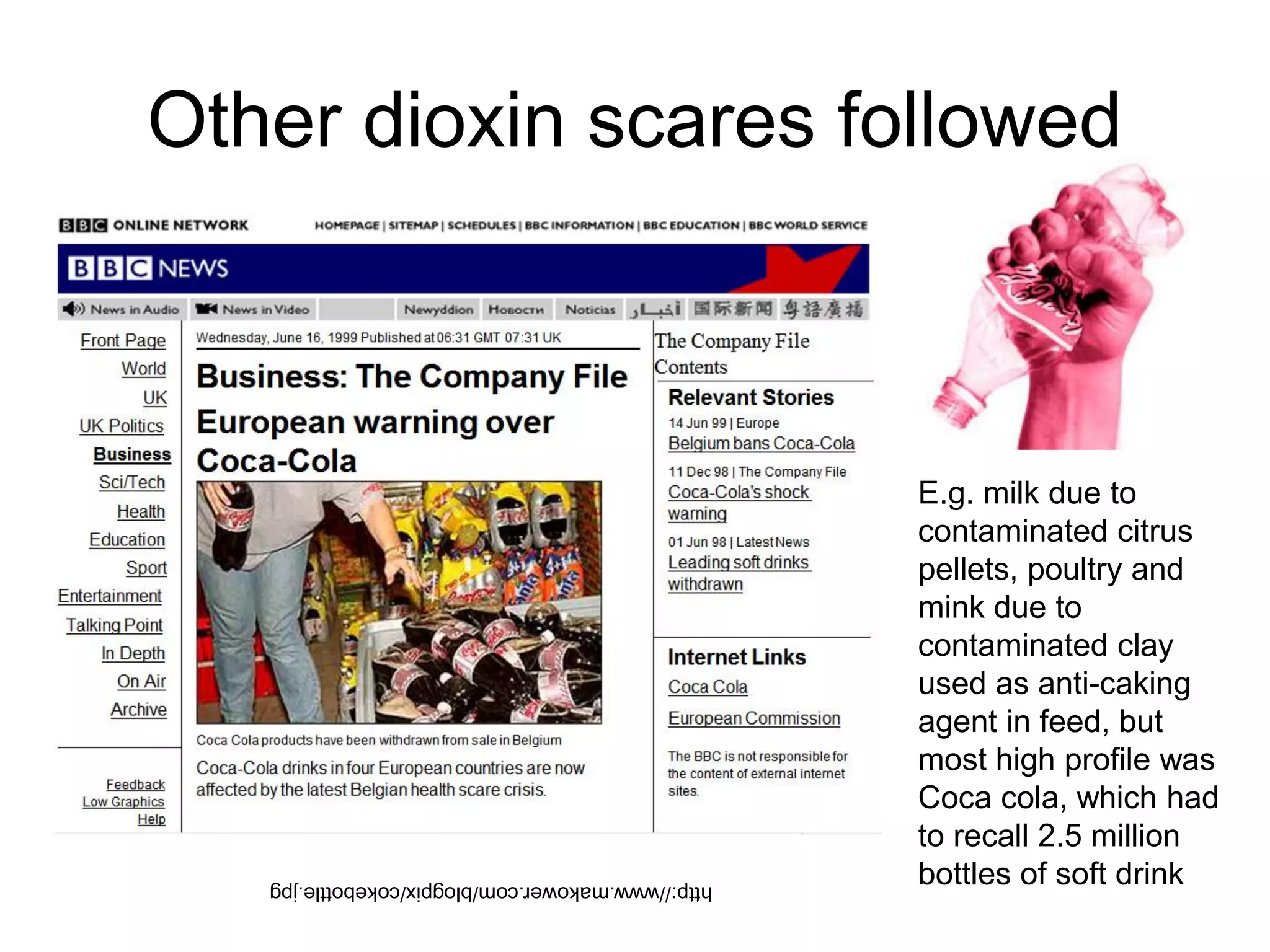
Other dioxin scares followed
http://www.makower.com/blogpix/cokebottle.jpg
E.g. milk due to
contaminated citrus
pellets, poultry and
mink due to
contaminated clay
used as anti-caking
agent in feed, but
most high profile was
Coca cola, which had
to recall 2.5 million
bottles of soft drink
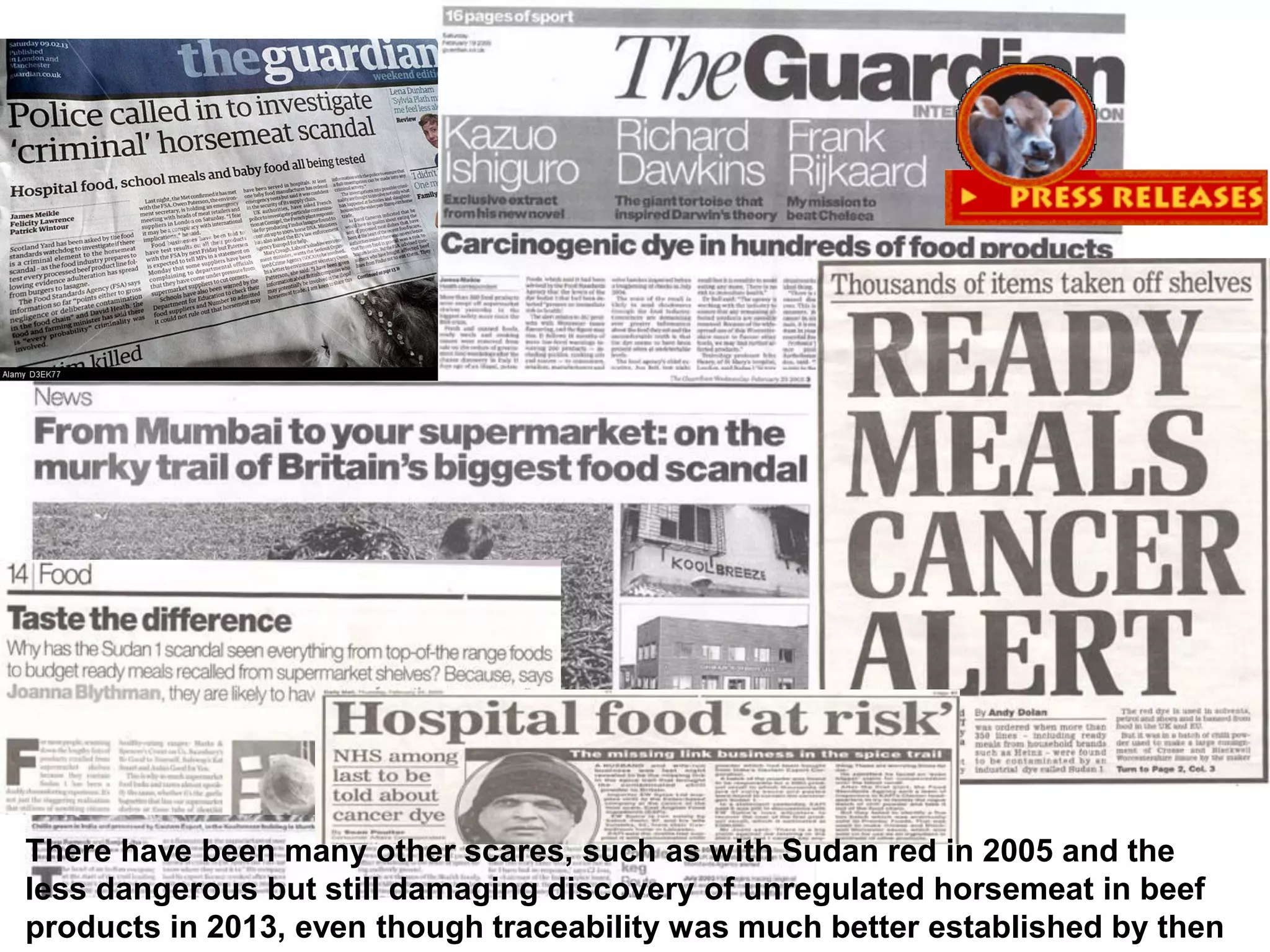
There have been many other scares, such as with Sudan red in 2005 and the
less dangerous but still damaging discovery of unregulated horsemeat in beef
products in 2013, even though traceability was much better established by then
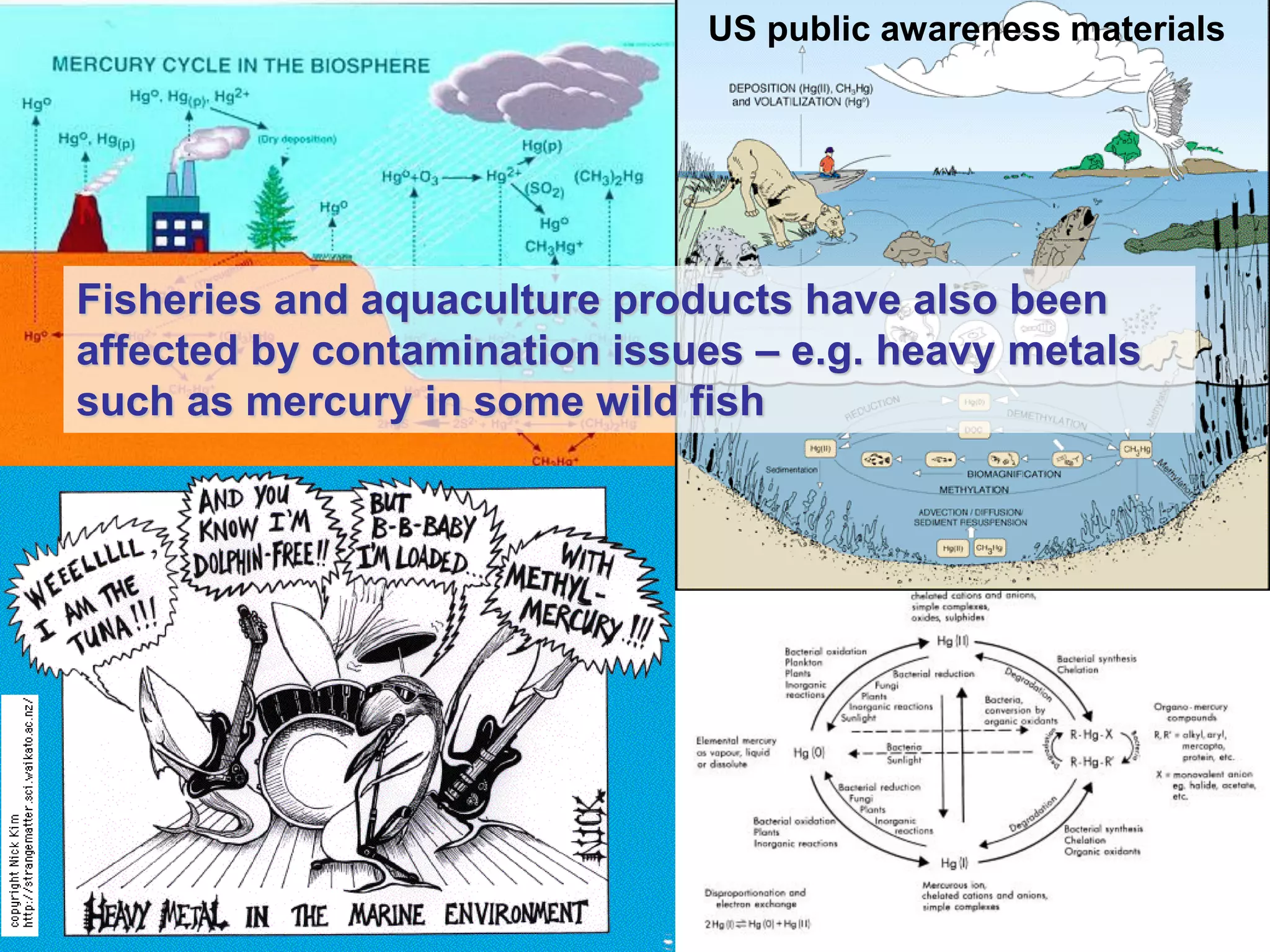
US public awareness materials
Fisheries and aquaculture products have also been
affected by contamination issues – e.g. heavy metals
such as mercury in some wild fish
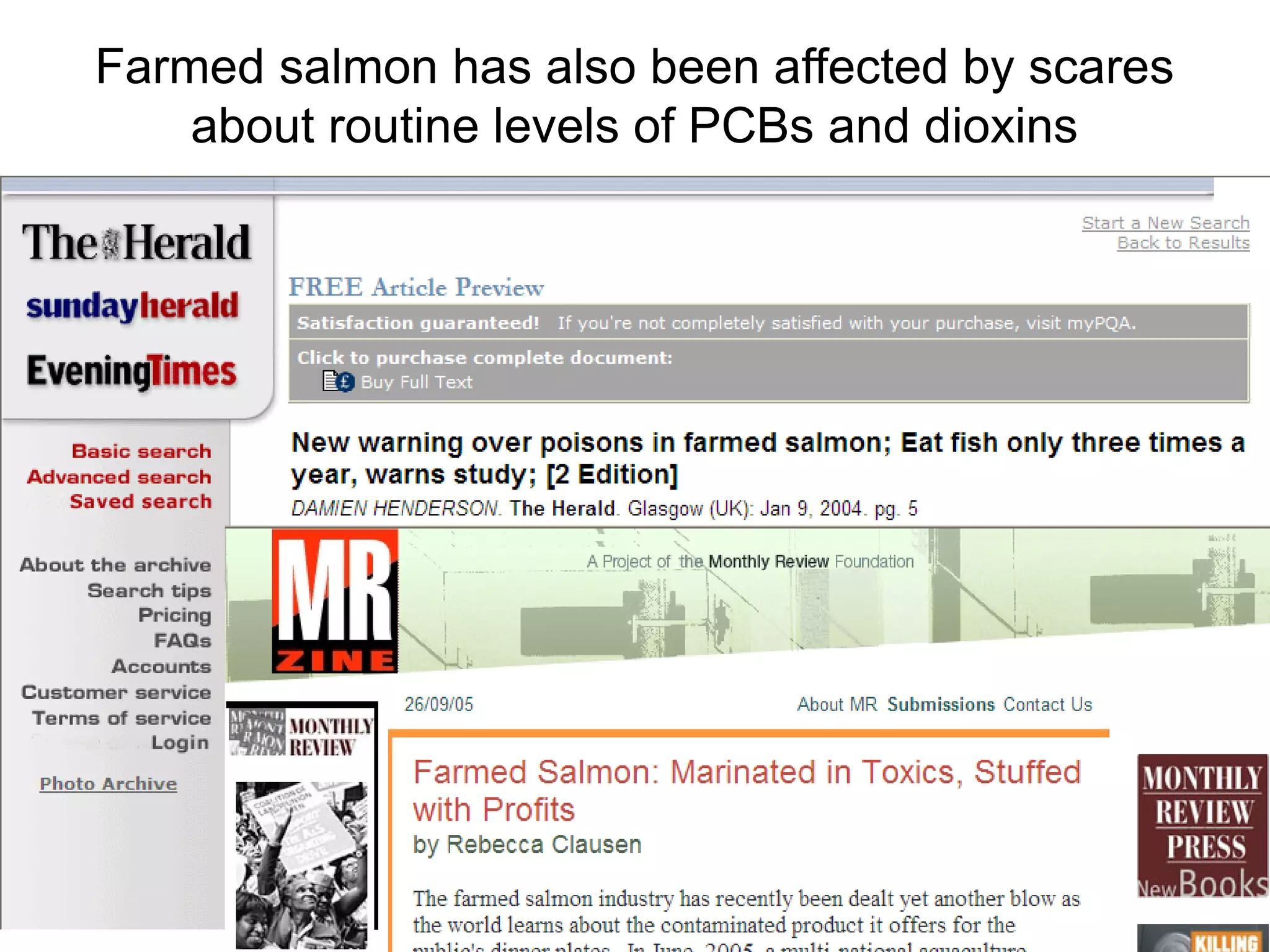
Farmed salmon has also been affected by scares
about routine levels of PCBs and dioxins
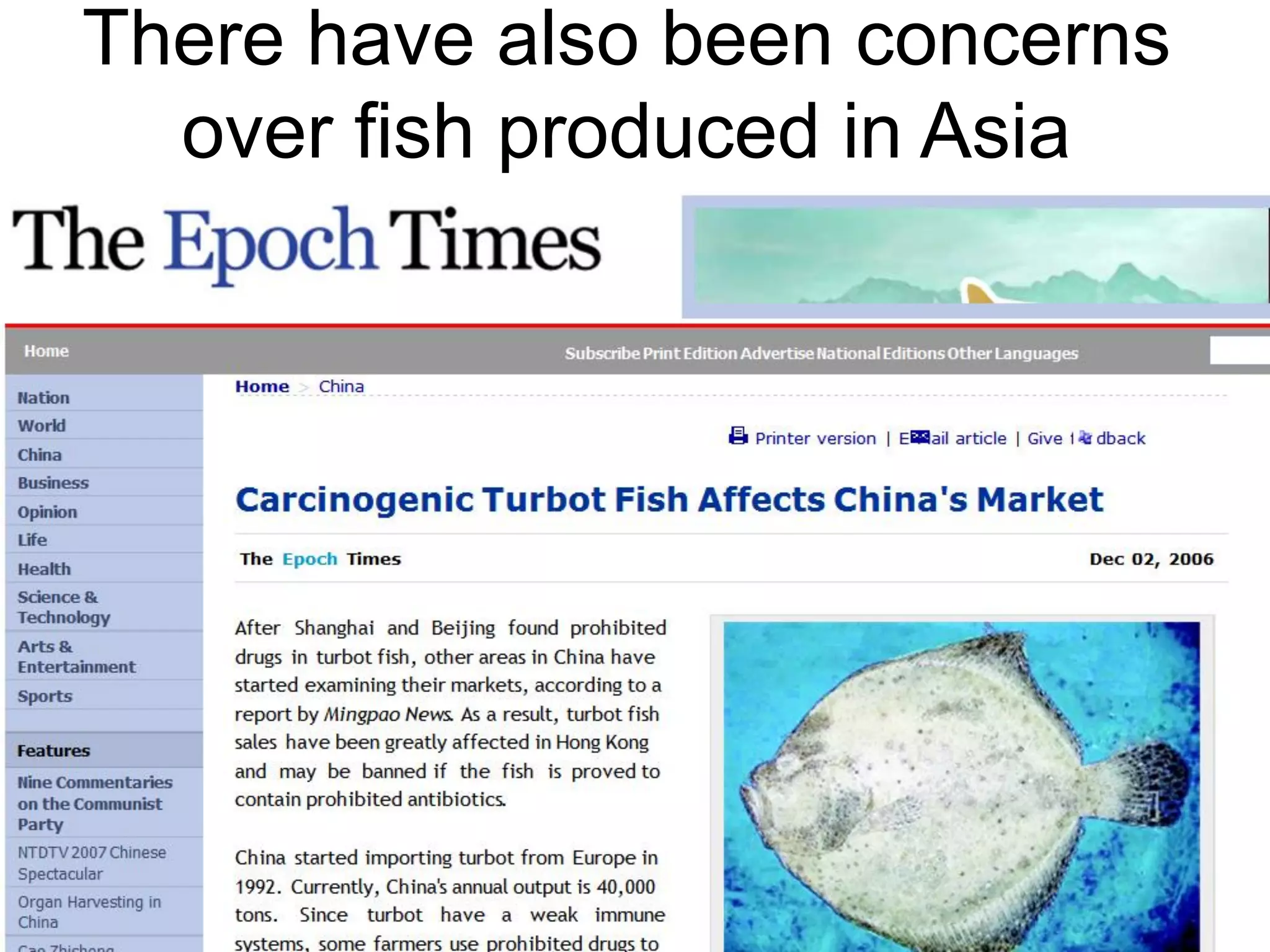
There have also been concerns
over fish produced in Asia
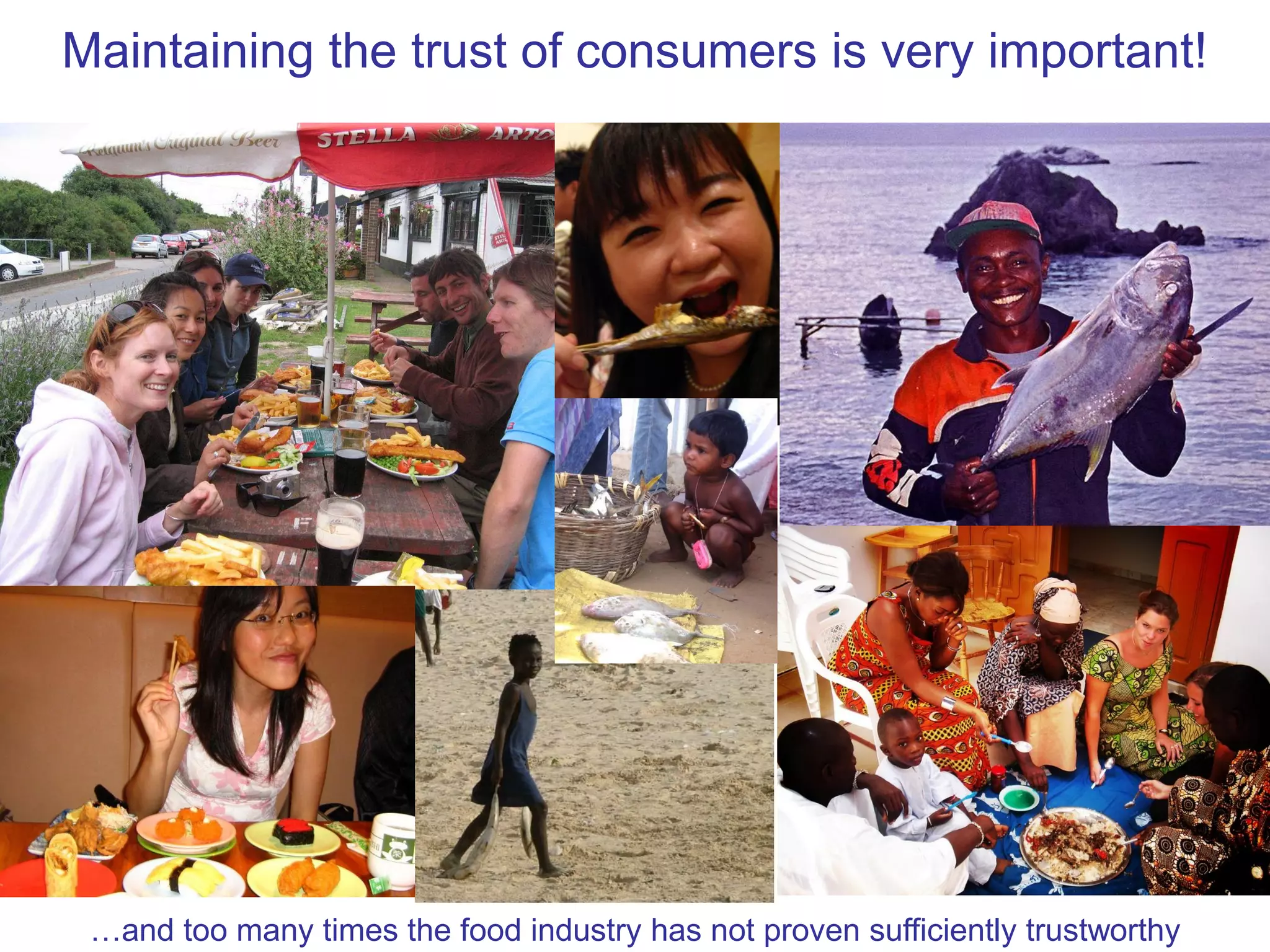
Maintaining the trust of consumers is very important!
…and too many times the food industry has not proven sufficiently trustworthy
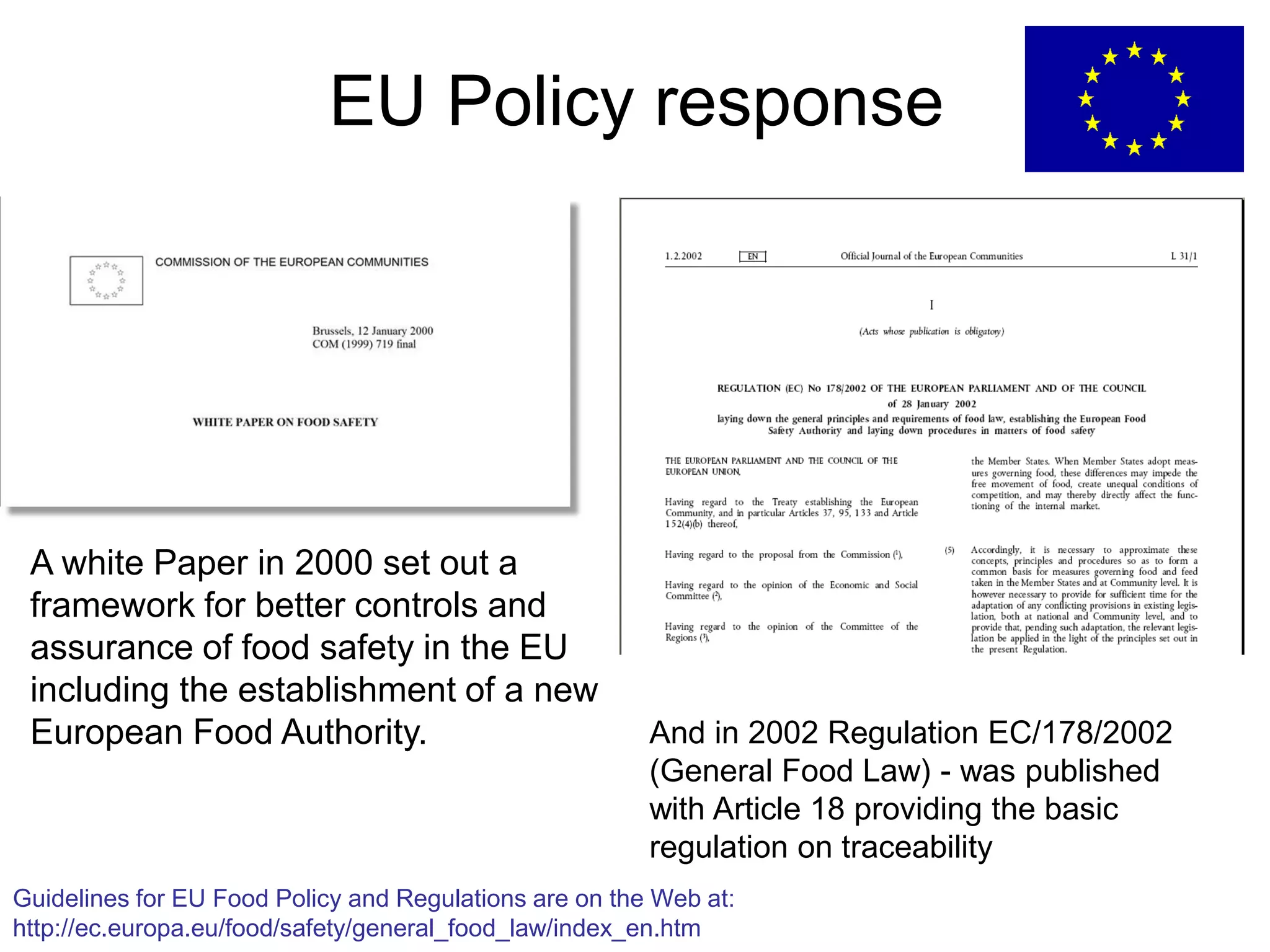
EU Policy response
A white Paper in 2000 set out a
framework for better controls and
assurance of food safety in the EU
including the establishment of a new
European Food Authority. And in 2002 Regulation EC/178/2002
(General Food Law) - was published
with Article 18 providing the basic
regulation on traceability
Guidelines for EU Food Policy and Regulations are on the Web at:
http://ec.europa.eu/food/safety/general_food_law/index_en.htm
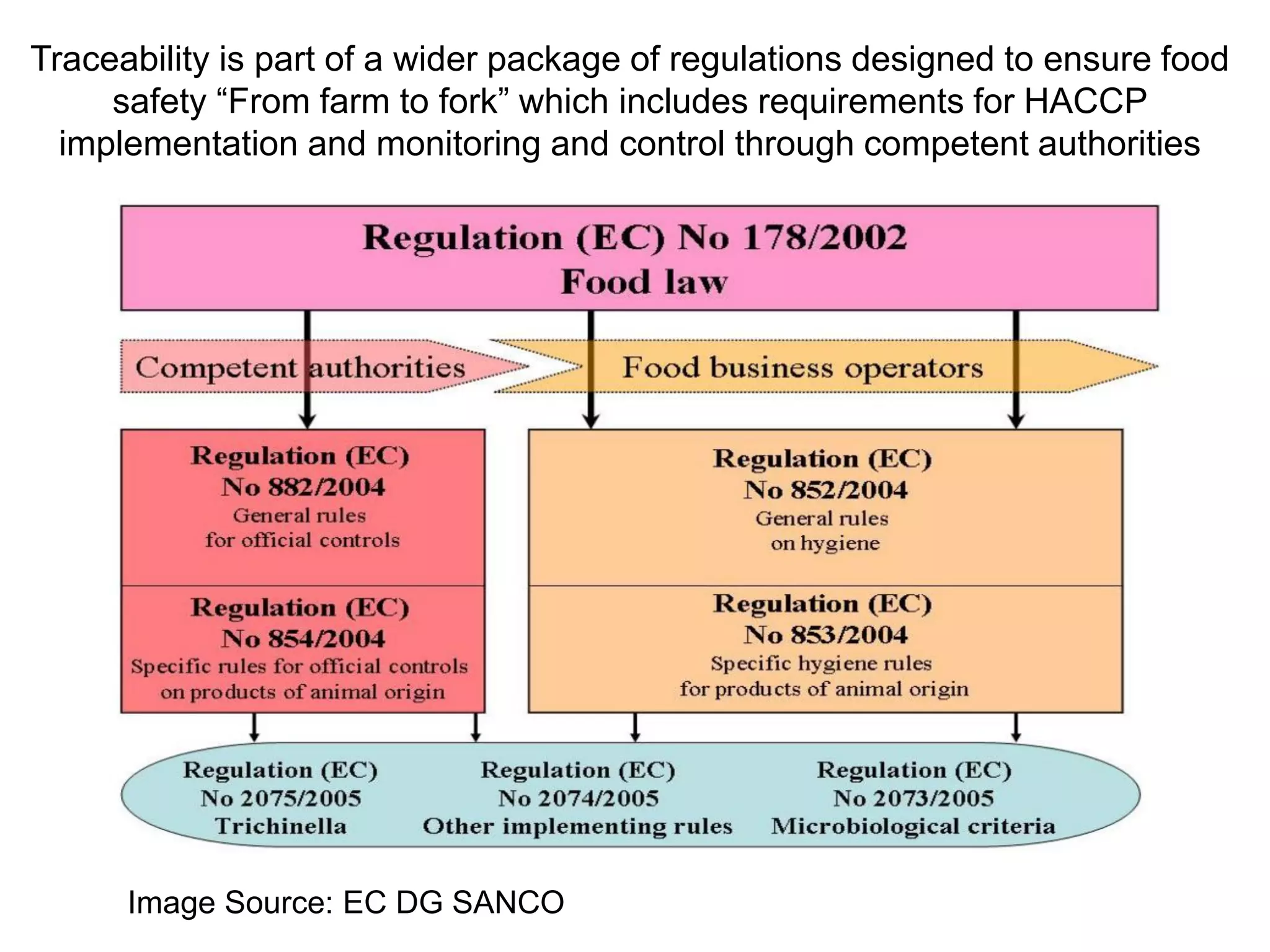
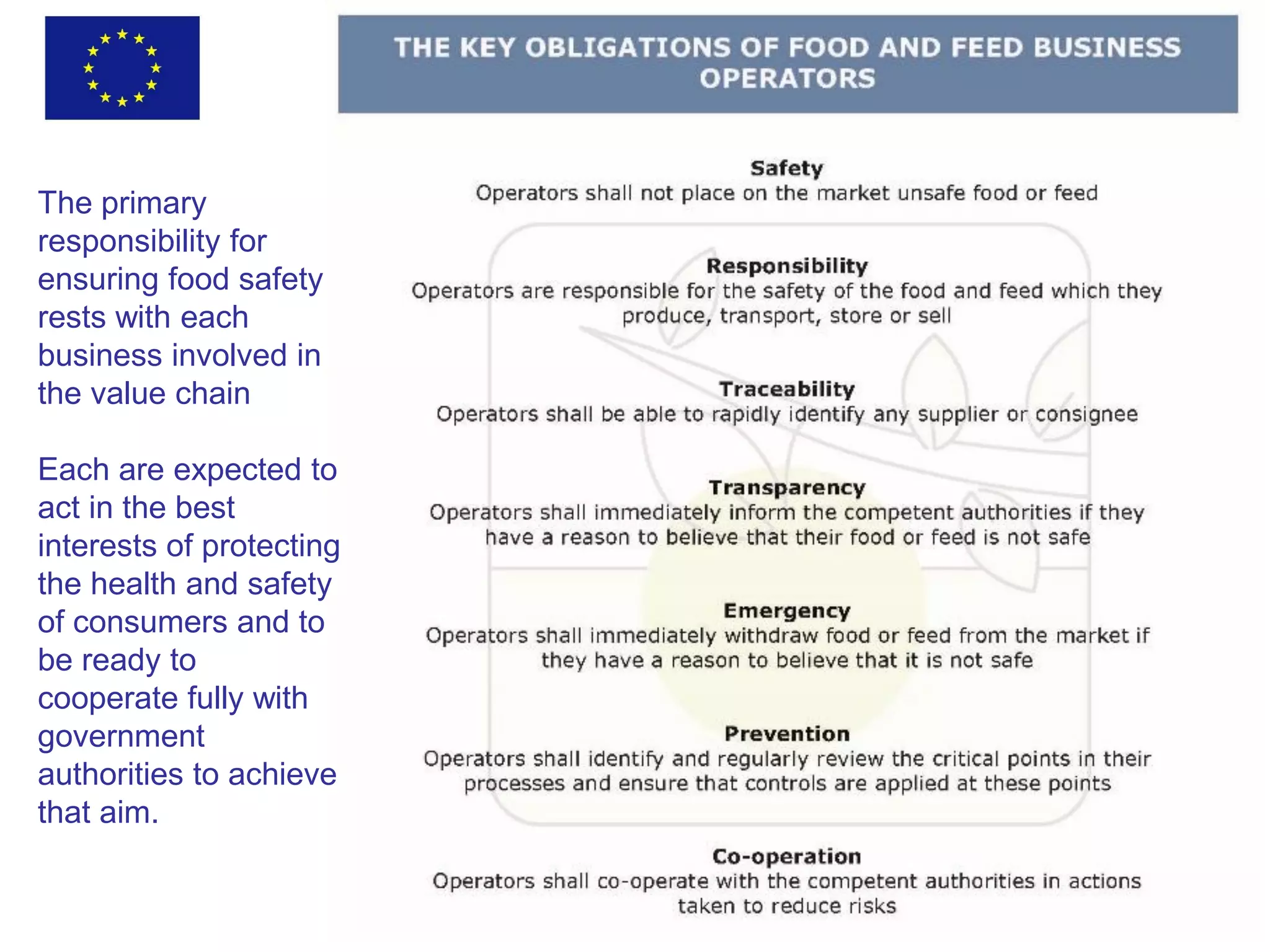
Traceability is part of a wider package of regulations designed to ensure food
safety “From farm to fork” which includes requirements for HACCP
implementation and monitoring and control through competent authorities
Image Source: EC DG SANCO
The primary
responsibility for
ensuring food safety
rests with each
business involved in
the value chain
Each are expected to
act in the best
interests of protecting
the health and safety
of consumers and to
be ready to
cooperate fully with
government
authorities to achieve
that aim.
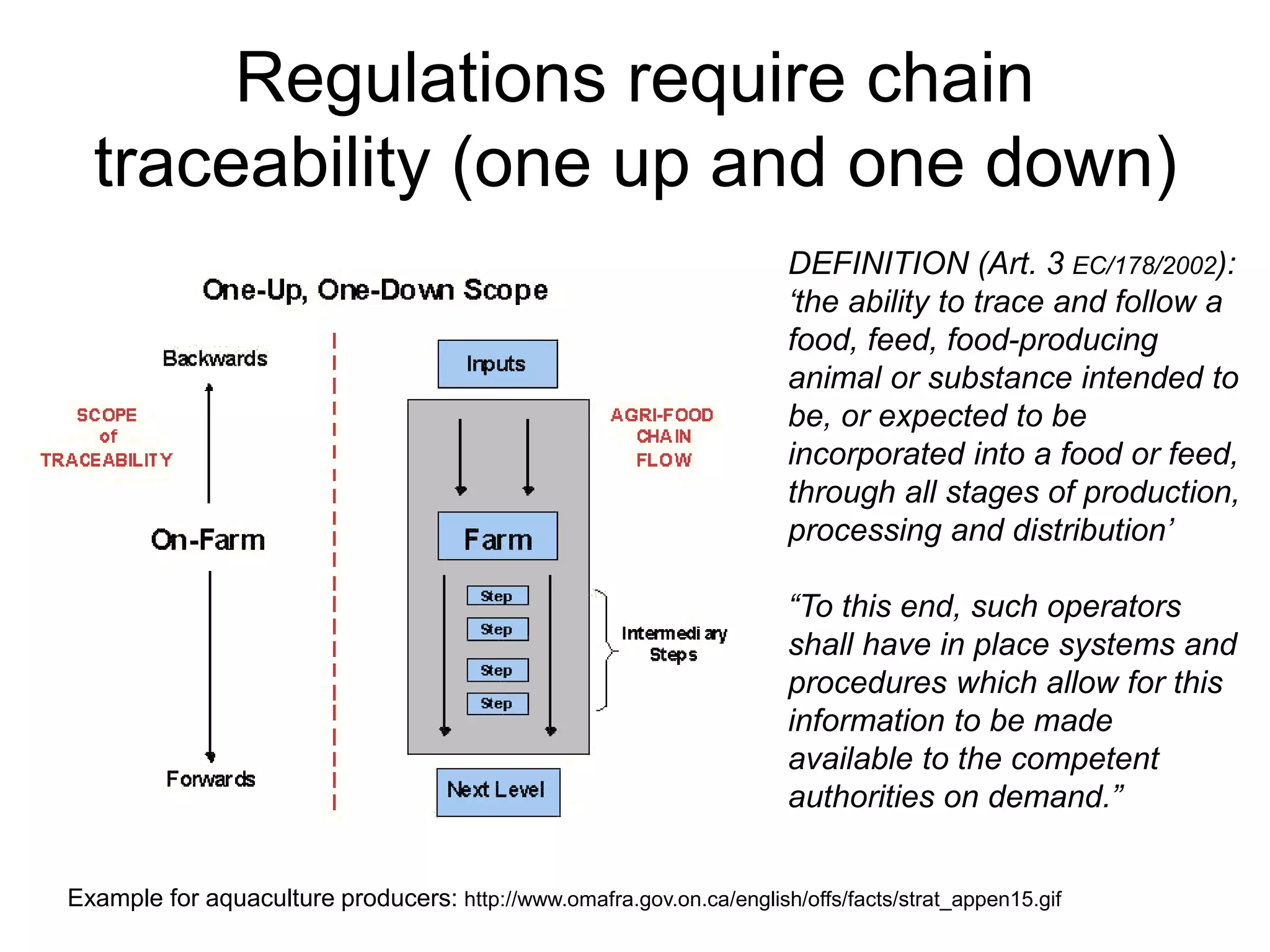
Regulations require chain
traceability (one up and one down)
Example for aquaculture producers: http://www.omafra.gov.on.ca/english/offs/facts/strat_appen15.gif
DEFINITION (Art. 3 EC/178/2002):
‘the ability to trace and follow a
food, feed, food-producing
animal or substance intended to
be, or expected to be
incorporated into a food or feed,
through all stages of production,
processing and distribution’
“To this end, such operators
shall have in place systems and
procedures which allow for this
information to be made
available to the competent
authorities on demand.”
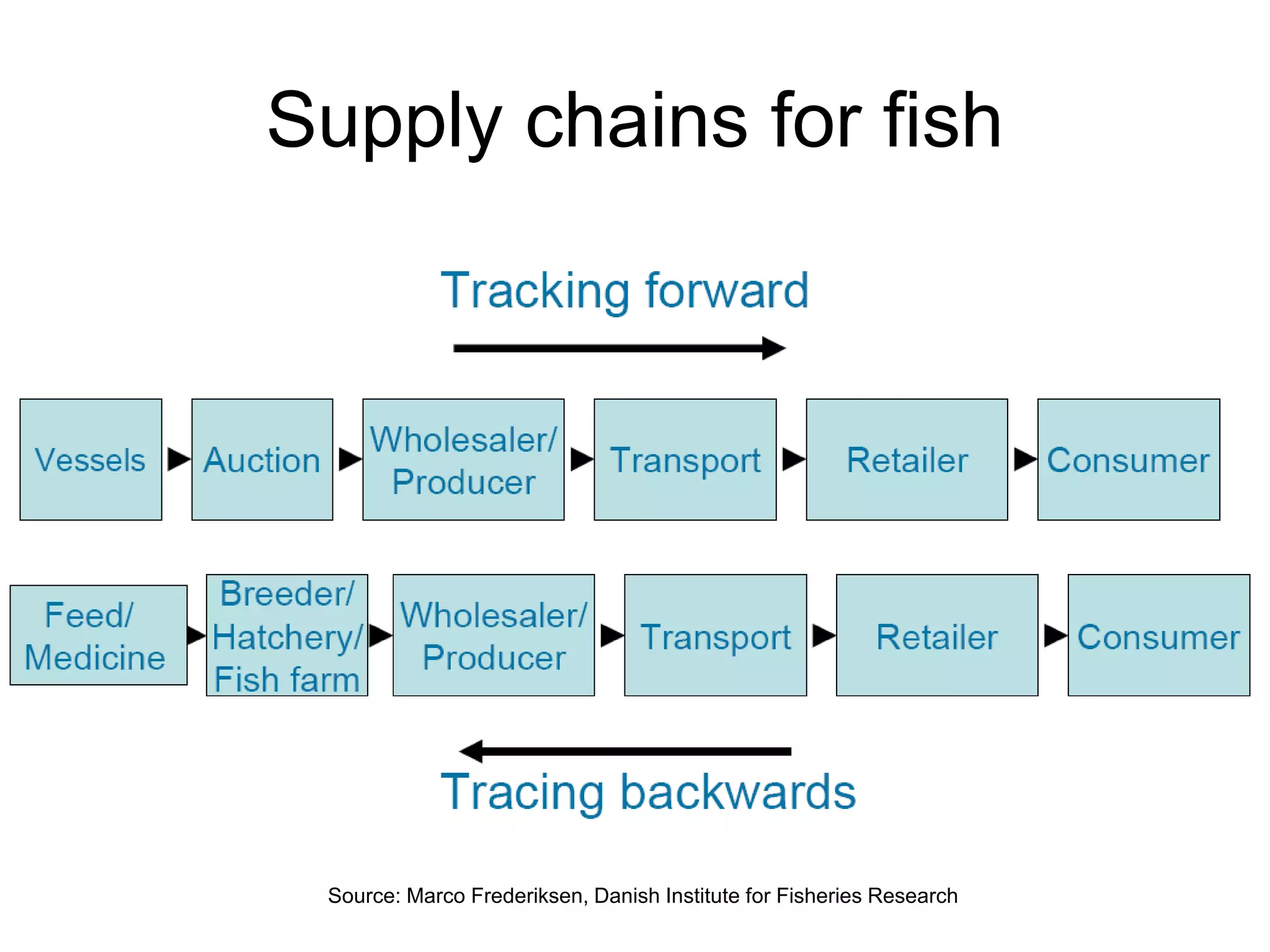
Supply chains for fish
Source: Marco Frederiksen, Danish Institute for Fisheries Research
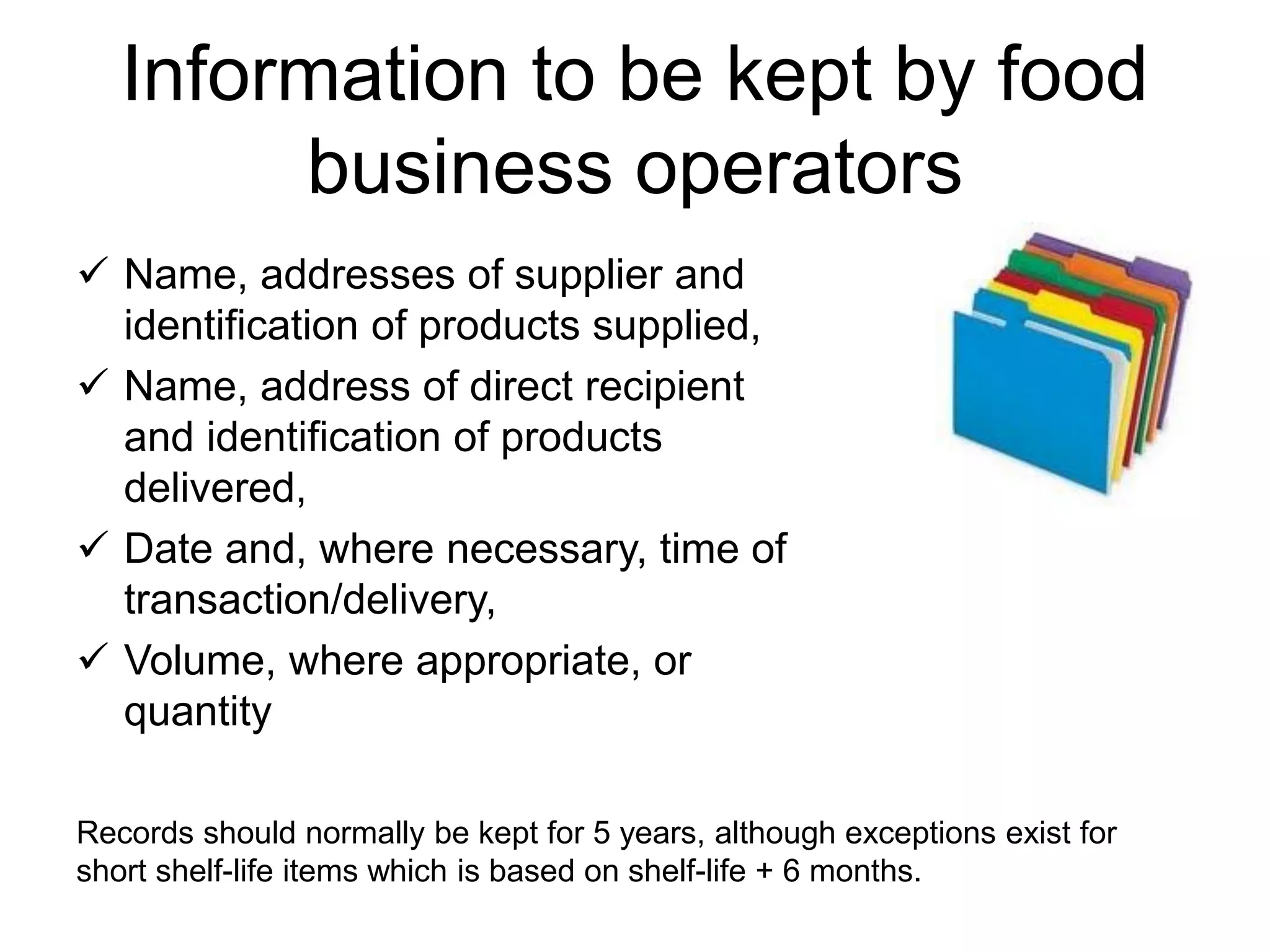
Information to be kept by food
business operators
 Name, addresses of supplier and
identification of products supplied,
 Name, address of direct recipient
and identification of products
delivered,
 Date and, where necessary, time of
transaction/delivery,
 Volume, where appropriate, or
quantity
Records should normally be kept for 5 years, although exceptions exist for
short shelf-life items which is based on shelf-life + 6 months.
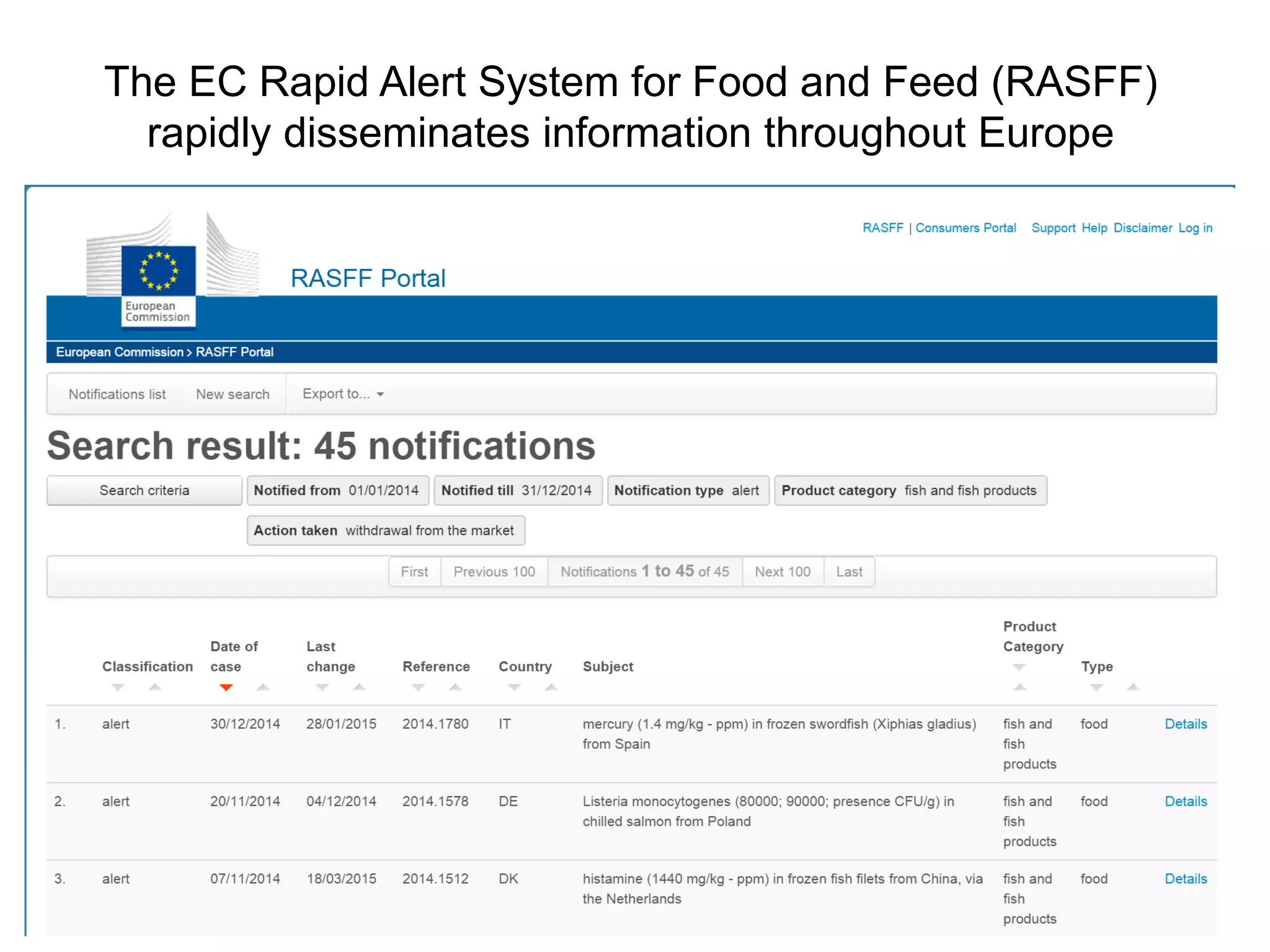
The EC Rapid Alert System for Food and Feed (RASFF)
rapidly disseminates information throughout Europe
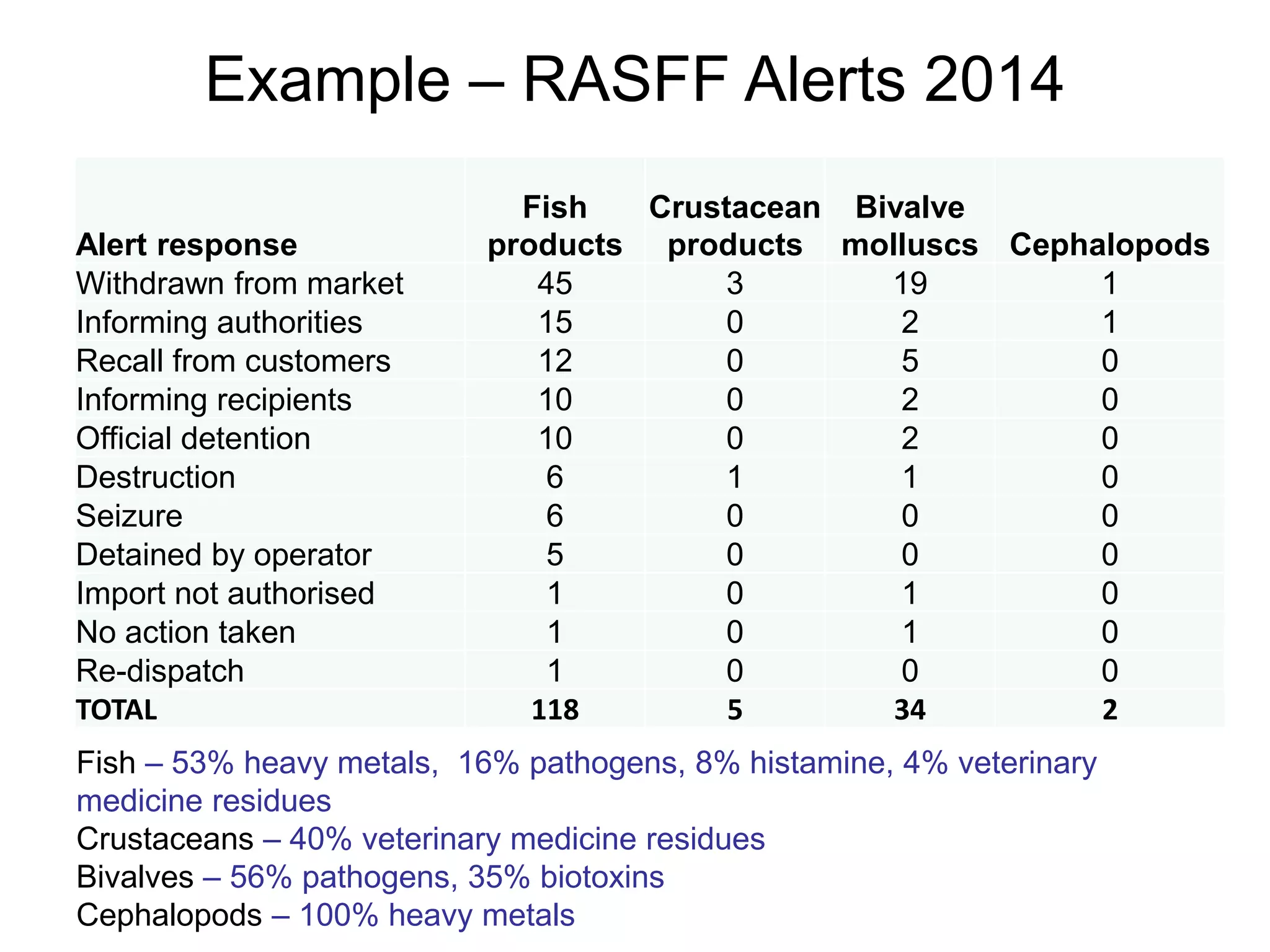
Example – RASFF Alerts 2014
Fish – 53% heavy metals, 16% pathogens, 8% histamine, 4% veterinary
medicine residues
Crustaceans – 40% veterinary medicine residues
Bivalves – 56% pathogens, 35% biotoxins
Cephalopods – 100% heavy metals
Alert response
Fish
products
Crustacean
products
Bivalve
molluscs Cephalopods
Withdrawn from market 45 3 19 1
Informing authorities 15 0 2 1
Recall from customers 12 0 5 0
Informing recipients 10 0 2 0
Official detention 10 0 2 0
Destruction 6 1 1 0
Seizure 6 0 0 0
Detained by operator 5 0 0 0
Import not authorised 1 0 1 0
No action taken 1 0 1 0
Re-dispatch 1 0 0 0
TOTAL 118 5 34 2
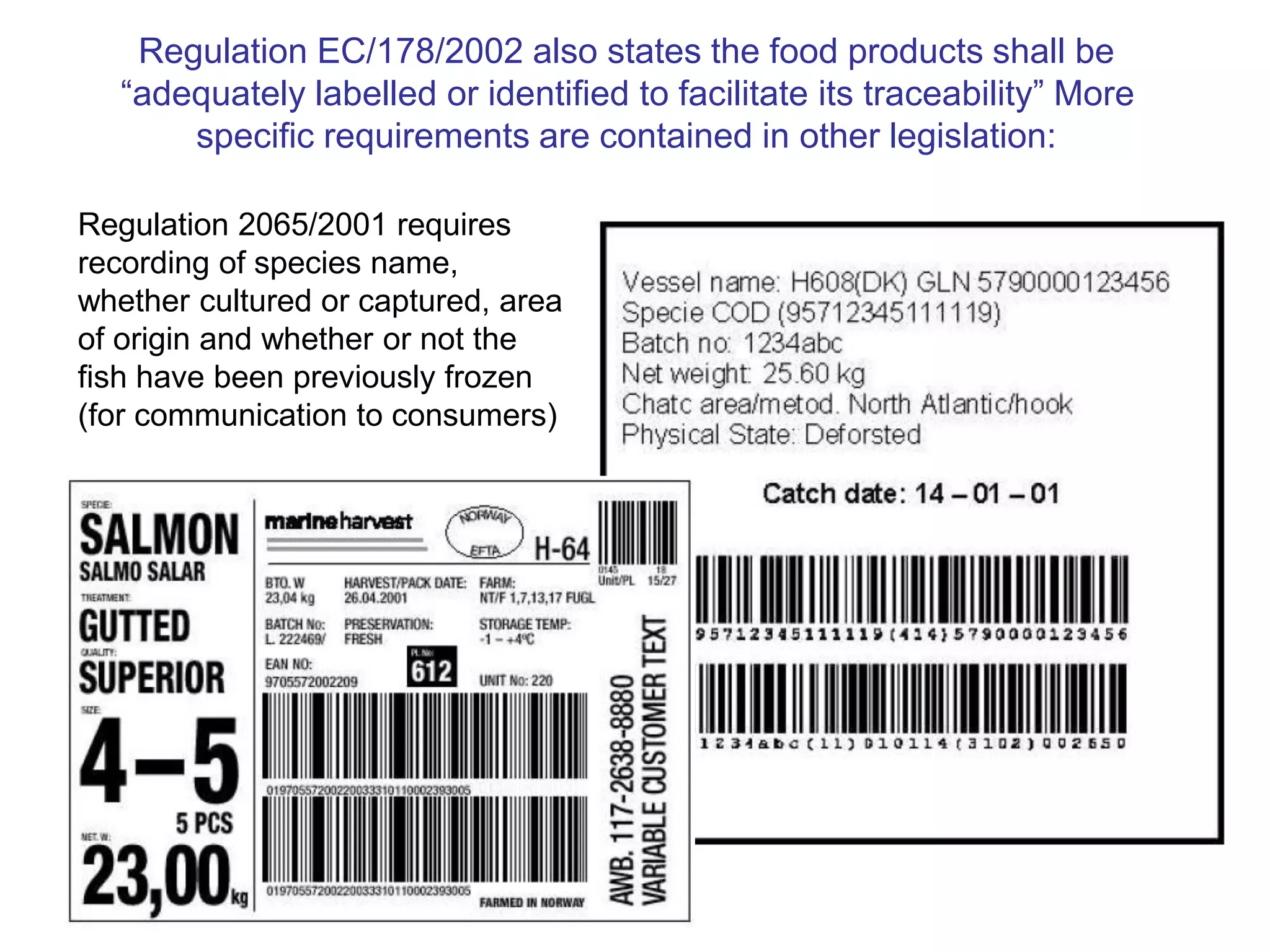
Regulation EC/178/2002 also states the food products shall be
“adequately labelled or identified to facilitate its traceability” More
specific requirements are contained in other legislation:
Regulation 2065/2001 requires
recording of species name,
whether cultured or captured, area
of origin and whether or not the
fish have been previously frozen
(for communication to consumers)
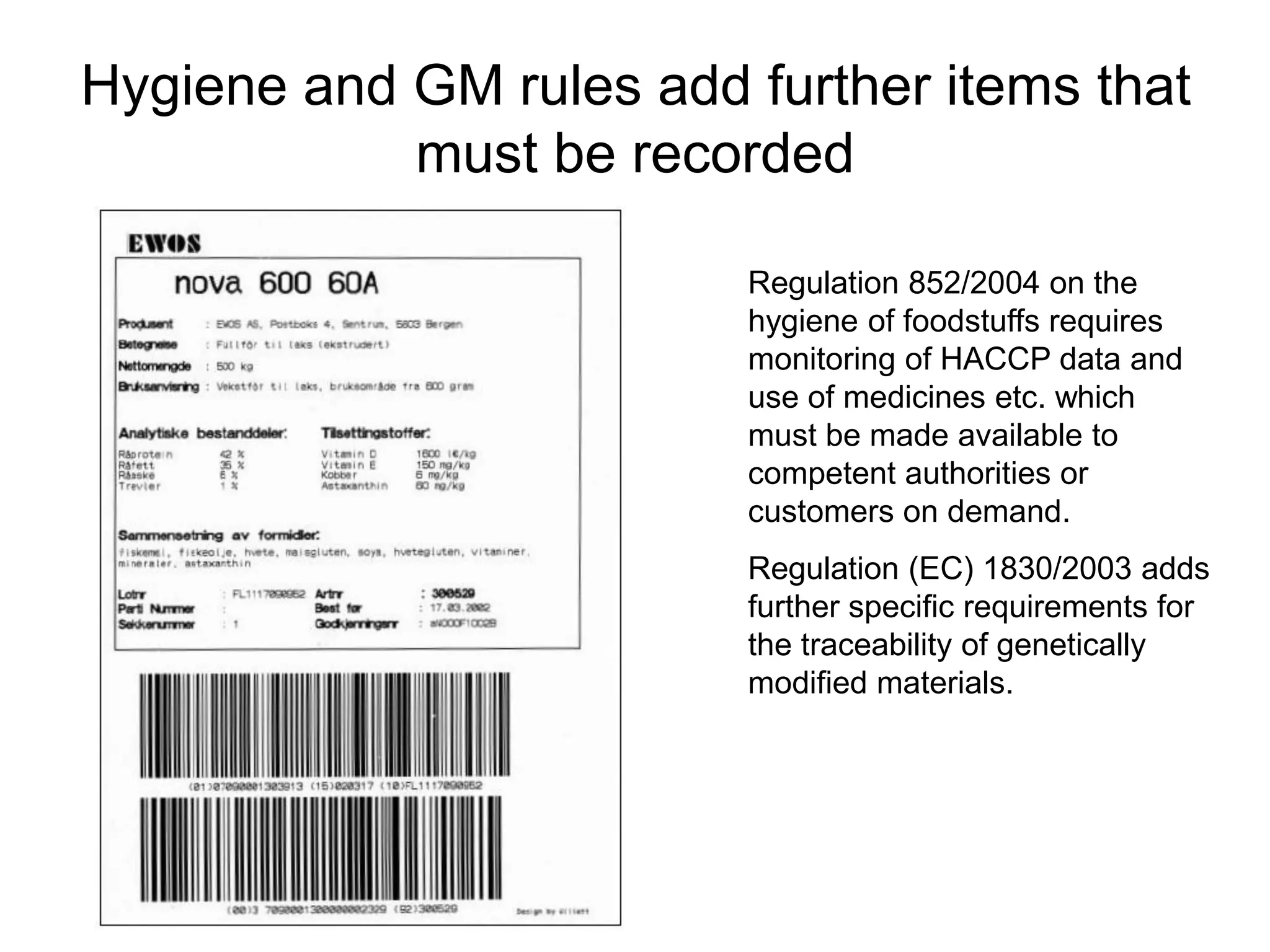
Hygiene and GM rules add further items that
must be recorded
Regulation 852/2004 on the
hygiene of foodstuffs requires
monitoring of HACCP data and
use of medicines etc. which
must be made available to
competent authorities or
customers on demand.
Regulation (EC) 1830/2003 adds
further specific requirements for
the traceability of genetically
modified materials.
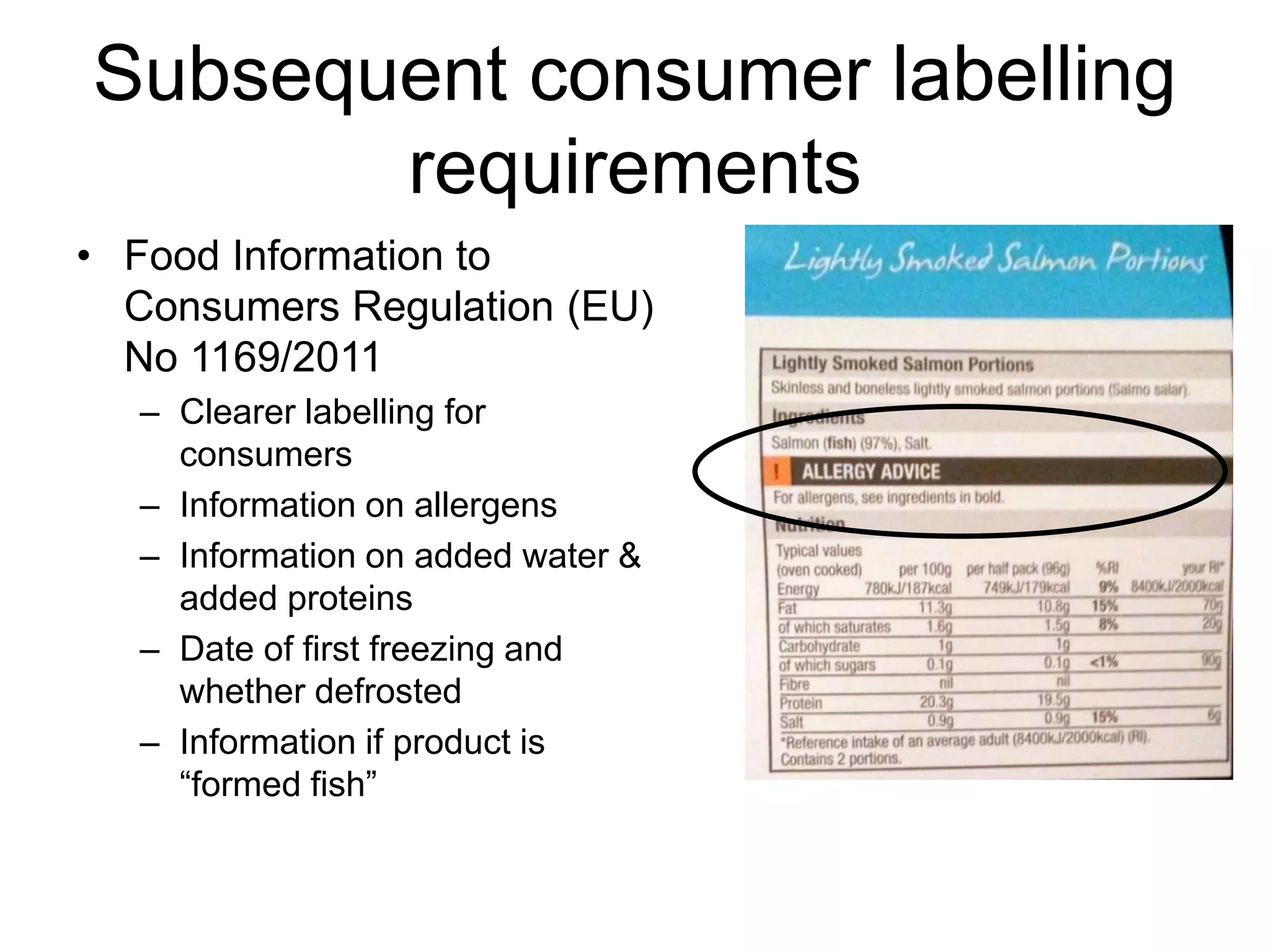
Subsequent consumer labelling
requirements
• Food Information to
Consumers Regulation (EU)
No 1169/2011
– Clearer labelling for
consumers
– Information on allergens
– Information on added water &
added proteins
– Date of first freezing and
whether defrosted
– Information if product is
“formed fish”
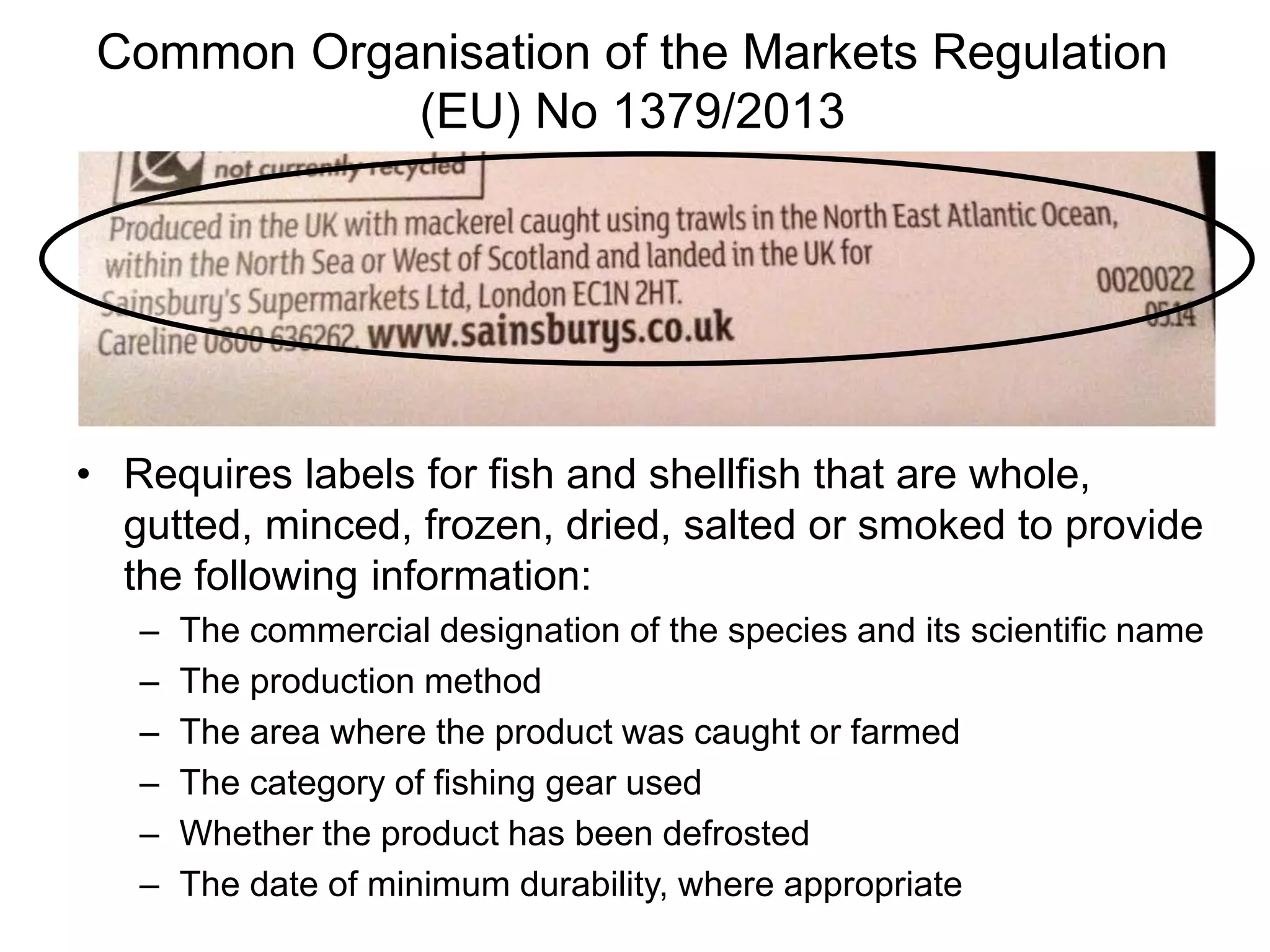
Common Organisation of the Markets Regulation
(EU) No 1379/2013
• Requires labels for fish and shellfish that are whole,
gutted, minced, frozen, dried, salted or smoked to provide
the following information:
– The commercial designation of the species and its scientific name
– The production method
– The area where the product was caught or farmed
– The category of fishing gear used
– Whether the product has been defrosted
– The date of minimum durability, where appropriate
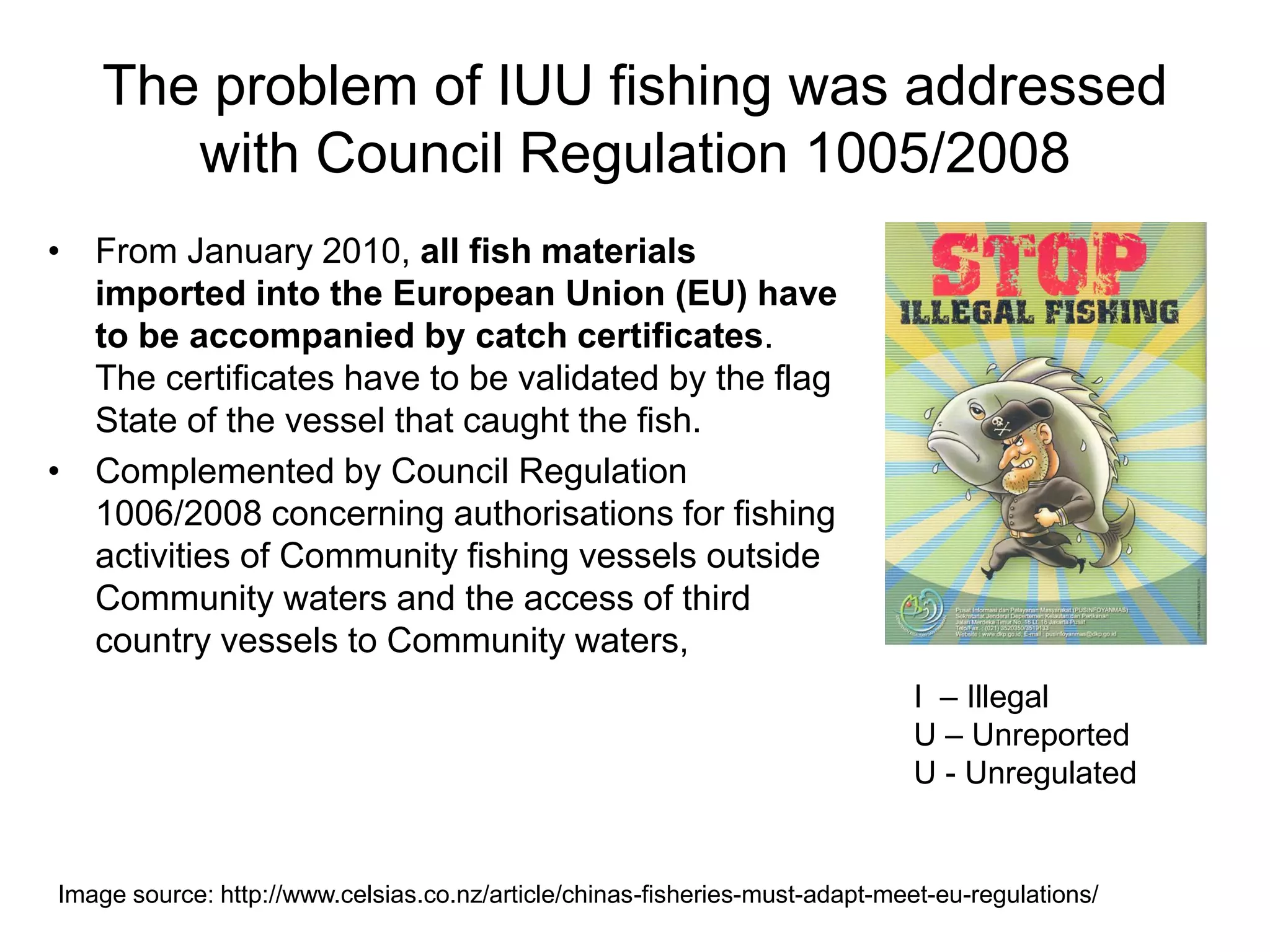
The problem of IUU fishing was addressed
with Council Regulation 1005/2008
• From January 2010, all fish materials
imported into the European Union (EU) have
to be accompanied by catch certificates.
The certificates have to be validated by the flag
State of the vessel that caught the fish.
• Complemented by Council Regulation
1006/2008 concerning authorisations for fishing
activities of Community fishing vessels outside
Community waters and the access of third
country vessels to Community waters,
Image source: http://www.celsias.co.nz/article/chinas-fisheries-must-adapt-meet-eu-regulations/
I – Illegal
U – Unreported
U - Unregulated
Implementation of traceability measures
• Council Regulation 1224/2009
establishing an updated Community
control system for ensuring
compliance with the rules of the
common fisheries policy
• Commission Implementing Regulation
404/2011 laying down detailed rules
for the implementation of Council
Regulation (EC) No 1224/2009
• Decision 623/2003 – TRACES
veterinary database for live animal
movements & byproducts
These regulations
set out in more
detail the measures
that need to be
taken including the
use of fishing boat
log books, the
definition of lots and
the use of barcodes
and other electronic
data recording
systems
http://ec.europa.eu/fisheries/cfp/control/index_en.htm
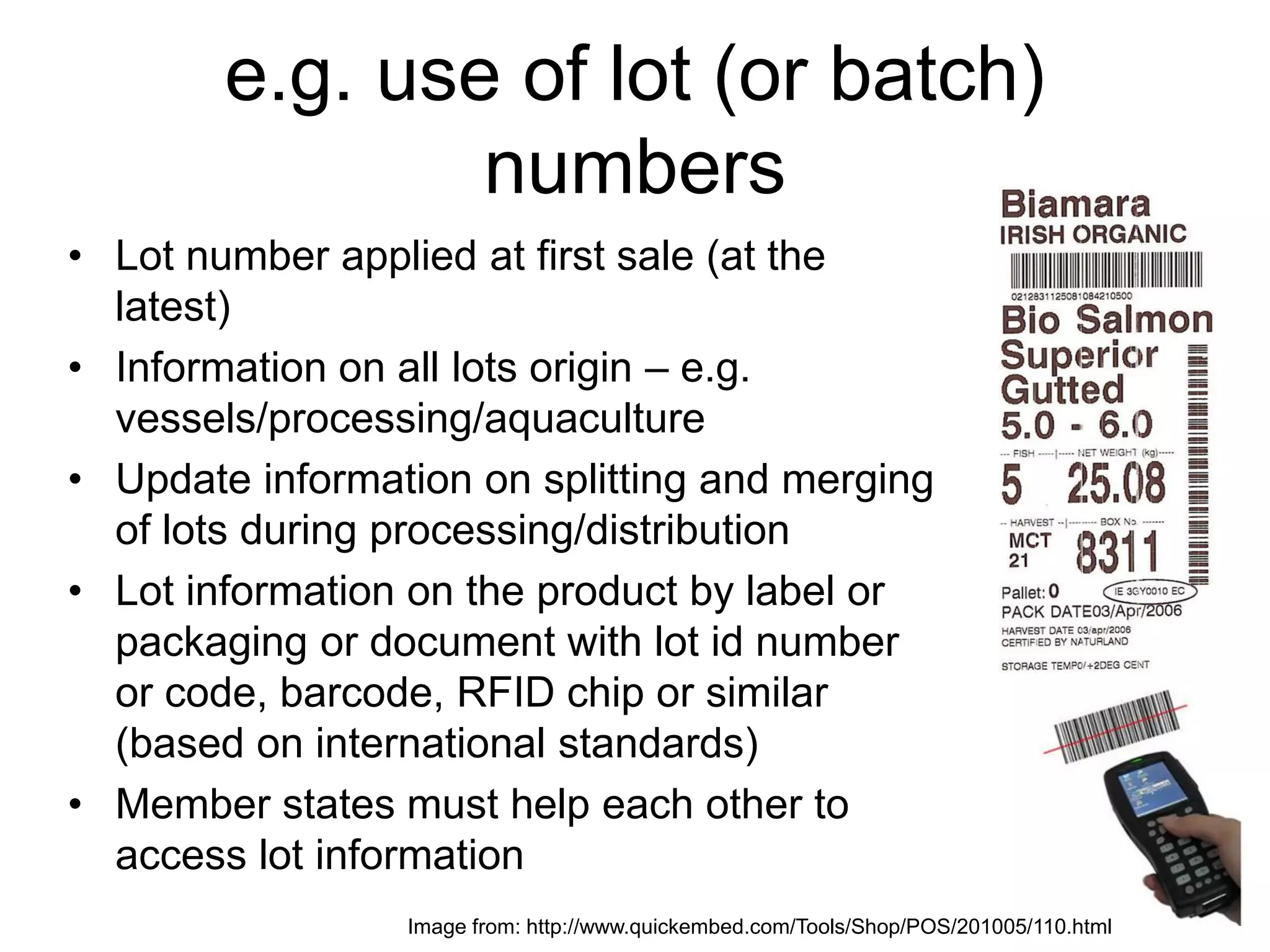
e.g. use of lot (or batch)
numbers
• Lot number applied at first sale (at the
latest)
• Information on all lots origin – e.g.
vessels/processing/aquaculture
• Update information on splitting and merging
of lots during processing/distribution
• Lot information on the product by label or
packaging or document with lot id number
or code, barcode, RFID chip or similar
(based on international standards)
• Member states must help each other to
access lot information
Image from: http://www.quickembed.com/Tools/Shop/POS/201005/110.html
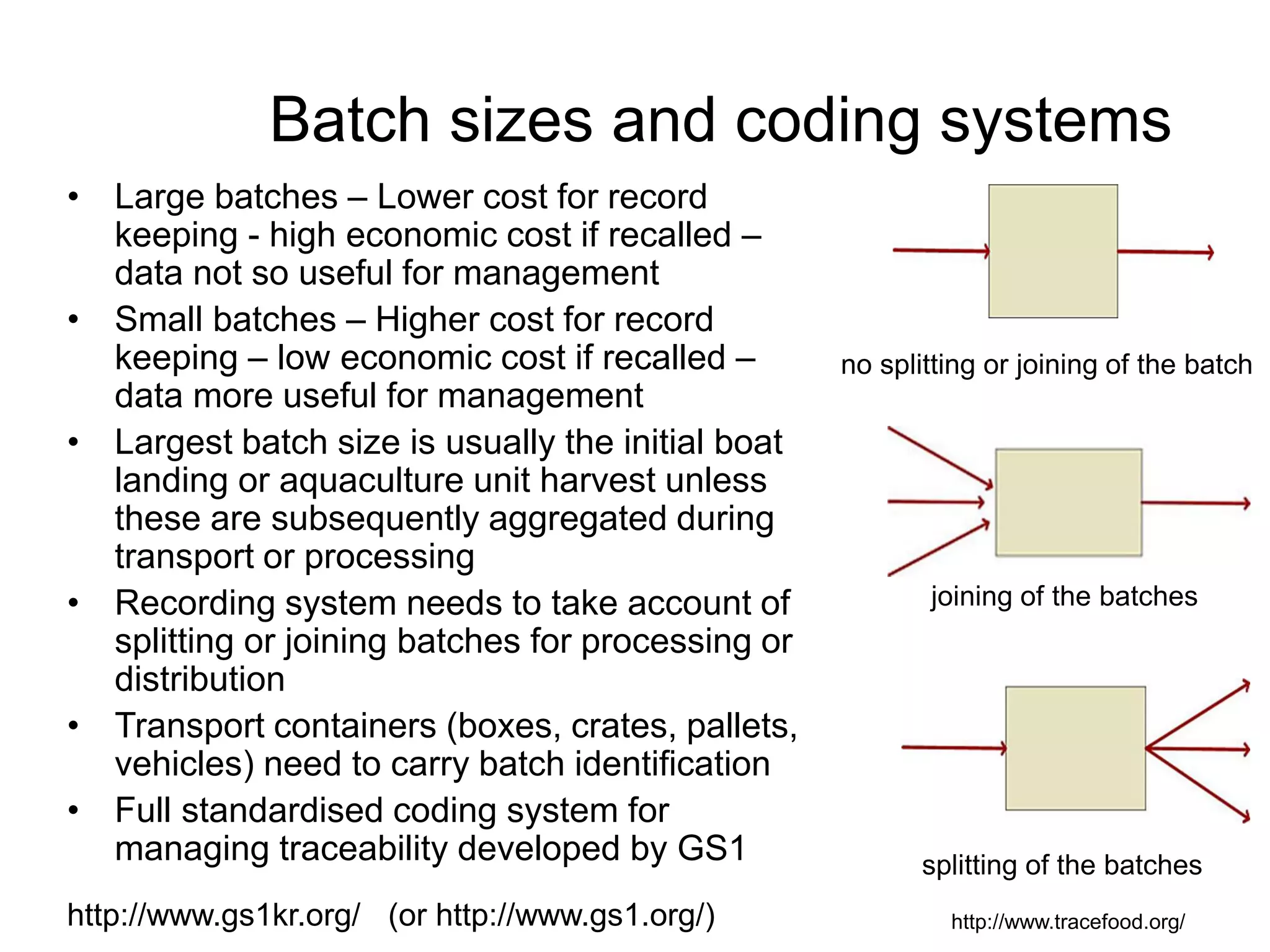
Batch sizes and coding systems
• Large batches – Lower cost for record
keeping - high economic cost if recalled –
data not so useful for management
• Small batches – Higher cost for record
keeping – low economic cost if recalled –
data more useful for management
• Largest batch size is usually the initial boat
landing or aquaculture unit harvest unless
these are subsequently aggregated during
transport or processing
• Recording system needs to take account of
splitting or joining batches for processing or
distribution
• Transport containers (boxes, crates, pallets,
vehicles) need to carry batch identification
• Full standardised coding system for
managing traceability developed by GS1
no splitting or joining of the batch
joining of the batches
splitting of the batches
http://www.tracefood.org/http://www.gs1kr.org/ (or http://www.gs1.org/)
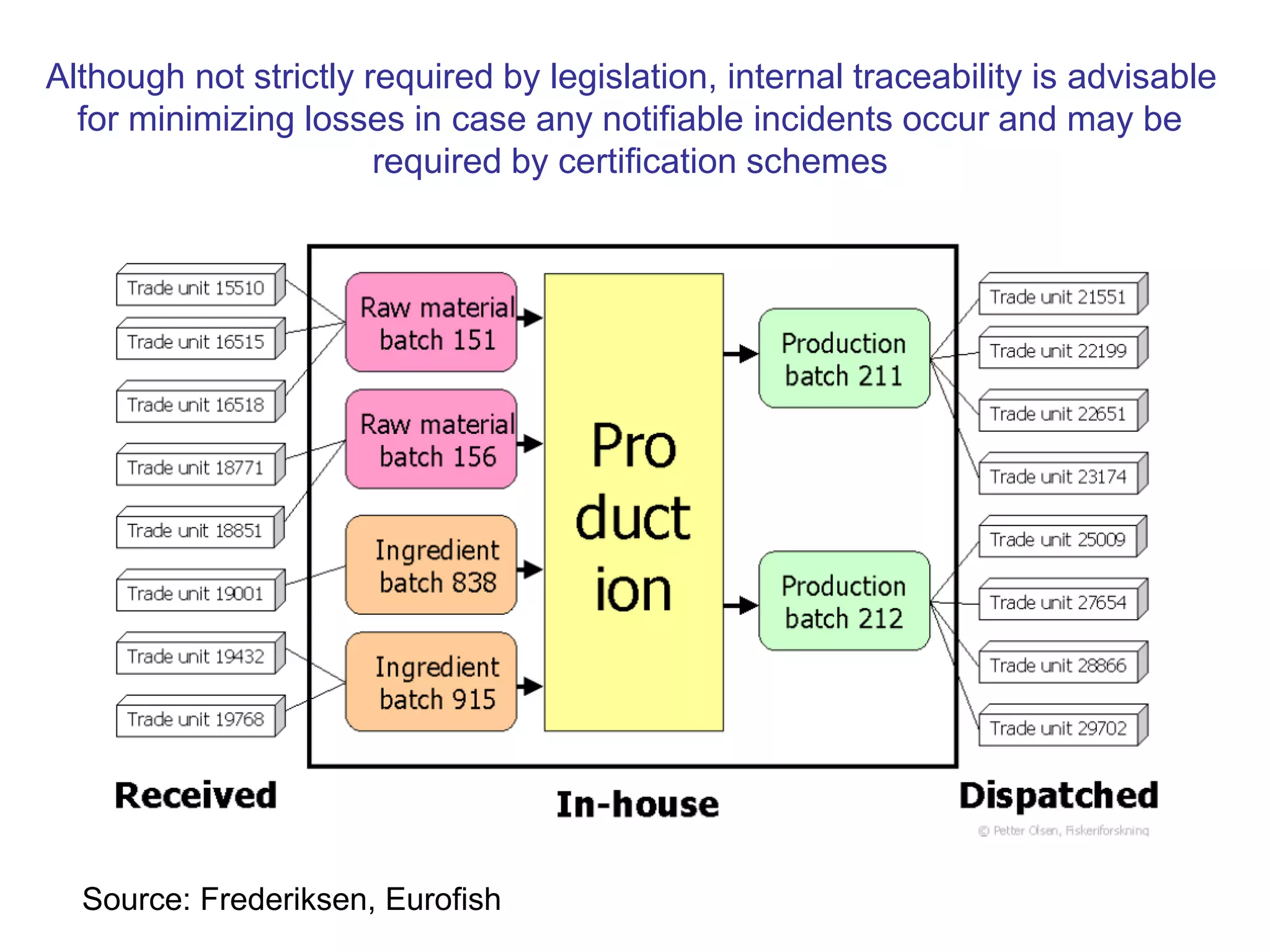
Although not strictly required by legislation, internal traceability is advisable
for minimizing losses in case any notifiable incidents occur and may be
required by certification schemes
Source: Frederiksen, Eurofish
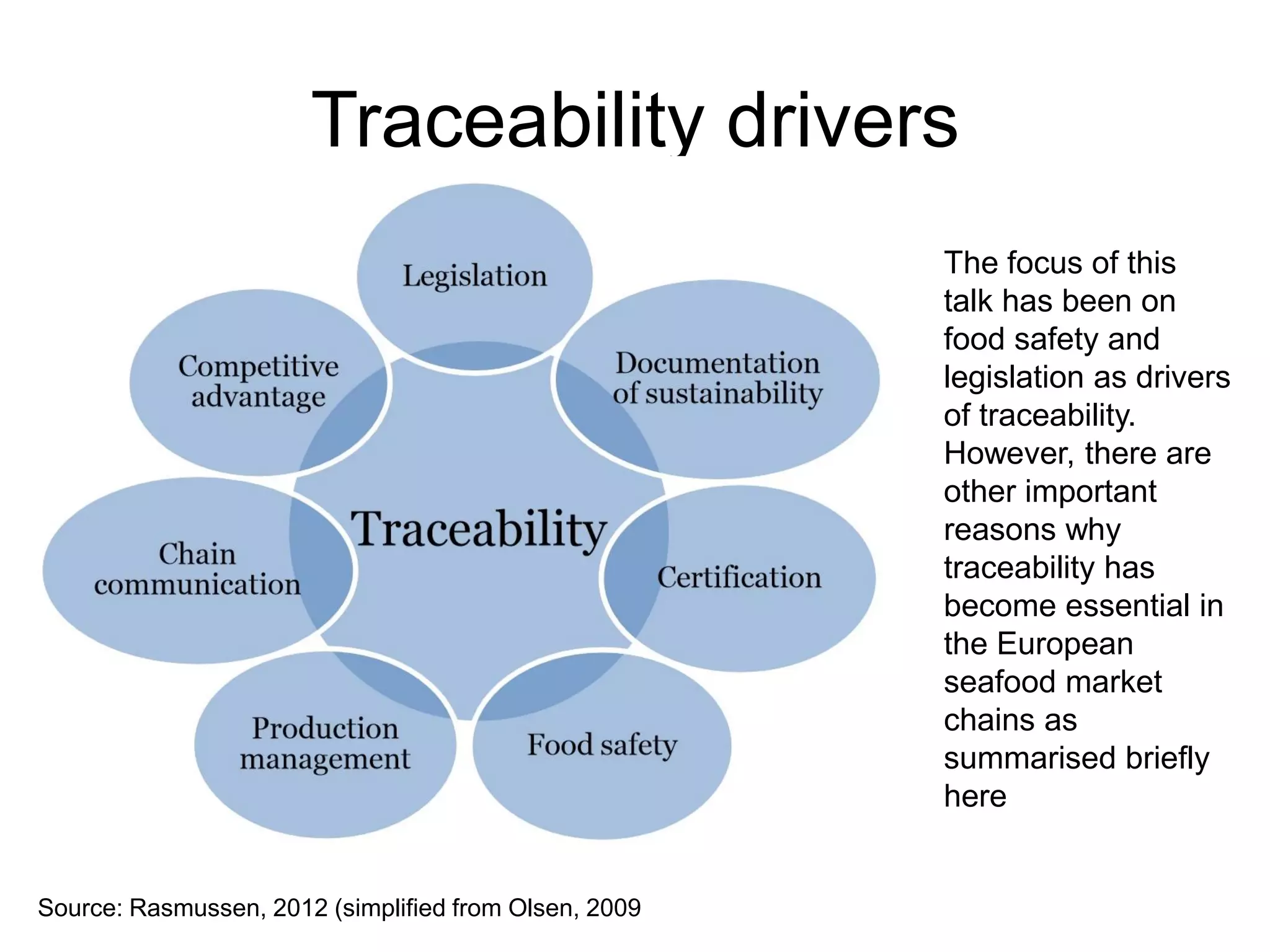
Traceability drivers
Source: Rasmussen, 2012 (simplified from Olsen, 2009
The focus of this
talk has been on
food safety and
legislation as drivers
of traceability.
However, there are
other important
reasons why
traceability has
become essential in
the European
seafood market
chains as
summarised briefly
here
Reference Websites
• http://ec.europa.eu/food/safety/general_food_law/index_en.htm
• http://ec.europa.eu/fisheries/cfp/control/index_en.htm
• http://eur-lex.europa.eu
• http://www.seafish.org/industry-support/legislation/traceability-and-
labelling/fish-traceability-requirements
• http://ec.europa.eu/fisheries/cfp/illegal_fishing/info/index_en.htm
• http://www.tracefood.org
• https://www.gov.uk/government/publications/fishing-regulations-the-
blue-book
• http://www.gs1kr.org (or http://www.gs1.org/)
http://www.flickr.com/photo_zoom.gne?id=1809300553&size=l
Bibliography/References
• EC 2009. Handbook on the practical application of Council Regulation (EC) No.
1005/2008 of 29 September 2008 establishing a Community system to prevent, deter
and eliminate illegal, unreported and unregulated fishing (The IUU Regulation)
http://ec.europa.eu/fisheries/cfp/illegal_fishing/info/handbook_original_en.pdf
• Eurofish/Sippo. A Guide to Traceability within the Fish Industry.
http://seafood.oregonstate.edu/.pdf%20Links/Guide%20to%20Traceability%20Within
%20the%20Fishery%20Industry.pdf
• Rasmussen, M-L.R. 2012. A study of traceability and quality assurance in fish supply
chains. PhD Thesis. DTU National Food Institute.
http://orbit.dtu.dk/ws/files/54035690/ph.d._afhandling_mariarandruprasmussen.pdf
• Olsen, P. (2009). Food traceability process mapping. Standard method for analyzing
material flow, information flow and information loss in food supply chains. In Donnelly,
K.A.- M. & Olsen, P. Harmonizing methods for food traceability process mapping and
cost/benefit calculations related to implementation of electronic traceability systems
(pp. 7-10). Workshop hosted by Nofima in association with the TRACE project 25-26
February 2009. Report 15/2009. Tromsø, Norway: Nofima.
• Seafish 2014. Consumer information under the EU Common Organisation of the
Markets Regulation.
http://www.seafish.org/media/Publications/CMO_Guide_Ver_2_17-10.pdf
• Schröder, U. 2007. Challenges in the Traceability of Seafood. J. Verbr. Lebensm. 3
(2008): 45 – 48. DOI 10.1007/s00003-007-0302-8
Thank You
John Bostock: j.c.bostock@stir.ac.uk
http://www.slideshare.net/jbostock/
http://rms.stir.ac.uk/converis-stirling/person/10729

The development and implementation of European regulations for (fish and shellfish) traceability

  • 1.
    The development and implementationof European regulations for traceability John Bostock Institute of Aquaculture University of Stirling, UK
  • 2.
    Why regulate fortraceability? Traceability - “The ability to follow the movement of a food through specified stage(s) of production, processing and distribution” A series of major failures in food safety in the 1980s and 1990s was the primary driver for the introduction of legislation on traceability
  • 3.
    The BSE/nvCJD crisisin the UK A series of crisis struck the European food industry in the 1990s – the worst being BSE
  • 4.
    UK impacts andactions • Cull of affected herds ordered – 1.3 million cattle slaughtered with compensation costs over GBP 2.7 billion • Beef exports banned – loss of US$ 1 billion market • Loss of market confidence - UK beef consumption fell by 30% and production by 40% with loss of 45,000 jobs • New rules on acceptable feedstuffs • New rules on maximum age of cattle entering food chain • Banning use of “specified materials” – brain, spinal cord etc. • Introduction of traceability – animal passport system
  • 5.
    http://news.bbc.co.uk/1/hi/world/europe/1143597.stm http://www.mad-cow.org/00/dec00_more.html Sales ofbeef fell by 27% in the EU with costs easily more than Euro 3 billion.
  • 6.
    Belgian dioxin &PCB crisis http://www.iht.com/articles/1999/07/31/pork.2.t_1.php
  • 7.
    Contamination affected 10 feed manufacterers; 505poultry, 1625 pig and 411 cattle farms, 2 million poultry were slaughtered and many products recalled
  • 8.
    Cost of thecrisis • Cost to industry: US$ 1 billion • Indirect costs: ~ US$ 3 billion • Human costs: 40 – 8000 additional cancer cases
  • 9.
    Other dioxin scaresfollowed http://www.makower.com/blogpix/cokebottle.jpg E.g. milk due to contaminated citrus pellets, poultry and mink due to contaminated clay used as anti-caking agent in feed, but most high profile was Coca cola, which had to recall 2.5 million bottles of soft drink
  • 10.
    There have beenmany other scares, such as with Sudan red in 2005 and the less dangerous but still damaging discovery of unregulated horsemeat in beef products in 2013, even though traceability was much better established by then
  • 11.
    US public awarenessmaterials Fisheries and aquaculture products have also been affected by contamination issues – e.g. heavy metals such as mercury in some wild fish
  • 12.
    Farmed salmon hasalso been affected by scares about routine levels of PCBs and dioxins
  • 13.
    There have alsobeen concerns over fish produced in Asia
  • 14.
    Maintaining the trustof consumers is very important! …and too many times the food industry has not proven sufficiently trustworthy
  • 15.
    EU Policy response Awhite Paper in 2000 set out a framework for better controls and assurance of food safety in the EU including the establishment of a new European Food Authority. And in 2002 Regulation EC/178/2002 (General Food Law) - was published with Article 18 providing the basic regulation on traceability Guidelines for EU Food Policy and Regulations are on the Web at: http://ec.europa.eu/food/safety/general_food_law/index_en.htm
  • 16.
    Traceability is partof a wider package of regulations designed to ensure food safety “From farm to fork” which includes requirements for HACCP implementation and monitoring and control through competent authorities Image Source: EC DG SANCO
  • 17.
    The primary responsibility for ensuringfood safety rests with each business involved in the value chain Each are expected to act in the best interests of protecting the health and safety of consumers and to be ready to cooperate fully with government authorities to achieve that aim.
  • 18.
    Regulations require chain traceability(one up and one down) Example for aquaculture producers: http://www.omafra.gov.on.ca/english/offs/facts/strat_appen15.gif DEFINITION (Art. 3 EC/178/2002): ‘the ability to trace and follow a food, feed, food-producing animal or substance intended to be, or expected to be incorporated into a food or feed, through all stages of production, processing and distribution’ “To this end, such operators shall have in place systems and procedures which allow for this information to be made available to the competent authorities on demand.”
  • 19.
    Supply chains forfish Source: Marco Frederiksen, Danish Institute for Fisheries Research
  • 20.
    Information to bekept by food business operators  Name, addresses of supplier and identification of products supplied,  Name, address of direct recipient and identification of products delivered,  Date and, where necessary, time of transaction/delivery,  Volume, where appropriate, or quantity Records should normally be kept for 5 years, although exceptions exist for short shelf-life items which is based on shelf-life + 6 months.
  • 21.
    The EC RapidAlert System for Food and Feed (RASFF) rapidly disseminates information throughout Europe
  • 22.
    Example – RASFFAlerts 2014 Fish – 53% heavy metals, 16% pathogens, 8% histamine, 4% veterinary medicine residues Crustaceans – 40% veterinary medicine residues Bivalves – 56% pathogens, 35% biotoxins Cephalopods – 100% heavy metals Alert response Fish products Crustacean products Bivalve molluscs Cephalopods Withdrawn from market 45 3 19 1 Informing authorities 15 0 2 1 Recall from customers 12 0 5 0 Informing recipients 10 0 2 0 Official detention 10 0 2 0 Destruction 6 1 1 0 Seizure 6 0 0 0 Detained by operator 5 0 0 0 Import not authorised 1 0 1 0 No action taken 1 0 1 0 Re-dispatch 1 0 0 0 TOTAL 118 5 34 2
  • 23.
    Regulation EC/178/2002 alsostates the food products shall be “adequately labelled or identified to facilitate its traceability” More specific requirements are contained in other legislation: Regulation 2065/2001 requires recording of species name, whether cultured or captured, area of origin and whether or not the fish have been previously frozen (for communication to consumers)
  • 24.
    Hygiene and GMrules add further items that must be recorded Regulation 852/2004 on the hygiene of foodstuffs requires monitoring of HACCP data and use of medicines etc. which must be made available to competent authorities or customers on demand. Regulation (EC) 1830/2003 adds further specific requirements for the traceability of genetically modified materials.
  • 25.
    Subsequent consumer labelling requirements •Food Information to Consumers Regulation (EU) No 1169/2011 – Clearer labelling for consumers – Information on allergens – Information on added water & added proteins – Date of first freezing and whether defrosted – Information if product is “formed fish”
  • 26.
    Common Organisation ofthe Markets Regulation (EU) No 1379/2013 • Requires labels for fish and shellfish that are whole, gutted, minced, frozen, dried, salted or smoked to provide the following information: – The commercial designation of the species and its scientific name – The production method – The area where the product was caught or farmed – The category of fishing gear used – Whether the product has been defrosted – The date of minimum durability, where appropriate
  • 27.
    The problem ofIUU fishing was addressed with Council Regulation 1005/2008 • From January 2010, all fish materials imported into the European Union (EU) have to be accompanied by catch certificates. The certificates have to be validated by the flag State of the vessel that caught the fish. • Complemented by Council Regulation 1006/2008 concerning authorisations for fishing activities of Community fishing vessels outside Community waters and the access of third country vessels to Community waters, Image source: http://www.celsias.co.nz/article/chinas-fisheries-must-adapt-meet-eu-regulations/ I – Illegal U – Unreported U - Unregulated
  • 28.
    Implementation of traceabilitymeasures • Council Regulation 1224/2009 establishing an updated Community control system for ensuring compliance with the rules of the common fisheries policy • Commission Implementing Regulation 404/2011 laying down detailed rules for the implementation of Council Regulation (EC) No 1224/2009 • Decision 623/2003 – TRACES veterinary database for live animal movements & byproducts These regulations set out in more detail the measures that need to be taken including the use of fishing boat log books, the definition of lots and the use of barcodes and other electronic data recording systems http://ec.europa.eu/fisheries/cfp/control/index_en.htm
  • 29.
    e.g. use oflot (or batch) numbers • Lot number applied at first sale (at the latest) • Information on all lots origin – e.g. vessels/processing/aquaculture • Update information on splitting and merging of lots during processing/distribution • Lot information on the product by label or packaging or document with lot id number or code, barcode, RFID chip or similar (based on international standards) • Member states must help each other to access lot information Image from: http://www.quickembed.com/Tools/Shop/POS/201005/110.html
  • 30.
    Batch sizes andcoding systems • Large batches – Lower cost for record keeping - high economic cost if recalled – data not so useful for management • Small batches – Higher cost for record keeping – low economic cost if recalled – data more useful for management • Largest batch size is usually the initial boat landing or aquaculture unit harvest unless these are subsequently aggregated during transport or processing • Recording system needs to take account of splitting or joining batches for processing or distribution • Transport containers (boxes, crates, pallets, vehicles) need to carry batch identification • Full standardised coding system for managing traceability developed by GS1 no splitting or joining of the batch joining of the batches splitting of the batches http://www.tracefood.org/http://www.gs1kr.org/ (or http://www.gs1.org/)
  • 31.
    Although not strictlyrequired by legislation, internal traceability is advisable for minimizing losses in case any notifiable incidents occur and may be required by certification schemes Source: Frederiksen, Eurofish
  • 32.
    Traceability drivers Source: Rasmussen,2012 (simplified from Olsen, 2009 The focus of this talk has been on food safety and legislation as drivers of traceability. However, there are other important reasons why traceability has become essential in the European seafood market chains as summarised briefly here
  • 33.
    Reference Websites • http://ec.europa.eu/food/safety/general_food_law/index_en.htm •http://ec.europa.eu/fisheries/cfp/control/index_en.htm • http://eur-lex.europa.eu • http://www.seafish.org/industry-support/legislation/traceability-and- labelling/fish-traceability-requirements • http://ec.europa.eu/fisheries/cfp/illegal_fishing/info/index_en.htm • http://www.tracefood.org • https://www.gov.uk/government/publications/fishing-regulations-the- blue-book • http://www.gs1kr.org (or http://www.gs1.org/) http://www.flickr.com/photo_zoom.gne?id=1809300553&size=l
  • 34.
    Bibliography/References • EC 2009.Handbook on the practical application of Council Regulation (EC) No. 1005/2008 of 29 September 2008 establishing a Community system to prevent, deter and eliminate illegal, unreported and unregulated fishing (The IUU Regulation) http://ec.europa.eu/fisheries/cfp/illegal_fishing/info/handbook_original_en.pdf • Eurofish/Sippo. A Guide to Traceability within the Fish Industry. http://seafood.oregonstate.edu/.pdf%20Links/Guide%20to%20Traceability%20Within %20the%20Fishery%20Industry.pdf • Rasmussen, M-L.R. 2012. A study of traceability and quality assurance in fish supply chains. PhD Thesis. DTU National Food Institute. http://orbit.dtu.dk/ws/files/54035690/ph.d._afhandling_mariarandruprasmussen.pdf • Olsen, P. (2009). Food traceability process mapping. Standard method for analyzing material flow, information flow and information loss in food supply chains. In Donnelly, K.A.- M. & Olsen, P. Harmonizing methods for food traceability process mapping and cost/benefit calculations related to implementation of electronic traceability systems (pp. 7-10). Workshop hosted by Nofima in association with the TRACE project 25-26 February 2009. Report 15/2009. Tromsø, Norway: Nofima. • Seafish 2014. Consumer information under the EU Common Organisation of the Markets Regulation. http://www.seafish.org/media/Publications/CMO_Guide_Ver_2_17-10.pdf • Schröder, U. 2007. Challenges in the Traceability of Seafood. J. Verbr. Lebensm. 3 (2008): 45 – 48. DOI 10.1007/s00003-007-0302-8
  • 35.
    Thank You John Bostock:j.c.bostock@stir.ac.uk http://www.slideshare.net/jbostock/ http://rms.stir.ac.uk/converis-stirling/person/10729