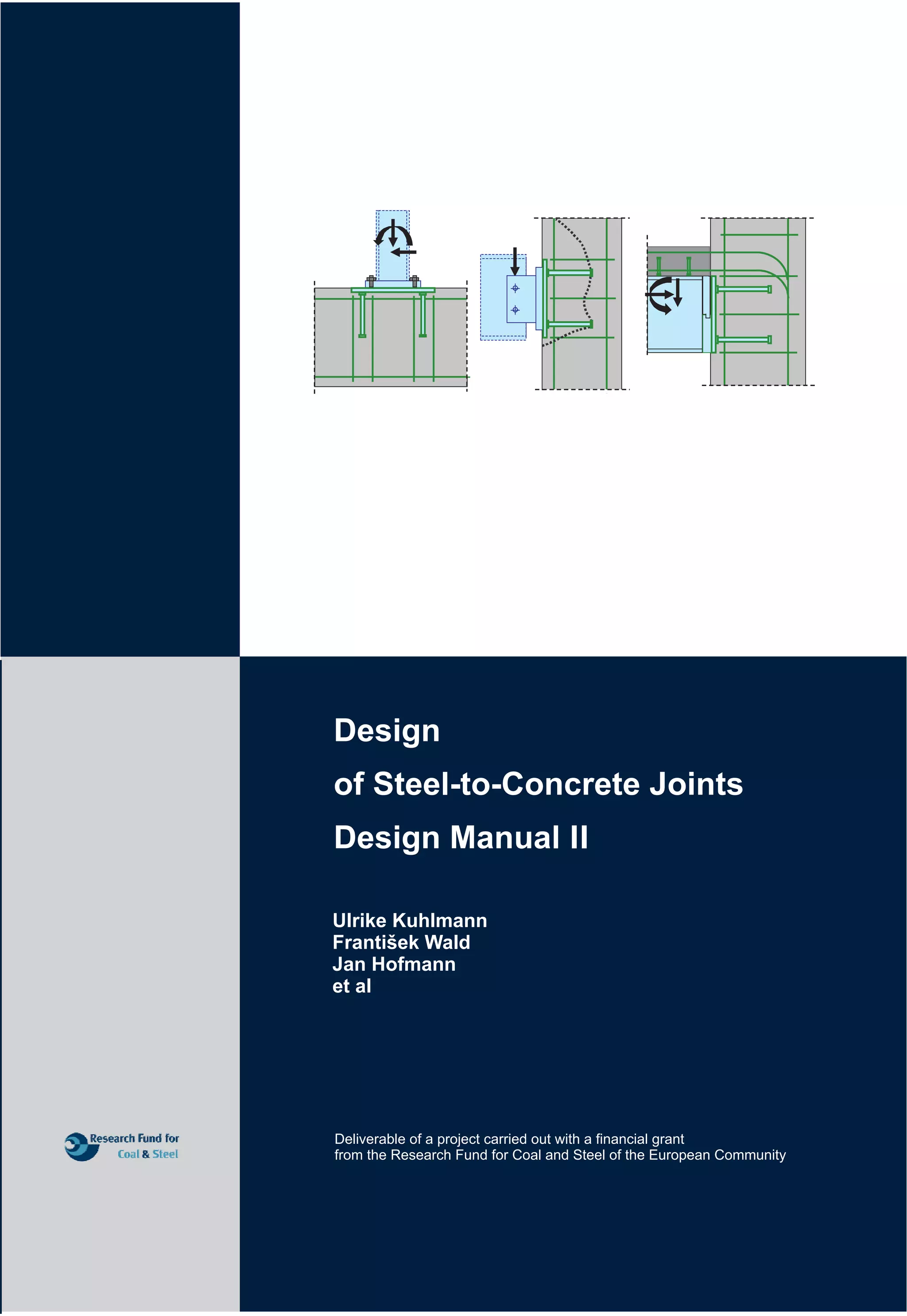
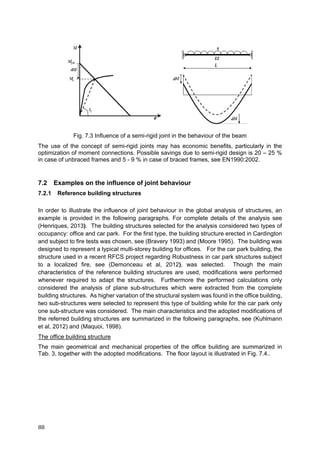
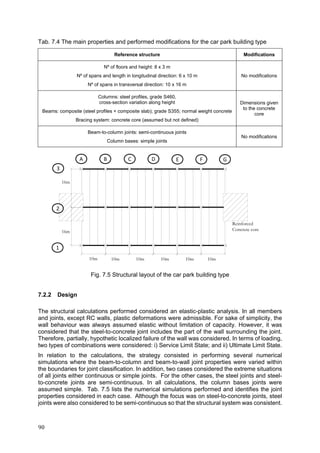
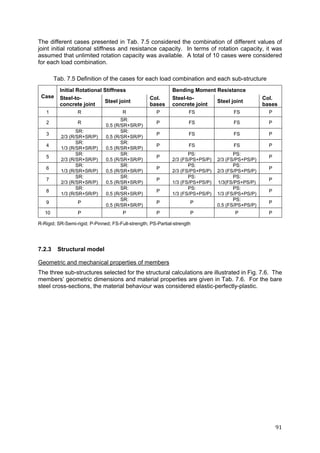
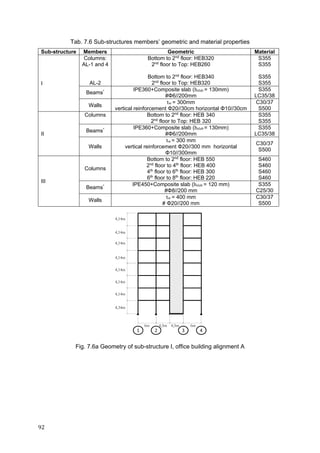
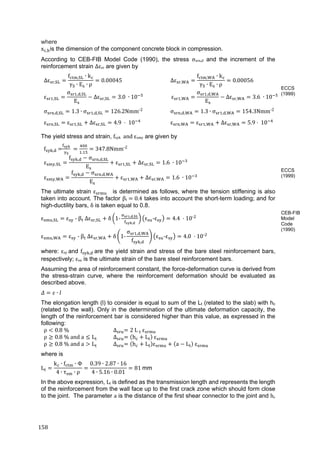
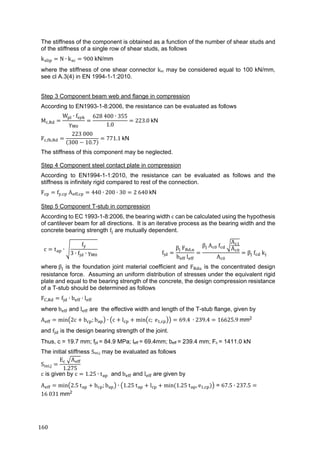
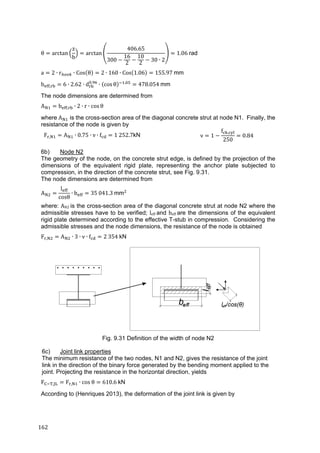
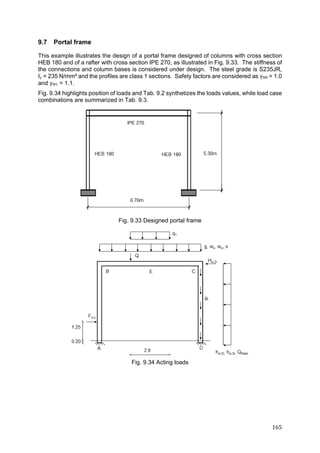
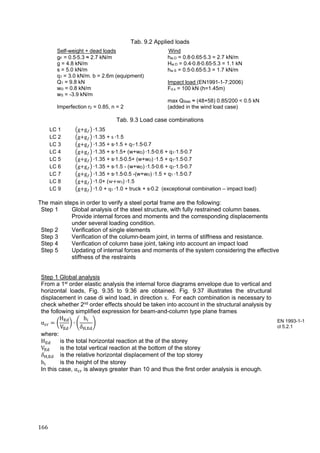
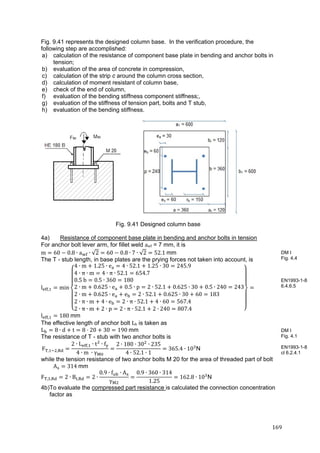
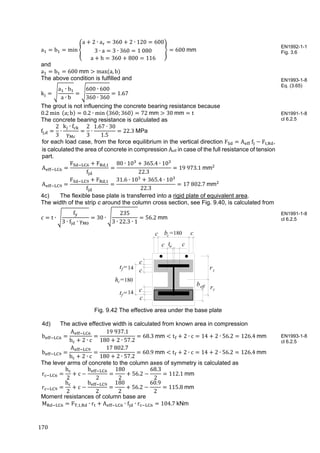
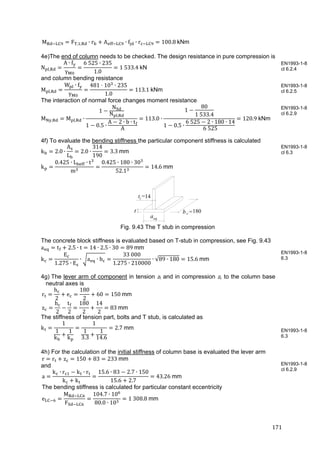
Design
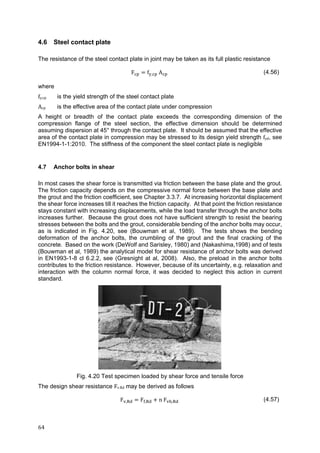
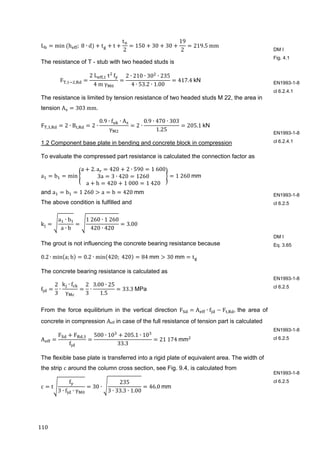
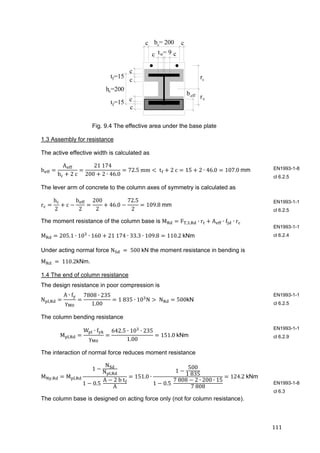
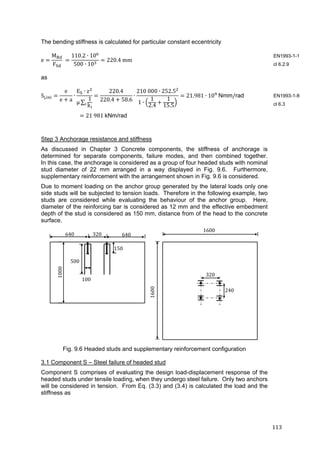
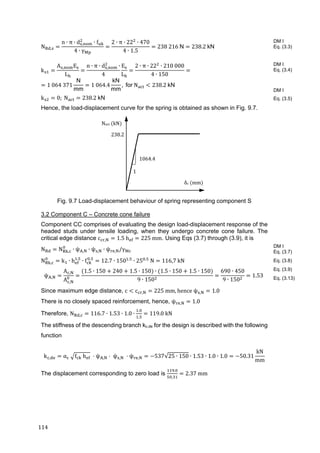
of Steel-to-Concrete Joints
Design Manual II
Ulrike Kuhlmann
František Wald
Jan Hofmann
et al
UlrikeKuhlmann,JanHofmann,FrantišekWald,,etal
Design of Steel-to-Concrete Joints
This Design manual I summarises the reached knowledge in the RFCS Project RFSR-
CT-2007-00051 New Market Chances for Steel Structures by Innovative Fastening
Solutions between Steel and Concrete, INFASO. The material was prepared in
cooperation researchers from Institute of Structural Design and Institute of Construction
Materials, Universität Stuttgart, Department of Steel and Timber Structures, Czech
Technical University in Prague, and practitioners from Gabinete de Informática
e Projecto Assistido Computador Lda., Coimbra, Goldbeck West GmbH, Bielefeld,
stahl+verbundbau GmbH, Dreieich and European Convention for Constructional
Steelwork, Bruxelles, one targeting on fastening technique modelling and others
focusing to steel joint design.
The models in the text are based on component method and enable the design of steel to
concrete joints in vertical position, e.g. beam to column or to wall connections, and
horizontal ones, base plates. The behaviour of components in terms of resistance,
stiffness, and deformation capacity is summed up for components in concrete and steel
parts: header studs, stirrups, concrete in compression, concrete panel in shear, steel
reinforcement, steel plate in bending, threaded studs, embedded plate in tension, beam
web and flange in compression and steel contact plate. In the Chapters 5 and 6 are
described the possibility of assembly of components behaviour into the whole joint
behaviour for resistance and stiffness separately. The presented assembly enables the
interaction of normal forces, bending moments and shear forces acting in the joint. The
global analyses in Chapter 7 is taken into account the joint behaviour. The connection
design is sensitive to tolerances, which are recapitulated for beam to column
connections and base plates in Chapter 8. The worked examples in Chapter 9
demonstrates the application of theory to design of pinned and moment resistant base
plates, pinned and moment resistance beam to column connections and the use of
predicted values into the global analyses.
Deliverable of a project carried out with a financial grant
from the Research Fund for Coal and Steel of the European Community
DesignofSteel-to-ConcreteJoints
ISBN 978-80-01-05439-0
February 2014
František Wald, Jan Hofmann, Ulrike Kuhlmann et al
Printing in Publishing house of CTU in Prague - production
Design
of Steel-to-Concrete Joints
Design Manual I
Prague, Stuttgart, Coimbra, and Brussels, February 2014
Deliverable of a project carried out with a financial grant
from the Research Fund for Coal and Steel of the European Community
II	
Design of steel-to-concrete joints, Design manual I
Although all care has been taken to ensure the integrity and quality of this publication and the information herein, no liability is
assumed by the project partners and the publisher for any damage to property or persons as a result of the use of this publication
and the information contained herein.
Reproduction for non-commercial purpose is authorised provided the source is acknowledged and notice is given to the project
coordinator. Publicly available distribution of this publication through other sources than the web sites given below requires the
prior permission of the project partners. Requests should be addressed to the project coordinator: Universität Stuttgart, Institut für
Konstruktion und Entwurf / Institute for Structural Design, Pfaffenwaldring 7, 70569 Stuttgart, Germany.
The present document and others related to the research project INFASO RFSR-CT-2007-00051 New Market Chances for Steel
Structures by Innovative Fastening Solutions between Steel and Concrete and the successive dissemination project RFS2-CT-
2012-00022 Valorisation of Knowledge for Innovative Fastening Solution between Steel and Concrete, which have been co-funded
by the Research Fund for Coal and Steel (RFCS) of the European Community.
ISBN 978-92-9147-119-5
František Wald, Jan Hofmann, Ulrike Kuhlmann,
Šárka Bečková, Filippo Gentili, Helena Gervásio, José Henriques, Markus Krimpmann, Ana Ožbolt, Jakob Ruopp,
Ivo Schwarz, Akanshu Sharma, Luis Simoes da Silva, and Jörg van Kann.
Printing by European Convention for Constructional Steelwork
February 2014
178 pages, 138 figures, 32 tables
III	
Contents
SYMBOLS.............................................................................................................................. VI 
1  INTRODUCTION...........................................................................................................10 
2  COMPONENT METHOD FOR STEEL TO CONCRETE JOINTS ................................12 
2.1  Design method....................................................................................................................... 12 
2.2  Classification of joints ............................................................................................................ 13 
2.2.1  Global analyses ............................................................................................................. 13 
2.2.2  Stiffness......................................................................................................................... 15 
2.2.3  Strength ......................................................................................................................... 16 
2.2.4  Deformation capacity..................................................................................................... 17 
2.3  Steel-to-concrete joints.......................................................................................................... 18 
2.3.1  Available models............................................................................................................ 18 
2.3.2  Steel and composite structures ..................................................................................... 18 
2.3.3  Concrete structures ....................................................................................................... 21 
2.3.4  Components for joints with anchor plate ....................................................................... 21 
3  COMPONENTS IN CONCRETE...................................................................................24 
3.1  Component model for headed studs ..................................................................................... 24 
3.1.1  Headed studs in tension, component S......................................................................... 24 
3.1.2  Headed studs in tension, component CC...................................................................... 25 
3.1.3  Stirrups in tension, component RS................................................................................ 27 
3.1.4  Stirrups in tension - bond failure, component RB.......................................................... 28 
3.1.5  Headed studs in tension, component P......................................................................... 29 
3.1.6  Headed studs in shear, component V ........................................................................... 30 
3.2  Combination of components.................................................................................................. 31 
3.2.1  Combination of concrete cone and stirrups, C1 = CC + RS/RB.................................... 31 
3.2.2  Combination of steel and pullout, C2 = S + P ............................................................... 32 
3.2.3  Combination of all components, C3 = CC + RS/RB + P +S.......................................... 33 
3.2.4  Design failure load......................................................................................................... 33 
3.2.5  Combination of tension and shear components............................................................ 34 
3.3  Simplified stiffness’s based on technical specifications ........................................................ 34 
3.3.1  Headed stud in tension without supplementary reinforcement ..................................... 34 
3.3.2  Headed stud in shear .................................................................................................... 35 
3.3.3  Concrete breakout in tension......................................................................................... 35 
3.3.4  Pull out failure of the headed studs ............................................................................... 36 
3.3.5  Interaction of components for concrete and stirrups ..................................................... 37 
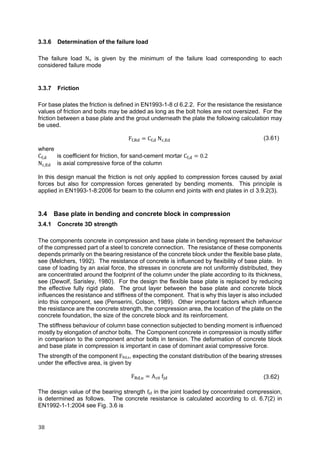
3.3.6  Determination of the failure load.................................................................................... 38 
3.3.7  Friction........................................................................................................................... 38 
IV	
3.4  Base plate in bending and concrete block in compression ................................................... 38 
3.4.1  Concrete 3D strength .................................................................................................... 38 
3.4.2  Base plate flexibility ....................................................................................................... 40 
3.4.3  Component stiffness...................................................................................................... 41 
3.5  Concrete panel ...................................................................................................................... 43 
3.6  Longitudinal steel reinforcement in tension........................................................................... 45 
3.7  Slip of the composite beam ................................................................................................... 46 
4  STEEL COMPONENTS................................................................................................47 
4.1  T-stub in tension .................................................................................................................... 47 
4.1.1  Model............................................................................................................................. 48 
4.1.2  Resistance..................................................................................................................... 50 
4.1.3  Stiffness......................................................................................................................... 57 
4.2  Threaded stud in tension....................................................................................................... 58 
4.3  Punching of the anchor plate................................................................................................. 58 
4.4  Anchor plate in bending and tension ..................................................................................... 59 
4.5  Column/beam flange and web in compression ..................................................................... 63 
4.6  Steel contact plate ................................................................................................................. 64 
4.7  Anchor bolts in shear............................................................................................................. 64 
5  ASSEMBLY FOR RESISTANCE ..................................................................................66 
5.1  Column base.......................................................................................................................... 66 
5.1.1  Column base with base plate ........................................................................................ 66 
5.1.2  Column base with anchor plate ..................................................................................... 68 
5.2  Simple steel to concrete joint................................................................................................. 69 
5.3  Moment resistant steel to concrete joint................................................................................ 75 
6  ASSEMBLY FOR STIFFNESS .....................................................................................77 
6.1  Column base.......................................................................................................................... 77 
6.1.1  Column base with base plate ........................................................................................ 77 
6.1.2  Column base with anchor plate ..................................................................................... 79 
6.2  Simple steel-to-concrete joint ................................................................................................ 80 
6.3  Moment resistant steel to concrete joint................................................................................ 84 
7  GLOBAL ANALYSIS INCLUDING JOINT BEHAVIOUR...............................................84 
7.1  Structural analysis ................................................................................................................. 84 
7.2  Examples on the influence of joint behaviour........................................................................ 88 
7.2.1  Reference building structures........................................................................................ 88 
7.2.2  Design............................................................................................................................ 90 
7.2.3  Structural model............................................................................................................. 91 
7.2.4  Analysis and discussion for Service Limit State............................................................ 97 
7.2.5  Analysis and discussion for Ultimate Limit State......................................................... 100 
V	
8  TOLERANCES............................................................................................................102 
8.1  Standardized tolerances...................................................................................................... 102 
8.2  Recommended tolerances................................................................................................... 105 
9  WORKED EXAMPLES................................................................................................107 
9.1  Pinned base plate................................................................................................................ 107 
9.2  Moment resistant base plate ............................................................................................... 109 
9.3  Stiffened base plate............................................................................................................. 122 
9.4  Column base with anchor plate ........................................................................................... 126 
9.5  Simple steel to concrete joint............................................................................................... 145 
9.6  Moment resistant steel to concrete joint.............................................................................. 155 
9.7  Portal frame ......................................................................................................................... 165 
10  SUMMARY..................................................................................................................174 
REFERENCES.....................................................................................................................175 
VI	
Symbols
Lower case
a factor considering the shoulder width,
length	
b length
c minimum edge distance,
effective width, length
ccr,N critical edge distance, ccr,N	 	1.5	hef	
cw drag coefficient
d diameter
db	 diameter of the bolt
dh diameter of the head of headed stud
ds diameter of the shaft of headed stud
ds,re diameter of the stirrup
ds,nom nominal diameter of the anchor shaft
dw diameter of the washer
ex,y length between the bolt axis
and the edge of the plate
e eccentricity
fbd	 design bond strength according
to EN1992-1-1:2004
fcd	 design strength of concrete
fck characteristic strength of concrete
fck,cube characteristic square strength
of concrete
fu strength of structural steel
fub strength of the bolt
fuk characteristic strength of steel
fy nominal yield strength of steel
fya average yield strength
fyb nominal value of yield strength
of the bolt
fyd design yield strength of steel
fyd,re design yield strength of the stirrups
fyk characteristic yield strength of steel
h height
hef effective embedment depth according
to product specifications
k coefficient depending on the type
of forming
k1 factor for concrete cone strength in
case of headed studs
k2 factor for the headed studs
for component P
kA factor considering the cross-section
ka form factor at porous edge sections
kb stiffness of the bolt
kb,re bond stiffness due to supplementary
reinforcement, stirrups
kC1 stiffness due to the displacement
of the anchorage in case of concrete
cone failure with supplementary
reinforcement, combination C1
kC2 stiffness due to the displacement
of the head, due to the pressure under
the head on the concrete, and steel
elongation, combination C2
kc,de stiffness of the descending branch
for component CC
kc,soft stiffness of the concrete cone in the
softening branch
kj	 concentration factor
kp stiffness coefficient of the plate
kp,de stiffness of the descending branch
for component P
ks stiffness of the anchor shaft
for component S
ks,re steel stiffness due to supplementary
reinforcement, stirrups
kv empirical value depending
on the type of anchor
l1 anchorage length
lep elongated length
leff effective length of T-stub, defined
in accordance with EN1993 1-8:2006
lv,eff effective length of shear area
m distance between threaded and
headed studs
mpl plastic moment resistance per unit,
defined as m
. ∙ ∙
	
n location of the prying force, number
nre total number of legs of stirrups
p internal pressure
r radius of the fillet of a rolled profile
s actual spacing of anchors
VII	
scr,N critical spacing for anchors
t thickness
tf thickness of the T-stub, flange
tw thickness of T-stub, column
tp1 thickness of the anchor plate
tp2 thickness of the base plate
wfic fictive effective width
x distance between the anchor and
the crack on the concrete surface
assuming a crack propagation
from the stirrup of the supplementary
reinforcement to the concrete surface
with an angle of 35°
z distance of tension/compressed part
Upper case	
A cross section area
Ac0 loaded area
Ac1 maximum spread area
Ac,N actual projected area of concrete cone
of the anchorage at the concrete
surface, limited by overlapping
concrete cones of adjacent anchors
(s	 	scr,N), as well as by edges of the
concrete member (c	 	ccr,N)
A , reference area of the concrete cone
of an individual anchor with large
spacing and edge distance projected
on the concrete surface
Aeff effective area
Ah area on the head of the headed stud
Anet net cross section area
As tensile stress area in the bolt
As,nom nominal cross section area of all shafts
As,re nominal cross section area of all legs
of the stirrups
Bt.Rd design tension resistance
of a single bolt-plate assembly
B , 0.9 ∙ f ∙ A /γ
D diameter of column
E modulus of elasticity the steel
E	 	210	000	MPa
F force or load
Fc.Rd resistance of compressed part
Fd	 design load
Fk	 characteristic load
Fmemb axial force
Ft.Ed external tensile force
Ft.Rd external ultimate resistance
FT.Rd resistance of tension part
I moment of inertia
It torsion constant
K general stiffness
L length
Lb length of anchor bolt
Lcr buckling length
LD the elongation length of the bolt, which
may be taken as the total grip length
(thickness of material plus washers)
plus half the sum of the height of the
bolt head and the height of the nut
Lh length of the anchor shaft
Ip,bp equivalent moment of inertia
Mc,Rd bending moment capacity
Mj,Rd design moment resistance of a joint
MN,Rd interaction resistance bending with
compression
Mpl.Rd plastic moment resistance defined
as M , l ∙ m 	
Mt,Rd torsion capacity
Nact actual load on the anchor
Nb,Rd design buckling resistance
Ncr critical buckling load
NEd tension/compression load
NETA tension load for which the
displacements are derived
in the product specifications
Npl,Rd design capacity
in tension/compression
NRd design capacity
NRd,b,re design tension resistance
for bond failure of stirrups
NRd.C3 design failure load
or the combined model
NRd,c design tension resistance for concrete
cone failure of headed stud
VIII	
NRd,cs design failure load
for the concrete strut
NRd,p design tension resistance
for pull out failure of headed stud
NRd,re design failure load
for the supplementary reinforcement
NRd,s design tension resistance
for steel failure of headed stud
NRd,s,re design tension resistance
for steel failure of stirrups
N , characteristic resistance
of a single anchor without edge and
spacing effects
Nu ultimate resistance
Ny yielding resistance
Q prying force
Rd design capacity
Rk characteristic resistance
Si elastic stiffness
Sj,ini initial stiffness
VETA shear load for which the displacements
are derived in the product
specifications
Vpl,Rd shear capacity
VRd design failure load
for the anchor under shear
VRd,c design shear resistance
for concrete cone failure
VRd,cp design shear resistance for concrete
pryout
VRd,p design shear resistance for pullout
VRd,s design shear resistance
for steel failure
We external work
Weff section modulus of effective area
Wel elastic section modulus
Wi	 internal work
Wpl plastic section modulus
Greek symbols
α factor according to EN1992:2006 for
hook effect and large concrete cover
αc factor of component concrete break
out in tension
αp factor for the component head
pressing
αs factor of component stirrups
βj material coefficient
γF	 partial safety factor for actions
γM material safety factor
γMb partial safety factor for bolts		γMb = 1.25
γMc partial safety factor for concrete
γMc = 1.5
γMs partial safety factor for steel γMs	= 1.15
γMV partial safety factor for shear
resistance of studs γMV	= 1.25
γMw partial safety factor for welds			
γMw = 1.25
γM0 partial safety factor for resistance
of Class 1, 2 or 3 cross-sections
γM0 = 1.0
γM1 partial safety factor for resistance
of a member to buckling γM1 = 1.0
γM2 partial safety factor resistance
of net section at bolt holes γM2 = 1.25
δ deformation, displacement
δact displacement corresponding to Nact
δc displacement corresponding to Nact
for concrete cone
δf corresponding displacement
at failure load NRd,sre or NRd,bre
δN,ETA displacement given in the product
specifications for a corresponding
tension load
δRd,b,re deformation corresponding to design
resistance for bond failure of stirrups
δRd,c deformation corresponding to design
resistance for concrete cone failure
δRd,p deformation corresponding
to design resistance for pull out failure
δRd,s deformation corresponding to NRd
δRd,s deformation corresponding to design
resistance for steel failure
δRd,s,re deformation corresponding to design
resistance for steel failure of stirrups
IX	
δRd,sy deformation corresponding to design
yield resistance for steel failure
δu elongation
δV,ETA displacement given in the product
specifications for a corresponding
shear load
εbu,re strain limit for the stirrups due to bond
εsu ultimate design strain limit for steel
εsu,re strain limit for the stirrups
under tension
εsu,re strain limit for the stirrups
under tension
εu ultimate strain
θ angle
λ slenderness of member
μ coefficient of friction
ν Poisson`s ratio, ν	 	0.30
σ stress
c reduction factor
ψA,N factor accounting for geometric effects
in anchor group, ψA,N = A , /A ,
ψre,N factor accounting for negative effect
of closely spaced reinforcement
in the concrete member on strength
of anchors with hef	 	100	mm
ψs,N factor accounting for the influence
of edges of the concrete member
on the distribution of stresses in the
concrete ψs,N = 0.7 0. ,3 ∙ c/c , 1.0
ψsupp	 support factor considering the
confinement of the stirrups
ψsupp = 2.5 x/h 1.0
Ф rotation
Subscripts
A area
act actual
b bolt, bond
bd design bond
c column, concrete
cb concrete block
ck characteristic concrete
cp concrete pry out
cs concrete strut
cr critical
d design
e external
eff effective
ETA European technical approval
g grout
h head
i internal
k characteristic
lim limit
Mc material concrete
Ms material steel
N tension
nom nominal
po pullout
p plate
pl plastic
Rd resistance design
Rk characteristic resistance
re failure
rec reinforcement
Sd internal design
s shaft of anchor, stud
soft softening
supp support
T tension part
t tension
tot total
p plate
p1 anchor plate
p2 base plate
u ultimate
uk characteristic ultimate
V shear
w column web
x,	y directions
y yield
yd design yield
yk characteristic yield
10	
1 INTRODUCTION
The mixed building technology allows to utilise the best performance of all structural materials
available such as steel, concrete, timber and glass. Therefore the building are nowadays
seldom designed from only one structural material. Engineers of steel structures in practice
are often faced with the question of economical design of steel to concrete joints, because
some structural elements, such as foundations, stair cases and fire protection walls, are
optimal of concrete. A gap in knowledge between the design of fastenings in concrete and
steel design was abridged by standardized joint solutions developed in the INFASO project,
which profit from the advantage of steel as a very flexible and applicable material and allow an
intelligent connection between steel and concrete building elements. The requirements for
such joint solutions are easy fabrication, quick erection, applicability in existing structures, high
loading capacity and sufficient deformation capacity. One joint solution is the use of anchor
plates with welded headed studs or other fasteners such as post-installed anchors. Thereby
a steel beam can be connected by butt straps, cams or a beam end plate connected by
threaded bolts on the steel plate encased in concrete. Examples of typical joint solutions for
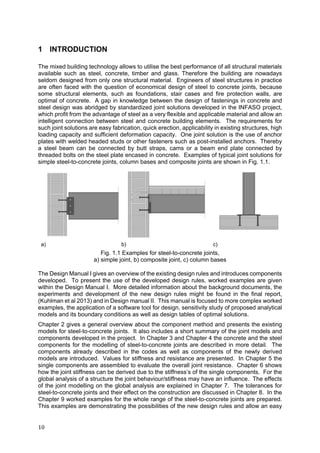
simple steel-to-concrete joints, column bases and composite joints are shown in Fig. 1.1.
a) b) c)
Fig. 1.1 Examples for steel-to-concrete joints,
a) simple joint, b) composite joint, c) column bases
The Design Manual I gives an overview of the existing design rules and introduces components
developed. To present the use of the developed design rules, worked examples are given
within the Design Manual I. More detailed information about the background documents, the
experiments and development of the new design rules might be found in the final report,
(Kuhlman et al 2013) and in Design manual II. This manual is focused to more complex worked
examples, the application of a software tool for design, sensitivity study of proposed analytical
models and its boundary conditions as well as design tables of optimal solutions.
Chapter 2 gives a general overview about the component method and presents the existing
models for steel-to-concrete joints. It also includes a short summary of the joint models and
components developed in the project. In Chapter 3 and Chapter 4 the concrete and the steel
components for the modelling of steel-to-concrete joints are described in more detail. The
components already described in the codes as well as components of the newly derived
models are introduced. Values for stiffness and resistance are presented. In Chapter 5 the
single components are assembled to evaluate the overall joint resistance. Chapter 6 shows
how the joint stiffness can be derived due to the stiffness’s of the single components. For the
global analysis of a structure the joint behaviour/stiffness may have an influence. The effects
of the joint modelling on the global analysis are explained in Chapter 7. The tolerances for
steel-to-concrete joints and their effect on the construction are discussed in Chapter 8. In the
Chapter 9 worked examples for the whole range of the steel-to-concrete joints are prepared.
This examples are demonstrating the possibilities of the new design rules and allow an easy
11	
access for the engineers in practice. The references are given to this Design manual I (DM I)
and to Eurocodes (EN199x-1-x). Chapter 10 summarises the offered opportunity for
innovations.
Chapters 1 and 2 were prepared by U. Kuhlman and J. Ruopp, Chapter 3 by J. Hofmann and
A. Sharma, Chapters 4, 5 and 6 by F. Wald, Bečková Š. and Schwarz I., Chapter 7 by da Silva
L. Simoes, H. Gervásio and J. Henriques and F. Gentili and Chapter 8 by M. Krimpmann. The
worked examples 9.1 to 9.3 were set by Š. Bečková and I. Schwarz, 9.4 by Š. Bečková,
I. Schwarz and M. Krimpmann, 9.5 by J. Ruopp, 9.6 and 9.7 by J. Henriques and F. Gentili,
with help of the headed studs design models by A. Sharma.
12	
2 COMPONENT METHOD FOR STEEL TO CONCRETE JOINTS
2.1 Design method
In the past decades, the component method has been set as a unified approach for the efficient
analysis of steel and composite joints, see (Da Silva 2008). The basic principle of the
component method consists of determining the complex non-linear joint response through the
subdivision into basic joint components. The joint can be regarded as a set of individual basic
components that contribute to its structural behaviour by means of resistance, stiffness and
deformation capacity. The component method allows designers to take options more
efficiently because the contribution of each component to the joint behaviour may be optimized
according to the limiting components. Thus, one of the main advantages of the component
method is that the analysis of an individual component can be done independently of the type
of joint. In a second calculation step the single components are assembled by the designers
according to the joint configuration.
Joint components may be divided by the type of loading. Accordingly, three groups
of components are usually identified: components for tension, compression and shear.
Additionally, a second division may be done according to their location: panel zone or
connecting zone. In Fig. 2.1 these two definitions are illustrated based on a double sided
composite joint.
Fig. 2.1 Division of joint into groups and zones
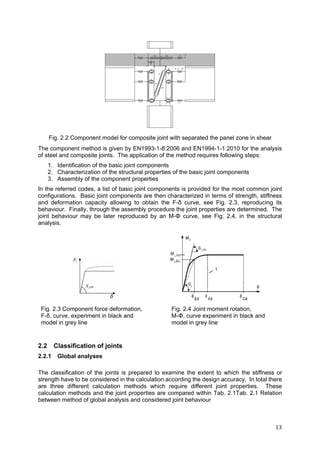
In practice these components are modelled by translational springs with non-linear force-
deformation response that are exposed to internal forces. The joint may then be represented
by a spring model as illustrated in Fig. 2.2.
13	
Fig. 2.2 Component model for composite joint with separated the panel zone in shear
The component method is given by EN1993-1-8:2006 and EN1994-1-1:2010 for the analysis
of steel and composite joints. The application of the method requires following steps:
1. Identification of the basic joint components
2. Characterization of the structural properties of the basic joint components
3. Assembly of the component properties
In the referred codes, a list of basic joint components is provided for the most common joint
configurations. Basic joint components are then characterized in terms of strength, stiffness
and deformation capacity allowing to obtain the F-δ curve, see Fig. 2.3, reproducing its
behaviour. Finally, through the assembly procedure the joint properties are determined. The
joint behaviour may be later reproduced by an M-Φ curve, see Fig. 2.4, in the structural
analysis.
Fig. 2.3 Component force deformation,
F-δ, curve, experiment in black and
model in grey line
Fig. 2.4 Joint moment rotation,
M-Φ, curve experiment in black and
model in grey line
2.2 Classification of joints
2.2.1 Global analyses
The classification of the joints is prepared to examine the extent to which the stiffness or
strength have to be considered in the calculation according the design accuracy. In total there
are three different calculation methods which require different joint properties. These
calculation methods and the joint properties are compared within Tab. 2.1Tab. 2.1 Relation
between method of global analysis and considered joint behaviour
14	
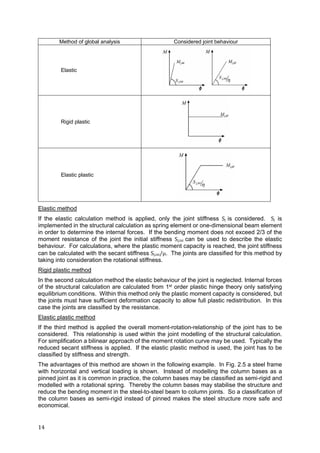
Method of global analysis Considered joint behaviour
Elastic
Rigid plastic
Elastic plastic
Elastic method
If the elastic calculation method is applied, only the joint stiffness Sj is considered. Sj is
implemented in the structural calculation as spring element or one-dimensional beam element
in order to determine the internal forces. If the bending moment does not exceed 2/3 of the
moment resistance of the joint the initial stiffness Sj,ini can be used to describe the elastic
behaviour. For calculations, where the plastic moment capacity is reached, the joint stiffness
can be calculated with the secant stiffness Sj,ini/. The joints are classified for this method by
taking into consideration the rotational stiffness.
Rigid plastic method
In the second calculation method the elastic behaviour of the joint is neglected. Internal forces
of the structural calculation are calculated from 1st order plastic hinge theory only satisfying
equilibrium conditions. Within this method only the plastic moment capacity is considered, but
the joints must have sufficient deformation capacity to allow full plastic redistribution. In this
case the joints are classified by the resistance.
Elastic plastic method
If the third method is applied the overall moment-rotation-relationship of the joint has to be
considered. This relationship is used within the joint modelling of the structural calculation.
For simplification a bilinear approach of the moment rotation curve may be used. Typically the
reduced secant stiffness is applied. If the elastic plastic method is used, the joint has to be
classified by stiffness and strength.
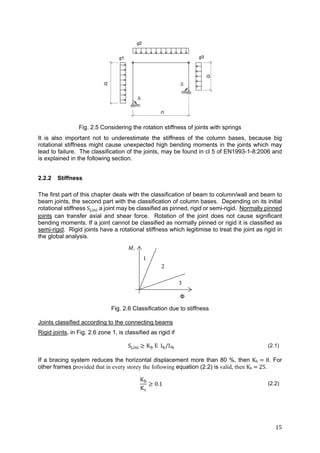
The advantages of this method are shown in the following example. In Fig. 2.5 a steel frame
with horizontal and vertical loading is shown. Instead of modelling the column bases as a
pinned joint as it is common in practice, the column bases may be classified as semi-rigid and
modelled with a rotational spring. Thereby the column bases may stabilise the structure and
reduce the bending moment in the steel-to-steel beam to column joints. So a classification of
the column bases as semi-rigid instead of pinned makes the steel structure more safe and
economical.
15	
Fig. 2.5 Considering the rotation stiffness of joints with springs
It is also important not to underestimate the stiffness of the column bases, because big
rotational stiffness might cause unexpected high bending moments in the joints which may
lead to failure. The classification of the joints, may be found in cl 5 of EN1993-1-8:2006 and
is explained in the following section.
2.2.2 Stiffness
The first part of this chapter deals with the classification of beam to column/wall and beam to
beam joints, the second part with the classification of column bases. Depending on its initial
rotational stiffness S , a joint may be classified as pinned, rigid or semi-rigid. Normally pinned
joints can transfer axial and shear force. Rotation of the joint does not cause significant
bending moments. If a joint cannot be classified as normally pinned or rigid it is classified as
semi-rigid. Rigid joints have a rotational stiffness which legitimise to treat the joint as rigid in
the global analysis.
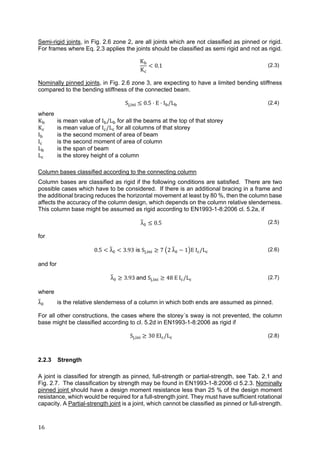
Fig. 2.6 Classification due to stiffness
Joints classified according to the connecting beams
Rigid joints, in Fig. 2.6 zone 1, is classified as rigid if
S , K E I /L (2.1)
If a bracing system reduces the horizontal displacement more than 80 %, then Kb	 	8. For
other frames provided that in every storey the following equation (2.2) is valid, then Kb	 	25.
K
K
0.1 (2.2)
16	
Semi-rigid joints, in Fig. 2.6 zone 2, are all joints which are not classified as pinned or rigid.
For frames where Eq. 2.3 applies the joints should be classified as semi rigid and not as rigid.
K
K
0.1 (2.3)
Nominally pinned joints, in Fig. 2.6 zone 3, are expecting to have a limited bending stiffness
compared to the bending stiffness of the connected beam.
S , 0.5 E I /L (2.4)
where
K is mean value of I /L for all the beams at the top of that storey
K is mean value of I /L for all columns of that storey
I is the second moment of area of beam
I is the second moment of area of column
L is the span of beam
L is the storey height of a column
Column bases classified according to the connecting column
Column bases are classified as rigid if the following conditions are satisfied. There are two
possible cases which have to be considered. If there is an additional bracing in a frame and
the additional bracing reduces the horizontal movement at least by 80 %, then the column base
affects the accuracy of the column design, which depends on the column relative slenderness.
This column base might be assumed as rigid according to EN1993-1-8:2006 cl. 5.2a, if
λ 0.5 (2.5)
for
0.5 λ 3.93 is S , 7 2 λ 1 E I /L (2.6)
and for
λ 3.93 and S , 48 E I /L (2.7)
where
λ is the relative slenderness of a column in which both ends are assumed as pinned.
For all other constructions, the cases where the storey´s sway is not prevented, the column
base might be classified according to cl. 5.2d in EN1993-1-8:2006 as rigid if
S , 30 EI /L (2.8)
2.2.3 Strength
A joint is classified for strength as pinned, full-strength or partial-strength, see Tab. 2.1 and
Fig. 2.7. The classification by strength may be found in EN1993-1-8:2006 cl 5.2.3. Nominally
pinned joint should have a design moment resistance less than 25 % of the design moment
resistance, which would be required for a full-strength joint. They must have sufficient rotational
capacity. A Partial-strength joint is a joint, which cannot be classified as pinned or full-strength.
17	
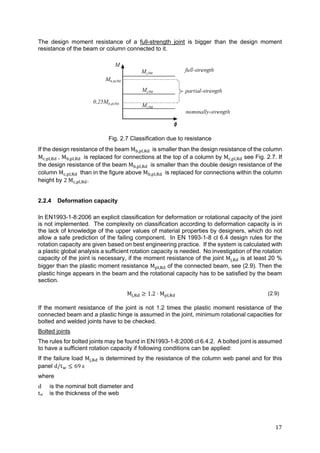
The design moment resistance of a full-strength joint is bigger than the design moment
resistance of the beam or column connected to it.
Fig. 2.7 Classification due to resistance
If the design resistance of the beam M , , 	 is smaller than the design resistance of the column
M , , 	, M , , 	 is replaced for connections at the top of a column by M , , see Fig. 2.7. If
the design resistance of the beam M , , 	 is smaller than the double design resistance of the
column M , , 	 than in the figure above M , , 	 is replaced for connections within the column
height by 2	M , , .
2.2.4 Deformation capacity
In EN1993-1-8:2006 an explicit classification for deformation or rotational capacity of the joint
is not implemented. The complexity on classification according to deformation capacity is in
the lack of knowledge of the upper values of material properties by designers, which do not
allow a safe prediction of the failing component. In EN 1993-1-8 cl 6.4 design rules for the
rotation capacity are given based on best engineering practice. If the system is calculated with
a plastic global analysis a sufficient rotation capacity is needed. No investigation of the rotation
capacity of the joint is necessary, if the moment resistance of the joint M , is at least 20 %
bigger than the plastic moment resistance M , of the connected beam, see (2.9). Then the
plastic hinge appears in the beam and the rotational capacity has to be satisfied by the beam
section.
M , 1.2 M , (2.9)
If the moment resistance of the joint is not 1.2 times the plastic moment resistance of the
connected beam and a plastic hinge is assumed in the joint, minimum rotational capacities for
bolted and welded joints have to be checked.
Bolted joints
The rules for bolted joints may be found in EN1993-1-8:2006 cl 6.4.2. A bolted joint is assumed
to have a sufficient rotation capacity if following conditions can be applied:
If the failure load M , is determined by the resistance of the column web panel and for this
panel d/t 69	ε
where
d is the nominal bolt diameter and
tw is the thickness of the web
18	
If the thickness of the flange of the column or the beam end plate is sufficiently thin to satisfy
the following formula.
t	 0.36 d f /f (2.10)
where
f is ultimate strength of the bolts
f is yield strength of the flange or the end plate
Welded joints
The rules for welded joints may also be found in EN1993-1-8:2006 cl 6.4. For a welded beam
to column connection the rotation capacity ∅ may be calculated with the following equation.
In this case the web has to be stiffened in the compression area but not in the tension are and
the moment resistance is not determined by the resistance of the column web panel.
∅ 0.025 h /h (2.11)
where
h is the depth of the column
h is the depth of the beam
For a welded beam to column connection where the compression and the tension area in the
column are not stiffened, the rotation capacity may be assumed to be at least 0.015 rad.
2.3 Steel-to-concrete joints
2.3.1 Available models
Design models for steel-to-concrete joints are currently available in the three standard
documents:
EN1993-1-8:2006 includes values for stiffness and resistance for all steel components and
values for stiffness and resistance for concrete components in compression. There are no
rules for concrete components in tension or shear.
EN1994-1-1:2010 enhancement of the rules from EN 1993-1-8 on composite joints such as
the connection of composite girder to steel columns.
CEN/TS 1992-4-1:2009 summarises values for the design resistance of fasteners in concrete.
But no values for stiffness and ductility are available.
2.3.2 Steel and composite structures
Design rules in the Eurocode are given for different joint configurations. The model for the
column bases is described in the EN1993-1-8:2006 and the model for the composite joint in
EN1994-1-1:2010.
Column bases with base plates
The analytical prediction model for column base with base plate is described in the EN1993-
1-8:2006. With these design rules column bases loaded by axial force and bending moments
are calculated. The model is only including concrete components for the compression forces.
19	
For the tension force only steel components are considered. The design resistance of column
bases with steel base plates is described in EN1993-1-8:2006, cl 6.2.8. First according to the
eccentricity of the axial force and the geometry of the column base one of the four loading
types is chosen, and the lever arm is calculated. For this see Tab. 2.2. Then the loading of
the tension and the compression components are calculated. The failure load is determined
by the weakest activated component. These components are for:
Tension
Base plate in bending under tension cl 6.2.6.11 in EN1993-1-8
Anchor bolt in tension cl 6.2.6.12 in EN1993-1-8
Column web in tension cl 6.2.6.8 in EN1993-1-8
Compression
Base plate in bending under compression cl 6.2.6.10 in EN1993-1-8
Concrete in compression cl 6.2.6.9 in EN1993-1-8
Column web and flange in compression cl 6.2.6.7 in EN1993-1-8
Shear
Anchor bolts in shear cl 6.2.2.6 to 6.2.2.9 in EN1993-1-8
According to procedure in EN1993-1-8:2006 cl 6.3.4 one of the four cases of the loading and
geometry is chosen, see Tab.2.2. Then the rotational stiffness is calculated. One complexity
creates change of the loading type depending on the loading cases. From this different
rotational stiffness values for different combinations of bending moment and axial forces are
resulting. The design of the embedded column base according to Eurocodes was developed
by (Pertold et al, 2000) based on set of tests and finite element modelling. This model is
prepared to approve resistance to combine base plate with embedding.
Composite joints
The composite joint is described in the Section 8 in EN1994-1-1:2010. The composite joint
may be used for the connection of composite beams to steel columns. The design rules are
an enhancement of the rules according to EN1993-1-8:2006 and new components are added.
These additional components are:
- Longitudinal steel reinforcement in tension cl. 8.4.2.1 EN1994-1-1:2010
- Steel contact plate in compression cl 8.4.2.2 EN1994-1-1:2010
- Column web in transverse compression cl 8.4.3 EN1994-1-1:2010
- Reinforced components cl 8.4.4 EN1994-1-1:2010
- Column web panel in shear cl 8.4.4.1 EN1994-1-1:2010
- Column web in compression cl 8.4.4.2 EN1994-1-1:2010
For all other components EN1993-1-8:2006 is applied.
20	
Tab. 2.2 The loading situations for the definition of the lever arm
Number Description of loading Sketch Explanation
1
Left side in tension
Right side in compression
, ,
Bending moment
is dominating
2
Left side in tension
Right side in tension
, ,
Tensile force
is dominating
3
Left side in compression
Right side in tension
, ,
Bending moment
is dominating
4
Left side in compression
Right side in compression
, ,
Compression force
is dominating
Fig. 2.8 Composite joint
21	
Tab. 2.3 Failure modes observed for anchors in concrete
Loading Failure modes
Tension	
Steel failure	
	
Concrete cone failure	 Pull-out / Pull-through	
Splitting failure	 Local Blow-out failure	 Steel failure	
	
Shear		
Steel failure	
	
Concrete edge failure
Pry-out failure	
Pull-out failure	
2.3.3 Concrete structures
In CEN/TS1992-4-1:2009 the design of fastenings in concrete is given. In these rules the failure
modes of the fasteners and the concrete are described in a detailed way. For tension and
shear loading various failure modes exist. Failure modes are given according to CEN/TS 1992-
4-1:2009, see Tab. 2.3.. All possible failure modes are determined. The smallest resistance
defines the design resistance of the joint. The design rules for the resistance include different
types of geometries. Also edge effects, concrete with and without cracks and different kinds
of fasteners are considered. However for stiffness no design rules are given and the use of
additional stirrups is covered in a very conservative way.
2.3.4 Components for joints with anchor plate
Headed studs in tension / Headed studs with stirrups in tension
Load-displacement-curves of test specimens have shown, that in cases were additional
reinforcement is used, also other components besides the reinforcement have a contribution
on the overall load bearing capacity of the fixture. If, for instance, the reinforcement starts to
yield, compression struts may develop and a small concrete cone failure can be the decisive
component. With the design model the interaction of the concrete cone and the stirrups is
considered. This allows the increase of the design resistance and the determination of the
stiffness of the two combined components concrete cone and stirrups in tension in cases,
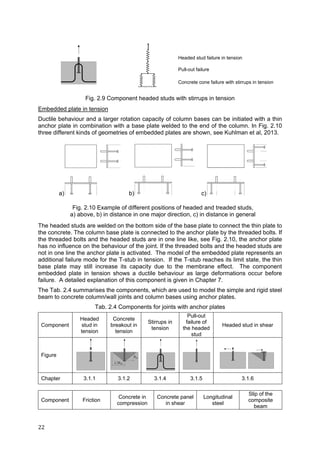
where both of them are interacting. In Fig. 2.9 a headed stud with additional reinforcement and
the assembly of single components is shown.
22	
Headed stud failure in tension
Pull-out failure
Concrete cone failure with stirrups in tension
Fig. 2.9 Component headed studs with stirrups in tension
Embedded plate in tension
Ductile behaviour and a larger rotation capacity of column bases can be initiated with a thin
anchor plate in combination with a base plate welded to the end of the column. In Fig. 2.10
three different kinds of geometries of embedded plates are shown, see Kuhlman et al, 2013.
a) b) c)
Fig. 2.10 Example of different positions of headed and treaded studs,
a) above, b) in distance in one major direction, c) in distance in general
The headed studs are welded on the bottom side of the base plate to connect the thin plate to
the concrete. The column base plate is connected to the anchor plate by the threaded bolts. If
the threaded bolts and the headed studs are in one line like, see Fig. 2.10, the anchor plate
has no influence on the behaviour of the joint. If the threaded bolts and the headed studs are
not in one line the anchor plate is activated. The model of the embedded plate represents an
additional failure mode for the T-stub in tension. If the T-stub reaches its limit state, the thin
base plate may still increase its capacity due to the membrane effect. The component
embedded plate in tension shows a ductile behaviour as large deformations occur before
failure. A detailed explanation of this component is given in Chapter 7.
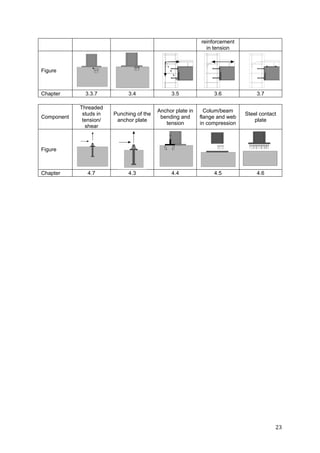
The Tab. 2.4 summarises the components, which are used to model the simple and rigid steel
beam to concrete column/wall joints and column bases using anchor plates.
Tab. 2.4 Components for joints with anchor plates
Component
Headed
stud in
tension
Concrete
breakout in
tension
Stirrups in
tension
Pull-out
failure of
the headed
stud
Headed stud in shear
Figure
Chapter 3.1.1 3.1.2 3.1.4 3.1.5 3.1.6
Component Friction
Concrete in
compression
Concrete panel
in shear
Longitudinal
steel
Slip of the
composite
beam
23	
reinforcement
in tension
Figure
Chapter 3.3.7 3.4 3.5 3.6 3.7
Component
Threaded
studs in
tension/
shear
Punching of the
anchor plate
Anchor plate in
bending and
tension
Colum/beam
flange and web
in compression
Steel contact
plate
Figure
Chapter 4.7 4.3 4.4 4.5 4.6
24	
3 COMPONENTS IN CONCRETE
3.1 Component model for headed studs
For components embedded in concrete the displacement behaviour and therefore
the F-curve is influenced by the concrete properties itself and the interaction between the
anchorage and the concrete. The influence of concrete on the behaviour of anchorages in
tension have to be considered. The scatter in concrete is much larger than that observed for
the material steel, see (Pallarés and Hajjar, 2009).
For design, a material safety factor for concrete according to EN1992-1-1:2004 of Mc	 	1.5 is
used. The characteristic values for the resistances are derived by assuming a normal
distribution and a probability of 90 % for the 5 % fractal that corresponds to the characteristic
value. The given displacements and stiffness’s are mean values and can scatter with
coefficient of variation up to 50 %.
The complete F‐curve for the design of a headed stud in tension is described by a rheological
model using and combining different components for the headed stud. The individual
components for anchorages with supplementary reinforcement are:
Component S Steel failure of the headed stud (Rd,s	/	NRd,s)
Component CC Concrete cone failure (Rd,c	/	NRd,c)
Component RS Steel failure of the stirrups (Rd,s,re	/	NRd,s,re)
Component RB Bond failure of the stirrups (Rd,b,re	/	NRd,b,re)
Component P Pull out failure of the headed stud (Rd,p	/	NRd,p)
The combination is given in Fig. 3.1.
Components
S
P
CC
KS/RB
Components
S
P
CC
a) with supplementary reinforcement b) without supplementary reinforcement
Fig. 3.1 Spring models for the different components of anchorages embedded in concrete
3.1.1 Headed studs in tension, component S
If a headed stud is loaded in tension, the load is first transferred from the loading point at the
base plate to the bearing areas of the headed stud. Therefore the shaft will elongate up to the
design yielding strength	f 	f /γ . For design the behaviour is assumed as linear elastic
up to the yielding load of the headed stud. The corresponding elongation due to the introduced
stress is calculated with the equation using the Hooke´s law. The elongation corresponding to
the yield load is given by
25	
δ ,
N , L
A , E
σ , L
E
[mm] (3.1)
where
Lh is length of the anchor shaft [mm]
NRd,s is design tension resistance of the headed stud [N]
Es is elastic modulus of the steel, Es	 	210	000 N/mm² [N/mm²]
As,nom is nominal cross section area of all shafts
A ,
 d ,
4
mm² (3.2)
where
ds,nom is nominal diameter of the shaft [mm]
The design load at steel yielding failure is calculated as given below
N , A ,
f
γ
n π
d ,
4
f
γ
N (3.3)
where
fuk is characteristic ultimate strength of the shaft material of the headed stud [N/mm²]
n is number of headed studs in tension [-]
Ms is partial safety factor for steel [-]
Exceeding the design steel yielding strength fyd, the elongation will strongly increase without
a significant increase in load up to a design strain limit su. For the design, this increase of
strength is neglected on the safe side and the stiffness is assumed to be zero, ks 	0 N/mm.
Depending on the product the failure shall be assumed at the yielding point. In general,
fasteners as headed studs are deemed to have an elongation capacity of at least su	 	0.8 %.
This limit shall be used to determine the response of the fasteners unless it is proven by means
of tests that they have a higher elongation capacity.
Therefore the stiffness ks is described as given below depending on the displacement or load
k 	
A , 	E
L
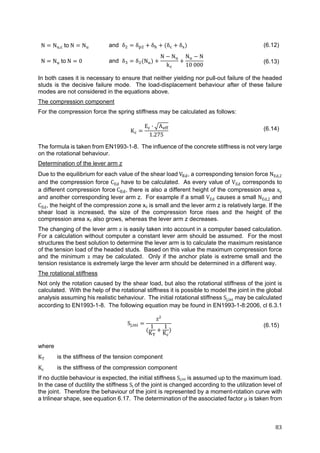
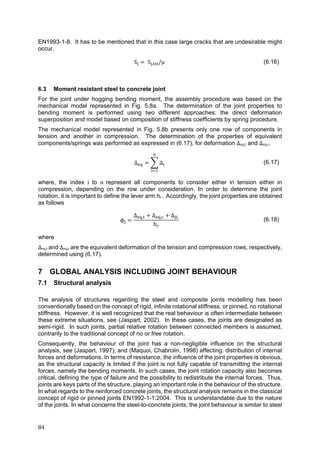
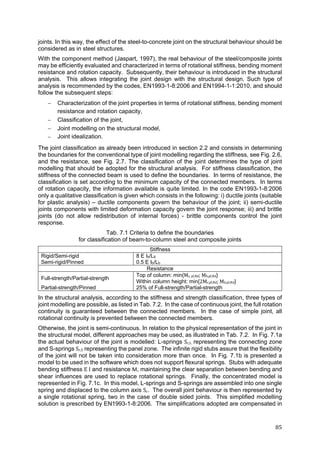
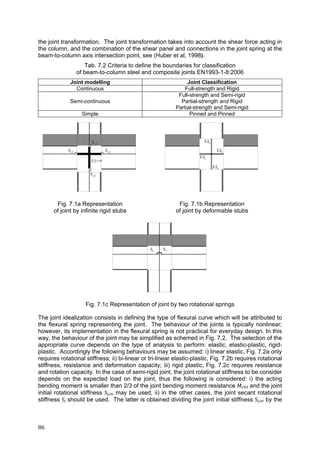
for N N , N/mm (3.4)
k 0	for	δ	 δ , e and N N , N/mm (3.5)
where
δRd,sy is displacement at yielding of the shaft, see Eq. (3.1) [mm]
εsu is maximum elongation capacity of the shaft, 0.8 % [-]
3.1.2 Headed studs in tension, component CC
The component concrete breakout in tension is described using the design load NRd,c for
concrete cone failure and the displacement in the softening branch after failure. Up to the
design load the component can´t be assumed as absolutely rigid without any displacement.
The displacement corresponding to design load is given by
26	
δ ,
N ,
k ,
[mm] (3.6)
The design load at concrete cone failure is calculated as
N , N , ψ , ψ ,
ψ ,
γ
[N] (3.7)
where
N , is characteristic resistance of a single anchor without edge and spacing effects
N , k h .
f .
[N] (3.8)
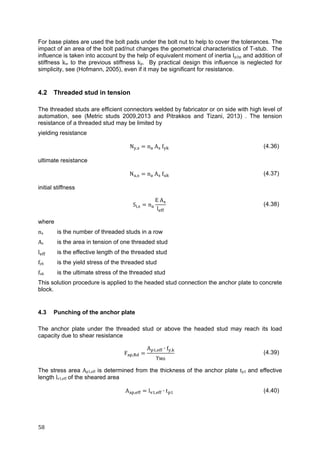
where
k1 is basic factor 8.9 for cracked concrete and 12.7 for non-cracked concrete [-]
hef is embedment depth given according to the product specifications [mm]
fck is characteristic concrete strength according to EN206-1:2000 [N/mm²]
ψ , is factor accounting for the geometric effects of spacing and edge distance [-]
ψ ,
,
,
[-] (3.9)
where
ψ , is factor accounting for the influence of edges of the concrete member on the
distribution of stresses in the concrete
ψ , 0.7 0.3
c
c ,
1 (3.10)
where
ψ , is factor accounting for the negative effect of closely spaced reinforcement in the
concrete member on the strength of anchors with an embedment depth hef	 	100 mm
0.5	 	hef	/	200 for s	 	150 mm (for any diameter) [-]
or s	 	100 mm (for ds	 	10 mm)
1.0 for s	 	150	mm (for any diameter) [-]
γMc is 1.5 for concrete [-]
A , is reference area of the concrete cone of an individual anchor with large spacing and
edge distance projected on the concrete surface [mm²]. The concrete cone is idealized
as a pyramid with a height equal to hef and a base length equal to scr,N with
s , 3.0 h [mm] (3.11)
c , 	 	0.5 s , 1.5 h [mm] (3.12)
where
Ac,N is actual projected area of concrete cone of the anchorage at the concrete surface,
limited by overlapping concrete cones of adjacent anchors, s	 	scr,N, as well as by edges
of the concrete member, c	 	ccr,N. It may be deduced from the idealized failure cones
of single anchors [mm²]
To avoid a local blow out failure the edge distance shall be larger than 0.5	hef. Due to sudden
and brittle failure, the initial stiffness for concrete cone is considered as infinity, i.e. till the actual
load, Nact is less than or equal to the design tension resistance for concrete cone, the
27	
displacement c	is zero. Once the design load is exceeded, the displacement increases with
decreasing load, descending branch. Thus, the load-displacement behaviour in case of
concrete cone breakout is idealized as shown in Fig. 3.2.
Fig. 3.2 Idealized load-displacement relationship for concrete cone breakout in tension
The stiffness of the descending branch kc,de for the design is described with the following
function
k , α 	 f 	h ψ , ψ , ψ , [N/mm] (3.13)
where
αc is factor of component concrete break out in tension, currently αc	 	‐537
hef is embedment depth of the anchorage [mm]
fck is characteristic concrete compressive strength [N/mm²]
Ac,N is projected surface of the concrete cone [mm2]
A , projected surface of the concrete cone of a single anchorage [mm2]
The displacement δc as a function of the acting load Nact is described using the design
resistance and the stiffness of the descending branch.
For ascending part
N N , and δc 0 (3.14)
For descending branch
δ 0	mm and δ
N N ,
k ,
(3.15)
3.1.3 Stirrups in tension, component RS
The component stirrups in tension was developed based on empirical studies. Therefore the
tests results were evaluated to determine the displacement of the stirrups depending on the
load Nact acting on the stirrup. The displacement is determined like given in the following
equation
δ , ,
2 N , ,
α f d , n
[mm] (3.16)
where
Nact
NRd,c
kc,de
δc
1
28	
αs	 is factor of the component stirrups, currently αs	 	12	100 [-]
NRd,s,re is design tension resistance of the stirrups for tension failure [N]
ds,re		 is nominal diameter of thereinforcement leg [mm]
fck is characteristic concrete compressive strength [N/mm²]
nre is total number of legs of stirrups [-]
The design load for yielding of the stirrups is determined as given
N , , A , f , n π
d ,
4
f , [N] (3.17)
where
As,re	 is nominal cross section area of all legs of the stirrups [mm²]
ds,re is nominal diameter of the stirrups [mm]
fyd is design yield strength of the shaft material of the headed stud [N/mm²]
nre is total number of legs of stirrups [-]
Exceeding the design steel yielding strength fyd,re the elongation will increase with no significant
increase of the load up to a strain limit εsu,re of the stirrups. For the design this increase of
strength is neglected on the safe side. In general reinforcement steel stirrups shall have an
elongation capacity of at least εsu,re = 2,5 %. So the design strain limit εsu,re is assumed to be
2.5 %. The displacement as a function of the acting load is determined as
k ,
n 	α 	f d ,
√2	δ
for δ δ , , [N/mm]
(3.18)
k , 0			 for		δ δ , , ε , [N/mm] (3.19)
3.1.4 Stirrups in tension - bond failure, component RB
The displacement of the concrete component stirrups in tension is determined under the
assumption that bond failure of the stirrups will occur. This displacement is calculated with
equation (3.19) as
δ , ,
2 N , ,
α f d , n
[mm] (3.20)
where
αs	 is factor of the component stirrups, currently αs	 	12	100 [-]
NRd,b,re is design tension resistance of the stirrups for bond failure [N]
ds,re is nominal diameter of the stirrups [mm]
fck is characteristic concrete compressive strength [N/mm²]
The design anchorage capacity of the stirrups according CEN/TS-model [5] is determined the
design tension resistance of the stirrups for bond failure
N , , n ,
l π d , f
α
[N] (3.21)
where
ns,re	 is number of legs [-]
29	
l1 is anchorage length [mm]
ds,re	 is nominal diameter of the stirrups [mm]
fbd	 is design bond strength according to EN1992-1-1:2004 [N/mm²]
α	 is factor according to EN1992-1-1:2004 for hook effect and large concrete cover,
currently 0.7 · 0.7 = 0.49 [-]
k ,
n 		α 	f d ,
√2	δ
for δ δ , , [N/mm]
(3.22)
k , 0				for	δ δ , , ε , [N/mm] (3.23)
3.1.5 Headed studs in tension, component P
The pull out failure of the headed studs will take place if the local stresses at the head are
larger than the local design resistance. Up to this level the displacement of the headed stud
will increase due to the increasing pressure under the head.
δ , , k ∙
N ,
A ∙ f ∙ n
[mm] (3.24)
δ , , 2	k ∙
min N , ; N ,
A ∙ f ∙ n
δ , , [mm] (3.25)
k α ∙
k ∙ k
k
(3.26)
where
Ah	 is area on the head of the headed stud [mm²]
A
π
4
∙ d d (3.27)
where
ka	 is form factor at porous edge sections [-]
k 5/a 1 (3.28)
where
ap is factor considering the shoulder width [mm]
a 0.5 ∙ d d (3.29)
where
kA is factor considering the cross section depending on factor ka [-]
k 0.5 ∙ d m ∙ d d 0.5 ∙ d (3.30)
where
n is number of the headed studs [-]
30	
αp is factor of the component head pressing, currently is αp	 	0.25 [-]
k2 is factor for the headed studs in non-cracked concrete, currently 600 [-]
is factor for the headed studs in cracked concrete, currently 300 [-]
m is pressing relation, m	 	9 for headed studs [-]
dh is diameter of the head [mm]
ds is diameter of the shaft [mm]
NRd,p is design load at failure in cases of pull out
N , n p A /γ (3.31)
where
puk is characteristic ultimate bearing pressure at the headed of stud [N/mm2]
NRd,c is design load for concrete cone failure without supplementary reinforcement
N , 	N , ψ , ψ ,
ψ ,
γ
[N] (3.32)
where
NRd,re design load at failure of the supplementary reinforcement minimum value of
N , , A , 	f , n	π	 ,
f , and N , , ∑
∙ ∙ , ∙
,
[N] (3.33)
The stiffness as a function of the displacement is determined as
k ,
A f n
δ k
[N/mm] (3.34)
k , 	
A 	f n δ δ ,
2 δ k
[N/mm] (3.35)
k , min N , ; N , /δ k , 1 δ , , /δ [N/mm] (3.36)
The stiffness kp,de depends on the failure modes. If the supplementary reinforcement fails by
yielding (NRd,s,re	 	NRd,b,re and NRd,s,re	 	NRd,p) the design stiffness kp,de is assumed as 104 N/mm²,
negative due to descending branch.
In all other cases (e.g. NRd,s,re	 	NRd,b,re or NRd,s,re	 	NRd,p) kp,de shall be assumed as infinite due to
brittle failure. The stiffness in case of pull out failure is calculated using the minimum value of
the stiffness’s calculated with equation (3.34) to (3.36).
k , min k , ; k , ; k , [N/mm] (3.37)
3.1.6 Headed studs in shear, component V
The load-displacement behaviour mainly depends on the pressure to the concrete near the
surface of the concrete member. Due to concrete crushing at the surface of the concrete
member, the displacement under shear loading varies very large with a coefficient of variation
about 40 % to 50 %. However a semi-empirical calculation shows that the displacement at
failure mainly depends on the acting loading, the diameter of the anchors and the embedment
31	
depth. Therefore the displacement under shear loading for a given load level is calculated,
see (Hofmann 2005), using the following equation only as an estimation
δ , k
V
d
h .
[mm] (3.38)
where
kv empirical value depending on the type of anchor [-], for headed studs	kv	 	2 to 4
VRd design failure load as the minimum of the design failure loads calculated for the different
failure modes (VRd,s, VRd,cp, VRd,c , VRd,p) given according to the technical product
specification CEN/TS 1992-4-1 or (FIB Bulletin 58, 2011)
The displacement at ultimate load up three times larger than the displacement at the design
load level due to the assumption, that the concrete near the surface is not fully crushed at
design load level.
3.2 Combination of components
To come up with the total stiffness of the connection with headed studs anchored in concrete
with or without supplementary reinforcement, the stiffness’s must be combined. The
combination depends on whether the components are acting in parallel, equal displacements,
or in serial, equal load. Three combinations are given, see (Hofmann, 2005):
Combination C1
Concrete cone failure with or without supplementary reinforcement, ks,re	= 0 and kb,re	= 0
Combination C2
Displacement due to steel elongation and head pressure, pull out
Combination C3
Total connection of headed studs anchored in concrete with supplementary reinforcement
Fig. 3.3 Combinations of different single components
for an anchorage with supplementary reinforcement
3.2.1 Combination of concrete cone and stirrups, C1 = CC + RS/RB
If both components are summarized, the load is calculated using the sum of the loads at the
same displacement due to the combination of the components using a parallel connection
32	
from the rheological view. Two ranges must be considered. The first range is up to the load
level at concrete failure NRd,c the second up to a load level of failure of the stirrups NRd,s,re or
NRd,b,re.
k . k k , ∞ for N N , [N/mm] (3.39)
This leads to the following equation
k .
n 	α 	f d ,
√2	δ
for N N , [N/mm]
(3.40)
In the second range the load is transferred to the stirrups and the stiffness decreases. The
stiffness is calculated if Nact is larger than NRd,c with the following equation
k . k k , for N N , [N/mm] (3.41)
This leads to a relative complex equation
k .
N ,
δ
k , k ,
δ ,
δ
n α f d ,
√2 δ (3.42)
for	N N , , N , , [N/mm]
If the load exceeds the ultimate load given by NRd,s,re or NRd,b,re the stiffness of the stirrups are
negligible. Therefore the following equation applies:
k . k k , 0			for N N , , N , , [N/mm] (3.43)
3.2.2 Combination of steel and pullout, C2 = S + P
If both components are summarized the load is calculated using the sum of the displacements
at the same load Nact due to the combination of the components using a serial connection from
the rheological view. This is done by summing up the stiffness’s as given below
k
1
k
1
k
[N/mm] (3.44)
This loads to the following equation
k
L
A , E
1
k
L
A , E
1
min k ; k ; k
[N/mm] (3.45)
where
kp is the minimum stiffness in case of pullout failure as the minimum of kp1,	kp2	and kp3
33	
3.2.3 Combination of all components, C3 = CC + RS/RB + P +S
To model the whole load- displacement curve of a headed stud embedded in concrete with a
supplementary reinforcement the following components are combined:
concrete and stirrups in tension, components CC and RB/RS, as combination C1,
shaft of headed stud in tension, component S, and
pull-out failure of the headed stud component P as Combination 2.
The combinations C1 and C2 is added by building the sum of displacements. This is due to
the serial function of both components. That means that these components are loaded with
the same load but the response concerning the displacement is different. The combination of
the components using a serial connection leads to the following stiffness of the whole
anchorage in tension:
1/k 1/k 1/k [N/mm] (3.46)
where
kC1 is the stiffness due to the displacement of the anchorage in case of concrete cone
failure with supplementary reinforcement, see combination C1 [N/mm], if no
supplementary reinforcement is provided kC1 is equal to kc
kC2 is the stiffness due to the displacement of the head, due to the pressure under the head
on the concrete, and steel elongation, see combination C2 [N/mm]
3.2.4 Design failure load
In principle two failure modes are possible to determine the design failure load NRd,C3 for the
combined model. These modes are failure of
the concrete strut NRd,cs,
the supplementary reinforcement NRd,re.
The design failure load in cases of concrete strut failure is calculated using the design load in
case of concrete cone failure and an increasing factor to consider the support of the
supplementary reinforcement, angle of the concrete strut,
N , ψ N , N (3.47)
where
NRd,c is design failure load in case of concrete cone failure, see Eq. 3.7 [N]
Ψsupport is support factor considering the confinement of the stirrups
2.5
x
h
1 (3.48)
where
x is distance between the anchor and the crack on the concrete surface assuming a crack
propagation from the stirrup of the supplementary reinforcement to the concrete surface
with an angle of 35° [mm]
34	
Fig. 3.4 Distance between the anchor and the crack on the concrete surface
The load is transferred to the stirrups and the concrete cone failure load is reached. Depending
on the amount of supplementary reinforcement the failure of the stirrups can decisive
NRd,re	 	NRd,cs. Two failure modes are possible:
steel yielding of stirrups NRd,s,re, see equation (3.16),
anchorage failure of stirrups NRd,b,re, see equation (3.20).
The corresponding failure load is calculated according to equation (3.49) summarizing the
loads of the corresponding components
N , min N , , ; N , , N , δ ∙ k , [N] (3.49)
where
NRd,c is design failure load in case of concrete cone failure, see equation (3.7), [N]
NRd,s,re is design failure load in case of yielding of the stirrups of the supplementary
reinforcement, see equation (3.16) [N]
NRd,b,re is design failure load in case of bond failure of the stirrups of the supplementary
reinforcement, see equation (3.20) [N]
kc,de is stiffness of the concrete cone in the descending branch, see equation (3.13) [N/mm]
δf is corresponding displacement at failure load NRd,s,re	or NRd,b,re [mm]
3.2.5 Combination of tension and shear components
The displacements in tension and shear is calculated by the sum of the displacement vectors.
3.3 Simplified stiffness’s based on technical specifications
3.3.1 Headed stud in tension without supplementary reinforcement
For simplification the displacements and the stiffness of headed studs or anchorages is
estimated using technical product specifications. The elongation δRd is estimated up to the
design load NRd using the displacements given in the technical product specification. The
displacement is estimated by the following equation
δ ,
δ ,
N
N (3.50)
where
δN,ETA is displacement given in the product specifications for a corresponding load
NETA is tension load for which the displacements are derived in the product specifications
35	
NRd is design tension resistance
The stiffness of the anchorage is calculated with the following equation
k ,
δ ,
N
(3.51)
where
δN,ETA is displacement given in the product specifications for a corresponding load
NETA is tension load for which the displacements are derived in the product specifications
3.3.2 Headed stud in shear
For the design the displacement δv is estimated up to the design load VRd using the
displacements given in the technical product specification. The displacement is estimated
using the displacements far from the edge δv,ETA for short term and long term loading. The
displacement is estimated by the following equation
δ ,
δ ,
V
V (3.52)
where
δV,ETA is displacement given in the product specifications for a corresponding load
VETA is shear load for which the displacements are derived in the product specifications
VRd,c is design shear resistance
The stiffness of the anchorage is calculated with the following equation
k ,
δ ,
V
(3.53)
where
δV,ETA is displacement given in the product specifications for a corresponding load
VETA is shear load for which the displacements are derived in the product specifications
3.3.3 Concrete breakout in tension
The characteristic load corresponding to the concrete cone breakout in tension for a single
headed stud without edge influence is given by equation
N , k h .
f (3.54)
where
k1 is basic factor for concrete cone breakout, which is equal to 8.9 for cracked concrete
and 12.7 for non-cracked concrete, for headed studs, [-]
hef is effective embedment depth given according to the product specifications [mm] [-]
fck is characteristic concrete strength according to EN206-1:2000 [N/mm²]
The design load for concrete cone breakout for a single anchor, N , is obtained by applying
partial safety factor of concrete γ to the characteristic load as
36	
N ,
N ,
γ
(3.55)
For concrete, the recommended value of is γ = 1.5.
For a group of anchors, the design resistance corresponding to concrete cone breakout is
given by equation (3.56), which is essentially same as equation (3.7)
N , N , ψ , ψ , ψ , /γ (3.56)
where
N , is characteristic resistance of a single anchor without edge and spacing effects
ψ , is factor accounting for the geometric effects of spacing and edge distance
given as ψ , 	 ,
,
A , is reference area of the concrete cone for a single anchor with large spacing and
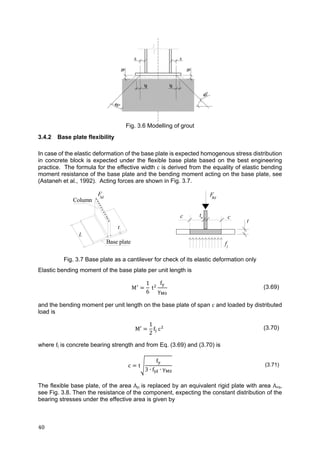
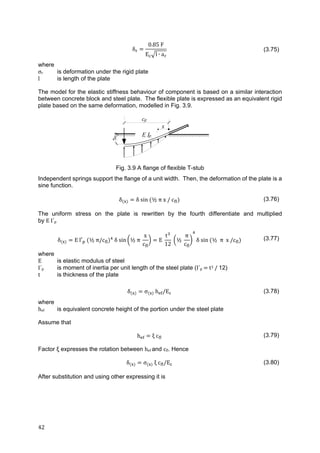
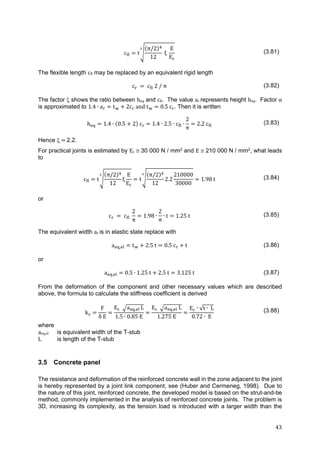
edge distance projected on the concrete surface [mm²].
The concrete cone is idealized as a pyramid with a height equal to hef	and a base
length equal to scr,N with s , 3.0	h , thus A , 9	h .
A , is reference area of the concrete cone of an individual anchor with large spacing and
edge distance projected on the concrete surface [mm²].
The concrete cone is idealized as a pyramid with a height equal to hef and a base
length equal to scr,N with s , 	 	3,0	h 	 mm 	
Ac,N is actual projected area of concrete cone of the anchorage at the concrete surface,
limited by overlapping concrete cones of adjacent anchors s	 	scr,N,
as well as by edges of the concrete member c	 	ccr,N.
It may be deduced from the idealized failure cones of single anchors [mm²]
c is minimum edge distance c	 	1.5	hef [mm]
ccr,N is critical edge distance ccr,N	 	1.5	hef [mm]
ψre,N is factor accounting for the negative effect of closely spaced reinforcement in the
concrete member on the strength of anchors with an embedment depth hef	< 100 mm
0.5 +	hef	/ 200 for s	 150 mm, for any diameter [-]
or s	< 100 mm, for ds ≤ 10 mm
1.0 for s	 150 mm (for any diameter) [-]
γMc is 1.5 for concrete [-]
3.3.4 Pull out failure of the headed studs
The design load corresponding to the pull out failure of the headed stud, NRd,p is given by
N , p A /γ (3.57)
where
puk is characteristic ultimate bearing pressure at the head of stud [N/mm2]
Ah is area on the head of the headed stud [mm²]
A
π
4
∙ d d (3.57b)
dh is diameter of the head [mm]
ds is diameter of the shaft [mm]
γMc is 1.5 for concrete [-]
37	
3.3.5 Interaction of components for concrete and stirrups
In case of headed stud anchored in concrete with supplementary reinforcement, stirrups, the
stirrups do not carry any load till the concrete breakout initiates, i.e. till Nact is less than or equal
to NRd,c. Once, the concrete breakout occurs, the load shared by concrete decreases with
increasing displacement as depicted in Fig. 3.4. The load shared by concrete Nact,c
corresponding to a given displacement δ is therefore given by equation
N , N , k , δ (3.57)
where kc,de is the slope of descending branch of Fig. 3.4, negative value, given by Eq. (3.7).
Simultaneously, in case of concrete with supplementary reinforcement, the stirrups start to
carry the load. The load carried by the stirrups corresponding to a given displacement δ is
given by equation
N , n d ,
α f δ
2
(3.58a)
where
s is factor of the component stirrups, currently is αs = 12 100 [-]
ds,nom is nominal diameter of the stirrups [mm]
fck is characteristic concrete compressive strength [N/mm²]
nre is total number of legs of stirrups [-]
The total load Nact carried by concrete cone and stirrups corresponding to any given
displacement δ is therefore given as the sum of the two components:
N N , N , N , k , δ min n d ,
α f δ
2
; N , , ;	N , ,
(3.59)
The displacement corresponding to peak load of the system is obtained by differentiating the
right hand side of Eq. (3.60) and equating it to zero. If the bond failure or steel failure of stirrups
is not reached at an earlier displacement then the design peak load carried by the system Nu,c s
is given by
N , N ,
,
,
(3.60)
where
NRd,c is design load at concrete cone failure given by equation (3.7)
s is factor of the component stirrups, currently is s = 12 100 [-]
ds,re is Nominal diameter of the stirrups [mm]
fck is characteristic concrete compressive strength [N/mm²]
nre is total number of legs of stirrups [-]
kc,de is stiffness of descending branch for concrete cone failure, given by eq. (3.13)
In a relatively rare case of all studs loaded in tension, both the legs of the hanger reinforcement
are not uniformly loaded and the distribution of forces is difficult to ascertain. Due to this reason
and also to avoid the problems with serviceability requirements, it is recommended that in such
a case, the contribution of hanger reinforcement is ignored.
38	
3.3.6 Determination of the failure load
The failure load Nu is given by the minimum of the failure load corresponding to each
considered failure mode
3.3.7 Friction
For base plates the friction is defined in EN1993-1-8 cl 6.2.2. For the resistance the resistance
values of friction and bolts may be added as long as the bolt holes are not oversized. For the
friction between a base plate and the grout underneath the plate the following calculation may
be used.
F , C , N , (3.61)
where
C , is coefficient for friction, for sand-cement mortar C , 0.2
N , is axial compressive force of the column
In this design manual the friction is not only applied to compression forces caused by axial
forces but also for compression forces generated by bending moments. This principle is
applied in EN1993-1-8:2006 for beam to the column end joints with end plates in cl 3.9.2(3).
3.4 Base plate in bending and concrete block in compression
3.4.1 Concrete 3D strength
The components concrete in compression and base plate in bending represent the behaviour
of the compressed part of a steel to concrete connection. The resistance of these components
depends primarily on the bearing resistance of the concrete block under the flexible base plate,
see (Melchers, 1992). The resistance of concrete is influenced by flexibility of base plate. In
case of loading by an axial force, the stresses in concrete are not uniformly distributed, they
are concentrated around the footprint of the column under the plate according to its thickness,
see (Dewolf, Sarisley, 1980). For the design the flexible base plate is replaced by reducing
the effective fully rigid plate. The grout layer between the base plate and concrete block
influences the resistance and stiffness of the component. That is why this layer is also included
into this component, see (Penserini, Colson, 1989). Other important factors which influence
the resistance are the concrete strength, the compression area, the location of the plate on the
concrete foundation, the size of the concrete block and its reinforcement.
The stiffness behaviour of column base connection subjected to bending moment is influenced
mostly by elongation of anchor bolts. The Component concrete in compression is mostly stiffer
in comparison to the component anchor bolts in tension. The deformation of concrete block
and base plate in compression is important in case of dominant axial compressive force.
The strength of the component FRd,u, expecting the constant distribution of the bearing stresses
under the effective area, is given by
F , A f (3.62)
The design value of the bearing strength fjd in the joint loaded by concentrated compression,
is determined as follows. The concrete resistance is calculated according to cl. 6.7(2) in
EN1992-1-1:2004 see Fig. 3.6 is
39	
F , A f
A
A
3.0 A f (3.63)
where
A 	 b 	d and A b d (3.64)
where Ac0 is the loaded area and Ac1 the maximum spread area. The influence of height of the
concrete block to its 3D behaviour is introduced by
h 	 b2 	b1 and h d2 d1
3	b 	 b and 3 d d
(3.65)
Load axes
Fig. 3.5 Concrete compressive strength for calculation of 3D concentration
From this geometrical limitation the following formulation is derived
f
β 	F ,
b l
β 	A 	f
A
A
A
β f k
3 A f
A
3.0 f
(3.66)
The factor j represents the fact that the resistance under the plate might be lower due to the
quality of the grout layer after filling. The value 2/3 is used in the case of the characteristic
resistance of the grout layer is at least 0.2 times the characteristic resistance of concrete and
thickness of this layer is smaller than 0.2 times the smallest measurement of the base plate.
In different cases, it is necessary to check the grout separately. The bearing distribution under
45° is expected in these cases, see (Steenhuis et al, 2008) and Fig. 3.5 Concrete compressive
strength for calculation of 3D concentration
Fig. 3. The design area Ac0 is conservatively considered as the full area of the plate	Ap.
40	
Fig. 3.6 Modelling of grout
3.4.2 Base plate flexibility
In case of the elastic deformation of the base plate is expected homogenous stress distribution
in concrete block is expected under the flexible base plate based on the best engineering
practice. The formula for the effective width c is derived from the equality of elastic bending
moment resistance of the base plate and the bending moment acting on the base plate, see
(Astaneh et al., 1992). Acting forces are shown in Fig. 3.7.
Fig. 3.7 Base plate as a cantilever for check of its elastic deformation only
Elastic bending moment of the base plate per unit length is
M
1
6
t
f
γ
(3.69)
and the bending moment per unit length on the base plate of span c and loaded by distributed
load is
M′
1
2
f c (3.70)
where fj is concrete bearing strength and from Eq. (3.69) and (3.70) is
c t
f
3 ∙ f ∙ γ
(3.71)
The flexible base plate, of the area Ap, is replaced by an equivalent rigid plate with area Aeq,
see Fig. 3.8. Then the resistance of the component, expecting the constant distribution of the
bearing stresses under the effective area is given by
c
fj
Column
Base plate
F
t
c tw
Sd FRd
L
t
41	
F , A ∙ f (3.72)
The resistance FRd should be higher than the loading FEd
F F , (3.73)
Fig. 3.8 Effective area under the base plate
3.4.3 Component stiffness
The proposed design model for stiffness of the components base plate in bending and concrete
in compression is given also in (Steenhuis et al, 2008). The stiffness of the component is
influenced by factors: the flexibility of the plate, the Young´s modulus of concrete, and the size
of the concrete block. By loading with force, a flexible rectangular plate could be pressed down
into concrete block. This flexible deformation is determined by theory of elastic semi-space
δ
F α a
E A
(3.74)
where
F is acting load
α is shape factor of the plate
ar	 is width of equivalent rigid plate
Ec is elastic modulus of concrete
Ap	 is area of the plate
The factor  depends on the material characteristics. The Tab. 3.1 gives values of this factor
dependent on the Poison's ratio, for concrete is 	 0.15. The table shows also the approximate
value of factor α, that is	0.58 ∙ L/a .
Tab. 3.1 Factor α and its approximation for concrete
l	/	ar	 α	 Approximation as α	 	0.58 ∙ L/a .
1 0.90 0.85
1.5 1.10 1.04
2 1.25 1.20
3 1.47 1.47
5 1.76 1.90
10 2.17 2.69
For steel plate laid on concrete block it is
Aeq
Ap
A
c cc
c
c
c
Aeq
Ap
A
Aeq
Ap
A
42	
δ
0.85 F
E l ∙ a
(3.75)
where
σr is deformation under the rigid plate
l is length of the plate
The model for the elastic stiffness behaviour of component is based on a similar interaction
between concrete block and steel plate. The flexible plate is expressed as an equivalent rigid
plate based on the same deformation, modelled in Fig. 3.9.
Fig. 3.9 A flange of flexible T-stub
Independent springs support the flange of a unit width. Then, the deformation of the plate is a
sine function.
δ δ sin ½ π x / c (3.76)
The uniform stress on the plate is rewritten by the fourth differentiate and multiplied
by E	I´p
δ E	l′ 	 ½ π/c 	δ	sin ½ π
x
c
E
t
12
½
π
c
δ sin ½ π x	/c (3.77)
where
E is elastic modulus of steel
I´p is moment of inertia per unit length of the steel plate (I´p	 	t3	/	12)
t is thickness of the plate
δ σ h /E (3.78)
where
hef is equivalent concrete height of the portion under the steel plate
Assume that
h ξ c (3.79)
Factor ξ expresses the rotation between hef and cfl. Hence
δ σ ξ c /E (3.80)
After substitution and using other expressing it is

E Ip
x
cfl
43	
c t
π/2
12
ξ
E
E
(3.81)
The flexible length cfl may be replaced by an equivalent rigid length
c c 2 / π (3.82)
The factor  shows the ratio between heq and cfl. The value ar represents height heq. Factor α
is approximated to 1.4 ∙ a t 2c 	and	t 0.5	c . Then it is written
h 1.4 ∙ 0.5 2 c 1.4 ∙ 2.5 ∙ c ∙
2
π
2.2 c (3.83)
Hence 	 	2.2.
For practical joints is estimated by Ec  30 000 N / mm2 and E  210 000 N / mm2, what leads
to
c t
π/2
12
ξ
E
E
t
π/2
12
2.2
210000
30000
1.98 t (3.84)
or
c 	 	c 	
2
π
1.98 ∙
2
π
∙ t 1.25 t (3.85)
The equivalent width ar is in elastic state replace with
a , t 2.5 t 0.5 c t (3.86)
or
a , 0.5 ∙ 1.25 t 2.5 t 3.125 t (3.87)
From the deformation of the component and other necessary values which are described
above, the formula to calculate the stiffness coefficient is derived
k
F
δ	E
E 		 a , L
1.5 ∙ 0.85 E
E a , L
1.275 E
E ∙ √t ∙ L
0.72 ∙ E
(3.88)
where
aeq,el is equivalent width of the T-stub
L is length of the T-stub
3.5 Concrete panel
The resistance and deformation of the reinforced concrete wall in the zone adjacent to the joint
is hereby represented by a joint link component, see (Huber and Cermeneg, 1998). Due to
the nature of this joint, reinforced concrete, the developed model is based on the strut-and-tie
method, commonly implemented in the analysis of reinforced concrete joints. The problem is
3D, increasing its complexity, as the tension load is introduced with a larger width than the
44	
compression, which may be assumed concentrated within an equivalent dimension of the
anchor plate, equivalent rigid plate as considered in T-stub in compression. Thus, a numerical
model considering only the reinforced concrete wall and an elastic response of the material
has been tested to identify the flow of principal stresses. These show that compression
stresses flow from the hook of the longitudinal reinforcement bar to the anchor plate. In this
way the strut-and-tie model (STM) represented in Fig. 10a is idealized. Subsequently, in order
to contemplate the evaluation of the deformation of the joint, a diagonal spring is idealized to
model the diagonal compression concrete strut, as illustrated in Fig. 10. The ties correspond
to the longitudinal steel reinforcement bars. The properties of this diagonal spring are
determined for resistance and stiffness.
The resistance is obtained based on the strut and nodes dimension and admissible stresses
within these elements. The node at the anchor plate is within a tri-axial state. Therefore, high
stresses are attained as confinement effect. In what concerns the strut, because of the 3D
nature, stresses tend to spread between nodes. Giving the dimensions of the wall of infinite
width, the strut dimensions should not be critical to the joint. Thus, the node at the hook of the
bar is assumed to define the capacity of the diagonal spring. The resistance of the spring is
then obtained according to the dimensions of this node and to the admissible stresses in the
node and in the strut. For the latter, the numerical model indicates the presence of transverse
tension stresses which have to be taken into consideration.
The deformation of the diagonal spring is obtained by assuming a non-linear stress-strain
relation for the concrete under compression, as defined in (Henriques, 2012). The maximum
stress is given by the limiting admissible stress as referred above. Then, deformation is
calculated in function of the length of the diagonal strut and the concrete strain.
a) Strut-and-tie model
b) Single diagonal spring
Fig. 3.10 Joint link modelling
Tab. 3.2 provides the stresses for nodes and struts according to EN1992-1-1:2004. Node 1 is
characterized by the hook longitudinal reinforcement bar. The represented dimension is
assumed as defined in CEB-FIP Model Code 1990. In what concerns the width of the node,
based on the numerical observations, it is considered to be limited by the distance between
the external longitudinal reinforcement bars within the effective width of the slab. The numerical
model demonstrates that the longitudinal reinforcement bars are sufficiently close, as no
relevant discontinuity in the stress field is observed. Though, this is an issue under further
T
T C
C
Strut
Node 1
Node 2
11’
45	
investigation and depending on the spacing of the reinforcing bars, this assumption may or
may not be correct (Henriques, 2013).
Tab. 3.2 Stresses in strut-and-tie elements according to EN1992-1-1:2004
Element Limiting stresses
Node 1 0.75	ν	fcd
Node 2 3 ν fcd
Strut 0.6 ν fcd 																																with ν	 1 ‐	fck/250
Fig. 3.11 Definition of the dimension related to the hook
of the longitudinal reinforcement bar in Node 1, according to the CEB Model Code
Finally, to simplify the assembling of the joint model, the diagonal spring representing the joint
link component is converted into a horizontal spring. The properties of the horizontal spring
are directly obtained from the diagonal spring determined as a function of the angle of the
diagonal spring.
3.6 Longitudinal steel reinforcement in tension
In the composite joint configuration under consideration, the longitudinal reinforcement in
tension is the only component able to transfer tension forces introduced by the bending
moment to the supporting member e.g. a reinforced concrete wall. This component determines
the behaviour of the joint. According to EN1994-1 the longitudinal steel reinforcement may be
stressed to its design yield strength. It is assumed that all the reinforcement within the effective
width of the concrete flange is used to transfer forces. The resistance capacity of the
component may then be determined as in Eq. (3.89). Regarding the deformation of the
component, the code provides stiffness coefficients for two composite joint configurations,
single and double-sided joints. The stiffness coefficient for single-sided joints may be
estimated as in Eq. (3.90). This stiffness coefficient depends essentially on the elongation
length of the longitudinal reinforcement contributing to the deformation of the component.
Analogous to the code provisions, the dimension h involved in Eq. (3.90) is assumed as shown
in Fig. 3.12.
F , A , f (3.89)
k ,
A ,
3.6 h
(3.90)
41 °
2 02 .35 26
Fc
Ft1
Ft2
Ft1
Ft2
Fc
θ
r
46	
Fig. 3.12 Dimension h for elongation length
The tension component of the joint is calculated according to
F M , /h (3.91)
3.7 Slip of the composite beam
The slip of composite beam does not directly influence the resistance of the joint. However,
the level of interaction between concrete slab and steel beam defines the maximum load the
longitudinal reinforcement can achieve. Therefore in such joint configuration, where
reinforcement is the only tension component, the level of interaction affects the joint resistance.
In the EN1994-1-1:2008, the influence of the slip of composite beam is taken into account.
The stiffness coefficient of the longitudinal reinforcement, see Eq. (3.92) should be multiplied
with the reduction factor kslip determined as follows:
k
1
1
E k
k
(3.92)
K
N k
ϑ
ϑ 1
1 ξ
h
d
(3.93)
ϑ
1 ξ N k l d
E I
(3.94)
ξ
E I
d E A
(3.95)
where
hs	 is the distance between the longitudinal reinforcing bars and the centre of compression of
the joint, that may be assumed as the midpoint of the compression flange of the steel
beam
ds is the distance between the longitudinal reinforcing bars and the centroid of the steel beam
section, see Fig. 13
47	
Ia is the second moment area of the steel beam section
l is the length of the beam in hogging bending adjacent to the joint, in the case of the tested
specimens is equal to the beam’s length
N is the number of shear connectors distributed over the length l
ksc is the stiffness of one shear connector
Fig. 3.13 Dimensions hs and ds
4 STEEL COMPONENTS
4.1 T-stub in tension
The base plate in bending and anchor bolts in tension is modelled by the help of T-stub model
based on the beam to column end plate connection model. Though in its behaviour there are
some differences. Thickness of the base plate is bigger to transfer compression into the
concrete block. The anchor bolts are longer due to thick pad, thick base plate, significant layer
of grout and flexible embedding into concrete block. The influence of a pad and a bolt head
may be higher.
eff
Column flange
Base plate
F
t
e m

Fig. 4.1 The T stub - anchor bolts in tension and base plate in bending
Due to longer free lengths of bolts, bigger deformations could arise. The anchor bolts, compare
to bolts, are expecting to behave ductile. When it is loaded by tension, the base plate is often
separated from the concrete surface. This case is shown in (Wilkinson et al, 2009). By bending
moment loading different behaviour should be expected. The areas of bolt head and pad
change favourably distribution of forces on T-stub. This influence is not so distinctive during
calculation of component stiffness. The all differences from end plate connections are involved
48	
in the component method, see EN1993-1-8:2006. The design model of this component for
resistance as well for stiffness is given in (Wald et al, 2008).
Lbf
L
d
be
Lb
Fig. 4.2 Length of anchor bolt
4.1.1 Model
When the column base is loaded by bending moment as it is shown in Fig. 4.3, anchor bolts
transfer tensile forces. This case of loading leads to elongation of anchor bolts and bending
of the base plate. Deformed bolts can cause failure as well as reaching of the yield strength
of the base plate. Sometimes failure in this tensile zone is caused by both, see (Di Sarno et
al, 2007).
Fig. 4.3 Tensile zone and equivalent T-stub in case of loading by bending moment
Column with connected base plate taken, as it is shown in Fig. 4.4, into model of T-stub.
nm
F
Q = 0 Q = 0
Fig. 4.4 T-stub separated from the concrete block with no prying force
There are two models of deformation of the T-stub of the base plate according to presence of
prying. In the case the base plate separated from the concrete foundation, there is no prying
force Q, see Fig. 4.4. In other case, the edge of the plate is in contact with concrete block, the
bolts are loaded by additional prying force Q. This force is balanced just by the contact force
at the edge of the T-stub, see Fig. 4.5.
When there is contact between the base plate and the concrete block, beam theory is used to
describe deformed shape of the T-stub.
49	
Fig. 4.5 Beam model of T-stub and prying force Q
Deformed shape of the curve is described by differential equation
E I δ" M (4.1)
After writing the above equation for both parts of the beam model 1 and 2, application of
suitable boundary conditions, the equations could be solved. The prying force Q is derived just
from these solved equations as
Q
F
2
∙
3 m n A 2 L I
2	n A 3 m n 3 L I
(4.2)
When the base plate is in contact with concrete surface, the prying of bolts appears and on the
contrary no prying forces occur in the case of separated base plate from the concrete block
due to the deformation of long bolts. This boundary, between prying and no prying has to be
determined. Providing that n	 	1.25 m	it may be expressed as
L ,
8.82 m A
l t
L (4.3)
where
As is the area of the bolt
Lb	 is equivalent length of anchor bolt
leff	 is equivalent length of T-stub determined by the help of Yield line method, presented in
following part of work
For embedded bolts length Lb is determined according to Fig. 4.2 as
L L L (4.4)
where
Lbe is 8 d effective bolt length
When the length of bolt L L , there is no prying. Previous formulae is expressed for
boundary thickness tlim, see (Wald et al, 2008), of the base plate as
t 2.066 m ∙
A
l L
(4.5)
F
2
F
2
+ Q
Q
+ x
2
1
50	
If the base plate are loaded by compression force and by bending moment and not by tensile
force it is recommended to neglect these prying forces. In other cases it needs to be checked.
4.1.2 Resistance
The design resistance of a T-stub of flange in tension of effective length ℓeff is determined as
minimum resistance of three possible plastic collapse mechanisms. For each collapse
mechanism there is a failure mode. Following collapse modes, shown in Fig. 4.6, is used for
T-stub in contact with the concrete foundation, see in EN1993-1-8:2006.
F
B
Rd.3
t.Rd
Bt.Rd
F
B
Rd.1
B
Q Q
e
n m
Q Q
Bt.RdBt.Rd
FRd.2
Mode 3 Mode 1 Mode 2a) b) c)
Fig. 4.6 Failure modes of the T-stub in contact with the concrete foundation
Mode 1
According to this kind of failure the T-stub with thin base plate and high strength anchor bolts
is broken. In the base plate plastic hinge mechanism with four hinges is developed.
F ,
4 l m ,
m
(4.6)
Mode 2
This mode is a transition between failure Mode 1 and 3. At the same time two plastic hinges
are developed in the base plate and the limit strength of the anchor bolts is achieved.
F ,
2 l m , Σ B , ∙ n
m n
(4.7)
Mode 3
Failure mode 3 occurs by the T-stub with thick base plate and weak anchor bolts. The collapse
is caused by bolt fracture.
F , Σ B , (4.8)
The design strength FRd of the T-stub is derived as the smallest of these three possible modes:
F min F , , F , , F , (4.9)
51	
Because of the long anchor bolts and thick base plate different failure mode arises compare
to an end plate connection. When the T-stub is uplifted from the concrete foundation, there is
no prying, new collapse mode is obtained, see Fig. 4.7. This particular failure mode is named
Mode 1-2.
F
B B
Rd,1-2
Fig. 4.7 T-stub without contact with the concrete foundation, Mode 1-2
Mode 1-2
The failure results either from bearing of the anchor bolts in tension or from the yielding of the
plate in bending, where a two hinges mechanism develops in the T-stub flange. This failure
does not appear in beam to column connection because of the small deformation of the bolts
in tension, see (Wald et al, 2008).
F ,
2 l m ,
m
(4.10)
The relationship between Mode 1-2 and modes of T-stub in contact with concrete is shown in
Fig. 4.8.
F B/  T,Rd
0,0
0,2
0,4
0,6
0,8
1,0
0 0,5 1 1,5 2
Mode1
Mode 2
Mode 3
Mode 1-2
4 eff mpl,Rd /  BT,Rd
Fig. 4.8 Failure mode 1-2
The boundary between the mode 1-2 and others is given in the same way like the boundary of
prying and no prying – according to the limiting bolt length Lb,min.
During the Mode 1-2 large deformations of the base plate can develop. Finally these
deformations could lead to contact between the concrete block and the edge of the T-stub
(prying forces can arise even in this case). After loading Modes 1 or 2 should be obtained like
the first. But for reaching this level of resistance, which is necessary to obtain these modes,
very large deformations are required. And so high deformations are not acceptable for design.
In conclusion, in cases where no prying forces develop, the design resistance of the T-stub is
taken as
52	
F min F , , F , (4.11)
where
F , ΣB , (4.12)
The equivalent length of T-stub leff, which is very important for the resistance determination, is
calculated by the help of the yield line method, which is explained in the following part of the
work.
Yield line method
Although numerical methods, based on extensive use of computers, are potentially capable of
solving the most difficult plate problems, yield-line analysis is such an alternative computational
technique (Thambiratnam, Paramasivam, 1986). It provides such an alternative design
method for plates. This simple method, which uses concepts and techniques familiar to
structural engineers, provides realistic upper bounds of collapse loads even for arbitrary
shapes and loading conditions. The advantages of the yield-line method are: simplicity and
economy, information is provided on the real load-carrying capacity of the slab, the basic
principles used are familiar to structural engineers, the method also gives acceptable estimates
for the ultimate load-carrying capacity of structural steel plates, and resulting designs are often
more economical. On the other hand, the present limitations of the method are: the method
fails in vibration analysis and cannot be used in the case of repeated static or dynamic loads
(but is applied effectively for suddenly applied one-time loads), and theoretically, the law of
superposition is not valid. The yield-line method offers, especially for the practicing engineer,
certain advantages over the elastic stress analysis approaches.
Assumptions
The correct failure pattern is known, the critical load is obtained either from virtual work or from
equilibrium considerations. Both approaches use the following basic assumptions: at
impending collapse, yield lines are developed at the location of the maximum moments, the
yield lines are straight lines, along the yield lines, constant ultimate moments mu are
developed, the elastic deformations within the slab segments are negligible in comparison with
the rigid body motions, created by the large deformations along the yield lines, from the many
possible collapse mechanisms, only one, pertinent to the lowest failure load, is important. In
this case the yield-line pattern is optimum, when yield lines are in the optimum position, only
ultimate bending moments, but no twisting moments or transverse shear forces are present
along the yield lines. The location and orientation of yield lines determine the collapse
mechanism. The Fig. 4.9 introduces an example of yield line.
Free edge
Fig. 4.9 Possible yield line patterns
53	
The work method
The work method, see (Johansen, 1949), gives an upper-bound solution to the critical load at
which the slab, with a certain ultimate resisting moment, fails. A particular configuration is
searched, from a family of possible yield-line patterns which gives the lowest value of the
ultimate load. The solution is based on the principle of virtual work.
The effective length of T-stub
The effective length leff of a T-stub is influenced by the failure mode of the T-stub. When there
are more than one possible failure modes, it means more than one effective length, the
calculation is done with the smallest (shortest) length, see EN1993-1-8:2006. The Fig. 4.10
shows, that two groups of yield line patterns can arise circular yield line and non-circular yield
line. The main difference between these two types is related to contact between the T-stub
and concrete foundation. By the non-circular patterns prying forces are developed. In this work
there are taken into account only the modes without the contact of the edge of the base plate
to the concrete foundation, it means without prying forces in bolts.
Fig. 4.10 The yield line patterns
As it was written in previous paragraphs, the effective length could be determined by the yield
line method. Hence the yield line of the base plate must be designed. The collapse Mode 1
of the plate, which is shown in Fig. 4.11, is expected.
Fig. 4.11 Expected collapse mode
For this collapse mode there are following formulas:
m ,
1
4
t f (4.13)
tan θ
δ
m
θ (4.14)
F
4l m ,
m
(4.15)
where
mpl,Rd is plastic bending moment resistance of the base plate per unit length
Fpl	 is force acting in the bolt position
a) Circular pattern, eff,cp b) Non-circular pattern, eff,np
54	
The assumptions to determine the yield line of the base plate are following the yield line is a
straight line, this line is perpendicular to a line which pass through the bolt and tangent to the
column, or this line is tangent to the column and parallel to the edge of the base plate. With
these assumptions are determined. Following calculation procedure of the effective length of
the T-stub in plate corner is given in (Wald et al, 2000) and (Heinisuo et al, 2012).
Fig. 4.12 The yield line parameters
 represents the angle between the yield line and the edge and c the minimal distance between
the corner of the plate and the yield line. With the previous geometrical relation, the following
relations is obtained
tan α
x
y
(4.16)
where
x,	y are coordinates of the bolt, which could vary
For the design of the parameter c, the work method of the yield line theory is used. The internal
work is
W θ ; m ; 1 m
1
y
x
1
x
y (4.17)
The external work is
W P Δ F Δ (4.18)
where  represents the deformation of the plate in the bolt position, see Fig. 4.13.
Fig. 4.13 The deformation of the plate represented by value Δ
According to previous figure is Δ	replaced with
55	
Δ
1
d
c
x y
c
(4.19)
After replacement Δ in the formula of the external work and putting it into equality with the
internal work as
x y
c
F m
x
y
y
x
(4.20)
and then the effective length of the T-stub is
l
c m
4
x y
c
(4.21)
The ultimate load is given by
F c m
x y
x y
(4.22)
∂	F
∂	c
m
x y
x y
cst (4.23)
With the yield line assumption the characteristics of the different possible failure models could
be designed.
The effective length of T-stub
Two groups of yield line patterns called circular and non-circular yield lines are distinguished
in EN1993-1-8:2006. The major difference between circular and non-circular patterns is
related to contact between the T-stub and rigid foundation. The contact may occur only for
non-circular patterns and prying force will develop only in this case. This is considered in the
failure modes as follows:
Mode 1
The prying force does not have influence on the failure and development of plastic hinges in
the base plate. Therefore, the formula (4.2) applies to both circular and non-circular yield line
patterns.
Mode 2
First plastic hinge forms at the web of the T-stub. Plastic mechanism is developed in the base
plate and its edges come into contact with the concrete foundation. As a result, prying forces
develop in the anchor bolts and bolt fracture is observed. Therefore, Mode 2 occurs only for
non-circular yield line patterns, which allow development of prying forces.
56	
Fig. 4.14a The effective length of T-stub
for bolts inside the flanges
Fig. 4.14b The effective length of T-stub
for bolts outside the flanges
Mode 3
This mode does not involve any yielding of the plate and applies therefore to any T-stub. In the
design procedure, the appropriate effective length of the T-stub should be used for Mode 1
l , min l , ; l , (4.24)
and for Mode 2
l , min l , (4.25)
The design resistance of the T-stub is given by the formula (4.8). Tab. 4.1 and Tab. 4.2 indicate
the values of leff for typical base plates in cases with and without contact. See Fig. 4.14 for the
used symbols.
Tab. 4.1 The effective length leff	of a T-stub with bolts inside the flanges (Wald et al, 2008)
Prying case No prying case
l1	 	2	α	m	‐ 4	m	‐	1,25	e 	 l1 	2 α m	‐ 4 m	 	1,25	e 	
l2	 	2	π	m	 l2 	4 π	m	
leff,1	 	min	 l1;	l2 	 leff,1 	min	 l1;	l2 	
leff,2 	l1	 leff,2 	l1	
Tab. 4.2 Effective length leff	for bolts outside the flanges (Wald et al, 2008)
Prying case No prying case
l1	 	4	α	mx	 	1,25	ex	 l1 	4 α mx 	1.25	ex	
l2	 	2	π	mx	 l2 	2 π mx	
l3	 	0.5bp	 l3 	0.5	bp	
l4	 	0.5	w	 	2 mx	 	0.625	ex	 l4 	0.5 w	 	2 mx	 	0.625	ex	
l5	 	e	 	2	mx	 	0.625	ex	 l5 	e	 	2 mx 	0.625	ex	
l6	 	π mx	 	2	e	 l6 	2	π mx	 	4	e	
l7	 	π mx	 	w	 l7 	2	 π mx	 	w	 	
leff,1	 	min	 l1	;	l2	;	l3	;	l4	;	l5	;	l6	;	l7 leff,1 	min	 l1 ;	l2	;	l3	;	l4	;	l5	;	l6	;	l7	 	
leff,2	 	min	 l1 ;	l2	;	l3	;	l4	;	l5	 	 leff,2 	min	 l1 ;	l2	;	l3	;	l4	;	l5	 	
e m a, 280
bp
mx
ex
e w e
a, 280
57	
4.1.3 Stiffness
The prediction of the base plate stiffness is based on (Steenhuis et al, 2008). The stiffness of
the component analogous to the resistance of the T-stub is influenced by the contact of the
base plate and the concrete foundation (Wald et al, 2008). The formula for deformation of the
base plate loaded by the force in bolt Fb is
δ
1
2
F m
3EI
2F m
E ∙ l t
2F
E ∙ k
(4.26)
and deformation of the bolt is
δ
F L
E A
F
E k
(4.27)
The stiffness of the T-stub is written as
k
F
E δ δ
(4.28)
In following conditions cases prying force are appearing in the T-stub
A
L
l , t
8.82 m
(4.29)
Formulas for stiffness coefficient of the base plate and of the bolt are
k
l , t
m
0.85 l t
m
(4.30)
k 1.6
A
L
(4.31)
In case of no prying, it means when
A
L
l , t
8.82 m
(4.32)
Formulas are as following:
k
F
E	δ
l , t
2 m
0.425 l t
m
(4.33)
k
F
Eδ
2.0
A
L
(4.34)
The stiffness of the component of base plate in bending and bolts in tension is summarised
from above simplified predictions as
1
k
1
k ,
1
k ,
(4.35)
58	
For base plates are used the bolt pads under the bolt nut to help to cover the tolerances. The
impact of an area of the bolt pad/nut changes the geometrical characteristics of T-stub. The
influence is taken into account by the help of equivalent moment of inertia Ip,bp and addition of
stiffness kw to the previous stiffness kp. By practical design this influence is neglected for
simplicity, see (Hofmann, 2005), even if it may be significant for resistance.
4.2 Threaded stud in tension
The threaded studs are efficient connectors welded by fabricator or on side with high level of
automation, see (Metric studs 2009,2013 and Pitrakkos and Tizani, 2013) . The tension
resistance of a threaded stud may be limited by
yielding resistance
N , n A f (4.36)
ultimate resistance
N , n A f (4.37)
initial stiffness
S , n
E A
l
(4.38)
where
na	 is the number of threaded studs in a row
As	 is the area in tension of one threaded stud
l is the effective length of the threaded stud
fyk	 is the yield stress of the threaded stud
fuk is the ultimate stress of the threaded stud
This solution procedure is applied to the headed stud connection the anchor plate to concrete
block.
4.3 Punching of the anchor plate
The anchor plate under the threaded stud or above the headed stud may reach its load
capacity due to shear resistance
F ,
A , ∙ f ,
γ
(4.39)
The stress area Ap1,eff is determined from the thickness of the anchor plate tp1	and effective
length lv1,eff of the sheared area
A , l , ∙ t (4.40)
59	
Due to high bending of the threaded stud under the large deformations of the thin plate is
assumed the effective length of shear area as half of the circumference only
l , 2π ∙ a
d
2
(4.41)
where
aw	 is throat thickness of weld of threaded stud [mm]
dts is diameter of the headed/threaded stud [mm]
This failure is assumed at all places, where a stud loaded by tension force is welded directly
to a steel plate. The endless stiffness of this component should be assumed in calculations
as no visible significant deformation performs due to punching trough steel plate during
loading.
4.4 Anchor plate in bending and tension
The anchor plate is designed as a thin steel plate located at the top of concrete block and
loaded predominantly in compression and shear. By loading the column base by the bending
or tension is the anchor plate exposed to the tensile force from the treaded studs. If the
threaded studs are not located directly under the headed studs, which are embedded in
concrete, the anchor plate is exposed to bending, see Fig. 2.15. After the plastic hinges of the
T-stub are developed, the anchor plate between the plastic hinges is elongates by tensile force.
Base plate and anchor plate T stub plastic deformation under threaded stud
Plastic hinges at anchor plate Anchor plate elongation under the threaded stud
Fig. 4.15 Model of the anchor plate in bending and tension
The resistance of the component, see (Kuhlman et al, 2012), is not restricted to plastic
mechanism only. The deformed shape with the elongated anchored plate between the
threaded and headed studs is caring the additional load and may be taken into account. The
behaviour, till the plastic hinges are developed, is modelled as the based plate in bending with
help of T stub model, see Chapter 3.4. The anchor plate in tension resistance is
60	
F , , A , ∙
f
γ
t ∙ b , ∙
f
γ (4.42)
where
t is the thickness of the anchor plate
b , n ∙ d 2 ∙ √2 ∙ a is the anchor plate effective width
aw is throat thickness of weld of threaded stud
n1 is the number of treaded studs
d1 is the diameter of treaded stud
As the tensile force is developing in anchor plate the headed and threaded studs are exposed
to horizontal force, see in Fig. 4.16. The elastic-plastic deformation at the stage of full
plastification of the T stub is evaluated, see in Fig 4.17, by model of beam with four supports
and three plastic hinges, see Fig. 4.15. The elongation of the anchor plate allows the uplift of
the threaded stud. The model assumes that the supports, i.e. the headed and threaded studs,
don’t move in the horizontal direction and the headed stud in the vertical direction. E.g. the
horizontal force depends linearly to the vertical one, see Fig. 4.18 and Fig. 4.19. The resulting
horizontal force from tension in anchor plate is taken into account for evaluation of resistance
of the components in shear and for the interaction of shear and tensile resistances.
Fig. 4.16 Plastic hinges and bending moments in the anchor plate
In case of activation of the membrane action in anchor plate is verified the resistance of the
related components in tension in vertical direction and in shear in horizontal direction. In the
procedure is derived:
- the bending resistance of the anchor plate,
- the tensile resistance of the anchor plate,
- the bending and tensile deformation of the anchor plate.
and further is limited the resistance of the component anchor plate in bending and tension by
- the vertical resistance of the threaded stud (tensile and punching resistance) and the
headed studs (tensile resistance, concrete cone failure, stirrups failure, bond failure).
- the horizontal resistance of the threaded stud (shear and bearing resistance) and the
headed studs (shear and pry out resistance).
FEd
MEd
E	Ib
L
c
b1
( ) (
-
 
a	 b
b2
+ +Map,pl	
Map,pl	 Map,pl
Map,pl
Map,pl
Map,pl	
Map,pl
E	Ic
F FEd	 	bd	 	Med /b

Map,pl
 
) (
61	
- the interaction in the threaded stud (tension and shear resistances) and the headed studs
(tension and shear resistances).
The plastic resistance of the anchor plate is
M ,
l , t
4
f
γ
(4.43)
where
tp1 is thickness of the anchor plate [mm]
leff,1 is the effective width of the anchor plate [mm]
The effective width of the anchor plate is minimum of the
l , min
4 m 1.25 e
2 π m
5	n 	d ∙ 0.5
2	m 0.625	e 0.5	p
2	m 	 0.625	e e
π m 2 e
π m p
(4.44)
where 5	h 	d is the effective width of the T stub between the headed and threaded studs.
The vertical deformation of the anchor plate under bending may be assumed for a beam with
four supports and three plastic hinges as
δ
1
E	I
∙
1
6
∙ b ∙ M ,
1
E I
∙
1
3
∙ b ∙ c ∙ M ,
(4.45a)
The elastic part of the deformation is
δ ,
2
3
∙ δ
(4.45b)
The elastic-plastic part of the deformation, see Fig. 4.17, is
δ , 2.22 δ ,
(4.45c)
The force at the bending resistance of the anchor plate is evaluated from equilibrium of internal
forces
N ∙ δ ∙
b
b
M ∙
δ
b
2 ∙ M , ∙
δ
a
2 ∙ M , ∙
δ
b
(4.45)
N ∙ b M 2 ∙ M , ∙ b ∙
1
a
1
b
(4.46)
for M N ∙ e
is	N ∙ b N ∙ e 2 ∙ M , ∙ b ∙
1
a
1
b
(4.47)
62	
N 2 ∙ M , ∙ b ∙
1
a
1
b
b e
(4.48)
The vertical resistance of the component anchor plate in tension is limited by the resistance of
the components: threaded stud in tension, punching of the threaded stud and tensile resistance
of the anchor plate. For the thin anchor plate is decisive the punching of the threaded stud.
The deformed length of the anchor plate between the threaded and headed studs at the
resistance in punching of the anchor plate under the threaded stud is
a a ∆a a
a ∙ F ,
t ∙ b , ∙ E
(4.49)
Fig. 4.17 Linear relation of acting vertical forces Fv and vertical deformation δv
The component of vertical deformation by the elongation of the anchor plate, see Fig. 4.14, is
δ , δ , a a (4.50)
The component of the horizontal force at the resistance in punching of the anchor plate under
the threaded stud, see Fig. 4.18, is
F , ,
a
δ ,
∙ F , , (4.51)
Fig. 4.18 Linear relation of vertical Fv and horizontal forces	FH
The horizontal force F , is limited by shear resistance of the threaded and headed studs VRd,
see in Figs 4.19. The resistance to vertical force is
Fv	
δT
Ft,p,Rd	
δ	δp,tot
FT,pl	
FT,el	
δT,el	
Fp,1,Rd	
δp,1δT,pl
Fv	
Ft,p,Rd	
FHFp,Rd,H
FT,pl
63	
F , , F ,
F , , F ,
F , ,
V (4.52)
Fig. 4.19 Linear relation of vertical Fv	and horizontal forces FH at resistance
The interaction of the tensile and shear forces is verified for the threaded and headed studs,
see Tab. 3.4 in EN1993-1-8:2006 by
F ,
F ,
F ,
1.4 ∙ F ,
1 (4.53)
The interaction of tensile and shear forces is verified for the headed stud anchoring to concrete,
see Chapter 3.2.5 by
F ,
F ,
F ,
F ,
1 (4.54)
4.5 Column/beam flange and web in compression
The resistance of the column flange and web in compression may be expected as for the beam
flange, see Chapter 6.2.6.7 in EN1993-1-8:2006. In this model the column/beam web has its
full plastic resistance on the lever arm of column/beam flanges
F , ,
M ,
h t
(4.55)
in EN1993-1-8:2006 Eq. (4.1), where
Mc,Rd is the design moment resistance of the beam cross-section, see EN1993-1-1:2004
h is the depth of the connected column/beam
tf is the column/beam flange thickness
If the height of the column/beam including the haunch exceeds 600 mm the contribution of the
beam web to the design compression resistance should be limited to 20%. If a beam is
reinforced with haunches the proposal for design is in cl 6.2.6.7(2). The stiffness of this
component in compression is expected to be negligible.
Fv	
VRd
Ft,p,Rd	
FHFp,Rd,H
Fp,1,Rd	
FT,pl
64	
4.6 Steel contact plate
The resistance of the steel contact plate in joint may be taken as its full plastic resistance
F f , A (4.56)
where
fy,cp is the yield strength of the steel contact plate
Acp is the effective area of the contact plate under compression
A height or breadth of the contact plate exceeds the corresponding dimension of the
compression flange of the steel section, the effective dimension should be determined
assuming dispersion at 45° through the contact plate. It should be assumed that the effective
area of the contact plate in compression may be stressed to its design yield strength fyd, see
EN1994-1-1:2010. The stiffness of the component the steel contact plate is negligible
4.7 Anchor bolts in shear
In most cases the shear force is transmitted via friction between the base plate and the grout.
The friction capacity depends on the compressive normal force between the base plate and
the grout and the friction coefficient, see Chapter 3.3.7. At increasing horizontal displacement
the shear force increases till it reaches the friction capacity. At that point the friction resistance
stays constant with increasing displacements, while the load transfer through the anchor bolts
increases further. Because the grout does not have sufficient strength to resist the bearing
stresses between the bolts and the grout, considerable bending of the anchor bolts may occur,
as is indicated in Fig. 4.20, see (Bouwman et al, 1989). The tests shows the bending
deformation of the anchor bolts, the crumbling of the grout and the final cracking of the
concrete. Based on the work (DeWolf and Sarisley, 1980) and (Nakashima,1998) and of tests
(Bouwman et al, 1989) the analytical model for shear resistance of anchor bolts was derived
in EN1993-1-8 cl 6.2.2, see (Gresnight at al, 2008). Also, the preload in the anchor bolts
contributes to the friction resistance. However, because of its uncertainty, e.g. relaxation and
interaction with the column normal force, it was decided to neglect this action in current
standard.
Fig. 4.20 Test specimen loaded by shear force and tensile force
The design shear resistance Fv.Rd may be derived as follows
F , F , n F , (4.57)
65	
where
Ff,Rd is the design friction resistance between base plate and grout layer
Ff.Rd Cf,d Nc,Edv,Rd
(4.58)
Cf,d is the coefficient of friction between base plate and grout layer. The following values
may be used for sand-cement mortar Cf,d		= 0.20, see Chapter 3.3.7.
Nc,Sd is the design value of the normal compressive force in the column. If the normal force
in the column is a tensile force Ff,Rd = 0
n is the number of anchor bolts in the base plate
Fvb,Rd is the smallest of F1.vb.Rd and F2.vb.Rd
F1.vb.Rd is the shear resistance of the anchor bolt and
F , ,
α f A
γ
(4.59)
As is the tensile stress area of the bolt or of the anchor bolt
bc is a coefficient depending on the yield strength fyb the anchor bolt
α 0.44 0.0003 f (4.60)
fyb is the nominal yield strength the anchor bolt
where 235 N/mm2 ≤ fyb ≤ 640 N/mm2
2 is the partial safety factor for anchor bolt
66	
5 ASSEMBLY FOR RESISTANCE
5.1 Column base
5.1.1 Column base with base plate
The calculation of the column base resistance, based on the plastic force equilibrium on the
base plate and applied in EN1993-1-8:2006, is described in (Wald et al, 2008). Based on the
combination of acting load, see Fig. 5.1, three patterns may be distinguished:
Pattern 1 without tension in anchor bolts occurs due to high normal force loading.
The collapse of concrete appears before developing stresses in the tension part.
Pattern 2 with tension in one anchor bolt row arises when the base plate is loaded by small
normal force compared to the ultimate bearing capacity of concrete. During
collapse the concrete bearing stress is not reached. The breaking down occurs
because of yielding of the bolts or because of plastic mechanism in the base plate.
Pattern 3 with tension in both rows of anchor bolts occurs when the base plate is loaded by
tensile normal force. The stiffness is guided by yielding of the bolts or because of
plastic mechanism in the base plate. This pattern occurs often in base plates
designed for tensile force only and may lead to contact of baseplate to the concrete
block.
The connection is loaded by axial force NEd and bending moment MEd, see Fig. 5.1. The
position of the neutral axis is calculated according to the resistance of the tension part FT,Rd.
Then the bending resistance MRd is determined assuming a plastic distribution of the internal
forces, see (Dewolf, Sarisley, 1980). For simplicity of the model, only the effective area is
taken into account. The effective area Aeff under the base plate, which is taken as an active
part of equivalent rigid plate, is calculated from an equivalent T-stub, with an effective width c,
see Chapter 3.4.2. The compression force is assumed to act at the centre of the compressed
part. The tensile force is located at the anchor bolts or in the middle when there are more rows
or bolts, see (Thambiratnam, Paramasivam, 1986). Like for another cross sections of the
composite structures there should be a closer look at the resistance for the ultimate limit state
ULS and to the elastic behaviour under the serviceability limit state SLS. In the ultimate limit
state the failure load of the system is important. Under service loads is checked the elastic
behaviour and that the concrete cone will not fail. This would lead to cracks and with the time
to a corrosion of the reinforcement of the concrete wall and finally to a failure of the
construction.
a) b) c)
Fig. 5.1 The force equilibrium of the base plate a) no tension in anchor bolts,
b) one row of the anchor bolts in tension, c) two rows of the anchor bolts in tension
67	
NEd
MRd
Ft.Rd
z
zt zc
Fc.Rd
Equivalent rigid plate
Active part
of the equivalent plate
Centre of the compressed part
Neutral axis NEd
MRd
Ft.Rd
z
zt zc
Fc.Rd
Active part
of the equivalent plate
Neutral axis

Fig. 5.2 Force equilibrium for the column base, one row of the anchor bolts in tension
The equilibrium of forces is calculated according to Fig. 5.2 as follows:
N F , F , (5.1)
M F , ∙ z F , ∙ z (5.2)
where
F , A ∙ f (5.3)
A is effective area under the base plate.
The resistance of the compressed part Fc,Rd and the resistance of the part in tension Ft,Rd are
determined in previous Chapters. If the tensile force in the anchor bolts according to Fig. 5.2
occur for
e
M
N
z (5.4)
formulas for tension and compressed part is derived
MRd
z
NEd ∙ zc
z
Fc1,Rd
(5.5)
MRd
z
NEd ∙ zc1
z
Fc,Rd
(5.6)
Then, the column base moment resistance MRd under a constant normal force NEd is expressed
as follow:
with tension force in the anchor bolts
MRd min
Ft,Rd ∙ z NEd ∙ zc
Fc,Rd ∙ z NEd ∙ zt
(5.7)
without tension force, both parts are compressed
68	
MRd min
Fc1,Rd ∙ z NEd ∙ zc
Fc,Rd ∙ z NEd ∙ zc1
(5.8)
The procedure is derived for open section of I/H cross section. For rectangular hollow section
RHS may be taken directly taking into account two webs. For circular/elliptical hollow sections
CHS/EHS may be modified, see Fig. 5.2 and (Horová, 2011). Using sector coordinates
depends the effective area Aeff	 	2		r	c on the angle .		The lever arm and the resistance of the
component in compression is
zc r ∙ cos
θ
2
(5.9)
Fc,Rd Fc1,Rd π ∙ r ∙ c (5.10)
The resistance of the base plate connection under different loading is illustrated in M-N
interaction diagram. In Fig. 5.3a there is an example of this diagram with its important points.
0
1 000
100 Moment, kNm
Normal force, kN
30
40
25
15
20
HE 200 B
t =
M
NRd
Rd
30
h =
M 24
1 600
340 630
630
340
1 600
pl.Rd
pl.RdN
M
t =
Column end resistance
1 835
151,0
1 000
Important points of interaction diagram
Fig. 5.3a An example of M-N interaction diagram for the base plate connection
5.1.2 Column base with anchor plate
The bending resistance of the base plate with anchor plate is assembled from the
tensile/compression resistances of its component. The additional components to the column
bases without the anchor plate is the anchor plate in bending and in tension. The procedure
for evaluation of the resistance is the same in all connections loaded by bending moment and
normal force.
First the resistance of the components in tension is evaluated: the base plate, the threaded
studs, the anchor plate and the headed studs. The activated area in contact under the base
and anchor plate is calculated from the equilibrium of internal forces for the tensile part
resistance. From the known size of the contact area is calculated the lever arm and the
69	
bending resistance of the column base for particular acting normal force by the same
procedure like for column base with the base plate only without the anchor plate.
During design of the base plate with the anchor plate is the elastic-plastic stage at serviceability
limit verified separately, similar to the composite steel and concrete beam design. If the
headed and threaded studs are not over each another the resistance of the base plate is
influenced by the resistance of the component the anchor plate in tension and related
components like punching of treated studs. The elastic-plastic resistance at Serviceability limit
state is calculated based on the bending resistance of the anchor plate only. Moment rotational
diagram at Fig. 5.4b sums up the behaviour of column base which is influenced by the elastic
bending of the anchor plate (1), its elastic-plastic bending (2) and its tension (3).
Fig. 5.3b Moment rotational diagram of column base with anchor plate
5.2 Simple steel to concrete joint
This joint typically represents a connection of a steel structure to a concrete wall. The anchor
plate is loaded by shear load V and a bending momentM , . The developed model assumes
a stiff anchor plate and deformations due to the anchor plate are neglected. The connection
between the girder and the anchor plate may be regarded as pinned, rigid or semi-rigid. For
most structures the connection between the beam and the anchor plate may be assumed as
pinned. In this case of a simple connection the anchor plate is only loaded by shear load and
a corresponding bending moment caused by the eccentricity of the shear load. The connection
between the girder and the anchor plate may be realised with butt straps or cams or any other
simple connection, see Fig. 5.4.
M, kNm
, mrad
Elastic-plastic behaviour
1
Resistance



Initial stiffness
Elastic behaviour
Anchor plate in tension
70	
Fig. 5.4a Simple joint with butt straps Fig. 5.4b Simple joint with cams
If the connection between the girder and the anchor plate cannot be assumed as pinned, there
might be larger bending moments in the joint. In this Chapter the system described is a pinned
connection between the beam and the anchor plate with an eccentricity	e . However if there
is a bending moment derived in the global analysis, the eccentricity e may be assumed no
longer a purely geometrical value anymore but is calculated by
e
M ,
V
(5.11)
The developed component model describes the structural behaviour of the simple joints. The
joints are consisting of an anchor plate with headed studs with and without additional
reinforcement in cracked as well as non-cracked concrete. To prove a sufficient resistance for
the ultimate limit state, the following steps have to be done:
- evaluation of the tension force caused by the shear load,
- verification of the geometry of the tension zone,
- evaluation of the tension resistance,
- evaluation of the shear resistance,
- verification of interaction conditions.
In the following the mechanical joint model for the simple joints is described. Due to the
eccentricity of the applied shear load a moment is acting on the anchor plate. This moment
causes forces, which are shown in Fig. 5.5. The anchor row on the non-loaded side of the
anchor plate is in tension. This anchor row represents the tension component of the joint NEd,2
and forms a vertical equilibrium with the compression force CEd under the anchor plate on the
loaded side. The shear forces are carried by the headed studs, VEd,1 and VEd,2, and the friction
between steel and concrete Vf.
The tension component of the joint, which is represented by the headed studs in tension or
headed studs with stirrups in tension, in the case of using additional reinforcement, is described
in Chapter 3. If no additional reinforcement is used, the following failure modes may occur:
steel failure of the shaft, pull-out failure of the headed stud due to the high compression of the
stud head on the concrete and concrete cone failure of the anchorage. When using additional
reinforcement however, the stirrups contribute to the deformation and the resistance of the
tension component. Besides the steel failure and the pull-out failure of the headed studs, a
concrete failure due to yielding of the stirrups, an anchorage failure of the stirrups and a smaller
71	
concrete cone failure may appear. A detailed description of these components is found in
Chapter 3.
Fig. 5.5 Forces at the anchor plate caused by the shear force VEd and its eccentricity eV
For the compression zone a rectangular stress block is assumed under the loaded side of the
plate. The stresses in the concrete are limited according to EN1993 1-8 cl 6.2.5. The design
bearing strength of the concrete is fjd. When there is no grout and the anchor plate has a
common geometry, fjd may be assumed as fjd 3fcd. The stress area Ac is given by the width
of the anchor plate b and the length of the compression zone xc perpendicular to the load,
resulting from the equilibrium with the assumed tension force in the studs on the non-loaded
side NEd,2. As the anchor plate is regarded as stiff, the compression zone starts at the edge of
the plate. The stiffness of this component is assumed according to Chapter 3.
Equilibrium N: C N , (5.12)
Compression force
C f ∙ x ∙ b
for most cases f 3 f
(5.13)
The position of the shear load VEd,1 and VEd,2 has been derived according to the stress
distribution given by the results of numerical calculations. There it is seen that the resulting
shear force is placed with a distance of about d in average from the anchor plate, when d is
the diameter of the headed stud. As a simplification of the mechanical joint model it is assumed
that the shear forces of both anchor rows appear in the same line, see Fig. 5.6. In case of a
high tension in the first row of studs only small additional shear forces VEd,2 is applied the 2nd
stud row. The position of the friction force Vf is assumed between the concrete surface and
the anchor plate.
72	
Fig. 5.6 Stress distribution σx in load direction
Forming the moment equilibrium according to (5.14), the size of the tension and the
compression component of the joint is calculated. The rotational equilibrium is calculated for
the point in the middle of the compression zone in one line with VEd,1 and VEd,2. The shear force
is turning clockwise with a lever arm of ev	 	d	 	tp. The tension force NEd,2 is turning counter
clockwise with a lever arm of z. The friction force is turning counter clockwise with a lever arm
of d. The tension component carried by the second stud row NEd,2 is calculated with the
following formula.
V ∙ e d t N , ∙ z V ∙ d (5.12)
N ,
V e d t V ∙ d
z
(5.13)
If the pinned joint is loaded by diagonal pull, additional normal forces have to be considered in
the moment equation, see Eq. (5.16). This equation requires, that the normal force does not
lead to an uplift of the anchor plate. In this case both anchor rows would be subjected to tension
forces and no shear resistance due to friction forces is carried by the pinned joint.
V ∙ e d t N ∙ z
s
2
N , ∙ z V ∙ d (5.14)
As already described above, the assumed tension load in the headed studs on the non-loaded
side and the compression component form a vertical equilibrium. This approach requires an
iterative process, as the area of the compression zone is dependent on the assumption for the
tension load in the studs on the non-loaded side. But the shear resistance of the joint is not
only limited by the acting moment. Therefore as a last step the resistance of the shear
components have to be verified. The joint shear resistance is defined by the sum of the shear
resistance of the studs and the friction between the concrete surface and the anchor plate, see
Fig. 5.7 The resistance due to friction Vf	is defined by the coefficient μ for friction between steel
and concrete. In cl 6.2.2 of EN1993-1-8:2006 a friction coefficient of μ = 0.2 is proposed. The
stiffness is assumed as infinite, as the displacement is zero if the shear force is smaller than Vf.
V2V1
d
d
73	
Friction between steel and concrete Vf
1st
stud row of headed studs in shear VEd,1
2nd
stud row of headed studs in shear VEd,2
Fig. 5.7 Shear components
After subtracting the component of the friction force, the rest of the applied shear load has to
be carried by the headed studs. The total shear resistance depends on two possible failure
modes due to shear: Steel failure of the headed studs as well as Concrete cone failure
respectively pry-out failure. Also the distribution of the shear load among the anchor rows
depends on the failure mode. Furthermore interaction between tension and shear loads in the
stud row on the non-loaded side of the anchor plate has to be considered resulting in a reduced
resistance of these studs. In case of a steel failure of the headed studs, it is assumed that at
ultimate limit state the front anchor row is subjected to 100% of its shear resistance, as there
are acting no tensional forces. The remaining part of the shear load is carried by the back row
of anchors, depending on the interaction conditions. In contrast when verifying the anchorage
for concrete failure, the shear load is distributed half to the front and half to the back row of
anchors. Thereby the interaction condition for concrete failure has to be considered. The
following interaction conditions are used:
Concrete failure n n 1 (5.15)
Steel failure n n 1
(5.16)
where
n is the minimum value for ,
,
n is the minimum value for ,
,
Additional verifications required
In the preceding description not all verifications are covered. Additional checks, which are not
described in this manual have to be done:
 Verification of the steel components connected to the anchor plate.
 Calculation of the anchor plate. The calculated tension and compression forces causes
bending moments in the anchor plate. The anchor plate must be able to carry these
bending moments. The anchor plate has to be stiff and therefore in the plate no yielding
is allowed.
 Additional checks for the reinforcement in the concrete wall to prevent local failure of the
concrete due to the compression force with have to be done, see EN19921-1:2004.
 The concrete wall must be able to carry the loads transferred by the anchor plate.
The verification of the design resistance of the joint is described in the Table 5.1 in a stepwise
manner.
74	
Tab. 5.1 Verification of the design resistance of the joint
Step Description Formula
The eccentricity e and the shear force V are known.
1 Evaluation of the
tension force caused by
the shear load
Estimation of xc and
calculation of the tension
component NEd,2.
z is depending on xc
NEd,2
VEd ∙ ev d tp Vf ∙ d
z
2 Verification of
compression height.
Check if the assumption
for xc is OK.
N: CEd NEd,2 			xc
CEd
b ∙	fjd
If x is estimated too small go back to Step 1 and try again.
For most cases fjd 3 fcd
3 Evaluation of the
tension resistance
Calculation of NRd,u
Without Stirrups With Stirrups
N , min
N , ,
N ,
		N , ,
NRd,u min
	NRd,u,s
NRd,p
			NRd,cs
NRd,re,1
NRd,re,2
4 Calculation of the shear
resistance
VRd,s 0.7 ∙ NRd,u,s
VRd,cp k min NRd,cs, NRd,re,1, NRd,re,2, NRd,u,group
5 Verification of
interaction conditions
Possible failure modes
Steel failure
of the headed studs
Concrete failure
VEd,2 VEd VRd,s Vf VEd,2 	
VEd Vf
2
NEd,2
NRd,u,s
2
VEd,2
VRd,s
2
1
NEd,2
NRd,u
3/2
VEd,2
VRd,cp
3/2
1
NRd,u is not including NRd,u,s
Are both interaction equations OK?
YES NO
Design calculation
finished
The load carrying capacity
of the joint is not sufficient.
The joint has to be improved.
75	
5.3 Moment resistant steel to concrete joint
A representative spring and rigid link model was idealized for the behaviour of composite beam
to reinforced concrete wall joint, subjected to hogging bending moment, which is illustrated in
Fig. 5.8. The joint components are:
 longitudinal steel reinforcement in the slab, at Fig. component 1
 slip oft he composite beam ,component 2;
 beam web and flange, component 3;
 steel contact plate, component 4;
 components activated in the anchor plate connection, components 5 to 10 and 13 to 15;
 the joint link, component 11.
Fig. 5.8: Joint component model for the composite beam to reinforced concrete wall joint
In order to obtain the joint properties, the assembly of the components and of the joint models
is described in the present section. For the joint under hogging bending moment, the assembly
procedure was based on the mechanical model depicted in Fig. 5.8b. The determination of the
joint properties to bending moment may be performed using a direct composition of
deformations. The longitudinal steel reinforcement bar in slab, the slip of the composite beam,
and the anchor plate components consider the models described in section 3. These models
enable a good approximation to the real behaviour of the components, see (Henriques, 2008).
The models may be described and composed also based on its stiffness coefficients as used
in EN1993-1-8:2006.
The mechanical model represented in Fig. 5.9 presents only one row of components in tension
and another in compression. This implies that the assembly procedure is much simpler, as no
distribution of load is required amongst rows, as in steel/composite joint with two or more
tension rows. Thus, the first step is the assembly of the components per row. Equivalent
springs are defined per row, as represented in Fig. 5.9. The equivalent component/spring
should perform as the group of components/springs it represents. The determination of its
properties takes into consideration the relative position of the components: acting in series or
in parallel. In the present case, either for the compression row either for the tension row, all
joint components are acting in series. Thus, the determination of the properties of equivalent
components/springs was performed as expressed in (5.17) for resistance Feq,t and Feq,c, see
(Henriques, 2008).
76	
Fig. 5.9 Simplified joint model with assembly of components per row
F min F toF (5.17)
where, the indexes i to n	represent all components to consider either in tension either in
compression, depending on the row under consideration.
Then, because only one tension row and one compression row was considered, the
determination of the joint properties, Mj,	Φj, becomes relatively easy. In order to determine the
joint rotation, it is important to define the lever arm hr. According to the joint configuration, it
was assumed that the lever arm is the distance between the centroid of the longitudinal steel
reinforcement bar and the mid thickness of bottom flange of the steel beam. The centroid of
steel contact plate is assumed to be aligned with this reference point of the steel beam.
Accordingly, the joint properties are obtained as follows:
F min F , , F , , F h (5.18)
where, Feq,tand Feq,care the equivalent resistance of the tension and compression rows,
respectively, determined using Eq. (5.17).
77	
6 ASSEMBLY FOR STIFFNESS
6.1 Column base
6.1.1 Column base with base plate
The calculation of stiffness of the base plate, given in (Wald et al, 2008), is compatible with
beam to column stiffness calculation. The difference between these two procedures is in the
fact that by the base plate joint the normal force has to be introduced, see (Ermopoulos,
Stamatopoulos, 1996). In Fig. 6.1 there is the stiffness model which shows a way of loading,
compression area under the flange, allocating of forces under the base plate, and a position
of the neutral axes.
NEd
MEd
Ft,l,Rd
z
zt,l z c,r
Fc,r,Rd
Fig. 6.1 The stiffness model of the base plate connection of the column base
By the calculation of the stiffness the effective area is only taken into account. The position of
compression force Fc.Rd is located at the centre of compression area. The tensile force Ft.Rd	is
located at the anchor bolts. The rotational bending stiffness of the base plate is usually
determined during proportional loading with constant eccentricity
e
M
N
const. (6.1)
According to the eccentricity three possible basic collapse modes can arise with activation of
anchor bolts, see (Wald et al, 2008). For large eccentricity with tension in one row of anchor
bolts Pattern 1, see Fig. 6.2a, without tension in row of anchor bolts, small eccentricity, Pattern
2 in Fig. 6.2b, and with tension in both row of anchor bolts Pattern 3.
Pattern 1 with tension in one bolt row of anchor bolts arises when the base plate is loaded
by small normal force compared to the ultimate bearing capacity of concrete.
During collapse the concrete bearing stress is not reached. The breaking down
occurs because of yielding of the bolts or because of plastic mechanism in the
base plate.
Pattern 2 without tension in anchor bolts grows up during high normal force loading. The
collapse of concrete appears before developing stresses in the tension part.
78	
Pattern 3 with tension in one bolt row of anchor bolts arises when both bolt row of anchor
bolts may be activated and column base is exposed to tension force in not so
common, and the theorems may be derived similarly.
NEd
MEd
NEd
MEd
t,l c,r
c,l c,r
  
zz
zt,l zc,r zc,l zc,r
 
NEd
MEd
t,l
z
zt,l zc,r

t,r
Fig. 6.2 The mechanical model of the base plate a) one anchor bolt row activated,
b) no anchor bolt activated c) both anchor bolt rows activated
Deformations δt and δc of components depend on the stiffness of tension part kt and the
stiffness of the compression part kc.
δt,l
MEd
z
NEd zt
z
E kt
MEd NEd zt
E z kt
(6.2)
δc,r
MEd
z
NEd zt
z
E kc
MEd NEd zt
E z kc
(6.3)
The rotation of the base plate could be determined from formulas above
ϕ
δ , δ ,
z
1
E	z
∙
M N ∙ z
k
M N ∙ z
k
(6.4)
From the rotation the initial stiffness is derived
S ,
E z
1
k
1
k
E z
∑
1
k
(6.5)
Nonlinear part of the moment-rotation curve is given by coefficient μ, which express the ratio
between the rotational stiffness in respect to the bending moment, see (Weynand et al, 1996)
and EN1993-1-8:2006
μ
S ,
S
κ
M
M
1 (6.6)
where
κ is coefficient introducing the beginning of non-linear part of curve, κ = 1.5
ξ	 is shape parameter of the curve, ξ = 2.7
The rotation stiffness is calculated as
79	
Sj
E z2
μ ∑
1
k
(6.7)
For above described components, the stiffness coefficients, showed in Fig. 6.3, is revised from
bolt in tension kb, base plate in bending kp, and concrete in compression kc.
Fig. 6.3 The mechanical simulation with stiffness coefficients
As it is evident in Fig. 6.3, the stiffness of the tension part kt consists of the stiffness of the base
plate kp and the stiffness of bolts kb. With these parameters, Sj,	µ, and MRd, we obtain the
moment rotation curve, which is the best way how to describe behaviour of the base plate
connection, see Fig. 6.4.
The procedure for evaluation of stiffens is derived for open section of I/H cross section. For
rectangular hollow section RHS may be taken directly taking into account two webs. For
circular/elliptical hollow sections CHS/EHS may be modified, see (Horová, 2011).
Fig. 6.4 Moment rotation curve for proportional loading
6.1.2 Column base with anchor plate
The bending stiffness of the base plate with anchor plate is assembled from the deformation
stiffness’s of its components, e.g. in the tensile part the base plate, the threaded studs, the
anchor plate, and the headed studs and in the compressed part the concrete block in
compression and base plate plus anchor plate in bending. The additional components are the
anchor plate and treated studs. The deformation springs representing the individual
components and its lever arms are summarized in Fig. 6.5. The effective stiffness coefficient,
see Chapter 6.3 in EN1993-1-8:2005, is applied to transfer all deformational springs into the
position of the threated stud.
80	
Fig. 6.5 Deformational springs representing in the model the components
6.2 Simple steel-to-concrete joint
The stiffness of the concrete components are not yet considered in the CEN/TS 1992-4-2 to
calculate the deformation behaviour of the Simple joint. In the following the stiffness that have
been developed within the INFASO project were applied to the Simple joint and from this the
rotational stiffness of the joint is developed. A detailed description of this components may be
found in Chapter 3. Thereby the rotational behaviour of the joint caused by the shear load VEd
is calculated. It is assumed that in the case of a Simple joint the rotation does not influence
the global analysis or the bending resistance of the joint to a high extend, see Fig. 6.6 and 6.7.
The Simple joint is primarily a shear force connection and the rotation or the rotational stiffness
of the joint is not relevant.
Fig. 6.6 Model for the global analysis
of a simple joint
between the beam and the anchor plate
Fig. 6.7 Model for the global analysis
of a rigid joint
between the beam and the anchor plate
If the connection between the girder and the anchor plate cannot be assumed as pinned, there
might be larger bending moments in the joint. In the following Chapters the system described
is a simple connection between the beam and the anchor plate with an eccentricity	ev.
However if there is a real bending moment derived in the global analysis, the eccentricity ev
may be assumed no longer a purely geometrical value anymore but is calculated by
The anchor plate in bending and tension
Headed studs in tension
Pull-out of headed studs
Concrete cone with/without reinforcement
Base plate in bending and concrete in compressionBase plate in bending
Threaded studs in tension
81	
ev
My,Ed
VEd
. In this case it is very important to determine the rotational stiffness of the joint
because the rotational stiffness may influence the load distribution in the global analysis and
the size of the bending moment of the joint, see Fig. 6.8. In order to model the rotational
behaviour of the joint, at minimum two components are necessary, a tension component and
a compression component. The tension component is represented by the headed stud in
tension, see Chapter 3, and the compression component by the component concrete in
compression. With these two components and the lever arm z and the rotational behaviour of
the joint may be modelled.
Fig. 6.8 Forces at the anchor plate caused by the shear force VEd and its eccentricity eV
The shear load VEd causes a tension force NEd,2in the headed stud on the non-loaded side of
the anchor plat. In equilibrium with the tension force there is a compression force CEd. For the
equilibrium of moments and forces also see Chapter 3.
This forces are leading to a deformation δT caused by the tension force on the non-loaded side
of the anchor plate and a deformation δC caused by the compression force on the loaded side
of the anchor plate, see Fig. 6.. With these two deformation values and the lever arm z the
rotation of the stiff anchor plate may be calculated according to the following formula
φ
δ δ
z
(6.8)
82	
Fig. 6.9 Rotation of the anchor plate caused by the shear load VEd
In the following an overview over the tension and over the compression component is given.
The tension component
The tension component is described in detail in Chapter 3. For these components two
alternatives exist, one with additional stirrups and one without, see Fig. 6.10. For every
alternative a model including several springs has been developed.
Headed studs in tension Headed studs with stirrups in tension
Steel failure in tension
Pull-out failure
Concrete cone failure
Steel failure in tension
Pull-out failure
Concrete cone failure
with stirrups in tension
Fig. 6.10 Spring model for headed stud in tension, with and without stirrups
Depending on, whether additional reinforcement is used or not, the deformations of the headed
studs are defined as follow:
Headed studs in tension
N 0	to	N N , and δ δ δ (6.9)
N N , 	to	N 0 and δ δ N ,
N N ,
k
(6.10)
Headed studs with stirrups in tension
N 0	to	N N , and δ δ δ (6.11)
83	
N N , 	to	N N and δ δ δ δ δ (6.12)
N N 	to	N 0 and δ δ N
N N
k
N N
10 000
(6.13)
In both cases it is necessary to ensure that neither yielding nor pull-out failure of the headed
studs is the decisive failure mode. The load-displacement behaviour after of these failure
modes are not considered in the equations above.
The compression component
For the compression force the spring stiffness may be calculated as follows:
K
E ∙ A
1.275
(6.14)
The formula is taken from EN1993-1-8. The influence of the concrete stiffness is not very large
on the rotational behaviour.
Determination of the lever arm z
Due to the equilibrium for each value of the shear load	V , a corresponding tension force NEd,2
and the compression force CEd have to be calculated. As every value of VEd corresponds to
a different compression force	C , there is also a different height of the compression area xc
and another corresponding lever arm z. For example if a small VEd causes a small NEd,2 and
CEd, the height of the compression zone xc is small and the lever arm z is relatively large. If the
shear load is increased, the size of the compression force rises and the height of the
compression area xc also grows, whereas the lever arm z decreases.
The changing of the lever arm z is easily taken into account in a computer based calculation.
For a calculation without computer a constant lever arm should be assumed. For the most
structures the best solution to determine the lever arm is to calculate the maximum resistance
of the tension load of the headed studs. Based on this value the maximum compression force
and the minimum z may be calculated. Only if the anchor plate is extreme small and the
tension resistance is extremely large the lever arm should be determined in a different way.
The rotational stiffness
Not only the rotation caused by the shear load, but also the rotational stiffness of the joint is
calculated. With the help of the rotational stiffness it is possible to model the joint in the global
analysis assuming his realistic behaviour. The initial rotational stiffness Sj,ini may be calculated
according to EN1993-1-8. The following equation may be found in EN1993-1-8:2006, cl 6.3.1
S ,
z²
1
K
1
K
(6.15)
where
KT is the stiffness of the tension component
Kc is the stiffness of the compression component
If no ductile behaviour is expected, the initial stiffness Sj,ini is assumed up to the maximum load.
In the case of ductility the stiffness Sj	of the joint is changed according to the utilization level of
the joint. Therefore the behaviour of the joint is represented by a moment-rotation curve with
a trilinear shape, see equation 6.17. The determination of the associated factor μ is taken from
84	
EN1993-1-8. It has to be mentioned that in this case large cracks that are undesirable might
occur.
S S , /μ (6.16)
6.3 Moment resistant steel to concrete joint
For the joint under hogging bending moment, the assembly procedure was based on the
mechanical model represented in Fig. 5.8a. The determination of the joint properties to
bending moment is performed using two different approaches: the direct deformation
superposition and model based on composition of stiffness coefficients by spring procedure.
The mechanical model represented in Fig. 5.8b presents only one row of components in
tension and another in compression. The determination of the properties of equivalent
components/springs was performed as expressed in (6.17), for deformation Δeq,t and Δeq,c.
Δ Δ (6.17)
where, the index i to n	 represent all components to consider either in tension either in
compression, depending on the row under consideration. In order to determine the joint
rotation, it is important to define the lever arm hr. Accordingly, the joint properties are obtained
as follows
ϕ
Δ , Δ , Δ
h
(6.18)
where
Δeq,t and Δeq,c are the equivalent deformation of the tension and compression rows, respectively,
determined using (6.17).
7 GLOBAL ANALYSIS INCLUDING JOINT BEHAVIOUR
7.1 Structural analysis
The analysis of structures regarding the steel and composite joints modelling has been
conventionally based on the concept of rigid, infinite rotational stiffness, or pinned, no rotational
stiffness. However, it is well recognized that the real behaviour is often intermediate between
these extreme situations, see (Jaspart, 2002). In these cases, the joints are designated as
semi-rigid. In such joints, partial relative rotation between connected members is assumed,
contrarily to the traditional concept of no or free rotation.
Consequently, the behaviour of the joint has a non-negligible influence on the structural
analysis, see (Jaspart, 1997); and (Maquoi, Chabrolin, 1998) affecting: distribution of internal
forces and deformations. In terms of resistance, the influence of the joint properties is obvious,
as the structural capacity is limited if the joint is not fully capable of transmitting the internal
forces, namely the bending moments. In such cases, the joint rotation capacity also becomes
critical, defining the type of failure and the possibility to redistribute the internal forces. Thus,
joints are keys parts of the structure, playing an important role in the behaviour of the structure.
In what regards to the reinforced concrete joints, the structural analysis remains in the classical
concept of rigid or pinned joints EN1992-1-1:2004. This is understandable due to the nature
of the joints. In what concerns the steel-to-concrete joints, the joint behaviour is similar to steel
85	
joints. In this way, the effect of the steel-to-concrete joint on the structural behaviour should be
considered as in steel structures.
With the component method (Jaspart, 1997), the real behaviour of the steel/composite joints
may be efficiently evaluated and characterized in terms of rotational stiffness, bending moment
resistance and rotation capacity. Subsequently, their behaviour is introduced in the structural
analysis. This allows integrating the joint design with the structural design. Such type of
analysis is recommended by the codes, EN1993-1-8:2006 and EN1994-1-1:2010, and should
follow the subsequent steps:
 Characterization of the joint properties in terms of rotational stiffness, bending moment
resistance and rotation capacity,
 Classification of the joint,
 Joint modelling on the structural model,
 Joint idealization.
The joint classification as already been introduced in section 2.2 and consists in determining
the boundaries for the conventional type of joint modelling regarding the stiffness, see Fig. 2.6,
and the resistance, see Fig. 2.7. The classification of the joint determines the type of joint
modelling that should be adopted for the structural analysis. For stiffness classification, the
stiffness of the connected beam is used to define the boundaries. In terms of resistance, the
classification is set according to the minimum capacity of the connected members. In terms
of rotation capacity, the information available is quite limited. In the code EN1993-1-8:2006
only a qualitative classification is given which consists in the following: i) ductile joints (suitable
for plastic analysis) – ductile components govern the behaviour of the joint; ii) semi-ductile
joints components with limited deformation capacity govern the joint response; iii) and brittle
joints (do not allow redistribution of internal forces) - brittle components control the joint
response.
Tab. 7.1 Criteria to define the boundaries
for classification of beam-to-column steel and composite joints
Stiffness
Rigid/Semi-rigid 8 E Ib/Lb
Semi-rigid/Pinned 0.5 E Ib/Lb
Resistance
Full-strength/Partial-strength
Top of column: min{Mc,	pl,Rd;	Mb,pl,Rd}
Within column height: min{2Mc,pl,Rd;	Mb,pl,Rd}
Partial-strength/Pinned 25% of Full-strength/Partial-strength
In the structural analysis, according to the stiffness and strength classification, three types of
joint modelling are possible, as listed in Tab. 7.2. In the case of continuous joint, the full rotation
continuity is guaranteed between the connected members. In the case of simple joint, all
rotational continuity is prevented between the connected members.
Otherwise, the joint is semi-continuous. In relation to the physical representation of the joint in
the structural model, different approaches may be used, as illustrated in Tab. 7.2. In Fig. 7.1a
the actual behaviour of the joint is modelled: L-springs Sr,L representing the connecting zone
and S-springs Sr,S representing the panel zone. The infinite rigid stubs assure that the flexibility
of the joint will not be taken into consideration more than once. In Fig. 7.1b is presented a
model to be used in the software which does not support flexural springs. Stubs with adequate
bending stiffness E	I and resistance M, maintaining the clear separation between bending and
shear influences are used to replace rotational springs. Finally, the concentrated model is
represented in Fig. 7.1c. In this model, L-springs and S-springs are assembled into one single
spring and displaced to the column axis Sc. The overall joint behaviour is then represented by
a single rotational spring, two in the case of double sided joints. This simplified modelling
solution is prescribed by EN1993-1-8:2006. The simplifications adopted are compensated in
86	
the joint transformation. The joint transformation takes into account the shear force acting in
the column, and the combination of the shear panel and connections in the joint spring at the
beam-to-column axis intersection point, see (Huber et al, 1998).
Tab. 7.2 Criteria to define the boundaries for classification
of beam-to-column steel and composite joints EN1993-1-8:2006
Joint modelling Joint Classification
Continuous Full-strength and Rigid
Semi-continuous
Full-strength and Semi-rigid
Partial-strength and Rigid
Partial-strength and Semi-rigid
Simple Pinned and Pinned
Fig. 7.1a Representation
of joint by infinite rigid stubs
Fig. 7.1b Representation
of joint by deformable stubs
Fig. 7.1c Representation of joint by two rotational springs
The joint idealization consists in defining the type of flexural curve which will be attributed to
the flexural spring representing the joint. The behaviour of the joints is typically nonlinear;
however, its implementation in the flexural spring is not practical for everyday design. In this
way, the behaviour of the joint may be simplified as schemed in Fig. 7.2. The selection of the
appropriate curve depends on the type of analysis to perform: elastic, elastic-plastic, rigid-
plastic. Accordingly the following behaviours may be assumed: i) linear elastic, Fig. 7.2a only
requires rotational stiffness; ii) bi-linear or tri-linear elastic-plastic, Fig. 7.2b requires rotational
stiffness, resistance and deformation capacity; iii) rigid plastic, Fig. 7.2c requires resistance
and rotation capacity. In the case of semi-rigid joint, the joint rotational stiffness to be consider
depends on the expected load on the joint, thus the following is considered: i) the acting
bending moment is smaller than 2/3 of the joint bending moment resistance Mj,Rd and the joint
initial rotational stiffness Sj,ini may be used; ii) in the other cases, the joint secant rotational
stiffness Sj should be used. The latter is obtained dividing the joint initial stiffness Sj,ini by the
Sr,S
Sr,S
Sr,L Sr,L
EI=∞
EIL
EIL
EIS
EIS
ScSc
87	
stiffness modification coefficient η. The codes EN1993-1-8:2006 and EN1994-1-1:2010
provide the stiffness modification coefficient to consider according to the type of connection.
Fig. 7.2a Linear elastic M-Ф curve
idealized for the joint behaviour
Fig. 7.2b Bi-linear and tri-linear elastic-plastic
M-Ф curve idealized for the joint behaviour
Fig. 7.2c Rigid plastic M-Ф curve idealized for the joint behaviour
The stiffness of a joint influences the deformability of the structure, which is reflected in the
check for SLS. The influence of non-linear behaviour of joints in terms of ULS is more difficult
to assess as it requires a non-linear analysis. The following example illustrates in a simplified
way, the influence of joints in the behaviour of the structure. Considering the beam
represented in Fig. 7.3, under a linear uniform load q and assuming rigid joints at both ends of
the beam leads to the bending moment Mj,∞ at both supports, and to the bending moment
diagram represented by the dashed line. On the other hand, assuming at both ends of the
beam a rotational stiffness of the joints Sj, then the bending diagram represented by the
continuous line is obtained. This represents a bending moment re-distribution of ∆M that varies
from 0 to q	L2/12. This re-distribution is also reflected in the vertical deflection of the beam,
which may vary from q	L4/ 384	EI to 5	q	L4/ 384	E	I .
Mj
Φj
Sj,ini
Mj,Rd
2/3Mj,Rd
Sj
Mj
Φj
Sj,ini
Mj,Rd
2/3Mj,Rd
Sj
Mj
Φj
Mj,Rd
88	
Fig. 7.3 Influence of a semi-rigid joint in the behaviour of the beam
The use of the concept of semi-rigid joints may has economic benefits, particularly in the
optimization of moment connections. Possible savings due to semi-rigid design is 20 – 25 %
in case of unbraced frames and 5 - 9 % in case of braced frames, see EN1990:2002.
7.2 Examples on the influence of joint behaviour
7.2.1 Reference building structures
In order to illustrate the influence of joint behaviour in the global analysis of structures, an
example is provided in the following paragraphs. For complete details of the analysis see
(Henriques, 2013). The building structures selected for the analysis considered two types of
occupancy: office and car park. For the first type, the building structure erected in Cardington
and subject to fire tests was chosen, see (Bravery 1993) and (Moore 1995). The building was
designed to represent a typical multi-storey building for offices. For the car park building, the
structure used in a recent RFCS project regarding Robustness in car park structures subject
to a localized fire, see (Demonceau et al, 2012), was selected. Though the main
characteristics of the reference building structures are used, modifications were performed
whenever required to adapt the structures. Furthermore the performed calculations only
considered the analysis of plane sub-structures which were extracted from the complete
building structures. As higher variation of the structural system was found in the office building,
two sub-structures were selected to represent this type of building while for the car park only
one sub-structure was considered. The main characteristics and the adopted modifications of
the referred building structures are summarized in the following paragraphs, see (Kuhlmann
et al, 2012) and (Maquoi, 1998).
The office building structure
The main geometrical and mechanical properties of the office building are summarized in
Tab. 3, together with the adopted modifications. The floor layout is illustrated in Fig. 7.4..
89	
Tab. 7.3 The main properties and performed modifications
of the reference structure representing the office building type
Reference Structure Modifications
Nº of floors and height: 1 x 4.34 m + 7 x 4.14 m
Nº of spans and length in longitudinal direction:
5 x 9 m
Nº of spans in transversal direction:
2 x 6 m+1 x 9 m
No modifications
Columns: British steel profiles, grade S355,
cross-section variation along height
Beams: composite, British steel profiles +
composite slab; grade S355 and grade S275;
Lightweight concrete
Bracing system: cross bracing flat steel
All British steel profiles were replaced by
common European steel profiles with equivalent
mechanical properties.
Bracing systems were replaced by shear walls in
order to introduce in the structural system, steel-
to-concrete joints.
Beam-to-column joints: simple joints
Column bases: continuous
The type of joint between horizontal members
and vertical members was one of the key
parameters of the study. The joint modelling was
varied from continuous to simple.
Column bases were assumed as simple joints.
Fig. 7.4 Floor layout of the reference structure representing the office building type
The car park building structure
This type of building represents the standard configuration of a car park structure in Europe.
The main geometrical and mechanical properties of this type of building are summarized in
Tab. 7.4. In this case, only a few modifications were required. Fig. 7.5 illustrates the floor
layout.
6m
6m
9m
9m 9m 9m 9m 9m
1
2
3
4
A B C D E F
4,5m
2m
90	
Tab. 7.4 The main properties and performed modifications for the car park building type
Reference structure Modifications
Nº of floors and height: 8 x 3 m
Nº of spans and length in longitudinal direction: 6 x 10 m
Nº of spans in transversal direction: 10 x 16 m
No modifications
Columns: steel profiles, grade S460,
cross-section variation along height
Beams: composite (steel profiles + composite slab); grade S355; normal weight concrete
Bracing system: concrete core (assumed but not defined)
Dimensions given
to the concrete
core
Beam-to-column joints: semi-continuous joints
Column bases: simple joints
No modifications
Fig. 7.5 Structural layout of the car park building type
7.2.2 Design
The structural calculations performed considered an elastic-plastic analysis. In all members
and joints, except RC walls, plastic deformations were admissible. For sake of simplicity, the
wall behaviour was always assumed elastic without limitation of capacity. However, it was
considered that the steel-to-concrete joint includes the part of the wall surrounding the joint.
Therefore, partially, hypothetic localized failure of the wall was considered. In terms of loading,
two types of combinations were considered: i) Service Limit State; and ii) Ultimate Limit State.
In relation to the calculations, the strategy consisted in performing several numerical
simulations where the beam-to-column and beam-to-wall joint properties were varied within
the boundaries for joint classification. In addition, two cases considered the extreme situations
of all joints either continuous or simple joints. For the other cases, the steel joints and steel-
to-concrete joints are semi-continuous. In all calculations, the column bases joints were
assumed simple. Tab. 7.5 lists the numerical simulations performed and identifies the joint
properties considered in each case. Although the focus was on steel-to-concrete joints, steel
joints were also considered to be semi-continuous so that the structural system was consistent.
10m 10m 10m 10m 10m 10m
16m
16m
Reinforced
Concrete core
1
2
3
A B C D E F G
91	
The different cases presented in Tab. 7.5 considered the combination of different values of
joint initial rotational stiffness and resistance capacity. In terms of rotation capacity, it was
assumed that unlimited rotation capacity was available. A total of 10 cases were considered
for each load combination.
Tab. 7.5 Definition of the cases for each load combination and each sub-structure
Case
Initial Rotational Stiffness Bending Moment Resistance
Steel-to-
concrete joint
Steel joint
Col.
bases
Steel-to-
concrete joint
Steel joint
Col.
bases
1 R R P FS FS P
2 R
SR:
0.5 (R/SR+SR/P)
P FS FS P
3
SR:
2/3 (R/SR+SR/P)
SR:
0.5 (R/SR+SR/P)
P FS FS P
4
SR:
1/3 (R/SR+SR/P)
SR:
0.5 (R/SR+SR/P)
P FS FS P
5
SR:
2/3 (R/SR+SR/P)
SR:
0.5 (R/SR+SR/P)
P
PS:
2/3 (FS/PS+PS/P)
PS:
2/3 (FS/PS+PS/P)
P
6
SR:
1/3 (R/SR+SR/P)
SR:
0.5 (R/SR+SR/P)
P
PS:
2/3 (FS/PS+PS/P)
PS:
2/3 (FS/PS+PS/P)
P
7
SR:
2/3 (R/SR+SR/P)
SR:
0.5 (R/SR+SR/P)
P
PS:
1/3 (FS/PS+PS/P)
PS:
1/3(FS/PS+PS/P)
P
8
SR:
1/3 (R/SR+SR/P)
SR:
0.5 (R/SR+SR/P)
P
PS:
1/3 (FS/PS+PS/P)
PS:
1/3 (FS/PS+PS/P)
P
9 P
SR:
0.5 (R/SR+SR/P)
P P
PS:
0.5 (FS/PS+PS/P)
P
10 P P P P P P
R-Rigid; SR-Semi-rigid; P-Pinned; FS-Full-strength; PS-Partial-strength
7.2.3 Structural model
Geometric and mechanical properties of members
The three sub-structures selected for the structural calculations are illustrated in Fig. 7.6. The
members’ geometric dimensions and material properties are given in Tab. 7.6. For the bare
steel cross-sections, the material behaviour was considered elastic-perfectly-plastic.
92	
Tab. 7.6 Sub-structures members’ geometric and material properties
Sub-structure Members Geometric Material
I
Columns:
AL-1 and 4
AL-2
Bottom to 2nd
floor: HEB320
2nd
floor to Top: HEB260
Bottom to 2nd
floor: HEB340
2nd
floor to Top: HEB320
S355
S355
S355
S355
Beams* IPE360+Composite slab (hslab = 130mm)
#Φ6//200mm
S355
LC35/38
Walls
tw = 300mm
vertical reinforcement Φ20//30cm horizontal Φ10//30cm
C30/37
S500
II
Columns Bottom to 2nd
floor: HEB 340
2nd
floor to Top: HEB 320
S355
S355
Beams* IPE360+Composite slab (hslab = 130mm)
#Φ6//200mm
S355
LC35/38
Walls
tw = 300 mm
vertical reinforcement Φ20//300 mm horizontal
Φ10//300mm
C30/37
S500
III
Columns
Bottom to 2nd
floor: HEB 550
2nd
floor to 4th
floor: HEB 400
4th
floor to 6th
floor: HEB 300
6th
floor to 8th
floor: HEB 220
S460
S460
S460
S460
Beams* IPE450+Composite slab (hslab = 120 mm)
#Φ8//200 mm
S355
C25/30
Walls
tw = 400 mm
# Φ20//200 mm
C30/37
S500
Fig. 7.6a Geometry of sub-structure I, office building alignment A
4,34m
4,14m
4,14m
4,14m
4,14m
4,14m
4,14m
4,14m
6m 4,5m 4,5m 6m
1 2 3 4
93	
Fig. 7.6b Geometry of sub-structure II, Office building alignment 3
Fig. 7.6c Geometry of sub-structure III, car park building alignment 2
In order to simplify the structural modelling, the composite beams cross-section was replaced
by equivalent rectangular cross-sections, see Table 7.7. Because of the different behaviour
of the composite section under sagging and hogging bending moments, the equivalent beams
cross-section (EqCS) varies within its length, as identified in Fig. 7.7. In terms of material
properties, equivalent yield strength was also determined so that the equivalent cross-section
attained a maximum bending moment equal to the resistance of the real composite cross-
section.
4,34m
4,14m
4,14m
4,14m
4,14m
4,14m
4,14m
4,14m
4,5m 4,5m 4,5m 4,5m9m 9m 9m
A B C D E F
3m
3m
3m
3m
3m
3m
3m
3m
6m 10m 10m 10m 10m 10m 10m 6m
BA C D E F G
94	
Tab. 7.7 Properties of the equivalent cross-sections
replacing the real composite cross-sections
Sub-structure I
Eq CS-1 Eq CS-2 Eq CS-3 Eq CS-4 Eq CS-5
I=1.59x10⁸
mm4
A=7034.56mm2
I=3.885x10⁸
mm4
A=14512.67mm2
I=1.63x10⁸
mm4
A=7087.57mm2
I=5.4975x10⁸
mm4
A=12633.20mm2
I=1.58x10⁸
mm4
A=7024.62mm2
Equivalent rectangular cross-section dimension
h=520.08mm
b=13.53mm
h=566.78mm
b=25.61mm
h=525.23mm
b=13.49mm
h=580.67mm
b=21.76mm
h=519.09mm
b=13.53mm
Yield strength (fy) of the equivalent rectangular cross-section to obtain the maximum bending moment (Mcb.max) of the
composite beam cross-section
Mcb.max
=351.41kN.m
fy=576.30N/mm2
Mcb.max =605.00kN.m
fy=441.31N/mm2
Mcb.max
=358.94kN.m
fy=578.52N/mm2
Mcb.max
=565.00kN.m
fy=462.12N/mm2
Mcb.max =349.98kN.m
fy=575.88N/mm2
Sub-structure II
Eq CS-1 Eq CS-2 Eq CS-3 Eq CS-4 Eq CS-5
I=1.14x10⁸
mm4
A=6012.32mm2
I=2.74x10⁸
mm4
A=11207.20mm2
I=1.20x10⁸
mm4
A=6101.78mm2
I=3.38x10⁸
mm4
A=16431.90mm2
I=1.23x10⁸
mm4
A=6141.54mm2
Equivalent rectangular cross-section dimension
h=476.37mm
b=12.62mm
h= 541.42mm
b= 20.70mm
h=486.39mm
b= 12.54mm
h=496.74mm
b= 33.08mm
h=490.57mm
b= 12.52mm
fy of the equivalent rectangular cross-section to obtain the Mmax of the composite cross-section
Mmax=274.86kN.m
fy=575.81N/mm2
Mmax=470kN.m
fy=464.75N/mm2
Mmax=286.85kN.m
fy=579.90N/mm2
Mmax=631kN.m
fy=463.83N/mm2
Mmax=292.05kN.m
fy=581.62N/mm2
Sub-structure III
Eq CS-1 Eq CS-2 Eq CS-3
I=6.72x10⁸
mm4
A=13192.32mm2
I=1.42x10⁹
mm4
A=27012.63mm2
I=7.23x10⁸
mm4
A=13600.91mm2
Equivalent rectangular cross-section dimension
h=781.66mm
b=16.88mm
h=794.22mm
b=34.01mm
h=798.44mm
b=17.00mm
fy of the equivalent rectangular cross-section to obtain the Mmax of the composite cross-section
Mmax=988.86kN.m
fy=575.37N/mm2
Mmax=1338.00kN.m
fy=374.20N/mm2
Mmax=1057.61kN.m
fy=584.00N/mm2
Fig. 7.7a Identification of the equivalent cross-sections of the beams in sub-structure I
1,5m
1 2 3 4
1,5m
3,0m
1,125m
1,125m
2,25m
1,5m
1,5m
3,0m
EqCS-1
EqCS-1
EqCS-2
EqCS-3
EqCS-3
EqCS-4
EqCS-5
EqCS-1
EqCS-2
95	
Fig. 7.7b Identification of the equivalent cross-sections of the beams in sub-structure II
Fig. 7.7c Identification of the equivalent cross-sections of the beams in each sub-structure III
Joint properties
The boundaries values for classification of the joint in terms of rotational stiffness and
resistance are listed in Tab. 7.8 for the three sub-structures. The joints were included in the
structural models using concentrated flexural springs. For the partial-strength joints, a tri-linear
behaviour was assigned, Fig. 7.8. The initial joint rotational stiffness is considered up to 2/3
of Mj,Rd, and then the joint rotation at Mj,Rd is determined using the secant joint rotational
stiffness. The latter is determined using a stiffness modification coefficient η equal to 2.
Tab. 7.8 The boundary values for classification of the joints in each sub-structure
Joints
Rotational Stiffness Bending Moment Resistance
R-SR [kNm/rad] SR-P [kNm/rad] FS-PS [kNm] PS-P [kNm]
Sub-structureI
AL-1-right
AL-2-left
AL-2-right
AL-3-left
AL-3-right
AL-4-left
108780.0
108780.0
205340.0
205240.0
108780.0
108780.0
2782.5
2782.5
3710.0
3710.0
2782.5
2782.5
351.4
358.9
358.9
345.0
351.4
351.4
87.9
89.7
89.7
87.5
85.9
87.9
Sub-structureII
AL-A-right
AL-B-left
AL-B-right
AL-C-left
to
AL-D-right
AL-E-left
AL-E-right
AL-F-left
102293.3
102293.3
94640.0
94640.0
94640.0
102293.3
102293.3
2660.0
2660.0
2100.0
2100.0
2100.0
2660.0
2660.0
274.9
286.9
286.9
292.1
286.9
286.9
274.9
68.7
71.7
71.7
73.0
71.7
71.7
68.7
Sub-structureIII
AL-A-right
AL-B-left
AL-B-right
to
AL-F-left
AL-F-right
AL-G-left
238560.0
238560.0
238560.0
238560.0
238560.0
7056.0
7056.0
7591.5
7056.0
7056.0
988.9
As below
b-6th
: 1058.1
6th
-T:380.4
As above
988.9
247.2
As below
b-6th
: 264.3
6th
-T: 95.1
As above
247.2
R-Rigid; SR-Semi-rigid; P-Pinned; FS-Full-strength; PS-Partial-strength
EqCS-1
EqCS-2
EqCS-3
EqCS-3
EqCS-4
EqCS-5
EqCS-5
EqCS-4
EqCS-5
EqCS-5
EqCS-4
EqCS-3
EqCS-3
EqCS-2
EqCS-1
2,25m
1,125m
1,125m
2,25m
2,25m
4,5m
2,25m
2,25m
4,5m
2,25m
2,25m
4,5m
2,25m
1,125m
1,125m
A B C D E FEqCS-1
EqCS-2
EqCS-3
EqCS-3
EqCS-2
EqCS-3
EqCS-3
EqCS-2
EqCS-3
EqCS-3
EqCS-2
EqCS-3
EqCS-3
EqCS-2
EqCS-3
EqCS-3
EqCS-2
EqCS-1
2,5m
2,5m
2,5m
2,5mv
2,5m
2,5m
2,5m
2,5m
2,5m
2,5m
2,5m
2,5m
5m
5m
5m
5m
5m
5m
BA C D E F G
96	
Fig. 7.8 Partial strength joint mechanical behaviour
Loading conditions
The loading considered in each sub-structure was determined for each load combination and
varies with the structural conception and building occupancy. The loads and load combinations
were defined according to EN1990:2002 and EN1991-1-1:2002. Note that for Sub-structure I
and II, the wind action was also considered while for Sub-structure 3 no lateral action was
assumed, this action was not quantified in (Demonceau et al, 2012) and it was considered that
the stiffness of the wall will absorb it. In the office building structure, the slab works in the
transverse direction, therefore the beams in the Sub-structure II are loaded with uniform
distributed loads. For the other two sub-structures, the represented beams are the main
beams so the loads are transmitted as concentrated loads, at the intersection of the secondary
beams. In all cases the self-weight is considered.
Sub-structures finite element models
The structural calculations were performed in the finite element software (Abaqus 6.11, 2011).
In Tab. 7.9 are listed the types of elements used to reproduce each component of the structural
system (members and joints): i) beam elements for beams and columns, ii) shell/plate
elements for the RC walls, and iii) spring elements to connect the structural members, in the
different degrees of freedom.
Tab. 7.9 Types of finite elements attributed to each component, members and joints
Structural Model Component Type of finite element Description
Beams and Columns Beam element 2-node linear beam element B31
Shear Walls Shell element
4-node shell element S4R
(general-purpose) with reduce
integration and hourglass control
Beam-to-column and Beam-to-
Wall Joints
Spring element
Non-linear spring element with
single degree of freedom
The concentrated joint modelling was selected, where a flexural spring was used to represent
the connection at each side of the column. As the parametric study was performed varying
the properties of this flexural spring, it was assumed that this spring was already integrating
the deformation of the column web panel and was already affected by the transformation
parameter β, so that an iterative calculation was avoid. As the main goal is to analyse the
influence of the joint and to obtain some structural requirements to the steel-to-concrete joints,
the joint springs are located at the axis of the columns, and the eccentricity associated to the
height of this member is neglected. . In what concerns the other degrees of freedom, namely
axial and shear direction of the beam, translation springs are used to connect the members.
Mj
Φj
Sj,ini
Mj,Rd
2/3Mj,Rd
97	
In this way, in each connection, between structural members, three springs are used, one for
each relevant degree of freedom.
The use of the above described types of elements was previously validated against academic
problems (Simoes da Silva et al, 2010). Simultaneously, the calibration of the required mesh
refinement was performed. Tab. 7.10 summarizes the mesh refinement to consider in the
different members of the structural models simulated and discussed in the next section.
Tab. 7.10 Summary of the mesh refinement for each member of the structural model
Member Number of elements or mesh size
Beams 40
Columns 10
Shear walls 400 mm x 400 mm
The performed numerical calculations are two dimensional; therefore, no out-of-plane
deformations occur. Both material and geometrical non-linearities are taken into account.
Furthermore, the analysis neglects any possible in-plane buckling phenomena. The structural
capacity is in this way only limited by the maximum resistance of the members and joints cross-
sections. Finally, in what concerns to the simulation of the column loss, the procedure
consisted in replacing the support of the relevant column by the reactions forces obtained in
a previous calculation during the application of the real loading, and then to reduce them to
zero.
7.2.4 Analysis and discussion for Service Limit State
The structure under service limit state (SLS) has to guarantee the comfort of the users. If in
terms of loading this limit state is less demanding, in terms of deformation requirements it is
often the most limiting state, and therefore, design guiding. For this load condition, the analysis
of the steel-to-concrete joint properties is performed using the two following parameters:
beams deflection and structure lateral deformation. For the latter, only Substructures I and II
are considered, as no horizontal load (namely wind load) was considered in the analysis of
Sub-structure III.
Fig. 7.10 illustrates how the beams deflection was considered. The maximum values obtained
for each case are listed in Table 7.11, in a beam connected to a RC member, columns in grey,
and in a beam only supported by steel columns. According to the Portuguese National Annex
to EN1993-1-1:2006 the limit value δmax	 	L/300 was calculated and is included in the table. It
is observed that in Sub-structures I and II, the values are distant from this limit, even if the
beams deformation achieves 20 mm in the sub-structure II with simple joints, the value is still
33% below the limit. The beam deformations in sub-structure III are closer to the limit value
but still, this value is not exceeded for any of the cases. In Fig. 7.11 are represented the beams
deformations for the cases corresponding to the maximum and minimum deflections, for the
beams implementing steel-to-concrete joints. These is seen as the envelope of the beams
deformation, as these cases consider the two extreme situations in what respects the joint
properties: i) continuous (Rigid + Full Strength); and ii) simple (Pinned). Using the beam
deformation mode corresponding to the maximum beam deflection, the deformation
corresponding to the code limit was extrapolated and is also included in the figure. The figure
illustrates the above observations, confirming Substructure III closer to the limit.
98	
Fig. 7.9 Representation of the considered beams deflection
Tab. 7.11 Maximum beams deformation under service limit state [mm]
Case
Sub-structure I Sub-structure II Sub-structure III
Joint PropertiesBeam
1-2
Beam
3-4
Beam
C-D
Beam
A-B
Beam
C-D
Beam
F-G
1 2.6 3.0 5.5 0.3 21.7 7.7 R FS
2 3.3 3.2 7.8 0.3 22.9 12.7
↓ ↓
3 3.3 3.5 7.8 0.4 23.4 12.6
4 3.3 3.6 7.8 0.4 23.7 12.6
5 3.3 3.5 7.8 0.4 23.7 14.1
6 3.3 3.6 7.8 0.4 24.1 14.1
7 3.3 3.5 7.8 0.4 24.7 18.8
8 3.3 3.6 7.8 0.4 25.2 18.8
9 3.2 4.6 7.8 0.6 28.1 15.1
10 6.1 6.1 20.5 1.5 31.8 27.1 P P
δmax	[mm] 20 20 30 15 33.3 33.3
R-Rigid; P-Pinned; FS-Full-strength
a) Sub-structure I b) Sub-structure II
c) Sub-structure III
Fig. 7.10 Beam deformations envelop and limit according to PNA to EN1993-1-1:2006
supported by a steel-to-concrete joint
δ
99	
Besides the beams deformation, the lateral stiffness of the sub-structures is also affected by
the joint properties. In Tab. 7.12 are listed the maximum top floor displacements obtained for
each case and for Sub-structures I and II. The design limit dh,top,limit according to Portuguese
National Annex to EN1993-1-1:2006 is also included. As for the beams deflections, it is
observed that the observed values are distant from the code limit. Note that as long as the
joints are continuous or semi-continuous, the top floor displacement suffers small variations.
This is due to the dominant contribution of the RC wall to the lateral stiffness of the sub-
structures. In Fig. 7.11 are represented the sub-structures lateral displacement envelops and
the code limit. In Sub-structure II, because two RC walls contribute to the lateral stiffness of
the sub-structure, the variation between minimum and maximum is quite reduced.
Tab. 7.12 Top floor lateral displacement for Sub-structures I and II [mm]
Case Sub-structure I Sub-structure II Joint Properties
1 26.7 13.5 R FS
2 27,6 14.0
↓ ↓
3 28.3 14.1
4 28.6 14.2
5 28.3 14.1
6 28.6 14.2
7 28.3 14.1
8 28.6 14.2
9 31.4 14.8
10 36.0 16.2
dh.top.limit [mm] 94.3 94.3 P P
R-Rigid; P-Pinned; FS-Full-strength
Sub-structure I Sub-structure II
Fig. 7.11 Lateral displacements envelops
In what concerns the steel-to-concrete joints, under service limit state, the bending moment
developed in the joints and the required joint rotation are represented in Fig. 7.12. In Fig. 7.13
the ratio between the bending moment developed in the joints and the joint or beam bending
moment capacity is represented. For none of the cases, the joints under SLS attained the
maximum bending moment resistance of the joint. As for the deformations, Sub-structure III
is the most demanding to the joints. In case 7, almost 70% of the joint bending moment
capacity is activated. Because the assumed joint resistance is lower, in case 7 and 8 the
percentage of bending moment activated is higher. In Fig. 7.13 is shown the maximum joint
rotations observed for each sub-structure and for each case. For the cases where the joints
are modelled as pinned, the joint rotation required is naturally higher, but never greater than
11 mrad. In the other cases, the joint rotation is quite low, below 3.2 mrad, which is expectable
as not plastic deformation of the joints occurs.
0
1
2
3
4
5
6
7
8
0 20 40 60 80 100
Floor
Lateral displacement [mm]
Case 1
Case 10
Limit
0
1
2
3
4
5
6
7
8
0 20 40 60 80 100
Floor
Lateral displacement [mm]
Case 1
Case 10
Limit
100	
Fig. 7.12 Ratio between acting bending moment and bending moment capacity
of joint/beam under SLS
Fig. 7.13 Joint rotation under SLS
7.2.5 Analysis and discussion for Ultimate Limit State
At Ultimate Limit State (ULS), joints should perform so that the structural integrity is not lost.
This requires to the joints either resistance either deformation capacity, allowing the
redistribution of internal forces within the structure. In order to quantify such structural demands
to the steel-to-concrete joints, calculations considering the load combinations of this limit state
are performed. In Fig. 7.14 are summarized the maximum loads obtained on these joints Mj,	
Nj,	Vj. In all cases, hogging bending moment and the axial compression are reported. Though,
it should be referred that axial tension is observed in bottom floors of the sub-structures;
however, in average, the maximum value does not exceed 10 kN.
0
0.1
0.2
0.3
0.4
0.5
0.6
1 2 3 4 5 6 7 8
Mj,Ed/[Mj,RdorMb,pl,Rd[-]
Case
Sub-structure I
Sub-structure II
Sub-structure III
0
2
4
6
8
10
12
1 2 3 4 5 6 7 8 9 10
Φj[mrad]
Case
Sub-structure I
Sub-structure II
Sub-structure III
101	
Tab. 7.13 Top floor lateral displacement for Sub-structures I and II
Sub-structure I Sub-structure II Sub-structure III
Joint
Properties
Joint
Location
AL-
3-L
AL-3-
R
AL-
3-L
AL-
F-L
AL-
A-R
AL-F-
L
AL-G-L
AL-
A-R
AL-
A-L
Case
Mj
[kNm]
Nj
[kN]
Vj		
[kN]
Mj
[kNm]
Nj
[kN]
Vj	
[kN]
Mj
[kNm]
Nj
[kN]
Vj		
[kN]
1 169.0 68.5 181.1 64.7 31.8 72.9 441.1 387.6 345.8 R FS
2 170.0 61.7 183.3 65. 33.4 73.9 539.5 406.4 371.4
↓ ↓
3 151.2 62.3 178.3 54.2 31.5 70.8 406.4 392.6 362.3
4 136.2 62.8 174.3 46.2 30.1 68.7 350.4 382.1 355.6
5 151.2 62.3 178.3 54.2 31.5 70.8 432.1 384.0 381.6
6 136.3 62.8 174.3 46.2 30.1 68.7 376.1 372.5 376.1
7 138.0 62.1 174.8 54.8 33.0 71.3 401.9 381.3 394.5
8 121.7 62.4 170.5 46.6 31.6 69.2 344.7 371.9 388.9
9 0 65.9 138.9 0 21.0 56.5 0 282.4 346.5
10 0 43.3 134.0 0 51.7 59.4 0 346.7 370.9 P P
AL-Alignment; L – Left hand side; R- right hand side; R – Rigid; P – Pinned; FS – Full Strength
Fig. 7.14 shows the ratio between acting bending moment and the bending moment capacity
of the steel-to-concrete joints or of the beams, in the case of full strength joints. As expected,
for this limit state the ratio increases in comparison to the service limit state though, in none of
the cases the full capacity of joints is activated. The higher ratios are observed in Sub-
structures I and III, for the cases with lower bending moment resistance.
In Fig. 7.15 are plotted the maximum joint rotations observed in the different calculations. The
maximum required joint rotation is approximately 20 mrad for the case studies where the steel-
to-concrete joints are modelled as simple joints.
Fig. 7.14 Ratio between acting bending
moment and bending moment capacity of
joints, and beam at ULS
Fig. 7.15 Maximum joint rotation at ULS
0
0.2
0.4
0.6
0.8
1
1.2
1 2 3 4 5 6 7 8
Mj,Ed/[Mj,RdorMb,pl,Rd[-]
Case
Sub-structure I
Sub-structure II
Sub-structure III
0
5
10
15
20
25
1 2 3 4 5 6 7 8 9 10
Φj[mrad]
Case
Sub-structure I
Sub-structure II
Sub-structure III
102	
8 TOLERANCES
8.1 Standardized tolerances
The European standard EN1090-2:2008 describes the geometric tolerances in Chapter 11.
Limits of geometric deviations contained therein are independent from the execution classes
and they are divided into two types.
Essential tolerances called those which are necessary for the mechanical resistance and
stability of the completed structure.
Functional tolerances have decisive influence on other criteria such as fit-up and
appearance. The permitted limits of deviations are defined for two tolerance classes in
generally. Stricter limits apply to class 2. Is not a class set, tolerance class 1 applies.
The essential tolerances, as well as the functional tolerances are normative.
With regard to the connections of steel structures in concrete components, essential tolerances
are limited in Chapter 11.2.3.2 for foundation bolts and other supports and in Chapter 11.2.3.3
for column bases. There, with regard to their desired location, permissible deviations of a
group of anchor bolts and instructions for the required hole clearance are specified for base
plates.
More interesting for connections with embedded anchor plates in concrete structures are the
functional tolerances given in Annex D Tab. 2.20, see Fig. 8.1.
The European standard EN13670:2011 Execution of concrete structures contains in Chapter
10 also information to geometrical tolerances, which are for buildings of importance, such as
structural safety. Two tolerance classes are defined, in which in generally the tolerance class
1 (reduced requirements) applies. The application of the tolerance class 2 is intended mainly
in connection with structural design according to EN1992-1-1:2004 Appendix A. Fig. 8.2 (Fig. 2
in EN13670:2011) provides limits of permissible deviations from the vertical of walls and pillars.
Deviations of these components have decisive influence on the steel structures to be
connected there (if required).
103	
No Criterion Parameter Permitted deviation ∆
1
Foundation level
Deviation 
from specified level
-15 mm ≤  ≤ +5 mm
2
Vertical wall
Kay
1 Specified
position
2 Steel component
3 Supporting wall
Deviation 
from specified position
at support point
for steel component
∆ =  25 mm
3
Pre-set foundation bolt where prepared
for adjustment
Deviation  from specified
location and protrusion :
- Location at tip
- Vertical protrusion p
NOTE
The permitted deviation for
location of the centre of a
bolt group is 6 mm.
∆y, ∆z =  10 mm
-5 mm ≤ p ≤ 25 mm
4
Pre-set foundation bolt where not prepared
for adjustment
Deviation  from specified
location, level and
protrusion:
- Location at tip
- Vertical protrusion p
- Vertical protrusion x
NOTE
The permitted deviation for
location also applies to the
centre of bolt group.
∆y, ∆z =  3 mm
-5 mm ≤ p ≤ 45 mm
-5 mm ≤ x ≤ 45 mm
5
Steel anchor plate embedded in concrete
Deviations Δx, Δy, Δz
from the specified location
and level
∆x, ∆y, ∆z =  10 mm
Fig. 8.1 Functional tolerances – concrete foundations and support,
Tab. D.2.20 in EN1090-2:2008
104	
No Type of deviation Description
Permitted deviation Δ
Tolerance class 1
a
h= free height
Inclination of a
column or wall at
any lever in a
single or a multi-
storey building
10	
10	
The larger of
15	 	 	 /400
25	 	 	 /800
b
Deviation between
centres
The larger of
t/300	or 	
15	mm
But not more than
30	mm
c
Curvature of a
column or wall
between adjacent
storey levels
The larger of
/30	or
15	mm
But not more than
30	mm
d
∑ =sum of height of storeys considered
Location of a
column or a wall at
any storey level,
from a vertical line
through its
intended centre at
base level in a
multi-storey
structure
n is the number of
storeys where
1
The smaller of
50	 	or 	
∑
200
1
2
Fig. 8.2 Permissible deviations from the vertical of walls and pillars,
abridged Fig. 2 in EN13670:2011
Geometric tolerances, which are in terms of suitability for use and the accuracy of fit for the
building of importance, are regulated in the informative Annex G, unless regulated otherwise,
the tolerances of Annex G apply, see Fig. 8.3. It is assumed that tolerances contained therein
relate to geometrical sizes, which have only a limited influence on the bearing capacity.
Fig. 8.1 shows the permissible deviations of built in components in all directions, compare
EN1090-2:2008 D. 2.20 line 5.
105	
No Type of deviation Description Permitted deviation Δ
d
1 normal position in plane
2 normal position in depth
Anchoring plates
and similar inserts
Deviation in plane
Deviation in depth
∆x, ∆y = 20 mm
∆z = 10 mm
Fig. 8.3 Permitted deviations for holes and inserts,
abridged Fig. G.6 in EN13670:2011
An assessment of the impact of the tabular listed permissible limits on connections with
embedded anchor plates will be in the next Chapter 8.2.
8.2 Recommended tolerances
For deviations from fixtures (anchoring) of the target location, relatively low values are allowed
in the previously mentioned standards, ±10 mm in each direction, see EN1090-2:2008, or ± 20
mm in the plains and ± 10 mm perpendicular to the surface, see EN13670:2011. Tolerances
for angular misalignments of the anchor plates to their installation levels are not available.
However, in EN 13670 Fig. 2d for multi-story buildings clearly greater deviations of the upper
floors to the vertical are allowed. For example, the permissible horizontal displacement of the
top-level of a floor from the target location is for a seven-story building with a floor height of
3.50 m.
∑ h /		 200 n /
= 46 mm (8.1)
If the building is made of prefabricated concrete elements, the concrete anchor plate - even
with exact location within the individual component - may exhibit the same displacement from
the target location as the above shown deviations.
Therefore, the deviations defined directly for anchor plates by ± 10 mm seem to be hardly
feasible. Much larger deviations have to be expected. If necessary, special tolerances for the
location of the built in components have to be defined. EN13670:2011 describes another
principle of tolerance definition, in which the allowable deviation of any point of construction
compared to a theoretical target location over a fixed value is defined in Chapter 10.1 cl 5.
A recommendation for the maximum permissible deviation is ± 20 mm.
Definitely, connecting elements between steel and concrete structures must be able to
compensate tolerances. Considering the previous explanations, a development of joints for
taking deviations of the anchor plate from the theoretical target location of ± 20 to 25 mm is
recommended. Fig. 8.4 and 8.5 show exemplary a connections with and without the possibility
to compensate geometrical derivations.
106	
Fig. 8.4 Joint with possibility of adjustment
Fig. 8.5 Joint without possibility of adjustment
The following methods is used to compensate certain displacements of build in components
to the target location. Depending on the loading, priority direction of the loads, the most
appropriate solution has to be chosen.
Tolerance absorption in the longitudinal direction of the profile
Bolted connection with end plate and scheduled filler plates
Bolted connection with base plate and grouting
Cleat / console
Beam / pillar scheduled with overlength; adjustment and welding on site
Buttstrap with overlength; adjustment and welding on site
Buttstrap with slot holes
Tolerance absorption perpendicular to the longitudinal direction of profile:
Additional steel plate with threaded bolts; welded on site; beam / pillar with end plate
Anchor plate with threaded bolts; head plate with oversized holes
Buttstrap; welding on site
107	
9 WORKED EXAMPLES
9.1 Pinned base plate
Check the resistance of the column base. The column of HE 200 B section, a concrete
foundation size 850 x 850 x 900 mm, a base plate thickness 18 mm, steel S 235 and
concrete C 12/15, Mc = 1.50, M0 = 1.00.
Fig. 9.1 Designed column base
Step 1 Concrete design strength
The stress concentration factor should be calculated, see Chap. 3.3. The minimum
values for a1 (or b1) are taken into account
a b min
a 2	a 340 2 ∙ 255 850
3	a 3 ∙ 340 1	020
a h 340 900 1	240
850	mm
The condition a b 850 a 340	mm is satisfied, and therefore
k
a ∙ b
a ∙ b
850 ∙ 850
340 ∙ 340
2.5
The concrete design strength is calculated from the equation
f
β 	F ,
b 	l
β 	A 	f
A
A
A
β 	f 	k 0.67 ∙
12.0
1.5
∙ 2.5 13.4	MPa
Step 2 Flexible base plate
The flexible base plate is replaced by a rigid plate, see the following picture Fig. 9.2.
The strip width is
c t
f
3 ∙ f ∙ γ
18 ∙
235
3 ∙ 13.4 ∙ 1.00
43.5	mm	
EN1993-1-8
cl. 6.2.5
EN1993-1-8
cl 6.2.5
EN1993-1-8
cl 6.2.5
4xP30-40x40Rd
F
t = 18
HE 200 B a = 850
a = 340 a = 255
b = 255
1
b = 850b = 340
1
r
r
h = 900
30
108	
Fig. 9.2 Effective area under the base plate
The effective area of the base plate of H shape is calculated as a rectangular area minus
the central areas without contact such that;
A min b; b 2c ∙ min a; h 2c
		max min b; b 2c t 2c; 0 ∙ max h 2t 2c; 0
A 200 2 ∙ 43.5 ∙ 200 2 ∙ 43.5
200 2 ∙ 43.5 9 2 ∙ 43.5 ∙ 200 2 ∙ 15 2 ∙ 43.5
A 82	369 15	853 66	516	mm 	
Step 3 Design resistance
The design resistance of the column base in compression is
N A ∙ f 66	516 ∙ 13.4 891 ∙ 10	
N	
Comments
The design resistance of the column footing is higher than the resistance of the column
base
N ,
A ∙ f
γ
7808 ∙ 235
1.00
1	835 ∙ 10 N 	N 	
where Ac is area of the column. The column base is usually designed for column
resistance, which is determined by column buckling resistance.
It is expected, that the grout will not affect the column base resistance. The grout has
to be of better quality or the thickness has to be smaller than
0.2 min a; b 0.2 ∙ 340 68	mm	
The steel packing or the levelling nuts is placed under the base plate during the erection.
It is recommended to include the packing/nuts in the documentation
EN1993-1-8
cl 6.2.5
EN1993-1-8
cl 6.2.5
EN1993-1-1
cl 6.2.4
EN1993-1-8
cl 6.2.5
c c
c
c
c
c
t = 15
t = 9h = 200 w
f
c
b = 200c
109	
9.2 Moment resistant base plate
In the following example the calculation of the moment resistance and the bending
stiffness of the column base at Fig. 9.3 is shown. The Column HE 200 B is loaded by
a normal force FSd	= 500	kN. The concrete block C25/30 of size 1 600 x 1 600x 1000 mm
is designed for particular soil conditions. The base plate is of 30 mm thickness and the
steel strength is S235. Safety factors are considered as Mc = 1.50; Ms = 1.15, M0 = 1.00;
and M2 = 1.25. The connection between the base plate and the concrete is carried out
through four headed studs of 22 mm diameter and an effective embedment depth of
150 mm, see Fig. 9.3. The diameter of the head of the stud is 40 mm. The
supplementary reinforcement for each headed stud consists of two legged 12 mm
diameter stirrups on each side of the stud. Consider fuk = 470 MPa for studs and design
yield strength of the supplementary reinforcement
as f ,
,
.
435	MPa.
r = 160
a = 1600
a = 420 a = 590
b = 590
t = 30
HE 200 B
1
r
r
b = 420 b = 16001
M
FSd Sd
b
30
h = 1000
M22
e = 50
e = 90
p = 240
b
a
e = 60c
Fig. 9.3 Designed column base
Step 1 Base plate resistance
1.1 Component base plate in bending and headed studs in tension
Lever arm, for fillet weld a 6	 mm is
m 60 0.8 ∙ a ∙ √2 60 0.8 ∙ 6 ∙ √2 53.2	mm	
The minimum T-stub length in base plates where the prying forces not taken into
account, is
l , min
4	m 1.25	e 4 ∙ 53.2 1.25 ∙ 50 275.3
2	π	m 2	π ∙ 53.2 334.3
b ∙ 0.5 420 ∙ 0.5 210
2	m 0.625	e 0.5	p 2 ∙ 53,2 0.625 ∙ 50 0.5 ∙ 240 257.7
2	m 0.625	e e 2 ∙ 53.2 0.625 ∙ 50 90 227.7
2	π	m 4	e 2	π ∙ 53.2 4 ∙ 90 694.3
2	π	m 2	p 2	π ∙ 53.2 2 ∙ 240 814.3
l , 210	mm
The effective length of headed studs Lb is taken as
DM I
Fig. 4.4
EN1993-1-8
cl 6.2.6.4
(Wald et al, 2008)
DM I
Tab. 4.2
110	
L min	 h ; 	8 ∙ d t t
t
2
150 30 30
19
2
219.5 mm
The resistance of T - stub with two headed studs is
F , ,
2	L , 	t 	
f
4	m	γ
2 ∙ 210 ∙ 30 ∙ 235
4 ∙ 53.2 ∙ 1.00
417.4	kN	
The resistance is limited by tension resistance of two headed studs M 22, the area in
tension A 303	mm.
F , , 2 ∙ B , 2 ∙
0.9 ∙ f ∙ A
γ
2 ∙
0.9 ∙ 470 ∙ 303
1.25
205.1	kN	
1.2 Component base plate in bending and concrete block in compression
To evaluate the compressed part resistance is calculated the connection factor as
a b min
a 2. a 420 2 ∙ 590 1	600
3a 3 ∙ 420 1260
a h 420 1	000 1	420
1	260	mm
and a b 1	260 a b 420	mm
The above condition is fulfilled and
k
a ∙ b
a ∙ b
1	260 ∙ 1	260
420 ∙ 420
3.00
The grout is not influencing the concrete bearing resistance because
0.2 ∙ min a; b 0.2 ∙ min 420; 	420 84	mm 30	mm t 	
The concrete bearing resistance is calculated as
f
2
3
∙
k ∙ f
γ
2
3
∙
3.00 ∙ 25
1.5
33.3	MPa		
From the force equilibrium in the vertical direction F A ∙ f F , ,	the area of
concrete in compression Aeff in case of the full resistance of tension part is calculated	
A
F F ,
f
500 ∙ 10 205.1 ∙ 10
33.3
21	174	mm 	
The flexible base plate is transferred into a rigid plate of equivalent area. The width of
the strip c around the column cross section, see Fig. 9.4, is calculated from 	
c t
f
3 ∙ f ∙ γ
30 ∙
235
3 ∙ 33.3 ∙ 1.00
46.0	mm	
DM I
Fig. 4.1
EN1993-1-8
cl 6.2.4.1
EN1993-1-8
cl 6.2.4.1
EN1993-1-8
cl 6.2.5
DM I
Eq. 3.65
EN1993-1-8
cl 6.2.5
EN1993-1-8
cl 6.2.5
EN1993-1-8
cl 6.2.5
111	
h =200c
c
c c
c
c t = 9w
t =15f
b = 200c
rt
rc
c
beff
c
ct =15f
Fig. 9.4 The effective area under the base plate
1.3 Assembly for resistance
The active effective width is calculated as
b
A
b 2	c
21	174
200 2 ∙ 46.0
72.5	mm 	t 2	c 15 2 ∙ 46.0 107.0	mm
The lever arm of concrete to the column axes of symmetry is calculated as
r
h
2
c
b
2
200
2
46.0
72.5
2
109.8	mm	
The moment resistance of the column base is M F , , ∙ r A ∙ f ∙ r
M 205.1 ∙ 10 ∙ 160 21	174 ∙ 33.3 ∙ 109.8 110.2	kNm
Under acting normal force N 	 	500	kN the moment resistance in bending is
M 	 	110.2kNm.
1.4 The end of column resistance
The design resistance in poor compression is
N ,
A ∙ f
γ
7808 ∙ 235
1.00
1	835 ∙ 10 N 	N 500kN
The column bending resistance
M ,
W ∙ f
γ
642.5 ∙ 10 ∙ 235
1.00
151.0	kNm	
The interaction of normal force reduces moment resistance
M , M ,
1
N
N ,
1 0.5	
A 2	b	t
A
151.0 ∙
1
500
1	835
1 0.5	
7	808 2 ∙ 200 ∙ 15
7	808
124.2	kNm	
The column base is designed on acting force only (not for column resistance).
EN1993-1-8
cl 6.2.5
EN1993-1-1
cl 6.2.5
EN1993-1-1
cl 6.2.4
EN1993-1-1
cl 6.2.5
EN1993-1-1
cl 6.2.9
EN1993-1-8
cl 6.3
112	
Step 2 Base plate stiffness
2.1 Component base plate in bending and headed stud in tension
The component stiffness coefficients for headed studs and base plate are calculated
k 2.0 ∙
A
L
2.0 ∙
303
219.5
2.8	mm
k
0.425 ∙ L ∙ t
m
0.425 ∙ 210 ∙ 30
53.2
16.0	mm	
Fig. 9.5 The T stub in compression
2.2 Component base plate in bending and concrete block in compression
For the stiffness coefficient the T-stub in compression, see Fig. 9.5, is
a t 2.5	t 15 2.5 ∙ 30 90	mm
k
E
1.275 ∙ E
∙ a ∙ b
31	000
1.275 ∙ 210	000
∙ √90 ∙ 200 15.5	mm	
2.3 Assembly of component tensile stiffness coefficient to base plate stiffness
The lever arm of component in tension zt and in compression zc to the column base
neutral axes is
z
h
2
e
200
2
60 160	mm
z
h
2
t
2
200
2
15
2
92.5	mm
The stiffness coefficient of tension part, headed studs and T stub, is calculated as
k
1
1
k
1
k
1
1
2.8
1
16.0
2.4	mm
For the calculation of the initial stiffness of the column base the lever arm is evaluated
z z z 160 92.5 252.5	mm and
a
k ∙ z k ∙ z
k k
15.5 92.5 2.4 ∙ 160
15.5 2.4
58.6	mm	
EN1993-1-8
cl 6.3
EN1993-1-8
cl 6.3
EN1993-1-8
cl 6.3
EN1993-1-8
cl 6.3
EN1993-1-1
cl 6.2.9
EN1993-1-8
cl 6.3
b =200c
t =15f
aeq
t
113	
The bending stiffness is calculated for particular constant eccentricity
e
M
F
	
110.2 ∙ 10
500 ∙ 10
220.4	mm	
as
S ,
e
e a
∙
E ∙ z
μ ∑
1
k
220.4
220.4 58.6
∙
210	000 ∙ 252.5
1 ∙
1
2.4
1
15.5
21.981 ∙ 10 	Nmm/rad
21	981	kNm/rad	
Step 3 Anchorage resistance and stiffness
As discussed in Chapter 3 Concrete components, the stiffness of anchorage is
determined for separate components, failure modes, and then combined together.
In this case, the anchorage is considered as a group of four headed studs with nominal
stud diameter of 22 mm arranged in a way displayed in Fig. 9.6. Furthermore,
supplementary reinforcement with the arrangement shown in Fig. 9.6 is considered.
Due to moment loading on the anchor group generated by the lateral loads only one
side studs will be subjected to tension loads. Therefore in the following example, two
studs are considered while evaluating the behaviour of the anchor group. Here,
diameter of the reinforcing bar is considered as 12 mm and the effective embedment
depth of the stud is considered as 150 mm, distance from of the head to the concrete
surface.
Fig. 9.6 Headed studs and supplementary reinforcement configuration
3.1 Component S – Steel failure of headed stud
Component S comprises of evaluating the design load-displacement response of the
headed studs under tensile loading, when they undergo steel failure. Only two anchors
will be considered in tension. From Eq. (3.3) and (3.4) is calculated the load and the
stiffness as
EN1993-1-1
cl 6.2.9
EN1993-1-8
cl 6.3
640	 320	 640	
150	
500	
1000	
1600
320
240	
1600	
100
114	
N ,
n ∙ π ∙ d , ∙ f
4 ∙ γ
2 ∙ π ∙ 22 ∙ 470
4 ∙ 1.5
238 216 N 238.2 kN
k
A , E
L
n ∙ π ∙ d , ∙
4
E
L
2 ∙ π ∙ 22 ∙ 210	000
4 ∙ 150
	
1	064	371
N
mm
1	064.4
kN
mm
,		for	N 238.2	kN	
k 0;	N 238.2	kN	
Hence, the load-displacement curve for the spring is obtained as shown in Fig. 9.7.
Fig. 9.7 Load-displacement behaviour of spring representing component S
3.2 Component C – Concrete cone failure
Component CC comprises of evaluating the design load-displacement response of the
headed studs under tensile loading, when they undergo concrete cone failure. The
critical edge distance c , 1.5	h 225	mm. Using Eqs (3.7) through (3.9), it is
N N , ∙ ψ , ∙ ψ , ∙ ψ , /γ 	
N , k ∙ h .
∙ f .
12.7 ∙ 150 .
∙ 25 .
	N 116,7	kN
ψ ,
A ,
A ,
1.5 ∙ 150 240 1.5 ∙ 150 ∙ 1.5 ∙ 150 1.5 ∙ 150
9 ∙ 150
690 ∙ 450
9 ∙ 150
1.53	
Since maximum edge distance, c c , 225	mm, hence	ψ , 1.0
There is no closely spaced reinforcement, hence, ψ , 1.0
Therefore, N , 116.7 ∙ 1.53 ∙ 1.0 ∙
.
.
119.0	kN
The stiffness of the descending branch kc,de for the design is described with the following
function
k , α 	 f 	h 	 ψ , 	ψ , 	 ψ , 537√25 ∙ 150 ∙ 1.53 ∙ 1.0 ∙ 1.0 50.31
kN
mm
The displacement corresponding to zero load is
.
,
2.37	mm
DM I
Eq. (3.3)
DM I
Eq. (3.4)
DM I
Eq. (3.5)
DM I
Eq. (3.7)
Eq. (3.8)
Eq. (3.9)
Eq. (3.13)
Nact	 kN 	
238.2
1064.4
δc mm
1
115	
Fig. 9.8 Evaluation of group effect
The load-displacement curve for the spring is shown in Fig. 9.9.
Fig. 9.9 Load-displacement behaviour of spring representing component CC
3.3 Component RS – Steel failure of stirrups
Component RS comprises of evaluating the design load-displacement response of the
stirrups, when they undergo steel failure. The design load for yielding of the stirrups is
given as Eq. (3.17)
N , , A , ∙ f , n ∙ π ∙ d , /4 ∙ f , 	
For each stud, two stirrups with two legs on either side of the headed stud are provided.
Therefore, for two headed studs in tension, the total number of the legs of the stirrups
in tension is 8. Hence,
N , , 8 ∙
π
4
∙ 12 ∙ 435 393.6	kN
δ , ,
2 ∙ N , ,
α ∙ f ∙ d , ∙ n
2 ∙ 393	578
12	100 ∙ 25 ∙ 12 ∙ 8
0.77	mm	
Stiffness as a function of displacement is given as Eq. (3.18)
DM I
Eq. (3.13)
DM I
Eq. (3.17)
Nact	 kN 	
119.0
50.31
δc mm
1
1600
Ac,N
1600	
450
690
116	
k ,
n ∙ α ∙ f ∙ d ,
√2 ∙ δ
√8 ∙ 12 100 ∙ 25 ∙ 12
√2 ∙ δ
448 023
√δ
N/mm
for	δ δ , , 	
k , 0	for	δ δ , , 	
The load-displacement curve for the spring is shown in Fig. 9.10
Fig. 9.10 Load-displacement behaviour of spring representing component RS
3.4 Component RB – Bond failure of stirrups
Component RB comprises of evaluating the design load-displacement response of the
stirrups under tensile loading, when they undergo bond failure. The design anchorage
capacity of the stirrups is given by Eq. (3.21). Assuming a cover of 25 mm to stirrups
and considering the distance between the stud and the stirrup as 50 mm, l1 is calculated
as CEN/TC1992-4-1:2009
l 150 25 0.7 50 90	mm
Considering fbd for C25/30 grade concrete is 2.25 ∙
.
.
1.0 1.0 2.7	N/mm2,
see Eq (8.2) cl 8.4.2.(2) in EN1992:2004, it is
N , , n ∙ l ∙ π ∙ d , ∙
f
α
8 ∙ 90 ∙ π ∙ 12 ∙
2.7
0.49
149	565	N 149.6	kN
	
The corresponding displacement is obtained using Eq. (3.20) as
δ , ,
2 ∙ N , ,
α ∙ f ∙ d , ∙ n
2 ∙ 149	565
12100 ∙ 25 ∙ 12 ∙ 8
0.11	mm
It may be noted that since NRd,b,re	 	NRd,s,re, bond failure of stirrups is the governing
failure mode for the stirrups.
Stiffness as a function of displacement is given as
k ,
n ∙ α ∙ f ∙ d ,
√2δ
√8 ∙ 12100 ∙ 25 ∙ 12
√2δ
448	023
√δ
N/mm	
for	δ δ , ,
DM I
Eq. (3.16)
DM I
eq. (3.18)
DM I
eq. (3.19)
DM I
Eq. (3.21)
DM I
Eq. (3.20)
DM I
Eq. (3.22)
DM I
Eq. (3.23)
0
50000
100000
150000
200000
250000
300000
350000
400000
450000
0 0.5 1 1.5 2
Axialload,N(Newtons)
Axial displacement, δ (mm)
117	
k , 0	for	δ δ , , 	
The load-displacement curve for the spring is shown in Fig. 9.11.
Fig. 9.11 Load-displacement relation of spring representing component RB
3.5 Component P - Pull out failure of the headed stud
For the first range, N N , using Eqs (3.26) through (3.30), it is	
k α ∙
k ∙ k
k
a 0.5 ∙ d d 0.5 ∙ 40 22 9	mm	
k
5
a
1.0; hence, ka 1.0	
k 0.5 ∙ d m ∙ d d 0.5 ∙ d 0.5 ∙ 22 9 ∙ 40 22 0.5 ∙ 40
31.30	
k2 = 600 (assuming uncracked concrete)
k α ∙
k ∙ k
k
0.25 ∙
1.0 ∙ 31.30
600
0.0130	
Thus, using Eq. (3.24), it is
δ , , k ∙
N ,
A ∙ f ∙ n
0.0130 ∙
119.0 ∙ 10
π
4
∙ 40 22 ∙ 25 ∙ 2
0.096	mm
In second range, using Eq. (3.25), it is
δ , , 2k ∙
min	 N , ; N ,
A ∙ f ∙ n
δ , ,
Eq. (3.31) yields
N , n ∙ p ∙ A /γ 	
N , min N , , ; N , , min 	 393.6; 149.6 149.6	kN	
The typical value of puk	is considered as 12	fck 	12	 	25	 	300 MPa. Hence, it is
DM I
Eq. (3.26)
DM I
Eq. (3.29)
DM I
Eq. (3.28)
DM I
Eq. (3.30)
DM I
Eq. (3.24)
DM I
Eq. (3.25)
0
20
40
60
80
100
120
140
160
0 0.05 0.1 0.15 0.2 0.25 0.3 0.35
Axialload,N(kN)
Displacement, δ (mm)
118	
N , 2 ∙ 300 ∙
π
4
∙
40 22
1.5
350.6 kN
δ , , 2 ∙ 0.0130 ∙
149	565
π
4
∙ 40 22 ∙ 25 ∙ 2
0.096 0.21	mm
The stiffness as a function of displacement is obtained using equations (3.34) and
(3.35) as:
k ,
π
4
∙ 40 22 ∙ 25 ∙ 2
0.0130 ∙ δ
384	373
δ
k ,
π
4
∙ 40 22 ∙ 25 ∙ 2 	
2 ∙ 0.0130 ∙ δ
δ 0.096 			
271	792
δ
∙ δ 0.096		
The load-displacement curve for the spring is shown in Fig. 9.12.
Fig. 9.12 Load-displacement behaviour of spring representing component P
3.6 Interaction of components Concrete and Stirrups
Once the concrete breakout occurs, the load is transferred to the stirrups and the load
shared by concrete decreases with increasing displacement. The load carried by the
combined component concrete + stirrups corresponding to any given displacement is
given by Eq. (3.59) as
N N , k , 	δ min	 n 	d ,
α 	f 	δ
2
;	N , , ;	N , ,
Hence, for a given displacement δ [mm] the load [kN] carried by combined concrete and
stirrups is given as
N 119.0 50.31 ∙ δ min	 448.023√δ; 393.6; 149.6
DM I
Eq. (3.34)
DM I
Eq. (3.35)
DM I
Eq. (3.59)
DM I
Eq. (3.59)
0
50
100
150
200
250
300
350
400
0 0.25 0.5 0.75 1 1.25 1.5 1.7
Axialload,N(kN)
Displacement, δ (mm)
119	
The load-displacement curve for the spring is shown in Fig. 9.13.
Fig. 9.13 Load-displacement behaviour of spring representing combined component
concrete and stirrups
Interaction of all components:
The combined load-displacement behaviour combining all the components is
displayed in Figure 9.14
Fig. 9.144 Load-displacement behaviour obtained by combining all the components
Notes
- The resistance of the anchoring by the headed studs is limited by its threaded part,
which represents a ductile behaviour.
- The resistance of the base plate is limited by the tension resistance of two headed
studs M 22, 205.1 kN. Under the serviceability limit state SLS is required resistance of
the concrete cone,119.0 kN. The elastic behaviour is expected till the 2/3 of the bending
resistance of the base plate, which comply, 2/3 ·	417.4 314.3	kN.
0
50
100
150
200
250
300
0 0.5 1 1.5 2 2.5 3
Axialload,N(kN)
Displacement, δ (mm)
0
50
100
150
200
250
0 0.5 1 1.5 2 2.5
Axialload,N(kN)
Displacement, δ (mm)
Range 1: N < NRd,c
Range 2: NRd,c < N < Nult
Nult due to steel failure
120	
0
1 000
100 Moment, kNm
Normal force, kN
30
40
25
15
20
HE 200 B
t =
M
NSd
Sd
30
h = 1 000
M 22
1 600
340 630
630
340
1 600
pl.Rd
pl.RdN
M
t =
Column resistance
1 835
151.0
Fig. 9.155a The column base resistance is compared to the column resistance
for different base plate thickness
- The column base resistance is compared to the column resistance for different base
plate thickness, see Fig. 9.15a. For plate P 30 are shown the major points of the
diagram, e.g. the pure compression, the highest bending resistance, in case of
coincidence of the neutral axis and the axis of symmetry of cross-section, the pure
bending and the pure tension.
- A conservative simplification may be applied by placing the concrete reaction on the
axes of the compressed flange only see Fig. 9.15b. This model is uneconomical and
not often used for prediction of resistance, but applied for stiffness prediction.
0
Moment, kNm
Normal force, kN
Base plate thickness, mm
30
40
25
15
20
pl.Rd
pl.RdN
Mt
Column resistance
Simplified prediction
Lever arm is changing by activation of one bolt row
Lever arm is changing by activation of both bolt rows
Full model
Full model
Simplified prediction
Fig. 9.16b The column base resistance calculated by the simplified prediction,
the contact force under the compressed flange only,
is compared to the application of the of the full contact area
- The stiffness of the anchoring by the headed studs corresponds to the expected
stiffness calculated by a simplified conservative method based on the embedded
effective length. The component stiffness coefficients for headed studs is estimated
121	
as
k 2.0 ∙ 2.0 ∙
;	 ∙
	2.0 ∙ 4.04 mm
and the deformation for acting force 300 kN is δ
	 	
				 	 	 	 .
	 0.35	mm.	
For headed stud is predicted, see Fig. 9.13, more precise value reached 0.22 mm.
- The classification of the column base according to its bending stiffness is evaluated in
comparison to column bending stiffness. For column length L 4	m and its cross-
section HE 200 B is relative bending stiffness
S , S , ∙
L
E ∙ I
21.981 ∙ 10 ∙
4000
210	000 ∙ 56.96 ∙ 10
7.53	
The designed column base is sway for braced as well as non-sway frames because
S , 7.53 12 S , , , ; S , 7.53 30 S , , , 	
- The influence of tolerances and size of welds, see EN 1090-2 and Chapter 8, is not
covered in above calculation.
EN1993-1-8
cl 6.3
122	
9.3 Stiffened base plate
Calculate the moment resistance of the column base shown in Fig. 9.17. Column
HE 200 B is loaded by normal force FSd = 1 100 kN. Concrete block C16/20 of size
1 600 x 1 600 x 1000 mm is design for particular soil conditions. Base plate of thickness
30 mm, steel S235, Mc = 1.50; M0 = 1.00; and M2 = 1.25.
Fig. 9.17 Designed column base
Step 1 Component in tension
Resistance of component base plate in bending and headed studs in tension. Anchor
stud lever arm, for fillet weld a 6	mm is
m 70 0.8 ∙ a ∙ √2 70 0.8 ∙ 6 ∙ √2 63.2	mm	
The T-stub length, in base plates are the prying forces not taken into account, is:
l , min
4	m 1.25	e 4 ∙ 63.2 1.25 ∙ 110 390.3
2π	m 2	π ∙ 63.2 397.1
b ∙ 0.5 320 ∙ 0.5 160
2	m 0.625	e 0.5	w 2 ∙ 63.2 0.625 ∙ 110 0,5 ∙ 132 261.2
2	m 0.625	e e 2 ∙ 63.2 0.625 ∙ 110 94 289.2
2	π	m 4	e 2	π ∙ 63.2 4 ∙ 94 773.1
2	π	m 2	w 2	π ∙ 63.2 2 ∙ 132 661.1
l , 160	mm
The effective length of headed studs Lb	is taken as
L 8 ∙ d t t
t
2
8 ∙ 24 30 30
19
2
261.5	mm	
The resistance of T - stub with two headed studs is
DM I
Fig. 4.4
EN1993-1-8
6.2.6.4
DM I
Fig. 4.1
123	
F , ,
2	L , 	t f
4	m	γ
2 ∙ 160 ∙ 30 ∙ 235
4 ∙ 63.2 ∙ 1.00
267.7 kN
The resistance is limited by tension resistance of two headed studs M 24 with the area
in tension	 353	mm
F , , 2 ∙ B , 2 ∙
0.9 ∙ f ∙ A
γ
2 ∙
0.9 ∙ 360 ∙ 353
1.25
183.0	kN	
Step 2 Component in compression
The connection concentration factor is calculated as
a min
a 2	a 560 2 ∙ 520 1	600
3	a 3 ∙ 560 1	680
a h 560 1	000 1	560
1	560	mm	
b min
b 2b 320 2 ∙ 640 1	600
3	b 3 ∙ 320 960
b h 320 1	000 1	320
960	mm	
and		a 1560 	a 560	mm			b 960 	b 320	a 		
The above condition is fulfilled and
k
a ∙ b
a ∙ b
1	560 ∙ 960
560 ∙ 320
2.89	
The grout is not influencing the concrete bearing resistance because
0.2 ∙ min a; b 0.2 ∙ min 560; 	320 64	mm 30	mm t
The concrete bearing resistance is calculated as
f
2
3
∙
k ∙ f
γ
2
3
∙
2.89 ∙ 16
1.5
20.6	MPa		
From the force equilibrium in the vertical directionF A ∙ f F , ,	is calculated the
area of concrete in compression Aeff in case of the full resistance of tension part.	
A
F F ,
f
	1	100 ∙ 10 183 ∙ 10
20.6
62	282	mm
The flexible base plate is transferred into a rigid plate of equivalent area. The width of
the strip c around the column cross section, see Fig. 9.18, is calculated from
c t
f
3 ∙ f ∙ γ
30 ∙
235
3 ∙ 20.6 ∙ 1.00
58.5	mm	
EN1993-1-8
6.2.4.1
EN1993-1-8
6.2.4.1
EN1993-1-8
6.2.5
DM I
Eq. 3.65
EN1993-1-8
6.2.5
EN1993-1-8
6.2.5
EN1993-1-8
6.2.5
124	
Fig. 9.18 The effective area under the base plate
The effective area is
A , l ∙ 2c t 120 ∙ 2 ∙ 58.5 12 15	480	mm 	
A , 2c 200 ∙ 2c t 2 ∙ 58.5 200 ∙ 2 ∙ 58.5 15 41	844	mm 	
A , A A , A , 62	282 15	480 41	844 4	958		mm 	
The active effective width is calculated from known area in compression
b
A ,
2	c t
4	958
2 ∙ 58.5 9
39.3	mm
Step 3 Assembly for resistance
The gravity centre of effective area
x
A , ∙ x A , ∙ x A , ∙ x
A
15	480 ∙
l
2
41	844 ∙ l
2c t
2
4	958 ∙ l 2c t
b
2
62	282
15	480 ∙ 60 41	844 ∙ 120
2 ∙ 58.5 15
2
4	958 ∙ 120 2 ∙ 58.5 15
39.3
2
62	282
161.5	mm	
The lever arm of concrete to the column axes of symmetry is calculated as
r
h
2
120 c b
53
2
x
200
2
120 58.5 39.3 26.5 161.5 	
EN1993-1-8
6.2.5
EN1993-1-8
6.2.5
125	
129.8	mm
The lever arm of concrete to the column axes of symmetry is calculated as
r
h
2
70
53
2
b 170 26.5 39.3 157.2	mm
Moment resistance of column base is
M F , , ∙ r A ∙ f ∙ r
M 183 ∙ 103
∙ 157.2 62	282 ∙ 20.6 ∙ 129.8 195.3	kNm
Under acting normal force N 	 	1	100	kN is the moment resistance
M 	 	195.3	kNm
Step 4 Resistance of the end of column
The design resistance in poor compression is
N ,
A ∙ f
γ
A 2 ∙ l ∙ t ∙ 235
1.00
7	808 2 ∙ 120 ∙ 12 ∙ 235
1.00
2 511.7	kN
	N 1	100	kN	
and column bending resistance
M ,
W ∙ f
γ
W W , W , 2 ∙ l ∙ t ∙ z 642.5 ∙ 10 2 ∙ 12 ∙ 120 ∙ 160 642.5 ∙ 10
1	103.3 ∙ 10 	mm3
	
M ,
W ∙ f
γ
	1	103.3 ∙ 10 ∙ 235	
1.00
259.3	kNm	
The interaction of normal force reduces moment resistance
M , M ,
1
N
N ,
1 0.5	
	A 2	b	t 	
A
259.3 ∙
1
1	100
2	511.7
1 0.5
	7	808 2 ∙ 200 ∙ 15
7	808
164.8	kNm	
The column base is designed on acting force even for column resistance.
Note
The resistance of the base plate is limited by the tension resistance of two headed studs
M 24; 183.0 kN. The elastic behaviour is expected till the 2/3 of the bending resistance
of the base plate; 2/3 · 267.7 = 178.5 kN, which comply for the bending moment at SLS
about 195.3 · 178.5/183.0 kNm.
EN1993-1-1
cl 6.2.5
EN1993-1-1
cl 6.23
EN1993-1-1
cl 6.29
126	
9.4 Column base with anchor plate
Evaluate the resistance of the column base shown in Fig. 9.19 using component method.
The Column HE 200 B is loaded by the normal force FEd = 45 kN and by the bending
moment MEd = 20 kNm. The concrete block designed for the particular soil conditions is
made out of concrete strength C30/37 and has dimensions of 1600 x 1600 x 1000 mm.
The base plate thickness is 30 mm and the anchor plate 10 mm. The steel grade is S355
and the safety factors are considered as Mc = 1.50; M0 = 1.00 and M2 = 1.25.
Fig. 9.19 Designed column base with anchor plate
Procedure
The calculation follows the Component method procedure for the column bases:
1 Components in tension
1.1. Threaded studs in tension
1.2. Punching of the anchor plate under threaded studs
1.3. Base plate in bending
1.4. Threaded studs in shear and bearing
1.5. Headed studs in tension
1.6. Punching of the anchor plate above the headed studs
127	
1.7. Concrete cone failure without reinforcement
1.8. Concrete cone failure with reinforcement
1.9. Pull out failure of headed studs
1.10. T stub of the anchor plate in bending
1.11. Anchor plate in tension
1.12. Headed studs in shear
1.13. Pry-out failure of headed stud
1.14. Reduction of vertical resistance
of the threaded stud (tensile and punching resistance) and
the headed studs (tensile resistance, concrete cone failure, stirrups failure, bond
failure the threaded stud)
Reduction of horizontal resistance
of the threaded stud (shear and bearing resistance) and
the headed studs (shear and pry out resistance)
1.15. Interaction in shear and tension for threaded and the headed studs
2 Component in compression
3 Assembly for resistance
3.1 Base plate resistance
3.2 End column resistance
3.3 Elastic resistance for Serviceability limit state
4 Connection stiffness
4.1 Component´s stiffness
4.2 Assembly for stiffness
Step 1 Components in tension
Step 1.1 Threaded studs in tension
The resistance of the component threaded studs in tension, with d	= 22 mm, strength 8.8,
fub = 800 N/mm2, with number of studs is n = 2, area of one stud is As	 303 mm2 and
coefficient k2 = 0.9, is
F , ,
n ∙ k ∙ A ∙ f
γ
2 ∙ 0.9 ∙ 303 ∙ 800
1.25
349.1	kN
The resistance of one stud is 174.5 kN.
Step 1.2 Punching of the anchor plate under threaded studs
The resistance in punching of the anchor plate, for fu = 510 MPa and the effective width
of studs weld aw = 1 mm, is
EN1993-1-8
Tab. 3.41
128	
F , ,
n ∙ A ∙ f
√3 ∙ γ
n ∙ t ∙ l , , ∙ f
√3 ∙ γ
n ∙ t ∙ 2 π ∙ a
d
2
∙ f
√3 ∙ γ
2 ∙ 10 ∙ 2π ∙ 1
22
2
∙ 510
√3 ∙ 1.25
355.2	kN
The resistance of one stud is 177.6 kN.
Step 1.3 Base plate in bending
The base plate has thickness tp2 = 30 mm, width ap2	 = 250 mm, yield strength
fyk = 355 N/mm2, m2	= 33.2 mm, ea2	= 40 mm, eb2	= 75 mm, and p2	= 100 mm, see in
Fig. 9.18. Headed stud lever arm for fillet weld a 6	mm is
m 40 0.8 ∙ a ∙ √2 40 0.8 ∙ 6 ∙ √2 33.2	mm
The T-stub length, in base plate are the prying forces not taken into account, is
l , min
4	m 1.25	e 4 ∙ 33.2 1.25 ∙ 40 182.9
2	π	m 2	π ∙ 33.2 208.7
b ∙ 0.5 250 ∙ 0.5 125.0
2	m 0.625	e 0.5	p 2 ∙ 33.2 0.625 ∙ 40 0.5 ∙ 100 141.4
2	m 0.625	e e 2 ∙ 33,2 0.625 ∙ 40 75 166.4
	2	π		m 4	e 2π ∙ 33.2 4 ∙ 75 508.7
	2	π		m 2	p 2	π ∙ 33.2 2 ∙ 100 408.7
l , 125	mm
Resistance of rigid plate T-stub in bending is verified for three possible failure modes
Mode 1
F , , ,
4 ∙ l , ∙ m , , ,
m
4 ∙ l , ∙
t , ∙ f
4 ∙ γ
m
4 ∙ 125 ∙
30 ∙ 355
4 ∙ 1.0
33.2
1	202.5	kN
Mode 2
F , , ,
2 ∙ l , ∙ m , , , ∑ F , 	. n
m n
2 ∙ l , ∙
t , ∙ f
4 ∙ γ
∑ F , ∙ n
m n
2 ∙ 125 ∙
30 ∙ 355
4 ∙ 1.0
349 ∙ 10 ∙ 40
33.2 40
463.5	kN
Mode 3
DMI
Ch. 4.3
DM I
Ch. 4.1.1
EN1993-1-8
cl 6.2.6.5
EN1993-1-8
cl 6.2.4.1
EN1993-1-8
cl 6.2.4.1
129	
F , min F , ;	F , , min 349.1; 355.2 349.1 kN
F , , , F , 349.1	kN
Decisive is Mode 3 with failure in threaded studs in tension Ft,3,Rd = 349.1 kN.
Step 1.4 Threaded studs in shear and bearing
Threaded studs have diameter d = 22 mm, d0 = 24 mm, base plate thickness tp2 = 30 mm,
coefficient e1	= 40 mm, e2 = 75 mm, tensile strength fu	= 510 N/mm2, fub = 800 N/mm2, area
of one stud As	 303 mm2; αv = 0.6; γM2 = 1.25 see in Fig. 9.18.
F ,
n ∙ α ∙ f ∙ A
γ
2 ∙ 0.6 ∙ 800 ∙ π ∙
22
2
1.25
291.9	kN
The resistance of one stud is 146.0 kN.
F , ,
n ∙ k ∙ α ∙ f ∙ d ∙ t
γ
2 ∙ 2.5 ∙ 0.56 ∙ 510 ∙ 22 ∙ 30
1.25
754.0	kN
The resistance of one stud is 377.0 kN.
where
k min 2.8
e
d
1.7; 2.5 min 2.8
75
24
1.7; 2.5 min 7.05; 2.5 2.5
α min
f
f
; 1.0;
e
3d
min
800
510
; 1.0;
40
3 ∙ 24
min 1.57; 1.0; 0.56 0.56
Step 1.5 Headed studs in tension
The resistance of headed studs in tension, of diameter d = 22 mm and material 8.8, with
tensile strength fub = 800 N/mm2, two studs n = 2 and coefficient k2 = 0.9; is
F ,
n ∙ k ∙ A ∙ f
γ
2 ∙ 0.9 ∙ π ∙
22
2
∙ 800
1.25
437.9	kN
The resistance of one stud is 219.0 kN.
EN1993-1-8
Tab. 3.41
EN1993-1-8
Tab. 3.41
EN1993-1-8
Tab. 3.41
EN1993-1-8
Tab. 3.41
130	
Step 1.6 Punching of the anchor plate above the headed studs
The resistance in punching of the anchor plate, for fu = 510 N/mm2 and the effective
width of studs weld aw	= 1 mm, is
F , ,
n ∙ A ∙ f
√3 ∙ γ
n ∙ t ∙ l , , ∙ f
√3 ∙ γ
n ∙ t ∙ 2	π ∙ a
d
2
∙ f
√3 ∙ γ
2 ∙ 10 ∙ 2π ∙ 1
22
2
∙ 510
√3 ∙ 1.25
355.2	kN
The resistance of one headed stud is 177.6 kN.
Step 1.7 Concrete cone failure without reinforcement
The resistance of concrete cone failure without reinforcement, for the concrete block
made out of concrete strength C30/37, fck = 30 N/mm2, k1	= 12.7; and length of headed
studs hef = 200 mm, is
N N , ∙ ψ , ∙ ψ , ∙ ψ , /γ
N , k ∙ h .
∙ f .
12.7 ∙ 200 .
∙ 30 .
		N 196.8	kN
ψ ,
A ,
A ,
420	000
360	000
1.17		
A , s , 2	c , 2	 1.5 ∙ h 2 1.5 ∙ 200 360	000	mm 	
A , 1.5 ∙ h ∙ 2 ∙ 1.5 ∙ h p 1.5 ∙ h
1.5 ∙ 200 ∙ 2 ∙ 1.5 ∙ 200 100 1.5 ∙ 200 420	000	mm
Since maximum edge distance is c c 1.5	h 300	mm	and	ψ , 1.0
There is no closely spaced reinforcement and ψ , 1.0
N , 196.8 ∙ 1.17 ∙ 1.0 ∙ 1.0 230.3	kN
N ,
, .
.
153.5	kN
Step 1.8 Concrete cone failure with reinforcement
For concrete cone failure with reinforcement, with diameter of headed studs d = 22 mm
and diameter of stirrups ds = 8 mm, is factor for support of reinforcement
DM I
Ch. 4.3
DM I
Chap. 3.1.2
Eq. (3.7)
Eq. (3.8)
Eq. (3.9)
131	
ψ 2.5
x
h
2.5
d
2
d ,
d ,
tan 35°
h
2.5
d
2
5 ∙
d
2
d
2
d
2
10
tan 35°
h
2.5
22
2
5 ∙
8
2
22
2
8
2
10
tan 35°
200
2.3
and resistance
N ,
ψ ∙ N ,
γ
2.3 ∙ 230.2
1.5
353.0	kN
with
k , α ∙ f ∙ h ∙ ψ , ∙ ψ , ∙ ψ , 537 ∙ √30 ∙ 200 ∙ 1.17 ∙ 1.0 ∙ 1.0
48.7	kN/mm
where
αc = -537 is factor of component concrete break out in tension
Yielding of reinforcement will occur for
N , N , , N , δ , ∙ k ,
A , ∙	
f ,
γ
N ,
2 ∙ N , ,
α ∙ f ∙ d , ∙ n ∙ n
∙ k ,
n ∙ n ∙ π ∙ ,
	 ∙
,
N ,
∙ ∙ ∙ ∙ ,
	 ∙
,
∙ ∙ , ∙ ∙
∙ k , =
2 ∙ 4 ∙ π ∙
8
4
	 ∙
500
1.15
153.5
2 ∙ 2 ∙ 4 ∙ π ∙
8
4
	 ∙
500
1.15
12100 ∙ 30 ∙ 8 ∙ 2 ∙ 4
∙ 48.7
	174.8 153.5 0.642 ∙ 48.7 297.0	kN
where
αs	= 12 100 is factor of the component stirrups
nre	= 4 is total number of legs of shafts
NRd,s,re is design tension resistance of the stirrups for tension failure [N]
ds,re = 8 mm is nominal diameter of the stirrup
dp = 25 mm is the covering
fyk,s = 500 N/mm2 is design yield strength of the stirrups
γMs = 1.15 is the partial safety factor
l1 is anchorage length [mm]
Anchorage failure resistance of the of reinforcement is
DM I
Eq. (3.48)
DM I
Eq. (3.47)
DM I
Eq. (3.13)
DM I
Eq. (3.16)
DM I
Eq. (3.16)
132	
N , N , , N , δ , ∙ k , n ∙ l π ∙ d , ∙
f
α
N , δ , ∙ k ,
n ∙ n ∙ l ∙ π ∙ d ∙
f
α
N ,
2 ∙ N , ,
α ∙ f ∙ d , ∙ n
∙ k ,
n ∙ n ∙ h d d ,
d ,
1.5
∙ π ∙ d ∙
2.25 ∙ η ∙ η ∙ f ; ,
α ∙ γ
N ,
2 ∙ n ∙ n ∙ l ∙ π ∙ d ∙
f
α
α ∙ f ∙ d , ∙ n
k ,
n ∙ n ∙ h d 10
∙
.
∙ π ∙ d ∙
. ∙ ∙ ∙ ; ,
∙
N ,
∙ ∙ ∙
∙
.
∙ ∙ ∙
. ∙ ∙ ∙ ; ,
∙
∙ ∙ , ∙
∙ k , =
2 ∙ 4 ∙ 200 25
8
2
10
5 ∙
8
2
22
2
1.5
∙ π ∙ 8 ∙
2.25 ∙ 1.0 ∙ 1.0 ∙ 2.0
0.49 ∙ 1.5
153.5
2 ∙ 2 ∙ 4 ∙ 200 25
8
2
10
5 ∙
8
2
22
2
1.5
∙ π ∙ 8 ∙
2.25 ∙ 1.0 ∙ 1.0 ∙ 2.0
0.49 ∙ 1.5
12100 ∙ 30 ∙ 8 ∙ 2 ∙ 4
∙ 48.7
190.8 153.5 0.765 ∙ 48.7 307.0	kN
where
l1 is anchorage length [mm]
ds is diameter of stirrups [mm]
α	 0.7·0.7 = 0.49 is factor for hook effect and large concrete cover
fbd is for C30/37 grade concrete is 2.25 ∙
.
.
1.0 1.0 3.0 N/mm2
η1	 1.0 is coefficient of bond conditions for vertical stirrups
and 0.7 for horizontal stirrups
η2 = 1.0 is coefficient of bond conditions for dimension ≤ 32 mm
and (132 - ds)/100 for dimension ≥ 32 mm
The resistance of concrete cone failure with reinforcement is
min N , ; N , ; N , min 353.0; 297.0; 307.0 297.0	kN
DM I
Eq. (3.20)
DM I
Eq. (3.21)
EN1992-1-1
133	
Step 1.9 Pull-out failure of headed studs
The resistance of pull-out failure of headed studs, with diameter of stud d = 22 mm,
diameter of stud’s head dh = 37 mm, concrete C30/37 with compressive strength
fck = 30 N/mm2 and the characteristic ultimate bearing pressure at ultimate limit state
under the headed of stud p 12 ∙ f N/mm2, is
N , n ∙ p ∙ A n ∙ 12 ∙ f ∙
π
4
∙ d d 2 ∙ 12 ∙ 30 ∙
π
4
∙ 37 22 500.5	kN
N ,
N ,
γ
500.5
1.5
333.7	kN
The resistance of one stud is 166.8 kN
Step 1.10 T stub of the anchor plate in bending
The resistance of component T-stub of the anchor plate in bending has thickness
tp1	 10 mm, yield strength fyk	 = 355 N/mm2, distance of threaded and headed stud
m1	 	80 mm, ea1	 50 mm, eb1 = 125 mm and p1	 100 mm, see in Fig. 9.18.
Due to small thickness of the anchor plate are the prying forces for evaluation of the
effective length of T stub taken into account as
Resistance of anchor plate T-stub in tension is verified for three failure modes, see in
Fig. 9.19. For effective length of the T stub
l , min
4		m 1.25	e 4 ∙ 80 1.25 ∙ 50 382.5
2	π		m 2	π ∙ 80 502.7
5	n 	d ∙ 0.5 220 ∙ 0.5 110.0
2	m 0.625	e 0.5	p 2 ∙ 80 0.625 ∙ 50 0.5 ∙ 100 241.3
2	m 	 0.625	e e 2 ∙ 80 0.625 ∙ 50 93.8 285.0
	π		m 2	e π ∙ 80 2 ∙ 93.8 721.4
	π		m p 	π ∙ 80 100 351.3
l , 110.0	mm
Fig. 9.19 T-stub in tension and forces in the individual failure modes
DM I
Eq. (3.20)
DM I
Eq. (3.21)
DM I
3.1.5.
Eq. 3.31
134	
Mode 1
F , , ,
4 ∙ l , ∙ m , ,
m
4 ∙ l , ∙
t , ∙ f
4 ∙ γ
m
4 ∙ 110.0 ∙
10 ∙ 355
4 ∙ 1.0
80
48.8	kN
Mode 2
F , , ,
2 ∙ l , ∙ m , , , ∑ F , 	. n
m n
2 ∙ l , ∙
t , ∙ f
4 ∙ γ
∑ F , ∙ n
m n
2 ∙ 110.0 ∙
10 ∙ 355
4 ∙ 1.0
297.0 ∙ 10 ∙ 50
80 50
129.1	kN
Mode 3
F , min F , ;	F , , , ;	N , ; 	N , min 437.9; 	355.2; 	297.0; 	333.7
297.0	kN
F , , , F , 297.0	kN
Mode 1 is decisive for the thin plate, 48.8 kN, see in Fig. 9.20.
Fig. 9.20 Vertical forces Fv and vertical deformation δ of T stub
Step 1.11 Anchor plate in tension
The anchor plate in tension resistance is
F , A , ∙
f
γ
t , ∙ b , ∙
f
γ
10 ∙ 2 ∙ 22 2 ∙ √2	 ∙ 1 ∙
355
1.0
176.3	kN
where
b , n ∙ d 2 ∙ √2 ∙ a
studs weld effective thickness aw	= 1 mm
EN1993-1-8
cl 6.2.4.1
EN1993-1-8
cl 6.2.4.1
EN1993-1-1
cl 6.2.4.13
DM I
Chap. 4.4
Fv	
δT	
Ft,p,Rd	
δδp,tot
FT,pl	
FT,el	
δT,el	
Fp,1,Rd	
δp,1δT,pl
135	
Step 1.12 Headed studs in shear
The shear resistance of headed studs, with material 8.8, strength fub = 800 N/mm2,
αv = 0.6; γM2 = 1.25; is
F ,
n ∙ α ∙ f ∙ A
γ
2 ∙ 0.6 ∙ 800 ∙ π ∙
22
2
1.25
291.9	kN
The resistance of one stud is 146.0 kN.
Step 1.13 Pry-out failure of headed stud
The resistance in pry-out failure of headed studs for is
V , 2 ∙ N , 2 ∙ 153.5 307.0	kN
Step 1.14 Reduction of resistance in the vertical/horizontal direction
For the calculation of plastic deformation is used model of continues beam with three
plastic hinges at supports and under applied load, see in Fig. 9.21.
Fig. 9.21 Model of continues beam with three plastic hinges
A min F , , , ; 	F , , , ;	F , , , min 48.8; 126.1; 296.7 48.8 kN
EN1993-1-8
Tab. 3.41
DM I
Ch. 3.2
DM I
Ch. 4.4
FEd
MEd
E	Ib
L
c
b1
( ) (
-
 
a	 b
b2
+ +Map,pl	
Map,pl	 Map,pl
Map,pl
Map,pl
Map,pl	
Map,pl	
E	Ic
F FEd	 	bd	 	Med /b

Map,pl
 
) (
136	
Q
l , ∙ m , ,
n
∙ 2
l , ∙
t , ∙ f
4 ∙ γ
n
∙ 2
110.0 ∙
10 ∙ 355
4 ∙ 1.0
50
∙ 2 39.1 kN
N , A Q 48.8 39.1 87.9	kN
Plastic deformation is calculated, see Fig. 9.21, for moment resistance
M
b ∙ t
4
∙
f
γ
350 10
4
∙
355
1
3.1	kNm
I
1
12
∙ b ∙ t
1
12
∙ 350 ∙ 10 29.2	 10 	mm4
;	I ∞
δ
1
E	I
∙
1
6
∙ b ∙ M
1
E	I
∙
1
3
∙ b ∙ c ∙ M
1
210	000 ∙ ∞
∙
1
6
∙ 232.5 ∙ 3106
1
210	000 ∙ 29.2
∙
1
3
∙ 232.5 ∙ 127.5 ∙ 3106 0 5.2
5.2	mm
with distance between threaded stud and headed stud a = 80 mm as
δ , 1.48	δ 7.8	mm
δ , δ , a a a ∆a a δ , a
∙ ,
∙ , ∙
a
													 	δ , a
∙
∙ ,
∙ , ∙
a δ , a
∙
∙ , ∙ ,
∙ , ∙
a 	
																			 7.8 80
80 ∙ 8.88 ∙
355
1.0
210 ∙ 10
80 13.9	mm
For the plastic deformation at resistance of the anchor plate punching under the threaded
studs Fp,Rd = 176.28 kN and Fp,Rd,V = A
, 	∙ ,
∆
79.0	kN
The acting horizontal force for this deformation is
DM I
Eq. (4.43)
137	
F , ,
F , , ∙ a
δ ,
79.0 ∙ 80
13.9
454.3 kN
For the resistance of headed studs in shear VRd = 291.9 kN is assumed the linear proportion
between the axial and horizontal forces, see in Fig. 9.22. The resistance in tension is
calculated as
F , , F ,
F , , F ,
F , ,
∙ V 48.8
79.0 48.8
454.3
∙ 291.9 68.2	kN
and deformation for Fp,1,Rd	 68.2 kN, see in Fig. 9.20, is
δ , δ ,
F , , F ,
F , , F ,
∙ δ , 7.8
68.2 48.8
79.0 48.8
∙ 13.9 16.7	mm
Fig. 9.22 Acting vertical Fv and horizontal FH forces to the anchor plate
The acting force in headed studs in case of the membrane action in the anchor plate
N , A Q 68.2 39.1 107.3	kN
Step 1.15 Interaction in shear and tension for treaded and headed studs
For the threaded studs is the interaction in shear and tension
F ,
F ,
F ,
1.4 ∙ F ,
1
291.9
291.9
107.3 48.8 ∙
220 165.9
140 165.9
1.4 ∙ 349.1
1.00
1.15	is not 1
DMI
Eq. (4.53)
DMI
Eq. (4.54)
EN1993-1-8
Tab.3.4
Fv	
VRd
Ft,p,Rd	
FHFp,Rd,H
Fp,1,Rd	
FT,pl
138	
For the headed studs is the interaction in shear and tension
F ,
F ,
F ,
1.4 ∙ F ,
1
291.9
291.9
107.3 48.8
1.4 ∙ 437.9
1
1.10	is	not 1
For anchoring of headed stud in concrete is the interaction in shear and tension
F ,
F ,
F ,
F ,
1
291.9
306.1
107.3 48.8
296.7
1
1.02	is	not 1
The full capacity in shear is not achieve due to headed stud resistance. By reducing the
acting forces to 80 % it is for interaction of the threaded stud
233.5
291.9
107.3 48.8 ∙
220 165.9
140 165.9
1.4 ∙ 349.1
1
0.95 1
and for the headed stud
233.5
291.9
107.3 48.8
1.4 ∙ 437.9
1
0.86 1
and for anchoring of headed stud in concrete
233.5
306.1
107.3 48.8
296.7
1
0.71 1
DMI
Eq. (4.54)
EN1993-1-8
Tab.3.4
DMI
Eq. (4.54)
139	
Step 2 Component in compression
The component base plate in bending and concrete block in compression is calculated for
the strength of the concrete block, C30/37, fck	= 30 N/mm2, and γMc = 1.5.
The connection concentration factor is
a min
a 2	a 250 2 ∙ 675 1	600
3	a 3 ∙ 250 750
a h 250 1	000 1	250
750	mm
b min
b 2b 360 2 ∙ 620 1	600
3	b 3 ∙ 360 1080
b h 360 1	000 1	360
1	080	mm
and a 750 	a 250	mm			b 1080 	b 360	mm
The above condition is fulfilled and
k
a ∙ b
a ∙ b
1	080 ∙ 750
250 ∙ 360
3.00
The concrete bearing resistance is calculated as
f
2
3
∙
k ∙ f
γ
2
3
∙
3.00 ∙ 30
1.5
40.0	N/mm 	
From the force equilibrium in the vertical direction F A ∙ f F , , is calculated the
area of concrete in compression Aeff in case of the full resistance of tension part
A
F F ,
f
45 ∙ 10 107.3 ∙ 10
40.0
1	557	mm
The flexible base plate is transferred into a rigid plate of equivalent area. The width of the
strip c around the column cross section, see Fig. 9.23a, is calculated from
c t t
f
3 ∙ f ∙ γ
30 10 ∙
355
3 ∙ 40.0 ∙ 1.00
68.8	mm
DM I
Ch. 3.4.1
EN1992-1-1 cl.
6.7(2)
DM I
Eq. (3.65)
DM I
Eq. (3.71)
EN1993-1-8
cl 6.5.2
140	
h =200c
c
c c
c
c t = 9w
t =15f
b = 200c
rt
rc
c
beff
c
ct =15f
Fig. 9.23a The effective area under the base plate
Step 3 Assembly for resistance
Step 3.1 Column base resistance
The active effective width is calculated as
b
A
a 2	t
1	557
270
5.8	mm 	t 2	c 15 2 ∙ 68.8 152.6	mm
The lever arm of concrete to the column axes of symmetry, see Fig. 9.23b, is calculated
as
r
h
2
c
b
2
200
2
68.8
5.8
2
165.9	mm
The moment resistance of the column base is M F , ∙ r A ∙ f ∙ r
F , 107.3 ∙
220 165.9
140 165.9
135.3	kN
M 135.3 ∙ 10 ∙ 140 1	557 ∙ 40 ∙ 165.9 29.3	kNm
Under acting normal force N 	 	 45	kN the moment resistance in bending is
M 	 	29.3	kNm.
Fig. 9.23b The lever arm of concrete and threaded stud to the column axes
DM I
Ch. 5.1
MRd
FEd
FT,3,Rd
Fc
rt rc
141	
3.2 End of column resistance
The design resistance in poor compression is
N ,
A ∙ f
γ
7808 ∙ 355
1.00
2	772 ∙ 10 N 	N 45	kN
The column bending resistance
M ,
W ∙ f
γ
642.5 ∙ 10 ∙ 355
1.00
228.1	kNm
The interaction of normal force reduces moment resistance (this interaction is valid for
compression load only)
M , M ,
1
N
N ,
1 0.5	
A 2	b	t
A
228.1 ∙
1
0
2772
1 0.5	
7	808 2 ∙ 200 ∙ 15
7	808
258.0	kNm
M , 228.1	kNm
The column base is designed on acting force only not for column resistance.
Step 3.3 Elastic resistance for Serviceability limit state
The resistance of the base plate is limited by the T stub resistance, 48.8 kN. The elastic-
plastic behaviour is expected by reaching the bending resistance of the anchor plate T
stub; 87.9 kN, which comply for the bending moment at SLS as 22.7 kNm.
Step 4 Connection stiffness
4.1 Component´s stiffness
The component´s stiffness coefficients are calculated as in Worked example 9.2. The
additional component is the anchor plate in bending and in tension and the component
threaded stud. In compression are transferring the forces both plates under the column,
the base and anchor plates.
The component base plate in bending and the threaded studs in tension
The stiffness coefficient for the threaded stud is assumed as
k 2.0 ∙
A
L
2.0 ∙
303
49.5
12.2	mm
The component stiffness coefficients for base plate is calculated as
k
0.425 ∙ L ∙ t
m
0.425 ∙ 125 ∙ 30
33.2
39.2	mm	
EN1993-1-1
cl 6.2.5
EN1993-1-1
cl 6.2.9
EN1993-1-8
cl 6.3
DM I
Ch. 5.1
EN1993-1-8
cl. 6.3
EN1993-1-8
cl. 6.3
142	
Component base and anchor plates and concrete block in compression
Fig. 9.23c The T stub in compression
The stiffness coefficient for concrete block in compression, see Fig. 9.23c, is calculated
for a t 2.5	t 15 2.5 ∙ 40 115	mm
where thickness t	 	t1 t2 = 10 + 30 = 40 mm
k
E
1.275 ∙ E
∙ a ∙ b
33	000
1.275 ∙ 210	000
∙ √115 ∙ 200 18.7	mm	
Component anchor plate in bending and in tension
The component stiffness coefficients for anchor plate is calculated from the bending of
the anchor plate as
k
0.85 ∙ L ∙ t
m
0.85 ∙ 110.0 ∙ 10
80 2 ∙
22
2
0.5	mm	
Component headed stud in tension
The component stiffness coefficients for headed studs is calculated as
k
n ∙ A ,
L
2 ∙
π ∙ 22
4
8 ∙ 22
4.3	mm
4.2 Assembly for stiffness
The coefficients of the initial stiffness in elongation are assembled to rotational stiffness as
in Worked example 9.2. The additional component is the anchor plate in bending and in
tension only.
Fig. 9.23d The lever arm in tension and compression
EN1993-1-8
Tab. 6.11
EN1993-1-8
Tab. 6.11
EN1993-1-8
Tab. 6.11
b =200c
t =15f
aeq
t
MRd
FEdFt2,1
Ftc2zt zc
143	
The lever arm of components, see Fig. 9.23d, in tension zt and in compression zc to the
column base neutral axes are
z
h
2
e
200
2
40 140	mm
z
h
2
t
2
200
2
15
2
92.5	mm
The stiffness of tension part, studs, T stubs and concrete parts, is calculated from the
stiffness coefficient for base plate and threaded studs
k
1
1
k
1
k
1
1
12.2
1
39.2
9.33	mm
from the stiffness coefficient for anchor plate and headed studs
k
1
1
k
1
k
1
1
0.5
1
4.3
0.43	mm
based on eccentricity
k ,
z
z 80
∙ k
232.5
312.5
∙ 0.43 0.32	mm
where
z z z 140 92.5 232.5	mm
with the effective stiffness coefficient in tension in position of threaded stud
k
1
1
k
1
k
1
1
0.32
1
9.33
0.31	mm
For the calculation of the initial stiffness of the column base the lever arm is evaluated
z 232.5	mm and
a
k ∙ z k ∙ z
k k
18.7 92.5 0.31 ∙ 140
18.7 0.31
88.7	mm	
The bending stiffness is calculated for particular constant eccentricity
e
M
F
	
20 ∙ 10
45 ∙ 10
444	mm	
as
EN1993-1-8
cl. 6.3.3.1
DMI 6.1.2
EN1993-1-8
cl. 6.3.3.1
EN1993-1-8
cl. 6.3.3.1
EN1993-1-8
cl. 6.3.3.1
EN1993-1-8
Tab. 6.11
EN1993-1-8
cl. 6.3.3.1
144	
S ,
e
e a
∙
E ∙ z
μ ∑
1
k
444
444 88.7
∙
210 000 ∙ 232.5
1 ∙
1
0.31
1
18.7
2 888 ∙ 10 Nmm/rad
2	888	kNm/rad	
Summary
Moment rotational diagram at Fig. 9.23e sums up the behaviour of column base with
anchor plate for loading with constant eccentricity.
Fig. 9.23e Moment rotational diagram of column base with anchor plate
for loading with constant eccentricity
EN1993-1-8
cl. 6.3.4
EN1993-1-8
cl. 6.3.3.1
M, kNm
2 888 kNm/rad
, mrad
22.7
5.2
29.3
1
15.1
11.6 50.0
145	
9.5 Simple steel to concrete joint
In this example the calculation of a simple steel-to-concrete joint is demonstrated. A girder
is connected to a concrete wall by a simple joint. The load capacity of the joint will be raised
by the use of additional reinforcement. The example does only include the design calculation
of the joint. The verification of the concrete wall is not included and the local failure of the
concrete wall due to the tension force caused by the eccentricity of the shear load is not
considered.
Overview about the system
In this example a steel platform is installed in an
industrial building. The main building is made of
concrete. The system consists of concrete walls
and concrete girders. An extra platform is
implemented in the building in order to gain
supplementary storage room.
The platform consists of primary and secondary
girders. The primary girders are made of
HE400A and they are arranged in a grid of
4.00 m. On one side they are supported on the
concrete wall, on the other side they are
supported by a steel column. The concrete wall
and the steel beam are connected by a pinned
steel-to-concrete joint.
Structural system and design of the girder
The structural system of the primary girder is a simply supported beam with an effective
length of 9.4 m. The cross section of the girder is HE400A. The girder carries load
applied to a width a = 4.0 m which is the distance to the next girder, see Fig. 9.25
Load on the girder
Self-weight of the girder with connection 2.0	kN/m
Floor and other girders 4.0	m ∙ 1.0 4.0	kN/m
Dead load 6.0 kN/m
Fig. 9.25 structural system
Fig. 9.24 Side view on structure
HE400A; S235
146	
Live load 4.0 m ∙ 5.0 20.0	kN/m
Design forces
Maximum shear load
V , 9.4	m	 ∙
1.35 6.0
kN
m
1.5 20.0
kN
m
2
179	kN	 180	kN
Maximum bending moment
M , 9.4	m 	∙
1.35 6.0
kN
m
1.5 20.0
kN
m
8
420	kNm	
Verification of the girder section
Next to the joint V , 180	kN V , , 777.8	kN
In the middle of the girder M , 420	kNm M , , 602.1	kNm
The girder is stabilized against lateral torsional buckling by the secondary girders, which
have a distance of 1.0 m. Lateral torsional buckling is not examined in this example.
The example only includes the design calculation of the joint. The verification of the
concrete wall is not included.
Overview of the joint
Fig. 9.26 Joint geometry
Load comb.
according to
EN 1990
EN1993-1-1
147	
Fig. 9.27 Reinforcement
In the following an overview of the joint geometry is given.
Connected girder HE400A, S235
Concrete C30/37 (fck,cube = 37 N/mm², cracked)
Stirrups 4 x 8 mm / B500A (two per headed stud)
Butt straps: 150 x 250 x 20 mm / S235
Anchor plate 300 x 250 x 25 mm / S235
Headed Studs d	= 22 mm
h = 150 mm / S235J2 + C470
Bolt connection 2 x M24 10.9
Shear load of the joint VEd =180 kN
Connection between the girder HE400A and the anchor plate
The small torsion moment caused by the eccentricity between the girder and the butt
straps is transferred into the girder HE400A and from this primary girder to the
secondary girders. The eccentric connection induces bending and shear stresses in the
butt strap. In the following they are determined:
M V ∙ 0.1 18	kNm	
τ 1.5 ∙
V
A
1.5 ∙
180
5000
54.0 135.6	N/mm²	
σ
M
W
18
250 ∙ 20
6
86.4 235.0	N/mm²	
The maximum forces don`t appear at the same place.
Edge distances: e 		65	mm 1.2 ∙ d 1.2	 ∙ 26 31.2	mm
e 		50	mm 1.2 ∙ d 1.2	 ∙ 26 31.2	mm
p 120	mm 2.2 ∙ d 2.2	 ∙ 26 57.2	mm
Shear resistance of the bolts:
EN 3-1-8
Table 3.3
148	
F , α ∙ A ∙
f
γ 	
0.6 ∙ 353	 ∙
1000
1.25
169.4 kN	
V , n 	∙ F , 2 ∙ 169.4 338.8	kN	
Bearing resistance of the butt strap:
V , 286.8	kN	
F ,
k ∙ α ∙ f ∙ d ∙ t
γ 	
2.5 ∙ 0.83 ∙ 360 ∙ 24 ∙ 20
1.25
286.8	kN	
k min 2.8
e
d
1.7; 1.4
p
d
1.7; 2.5 min 3.68; ; 2.5 	
α min
e
3 ∙ d
;
f
f
; 1.0 min 0.83; 2.78; 1.0 	
Bearing resistance of the beam web:
V , 190.1		kN	
F ,
k ∙ α ∙ f ∙ d ∙ t
γ 	
2.5 ∙ 1.0 ∙ 360 ∙ 24 ∙ 11
1.25
190.1	kN	
k min 2.8
e
d
1.7; 1.4
p
d
1.7; 2.5 min 3.68; ; 2.5 	
α min
e
3 ∙ d
;
f
f
; 1.0 min ; 2.78; 1.0 	
V min V , ; V , ; V , 190.1	kN	 V 180	kN	
Welding of the butt straps to the anchor plate
A welding seam all around with a 7		mm is assumed. Following stresses in the
welding seam can be determined:
a 2 ∙ 7	 14	mm
l 250	mm	
W ,
a ∙ l ,
6
14 ∙ 250
6
145.8	 10 	mm 	
σ ,
f
β ∙ γ
360
0.8 ∙ 1.25
360	N/mm 	
Shear stresses caused by shear load and eccentricity:
τ
V
2 ∙ a ∙ l ,
180
2 ∙ 7 ∙ 250
51.4	N/mm²	
σ
M
W
1	8
145.8
123.5		N/mm 		
σ τ σ ∙ sin 45° 123.5	 ∙ sin 45° 87.3
0.9 ∙ f
γ
259.2	N/	mm 	
Interaction caused by bending and shear stresses:
σ , σ 3 τ τ 87.3² 3 87.3² 51.4² 195.0 σ , 360	N/mm²	
EN 3-1-8
Table 3.4
EN 3-1-8
Table 3.4
EN 3-1-8
Table 3.4
EN 3-1-8
4.5.3.2
149	
Design of the connection to the concrete
The anchor plate has the geometry 300	x	250	x	25	mm S235
Headed studs d 22	mm	
h 150	mm S350 C470
Stirrups (for each headed stud) 4 ∙ 8	mm B 500 A
The verification of the design resistance of the joint is described in a stepwise manner.
The eccentricity e and the shear force V are known.
Step 1 Evaluation of the tension force caused by the shear load
If the joint is loaded in shear the anchor row on the non-loaded side of the anchor plate
is subjected to tension. In a first step the tension load has to be calculated. Therefore
the height of the compression area has to be assumed.
Shear load of the connection V 180	kN
Resistance due to friction V C ∙ 0.2 N , ∙ 0.2
Thickness plate t 25	mm
Diameter anchor d 22	mm
Eccentricity e 100	mm
Calculation of N ,
N ,
V ∙ e d t V ∙ d
z
N , ∙ 1
0.2 ∙ d
z
V ∙ e d t
z
The height of the compression zone is estimated to x 20	mm	
With xc the lever arm
z 40 220
x
2
40 220
20
2
250	mm
and
N , 1
0.2 ∙ 22
250
V ∙ 100 22 25
250
From this the tension force result N , 104.0	kN
Step 2 Verification of the geometry of the compression zone
The tension component of the joint NEd,2 forms a vertical equilibrium with the
compression force CEd under the anchor plate on the loaded side. The next step of the
calculation is to prove that the concrete resistance is sufficient for the compression force
and that the assumption of the compression area was correct.
Calculation of the compression force
N:	C N , 104.0	kN
Height of the compression zone is
Additional
condition Eq. (4.1)
EN 3-1-8
DM I
Eq. (5.12)
150	
f 	f ∙ 17	N/mm²
where α	 	0.85	
The compression forces are causing a bending moment
in the anchor plate. To make sure that the anchor plate
is still elastic, only the part of the anchor plate is
activated which is activated with elastic bending only.
b t 2 ∙ t ∙
f
3 ∙ f ∙ γ
20 2 ∙ 25 ∙
235
3 ∙ 17 ∙ 1.0
127	mm
x
C
b ∙ 3 ∙ f
104.0
127 3 17
16	mm
Instead of the regular width b of the anchor plate the effective width beff is used. The
calculated x 16	mm is smaller than the predicted value of	x 20	mm. That means
that the lever arm was estimated slightly too small. This is on the safe side, so the
calculation may be continued.
Step 3 Evaluation of the tension resistance
3.1 Steel failure of the fasteners
Calculation of the characteristic failure load of the headed studs on the non-loaded side:
N , n ∙ A ∙
f
γ
2 ∙ 380	
470
1.5
∙ 10 238.1	kN
where
Characteristic ultimate strength f 470	N/mm²
Characteristic yield strength f 350	N/mm²
Number of headed studs in tension n 2
Cross section area of one shaft A π ∙ 380	mm²
Partial safety factor γ 1.2 ∙ 1.5
3.2 Pull-out failure
If the concrete strength is too low or the load bearing area of the headed stud is too
small, pull-out failure might occur.
N , n ∙
p
γ
∙ A n ∙
p ∙ f
γ
∙
π
4
∙ dh
2
d , 2 ∙
12 ∙ 30
1.5
∙
π
4
∙ 35 22 279.4	kN	
where
Factor considering the head pressing p 12 ∙ fck	
Partial safety factor γ 1.5
3.3 Concrete cone failure
Fig. 9.28 Effective with
EN 3-1-8
6.2.5
DM I
Eq. (3.3)
DM I
Eq. (3.31)
151	
A pure concrete cone failure should not occur because of the reinforcement, but this
failure load has to be calculated so that the resistance may be combined with the
resistance of the stirrups.
N , N , ∙ ψ , ∙ ψ , ∙ ψ , /γ 	
N , k ∙ h .
∙ f .
12.7 ∙ 165 .
∙ 30 .
	 147.4 kN	
ψ ,
A ,
A ,
319	275
245	025
1.3			
A , s , 2	c , 2	 1.5 ∙ h 2 1.5 ∙ 165 245	025	mm2
N , 147.4 ∙ 1.3 ∙ 1.0 ∙ 1.0 191.6	kN
N ,
, .
.
127.7	kN
where
Effective anchorage depth h h t k 165	mm
Factor for close edge Ψ , 		1.0
Factor for small reinforcement spacing Ψ , 1.0
Actual projected area A , 2 ∙ 1.5 ∙ h ∙ 2 ∙ 1.5 ∙ h s 	
2 ∙ 1.5 ∙ 165 ∙ 2 ∙ 1.5 ∙ 165 150 319	275	mm2
Partial safety factor γ 1.5
3.4 Concrete cone failure with reinforcement
With reinforcement one of the three below described failure modes will occur.
3.5 Concrete failure
N , Ψ ∙ N , , 2.26 ∙ 191.6 433.0	kN
N ,
N ,
γ
433.0
1.5
288.7	kN	
where
Factor for support of reinforcement Ψ 2.5 2.26
Distance between the anchor axis and the crack on the surface
x
d
2
	d ,
d ,
tan35°
40	mm
Distance of hanger reinforcement to the face of the anchor shaft
d , 5 ∙
d
2
d
2
9	mm	
Distance axis of the reinforcement to the concrete surface
d ,
d
2
10 14	mm	
Partial safety factor γ 1.5
3.6 Yielding of reinforcement
N , , N , , N , δ , , ∙ k , 	
N , , 174.8 127.7 0.642 ∙ 49.1 271.0	kN
where
Normal force of hanger reinforcement
DM I
Ch. 3.1.2
DM I
Eq. (3.7)
Eq. (3.8)
Eq. (3.9)
Eq. (3.11)
Eq. (3.12)
DM I
Ch. 3.2.4
DM I
Eq. (3.47)
DM I
Ch. 3.2.4
152	
N , , A , ∙
f , ,
γ
n ∙ π ∙
d ,
4
∙
f
γ
8 ∙ π ∙
8
4
∙
500
1.15
174.8 kN
Deformation of reinforcement at yielding
δ ,
2 ∙ A , ∙ f ,
α ∙ f ∙ d , ∙ n ∙ n
2 ∙ 174.8 ∙ 10
12100 ∙ 30 ∙ 8 ∙ 2 ∙ 4
0.642	mm
Stiffness concrete break out
k , α ∙ f ∙ h ∙ ψ , ∙ ψ , ∙ ψ , 537 ∙ √30 ∙ 165 ∙ 1.3 ∙ 1.0 ∙ 1.0 49.1	kN/mm	
Partial safety factor γ 1.15
3.7 Anchorage failure of the reinforcement
N , , N , , N , δ , , ∙ k ,
N , , 147.7 127.7 0.459 ∙ 49.1 252.8	kN
where
Anchorage force of all hanger legs N , , n ∙ n ∙ l ∙ π ∙ d ∙
N , , 2 ∙ 4 ∙ 120 ∙ π ∙ 8 ∙
.
.
∙ 10
147.7	kN
Anchorage length of the hanger l h d d ,
,
.
165 25 14
,
	
120	mm
Dist. hanger reinforcement to the face
of the anchor shaft: d , 5 ∙ 5 ∙ 9	mm	
Dist. axis of the reinforcement to the
concrete surface d , 10 14	mm
Bond strength f 2.25 ∙ η ∙ η ∙ 2.25 ∙ 1 ∙ 1 ∙
.
	 3.0	N/mm
where η1 is coefficient of bond conditions, η1	 	1.0 for vertical stirrups and 0.7	for
horizontal stirrups, η2	 	1.0 for dimension ≤ 32 mm and (132 - dimension)/100 for
dimension ≥ 32 mm
Hook α 0.49
Def. of the reinforcement at bond failure
δ , ,
2 ∙ N , ,
α ∙ f ∙ d , n ∙ n
2 ∙ 147.7 ∙ 10 	
12100	 ∙ 	30	 ∙ 	8 ∙ 2 ∙ 4
0.459	mm
Partial safety factor γ 1.5
The decisive component of the three failure modes of the concrete cone failure with
reinforcement is the anchorage failure of the reinforcement. The anchors have a
tension resistance of N , N , , 252.8	kN
Step 4 Evaluation of the shear resistance
4.1 Steel failure of the fasteners
DM I
Eq. (3.17)
DM I
Eq. (3.16)
DM I
Eq. (3.13)
DM I
Eq. (3.49)
DM I
Eq.(3.21)
EN1992-1-1
153	
F ,
n , ∙ 0.6 ∙ f ∙ A
γ
2 ∙ 0.6 ∙ 470 ∙ π ∙
22
2
1.25
171.5	kN	
4.2 Pry-out failure
V , k ∙ N , , 2 ∙ 184.9 369.9	kN
where
Min. component concrete failure N
min N , ; N , , ; N , , ; N , , , 	
min 288.7	kN; 271.0	kN; 252.8	kN, 184.9	kN
Partial safety factor γ 1.5
According to the Technical Specifications the factor k3 is taken as 2.0. There are not
yet made examinations how the resistance V , may be calculated taking account of
the reinforcement. Therefore N , , is determined as the minimum value of the
concrete cone failure with reinforcement (N , , ,	N , , ,	N , ) and the concrete
cone failure of the whole anchor group without considering additional reinforcement
(N , , 	). N , , 	is calculated in the following.
N , , , N , ∙
A ,
A ,
∙ Ψ , ∙ Ψ , ∙ Ψ ,
N , , , 147.4 ∙
461175
245025
∙ 1.0 ∙ 1.0 ∙ 1.0 277.4	kN
N , , ,
N , ,
γ
277.4	kN
1.5
184.9	kN
where
N , k ∙ f .
∙ h .
12.7 ∙ 30 .
∙ 165 .
∙ 10 147.4	kN
Effective anchorage depth h h t 150 10 25 165mm
Factor for close edge Ψ , 1.0
Factor for small reinforcement spacing Ψ , 1.0
Factor for eccentricity of loading Ψ , 1.0
Reference projected area A , s 495 245025	mm²
Actual projected area A , s s ∙ s s
495 220 ∙ 495 150
461175	mm²
Step 5 Verification of interaction conditions
5.1 Interaction of tension and shear for steel failure
Shear load in the headed studs on the non-loaded side is
V , 	V V , V 180	 190.1	 20.8	 	 31.0	kN
All loads is taken by the front anchor. No load for the back anchor and
N ,
N ,
V ,
V
1	
104.0
238.1
0
171.5
0.19 1	
DM I
Eq.(3.20)
N1993-1-8
Cl 3.6.1
DM I
Eq.(3.54)
DM I
(5.16)
154	
5.2 Interaction of tension and shear for concrete failure
Shear load in the headed studs on the non-loaded side is
V , 	
V V
2
180 20
2
80	kN
N ,
N ,
/
V ,
V
/
1	
104.0
252.8
/
80
184.9
/
0.57 1	
Note
Without the additional reinforcement there would be a brittle failure of the anchor in
tension in concrete. The resistance of pure concrete cone failure with reinforcement is
nearly two times the size of the resistance without reinforcement. With the additional
reinforcement there is a ductile failure mode with reserve capacity.
DM I
(5.15)
155	
9.6 Moment resistant steel to concrete joint
The steel-to-concrete connection is illustrated in Fig. 9.27. It represents the moment-resistant
support of a steel-concrete-composite beam system consisting of a hot rolled or welded steel
profile and a concrete slab, which can either be added in situ or by casting semi-finished
precast elements. Beam and slab are connected by studs and are designed to act together.
Whereas the advantage of the combined section is mostly seen for positive moments, where
compression is concentrated in the slab and tension in the steel beam, it may be useful to use
the hogging moment capacity of the negative moment range either as a continuous beam, or
as a moment resistant connection. In this case, the reinforcement of the slab is used to raise
the inner lever arm of the joint. The composite beam is made of a steel profile IPE 300 and a
reinforced concrete slab with a thickness of 160 mm and a width of 700 mm. The concrete
wall has a thickness of 300 mm and a width of 1 450 mm. The system is subjected to a hogging
bending moment ME,d = 150 kNm. Tabs 9.1 and 9.2 summarize data for the steel-to-concrete
joint.
Fig. 9.27: Geometry of the moment resisting joint
Tab. 9.1 Geometry for the steel-to-concrete joint
Geometry
RC wall RC Slab Anchors
t [mm] 300 t [mm] 160 d [mm] 22
b [mm] 1450 b [mm] 700 dh [mm] 35
h [mm] 1600 l [mm] 1550 la [mm] 200
Reinforcement Reinforcement hef [mm] 215
Φv [mm] 12 Φl [mm] 16 nv 2
nv 15 nl 6 e1 [mm] 50
sv [mm] 150 sl [mm] 120 p1 [mm] 200
Φh [mm] 12 Φt [mm] 10 nh 2
nh 21 nt 14 e2 [mm] 50
sh [mm] 150 st [mm] 100 p2 [mm] 200
ctens,bars [mm] 30
rhook [mm] 160
Console 1 Console 2 Anchor plate
t [mm] 20
200
150
t [mm] 10
170
140
tap [mm] 15
b [mm] b [mm] bap [mm] 300
h [mm] h [mm] lap [mm] 300
Shear Studs Steel beam IPE 300 Contact Plate
d [mm] 22
100
9
140
270
90
h [mm] 300 t [mm] 10
hcs [mm] b [mm] 150 bcp [mm] 200
Nf tf [mm] 10.7 lcp [mm] 30
s [mm] tw [mm] 7.1 e1,cp [mm] 35
a [mm] As [mm2
] 5381 eb,cp [mm] 235
hc [mm]     bap [mm] 300
156	
The part of the semi-continuous joint configuration, within the reinforced concrete wall,
adjacent to the connection, is analyzed in this example. This has been denominated as “Joint
Link”. The main objective is to introduce the behaviour of this component in the global analysis
of the joint which is commonly disregarded.
Tab. 9.2 Material of the steel-to-concrete joint
Concrete wall Concrete slab Rebars wall
fck,cube [Mpa] 50 fck,cube [Mpa] 37 fsyk [MPa] 500
fck,cyl [Mpa] 40 fck,cyl [Mpa] 30 fu [Mpa] 650
E [GPa] 36 E [GPa] 33
fctm [Mpa] 3.51 fctm [Mpa] 2.87
Rebars Slab Steel Plates Anchors
fsyk [Mpa] 400 fsyk [Mpa] 440 fsyk [Mpa] 440
fu [Mpa] 540 fu [Mpa] 550 fu [Mpa] 550
εsry [‰] 2 Steel Profile Shear Studs
εsru 75 fsyk [Mpa] 355 fsyk [Mpa] 440
fu [Mpa] 540 fu [Mpa] 550
The design value of the modulus of elasticity of steel Es may be assumed to be 200 GPa.
Fig. 9.28 Activated joint components
In order to evaluate the joint behaviour, the following basic components are identified, as
shown in Fig. 9.28:
- longitudinal steel reinforcement in the slab, component 1
- slip of the composite beam, component 2;
- beam web and flange, component 3;
- steel contact plate, component 4;
- components activated in the anchor plate connection, components 5 to 10 and 13 to 15;
- the joint link, component 11.
Step 1 Component longitudinal reinforcement in tension
In this semi-continuous joint configuration, the longitudinal steel reinforcement bar is the only
component that is able to transfer tension forces from the beam to the wall. In addition, the
experimental investigations carried (Kuhlmann et al., 2012) revealed the importance of this
component on the joint response. For this reason, the accuracy of the model to predict the
joint response will much depend on the level of accuracy introduced in the modelling of this
component. According to ECCS Publication Nº 109 (1999), the behaviour of the longitudinal
steel reinforcement in tension is illustrated in Fig. 9.29.
157	
σ stress of the embedded steel at the first crack
ε strain of the embedded steel at the first crack
σ stress of the embedded steel at the last crack
ε strain of the embedded steel at the last crack
f yielding stress of the bare bar
ε strain at yield strength of the bare bar
ε strain at yield strength of the embedded bar
f ultimate stress of the bare steel
ε strain of the bare bar at ultimate strength
ε strain at ultimate strength of the embedded bar
Fig. 9.29 Stress-strain curve for steel reinforcement in tension
The resistance of the component may then be determined as follows
F , A , 	f
Since concrete grades of wall and slab are different it is possible to evaluate separately the
stress-strain curve of the two elements. While the concrete is uncracked, the stiffness of
the longitudinal reinforcement is considerably higher when compared with bare steel.
Cracks form in the concrete when mean tensile strength of the concrete fctm is achieved.
The stress in the reinforcement at the beginning of cracking (σsr1) is determined as follows.
σ , ,
σ ,
γ
f , 	 ∙ k
γ ∙ ρ
1 ρ
E
E
2.87 ∙ 0.39
1.15 ∙ 0.010
1 0.010 ∙ 6.06
97.1	Nmm-2
 
σ , ,
σ ,
γ
f , 	 ∙ k
γ ∙ ρ
1 ρ
E
E
3.51 ∙ 0.39
1.15 ∙ 0.010
1 0.010 ∙ 6.06
118.7	Nmm-2
where: fctm is the tensile strength of the concrete; Es and Ec	are the elastic modulus of the
steel reinforcement bar and concrete, kc is a factor which allows using the properties of the
steel beam section and ρ is the ratio between the area of steel reinforcement and the area
of concrete flange expressed as follows:
k
1
1
t
2 ∙ z
1
1
160
2 ∙ 51.8
0.39
ρ
A ,
A ,
n ∙ π ∙ Φ 4⁄
b , ∙ t
1	206.4
700 ∙ 160
0.010
where: Ac,slab	is the area of the effective concrete slab; As,r is the area of the longitudinal
reinforcement within the effective slab width (in this example the width of the slab is fully
effective); tslab is the thickness of the concrete flange and z0 is the vertical distance between
the centroid of the uncracked concrete flange and uncracked unreinforced composite
section, calculated using the modular ration for short-term effects, Es/Ec.
z ,
t
2
b ∙
E
E
∙ t ∙
t
2
t
h
2
∙ A
b ∙ t ∙
E
E
A
t
2
51.8	mm
ECCS
(1999)
ECCS
(1999)
CEB-FIB
Model
Code
(1990)
158	
where
x , is the dimension of the component concrete block in compression.
According to CEB-FIB Model Code (1990), the stress σsrn,d and the increment of the
reinforcement strain Δεsr are given by
∆ε ,
f , ∙ k
γ ∙ E ∙ ρ
0.00045 ∆ε ,
f , ∙ k
γ ∙ E ∙ ρ
0.00056
ε ,
σ , ,
E
∆ε , 3.0	 ∙ 10 ε ,
σ , ,
E
∆ε , 3.6	 ∙ 10
σ , , 1.3 ∙ σ , , 126.2Nmm‐2
σ , , 1.3 ∙ σ , , 154.3Nmm‐2
ε , ε , ∆ε , 4.9	 	10 ε , ε , ∆ε , 5.9 	10
The yield stress and strain, fsyk		and	εsmy		are given by
f , 	 	
.
347.8Nmm‐2
ε ,
f , σ , ,
E
ε , ∆ε , 1.6 ∙ 10
ε ,
f , σ , ,
E
ε , ∆ε , 1.6 ∙ 10
The ultimate strain ε 	 is determined as follows, where the tension stiffening is also
taken into account. The factor βt	 	0.4 takes into account the short-term loading; and for
high-ductility bars, δ is taken equal to 0.8.
ε , ε 	‐	β 	∆ε , δ 1‐ , ,
,
ε ‐ε 4.4	 10‐
ε , ε 	‐	β 	∆ε , δ 1‐
σ , ,
f ,
ε ‐ε 4.0	 10‐
where: εsy	and f , 	are the yield strain and stress of the bare steel reinforcement bars,
respectively; εsu is the ultimate strain of the bare steel reinforcement bars.
Assuming the area of reinforcement constant, the force-deformation curve is derived from
the stress-strain curve, where the reinforcement deformation should be evaluated as
described above.
∙   
The elongation length (l) to consider is equal to sum of the Lt (related to the slab) with hc
(related to the wall). Only in the determination of the ultimate deformation capacity, the
length of the reinforcement bar is considered higher than this value, as expressed in the
following:
ρ 0.8	% ∆ 2 L ε
ρ 0.8	%	and	a L ∆ h L ε
ρ 0.8	%	and	a L ∆ h L ε a L ε
where is
L
k ∙ f ∙ Φ
4 ∙ τ ∙ ρ
0.39 ∙ 2.87 ∙ 16
4 ∙ 5.16 ∙ 0.01
81	mm
In the above expression, Lt is defined as the transmission length and represents the length
of the reinforcement from the wall face up to the first crack zone which should form close
to the joint. The parameter a is the distance of the first shear connector to the joint and hc	
ECCS
(1999)
ECCS
(1999)
CEB-FIB
Model
Code
(1990)
159	
is the length of the reinforcement up to the beginning of the bend. sm is the average bond
stress, given by
τ 1.8	 ∙ f
Forces can be evaluated considering minimum values of tensions found for slab and wall.
Table 9.3 summarizes the results for the stress-strain and force-displacement curves.
Tab. 9.3 Force-displacement relation for longitudinal reinforcement in tension
σSL			
[N/mm2
]
SL
[-]
σWA 	
[N/mm2
]
WA
[-]
F
[kN]
Δr	
[mm]
97.1 3.0 · 10-5
118.7 3.6 · 10-5
117.1 0.0
126.2 4.9· 10-4
154.3 5.9· 10-4
152.3 0.1
347.8 1.6 · 10-3
347.8 1.6 · 10-3
419.6 0.3
469.5 4.4 · 10-2
469.5 4.0 · 10-2
566.5 5.7
Step 2 Component slip of composite beam
The slip of composite beam is not directly related to the resistance of the joint; however,
the level of interaction between the concrete slab and the steel beam defines the maximum
load acting on the longitudinal reinforcement bar. In EN 1994-1-1: 2010, the slip of
composite beam component is not evaluated in terms of resistance of the joint, but the
level of interaction is considered on the resistance of the composite beam. However, the
influence of the slip of the composite beam is taken into account on the evaluation of the
stiffness and rotation capacity of the joint. The stiffness coefficient of the longitudinal
reinforcement should be affected by a reduction factor kslip determined according to Chap.
3.7.
According to (Aribert, 1995) the slip resistance may be obtained from the level of interaction
as expressed in the following. Note that the shear connectors were assumed to be ductile
allowing redistribution of the slab-beam interaction load.
F N ∙ P
Where: N is the real number of shear connectors; and PRK is characteristic resistance of the
shear connectors that can be determined according to EN1994-1-1:2010 as follows
P min
0.8 ∙ f ∙ π ∙ d
γ ∙ 4
;
0.29 ∙ α ∙ d f ∙ E
γ
 
with
3 4 α 0.2 1
4 α 1
where fu is the ultimate strength of the steel shear stud; d is the diameter of the shear stud;
fck is the characteristic concrete cylinder resistance; Ecm is the secant modulus of elasticity
of the concrete; hsc is the height of the shear connector including the head; γ is the partial
factor for design shear resistance of a headed stud.
P min	
0.8 ∙ 540 ∙ π ∙ 22
1.25 ∙ 4
;
0.29 ∙ 1 ∙ 22 ∙ 30 ∙ 33
1.25
min 486.5; 	111.0 111.0	kN
F 9 ∙ 111.0 999.0	kN
Concerning the deformation of the component, assuming an uniform shear load distribution
along the beam, an equal distribution of the load amongst the shear studs is expected.
EN1994-1-
1:2010
160	
The stiffness of the component is obtained as a function of the number of shear studs and
of the stiffness of a single row of shear studs, as follows
k N ∙ k 900	kN/mm
where the stiffness of one shear connector ksc may be considered equal to 100 kN/mm,
see cl A.3(4) in EN 1994-1-1:2010.
Step 3 Component beam web and flange in compression
According to EN1993-1-8:2006, the resistance can be evaluated as follows
M ,
W ∙ f
γ
628	400 ∙ 355
1.0
223.0	kN
F , ,
223	000
300 10.7
771.1	kN
The stiffness of this component may be neglected.
Step 4 Component steel contact plate in compression
According to EN1994-1-1:2010, the resistance can be evaluated as follows and the
stiffness is infinitely rigid compared to rest of the connection.
F f , 	A , 440 ∙ 200 ∙ 30 2	640	kN
Step 5 Component T-stub in compression
According to EC 1993-1-8:2006, the bearing width c can be calculated using the hypothesis
of cantilever beam for all directions. It is an iterative process as the bearing width and the
concrete bearing strength f are mutually dependent.
c t ∙
f
3 ∙ f ∙ γ f
β F ,
b l
β A f
A
A
A
β 	f 	k
where	β is the foundation joint material coefficient and F is the concentrated design
resistance force. Assuming an uniform distribution of stresses under the equivalent rigid
plate and equal to the bearing strength of the concrete, the design compression resistance
of a T-stub should be determined as follows
F , f ∙ b ∙ l
where	b and l are the effective width and length of the T-stub flange, given by
A min 2c b ; b ∙ c l min c;	e , 69.4	 ∙ 239.4 16625.9	mm2
and f is the design bearing strength of the joint.
Thus, c = 19.7 mm; fjd = 84.9 MPa; leff = 69.4mm; beff = 239.4 mm; Fc = 1411.0 kN	
The initial stiffness Sini,j may be evaluated as follows
S ,
E 	 A
1.275
c is given by c 1.25 ∙ t and	b and l are given by
A min 2.5	t b ; b ∙ 1.25	t l min	 1.25	t , e , = 67.5 ∙ 237.5
16	031	mm2
161	
Thus, c	 	18.7 mm; leff 	67.5	mm; beff	 	237.5 mm and S , 	3	575.0 kN/mm
This value of the initial stiffness could be used for the calculation of the component of
displacement related to the T-stub in compression.
Step 6 Joint Link
In the proposed model based on the STM principles, the properties of this diagonal spring
are determined as follows:
- The resistance is obtained based on the strut and nodes dimension and admissible
stresses within these elements, given in Tab. 3.2.
- The deformation of the diagonal spring is obtained by assuming a non-linear stress-
strain relation for the concrete under compression, as defined in (Henriques, 2013).
In terms of resistance, the model is characterized by the resistance of the nodes at the
edge of the diagonal strut. Accordingly, the maximum admissible stresses, see Tab. 3.2,
and the geometry of these nodes define the joint link load capacity. It is recalled that failure
is governed by the nodal regions and disregarded within the strut. Hence, the resistance
of the nodes is obtained as follows.
6a) Node N1
The geometry of the node is defined in one direction by the bend radius of the longitudinal
reinforcement and by the strut angle  with the dimension a Fig. 9.30. In the other direction
(along the width of the wall), assuming the distance between the outer longitudinal
overestimates the resistance of this node, since the analytical approach assumes that the
stresses are constant within the dimension brb and the stress field “under” the hook and
along this dimension is non-uniform.
Fig. 9.30 Definition of the width of node N1
According to Henriques (2013), in order to obtain a more accurate approach, an analytical
expression was derived to estimate an effective width “under” each reinforcement bar
where constant stresses can be assumed. The basis of this analytical expression was a
parametrical study performed by means of numerical calculations.
In order to obtain an expression which could approximate the effective width with sufficient
accuracy, a regression analysis, using the data produced in the parametric study, was
performed The effective width beff,rb		of the reinforcement is calculated as a function of the
reinforcement bar diameter drb, the spacing of bars srb	and strut angle θ as follows
s 80	mm b , n ∙ 2.62 ∙ d .
∙ cos θ .
s 80	mm 							b , n ∙ 2.62 ∙ d .
∙ cos θ .
∙
s
80
.
As in this case srb 80 mm
Henriques
(2013)
162	
θ arctan
z
b
arctan
406.65
300
16
2
10
2
30 ∙ 2
1.06 rad
a 2 ∙ r ∙ Cos θ 2 ∙ 160 ∙ Cos 1.06 155.97	mm
b , 6 ∙ 2.62 ∙ d .
∙ cos θ .
478.054	mm
The node dimensions are determined from
A b , ∙ 2 ∙ r ∙ cos θ
where	A is the cross-section area of the diagonal concrete strut at node N1. Finally, the
resistance of the node is given by
F , A ∙ 0.75 ∙ ν ∙ f 1	252.7kN ν 1
f ,
250
0.84
6b) Node N2
The geometry of the node, on the concrete strut edge, is defined by the projection of the
dimensions of the equivalent rigid plate, representing the anchor plate subjected to
compression, in the direction of the concrete strut, see Fig. 9.31.
The node dimensions are determined from
A
l
cosθ
∙ b 35	041.3	mm
where: AN2 is the cross-section area of the diagonal concrete strut at node N2 where the
admissible stresses have to be verified; leff	and beff	are the dimensions of the equivalent
rigid plate determined according to the effective T-stub in compression. Considering the
admissible stresses and the node dimensions, the resistance of the node is obtained
F , A ∙ 3 ∙ ν ∙ f 2	354	kN
Fig. 9.31 Definition of the width of node N2
6c) Joint link properties
The minimum resistance of the two nodes, N1 and N2, gives the resistance of the joint
link in the direction of the binary force generated by the bending moment applied to the
joint. Projecting the resistance in the horizontal direction, yields
F , F , ∙ cos	θ 610.6	kN
According to (Henriques 2013), the deformation of the joint link is given by
163	
Δ 6.48	 10 F , 7.47	 10 F , ∙ cos θ
Thus, considering 10 load steps, Tab. 9.4 summarizes the force-displacement curve.
Tab. 9.4 Force-displacement for the Joint Link component
Fh [kN] Δh [mm]
0.0 0.00
61.1 0.00
122.1 0.00
183.2 0.01
244.2 0.01
305.3 0.01
366.3 0.02
427.4 0.02
488.5 0.03
549.5 0.03
610.6 0.03
Step 7 Assembly of joint
The simplified mechanical model represented in Fig. 9.32 consists of two rows, one row
for the tensile components and another for the compression components. It combines the
tension and compression components into a single equivalent spring per row.
Fig. 9.32: Simplified joint model with assembly of components per row
The properties of the equivalent components/springs are calculated, for resistance, Feq,t
and Feq,c, and deformation, Δeq,t and Δeq,c, as follows
F min F 	to	F
∆ ∆
where index i to n represents all relevant components, either in tension or in compression,
depending on the row under consideration.
According to the joint configuration, it is assumed that the lever arm is the distance between
the centroid of the longitudinal steel reinforcement bar and the middle plane of the bottom
flange of the steel beam. The centroid of the steel contact plate is assumed aligned with
this reference point of the steel beam. Hence, the bending moment and the corresponding
rotation follow from
M min F , ; F , ; F ∙ h Φ
Δ , Δ , Δ
h
Thus
Ft,max = 566.5 kN Longitudinal rebar
Fc,max = 610.6 kN Joint link
164	
Feq	= 566.5 kN
hr	= 406.65 mm
Mj = 230.36 KNm
Table 9.5 summarizes the main results in order to calculate the moment rotation curve,
where Δr is the displacement of the longitudinal steel reinforcement, Δslip is related to the
slip of composite beam through to the coefficient kslip, ΔT-stub is the displacement of the T-
stub in compression and ΔJL is the displacement of the joint link.
Tab. 9.5 Synthesis of results
F	
[kN]
Δr	
[mm]
Δslip												
[mm]
ΔT‐stub
[mm]
ΔJL
[mm]
Δt
[mm]
Φ	
[mrad]
Mj
[kNm]
0.0 0.00 0.00 0.00 0.00 0.00 0.00 0.00
117.1 0.01 0.13 0.03 0.00 0.17 0.40 47.64
152.3 0.09 0.17 0.04 0.01 0.30 0.73 61.93
419.6 0.27 0.47 0.12 0.02 0.88 2.06 170.63
566.5 5.68 0.63 0.16 0.03 6.36 15.53 230.36
Note
The resulting moment-rotation behaviour is shown in Fig. 9.33. The system is able to resist
the applied load.
Fig. 9.33 Joint bending moment-rotation curve Mj	‐	Фj
165	
9.7 Portal frame
This example illustrates the design of a portal frame designed of columns with cross section
HEB 180 and of a rafter with cross section IPE 270, as illustrated in Fig. 9.33. The stiffness of
the connections and column bases is considered under design. The steel grade is S235JR,
fy = 235 N/mm² and the profiles are class 1 sections. Safety factors are considered as γM0	= 1.0
and γM1 = 1.1.
Fig. 9.34 highlights position of loads and Tab. 9.2 synthetizes the loads values, while load case
combinations are summarized in Tab. 9.3.
Fig. 9.33 Designed portal frame
Fig. 9.34 Acting loads
166	
Tab. 9.2 Applied loads
Self-weight + dead loads Wind
gF = 0.5∙5.3 ≈ 2.7 kN/m
g = 4.8 kN/m
s = 5.0 kN/m
q1 = 3.0 kN/m. b = 2.6m (equipment)
Q1 = 9.8 kN
wD = 0.8 kN/m
wS = -3.9 kN/m
Imperfection r2 = 0.85, n = 2
hw.D = 0.8∙0.65∙5.3 = 2.7 kN/m
Hw.D = 0.4∙0.8∙0.65∙5.3 = 1.1 kN
hw.S = 0.5∙0.65∙5.3 = 1.7 kN/m
Impact load (EN1991-1-7:2006)
Fd.x = 100 kN (h=1.45m)
max QStab ≈ (48+58) 0.85/200 < 0.5 kN
(added in the wind load case)
Tab. 9.3 Load case combinations
LC 1 g g ∙1.35
LC 2 g g ∙1.35 + s ∙1.5
LC 3 g g ∙1.35 + s∙1.5 + q1∙1.5∙0.7
LC 4 g g ∙1.35 + s∙1.5+ (w+wD) ∙1.5∙0.6 + q1 1.5∙0.7
LC 5 g g ∙1.35 + s∙1.5∙0.5+ (w+wD) ∙1.5 + q1∙1.5∙0.7
LC 6 g g ∙1.35 + s∙1.5 - (w+wD) ∙1.5∙0.6 + q1∙1.5∙0.7
LC 7 g g ∙1.35 + s∙1.5∙0.5 -(w+wD) ∙1.5 + q1 ∙1.5∙0.7
LC 8 g g ∙1.0+ (w wS)	∙1.5
LC 9 g g ∙1.0 + q1	∙1.0 + truck + s∙0.2 (exceptional combination – impact load)
The main steps in order to verify a steel portal frame are the following:
Step 1 Global analysis of the steel structure, with fully restrained column bases.
Provide internal forces and moments and the corresponding displacements
under several loading condition.
Step 2 Verification of single elements
Step 3 Verification of the column-beam joint, in terms of stiffness and resistance.
Step 4 Verification of column base joint, taking into account an impact load
Step 5 Updating of internal forces and moments of the system considering the effective
stiffness of the restraints
Step 1 Global analysis
From a 1st order elastic analysis the internal force diagrams envelope due to vertical and
horizontal loads, Fig. 9.35 to 9.36 are obtained. Fig. 9.37 illustrates the structural
displacement in case di wind load, in direction x. For each combination is necessary to
check whether 2nd order effects should be taken into account in the structural analysis by
the following simplified expression for beam-and-column type plane frames
α
H
V
∙
h
,
where:
H is the total horizontal reaction at the of the storey
V is the total vertical reaction at the bottom of the storey
, is the relative horizontal displacement of the top storey
h is the height of the storey
In this case, α is always greater than 10 and thus the first order analysis is enough.
EN 1993-1-1
cl 5.2.1
167	
Fig. 9.35 System with max bending
moment from all combinations [kNm]
Fig. 9.36 System with min bending
moment from all combinations [kNm]
Fig. 9.37 System with min axial force
from all combinations [kN]
Fig. 9.38 Deformation
for wind in x-direction [mm]
Maximal deformation under variable load is 17 mm at the top.
Step 2 Verification of elements
Verifications are performed using the EC3 Steel Member Calculator for iPhone.
Column HEB 180 is verified as
Acting forces
from LC 6
Critical section
resistance
Buckling
resistance
Verification
Nmin,d = -80 kN Nc,Rd = -1533 kN Nb,y,Rd = -1394 kN
ε	 N My V ≤ 1
0.477
MAy,d = 51 kNm MyAy,c,Rd = 113.1 kNm Nb,z,Rd = 581 kN ε	 Mb 	Nby (6.61)) ≤ 1
0.265MB’y,d = 45 kNm Vc,Rd = 274 kN Mb,Rd = 102.8 kNm
Beam IPE 270 is verified as
Acting force
from LC 4
Critical cection
resistance
Buckling
resistance
Verification
Nmin,d = -19 kN Nc,Rd = 1079.7 kN
Mb,Rd = 103,4 kNm
ε	 N My V ≤ 1
0.536
MEy,d = 61 kNm My,c,Rd = 113.7 kNm ε	 Mb 	Nby (6,61)) ≤ 1
0.265MB’’y,d = -51 kNm Vc,Rd = 300.4 kN
168	
Step 3 Design of beam to column joint
The connection is illustrated in Fig. Fig. 9.39. The end plate has a height of 310 mm, a
thickness of 30 mm and a width of 150 mm with 4 bolts M20 10.9.
Design Values
My,Rd = -70.7 kNm > -54.5 kNm (at x	= 0.09 of supports axis)
Vz,Rd = 194 kN
Fig. 9.39 Design of beam-to-column joint
The verification is performed using the ACOP software. The resulting bending moment –
rotation curve is represented in Fig. 9.40.
Fig. 9.40 The bending moment to rotation curve Mj	‐	Фj
Step 4 Verification of the column base joint
Main Data
- Base plate of 360 x 360 x 30 mm, S235
- Concrete block of size 600 x 600 x 800 mm, C30/37
- Welds aw,Fl = 7 mm, aw,St = 5 mm
- The support with base plate is in a 200 mm deep of the foundation.
Design Values
Characteristic LC Nx,d [kN] My,d [kNm]
Nmin	 6 -80 51
Mmax	 9 -31.6 95.6
169	
Fig. 9.41 represents the designed column base. In the verification procedure, the
following step are accomplished:
a) calculation of the resistance of component base plate in bending and anchor bolts in
tension;
b) evaluation of the area of concrete in compression,
c) calculation of the strip c around the column cross section,
d) calculation of moment resistant of column base,
e) check of the end of column,
f) evaluation of the bending stiffness component stiffness;,
g) evaluation of the stiffness of tension part, bolts and T stub,
h) evaluation of the bending stiffness.
Fig. 9.41 Designed column base
4a) Resistance of component base plate in bending and anchor bolts in tension
For anchor bolt lever arm, for fillet weld awf = 7 mm, it is
m 60 0.8 ∙ a ∙ √2 60 0.8 ∙ 7 ∙ √2 52.1	mm
The T - stub length, in base plates are the prying forces not taken into account, is
l , min
4 ∙ m 1.25 ∙ e 4 ∙ 52.1 1.25 ∙ 30 245.9
4 ∙ π ∙ m 4 ∙ π ∙ 52.1 654.7
0.5	b 0.5 ∙ 360 180
2 ∙ m 0.625 ∙ e 0.5 ∙ p 2 ∙ 52.1 0.625 ∙ 30 0.5 ∙ 240 243
2 ∙ m 0.625 ∙ e e 2 ∙ 52.1 0.625 ∙ 30 60 183
2 ∙ π ∙ m 4 ∙ e 2 ∙ π ∙ 52.1 4 ∙ 60 567.4
2 ∙ π ∙ m 2 ∙ p 2 ∙ π ∙ 52.1 2 ∙ 240 807.4
l , 180	mm
The effective length of anchor bolt Lb is taken as
L 8 ∙ d t 8 20 30 190	mm
The resistance of T - stub with two anchor bolts is
F , ,
2 ∙ L , ∙ t ∙ f
4 ∙ m	 ∙ γ
2 ∙ 180 ∙ 30 ∙ 235
4 ∙ 52.1 ∙ 1
365.4 ∙ 10 N
while the tension resistance of two anchor bolts M 20 for the area of threaded part of bolt
A 314	mm
F , , 2 ∙ B , 2 ∙
0.9 ∙ f ∙ A
γ
0.9 ∙ 360 ∙ 314
1.25
162.8 ∙ 10 N
4b)To evaluate the compressed part resistance is calculated the connection concentration
factor as
DM I
Fig. 4.4
EN1993-1-8
6.4.6.5
DM I
Fig. 4.1
EN1993-1-8
cl 6.2.4.1
170	
a b min
a 2 ∙ a 360 2 ∙ 120 600
3 ∙ a 3 ∙ 360 1 080
a h 360 800 116
600 mm
and
a b 600	mm max	 a, b
The above condition is fulfilled and
k
a ∙ b
a ∙ b
600 ∙ 600
360 ∙ 360
1.67
The grout is not influencing the concrete bearing resistance because
0.2 min 	 a; b 0.2 ∙ min	 360; 360 72	mm 30	mm t
The concrete bearing resistance is calculated as
f ,
2
3
∙
k ∙ f
γ
2
3
∙
1.67 ∙ 30
1.5
22.3	MPa
for each load case, from the force equilibrium in the vertical direction F A 	f F , ,
is calculated the area of concrete in compression Aeff in case of the full resistance of tension
part.
A
F F ,
f
80 ∙ 10 365.4 ∙ 10
22.3
19	973.1	mm
A
F F ,
f
31.6 ∙ 10 365.4 ∙ 10
22.3
17	802.7	mm
4c) The flexible base plate is transferred into a rigid plate of equivalent area.
The width of the strip c around the column cross section, see Fig. 9.40, is calculated from
c t ∙
f
3 ∙ f ∙ γ
30 ∙
235
3 ∙ 22.3 ∙ 1
56.2	mm
Fig. 9.42 The effective area under the base plate
4d) The active effective width is calculated from known area in compression
b
A
b 2 ∙ c
19	937.1
180 2 ∙ 57.2
68.3	mm t 2 ∙ c 14 2 ∙ 56.2 126.4	mm
b
A
b 2 ∙ c
17	802.7
180 2 ∙ 57.2
60.9	mm t 2 ∙ c 14 2 ∙ 56.2 126.4	mm
The lever arms of concrete to the column axes of symmetry is calculated as
r
h
2
c
b
2
180
2
56.2
68.3
2
112.1	mm
r
h
2
c
b
2
180
2
56.2
60.9
2
115.8	mm
Moment resistances of column base are
M F , , ∙ r A ∙ f ∙ r 104.7 kNm
EN1992-1-1
Fig. 3.6
EN1993-1-8
Eq. (3.65)
EN1991-1-8
cl 6.2.5
EN1991-1-8
cl 6.2.5
EN1993-1-8
cl 6.2.5
h =200c
c
c c
c
c t =9w
t =15f
b =200c
rt
rc
c
beff
c
ct =15f
180
180
14
14
171	
M F , , ∙ r A ∙ f ∙ r 100.8 kNm
4e)The end of column needs to be checked. The design resistance in pure compression is
N ,
A ∙ f
γ
6	525 ∙ 235
1.0
1	533.4	kN
and column bending resistance
M ,
W ∙ f
γ
481 10 ∙ 235
1.0
113.1	kNm
The interaction of normal force changes moment resistance
M , M , ∙
1
N
N ,
1 0.5 ∙
A 2 ∙ b ∙ t
A
113.0 ∙
1
80
1	533.4
1 0.5 ∙
6	525 2 ∙ 180 ∙ 14
6	525
120.9	kNm
4f) To evaluate the bending stiffness the particular component stiffness is calculated
k 2.0 ∙
A
L
2.0 ∙
314
190
3.3	mm
k
0.425 ∙ L ∙ t
m
0.425 ∙ 180 ∙ 30
52.1
14.6	mm
Fig. 9.43 The T stub in compression
The concrete block stiffness is evaluated based on T-stub in compression, see Fig. 9.43
a t 2.5 ∙ t 14 ∙ 2.5 ∙ 30 89	mm
k
E
1.275 ∙ E
∙ a ∙ b
33	000
1.275 ∙ 210000
∙ √89 ∙ 180 15.6	mm
4g) The lever arm of component in tension zt and in compression zc to the column base
neutral axes is
r
h
2
e
180
2
60 150	mm
z
h
2
t
2
180
2
14
2
83	mm
The stiffness of tension part, bolts and T stub, is calculated as
k
1
1
k
1
k
1
1
3.3
1
14.6
2.7	mm
4h) For the calculation of the initial stiffness of column base is evaluated the lever arm
r r z 150 83 233	mm
and
a
k ∙ r k ∙ r
k k
15.6 ∙ 83 2.7 ∙ 150
15.6 2.7
43.26	mm
The bending stiffness is calculated for particular constant eccentricity
e
M
F
104.7 ∙ 10
80.0 ∙ 10
1	308.8 mm
EN1993-1-8
cl 6.2.4
EN1993-1-8
cl 6.2.5
EN1993-1-8
cl 6.2.9
EN1993-1-8
cl 6.3
EN1993-1-8
6.3
EN1993-1-8
6.3
EN1993-1-8
cl 6.2.9
b =200c
t =15f
aeq
t
14
180
172	
e
M
F
100.8 ∙ 10
31.6 ∙ 10
3 189.9 mm
as
S ,
e
e a
∙
E ∙ r
μ ∑
1
k
1	308.8
1	308.8 3	189.9
∙
210	000 ∙ 233
1 ∙
1
2.7
1
15.6
25	301	kNm/rad
S ,
e
e a
∙
E ∙ r
μ ∑
1
k
3	189.9
3	189.9 3	189.9
∙
210	000 ∙ 233
1 ∙
1
2.7
1
15.6
	 25	846	kNm/rad
These values of stiffness do not satisfy the condition about the rigid base
S , 	 30	E ∙ I /L 45	538	kNm/rad
Step 5 Updating of internal forces and moments
Steps 1 to 4 should be evaluated again considering internal forces obtained from a
structural analysis taking into account the stiffness of column base, see Fig. 9.44. Tab. 9.4
summarizes results of the structural analysis of the two meaning full combinations Nmin		and
Mmax.
Fig. 9.44 Structural system with rotational springs
Tab. 9.4 Comparison of internal forces between the model with rigid column base joint and
the model with the actual stiffness
Load
case
Column base
stiffness
Point A Point B Point C Point D
N	
[kN]
M	
[kNm]
N
[kN]
M
[kNm]
N
[kN]
M
[kNm]
N
[kN]
M
[kNm]
6
Rigid -57.0 1.6 -54.0 27.7 -56.0 49.3 -80.0 51.0
Semi-rigid -56.9 3.1 -53.3 24.3 -57.1 -40.7 -80.8 48.4
9
Rigid -31.6 95.6 -29 -18.7 -29.0 -36.0 -47.0 32.6
Semi-rigid -30.5 87.3 -27.9 -17.7 -30.9 -40.6 -48.4 34.7
For the LC6 has been implemented a structural model with two rotational springs equal to
25	301 kNm/rad. For the LC9 the adopted rotational stiffness was equal to 25	846 kNm/rad.
Due to the proximity of the stiffness value calculated in Step 4. it was reasonable to
assumed in a simplified manner. The lower value of the stiffness in order to update the
internal forces of the system.
As shown in the above table, the differences in terms of internal forces are negligible and
therefore the single elements and the beam to column joint is considered verified. Tab. 9.4
synthetizes the updated properties of the column base joint.
EN1993-1-8
cl 6.3
EN1993-1-8
cl 5.2
A
B C
D
173	
Tab. 9.4 Updated properties of the column base joint
Load
case
Column base
stiffness
Aeff	
[mm2
]
beff
[mm]
rc
[mm]
Mrd
[kNm]
S .
[kNm/rad
6
Rigid 19 973.1 68.3 112.1 104.7 25 301
Semi-rigid 20 008.0 68.4 112.0 104.8 25 268
9
Rigid 17 802.7 60.9 115.8 100.8 25 846
Semi-rigid 17 757.0 60.7 115.8 100.7 25 344
The designed column base fulfils the asked requirements as shown in the Tab. 9.4.
174	
10 SUMMARY
This design manual summarises the reached knowledge in the RFCS Project RFSR-CT-2007-
00051 New Market Chances for Steel Structures by Innovative Fastening Solutions between
Steel and Concrete (INFASO). The material was prepared in cooperation of two teams of
researchers one targeting on fastening technique modelling and others focusing to steel joint
design from Institute of Structural Design and Institute of Construction Materials, Universität
Stuttgart, Department of Steel and Timber Structures, Czech Technical University in Prague,
and practitioners Gabinete de Informática e Projecto Assistido Computador Lda., Coimbra,
Goldbeck West GmbH, Bielefeld, stahl+verbundbau GmbH, Dreieich and European
Convention for Constructional Steelwork, Bruxelles.
The model of three types of steel to concrete connections with the headed studs on anchor
plate are introduced. There are based on component method and enable the design of steel
to concrete joints in vertical position, e.g. beam to column or to wall connections, and horizontal
ones, base plates. The behaviour of components in terms of resistance, stiffness, and
deformation capacity is summed up for components in concrete and steel parts: header studs,
stirrups, concrete in compression, concrete panel in shear, steel reinforcement, steel plate in
bending, threaded studs, anchor plate in tension, beam web and flange in compression and
steel contact plate.
In the Chapters 5 and 6 are described the possibility of assembly of components behaviour
into the whole joint behaviour for resistance and stiffness separately. The presented assembly
enables the interaction of normal forces, bending moments and shear forces acting in the joint.
The global analyses in Chapter 7 is taken into account the joint behaviour. The connection
design is sensitive to tolerances, which are recapitulated for beam to column connections and
base plates in Chapter 8. The worked examples in Chapter 9 demonstrates the application of
theory to design of pinned and moment resistant base plates, pinned and moment resistance
beam to column connections and the use of predicted values into the global analyses.
175	
References
Standards and guidelines
CEB-FIP Model Code 1990, Comité Euro-International du Béton, Lausanne, 1993.
CEN/TS1992-4-1, Design of fastenings for use in concrete – Part 4-2, Headed fasteners
Technical Specification, CEN, Brussels, 2009.
EN1090-2, Execution of steel structures and aluminium structures, Part 2, Technical
requirements for steel structures. CEN, Brussels, 2008.
EN13670, Execution of concrete structures, CEN, Brussels, 2011.
EN1990, Eurocode 0: Basis of structural design, CEN, Brussels, 2002.
EN1991-1-1, Eurocode 1: Actions on structures, Part 1.1, General actions, Densities, self-
weight, imposed load for buildings, CEN, Brussels, 2002.
EN1991-1-1, Eurocode 1: Actions on structures, Part 1.7, General actions, Densities, self-
weight, imposed load for buildings, CEN, Brussels, 2006.
EN1992-1-1, Eurocode 2, Design of concrete structures, Part 1-7, General actions -
Accidental actions, CEN, Brussels, 2004.
EN1993-1-1, Eurocode 3, Design of steel structures, Part 1-1, General rules and rules for
buildings, CEN, Brussels, 2010.
EN1993-1-8, Eurocode 3, Design of steel structures, Part 1-8, Design of joints, CEN,
Brussels, 2006.
EN1994-1-1, Eurocode 4, Design of composite steel and concrete structures, Part 1-1,
General rules and rules for buildings, CEN, 2010.
EN206-1, Concrete - Part 1, Specification, performance, production and conformity, CEN,
Brussels, 2000.
FIB Bulletin 58, Design of anchorages in concrete, Guide to good practice, International
federation for structural concrete, Lausanne, 2011.
Textbooks and publications
Aribert, J. M., Influence of Slip on Joint Behaviour, Connections in Steel Structures III,
Behaviour, Strength and Design, Third International Workshop, Trento, 1995.
Astaneh A. et al., Behaviour and design of base plates for gravity, wind and seismic loads, In
AISC, National Steel Construction Conference, Las Vegas, 1992.
Bouwman L.P., Gresnigt A.M., Romeijn A., Research into the connection of steel base plates
to concrete foundations, TU-Delft Stevin Laboratory report 25.6.89.05/c6, Delft.
Bravery P.N.R., Cardington Large Building Test Facility, Construction details for the first
building. Building Research Establishment, Internal paper, Watford (1993) 158.
British Steel plc, The behaviour of multi-storey steel framed buildings in fire, European Joint
Research Programme, Swinden Technology Centre, South Yorkshire, 1999.
Demonceau J., Steel and composite building frames: Sway-response under conventional
loading and development of membrane effects in beam further to an exceptional
actions. PhD Thesis, University of Liege, Liege, 2008.
Demonceau J.F., Huvelle C., Comeliau L., Hoang L.V., Jaspart J.P., Fang C. et al,
Robustness of car parks against localised fire,European Comission, Final Report
RFSR-CT-2008-00036, Brussels, 2012.
Da Silva L. Simoes, Towards a consistent design approach for steel joints undergeneralized
176	
loading, Journal of Constructional Steel Research, 64 (2008) 1059–1075.
De Wolf J. T., Sarisle, E. F., Column base plates with axial loads and moments, Journal of
Structural Division ASCE, 106 (1980) 2167-2184.
Di Sarno L, Pecce M.R., Fabbrocino G., Inelastic response of composite steel and concrete
base column connections, Journal of Constructional Steel Research 63 (2007) 819–
832.
ECCS, European Convention for Constructional Steelwork, Design of Composite Joints for
Buildings. Publication 109, TC11, Composite Structures, Belgium, 1999.
Ermopoulos J. Ch., Stamatopoulos G. N., Mathematical Modelling of Column Base Plate
Connections, Journal of Constructional Steel Research, 36 (1996) 79-100.
Gresnigt N., Romeijn A., Wald F., Steenhuis M., Column Bases in Shear and Normal Force,
Heron (2008) 87-108.
Heinisuo M., Perttola H., Ronni H., Joints between circular tubes, Steel Construction, 5(2)
(2012) 101-107.
Henriques J., Behaviour of joints: simple and efficient steel-to-concrete joints, PhD Thesis,
University of Coimbra, 2013.
Hofmann J. Behaviour and design of anchorages under arbitrary shear load direction in
uncracked concrete, (Tragverhalten und Bemessung von Befestigungen unter
beliebiger Querbelastung in ungerissenem Beton), PhD Thesis, IWB, University of
Stuttgart, 2005.
Horová K., Wald F., Sokol Z., Design of Circular Hollow Section Base Plates, in Eurosteel
2011 6th European Conference on Steel and Composite Structures. Brussels, 2011 (1)
249-254.
Huber G., Tschemmernegg F., Modeling of Beam-to- Column Joints: Test evaluation and
practical application, Journal of Constructional Steel Research 45 (1998) 119-216.
Jaspart J.P., Design of structural joints in building frames, Prog. Struct. Engng Mater., 4
(2002) 18–34.
Jaspart J.P., Recent advances in the field of steel joints - column bases and further
configurations for beam-to-column joints and beam splices, Professorship Thesis,
Department MSM, University of Liege, Belgium, 1997.
Johansen K. W., Pladeformler, Kobenhavn, Pol. Forening, 1949.
Kuhlmann U. , Hofman J., Wald F., da Silva L., Krimpmann M., Sauerborn N. et al, New
market chances for steel structures by innovative fastening solutions between steel and
concrete INFASO, Final report EUR 25100 EN, European Commission, 2012.
Mallée R., Silva J. F., Anchorage in Concrete Construction, Ernst and Sohn Verlag,
Darmstadt, 2006, ISBN 978-433-01143-0.
Maquoi R., Chabrolin B., Frame Design Including Joint Behaviour, ECSC, Report 18563.
Luxembourg. Office for Official Publications of the European Communities, 1998.
Melchers R. E., Column-base response under applied moment, Journal of Constructional
Steel Research 23 (1992) 127-143.
Metric studs, Nelson stud welding specification, 2009, http://www.nelsonstud.com.
Metric studs, Nelson stud welding stud and ferrule catalog, 2013, http://www.nelsonstud.com.
Moore D.B. Steel fire tests on a building framed. Building Research Establishment, No.
PD220/95, Watford (1995) 13.
Nakashima S., Experimental behaviour of steel column-base connections, Report, Osaka
Institute of Technology, 1996.
177	
Nakashima S., Mechanical Characteristics of Exposed Portions of Anchor Bolts in Steel
Column Bases under Combined Tension and Shear. Journal of Constructional Steel
Research, 46, (1998) 206-277.
Pallarés l., Hajjar J. F., Headed Steel Stud Anchors in Composite Structures: Part I – Shear,
Part II – Tension and Interaction, The Newmark Structural Engineering Laboratory,
NSEL-013, April 2009.
Penserini P., Colson A., Ultimate limit strength of column-base connections, Journal of
Constructional Steel Research 14 (1989) 301-320.
Pertold J, Xiao R.Y, Wald F, Embedded steel column bases: I. Experiments and numerical
simulation, Journal of Constructional Steel Research, 56 (3) 2000, 253-270.
Pertold J, Xiao R.Y, Wald F, Embedded steel column bases: II. Design model proposal,
Journal of Constructional Steel Research, 56 (3) 2000, 271-286.
Pitrakkos T., Tizani W., Experimental behaviour of a novel anchored blind-bolt in tension
Engineering Structures, 49, 2013, 905-919.
Romeijn A., The fatigue behaviour of multiplanar tubular joints, Heron 39 (1994) 3-14.
Simoes da Silva L., Simoes R., Gervasio H., Design of Steel Structures, Eurocode 3: Design
of steel structures, Part 1-1 General rules and rules for buildings. ECCS Eurocode
Design Manuals, 2010.
Steenhuis M., Wald F., Sokol Z., Stark J.W.B., Concrete in Compression and Base Plate in
Bending, Heron 53 (2008) 51-68.
Thambiratnam, D. P., Paramasivam P., Base plates under axial load and moment, Journal of
Structural Engineering 112 (1986) 1166-1181.
Wald F., Bouguin V., Sokol Z., Muzeau J.P., Component Method for Base Plate of RHS,
Proceedings of the Conference Connections in Steel Structures IV: Steel Connections
in the New Millenium, October 22-25, Roanoke 2000, s. IV/8- IV/816.
Wald F., Sokol Z., Jaspart J.P., Base Plate in Bending and Anchor Bolts in Tension, Heron 53
(2008) 21-50.
Wald F., Sokol Z., Steenhuis M. and Jaspart, J.P., Component Method for Steel Column
Bases, Heron 53 (2008) 3-20.
Weynand K., Jaspart J.-P. Steenhuis M., The stiffness model of revised Annex J of Eurocode
3, in Connections in Steel Structures III, Pergamon, New York, 1996, 441-452.
Wilkinson T., Ranzi G., Williams P., Edwards M. Bolt prying in hollow section base plate
connections, in Sixth International Conference on Advances in Steel Structures and
Progress in Structural Stability and Dynamics, Hong Kong, 2009, ISBN 978-988-99140-
5-9.
Software
Abaqus 6.11, Theory Manual and Users Manuals. Dassault Systemes Simulia Corp., 2011.
ACOP software, http://amsections.arcelormittal.com.
EC3 Steel Member Calculator for iPhone, CMM, Associacao Portuguesa de Construcao
Metalica e Mista, https://itunes.apple.com/us/app/ec3-steel-member-calculator.
Sources
This Design manual I was prepared based on Final report (Kuhlmann et al, 2012). The
following Figs were worked up according the Eurocodes and its background materials:
EN1090-2:2008 Figs 8.1-8.3, EN1992-1-1:2004 Fig. 3.5, CEB-FIP:1990 Fig. 4.11, (Gresnight
et al, 2008) Fig. 4.20, (Steenhuis et al, 2008) Figs 3.6-3.9, (Wald et al, 2008) Figs 4.1-4.8.
178	
List of partners working on the dissemination project RFS2-CT-2012-00022 Valorisation of knowledge for innovative
fastening solution between steel and concrete:
Ulrike Kuhlmann, Jakob Ruopp
Institute of Structural Design
University Stuttgart
Pfaffenwaldring 7
70569 Stuttgart
Germany
Jan Hofmann, Akanshu Sharma
Institute of Construction Materials
University Stuttgart
Pfaffenwaldring 4
70569 Stuttgart
Germany
František Wald, Šárka Bečková, Ivo Schwarz
Czech Technical University in Prague
Department of Steel and Timber Structures
Thákurova 7
16629 Praha
Czech Republic
Luis Simões da Silva, Helena Gervásio, Filippo Gentili
GIPAC – Gabinete de Informática e Projecto Assistido Computador Lda.
Trav. Padre Manuel da Nóbrega 17
3000-323 Coimbra
Portugal
Markus Krimpmann
Goldbeck West GmbH
Ummelner Str. 4-6
33649 Bielefeld
Germany
Jörg van Kann
stahl+verbundbau GmbH
Im Steingrund 8
63303 Dreieich
Germany
Véronique Dehan
ECCS - European Convention for Constructional Steel work
AVENUE DES OMBRAGES 32
1200 Bruxelles
Belgium
ISBN 978-92-9147-119-5
František Wald, Jan Hofmann, Ulrike Kuhlmann,
Šárka Bečková, Filippo Gentili, Helena Gervásio, José Henriques,
Markus Krimpmann, Ana Ožbolt, Jakob Ruopp, Ivo Schwarz,
Akanshu Sharma, Luis Simoes da Silva, and Jörg van Kann
Design of steel-to-concrete joints, Design manual I
Printing by European Convention for Constructional Steelwork
February 2014
178 pages, 138 figures, 32 tables
Deliverable of a project carried out with a financial grant from the Research Fund for Coal and Steel (RFCS) of the European Community
Design	of	Steel‐to‐Concrete	Joints	
	
Design	Manual	II	


Deliverable	of	a	project	carried	out	with	a	financial	grant	
from	the	Research	Fund	for	Coal	and	Steel	of	the	European	Community_
Infaso+‐Handbook	II	 	 	
2	
Design	of	Steel‐to‐Concrete	Joints	
	
Although	all	care	has	been	taken	to	ensure	the	integrity	and	quality	of	this	publication	and	the	information	herein,	no	liability	is	as‐
sumed	by	the	project	partners	and	the	publisher	for	any	damage	to	property	or	persons	as	a	result	of	the	use	of	this	publication	and	
the	information	contained	herein.	
	
Reproduction	for	non‐commercial	purpose	is	authorised	provided	the	source	is	acknowledged	and	notice	is	given	to	the	project	co‐
ordinator.	Publicly	available	distribution	of	this	publication	through	other	sources	than	the	web	sites	given	below	requires	the	prior	
permission	of	the	project	partners.	Requests	should	be	addressed	to	the	project	coordinator:	
	
Universität	Stuttgart,	Institut	für	Konstruktion	und	Entwurf	/	Institute	for	Structural	Design	
Pfaffenwaldring	7	
70569	Stuttgart	
Germany	
Phone:	+49‐(0)711‐685‐66245	
Fax:	+49‐(0)711‐685‐66236	
E‐mail:	sekretariat@ke.uni‐stuttgart.de	
	
The	present	document	and	others	related	to	the	research	project	INFASO	RFSR‐CT‐2007‐00051	“New	Market	Chances	for	Steel	
Structures	by	Innovative	Fastening	Solutions	between	Steel	and	Concrete	and	the	successive	dissemination	project	RFS2‐CT‐2012‐
00022	“Valorisation	of	Knowledge	for	Innovative	Fastening	Solution	between	Steel	and	Concrete,	which	have	been	co‐funded	by	the	
Research	Fund	for	Coal	and	Steel	(RFCS)	of	the	European	Community,	can	be	accessed	for	free	on	the	following	project	partners’	web	
sites:	
Czech:	 steel.fsv.cvut.cz/infaso	
Germany:		 www.uni‐stuttgart.de/ke/	
Germany:		 www.iwb.uni‐stuttgart.de/	
Portugal:		 www.steelconstruct.com/site/
Chyba!	Pomocí	karty	Domů	použijte	u	textu,	který	se	
má	zde	zobrazit,	styl	Überschrift	1.	Chyba!	Pomocí	karty	Domů	použijte	u	textu,	který	se	má	zde	zobrazit,	styl	
Überschrift	1.	
3	
List	of	Partners	
List	of	partners	working	on	the	dissemination	project	RFS2‐CT‐2012‐00022	Valorization	of	knowledge	for	
innovative	fastening	solution	between	steel	and	concrete:	
	
Ulrike	Kuhlmann,	Jakob	Ruopp	
Institute	of	Structural	Design	
University	Stuttgart	
Pfaffenwaldring	7	
70569	Stuttgart	
Germany	
	
Jan	Hofmann,	Akanshu	Sharma	
Institute	of	Construction	Materials	
University	Stuttgart	
Pfaffenwaldring	4	
70569	Stuttgart	
Germany	
	
František	Wald,	Šárka	Bečková,	Ivo	Schwarz	
Czech	Technical	University	in	Prague	
Department	of	Steel	and	Timber	Structures	
Thákurova	7	
16629	Praha	
Czech	Republic	
	
Luis	Simões	da	Silva,	Helena	Gervásio,	Filippo	Gentili	
GIPAC	–	Gabinete	de	Informática	e	Projecto	Assistido	Computador	Lda.	
Trav.	Padre	Manuel	da	Nóbrega	17	
3000‐323	Coimbra	
Portugal	
	
Markus	Krimpmann	
Goldbeck	West	GmbH	
Ummelner	Str.	4‐6	
33649	Bielefeld	
Germany	
	
Jörg	van	Kann	
stahl+verbundbau	GmbH	
Im	Steingrund	8	
63303	Dreieich	
Germany	
	
Véronique	Dehan	
ECCS	‐	European	Convention	for	Constructional	Steel	work	
AVENUE	DES	OMBRAGES	32	
1200	Bruxelles	
Belgium
Infaso+‐Handbook	II	 	 	
4
Chyba!	Pomocí	karty	Domů	použijte	u	textu,	který	se	
má	zde	zobrazit,	styl	Überschrift	1.	Chyba!	Pomocí	karty	Domů	použijte	u	textu,	který	se	má	zde	zobrazit,	styl	
Überschrift	1.	
5	
Contents	
LIST	OF	PARTNERS	.........................................................................................................................................................	3 
CONTENTS	.........................................................................................................................................................................	5 
1  INTRODUCTION	...................................................................................................................................................	9 
1.1  Introduction	and	structure	of	the	document	..........................................................................................................	9 
2  PROGRAM	DESCRIPTION	...............................................................................................................................	11 
2.1  Restrained	connection	of	composite	beams	........................................................................................................	11 
  General	.............................................................................................................................................................................	11 
  Program	structure	......................................................................................................................................................	11 
  Input	and	output	data	and	input	data	cells	.....................................................................................................	12 
  Calculation	.....................................................................................................................................................................	14 
  Output	mask	..................................................................................................................................................................	14 
  Results	of	evaluation	of	individual	components	...........................................................................................	17 
  Global	Results	...............................................................................................................................................................	21 
2.2  Slim	anchor	plate	with	headed	studs	–	bending	joints	....................................................................................	22 
  General	.............................................................................................................................................................................	22 
  Program	structure	and	static	model	..................................................................................................................	22 
  EXCEL‐Worksheets	/	VBA‐Program	...................................................................................................................	27 
  Components	..................................................................................................................................................................	28 
  Safety	factors	................................................................................................................................................................	28 
  Boundary	conditions	.................................................................................................................................................	28 
  Input	mask	.....................................................................................................................................................................	31 
  Output	mask	..................................................................................................................................................................	33 
  Optimization	of	the	joint	..........................................................................................................................................	36 
2.3  Rigid	anchor	plate	with	headed	studs	–	simple	joint	.......................................................................................	37 
  General	.............................................................................................................................................................................	37 
  Program	structure	and	static	model	..................................................................................................................	37 
  EXCEL	Worksheets	/	VBA	program	....................................................................................................................	37 
  Components	..................................................................................................................................................................	38 
  Safety	factors	................................................................................................................................................................	38 
  Boundary	condition	...................................................................................................................................................	39 
  Input	mask	.....................................................................................................................................................................	39 
  Output	mask	..................................................................................................................................................................	40 
  Optimization	of	the	joint	..........................................................................................................................................	40 
3  DESIGN	EXAMPLES	..........................................................................................................................................	42 
Infaso+‐Handbook	II	 	 	
6	
3.1  Composite	beam	of	a	standard	office	structure	connected	to	reinforced	concrete	wall	..................	42 
  General	.............................................................................................................................................................................	42 
  Execution	options	.......................................................................................................................................................	43 
  Structural	analysis	of	the	joint	..............................................................................................................................	44 
  Conducting	.....................................................................................................................................................................	49 
3.2  Column	base	as	connection	of	a	safety	fence	on	a	car	parking	deck	to	a	reinforced	concrete	slab
	 50 
  General	.............................................................................................................................................................................	50 
  Execution	options	.......................................................................................................................................................	50 
  Conducting	and	assessment	...................................................................................................................................	55 
3.3  Connection	of	a	balcony	construction	on	an	insulated	exterior	reinforced	concrete	wall	as	simple	
connection	...........................................................................................................................................................................................	56 
  General	.............................................................................................................................................................................	56 
  Execution	options	.......................................................................................................................................................	57 
  Conducting	and	Assessment	..................................................................................................................................	60 
4  PARAMETER	STUDIES	....................................................................................................................................	62 
4.1  General	..................................................................................................................................................................................	62 
4.2  Parameter	study	on	concrete	components	...........................................................................................................	62 
  General	.............................................................................................................................................................................	62 
  Example	considered	..................................................................................................................................................	62 
  Parameter	studied	and	methodology	followed	.............................................................................................	62 
  Sensitivity	to	Concrete	Strength,	fck	....................................................................................................................	63 
  Sensitivity	to	parameter	αc	.....................................................................................................................................	64 
  Sensitivity	to	effective	embedment	depth	hef	.................................................................................................	65 
  Sensitivity	to	shoulder	with	a	................................................................................................................................	66 
  Sensitivity	to	pressing	relation	m	........................................................................................................................	66 
  Sensitivity	to	design	bond	strength	fbd	..............................................................................................................	67 
  Sensitivity	to	diameter	of	supplementary	reinforcement	ds,re	..........................................................	67 
  Sensitivity	to	descending	anchor	stiffness	due	to	concrete,	kp,de	.....................................................	68 
  Summary	of	sensitivity	of	anchorage	stiffness	to	various	parameters	.........................................	68 
4.3  Parameter	study	on	simple	steel‐to‐concrete	joints	........................................................................................	70 
  General	.............................................................................................................................................................................	70 
  Validation	of	the	model	............................................................................................................................................	70 
  Sensitivity	study	of	major	parameters	..............................................................................................................	72 
  Limits	of	the	model	and	recommendations	....................................................................................................	78 
4.4  Parameter	study	on	column	bases	...........................................................................................................................	81 
  Validation	of	the	model	............................................................................................................................................	81 
Chyba!	Pomocí	karty	Domů	použijte	u	textu,	který	se	
má	zde	zobrazit,	styl	Überschrift	1.	Chyba!	Pomocí	karty	Domů	použijte	u	textu,	který	se	má	zde	zobrazit,	styl	
Überschrift	1.	
7	
  Sensitivity	study	of	major	parameters	..............................................................................................................	83 
  Limits	of	the	model	....................................................................................................................................................	89 
  Recommendation	for	design	values	...................................................................................................................	90 
4.5  Parameter	study	on	composite	joints	.....................................................................................................................	99 
  General	.............................................................................................................................................................................	99 
  Parameters	Studied	and	methodology	followed	...........................................................................................	99 
  Failure	Mechanism	..................................................................................................................................................	100 
  Valorization	of	slab	reinforcement	properties	...........................................................................................	100 
  Variation	of	angle	θ	.................................................................................................................................................	102 
  Variation	of	wall	concrete	grade	.......................................................................................................................	104 
  Interaction	between	wall	thickness	and	concrete	grade	.......................................................................	105 
  Summary,	Predesign	charts	for	ductile	behaviour	...................................................................................	107 
5  SUMMARY	.........................................................................................................................................................	111 
6  REFERENCES	....................................................................................................................................................	112 
Infaso+‐Handbook	II	 	 	
8
Chyba!	Pomocí	karty	Domů	použijte	u	textu,	který	se	
má	zde	zobrazit,	styl	Überschrift	1.	Chyba!	Pomocí	karty	Domů	použijte	u	textu,	který	se	má	zde	zobrazit,	styl	
Überschrift	1.	
9	
1 Introduction	
1.1 Introduction	and	structure	of	the	document	
The	mixed	building	technology	allows	to	utilise	the	best	performance	of	all	structural	materials	available	
such	as	steel,	concrete,	timber	and	glass.	Therefore	the	building	are	nowadays	seldom	designed	from	only	
one	structural	material.	Engineers	of	steel	structures	in	practice	are	often	faced	with	the	question	of	eco‐
nomical	design	of	steel‐to‐concrete	joints,	because	some	structural	elements,	such	as	foundations,	stair	
cases	and	fire	protection	walls,	are	optimal	of	concrete.	A	gap	in	knowledge	between	the	design	of	fastenings	
in	concrete	and	steel	design	was	abridged	by	standardized	joint	solutions	developed	in	the	INFASO	project,	
which	profit	from	the	advantage	of	steel	as	a	very	flexible	and	applicable	material	and	allow	an	intelligent	
connection	between	steel	and	concrete	building	elements.	The	requirements	for	such	joint	solutions	are	
easy	fabrication,	quick	erection,	applicability	in	existing	structures,	high	loading	capacity	and	sufficient	de‐
formation	capacity.	One	joint	solution	is	the	use	of	anchor	plates	with	welded	headed	studs	or	other	fasten‐
ers	such	as	post‐installed	anchors.	Thereby	a	steel	beam	can	be	connected	by	butt	straps,	cams	or	a	beam	
end	plate	connected	by	threaded	bolts	on	the	steel	plate	encased	in	concrete.	Examples	of	typical	joint	so‐
lutions	for	simple	steel‐to‐concrete	joints,	column	bases	and	composite	joints	are	shown	in	Fig.	1.1.		
a)	 b)	 c)
Fig.	1.1:	Examples	for	steel‐to‐concrete	joints:	a)	simple	joint,	b)	composite	joint,	c)	column	bases	
The	Design	Manual	II	"Application	in	practice"	shows,	how	the	results	of	the	INFASO	projects	can	be	simply	
applied	with	the	help	of	the	developed	design	programs.	For	this	purpose	the	possibility	of	joint	design	with	
new	components	will	be	pointed	out	by	using	practical	examples	and	compared	with	the	previous	realiza‐
tions.	A	parametric	study	also	indicates	the	effects	of	the	change	of	individual	components	on	the	bearing	
capacity	of	the	entire	group	of	components.	A	detailed	technical	description	of	the	newly	developed	com‐
ponents,	including	the	explanation	of	their	theory,	can	be	found	in	the	Design	Manual	I	"Design	of	steel‐to‐
concrete	joints"[13].		
Chapter	2	includes	a	description	of	the	three	design	programs	that	have	been	developed	for	the	connection	
types	shown	in	Fig.	1.1.	Explanations	for	the	application	in	practice,	the	handling	of	results	and	informations	
on	the	program	structure	will	be	given	as	well	as	application	limits	and	explanations	of	the	selected	static	
system	and	the	components.	Practical	examples,	which	have	been	calculated	by	using	the	newly	developed	
programs,	are	included	in	Chapter	3.	These	connections	are	compared	in	terms	of	handling,	tolerances	and	
the	behaviour	under	fire	conditions	to	joints	calculated	by	common	design	rules.	The	significant	increase	of	
the	bearing	capacity	of	the	"new"	connections	under	tensile	and	/	or	bending	stress	result	from	the	newly	
developed	components	"pull‐out"	and	"concrete	cone	failure	with	additional	reinforcement".	Chapter	4	con‐
tains	parameter	studies	in	order	to	show	the	influence	of	the	change	of	a	single	component	on	the	entire	
group	of	components,	and	hence	to	highlight	their	effectiveness.
Infaso+‐Handbook	II	 	 	
10
Chyba!	Pomocí	karty	Domů	použijte	u	textu,	který	se	
má	zde	zobrazit,	styl	Überschrift	1.	Chyba!	Pomocí	karty	Domů	použijte	u	textu,	který	se	má	zde	zobrazit,	styl	
Überschrift	1.	
11	
2 Program	description	
2.1 Restrained	connection	of	composite	beams	
General	
In	the	following	the	Excel	sheet	“Restrained	connection	of	composite	beams”	(Version	2.0	Draft)	[21]	is	
presented.	With	this	program	the	load	bearing	capacity	(moment	and	shear)	of	a	fully	defined	joint,	com‐
posed	of	tensional	reinforcement	in	slab	and	cast‐in	steel	plate	with	headed	studs	and	additional	reinforce‐
ment	at	the	lower	flange	of	the	steel	section	can	be	determined.	The	shear	and	the	compression	component,	
derived	from	given	bending	moment,	are	acting	on	a	welded	steel	bracket	with	a	contact	plate	in‐between,	
as	the	loading	position	on	the	anchor	plate	is	exactly	given.	The	tensional	component	derived	from	given	
bending	moment	is	transferred	by	the	slab	reinforcement,	which	is	bent	downwards	into	the	adjacent	wall.	
Attention	should	be	paid	to	this	issue	as	at	this	state	of	modelling	the	influence	of	reduced	distances	to	edges	
is	not	considered.	The	wall	with	the	cast‐in	steel	plate	is	assumed	to	be	infinite	in	elevation.	In	this	program	
only	headed	studs	are	considered.	Post	installed	anchors	or	similar	have	to	be	taken	in	further	considera‐
tion.	
Program	structure
Infaso+‐Handbook	II	 	 	
12	
The	 Excel	 file	 is	 composed	 of	 two	 visible	
sheets.	 The	 top	 sheet	 contains	 full	 input,	 a	
calculation	button	and	the	resulting	load	bearing	capacity	of	the	joint	with	utilization	of	bending	moment	
and	shear	(see	Fig.	2.1).	The	second	sheet	gives	the	input	data	echo,	with	some	additional	calculated	geom‐
etry	parameters	and	the	characteristic	material	properties.	Subsequently	it	returns	calculation	values	to	
allow	checking	the	calculation	flow	and	intermediate	data.	Other	sheets	are	not	accessible	to	the	user.	One	
contains	data	for	cross	sections	(only	hot	rolled	sections	are	considered),	for	headed	studs	and	concrete.	
The	three	other	sheets	are	used	to	calculate	tension	in	studs,	shear	resistance,	anchor	plate	assessment	and	
stiffness	values.	Parameter	and	results	are	given	in	output	echo	(sheet	2).	The	user	introduces	data	in	cells	
coloured	in	light	yellow.	All	drawings	presented	are	used	to	illustrate	the	considered	dimensions	and	theory	
used	behind.	They	do	neither	change	with	input	nor	are	drawn	to	scale.	A	check	for	plausibility	will	be	exe‐
cuted	for	some	input	parameters,	with	warning	but	without	abortion.	The	user	has	to	interpret	results	on	
own	responsibility	and	risk.	The	majority	of	the	calculations	are	performed	introducing	formulae	in	the	
cells.	However,	when	more	complex	calculation	and	iterative	procedure	is	required,	a	macro	is	used	to	per‐
form	these	calculation.	The	user	has	to	press	the	corresponding	‘Calculation’	button.	If	any	changes	in	the	
parameters	are	made	the	macro	calculation	should	be	repeated.	By	opening	the	worksheet	the	accessible	
input	cells	(in	yellow)	are	preset	with	reasonable	default	values.	They	must	be	changed	by	the	user.	Hot	
rolled	steel	sections,	steel	and	concrete	grades,	type	and	length	of	studs/reinforcement	are	implemented	
with	the	help	of	a	dropdown	menu	to	choose	one	of	the	given	parameters.	To	model	the	stiffness	according	
to	the	developed	theory	some	additional	information	must	be	given	in	the	top	(input)	sheet.	The	effective	
width	and	length	of	slab	in	tension,	the	reinforcement	actually	built	in	and	the	number	and	type	of	studs	
connection	slab	and	steel	beam.	These	information	do	not	influence	the	load	capacity	calculations.	
Input	and	output	data	and	input	data	cells	
The	user	inserts	data	only	into	cells	coloured	in	light	yellow.	The	accessible	input	cells	are	not	empty	but	
preset	per	default	with	reasonable	values.	They	can	be	changed	by	the	user.	The	units	given	in	the	input	
cells	must	not	be	entered,	they	appear	automatically	to	remind	the	correct	input	unit.		
Choice	 of	 appropriate	 code	 –	 whereas	 Eurocode	 EN	 1992‐1‐1	 [7]	 for	 design	 of	 reinforced	 concrete,	
EN	1993‐1‐1	[8]	for	design	of	steel	and	EN	1994‐1‐1	[10]	for	steel‐concrete	composite	structures	are	the	
obligatory	base	for	all	users,	the	national	annexes	must	be	additionally	considered.	For	purpose	of	design	
of	connections	to	concrete	it	can	be	chosen	between	EN	1992‐1‐1	[7]	in	its	original	version	and	the	appro‐
priate	(and	possibly	altered)	values	according	to	national	annex	for	Germany,	Czech	Republic,	Portugal,	the	
UK,	France	and	Finland.	The	input	procedure	should	be	self‐explaining,	in	context	with	the	model	sketch	on	
top	of	first	visible	sheet.	According	to	this	principal	sketch	of	the	moment	resisting	joint	there	are	nine	com‐
ponents	and	their	input	parameters	necessary	to	define	characteristics	and	geometry.	
1.	+	2.	Composite	beam	of	a	hot	rolled	section	of	any	steel	grade	acc.	to	EN	1993‐1‐1	[8]	and	a	reinforced	
concrete	slab	of	any	concrete	grade	acc.	to	EN	1992‐1‐1	[7].	They	are	connected	by	studs	and	working	as	a	
composite	structure	according	to	EN	1994‐1‐1	[10].	This	composite	behaviour	is	only	subject	of	this	calcu‐
lation	because	it’s	flexibility	due	to	slip	influences	the	connection	stiffness.	Following	selections	can	be	
made:	
 Type	of	sections:	 Hot	rolled	sections	IPE,	HEA,	HEB,	HEM	of	any	height	
 Steel	grades:	 	 S	235,	 S275,	S355	acc.	to	EN	1993‐1‐1	[8]	(EN‐10025)	
 Concrete	grades:	 C20/25	until	C50/60	acc.	to	EN	1992‐1‐1	[7]	
 Reinforcement	grade:		 BSt	500	ductility	class	B	 acc.	to	EN	1992‐1‐1	[7]	
3.	Concrete	wall	–	the	shear	and	bending	moment	are	to	be	transferred	into	the	infinite	concrete	wall	with	
limited	thickness.	Per	definition	reinforcement	and	a	cast‐in	steel	plate	are	used.	It	can	be	chosen	between:	
 	Concrete	grades:	 C20/25	until	C50/60	acc.	to	EN	1992‐1‐1	[7]	
 Reinforcement	grade:		 Bst	500	ductility	class	B	 acc.	to	EN	1992‐1‐1	[7]	
4.	Anchor	plate	with	studs	–	at	the	bottom	flange	of	the	steel	section	an	anchor	plate	is	inserted	into	the	
concrete	wall.	Welded	studs	on	the	rear	side	transfer	tensional	(if	any)	and/or	shear	forces	from	top	of	
Fig.	2.1:	EXCEL	input	file
Chyba!	Pomocí	karty	Domů	použijte	u	textu,	který	se	
má	zde	zobrazit,	styl	Überschrift	1.	Chyba!	Pomocí	karty	Domů	použijte	u	textu,	který	se	má	zde	zobrazit,	styl	
Überschrift	1.	
13	
anchor	plate	into	the	concrete.	The	compression	components	are	transferred	directly	by	contact	between	
the	steel	plate	and	the	concrete.	
 Geometry	of	plate:	 Thickness	 and	 2D‐dimensions	 and	 steel	 grade,	 single	 input	 values	 in	
[mm],		 	 	 input	check:	thickness	≥	8mm	is	deemed	to	be	ok.	
 Type	of	studs:	 	 Köco	resp.	Nelson	d19,	d22,	d25	regular	or	d19,	d22	stainless	steel,	Peikko	
	 	 	 d19,	d20	regular	or	d20,	d25	reinforcement	bar	with	head	all	data		
	 	 	 including	 steel	 grades	 from	 ETA‐approval	 (e.g.	 the	 steel	 grades	 are	
	 	 	 considered	automatically	according	to	approval).	
 Length	of	studs:		 75	until	525	mm	(from	ETA‐approval),	input	check:	length	less	than	wall	
	 	 	 thickness	less	coverage	and	plate	thickness	is	deemed	to	be	ok.	
 Distribution	studs:	 Number	of	studs	(4,6,8)	and	inner	distances,	input	check:	distances	to	lay	
	 	 	 within	plate	are	deemed	to	be	ok	
	
5.	Steel	bracket	is	welded	on	top	of	the	anchor	plate	and	takes	the	shear	force	with	small	eccentricity	and	
transfers	it	into	the	anchor	plate	/concrete	wall.	
 Geometry	of	plate:		 Thickness	and	2D‐dimensions,	‘nose’	thickness,	input	check:	width	and
	 	 	 height	less	than	anchor	plate	is	deemed	to	be	ok.	Position/eccentricity	is	
	 	 	 required	in	6.	Contact	plate.	
6.	Contact	plate	–	the	contact	plate	is	inserted	force‐fit	between	the	end	of	the	steel	section	and	the	anchor	
plate	at	lower	flange	level.	The	compression	force	component	from	negative	(closing)	bending	moment	is	
transferred	on	top	of	anchor	plate.	
 Geometry	of	plate:		 Thickness	and	2D‐dimensions,	eccentricity	of	plate	position	in	relation	to	
	 	 	 anchor	plate	centre.	Input	check:	width	less	than	anchor	plate	and	position	
	 	 	 within	anchor	plate	is	deemed	to	be	ok.	
7.	Reinforcement	bars	–	in	the	slab	of	the	composite	section.	The	tensional	force	component	from	negative	
(closing)	bending	moment	is	transferred	into	the	wall	and	bent	down	on	the	rear	face	of	the	wall	and	an‐
chored	there.	Whereas	the	necessary	design	reinforcement	is	calculated	by	the	work	sheet,	for	later	use	of	
stiffness	calculation,	the	existing	reinforcement	in	the	slab	of	the	composite	beam	is	required.	The	bar	di‐
ameter	should	be	chosen	in	a	way	that	reasonable	spacings	within	the	effective	width	result	and	that	the	
bend	can	be	installed	within	the	wall.	The	length	of	tension	zone	is	crucial	for	the	stiffness	evaluation	and	
depends	on	the	structural	system.	It	must	be	chosen	in	accordance	with	codes	or	independent	calculation	
results	of	the	underlying	model	(Example:	in	case	of	beam	simply	supported	and	other	side	restrained	it	is	
≈	0,25	*length,	in	case	of	cantilever	beam	it	is	1,0*length)	
 Bars:	 	 steel	area	[cm²],	diameter	and	length	of	tension	zone	[cm],	input	check:		
	 	 reinforcement	must	be	≥	minimum	design	reinf.	area,	spacing	of	bars	should	be	
	 	 within	interval	5‐25	cm,	bar	curvature	Ø*20	must	fit	into	wall.	
8.	Additional	stirrups	–	these	optional	stirrups	are	proposed	as	an	effective	means	to	improve	the	joint	in	
case	of	tension	forces	(if	any,	only	in	case	of	small	moments	and	large	shear	force	with	large	eccentricity)	in	
the	stud.	They	are	useful	only	in	the	upper	row,	and	only	under	certain	circumstances	of	the	complete	as‐
semblage.	Further	information	can	be	found	in	the	parameter	study	in	Chapter	4.		Generally	there	is	always	
a	surface	reinforcement	in	the	front	face	of	the	wall.	This	may	be	optionally	taken	into	account	and	will	
improve	the	capacity	of	the	joint	under	certain	circumstances	of	the	complete	assemblage.	
 Reinforcement:	 	 bar‐diameter	of	stirrups	with	legs	each	very	close	to	studs	(default:	no		
	 	 	 stirrup,	input	range	Ø8‐14	mm),	and	surface	reinforcement	bar‐diameter			
	 	 	 (Ø6‐14	mm)	and	spacing		(75‐250	mm)
Infaso+‐Handbook	II	 	 	
14	
9.	Slab	studs	–	these	studs	are	welded	at	the	upper	flange	of	the	steel	cross	section	and	are	the	connection	
medium	in	the	joint	between	steel	and	concrete	sections	to	work	as	a	composite	structure	according	to	
EN	1994‐1‐1	[10].	Only	the	composite	behaviour	is	subject	of	the	calculation	because	it’s	flexibility	due	to	
slip	influences	the	connection	stiffness.		
 Studs:	 	 	 Diameter	(Ø16	‐25	mm)	and	length	of	studs	(75‐525	mm)	of	any	kind,		
	 	 	 input	check:	length	less	than	slab	thickness	less	coverage.	
 Distribution	studs:	 Number	of	studs	<	27	within	length	of	tension	zone,	input	check:		
	 	 	 spacing	of	studs	should	be	within	limits	of	EN	1994‐1‐1	[10].	
10.	Loads	‐	a	combination	of	shear	force	and	bending	moment	must	be	given	by	overwriting	the	preset	
starting	values.	Design	Forces	with	partial	safety	factors	according	to	current	codes	are	required.	An	evalu‐
ation	of	capacity	of	composite	beam	section	is	not	executed	at	that	point	and	must	be	done	separately	by	
the	user!	
 Loading:	 	 Shear	 force	 Ved	 [kN]	 and	 bending	 moment	 Med	 [kNm]	 from	 external	
	 	 	 member	calculation.	
Calculation	
As	it	is	the	characteristic	of	worksheet	programming	the	calculation	has	to	be	updated	any	time	if	the	user	
changes	input	parameters.	This	program	does	the	same,	starting	with	the	preset	values	and	recalculates	any	
time	the	content	of	a	cell	(if	necessary	for	the	mechanical	model)	is	changed,	so	any	result	is	up	to	date.	Due	
to	the	nonlinear	characteristic	of	the	compressed	anchor	plate	on	the	top	of	the	wall	concrete	at	bottom	of	
top	sheet	a	calculation	button	is	placed,	which	starts	the	complex	update	of	the	effective	geometry	(via	
Macro‐programming).	After	any	change	of	input	parameters	this	button	must	be	pushed	for	updating	the	
complex	evaluation	of	anchor	plate	behaviour.	Even	if	differences	often	can	be	small,	only	the	calculation	
starting	with	the	calculation	button	yields	the	correct	result	regarding	the	presented	model.	Detailed	results	
are	given	on	second	sheet.	If	the	anchor	plate	is	assumed	to	be	rigid,	the	original	dimensions	can	be	used	
for	further	calculation.	In	case	of	a	thin	and	flexible	anchor	plate	reduced	dimensions	are	returned	and	used	
for	further	calculation.	
Output	mask	
The	user	inserts	data	only	into	cells	coloured	in	light	yellow.	Any	other	cell	is	automatically	(or	by	using	the	
‘Calculate’	button)	updated	with	result	data.	At	the	bottom	of	top	sheet	(see	Fig.	2.2)	the	load	bearing	capac‐
ity	and	utilization	of	the	joint	assemblage	for	tension	and	shear	is	given	in	terms	of	VR,d	and	MR,d,	resp.	
VS,d/VR,d	and	MS,d/MR,d.	The	minimum	tensional	reinforcement	(design)	in	the	slab	is	given	as	information.	
On	top	of	the	second	sheet	(see	Fig.	2.2)	the	input	data	from	page	one	together	with	some	additionally	cal‐
culated	geometry	parameters	and	characteristic	material	properties	are	given.	These	are:	
 Steel	section	of	the	composite	beam,	with	characteristics	geometric	and	steel	grade	values.	The	sec‐
tion	is	restricted	to	common	hot	rolled	sections	as	available	in	Europe.	Three	predefined	steel	
grades	are	available	according	to	EN	1993‐1‐1	[8].	Attention	should	be	paid,	that	these	steel	grades	
are	only	used	for	assessment	of	the	composite	beam	and	not	for	the	anchoring	of	the	joint.	
 Contact	plate	–	the	contact	plate	is	an	interface	between	lower	flange	of	the	steel	section	and	the	
anchor	plate.	Per	definition	the	gravity	centre	is	in	one	line	with	the	centroid	axis	of	the	flange.	By	
input	of	distance	between	upper	edge	of	the	anchor	plate	to	upper	edge	of	the	contact	plate	the	
loading	position	is	defined.	
 Steel	bracket	–	this	bracket	is	the	interface	to	carry	the	shear	load.	The	position	is	defined	exactly	
by	input	of	contact	plate	because	of	direct	contact.	The	eccentricity	of	shear	loading,	i.e.	the	position	
of	vertical	support	of	section	flange	is	defined	by	subtracting	half	contact	area	(tsb2	or	ax)	from	total	
thickness	(tsb)	of	the	bracket.	
 The	rectangular	steel	plate	is	defined	by	three	parameters.	It	is	assumed	to	be	flush	with	surface	of	
concrete	wall,	where	it	is	embedded.	Three	predefined	steel	grades	are	available	according	to	EN	
1993‐1‐1	[8].	The	given	steel	grade	applies	for	contact	plate	and	steel	bracket	as	well.
Chyba!	Pomocí	karty	Domů	použijte	u	textu,	který	se	
má	zde	zobrazit,	styl	Überschrift	1.	Chyba!	Pomocí	karty	Domů	použijte	u	textu,	který	se	má	zde	zobrazit,	styl	
Überschrift	1.	
15	
The	parameters	of	headed	studs	are:		
 The	thickness	and	the	steel	grade	with	characteristic	tensional	resp.	yield	strength	acc.	to	the	Eu‐
ropean	approvals	of	the	stud	types,	the	number	of	rows	and	columns	with	their	corresponding	dis‐
tances	of	axis.		
The	parameters	of	the	concrete	parts	are:		
 Slab	 section	 –	 concrete	 grade	 with	 characteristic	 (cylindrical)	 strength	 according	 to	
EN	1992‐1‐1	[7],	thickness	together	with	distance	of	reinforcement	(fixed	to	40	mm),	width	of	slab	
and	area	of	reinforcement	(given)	are	returned	from	input.	
 Wall	section	–	concrete	grade	with	characteristic	(cylindrical)	strength	according	to	EN	1992‐1‐1,	
wall	thickness	together	with	the	distance	of	the	reinforcement	(fixed	to	40	mm	at	both	sides)	are	
returned	from	input.	The	wall	is	assumed	to	be	infinite,	as	close	to	edge	anchoring	is	not	considered.	
Two	possible	types	can	be	built	in	as	supplementary	reinforcement.	The	orthogonal	surface	rein‐
forcement	of	given	diameter	and	spacing	(distance	to	surface	40mm)	and	the	supplementary	rein‐
forcement	close	to	the	stud	in	tension	to	clearly	enhance	the	capacity	of	the	stud	in	concrete.	These	
stirrups	may	be	defined	by	arbitrary	diameter,	whereas	the	number	of	legs	in	that	case	is	fixed	to	
four	in	this	program	(i.e.	two	stirrups	very	close	to	each	stud,	positioned	orthogonal	to	the	wall	
surface).	
Joint	loading	echo:	
 Beneath	the	given	external	moment	and	shear	loading	(design	forces)	the	resulting	external	design	
components	tension	in	slab	reinforcement	(Td)	and	compression	on	contact	plate	(Cd)	are	returned	
–	these	forces	are	equal	in	absence	of	external	axial	forces,	as	it	is	assumed	in	that	model.	
 The	eccentricity	of	the	shear	force	is	calculated	with	geometric	components	of	bracket,	anchor	plate	
thickness	and	‐	following	common	practice	‐	the	stud	diameter.	This	yields	a	local	moment	acting	
on	the	anchor	plate	which	is	returned.
Infaso+‐Handbook	II	 	 	
16	
	
Fig.	2.2:	EXCEL	output	file	1
Chyba!	Pomocí	karty	Domů	použijte	u	textu,	který	se	
má	zde	zobrazit,	styl	Überschrift	1.	Chyba!	Pomocí	karty	Domů	použijte	u	textu,	který	se	má	zde	zobrazit,	styl	
Überschrift	1.	
17	
Fig.	2.3:	EXCEL	output	file	2	 Fig.	2.4:	EXCEL	output	file	3	
Results	of	evaluation	of	individual	components	
2.1.6.1 General	
In	the	following	the	results	of	evaluation	of	individual	components	are	presented.	In	this	specific	joint	con‐
stellation	of	moment	resisting	composite	joint	with	closing,	negative	bending	moment,	generally	concrete	
is	in	compression	and	the	anchor	plate	is	in	bending.	The	calculation	model	relies	on	consideration	of	the	
activated	components	illustrated	in	the	following	Fig.	2.5.	The	Excel	sheet	evaluates	the	following	compo‐
nents.	
	
Number	 Component	
1	 Slab	reinforcement	in	tension	
2	 Beam	web	and	flange	in	compression	
3	 Contact	plate	in	compression	
4	 Bracket	in	bending	(rotational	spring)	
5	 Anchor	in	tension	
6	
Concrete	in	compression	with	anchor	plate	
in	bending	
7	 Concrete	strut	in	compression.	
Fig.	2.5:	Components	for	joints	with	negative	bending	moment
Infaso+‐Handbook	II	 	 	
18
Chyba!	Pomocí	karty	Domů	použijte	u	textu,	který	se	
má	zde	zobrazit,	styl	Überschrift	1.	Chyba!	Pomocí	karty	Domů	použijte	u	textu,	který	se	má	zde	zobrazit,	styl	
Überschrift	1.	
19	
2.1.6.2 Anchor	plate	in	compression	and	bending	
Any	result	of	this	component	is	derived	from	the	nonlinear	evaluation	of	combined	compression	force	from	
negative	bending	moment	and	moment	due	to	the	eccentricity	of	shear	force	at	the	anchor	plate.	First	the	
minimum	thickness	required	to	consider	the	anchor	plate	as	rigid	is	determined.	By	comparing	the	mini‐
mum	thickness	previously	calculated	with	the	actual	thickness	of	the	anchor	plate,	the	type	of	the	plate	
under	consideration	is	determined.	If	the	plate	is	rigid,	the	real	dimensions	of	the	plate	are	used	in	the	fol‐
lowing	calculations.	If	flexible,	an	equivalent	rigid	and	smaller	plate	is	determined.	An	iterative	procedure	
using	a	macro	is	implemented.	This	macro	will	be	started	by	pushing	the	‘CALCULATE’	button	at	top	sheet.	
Subsequently	two	extreme	cases	are	considered:	
 Maximum	axial	load	under	compression	together	with	a	given	eccentricity	moment	from	shear	
force	X	eccentricity.	
 Maximum	bending	moment	together	with	a	given	axial	load	under	compression.	
The	given	values	are	the	same	as	in	cells	D/36	and	D/33	respectively,	the	calculated	values	define	the	cor‐
responding	forces	the	anchor	plate	configuration	can	bear	additionally.	The	fictive	effective	size	of	the	plate	
is	returned	as	well.	
2.1.6.3 Tensional	resistance	of	the	upper	row	of	anchors	
In	this	part	the	resistance	of	the	upper	row	of	anchors,	which	possibly	may	be	in	tension,	is	evaluated.	Dif‐
ferent	failure	modes	are	possible.	Tension	resistance	of	studs	is	equal	to	the	minimum	resistance	value	of	
the	five	following	components:	
Steel	failure	
Steel	failure	is	calculated	according	to	EN	1992‐4‐2,	Cl.	6.2.3	[2].		
Pull‐out	failure		
Pull	out	failure	is	calculated	according	to	EN	1992‐4‐2,	Cl.	6.2.4	[2].	Cracked	concrete	is	assumed,	though	
uncracked	concrete	of	the	wall	is	possible	due	to	vertical	loading	in	the	wall;	this	must	be	separately	as‐
sessed	–	in	case	the	parameter	may	be	1,4	for	uncracked	concrete.	
Concrete	cone	failure	without	supplementary	reinforcement	(modified	standard	model)	
Cracked	concrete	is	assumed,	though	uncracked	concrete	of	the	wall	is	possible	due	to	vertical	loading	in	
the	wall;	this	must	be	separately	assessed	–	in	case	the	parameter	may	be	1,4	for	uncracked	concrete.	
Concrete	cone	failure	with	supplementary	hanger	reinforcement		
If	supplementary	stirrups	are	used	with	a	di‐
ameter	according	to	the	input	on	the	top	sheet	
and	per	definition	with	2+2	legs,	an	additional	
resistance	 component	 can	 be	 evaluated,	 as‐
suming	the	stirrup	bar	axis	being	40	mm	be‐
low	 the	 surface	 (see	 Fig.	 2.6).This	 concrete	
cone	failure	mode	depends	fully	on	the	behav‐
iour	of	the	stirrups.	If	steel	yielding	or	steel	
bond	failure	occurs	before	reaching	the	con‐
crete	cone	resistance,	the	resistance	force	will	
be	the	yielding	or	anchorage	force	instead.	
 Yielding	of	stirrups	
 Anchoring	failure	of	stirrups	
	 	
	
Fig.	2.6:	Definition	of	distance	x
Infaso+‐Handbook	II	 	 	
20	
Splitting	failure		
Due	to	the	fact,	that	the	wall	per	definition	is	indefinite	only	the	minimum	wall	thickness	must	be	checked.	
For	long	studs	with	large	cones	splitting	is	generally	possible	and	must	be	assessed.	The	existence	of	a	min‐
imum	surface	reinforcement	is	sufficient	to	avoid	splitting	failure.	This	reinforcement	should	be	determined	
in	each	orthogonal	direction	according	to	Eq.	(2.1).	The	material	safety	factor	used	with	reinforcement	bars	
is	γs	=	1,15.	If	this	conditions	is	not	fulfilled,	the	resistance	force	for	splitting	failure	will	be	calculated.	
A 0,5 ∙
N
f /γ ,
	 (2.1)	
2.1.6.4 Diagonal	concrete	strut	
Regarding	the	concrete	part	of	the	wall,	for	the	bending	moment	a	
simple	single	diagonal	compression	strut	has	been	assumed.	In	Fig.	
2.7this	strut	is	represented	by	a	dashed	line.		
2.1.6.5 Longitudinal	steel	reinforcement	in	tension		
The	longitudinal	reinforcement	of	the	concrete	slab	is	the	only	ele‐
ment	considered	in	the	tension	zone.	Concrete	is	ignored.	The	ten‐
sion	force	is	calculated	using	a	two‐point‐section	with	reinforce‐
ment	in	slab	and	compression	point	in	the	middle	of	lower	flange,	
fulfilling	equilibrium.	The	resistance	of	this	first	component	is	eval‐
uated	according	to	EN	1994‐1‐1,	Cl.	4.4	[10]	and	is	restricted	to	re‐
inforcement	within	the	effective	width	according	to	Cl.	4.2.	
2.1.6.6 Shear	components	
In	this	part	the	shear	resistance	of	the	anchors	is	evaluated.	Three	resistance	components	can	be	deter‐
mined	for	shear:	friction,	steel	failure	of	the	anchors	and	pry‐out	failure.	Shear	resistance	of	studs	is	equal	
to	the	minimum	resistance	value	of	the	three	components	mentioned	above.	
Friction		
In	the	compressed	area	a	friction	component	acting	opposite	to	the	shear	force	is	possible.	Nevertheless	the	
coefficient	at	that	stage	is	set	to	zero,	i.e.	no	friction.	
Steel	failure	
Steel	failure	is	calculated	according	to	EN	1992‐4‐2,	Cl.	6.3.3	[2].		
Pry‐out	failure	
Pry‐out	failure	is	calculated	according	to	EN	1992‐4‐2,	Cl.	6.3.4	[2].		
Resulting	shear	resistance		
The	shear	force	which	can	be	applied	to	the	concrete	wall	is	restricted	by	two	mechanism	–	the	minimum	
of	these	two	will	be	the	relevant	design	force	under	given	geometrical	circumstances.	
 Pure	shear:	the	shear	resistance	is	derived	from	the	fore	mentioned	considerations.	This	value	
is	governed	under	usual	circumstances,	as	found	in	real	structures.	This	force	is	called	VRd,V.	
 Shear	force	with	small	eccentricity:	the	shear	force	can	be	limited	as	well	by	the	resistance	of	
the	anchor	plate.	The	maximum	moment	derived	from	eccentricity	under	a	given	compression	
force	is	evaluated	in	2.1.6.2	cell	D/36.	Divided	by	the	lever	arm	of	the	bracket	the	shear	force	
called	VRd,M	is	defined.	
	
Fig.	2.7:	Strut	and	tie	model
Chyba!	Pomocí	karty	Domů	použijte	u	textu,	který	se	
má	zde	zobrazit,	styl	Überschrift	1.	Chyba!	Pomocí	karty	Domů	použijte	u	textu,	který	se	má	zde	zobrazit,	styl	
Überschrift	1.	
21	
2.1.6.7 Other	steel	components	
In	this	part	other	steel	components	on	top	of	the	anchor	plate	might	be	assessed	that	should	not	fail	even	if	
they	are	not	part	of	the	model	“anchor	plate	with	headed	studs”.	Under	consideration	are:	steel	contact	
plate,	 beam	 web	 and	 flange	 in	 compression	 and	 steel	 bracket.	 The	 first	 two	 are	 calculated	 using	
EN	1994‐1‐1	[10]	and	EN	1993‐1‐8	[9],	respectively.	The	steel	bracket	is	analysed	comparing	the	acting	
bending	moment	with	resisting	bending	moment,	at	the	cross‐section	in	contact	with	the	anchor	plate.	Ad‐
ditionally	one	must	assess	the	welding	seams	of	the	bracket	as	well.	The	assessment	of	these	components	
is	returning	‘OK’	or	‘NOT	OK’.	The	user	has	to	decide	what	actions	to	be	taken	(e.g.	changing	geometry	or	
material	grades)	to	fulfil	the	requirements.	
Global	Results	
2.1.7.1 Utilisation	in	terms	of	overall	bending	moment	and	shear	
At	the	bottom	of	second	sheet	the	load	bearing	capacity	and	utilization	of	the	joint	assemblage	for	tension	
and	shear	is	given	in	terms	of	VR,d	and	MR,d,	resp	VS,d/VR,d	and	MS,d/MR,d.	These	values	are	transferred	to	bot‐
tom	of	top	sheet	(see	2.1.5).	
2.1.7.2 Interaction	
In	case	of	tension	and	shear	in	the	stud	additionally	the	combined	action	of	both	components	must	be	as‐
sessed.	As	it	is	a	rare	situation	due	the	governing	compression	force	from	closing	moments,	usually	there	is	
no	 limitation.	 If	 tension	 and	 shear	 forces	 have	 to	 be	 considered,	 Eq	 (2.2)	 can	 be	 applied	 according	 to	
EN	1992‐4‐2,	Cl.	6.4.1	[10].	
V ,
V ,
T ,
T ,
1	 (2.2)	
As	Exponent	α	=	2,0	is	taken	in	case	of	steel	failure	acc.	to	Cl.	6.4.1.1	or	α	=	1,5	in	case	of	other	failure	modes	
acc.	to	Cl.	6.4.1.2.	In	case	of	supplementary	reinforcement	which	is	designed	for	both	failure	modes	tension	
and	shear,	the	same	α	can	be	applied.	For	simplification,	and	according	to	the	current	status	of	European	
approvals	for	headed	studs,	the	value	α	=	1,5	is	used.		
2.1.7.3 Stiffness	and	ductility	
Due	to	the	character	of	the	joint,	the	stiffness	of	the	moment	resisting	joint	(i.e.	relation	of	overall	bending	
moment	to	rotation)	depends	mainly	on	the	nonlinear	flexibility	of	steel/concrete	bond,	the	slip	of	studs	in	
slab	and	the	behaviour	of	concrete	shear	panel	in	the	wall	which	is	activated	by	the	bend	of	reinforcement,	
whereas	the	compression	strain	in	the	anchor	plate	is	inferior.	This	approximate	joint	stiffness	by	M*lever	
arm/horizontal	displacement	in	axis	of	reinforcement	is	given	with	two	parameters:	
 Sini	=	initial	stiffness	in	unit	[MNm/rad]	gives	the	relation	between	bending	moment	and	rotation	
of	the	connection	in	the	very	beginning.	The	incline	represents	the	maximum	elastic	behaviour.	
 Ssec	=	Secant	stiffness	in	unit	[MNm/rad]	gives	the	relation	between	the	effective	bending	moment	
and	the	according,	possibly	nonlinear	rotation	of	the	connection.	The	incline	is	always	equal	(in	
case	of	small	bending	moment	and	elastic	behaviour)	or	typically	smaller	than	Sini.	
The	term	ductility	is	usually	used	in	connections	with	energy	consuming	behaviour	due	to	plasticity,	if	there	
is	displacement	which	will	not	reset	but	will	remain	in	case	of	load	removal.	So	even	if	the	descent	of	stiff‐
ness	Ssec	points	to	nonlinearity	it	mostly	will	be	a	nonlinear	elastic	effect,	which	yields	no	ductility	factor.	In	
that	case	the	cell	will	give	the	information	‘elastic’.	
2.1.7.4 Anchor	plate	and	minimum	tensional	reinforcement	
The	type	of	anchor	plate	behaviour	is	given	as	information	(rigid/flexible)	and	represents	cell	B45	of	this	
sheet	and	the	minimum	tensional	reinforcement	(design)	in	the	slab	is	given	as	information.
Infaso+‐Handbook	II	 	 	
22	
	
2.2 Slim	anchor	plate	with	headed	studs	–	bending	joints	
General	
With	the	program	“slim	anchor	plates	with	headed	studs	‐	bending	joints”	(Version	2.0)	[22]	load	carrying	
capacities	of	joints	with	minimum	four	and	maximum	six	headed	studs	can	be	proved.	The	headed	studs	
therefore	have	to	be	placed	in	two	rows	and	the	loading	only	can	be	considered	in	one	direction	(see	Fig.	
2.8).	In	the	progress	of	the	calculation	the	deformation	behaviour	of	the	anchor	plate	up	to	a	kinematic	chain	
is	taken	into	consideration.	At	the	end	a	moment‐rotation	curve	can	be	obtained.	The	load	carrying	capacity	
of	the	tensional	component	can	be	increased	by	taking	the	supplementary	reinforcement	which	is	placed	
next	to	the	headed	studs	into	account.	Compared	to	pure	concrete	cone	failure	the	capacity	of	this	compo‐
nent	can	be	highly	increased	due	to	supplementary	reinforcement.	Within	anchor	plates,	where	the	load	
carrying	capacity	of	the	tensional‐,	bending‐	or	combined	components	is	not	governed	due	to	failure	of	the	
steel	components	(anchor	plate	in	bending,	headed	studs	in	tension)	high	increases	in	loading	of	the	joint	
are	possible.	Additional	the	knowledge	of	the	deformation	behaviour	of	the	joint	can	be	used	in	the	global	
analysis.	
	
Fig.	2.8:	Geometry	of	the	joint	with	slim	anchor	plate	
Program	structure	and	static	model	
2.2.2.1 General	
The	design	software	is	based	on	the	EXCEL	table	calculation	program	with	the	integrated	programming	
language	VBA.	Within	the	EXCEL	file	ten	different	spreadsheets	for	the	in‐	and	output,	for	the	design	of	the	
different	components,	for	the	consideration	of	the	joint	in	the	global	analysis	and	for	a	summary	of	the	joint	
properties.	Due	to	physical	non‐linear	behaviour	of	the	anchor	plate	under	bending	forces	and	the	geomet‐
ric	non‐linear	effects	based	on	the	development	of	cinematic	chains,	the	design	approach	is	done	iteratively	
with	consideration	of	changes	in	the	system.	The	geometric	non‐linear	effect	occurs	due	to	the	activation	of	
the	anchor	plate	due	to	tension	forces	and	additional	non‐linear	load‐deformation	behaviour	of	the	single	
components.	This	is	implemented	in	the	VBA‐program,	which	is	accessing	the	input	data	from	the	different	
spreadsheets.
Chyba!	Pomocí	karty	Domů	použijte	u	textu,	který	se	
má	zde	zobrazit,	styl	Überschrift	1.	Chyba!	Pomocí	karty	Domů	použijte	u	textu,	který	se	má	zde	zobrazit,	styl	
Überschrift	1.	
23	
2.2.2.2 Load‐transfer	of	the	vertical	loads	N	and	the	bending	moment	M	–	static	model	at	the	beginning	
of	the	calculation	process	
The	first	model	for	the	load	transfer	of	the	vertical	loads	N	and	the	bending	moments	M	is	a	continuous	
beam	supported	on	single	springs.	The	anchor	plate	is	therefore	modeled	as	a	two‐dimensional	system.	As	
the	connected	profile	stiffens	the	anchor	plate,	this	sections	is	modeled	with	rigid	members.	Springs	for	
compression	are	placed	at	the	nodes	1	to	8	to	reflect	the	behaviour	of	the	concrete	under	compression.	If	
the	anchor	plate	is	not	in	contact	with	the	concrete	surface	and	no	compression	forces	in	this	place	might	
occur,	the	springs	can	be	neglected.	Non‐linear	tensional	springs	are	reflecting	the	load	carrying	behaviour	
of	the	headed	stud	with	the	supplementary	reinforcement.	Depending	on	the	geometry	of	the	anchor	plate	
the	tensional	springs	can	be	only	placed	on	the	nodes	2	and	7,	3	and	6	or	4	and	5.	They	are	only	activated	if	
the	distance	between	the	anchor	plate	and	the	concrete	surfaces	increases.	If	not	a	spring	which	is	simulat‐
ing	the	compression	forces	of	the	concrete	is	placed	at	the	same	node.	There	are	no	hinges	in	the	continuous	
beam	at	the	beginning	of	the	calculation,	but	within	the	calculation	process	plastic	hinges	might	occur	at	the	
nodes	2,	3,	6	and	7.	After	each	load	step	the	boundary	conditions	of	the	supporting	springs	are	adopted.	The	
prying	forces	of	the	anchor	plate	are	considered	by	the	compression	springs	in	the	external	nodes	1	and	8	
(see	Fig.	2.9).	
	
Fig.	2.9:	Design	model	for	vertical	loads	and	bending	moments	
The	calculation	will	be	done	by	displacement	method.	Non‐linear	(physical)	effects	will	be	considered	by	an	
iterative	calculation	with	continuous	increase	of	load	steps.	For	every	load	step	the	support	conditions	and	
the	appearance	of	plastic	hinges	will	be	checked.	In	case	of	changing	support	conditions	or	appearance	of	
plastic	hinges	the	corresponding	elements	of	the	total	stiffness	matrix	K,	the	kinematic	transformation	ma‐
trix	a	and	the	vector	of	the	external	nodal	forces	P	will	be	manipulated.	In	case	of	bending	loads	without	
tension	forces	(N	≥	0)	the	row	of	headed	studs	near	to	the	compression	zone	is	not	considered	as	support	
spring	for	tension	loads	(cs=0).	Internal	forces	and	global	node	deformations	caused	by	bending	moments	
and	normal	forces	will	be	determined	by	using	the	displacement	method,	(Krätzig	[18]).	
	 v a ∙ V	 (2.3)	
	 s k ∙ v ṡ	 (2.4)	
	 P a ∙ s	 (2.5)	
	
P a ∙ k ∙ aV a ∙ ṡ K ∙ V a ∙ ṡ	 (2.6)	
V K ∙ P K ∙ a ∙ ṡ	 (2.7)	
s k ∙ a ∙ V ṡ	 (2.8)
Infaso+‐Handbook	II	 	 	
24
Chyba!	Pomocí	karty	Domů	použijte	u	textu,	který	se	
má	zde	zobrazit,	styl	Überschrift	1.	Chyba!	Pomocí	karty	Domů	použijte	u	textu,	který	se	má	zde	zobrazit,	styl	
Überschrift	1.	
25	
With:	
s	 Vector	of	internal	element	end	forces;	
v	 Vector	of	internal	element	end	displacements;	
P	 Vector	of	external	nodal	forces;	
V	 Vector	of	external	nodal	displacements;	
k	 Reduced	stiffness	matrix	of	all	elements;	
a	 Kinematic	transformation	matrix;	
ṡ	 Vector	of	internal	rigid‐boundary	element	forces.	
Non‐linear	material	effects	will	be	considered	by	manipulating	the	total	stiffness	matrix	K,	the	kinematic	
transformation	Matrix	a	and	the	vector	of	the	external	nodal	forces	P.	
K K K 	 (2.9)	
With:	
Ksing	 Stiffness	matrix	without	boundary	conditions	and	hinges	at	node	2,	3,	6	and	7;	
Kbound	 Stiffness	matrix	considering	boundary	conditions	and	reducing	0‐Elements	at	the	main	diagonal	caused	by	
reducing	hinges.	
P P´ ∆P	 (2.10)
With:	
P´	 Nodal	forces	caused	by	external	loads;	
∆P	 Nodal	forces	caused	by	non‐linear	support	springs	and	plastic	hinges;	
a	 Varying	some	values	to	reduce	the	number	of	degrees	of	freedom	at	the	nodes	2,	3,	6	and	7	in	case	of	no	plastic	
hinges.	
The	bearing	reactions	will	be	determined	by	multiplying	the	diagonal	elements	of	Kbound	by	the	correspond‐
ing	deformations	of	V	plus	the	nodal	forces	of	P’.	
C K ∙ V ∆P 	 (2.11)
C K , ∙ V ∆P ;…; C K , ∙ V ∆P 	 (2.12)
P
P
P
⋮
P
20x1 	 V
V
V
⋮
V
20x1 	 s
M
M
⋮
M
M
14x1 	 ṡ
Ṁ
Ṁ
⋮
Ṁ
Ṁ
14x1 	 	
k
4EI
l
2EI
l
2EI
l
4EI
l
2x2 	 k
4EI
l
2EI
l
2EI
l
4EI
l
⋯
0 0
0 0
⋮ ⋱ ⋮
0 0
0 0
⋯
4EI
l
2EI
l
2EI
l
4EI
l
14x14
Infaso+‐Handbook	II	 	 	
26	



























































































000000001000
11
000000
100000000000
11
000000
0100000000000
11
00000
0010000000000
11
00000
00010000000000
11
0000
00000000001000
11
0000
000000000010000
11
000
000000000001000
11
000
0000000000010000
11
00
0000100000000000
11
00
00000100000000000
11
0
00000010000000000
11
0
000000010000000000
11
000000000100000000
11
77
77
66
66
55
55
44
44
33
33
22
22
11
11
ll
ll
ll
ll
ll
ll
ll
ll
ll
ll
ll
ll
ll
ll
a
	
(14x20)	
In	case	of	no	hinge	at	node	2,	3,	6	or	7	the	marked	values	of	the	corresponding	lines	will	be	changed.	
K a ∙ k ∙ a 20x20 	 (2.13)
K
K 0
0 0
⋯
0 0
0 0
⋮ ⋱ ⋮
0 0
0 0
⋯
0 0
0 K
20x20 	 (2.14)
K K K 20x20 (2.15)
The	loading	that	has	been	implemented	by	the	engineer	in	the	input	worksheet	is	subdivided	into	100	load	
steps	and	applied	gradually	to	the	system.	After	100	load	steps	the	entire	load	is	applied	to	the	statical	
system.	It	might	happen,	that	a	kinematic	chain	due	to	plastic	hinges	will	occur	and	the	beam	series	will	fail	
before	reaching	the	last	sub	step	(singular	stiffness	matrix).	In	this	cases	the	iteration	will	continue	with	a	
different	system,	which	is	described	in	the	following.		
2.2.2.3 Load‐transfer	of	the	vertical	loads	N	and	the	bending	moment	M	–	static	model	after	formation	of	
a	plastic	chain	
The	anchor	plate	can	be	considered	as	a	tension	member	after	the	formation	of	a	plastic	chain	(see	Fig.	2.10.)	
As	a	simplification	the	whole	resultant	tension	force	is	assigned	to	the	bar	with	the	higher	inclination.	For	
each	new	load	step	the	increase	in	loading	of	the	normal	force	in	the	deformed	system	is	determined.	In	the	
next	step	the	elongation	of	the	tensional	bar	and	the	entire	deformation	of	the	anchor	plate	is	calculated.	In	
general	the	 load	 carrying	capacity	 is	 limited	due	to	the	 component	resistance	of	the	supports	(headed	
studs).	Due	to	the	relatively	low	deformation	of	the	anchor	plate	extreme	horizontal	forces	will	act	at	the	
supports	of	the	membrane	system.
Chyba!	Pomocí	karty	Domů	použijte	u	textu,	který	se	
má	zde	zobrazit,	styl	Überschrift	1.	Chyba!	Pomocí	karty	Domů	použijte	u	textu,	který	se	má	zde	zobrazit,	styl	
Überschrift	1.	
27	
	
	
Fig.	2.10:	Model	of	the	baseplate	under	tension	and	simplified	calculation	model	
For	the	load	transfer	of	the	horizontal	forces	V	the	friction	forces	between	concrete	and	the	anchor	plate	
are	considered	on	all	joints	with	compression	springs	(see	Fig.	2.11).	The	remaining	forces	as	difference	
between	friction	part	and	applied	shear	load	will	be	distributed	among	the	headed	studs	according	to	the	
stiffness	of	the	spring.		
	
Fig.	2.11:	Design	model	for	horizontal	(shear)	loads	
EXCEL‐Worksheets	/	VBA‐Program	
The	whole	design	tool	contains	ten	Microsoft	Excel	worksheets	and	one	Microsoft	Visual	Basic	program	
part.	Visible	for	the	user	are	only	the	worksheets	“Input	+	Output”	and	“Design	output”.	The	following	sched‐
ule	gives	a	short	overview	about	the	function	of	the	different	worksheets	(see	Tab.	2.1	and	Tab.	2.2).	
Tab.	2.1:	Overview	of	all	worksheets	
Name	(Worksheet)	 Function	
“Input	+	Output”	 Chapter	2.2.7	
“Design	output”	 Chapter	2.2.8	
“Headed	studs	tension”	 Determination	of	the	deformation	behaviour	and	the	load	bearing	capacity	of	the	com‐
ponent	“headed	studs	in	tension	(considering	additional	reinforcement)”	
“Headed	studs	shear”	 Determination	of	the	deformation	behaviour	and	the	load	bearing	capacity	of	the	com‐
ponent	“headed	studs	in	shear”	
“HS	 interaction	 tension‐
shear”	
Determination	of	the	load	bearing	capacity	of	headed	studs	under	tension	and	shear	
loads	
“Concrete	 member	 com‐
pression”	
Determination	of	the	deformation	behaviour	and	the	load	bearing	capacity	of	the	com‐
ponent	“Concrete	member	under	compression	loads”	
“Steel	plate	bending”	 Determination	of	the	deformation	behaviour	and	the	load	bearing	capacity	of	the	com‐
ponent	“Steel	plate	under	bending	moments”	
“Calculation	 core	 anchor	
plate”	
Calculation	of	internal	forces	and	bearing	reactions	by	displacement	method	for	every	
load	step	
“Data”	 Data	schedule	for	fixed	values	(materials,	dimensions,	partial	factors,	internal	control	
parameters)	
“Data	temp”	 Data	schedule	for	temporary	values	(nodal	displacements	of	every	load	step);	nodal	
displacements	are	used	to	create	the	moment‐rotation	curve	in	“Design	output”	
Tab.	2.2:	VBA‐Subroutine	
Program	(Subroutine)	 Function
Infaso+‐Handbook	II	 	 	
28	
“NL_Berechnung”	 Iterative	calculation	of	internal	forces	and	bearing	reactions	by	using	the	worksheet	
“Calculation	core	anchor	plate”	for	100	load	steps;	change	of	support	conditions	or	in‐
troducing	plastic	hinges	depending	of	the	bearing	reactions	or	the	internal	forces	for	
the	current	load	step;	system	change	after	reaching	a	kinematic	structure	
Components	
The	following	components	are	implemented	in	the	program.	Detailed	explanations	of	this	components	can	
be	found	in	Handbook	I	in	the	specific	sections.	The	load	deformation	behaviour	of	the	anchor	plate	is	con‐
sidered	within	the	iterative	calculation	of	the	load	steps.	
Tab.	2.3:	Components	implemented	in	the	calculation	program	for	slim	anchor	plate	
Component	
Headed	stud	
in	tension	
Concrete	
breakout	in	
tension	
Stirrups	in	ten‐
sion	
Pull‐out	fail‐
ure	of	the	
headed	stud	
Headed	stud	in	shear	
Figure	
	 	 	 	
	 	 	 	 	 	
Component	 Friction	 Concrete	in	compression	
Threaded	studs	in	tension/	
shear	
Figure	
	 	 	
Safety	factors	
Tab.	2.4:	Ultimate	limit	state	(CEN/TS	1992‐4‐1:2009	4.4.3.1.1	[1])	
Steel	
Anchors	tension	 Anchors	shear	 Reinforcement	
Ms	 Ms	 Ms,re	
Ms=1,2*fuk/fykMs≥1,4)	 Ms=1,0*fuk/fyk	Ms≥1,25	(fuk≤800	N/mm²	and	fyk/fuk≤0,8))	 1,15	
	 Ms=1,25	(fuk>800	N/mm²	or	fyk/fuk>0,8)	 	
	
Tab.	2.5:	Ultimate	limit	state	(EN	1993‐1‐8	[9])	 Tab.	 2.6:	 Ultimate	 limit	 state	 (CEN/TS	 1992‐4‐
1:2009	4.4.3.1.2	[1])	
Steel	 	 Concrete		
Steelplate	
	 Cone	 fail‐
ure	
Pry‐out	
failure	
Pull	 out	 fail‐
ure	
Anchor.	 fail‐
ure	
Ma	
	
Mc	 Mc	 Mp	 Mc	
1,00	
	
1,5	 1,5	 1,5	 1,5	
(no	stability	failure)	 	 	 	 	 	
	
Boundary	conditions	
Anchor	plates	with	headed	studs	at	the	concrete	side	and	a	welded	steel	profile	at	the	airside	do	have	com‐
plex	three	dimensional	load	transfer.	Under	compression	forces	all	sections	of	the	anchor	plate	are	sup‐
ported	in	places,	where	a	gap	might	occur	(except	in	the	area	of	the	headed	studs)	under	tensional	forces.	
The	web	and	the	flange	of	the	welded	steel	sections	do	have	a	stiffening	effect	on	the	anchor	plate.	Inde‐
pendently	from	the	thickness	of	the	anchor	plat	the	anchor	plate	is	assumed	in	the	stiffened	sections	as	
almost	completely	rigid.	Due	to	this	reason	the	system	is	assumed	as	two	dimensional	continuous	beam.	In
Chyba!	Pomocí	karty	Domů	použijte	u	textu,	který	se	
má	zde	zobrazit,	styl	Überschrift	1.	Chyba!	Pomocí	karty	Domů	použijte	u	textu,	který	se	má	zde	zobrazit,	styl	
Überschrift	1.	
29	
the	midsection	of	the	beam	the	normal	and	shear	forces	and	the	bending	moments	are	acting.	Between	line	
2	and	line	3	(see	Fig.	2.12)	the	anchor	plate	is	assumed	to	be	rigid	and	discretized	by	a	rigid	bar.	The	geo‐
metrical	cross	section	of	all	other	bars	is	formed	by	the	effective	width	bm	and	the	thickness	of	the	anchor	
plate	tAP.	As	lower	limit	the	effective	width	bm	is	assumed	with	bPR	+	5	*	tAP	,	as	upper	limit	the	entire	width	
of	the	anchor	plate	is	possible.	If	plastic	hinges	in	the	anchor	plate	occur	the	yielding	lines	are	assumed	as	
continuous	and	perpendicular	to	the	axis	of	the	discretized	bar	(see	Fig.	2.12).	If	this	plastic	resistance	of	
the	anchor	plate	is	larger	as	if	the	yielding	lines	would	be	locally	limited	due	to	a	triangular	shape	of	the	
yielding	lines	(see	Fig.	2.13).	The	effective	width	of	the	anchor	plate	is	reduced	accordingly	without	falling	
below	the	resistance	of	the	lower	limit.	
	
Rolled	I	sections	
	
Buttstrup	
	
Fig.	2.12:	Static	model	of	the	anchor	plate	yielding	
lines	with	yielding	lines	over	the	whole	width	
Fig.	2.13:	Local	rotating	yielding	lines	for	cases	
where	bHS	>	bPR	
The	tensional	resistance	in	cases	of	straight	yielding	lines	(see	Fig.	2.12)	can	be	calculated	with	Equa‐
tions	(2.16)	to	(2.18).	
Z ∙ δ m , ∙ b ∙
2 ∙ δ
a
2 ∙ δ
b
	 (2.16)
Z m , ∙ f 	 (2.17)
f
b ∙
δ
	
(2.18)
The	tensional	resistance	for	local	rotating	yielding	lines	(see	Fig.	2.14)	can	be	calculated	with	Equations	
(2.19)	to	(2.22).
Infaso+‐Handbook	II	 	 	
30	
	
Fig.	2.14:	Geometry	for	local	rotating	yielding	lines	
l c 2 ∙ d	
l a b d /
	
l a	
l c	
l b d /
	
(2.19)
s b	
s l ∙ sin α 	with	sin α d / l 	
s l /	tan	α 	with	tan	α d	/ a b 	
s s 	
s l ∙ 	tan α 	with	tan α b /d	
s l ∙ 	tan α 	with sin α s /l 	
(2.20)
tan ψ δ /s ψ 	
tan ψ δ /s ψ 	
tan	ψ δ	/s 	 ψ 	
tan	ψ , δ	/l δ	/s 	 ψ , 	
tan	ψ , δ /l ψ , 	
tan	ψ δ /s δ /s ψ 	
(2.21)
	Z ∙ δ m , ∙ l ∙ ψ 2 ∙ l ∙ ψ 2 ∙ l ∙ ψ l ∙ ψ , ψ , 2 ∙ l ∙ ψ 	
Z m , ∙ f 	
f l ∙ ψ 2 ∙ l ∙ ψ 2 ∙ l ∙ ψ l ∙ ψ , ψ , 2 ∙ l ∙ ψ /δ		
(2.22)
If	flocal	<	fbar	the	effective	width	of	the	bar	is	calculated	with	Eq.	(2.23).	
b b ∙ f /f 	 (2.23)
The	design	calculations	for	the	connection	between	the	steel	profile	and	the	anchor	plate	are	not	covered	
by	the	design	program	and	have	to	be	done	in	spate	calculations.	If	steel	profiles	are	not	directly	welded	to	
the	anchor	plate	and	connected	by	threaded	studs	and	an	endplate	the	dimensions	lAP	and	bAP	have	to	be	
defined	analogous	independent	from	the	actual	dimensions	of	the	steel	profile	(for	example	with	the	dis‐
tances	of	the	threaded	studs	lAP	and	bAP).	The	new	components	that	are	used	in	the	program	are	based	on	
test	with	large	edge	distances	of	the	headed	studs.	Due	to	this	reason	the	edge	distances	of	Fig.	4.22	are	
required	(see	Chapter	4.3.4.2).		
If	the	supplementary	reinforcement	is	located	with	too	large	distance	from	the	headed	stud	or	from	the	
concrete	surface	the	anchorage	length	of	the	reinforcement	within	the	concrete	cone	can	be	too	small	(see	
Fig.	2.15).	In	the	worst	case	the	contribution	due	to	the	supplementary	reinforcement	can	be	neglected.	The	
distances	X	and	Y	in	Fig.	2.15	have	to	be	minimized.
Chyba!	Pomocí	karty	Domů	použijte	u	textu,	který	se	
má	zde	zobrazit,	styl	Überschrift	1.	Chyba!	Pomocí	karty	Domů	použijte	u	textu,	který	se	má	zde	zobrazit,	styl	
Überschrift	1.	
31	
	
Values	X	and	Y	as	small	as	possible	
Fig.	2.15:	Arrangement	of	the	hanger	reinforcement	
Input	mask	
The	input	sheet	“Input	+	Output”	shows	on	
top	a	sketch	of	the	connection	labeling	the	
most	 important	 input	 parameters.	 In	 the	
second	 part	 of	 the	 worksheet	 the	 dimen‐
sions,	 materials	 and	 loads	 on	 the	 anchor	
plate	can	be	entered	into	the	program.	With	
the	 “Calculation‐Button”	 on	 the	 right	 bot‐
tom	of	the	worksheet	the	non‐linear	deter‐
mination	of	internal	forces	and	the	compo‐
nent	design	will	be	started.	Left	beside	the	
“Calculation‐Button”	the	degree	of	utiliza‐
tion	of	the	main	components	is	shown.	In	
the	following	the	input	data	is	described	in	
particular.	
Steel	profile	(1.	line):	Input	of	the	length	
lPR	[mm]	and	the	width	bPR	[mm]	of	the	con‐
nected	 profile	 or	 steel	 element	 to	 deter‐
mine	the	rigid	plate	area.	In	case	of	connec‐
tions	of	steel	profiles	with	head	plates	by	
threaded	studs	welded	on	the	anchor	plate	
directly	the	outer	distances	of	the	threaded	
studs	in	both	directions	have	to	be	used	for	
lPR	and	bPR.	
Anchor	plate	(2.	line):	Input	of	the	length	
lAP	[mm],	the	width	bAP	[mm]	and	the	thick‐
ness	tAP	[mm]	of	the	anchor	plate;	the	num‐
ber	of	headed	studs	per	row	(2	or	3);	the	
material	of	the	steel	plate	(acc.	to	EN	1993‐
1‐1	Chyba!	Nenalezen	zdroj	odkazů.	and	
EN	10025	[4]).	
Headed	 studs	 (3.	 line):	 Input	of	 the	dis‐
tances	of	the	headed	studs	in	longitudinal	direction	lHS	[mm],	in	cross	direction	bHS	[mm];	the	shaft	diameter	
[mm];	the	length	of	the	studs	hn	[mm];	the	material	of	the	headed	studs	(acc.	to	EN	10025	and	EN	10088).	
In	case	of	lHS	≤	lPR	the	distance	bHS	of	the	headed	studs	has	to	be	equal	or	smaller	than	the	width	bPR	plus	five	
times	tAP	(bHS≤bPR+5*tAP).	
Fig.	2.16:	Excel	worksheet	“Input	+	Output”	page	1/1
Infaso+‐Handbook	II	 	 	
32	
Reinforcement	(4.	line):	Input	of	the	diameter	dS	[mm]	and	the	material	(acc.	to	DIN	488	[3])	of	the	rein‐
forcement	stirrups.	The	reinforcement	stirrups	have	to	be	formed	as	loops	with	the	smallest	admissible	
bending	role	diameter.	They	have	to	be	grouped	in	pairs	close	to	the	shafts	of	the	headed	studs	with	mini‐
mum	distance	to	the	bottom	side	of	the	anchor	plate	(maximum	possible	overlapping	length	of	stirrup	leg	
and	headed	stud).		
Concrete	member	(5.	line):	Input	of	the	thickness	hC	[mm]	and	the	material	type	(acc.	to	EN	1992‐1‐1	[7])	
of	the	concrete	member.	
Loads	(last	line):	Input	of	the	bending	moment	MEd	[kNm],	the	normal	force	NEd	[kN]	and	the	shear	force	
VEd	[kN]	as	design	loads	(ultimate	limit	state).	Design	loads	have	to	be	determined	by	the	user.	Partial	factors	
will	not	be	considered	at	the	load	side	by	the	program!
Chyba!	Pomocí	karty	Domů	použijte	u	textu,	který	se	
má	zde	zobrazit,	styl	Überschrift	1.	Chyba!	Pomocí	karty	Domů	použijte	u	textu,	který	se	má	zde	zobrazit,	styl	
Überschrift	1.	
33	
Output	mask	
The	output	sheet	“Design	output”	is	divided	into	four	parts.	The	first	part	gives	information	about	the	struc‐
tural	system	and	the	non‐linear	support	conditions	(spring	models).	Results	of	the	non‐linear	determination	
of	internal	forces	are	shown	in	the	second	part.	In	part	3	the	main	verifications	of	the	components	are	given.	
The	last	part	shows	the	moment‐rotation	behaviour	of	the	joint.	
	
Fig.	2.17:	Excel	worksheet	“Design	output”	page	1/3
Infaso+‐Handbook	II	 	 	
34	
	
	
Fig.	2.18:	Excel	worksheet	“Design	output”	page	2/3
Chyba!	Pomocí	karty	Domů	použijte	u	textu,	který	se	
má	zde	zobrazit,	styl	Überschrift	1.	Chyba!	Pomocí	karty	Domů	použijte	u	textu,	který	se	má	zde	zobrazit,	styl	
Überschrift	1.	
35	
	
Fig.	2.19:	Excel	worksheet	“Design	output”	page	2/3
Infaso+‐Handbook	II	 	 	
36	
Optimization	of	the	joint	
Following	methods	can	be	applied	for	increase	in	loading	capacity	of	the	joint.	Which	one	of	the	following	
changes	should	be	taken	is	linked	to	the	individual	properties	of	the	joint.	Additionally	the	different	methods	
are	interdependent	and	the	optimization	of	the	joint	is	an	iterative	process.	Within	this	process	the	specific	
component	has	to	be	changed	until	sufficient	load	carrying	capacity	is	reached,	see	Chapter	4.4.	
For	large	bending	moments	M	and	/	or	large	tensional	forces	N:	
 (M1)	Arrangement	of	supplementary	reinforcement	next	to	the	tensional	loaded	headed	stud	row.	
 (M2)	Enlargement	of	the	distance	between	the	headed	studs	lHS	in	the	transversal	direction.	
 (M3)	Enlargement	of	the	distance	between	the	headed	studs	up	to	bHS	=	3	*	hef.	
 (M4)	Enlargement	of	the	effective	height	of	the	headed	studs.	
 (M5)	Enlargement	of	the	diameter	of	the	headed	studs.	
 (M6)	Enlargement	of	the	number	of	headed	suds	per	row.	
 (M7)	Choice	of	different	steel	properties	for	the	headed	studs.	
 (M8)	Choice	of	higher	concrete	strength.	
 (M9)	Enlargement	of	the	thickness	of	the	anchor	plate.		
 (M10)	Choice	of	different	steel	properties	for	the	anchor	plate.	
For	large	shear	forces	V:	
 (M2a)	Enlargement	of	the	distance	between	the	headed	studs	lHS	=	3	*	hef.	
 (M3)	Enlargement	of	the	distance	between	the	headed	studs	bHS	=	3	*	hef	.	
 (M4)	Enlargement	of	the	effective	height	of	the	headed	studs.	
 (M5)	Enlargement	of	the	diameter	of	the	headed	studs.	
 (M6)	Enlargement	of	the	number	of	headed	suds	per	row.		
 (M7)	Choice	of	different	steel	properties	for	the	headed	studs.	
 (M8)	Choice	of	higher	concrete	strength.	
For	bending‐	and	shear	forces	the	methods	as	described	above	might	be	combined.	The	following	table	
shows	possibilities	for	optimization	of	joints	for	different	objectives	(see	Tab.	2.7).		
Tab.	2.7:	Optimization	of	the	slim	anchor	plate	with	headed	studs	
Objectives	 Method
Small	thickness	of	the	anchor	plate	 For	bending:	Arrangement	of	the	headed	studs	at	the	edges	of	the	con‐
nected	steel	profile	
High	ductility	 For	bending:	Configuration	of	the	components	of	the	joint	in	a	way	that	
the	plastic	chain	becomes	the	decisive	component	of	the	anchor	plate.	
Choice	of	a	ductile	steel	material	of	the	anchor	plate.		
Small	length	of	the	headed	studs	 For	bending:	Methods	M1,	M2,	M3,	M5,	M6,	(M7),	M8,	M9,	M10;	
For	shear:	Methods	M2a,	M3,	M5,	M6,	(M7),	M8	
No	supplementary	reinforcement	 For	bending:	Methods	M2	till	M8,	(M9),	(M10)
Chyba!	Pomocí	karty	Domů	použijte	u	textu,	který	se	
má	zde	zobrazit,	styl	Überschrift	1.	Chyba!	Pomocí	karty	Domů	použijte	u	textu,	který	se	má	zde	zobrazit,	styl	
Überschrift	1.	
37	
2.3 Rigid	anchor	plate	with	headed	studs	–	simple	joint	
General	
With	 the	 program	 “Rigid	 anchor	 plate	
with	headed	studs	–	simple	joint”	(Ver‐
sion	2.0)	[23]	the	load	carrying	capaci‐
ties	of	anchor	plates	with	minimum	four	
and	maximum	six	headed	studs	in	two	
rows	under	loading	in	one	direction	can	
be	 calculated	 (see	 Fig.	 2.20).	 It	 is	 re‐
quired,	 that	 the	 point	 of	 load	 transfer	
into	 the	 simple	 joint	 is	 defined	 in	 the	
static	 system	 as	 hinged.	 As	 this	 point	
can`t	be	assumed	directly	located	at	the	
concrete	surface,	the	eccentricity	has	to	
be	 taken	 into	 consideration.	 As	 the	
shear	load	is	applied	with	some	eccen‐
tricity	also	bending	moments	in	the	an‐
chor	plate	have	to	be	considered	beside	
normal	and	shear	forces.	In	order	to	in‐
crease	 the	 tensional	 resistance	 of	 the	
component	of	the	headed	stud,	supple‐
mentary	reinforcement	can	be	used	next	to	the	studs.	With	the	supplementary	reinforcement	high	increases	
in	loading	of	the	joint	are	possible	as	the	load	carrying	capacity	of	pure	concrete	cone	failure	can	be	in‐
creased	by	taking	the	reinforcement	into	account.	The	anchor	plate	is	assumed	to	be	rigid	without	any	plas‐
tic	reserves.		
Program	structure	and	static	model	
The	design	software	is	based	on	the	EXCEL	table	calculation	program	with	the	integrated	programming	
language	VBA.	Within	the	EXCEL	file	ten	different	spreadsheets	for	the	in‐	and	output,	for	the	design	of	the	
different	components,	for	the	consideration	of	the	joint	in	the	global	analysis	and	for	a	summary	of	the	joint	
properties.	In	a	first	step	the	height	of	the	compression	zone	is	assumed.	Based	on	this	assumption	all	un‐
known	forces	in	Fig.	4.11	can	be	calculated.	Based	on	moment	equilibrium	and	equilibrium	in	the	vertical	
direction	the	assumption	can	be	verified.	The	shear	force	VEd	is	carried	by	a	frictional	part	and	the	two	shear	
components	of	the	headed	studs,	see	Eq.	(2.24)	.	
V V , V , V 	 (2.24)
With	the	equilibrium	of	moments	at	the	intersection	point	of	the	action	lines	of	the	concrete	force	CEd	and	
the	shear	components	of	the	headed	studs	VEd,2	and	VEd,1	the	formulations	in	Eq.	(2.25)	can	be	obtained	for	
the	calculation	of	the	applied	normal	force	in	the	second	stud	row.	By	a	vertical	equilibrium	of	forces	the	
assumed	height	of	the	compression	zone	can	be	verified.	In	the	program	the	effective	compressive	height	is	
determined	iteratively.	For	further	information	see	Design	Manual	I	"Design	of	steel‐to‐concrete	joints",	
Chapter	5.2.2	[13]	and	for	the	calculation	of	the	deformations	see	Chapter	4.2	and	Chapter	4.3.	
V V , ∙
e t d
z μ ∙ d
	 (2.25)
EXCEL	Worksheets	/	VBA	program	
The	whole	design	tool	contains	10	Microsoft	Excel	worksheets.	Visible	for	the	user	are	only	the	worksheets	
“Input	+	Output	CM”	and	“Design	output	CM”.	The	following	schedule	gives	a	short	overview	about	the	func‐
tion	of	the	different	worksheets	(see	Tab.	2.8).	
	 	
Fig.	2.20:	Geometry	of	the	joint	with	rigid	anchor	plate
Infaso+‐Handbook	II	 	 	
38	
Tab.	2.8:	Overview	about	the	different	worksheets	
Name	(Worksheet)	 Function	
“Input	+	Output	CM”	 Chapter	2.3.7	
“Design	output	CM”	 Chapter	2.3.8	
“Headed	studs	tension”	 Determination	of	the	deformation	behaviour	and	the	load	bearing	capacity	of	the	
component	“headed	studs	in	tension	(considering	additional	reinforcement)”	
“Headed	studs	shear”	 Determination	of	the	deformation	behaviour	and	the	load	bearing	capacity	of	the	
component	“headed	studs	in	shear”	
“Headed	 studs	 interaction	 ten‐
sion‐shear”	
Determination	of	the	load	bearing	capacity	of	headed	studs	under	tension	and	
shear	loads	
“Concrete	 member	 under	 com‐
pression”	
Determination	of	the	deformation	behaviour	and	the	load	bearing	capacity	of	the	
component	“Concrete	member	under	compression	loads”	
“Steel	plate	bending	CM”	 Design	of	the	anchor	plate	under	bending	moments	
“Calculation	core	CM”	 Calculation	of	internal	forces	by	equilibrium	of	forces	and	moments;	iterative	
determination	of	the	compression	zones	length	
“Data”	 Data	schedule	for	fixed	values	(materials,	dimensions,	partial	factors,	internal	
control	parameters)	
“Data	temp”	 Data	schedule	for	temporary	values	(nodal	displacements	of	every	load	step);	
nodal	displacements	are	used	to	create	the	moment‐rotation	curve	in	“Design	
output”	
Components	
The	following	components	are	implemented	in	the	program	(see	Tab.	2.9).	Detailed	explanations	of	this	
components	can	be	found	in	Handbook	I	in	the	specific	sections.	The	load	deformation	behaviour	of	the	
anchor	plate	is	considered	within	the	iterative	calculation	of	the	load	steps.	
Tab.	2.9:	Components	implemented	in	the	calculation	program	for	a	rigid	anchor	plate	
Component	
Headed	stud	
in	tension	
Concrete	
breakout	in	
tension	
Stirrups	in	ten‐
sion	
Pull‐out	fail‐
ure	of	the	
headed	stud	
Headed	stud	in	shear	
Figure	
	 	 	 	
	 	 	 	 	 	
Component	 Friction	
Concrete	in	compres‐
sion	
Threaded	studs	in	
tension/	shear	
Anchor	plate	in	
bending	and	ten‐
sion	
Figure	
	 	 	 	
Safety	factors		
See	Chapter	2.2.5
Chyba!	Pomocí	karty	Domů	použijte	u	textu,	který	se	
má	zde	zobrazit,	styl	Überschrift	1.	Chyba!	Pomocí	karty	Domů	použijte	u	textu,	který	se	má	zde	zobrazit,	styl	
Überschrift	1.	
39	
Boundary	condition	
The	calculation	of	the	design	resistance	of	the	connection	between	the	steel	element	and	the	anchor	plate	
is	not	covered	by	the	program	and	has	to	be	done	separately	by	the	engineer.	If	the	steel	elements	or	the	
steel	profiles	are	not	directly	welded	to	the	anchor	plate	and	connected	by	threaded	studs	and	an	endplate	
the	dimensions	lAP	and	bAP	have	to	be	defined	analogous	independent	from	the	actual	dimensions	of	the	
steel	profile	(for	example	with	the	distances	of	the	threaded	studs	lAP	and	bAP).	The	new	components	that	
are	used	in	the	program	are	based	on	test	with	large	edge	distances	of	the	headed	studs.	Due	to	this	reason	
the	edge	distances	described	in	Chapter	2.2.6	are	required.	Also	requirements	for	the	exact	location	of	the	
supplementary	reinforcement	are	given	there.	
Input	mask	
The	input	sheet	“Input	+	Output”	shows	on	
top	a	sketch	of	the	connection	labeling	the	
most	important	input	parameters	(see	Fig.	
2.21).	In	the	second	part	of	the	worksheet	
the	dimensions,	materials	and	loads	on	the	
anchor	plate	can	be	fed	into	the	program.	
With	the	“Calculation‐Button”	on	the	right	
bottom	of	the	worksheet	the	determination	
of	 internal	 forces	 and	 the	 component	 de‐
sign	will	be	started.	Left	beside	the	“Calcu‐
lation‐Button”	 the	 degree	 of	 utilization	 of	
the	main	components	is	shown.	In	the	fol‐
lowing	the	input	data	is	described	in	partic‐
ular.	
Steel	profile	(1.	line):	Input	of	the	length	
lPR	[mm]	and	the	width	bPR	[mm]	of	the	con‐
nected	butt	strap.	
Anchor	plate	(2.	line):Input	of	the	length	
lAP	[mm],	the	width	bAP	[mm]	and	the	thick‐
ness	tAP	[mm]	of	the	anchor	plate;	the	num‐
ber	of	headed	studs	per	row	(2	or	3);	the	
material	of	the	steel	plate	(acc.	to	EN	1993‐
1‐1	[8]	and	EN	10025	[4]).	
Headed	 studs	 (3.	 line):Input	 of	 the	 dis‐
tances	of	the	headed	studs	in	longitudinal	
direction	 lHS	 [mm],	 in	 cross	 direction	 bHS	
[mm];	the	shaft	diameter	[mm];	the	length	
of	 the	 studs	 hn	 [mm];	 the	 material	 of	 the	
headed	studs	(acc.	to	EN	10025	[4]).	
Reinforcement	(4.	line):	Input	of	the	diameter	dS	[mm]	and	the	material	(acc.	to	DIN	488	[3])	of	the	rein‐
forcement	stirrups.	The	reinforcement	stirrups	have	to	be	formed	as	loops	with	the	smallest	admissible	
bending	role	diameter.	They	have	to	be	grouped	in	pairs	close	to	the	shafts	of	the	headed	studs	with	mini‐
mum	distance	to	the	bottom	side	of	the	anchor	plate	(maximum	possible	overlapping	length	of	stirrup	leg	
and	headed	stud).		
Concrete	member	(5.	line):	Input	of	the	thickness	hC	[mm]	and	the	material	type	(acc.	to	EN	1992‐1‐1	[7])	
of	the	concrete	member.	
	
Fig.	2.21:	Excel	worksheet	“Input	+	Output	CM”	page	1/1
Infaso+‐Handbook	II	 	 	
40	
Loads	(last	line):	Input	of	the	shear	force	VEd	[kN]	and	their	eccentricity	to	the	anchor	plates	surface	in	
[cm].	Design	loads	have	to	be	determined	by	the	user.	Partial	factors	will	not	be	considered	at	the	load	side	
by	the	program!	
Output	mask	
The	output	sheet	“Design	output”	is	divided	into	three	parts.	The	first	part	gives	information	about	the	
structural	system	(see	Fig.	2.21).	Results	of	the	static	calculation	of	internal	forces	are	shown	in	the	second	
part	(see	Fig.	2.23).	In	part	3	the	main	verifications	of	the	components	are	given	(see	Fig.	2.23).	
Fig.	2.22:	Excel	worksheet	“Design	output	CM”	
page	1/2	
Fig.	2.23:	Excel	worksheet	“Design	output	CM”	
page	2/2	
Optimization	of	the	joint	
The	optimization	of	the	joint	can	be	done	according	to	the	optimization	of	the	connection	of	the	slim	anchor	
plate	(see	Chapter	2.2.9)	more	information	about	optimization	of	simple	joints	is	given	in	the	parameter	
study	for	simple	joints	in	Chapter	4.3.
Chyba!	Pomocí	karty	Domů	použijte	u	textu,	který	se	
má	zde	zobrazit,	styl	Überschrift	1.	Chyba!	Pomocí	karty	Domů	použijte	u	textu,	který	se	má	zde	zobrazit,	styl	
Überschrift	1.	
41
Infaso+‐Handbook	II	 	 	
42	
3 Design	examples	
3.1 Composite	beam	of	a	standard	office	structure	connected	to	reinforced	con‐
crete	wall	
General	
3.1.1.1 Depiction	of	the	situation	
Multistory	 office	 building	 structures	 often	
have	a	floor	modulus	of		n ∙ 1,35	m	by	approx.	
7,8	 m,	 which	 results	 from	 the	 room	 depth	
plus	 corridor.	 Beneath	 several	 variation	 of	
concrete	slabs	with	or	without	beams	con‐
crete	steel	composite	beams	made	of	a	hot	
rolled	cross	section	IPE	300	with	a	semi‐fin‐
ished	concrete	slab	connected	by	studs	can	
be	used	to	reduce	the	height	of	the	construc‐
tion	 and	 by	 this	 means	 the	 total	 height	 of	
each	floor.	One	possibility	to	design	a	con‐
struction	of	minimum	height	properly	can	be	
the	moment	resistant	constraint	in	the	wall.	
The	knowledge	of	rotational	behaviour	of	the	
connection	 allows	 to	 optimize	 the	 connec‐
tion	on	behalf	of	reinforcement	and	to	evalu‐
ate	the	redistribution	of	forces.	
3.1.1.2 Overall	structural	system	
The	example	shows	a	concrete	steel	composite	beam	made	of	a	hot	rolled	cross	section	IPE	300	with	a	semi‐
finished	concrete	slab	(total	14	cm)	connected	by	studs.	The	lateral	distance	of	the	beams	is	2 ∙ 1,35	m
2,70m,	the	span	is	7,8	m.	The	inner	support	can	be	at	a	reinforced	concrete	(RC)	wall	of	the	building	core,	
the	outer	support	is	a	façade	column	(see	Fig.	3.1).		
 Semi‐finished	slab	(6cm	precast	concrete)	+	cast	in‐situ	of	altogether	14	cm,	continuous	system,	
span	2,70	m	each.	
 Hot	rolled	beam	IPE	300	S355	JR,	L	=	7,8	m;	uniformly	distributed	loading	with	headed	studs.	
 Support	façade:	Steel	column	spaced	2,7	m.	
 Support	inner	core:	Reinforced	concrete	wall	with	fully	restraint	connection	by	reinforcement	and	
steel/concrete	compression	contact.	
3.1.1.3 Loads	
Own	weight	slab	 g’	 =	 1,6	kN/m	
Own	weight	slab	 g1	 =	 3,5	kN/m²	
Dead	load	screed	 g2	 =	 1,6	kN/m	
Dead	load	suspended	ceiling	+	installation	 g3	 =	 0,4	kN/m²	
Dead	load	(total)	 g	 =	 5,50	kN/m²	
	 	 	 	
Live	load	(B2,C1	acc.	DIN	1991‐1‐1	NA	[5])	 q	 =	 3,00	kN/m²	
	 	 	 	
	
Fig.	3.1:	Structural	system
Chyba!	Pomocí	karty	Domů	použijte	u	textu,	který	se	
má	zde	zobrazit,	styl	Überschrift	1.	Chyba!	Pomocí	karty	Domů	použijte	u	textu,	který	se	má	zde	zobrazit,	styl	
Überschrift	1.	
43	
Execution	options	
3.1.2.1 Previous	realization	
To	provide	a	moment	resistant	connection	of	composite	structures	to	a	concrete	wall	is	not	new	at	all,	as	it	
isn’t	the	separation	of	tensile	forces	into	the	slab’s	reinforcement	and	compression	into	lower	beam	flange	
resp.	anchor	plate.	Nevertheless	there	have	been	bolted	solutions	with	fin	plates	for	the	shear	forces	or	
endplates	as	an	adaption	of	common	steel	constructions,	which	were	more	costly	in	terms	of	manufacturing	
costs.	These	solutions	with	their	more	complex	mechanisms	were	as	well	difficult	to	design	effectively	and	
to	predict	their	rotational	behaviour.	Therefore	a	larger	range	of	maximum	and	minimum	forces	has	to	be	
covered,	as	the	redistribution	of	forces	is	unknown.	
3.1.2.2 Improved	implementation	
The	presented	connection	of	a	moment	resistant	connection	of	composite	structures	to	a	concrete	wall	pro‐
vides	a	solution	that	is	simple	feasible	on	site,	because	the	vertical	and	horizontal	tolerances	are	relatively	
high,	and	the	necessary	parts	are	minimized.	Forces	are	strictly	separated	and	transferred	by	easy	mecha‐
nisms.	Due	to	this	reason	the	knowledge	of	the	connection	behaviour	has	grown	since	any	of	these	single	
shares	have	been	explored	further	on	and	the	characteristics	have	been	put	in	a	simple	component	(spring)	
model.	The	component	method	is	implemented	in	Eurocodes,	but	has	been	improved	by	detail	research	
throughout	this	project.	So	the	stress‐strain	model	of	the	slab’s	reinforcement	has	been	developed	with	
additive	tensile	stresses	in	concrete,	the	displacement	of	the	anchor	plate,	the	slip	of	the	slab	studs	can	now	
be	considered	and	the	contribution	of	the	nonlinear	behaviour	of	the	shear	panel	in	the	connecting	concrete	
wall	has	been	added.	
	
	
1.	Composite	beam	(steel	section)	 	 2.	Concrete	slab	
3.	Concrete	wall	 	 	 	 4.	Anchor	plate	
5.	Steel	bracket	 	 	 	 6.	Contact	plate	
7.	Reinforcing	bars	(tension	component)	 8.	Additional	stirrups	
9.	Studs	in	slab's	tensile	zone	
tc,wall	
steel	section
reinforcing	bars	
contact	plate
steel	bracket
	
anchor	plate
hc	
V	
1	
2
3	
4	
5	
6	
7
x	
y	
z	
lz	
xr	
8	
ez	
dz	hz	
tsb	
axtap	
tcp
length	slab	in	tension	
9
20	Ø	
M
Infaso+‐Handbook	II	 	 	
44	
Fig.	3.2:	Geometry	of	the	composite	joint	
Structural	analysis	of	the	joint	
3.1.3.1 Modelling	
The	member	forces	of	the	structure	generally	can	be	calculated	with	any	software	which	is	able	to	consider	
ranges	of	different	beam	stiffness	and	rotational	springs.	As	the	structure	is	statically	indeterminate	the	
different	stiffness	of	the	positive	and	negative	moment	range	must	be	taken	into	account	to	properly	calcu‐
late	the	member	and	support	forces.	For	this	example	the	software	KRASTA	[21]	for	spatial	frame	analysis	
has	been	used.	Prior	to	any	calculation	we	can	do	a	reliable	prediction	concerning	the	quality	of	moment	
distribution.	There	will	be	a	maximum	negative	moment	at	the	moment	resistant	support,	the	moment	will	
then	be	reduced	and	will	cross	the	zero‐line.	Afterwards	it	will	drop	down	to	its	positive	maximum	at	ap‐
prox.	5/8	of	the	span	and	ending	at	zero	at	the	hinged	support	at	the	end	of	the	beam.	The	negative	range	is	
assumed	for	the	first	quarter	of	span,	the	positive	is	set	for	the	rest	of	span.	According	to	EN	1994‐1‐1	
Cl.	5.4.1.2	[10]	the	effective	width	can	be	calculated	with	Eq.	(3.1).	
b b b , 	 (3.1)	
In	case	of	equally	spaced	beams	these	equation	can	be	calculated	in	the	negative	range	with	Eq.	(3.2)	and	in	
the	positive	range	with	Eq.	(3.3)	each	of	them	less	as	the	spacing	between	adjacent	beams	(270	cm).	This	
means	that	necessary	reinforcement	bars	in	the	negative	range	of	the	slab	must	be	arranged	within	the	
effective	width.		
b , 15 2 ∙ 780 ∙ 0,25/8 63,8 cm	 (3.2)	
b , 15 2 ∙ 780 ∙ 0,75/8 161,25 cm (3.3)	
The	different	moments	of	inertia	Ipos	are	calculated	in	accordance	to	common	values	of	creep	influence	(see	
Eq.	(3.4)	to	(3.5).	In	this	example	the	relation	between	stiffness	shortly	after	erection	and	after	1‐2	years	
(means	T=∞)	is	approximately	¾.	The	effect	of	shrinking	(eccentricity	of	tensional	force	in	slab)	is	not	con‐
sidered.	The	moment	of	inertia	for	T=∞	will	be	used	with	dead	load	and	value	for	T=0	will	be	used	with	life	
load.	This	will	yield	the	maximum	restraint	moment	and	force	at	support	A.	
Negative	range:		 I 18360 15,5 ∙ 30/2 15 4 ² 18000	cm 	 (3.4)	
Positive	range:			 Ipos,	t=0	≈	30200	cm4	 Ipos,	t=∞	≈	22500	cm4	 (3.5)	
3.1.3.2 Calculation	of	forces	
Using	 the	 previous	 mentioned	
characteristics	in	the	first	iteration	
of	forces,	the	rotation	stiffness	of	
the	connection	is	set	to	infinite,	i.e.	
complete	 moment	 resistant	 re‐
straint.	 The	 resultant	 internal	
forces	 for	 characteristic	 points	 of	
the	beam	are	shown	in	Fig.	3.3.	
The	 next	 step	 will	 be	 an	 assess‐
ment	of	the	moment	restraint	con‐
nection	and	the	evaluation	of	rota‐
tion	 to	 define	 a	 rotational	 spring	
characteristic.	
	 	
Fig.	3.3:	Mind:	these	are	independently	calculated	input	values	for
Chyba!	Pomocí	karty	Domů	použijte	u	textu,	který	se	
má	zde	zobrazit,	styl	Überschrift	1.	Chyba!	Pomocí	karty	Domů	použijte	u	textu,	který	se	má	zde	zobrazit,	styl	
Überschrift	1.	
45	
The	structural	design	and	the	evaluation	of	the	connection	stiffness	will	be	done	by	using	the	program	"Re‐
strained	connection	of	composite	beams	".The	model	data	of	the	parts	which	contribute	to	the	connection	
must	be	defined	in	detail.	These	are	geometric	data	like	size,	position	and	thickness	of	plates	with	headed	
studs,	the	beams	cross	section,	reinforcement	in	the	slab	and	in	the	wall.	As	the	rotational	characteristics	
are	largely	dependent	of	the	slab	reinforcement,	a	contribution	of	stud	slip,	the	concrete	shear	panel	behav‐
iour	and	the	compressed	anchor	plate	is	considered	as	well.	Therefore	the	user	is	asked	for	parameters,	
which	are	not	important	for	the	connection	design	but	might	have	influence	on	the	horizontal	displacement	
of	the	slab.	By	starting	the	Excel	worksheet	all	parameters	are	set	by	default	with	a	valid	set	of	input	data,	
where	an	obviously	rational	result	is	obtained.	It	will	never	the	less	be	a	duty	for	the	user	to	ensure,	that	all	
parameters	are	reasonable,	at	least	under	geometrical	aspects	(spacing	of	reinforcement	and	slab	studs,	
enough	reinforcement,	studs	inside	plate	etc.).	These	validation	results	will	show	up	on	the	right	of	the	input	
mask.	
The	 slab	 reinforcement	 is	 set	 to	 a	
value	 a	 little	 higher	 than	 the	 mini‐
mum	–	that	is	due	to	the	assessment	
of	the	shear	panel	resistance,	which	
is	 amongst	 others	 affected	 by	 the	
amount	of	reinforcement.	This	area	
must	be	built	in	within	the	effective	
width	of	the	negative	moment	range	
of	64	cm.	The	number	of	studs	over	
the	length	of	tensile	action	in	the	slab	
is	 chosen	 as	 13,	 spacing	 approx.	
15	cm.	
Though	 the	 calculation	 is	 executed	
with	an	Excel	sheet	and	is	therefore	
directly	updating	most	of	the	values	
upon	 any	 changed	 cell	 input	 value,	
there	is	a	Visual‐Basic‐Macro	imple‐
mented	to	iterate	depending	on	the	
used	 model.	 To	 update	 all	 of	 these	
characteristics	 the	 calculation	 must	
be	 started	 with	 pushing	 the	 ‘calcu‐
late’	–	button	in	the	lower	region	of	
the	 page.	 Any	 changes	 connected	
with	 the	 anchor	 plate,	 beginning	
with	 wall	 concrete	 and	 reinforce‐
ment	parameters	and	the	geometry	
of	plate	and	studs	need	the	use	of	this	
updated	macro.	
After	 all	 geometry	 data	 and	 forces	
have	been	inserted	into	the	mask,	the	
two	main	results	will	be	the	utiliza‐
tion	 of	 the	 connection,	 the	 relation	
between	 given	 force	 and	 the	 re‐
sistance	of	the	connection,	and	sec‐
ondly	the	stiffness	of	the	restrained	cross	section	at	the	edge	of	wall	to	generate	a	new,	updated	rotational	
spring.	In	the	Fig.	3.4	see	the	completely	filled	input	mask	and	resulting	utilization	of	the	connection.	In	the	
following	figures	(see	Fig.	3.5	to	Fig.	3.7)	the	complete	detailed	output	with	intermediate	results	of	compo‐
nents	and	the	resulting	stiffness	of	the	actual	constellation	is	shown.	
Fig.	3.4:	Excel	sheet,	“Input+Short	Output”‐Mask
Infaso+‐Handbook	II	 	 	
46	
	
Fig.	3.5:	Output	file	with	intermediate	results	(1)
Chyba!	Pomocí	karty	Domů	použijte	u	textu,	který	se	
má	zde	zobrazit,	styl	Überschrift	1.	Chyba!	Pomocí	karty	Domů	použijte	u	textu,	který	se	má	zde	zobrazit,	styl	
Überschrift	1.	
47	
	
Fig.	3.6:	Output	file	with	intermediate	results	(2)	 Fig.	3.7:	Output	file	with	intermediate	results	(3)	
The	rotational	stiffness	of	the	connection	will	be	given	as	a	result	of	the	connection	assessment,	with	a	se‐
cant	stiffness	of	Cφ	≈	93	MNm/rad.	If	the	secant	stiffness	of	Cφ	is	taken	as	a	rotational	stiffness	of	the	support	
internal	forces	can	be	obtained	(see	Fig.	3.8).	
	
Fig.	3.8:	Internal	forces	by	taking	into	account	the	secant	stiffness	Cφ	at	the	support	A
Infaso+‐Handbook	II	 	 	
48	
These	values	will	be	approximately	very	close	to	convergence	and	are	those	values	to	be	assessed	finally,	
and	in	this	case	of	statically	indeterminant	systems.	The	reduced	moment	and	shear	force	acting	in	the	con‐
nection	will	increase	the	resulting	stiffness	output	to	approximately	Cφ	≈	94	MNm/rad,	which	is	no	remark‐
able	difference	to	the	value	considered.	Generally	with	decreasing	moments	the	stiffness	value	converges	
to	a	maximum,	the	so	called	initial	stiffness,	which	is	135	MN/rad	and	cannot	be	exceeded.	This	limit	is	
connected	to	steel	strain	with	uncracked	concrete	contribution.	Due	to	the	a	possible	reduction	of	the	rein‐
forcement	grade	the	resulting	stiffness	will	decrease	to	89	MNm/rad.	As	there	is	no	underestimation	of	
stiffness,	higher	forces	don`t	have	to	be	expected	in	the	connection	and	the	connection	can	be	considered	
safe.	
3.1.3.3 Structural	analysis	
The	structural	analysis	will	be	done	by	using	the	program	"Restrained	connection	of	composite	beams	"(see	
Fig.	3.9).	As	mentioned	above,	the	reinforcement	grade	is	possibly	reduced	according	to	the	moment	reduc‐
tion.	
	
Fig.	3.9:	Structural	analysis	of	the	restrained	connection
Chyba!	Pomocí	karty	Domů	použijte	u	textu,	který	se	
má	zde	zobrazit,	styl	Überschrift	1.	Chyba!	Pomocí	karty	Domů	použijte	u	textu,	který	se	má	zde	zobrazit,	styl	
Überschrift	1.	
49	
The	bending	diameter	of	the	reinforcement	in	the	wall	has	a	significant	influence	on	the	model.	Even	gen‐
erally	allowed	with	a	value	of	minimum	10	Øs	(with	higher	edge	distances)	it	is	strongly	recommended	to	
take	a	value	of	20	Øs	,	because	the	curvature	influences	the	diagonal	concrete	strut	in	size.	The	larger	the	
diameter	of	bending	is,	the	larger	is	the	effective	concrete	area	which	resists	the	tensile	force	within	the	
slab’s	reinforcement	bars.	Definitely	this	can	be	the	component	which	limits	the	resistance	of	the	entire	
joint.	Using	the	minimum	bending	diameter	one	will	experience	a	limitation	in	the	concrete	shear	panel	
behaviour	which	is	not	appropriate.	The	increase	in	the	amount	of	reinforcement	or	the	concrete	grade	is	
not	a	useful	option	as	consequence.	In	case	of	statically	determined	systems	the	iteration	step	can	obviously	
be	skipped,	as	the	internal	forces	are	not	related	to	the	changes	of	the	stiffness	in	the	model.	
Conducting	
3.1.4.1 Installation	
The	anchor	plate	can	be	installed	easily	at	the	inner	surface	of	the	formwork	because	the	relatively	small	
headed	studs	can	easily	installed	on‐site	within	the	crosswise	placed	external	reinforcement	layer	of	the	
concrete	wall.	The	loop‐shaped	hanger	reinforcement	will	be	fixed	at	the	inner	reinforcement	layer.	These	
must	be	adjusted	after	installing	the	anchor	plate,	if	the	distance	to	the	headed	studs	are	too	large.	The	
reinforcement	in	the	slab	transferring	the	tensile	forces	into	the	wall	will	be	easily	mounted	by	using	a	rebar	
splicing	system.	The	screwed	joint	will	be	fixed	at	the	formwork.	The	bar	has	to	have	a	large	bending	diam‐
eter	of	20	Øs	as	a	recommendation	to	optimize	the	transfer	of	the	diagonal	compression	force	in	the	shear	
panel	zone.	After	removal	of	formwork	the	steel	bracket	will	be	welded	on	the	anchor	plate.	In	a	next	step	
the	steel	profiles	can	be	mounted,	adjusted	and	the	contact	element	of	the	formwork	for	the	slab	(or	semi‐
finished	panels)	will	be	placed	and	the	reinforcement	can	be	screwed	into	the	couplers.	After	having	all	
reinforcement	placed	properly	the	concrete	slab	can	be	poured.	
3.1.4.2 Tolerances	
Deviations	of	the	anchor	plate	regarding	to	the	longitudinal	axis	of	the	beam	in	horizontal	and	vertical	di‐
rection	can	easily	be	compensated,	because	the	steel	bracket	is	welded	to	the	anchor	plate	on‐site.	If	larger	
tolerances	in	longitudinal	direction	of	the	beam	have	to	be	taken	into	consideration,	the	beam	has	to	be	
produced	after	measurement	of	the	exact	distances	between	supports.	Small	deviations	can	be	bridged	by	
adapting	the	steel	contact	element.	The	reinforcement	connectors	placed	in	the	concrete	wall	may	have	
vertical	or	horizontal	deviations,	as	far	they	can	be	cast	in	the	slab	with	the	necessary	concrete	cover.	The	
concrete	cover	should	be	taken	into	account	sufficiently	large	not	to	overrate	the	inner	lever	arm	of	forces.	
3.1.4.3 Fire	protection	
For	the	structure	shown	in	this	example	usually	the	fire	resistance	R90	has	to	be	fulfilled.	The	steel	structure	
including	its	connections	must	be	protected	with	approved	coating	systems	or	plate‐shaped	panels.	As	there	
is	no	required	space	for	installation	within	the	cross	section	chambers	during	erection,	the	chamber	can	be	
filled	with	concrete	as	a	fire	protection.	The	open	bracket	at	lower	flange	must	nevertheless	be	protected	
additionally.	This	can	be	assessed	by	a	fire	protection	expertise.	The	reinforcement	is	protected	by	concrete	
covert	and	can	be	assessed	by	considering	codes.	
3.1.4.4 Costs	
The	ability	to	calculate	the	stiffness	of	the	connection	with	deeper	understanding	and	less	uncertainties	and	
therefore	getting	a	more	realistic	force	distribution	helps	to	reduce	overall	costs	of	the	steel	construction.	
The	connection	itself	can	be	easily	installed	by	placing	the	beam	on	the	steel	bracket	without	using	any	bolts.	
The	use	of	screwed	reinforcement	connectors	is	nevertheless	necessary.
Infaso+‐Handbook	II	 	 	
50	
3.2 Column	base	as	connection	of	a	safety	fence	on	a	car	parking	deck	to	a	rein‐
forced	concrete	slab	
General	
3.2.1.1 Depiction	of	the	situation	
A	safety	fence,	consisting	of	a	horizontal	beam	barrier	of	two	connected	hollow	sections	on	vertical	
columns	of	rolled	sections,	is	connected	at	the	column	bases	to	a	300	mm	thick	reinforced	concrete	
slab.	Embedded	anchor	plates	with	headed	studs	and	welded	threaded	studs	are	used	to	connect	
the	columns	base	plates	with	the	concrete	deck.	The	distance	between	the	steel	columns	varies	
from	1,50	m	up	to	2,00	m	and	the	centre	of	the	beam	barrier	is	0,50	m	above	the	concrete	surface.	
The	whole	construction	has	to	be	protected	against	corrosion,	for	example	by	galvanization.	
3.2.1.2 Overall	structural	system	
Horizontal	beam	barrier:		
Single	span	beam	L	=	1,50	m	up	to	2,00	m;	loaded	by	a	horizontal	vehicle	impact	force.	
Vertical	column:	
Cantilever	beam	(vertical)	L	=	0,50	m;	loaded	by	a	horizontal	vehicle	impact	force	(directly	or	indirectly	by	the	beam	
barrier)	
3.2.1.3 Loads	
Impact	passenger	car	(EN	1991‐1‐7,	Cl.	4.3.1	[6])	 Fdx	 =	 50,00	kN	
(Load	application	0,50	m	above	street	surface)	 	 	 	
3.2.1.4 Joint	loads	
Design	load	 VEd	=	Fdx	 =	 50,00	kN	
	 MEd	=	50,00	*	0,50	 =	 25,00	kNm	
Execution	options	
3.2.2.1 Previous	realization	
	
Fig.	3.10:	Conventional	joint	solution	of	the	safety	fence
Chyba!	Pomocí	karty	Domů	použijte	u	textu,	který	se	
má	zde	zobrazit,	styl	Überschrift	1.	Chyba!	Pomocí	karty	Domů	použijte	u	textu,	který	se	má	zde	zobrazit,	styl	
Überschrift	1.	
51	
In	the	conventional	joint	solution	the	columns	base	plate	is	directly	bolted	to	the	anchor	plate	by	threaded	
studs	which	are	welded	on	the	embedded	steel	plate	(see	Fig.	3.10).	In	order	to	reduce	the	headed	studs	
tension	forces	caused	by	bending,	the	distance	of	the	studs	in	load	direction	and	therewith	the	length	of	the	
embedded	steel	plate	have	to	be	large.	For	this	reason	the	distance	between	the	threaded	bolts	and	headed	
studs	is	quite	large	and	high	bending	moments	in	the	anchor	plate	are	resulting.	The	anchor	plates	is	de‐
signed	as	thick	and	rigid	in	order	to	consider	an	elastic	approach	in	the	calculation.	The	dimensions	of	the	
anchor	plate	are	given	in	the	following.	
Base	plate	 200	/	200	/	20	mm			S	235	
Threaded	bolts	 ø	20	mm			fub	=	500	N/mm²	
Distance	threaded	bolts	 150	/	150	mm	
Anchor	plate	 350	/	350	/	30	mm	
Headed	studs	 22	/	175	mm			S	235	
Distance	headed	studs	 270	/	270	mm	
3.2.2.2 Improved	realization	Version	1	
	
Fig.	3.11:	Improved	realization	Version	1	
Within	this	modified	joint	solution	the	new	components	of	the	INFASO	[12]	project	are	considered.	In	this	
solution	the	columns	base	plate	is	directly	bolted	to	the	anchor	plate	by	threaded	studs	which	are	welded	
on	the	embedded	steel	plate	(see	Fig.	3.11).	The	choice	of	a	quite	small	anchor	plate	generates	high	tension	
forces	in	the	headed	studs	caused	by	external	bending	moment.	So	additional	hanger	reinforcement	is	fixed	
very	close	to	the	headed	studs	loaded	by	tension	forces.	The	distance	of	the	headed	studs	in	load	direction	
is	small.	Due	to	the	fact	that	the	headed	studs	and	the	threaded	studs	are	spaced	very	close,	low	bending	
moments	in	the	anchor	plate	are	resulting.	A	plastic	design	of	the	anchor	plate	is	possible.	Thin	steel	plates	
can	be	used.	The	complete	embedded	plate	is	covered	by	the	columns	base	plate.	The	dimensions	of	the	
anchor	plate	are	given	in	the	following.	
Base	plate	 200	/	200	/	20	mm			S	235	
Threaded	bolts	 ø	20	mm			fub	=	500	N/mm²	
Distance	threaded	bolts	 150	/	150	mm	
Anchor	plate	 200	/	200	/	12	mm	
Headed	studs	 22	/	175	mm			S	235	
Distance	headed	studs	 150	/	150	mm
Infaso+‐Handbook	II	 	 	
52	
The	structural	design	will	be	done	by	using	the	program	"Slim	anchor	plate	with	headed	studs"(see	Fig.	3.12	
and	Fig.	3.13).	
	
Fig.	3.12:	Excel	sheet,	“Input+Output”‐mask	for	version	1
Chyba!	Pomocí	karty	Domů	použijte	u	textu,	který	se	
má	zde	zobrazit,	styl	Überschrift	1.	Chyba!	Pomocí	karty	Domů	použijte	u	textu,	který	se	má	zde	zobrazit,	styl	
Überschrift	1.	
53
Infaso+‐Handbook	II	 	 	
54	
Fig.	3.13:	Excel	sheet,	“Design	output”	for	version	1	
3.2.2.3 Improved	realization‐Version	2	
Description	of	a	modified	joint	solution	considering	
the	new	components	of	WP	1	
Within	this	modified	joint	solution	the	new	components	
of	the	INFASO	[12]	project	are	considered.	The	columns	
base	 plate	 is	 directly	 bolted	 to	 the	 anchor	 plate	 by	
threaded	 studs	 which	 are	 welded	 on	 the	 embedded	
steel	plate.	Except	that	the	anchor	plate	has	only	a	thick‐
ness	of	12	mm	the	construction	is	the	same	as	shown	by	
structure	 of	 the	 previous	 realization.	 The	 embedded	
steel	plate	cannot	take	the	total	bending	moment.	The	
behaviour	of	the	joint	is	comparable	with	a	kind	of	plas‐
tic	hinge.	The	joint	will	be	designed	by	transformation	
of	kinetic	energy	into	plastic	deformation	energy.	The	
dimensions	of	the	anchor	plate	are	given	in	the	follow‐
ing.	
Base	plate	 200	/	200	/	20	mm			S	235	
Threaded	bolts	 ø	20	mm			fub	=	500	N/mm²	
Distance	threaded	bolts	 150	/	150	mm	
Anchor	plate	 350	/	350	/	12	mm	
Headed	studs	 22	/	175	mm			S	235	
Distance	headed	studs	 270	/	270	mm	
Fig.	3.14:	Improved	Version	2	
For	 structural	 design	 information	 about	 the	
bending	 moment	 resistance	 and	 the	 defor‐
mation	 behaviour	 of	 the	 joint	 is	 needed.	 The	
bending	moment	resistance	will	be	obtained	by	
using	 the	 program	 “Slim	 anchor	 plate	 with	
headed	studs”	with	stepwise	increase	of	the	ex‐
ternal	 forces	 (see	 Chapter	 2.3).	 After	 the	 last	
step	 the	 moment‐rotation	 curve	 of	 the	 sheet	
“Design	output”	can	be	used	(see	Fig.	3.15).	The	
verification	will	be	done	according	to	EN	1991‐
1‐7	Annex	C	2.2	[6].
Chyba!	Pomocí	karty	Domů	použijte	u	textu,	který	se	
má	zde	zobrazit,	styl	Überschrift	1.	Chyba!	Pomocí	karty	Domů	použijte	u	textu,	který	se	má	zde	zobrazit,	styl	
Überschrift	1.	
55	
	
The	moment	resistance,	the	kinetic	energy	the	deformation	energy	and	the	deformation	of	the	
joint	can	be	calculated	with	the	Equations	(3.6)	to	(3.9)	
M 17,0 kNm M
V 34,0 kN	
M V ∙ t d 18,0 kNm	
→ M 11,0 kNm ∙ 17/18 10,40 kNm	
(3.6)	
E 1/2 ∙ m ∙ v 1/2 ∙ 1500 kg ∙ 10/3,6 m/s 5787 Nm 5,787KNm		 (3.7)	
E , 10,4/2 ∙ 2,1/1000 0,011 KNm 	
E , 10,4	 17 10,4 /2 ∙ 13,2 2,1 /1000 0,152 KNm	
E , 17 ∙ ∆Φ 17 ∙ Φ Φ 	
(3.8)	
∆Φ 5,787 0,011 0,152 /17 0,33 rad
∆Φ 0,33 rad 18,9°
(3.9)	
Note	1	 The	 required	 rotation	 of	 18,9°	 induces	 extremely	 large	 stretching	 at	 the	 locations	 with	 plastic	
hinges.	It	has	to	be	checked	that	the	admissible	elongation	is	not	exceeded.	
Note	2	 The	component	‘Headed	studs	in	tension’	is	high	exploited.	So	the	installation	of	additional	hanger	
reinforcement	is	advised	to	ensure	that	the	component	‘Anchor	plate	in	bending’	is	the	decisive	
component.			
Due	to	the	extremly	deviation	of	the	necessary	rotation	from	the	calutated	diagram	range,	the	execution	of	
this	version	can	not	be	recommended!	
Conducting	and	assessment	
3.2.3.1 Installation	
In	each	of	both	cases	the	embedded	plates	can	be	installed	easily.	The	anchor	plate	of	the	previous	realiza‐
tion	is	large	and	heavy	and	thus	it	is	not	so	easy	to	handle	during	installation.	Much	more	compact	and	light	
is	the	solution	of	the	improved	realization,	but	additional	reinforcement	is	needed.	
3.2.3.2 Tolerances	
Deviations	of	the	anchor	plate’s	centre	in	any	horizontal	direction	could	only	be	settled	by	oversized	holes,	
in	vertical	direction	by	using	filler	plates.	Normally	for	more	or	less	rude	constructions	like	guide	boards	
low	tolerances	are	needed.	
3.2.3.3 Fire	protection	
For	the	structure	shown	in	this	example,	no	requirements	relating	to	fire	protection	have	to	be	fulfilled.	If	
the	classification	in	a	particular	fire	resistance	class	should	be	required	in	other	cases,	the	steel	structure	
including	its	connections	shall	be	protected	with	approved	coating	systems	or	plate‐shaped	panels.	
3.2.3.4 Costs	
For	the	improved	construction	lower	material	costs	can	be	expected.	The	advantage	of	the	smallest	weight	
of	the	anchor	plate	of	the	improved	realization	is	a	bit	compensated	by	the	installation	costs	of	the	needed	
additional	reinforcement.	
Fig.	3.15:	Moment‐rotation	curve	of	the	joint	
Fig.	3.16:	Excel	sheet,	“Input+Output”‐mask	for	ver‐
sion	2
Infaso+‐Handbook	II	 	 	
56	
3.3 Connection	of	a	balcony	construction	on	an	insulated	exterior	reinforced	con‐
crete	wall	as	simple	connection	
General		
3.3.1.1 Depiction	of	the	situation	
Continuous,	3.00	m	wide	balconies	are	connected	to	a	thermally	insulated	reinforced	concrete	wall,	sup‐
ported	at	their	outer	edge	at	a	distance	of	6.50	m	(see	Fig.	3.17).	The	walk‐in	area	is	realized	as	a	14	cm	thick	
precast	concrete	slab	with	surrounding	up	stand.	Paving	slabs	laid	in	a	gravel	bed	are	laid	on	top.	The	load‐
bearing	reinforced	concrete	plates	are	supported	at	their	ends	and	arranged	parallel	to	steel	girders	of	
6,50	meters	length.	These	are	connected	to	interception	beams	running	perpendicular	to	the	wall	plane	and	
which	are	connected	to	the	external	wall	and	the	steel	columns.	Embedded	anchor	plates	are	used	to	fasten	
the	steel	girders	on	the	concrete	wall.	Due	to	the	22	cm	thick	thermal	insulation	composite	system	of	the	
buildings	external	wall	a	joint	eccentricity	of	30	cm	between	steel	beam	and	anchor	plate	has	to	be	consid‐
ered.	Within	the	insulation,	a	thermal	separation	is	provided.	In	order	to	fulfil	the	plastering	practical	and	
professionally,	the	intersection	of	the	plaster	layer	should	be	done	only	by	simple	steel	plate.	All	weathered	
external	components	must	be	galvanized.	
	
Fig.	3.17:	Conventional	solution	and	structural	system
Chyba!	Pomocí	karty	Domů	použijte	u	textu,	který	se	
má	zde	zobrazit,	styl	Überschrift	1.	Chyba!	Pomocí	karty	Domů	použijte	u	textu,	který	se	má	zde	zobrazit,	styl	
Überschrift	1.	
57	
3.3.1.2 Overall	structural	system	
Precast	concrete	slab:	
Single	span	slab	L	=	3,00	m	(uniaxial	load	transfer)	with	uniformly	distributed	load	
Ceiling	beams:	
Single	span	beams	L	=	6,50	m	with	uniformly	distributed	loading	
Interception	beams:	
Single	span	beams	L	=	3,00	m	(connection	eccentricity	to	the	steel	column	and	the	anchor	plate);	single	loads	F	close	
to	the	supports	(see	figure))	
Connection	adapter	anchor	plate	to	interception	beam:	
Cantilevers	L	=	0,30	m	
3.3.1.3 Loads	
Dead	load	beam	construction	 g1	 =	 0,40	kN/m²	
Dead	load	flooring	(gravel	and	paving	slabs)	 g2	 =	 2,00	kN/m²	
Dead	load	precast	concrete	slab	 g3	 =	 3,50	kN/m²	
Dead	load	(total)	 g	 =	 5,90	kN/m²	
	 	 	 	
Live	load	 q	 =	 4,00	kN/m²	
3.3.1.4 Joint	loads	
Dead	load	 Fg,k	=	5,90	kN/m²	*	3,00	m	/	2	*	6,50	m	 =	 57,53	kN	
Dead	load	 Fq,k	=	4,00	kN/m²	*	3,00	m	/	2	*	6,50	m	 =	 39,00	kN	
	 	 	 	
Design	load	 FEd	=	1,35	*	57,53	+	1,50	*	39,00	 =	 136,17	kN	
Execution	options	
3.3.2.1 Previous	realization	
	
Fig.	3.18:	Conventional	joint	solution	of	the	balcony	construction	
The	conventional	joint	solution	consists	of	two	parts	with	an	end	plate	connection,	where	the	inner	part	
made	of	a	rolled	profile	segment	(IPE	220)	is	welded	directly	to	the	anchor	plate.	At	the	other	end	of	the
Infaso+‐Handbook	II	 	 	
58	
profile,	a	welded	end	plate	for	a	rigid	joint	to	the	end	plate	of	the	outer	connector	part	is	located.	This	outer	
part	consists	of	a	vertical	butt	strap	for	a	hinged	connection	to	the	web	of	the	interception	beam.	A	com‐
pression‐proof	bearing	plate	for	the	thermal	separation	of	the	two	parts	will	be	placed	between	the	two	end	
plates.	Depending	on	the	type	and	thickness	of	the	separating	layer	a	projecting	plate	to	transfer	the	shear	
force	without	bolts	in	bending	must	be	welded	under	the	connectors’	internal	part.	The	weathered	external	
adapter	segment	is	galvanized.	As	just	the	inner	part	to	the	anchor	plate	is	welded	only	coating	is	planned.	
The	concrete‐casted	part	of	the	joint	consists	of	an	anchor	plate	with	welded	reinforcement	and	a	welded	
on	rolled	section.	The	centrally	arranged	steel	profile	is	designed	to	carry	the	vertical	shear	force.	The	loca‐
tion	of	the	load	resultant	can	be	assumed	approximately	in	the	middle	of	the	shear	section.	Bending	mo‐
ments	caused	by	outer	eccentricity	(30	cm)	and	inner	eccentricity	(outer	edge	of	the	anchor	plate	up	to	the	
mid	of	the	shear	section)	are	taken	by	a	couple	of	horizontal	forces.	The	pressure	force	is	transferred	by	
contact,	the	tension	force	is	taken	by	the	welded	on	reinforcement	bars.	Due	to	the	relatively	low	wall	thick‐
ness,	the	tensile	reinforcement	is	turned	down	with	large	bending	roll	diameter	and	overlapping	with	the	
vertical	reinforcement	layer	of	the	walls	inner	side.	The	horizontal	part	of	the	diagonal,	from	the	point	of	
deflection	to	the	anchor	plate’s	lower	pressure	point	leading	strut	is	at	equilibrium	with	the	lower	pressure	
force	transferred	by	contact.	The	location	and	size	of	welded	steel	profiles	have	decisive	influence	on	the	
stiffness	of	the	anchor	plate.	As	the	end	plate	is	stiffened	by	the	welded	steel	profiles,	pure	bending	has	to	
be	taken	into	consideration	only	in	the	external	sections.	
3.3.2.2 Improved	realization	
	
Fig.	3.19:	Improved	joint	solution	of	the	balcony	construction	
The	steel	connection	of	this	version	is	identical	to	the	previously	described	solution.	The	concrete‐casted	
part	consists	of	a	25	mm	thick	anchor	plate	with	four	headed	studs	22/150	mm	(see	Fig.	3.9).	Closed	to	the	
tensional	loaded	headed	studs	two	reinforcing	loops	ø	8	mm	are	installed.	A	welding	of	reinforcement	to	
the	anchor	plate	is	not	required.	The	hanger	reinforcement	is	placed	next	to	the	reinforcement	at	the	inner	
side	of	the	wall.	The	supplementary	reinforcement	has	a	large	bending	roll	diameter	and	overlaps	with	the	
vertical	reinforcement	on	the	inside	of	the	wall.	All	four	studs	are	involved	in	the	load	transfer	of	the	verti‐
cally	acting	shear	force,	where	only	the	top	couple	of	headed	studs	will	also	be	used	for	carrying	the	hori‐
zontal	tensile	force	resulting	from	the	eccentricity	moment.	The	“concrete	cone	failure	mode”	is	positively	
influenced	by	the	slope	reinforcement	arranged	directly	parallel	to	the	headed	studs.	The	anchor	plate	is	
also	stiffened	in	this	connection	by	the	welded	steel	profile	of	the	docking	adapter.	The	structural	design	
will	be	done	by	using	the	program	"Rigid	anchor	plate	with	headed	studs"(see	Fig.	3.20	to	Fig.	3.21).
Chyba!	Pomocí	karty	Domů	použijte	u	textu,	který	se	
má	zde	zobrazit,	styl	Überschrift	1.	Chyba!	Pomocí	karty	Domů	použijte	u	textu,	který	se	má	zde	zobrazit,	styl	
Überschrift	1.	
59	
	
Fig.	3.20:	Excel	sheet,	“Input+Output”‐mask	of	the	improved	realization	of	the	balcony	construction	
	 	
Fig.	3.21:	Excel	sheet,	“Design	output”	of	the	improved	realization	of	the	balcony	construction
Infaso+‐Handbook	II	 	 	
60	
Conducting	and	Assessment	
3.3.3.1 Installation	
In	the	improved	realization	the	anchor	plate	can	be	installed	easily	because	the	relatively	small	headed	
studs	have	a	minimal	impact	on	the	crosswise	running	external	reinforcement	layer	of	the	concrete	wall.	
The	loop‐shaped	hanger	reinforcement	can	be	fixed	first	on	the	inner	reinforcement	layer.	These	must	be	
adjusted	yet	after	installing	the	anchor	plate,	if	the	distance	to	the	headed	studs	is	too	large.	Due	to	welded	
bars	on	shear	connection	in	the	previous	realization	and	reinforcement	the	anchor	plate	is	unhandy	and	the	
walls	reinforcement	and	their	order	of	installation	have	to	be	coordinated	to	the	plate’s	anchors.	
3.3.3.2 Tolerances	
Deviations	of	the	anchor	plate’s	centre	to	the	longitudinal	axis	of	the	docking	adapter	in	horizontal	and	
vertical	direction	inside	the	walls	plane	can	easily	be	absorbed,	because	the	adapter	is	welded	to	the	anchor	
plate	on‐site.	If	tolerances	in	longitudinal	direction	of	the	adapter	have	to	be	taken,	the	port	adapters	have	
to	be	either	manufactured	extra‐long	to	be	cut	to	the	appropriate	size	on‐site	or	produced	after	measure‐
ment	of	the	exact	location	of	the	anchor	plates.	
3.3.3.3 Fire	protection	
For	the	structure	shown	in	this	example,	no	requirements	relating	to	fire	protection	have	to	be	fulfilled.	If	
the	classification	in	a	particular	fire	resistance	class	should	be	required	in	other	cases,	the	steel	structure	
including	its	connections	shall	be	protected	with	approved	coating	systems	or	plate‐shaped	panels.	
3.3.3.4 Costs	
The	cost	advantage	of	the	"improved	realization"	to	the	anchor	plate	with	shear	section	and	welded	rein‐
forcement	mainly	results	by	the	simpler	manufacturing	and	installation.	The	studs	are	fixed	by	drawn	arc	
stud	welding	on	the	fitting	steel	plate.	This	process	takes	a	very	short	time.	Concerning	the	shear	section	
variant,	the	steel	and	the	rebar	in	their	position	must	be	fixed	first	and	then	circumferential	welded	by	hand.	
This	process	takes	considerably	more	time.	The	same	applies	also	for	the	installation	of	the	anchor	plate,	
because	the	relatively	large	shear	section	and	the	welded	reinforcement	have	influence	on	the	assembly	of	
the	walls	reinforcement	and	some	reinforcing	bars	can	be	inserted	only	after	the	installation	of	the	anchor	
plate.
Chyba!	Pomocí	karty	Domů	použijte	u	textu,	který	se	
má	zde	zobrazit,	styl	Überschrift	1.	Chyba!	Pomocí	karty	Domů	použijte	u	textu,	který	se	má	zde	zobrazit,	styl	
Überschrift	1.	
61
Infaso+‐Handbook	II	 	 	
62	
4 Parameter	studies	
4.1 General	
In	this	parameter	studies	the	three	steel‐to‐concrete	connections	of	the	Design	Manual	I	"Design	of	steel‐to‐
concrete	joints"	[13]	are	under	examination	(see	Fig.	1.1).	In	the	parameter	study	for	concrete	components	
in	Chapter	4.2	experimentally	determined	pre‐factors	are	taken	into	consideration.	Their	influence	on	the	
stiffness	of	the	concrete	component	is	shown.	In	Chapter	4.3	parameters	for	geometry	and	material	are	
changed	in	order	to	show	their	influence	on	the	load‐deformation	and	moment	rotational	behavior	of	the	
simple	steel‐to‐concrete	joints.	Changes	in	the	thickness	of	the	anchor	plate	and	in	steel	grade	for	column	
bases	are	explained	in	Chapter	4.4	where	especially	this	two	parameters	have	a	high	influence	on	the	struc‐
tural	behavior	for	this	type	of	connection.	Also	recommendations	for	design	values	are	given	in	this	Chapter.	
In	the	last	parameter	study	the	focus	is	on	composite	joints	in	Chapter	4.5.	
4.2 Parameter	study	on	concrete	components	
General	
As	discussed	in	Chapter	3	on	concrete	components	in	the	Design	Manual	I	"Design	of	steel‐to‐concrete	
joints"	[13],	the	stiffness	of	an	anchorage	group	is	determined	by	several	parameters.	Out	of	these	parame‐
ters,	certain	parameters	are	known	with	high	degree	of	confidence	at	the	time	of	analysis	such	as	dimen‐
sions	of	studs,	dimensions	of	reinforcement	and	further	parameters.	Certain	other	parameters,	such	as	con‐
crete	material	properties,	bond	strength	etc.	are	known	within	the	statistical	range	of	distribution	normally	
occurring	in	practice.	Certain	parameters	are	used	to	define	the	stiffness	and	are	based	on	empirical	studies,	
which	are	not	known	with	a	high	certainty.	In	this	chapter,	the	sensitivity	of	the	stiffness	values	towards	
different	parameters	has	been	investigated.	
Example	considered	
A	basic	example	of	a	single	headed	stud	with	supplementary	reinforcement	subjected	to	tensile	loads	is	
considered	in	this	parameter	study.	The	stud	is	considered	to	be	far	from	the	edges.	All	the	components	are	
considered	while	evaluating	the	stiffness	of	the	anchor.	The	variation	of	secant	stiffness	as	a	function	of	
anchor	displacement	is	evaluated	and	plotted.	Though	the	plots	are	given	in	terms	of	absolute	values	for	the	
anchor	stiffness	and	displacement,	the	objective	of	this	study	is	to	relatively	compare	the	stiffness	variation	
and	verify,	principally,	the	influence	of	different	parameters.	
Parameter	studied	and	methodology	followed	
The	stiffness	of	the	anchorage	system	as	a	function	of	anchor	displacement	was	evaluated	using	the	formu‐
lations	given	in	Chapter	3	of	the	Design	Manual	I	"Design	of	steel‐to‐concrete	joints"	[13]	and	a	parameter	
study	was	performed	to	investigate	the	influence	of	various	parameters	on	the	stiffness	of	the	system.	While	
evaluating	the	influence	of	a	given	parameter,	all	other	parameters	were	kept	constant.	These	parameters	
are	considered	as	independent	and	uncorrelated	for	this	study.	The	parameters	considered	for	the	param‐
eter	study	along	with	the	range	of	study	are	tabulated	in	Tab.	4.1.	This	assumption	of	no	correlation	between	
the	 parameters	 is	 valid	 for	 all	 the	 parameters	 except	 the	 concrete	 compressive	 strength	 and	 the	 bond	
strength	between	concrete	and	reinforcement.	Therefore,	for	these	two	parameters,	the	dependence	of	
bond	strength	on	concrete	compressive	strength	is	considered	in	this	study.	As	can	be	seen	from	Tab.	4.1,	a	
sufficiently	wide	range	is	considered	for	the	parameter	studies.
Chyba!	Pomocí	karty	Domů	použijte	u	textu,	který	se	
má	zde	zobrazit,	styl	Überschrift	1.	Chyba!	Pomocí	karty	Domů	použijte	u	textu,	který	se	má	zde	zobrazit,	styl	
Überschrift	1.	
63	
Tab.	4.1:	Parameters	considered	for	the	parameter	study	
Parameter	 Symbol	 Units	
Recommended	
value	in	DM	
Range	of	study	
Concrete	Strength	 fck	
N/mm2	
(MPa)	
	
‐	
25	–	65	
Factor	for	concrete	breakout	in	tension	 αc	 ‐	 ‐	537	 250	–	1000	(negative)	
Embedment	depth	 hef	 mm	 ‐	 50	–	400	
Shoulder	width	 a	 mm	 ‐	 0.25	–	4.0	
Pressing	relation	 m	 ‐	 9	 7	–	12	
Design	bond	strength	 fbd	
N/mm2	
(MPa)	
‐	 0	–	5	
Diameter	 of	 supplementary	 reinforce‐
ment	
ds,re	 mm	 ‐	 6	–	20	
Descending	 anchor	 stiffness	 for	 compo‐
nent	P	
kp,de	 N/mm	 ‐10000	 5000	–	20000	(negative)	
Sensitivity	to	Concrete	Strength,	fck	
The	concrete	strength	influences	the	concrete	cone	failure	and	the	pull	out	failure.	The	influence	of	concrete	
strength,	fck	is	studied	for	the	cases	if	supplementary	reinforcement	is	considered	or	not.	In	case	of	plain	
concrete	(no	supplementary	reinforcement),	the	concrete	strength	governs	the	failure	load	corresponding	
to	concrete	cone	failure	through	Eq.	(4.1):	
N , k ∙ h .
∙ f .
N 	 (4.1)	
The	stiffness	of	the	ascending	branch	of	the	load‐deflection	curve	is	considered	as	infinite	and	the	failure	
load	is	assumed	to	occur	at	zero	displacement.	After	the	peak	load	is	reached,	a	linearly	degrading	softening	
branch	is	considered.	The	concrete	strength,	fck,	governs	the	stiffness	of	this	descending	branch,	kc,de	through	
Eq.	(4.2)	for	a	single	anchor	far	from	edge	influences.	
k , α ∙ f ∙ h ,
N/mm 	 (4.2)	
No	 particular	 value	 of	 fck	 is	 recom‐
mended	in	the	design	manual.	Con‐
sidering	the	concrete	class	in	normal	
strength	range,	in	this	study,	the	sen‐
sitivity	 of	 stiffness	 to	 concrete	
strength	is	evaluated	for	cylindrical	
concrete	 strength,	 fck	 within	 the	
range	of	25	MPa	to	65	MPa.	Fig.	4.1	
shows	 the	 influence	 of	 concrete	
strength	 on	 the	 stiffness	 of	 the	 an‐
chorage	system	in	concrete	without	
supplementary	 reinforcement	 as	 a	
function	of	displacement.	It	may	be	
noted	that	the	secant	stiffness	plot‐
ted	in	Fig.	4.1	is	the	overall	stiffness	
of	the	system	considering	all	compo‐
nents	and	not	only	the	concrete	cone	
component.		
	
Fig.	4.1:	Influence	of	Concrete	Strength	fck	on	stiffness	of	anchor‐
age	without	supplementary	reinforcement	
0
2000
4000
6000
8000
10000
12000
14000
16000
0 1 2 3 4 5
Stiffness(N/mm)
Displacement (mm)
20
25
35
45
55
65
Infaso+‐Handbook	II	 	 	
64	
	The	secant	stiffness	gradually	reduces	with	
increasing	 displacement.	 As	 expected,	 a	
clear	but	reasonable	sensitivity	is	obtained	
to	 concrete	 strength.	 At	 higher	 displace‐
ments,	the	band	of	stiffness	values	gets	nar‐
rower.	 For	 the	 given	 range	 of	 concrete	
strength	 that	 can	 be	 expected	 in	 practice	
from	the	same	concrete	mix,	the	sensitivity	
to	 concrete	 strength	 can	 be	 considered	
through	 material	 safety	 factor.	 Therefore,	
the	 sensitivity	 of	 stiffness	 on	 concrete	
strength	 can	 be	 reasonably	 considered	 in	
the	analysis.	In	case	of	anchorage	with	sup‐
plementary	 reinforcement,	 the	 ascending	
stiffness	of	the	component	stirrups	in	ten‐
sion	 depends	 on	 the	 concrete	 strength	
through	Eq.	(4.3)	up	to	the	failure	load:		
k
n ∙ α ∙ f ∙ d
√2δ
N/mm 	 (4.3)	
Thus,	 the	 stiffness	 of	 both	concrete	 component	and	the	 stirrup	 component	are	dependent	on	 concrete	
strength,	fck.	Fig.	4.2	shows	the	influence	of	concrete	strength	on	the	stiffness	of	anchorage	system	with	
supplementary	reinforcement.	Again,	a	similar	shaped	curve	as	that	obtained	for	anchorage	in	plain	con‐
crete	is	obtained.	The	secant	stiffness	gradually	reduces	with	increasing	displacement	and	at	higher	dis‐
placements	the	band	of	stiffness	values	gets	narrower.	Based	on	the	results	of	calculations,	it	can	be	said	
that	the	sensitivity	of	the	evaluated	stiffness	of	the	anchorage	to	the	concrete	compressive	strength	is	rea‐
sonable.	For	the	given	range	of	concrete	strength	that	can	be	expected	in	practice	from	the	same	concrete	
mix,	the	sensitivity	to	concrete	strength	can	be	considered	through	material	safety	factor.	Therefore,	the	
sensitivity	of	stiffness	on	concrete	strength	can	be	reasonably	considered	in	the	analysis.	
Sensitivity	to	parameter	αc	
The	parameter,	αc,	is	used	to	determine	the	stiffness	of	the	linear	descending	branch	in	case	of	concrete	
breakout	in	tension	(see	Eq.	(4.2)).	Currently,	a	value	of	‐537	is	assigned	to	the	factor	αc.	In	this	study,	the	
influence	of	variation	of	this	parameter	on	the	secant	stiffness	of	the	anchor	is	considered	for	αc	in	the	range	
of	‐250	to	‐1000.	The	influence	of	the	factor	αc	on	stiffness	of	the	anchorage	is	displayed	in	Fig.	4.3.	During	
initial	displacement	range,	the	secant	stiffness	is	almost	independent	of	αc.	This	is	because	the	stiffness	dur‐
ing	initial	displacements	is	governed	by	components	other	than	component	C	and	the	factor	αc	governs	only	
the	descending	stiffness	of	the	component	C.	
	
Fig.	4.2:	Influence	of	Concrete	Strength,	fck	on	stiffness	of	
anchorage	with	supplementary	reinforcement	
0
2000
4000
6000
8000
10000
12000
14000
16000
0 1 2 3 4 5
Stiffness(N/mm)
Displacement (mm)
20
25
35
45
55
65
Chyba!	Pomocí	karty	Domů	použijte	u	textu,	který	se	
má	zde	zobrazit,	styl	Überschrift	1.	Chyba!	Pomocí	karty	Domů	použijte	u	textu,	který	se	má	zde	zobrazit,	styl	
Überschrift	1.	
65	
However,	 at	 higher	 displacements,	 the	
descending	 stiffness	 of	 the	 concrete	
breakout	in	tension	becomes	dominating	
and	as	seen	in	Fig.	4.3,	the	stiffness	of	the	
anchorage	system	becomes	sensitive	to	
the	parameter	αc.	The	sensitivity	is	high‐
est	 in	 the	 range	 of	 displacements	 be‐
tween	2	to	4	mm.	On	further	increasing	
of	the	displacements,	the	stiffness	of	the	
system	 again	 becomes	 less	 sensitive	 to	
the	 parameter	 ac	 (Fig.	 4.3).	 This	 is	 be‐
cause	after	certain	value	of	displacement	
equal	to	the	concrete	cone	failure	load,	
NRk,c	 divided	 by	 descending	 stiffness,	
kc,de,	the	component	C	does	not	contrib‐
ute	anymore	to	the	anchorage.	However,	
the	 stiffness	 variation	 in	 the	 middle	
range	of	displacements	(2	–	4	mm)	is	not	
very	high	and	can	be	considered	through	material	safety	factors.	
Sensitivity	to	effective	embedment	depth	hef		
For	concrete	component	(component	C),	the	effective	embedment	depth,	hef,	is	the	most	important	factor,	
which	significantly	affects	the	peak	failure	load	(see	Eq.	(4.1))	as	well	as	the	stiffness	(see	Eq.	(4.2))	of	the	
anchorage	system.	Further,	the	effective	embedment	depth	also	influences	the	component	RB	(bond	failure	
of	the	stirrups)	since	the	effective	bond	length,	l1	of	the	stirrups	is	dependent	on	hef	(see	Fig.	4.4).	The	failure	
load	corresponding	to	the	bond	failure	of	stirrups	is	given	as	
N , ,
l ∙ π ∙ d , ∙ f
α
,
N 	 (4.4)	
There	is	no	recommended	value	of	hef	given	in	the	design	manual,	however	considering	the	most	used	sizes	
in	practice,	in	this	study,	a	range	of	hef	from	50	mm	to	400	mm	is	considered.	As	expected,	the	stiffness	of	
the	anchorage	system	is	strongly	influenced	by	the	effective	embedment	depth,	hef	for	low	displacement	
levels	(see	Fig.	4.5).	
Fig.	4.4:	Definition	of	effective	bond	length,	l1	of	
stirrups	and	its	dependence	on	the	effective	
embedment	depth,	hef	
Fig.	4.5:	Influence	of	effective	embedment	depth,	hef	
on	stiffness	of	anchorage	
0
4000
8000
12000
16000
20000
0 1 2 3 4 5
Stiffness(N/mm)
Displacement (mm)
50
100
150
200
250
400
Fig.	4.3:	Influence	of	parameter,	αc	on	stiffness	of	anchorage	
0
2000
4000
6000
8000
10000
12000
0 1 2 3 4 5Stiffness(N/mm)
Displacement (mm)
-250
-400
-500
-600
-700
-1000
l1	
Theoretical	fail‐
ure	cone	
hef
Infaso+‐Handbook	II	 	 	
66	
However,	as	the	displacement	level	increases	and	concrete	cone	breakout	occurs	and	the	influence	of	hef	
reduces.	Nevertheless,	in	reality,	the	effective	embedment	depth	of	the	headed	stud	is	known	a	priori	almost	
accurately	and	therefore,	the	stiffness	can	also	be	estimated	with	reasonable	confidence.	
Sensitivity	to	shoulder	with	a	
The	shoulder	width	of	the	headed	stud	given	as	“a	=	0.5(dh	–	ds)”,	where	dh	is	the	head	diameter	and	ds	is	
the	shaft	diameter,	is	an	important	parameter	influencing	the	stiffness	of	the	anchorage.	The	stud	dimen‐
sions	and	hence	the	shoulder	width	is	normally	well	known	at	the	time	of	the	analysis.	As	the	bearing	area	
of	the	headed	stud	is	proportional	to	the	square	of	the	shoulder	width,	this	factor	dominates	the	stiffness	of	
the	component	P.	The	load‐deflection	response	for	the	component	P	is	given	by	Eq.	(4.5)	up	to	the	point	of	
failure	load	corresponding	to	concrete	cone	failure	and	Eq.	(4.6)	beyond	that:		
δ , , k ∙
N ,
A ∙ f ∙ n
mm 	 (4.5)	
δ , , 2k ∙
N ,
A ∙ f ∙ n
δ , , mm 	 (4.6)	
In	expressions	(4.5)	and	(4.6),	the	shoulder	width	appears	indirectly	in	the	bearing	area	of	the	head,	Ah	as	
well	as	through	the	factor	kp.	The	factor	kp	is	given	by	Eq.	(4.7).	
k α ∙
k ∙ k
k
	 (4.7)	
In	 Eq.	 (4.7),	 the	 shoulder	 width	 appears	 indirectly	 in	 the	 expression	 for	 ka	 (see	 Eq.	 (4.8))	 and	 kA	 (see	
Eq.	(4.9)).	
k 5/a 1	 (4.8)	
k 0,5 ∙ d m ∙ d d 0,5 ∙ d 	 (4.9)	
Thus,	based	on	Eq.	(4.5)	through	Eq.	(4.9),	
a	significant	dependence	of	the	component	
P	on	the	parameter,	a,	should	be	expected.	
No	value	of	the	shoulder	width	is	recom‐
mended	 in	 the	 design	 manual,	 however,	
considering	the	normal	range	of	shoulder	
widths	 that	 may	 be	 encountered	 in	 prac‐
tice,	in	this	study,	the	shoulder	width	is	var‐
ied	between	0.25	mm	to	4.0	mm.	Fig.	4.6	
summarizes	 the	 influence	 of	 shoulder	
width	on	the	stiffness	of	anchorage.	As	ex‐
pected,	a	very	high	sensitivity	of	the	secant	
stiffness	is	obtained	on	the	shoulder	width,	
a,	especially	at	lower	displacements.	How‐
ever,	since	the	bolt	dimensions	are	known	
with	quite	high	accuracy	while	performing	
the	analysis,	the	estimated	stiffness	values	
are	not	expected	to	vary	significantly	from	its	real	value	due	to	shoulder	width.		
Sensitivity	to	pressing	relation	m	
Pressing	relation,	m,	appears	in	the	equation	for	evaluating	stiffness	for	component	‘P’	(see	Eq.	(4.9)).	The	
value	of	this	factor	may	not	be	known	exactly	and	a	value	of	‘9’	is	currently	recommended	in	the	design	
manual.	The	parameter	variation	from	in	the	range	of	7	to	12	displays	little	sensitivity	of	stiffness	on	this	
parameter	(see	Fig.	4.7).	Therefore,	a	value	of	9	is	reasonable.		
Fig.	4.6:	Influence	of	shoulder	width,	a,	on	stiffness	of	an‐
chorage	
0
2000
4000
6000
8000
10000
12000
14000
16000
0 1 2 3 4 5
Stiffness(N/mm)
Displacement (mm)
0.25
0.5
1
2
3
4
Chyba!	Pomocí	karty	Domů	použijte	u	textu,	který	se	
má	zde	zobrazit,	styl	Überschrift	1.	Chyba!	Pomocí	karty	Domů	použijte	u	textu,	který	se	má	zde	zobrazit,	styl	
Überschrift	1.	
67	
	
Fig.	4.7:	Influence	of	pressing	relation,	m	on	stiffness	of	anchorage	
	
Sensitivity	to	design	bond	strength	fbd	
For	the	case	of	anchorage	with	supplementary	reinforcement,	the	design	bond	strength	of	stirrups,	fbd	in‐
fluences	the	stiffness	of	the	anchorage	system.	The	failure	load	for	the	reinforcement	due	to	bond	is	given	
by	Eq.	(4.4).	The	value	of	the	design	bond	strength	is	directly	dependent	on	the	concrete	strength,	fck.	No	
particular	value	of	the	design	bond	strength	is	recommended	in	the	design	manual.	For	the	grades	of	con‐
crete	considered	in	this	study	(fck	=	25	–	65	MPa),	the	typical	value	of	the	design	bond	strength	may	vary	
approximately	between	2	to	5	MPa.	In	this	work,	the	influence	of	the	design	bond	strength	on	the	stiffness	
is	evaluated	for	a	range	of	0	to	5	MPa.	It	is	observed	that	the	stiffness	of	the	anchorage	is	not	affected	by	the	
bond	strength	at	low	displacements	as	shown	in	Fig.	4.8.	Though	at	higher	displacement	levels,	the	esti‐
mated	stiffness	value	depends	on	the	fbd	value,	the	variation	is	within	reasonable	range	that	can	be	ac‐
counted	for	through	material	safety	factor.	
	
Fig.	4.8:	Influence	of	design	bond	strength,	fbd	on	stiffness	of	anchorage	
Sensitivity	to	diameter	of	supplementary	reinforcement	ds,re	
The	diameter	of	supplementary	reinforcement,	ds,re	influences	the	components	RS	and	RB.	The	failure	load	
corresponding	to	bond	failure	of	stirrups	is	given	by	Eq.	(4.4),	while	the	failure	load	corresponding	to	the	
yielding	of	stirrups	in	tension	is	given	by	Eq.	(4.10).	
0
2000
4000
6000
8000
10000
12000
14000
0 1 2 3 4 5
Stiffness(N/mm)
Displacement (mm)
7
8
9
10
11
12
0
2000
4000
6000
8000
10000
12000
14000
0 1 2 3 4 5
Stiffness(N/mm)
Displacement (mm)
0
1
2
3
4
5
Infaso+‐Handbook	II	 	 	
68	
N , , A , ∙ f , n ∙ π ∙
d ,
4
∙ f , N 	 (4.10)
The	load‐displacement	relationship	of	the	anchorage	corresponding	to	the	failure	of	supplementary	rein‐
forcement	is	given	by	Eq.	(4.11).	
δ , ,
2N ,
α ∙ f ∙ d , ∙ n
mm 	 (4.11)
In	Eq.	(4.11),	NRd,re	is	equal	to	the	min‐
imum	of	NRd,b,re	and	NRd,s,re	(minimum	
of	steel	failure	and	bond	failure	load	of	
supplementary	 reinforcement).	 No	
particular	value	of	the	diameter	is	rec‐
ommended	for	stirrups	in	the	design	
manual.	Considering	the	normal	range	
of	diameters	used	in	practice,	the	re‐
sults	 of	 the	 parametric	 study	 per‐
formed	 on	 the	 anchorage	 by	 varying	
the	 stirrup	 diameter	 in	 the	 range	 of	
6	mm	to	20	mm	are	displayed	in	Fig.	
4.9.	It	can	be	observed	that	the	stiff‐
ness	of	the	anchorage	is	insensitive	to	
the	 diameter	 of	 supplementary	 rein‐
forcement	at	low	displacement	levels	
but	the	variation	slightly	increases	at	higher	displacement	levels.	Nevertheless,	the	diameter	of	the	stirrups	
is	also	generally	known	with	good	accuracy	and	therefore	the	stiffness	of	the	anchorage	system	can	be	rea‐
sonably	accurately	estimated.	
Sensitivity	to	descending	anchor	stiffness	due	to	concrete,	kp,de	
The	stiffness	of	the	descending	branch,	
kp,de	in	case	of	pullout	failure	of	the	stud	
(component	 P)	 depends	 on	 the	 failure	
mode.	 If	 the	 supplementary	 reinforce‐
ment	fails	by	yielding	(NRd,s,re	<	NRd,p)	the	
recommended	 value	 of	 kp,de	 is	 ‐104	
N/mm²	 (negative	 due	 to	 descending	
branch).	 In	 this	 parametric	 study,	 the	
value	of	kp,de	is	varied	between	‐5000	to	
‐20,000	N/mm2.	As	shown	in	Fig.	4.10,	
the	stiffness	of	the	anchorage	system	is	
insensitive	to	this	parameter	and	there‐
fore	 the	 value	 of	 ‐10000	 can	 be	 used	
with	sufficient	accuracy.	
	
Summary	of	sensitivity	of	anchorage	stiffness	to	various	parameters	
In	this	study,	the	sensitivity	of	the	stiffness	of	an	anchorage	with	supplementary	reinforcement	towards	
different	parameters	is	investigated.	Table	5.2.2	summarizes	the	statistical	information	on	the	sensitivity	to	
various	parameters	studied	in	this	chapter.	The	table	gives	the	values	of	secant	stiffness	(kN/mm)	corre‐
sponding	to	peak	load	obtained	for	various	values	of	parameters	governing	the	stiffness	of	anchorage	sys‐
tem.	The	values	of	the	stiffness	are	first	arranged	in	an	ascending	order	in	the	table	followed	by	the	mean	
and	coefficient	of	variation.	
	
Fig.	4.9:	Influence	of	diameter	of	supplementary	reinforcement,	
ds,re	on	stiffness	of	anchorage	
	
Fig.	4.10:	Influence	of	descending	anchor	stiffness	due	to	con‐
crete,	kc,de	on	stiffness	of	anchorage	
0
4000
8000
12000
16000
20000
0 1 2 3 4 5
Stiffness(N/mm)
Displacement (mm)
6
8
10
12
16
20
0
2000
4000
6000
8000
10000
12000
0 1 2 3 4 5
Stiffness(N/mm)
Displacement (mm)
-5000
-7500
-10000
-12500
-15000
-20000
Chyba!	Pomocí	karty	Domů	použijte	u	textu,	který	se	
má	zde	zobrazit,	styl	Überschrift	1.	Chyba!	Pomocí	karty	Domů	použijte	u	textu,	který	se	má	zde	zobrazit,	styl	
Überschrift	1.	
69	
The	stiffness	of	the	anchorage	is	found	to	be	most	sensitive	to	the	shoulder	width	‘a’,	followed	by	the	em‐
bedment	depth,	‘hef’.	However,	both	these	parameters	are	known	quite	accurately	during	design,	therefore	
the	stiffness	can	be	reasonably	accurately	determined.	The	next	biggest	variation	comes	through	the	con‐
crete	strength	with	a	reasonable	coefficient	of	variation	of	20%.	For	the	given	range	of	concrete	strength	
that	can	be	expected	in	practice	from	the	same	concrete	mix,	the	sensitivity	to	concrete	strength	can	be	
considered	through	material	safety	factor.	The	stiffness	is	sensitive	to	the	parameter,	αc	only	in	the	mid‐
range	of	displacement	(see	Figure	5.2.3),	while	the	initial	stiffness	and	the	stiffness	at	large	displacements	
are	practically	independent	of	this	parameter.	The	variation	in	stiffness	due	to	αc	can	also	be	considered	
through	material	safety	factor.	The	stiffness	is	found	to	be	practically	insensitive	to	other	parameters	listed	
in	Tab.	4.2.	
Tab.	4.2:	Statistical	information	on	parameter	study	
		 fck	 a	 kp,de m αc fbd hef	 ds,re
Min	 3,29	 1,49	 3,3	 3,48	 2,88	 3,5	 4,5	 3,3	
		 3,704	 2,29	 3,3	 3,38	 3,01	 3,4	 4	 3,3	
		 3,96	 3,29	 3,3	 3,3	 3,3	 3,3	 3,3	 3,3	
		 4,64	 4,21	 3,3	 3,22	 3,54	 3,2	 2,87	 3,3	
		 4,95	 5,1	 3,3	 3,15	 3,78	 3,1	 2,56	 3,2	
Max	 5,66	 5,32	 3,3	 3,1	 4,29	 3,06	 2	 3,1	
Mean	 4,367	 3,617	 3,300 3,272 3,467 3,260 3,205	 3,250
Stabw	 0,878	 1,539	 0,000 0,143 0,522 0,172 0,927	 0,084
Var	Koeff	 20%	 43%	 0% 4% 15% 5% 29%	 3%
Infaso+‐Handbook	II	 	 	
70	
4.3 Parameter	study	on	simple	steel‐to‐concrete	joints	
General	
The	following	parameter	study	is	carried	out	in	order	to	describe	the	influence	by	varying	different	input	
factors	of	the	simple	joint.	With	the	variation	of	different	parameters	the	load	bearing	capacity	and	the	ro‐
tational	stiffness	of	the	whole	joint	can	be	influenced	to	a	high	extend.	The	optimization	of	the	simple	joint	
will	be	aimed	to	achieve	on	one	hand	maximum	strength	with	minimum	costs	and	on	the	other	hand	a	duc‐
tile	behaviour	of	the	whole	joint.	For	the	concrete	component	ductility	exists	if	the	load	can	be	transferred	
at	the	cracked	level	to	other	components	such	as	stirrups,	as	a	certain	amount	of	deformation	occurs	at	the	
maximum	level	of	load.	Furthermore	the	parameter	study	will	demonstrate	a	range	of	validity	and	will	point	
out	the	possible	increase	in	loading	of	the	joint	by	changing	different	parameters.	
Validation	of	the	model	
Within	the	INFASO	project	a	design	approach	based	on	the	component	method	has	been	developed	for	the	
simple	steel‐to‐concrete	joints	[12].	Thereby	the	joint	is	subdivided	into	its	different	components	and	the	
deformations	can	be	calculated	as	each	of	the	component	is	represented	by	a	spring.	The	calculation	of	the	
load	carrying	capacity	mainly	consists	of	the	following	procedure:	
1. Evaluation	of	the	decisive	tension	component.	
2. Verification	of	the	influence	of	the	compression	zone	on	the	tension	component.	
3. Calculation	of	the	shear	resistance	of	the	joint	out	of	the	moment	equilibrium,	see	Fig.	4.11.	
4. Verification	of	interaction	conditions.		
In	the	Design	Manual	I	"Design	of	steel‐to‐concrete	joints"	[13]	this	approach	is	described	in	more	detail	
based	on	a	flowchart	and	a	worked	example.	In	order	to	determine	the	moment‐rotation	curve	of	the	joint,	
the	deformation	of	the	single	components	have	to	be	calculated.	Therefore	load‐deformation	curves	of	the	
single	steel	and	concrete	components	have	been	developed.	A	parameter	study	on	the	concrete	components	
and	a	detailed	investigation	on	the	unknown	factors	of	the	concrete	components	can	be	found	in	the	previ‐
ous	chapter.	Fig.	4.11	shows	the	mechanical	model	and	a	simplified	joint	model	if	the	tensional	and	the	
compression	components	are	assembled	in	one	spring.	
The	deformation	of	the	tensional	component	can	be	determined	in	three	ranges	(see	Fig.	4.11).	In	the	first	
range	the	deformations	can	be	calculated	according	to	[12]	with	Eq.	(4.12).	For	this	the	deformation	due	to	
pull‐out	failure	(see	Eq.	(4.5))	and	the	deformation	due	to	elongation	of	the	shaft	of	the	headed	stud	are	
added.		
δ δ , , δ , 	 (4.12)
With:	
δ , , 	 Deformation	due	to	pull‐out	failure;	
δ , 	 Deformation	due	to	yielding	of	the	headed	stud.	
	
Fig.	4.11:	Analytic	model	of	the	simple	steel‐to‐concrete	joint	(left),	load‐deformation	of	the	tensional	
component	if	supplementary	reinforcement	can	be	activated	in	best	case	(right)
Chyba!	Pomocí	karty	Domů	použijte	u	textu,	který	se	
má	zde	zobrazit,	styl	Überschrift	1.	Chyba!	Pomocí	karty	Domů	použijte	u	textu,	který	se	má	zde	zobrazit,	styl	
Überschrift	1.	
71	
At	the	end	of	the	first	range	first	cracks	might	develop	from	the	head	of	the	headed	stud	into	the	direction	
of	the	concrete	surface.	If	the	load	carrying	capacity	at	concrete	cone	failure	is	reached,	the	supplementary	
reinforcement	can	be	activated.	In	this	case	the	deformations	can	be	calculated	up	to	the	ultimate	load	with	
Eq.	(4.13).	
δ δ , , δ , δ , 	 (4.13)
With:	
δ , , 	 Deformation	due	to	pull‐out	failure;	
δ , 	 Deformation	due	to	yielding	of	the	headed	stud;	
δ , 	 Deformation	of	the	supplementary	reinforcement	in	interaction	with	concrete	cone	failure.	
The	deformations	in	the	third	range	depend	on	the	failure	mode	of	the	ultimate	load.	If	yielding	of	the	sup‐
plementary	reinforcement	occurs,	a	ductile	behaviour	can	be	observed	in	the	third	range.	The	deformations	
in	the	third	range	can	be	calculated	with	Eq.	(4.14).	
δ δ N ,
N N ,
k ,
k	 (4.14)
With:	
k , 	 Stiffness	of	the	descending	branch	see	Eq.	(4.2);	
k
10000
	 If	yielding	of	the	supplementary	reinforcement	occurs;	
k 0	 If	the	failure	mode	concrete	failure	and	anchorage	failure	of	the	stirrups	occurs;	
N , 	
Characteristic	load	carrying	capacity	of	the	supplementary	reinforcement	in	interaction	
with	concrete	cone	failure;	
	 Ultimate	load	carrying	capacity.	
It	has	to	be	considered,	that	the	supplementary	reinforcement	can	only	be	activated	in	the	optimum	case.	
As	the	failure	modes	like,	pull‐out	failure	of	the	headed	studs,	concrete	cone	failure	between	the	supple‐
mentary	reinforcement	and	steel	failure	of	the	headed	stud	can	also	occur,	scenario	distinctions	have	to	be	
made	in	all	ranges.	Within	the	following	parameter	study	this	issue	will	be	highlighted	and	explained.	The	
rotation	of	the	joint	can	be	determined	with	Eq.	(4.15)	according	to	the	spring	model	of	Fig.	4.12.		
Φ
δ δ
	 (4.15)
With:	
δ 	 Deformation	of	the	tensional	component;	
δ 	 Deformation	 of	 the	 compression	 component	 according	 to	 Design	
Manual	I	“Design	of	steel‐to‐concrete	joints”	[13]	Eq.	(3.75).	
For	the	calculation	of	the	full	moment‐rotation	curve	of	the	joint	the	interac‐
tion	conditions	for	steel	failure	(see	Eq.	(4.16))	and	for	concrete	failure	(see	
Eq.	(4.17))	have	to	be	considered	as	tension	forces	and	shear	forces	are	acting	
simultaneously	on	the	simple	steel‐to‐concrete	joint.	
Steel	failure	
N
N , ,
V
V , ,
1	 (4.16)
Concrete	failure	
N
N ,
/
V
V ,
/
1	 (4.17)
With:	
N , , /V , , 	 Characteristic	load	carrying	capacity	due	to	steel‐failure	of	the	headed	stud;	
N , /V , 	 Characteristic	load	carrying	capacity	due	to	concrete	failure	modes.	
In	Fig.	4.13	the	validation	of	the	model	is	shown	for	the	different	test	specimens	[12].	In	this	figures	the	
moment‐rotation	curves	are	compared	with	the	calculated	curves	according	to	the	developed	mechanical	
joint	model.	It	can	be	seen,	that	the	model	curves	fit	well	to	the	test	curves.		
	
Fig.	4.12:	Spring	model
Infaso+‐Handbook	II	 	 	
72	
Within	the	first	section	the	moment‐rotational	behaviour	of	the	joint	is	described	up	to	concrete	cone	fail‐
ure.	Test	specimens	without	additional	reinforcement	reach	their	ultimate	resistance	up	to	this	point.	If	
additional	reinforcement	is	placed	next	to	the	stirrups,	the	load	carrying	capacity	of	the	tensional	compo‐
nent	can	be	increased	(see	2nd	range	for	B1‐B‐R	and	B2‐C‐R	in	Fig.	4.13).	In	these	cases	the	additional	rein‐
forcement	is	activated	and	the	ultimate	load	can	be	increased.	In	the	following	parameter	study	configura‐
tions	will	be	shown,	where	the	supplementary	reinforcement	can	be	activated	and	a	ductile	failure	mode	
can	be	obtained.		
Sensitivity	study	of	major	parameters	
4.3.3.1 General		
Based	on	the	worked	example	on	simple	joints	of	Design	Manual	I	"Design	of	steel‐to‐concrete	joints"	[13]	
the	different	parameters	were	defined	and	varied	in	particular	in	the	following.	The	worked	example	is	used	
thereby	as	reference	version.	Safety	factors	weren`t	considered	in	this	parameter	study.	Furthermore	the	
absolute	terms	in	the	equations	for	pull‐out	failure	and	concrete	cone	failure	were	assumed	as	12	and	15.5	
to	reproduce	the	real	load‐carrying	capacity.	Values	for	application	may	be	taken	from	the	relevant	Euro‐
pean	Technical	Specification	of	the	specific	headed	studs.	
4.3.3.2 Overview	of	the	major	parameters	
The	load‐carrying	capacity	and	the	rotational	stiffness	depends	on	different	parameters	and	boundary	con‐
ditions.	The	examined	parameters	are	listed	in	Table	4.1.	 	
	
Moment‐rotation‐curve	for	test	B1‐BS	 Moment‐rotation‐curve	for	test	B1‐B‐R	
	
Moment‐rotation‐curve	for	test	R1‐C	 Moment‐rotation‐curve	for	test	B2‐C‐R	
Fig.	4.13:	Validation	of	the	INFASO	model	without	supplementary	reinforcement	(left),	
with	supplementary	reinforcement	(right)
Chyba!	Pomocí	karty	Domů	použijte	u	textu,	který	se	
má	zde	zobrazit,	styl	Überschrift	1.	Chyba!	Pomocí	karty	Domů	použijte	u	textu,	který	se	má	zde	zobrazit,	styl	
Überschrift	1.	
73	
Tab.	4.3:	Overview	of	the	examined	parameters	and	their	influence	on	the	model	
Parameter	 Influence		 Remarks	and	brief	description	 Chapter	
Effective	height	 ++	
Influences	the	ultimate	load	carrying	capacity	as	well	as	
the	load	carrying	capacity	of	the	concrete	cone	failure	NRk,c	
4.3.3.3	
Eccentricity	 ++	
Can	have	high	influence	on	the	moment	resistance	of	the	
joint	within	high	utilization	factors	of	the	interaction	equa‐
tions	
4.3.3.5	
Diameter	headed	studs	 +++	 High	influence	on	the	ductility	of	the	joint.	 4.3.3.3	
Diameter	stirrups	 ++	
Diameter	of	the	stirrups	can	increase	the	overall	load‐car‐
rying	capacity	
4.3.3.6	
Number	of	stirrups	 ++	
If	the	number	of	stirrups	is	increases	brittle	failure	modes	
can	be	avoided.	
4.3.3.6	
Concrete	strength	 +++	
Concrete	 strength	 has	 influence	 on	 all	 concrete	 compo‐
nents	
4.3.3.7	
4.3.3.3 Effective	height		
The	effective	height	(see	Fig.	4.4)	can	either	be	varied	by	changing	the	thickness	of	the	anchor	plate,	the	
overall	length	of	the	headed	stud	or	the	head	height	of	the	anchor.	In	this	study	only	the	anchor	length	has	
been	modified	as	this	factor	has	the	biggest	influence	on	the	final	result,	see	Tab.	4.4.		
Tab.	4.4:	Analyzed	effective	heights	
Parameter	 Case	1	 Case	2	
Reference	ver‐
sion	
Case	3	 Case	4	
Anchor	length	[mm]	 50	 100	 150	 200	 250	
Effective	height	[mm]	 65	 115	 165	 215	 265	
Fig.	4.14	shows	the	load‐displacement	curve	of	the	tensile	component.	The	desired	behaviour	of	the	simple	
joint	can	be	monitored,	if	an	effective	height	of	165	mm	is	used.	By	selecting	this	effective	height	all	three	
sections	δRange1,	δRange2	and	δRange3	in	Fig.	4.14	are	clearly	evident.	By	the	end	of	the	first	section	δRange1	the	
ultimate	load	of	the	concrete	cone	failure	without	considering	supplementary	reinforcement	NRk,c	=	190	kN	
is	reached	for	the	reference	version	(see	Tab.	4.4).	By	further	increase	of	the	load,	the	hanger	reinforcement	
is	activated	and	the	smallest	resistance	of	steel	yielding	of	the	stirrups	NRk,re,1,	anchorage	failure	of	the	stir‐
rups	NRk,re,2	or	the	small	concrete	cone	failure	NRk,cs	can	be	decisive.	In	the	third	range	δRange3	the	inclination	
of	the	load‐displacement‐curve	depends	whether	brittle	failure	modes	like	concrete	cone	failure	or	anchor‐
age	failure	or	steel	failure	becomes	crucial.	According	to	Fig.	4.14	ductile	behaviour	occurs	if	longer	headed	
studs	are	used.	The	headed	stud	is	yielding	before	other	failure	modes	can	be	recognized.	Fig.	4.14	indicates	
that	the	selection	of	longer	headed	studs	does	not	increase	the	load	carrying	capacity	of	the	tensional	com‐
ponent	of	the	joint.	In	this	cases	steel	failure	of	the	headed	studs	becomes	the	decisive	failure	mode.	If	
headed	studs	with	smaller	effective	heights	are	used,	brittle	failure	modes	might	occur.	For	effective	height	
of	115	mm	concrete	cone	failure	between	the	supplementary	reinforcement	with	approx.	NRk,cs	=	250	kN	is	
decisive	and	for	an	effective	height	of	65	mm	with	approx.	NRk,cs	=	105	kN	is	the	governing	failure	mode.	In	
Fig.	4.15	the	moment‐rotation	curve	by	varying	the	effective	length	of	the	headed	stud	is	shown.	By	changing	
the	effective	height	the	rotational	behavior	of	the	joint	can	be	influenced	less	as	if	the	diameter	of	the	heads	
stud	is	changed.	Changes	of	the	diameter	of	the	headed	stud	have	higher	influence	on	the	stiffness	EA	of	this	
component	(see	Eq.(4.12)).
Infaso+‐Handbook	II	 	 	
74	
	
4.3.3.4 Diameter	of	the	headed	studs	
In	Fig.	4.16	the	load‐displacement	curves	of	the	tensional	component	for	different	diameters	of	the	headed	
stud	is	shown.	The	diameters	of	the	headed	studs	are	varied	according	to	Tab.	4.5.	By	using	a	diameter	of	
22	mm	in	the	reference	version	the	supplementary	reinforcement	can	be	activated.	This	can	be	seen	in	Fig.	
4.16	as	the	load	can	be	increased	from	approx.	NRk,u,c	=	190	kN	up	to	NRk,u	=	350	kN	(for	definition	see	Fig.	
4.11,	right).	The	overall	load	carrying	capacity	cannot	be	increased	by	selecting	even	a	higher	diameter	of	
the	headed	stud.	As	yielding	of	the	supplementary	reinforcement	becomes	the	decisive	component	with	
NRk,re,1	=	350	kN	a	larger	diameter	is	not	more	advantageous.	If	the	diameter	is	reduced,	the	increase	in	
	
Fig.	4.14:	Load‐displacement	curve	of	the	tensional	component	for	variation	of	the	effective	height	
	
Fig.	4.15:	Moment‐rotation	curve	for	variation	of	the	effective	height	
0
50
100
150
200
250
300
350
400
0,00 0,50 1,00 1,50 2,00 2,50 3,00 3,50 4,00 4,50 5,00
Load[kN]
Displacement [mm]
Load-displacement curve
hn = 50 mm
hn = 100 mm
hn = 150 mm
hn = 200 mm
hn = 250 mm
0,00
0,20
0,40
0,60
0,80
1,00
1,20
0,00 1,00 2,00 3,00 4,00 5,00 6,00 7,00 8,00 9,00 10,00
Mref/Mx[-]
Rotation [mrad]
Moment-rotation curve
hn = 50 mm
hn = 100 mm
hn = 150 mm
hn = 200 mm
hn = 250 mm
Chyba!	Pomocí	karty	Domů	použijte	u	textu,	který	se	
má	zde	zobrazit,	styl	Überschrift	1.	Chyba!	Pomocí	karty	Domů	použijte	u	textu,	který	se	má	zde	zobrazit,	styl	
Überschrift	1.	
75	
loading	due	to	the	supplementary	reinforcement	cannot	be	taken	into	account	fully.	In	this	case	a	diameter	
of	16	mm	is	too	small	as	the	load	level	of	concrete	cone	failure,	NRk,c	=	190	kN,	cannot	be	reached.	In	Fig.	
4.17	the	moment‐rotation	curves	of	this	simple	steel‐to‐concrete	joint	by	varying	the	diameter	of	the	headed	
stud	are	shown.	The	variation	of	the	diameter	has	also	an	influence	on	the	interaction	equations	of	the	joint.	
Steel	failure	might	become	the	decisive	interaction	equation.	
Tab.	4.5:	Diameter	of	the	headed	studs		
Parameter	 Case	1	 Case	2	 Case	3	 Reference	version	 Case	4	
Diameter	headed	studs	
[mm]	
13	 16	 19	 22	 25	
	
	
Fig.	4.16:	Load‐displacement	curve	of	the	tensional	component	for	variation	of	the	diameter	of	the	
headed	studs	
	
Fig.	4.17:	Moment‐rotation	curve	of	the	simple	steel‐to‐concrete	joint	for	variation	of	the	diameter	of	
the	headed	studs	
0
50
100
150
200
250
300
350
400
0,00 2,00 4,00 6,00 8,00 10,00 12,00 14,00 16,00 18,00 20,00
Load[kN]
Displacement [mm]
Load-displacement curve
ds,nom = 16 mm
ds,nom = 19 mm
ds,nom = 22 mm
ds,nom = 25 mm
0,00
0,20
0,40
0,60
0,80
1,00
1,20
1,40
0,00 10,00 20,00 30,00 40,00 50,00 60,00 70,00 80,00 90,00 100,00
Mref/Mx[-]
Rotaition [mrad]
Moment-rotation curve
ds,nom = 16 mm
ds,nom = 19 mm
ds,nom = 22 mm
ds,nom = 25 mm
Infaso+‐Handbook	II	 	 	
76	
4.3.3.5 Eccentricity	
According	to	Tab.	4.6	five	different	cases	are	considered	in	order	to	determine	the	influence	of	the	eccen‐
tricity	on	the	rotational	behavior	of	the	joint.	Originally	there	shouldn`t	be	any	effect	to	the	load‐carrying	
capacity	of	the	simple	joint	since	there	is	no	direct	relation	between	the	eccentricity	and	the	tensile	compo‐
nent.	But	changes	in	the	eccentricity	have	influence	on	the	overall	load‐carrying	capacity.	As	interaction	
equations	(see	Eq.	(4.16)	to	(4.17))	have	to	be	considered,	increases	of	the	eccentricity	can	have	an	influence	
on	the	moment	resistance	of	the	joint.	Either	steel	failure	or	concrete	failure	can	be	decisive.	If	joints	are	
designed	with	higher	eccentricities,	increases	of	the	tensional	components	of	the	joint	have	to	be	consid‐
ered.	By	varying	the	eccentricity	in	this	example	the	interaction	equation	is	not	overstepped	as	the	re‐
sistances	due	to	friction	also	increases	due	to	higher	normal	forces	in	the	joint	(see	Fig.	4.19).	As	the	normal	
forces	are	getting	larger	the	load	capacity	of	the	friction	component	rises	and	the	shear	resistance	of	the	
headed	studs	is	exceeded.	Smaller	shear	forces	are	transferred	to	the	second	anchor	row	and	possible	nor‐
mal	forces	can	be	raised	in	this	row.	The	particular	application	must	be	investigated	therefore	on	case‐by‐
case	basis.	
Tab.	4.6:	Analyzed	eccentricities	
Parameter	 Case	1	 Case	2	
Reference	ver‐
sion	
Case	3	 Case	4	
Eccentricity	[mm]	 50	 75	 100	 200	 250	
4.3.3.6 Diameter	and	number	of	the	stirrups	
The	parameters	of	the	diameter	and	the	number	of	stirrups	have	been	changed	according	to	Tab.	4.7.	If	the	
load	carrying	capacity	of	concrete	cone	failure	is	reached,	further	load	increases	depend	on	the	supplemen‐
tary	reinforcement.	Two	different	failure	modes	have	to	be	considered	if	the	supplementary	reinforcement	
can	be	activated.	Bond	failure	according	to	Chapter	4.2.9	or	yielding	of	the	supplementary	reinforcement	
might	occur.	By	increasing	the	diameter	of	the	stirrup	the	ultimate	resistance	of	the	tensile	component	can	
only	be	increased	slightly	(see	Fig.	4.19).	By	increasing	the	diameter	of	the	headed	stud,	steel	failure	of	the	
headed	studs	becomes	the	decisive	component	with	approx.	NRk,s	=	350	kN.	As	this	is	the	crucial	component	
increases	in	the	diameter	of	the	supplementary	reinforcement	are	not	more	advantageous.	In	a	further	pa‐
rameter	study	the	number	of	stirrups	has	been	varied.	If	the	number	of	stirrups	is	reduced	brittle	failure	
modes	might	occur,	as	the	surface	area	of	the	supplementary	reinforcement	is	reduced	(see	Fig.	4.20).	
	
Fig.	4.18:	Moment‐rotation	curve	for	variation	of	the	eccentricity	
0,00
0,50
1,00
1,50
2,00
2,50
0,00 2,00 4,00 6,00 8,00 10,00 12,00 14,00 16,00 18,00 20,00
Mref/Mx[-]
Rotaition [mrad]
Moment-rotation curve
hn = 250 mm
hn = 200 mm
hn = 150 mm
hn = 100 mm
hn = 50 mm
Chyba!	Pomocí	karty	Domů	použijte	u	textu,	který	se	
má	zde	zobrazit,	styl	Überschrift	1.	Chyba!	Pomocí	karty	Domů	použijte	u	textu,	který	se	má	zde	zobrazit,	styl	
Überschrift	1.	
77	
Tab.	4.7:	Analyzed	diameter	of	stirrups	and	analyzed	number	of	stirrups	
Parameter	 Case	1	 Reference	version	 Case	2	 Case	3	 Case	4	
Diameter	of	stirrups	[mm]	 6	 8	 10	 12	 14	
	 	 	 	 	 	
Parameter	 Case	1	 Case	2	
Reference	
version	
	 	
Number	of	stirrups	[mm]	 1	 2	 4	 	 	
4.3.3.7 Concrete	strength	
The	concrete	strength	has	an	influence	on	all	components	and	therefore	a	high	influence	on	the	load‐defor‐
mation	behavior	of	the	tensile	components.	The	issue	of	the	scattering	of	this	parameter	is	described	in	
Chapter	 4.2.4.	 In	 this	 parameter	 study	 this	 component	 is	 varied	 according	 to	 Tab.	 4.8.	 If	 the	 concrete	
strength	is	reduced	the	load	carrying	capacity	of	the	concrete	component	without	considering	the	additional	
reinforcement	(see	Eq.	(4.1))	decreases.	The	supplementary	reinforcement	cannot	be	activated	fully	in	two	
Fig.	4.19:	Load‐displacement	curve	for	variation	of	the	diameter	of	the	supplementary	reinforcement	
Fig.	4.20:	Load‐displacement	curve	for	variation	of	the	number	of	stirrups	
0
50
100
150
200
250
300
350
400
0,00 0,50 1,00 1,50 2,00 2,50 3,00 3,50 4,00 4,50 5,00
Load[kN]
Displacement [mm]
Load-displacement curve
ds,re= 14 mm
ds,re= 12 mm
ds,re= 10 mm
ds,re= 8 mm
ds,re= 6 mm
0
50
100
150
200
250
300
350
400
0,00 0,50 1,00 1,50 2,00 2,50 3,00 3,50 4,00 4,50 5,00
Load[kN]
Displacement [mm]
Load-displacement curve
nre= 1
nre= 2
nre= 4
Infaso+‐Handbook	II	 	 	
78	
cases	as	(Case	1	and	Case	2)	as	pull‐out	failure	is	the	decisive	component	NRk,p	=	280	kN	(Case	1)	in	this	
cases.	
Tab.	4.8:	Variation	of	concrete	strength	
Parameter	 Case	1	 Case	2	
Reference	
version	
Case	3	 Case	4	
Concrete	strength	[N/mm²]	 C20/25	 C25/30	 C30/37	 C35/45	 C40/50	
Limits	of	the	model	and	recommendations	
	
Fig.	4.21:	Load‐displacement	curve	for	variation	of	the	concrete	strength	
0
50
100
150
200
250
300
350
400
0,00 0,50 1,00 1,50 2,00 2,50 3,00 3,50 4,00 4,50 5,00
Load[kN]
Displacement [mm]
Load-displacement curve
fck = 50 N/mm²
fck = 45 N/mm²
fck = 37 N/mm²
fck = 30 N/mm²
fck = 25 N/mm²
Chyba!	Pomocí	karty	Domů	použijte	u	textu,	který	se	
má	zde	zobrazit,	styl	Überschrift	1.	Chyba!	Pomocí	karty	Domů	použijte	u	textu,	který	se	má	zde	zobrazit,	styl	
Überschrift	1.	
79	
4.3.4.1 General	
In	the	parameter	study	above	the	sensitivity	of	simple	steel‐to‐con‐
crete	joints	to	changes	of	different	parameters	is	shown.	The	overall	influence	on	the	load‐carrying	capacity	
of	the	tensile	components	or	the	moment‐rotation	curve	of	the	whole	joint	depends	strongly	on	the	design,	
e.g.	geometry,	size	of	anchors	etc.,	of	the	simple	steel‐to‐concrete	joints	in	particular.	Brittle	failure	modes	
have	to	be	prevented	within	case	by	case	studies	where	the	different	parameters	are	changed	carefully.	A	
very	helpful	tool	in	the	design	process	of	the	joint	can	be	the	use	of	the	design	program	for	“Rigid	anchor	
plate	with	headed	studs	–	simple	joint”	(see	Chapter	2.3).	With	the	help	of	this	program	the	failure	modes	
of	the	specific	anchor	plate	can	be	determined.	By	varying	the	above	mentioned	parameters	ductile	behavior	
of	this	joint	can	be	achieved.	Nevertheless	limitations	have	to	be	made,	if	the	newly	developed	INFASO‐
components	are	considered.	These	limitations	are	described	in	the	following.	
4.3.4.2 Edge	distances	
Within	the	INFASO	project	[11]	a	calculation	approach	for	the	tensile	concrete	components	has	been	devel‐
oped.	Tests	with	loading	perpendicular	toward	a	free	edge	under	shear	with	consideration	of	the	positive	
contribution	of	the	supplementary	reinforcement	have	not	yet	been	made.	The	additional	reinforcement	
can	only	be	taken	into	account,	if	the	geometric	limitations	in	Fig.	4.22	are	taken	into	consideration.	These	
limitations	ensure	that	there	are	no	edge	effects	which	might	lead	to	different	failure	modes.	Further	infor‐
mation	will	be	given	in	Ožbolt	[19].	Furthermore	conservative	calculation	approaches	for	the	calculation	of	
the	shear	resistance	due	to	pry‐out	failure	have	to	be	made,	as	the	calculation	of	the	resistance	due	to	pry‐
out	failure	is	based	on	the	tensile	resistance	of	the	concrete	components	without	considering	the	additional	
reinforcement.	In	future	further	tests	have	to	be	done	for	this	failure	mode.	
4.3.4.3 Number	of	headed	studs	
In	the	INFASO	project	[11]	tests	on	anchor	plates	
of	simple	steel‐to‐concrete	connections	with	dis‐
positions	 of	 2x3	 and	 2x2	 of	 the	 headed	 studs	
have	been	made.	Limitations	for	anchor	plates	
with	a	larger	number	of	headed	studs	are	given	
in	 CEN/TS	 1992‐4‐1	 [1].	 Anchor	 plates	 with	
more	than	nine	headed	studs	are	not	covered	by	
this	standard.	If	the	number	of	headed	studs	is	
increased,	according	to	the	tests	of	the	INFASO	
project	 [11]	 further	 considerations	 have	 to	 be	
made,	 if	 the	 supplementary	 reinforcement	 is	
taken	into	account..	
4.3.4.4 Concrete	strength	
A	relatively	low	concrete	strength	of	C20/25	[7]	has	been	used	for	all	test	specimens	to	achieve	concrete	
failure	modes	as	lower	bound	of	all	failure	mechanism.	The	developed	INFASO	models	[11]	are	only	valid	
for	normal‐strength	concrete	and	should	not	be	transferred	to	high‐strength	concrete.	
4.3.4.5 Number	of	stirrups		
The	model	of	the	tensile	components	has	been	developed	in	the	INFASO	project	[11]	for	one	stud	row.	This	
model	is	based	on	tests	of	headed	studs	under	pure	tension,	where	supplementary	reinforcement	is	consid‐
ered.	In	the	test	specimens	with	consideration	of	supplementary	reinforcement	two	stirrups	have	been	
placed	next	to	the	headed	stud.	In	total	four	legs	have	been	considered	within	the	concrete	cone	of	one	
headed	stud.	The	model	of	this	tensile	component	has	been	implemented	in	the	model	of	the	simple	joint,	
where	the	tensional	forces	have	to	be	considered	in	the	second	row	of	headed	studs	(see	Fig.	4.11).	The	
Fig.	4.22:	Required	edge‐dis‐
tances		
	
Fig.	4.23:	Number	of	headed	studs	according	to	
CEN/TS	1992‐4‐1	[1]
Infaso+‐Handbook	II	 	 	
80	
model	of	this	simple	steel‐to‐concrete	joint	has	been	validated	with	good	agreement	against	the	test	results	
(see	Fig.	4.13)	with	the	exact	constellation	of	supplementary	reinforcement	as	in	the	component	tests	under	
pure	tension.		
If	 the	 new	 INFASO	 design	 approach	 [11]	 is	 transferred	 to	 anchor	
plates	with	more	than	two	stud	rows,	the	load	distribution	among	
the	supplementary	reinforcement	has	to	be	considered	in	special.	If	
the	model	is	assigned	for	two	stud	rows	under	tension,	calculation	
approaches	are	given	in	[16].	If	the	supplementary	reinforcement	is	
placed	next	to	the	headed	studs	according	to	Fig.	4.24	the	concrete	
cone	can	be	subdivided	into	the	intermediate	part	with	normal	con‐
crete	break‐out	and	the	right	side	and	left	side	part	where	the	factor	
ψsupp	is	considered.	The	failure	load	of	this	component	can	be	calcu‐
lated	with	Eq.	(4.18):	
N ,
∙
, ,
, ,
∙ ,
, ,
, ,
∙ , ∙
, ,
, ,
∙ , 	
	
(4.18)	
Further	investigations	no	the	subject	of	edge	effects,	number	of	stir‐
rups	(see	[19]	and	[14])	and	number	of	heads	studs	(see	[15])are	on	
the	way	but	not	yet	in	a	status	to	be	implemented	in	Eurocodes.		
	
	 	
Fig.	4.24:	Design	approach	for	
more	than	one	headed	stud	under	
tension
Chyba!	Pomocí	karty	Domů	použijte	u	textu,	který	se	
má	zde	zobrazit,	styl	Überschrift	1.	Chyba!	Pomocí	karty	Domů	použijte	u	textu,	který	se	má	zde	zobrazit,	styl	
Überschrift	1.	
81	
4.4 Parameter	study	on	column	bases	
Validation	of	the	model	
. 	
Fig.	4.25:	Geometry	of	tests	with	column	base	with	anchor	plate	
The	analytical	component	based	model	of	column	base	with	anchor	plate	was	validated	on	experiments	
prepared	under	the	project,	see	Kuhlman	et	al.	[12].	The	specimen	was	consisted	of	two	steel	units,	see	Fig.	
4.25.	The	thin	steel	anchor	plate	was	tp1	=	10	mm	with	welded	studs	d	=	22	mm,	h	=	150	mm	and	with	
threaded	studs	d	=	24	mm,	h	=	100	mm.	The	thick	steel	base	plate	tp2	=	25	mm	was	design	under	the	column	
HE180B,	 fillet	 weld	 aw	 =	 6	 mm.	 The	 concrete	 block	 was	 made	 from	 reinforced	 concrete	
1	600	x	1	000	x	400	mm,	see	Tab.	4.9	The	test	results	were	published	in	Ph.D.	thesis	of	Žižka,	J.	[20]	
Tab.	4.9:	Geometric	dimensions	of	the	tests	
Column	 Base	plate Anchor	plate	
HE180B	 S355	 250x380x25	 S355	 350x560x10	 S235	
fyk	=	355	MPa	 fuk	=	510	MPa	 fyk	=	355	MPa	 fuk	=	510	MPa	 fy,exp	=	270.1	MPa	 fu,exp	=	421.3	
Threaded	studs Headed	studs Foundation	(cracked)
d	=	24	mm;	h	=	100	mm	 S355	 d	=	22	mm;	h	=	150	mm	 S355	 1600x1000x400	 C25/30	
fyk	=	355	MPa	 fuk	=	510	MPa	 fy,exp	=	444.8	MPa	 fu,exp	=	542.1	 fck	=	25	MPa	 fck,c	=	30	MPa	
The	analytical	model	is	described	in	Design	Manual	I	"Design	of	steel‐to‐concrete	joints"	[13].	For	the	calcu‐
lation	were	taken	the	measured	values	of	material	properties	of	steel.	In	the	experiments	S2‐0,	S2‐5,	and	
S2‐30	varies	the	thickness	of	the	grout,	form	0	mm,	5	mm	and	30	mm.	The	experimental	moment	rotational	
curves	are	summarized	in	Fig.	4.26.	
	
Fig.	4.26:	Moment‐rotation	curves	of	three	experiments	with	different	position	of	headed	and	threaded	
studs	
0
10
20
30
40
50
0,00 0,02 0,04 0,06 0,08 0,10
M[kNm]
φ[rad]
S2‐0
S2‐5
S2‐30
Infaso+‐Handbook	II	 	 	
82	
The	differences	of	experimental	results	are	reported	to	be	due	to	changes	of	lever	arm	during	the	loading	
at	large	deformations,	see	Fig.	4.27.	The	vertical	deformations	were	measured	at	points	1‐11,	the	horizontal	
ones	in	12	and	13,	see	Fig.	4.27.	Results	of	each	experiments	were	recalculated	based	on	the	measured	actual	
acting	force,	see	Fig.	4.28	to	Fig.	4.30.	The	eccentricity	is	recalculated	to	the	column	axes.	The	comparison	
of	the	calculated	and	measured	initial	stiffness	Sj,ini	shows	a	good	agreement.	The	difference	is	in	between	a	
range	of	5	%.	The	elastic‐plastic	stage	is	affected	to	the	material	properties	and	the	development	of	cracks	
in	concrete	block.	The	modelling	respects	the	engineering	level	of	accuracy	in	prediction	of	resistance.		
	
Fig.	4.27:	Measured	values	during	the	tests	
	
Fig.	4.28:	Comparison	of	predicted	and	measured	moment	rotational	relation	
	for	experiment	S2‐0,	eccentricity	495	mm	
	
Fig.	4.29:	Comparison	of	predicted	and	measured	moment	rotational	relation	
	for	experiment	S2‐5,	eccentricity	354	mm	
0
5
10
15
20
25
30
35
40
45
50
‐0,01 0,00 0,01 0,02 0,03 0,04 0,05 0,06 0,07 0,08 0,09 0,10
M[kNm]
φ[rad]
S2‐0
Calculation
0
5
10
15
20
25
30
35
40
45
50
‐0,01 0,00 0,01 0,02 0,03 0,04 0,05 0,06 0,07 0,08 0,09 0,10
M[kNm]
φ[rad]
Calculation
S2‐5
Chyba!	Pomocí	karty	Domů	použijte	u	textu,	který	se	
má	zde	zobrazit,	styl	Überschrift	1.	Chyba!	Pomocí	karty	Domů	použijte	u	textu,	který	se	má	zde	zobrazit,	styl	
Überschrift	1.	
83	
	
Fig.	4.30:	Comparison	of	predicted	and	measured	moment	rotational	relation	
for	experiment	S2‐30,	eccentricity	504	mm	
Sensitivity	study	of	major	parameters	
The	bending	resistance	of	the	base	plate	with	anchor	plate	is	assembled	from	the	tensile	and	compression	
resistance	of	its	components.	The	additional	component	is	the	anchor	plate	in	bending	and	in	tension.	The	
procedure	for	evaluation	of	the	resistance	is	the	same	in	all	connections	loaded	by	bending	moment	and	
normal	force.	The	influence	of	parameters	like	the	base	plate	thickness,	the	anchor	plate	thickness,	and	the	
distance	between	the	headed	and	threaded	studs	is	studied.	The	study	is	prepared	for	column	of	cross	sec‐
tion	HE180B,	for	all	plates	and	cross	sections	of	steel	S355	(if	not	mentioned	for	all	plates	and	cross	sections	
S235),	concrete	C25/30,	threaded	studs	M	24,	steel	S355,	and	headed	studs	M22,	steel	S355.	In	each	normal	
force	moment	interaction	diagram	are	marked	the	important	points	e.	g.	the	resistance	in	tension,	in	maxi‐
mal	bending,	in	pure	bending,	and	in	maximal	compression.	The	Fig.	4.31	and	Fig.	4.32	demonstrate	the	
influence	of	the	base	plate	thickness	tp2	for	steel	S355	and	S235.	
	
Fig.	4.31:	Moment	–	normal	force	interaction	diagram	for	different	base	plate	
thickness	tp2	and	steel	S355	
0
5
10
15
20
25
30
35
40
45
50
‐0,01 0,00 0,01 0,02 0,03 0,04 0,05 0,06 0,07 0,08 0,09 0,10
M[kNm]
φ[rad]
Calculation
S2‐30
‐250
0
250
500
750
1000
1250
1500
1750
2000
2250
2500
2750
3000
3250
0 20 40 60 80 100 120 140 160 180
Normal force [kN]
Moment [kNm]
15 mm
20 mm
25 mm
30 mm
tp2 = 40 mm
Column end 
resistance
Infaso+‐Handbook	II	 	 	
84	
	
Fig.	4.32:	Moment	–	normal	force	interaction	diagram	for	different	base	plate	
thickness	tp2	and	steel	S235	
The	parameter	study	of	the	anchor	plate	thickness	tp1	is	influenced	by	the	interaction	of	acting	developed	
forces	in	headed	studs	in	shear	and	in	tension.	The	selected	value	of	effective	height	of	the	headed	stud	is	
included	for	each	anchor	plate	thickness.	Fig.	4.33	to	Fig.	4.36	show	the	influence	of	the	anchor	plate	thick‐
ness	to	the	column	base	resistance	for	two	material	properties.	For	headed	studs	with	the	effective	height	
150	mm,	only	the	anchor	plate	with	thickness	10	mm	is	not	affected	by	the	headed	stud’s	resistance.	
	
Fig.	4.33:	Moment	–	normal	force	interaction	diagram	for	different	anchor	plate	thickness	tp1,		
for	the	anchor	plate	steel	S355,	and	the	headed	stud	length	heff	=	150	mm	
	
‐250
0
250
500
750
1000
1250
1500
1750
2000
2250
2500
2750
3000
0 20 40 60 80 100 120 140 160 180
Normal force [kN]
Moment [kNm]
15 mm
20 mm
25 mm
30 mm
tp2 = 40 mm
Column end 
resistance
‐250
0
250
500
750
1000
1250
1500
1750
2000
2250
2500
2750
0 20 40 60 80 100 120 140 160 180
Normal force [kN]
Moment [kNm]
tp1 = 8 mm
tp1 = 10 mm
heff = 150 mm
Column end 
resistance
Chyba!	Pomocí	karty	Domů	použijte	u	textu,	který	se	
má	zde	zobrazit,	styl	Überschrift	1.	Chyba!	Pomocí	karty	Domů	použijte	u	textu,	který	se	má	zde	zobrazit,	styl	
Überschrift	1.	
85	
	
Fig.	4.34:	Moment	–	normal	force	interaction	diagram	for	different	anchor	plate	thickness	tp1,		
for	the	anchor	plate	steel	S235,	and	the	headed	stud	length	heff	=	150	mm	
Fig.	4.35:	Moment	–	rotation	diagram	for	different	anchor	plate	thickness	tp1,		
for	the	anchor	plate	steel	S355,	and	the	headed	stud	lengths	heff	=	200	mm	and	350	mm	
	
‐250
0
250
500
750
1000
1250
1500
1750
2000
2250
2500
2750
3000
0 20 40 60 80 100 120 140 160 180
Normal force [kN]
Moment [kNm]
tp1 = 8 mm
tp1 = 10 mm
heff = 150 mm
Column end 
resistance
tp1 = 20 mm
0
20
40
60
80
100
120
140
160
0,00 0,01 0,02 0,03 0,04 0,05 0,06
M[kNm]
φ[rad]
tp2 = 20 mm
10 mm
8 mm
15 mm
tp1 = 8, 10 mm; heff = 200 mm; d1 = 22 mm
tp1 = 15, 20 mm; heff = 350 mm; d1 = 30 mm
Infaso+‐Handbook	II	 	 	
86	
	
Fig.	4.36:	Moment	–	rotation	interaction	diagram	for	different	anchor	plate	thickness	tp1,		
for	the	anchor	plate	steel	S235,	and	the	headed	stud	lengths	heff	=	200	mm	and	300	mm	
The	influence	of	the	effective	length	of	the	headed	stud	200	and	350	mm,	for	steel	S355,	the	plate	thickness	
25	mm	is	summarized	in	a	moment	–	normal	force	interaction	diagram	in	Fig.	4.37	and	Fig.	4.38.	
	
Fig.	4.37:	Moment	–	normal	force	interaction	diagram	for	different	anchor	plate	thickness	tp1,		
for	the	anchor	plate	steel	S355,	and	the	headed	stud	lengths	heff	=	200	mm	and	350	mm	
	
0
20
40
60
80
100
120
0,00 0,01 0,02 0,03 0,04 0,05 0,06
M[kNm]
φ[rad]
tp2 = 20 mm
10 mm
8 mm
15 mm
tp1 = 8, 10, 15 mm; heff = 200 mm; d1 = 22 mm
tp1 = 20 mm; heff = 300 mm; d1 = 30 mm
‐750
‐500
‐250
0
250
500
750
1000
1250
1500
1750
2000
2250
2500
2750
3000
3250
3500
0 20 40 60 80 100 120 140 160 180 200 220
Normal force [kN]
Moment [kNm]
8 mm
10 mm
15 mm
tp1 = 20 mm
Column end resistance
tp1 = 8, 10 mm; heff = 200 mm; d1 = 22 mm
tp1 = 15, 20 mm; heff = 350 mm; d1 = 30 mm
Chyba!	Pomocí	karty	Domů	použijte	u	textu,	který	se	
má	zde	zobrazit,	styl	Überschrift	1.	Chyba!	Pomocí	karty	Domů	použijte	u	textu,	který	se	má	zde	zobrazit,	styl	
Überschrift	1.	
87	
	
Fig.	4.38:	Moment	–	normal	force	interaction	diagram	for	different	anchor	plate	thickness	tp1,		
for	the	anchor	plate	steel	S235,	and	the	headed	stud	lengths	heff	=	200	mm	and	300	mm	
Different	distance	between	the	headed	and	threaded	studs	of	the	anchor	plates	and	their	influence	on	the	
moment	resistance	are	shown	in	Fig.	4.39	to	Fig.	4.42	for	the	anchor	plate	thickness	10	mm,	base	plate	
thickness	25	mm,	and	steels	S355	and	S235.	The	pure	bending	resistance	decreases	till	the	distance	between	
the	headed	and	threaded	studs	200	mm,	where	the	base	plate	resistance	is	changed.	
Fig.	4.39:	Moment	–	normal	force	interaction	diagram	for	different	distances	between	the	headed	and	
threaded	studs	m1,	for	the	anchor	plate	steel	S355	
	
‐500
‐250
0
250
500
750
1000
1250
1500
1750
2000
2250
2500
2750
3000
3250
0 20 40 60 80 100 120 140 160 180
Normal force [kN]
Moment [kNm]
8 mm
10 mm
15 mm
tp1 = 20 mm
Column end resistance
tp1 = 8, 10, 15 mm; heff = 200 mm; d1 = 22 mm
tp1 = 20 mm; heff = 300 mm; d1 = 30 mm
‐250
0
250
500
750
1000
1250
1500
1750
2000
2250
2500
2750
0 20 40 60 80 100 120 140 160 180
Normal force [kN]
Moment [kNm]
m1 = 50 mm
m1 = 80 mm
m1 = 100 mm
m1 = 120 mm
m1 = 150 mm
Column end 
resistance
m1 = 200 mm
Infaso+‐Handbook	II	 	 	
88	
Fig.	4.40:	Moment	–	normal	force	interaction	diagram	for	different	distances	between	the	headed	and	
threaded	studs	m1,	for	the	anchor	plate	steel	S235	
	
Fig.	4.41:	Moment	–	rotation	diagram	for	different	distances	between	the	headed	and	threaded	studs	
m1,	for	the	anchor	plate	steel	S355	
	
‐250
0
250
500
750
1000
1250
1500
1750
2000
2250
2500
2750
0 20 40 60 80 100 120 140 160 180
Normal force [kN]
Moment [kNm]
m1 = 50 mm
m1 = 80 mm
m1 = 100 mm
m1 = 120 mm
m1 = 150 mm
Column end 
resistance
m1 = 200 mm
0
5
10
15
20
25
30
35
40
45
50
0,00 0,02 0,04 0,06 0,08 0,10 0,12 0,14 0,16 0,18 0,20 0,22 0,24 0,26 0,28 0,30 0,32
M[kNm]
φ[rad]
m1 = 50 mm
60 mm
90 mm
80 mm
70 mm
200 mm
120 mm
100 mm
110 mm
150 mm
Chyba!	Pomocí	karty	Domů	použijte	u	textu,	který	se	
má	zde	zobrazit,	styl	Überschrift	1.	Chyba!	Pomocí	karty	Domů	použijte	u	textu,	který	se	má	zde	zobrazit,	styl	
Überschrift	1.	
89	
	
Fig.	4.42:	Moment	–	rotation	diagram	for	different	distances	between	the	headed	and	threaded	studs	
m1,	for	the	anchor	plate	steel	S235	
Limits	of	the	model	
The	analytical	design	model	by	component	based	method	of	a	base	plate	with	an	anchor	plate	offers	free‐
dom	in	selection	of	material	properties	and	geometries	of	the	threaded	and	headed	studs,	the	base	and	
anchor	plates	and	the	concrete	foundation.	The	limits	follows	the	recommended	values	in	Chapter	2.2.	In‐
formation	about	positioning	of	holes	for	bolts	and	rivets	is	given	in	EN	1993‐1‐8	[9].	The	symbols	used	are	
summarized	in	Fig.	4.43.	These	limits	may	be	interpreted	for	a	base	plate	with	an	anchor	plate	in	terms	of	
p min 2.5 d 	 (4.19)
e min 1.2 d 	 (4.20)
m min 1.2 d a √2 (4.21)
e min 1.2 d (4.22)
e min 1.2 d (4.23)
With:		
p2		 is	distance	between	the	threaded	studs		
d10		 is	diameters	of	headed	stud	including	weld	to	the	anchor	plate	
d20		 is	diameters	of	threaded	stud	including	weld	to	the	anchor	plate	
eb1		 is	the	edge	distance	the	headed	stud	
eb2		 is	the	edge	distance	the	threaded	stud	
m2		 is	distance	between	the	threaded	stud	and	column	cross	section	
0
5
10
15
20
25
30
35
0,00 0,02 0,04 0,06 0,08 0,10 0,12 0,14 0,16 0,18 0,20 0,22
M[kNm]
φ[rad]
m1 = 50 mm
80 mm
120 mm
200 mm
110 mm
150 mm
60 mm
70 mm
90 mm
100 mm
Infaso+‐Handbook	II	 	 	
90	
	
The	 presented	 model	 was	 validated/verified	 in	
limited	range	of	geometry	and	materials	S235	to	
S355	for:	
tp1	=	6	to	20	mm	
d1	=	20	to	40	mm		
d2	=	min	d1		
heff	=	min	150	mm		
where		
tp1		 is	thickness	of	the	anchor	plate		
tp2		 is	thickness	of	the	base		plate		
d1		 is	diameters	of	headed	stud	
d2		 is	diameters	of	threaded	stud	
heff		 is	the	effective	height	of	the	headed	stud		
	Fig.	4.43:	Scheme	of	base	plate	with	anchor	plate	
For	very	thin	anchor	plates	tp1		<	6	mm	and	huge	headed	and	threaded	studs	d1	>	40	mm	too	rough	simplifi‐
cation	of	changes	in	the	geometry	in	the	model	might	occur.	The	prediction	of	the	tensile	resistance	of	the	
component	anchor	plate	in	bending	and	in	tension	should	be	modelled	by	iteration,	which	is	described	in	
Žižka,	J.	[20].	
For	ductile	behaviour	of	the	base	plate	with	anchor	plate	it	is	necessary	to	avoid	a	brittle	failure	of	the	con‐
crete	components.	The	concrete	cone	failure	without	or	with	reinforcement,	the	pull‐out	failure	of	headed	
studs,	the	pry‐out	failure	of	headed	stud,	and	its	interaction.	The	steel	failure	of	the	threaded	stud	in	tension	
is	unacceptable	brittle	for	design	of	steel	structures.	In	column	bases	it	is	approved,	that	the	failure	of	the	
anchor	bolts	is	for	predominantly	static	loading	of	column	bases	ductile	enough.	The	headed	studs	with	
embedded	length	of	at	least	8	d1	may	be	expected	to	present	ductile	behaviour.	The	deformation	capacity	
of	headed	studs	with	shorter	embedded	length	in	the	reinforced	concrete	block	should	be	checked	by	pre‐
sented	method	in	Design	Manual	I	"Design	of	steel‐to‐concrete	joints"	[13].	
Under	serviceability	limit	state	the	elastic	plastic	behaviour	without	any	membrane	actions	is	expected	in	
connections.	Column	bases	with	base	plate	and	anchor	plate	develop	the	plastic	hinge	mechanism	and	the	
anchor	 plate	 due	 to	 a	 tensile	 bar.	 This	 behaviour	 is	 ductile	 but	 creates	 large	 deformations.	 Hence	 this	
method	is	recommended	to	limit	the	serviceability	limit	state	by	the	creation	of	the	full	plastic	mechanism	
only.	
Recommendation	for	design	values	
The	column	base	with	base	plate	in	pure	compression	is	not	limited	by	the	size	of	the	concrete	block	for	
ac	=	min	3	ap2	and	bc	=	min	3	bp2.	Full	resistance	of	the	steel	part	may	be	developed,	where	ac	and	bc	is	the	
concrete	width/length,	and	ap2	and	bp2	is	the	base	plate	width/length.	
The	resistance	of	column	base	with	anchor	plate	in	pure	bending	is	mostly	limited	by	interaction	of	tension	
and	shear	of	headed	studs	be	creating	the	tensile	bar	behaviour	of	the	anchor	plate.	The	longer	headed	studs	
of	higher	diameter	and	better	material	properties	of	stirrups	allows	the	development	of	this	ductile	behav‐
iour.	The	contribution	of	the	tensile	resistance	of	the	component	the	anchor	plate	in	bending	and	in	tension	
is	expected	t1	≤	max	0,5	t2,	where	t1	is	the	anchor	plate	thickness	and	t2	is	the	base	plate	thickness.	For	typical	
column	cross	sections	recommended	sizes	of	the	column	base	with	anchor	plate	are	summarized	in	Tab.	
4.10.	to	Tab.	4.15.	The	table	is	prepared	for	all	plates	and	cross	sections	of	steel	S355,	concrete	C25/30,	
threaded	studs	M	24,	steel	S355,	and	headed	studs	M22	of	effective	length	heff	=200	mm,	steel	S355.		Stirrups	
have	diameter	Ø	8	mm,	steel	B500A,	4	legs	for	stud.	The	influence	of	the	weld	size	on	tension	part	resistance	
is	not	taken	into	account.
Chyba!	Pomocí	karty	Domů	použijte	u	textu,	který	se	
má	zde	zobrazit,	styl	Überschrift	1.	Chyba!	Pomocí	karty	Domů	použijte	u	textu,	který	se	má	zde	zobrazit,	styl	
Überschrift	1.	
91	
The	distance	between	the	threaded	and	headed	studs	m1	is	expected	in	one	direction	along	the	base	plate	
only.	For	distances	in	both	direction	the	real	distance	m1	should	be	taken	into	account.	The	threaded	and	
headed	stud´s	deviation	from	the	specified	location	is	expected	in	the	calculations	as	6	mm.	The	stud	devi‐
ation	is	taken	into	consideration	reducing	the	lever	arm	as:	
m1 4	mm	
m 2	mm	
Due	to	loading	of	the	of	column	base	with	plastic	mechanism	in	the	anchor	plate	internal	vertical	and	hori‐
zontal	forces	in	the	headed	studs	from	changed	geometry	have	to	be	considered.	In	the	presented	tables	this	
is	dissipated	till	20	%	of	the	horizontal	resistance	of	headed	studs.	The	remaining	80	%	may	carry	the	acting	
external	shear	forces.	The	symbols	used	are	summarized	in	Fig.	4.43.	By	utilization	of	tables	the	linear	tran‐
sition	for	different	normal	force	/	bending	moment	ratio	is	recommended.	The	geometry	of	the	column	base	
is	defined	by	following	values:		
ap2	 is	width	of	the	base	plate	
d1		 is	diameters	of	threaded	stud		
d2		 is	diameters	of	headed	stud		
eb1		 is	the	edge	distance	the	threaded	stud	
eb2		 is	the	edge	distance	the	headed	stud	
m1		 is	distance	between	the	threaded	and	headed	studs		
m2		 is	distance	between	the	threaded	stud	and	column	cross	section	
p1		 is	distance	between	the	threaded	studs	
p2		 is	distance	between	the	headed	studs		
tp2		 is	thickness	of	the	base	plate		
tp1		 is	thickness	of	the	anchor	plate		
Tabularized	are	values	for:	
MN=0,pl	 is	 the	 bending	 design	 re‐
sistance	of	column	base	under	poor	
bending	for	SLS,	under	plastic	bend‐
ing	of	the	anchor	plate,	see	Fig.	4.44.	
MN=0,mem	 is	 the	 bending	 design	 re‐
sistance	of	column	base	under	poor	
bending	 for	 ULS,	 the	 anchor	 plate	
acts	as	anchor	plate	
M1	is	the	specific	design	bending	re‐
sistance	 of	 column	 base	 for	 acting	
normal	 force	 N1	 for	 effective	 cross	
section	under	one	flange	in	compres‐
sion	only	
M2,	 is	 the	 maximal	 design	 bending	
resistance	of	column	base	for	acting	
normal	force	N2	for	one‐half	of	effec‐
tive	cross	section	is	in	compression	
M3	is	the	specific	design	bending	re‐
sistance	of	column	base	for	acting	normal	force	N3	for	effective	cross	section	under	the	column	web	and	one	
flange	in	compression	
NM=0	is	the	design	compression	resistance	of	column	base	under	poor	compression	
The	column	bases	are	classified	based	on	its	relative	stiffness	compared	to	the	column	stiffness	in	the	terms	
of	column	length.		Shorter	columns	with	this	column	base	may	be	design	with	a	rigid	connection	in	bending.		
0
Moment, kNm
Normal force, kN
M=0N
M = 0
1
1N
M
2
2N
M
3
3N
M
N=0
N = 0
M
	
Fig.	4.44:	Tabulated	points	at	the	moment	–normal	force		
interaction	diagram	in	Tab.	4.10.	to	Tab.	4.15
Infaso+‐Handbook	II	 	 	
92	
The	 tables	 contain	 the	 limiting	 length	 of	 columns	 for	 the	 rigid	 column	 bases	 for	 frames	 where	
Lcb	=	8	E	Ic	/	Sj.ini	and	for	other	frames	as	Lco	=	25	E	Ic	/	Sj.ini.
Chyba!	Pomocí	karty	Domů	použijte	u	textu,	který	se	má	zde	zobrazit,	styl	Überschrift	1.	Chyba!	Pomocí	karty	Domů	
použijte	u	textu,	který	se	má	zde	zobrazit,	styl	Überschrift	1.	
							93	
Tab.	4.10:	Recommended	geometry	of	the	column	base	with	anchor	plate,	its	design	resistances,	stiffness	and	limiting	length	for	HE160B	
HE160B	
Column	 Base	plate	 Anchor	plate	 Threaded	studs	 Headed	studs	 Stirrups	
awf	=	6	mm	 S355	 P25	‐	200	x	360	 	 S355	 P(tp1)	‐	240	x	(380	+	2m1)	 S355	 Ø	24	mm	 S355	 Ø	22	mm	 S355 Ø	8	mm	
Foundation	 ea2	=	50	mm	 p2	=	100	mm	 ea1	=	60	mm	 p1	=	100	mm	 		 	 heff	=	200	mm	 B500A	
700	x	1200	x	850	 C20/25	 eb2	=	50	mm	 m2	=	50	mm	 		 eb1	=	70	mm	 	 		 		 	 	 		 	 		 4	legs	for	stud	
Varying	 Resistance	/	Stiffness	/	Limiting	length		
m1	 tp1	 MN=0,pl	 Sj,ini,pl	 MN=0,mem	 Lcb	 Lco	 M1	 N1	 Sj,ini	 Lcb	 Lco	 M2	 N2	 Sj,ini	 Lcb	 Lco	 M3	 N3	 Sj,ini	 Lcb	 Lco	 NM=0	
[mm]	 [mm]	 [kNm]	 [kNm/rad]	 [kNm]	 [m]	 [m]	 [kNm]	 [kN] [kNm/rad]	 [m]	 [m]	 [kNm]	 [kN]	 [kNm/rad]	 [m]	 [m]	 [kNm]	 [kN] [kNm/rad] [m]	 [m]	 [kN]	
0	
10	 53 15133	 ‐	 2.8 8.6 95 700 13939 3.0 9.4 95	 700	 13939 3.0 9.4 95 700 13939 3.0 9.4	 1804	
12	 54 15045	 ‐	 2.8 8.7 100 742 13826 3.0 9.5 100	 742	 13826 3.0 9.5 100 742 13826 3.0 9.5	 1887	
15	 55 14913	 ‐	 2.8 8.8 108 806 13669 3.1 9.6 108	 806	 13669 3.1 9.6 108 806 13669 3.1 9.6	 1926	
50	
10	 31 6380	 34	 6.6 20.5 86 767 6301 6.6 20.8 86	 767	 6301 6.6 20.8 86 767 6301 6.6 20.8	 1804	
12	 45 8683	 48	 4.8 15.1 98 756 8093 5.2 16.2 98	 756	 8093 5.2 16.2 98 756 8093 5.2 16.2	 1887	
15	 65 10958	 65	 3.8 11.9 114 756 9917 4.2 13.2 114	 756	 9917 4.2 13.2 114 756 9917 4.2 13.2	 1926	
100	
10	 24 494	 29	 84.8 265.0 84 784 536 78.1 244.2 84	 784	 536 78.1 244.2 84 784 536 78.1 244.2	 1804	
12	 35 950	 39	 44.1 137.7 94 785 930 45.0 140.7 94	 785	 930 45.0 140.7 94 785 930 45.0 140.7	 1887	
15	 54 1953	 58	 21.4 67.0 112 775 1780 23.5 73.5 112	 775	 1780 23.5 73.5 112 775 1780 23.5 73.5	 1926	
	 	 	 	 	 	 	
HE160B	
Column	 Base	plate	 Anchor	plate	 Threaded	studs	 Headed	studs	 Stirrups	
awf	=	6	mm	 S355	 P30	‐	200	x	360	 	 S355	 P(tp1)	‐	240	x	(380	+	2m1)	 S355	 Ø	24	mm	 S355	 Ø	22	mm	 S355 Ø	8	mm	
Foundation	 ea2	=	50	mm	 p2	=	100	mm	 ea1	=	60	mm	 p1	=	100	mm	 		 	 heff	=	200	mm	 B500A	
700	x	1200	x	850	 C20/25	 eb2	=	50	mm	 m2	=	50	mm	 		 eb1	=	70	mm	 	 		 		 	 	 		 	 		 4	legs	for	stud	
Varying	 Resistance	/	Stiffness	/	Limiting	length		
m1	 tp1	 MN=0,pl	 Sj,ini,pl	 MN=0,mem	 Lcb	 Lco	 M1	 N1	 Sj,ini	 Lcb	 Lco	 M2	 N2	 Sj,ini	 Lcb	 Lco	 M3	 N3	 Sj,ini	 Lcb	 Lco	 NM=0	
[mm]	 [mm]	 [kNm]	 [kNm/rad]	 [kNm]	 [m]	 [m]	 [kNm]	 [kN] [kNm/rad]	 [m]	 [m]	 [kNm]	 [kN]	 [kNm/rad]	 [m]	 [m]	 [kNm]	 [kN] [kNm/rad]	 [m]	 [m]	 [kN]	
0	
10	 55 16445	 ‐	 2.5 8.0 105 762 15214 2.8 8.6 105	 762	 15214 2.8 8.6 105 762 15214 2.8 8.6	 1926	
12	 56 16338	 ‐	 2.6 8.0 110 805 15090 2.8 8.7 110	 805	 15090 2.8 8.7 110 805 15090 2.8 8.7	 1926	
15	 57 16177	 ‐	 2.6 8.1 119 871 14916 2.8 8.8 119	 871	 14916 2.8 8.8 119 871 14916 2.8 8.8	 1926	
50	
10	 33 6623	 36	 6.3 19.8 96 830 6616 6.3 19.8 96	 830	 6616 6.3 19.8 96 830 6616 6.3 19.8	 1926	
12	 47 9103	 49	 4.6 14.4 108 820 8540 4.9 15.3 108	 820	 8540 4.9 15.3 108 820 8540 4.9 15.3	 1926	
15	 67 11589	 67	 3.6 11.3 125 822 10519 4.0 12.4 125	 822	 10519 4.0 12.4 125 822 10519 4.0 12.4	 1926	
100	
10	 25 493	 30	 84.9 265.4 94 847 544 76.9 240.3 94	 847	 544 76.9 240.3 94 847 544 76.9 240.3	 1926	
12	 36 952	 41	 44.0 137.4 105 850 943 44.4 138.7 105	 850	 943 44.4 138.7 105 850 943 44.4 138.7	 1926	
15	 56 1968	 60	 21.3 66.5 123 841 1803 23.2 72.6 123	 841	 1803 23.2 72.6 123 841 1803 23.2 72.6	 1926
Infaso+‐Handbuch	Teil	I	 	 	
94	
Tab.	4.11:	Recommended	geometry	of	the	column	base	with	anchor	plate,	its	design	resistances,	stiffness	and	limiting	length	for	HE180B	
HE180B	
Column	 Base	plate	 Anchor	plate	 Threaded	studs	 Headed	studs	 Stirrups	
awf	=	6	mm	 S355	 P25	‐	220	x	380	 	 S355	 P(tp1)	‐	260	x	(400	+	2m1)	 S355	 M24	 	 S355	 Ø	22	mm	 S355 Ø	8	mm	
Foundation	 ea2	=	50	mm	 p2	=	100	mm	 ea1	=	60	mm	 p1	=	100	mm	 		 	 heff	=	200	mm	 B500A	
800	x	1200	x	850	 C25/30	 eb2	=	60	mm	 m2	=	50	mm	 		 eb1	=	80	mm	 	 		 		 	 	 		 	 		 4	legs	for	stud	
Varying	 Resistance	/	Stiffness	/	Limiting	length		
m1	 tp1	 MN=0,pl	 Sj,ini,pl	 MN=0,mem	 Lcb	 Lco	 M1	 N1	 Sj,ini	 Lcb	 Lco	 M2	 N2	 Sj,ini	 Lcb	 Lco	 M3	 N3	 Sj,ini	 Lcb	 Lco	 NM=0	
[mm]	 [mm]	 [kNm] [kNm/rad]	 [kNm]	 [m]	 [m]	 [kNm] [kN]	 [kNm/rad] [m]	 [m]	 [kNm] [kN]	 [kNm/rad] [m]	 [m]	 [kNm] [kN]	 [kNm/rad]	 [m]	 [m]	 [kN]	
0	
10	 63 18604	 ‐	 3.5 10.8 127 942 16566 3.9 12.1 127 989	 16342 3.9 12.3 127 1036 16088 4.0 12.5	 2316	
12	 63 18493	 ‐	 3.5 10.9 134 1023 16299 3.9 12.3 134 1054	 16160 4.0 12.4 134 1085 16009 4.0 12.6	 2316	
15	 65 18325	 ‐	 3.5 11.0 145 1148 15925 4.0 12.6 145 1151	 15911 4.0 12.6 145 1154 15897 4.0 12.7	 2316	
50	
10	 36 8107	 39	 7.9 24.8 117 1022 7795 8.3 25.8 117 1069	 7668 8.4 26.2 116 1116 7522 8.6 26.7	 2316	
12	 52 10958	 55	 5.9 18.4 131 1046 9795 6.6 20.5 131 1077	 9701 6.6 20.7 131 1107 9600 6.7 21.0	 2316	
15	 74 13710	 74	 4.7 14.7 149 1114 11642 5.5 17.3 149 1117	 11631 5.5 17.3 149 1120 11620 5.5 17.3	 2316	
100	
10	 27 659	 33	 97.6 305.1 114 1042 697 92.3 288.4 114 1089	 685 94.0 293.8 113 1135 670 96.1 300.3	 2316	
12	 40 1269	 45	 50.7 158.5 126 1080 1190 54.1 169.0 127 1110	 1177 54.7 171.0 126 1141 1162 55.4 173.1	 2316	
15	 62 2600	 66	 24.8 77.4 148 1123 2222 29.0 90.5 148 1126	 2220 29.0 90.6 148 1129 2217 29.0 90.7	 2316	
	 	 	 	 	 	 	
HE180B	
Column	 Base	plate	 Anchor	plate	 Threaded	studs	 Headed	studs	 Stirrups	
awf	=	6	mm	 S355	 P30	‐	220	x	380	 	 S355	 P(tp1)	‐	260	x	(400	+	2m1)	 S355	 M24	 	 S355	 Ø	22	mm	 S355 Ø	8	mm	
Foundation	 ea2	=	50	mm	 p2	=	100	mm	 ea1	=	60	mm	 p1	=	100	mm	 		 	 heff	=	200	mm	 		 B500A	
800	x	1200	x	850	 C25/30	 eb2	=	60	mm	 m2	=	50	mm	 		 eb1	=	80	mm	 	 		 		 	 	 		 	 		 4	legs	for	stud	
Varying	 Resistance	/	Stiffness	/	Limiting	length		
m1	 tp1	 MN=0,pl	 Sj,ini,pl	 MN=0,mem	 Lcb	 Lco	 M1	 N1	 Sj,ini	 Lcb	 Lco	 M2	 N2	 Sj,ini	 Lcb	 Lco	 M3	 N3	 Sj,ini	 Lcb	 Lco	 NM=0	
[mm]	 [mm]	 [kNm] [kNm/rad]	 [kNm]	 [m]	 [m]	 [kNm] [kN]	 [kNm/rad] [m]	 [m]	 [kNm] [kN]	 [kNm/rad] [m]	 [m]	 [kNm] [kN]	 [kNm/rad]	 [m]	 [m]	 [kN]	
0	
10	 65 20062	 ‐	 3.2 10.0 140 1093 17608 3.7 11.4 140 1096	 17593 3.7 11.4 140 1099 17577 3.7 11.4	 2316	
12	 66 19928	 ‐	 3.2 10.1 147 1150 17448 3.7 11.5 147 1150	 17448 3.7 11.5 147 1150 17448 3.7 11.5	 2316	
15	 67 19728	 ‐	 3.3 10.2 158 1231 17255 3.7 11.7 158 1231	 17255 3.7 11.7 158 1231 17255 3.7 11.7	 2316	
50	
10	 37 8401	 40	 7.7 23.9 129 1173 7984 8.1 25.2 129 1177	 7976 8.1 25.2 129 1180 7967 8.1 25.2	 2316	
12	 54 11456	 56	 5.6 17.6 144 1174 10173 6.3 19.8 144 1174	 10173 6.3 19.8 144 1174 10173 6.3 19.8	 2316	
15	 77 14458	 77	 4.5 13.9 163 1197 12328 5.2 16.3 163 1197	 12328 5.2 16.3 163 1197 12328 5.2 16.3	 2316	
100	
10	 28 659	 34	 97.7 305.3 126 1193 691 93.2 291.3 126 1196	 690 93.3 291.6 126 1200 689 93.4 292.0	 2316	
12	 41 1272	 46	 50.6 158.1 139 1208 1188 54.2 169.2 139 1208	 1188 54.2 169.2 139 1208 1188 54.2 169.2	 2316	
15	 64 2621	 68	 24.6 76.7 161 1208 2254 28.6 89.2 161 1208	 2254 28.6 89.2 161 1208 2254 28.6 89.2	 2316
Chyba!	Pomocí	karty	Domů	použijte	u	textu,	který	se	má	zde	zobrazit,	styl	Überschrift	1.	Chyba!	Pomocí	karty	Domů	
použijte	u	textu,	který	se	má	zde	zobrazit,	styl	Überschrift	1.	
							95	
Tab.	4.12:	Recommended	geometry	of	the	column	base	with	anchor	plate,	its	design	resistances,	stiffness	and	limiting	length	for	HE200B	
	
HE200B	
Column	 Base	plate	 Anchor	plate	 Threaded	studs	 Headed	studs	 Stirrups	
awf	=	6	mm	 S355	 P25	‐	240	x	400	 	 S355	 P(tp1)	‐	280	x	(420	+	2m1)	 S355	 M24 	 S355	 Ø	22	mm	 S355 Ø	8	mm	
Foundation	 ea2	=	50	mm	 p2	=	120	mm	 ea1	=	60	mm	 p1	=	120	mm	 		 	 heff	=	200	mm	 B500A	
800	x	1300	x	900	 C25/30	 eb2	=	60	mm	 m2	=	50	mm	 		 eb1	=	80	mm	 	 		 		 	 	 		 	 		 4	legs	for	stud	
Varying	 Resistance	/	Stiffness	/	Limiting	length		
m1	 tp1	 MN=0,pl Sj,ini,pl	 MN=0,mem	 Lcb	 Lco	 M1	 N1	 Sj,ini	 Lcb	 Lco	 M2	 N2	 Sj,ini	 Lcb	 Lco	 M3	 N3	 Sj,ini	 Lcb	 Lco	 NM=0	
[mm]	 [mm]	 [kNm] [kNm/rad]	 [kNm]	 [m]	 [m]	 [kNm] [kN]	 [kNm/rad] [m]	 [m]	 [kNm] [kN]	 [kNm/rad] [m]	 [m]	 [kNm] [kN]	 [kNm/rad] [m]	 [m]	 [kN]	
0	
10	 69 22107	 ‐	 2.9	 9.1 152 1041 19735 3.3 10.2 152 1131	 19257 3.3 10.4 148 1220 18664 3.4 10.8	 2725	
12	 70 21967	 ‐	 2.9	 9.2 160 1127 19423 3.3 10.4 160 1203	 19043 3.4 10.6 157 1279 18588 3.5 10.8	 2772	
15	 71 21758	 ‐	 3.0	 9.2 172 1260 18985 3.4 10.6 172 1311	 18748 3.4 10.7 171 1363 18483 3.5 10.9	 2772	
50	
10	 38 9400	 42	 6.8	 21.4 139 1131 9302 6.9 21.6 139 1219	 9036 7.1 22.3 135 1308 8696 7.4 23.1	 2725	
12	 55 12865	 58	 5.0	 15.6 155 1160 11676 5.5 17.2 155 1235	 11421 5.6 17.6 153 1310 11117 5.8 18.1	 2772	
15	 80 16297	 80	 3.9	 12.3 176 1232 13907 4.6 14.5 176 1284	 13721 4.7 14.7 175 1335 13514 4.8 14.9	 2772	
100	
10	 29 756	 35	 85.1	 266.0 135 1152 837 76.9 240.3 136 1240	 810 79.4 248.2 132 1328 776 82.9 259.1	 2725	
12	 42 1472	 47	 43.7	 136.6 150 1195 1424 45.2 141.2 150 1270	 1389 46.3 144.8 148 1344 1346 47.8 149.4	 2772	
15	 66 3058	 70	 21.0	 65.8 174 1248 2651 24.3 75.9 174 1298	 2612 24.6 77.0 173 1349 2567 25.1 78.3	 2772	
	 	 	 	 	 	 	 	 	
HE200B	
Column	 Base	plate	 Anchor	plate	 Threaded	studs	 Headed	studs	 Stirrups	
awf	=	6	mm	 S355	 P30	‐	240	x	400	 	 S355	 P(tp1)	‐	280	x	(420	+	2m1)	 S355	 M24 	 S355	 Ø	22	mm	 S355 Ø	8	mm	
Foundation	 ea2	=	50	mm	 p2	=	120	mm	 ea1	=	60	mm	 p1	=	120	mm	 		 	 heff	=	200	mm	 B500A	
800	x	1300	x	900	 C25/30	 eb2	=	60	mm	 m2	=	50	mm	 		 eb1	=	80	mm	 	 		 		 	 	 		 	 		 4	legs	for	stud	
Varying	 Resistance	/	Stiffness	/	Limiting	length		
m1	 tp1	 MN=0,pl Sj,ini,pl	 MN=0,mem	 Lcb	 Lco	 M1	 N1	 Sj,ini	 Lcb	 Lco	 M2	 N2	 Sj,ini	 Lcb	 Lco	 M3	 N3	 Sj,ini	 Lcb	 Lco	 NM=0	
[mm]	 [mm]	 [kNm] [kNm/rad]	 [kNm]	 [m]	 [m]	 [kNm] [kN]	 [kNm/rad] [m]	 [m]	 [kNm] [kN]	 [kNm/rad] [m]	 [m]	 [kNm] [kN]	 [kNm/rad] [m]	 [m]	 [kN]	
0	
10	 71 23682	 ‐	 2.7	 8.5 167 1205 20840 3.1 9.7 167 1256	 20579 3.1 9.8 166 1307 20286 3.2 9.9	 2772	
12	 72 23518	 ‐	 2.7	 8.6 175 1293 20524 3.1 9.8 175 1326	 20367 3.2 9.9 174 1359 20198 3.2 10.0	 2772	
15	 74 23274	 ‐	 2.8	 8.6 187 1430 20077 3.2 10.0 187 1431	 20071 3.2 10.0 187 1432 20066 3.2 10.0	 2772	
50	
10	 39 9709	 43	 6.6	 20.7 154 1294 9508 6.8 21.2 154 1345	 9366 6.9 21.5 153 1396 9206 7.0 21.8	 2772	
12	 57 13398	 60	 4.8	 15.0 170 1326 12005 5.4 16.8 170 1358	 11901 5.4 16.9 170 1391 11790 5.5 17.1	 2772	
15	 82 17112	 82	 3.8	 11.8 192 1402 14392 4.5 14.0 192 1403	 14388 4.5 14.0 192 1404 14384 4.5 14.0	 2772	
100	
10	 30 756	 35	 85.2	 266.2 151 1315 830 77.6 242.4 151 1366	 816 78.9 246.5 150 1416 800 80.4 251.3	 2772	
12	 43 1476	 48	 43.6	 136.3 165 1361 1412 45.6 142.4 165 1393	 1398 46.0 143.8 165 1425 1383 46.5 145.4	 2772	
15	 67 3081	 72	 20.9	 65.3 189 1418 2633 24.4 76.4 189 1419	 2633 24.4 76.4 189 1420 2632 24.5 76.4	 2772
Infaso+‐Handbuch	Teil	I	 	 	
96	
Tab.	4.13:	Recommended	geometry	of	the	column	base	with	anchor	plate,	its	design	resistances,	stiffness	and	limiting	length	for	HE220B	
HE220B	
Column	 Base	plate	 Anchor	plate	 Threaded	studs	 Headed	studs	 Stirrups	
awf	=	6	mm	 S355	 P25	‐	260	x	420	 	 S355	 P(tp1)	‐	300	x	(440	+	2m1)	 S355	 M24	 	 S355	 Ø	22	mm	 S355 Ø	8	mm	
Foundation	 ea2	=	50	mm	 p2	=	120	mm	 ea1	=	60	mm	 p1	=	120	mm	 		 	 heff	=	200	mm	 B500A	
900	x	1400	x	1000	 C25/30	 eb2	=	70	mm	 m2	=	50	mm	 		 eb1	=	90	mm	 	 		 		 	 	 		 	 		 4	legs	for	stud	
Varying	 Resistance	/	Stiffness	/	Limiting	length		
m1	 tp1	 MN=0,pl	 Sj,ini,pl	 MN=0,mem	 Lcb	 Lco	 M1	 N1	 Sj,ini	 Lcb	 Lco	 M2	 N2	 Sj,ini	 Lcb	 Lco	 M3	 N3	 Sj,ini	 Lcb	 Lco	 NM=0	
[mm]	 [mm]	 [kNm] [kNm/rad]	 [kNm]	 [m]	 [m]	 [kNm] [kN]	 [kNm/rad] [m]	 [m]	 [kNm] [kN]	 [kNm/rad] [m]	 [m]	 [kNm] [kN]	 [kNm/rad] [m]	 [m]	 [kN]	
0	
10	 74 25718	 ‐	 2.5 7.8 177 1149 23107 2.8 8.7 177 1411	 21614 3.0 9.3 162 1672 19614 3.3 10.3	 3232	
12	 75 25547	 ‐	 2.5 7.9 186 1240 22751 2.8 8.8 186 1470	 21509 3.0 9.4 175 1700 19909 3.2 10.1	 3232	
15	 76 25291	 ‐	 2.5 8.0 201 1380 22250 2.9 9.0 201 1560	 21351 3.0 9.4 194 1740 20258 3.2 9.9	 3232	
50	
10	 41 10735	 44	 6.0 18.7 161 1221 10963 5.9 18.3 161 1468	 10175 6.3 19.8 148 1714 9108 7.1 22.1	 3220	
12	 59 14863	 62	 4.3 13.5 179 1256 13750 4.7 14.6 179 1470	 12962 5.0 15.5 169 1685 11958 5.4 16.8	 3232	
15	 85 19056	 85	 3.4 10.6 203 1331 16407 3.9 12.3 203 1498	 15742 4.1 12.8 197 1665 14953 4.3 13.5	 3232	
100	
10	 30 855	 36	 75.3 235.3 157 1243 992 64.9 202.8 158 1489	 913 70.5 220.3 145 1734 807 79.7 249.1	 3220	
12	 44 1683	 49	 38.3 119.5 173 1291 1685 38.2 119.4 173 1506	 1575 40.9 127.7 164 1719 1437 44.8 140.0	 3232	
15	 69 3539	 74	 18.2 56.8 199 1352 3128 20.6 64.3 200 1517	 2987 21.5 67.3 194 1681 2821 22.8 71.3	 3232	
	 	 	 	 	 	 	
HE220B	
Column	 Base	plate	 Anchor	plate	 Threaded	studs	 Headed	studs	 Stirrups	
awf	=	6	mm	 S355	 P30	‐	260	x	420	 	 S355	 P(tp1)	‐	300	x	(440	+	2m1)	 S355	 M24	 	 S355	 Ø	22	mm	 S355 Ø	8	mm	
Foundation	 ea2	=	50	mm	 p2	=	120	mm	 ea1	=	60	mm	 p1	=	120	mm	 		 	 heff	=	200	mm	 B500A	
900	x	1400	x	1000	 C25/30	 eb2	=	70	mm	 m2	=	50	mm	 		 eb1	=	90	mm	 	 		 		 	 	 		 	 		 4	legs	for	stud	
Varying	 Resistance	/	Stiffness	/	Limiting	length		
m1	 tp1	 MN=0,pl	 Sj,ini,pl	 MN=0,mem	 Lcb	 Lco	 M1	 N1	 Sj,ini	 Lcb	 Lco	 M2	 N2	 Sj,ini	 Lcb	 Lco	 M3	 N3	 Sj,ini	 Lcb	 Lco	 NM=0	
[mm]	 [mm]	 [kNm] [kNm/rad]	 [kNm]	 [m]	 [m]	 [kNm] [kN]	 [kNm/rad] [m]	 [m]	 [kNm] [kN]	 [kNm/rad] [m]	 [m]	 [kNm] [kN]	 [kNm/rad]	 [m]	 [m]	 [kN]	
0	
10	 76 27392	 ‐	 2.3 7.3 195 1325 24272 2.7 8.3 195 1498	 23316 2.8 8.6 188 1672 22155 2.9 9.1	 3232	
12	 77 27194	 ‐	 2.4 7.4 204 1418 23913 2.7 8.4 204 1559	 23178 2.8 8.7 200 1700 22319 2.9 9.0	 3232	
15	 78 26901	 ‐	 2.4 7.5 219 1562 23405 2.7 8.6 219 1651	 22973 2.8 8.8 217 1740 22498 2.9 8.9	 3232	
50	
10	 42 11057	 45	 5.8 18.2 179 1395 11184 5.8 18.0 179 1555	 10702 6.0 18.8 173 1716 10113 6.4 19.9	 3232	
12	 60 15426	 63	 4.2 13.0 197 1432 14102 4.6 14.3 197 1559	 13658 4.7 14.7 193 1687 13145 4.9 15.3	 3232	
15	 88 19931	 88	 3.2 10.1 221 1511 16924 3.8 11.9 221 1588	 16630 3.9 12.1 220 1665 16312 3.9 12.3	 3232	
100	
10	 31 854	 37	 75.4 235.5 175 1417 984 65.4 204.4 175 1577	 937 68.7 214.6 170 1736 880 73.1 228.5	 3232	
12	 45 1686	 51	 38.2 119.3 191 1468 1672 38.5 120.3 191 1595	 1612 39.9 124.8 188 1721 1543 41.7 130.3	 3232	
15	 71 3563	 75	 18.1 56.5 218 1532 3108 20.7 64.7 218 1608	 3048 21.1 66.0 217 1684 2983 21.6 67.4	 3232
Chyba!	Pomocí	karty	Domů	použijte	u	textu,	který	se	má	zde	zobrazit,	styl	Überschrift	1.	Chyba!	Pomocí	karty	Domů	
použijte	u	textu,	který	se	má	zde	zobrazit,	styl	Überschrift	1.	
							97	
Tab.	4.14:	Recommended	geometry	of	the	column	base	with	anchor	plate,	its	design	resistances,	stiffness	and	limiting	length	for	HE240B	
HE240B	
Column	 Base	plate	 Anchor	plate	 Threaded	studs	 Headed	studs	 Stirrups	
awf	=	6	mm	 S355	 P25	‐	280	x	440	 	 S355	 P(tp1)	‐	320	x	(460	+	2m1)	 S355	 M24	 	 S355	 Ø	22	mm	 S355 Ø	8	mm	
Foundation	 ea2	=	50	mm	 p2	=	140	mm	 ea1	=	60	mm	 p1	=	140	mm	 		 	 heff	=	200	mm	 B500A	
900	x	1400	x	1000	 C25/30	 eb2	=	70	mm	 m2	=	50	mm	 		 eb1	=	90	mm	 	 		 		 	 	 		 	 		 4	legs	for	stud	
Varying	 Resistance	/	Stiffness	/	Limiting	length		
m1	 tp1	 MN=0,pl	 Sj,ini,pl	 MN=0,mem	 Lcb	 Lco	 M1	 N1	 Sj,ini	 Lcb	 Lco	 M2	 N2	 Sj,ini	 Lcb	 Lco	 M3	 N3	 Sj,ini	 Lcb	 Lco	 NM=0	
[mm]	 [mm]	 [kNm] [kNm/rad]	 [kNm]	 [m]	 [m]	 [kNm] [kN]	 [kNm/rad] [m]	 [m]	 [kNm] [kN]	 [kNm/rad] [m]	 [m]	 [kNm] [kN]	 [kNm/rad]	 [m]	 [m]	 [kN]	
0	
10	 81 29714	 ‐	 2.2 6.8 206 1251 26832 2.4 7.5 206 1426	 25704 2.5 7.8 193 1601 24068 2.7 8.4	 3328	
12	 82 29509	 ‐	 2.2 6.8 216 1347 26425 2.4 7.6 216 1513	 25420 2.5 7.9 205 1679 24010 2.7 8.4	 3502	
15	 83 29205	 ‐	 2.2 6.9 233 1495 25853 2.5 7.8 233 1643	 25031 2.6 8.0 225 1791 23934 2.7 8.4	 3763	
50	
10	 43 12106	 47	 5.3 16.6 183 1292 12783 5.0 15.7 183 1448	 12204 5.3 16.5 172 1605 11359 5.7 17.7	 3176	
12	 62 16942	 65	 3.8 11.9 202 1329 16025 4.0 12.6 202 1476	 15408 4.2 13.1 193 1621 14560 4.4 13.8	 3341	
15	 91 21975	 91	 2.9 9.2 229 1407 19151 3.4 10.5 229 1535	 18567 3.5 10.8 222 1663 17821 3.6 11.3	 3588	
100	
10	 32 955	 38	 67.4 210.7 179 1314 1162 55.4 173.1 179 1470	 1104 58.3 182.2 168 1626 1019 63.1 197.3	 3176	
12	 46 1898	 52	 33.9 106.0 196 1366 1971 32.7 102.0 196 1512	 1886 34.1 106.7 187 1657 1768 36.4 113.8	 3341	
15	 73 4040	 78	 15.9 49.8 224 1433 3653 17.6 55.1 225 1559	 3529 18.2 57.0 219 1685 3372 19.1 59.6	 3588	
	 	 	 	 	 	 	
HE240B	
Column	 Base	plate	 Anchor	plate	 Threaded	studs	 Headed	studs	 Stirrups	
awf	=	6	mm	 S355	 P30	‐	280	x	440	 	 S355	 P(tp1)	‐	320	x	(460	+	2m1)	 S355	 M24	 	 S355	 Ø	22	mm	 S355 Ø	8	mm	
Foundation	 ea2	=	50	mm	 p2	=	140	mm	 ea1	=	60	mm	 p1	=	140	mm	 		 	 heff	=	200	mm	 B500A	
900	x	1400	x	1000	 C25/30	 eb2	=	70	mm	 m2	=	50	mm	 		 eb1	=	90	mm	 	 		 		 	 	 		 	 		 4	legs	for	stud	
Varying	 Resistance	/	Stiffness	/	Limiting	length		
m1	 tp1	 MN=0,pl	 Sj,ini,pl	 MN=0,mem	 Lcb	 Lco	 M1	 N1	 Sj,ini	 Lcb	 Lco	 M2	 N2	 Sj,ini	 Lcb	 Lco	 M3	 N3	 Sj,ini	 Lcb	 Lco	 NM=0	
[mm]	 [mm]	 [kNm] [kNm/rad]	 [kNm]	 [m]	 [m]	 [kNm] [kN]	 [kNm/rad] [m]	 [m]	 [kNm] [kN]	 [kNm/rad] [m]	 [m]	 [kNm] [kN]	 [kNm/rad]	 [m]	 [m]	 [kN]	
0	
10	 83 31486	 ‐	 2.0 6.4 227 1439 28047 2.3 7.2 227 1587	 27147 2.4 7.4 218 1735 25948 2.5 7.8	 3651	
12	 84 31253	 ‐	 2.1 6.4 238 1538 27640 2.3 7.3 238 1672	 26870 2.4 7.5 231 1806 25880 2.5 7.8	 3763	
15	 86 30907	 ‐	 2.1 6.5 254 1690 27062 2.4 7.4 254 1799	 26484 2.4 7.6 251 1908 25779 2.5 7.8	 3763	
50	
10	 44 12436	 48	 5.2 16.2 203 1473 13017 4.9 15.5 203 1601	 12582 5.1 16.0 197 1728 12007 5.4 16.8	 3481	
12	 64 17530	 67	 3.7 11.5 223 1514 16396 3.9 12.3 223 1626	 15954 4.0 12.6 218 1738 15401 4.2 13.1	 3641	
15	 93 22905	 93	 2.8 8.8 250 1594 19694 3.3 10.2 250 1681	 19320 3.3 10.4 247 1769 18885 3.4 10.7	 3763	
100	
10	 33 954	 39	 67.5 210.9 199 1496 1153 55.8 174.4 199 1623	 1111 57.9 181.0 193 1750 1055 61.0 190.6	 3481	
12	 47 1901	 53	 33.9 105.8 216 1550 1957 32.9 102.8 217 1662	 1897 33.9 106.0 212 1774 1823 35.3 110.3	 3641	
15	 74 4064	 79	 15.8 49.5 245 1621 3631 17.7 55.4 246 1706	 3554 18.1 56.6 243 1792 3465 18.6 58.0	 3763
Infaso+‐Handbuch	Teil	I	 	 	
98	
Tab.	4.15:	Recommended	geometry	of	the	column	base	with	anchor	plate,	its	design	resistances,	stiffness	and	limiting	length	for	HE260B	
HE260B	
Column	 Base	plate	 Anchor	plate	 Threaded	studs	 Headed	studs	 Stirrups	
awf	=	6	mm	 S355	 P25	‐	300	x	460	 	 S355	 P(tp1)	‐	340	x	(480	+	2m1)	 S355	 M24	 	 S355	 Ø	22	mm	 S355 Ø	8	mm	
Foundation	 ea2	=	50	mm	 p2	=	140	mm	 ea1	=	60	mm	 p1	=	140	mm	 		 	 heff	=	200	mm	 B500A	
100	x	1500	x	1050	 C25/30	 eb2	=	80	mm	 m2	=	50	mm	 		 eb1	=	100	mm	 	 		 		 	 	 		 	 		 4	legs	for	stud	
Varying	 Resistance	/	Stiffness	/	Limiting	length		
m1	 tp1	 MN=0,pl	 Sj,ini,pl	 MN=0,mem	 Lcb	 Lco	 M1	 N1	 Sj,ini	 Lcb	 Lco	 M2	 N2	 Sj,ini	 Lcb	 Lco	 M3	 N3	 Sj,ini	 Lcb	 Lco	 NM=0	
[mm]	 [mm]	 [kNm] [kNm/rad]	 [kNm]	 [m]	 [m]	 [kNm] [kN]	 [kNm/rad] [m]	 [m]	 [kNm] [kN]	 [kNm/rad] [m]	 [m]	 [kNm] [kN]	 [kNm/rad]	 [m]	 [m]	 [kN]	
0	
10	 86 33765	 ‐	 1.9 6.0 235 1355 30797 2.1 6.5 235 1576	 29258 2.2 6.9 215 1796 26868 2.4 7.5	 3627	
12	 87 33523	 ‐	 1.9 6.0 247 1457 30340 2.1 6.6 247 1670	 28938 2.2 7.0 229 1883 26826 2.4 7.5	 3816	
15	 88 33164	 ‐	 1.9 6.1 266 1613 29698 2.2 6.8 266 1811	 28498 2.3 7.1 251 2010 26774 2.4 7.5	 4099	
50	
10	 45 13518	 49	 4.8 14.9 204 1346 14783 4.4 13.6 204 1531	 14019 4.6 14.3 189 1716 12847 5.0 15.7	 3339	
12	 66 19111	 69	 3.4 10.5 225 1386 18528 3.5 10.9 225 1563	 17694 3.6 11.4 212 1738 16489 3.9 12.2	 3511	
15	 97 25071	 97	 2.6 8.0 255 1465 22170 2.9 9.1 255 1625	 21346 3.0 9.4 244 1786 20242 3.2 9.9	 3769	
100	
10	 34 1057	 40	 60.9 190.4 200 1369 1350 47.7 149.0 200 1554	 1273 50.5 157.9 185 1738 1156 55.7 174.0	 3339	
12	 48 2120	 55	 30.4 94.9 218 1424 2287 28.1 87.9 219 1600	 2172 29.6 92.6 206 1774 2005 32.1 100.3	 3511	
15	 76 4563	 81	 14.1 44.1 249 1495 4232 15.2 47.5 250 1654	 4059 15.9 49.6 240 1811 3827 16.8 52.6	 3769	
	 	 	 	 	 	 	
HE260B	
Column	 Base	plate	 Anchor	plate	 Threaded	studs	 Headed	studs	 Stirrups	
awf	=	6	mm	 S355	 P30	‐	300	x	460	 	 S355	 P(tp1)	‐	340	x	(480	+	2m1)	 S355	 M24	 	 S355	 Ø	22	mm	 S355 Ø	8	mm	
Foundation	 ea2	=	50	mm	 p2	=	140	mm	 ea1	=	60	mm	 p1	=	140	mm	 		 	 heff	=	200	mm	 B500A	
100	x	1500	x	1050	 C25/30	 eb2	=	80	mm	 m2	=	50	mm	 		 eb1	=	100	mm	 	 		 		 	 	 		 	 		 4	legs	for	stud	
Varying	 Resistance	/	Stiffness	/	Limiting	length		
m1	 tp1	 MN=0,pl	 Sj,ini,pl	 MN=0,mem	 Lcb	 Lco	 M1	 N1	 Sj,ini	 Lcb	 Lco	 M2	 N2	 Sj,ini	 Lcb	 Lco	 M3	 N3	 Sj,ini	 Lcb	 Lco	 NM=0	
[mm]	 [mm]	 [kNm] [kNm/rad]	 [kNm]	 [m]	 [m]	 [kNm] [kN]	 [kNm/rad] [m]	 [m]	 [kNm] [kN]	 [kNm/rad] [m]	 [m]	 [kNm] [kN]	 [kNm/rad]	 [m]	 [m]	 [kN]	
0	
10	 88 35615	 ‐	 1.8 5.6 259 1556 32062 2.0 6.3 259 1755	 30753 2.1 6.5 245 1954 28875 2.2 7.0	 3987	
12	 89 35342	 ‐	 1.8 5.7 272 1660 31606 2.0 6.4 272 1847	 30442 2.1 6.6 260 2035 28824 2.2 7.0	 4171	
15	 90 34940	 ‐	 1.8 5.8 291 1820 30960 2.1 6.5 291 1986	 30008 2.1 6.7 282 2152 28750 2.2 7.0	 4203	
50	
10	 46 13855	 50	 4.6 14.5 227 1534 15027 4.3 13.4 227 1694	 14420 4.5 13.9 217 1854 13571 4.7 14.8	 3665	
12	 67 19720	 71	 3.3 10.2 248 1577 18914 3.4 10.6 248 1724	 18271 3.5 11.0 240 1870 17420 3.7 11.5	 3832	
15	 99 26050	 99	 2.5 7.7 278 1659 22735 2.8 8.8 278 1782	 22141 2.9 9.1 273 1906 21409 3.0 9.4	 4083	
100	
10	 34 1056	 41	 61.0 190.5 223 1557 1340 48.0 150.0 223 1717	 1281 50.2 157.0 213 1876 1198 53.7 167.8	 3665	
12	 50 2123	 56	 30.3 94.8 242 1615 2271 28.3 88.6 242 1761	 2185 29.5 92.0 234 1906 2071 31.1 97.1	 3832	
15	 78 4588	 83	 14.0 43.8 273 1689 4207 15.3 47.8 273 1811	 4086 15.8 49.2 268 1933 3936 16.4 51.1	 4083
Chyba!	Pomocí	karty	Domů	použijte	u	textu,	který	se	
má	zde	zobrazit,	styl	Überschrift	1.	Chyba!	Pomocí	karty	Domů	použijte	u	textu,	který	se	má	zde	zobrazit,	styl	
Überschrift	1.	
99	
4.5 Parameter	study	on	composite	joints	
General	
Composite	joint	behaviour	depends	on	the	characteristics	of	several	active	components.	The	hogging	mo‐
ment	capacity	can	be	calculated	with	the	hypothesis	of	failure	of	the	weakest	of	them,	while	the	total	dis‐
placement	(and	relative	rotation)	can	be	found	considering	the	contribution	of	all	of	them.	The	following	
basic	components	are	identified	in	Design	Manual	I	"Design	of	steel‐to‐concrete	joints"	[13]:	i)	longitudinal	
steel	reinforcement	in	the	slab;	ii)	slip	of	the	composite	beam;	ii)	beam	web	and	flange;	iv)	steel	contact	
plate;	v)	components	activated	in	the	anchor	plate	connection;	vi)	the	joint	link.	Among	them,	the	longitu‐
dinal	steel	reinforcement	transfers	the	tension	force;	the	others	contribute	to	the	transmission	of	the	com‐
pression	force.	Failure	that	depends	on	the	steel	reinforcement	behaviour	is	ductile,	while	failure	of	con‐
crete	components	is	brittle	and	should	be	avoided.	The	aim	of	this	investigation	is	to	evaluate	the	failure	
mechanism	of	the	joint	in	order	to	ensure	a	ductile	failure.	For	this	reason,	a	parametric	study	followed	by	
sensitivity	analysis	is	carried	out,	taking	into	account	the	variation	of	some	parameters	that	determine	the	
behaviour	of	basic	components.		
Parameters	Studied	and	methodology	followed	
The	attention	is	mainly	focused	on	the	behaviour	of	steel	reinforcement	and	the	joint	link.	The	force	in	the	
reinforcement	is	a	function	of	the	steel	grade	and	of	bars	layout.	The	first	aspect	concerns	the	yield	strength	
(fsyk),	the	coefficient	between	the	ultimate	and	yield	strength	(k)	and	ductility	(εs,u).The	second	one	is	char‐
acterized	by	number	and	diameter	of	bars	and	number	of	layers.	In	the	analysis	three	values	of	fsyk,	four	
values	of	k,	three	εs,u	values	and	four	reinforcement	layouts	are	considered.	The	possibility	of	development	
of	the	strut&tie	mechanism	in	the	concrete	panel	depends	on	the	angle	θ.	This	geometrical	quantity	is	cal‐
culated	through	the	ratio	between	the	sum	of	beam	height	and	slab	thickness	on	the	thickness	of	the	wall.	
In	the	analysis,	six	beam	profiles,	four	wall	thickness	twall	and	three	slab	thickness	sslab	are	considered.	Wall	
concrete	properties,	i.e.	the	characteristic	compressive	cylinder	(fck,cyl)	and	cubic	(fck,cube)	strength,	and	se‐
cant	modulus	of	elasticity	(Ecm),	affect	as	well	the	joint	link	behaviour.	In	the	analysis	five	concrete	grades	
for	wall	are	considered.	The	sensitivity	analysis	compared	by	51840	combinations.	Tab.	4.16	summarizes	
the	parameters	considered	for	the	parameter	study.	
Tab.	4.16:	Parameters	considered	for	parameter	study	
Element	 Parameter	
Reinforcement	
Yield	strength	
fsyk[MPa]	 400	 500	 600	 	 	
Coefficient	fu/fsyk	
k	[‐] 1.05 1.15	 1.25	 1.35	 	
Ductility	
εs,u	[‰]	 25	 50	 75	 	 	
Bar	layout	
	
N	layers	[‐]	
N	bars	[‐]	
Diameter	bars	[mm]	
Case	A	
1	
6	
12	
Case		B	
1	
6	
14	
Case	C	
1	
6	
16	
Case	D	
2	
6	
16	
	
Slab		
Thickness	
tslab	[mm]	 120	 160	 200	 	 	
Wall		
Thickness	
twall	[mm]	 160	 200	 240	 300	 	
Concrete	grade	
fck,cyl[MPa]	
fck,cube[MPa]	
Ecm[MPa]	
20	
25	
30	
30	
37	
33	
40	
50	
35	
50	
60	
37	
60	
75	
39	
Beam	
Profile	
IPE	240	 IPE	270	 IPE	300	 IPE	330	 IPE	360	 IPE	400
Infaso+‐Handbook	II	 	 	
100	
Failure	Mechanism	
Considering	the	simultaneous	variation	of	all	parameters,	the	most	common	failure	type	is	the	joint	link	
(34149	cases	of	51840,	65.87%);	only	in	14493	cases	(27.96)	a	slab	reinforcement	failure	occurs;	in	few	
cases	(3198,	6.17%)	the	failure	depends	on	the	behaviour	of	beam.	Fig.	4.45	summarizes	found	failure	types	
in	the	sensitivity	analysis.	
	
Fig.	4.45:	Failure	type	
Valorization	of	slab	reinforcement	properties	
The	role	of	slab	reinforcement	layout	is	studied,	taking	into	account	four	bars	configurations,	according	to	
Tab.	4.16.	Fig.	4.46	illustrates	the	influence.	Increasing	the	reinforcement	area,	incidence	of	joint	link	failure	
grows	significantly,	while	reinforcement	failure	decreases.	The	trend	is	reversed	considering	the	reinforce‐
ments	on	two	layers	(Case	D).	Beam	failure	is	almost	absent	for	low	values	of	steel	area,	but	it	assumes	a	
quite	relevant	rate	in	Case	D.	
	
Fig.	4.46:	Influence	of	rebar	layout	
As	expected,	one	of	the	most	influential	parameter	is	the	steel	grade	(see	Fig.	4.47).Here,	increasing	the	yield	
strength,	the	percentage	of	joint	link	failure	switches	from	49.65	to	75.67,	while	cases	with	ductile	failure	
decrease.	Variation	of	ductility	of	the	bar	does	not	lead	to	changes	in	failure	type	distribution.	
6.17
65.87
27.96
Beam Web and Flange
Joint Link
Reinforcement
0.00 0.65
4.81
19.21
62.43
73.56
80.49
47.01
37.57
25.79
14.70
33.77
0.00
20.00
40.00
60.00
80.00
100.00
Case A Case B Case C Case D
FailureMechanism[%]
Bar Layout [-]
Beam Joint Link Reinforcement
Chyba!	Pomocí	karty	Domů	použijte	u	textu,	který	se	
má	zde	zobrazit,	styl	Überschrift	1.	Chyba!	Pomocí	karty	Domů	použijte	u	textu,	který	se	má	zde	zobrazit,	styl	
Überschrift	1.	
101	
	
Fig.	4.47:	Influence	of	yield	strength	of	slab	reinforcement	
The	coefficient	k	influence	is	highlighted	in	Fig.	4.48.	Increasing	k,	joint	link	failures	number	rises,	while	
cases	of	reinforcement	failure	are	approximately	halved.	
	
Fig.	4.48:	Influence	of	coefficient	k		
The	interaction	between	the	yield	and	ultimate	strength	is	evaluated	in	Fig.	4.49.	A	change	of	the	main	fail‐
ure	type	is	visible	for	yield	strength	equal	to	400MPa.	While	the	joint	link	is	crucial	for	high	values	of	k	(61%	
of	failures),	the	longitudinal	reinforcement	becomes	the	most	important	component	for	a	lower	value	of	k	
(57%	of	failures).	The	number	of	cases	with	joint	link	failure	grows	significantly	(+20%)	with	increasing	k	
for	a	steel	with	a	low	value	of	yield	strength	(fsyk=	400	MPa).	The	same	trend	is	visible	for	a	steel	with	greater	
yield	strength	(fsyk	=600	MPa),	but	the	increase	is	lower	(10%).	
1.09
5.81
9.12
49.65
65.25
75.67
49.26
28.94
15.21
0.00
20.00
40.00
60.00
80.00
100.00
400 500 600
FailureMechanism[%]
fsyk [MPa]
Beam Joint Link Reinforcement
1.09
5.81
9.12
49.65
65.25
75.67
49.26
28.94
15.21
0.00
20.00
40.00
60.00
80.00
100.00
400 500 600
FailureMechanism[%]
fsyk [MPa]
Beam Joint Link Reinforcement
Infaso+‐Handbook	II	 	 	
102	
	
Fig.	4.49:	Interaction	between	yield	and	ultimate	strength			
Variation	of	angle	θ	
In	order	to	assess	the	role	of	the	angle	theta,	the	influence	of	the	individual	parameters	(twall,	tslab	and	hbeam)	
is	studied.	In	addition,	the	total	height	(slab	+	beam)	has	been	considered.	The	main	parameter	that	affects	
the	development	of	the	failure	mechanism	is	the	wall	thickness.	For	a	thickness	of	160	mm	in	93.45%	of	
cases	the	failure	occurs	in	the	concrete	panel.	The	number	of	cases	of	brittle	failure	drops	to	76.04	for	a	
thickness	of	200	mm	(Fig.	4.50).	The	ductile	failure	becomes	the	main	type	of	failure	only	for	a	thickness	of	
300	mm.	
7.08 9.51
10.76 11.81
71.25
76.04
79.72
82.22
21.67
14.44
9.51
5.973.26 7.08 7.08
9.51
59.51
65.63
70.63
75.07
27.29 27.29
22.29
15.42
0.00 0.00 3.26 4.65
42.85 49.79
56.32
61.46
57.15
50.21
40.42
33.89
0
20
40
60
80
100
1.05 1.15 1.25 1.35
FailureMechanism[%]
k [-]
Beam fsyk 600 MPa Joint Link fsyk 600 MPa Reinforcement fsyk 600 MPa
Beam fsyk 500 MPa Joint Link fsyk 500 MPa Reinforcement fsyk 500 MPa
Beam fsyk 400 MPa Joint Link fsyk 400 MPa Reinforcement fsyk 400 MPa
Chyba!	Pomocí	karty	Domů	použijte	u	textu,	který	se	
má	zde	zobrazit,	styl	Überschrift	1.	Chyba!	Pomocí	karty	Domů	použijte	u	textu,	který	se	má	zde	zobrazit,	styl	
Überschrift	1.	
103	
	
Fig.	4.50:	Influence	of	twall			
The	influence	of	the	slab	thickness	is	shown	in	Fig.	4.51.	For	the	three	values	considered	(120,	160,	200),	
structural	 failure	 happens	 in	 the	 concrete	 panel	 in	 most	 of	 the	 cases	 (variation	 between	 55.09%	 and	
67.34%).	The	percentage	of	beam	failure	does	not	vary	appreciably.	The	increase	in	the	height	of	the	beam	
determines	a	clear	trend,	as	seen	in	Fig.	4.52.	For	a	height	of	240	mm,	in	about	50%	of	cases	the	failure	
happens	for	the	concrete	panel.	Here,	the	number	of	cases	with	beam	failure	is	not	negligible	(22%).	With	
the	increase	of	the	height,	the	possibility	of	a	failure	in	the	beam	decreases	significantly,	increasing	sharply	
the	percentage	of	the	failure	in	the	concrete	panel.	The	consideration	of	the	total	height	(slab	+	beam)	leads	
to	a	less	clear	trend	for	low	values	(Fig.	4.53).		
	
Fig.	4.51:	Influence	of	tslab			
	
2.34
5.09
7.55 9.70
93.45
76.04
56.94
37.06
4.21
18.87
35.51
53.24
0.00
20.00
40.00
60.00
80.00
100.00
160 200 240 300
FailureMechanism[%]
twall [mm]
Beam Joint Link Reinforcement
5.32 4.68 3.98
55.09
61.74
67.34
39.58
33.59
28.68
0.00
20.00
40.00
60.00
80.00
100.00
120 160 200
FailureMechanism[%]
tslab [mm]
Beam Joint Link Reinforcement
Infaso+‐Handbook	II	 	 	
104	
	
Fig.	4.52:	Influence	of	hbeam			
	
Fig.	4.53:	Influence	of	total	height			
Initial	beam	failure	peaks	(26.46%,	22.7%	and	19.38%)	are	due	to	the	presence	of	IPE240.	However,	joint	
link	represents	always	the	main	failure	type	and	the	possibility	of	brittle	crisis	doubles,	moving	from	a	
height	of	360	mm	(41.67%)	to	600	mm	(82.08).	
Variation	of	wall	concrete	grade	
The	concrete	grade	is	an	important	parameter.	Fig.	4.54	shows	the	variation	of	number	of	case	for	each	
mechanism	failure	type.	For	concrete	grade	C20/25,	joint	link	behaviour	represents	the	limit	condition	in	
almost	all	of	the	cases	(97.25%).	The	variation	is	evident.	This	percentage	drops	to	36.86	%	for	concrete	
C60/75.	Brittle	failure	is	the	most	probable	event	for	fck,wall	is	smaller	than	40MPa.	
22.85 9.90
3.75 0.52 0 0
49.34
58.85
65.14
69.76
78.29 78.3
27.81
31.25 31.11 29.72
21.71 21.7
0.00
20.00
40.00
60.00
80.00
100.00
240 270 300 330 360 400
FailureMechanism[%]
hbeam [mm]
Beam Joint Link Reinforcement
26.46 11.56
22.71 4.17
10.00
19.38
0.63
3.96
8.13
0.00 0.52
3.13
0.00 0.42 0.00 0.00
41.67
51.98
49.69
58.96 58.85 56.67
64.17 65.63 65.73
68.75 70.10 70.83
73.96 75.00
78.85
82.08
31.88
36.46
27.60
36.88
31.15
23.96
35.21
30.42
26.15
31.25 29.38
26.04 26.04 24.58
21.15
17.92
0.00
20.00
40.00
60.00
80.00
100.00
360 390 400 420 430 440 450 460 470 480 490 500 520 530 560 600
FailureMechanism[%]
hbeam [mm]
Beam Joint Link Reinforcement
Chyba!	Pomocí	karty	Domů	použijte	u	textu,	který	se	
má	zde	zobrazit,	styl	Überschrift	1.	Chyba!	Pomocí	karty	Domů	použijte	u	textu,	který	se	má	zde	zobrazit,	styl	
Überschrift	1.	
105	
	
Fig.	4.54:	Influence	of	wall	concrete	grade			
Interaction	between	wall	thickness	and	concrete	grade	
The	interaction	between	geometrical	properties	and	material	of	the	wall	is	studied.	For	a	thickness	of	160	
mm,	joint	link	determines	the	failure	for	all	types	of	concrete	considered	(Fig.	4.54).		
	
Fig.	4.55:	Influence	of	wall	concrete	grade	for	twall	=	160	mm			
The	percentage	drops	from	100%	(C20/25)	to	81.94%	(C60/75).	The	decrease	in	the	percentage	of	brittle	
failure	is	more	pronounced	for	a	thickness	of	200	mm	(Fig.	4.56).	In	this	case	for	C60/75,	ductile	failure	is	
more	probable	than	a	brittle	failure	(44.68%).		
1.16
3.79
6.94
9.00 9.92
97.25 83.97
63.74
47.80
36.86
1.59
12.24
29.31 43.20
53.22
0.00
20.00
40.00
60.00
80.00
100.00
20 29.6 40 50 60
FailureMechanism[%]
fckcylWall [MPa]
Beam Web and Flange Joint Link Reinforcement
0.00 0.00 2.31
4.28
5.09
100.00 99.88
96.06
89.35
81.94
0.00
2.78 1.62
6.37
12.96
0.00
20.00
40.00
60.00
80.00
100.00
20.00 29.6 40 50 60
FailureMechanism[%]
fckcylWall [MPa]
twall = 160 mm
Beam Joint Link Reinforcement
Infaso+‐Handbook	II	 	 	
106	
	
Fig.	4.56:	Influence	of	wall	concrete	grade	for	twall	=	200	mm			
With	a	wall	thickness	of	240mm	(Fig.	4.57),	the	increase	of	reinforcement	failure	is	evident.	It	represents	
0.96%	of	the	cases	for	fck,Wall	equal	to	20	MPa	and	becomes	70.37	%	when	fck,Wall	is	60	MPa.	Reduction	of	joint	
link	failures	is	noteworthy.	From	97.92%	(C20/25)	to	17.59%	(C60/75).	Considering	a	wall	thickness	of	
300	mm	(Fig.	4.58),	the	inversion	of	most	probable	failure	type	(from	brittle	to	ductile)	occurs	for	concrete	
grade	C40/50.	A	strong	change	in	the	trend	is	visible	between	C20/25	and	C40/50,	where	brittle	failure	
switches	from	91.09	to	25.54	and	reinforcement	failure	switches	from	5.44	to	64.12.	After	this,	the	change	
is	less	marked.	
	
Fig.	4.57:	Influence	of	wall	concrete	grade	for	twall	=	240	mm			
	
0.00
2.31
5.9
7.75 9.49
100.00
94.91
79.17
63.89
44.68
0.00 2.78
14.93
28.36
45.83
0.00
20.00
40.00
60.00
80.00
100.00
20.00 29.6 40 50 60
FailureMechanism[%]
fckcylWall [MPa]
twall = 200 mm
Beam Joint Link Reinforcement
1.16 5.09
8.22
11.23
12.04
97.92 82.52
55.21
31.48
17.59
0.93
12.38
36.57
57.29
70.37
0.00
20.00
40.00
60.00
80.00
100.00
20.00 29.6 40 50 60
FailureMechanism[%]
fckcylWall [MPa]
twall = 240 mm
Beam Joint Link Reinforcement
Chyba!	Pomocí	karty	Domů	použijte	u	textu,	který	se	
má	zde	zobrazit,	styl	Überschrift	1.	Chyba!	Pomocí	karty	Domů	použijte	u	textu,	který	se	má	zde	zobrazit,	styl	
Überschrift	1.	
107	
	
Fig.	4.58:	Influence	of	wall	concrete	grade	for	twall	=	300	mm			
Summary,	Predesign	charts	for	ductile	behaviour		
The	above	sensitivity	analysis	shows	the	main	parameters	that	affect	the	failure	mode:	
Yield	strength:	cases	with	brittle	failure	rises	from	49.65%	(for	fsyk	=	400	MPa)	to	75.67%	(for	fsyk	=	600	
MPa).	
Wall	thickness:	the	concrete	panel	failure	occurs	in	93.45%	of	cases	for	a	thickness	of	160mm	and	in	
37.06%	for	a	thickness	of	300	m.	
Total	height	of	the	composite	beam:	for	the	lowest	value	(360mm)	a	ductile	failure	happens	in	59.33%	
cases,	while	for	the	highest	height,	19.72%	of	cases	show	this	failure.	
Concrete	grade:	for	C20/25,	there	are	97.25%	cases	of	brittle	behaviour,	and	this	percentage	drops	to	
36.86	%	for	concrete	C60/75.		
For	these	considerations,	a	pre	design	chart	(Fig.	4.59,	Fig.	4.60	and	Fig.	4.61)	can	be	a	useful	tool	in	order	
to	lead	to	a	ductile	failure.	Here,	the	wall	thickness	(on	the	ordinate)	is	related	to	the	concrete	grade	(on	the	
abscissa).	Separation	curves	between	ductile	(top‐right)	and	brittle	(bottom‐left)	failure	can	be	built	for	
nine	steel	grades	(3	fsyk	and	3	k).	To	take	into	account	the	total	height	of	the	composite	beam,	three	charts	
are	drawn:	Fig.	4.59	represents	the	pre	design	chart	for	a	total	height	between	360mm	and	440mm;	Fig.	
4.60	refers	to	a	range	between	440mm	and	520mm;	finally	Fig.	4.61	concerns	the	behaviour	for	a	total	
height	between	520mm	and	600mm.	In	these	figures,	black	lines	refer	to	fsyk	=	400	MPa,	dark	grey	to	fsyk	=	
500	MPa	and	light	grey	fsyk	=	600	MPa;	solid	lines	refer	to	k	=	1.05,	dash	lines	to	k	=	1.15,	long	dash	lines	to	
k	=	1.25,	dash‐dot‐dot	lines	to	k	=	1.35.	Curves	stretches	found	for	regression	are	shown	dotted.	
For	example,	for	a	total	height	of	390mm,	a	wall	thickness	of	160mm	and	a	concrete	characteristic	compres‐
sive	cylinder	equal	to	50	MPa,	the	steel	yield	strength	that	ensure	a	ductile	behaviour	is	equal	to	400MPa	
with	a	k	=	1.05,	according	to	Fig.	4.59.	
3.47
7.75
11.34
12.73
13.19
91.09
57.75
24.54
14.7
3.01
5.44
34.49
64.12
72.57
83.8
0.00
20.00
40.00
60.00
80.00
100.00
20.00 29.6 40 50 60
FailureMechanism[%]
fckcylWall [MPa]
twall = 300 mm
Beam Joint Link Reinforcement
Infaso+‐Handbook	II	 	 	
108	
	
Fig.	4.59:	Pre	design	chart	for	ductile	behaviour	in	case	of	total	depth	of	the	composite	beam	between	
360	and	440	mm			
	
160
180
200
220
240
260
280
300
20 30 40 50 60
twall
[mm]
fckcylWall [MPa]
fsyk 400 MPa k 1.05 fsyk 500 MPa k 1.05 fsyk 600 MPa k 1.05
fsyk 400 MPa k 1.15 fsyk 500 MPa k 1.15 fsyk 600 MPa k 1.15
fsyk 400 MPa k 1.25 fsyk 500 MPa k 1.25 fsyk 600 MPa k 1.25
fsyk 400 MPa k 1.35 fsyk 500 MPa k 1.35 fsyk 600 MPa k 1.35
B
D
B
D
B
D
B
D
B
D
B
D
B
D
B
D
B
D
B
D
B
D
B
D
Pre design chart for ductile behavior in case of total depth of the composite beam
between 360 and 440 mm
Chyba!	Pomocí	karty	Domů	použijte	u	textu,	který	se	
má	zde	zobrazit,	styl	Überschrift	1.	Chyba!	Pomocí	karty	Domů	použijte	u	textu,	který	se	má	zde	zobrazit,	styl	
Überschrift	1.	
109	
	
Fig.	4.60:	Pre	design	chart	for	ductile	behaviour	in	case	of	total	depth	of	the	composite	beam	between	
440	and	520	mm			
	
160
180
200
220
240
260
280
300
20 30 40 50 60
twall
[mm]
fckcylWall [MPa]
fsyk 400 MPa k 1.05 fsyk 500 MPa k 1.05 fsyk 600 MPa k 1.05
fsyk 400 MPa k 1.15 fsyk 500 MPa k 1.15 fsyk 600 MPa k 1.15
fsyk 400 MPa k 1.25 fsyk 500 MPa k 1.25 fsyk 600 MPa k 1.25
fsyk 400 MPa k 1.35 fsyk 500 MPa k 1.35 fsyk 600 MPa k 1.35
B
D
B
D
B
D
B
D
B
D
B
D
B
D
B
D
B
D
B
D
B
D
B
D
Pre design chart for ductile behavior in case of total depth of the composite beam
between 440 and 520 mm
fsyk 400 MPa k 1.05 fsyk 500 MPa k 1.05 fsyk 600 MPa k 1.05
fsyk 400 MPa k 1.15 fsyk 500 MPa k 1.15 fsyk 600 MPa k 1.15
fsyk 400 MPa k 1.25 fsyk 500 MPa k 1.25 fsyk 600 MPa k 1.25
fsyk 400 MPa k 1.35 fsyk 500 MPa k 1.35 fsyk 600 MPa k 1.35
Infaso+‐Handbook	II	 	 	
110	
	
Fig.	4.61:	Pre	design	chart	for	ductile	behaviour	in	case	of	total	depth	of	the	composite	beam	between	
520	and	600	mm			
	
	 	
160
180
200
220
240
260
280
300
20 30 40 50 60
twall
[mm]
fckcylWall [MPa]
fsyk 400 MPa k 1.05 fsyk 500 MPa k 1.05 fsyk 600 MPa k 1.05
fsyk 400 MPa k 1.15 fsyk 500 MPa k 1.15 fsyk 600 MPa k 1.15
fsyk 400 MPa k 1.25 fsyk 500 MPa k 1.25 fsyk 600 MPa k 1.25
fsyk 400 MPa k 1.35 fsyk 500 MPa k 1.35 fsyk 600 MPa k 1.35
B
D
B
D
B
D
B
D
B
D
B
D
B
D
B
D
B
D
B
D
B
D
B
D
Pre design chart for ductile behavior in case of total depth of the composite beam
between 520 and 600 mm
fsyk 400 MPa k 1.05 fsyk 500 MPa k 1.05 fsyk 600 MPa k 1.05
fsyk 400 MPa k 1.15 fsyk 500 MPa k 1.15 fsyk 600 MPa k 1.15
fsyk 400 MPa k 1.25 fsyk 500 MPa k 1.25 fsyk 600 MPa k 1.25
fsyk 400 MPa k 1.35 fsyk 500 MPa k 1.35 fsyk 600 MPa k 1.35
Chyba!	Pomocí	karty	Domů	použijte	u	textu,	který	se	
má	zde	zobrazit,	styl	Überschrift	1.	Chyba!	Pomocí	karty	Domů	použijte	u	textu,	který	se	má	zde	zobrazit,	styl	
Überschrift	1.	
111	
5 Summary	
This	Design	Manual	II	is	based	on	the	Design	Manual	I	"Design	of	steel‐to‐concrete	joints"	[13]	which	sum‐
marizes	the	reached	knowledge	in	the	RFCS	Project	RFSR‐CT‐2007‐00051	New	market	Chances	for	Steel	
Structures	by	Innovative	Fastening	Solutions	between	Steel	and	Concrete	(INFASO)	[12].		
Within	the	INFASO	project	design	programs	were	developed	for	three	different	steel‐to‐concrete	joints.	This	
programs	have	been	revised	and	updated	within	INFASO+.	In	this	design	manual	background	information	
about	this	design	programs	is	given	and	the	application	of	the	programs	is	explained	in	detail	(see	Chap‐
ter	2).	This	includes	following	design	programs:	
 Restrained	connection	of	composite	beams	(Version	2.0)	[21]	
 Slim	anchor	plates	with	headed	studs	‐	bending	joints	(Version	2.0)	[22]	
 Rigid	anchor	plate	with	headed	studs	–	simple	joint	(Version	2.0)	[23]	
Furthermore	the	transferability	of	the	results	to	real	life	is	shown	within	realistic	design	examples	taken	
from	practice	where	the	newly	developed	design	rules	are	applied	(see	Chapter	3).	In	the	worked	examples	
common	solutions	for	steel‐to‐concrete	connections	are	compared	with	the	innovative	developed	solutions.	
These	connections	are	compared	in	terms	of	calculation	approaches,	handling,	tolerances	and	behavior	un‐
der	fire	conditions.	Parameter	studies	of	the	components	and	analytic	model	of	the	three	different	steel‐to‐
concrete	joints	show	the	influence	of	each	parameter.	Furthermore	recommendations	for	design	values	and	
limits	of	the	model	are	given	(see	Chapter	4).		
The	material	was	prepared	in	cooperation	of	two	teams	of	researchers	one	targeting	on	fastening	technique	
modelling	and	other	focusing	to	steel	joints	design	from	the	Institute	of	Structural	Design	and	Institute	of	
Construction	Materials,	University	Stuttgart,	Department	of	Steel	and	Timber	structures,	Czech	Technical	
University	in	Prague	and	practitioners	Gabinete	de	Informática	e	Projecto	Assistido	Computador	Lda.,	Coim‐
bra,	Goldbeck	West	GmbH,	Bielefeld,	stahl+verbundbau	GmbH,	Dreieich	and	European	Convention	for	Con‐
structional	Steelwork,	Bruxelles.
Infaso+‐Handbook	II	 	 	
112	
6 References	
Standards	and	guidelines	
[1] CEN/TS	1992‐4‐1,	Design	of	fastenings	for	use	in	concrete	–	Part	4‐1,	General,	CEN,	Brussels,	
2009.	
[2] CEN/TS	1992‐4‐2,	Design	of	fastenings	for	use	in	concrete	–	Part	4‐2,	Headed	fasteners	Technical	
Specification,	CEN,	Brussels,	2009.	
[3] DIN	488‐1,	Reinforcing	steels	–	Part	1:	Grades,	properties,	marking,	CEN,	Brussels,	2009.	
[4] DIN	EN	10025‐1,	Designation	systems	for	steels	–	Part	1:	Steel	names,	CEN,	Brussels,	2005.		
[5] EN1991‐1‐1,	Eurocode	1:	Actions	on	structures,	Part	1.1,	General	actions,	Densities,	self‐weight,	
imposed	load	for	buildings,	CEN,	Brussels,	2002.	
[6] EN1991‐1‐7,	Eurocode	1:	Actions	on	structures,	Part	1.7,	General	actions,	Accidental	actions,	CEN,	
Brussels,	2006.	
[7] EN1992‐1‐1,	Eurocode	2,	Design	of	concrete	structures,	Part	1‐7,	General	actions	‐	Accidental	ac‐
tions,	CEN,	Brussels,	2004.	
[8] EN1993‐1‐1,	Eurocode	3,	Design	of	steel	structures,	Part	1‐1,	General	rules	and	rules	for	buildings,	
CEN,	Brussels,	2010.	
[9] EN1993‐1‐8,	Eurocode	3,	Design	of	steel	structures,	Part	1‐8,	Design	of	joints,	CEN,	Brussels,	2006.	
[10] EN1994‐1‐1,	Eurocode	4,	Design	of	composite	steel	and	concrete	structures,	Part	1‐1,	General	
rules	and	rules	for	buildings,	CEN,	2010.	
[11] Abaquus	6.11:	Theory	Manual	and	Users	Manuals,	Dassault	Systemes	Simulia	Corp.,	2011.	
Textbooks	and	publications	
[12] KUHLMANN,	U.;	WALD,	F.;	DA	SILVA,	L	et	al:	New	Market	Chances	for	Steel	Structures	by	Innovative	
Fastening	Solutions	between	Steel	and	Concrete,	INFASO	Publishable	Report,	Project	No.	RFSR‐CT‐
2007‐00051,	Research	Fund	for	Coal	and	Steel,	European	Comission,	2011.	
[13] KUHLMANN,	U.;	WALD,	F.;	DA	SILVA,	L	et	al:	Valorisation	of	Knowledge	for	Innovative	Fastening	
Solutions	between	Steel	and	Concrete,	INFASO+	Design	Manual	1,	Project	No.	RFSR‐CT‐2012‐00022,	
Research	Fund	for	Coal	and	Steel,	European	Comission,	2013.	
[14] KUHLMANN,	U,;	OZBOLT,	A.:	Verbesserung	der	Tragfähigkeit	von	Ankerplatten	mit	angeschweißten	
Kopfbolzen	in	stabförmigen	Stahlbetonbauteilen.	Schlussbericht,	Forschungsvorhaben	Aif/IGF‐Nr.	
17028	über	den	Deutschen	Ausschuss	für	Stahlbau	(DASt),	2013.		
[15] KURZ,	W.;	KUHLMANN,	U:	Große	Ankerplatten	mit	Kopfbolzen	für	hochbeanspruchte	Konstruktio‐
nen	im	Industrie‐	und	Anlagenbau,	Forschungsvorhaben	Aif/IGF‐Nr.	17654	über	den	Deutschen	
Ausschuss	für	Stahlbau	(DASt),	geplant	2015.		
[16] INFASO‐IWB‐09:	Determination	of	the	Failure	Load	and	Load‐Displacement.	Behaviour	of	the	Joints	
with	 Supplementary	 Reinforcement	 under	 Tension	 Load,	 internal	 project	 document,	 RFSR‐CT‐
2007‐00051,	2010.	
[17] INFASO‐KE‐50:	Component	Model	for	Pinned	Steel	to	Concrete	Joints,	internal	project	document,	
RFSR‐CT‐2007‐00051,	2010.	
[18] KRATZIG,	W.;	Tragwerke	2	–	Theorie	und	Berechnungsmethoden	statisch	unbestimmter	Stabtrag‐
werke.	1.	Auflage.	Heidelberg:	Springer‐Verlag,	1990.		
[19] OZBOLT,	A.:	Bemessung	von	Kopfbolzenverankerungen	in	bewehrten	Betonbauteilen,	Dissertation,	
Institut	für	Konstruktion	und	Entwurf,	Universität	Stuttgart,	Veröffentlichung,	geplant	2015.	
[20] ZIZKA,	J.:	Component	method	for	column	base	with	embedded	plate,	Ph.D.	thesis,	CVUT,	Prague	
2012.
Chyba!	Pomocí	karty	Domů	použijte	u	textu,	který	se	
má	zde	zobrazit,	styl	Überschrift	1.	Chyba!	Pomocí	karty	Domů	použijte	u	textu,	který	se	má	zde	zobrazit,	styl	
Überschrift	1.	
113	
Software	
[21] VAN	 KANN,	 J.:	 Restrained	 connection	 of	 composite	 beams	 (Version	 2.0),	 (http://www.uni‐
stuttgart.de/ke/forschung/INFASOplus/index.html)	
[22] KRIMPMANN,	 M.:	 Slim	 anchor	 plates	 with	 headed	 studs	 –	 bending	 joints	 (Version	 2.0),	
(http://www.uni‐stuttgart.de/ke/forschung/INFASOplus/index.html)	
[23] KRIMPMANN,	 M.:	 Slim	 anchor	 plates	 with	 headed	 studs	 –	 simple	 joints	 (Version	 2.0),	
(http://www.uni‐stuttgart.de/ke/forschung/INFASOplus/index.html)	
[24] KRASTA	–	Stabstatik	für	betriebsfestigkeitsrelevante	und	bewegte	Strukturen,	KUHNE	BSB	GmbH	
Fördertechnik	&	Stahlbau.

Bolt design manual ii-en

  • 1.
    Design of Steel-to-Concrete Joints DesignManual II Ulrike Kuhlmann František Wald Jan Hofmann et al UlrikeKuhlmann,JanHofmann,FrantišekWald,,etal Design of Steel-to-Concrete Joints This Design manual I summarises the reached knowledge in the RFCS Project RFSR- CT-2007-00051 New Market Chances for Steel Structures by Innovative Fastening Solutions between Steel and Concrete, INFASO. The material was prepared in cooperation researchers from Institute of Structural Design and Institute of Construction Materials, Universität Stuttgart, Department of Steel and Timber Structures, Czech Technical University in Prague, and practitioners from Gabinete de Informática e Projecto Assistido Computador Lda., Coimbra, Goldbeck West GmbH, Bielefeld, stahl+verbundbau GmbH, Dreieich and European Convention for Constructional Steelwork, Bruxelles, one targeting on fastening technique modelling and others focusing to steel joint design. The models in the text are based on component method and enable the design of steel to concrete joints in vertical position, e.g. beam to column or to wall connections, and horizontal ones, base plates. The behaviour of components in terms of resistance, stiffness, and deformation capacity is summed up for components in concrete and steel parts: header studs, stirrups, concrete in compression, concrete panel in shear, steel reinforcement, steel plate in bending, threaded studs, embedded plate in tension, beam web and flange in compression and steel contact plate. In the Chapters 5 and 6 are described the possibility of assembly of components behaviour into the whole joint behaviour for resistance and stiffness separately. The presented assembly enables the interaction of normal forces, bending moments and shear forces acting in the joint. The global analyses in Chapter 7 is taken into account the joint behaviour. The connection design is sensitive to tolerances, which are recapitulated for beam to column connections and base plates in Chapter 8. The worked examples in Chapter 9 demonstrates the application of theory to design of pinned and moment resistant base plates, pinned and moment resistance beam to column connections and the use of predicted values into the global analyses. Deliverable of a project carried out with a financial grant from the Research Fund for Coal and Steel of the European Community DesignofSteel-to-ConcreteJoints ISBN 978-80-01-05439-0 February 2014 František Wald, Jan Hofmann, Ulrike Kuhlmann et al Printing in Publishing house of CTU in Prague - production
  • 2.
    Design of Steel-to-Concrete Joints DesignManual I Prague, Stuttgart, Coimbra, and Brussels, February 2014 Deliverable of a project carried out with a financial grant from the Research Fund for Coal and Steel of the European Community
  • 3.
    II Design of steel-to-concretejoints, Design manual I Although all care has been taken to ensure the integrity and quality of this publication and the information herein, no liability is assumed by the project partners and the publisher for any damage to property or persons as a result of the use of this publication and the information contained herein. Reproduction for non-commercial purpose is authorised provided the source is acknowledged and notice is given to the project coordinator. Publicly available distribution of this publication through other sources than the web sites given below requires the prior permission of the project partners. Requests should be addressed to the project coordinator: Universität Stuttgart, Institut für Konstruktion und Entwurf / Institute for Structural Design, Pfaffenwaldring 7, 70569 Stuttgart, Germany. The present document and others related to the research project INFASO RFSR-CT-2007-00051 New Market Chances for Steel Structures by Innovative Fastening Solutions between Steel and Concrete and the successive dissemination project RFS2-CT- 2012-00022 Valorisation of Knowledge for Innovative Fastening Solution between Steel and Concrete, which have been co-funded by the Research Fund for Coal and Steel (RFCS) of the European Community. ISBN 978-92-9147-119-5 František Wald, Jan Hofmann, Ulrike Kuhlmann, Šárka Bečková, Filippo Gentili, Helena Gervásio, José Henriques, Markus Krimpmann, Ana Ožbolt, Jakob Ruopp, Ivo Schwarz, Akanshu Sharma, Luis Simoes da Silva, and Jörg van Kann. Printing by European Convention for Constructional Steelwork February 2014 178 pages, 138 figures, 32 tables
  • 4.
    III Contents SYMBOLS.............................................................................................................................. VI  1  INTRODUCTION...........................................................................................................10  2 COMPONENT METHOD FOR STEEL TO CONCRETE JOINTS ................................12  2.1  Design method....................................................................................................................... 12  2.2  Classification of joints ............................................................................................................ 13  2.2.1  Global analyses ............................................................................................................. 13  2.2.2  Stiffness......................................................................................................................... 15  2.2.3  Strength ......................................................................................................................... 16  2.2.4  Deformation capacity..................................................................................................... 17  2.3  Steel-to-concrete joints.......................................................................................................... 18  2.3.1  Available models............................................................................................................ 18  2.3.2  Steel and composite structures ..................................................................................... 18  2.3.3  Concrete structures ....................................................................................................... 21  2.3.4  Components for joints with anchor plate ....................................................................... 21  3  COMPONENTS IN CONCRETE...................................................................................24  3.1  Component model for headed studs ..................................................................................... 24  3.1.1  Headed studs in tension, component S......................................................................... 24  3.1.2  Headed studs in tension, component CC...................................................................... 25  3.1.3  Stirrups in tension, component RS................................................................................ 27  3.1.4  Stirrups in tension - bond failure, component RB.......................................................... 28  3.1.5  Headed studs in tension, component P......................................................................... 29  3.1.6  Headed studs in shear, component V ........................................................................... 30  3.2  Combination of components.................................................................................................. 31  3.2.1  Combination of concrete cone and stirrups, C1 = CC + RS/RB.................................... 31  3.2.2  Combination of steel and pullout, C2 = S + P ............................................................... 32  3.2.3  Combination of all components, C3 = CC + RS/RB + P +S.......................................... 33  3.2.4  Design failure load......................................................................................................... 33  3.2.5  Combination of tension and shear components............................................................ 34  3.3  Simplified stiffness’s based on technical specifications ........................................................ 34  3.3.1  Headed stud in tension without supplementary reinforcement ..................................... 34  3.3.2  Headed stud in shear .................................................................................................... 35  3.3.3  Concrete breakout in tension......................................................................................... 35  3.3.4  Pull out failure of the headed studs ............................................................................... 36  3.3.5  Interaction of components for concrete and stirrups ..................................................... 37  3.3.6  Determination of the failure load.................................................................................... 38  3.3.7  Friction........................................................................................................................... 38 
  • 5.
    IV 3.4  Base platein bending and concrete block in compression ................................................... 38  3.4.1  Concrete 3D strength .................................................................................................... 38  3.4.2  Base plate flexibility ....................................................................................................... 40  3.4.3  Component stiffness...................................................................................................... 41  3.5  Concrete panel ...................................................................................................................... 43  3.6  Longitudinal steel reinforcement in tension........................................................................... 45  3.7  Slip of the composite beam ................................................................................................... 46  4  STEEL COMPONENTS................................................................................................47  4.1  T-stub in tension .................................................................................................................... 47  4.1.1  Model............................................................................................................................. 48  4.1.2  Resistance..................................................................................................................... 50  4.1.3  Stiffness......................................................................................................................... 57  4.2  Threaded stud in tension....................................................................................................... 58  4.3  Punching of the anchor plate................................................................................................. 58  4.4  Anchor plate in bending and tension ..................................................................................... 59  4.5  Column/beam flange and web in compression ..................................................................... 63  4.6  Steel contact plate ................................................................................................................. 64  4.7  Anchor bolts in shear............................................................................................................. 64  5  ASSEMBLY FOR RESISTANCE ..................................................................................66  5.1  Column base.......................................................................................................................... 66  5.1.1  Column base with base plate ........................................................................................ 66  5.1.2  Column base with anchor plate ..................................................................................... 68  5.2  Simple steel to concrete joint................................................................................................. 69  5.3  Moment resistant steel to concrete joint................................................................................ 75  6  ASSEMBLY FOR STIFFNESS .....................................................................................77  6.1  Column base.......................................................................................................................... 77  6.1.1  Column base with base plate ........................................................................................ 77  6.1.2  Column base with anchor plate ..................................................................................... 79  6.2  Simple steel-to-concrete joint ................................................................................................ 80  6.3  Moment resistant steel to concrete joint................................................................................ 84  7  GLOBAL ANALYSIS INCLUDING JOINT BEHAVIOUR...............................................84  7.1  Structural analysis ................................................................................................................. 84  7.2  Examples on the influence of joint behaviour........................................................................ 88  7.2.1  Reference building structures........................................................................................ 88  7.2.2  Design............................................................................................................................ 90  7.2.3  Structural model............................................................................................................. 91  7.2.4  Analysis and discussion for Service Limit State............................................................ 97  7.2.5  Analysis and discussion for Ultimate Limit State......................................................... 100 
  • 6.
    V 8  TOLERANCES............................................................................................................102  8.1  Standardizedtolerances...................................................................................................... 102  8.2  Recommended tolerances................................................................................................... 105  9  WORKED EXAMPLES................................................................................................107  9.1  Pinned base plate................................................................................................................ 107  9.2  Moment resistant base plate ............................................................................................... 109  9.3  Stiffened base plate............................................................................................................. 122  9.4  Column base with anchor plate ........................................................................................... 126  9.5  Simple steel to concrete joint............................................................................................... 145  9.6  Moment resistant steel to concrete joint.............................................................................. 155  9.7  Portal frame ......................................................................................................................... 165  10  SUMMARY..................................................................................................................174  REFERENCES.....................................................................................................................175 
  • 7.
    VI Symbols Lower case a factorconsidering the shoulder width, length b length c minimum edge distance, effective width, length ccr,N critical edge distance, ccr,N 1.5 hef cw drag coefficient d diameter db diameter of the bolt dh diameter of the head of headed stud ds diameter of the shaft of headed stud ds,re diameter of the stirrup ds,nom nominal diameter of the anchor shaft dw diameter of the washer ex,y length between the bolt axis and the edge of the plate e eccentricity fbd design bond strength according to EN1992-1-1:2004 fcd design strength of concrete fck characteristic strength of concrete fck,cube characteristic square strength of concrete fu strength of structural steel fub strength of the bolt fuk characteristic strength of steel fy nominal yield strength of steel fya average yield strength fyb nominal value of yield strength of the bolt fyd design yield strength of steel fyd,re design yield strength of the stirrups fyk characteristic yield strength of steel h height hef effective embedment depth according to product specifications k coefficient depending on the type of forming k1 factor for concrete cone strength in case of headed studs k2 factor for the headed studs for component P kA factor considering the cross-section ka form factor at porous edge sections kb stiffness of the bolt kb,re bond stiffness due to supplementary reinforcement, stirrups kC1 stiffness due to the displacement of the anchorage in case of concrete cone failure with supplementary reinforcement, combination C1 kC2 stiffness due to the displacement of the head, due to the pressure under the head on the concrete, and steel elongation, combination C2 kc,de stiffness of the descending branch for component CC kc,soft stiffness of the concrete cone in the softening branch kj concentration factor kp stiffness coefficient of the plate kp,de stiffness of the descending branch for component P ks stiffness of the anchor shaft for component S ks,re steel stiffness due to supplementary reinforcement, stirrups kv empirical value depending on the type of anchor l1 anchorage length lep elongated length leff effective length of T-stub, defined in accordance with EN1993 1-8:2006 lv,eff effective length of shear area m distance between threaded and headed studs mpl plastic moment resistance per unit, defined as m . ∙ ∙ n location of the prying force, number nre total number of legs of stirrups p internal pressure r radius of the fillet of a rolled profile s actual spacing of anchors
  • 8.
    VII scr,N critical spacingfor anchors t thickness tf thickness of the T-stub, flange tw thickness of T-stub, column tp1 thickness of the anchor plate tp2 thickness of the base plate wfic fictive effective width x distance between the anchor and the crack on the concrete surface assuming a crack propagation from the stirrup of the supplementary reinforcement to the concrete surface with an angle of 35° z distance of tension/compressed part Upper case A cross section area Ac0 loaded area Ac1 maximum spread area Ac,N actual projected area of concrete cone of the anchorage at the concrete surface, limited by overlapping concrete cones of adjacent anchors (s scr,N), as well as by edges of the concrete member (c ccr,N) A , reference area of the concrete cone of an individual anchor with large spacing and edge distance projected on the concrete surface Aeff effective area Ah area on the head of the headed stud Anet net cross section area As tensile stress area in the bolt As,nom nominal cross section area of all shafts As,re nominal cross section area of all legs of the stirrups Bt.Rd design tension resistance of a single bolt-plate assembly B , 0.9 ∙ f ∙ A /γ D diameter of column E modulus of elasticity the steel E 210 000 MPa F force or load Fc.Rd resistance of compressed part Fd design load Fk characteristic load Fmemb axial force Ft.Ed external tensile force Ft.Rd external ultimate resistance FT.Rd resistance of tension part I moment of inertia It torsion constant K general stiffness L length Lb length of anchor bolt Lcr buckling length LD the elongation length of the bolt, which may be taken as the total grip length (thickness of material plus washers) plus half the sum of the height of the bolt head and the height of the nut Lh length of the anchor shaft Ip,bp equivalent moment of inertia Mc,Rd bending moment capacity Mj,Rd design moment resistance of a joint MN,Rd interaction resistance bending with compression Mpl.Rd plastic moment resistance defined as M , l ∙ m Mt,Rd torsion capacity Nact actual load on the anchor Nb,Rd design buckling resistance Ncr critical buckling load NEd tension/compression load NETA tension load for which the displacements are derived in the product specifications Npl,Rd design capacity in tension/compression NRd design capacity NRd,b,re design tension resistance for bond failure of stirrups NRd.C3 design failure load or the combined model NRd,c design tension resistance for concrete cone failure of headed stud
  • 9.
    VIII NRd,cs design failureload for the concrete strut NRd,p design tension resistance for pull out failure of headed stud NRd,re design failure load for the supplementary reinforcement NRd,s design tension resistance for steel failure of headed stud NRd,s,re design tension resistance for steel failure of stirrups N , characteristic resistance of a single anchor without edge and spacing effects Nu ultimate resistance Ny yielding resistance Q prying force Rd design capacity Rk characteristic resistance Si elastic stiffness Sj,ini initial stiffness VETA shear load for which the displacements are derived in the product specifications Vpl,Rd shear capacity VRd design failure load for the anchor under shear VRd,c design shear resistance for concrete cone failure VRd,cp design shear resistance for concrete pryout VRd,p design shear resistance for pullout VRd,s design shear resistance for steel failure We external work Weff section modulus of effective area Wel elastic section modulus Wi internal work Wpl plastic section modulus Greek symbols α factor according to EN1992:2006 for hook effect and large concrete cover αc factor of component concrete break out in tension αp factor for the component head pressing αs factor of component stirrups βj material coefficient γF partial safety factor for actions γM material safety factor γMb partial safety factor for bolts γMb = 1.25 γMc partial safety factor for concrete γMc = 1.5 γMs partial safety factor for steel γMs = 1.15 γMV partial safety factor for shear resistance of studs γMV = 1.25 γMw partial safety factor for welds γMw = 1.25 γM0 partial safety factor for resistance of Class 1, 2 or 3 cross-sections γM0 = 1.0 γM1 partial safety factor for resistance of a member to buckling γM1 = 1.0 γM2 partial safety factor resistance of net section at bolt holes γM2 = 1.25 δ deformation, displacement δact displacement corresponding to Nact δc displacement corresponding to Nact for concrete cone δf corresponding displacement at failure load NRd,sre or NRd,bre δN,ETA displacement given in the product specifications for a corresponding tension load δRd,b,re deformation corresponding to design resistance for bond failure of stirrups δRd,c deformation corresponding to design resistance for concrete cone failure δRd,p deformation corresponding to design resistance for pull out failure δRd,s deformation corresponding to NRd δRd,s deformation corresponding to design resistance for steel failure δRd,s,re deformation corresponding to design resistance for steel failure of stirrups
  • 10.
    IX δRd,sy deformation correspondingto design yield resistance for steel failure δu elongation δV,ETA displacement given in the product specifications for a corresponding shear load εbu,re strain limit for the stirrups due to bond εsu ultimate design strain limit for steel εsu,re strain limit for the stirrups under tension εsu,re strain limit for the stirrups under tension εu ultimate strain θ angle λ slenderness of member μ coefficient of friction ν Poisson`s ratio, ν 0.30 σ stress c reduction factor ψA,N factor accounting for geometric effects in anchor group, ψA,N = A , /A , ψre,N factor accounting for negative effect of closely spaced reinforcement in the concrete member on strength of anchors with hef 100 mm ψs,N factor accounting for the influence of edges of the concrete member on the distribution of stresses in the concrete ψs,N = 0.7 0. ,3 ∙ c/c , 1.0 ψsupp support factor considering the confinement of the stirrups ψsupp = 2.5 x/h 1.0 Ф rotation Subscripts A area act actual b bolt, bond bd design bond c column, concrete cb concrete block ck characteristic concrete cp concrete pry out cs concrete strut cr critical d design e external eff effective ETA European technical approval g grout h head i internal k characteristic lim limit Mc material concrete Ms material steel N tension nom nominal po pullout p plate pl plastic Rd resistance design Rk characteristic resistance re failure rec reinforcement Sd internal design s shaft of anchor, stud soft softening supp support T tension part t tension tot total p plate p1 anchor plate p2 base plate u ultimate uk characteristic ultimate V shear w column web x, y directions y yield yd design yield yk characteristic yield
  • 11.
    10 1 INTRODUCTION The mixedbuilding technology allows to utilise the best performance of all structural materials available such as steel, concrete, timber and glass. Therefore the building are nowadays seldom designed from only one structural material. Engineers of steel structures in practice are often faced with the question of economical design of steel to concrete joints, because some structural elements, such as foundations, stair cases and fire protection walls, are optimal of concrete. A gap in knowledge between the design of fastenings in concrete and steel design was abridged by standardized joint solutions developed in the INFASO project, which profit from the advantage of steel as a very flexible and applicable material and allow an intelligent connection between steel and concrete building elements. The requirements for such joint solutions are easy fabrication, quick erection, applicability in existing structures, high loading capacity and sufficient deformation capacity. One joint solution is the use of anchor plates with welded headed studs or other fasteners such as post-installed anchors. Thereby a steel beam can be connected by butt straps, cams or a beam end plate connected by threaded bolts on the steel plate encased in concrete. Examples of typical joint solutions for simple steel-to-concrete joints, column bases and composite joints are shown in Fig. 1.1. a) b) c) Fig. 1.1 Examples for steel-to-concrete joints, a) simple joint, b) composite joint, c) column bases The Design Manual I gives an overview of the existing design rules and introduces components developed. To present the use of the developed design rules, worked examples are given within the Design Manual I. More detailed information about the background documents, the experiments and development of the new design rules might be found in the final report, (Kuhlman et al 2013) and in Design manual II. This manual is focused to more complex worked examples, the application of a software tool for design, sensitivity study of proposed analytical models and its boundary conditions as well as design tables of optimal solutions. Chapter 2 gives a general overview about the component method and presents the existing models for steel-to-concrete joints. It also includes a short summary of the joint models and components developed in the project. In Chapter 3 and Chapter 4 the concrete and the steel components for the modelling of steel-to-concrete joints are described in more detail. The components already described in the codes as well as components of the newly derived models are introduced. Values for stiffness and resistance are presented. In Chapter 5 the single components are assembled to evaluate the overall joint resistance. Chapter 6 shows how the joint stiffness can be derived due to the stiffness’s of the single components. For the global analysis of a structure the joint behaviour/stiffness may have an influence. The effects of the joint modelling on the global analysis are explained in Chapter 7. The tolerances for steel-to-concrete joints and their effect on the construction are discussed in Chapter 8. In the Chapter 9 worked examples for the whole range of the steel-to-concrete joints are prepared. This examples are demonstrating the possibilities of the new design rules and allow an easy
  • 12.
    11 access for theengineers in practice. The references are given to this Design manual I (DM I) and to Eurocodes (EN199x-1-x). Chapter 10 summarises the offered opportunity for innovations. Chapters 1 and 2 were prepared by U. Kuhlman and J. Ruopp, Chapter 3 by J. Hofmann and A. Sharma, Chapters 4, 5 and 6 by F. Wald, Bečková Š. and Schwarz I., Chapter 7 by da Silva L. Simoes, H. Gervásio and J. Henriques and F. Gentili and Chapter 8 by M. Krimpmann. The worked examples 9.1 to 9.3 were set by Š. Bečková and I. Schwarz, 9.4 by Š. Bečková, I. Schwarz and M. Krimpmann, 9.5 by J. Ruopp, 9.6 and 9.7 by J. Henriques and F. Gentili, with help of the headed studs design models by A. Sharma.
  • 13.
    12 2 COMPONENT METHODFOR STEEL TO CONCRETE JOINTS 2.1 Design method In the past decades, the component method has been set as a unified approach for the efficient analysis of steel and composite joints, see (Da Silva 2008). The basic principle of the component method consists of determining the complex non-linear joint response through the subdivision into basic joint components. The joint can be regarded as a set of individual basic components that contribute to its structural behaviour by means of resistance, stiffness and deformation capacity. The component method allows designers to take options more efficiently because the contribution of each component to the joint behaviour may be optimized according to the limiting components. Thus, one of the main advantages of the component method is that the analysis of an individual component can be done independently of the type of joint. In a second calculation step the single components are assembled by the designers according to the joint configuration. Joint components may be divided by the type of loading. Accordingly, three groups of components are usually identified: components for tension, compression and shear. Additionally, a second division may be done according to their location: panel zone or connecting zone. In Fig. 2.1 these two definitions are illustrated based on a double sided composite joint. Fig. 2.1 Division of joint into groups and zones In practice these components are modelled by translational springs with non-linear force- deformation response that are exposed to internal forces. The joint may then be represented by a spring model as illustrated in Fig. 2.2.
  • 14.
    13 Fig. 2.2 Componentmodel for composite joint with separated the panel zone in shear The component method is given by EN1993-1-8:2006 and EN1994-1-1:2010 for the analysis of steel and composite joints. The application of the method requires following steps: 1. Identification of the basic joint components 2. Characterization of the structural properties of the basic joint components 3. Assembly of the component properties In the referred codes, a list of basic joint components is provided for the most common joint configurations. Basic joint components are then characterized in terms of strength, stiffness and deformation capacity allowing to obtain the F-δ curve, see Fig. 2.3, reproducing its behaviour. Finally, through the assembly procedure the joint properties are determined. The joint behaviour may be later reproduced by an M-Φ curve, see Fig. 2.4, in the structural analysis. Fig. 2.3 Component force deformation, F-δ, curve, experiment in black and model in grey line Fig. 2.4 Joint moment rotation, M-Φ, curve experiment in black and model in grey line 2.2 Classification of joints 2.2.1 Global analyses The classification of the joints is prepared to examine the extent to which the stiffness or strength have to be considered in the calculation according the design accuracy. In total there are three different calculation methods which require different joint properties. These calculation methods and the joint properties are compared within Tab. 2.1Tab. 2.1 Relation between method of global analysis and considered joint behaviour
  • 15.
    14 Method of globalanalysis Considered joint behaviour Elastic Rigid plastic Elastic plastic Elastic method If the elastic calculation method is applied, only the joint stiffness Sj is considered. Sj is implemented in the structural calculation as spring element or one-dimensional beam element in order to determine the internal forces. If the bending moment does not exceed 2/3 of the moment resistance of the joint the initial stiffness Sj,ini can be used to describe the elastic behaviour. For calculations, where the plastic moment capacity is reached, the joint stiffness can be calculated with the secant stiffness Sj,ini/. The joints are classified for this method by taking into consideration the rotational stiffness. Rigid plastic method In the second calculation method the elastic behaviour of the joint is neglected. Internal forces of the structural calculation are calculated from 1st order plastic hinge theory only satisfying equilibrium conditions. Within this method only the plastic moment capacity is considered, but the joints must have sufficient deformation capacity to allow full plastic redistribution. In this case the joints are classified by the resistance. Elastic plastic method If the third method is applied the overall moment-rotation-relationship of the joint has to be considered. This relationship is used within the joint modelling of the structural calculation. For simplification a bilinear approach of the moment rotation curve may be used. Typically the reduced secant stiffness is applied. If the elastic plastic method is used, the joint has to be classified by stiffness and strength. The advantages of this method are shown in the following example. In Fig. 2.5 a steel frame with horizontal and vertical loading is shown. Instead of modelling the column bases as a pinned joint as it is common in practice, the column bases may be classified as semi-rigid and modelled with a rotational spring. Thereby the column bases may stabilise the structure and reduce the bending moment in the steel-to-steel beam to column joints. So a classification of the column bases as semi-rigid instead of pinned makes the steel structure more safe and economical.
  • 16.
    15 Fig. 2.5 Consideringthe rotation stiffness of joints with springs It is also important not to underestimate the stiffness of the column bases, because big rotational stiffness might cause unexpected high bending moments in the joints which may lead to failure. The classification of the joints, may be found in cl 5 of EN1993-1-8:2006 and is explained in the following section. 2.2.2 Stiffness The first part of this chapter deals with the classification of beam to column/wall and beam to beam joints, the second part with the classification of column bases. Depending on its initial rotational stiffness S , a joint may be classified as pinned, rigid or semi-rigid. Normally pinned joints can transfer axial and shear force. Rotation of the joint does not cause significant bending moments. If a joint cannot be classified as normally pinned or rigid it is classified as semi-rigid. Rigid joints have a rotational stiffness which legitimise to treat the joint as rigid in the global analysis. Fig. 2.6 Classification due to stiffness Joints classified according to the connecting beams Rigid joints, in Fig. 2.6 zone 1, is classified as rigid if S , K E I /L (2.1) If a bracing system reduces the horizontal displacement more than 80 %, then Kb 8. For other frames provided that in every storey the following equation (2.2) is valid, then Kb 25. K K 0.1 (2.2)
  • 17.
    16 Semi-rigid joints, inFig. 2.6 zone 2, are all joints which are not classified as pinned or rigid. For frames where Eq. 2.3 applies the joints should be classified as semi rigid and not as rigid. K K 0.1 (2.3) Nominally pinned joints, in Fig. 2.6 zone 3, are expecting to have a limited bending stiffness compared to the bending stiffness of the connected beam. S , 0.5 E I /L (2.4) where K is mean value of I /L for all the beams at the top of that storey K is mean value of I /L for all columns of that storey I is the second moment of area of beam I is the second moment of area of column L is the span of beam L is the storey height of a column Column bases classified according to the connecting column Column bases are classified as rigid if the following conditions are satisfied. There are two possible cases which have to be considered. If there is an additional bracing in a frame and the additional bracing reduces the horizontal movement at least by 80 %, then the column base affects the accuracy of the column design, which depends on the column relative slenderness. This column base might be assumed as rigid according to EN1993-1-8:2006 cl. 5.2a, if λ 0.5 (2.5) for 0.5 λ 3.93 is S , 7 2 λ 1 E I /L (2.6) and for λ 3.93 and S , 48 E I /L (2.7) where λ is the relative slenderness of a column in which both ends are assumed as pinned. For all other constructions, the cases where the storey´s sway is not prevented, the column base might be classified according to cl. 5.2d in EN1993-1-8:2006 as rigid if S , 30 EI /L (2.8) 2.2.3 Strength A joint is classified for strength as pinned, full-strength or partial-strength, see Tab. 2.1 and Fig. 2.7. The classification by strength may be found in EN1993-1-8:2006 cl 5.2.3. Nominally pinned joint should have a design moment resistance less than 25 % of the design moment resistance, which would be required for a full-strength joint. They must have sufficient rotational capacity. A Partial-strength joint is a joint, which cannot be classified as pinned or full-strength.
  • 18.
    17 The design momentresistance of a full-strength joint is bigger than the design moment resistance of the beam or column connected to it. Fig. 2.7 Classification due to resistance If the design resistance of the beam M , , is smaller than the design resistance of the column M , , , M , , is replaced for connections at the top of a column by M , , see Fig. 2.7. If the design resistance of the beam M , , is smaller than the double design resistance of the column M , , than in the figure above M , , is replaced for connections within the column height by 2 M , , . 2.2.4 Deformation capacity In EN1993-1-8:2006 an explicit classification for deformation or rotational capacity of the joint is not implemented. The complexity on classification according to deformation capacity is in the lack of knowledge of the upper values of material properties by designers, which do not allow a safe prediction of the failing component. In EN 1993-1-8 cl 6.4 design rules for the rotation capacity are given based on best engineering practice. If the system is calculated with a plastic global analysis a sufficient rotation capacity is needed. No investigation of the rotation capacity of the joint is necessary, if the moment resistance of the joint M , is at least 20 % bigger than the plastic moment resistance M , of the connected beam, see (2.9). Then the plastic hinge appears in the beam and the rotational capacity has to be satisfied by the beam section. M , 1.2 M , (2.9) If the moment resistance of the joint is not 1.2 times the plastic moment resistance of the connected beam and a plastic hinge is assumed in the joint, minimum rotational capacities for bolted and welded joints have to be checked. Bolted joints The rules for bolted joints may be found in EN1993-1-8:2006 cl 6.4.2. A bolted joint is assumed to have a sufficient rotation capacity if following conditions can be applied: If the failure load M , is determined by the resistance of the column web panel and for this panel d/t 69 ε where d is the nominal bolt diameter and tw is the thickness of the web
  • 19.
    18 If the thicknessof the flange of the column or the beam end plate is sufficiently thin to satisfy the following formula. t 0.36 d f /f (2.10) where f is ultimate strength of the bolts f is yield strength of the flange or the end plate Welded joints The rules for welded joints may also be found in EN1993-1-8:2006 cl 6.4. For a welded beam to column connection the rotation capacity ∅ may be calculated with the following equation. In this case the web has to be stiffened in the compression area but not in the tension are and the moment resistance is not determined by the resistance of the column web panel. ∅ 0.025 h /h (2.11) where h is the depth of the column h is the depth of the beam For a welded beam to column connection where the compression and the tension area in the column are not stiffened, the rotation capacity may be assumed to be at least 0.015 rad. 2.3 Steel-to-concrete joints 2.3.1 Available models Design models for steel-to-concrete joints are currently available in the three standard documents: EN1993-1-8:2006 includes values for stiffness and resistance for all steel components and values for stiffness and resistance for concrete components in compression. There are no rules for concrete components in tension or shear. EN1994-1-1:2010 enhancement of the rules from EN 1993-1-8 on composite joints such as the connection of composite girder to steel columns. CEN/TS 1992-4-1:2009 summarises values for the design resistance of fasteners in concrete. But no values for stiffness and ductility are available. 2.3.2 Steel and composite structures Design rules in the Eurocode are given for different joint configurations. The model for the column bases is described in the EN1993-1-8:2006 and the model for the composite joint in EN1994-1-1:2010. Column bases with base plates The analytical prediction model for column base with base plate is described in the EN1993- 1-8:2006. With these design rules column bases loaded by axial force and bending moments are calculated. The model is only including concrete components for the compression forces.
  • 20.
    19 For the tensionforce only steel components are considered. The design resistance of column bases with steel base plates is described in EN1993-1-8:2006, cl 6.2.8. First according to the eccentricity of the axial force and the geometry of the column base one of the four loading types is chosen, and the lever arm is calculated. For this see Tab. 2.2. Then the loading of the tension and the compression components are calculated. The failure load is determined by the weakest activated component. These components are for: Tension Base plate in bending under tension cl 6.2.6.11 in EN1993-1-8 Anchor bolt in tension cl 6.2.6.12 in EN1993-1-8 Column web in tension cl 6.2.6.8 in EN1993-1-8 Compression Base plate in bending under compression cl 6.2.6.10 in EN1993-1-8 Concrete in compression cl 6.2.6.9 in EN1993-1-8 Column web and flange in compression cl 6.2.6.7 in EN1993-1-8 Shear Anchor bolts in shear cl 6.2.2.6 to 6.2.2.9 in EN1993-1-8 According to procedure in EN1993-1-8:2006 cl 6.3.4 one of the four cases of the loading and geometry is chosen, see Tab.2.2. Then the rotational stiffness is calculated. One complexity creates change of the loading type depending on the loading cases. From this different rotational stiffness values for different combinations of bending moment and axial forces are resulting. The design of the embedded column base according to Eurocodes was developed by (Pertold et al, 2000) based on set of tests and finite element modelling. This model is prepared to approve resistance to combine base plate with embedding. Composite joints The composite joint is described in the Section 8 in EN1994-1-1:2010. The composite joint may be used for the connection of composite beams to steel columns. The design rules are an enhancement of the rules according to EN1993-1-8:2006 and new components are added. These additional components are: - Longitudinal steel reinforcement in tension cl. 8.4.2.1 EN1994-1-1:2010 - Steel contact plate in compression cl 8.4.2.2 EN1994-1-1:2010 - Column web in transverse compression cl 8.4.3 EN1994-1-1:2010 - Reinforced components cl 8.4.4 EN1994-1-1:2010 - Column web panel in shear cl 8.4.4.1 EN1994-1-1:2010 - Column web in compression cl 8.4.4.2 EN1994-1-1:2010 For all other components EN1993-1-8:2006 is applied.
  • 21.
    20 Tab. 2.2 Theloading situations for the definition of the lever arm Number Description of loading Sketch Explanation 1 Left side in tension Right side in compression , , Bending moment is dominating 2 Left side in tension Right side in tension , , Tensile force is dominating 3 Left side in compression Right side in tension , , Bending moment is dominating 4 Left side in compression Right side in compression , , Compression force is dominating Fig. 2.8 Composite joint
  • 22.
    21 Tab. 2.3 Failuremodes observed for anchors in concrete Loading Failure modes Tension Steel failure Concrete cone failure Pull-out / Pull-through Splitting failure Local Blow-out failure Steel failure Shear Steel failure Concrete edge failure Pry-out failure Pull-out failure 2.3.3 Concrete structures In CEN/TS1992-4-1:2009 the design of fastenings in concrete is given. In these rules the failure modes of the fasteners and the concrete are described in a detailed way. For tension and shear loading various failure modes exist. Failure modes are given according to CEN/TS 1992- 4-1:2009, see Tab. 2.3.. All possible failure modes are determined. The smallest resistance defines the design resistance of the joint. The design rules for the resistance include different types of geometries. Also edge effects, concrete with and without cracks and different kinds of fasteners are considered. However for stiffness no design rules are given and the use of additional stirrups is covered in a very conservative way. 2.3.4 Components for joints with anchor plate Headed studs in tension / Headed studs with stirrups in tension Load-displacement-curves of test specimens have shown, that in cases were additional reinforcement is used, also other components besides the reinforcement have a contribution on the overall load bearing capacity of the fixture. If, for instance, the reinforcement starts to yield, compression struts may develop and a small concrete cone failure can be the decisive component. With the design model the interaction of the concrete cone and the stirrups is considered. This allows the increase of the design resistance and the determination of the stiffness of the two combined components concrete cone and stirrups in tension in cases, where both of them are interacting. In Fig. 2.9 a headed stud with additional reinforcement and the assembly of single components is shown.
  • 23.
    22 Headed stud failurein tension Pull-out failure Concrete cone failure with stirrups in tension Fig. 2.9 Component headed studs with stirrups in tension Embedded plate in tension Ductile behaviour and a larger rotation capacity of column bases can be initiated with a thin anchor plate in combination with a base plate welded to the end of the column. In Fig. 2.10 three different kinds of geometries of embedded plates are shown, see Kuhlman et al, 2013. a) b) c) Fig. 2.10 Example of different positions of headed and treaded studs, a) above, b) in distance in one major direction, c) in distance in general The headed studs are welded on the bottom side of the base plate to connect the thin plate to the concrete. The column base plate is connected to the anchor plate by the threaded bolts. If the threaded bolts and the headed studs are in one line like, see Fig. 2.10, the anchor plate has no influence on the behaviour of the joint. If the threaded bolts and the headed studs are not in one line the anchor plate is activated. The model of the embedded plate represents an additional failure mode for the T-stub in tension. If the T-stub reaches its limit state, the thin base plate may still increase its capacity due to the membrane effect. The component embedded plate in tension shows a ductile behaviour as large deformations occur before failure. A detailed explanation of this component is given in Chapter 7. The Tab. 2.4 summarises the components, which are used to model the simple and rigid steel beam to concrete column/wall joints and column bases using anchor plates. Tab. 2.4 Components for joints with anchor plates Component Headed stud in tension Concrete breakout in tension Stirrups in tension Pull-out failure of the headed stud Headed stud in shear Figure Chapter 3.1.1 3.1.2 3.1.4 3.1.5 3.1.6 Component Friction Concrete in compression Concrete panel in shear Longitudinal steel Slip of the composite beam
  • 24.
    23 reinforcement in tension Figure Chapter 3.3.73.4 3.5 3.6 3.7 Component Threaded studs in tension/ shear Punching of the anchor plate Anchor plate in bending and tension Colum/beam flange and web in compression Steel contact plate Figure Chapter 4.7 4.3 4.4 4.5 4.6
  • 25.
    24 3 COMPONENTS INCONCRETE 3.1 Component model for headed studs For components embedded in concrete the displacement behaviour and therefore the F-curve is influenced by the concrete properties itself and the interaction between the anchorage and the concrete. The influence of concrete on the behaviour of anchorages in tension have to be considered. The scatter in concrete is much larger than that observed for the material steel, see (Pallarés and Hajjar, 2009). For design, a material safety factor for concrete according to EN1992-1-1:2004 of Mc 1.5 is used. The characteristic values for the resistances are derived by assuming a normal distribution and a probability of 90 % for the 5 % fractal that corresponds to the characteristic value. The given displacements and stiffness’s are mean values and can scatter with coefficient of variation up to 50 %. The complete F‐curve for the design of a headed stud in tension is described by a rheological model using and combining different components for the headed stud. The individual components for anchorages with supplementary reinforcement are: Component S Steel failure of the headed stud (Rd,s / NRd,s) Component CC Concrete cone failure (Rd,c / NRd,c) Component RS Steel failure of the stirrups (Rd,s,re / NRd,s,re) Component RB Bond failure of the stirrups (Rd,b,re / NRd,b,re) Component P Pull out failure of the headed stud (Rd,p / NRd,p) The combination is given in Fig. 3.1. Components S P CC KS/RB Components S P CC a) with supplementary reinforcement b) without supplementary reinforcement Fig. 3.1 Spring models for the different components of anchorages embedded in concrete 3.1.1 Headed studs in tension, component S If a headed stud is loaded in tension, the load is first transferred from the loading point at the base plate to the bearing areas of the headed stud. Therefore the shaft will elongate up to the design yielding strength f f /γ . For design the behaviour is assumed as linear elastic up to the yielding load of the headed stud. The corresponding elongation due to the introduced stress is calculated with the equation using the Hooke´s law. The elongation corresponding to the yield load is given by
  • 26.
    25 δ , N ,L A , E σ , L E [mm] (3.1) where Lh is length of the anchor shaft [mm] NRd,s is design tension resistance of the headed stud [N] Es is elastic modulus of the steel, Es 210 000 N/mm² [N/mm²] As,nom is nominal cross section area of all shafts A ,  d , 4 mm² (3.2) where ds,nom is nominal diameter of the shaft [mm] The design load at steel yielding failure is calculated as given below N , A , f γ n π d , 4 f γ N (3.3) where fuk is characteristic ultimate strength of the shaft material of the headed stud [N/mm²] n is number of headed studs in tension [-] Ms is partial safety factor for steel [-] Exceeding the design steel yielding strength fyd, the elongation will strongly increase without a significant increase in load up to a design strain limit su. For the design, this increase of strength is neglected on the safe side and the stiffness is assumed to be zero, ks 0 N/mm. Depending on the product the failure shall be assumed at the yielding point. In general, fasteners as headed studs are deemed to have an elongation capacity of at least su 0.8 %. This limit shall be used to determine the response of the fasteners unless it is proven by means of tests that they have a higher elongation capacity. Therefore the stiffness ks is described as given below depending on the displacement or load k A , E L for N N , N/mm (3.4) k 0 for δ δ , e and N N , N/mm (3.5) where δRd,sy is displacement at yielding of the shaft, see Eq. (3.1) [mm] εsu is maximum elongation capacity of the shaft, 0.8 % [-] 3.1.2 Headed studs in tension, component CC The component concrete breakout in tension is described using the design load NRd,c for concrete cone failure and the displacement in the softening branch after failure. Up to the design load the component can´t be assumed as absolutely rigid without any displacement. The displacement corresponding to design load is given by
  • 27.
    26 δ , N , k, [mm] (3.6) The design load at concrete cone failure is calculated as N , N , ψ , ψ , ψ , γ [N] (3.7) where N , is characteristic resistance of a single anchor without edge and spacing effects N , k h . f . [N] (3.8) where k1 is basic factor 8.9 for cracked concrete and 12.7 for non-cracked concrete [-] hef is embedment depth given according to the product specifications [mm] fck is characteristic concrete strength according to EN206-1:2000 [N/mm²] ψ , is factor accounting for the geometric effects of spacing and edge distance [-] ψ , , , [-] (3.9) where ψ , is factor accounting for the influence of edges of the concrete member on the distribution of stresses in the concrete ψ , 0.7 0.3 c c , 1 (3.10) where ψ , is factor accounting for the negative effect of closely spaced reinforcement in the concrete member on the strength of anchors with an embedment depth hef 100 mm 0.5 hef / 200 for s 150 mm (for any diameter) [-] or s 100 mm (for ds 10 mm) 1.0 for s 150 mm (for any diameter) [-] γMc is 1.5 for concrete [-] A , is reference area of the concrete cone of an individual anchor with large spacing and edge distance projected on the concrete surface [mm²]. The concrete cone is idealized as a pyramid with a height equal to hef and a base length equal to scr,N with s , 3.0 h [mm] (3.11) c , 0.5 s , 1.5 h [mm] (3.12) where Ac,N is actual projected area of concrete cone of the anchorage at the concrete surface, limited by overlapping concrete cones of adjacent anchors, s scr,N, as well as by edges of the concrete member, c ccr,N. It may be deduced from the idealized failure cones of single anchors [mm²] To avoid a local blow out failure the edge distance shall be larger than 0.5 hef. Due to sudden and brittle failure, the initial stiffness for concrete cone is considered as infinity, i.e. till the actual load, Nact is less than or equal to the design tension resistance for concrete cone, the
  • 28.
    27 displacement c is zero.Once the design load is exceeded, the displacement increases with decreasing load, descending branch. Thus, the load-displacement behaviour in case of concrete cone breakout is idealized as shown in Fig. 3.2. Fig. 3.2 Idealized load-displacement relationship for concrete cone breakout in tension The stiffness of the descending branch kc,de for the design is described with the following function k , α f h ψ , ψ , ψ , [N/mm] (3.13) where αc is factor of component concrete break out in tension, currently αc ‐537 hef is embedment depth of the anchorage [mm] fck is characteristic concrete compressive strength [N/mm²] Ac,N is projected surface of the concrete cone [mm2] A , projected surface of the concrete cone of a single anchorage [mm2] The displacement δc as a function of the acting load Nact is described using the design resistance and the stiffness of the descending branch. For ascending part N N , and δc 0 (3.14) For descending branch δ 0 mm and δ N N , k , (3.15) 3.1.3 Stirrups in tension, component RS The component stirrups in tension was developed based on empirical studies. Therefore the tests results were evaluated to determine the displacement of the stirrups depending on the load Nact acting on the stirrup. The displacement is determined like given in the following equation δ , , 2 N , , α f d , n [mm] (3.16) where Nact NRd,c kc,de δc 1
  • 29.
    28 αs is factorof the component stirrups, currently αs 12 100 [-] NRd,s,re is design tension resistance of the stirrups for tension failure [N] ds,re is nominal diameter of thereinforcement leg [mm] fck is characteristic concrete compressive strength [N/mm²] nre is total number of legs of stirrups [-] The design load for yielding of the stirrups is determined as given N , , A , f , n π d , 4 f , [N] (3.17) where As,re is nominal cross section area of all legs of the stirrups [mm²] ds,re is nominal diameter of the stirrups [mm] fyd is design yield strength of the shaft material of the headed stud [N/mm²] nre is total number of legs of stirrups [-] Exceeding the design steel yielding strength fyd,re the elongation will increase with no significant increase of the load up to a strain limit εsu,re of the stirrups. For the design this increase of strength is neglected on the safe side. In general reinforcement steel stirrups shall have an elongation capacity of at least εsu,re = 2,5 %. So the design strain limit εsu,re is assumed to be 2.5 %. The displacement as a function of the acting load is determined as k , n α f d , √2 δ for δ δ , , [N/mm] (3.18) k , 0 for δ δ , , ε , [N/mm] (3.19) 3.1.4 Stirrups in tension - bond failure, component RB The displacement of the concrete component stirrups in tension is determined under the assumption that bond failure of the stirrups will occur. This displacement is calculated with equation (3.19) as δ , , 2 N , , α f d , n [mm] (3.20) where αs is factor of the component stirrups, currently αs 12 100 [-] NRd,b,re is design tension resistance of the stirrups for bond failure [N] ds,re is nominal diameter of the stirrups [mm] fck is characteristic concrete compressive strength [N/mm²] The design anchorage capacity of the stirrups according CEN/TS-model [5] is determined the design tension resistance of the stirrups for bond failure N , , n , l π d , f α [N] (3.21) where ns,re is number of legs [-]
  • 30.
    29 l1 is anchoragelength [mm] ds,re is nominal diameter of the stirrups [mm] fbd is design bond strength according to EN1992-1-1:2004 [N/mm²] α is factor according to EN1992-1-1:2004 for hook effect and large concrete cover, currently 0.7 · 0.7 = 0.49 [-] k , n α f d , √2 δ for δ δ , , [N/mm] (3.22) k , 0 for δ δ , , ε , [N/mm] (3.23) 3.1.5 Headed studs in tension, component P The pull out failure of the headed studs will take place if the local stresses at the head are larger than the local design resistance. Up to this level the displacement of the headed stud will increase due to the increasing pressure under the head. δ , , k ∙ N , A ∙ f ∙ n [mm] (3.24) δ , , 2 k ∙ min N , ; N , A ∙ f ∙ n δ , , [mm] (3.25) k α ∙ k ∙ k k (3.26) where Ah is area on the head of the headed stud [mm²] A π 4 ∙ d d (3.27) where ka is form factor at porous edge sections [-] k 5/a 1 (3.28) where ap is factor considering the shoulder width [mm] a 0.5 ∙ d d (3.29) where kA is factor considering the cross section depending on factor ka [-] k 0.5 ∙ d m ∙ d d 0.5 ∙ d (3.30) where n is number of the headed studs [-]
  • 31.
    30 αp is factorof the component head pressing, currently is αp 0.25 [-] k2 is factor for the headed studs in non-cracked concrete, currently 600 [-] is factor for the headed studs in cracked concrete, currently 300 [-] m is pressing relation, m 9 for headed studs [-] dh is diameter of the head [mm] ds is diameter of the shaft [mm] NRd,p is design load at failure in cases of pull out N , n p A /γ (3.31) where puk is characteristic ultimate bearing pressure at the headed of stud [N/mm2] NRd,c is design load for concrete cone failure without supplementary reinforcement N , N , ψ , ψ , ψ , γ [N] (3.32) where NRd,re design load at failure of the supplementary reinforcement minimum value of N , , A , f , n π , f , and N , , ∑ ∙ ∙ , ∙ , [N] (3.33) The stiffness as a function of the displacement is determined as k , A f n δ k [N/mm] (3.34) k , A f n δ δ , 2 δ k [N/mm] (3.35) k , min N , ; N , /δ k , 1 δ , , /δ [N/mm] (3.36) The stiffness kp,de depends on the failure modes. If the supplementary reinforcement fails by yielding (NRd,s,re NRd,b,re and NRd,s,re NRd,p) the design stiffness kp,de is assumed as 104 N/mm², negative due to descending branch. In all other cases (e.g. NRd,s,re NRd,b,re or NRd,s,re NRd,p) kp,de shall be assumed as infinite due to brittle failure. The stiffness in case of pull out failure is calculated using the minimum value of the stiffness’s calculated with equation (3.34) to (3.36). k , min k , ; k , ; k , [N/mm] (3.37) 3.1.6 Headed studs in shear, component V The load-displacement behaviour mainly depends on the pressure to the concrete near the surface of the concrete member. Due to concrete crushing at the surface of the concrete member, the displacement under shear loading varies very large with a coefficient of variation about 40 % to 50 %. However a semi-empirical calculation shows that the displacement at failure mainly depends on the acting loading, the diameter of the anchors and the embedment
  • 32.
    31 depth. Therefore thedisplacement under shear loading for a given load level is calculated, see (Hofmann 2005), using the following equation only as an estimation δ , k V d h . [mm] (3.38) where kv empirical value depending on the type of anchor [-], for headed studs kv 2 to 4 VRd design failure load as the minimum of the design failure loads calculated for the different failure modes (VRd,s, VRd,cp, VRd,c , VRd,p) given according to the technical product specification CEN/TS 1992-4-1 or (FIB Bulletin 58, 2011) The displacement at ultimate load up three times larger than the displacement at the design load level due to the assumption, that the concrete near the surface is not fully crushed at design load level. 3.2 Combination of components To come up with the total stiffness of the connection with headed studs anchored in concrete with or without supplementary reinforcement, the stiffness’s must be combined. The combination depends on whether the components are acting in parallel, equal displacements, or in serial, equal load. Three combinations are given, see (Hofmann, 2005): Combination C1 Concrete cone failure with or without supplementary reinforcement, ks,re = 0 and kb,re = 0 Combination C2 Displacement due to steel elongation and head pressure, pull out Combination C3 Total connection of headed studs anchored in concrete with supplementary reinforcement Fig. 3.3 Combinations of different single components for an anchorage with supplementary reinforcement 3.2.1 Combination of concrete cone and stirrups, C1 = CC + RS/RB If both components are summarized, the load is calculated using the sum of the loads at the same displacement due to the combination of the components using a parallel connection
  • 33.
    32 from the rheologicalview. Two ranges must be considered. The first range is up to the load level at concrete failure NRd,c the second up to a load level of failure of the stirrups NRd,s,re or NRd,b,re. k . k k , ∞ for N N , [N/mm] (3.39) This leads to the following equation k . n α f d , √2 δ for N N , [N/mm] (3.40) In the second range the load is transferred to the stirrups and the stiffness decreases. The stiffness is calculated if Nact is larger than NRd,c with the following equation k . k k , for N N , [N/mm] (3.41) This leads to a relative complex equation k . N , δ k , k , δ , δ n α f d , √2 δ (3.42) for N N , , N , , [N/mm] If the load exceeds the ultimate load given by NRd,s,re or NRd,b,re the stiffness of the stirrups are negligible. Therefore the following equation applies: k . k k , 0 for N N , , N , , [N/mm] (3.43) 3.2.2 Combination of steel and pullout, C2 = S + P If both components are summarized the load is calculated using the sum of the displacements at the same load Nact due to the combination of the components using a serial connection from the rheological view. This is done by summing up the stiffness’s as given below k 1 k 1 k [N/mm] (3.44) This loads to the following equation k L A , E 1 k L A , E 1 min k ; k ; k [N/mm] (3.45) where kp is the minimum stiffness in case of pullout failure as the minimum of kp1, kp2 and kp3
  • 34.
    33 3.2.3 Combination ofall components, C3 = CC + RS/RB + P +S To model the whole load- displacement curve of a headed stud embedded in concrete with a supplementary reinforcement the following components are combined: concrete and stirrups in tension, components CC and RB/RS, as combination C1, shaft of headed stud in tension, component S, and pull-out failure of the headed stud component P as Combination 2. The combinations C1 and C2 is added by building the sum of displacements. This is due to the serial function of both components. That means that these components are loaded with the same load but the response concerning the displacement is different. The combination of the components using a serial connection leads to the following stiffness of the whole anchorage in tension: 1/k 1/k 1/k [N/mm] (3.46) where kC1 is the stiffness due to the displacement of the anchorage in case of concrete cone failure with supplementary reinforcement, see combination C1 [N/mm], if no supplementary reinforcement is provided kC1 is equal to kc kC2 is the stiffness due to the displacement of the head, due to the pressure under the head on the concrete, and steel elongation, see combination C2 [N/mm] 3.2.4 Design failure load In principle two failure modes are possible to determine the design failure load NRd,C3 for the combined model. These modes are failure of the concrete strut NRd,cs, the supplementary reinforcement NRd,re. The design failure load in cases of concrete strut failure is calculated using the design load in case of concrete cone failure and an increasing factor to consider the support of the supplementary reinforcement, angle of the concrete strut, N , ψ N , N (3.47) where NRd,c is design failure load in case of concrete cone failure, see Eq. 3.7 [N] Ψsupport is support factor considering the confinement of the stirrups 2.5 x h 1 (3.48) where x is distance between the anchor and the crack on the concrete surface assuming a crack propagation from the stirrup of the supplementary reinforcement to the concrete surface with an angle of 35° [mm]
  • 35.
    34 Fig. 3.4 Distancebetween the anchor and the crack on the concrete surface The load is transferred to the stirrups and the concrete cone failure load is reached. Depending on the amount of supplementary reinforcement the failure of the stirrups can decisive NRd,re NRd,cs. Two failure modes are possible: steel yielding of stirrups NRd,s,re, see equation (3.16), anchorage failure of stirrups NRd,b,re, see equation (3.20). The corresponding failure load is calculated according to equation (3.49) summarizing the loads of the corresponding components N , min N , , ; N , , N , δ ∙ k , [N] (3.49) where NRd,c is design failure load in case of concrete cone failure, see equation (3.7), [N] NRd,s,re is design failure load in case of yielding of the stirrups of the supplementary reinforcement, see equation (3.16) [N] NRd,b,re is design failure load in case of bond failure of the stirrups of the supplementary reinforcement, see equation (3.20) [N] kc,de is stiffness of the concrete cone in the descending branch, see equation (3.13) [N/mm] δf is corresponding displacement at failure load NRd,s,re or NRd,b,re [mm] 3.2.5 Combination of tension and shear components The displacements in tension and shear is calculated by the sum of the displacement vectors. 3.3 Simplified stiffness’s based on technical specifications 3.3.1 Headed stud in tension without supplementary reinforcement For simplification the displacements and the stiffness of headed studs or anchorages is estimated using technical product specifications. The elongation δRd is estimated up to the design load NRd using the displacements given in the technical product specification. The displacement is estimated by the following equation δ , δ , N N (3.50) where δN,ETA is displacement given in the product specifications for a corresponding load NETA is tension load for which the displacements are derived in the product specifications
  • 36.
    35 NRd is designtension resistance The stiffness of the anchorage is calculated with the following equation k , δ , N (3.51) where δN,ETA is displacement given in the product specifications for a corresponding load NETA is tension load for which the displacements are derived in the product specifications 3.3.2 Headed stud in shear For the design the displacement δv is estimated up to the design load VRd using the displacements given in the technical product specification. The displacement is estimated using the displacements far from the edge δv,ETA for short term and long term loading. The displacement is estimated by the following equation δ , δ , V V (3.52) where δV,ETA is displacement given in the product specifications for a corresponding load VETA is shear load for which the displacements are derived in the product specifications VRd,c is design shear resistance The stiffness of the anchorage is calculated with the following equation k , δ , V (3.53) where δV,ETA is displacement given in the product specifications for a corresponding load VETA is shear load for which the displacements are derived in the product specifications 3.3.3 Concrete breakout in tension The characteristic load corresponding to the concrete cone breakout in tension for a single headed stud without edge influence is given by equation N , k h . f (3.54) where k1 is basic factor for concrete cone breakout, which is equal to 8.9 for cracked concrete and 12.7 for non-cracked concrete, for headed studs, [-] hef is effective embedment depth given according to the product specifications [mm] [-] fck is characteristic concrete strength according to EN206-1:2000 [N/mm²] The design load for concrete cone breakout for a single anchor, N , is obtained by applying partial safety factor of concrete γ to the characteristic load as
  • 37.
    36 N , N , γ (3.55) Forconcrete, the recommended value of is γ = 1.5. For a group of anchors, the design resistance corresponding to concrete cone breakout is given by equation (3.56), which is essentially same as equation (3.7) N , N , ψ , ψ , ψ , /γ (3.56) where N , is characteristic resistance of a single anchor without edge and spacing effects ψ , is factor accounting for the geometric effects of spacing and edge distance given as ψ , , , A , is reference area of the concrete cone for a single anchor with large spacing and edge distance projected on the concrete surface [mm²]. The concrete cone is idealized as a pyramid with a height equal to hef and a base length equal to scr,N with s , 3.0 h , thus A , 9 h . A , is reference area of the concrete cone of an individual anchor with large spacing and edge distance projected on the concrete surface [mm²]. The concrete cone is idealized as a pyramid with a height equal to hef and a base length equal to scr,N with s , 3,0 h mm Ac,N is actual projected area of concrete cone of the anchorage at the concrete surface, limited by overlapping concrete cones of adjacent anchors s scr,N, as well as by edges of the concrete member c ccr,N. It may be deduced from the idealized failure cones of single anchors [mm²] c is minimum edge distance c 1.5 hef [mm] ccr,N is critical edge distance ccr,N 1.5 hef [mm] ψre,N is factor accounting for the negative effect of closely spaced reinforcement in the concrete member on the strength of anchors with an embedment depth hef < 100 mm 0.5 + hef / 200 for s 150 mm, for any diameter [-] or s < 100 mm, for ds ≤ 10 mm 1.0 for s 150 mm (for any diameter) [-] γMc is 1.5 for concrete [-] 3.3.4 Pull out failure of the headed studs The design load corresponding to the pull out failure of the headed stud, NRd,p is given by N , p A /γ (3.57) where puk is characteristic ultimate bearing pressure at the head of stud [N/mm2] Ah is area on the head of the headed stud [mm²] A π 4 ∙ d d (3.57b) dh is diameter of the head [mm] ds is diameter of the shaft [mm] γMc is 1.5 for concrete [-]
  • 38.
    37 3.3.5 Interaction ofcomponents for concrete and stirrups In case of headed stud anchored in concrete with supplementary reinforcement, stirrups, the stirrups do not carry any load till the concrete breakout initiates, i.e. till Nact is less than or equal to NRd,c. Once, the concrete breakout occurs, the load shared by concrete decreases with increasing displacement as depicted in Fig. 3.4. The load shared by concrete Nact,c corresponding to a given displacement δ is therefore given by equation N , N , k , δ (3.57) where kc,de is the slope of descending branch of Fig. 3.4, negative value, given by Eq. (3.7). Simultaneously, in case of concrete with supplementary reinforcement, the stirrups start to carry the load. The load carried by the stirrups corresponding to a given displacement δ is given by equation N , n d , α f δ 2 (3.58a) where s is factor of the component stirrups, currently is αs = 12 100 [-] ds,nom is nominal diameter of the stirrups [mm] fck is characteristic concrete compressive strength [N/mm²] nre is total number of legs of stirrups [-] The total load Nact carried by concrete cone and stirrups corresponding to any given displacement δ is therefore given as the sum of the two components: N N , N , N , k , δ min n d , α f δ 2 ; N , , ; N , , (3.59) The displacement corresponding to peak load of the system is obtained by differentiating the right hand side of Eq. (3.60) and equating it to zero. If the bond failure or steel failure of stirrups is not reached at an earlier displacement then the design peak load carried by the system Nu,c s is given by N , N , , , (3.60) where NRd,c is design load at concrete cone failure given by equation (3.7) s is factor of the component stirrups, currently is s = 12 100 [-] ds,re is Nominal diameter of the stirrups [mm] fck is characteristic concrete compressive strength [N/mm²] nre is total number of legs of stirrups [-] kc,de is stiffness of descending branch for concrete cone failure, given by eq. (3.13) In a relatively rare case of all studs loaded in tension, both the legs of the hanger reinforcement are not uniformly loaded and the distribution of forces is difficult to ascertain. Due to this reason and also to avoid the problems with serviceability requirements, it is recommended that in such a case, the contribution of hanger reinforcement is ignored.
  • 39.
    38 3.3.6 Determination ofthe failure load The failure load Nu is given by the minimum of the failure load corresponding to each considered failure mode 3.3.7 Friction For base plates the friction is defined in EN1993-1-8 cl 6.2.2. For the resistance the resistance values of friction and bolts may be added as long as the bolt holes are not oversized. For the friction between a base plate and the grout underneath the plate the following calculation may be used. F , C , N , (3.61) where C , is coefficient for friction, for sand-cement mortar C , 0.2 N , is axial compressive force of the column In this design manual the friction is not only applied to compression forces caused by axial forces but also for compression forces generated by bending moments. This principle is applied in EN1993-1-8:2006 for beam to the column end joints with end plates in cl 3.9.2(3). 3.4 Base plate in bending and concrete block in compression 3.4.1 Concrete 3D strength The components concrete in compression and base plate in bending represent the behaviour of the compressed part of a steel to concrete connection. The resistance of these components depends primarily on the bearing resistance of the concrete block under the flexible base plate, see (Melchers, 1992). The resistance of concrete is influenced by flexibility of base plate. In case of loading by an axial force, the stresses in concrete are not uniformly distributed, they are concentrated around the footprint of the column under the plate according to its thickness, see (Dewolf, Sarisley, 1980). For the design the flexible base plate is replaced by reducing the effective fully rigid plate. The grout layer between the base plate and concrete block influences the resistance and stiffness of the component. That is why this layer is also included into this component, see (Penserini, Colson, 1989). Other important factors which influence the resistance are the concrete strength, the compression area, the location of the plate on the concrete foundation, the size of the concrete block and its reinforcement. The stiffness behaviour of column base connection subjected to bending moment is influenced mostly by elongation of anchor bolts. The Component concrete in compression is mostly stiffer in comparison to the component anchor bolts in tension. The deformation of concrete block and base plate in compression is important in case of dominant axial compressive force. The strength of the component FRd,u, expecting the constant distribution of the bearing stresses under the effective area, is given by F , A f (3.62) The design value of the bearing strength fjd in the joint loaded by concentrated compression, is determined as follows. The concrete resistance is calculated according to cl. 6.7(2) in EN1992-1-1:2004 see Fig. 3.6 is
  • 40.
    39 F , Af A A 3.0 A f (3.63) where A b d and A b d (3.64) where Ac0 is the loaded area and Ac1 the maximum spread area. The influence of height of the concrete block to its 3D behaviour is introduced by h b2 b1 and h d2 d1 3 b b and 3 d d (3.65) Load axes Fig. 3.5 Concrete compressive strength for calculation of 3D concentration From this geometrical limitation the following formulation is derived f β F , b l β A f A A A β f k 3 A f A 3.0 f (3.66) The factor j represents the fact that the resistance under the plate might be lower due to the quality of the grout layer after filling. The value 2/3 is used in the case of the characteristic resistance of the grout layer is at least 0.2 times the characteristic resistance of concrete and thickness of this layer is smaller than 0.2 times the smallest measurement of the base plate. In different cases, it is necessary to check the grout separately. The bearing distribution under 45° is expected in these cases, see (Steenhuis et al, 2008) and Fig. 3.5 Concrete compressive strength for calculation of 3D concentration Fig. 3. The design area Ac0 is conservatively considered as the full area of the plate Ap.
  • 41.
    40 Fig. 3.6 Modellingof grout 3.4.2 Base plate flexibility In case of the elastic deformation of the base plate is expected homogenous stress distribution in concrete block is expected under the flexible base plate based on the best engineering practice. The formula for the effective width c is derived from the equality of elastic bending moment resistance of the base plate and the bending moment acting on the base plate, see (Astaneh et al., 1992). Acting forces are shown in Fig. 3.7. Fig. 3.7 Base plate as a cantilever for check of its elastic deformation only Elastic bending moment of the base plate per unit length is M 1 6 t f γ (3.69) and the bending moment per unit length on the base plate of span c and loaded by distributed load is M′ 1 2 f c (3.70) where fj is concrete bearing strength and from Eq. (3.69) and (3.70) is c t f 3 ∙ f ∙ γ (3.71) The flexible base plate, of the area Ap, is replaced by an equivalent rigid plate with area Aeq, see Fig. 3.8. Then the resistance of the component, expecting the constant distribution of the bearing stresses under the effective area is given by c fj Column Base plate F t c tw Sd FRd L t
  • 42.
    41 F , A∙ f (3.72) The resistance FRd should be higher than the loading FEd F F , (3.73) Fig. 3.8 Effective area under the base plate 3.4.3 Component stiffness The proposed design model for stiffness of the components base plate in bending and concrete in compression is given also in (Steenhuis et al, 2008). The stiffness of the component is influenced by factors: the flexibility of the plate, the Young´s modulus of concrete, and the size of the concrete block. By loading with force, a flexible rectangular plate could be pressed down into concrete block. This flexible deformation is determined by theory of elastic semi-space δ F α a E A (3.74) where F is acting load α is shape factor of the plate ar is width of equivalent rigid plate Ec is elastic modulus of concrete Ap is area of the plate The factor  depends on the material characteristics. The Tab. 3.1 gives values of this factor dependent on the Poison's ratio, for concrete is   0.15. The table shows also the approximate value of factor α, that is 0.58 ∙ L/a . Tab. 3.1 Factor α and its approximation for concrete l / ar α Approximation as α 0.58 ∙ L/a . 1 0.90 0.85 1.5 1.10 1.04 2 1.25 1.20 3 1.47 1.47 5 1.76 1.90 10 2.17 2.69 For steel plate laid on concrete block it is Aeq Ap A c cc c c c Aeq Ap A Aeq Ap A
  • 43.
    42 δ 0.85 F E l∙ a (3.75) where σr is deformation under the rigid plate l is length of the plate The model for the elastic stiffness behaviour of component is based on a similar interaction between concrete block and steel plate. The flexible plate is expressed as an equivalent rigid plate based on the same deformation, modelled in Fig. 3.9. Fig. 3.9 A flange of flexible T-stub Independent springs support the flange of a unit width. Then, the deformation of the plate is a sine function. δ δ sin ½ π x / c (3.76) The uniform stress on the plate is rewritten by the fourth differentiate and multiplied by E I´p δ E l′ ½ π/c δ sin ½ π x c E t 12 ½ π c δ sin ½ π x /c (3.77) where E is elastic modulus of steel I´p is moment of inertia per unit length of the steel plate (I´p t3 / 12) t is thickness of the plate δ σ h /E (3.78) where hef is equivalent concrete height of the portion under the steel plate Assume that h ξ c (3.79) Factor ξ expresses the rotation between hef and cfl. Hence δ σ ξ c /E (3.80) After substitution and using other expressing it is  E Ip x cfl
  • 44.
    43 c t π/2 12 ξ E E (3.81) The flexiblelength cfl may be replaced by an equivalent rigid length c c 2 / π (3.82) The factor  shows the ratio between heq and cfl. The value ar represents height heq. Factor α is approximated to 1.4 ∙ a t 2c and t 0.5 c . Then it is written h 1.4 ∙ 0.5 2 c 1.4 ∙ 2.5 ∙ c ∙ 2 π 2.2 c (3.83) Hence  2.2. For practical joints is estimated by Ec  30 000 N / mm2 and E  210 000 N / mm2, what leads to c t π/2 12 ξ E E t π/2 12 2.2 210000 30000 1.98 t (3.84) or c c 2 π 1.98 ∙ 2 π ∙ t 1.25 t (3.85) The equivalent width ar is in elastic state replace with a , t 2.5 t 0.5 c t (3.86) or a , 0.5 ∙ 1.25 t 2.5 t 3.125 t (3.87) From the deformation of the component and other necessary values which are described above, the formula to calculate the stiffness coefficient is derived k F δ E E a , L 1.5 ∙ 0.85 E E a , L 1.275 E E ∙ √t ∙ L 0.72 ∙ E (3.88) where aeq,el is equivalent width of the T-stub L is length of the T-stub 3.5 Concrete panel The resistance and deformation of the reinforced concrete wall in the zone adjacent to the joint is hereby represented by a joint link component, see (Huber and Cermeneg, 1998). Due to the nature of this joint, reinforced concrete, the developed model is based on the strut-and-tie method, commonly implemented in the analysis of reinforced concrete joints. The problem is 3D, increasing its complexity, as the tension load is introduced with a larger width than the
  • 45.
    44 compression, which maybe assumed concentrated within an equivalent dimension of the anchor plate, equivalent rigid plate as considered in T-stub in compression. Thus, a numerical model considering only the reinforced concrete wall and an elastic response of the material has been tested to identify the flow of principal stresses. These show that compression stresses flow from the hook of the longitudinal reinforcement bar to the anchor plate. In this way the strut-and-tie model (STM) represented in Fig. 10a is idealized. Subsequently, in order to contemplate the evaluation of the deformation of the joint, a diagonal spring is idealized to model the diagonal compression concrete strut, as illustrated in Fig. 10. The ties correspond to the longitudinal steel reinforcement bars. The properties of this diagonal spring are determined for resistance and stiffness. The resistance is obtained based on the strut and nodes dimension and admissible stresses within these elements. The node at the anchor plate is within a tri-axial state. Therefore, high stresses are attained as confinement effect. In what concerns the strut, because of the 3D nature, stresses tend to spread between nodes. Giving the dimensions of the wall of infinite width, the strut dimensions should not be critical to the joint. Thus, the node at the hook of the bar is assumed to define the capacity of the diagonal spring. The resistance of the spring is then obtained according to the dimensions of this node and to the admissible stresses in the node and in the strut. For the latter, the numerical model indicates the presence of transverse tension stresses which have to be taken into consideration. The deformation of the diagonal spring is obtained by assuming a non-linear stress-strain relation for the concrete under compression, as defined in (Henriques, 2012). The maximum stress is given by the limiting admissible stress as referred above. Then, deformation is calculated in function of the length of the diagonal strut and the concrete strain. a) Strut-and-tie model b) Single diagonal spring Fig. 3.10 Joint link modelling Tab. 3.2 provides the stresses for nodes and struts according to EN1992-1-1:2004. Node 1 is characterized by the hook longitudinal reinforcement bar. The represented dimension is assumed as defined in CEB-FIP Model Code 1990. In what concerns the width of the node, based on the numerical observations, it is considered to be limited by the distance between the external longitudinal reinforcement bars within the effective width of the slab. The numerical model demonstrates that the longitudinal reinforcement bars are sufficiently close, as no relevant discontinuity in the stress field is observed. Though, this is an issue under further T T C C Strut Node 1 Node 2 11’
  • 46.
    45 investigation and dependingon the spacing of the reinforcing bars, this assumption may or may not be correct (Henriques, 2013). Tab. 3.2 Stresses in strut-and-tie elements according to EN1992-1-1:2004 Element Limiting stresses Node 1 0.75 ν fcd Node 2 3 ν fcd Strut 0.6 ν fcd with ν 1 ‐ fck/250 Fig. 3.11 Definition of the dimension related to the hook of the longitudinal reinforcement bar in Node 1, according to the CEB Model Code Finally, to simplify the assembling of the joint model, the diagonal spring representing the joint link component is converted into a horizontal spring. The properties of the horizontal spring are directly obtained from the diagonal spring determined as a function of the angle of the diagonal spring. 3.6 Longitudinal steel reinforcement in tension In the composite joint configuration under consideration, the longitudinal reinforcement in tension is the only component able to transfer tension forces introduced by the bending moment to the supporting member e.g. a reinforced concrete wall. This component determines the behaviour of the joint. According to EN1994-1 the longitudinal steel reinforcement may be stressed to its design yield strength. It is assumed that all the reinforcement within the effective width of the concrete flange is used to transfer forces. The resistance capacity of the component may then be determined as in Eq. (3.89). Regarding the deformation of the component, the code provides stiffness coefficients for two composite joint configurations, single and double-sided joints. The stiffness coefficient for single-sided joints may be estimated as in Eq. (3.90). This stiffness coefficient depends essentially on the elongation length of the longitudinal reinforcement contributing to the deformation of the component. Analogous to the code provisions, the dimension h involved in Eq. (3.90) is assumed as shown in Fig. 3.12. F , A , f (3.89) k , A , 3.6 h (3.90) 41 ° 2 02 .35 26 Fc Ft1 Ft2 Ft1 Ft2 Fc θ r
  • 47.
    46 Fig. 3.12 Dimensionh for elongation length The tension component of the joint is calculated according to F M , /h (3.91) 3.7 Slip of the composite beam The slip of composite beam does not directly influence the resistance of the joint. However, the level of interaction between concrete slab and steel beam defines the maximum load the longitudinal reinforcement can achieve. Therefore in such joint configuration, where reinforcement is the only tension component, the level of interaction affects the joint resistance. In the EN1994-1-1:2008, the influence of the slip of composite beam is taken into account. The stiffness coefficient of the longitudinal reinforcement, see Eq. (3.92) should be multiplied with the reduction factor kslip determined as follows: k 1 1 E k k (3.92) K N k ϑ ϑ 1 1 ξ h d (3.93) ϑ 1 ξ N k l d E I (3.94) ξ E I d E A (3.95) where hs is the distance between the longitudinal reinforcing bars and the centre of compression of the joint, that may be assumed as the midpoint of the compression flange of the steel beam ds is the distance between the longitudinal reinforcing bars and the centroid of the steel beam section, see Fig. 13
  • 48.
    47 Ia is thesecond moment area of the steel beam section l is the length of the beam in hogging bending adjacent to the joint, in the case of the tested specimens is equal to the beam’s length N is the number of shear connectors distributed over the length l ksc is the stiffness of one shear connector Fig. 3.13 Dimensions hs and ds 4 STEEL COMPONENTS 4.1 T-stub in tension The base plate in bending and anchor bolts in tension is modelled by the help of T-stub model based on the beam to column end plate connection model. Though in its behaviour there are some differences. Thickness of the base plate is bigger to transfer compression into the concrete block. The anchor bolts are longer due to thick pad, thick base plate, significant layer of grout and flexible embedding into concrete block. The influence of a pad and a bolt head may be higher. eff Column flange Base plate F t e m  Fig. 4.1 The T stub - anchor bolts in tension and base plate in bending Due to longer free lengths of bolts, bigger deformations could arise. The anchor bolts, compare to bolts, are expecting to behave ductile. When it is loaded by tension, the base plate is often separated from the concrete surface. This case is shown in (Wilkinson et al, 2009). By bending moment loading different behaviour should be expected. The areas of bolt head and pad change favourably distribution of forces on T-stub. This influence is not so distinctive during calculation of component stiffness. The all differences from end plate connections are involved
  • 49.
    48 in the componentmethod, see EN1993-1-8:2006. The design model of this component for resistance as well for stiffness is given in (Wald et al, 2008). Lbf L d be Lb Fig. 4.2 Length of anchor bolt 4.1.1 Model When the column base is loaded by bending moment as it is shown in Fig. 4.3, anchor bolts transfer tensile forces. This case of loading leads to elongation of anchor bolts and bending of the base plate. Deformed bolts can cause failure as well as reaching of the yield strength of the base plate. Sometimes failure in this tensile zone is caused by both, see (Di Sarno et al, 2007). Fig. 4.3 Tensile zone and equivalent T-stub in case of loading by bending moment Column with connected base plate taken, as it is shown in Fig. 4.4, into model of T-stub. nm F Q = 0 Q = 0 Fig. 4.4 T-stub separated from the concrete block with no prying force There are two models of deformation of the T-stub of the base plate according to presence of prying. In the case the base plate separated from the concrete foundation, there is no prying force Q, see Fig. 4.4. In other case, the edge of the plate is in contact with concrete block, the bolts are loaded by additional prying force Q. This force is balanced just by the contact force at the edge of the T-stub, see Fig. 4.5. When there is contact between the base plate and the concrete block, beam theory is used to describe deformed shape of the T-stub.
  • 50.
    49 Fig. 4.5 Beammodel of T-stub and prying force Q Deformed shape of the curve is described by differential equation E I δ" M (4.1) After writing the above equation for both parts of the beam model 1 and 2, application of suitable boundary conditions, the equations could be solved. The prying force Q is derived just from these solved equations as Q F 2 ∙ 3 m n A 2 L I 2 n A 3 m n 3 L I (4.2) When the base plate is in contact with concrete surface, the prying of bolts appears and on the contrary no prying forces occur in the case of separated base plate from the concrete block due to the deformation of long bolts. This boundary, between prying and no prying has to be determined. Providing that n 1.25 m it may be expressed as L , 8.82 m A l t L (4.3) where As is the area of the bolt Lb is equivalent length of anchor bolt leff is equivalent length of T-stub determined by the help of Yield line method, presented in following part of work For embedded bolts length Lb is determined according to Fig. 4.2 as L L L (4.4) where Lbe is 8 d effective bolt length When the length of bolt L L , there is no prying. Previous formulae is expressed for boundary thickness tlim, see (Wald et al, 2008), of the base plate as t 2.066 m ∙ A l L (4.5) F 2 F 2 + Q Q + x 2 1
  • 51.
    50 If the baseplate are loaded by compression force and by bending moment and not by tensile force it is recommended to neglect these prying forces. In other cases it needs to be checked. 4.1.2 Resistance The design resistance of a T-stub of flange in tension of effective length ℓeff is determined as minimum resistance of three possible plastic collapse mechanisms. For each collapse mechanism there is a failure mode. Following collapse modes, shown in Fig. 4.6, is used for T-stub in contact with the concrete foundation, see in EN1993-1-8:2006. F B Rd.3 t.Rd Bt.Rd F B Rd.1 B Q Q e n m Q Q Bt.RdBt.Rd FRd.2 Mode 3 Mode 1 Mode 2a) b) c) Fig. 4.6 Failure modes of the T-stub in contact with the concrete foundation Mode 1 According to this kind of failure the T-stub with thin base plate and high strength anchor bolts is broken. In the base plate plastic hinge mechanism with four hinges is developed. F , 4 l m , m (4.6) Mode 2 This mode is a transition between failure Mode 1 and 3. At the same time two plastic hinges are developed in the base plate and the limit strength of the anchor bolts is achieved. F , 2 l m , Σ B , ∙ n m n (4.7) Mode 3 Failure mode 3 occurs by the T-stub with thick base plate and weak anchor bolts. The collapse is caused by bolt fracture. F , Σ B , (4.8) The design strength FRd of the T-stub is derived as the smallest of these three possible modes: F min F , , F , , F , (4.9)
  • 52.
    51 Because of thelong anchor bolts and thick base plate different failure mode arises compare to an end plate connection. When the T-stub is uplifted from the concrete foundation, there is no prying, new collapse mode is obtained, see Fig. 4.7. This particular failure mode is named Mode 1-2. F B B Rd,1-2 Fig. 4.7 T-stub without contact with the concrete foundation, Mode 1-2 Mode 1-2 The failure results either from bearing of the anchor bolts in tension or from the yielding of the plate in bending, where a two hinges mechanism develops in the T-stub flange. This failure does not appear in beam to column connection because of the small deformation of the bolts in tension, see (Wald et al, 2008). F , 2 l m , m (4.10) The relationship between Mode 1-2 and modes of T-stub in contact with concrete is shown in Fig. 4.8. F B/  T,Rd 0,0 0,2 0,4 0,6 0,8 1,0 0 0,5 1 1,5 2 Mode1 Mode 2 Mode 3 Mode 1-2 4 eff mpl,Rd /  BT,Rd Fig. 4.8 Failure mode 1-2 The boundary between the mode 1-2 and others is given in the same way like the boundary of prying and no prying – according to the limiting bolt length Lb,min. During the Mode 1-2 large deformations of the base plate can develop. Finally these deformations could lead to contact between the concrete block and the edge of the T-stub (prying forces can arise even in this case). After loading Modes 1 or 2 should be obtained like the first. But for reaching this level of resistance, which is necessary to obtain these modes, very large deformations are required. And so high deformations are not acceptable for design. In conclusion, in cases where no prying forces develop, the design resistance of the T-stub is taken as
  • 53.
    52 F min F, , F , (4.11) where F , ΣB , (4.12) The equivalent length of T-stub leff, which is very important for the resistance determination, is calculated by the help of the yield line method, which is explained in the following part of the work. Yield line method Although numerical methods, based on extensive use of computers, are potentially capable of solving the most difficult plate problems, yield-line analysis is such an alternative computational technique (Thambiratnam, Paramasivam, 1986). It provides such an alternative design method for plates. This simple method, which uses concepts and techniques familiar to structural engineers, provides realistic upper bounds of collapse loads even for arbitrary shapes and loading conditions. The advantages of the yield-line method are: simplicity and economy, information is provided on the real load-carrying capacity of the slab, the basic principles used are familiar to structural engineers, the method also gives acceptable estimates for the ultimate load-carrying capacity of structural steel plates, and resulting designs are often more economical. On the other hand, the present limitations of the method are: the method fails in vibration analysis and cannot be used in the case of repeated static or dynamic loads (but is applied effectively for suddenly applied one-time loads), and theoretically, the law of superposition is not valid. The yield-line method offers, especially for the practicing engineer, certain advantages over the elastic stress analysis approaches. Assumptions The correct failure pattern is known, the critical load is obtained either from virtual work or from equilibrium considerations. Both approaches use the following basic assumptions: at impending collapse, yield lines are developed at the location of the maximum moments, the yield lines are straight lines, along the yield lines, constant ultimate moments mu are developed, the elastic deformations within the slab segments are negligible in comparison with the rigid body motions, created by the large deformations along the yield lines, from the many possible collapse mechanisms, only one, pertinent to the lowest failure load, is important. In this case the yield-line pattern is optimum, when yield lines are in the optimum position, only ultimate bending moments, but no twisting moments or transverse shear forces are present along the yield lines. The location and orientation of yield lines determine the collapse mechanism. The Fig. 4.9 introduces an example of yield line. Free edge Fig. 4.9 Possible yield line patterns
  • 54.
    53 The work method Thework method, see (Johansen, 1949), gives an upper-bound solution to the critical load at which the slab, with a certain ultimate resisting moment, fails. A particular configuration is searched, from a family of possible yield-line patterns which gives the lowest value of the ultimate load. The solution is based on the principle of virtual work. The effective length of T-stub The effective length leff of a T-stub is influenced by the failure mode of the T-stub. When there are more than one possible failure modes, it means more than one effective length, the calculation is done with the smallest (shortest) length, see EN1993-1-8:2006. The Fig. 4.10 shows, that two groups of yield line patterns can arise circular yield line and non-circular yield line. The main difference between these two types is related to contact between the T-stub and concrete foundation. By the non-circular patterns prying forces are developed. In this work there are taken into account only the modes without the contact of the edge of the base plate to the concrete foundation, it means without prying forces in bolts. Fig. 4.10 The yield line patterns As it was written in previous paragraphs, the effective length could be determined by the yield line method. Hence the yield line of the base plate must be designed. The collapse Mode 1 of the plate, which is shown in Fig. 4.11, is expected. Fig. 4.11 Expected collapse mode For this collapse mode there are following formulas: m , 1 4 t f (4.13) tan θ δ m θ (4.14) F 4l m , m (4.15) where mpl,Rd is plastic bending moment resistance of the base plate per unit length Fpl is force acting in the bolt position a) Circular pattern, eff,cp b) Non-circular pattern, eff,np
  • 55.
    54 The assumptions todetermine the yield line of the base plate are following the yield line is a straight line, this line is perpendicular to a line which pass through the bolt and tangent to the column, or this line is tangent to the column and parallel to the edge of the base plate. With these assumptions are determined. Following calculation procedure of the effective length of the T-stub in plate corner is given in (Wald et al, 2000) and (Heinisuo et al, 2012). Fig. 4.12 The yield line parameters  represents the angle between the yield line and the edge and c the minimal distance between the corner of the plate and the yield line. With the previous geometrical relation, the following relations is obtained tan α x y (4.16) where x, y are coordinates of the bolt, which could vary For the design of the parameter c, the work method of the yield line theory is used. The internal work is W θ ; m ; 1 m 1 y x 1 x y (4.17) The external work is W P Δ F Δ (4.18) where  represents the deformation of the plate in the bolt position, see Fig. 4.13. Fig. 4.13 The deformation of the plate represented by value Δ According to previous figure is Δ replaced with
  • 56.
    55 Δ 1 d c x y c (4.19) After replacementΔ in the formula of the external work and putting it into equality with the internal work as x y c F m x y y x (4.20) and then the effective length of the T-stub is l c m 4 x y c (4.21) The ultimate load is given by F c m x y x y (4.22) ∂ F ∂ c m x y x y cst (4.23) With the yield line assumption the characteristics of the different possible failure models could be designed. The effective length of T-stub Two groups of yield line patterns called circular and non-circular yield lines are distinguished in EN1993-1-8:2006. The major difference between circular and non-circular patterns is related to contact between the T-stub and rigid foundation. The contact may occur only for non-circular patterns and prying force will develop only in this case. This is considered in the failure modes as follows: Mode 1 The prying force does not have influence on the failure and development of plastic hinges in the base plate. Therefore, the formula (4.2) applies to both circular and non-circular yield line patterns. Mode 2 First plastic hinge forms at the web of the T-stub. Plastic mechanism is developed in the base plate and its edges come into contact with the concrete foundation. As a result, prying forces develop in the anchor bolts and bolt fracture is observed. Therefore, Mode 2 occurs only for non-circular yield line patterns, which allow development of prying forces.
  • 57.
    56 Fig. 4.14a Theeffective length of T-stub for bolts inside the flanges Fig. 4.14b The effective length of T-stub for bolts outside the flanges Mode 3 This mode does not involve any yielding of the plate and applies therefore to any T-stub. In the design procedure, the appropriate effective length of the T-stub should be used for Mode 1 l , min l , ; l , (4.24) and for Mode 2 l , min l , (4.25) The design resistance of the T-stub is given by the formula (4.8). Tab. 4.1 and Tab. 4.2 indicate the values of leff for typical base plates in cases with and without contact. See Fig. 4.14 for the used symbols. Tab. 4.1 The effective length leff of a T-stub with bolts inside the flanges (Wald et al, 2008) Prying case No prying case l1 2 α m ‐ 4 m ‐ 1,25 e l1 2 α m ‐ 4 m 1,25 e l2 2 π m l2 4 π m leff,1 min l1; l2 leff,1 min l1; l2 leff,2 l1 leff,2 l1 Tab. 4.2 Effective length leff for bolts outside the flanges (Wald et al, 2008) Prying case No prying case l1 4 α mx 1,25 ex l1 4 α mx 1.25 ex l2 2 π mx l2 2 π mx l3 0.5bp l3 0.5 bp l4 0.5 w 2 mx 0.625 ex l4 0.5 w 2 mx 0.625 ex l5 e 2 mx 0.625 ex l5 e 2 mx 0.625 ex l6 π mx 2 e l6 2 π mx 4 e l7 π mx w l7 2 π mx w leff,1 min l1 ; l2 ; l3 ; l4 ; l5 ; l6 ; l7 leff,1 min l1 ; l2 ; l3 ; l4 ; l5 ; l6 ; l7 leff,2 min l1 ; l2 ; l3 ; l4 ; l5 leff,2 min l1 ; l2 ; l3 ; l4 ; l5 e m a, 280 bp mx ex e w e a, 280
  • 58.
    57 4.1.3 Stiffness The predictionof the base plate stiffness is based on (Steenhuis et al, 2008). The stiffness of the component analogous to the resistance of the T-stub is influenced by the contact of the base plate and the concrete foundation (Wald et al, 2008). The formula for deformation of the base plate loaded by the force in bolt Fb is δ 1 2 F m 3EI 2F m E ∙ l t 2F E ∙ k (4.26) and deformation of the bolt is δ F L E A F E k (4.27) The stiffness of the T-stub is written as k F E δ δ (4.28) In following conditions cases prying force are appearing in the T-stub A L l , t 8.82 m (4.29) Formulas for stiffness coefficient of the base plate and of the bolt are k l , t m 0.85 l t m (4.30) k 1.6 A L (4.31) In case of no prying, it means when A L l , t 8.82 m (4.32) Formulas are as following: k F E δ l , t 2 m 0.425 l t m (4.33) k F Eδ 2.0 A L (4.34) The stiffness of the component of base plate in bending and bolts in tension is summarised from above simplified predictions as 1 k 1 k , 1 k , (4.35)
  • 59.
    58 For base platesare used the bolt pads under the bolt nut to help to cover the tolerances. The impact of an area of the bolt pad/nut changes the geometrical characteristics of T-stub. The influence is taken into account by the help of equivalent moment of inertia Ip,bp and addition of stiffness kw to the previous stiffness kp. By practical design this influence is neglected for simplicity, see (Hofmann, 2005), even if it may be significant for resistance. 4.2 Threaded stud in tension The threaded studs are efficient connectors welded by fabricator or on side with high level of automation, see (Metric studs 2009,2013 and Pitrakkos and Tizani, 2013) . The tension resistance of a threaded stud may be limited by yielding resistance N , n A f (4.36) ultimate resistance N , n A f (4.37) initial stiffness S , n E A l (4.38) where na is the number of threaded studs in a row As is the area in tension of one threaded stud l is the effective length of the threaded stud fyk is the yield stress of the threaded stud fuk is the ultimate stress of the threaded stud This solution procedure is applied to the headed stud connection the anchor plate to concrete block. 4.3 Punching of the anchor plate The anchor plate under the threaded stud or above the headed stud may reach its load capacity due to shear resistance F , A , ∙ f , γ (4.39) The stress area Ap1,eff is determined from the thickness of the anchor plate tp1 and effective length lv1,eff of the sheared area A , l , ∙ t (4.40)
  • 60.
    59 Due to highbending of the threaded stud under the large deformations of the thin plate is assumed the effective length of shear area as half of the circumference only l , 2π ∙ a d 2 (4.41) where aw is throat thickness of weld of threaded stud [mm] dts is diameter of the headed/threaded stud [mm] This failure is assumed at all places, where a stud loaded by tension force is welded directly to a steel plate. The endless stiffness of this component should be assumed in calculations as no visible significant deformation performs due to punching trough steel plate during loading. 4.4 Anchor plate in bending and tension The anchor plate is designed as a thin steel plate located at the top of concrete block and loaded predominantly in compression and shear. By loading the column base by the bending or tension is the anchor plate exposed to the tensile force from the treaded studs. If the threaded studs are not located directly under the headed studs, which are embedded in concrete, the anchor plate is exposed to bending, see Fig. 2.15. After the plastic hinges of the T-stub are developed, the anchor plate between the plastic hinges is elongates by tensile force. Base plate and anchor plate T stub plastic deformation under threaded stud Plastic hinges at anchor plate Anchor plate elongation under the threaded stud Fig. 4.15 Model of the anchor plate in bending and tension The resistance of the component, see (Kuhlman et al, 2012), is not restricted to plastic mechanism only. The deformed shape with the elongated anchored plate between the threaded and headed studs is caring the additional load and may be taken into account. The behaviour, till the plastic hinges are developed, is modelled as the based plate in bending with help of T stub model, see Chapter 3.4. The anchor plate in tension resistance is
  • 61.
    60 F , ,A , ∙ f γ t ∙ b , ∙ f γ (4.42) where t is the thickness of the anchor plate b , n ∙ d 2 ∙ √2 ∙ a is the anchor plate effective width aw is throat thickness of weld of threaded stud n1 is the number of treaded studs d1 is the diameter of treaded stud As the tensile force is developing in anchor plate the headed and threaded studs are exposed to horizontal force, see in Fig. 4.16. The elastic-plastic deformation at the stage of full plastification of the T stub is evaluated, see in Fig 4.17, by model of beam with four supports and three plastic hinges, see Fig. 4.15. The elongation of the anchor plate allows the uplift of the threaded stud. The model assumes that the supports, i.e. the headed and threaded studs, don’t move in the horizontal direction and the headed stud in the vertical direction. E.g. the horizontal force depends linearly to the vertical one, see Fig. 4.18 and Fig. 4.19. The resulting horizontal force from tension in anchor plate is taken into account for evaluation of resistance of the components in shear and for the interaction of shear and tensile resistances. Fig. 4.16 Plastic hinges and bending moments in the anchor plate In case of activation of the membrane action in anchor plate is verified the resistance of the related components in tension in vertical direction and in shear in horizontal direction. In the procedure is derived: - the bending resistance of the anchor plate, - the tensile resistance of the anchor plate, - the bending and tensile deformation of the anchor plate. and further is limited the resistance of the component anchor plate in bending and tension by - the vertical resistance of the threaded stud (tensile and punching resistance) and the headed studs (tensile resistance, concrete cone failure, stirrups failure, bond failure). - the horizontal resistance of the threaded stud (shear and bearing resistance) and the headed studs (shear and pry out resistance). FEd MEd E Ib L c b1 ( ) ( -   a b b2 + +Map,pl Map,pl Map,pl Map,pl Map,pl Map,pl Map,pl E Ic F FEd bd Med /b  Map,pl   ) (
  • 62.
    61 - the interactionin the threaded stud (tension and shear resistances) and the headed studs (tension and shear resistances). The plastic resistance of the anchor plate is M , l , t 4 f γ (4.43) where tp1 is thickness of the anchor plate [mm] leff,1 is the effective width of the anchor plate [mm] The effective width of the anchor plate is minimum of the l , min 4 m 1.25 e 2 π m 5 n d ∙ 0.5 2 m 0.625 e 0.5 p 2 m 0.625 e e π m 2 e π m p (4.44) where 5 h d is the effective width of the T stub between the headed and threaded studs. The vertical deformation of the anchor plate under bending may be assumed for a beam with four supports and three plastic hinges as δ 1 E I ∙ 1 6 ∙ b ∙ M , 1 E I ∙ 1 3 ∙ b ∙ c ∙ M , (4.45a) The elastic part of the deformation is δ , 2 3 ∙ δ (4.45b) The elastic-plastic part of the deformation, see Fig. 4.17, is δ , 2.22 δ , (4.45c) The force at the bending resistance of the anchor plate is evaluated from equilibrium of internal forces N ∙ δ ∙ b b M ∙ δ b 2 ∙ M , ∙ δ a 2 ∙ M , ∙ δ b (4.45) N ∙ b M 2 ∙ M , ∙ b ∙ 1 a 1 b (4.46) for M N ∙ e is N ∙ b N ∙ e 2 ∙ M , ∙ b ∙ 1 a 1 b (4.47)
  • 63.
    62 N 2 ∙M , ∙ b ∙ 1 a 1 b b e (4.48) The vertical resistance of the component anchor plate in tension is limited by the resistance of the components: threaded stud in tension, punching of the threaded stud and tensile resistance of the anchor plate. For the thin anchor plate is decisive the punching of the threaded stud. The deformed length of the anchor plate between the threaded and headed studs at the resistance in punching of the anchor plate under the threaded stud is a a ∆a a a ∙ F , t ∙ b , ∙ E (4.49) Fig. 4.17 Linear relation of acting vertical forces Fv and vertical deformation δv The component of vertical deformation by the elongation of the anchor plate, see Fig. 4.14, is δ , δ , a a (4.50) The component of the horizontal force at the resistance in punching of the anchor plate under the threaded stud, see Fig. 4.18, is F , , a δ , ∙ F , , (4.51) Fig. 4.18 Linear relation of vertical Fv and horizontal forces FH The horizontal force F , is limited by shear resistance of the threaded and headed studs VRd, see in Figs 4.19. The resistance to vertical force is Fv δT Ft,p,Rd δ δp,tot FT,pl FT,el δT,el Fp,1,Rd δp,1δT,pl Fv Ft,p,Rd FHFp,Rd,H FT,pl
  • 64.
    63 F , ,F , F , , F , F , , V (4.52) Fig. 4.19 Linear relation of vertical Fv and horizontal forces FH at resistance The interaction of the tensile and shear forces is verified for the threaded and headed studs, see Tab. 3.4 in EN1993-1-8:2006 by F , F , F , 1.4 ∙ F , 1 (4.53) The interaction of tensile and shear forces is verified for the headed stud anchoring to concrete, see Chapter 3.2.5 by F , F , F , F , 1 (4.54) 4.5 Column/beam flange and web in compression The resistance of the column flange and web in compression may be expected as for the beam flange, see Chapter 6.2.6.7 in EN1993-1-8:2006. In this model the column/beam web has its full plastic resistance on the lever arm of column/beam flanges F , , M , h t (4.55) in EN1993-1-8:2006 Eq. (4.1), where Mc,Rd is the design moment resistance of the beam cross-section, see EN1993-1-1:2004 h is the depth of the connected column/beam tf is the column/beam flange thickness If the height of the column/beam including the haunch exceeds 600 mm the contribution of the beam web to the design compression resistance should be limited to 20%. If a beam is reinforced with haunches the proposal for design is in cl 6.2.6.7(2). The stiffness of this component in compression is expected to be negligible. Fv VRd Ft,p,Rd FHFp,Rd,H Fp,1,Rd FT,pl
  • 65.
    64 4.6 Steel contactplate The resistance of the steel contact plate in joint may be taken as its full plastic resistance F f , A (4.56) where fy,cp is the yield strength of the steel contact plate Acp is the effective area of the contact plate under compression A height or breadth of the contact plate exceeds the corresponding dimension of the compression flange of the steel section, the effective dimension should be determined assuming dispersion at 45° through the contact plate. It should be assumed that the effective area of the contact plate in compression may be stressed to its design yield strength fyd, see EN1994-1-1:2010. The stiffness of the component the steel contact plate is negligible 4.7 Anchor bolts in shear In most cases the shear force is transmitted via friction between the base plate and the grout. The friction capacity depends on the compressive normal force between the base plate and the grout and the friction coefficient, see Chapter 3.3.7. At increasing horizontal displacement the shear force increases till it reaches the friction capacity. At that point the friction resistance stays constant with increasing displacements, while the load transfer through the anchor bolts increases further. Because the grout does not have sufficient strength to resist the bearing stresses between the bolts and the grout, considerable bending of the anchor bolts may occur, as is indicated in Fig. 4.20, see (Bouwman et al, 1989). The tests shows the bending deformation of the anchor bolts, the crumbling of the grout and the final cracking of the concrete. Based on the work (DeWolf and Sarisley, 1980) and (Nakashima,1998) and of tests (Bouwman et al, 1989) the analytical model for shear resistance of anchor bolts was derived in EN1993-1-8 cl 6.2.2, see (Gresnight at al, 2008). Also, the preload in the anchor bolts contributes to the friction resistance. However, because of its uncertainty, e.g. relaxation and interaction with the column normal force, it was decided to neglect this action in current standard. Fig. 4.20 Test specimen loaded by shear force and tensile force The design shear resistance Fv.Rd may be derived as follows F , F , n F , (4.57)
  • 66.
    65 where Ff,Rd is thedesign friction resistance between base plate and grout layer Ff.Rd Cf,d Nc,Edv,Rd (4.58) Cf,d is the coefficient of friction between base plate and grout layer. The following values may be used for sand-cement mortar Cf,d = 0.20, see Chapter 3.3.7. Nc,Sd is the design value of the normal compressive force in the column. If the normal force in the column is a tensile force Ff,Rd = 0 n is the number of anchor bolts in the base plate Fvb,Rd is the smallest of F1.vb.Rd and F2.vb.Rd F1.vb.Rd is the shear resistance of the anchor bolt and F , , α f A γ (4.59) As is the tensile stress area of the bolt or of the anchor bolt bc is a coefficient depending on the yield strength fyb the anchor bolt α 0.44 0.0003 f (4.60) fyb is the nominal yield strength the anchor bolt where 235 N/mm2 ≤ fyb ≤ 640 N/mm2 2 is the partial safety factor for anchor bolt
  • 67.
    66 5 ASSEMBLY FORRESISTANCE 5.1 Column base 5.1.1 Column base with base plate The calculation of the column base resistance, based on the plastic force equilibrium on the base plate and applied in EN1993-1-8:2006, is described in (Wald et al, 2008). Based on the combination of acting load, see Fig. 5.1, three patterns may be distinguished: Pattern 1 without tension in anchor bolts occurs due to high normal force loading. The collapse of concrete appears before developing stresses in the tension part. Pattern 2 with tension in one anchor bolt row arises when the base plate is loaded by small normal force compared to the ultimate bearing capacity of concrete. During collapse the concrete bearing stress is not reached. The breaking down occurs because of yielding of the bolts or because of plastic mechanism in the base plate. Pattern 3 with tension in both rows of anchor bolts occurs when the base plate is loaded by tensile normal force. The stiffness is guided by yielding of the bolts or because of plastic mechanism in the base plate. This pattern occurs often in base plates designed for tensile force only and may lead to contact of baseplate to the concrete block. The connection is loaded by axial force NEd and bending moment MEd, see Fig. 5.1. The position of the neutral axis is calculated according to the resistance of the tension part FT,Rd. Then the bending resistance MRd is determined assuming a plastic distribution of the internal forces, see (Dewolf, Sarisley, 1980). For simplicity of the model, only the effective area is taken into account. The effective area Aeff under the base plate, which is taken as an active part of equivalent rigid plate, is calculated from an equivalent T-stub, with an effective width c, see Chapter 3.4.2. The compression force is assumed to act at the centre of the compressed part. The tensile force is located at the anchor bolts or in the middle when there are more rows or bolts, see (Thambiratnam, Paramasivam, 1986). Like for another cross sections of the composite structures there should be a closer look at the resistance for the ultimate limit state ULS and to the elastic behaviour under the serviceability limit state SLS. In the ultimate limit state the failure load of the system is important. Under service loads is checked the elastic behaviour and that the concrete cone will not fail. This would lead to cracks and with the time to a corrosion of the reinforcement of the concrete wall and finally to a failure of the construction. a) b) c) Fig. 5.1 The force equilibrium of the base plate a) no tension in anchor bolts, b) one row of the anchor bolts in tension, c) two rows of the anchor bolts in tension
  • 68.
    67 NEd MRd Ft.Rd z zt zc Fc.Rd Equivalent rigidplate Active part of the equivalent plate Centre of the compressed part Neutral axis NEd MRd Ft.Rd z zt zc Fc.Rd Active part of the equivalent plate Neutral axis  Fig. 5.2 Force equilibrium for the column base, one row of the anchor bolts in tension The equilibrium of forces is calculated according to Fig. 5.2 as follows: N F , F , (5.1) M F , ∙ z F , ∙ z (5.2) where F , A ∙ f (5.3) A is effective area under the base plate. The resistance of the compressed part Fc,Rd and the resistance of the part in tension Ft,Rd are determined in previous Chapters. If the tensile force in the anchor bolts according to Fig. 5.2 occur for e M N z (5.4) formulas for tension and compressed part is derived MRd z NEd ∙ zc z Fc1,Rd (5.5) MRd z NEd ∙ zc1 z Fc,Rd (5.6) Then, the column base moment resistance MRd under a constant normal force NEd is expressed as follow: with tension force in the anchor bolts MRd min Ft,Rd ∙ z NEd ∙ zc Fc,Rd ∙ z NEd ∙ zt (5.7) without tension force, both parts are compressed
  • 69.
    68 MRd min Fc1,Rd ∙z NEd ∙ zc Fc,Rd ∙ z NEd ∙ zc1 (5.8) The procedure is derived for open section of I/H cross section. For rectangular hollow section RHS may be taken directly taking into account two webs. For circular/elliptical hollow sections CHS/EHS may be modified, see Fig. 5.2 and (Horová, 2011). Using sector coordinates depends the effective area Aeff 2  r c on the angle . The lever arm and the resistance of the component in compression is zc r ∙ cos θ 2 (5.9) Fc,Rd Fc1,Rd π ∙ r ∙ c (5.10) The resistance of the base plate connection under different loading is illustrated in M-N interaction diagram. In Fig. 5.3a there is an example of this diagram with its important points. 0 1 000 100 Moment, kNm Normal force, kN 30 40 25 15 20 HE 200 B t = M NRd Rd 30 h = M 24 1 600 340 630 630 340 1 600 pl.Rd pl.RdN M t = Column end resistance 1 835 151,0 1 000 Important points of interaction diagram Fig. 5.3a An example of M-N interaction diagram for the base plate connection 5.1.2 Column base with anchor plate The bending resistance of the base plate with anchor plate is assembled from the tensile/compression resistances of its component. The additional components to the column bases without the anchor plate is the anchor plate in bending and in tension. The procedure for evaluation of the resistance is the same in all connections loaded by bending moment and normal force. First the resistance of the components in tension is evaluated: the base plate, the threaded studs, the anchor plate and the headed studs. The activated area in contact under the base and anchor plate is calculated from the equilibrium of internal forces for the tensile part resistance. From the known size of the contact area is calculated the lever arm and the
  • 70.
    69 bending resistance ofthe column base for particular acting normal force by the same procedure like for column base with the base plate only without the anchor plate. During design of the base plate with the anchor plate is the elastic-plastic stage at serviceability limit verified separately, similar to the composite steel and concrete beam design. If the headed and threaded studs are not over each another the resistance of the base plate is influenced by the resistance of the component the anchor plate in tension and related components like punching of treated studs. The elastic-plastic resistance at Serviceability limit state is calculated based on the bending resistance of the anchor plate only. Moment rotational diagram at Fig. 5.4b sums up the behaviour of column base which is influenced by the elastic bending of the anchor plate (1), its elastic-plastic bending (2) and its tension (3). Fig. 5.3b Moment rotational diagram of column base with anchor plate 5.2 Simple steel to concrete joint This joint typically represents a connection of a steel structure to a concrete wall. The anchor plate is loaded by shear load V and a bending momentM , . The developed model assumes a stiff anchor plate and deformations due to the anchor plate are neglected. The connection between the girder and the anchor plate may be regarded as pinned, rigid or semi-rigid. For most structures the connection between the beam and the anchor plate may be assumed as pinned. In this case of a simple connection the anchor plate is only loaded by shear load and a corresponding bending moment caused by the eccentricity of the shear load. The connection between the girder and the anchor plate may be realised with butt straps or cams or any other simple connection, see Fig. 5.4. M, kNm , mrad Elastic-plastic behaviour 1 Resistance    Initial stiffness Elastic behaviour Anchor plate in tension
  • 71.
    70 Fig. 5.4a Simplejoint with butt straps Fig. 5.4b Simple joint with cams If the connection between the girder and the anchor plate cannot be assumed as pinned, there might be larger bending moments in the joint. In this Chapter the system described is a pinned connection between the beam and the anchor plate with an eccentricity e . However if there is a bending moment derived in the global analysis, the eccentricity e may be assumed no longer a purely geometrical value anymore but is calculated by e M , V (5.11) The developed component model describes the structural behaviour of the simple joints. The joints are consisting of an anchor plate with headed studs with and without additional reinforcement in cracked as well as non-cracked concrete. To prove a sufficient resistance for the ultimate limit state, the following steps have to be done: - evaluation of the tension force caused by the shear load, - verification of the geometry of the tension zone, - evaluation of the tension resistance, - evaluation of the shear resistance, - verification of interaction conditions. In the following the mechanical joint model for the simple joints is described. Due to the eccentricity of the applied shear load a moment is acting on the anchor plate. This moment causes forces, which are shown in Fig. 5.5. The anchor row on the non-loaded side of the anchor plate is in tension. This anchor row represents the tension component of the joint NEd,2 and forms a vertical equilibrium with the compression force CEd under the anchor plate on the loaded side. The shear forces are carried by the headed studs, VEd,1 and VEd,2, and the friction between steel and concrete Vf. The tension component of the joint, which is represented by the headed studs in tension or headed studs with stirrups in tension, in the case of using additional reinforcement, is described in Chapter 3. If no additional reinforcement is used, the following failure modes may occur: steel failure of the shaft, pull-out failure of the headed stud due to the high compression of the stud head on the concrete and concrete cone failure of the anchorage. When using additional reinforcement however, the stirrups contribute to the deformation and the resistance of the tension component. Besides the steel failure and the pull-out failure of the headed studs, a concrete failure due to yielding of the stirrups, an anchorage failure of the stirrups and a smaller
  • 72.
    71 concrete cone failuremay appear. A detailed description of these components is found in Chapter 3. Fig. 5.5 Forces at the anchor plate caused by the shear force VEd and its eccentricity eV For the compression zone a rectangular stress block is assumed under the loaded side of the plate. The stresses in the concrete are limited according to EN1993 1-8 cl 6.2.5. The design bearing strength of the concrete is fjd. When there is no grout and the anchor plate has a common geometry, fjd may be assumed as fjd 3fcd. The stress area Ac is given by the width of the anchor plate b and the length of the compression zone xc perpendicular to the load, resulting from the equilibrium with the assumed tension force in the studs on the non-loaded side NEd,2. As the anchor plate is regarded as stiff, the compression zone starts at the edge of the plate. The stiffness of this component is assumed according to Chapter 3. Equilibrium N: C N , (5.12) Compression force C f ∙ x ∙ b for most cases f 3 f (5.13) The position of the shear load VEd,1 and VEd,2 has been derived according to the stress distribution given by the results of numerical calculations. There it is seen that the resulting shear force is placed with a distance of about d in average from the anchor plate, when d is the diameter of the headed stud. As a simplification of the mechanical joint model it is assumed that the shear forces of both anchor rows appear in the same line, see Fig. 5.6. In case of a high tension in the first row of studs only small additional shear forces VEd,2 is applied the 2nd stud row. The position of the friction force Vf is assumed between the concrete surface and the anchor plate.
  • 73.
    72 Fig. 5.6 Stressdistribution σx in load direction Forming the moment equilibrium according to (5.14), the size of the tension and the compression component of the joint is calculated. The rotational equilibrium is calculated for the point in the middle of the compression zone in one line with VEd,1 and VEd,2. The shear force is turning clockwise with a lever arm of ev d tp. The tension force NEd,2 is turning counter clockwise with a lever arm of z. The friction force is turning counter clockwise with a lever arm of d. The tension component carried by the second stud row NEd,2 is calculated with the following formula. V ∙ e d t N , ∙ z V ∙ d (5.12) N , V e d t V ∙ d z (5.13) If the pinned joint is loaded by diagonal pull, additional normal forces have to be considered in the moment equation, see Eq. (5.16). This equation requires, that the normal force does not lead to an uplift of the anchor plate. In this case both anchor rows would be subjected to tension forces and no shear resistance due to friction forces is carried by the pinned joint. V ∙ e d t N ∙ z s 2 N , ∙ z V ∙ d (5.14) As already described above, the assumed tension load in the headed studs on the non-loaded side and the compression component form a vertical equilibrium. This approach requires an iterative process, as the area of the compression zone is dependent on the assumption for the tension load in the studs on the non-loaded side. But the shear resistance of the joint is not only limited by the acting moment. Therefore as a last step the resistance of the shear components have to be verified. The joint shear resistance is defined by the sum of the shear resistance of the studs and the friction between the concrete surface and the anchor plate, see Fig. 5.7 The resistance due to friction Vf is defined by the coefficient μ for friction between steel and concrete. In cl 6.2.2 of EN1993-1-8:2006 a friction coefficient of μ = 0.2 is proposed. The stiffness is assumed as infinite, as the displacement is zero if the shear force is smaller than Vf. V2V1 d d
  • 74.
    73 Friction between steeland concrete Vf 1st stud row of headed studs in shear VEd,1 2nd stud row of headed studs in shear VEd,2 Fig. 5.7 Shear components After subtracting the component of the friction force, the rest of the applied shear load has to be carried by the headed studs. The total shear resistance depends on two possible failure modes due to shear: Steel failure of the headed studs as well as Concrete cone failure respectively pry-out failure. Also the distribution of the shear load among the anchor rows depends on the failure mode. Furthermore interaction between tension and shear loads in the stud row on the non-loaded side of the anchor plate has to be considered resulting in a reduced resistance of these studs. In case of a steel failure of the headed studs, it is assumed that at ultimate limit state the front anchor row is subjected to 100% of its shear resistance, as there are acting no tensional forces. The remaining part of the shear load is carried by the back row of anchors, depending on the interaction conditions. In contrast when verifying the anchorage for concrete failure, the shear load is distributed half to the front and half to the back row of anchors. Thereby the interaction condition for concrete failure has to be considered. The following interaction conditions are used: Concrete failure n n 1 (5.15) Steel failure n n 1 (5.16) where n is the minimum value for , , n is the minimum value for , , Additional verifications required In the preceding description not all verifications are covered. Additional checks, which are not described in this manual have to be done:  Verification of the steel components connected to the anchor plate.  Calculation of the anchor plate. The calculated tension and compression forces causes bending moments in the anchor plate. The anchor plate must be able to carry these bending moments. The anchor plate has to be stiff and therefore in the plate no yielding is allowed.  Additional checks for the reinforcement in the concrete wall to prevent local failure of the concrete due to the compression force with have to be done, see EN19921-1:2004.  The concrete wall must be able to carry the loads transferred by the anchor plate. The verification of the design resistance of the joint is described in the Table 5.1 in a stepwise manner.
  • 75.
    74 Tab. 5.1 Verificationof the design resistance of the joint Step Description Formula The eccentricity e and the shear force V are known. 1 Evaluation of the tension force caused by the shear load Estimation of xc and calculation of the tension component NEd,2. z is depending on xc NEd,2 VEd ∙ ev d tp Vf ∙ d z 2 Verification of compression height. Check if the assumption for xc is OK. N: CEd NEd,2 xc CEd b ∙ fjd If x is estimated too small go back to Step 1 and try again. For most cases fjd 3 fcd 3 Evaluation of the tension resistance Calculation of NRd,u Without Stirrups With Stirrups N , min N , , N , N , , NRd,u min NRd,u,s NRd,p NRd,cs NRd,re,1 NRd,re,2 4 Calculation of the shear resistance VRd,s 0.7 ∙ NRd,u,s VRd,cp k min NRd,cs, NRd,re,1, NRd,re,2, NRd,u,group 5 Verification of interaction conditions Possible failure modes Steel failure of the headed studs Concrete failure VEd,2 VEd VRd,s Vf VEd,2 VEd Vf 2 NEd,2 NRd,u,s 2 VEd,2 VRd,s 2 1 NEd,2 NRd,u 3/2 VEd,2 VRd,cp 3/2 1 NRd,u is not including NRd,u,s Are both interaction equations OK? YES NO Design calculation finished The load carrying capacity of the joint is not sufficient. The joint has to be improved.
  • 76.
    75 5.3 Moment resistantsteel to concrete joint A representative spring and rigid link model was idealized for the behaviour of composite beam to reinforced concrete wall joint, subjected to hogging bending moment, which is illustrated in Fig. 5.8. The joint components are:  longitudinal steel reinforcement in the slab, at Fig. component 1  slip oft he composite beam ,component 2;  beam web and flange, component 3;  steel contact plate, component 4;  components activated in the anchor plate connection, components 5 to 10 and 13 to 15;  the joint link, component 11. Fig. 5.8: Joint component model for the composite beam to reinforced concrete wall joint In order to obtain the joint properties, the assembly of the components and of the joint models is described in the present section. For the joint under hogging bending moment, the assembly procedure was based on the mechanical model depicted in Fig. 5.8b. The determination of the joint properties to bending moment may be performed using a direct composition of deformations. The longitudinal steel reinforcement bar in slab, the slip of the composite beam, and the anchor plate components consider the models described in section 3. These models enable a good approximation to the real behaviour of the components, see (Henriques, 2008). The models may be described and composed also based on its stiffness coefficients as used in EN1993-1-8:2006. The mechanical model represented in Fig. 5.9 presents only one row of components in tension and another in compression. This implies that the assembly procedure is much simpler, as no distribution of load is required amongst rows, as in steel/composite joint with two or more tension rows. Thus, the first step is the assembly of the components per row. Equivalent springs are defined per row, as represented in Fig. 5.9. The equivalent component/spring should perform as the group of components/springs it represents. The determination of its properties takes into consideration the relative position of the components: acting in series or in parallel. In the present case, either for the compression row either for the tension row, all joint components are acting in series. Thus, the determination of the properties of equivalent components/springs was performed as expressed in (5.17) for resistance Feq,t and Feq,c, see (Henriques, 2008).
  • 77.
    76 Fig. 5.9 Simplifiedjoint model with assembly of components per row F min F toF (5.17) where, the indexes i to n represent all components to consider either in tension either in compression, depending on the row under consideration. Then, because only one tension row and one compression row was considered, the determination of the joint properties, Mj, Φj, becomes relatively easy. In order to determine the joint rotation, it is important to define the lever arm hr. According to the joint configuration, it was assumed that the lever arm is the distance between the centroid of the longitudinal steel reinforcement bar and the mid thickness of bottom flange of the steel beam. The centroid of steel contact plate is assumed to be aligned with this reference point of the steel beam. Accordingly, the joint properties are obtained as follows: F min F , , F , , F h (5.18) where, Feq,tand Feq,care the equivalent resistance of the tension and compression rows, respectively, determined using Eq. (5.17).
  • 78.
    77 6 ASSEMBLY FORSTIFFNESS 6.1 Column base 6.1.1 Column base with base plate The calculation of stiffness of the base plate, given in (Wald et al, 2008), is compatible with beam to column stiffness calculation. The difference between these two procedures is in the fact that by the base plate joint the normal force has to be introduced, see (Ermopoulos, Stamatopoulos, 1996). In Fig. 6.1 there is the stiffness model which shows a way of loading, compression area under the flange, allocating of forces under the base plate, and a position of the neutral axes. NEd MEd Ft,l,Rd z zt,l z c,r Fc,r,Rd Fig. 6.1 The stiffness model of the base plate connection of the column base By the calculation of the stiffness the effective area is only taken into account. The position of compression force Fc.Rd is located at the centre of compression area. The tensile force Ft.Rd is located at the anchor bolts. The rotational bending stiffness of the base plate is usually determined during proportional loading with constant eccentricity e M N const. (6.1) According to the eccentricity three possible basic collapse modes can arise with activation of anchor bolts, see (Wald et al, 2008). For large eccentricity with tension in one row of anchor bolts Pattern 1, see Fig. 6.2a, without tension in row of anchor bolts, small eccentricity, Pattern 2 in Fig. 6.2b, and with tension in both row of anchor bolts Pattern 3. Pattern 1 with tension in one bolt row of anchor bolts arises when the base plate is loaded by small normal force compared to the ultimate bearing capacity of concrete. During collapse the concrete bearing stress is not reached. The breaking down occurs because of yielding of the bolts or because of plastic mechanism in the base plate. Pattern 2 without tension in anchor bolts grows up during high normal force loading. The collapse of concrete appears before developing stresses in the tension part.
  • 79.
    78 Pattern 3 withtension in one bolt row of anchor bolts arises when both bolt row of anchor bolts may be activated and column base is exposed to tension force in not so common, and the theorems may be derived similarly. NEd MEd NEd MEd t,l c,r c,l c,r    zz zt,l zc,r zc,l zc,r   NEd MEd t,l z zt,l zc,r  t,r Fig. 6.2 The mechanical model of the base plate a) one anchor bolt row activated, b) no anchor bolt activated c) both anchor bolt rows activated Deformations δt and δc of components depend on the stiffness of tension part kt and the stiffness of the compression part kc. δt,l MEd z NEd zt z E kt MEd NEd zt E z kt (6.2) δc,r MEd z NEd zt z E kc MEd NEd zt E z kc (6.3) The rotation of the base plate could be determined from formulas above ϕ δ , δ , z 1 E z ∙ M N ∙ z k M N ∙ z k (6.4) From the rotation the initial stiffness is derived S , E z 1 k 1 k E z ∑ 1 k (6.5) Nonlinear part of the moment-rotation curve is given by coefficient μ, which express the ratio between the rotational stiffness in respect to the bending moment, see (Weynand et al, 1996) and EN1993-1-8:2006 μ S , S κ M M 1 (6.6) where κ is coefficient introducing the beginning of non-linear part of curve, κ = 1.5 ξ is shape parameter of the curve, ξ = 2.7 The rotation stiffness is calculated as
  • 80.
    79 Sj E z2 μ ∑ 1 k (6.7) Forabove described components, the stiffness coefficients, showed in Fig. 6.3, is revised from bolt in tension kb, base plate in bending kp, and concrete in compression kc. Fig. 6.3 The mechanical simulation with stiffness coefficients As it is evident in Fig. 6.3, the stiffness of the tension part kt consists of the stiffness of the base plate kp and the stiffness of bolts kb. With these parameters, Sj, µ, and MRd, we obtain the moment rotation curve, which is the best way how to describe behaviour of the base plate connection, see Fig. 6.4. The procedure for evaluation of stiffens is derived for open section of I/H cross section. For rectangular hollow section RHS may be taken directly taking into account two webs. For circular/elliptical hollow sections CHS/EHS may be modified, see (Horová, 2011). Fig. 6.4 Moment rotation curve for proportional loading 6.1.2 Column base with anchor plate The bending stiffness of the base plate with anchor plate is assembled from the deformation stiffness’s of its components, e.g. in the tensile part the base plate, the threaded studs, the anchor plate, and the headed studs and in the compressed part the concrete block in compression and base plate plus anchor plate in bending. The additional components are the anchor plate and treated studs. The deformation springs representing the individual components and its lever arms are summarized in Fig. 6.5. The effective stiffness coefficient, see Chapter 6.3 in EN1993-1-8:2005, is applied to transfer all deformational springs into the position of the threated stud.
  • 81.
    80 Fig. 6.5 Deformationalsprings representing in the model the components 6.2 Simple steel-to-concrete joint The stiffness of the concrete components are not yet considered in the CEN/TS 1992-4-2 to calculate the deformation behaviour of the Simple joint. In the following the stiffness that have been developed within the INFASO project were applied to the Simple joint and from this the rotational stiffness of the joint is developed. A detailed description of this components may be found in Chapter 3. Thereby the rotational behaviour of the joint caused by the shear load VEd is calculated. It is assumed that in the case of a Simple joint the rotation does not influence the global analysis or the bending resistance of the joint to a high extend, see Fig. 6.6 and 6.7. The Simple joint is primarily a shear force connection and the rotation or the rotational stiffness of the joint is not relevant. Fig. 6.6 Model for the global analysis of a simple joint between the beam and the anchor plate Fig. 6.7 Model for the global analysis of a rigid joint between the beam and the anchor plate If the connection between the girder and the anchor plate cannot be assumed as pinned, there might be larger bending moments in the joint. In the following Chapters the system described is a simple connection between the beam and the anchor plate with an eccentricity ev. However if there is a real bending moment derived in the global analysis, the eccentricity ev may be assumed no longer a purely geometrical value anymore but is calculated by The anchor plate in bending and tension Headed studs in tension Pull-out of headed studs Concrete cone with/without reinforcement Base plate in bending and concrete in compressionBase plate in bending Threaded studs in tension
  • 82.
    81 ev My,Ed VEd . In thiscase it is very important to determine the rotational stiffness of the joint because the rotational stiffness may influence the load distribution in the global analysis and the size of the bending moment of the joint, see Fig. 6.8. In order to model the rotational behaviour of the joint, at minimum two components are necessary, a tension component and a compression component. The tension component is represented by the headed stud in tension, see Chapter 3, and the compression component by the component concrete in compression. With these two components and the lever arm z and the rotational behaviour of the joint may be modelled. Fig. 6.8 Forces at the anchor plate caused by the shear force VEd and its eccentricity eV The shear load VEd causes a tension force NEd,2in the headed stud on the non-loaded side of the anchor plat. In equilibrium with the tension force there is a compression force CEd. For the equilibrium of moments and forces also see Chapter 3. This forces are leading to a deformation δT caused by the tension force on the non-loaded side of the anchor plate and a deformation δC caused by the compression force on the loaded side of the anchor plate, see Fig. 6.. With these two deformation values and the lever arm z the rotation of the stiff anchor plate may be calculated according to the following formula φ δ δ z (6.8)
  • 83.
    82 Fig. 6.9 Rotationof the anchor plate caused by the shear load VEd In the following an overview over the tension and over the compression component is given. The tension component The tension component is described in detail in Chapter 3. For these components two alternatives exist, one with additional stirrups and one without, see Fig. 6.10. For every alternative a model including several springs has been developed. Headed studs in tension Headed studs with stirrups in tension Steel failure in tension Pull-out failure Concrete cone failure Steel failure in tension Pull-out failure Concrete cone failure with stirrups in tension Fig. 6.10 Spring model for headed stud in tension, with and without stirrups Depending on, whether additional reinforcement is used or not, the deformations of the headed studs are defined as follow: Headed studs in tension N 0 to N N , and δ δ δ (6.9) N N , to N 0 and δ δ N , N N , k (6.10) Headed studs with stirrups in tension N 0 to N N , and δ δ δ (6.11)
  • 84.
    83 N N , to N N and δ δ δ δ δ (6.12) N N to N 0 and δ δ N N N k N N 10 000 (6.13) In both cases it is necessary to ensure that neither yielding nor pull-out failure of the headed studs is the decisive failure mode. The load-displacement behaviour after of these failure modes are not considered in the equations above. The compression component For the compression force the spring stiffness may be calculated as follows: K E ∙ A 1.275 (6.14) The formula is taken from EN1993-1-8. The influence of the concrete stiffness is not very large on the rotational behaviour. Determination of the lever arm z Due to the equilibrium for each value of the shear load V , a corresponding tension force NEd,2 and the compression force CEd have to be calculated. As every value of VEd corresponds to a different compression force C , there is also a different height of the compression area xc and another corresponding lever arm z. For example if a small VEd causes a small NEd,2 and CEd, the height of the compression zone xc is small and the lever arm z is relatively large. If the shear load is increased, the size of the compression force rises and the height of the compression area xc also grows, whereas the lever arm z decreases. The changing of the lever arm z is easily taken into account in a computer based calculation. For a calculation without computer a constant lever arm should be assumed. For the most structures the best solution to determine the lever arm is to calculate the maximum resistance of the tension load of the headed studs. Based on this value the maximum compression force and the minimum z may be calculated. Only if the anchor plate is extreme small and the tension resistance is extremely large the lever arm should be determined in a different way. The rotational stiffness Not only the rotation caused by the shear load, but also the rotational stiffness of the joint is calculated. With the help of the rotational stiffness it is possible to model the joint in the global analysis assuming his realistic behaviour. The initial rotational stiffness Sj,ini may be calculated according to EN1993-1-8. The following equation may be found in EN1993-1-8:2006, cl 6.3.1 S , z² 1 K 1 K (6.15) where KT is the stiffness of the tension component Kc is the stiffness of the compression component If no ductile behaviour is expected, the initial stiffness Sj,ini is assumed up to the maximum load. In the case of ductility the stiffness Sj of the joint is changed according to the utilization level of the joint. Therefore the behaviour of the joint is represented by a moment-rotation curve with a trilinear shape, see equation 6.17. The determination of the associated factor μ is taken from
  • 85.
    84 EN1993-1-8. It hasto be mentioned that in this case large cracks that are undesirable might occur. S S , /μ (6.16) 6.3 Moment resistant steel to concrete joint For the joint under hogging bending moment, the assembly procedure was based on the mechanical model represented in Fig. 5.8a. The determination of the joint properties to bending moment is performed using two different approaches: the direct deformation superposition and model based on composition of stiffness coefficients by spring procedure. The mechanical model represented in Fig. 5.8b presents only one row of components in tension and another in compression. The determination of the properties of equivalent components/springs was performed as expressed in (6.17), for deformation Δeq,t and Δeq,c. Δ Δ (6.17) where, the index i to n represent all components to consider either in tension either in compression, depending on the row under consideration. In order to determine the joint rotation, it is important to define the lever arm hr. Accordingly, the joint properties are obtained as follows ϕ Δ , Δ , Δ h (6.18) where Δeq,t and Δeq,c are the equivalent deformation of the tension and compression rows, respectively, determined using (6.17). 7 GLOBAL ANALYSIS INCLUDING JOINT BEHAVIOUR 7.1 Structural analysis The analysis of structures regarding the steel and composite joints modelling has been conventionally based on the concept of rigid, infinite rotational stiffness, or pinned, no rotational stiffness. However, it is well recognized that the real behaviour is often intermediate between these extreme situations, see (Jaspart, 2002). In these cases, the joints are designated as semi-rigid. In such joints, partial relative rotation between connected members is assumed, contrarily to the traditional concept of no or free rotation. Consequently, the behaviour of the joint has a non-negligible influence on the structural analysis, see (Jaspart, 1997); and (Maquoi, Chabrolin, 1998) affecting: distribution of internal forces and deformations. In terms of resistance, the influence of the joint properties is obvious, as the structural capacity is limited if the joint is not fully capable of transmitting the internal forces, namely the bending moments. In such cases, the joint rotation capacity also becomes critical, defining the type of failure and the possibility to redistribute the internal forces. Thus, joints are keys parts of the structure, playing an important role in the behaviour of the structure. In what regards to the reinforced concrete joints, the structural analysis remains in the classical concept of rigid or pinned joints EN1992-1-1:2004. This is understandable due to the nature of the joints. In what concerns the steel-to-concrete joints, the joint behaviour is similar to steel
  • 86.
    85 joints. In thisway, the effect of the steel-to-concrete joint on the structural behaviour should be considered as in steel structures. With the component method (Jaspart, 1997), the real behaviour of the steel/composite joints may be efficiently evaluated and characterized in terms of rotational stiffness, bending moment resistance and rotation capacity. Subsequently, their behaviour is introduced in the structural analysis. This allows integrating the joint design with the structural design. Such type of analysis is recommended by the codes, EN1993-1-8:2006 and EN1994-1-1:2010, and should follow the subsequent steps:  Characterization of the joint properties in terms of rotational stiffness, bending moment resistance and rotation capacity,  Classification of the joint,  Joint modelling on the structural model,  Joint idealization. The joint classification as already been introduced in section 2.2 and consists in determining the boundaries for the conventional type of joint modelling regarding the stiffness, see Fig. 2.6, and the resistance, see Fig. 2.7. The classification of the joint determines the type of joint modelling that should be adopted for the structural analysis. For stiffness classification, the stiffness of the connected beam is used to define the boundaries. In terms of resistance, the classification is set according to the minimum capacity of the connected members. In terms of rotation capacity, the information available is quite limited. In the code EN1993-1-8:2006 only a qualitative classification is given which consists in the following: i) ductile joints (suitable for plastic analysis) – ductile components govern the behaviour of the joint; ii) semi-ductile joints components with limited deformation capacity govern the joint response; iii) and brittle joints (do not allow redistribution of internal forces) - brittle components control the joint response. Tab. 7.1 Criteria to define the boundaries for classification of beam-to-column steel and composite joints Stiffness Rigid/Semi-rigid 8 E Ib/Lb Semi-rigid/Pinned 0.5 E Ib/Lb Resistance Full-strength/Partial-strength Top of column: min{Mc, pl,Rd; Mb,pl,Rd} Within column height: min{2Mc,pl,Rd; Mb,pl,Rd} Partial-strength/Pinned 25% of Full-strength/Partial-strength In the structural analysis, according to the stiffness and strength classification, three types of joint modelling are possible, as listed in Tab. 7.2. In the case of continuous joint, the full rotation continuity is guaranteed between the connected members. In the case of simple joint, all rotational continuity is prevented between the connected members. Otherwise, the joint is semi-continuous. In relation to the physical representation of the joint in the structural model, different approaches may be used, as illustrated in Tab. 7.2. In Fig. 7.1a the actual behaviour of the joint is modelled: L-springs Sr,L representing the connecting zone and S-springs Sr,S representing the panel zone. The infinite rigid stubs assure that the flexibility of the joint will not be taken into consideration more than once. In Fig. 7.1b is presented a model to be used in the software which does not support flexural springs. Stubs with adequate bending stiffness E I and resistance M, maintaining the clear separation between bending and shear influences are used to replace rotational springs. Finally, the concentrated model is represented in Fig. 7.1c. In this model, L-springs and S-springs are assembled into one single spring and displaced to the column axis Sc. The overall joint behaviour is then represented by a single rotational spring, two in the case of double sided joints. This simplified modelling solution is prescribed by EN1993-1-8:2006. The simplifications adopted are compensated in
  • 87.
    86 the joint transformation.The joint transformation takes into account the shear force acting in the column, and the combination of the shear panel and connections in the joint spring at the beam-to-column axis intersection point, see (Huber et al, 1998). Tab. 7.2 Criteria to define the boundaries for classification of beam-to-column steel and composite joints EN1993-1-8:2006 Joint modelling Joint Classification Continuous Full-strength and Rigid Semi-continuous Full-strength and Semi-rigid Partial-strength and Rigid Partial-strength and Semi-rigid Simple Pinned and Pinned Fig. 7.1a Representation of joint by infinite rigid stubs Fig. 7.1b Representation of joint by deformable stubs Fig. 7.1c Representation of joint by two rotational springs The joint idealization consists in defining the type of flexural curve which will be attributed to the flexural spring representing the joint. The behaviour of the joints is typically nonlinear; however, its implementation in the flexural spring is not practical for everyday design. In this way, the behaviour of the joint may be simplified as schemed in Fig. 7.2. The selection of the appropriate curve depends on the type of analysis to perform: elastic, elastic-plastic, rigid- plastic. Accordingly the following behaviours may be assumed: i) linear elastic, Fig. 7.2a only requires rotational stiffness; ii) bi-linear or tri-linear elastic-plastic, Fig. 7.2b requires rotational stiffness, resistance and deformation capacity; iii) rigid plastic, Fig. 7.2c requires resistance and rotation capacity. In the case of semi-rigid joint, the joint rotational stiffness to be consider depends on the expected load on the joint, thus the following is considered: i) the acting bending moment is smaller than 2/3 of the joint bending moment resistance Mj,Rd and the joint initial rotational stiffness Sj,ini may be used; ii) in the other cases, the joint secant rotational stiffness Sj should be used. The latter is obtained dividing the joint initial stiffness Sj,ini by the Sr,S Sr,S Sr,L Sr,L EI=∞ EIL EIL EIS EIS ScSc
  • 88.
    87 stiffness modification coefficientη. The codes EN1993-1-8:2006 and EN1994-1-1:2010 provide the stiffness modification coefficient to consider according to the type of connection. Fig. 7.2a Linear elastic M-Ф curve idealized for the joint behaviour Fig. 7.2b Bi-linear and tri-linear elastic-plastic M-Ф curve idealized for the joint behaviour Fig. 7.2c Rigid plastic M-Ф curve idealized for the joint behaviour The stiffness of a joint influences the deformability of the structure, which is reflected in the check for SLS. The influence of non-linear behaviour of joints in terms of ULS is more difficult to assess as it requires a non-linear analysis. The following example illustrates in a simplified way, the influence of joints in the behaviour of the structure. Considering the beam represented in Fig. 7.3, under a linear uniform load q and assuming rigid joints at both ends of the beam leads to the bending moment Mj,∞ at both supports, and to the bending moment diagram represented by the dashed line. On the other hand, assuming at both ends of the beam a rotational stiffness of the joints Sj, then the bending diagram represented by the continuous line is obtained. This represents a bending moment re-distribution of ∆M that varies from 0 to q L2/12. This re-distribution is also reflected in the vertical deflection of the beam, which may vary from q L4/ 384 EI to 5 q L4/ 384 E I . Mj Φj Sj,ini Mj,Rd 2/3Mj,Rd Sj Mj Φj Sj,ini Mj,Rd 2/3Mj,Rd Sj Mj Φj Mj,Rd
  • 89.
    88 Fig. 7.3 Influenceof a semi-rigid joint in the behaviour of the beam The use of the concept of semi-rigid joints may has economic benefits, particularly in the optimization of moment connections. Possible savings due to semi-rigid design is 20 – 25 % in case of unbraced frames and 5 - 9 % in case of braced frames, see EN1990:2002. 7.2 Examples on the influence of joint behaviour 7.2.1 Reference building structures In order to illustrate the influence of joint behaviour in the global analysis of structures, an example is provided in the following paragraphs. For complete details of the analysis see (Henriques, 2013). The building structures selected for the analysis considered two types of occupancy: office and car park. For the first type, the building structure erected in Cardington and subject to fire tests was chosen, see (Bravery 1993) and (Moore 1995). The building was designed to represent a typical multi-storey building for offices. For the car park building, the structure used in a recent RFCS project regarding Robustness in car park structures subject to a localized fire, see (Demonceau et al, 2012), was selected. Though the main characteristics of the reference building structures are used, modifications were performed whenever required to adapt the structures. Furthermore the performed calculations only considered the analysis of plane sub-structures which were extracted from the complete building structures. As higher variation of the structural system was found in the office building, two sub-structures were selected to represent this type of building while for the car park only one sub-structure was considered. The main characteristics and the adopted modifications of the referred building structures are summarized in the following paragraphs, see (Kuhlmann et al, 2012) and (Maquoi, 1998). The office building structure The main geometrical and mechanical properties of the office building are summarized in Tab. 3, together with the adopted modifications. The floor layout is illustrated in Fig. 7.4..
  • 90.
    89 Tab. 7.3 Themain properties and performed modifications of the reference structure representing the office building type Reference Structure Modifications Nº of floors and height: 1 x 4.34 m + 7 x 4.14 m Nº of spans and length in longitudinal direction: 5 x 9 m Nº of spans in transversal direction: 2 x 6 m+1 x 9 m No modifications Columns: British steel profiles, grade S355, cross-section variation along height Beams: composite, British steel profiles + composite slab; grade S355 and grade S275; Lightweight concrete Bracing system: cross bracing flat steel All British steel profiles were replaced by common European steel profiles with equivalent mechanical properties. Bracing systems were replaced by shear walls in order to introduce in the structural system, steel- to-concrete joints. Beam-to-column joints: simple joints Column bases: continuous The type of joint between horizontal members and vertical members was one of the key parameters of the study. The joint modelling was varied from continuous to simple. Column bases were assumed as simple joints. Fig. 7.4 Floor layout of the reference structure representing the office building type The car park building structure This type of building represents the standard configuration of a car park structure in Europe. The main geometrical and mechanical properties of this type of building are summarized in Tab. 7.4. In this case, only a few modifications were required. Fig. 7.5 illustrates the floor layout. 6m 6m 9m 9m 9m 9m 9m 9m 1 2 3 4 A B C D E F 4,5m 2m
  • 91.
    90 Tab. 7.4 Themain properties and performed modifications for the car park building type Reference structure Modifications Nº of floors and height: 8 x 3 m Nº of spans and length in longitudinal direction: 6 x 10 m Nº of spans in transversal direction: 10 x 16 m No modifications Columns: steel profiles, grade S460, cross-section variation along height Beams: composite (steel profiles + composite slab); grade S355; normal weight concrete Bracing system: concrete core (assumed but not defined) Dimensions given to the concrete core Beam-to-column joints: semi-continuous joints Column bases: simple joints No modifications Fig. 7.5 Structural layout of the car park building type 7.2.2 Design The structural calculations performed considered an elastic-plastic analysis. In all members and joints, except RC walls, plastic deformations were admissible. For sake of simplicity, the wall behaviour was always assumed elastic without limitation of capacity. However, it was considered that the steel-to-concrete joint includes the part of the wall surrounding the joint. Therefore, partially, hypothetic localized failure of the wall was considered. In terms of loading, two types of combinations were considered: i) Service Limit State; and ii) Ultimate Limit State. In relation to the calculations, the strategy consisted in performing several numerical simulations where the beam-to-column and beam-to-wall joint properties were varied within the boundaries for joint classification. In addition, two cases considered the extreme situations of all joints either continuous or simple joints. For the other cases, the steel joints and steel- to-concrete joints are semi-continuous. In all calculations, the column bases joints were assumed simple. Tab. 7.5 lists the numerical simulations performed and identifies the joint properties considered in each case. Although the focus was on steel-to-concrete joints, steel joints were also considered to be semi-continuous so that the structural system was consistent. 10m 10m 10m 10m 10m 10m 16m 16m Reinforced Concrete core 1 2 3 A B C D E F G
  • 92.
    91 The different casespresented in Tab. 7.5 considered the combination of different values of joint initial rotational stiffness and resistance capacity. In terms of rotation capacity, it was assumed that unlimited rotation capacity was available. A total of 10 cases were considered for each load combination. Tab. 7.5 Definition of the cases for each load combination and each sub-structure Case Initial Rotational Stiffness Bending Moment Resistance Steel-to- concrete joint Steel joint Col. bases Steel-to- concrete joint Steel joint Col. bases 1 R R P FS FS P 2 R SR: 0.5 (R/SR+SR/P) P FS FS P 3 SR: 2/3 (R/SR+SR/P) SR: 0.5 (R/SR+SR/P) P FS FS P 4 SR: 1/3 (R/SR+SR/P) SR: 0.5 (R/SR+SR/P) P FS FS P 5 SR: 2/3 (R/SR+SR/P) SR: 0.5 (R/SR+SR/P) P PS: 2/3 (FS/PS+PS/P) PS: 2/3 (FS/PS+PS/P) P 6 SR: 1/3 (R/SR+SR/P) SR: 0.5 (R/SR+SR/P) P PS: 2/3 (FS/PS+PS/P) PS: 2/3 (FS/PS+PS/P) P 7 SR: 2/3 (R/SR+SR/P) SR: 0.5 (R/SR+SR/P) P PS: 1/3 (FS/PS+PS/P) PS: 1/3(FS/PS+PS/P) P 8 SR: 1/3 (R/SR+SR/P) SR: 0.5 (R/SR+SR/P) P PS: 1/3 (FS/PS+PS/P) PS: 1/3 (FS/PS+PS/P) P 9 P SR: 0.5 (R/SR+SR/P) P P PS: 0.5 (FS/PS+PS/P) P 10 P P P P P P R-Rigid; SR-Semi-rigid; P-Pinned; FS-Full-strength; PS-Partial-strength 7.2.3 Structural model Geometric and mechanical properties of members The three sub-structures selected for the structural calculations are illustrated in Fig. 7.6. The members’ geometric dimensions and material properties are given in Tab. 7.6. For the bare steel cross-sections, the material behaviour was considered elastic-perfectly-plastic.
  • 93.
    92 Tab. 7.6 Sub-structuresmembers’ geometric and material properties Sub-structure Members Geometric Material I Columns: AL-1 and 4 AL-2 Bottom to 2nd floor: HEB320 2nd floor to Top: HEB260 Bottom to 2nd floor: HEB340 2nd floor to Top: HEB320 S355 S355 S355 S355 Beams* IPE360+Composite slab (hslab = 130mm) #Φ6//200mm S355 LC35/38 Walls tw = 300mm vertical reinforcement Φ20//30cm horizontal Φ10//30cm C30/37 S500 II Columns Bottom to 2nd floor: HEB 340 2nd floor to Top: HEB 320 S355 S355 Beams* IPE360+Composite slab (hslab = 130mm) #Φ6//200mm S355 LC35/38 Walls tw = 300 mm vertical reinforcement Φ20//300 mm horizontal Φ10//300mm C30/37 S500 III Columns Bottom to 2nd floor: HEB 550 2nd floor to 4th floor: HEB 400 4th floor to 6th floor: HEB 300 6th floor to 8th floor: HEB 220 S460 S460 S460 S460 Beams* IPE450+Composite slab (hslab = 120 mm) #Φ8//200 mm S355 C25/30 Walls tw = 400 mm # Φ20//200 mm C30/37 S500 Fig. 7.6a Geometry of sub-structure I, office building alignment A 4,34m 4,14m 4,14m 4,14m 4,14m 4,14m 4,14m 4,14m 6m 4,5m 4,5m 6m 1 2 3 4
  • 94.
    93 Fig. 7.6b Geometryof sub-structure II, Office building alignment 3 Fig. 7.6c Geometry of sub-structure III, car park building alignment 2 In order to simplify the structural modelling, the composite beams cross-section was replaced by equivalent rectangular cross-sections, see Table 7.7. Because of the different behaviour of the composite section under sagging and hogging bending moments, the equivalent beams cross-section (EqCS) varies within its length, as identified in Fig. 7.7. In terms of material properties, equivalent yield strength was also determined so that the equivalent cross-section attained a maximum bending moment equal to the resistance of the real composite cross- section. 4,34m 4,14m 4,14m 4,14m 4,14m 4,14m 4,14m 4,14m 4,5m 4,5m 4,5m 4,5m9m 9m 9m A B C D E F 3m 3m 3m 3m 3m 3m 3m 3m 6m 10m 10m 10m 10m 10m 10m 6m BA C D E F G
  • 95.
    94 Tab. 7.7 Propertiesof the equivalent cross-sections replacing the real composite cross-sections Sub-structure I Eq CS-1 Eq CS-2 Eq CS-3 Eq CS-4 Eq CS-5 I=1.59x108 mm4 A=7034.56mm2 I=3.885x108 mm4 A=14512.67mm2 I=1.63x108 mm4 A=7087.57mm2 I=5.4975x108 mm4 A=12633.20mm2 I=1.58x108 mm4 A=7024.62mm2 Equivalent rectangular cross-section dimension h=520.08mm b=13.53mm h=566.78mm b=25.61mm h=525.23mm b=13.49mm h=580.67mm b=21.76mm h=519.09mm b=13.53mm Yield strength (fy) of the equivalent rectangular cross-section to obtain the maximum bending moment (Mcb.max) of the composite beam cross-section Mcb.max =351.41kN.m fy=576.30N/mm2 Mcb.max =605.00kN.m fy=441.31N/mm2 Mcb.max =358.94kN.m fy=578.52N/mm2 Mcb.max =565.00kN.m fy=462.12N/mm2 Mcb.max =349.98kN.m fy=575.88N/mm2 Sub-structure II Eq CS-1 Eq CS-2 Eq CS-3 Eq CS-4 Eq CS-5 I=1.14x108 mm4 A=6012.32mm2 I=2.74x108 mm4 A=11207.20mm2 I=1.20x108 mm4 A=6101.78mm2 I=3.38x108 mm4 A=16431.90mm2 I=1.23x108 mm4 A=6141.54mm2 Equivalent rectangular cross-section dimension h=476.37mm b=12.62mm h= 541.42mm b= 20.70mm h=486.39mm b= 12.54mm h=496.74mm b= 33.08mm h=490.57mm b= 12.52mm fy of the equivalent rectangular cross-section to obtain the Mmax of the composite cross-section Mmax=274.86kN.m fy=575.81N/mm2 Mmax=470kN.m fy=464.75N/mm2 Mmax=286.85kN.m fy=579.90N/mm2 Mmax=631kN.m fy=463.83N/mm2 Mmax=292.05kN.m fy=581.62N/mm2 Sub-structure III Eq CS-1 Eq CS-2 Eq CS-3 I=6.72x108 mm4 A=13192.32mm2 I=1.42x109 mm4 A=27012.63mm2 I=7.23x108 mm4 A=13600.91mm2 Equivalent rectangular cross-section dimension h=781.66mm b=16.88mm h=794.22mm b=34.01mm h=798.44mm b=17.00mm fy of the equivalent rectangular cross-section to obtain the Mmax of the composite cross-section Mmax=988.86kN.m fy=575.37N/mm2 Mmax=1338.00kN.m fy=374.20N/mm2 Mmax=1057.61kN.m fy=584.00N/mm2 Fig. 7.7a Identification of the equivalent cross-sections of the beams in sub-structure I 1,5m 1 2 3 4 1,5m 3,0m 1,125m 1,125m 2,25m 1,5m 1,5m 3,0m EqCS-1 EqCS-1 EqCS-2 EqCS-3 EqCS-3 EqCS-4 EqCS-5 EqCS-1 EqCS-2
  • 96.
    95 Fig. 7.7b Identificationof the equivalent cross-sections of the beams in sub-structure II Fig. 7.7c Identification of the equivalent cross-sections of the beams in each sub-structure III Joint properties The boundaries values for classification of the joint in terms of rotational stiffness and resistance are listed in Tab. 7.8 for the three sub-structures. The joints were included in the structural models using concentrated flexural springs. For the partial-strength joints, a tri-linear behaviour was assigned, Fig. 7.8. The initial joint rotational stiffness is considered up to 2/3 of Mj,Rd, and then the joint rotation at Mj,Rd is determined using the secant joint rotational stiffness. The latter is determined using a stiffness modification coefficient η equal to 2. Tab. 7.8 The boundary values for classification of the joints in each sub-structure Joints Rotational Stiffness Bending Moment Resistance R-SR [kNm/rad] SR-P [kNm/rad] FS-PS [kNm] PS-P [kNm] Sub-structureI AL-1-right AL-2-left AL-2-right AL-3-left AL-3-right AL-4-left 108780.0 108780.0 205340.0 205240.0 108780.0 108780.0 2782.5 2782.5 3710.0 3710.0 2782.5 2782.5 351.4 358.9 358.9 345.0 351.4 351.4 87.9 89.7 89.7 87.5 85.9 87.9 Sub-structureII AL-A-right AL-B-left AL-B-right AL-C-left to AL-D-right AL-E-left AL-E-right AL-F-left 102293.3 102293.3 94640.0 94640.0 94640.0 102293.3 102293.3 2660.0 2660.0 2100.0 2100.0 2100.0 2660.0 2660.0 274.9 286.9 286.9 292.1 286.9 286.9 274.9 68.7 71.7 71.7 73.0 71.7 71.7 68.7 Sub-structureIII AL-A-right AL-B-left AL-B-right to AL-F-left AL-F-right AL-G-left 238560.0 238560.0 238560.0 238560.0 238560.0 7056.0 7056.0 7591.5 7056.0 7056.0 988.9 As below b-6th : 1058.1 6th -T:380.4 As above 988.9 247.2 As below b-6th : 264.3 6th -T: 95.1 As above 247.2 R-Rigid; SR-Semi-rigid; P-Pinned; FS-Full-strength; PS-Partial-strength EqCS-1 EqCS-2 EqCS-3 EqCS-3 EqCS-4 EqCS-5 EqCS-5 EqCS-4 EqCS-5 EqCS-5 EqCS-4 EqCS-3 EqCS-3 EqCS-2 EqCS-1 2,25m 1,125m 1,125m 2,25m 2,25m 4,5m 2,25m 2,25m 4,5m 2,25m 2,25m 4,5m 2,25m 1,125m 1,125m A B C D E FEqCS-1 EqCS-2 EqCS-3 EqCS-3 EqCS-2 EqCS-3 EqCS-3 EqCS-2 EqCS-3 EqCS-3 EqCS-2 EqCS-3 EqCS-3 EqCS-2 EqCS-3 EqCS-3 EqCS-2 EqCS-1 2,5m 2,5m 2,5m 2,5mv 2,5m 2,5m 2,5m 2,5m 2,5m 2,5m 2,5m 2,5m 5m 5m 5m 5m 5m 5m BA C D E F G
  • 97.
    96 Fig. 7.8 Partialstrength joint mechanical behaviour Loading conditions The loading considered in each sub-structure was determined for each load combination and varies with the structural conception and building occupancy. The loads and load combinations were defined according to EN1990:2002 and EN1991-1-1:2002. Note that for Sub-structure I and II, the wind action was also considered while for Sub-structure 3 no lateral action was assumed, this action was not quantified in (Demonceau et al, 2012) and it was considered that the stiffness of the wall will absorb it. In the office building structure, the slab works in the transverse direction, therefore the beams in the Sub-structure II are loaded with uniform distributed loads. For the other two sub-structures, the represented beams are the main beams so the loads are transmitted as concentrated loads, at the intersection of the secondary beams. In all cases the self-weight is considered. Sub-structures finite element models The structural calculations were performed in the finite element software (Abaqus 6.11, 2011). In Tab. 7.9 are listed the types of elements used to reproduce each component of the structural system (members and joints): i) beam elements for beams and columns, ii) shell/plate elements for the RC walls, and iii) spring elements to connect the structural members, in the different degrees of freedom. Tab. 7.9 Types of finite elements attributed to each component, members and joints Structural Model Component Type of finite element Description Beams and Columns Beam element 2-node linear beam element B31 Shear Walls Shell element 4-node shell element S4R (general-purpose) with reduce integration and hourglass control Beam-to-column and Beam-to- Wall Joints Spring element Non-linear spring element with single degree of freedom The concentrated joint modelling was selected, where a flexural spring was used to represent the connection at each side of the column. As the parametric study was performed varying the properties of this flexural spring, it was assumed that this spring was already integrating the deformation of the column web panel and was already affected by the transformation parameter β, so that an iterative calculation was avoid. As the main goal is to analyse the influence of the joint and to obtain some structural requirements to the steel-to-concrete joints, the joint springs are located at the axis of the columns, and the eccentricity associated to the height of this member is neglected. . In what concerns the other degrees of freedom, namely axial and shear direction of the beam, translation springs are used to connect the members. Mj Φj Sj,ini Mj,Rd 2/3Mj,Rd
  • 98.
    97 In this way,in each connection, between structural members, three springs are used, one for each relevant degree of freedom. The use of the above described types of elements was previously validated against academic problems (Simoes da Silva et al, 2010). Simultaneously, the calibration of the required mesh refinement was performed. Tab. 7.10 summarizes the mesh refinement to consider in the different members of the structural models simulated and discussed in the next section. Tab. 7.10 Summary of the mesh refinement for each member of the structural model Member Number of elements or mesh size Beams 40 Columns 10 Shear walls 400 mm x 400 mm The performed numerical calculations are two dimensional; therefore, no out-of-plane deformations occur. Both material and geometrical non-linearities are taken into account. Furthermore, the analysis neglects any possible in-plane buckling phenomena. The structural capacity is in this way only limited by the maximum resistance of the members and joints cross- sections. Finally, in what concerns to the simulation of the column loss, the procedure consisted in replacing the support of the relevant column by the reactions forces obtained in a previous calculation during the application of the real loading, and then to reduce them to zero. 7.2.4 Analysis and discussion for Service Limit State The structure under service limit state (SLS) has to guarantee the comfort of the users. If in terms of loading this limit state is less demanding, in terms of deformation requirements it is often the most limiting state, and therefore, design guiding. For this load condition, the analysis of the steel-to-concrete joint properties is performed using the two following parameters: beams deflection and structure lateral deformation. For the latter, only Substructures I and II are considered, as no horizontal load (namely wind load) was considered in the analysis of Sub-structure III. Fig. 7.10 illustrates how the beams deflection was considered. The maximum values obtained for each case are listed in Table 7.11, in a beam connected to a RC member, columns in grey, and in a beam only supported by steel columns. According to the Portuguese National Annex to EN1993-1-1:2006 the limit value δmax L/300 was calculated and is included in the table. It is observed that in Sub-structures I and II, the values are distant from this limit, even if the beams deformation achieves 20 mm in the sub-structure II with simple joints, the value is still 33% below the limit. The beam deformations in sub-structure III are closer to the limit value but still, this value is not exceeded for any of the cases. In Fig. 7.11 are represented the beams deformations for the cases corresponding to the maximum and minimum deflections, for the beams implementing steel-to-concrete joints. These is seen as the envelope of the beams deformation, as these cases consider the two extreme situations in what respects the joint properties: i) continuous (Rigid + Full Strength); and ii) simple (Pinned). Using the beam deformation mode corresponding to the maximum beam deflection, the deformation corresponding to the code limit was extrapolated and is also included in the figure. The figure illustrates the above observations, confirming Substructure III closer to the limit.
  • 99.
    98 Fig. 7.9 Representationof the considered beams deflection Tab. 7.11 Maximum beams deformation under service limit state [mm] Case Sub-structure I Sub-structure II Sub-structure III Joint PropertiesBeam 1-2 Beam 3-4 Beam C-D Beam A-B Beam C-D Beam F-G 1 2.6 3.0 5.5 0.3 21.7 7.7 R FS 2 3.3 3.2 7.8 0.3 22.9 12.7 ↓ ↓ 3 3.3 3.5 7.8 0.4 23.4 12.6 4 3.3 3.6 7.8 0.4 23.7 12.6 5 3.3 3.5 7.8 0.4 23.7 14.1 6 3.3 3.6 7.8 0.4 24.1 14.1 7 3.3 3.5 7.8 0.4 24.7 18.8 8 3.3 3.6 7.8 0.4 25.2 18.8 9 3.2 4.6 7.8 0.6 28.1 15.1 10 6.1 6.1 20.5 1.5 31.8 27.1 P P δmax [mm] 20 20 30 15 33.3 33.3 R-Rigid; P-Pinned; FS-Full-strength a) Sub-structure I b) Sub-structure II c) Sub-structure III Fig. 7.10 Beam deformations envelop and limit according to PNA to EN1993-1-1:2006 supported by a steel-to-concrete joint δ
  • 100.
    99 Besides the beamsdeformation, the lateral stiffness of the sub-structures is also affected by the joint properties. In Tab. 7.12 are listed the maximum top floor displacements obtained for each case and for Sub-structures I and II. The design limit dh,top,limit according to Portuguese National Annex to EN1993-1-1:2006 is also included. As for the beams deflections, it is observed that the observed values are distant from the code limit. Note that as long as the joints are continuous or semi-continuous, the top floor displacement suffers small variations. This is due to the dominant contribution of the RC wall to the lateral stiffness of the sub- structures. In Fig. 7.11 are represented the sub-structures lateral displacement envelops and the code limit. In Sub-structure II, because two RC walls contribute to the lateral stiffness of the sub-structure, the variation between minimum and maximum is quite reduced. Tab. 7.12 Top floor lateral displacement for Sub-structures I and II [mm] Case Sub-structure I Sub-structure II Joint Properties 1 26.7 13.5 R FS 2 27,6 14.0 ↓ ↓ 3 28.3 14.1 4 28.6 14.2 5 28.3 14.1 6 28.6 14.2 7 28.3 14.1 8 28.6 14.2 9 31.4 14.8 10 36.0 16.2 dh.top.limit [mm] 94.3 94.3 P P R-Rigid; P-Pinned; FS-Full-strength Sub-structure I Sub-structure II Fig. 7.11 Lateral displacements envelops In what concerns the steel-to-concrete joints, under service limit state, the bending moment developed in the joints and the required joint rotation are represented in Fig. 7.12. In Fig. 7.13 the ratio between the bending moment developed in the joints and the joint or beam bending moment capacity is represented. For none of the cases, the joints under SLS attained the maximum bending moment resistance of the joint. As for the deformations, Sub-structure III is the most demanding to the joints. In case 7, almost 70% of the joint bending moment capacity is activated. Because the assumed joint resistance is lower, in case 7 and 8 the percentage of bending moment activated is higher. In Fig. 7.13 is shown the maximum joint rotations observed for each sub-structure and for each case. For the cases where the joints are modelled as pinned, the joint rotation required is naturally higher, but never greater than 11 mrad. In the other cases, the joint rotation is quite low, below 3.2 mrad, which is expectable as not plastic deformation of the joints occurs. 0 1 2 3 4 5 6 7 8 0 20 40 60 80 100 Floor Lateral displacement [mm] Case 1 Case 10 Limit 0 1 2 3 4 5 6 7 8 0 20 40 60 80 100 Floor Lateral displacement [mm] Case 1 Case 10 Limit
  • 101.
    100 Fig. 7.12 Ratiobetween acting bending moment and bending moment capacity of joint/beam under SLS Fig. 7.13 Joint rotation under SLS 7.2.5 Analysis and discussion for Ultimate Limit State At Ultimate Limit State (ULS), joints should perform so that the structural integrity is not lost. This requires to the joints either resistance either deformation capacity, allowing the redistribution of internal forces within the structure. In order to quantify such structural demands to the steel-to-concrete joints, calculations considering the load combinations of this limit state are performed. In Fig. 7.14 are summarized the maximum loads obtained on these joints Mj, Nj, Vj. In all cases, hogging bending moment and the axial compression are reported. Though, it should be referred that axial tension is observed in bottom floors of the sub-structures; however, in average, the maximum value does not exceed 10 kN. 0 0.1 0.2 0.3 0.4 0.5 0.6 1 2 3 4 5 6 7 8 Mj,Ed/[Mj,RdorMb,pl,Rd[-] Case Sub-structure I Sub-structure II Sub-structure III 0 2 4 6 8 10 12 1 2 3 4 5 6 7 8 9 10 Φj[mrad] Case Sub-structure I Sub-structure II Sub-structure III
  • 102.
    101 Tab. 7.13 Topfloor lateral displacement for Sub-structures I and II Sub-structure I Sub-structure II Sub-structure III Joint Properties Joint Location AL- 3-L AL-3- R AL- 3-L AL- F-L AL- A-R AL-F- L AL-G-L AL- A-R AL- A-L Case Mj [kNm] Nj [kN] Vj [kN] Mj [kNm] Nj [kN] Vj [kN] Mj [kNm] Nj [kN] Vj [kN] 1 169.0 68.5 181.1 64.7 31.8 72.9 441.1 387.6 345.8 R FS 2 170.0 61.7 183.3 65. 33.4 73.9 539.5 406.4 371.4 ↓ ↓ 3 151.2 62.3 178.3 54.2 31.5 70.8 406.4 392.6 362.3 4 136.2 62.8 174.3 46.2 30.1 68.7 350.4 382.1 355.6 5 151.2 62.3 178.3 54.2 31.5 70.8 432.1 384.0 381.6 6 136.3 62.8 174.3 46.2 30.1 68.7 376.1 372.5 376.1 7 138.0 62.1 174.8 54.8 33.0 71.3 401.9 381.3 394.5 8 121.7 62.4 170.5 46.6 31.6 69.2 344.7 371.9 388.9 9 0 65.9 138.9 0 21.0 56.5 0 282.4 346.5 10 0 43.3 134.0 0 51.7 59.4 0 346.7 370.9 P P AL-Alignment; L – Left hand side; R- right hand side; R – Rigid; P – Pinned; FS – Full Strength Fig. 7.14 shows the ratio between acting bending moment and the bending moment capacity of the steel-to-concrete joints or of the beams, in the case of full strength joints. As expected, for this limit state the ratio increases in comparison to the service limit state though, in none of the cases the full capacity of joints is activated. The higher ratios are observed in Sub- structures I and III, for the cases with lower bending moment resistance. In Fig. 7.15 are plotted the maximum joint rotations observed in the different calculations. The maximum required joint rotation is approximately 20 mrad for the case studies where the steel- to-concrete joints are modelled as simple joints. Fig. 7.14 Ratio between acting bending moment and bending moment capacity of joints, and beam at ULS Fig. 7.15 Maximum joint rotation at ULS 0 0.2 0.4 0.6 0.8 1 1.2 1 2 3 4 5 6 7 8 Mj,Ed/[Mj,RdorMb,pl,Rd[-] Case Sub-structure I Sub-structure II Sub-structure III 0 5 10 15 20 25 1 2 3 4 5 6 7 8 9 10 Φj[mrad] Case Sub-structure I Sub-structure II Sub-structure III
  • 103.
    102 8 TOLERANCES 8.1 Standardizedtolerances The European standard EN1090-2:2008 describes the geometric tolerances in Chapter 11. Limits of geometric deviations contained therein are independent from the execution classes and they are divided into two types. Essential tolerances called those which are necessary for the mechanical resistance and stability of the completed structure. Functional tolerances have decisive influence on other criteria such as fit-up and appearance. The permitted limits of deviations are defined for two tolerance classes in generally. Stricter limits apply to class 2. Is not a class set, tolerance class 1 applies. The essential tolerances, as well as the functional tolerances are normative. With regard to the connections of steel structures in concrete components, essential tolerances are limited in Chapter 11.2.3.2 for foundation bolts and other supports and in Chapter 11.2.3.3 for column bases. There, with regard to their desired location, permissible deviations of a group of anchor bolts and instructions for the required hole clearance are specified for base plates. More interesting for connections with embedded anchor plates in concrete structures are the functional tolerances given in Annex D Tab. 2.20, see Fig. 8.1. The European standard EN13670:2011 Execution of concrete structures contains in Chapter 10 also information to geometrical tolerances, which are for buildings of importance, such as structural safety. Two tolerance classes are defined, in which in generally the tolerance class 1 (reduced requirements) applies. The application of the tolerance class 2 is intended mainly in connection with structural design according to EN1992-1-1:2004 Appendix A. Fig. 8.2 (Fig. 2 in EN13670:2011) provides limits of permissible deviations from the vertical of walls and pillars. Deviations of these components have decisive influence on the steel structures to be connected there (if required).
  • 104.
    103 No Criterion ParameterPermitted deviation ∆ 1 Foundation level Deviation  from specified level -15 mm ≤  ≤ +5 mm 2 Vertical wall Kay 1 Specified position 2 Steel component 3 Supporting wall Deviation  from specified position at support point for steel component ∆ =  25 mm 3 Pre-set foundation bolt where prepared for adjustment Deviation  from specified location and protrusion : - Location at tip - Vertical protrusion p NOTE The permitted deviation for location of the centre of a bolt group is 6 mm. ∆y, ∆z =  10 mm -5 mm ≤ p ≤ 25 mm 4 Pre-set foundation bolt where not prepared for adjustment Deviation  from specified location, level and protrusion: - Location at tip - Vertical protrusion p - Vertical protrusion x NOTE The permitted deviation for location also applies to the centre of bolt group. ∆y, ∆z =  3 mm -5 mm ≤ p ≤ 45 mm -5 mm ≤ x ≤ 45 mm 5 Steel anchor plate embedded in concrete Deviations Δx, Δy, Δz from the specified location and level ∆x, ∆y, ∆z =  10 mm Fig. 8.1 Functional tolerances – concrete foundations and support, Tab. D.2.20 in EN1090-2:2008
  • 105.
    104 No Type ofdeviation Description Permitted deviation Δ Tolerance class 1 a h= free height Inclination of a column or wall at any lever in a single or a multi- storey building 10 10 The larger of 15 /400 25 /800 b Deviation between centres The larger of t/300 or 15 mm But not more than 30 mm c Curvature of a column or wall between adjacent storey levels The larger of /30 or 15 mm But not more than 30 mm d ∑ =sum of height of storeys considered Location of a column or a wall at any storey level, from a vertical line through its intended centre at base level in a multi-storey structure n is the number of storeys where 1 The smaller of 50 or ∑ 200 1 2 Fig. 8.2 Permissible deviations from the vertical of walls and pillars, abridged Fig. 2 in EN13670:2011 Geometric tolerances, which are in terms of suitability for use and the accuracy of fit for the building of importance, are regulated in the informative Annex G, unless regulated otherwise, the tolerances of Annex G apply, see Fig. 8.3. It is assumed that tolerances contained therein relate to geometrical sizes, which have only a limited influence on the bearing capacity. Fig. 8.1 shows the permissible deviations of built in components in all directions, compare EN1090-2:2008 D. 2.20 line 5.
  • 106.
    105 No Type ofdeviation Description Permitted deviation Δ d 1 normal position in plane 2 normal position in depth Anchoring plates and similar inserts Deviation in plane Deviation in depth ∆x, ∆y = 20 mm ∆z = 10 mm Fig. 8.3 Permitted deviations for holes and inserts, abridged Fig. G.6 in EN13670:2011 An assessment of the impact of the tabular listed permissible limits on connections with embedded anchor plates will be in the next Chapter 8.2. 8.2 Recommended tolerances For deviations from fixtures (anchoring) of the target location, relatively low values are allowed in the previously mentioned standards, ±10 mm in each direction, see EN1090-2:2008, or ± 20 mm in the plains and ± 10 mm perpendicular to the surface, see EN13670:2011. Tolerances for angular misalignments of the anchor plates to their installation levels are not available. However, in EN 13670 Fig. 2d for multi-story buildings clearly greater deviations of the upper floors to the vertical are allowed. For example, the permissible horizontal displacement of the top-level of a floor from the target location is for a seven-story building with a floor height of 3.50 m. ∑ h / 200 n / = 46 mm (8.1) If the building is made of prefabricated concrete elements, the concrete anchor plate - even with exact location within the individual component - may exhibit the same displacement from the target location as the above shown deviations. Therefore, the deviations defined directly for anchor plates by ± 10 mm seem to be hardly feasible. Much larger deviations have to be expected. If necessary, special tolerances for the location of the built in components have to be defined. EN13670:2011 describes another principle of tolerance definition, in which the allowable deviation of any point of construction compared to a theoretical target location over a fixed value is defined in Chapter 10.1 cl 5. A recommendation for the maximum permissible deviation is ± 20 mm. Definitely, connecting elements between steel and concrete structures must be able to compensate tolerances. Considering the previous explanations, a development of joints for taking deviations of the anchor plate from the theoretical target location of ± 20 to 25 mm is recommended. Fig. 8.4 and 8.5 show exemplary a connections with and without the possibility to compensate geometrical derivations.
  • 107.
    106 Fig. 8.4 Jointwith possibility of adjustment Fig. 8.5 Joint without possibility of adjustment The following methods is used to compensate certain displacements of build in components to the target location. Depending on the loading, priority direction of the loads, the most appropriate solution has to be chosen. Tolerance absorption in the longitudinal direction of the profile Bolted connection with end plate and scheduled filler plates Bolted connection with base plate and grouting Cleat / console Beam / pillar scheduled with overlength; adjustment and welding on site Buttstrap with overlength; adjustment and welding on site Buttstrap with slot holes Tolerance absorption perpendicular to the longitudinal direction of profile: Additional steel plate with threaded bolts; welded on site; beam / pillar with end plate Anchor plate with threaded bolts; head plate with oversized holes Buttstrap; welding on site
  • 108.
    107 9 WORKED EXAMPLES 9.1Pinned base plate Check the resistance of the column base. The column of HE 200 B section, a concrete foundation size 850 x 850 x 900 mm, a base plate thickness 18 mm, steel S 235 and concrete C 12/15, Mc = 1.50, M0 = 1.00. Fig. 9.1 Designed column base Step 1 Concrete design strength The stress concentration factor should be calculated, see Chap. 3.3. The minimum values for a1 (or b1) are taken into account a b min a 2 a 340 2 ∙ 255 850 3 a 3 ∙ 340 1 020 a h 340 900 1 240 850 mm The condition a b 850 a 340 mm is satisfied, and therefore k a ∙ b a ∙ b 850 ∙ 850 340 ∙ 340 2.5 The concrete design strength is calculated from the equation f β F , b l β A f A A A β f k 0.67 ∙ 12.0 1.5 ∙ 2.5 13.4 MPa Step 2 Flexible base plate The flexible base plate is replaced by a rigid plate, see the following picture Fig. 9.2. The strip width is c t f 3 ∙ f ∙ γ 18 ∙ 235 3 ∙ 13.4 ∙ 1.00 43.5 mm EN1993-1-8 cl. 6.2.5 EN1993-1-8 cl 6.2.5 EN1993-1-8 cl 6.2.5 4xP30-40x40Rd F t = 18 HE 200 B a = 850 a = 340 a = 255 b = 255 1 b = 850b = 340 1 r r h = 900 30
  • 109.
    108 Fig. 9.2 Effectivearea under the base plate The effective area of the base plate of H shape is calculated as a rectangular area minus the central areas without contact such that; A min b; b 2c ∙ min a; h 2c max min b; b 2c t 2c; 0 ∙ max h 2t 2c; 0 A 200 2 ∙ 43.5 ∙ 200 2 ∙ 43.5 200 2 ∙ 43.5 9 2 ∙ 43.5 ∙ 200 2 ∙ 15 2 ∙ 43.5 A 82 369 15 853 66 516 mm Step 3 Design resistance The design resistance of the column base in compression is N A ∙ f 66 516 ∙ 13.4 891 ∙ 10 N Comments The design resistance of the column footing is higher than the resistance of the column base N , A ∙ f γ 7808 ∙ 235 1.00 1 835 ∙ 10 N N where Ac is area of the column. The column base is usually designed for column resistance, which is determined by column buckling resistance. It is expected, that the grout will not affect the column base resistance. The grout has to be of better quality or the thickness has to be smaller than 0.2 min a; b 0.2 ∙ 340 68 mm The steel packing or the levelling nuts is placed under the base plate during the erection. It is recommended to include the packing/nuts in the documentation EN1993-1-8 cl 6.2.5 EN1993-1-8 cl 6.2.5 EN1993-1-1 cl 6.2.4 EN1993-1-8 cl 6.2.5 c c c c c c t = 15 t = 9h = 200 w f c b = 200c
  • 110.
    109 9.2 Moment resistantbase plate In the following example the calculation of the moment resistance and the bending stiffness of the column base at Fig. 9.3 is shown. The Column HE 200 B is loaded by a normal force FSd = 500 kN. The concrete block C25/30 of size 1 600 x 1 600x 1000 mm is designed for particular soil conditions. The base plate is of 30 mm thickness and the steel strength is S235. Safety factors are considered as Mc = 1.50; Ms = 1.15, M0 = 1.00; and M2 = 1.25. The connection between the base plate and the concrete is carried out through four headed studs of 22 mm diameter and an effective embedment depth of 150 mm, see Fig. 9.3. The diameter of the head of the stud is 40 mm. The supplementary reinforcement for each headed stud consists of two legged 12 mm diameter stirrups on each side of the stud. Consider fuk = 470 MPa for studs and design yield strength of the supplementary reinforcement as f , , . 435 MPa. r = 160 a = 1600 a = 420 a = 590 b = 590 t = 30 HE 200 B 1 r r b = 420 b = 16001 M FSd Sd b 30 h = 1000 M22 e = 50 e = 90 p = 240 b a e = 60c Fig. 9.3 Designed column base Step 1 Base plate resistance 1.1 Component base plate in bending and headed studs in tension Lever arm, for fillet weld a 6 mm is m 60 0.8 ∙ a ∙ √2 60 0.8 ∙ 6 ∙ √2 53.2 mm The minimum T-stub length in base plates where the prying forces not taken into account, is l , min 4 m 1.25 e 4 ∙ 53.2 1.25 ∙ 50 275.3 2 π m 2 π ∙ 53.2 334.3 b ∙ 0.5 420 ∙ 0.5 210 2 m 0.625 e 0.5 p 2 ∙ 53,2 0.625 ∙ 50 0.5 ∙ 240 257.7 2 m 0.625 e e 2 ∙ 53.2 0.625 ∙ 50 90 227.7 2 π m 4 e 2 π ∙ 53.2 4 ∙ 90 694.3 2 π m 2 p 2 π ∙ 53.2 2 ∙ 240 814.3 l , 210 mm The effective length of headed studs Lb is taken as DM I Fig. 4.4 EN1993-1-8 cl 6.2.6.4 (Wald et al, 2008) DM I Tab. 4.2
  • 111.
    110 L min h; 8 ∙ d t t t 2 150 30 30 19 2 219.5 mm The resistance of T - stub with two headed studs is F , , 2 L , t f 4 m γ 2 ∙ 210 ∙ 30 ∙ 235 4 ∙ 53.2 ∙ 1.00 417.4 kN The resistance is limited by tension resistance of two headed studs M 22, the area in tension A 303 mm. F , , 2 ∙ B , 2 ∙ 0.9 ∙ f ∙ A γ 2 ∙ 0.9 ∙ 470 ∙ 303 1.25 205.1 kN 1.2 Component base plate in bending and concrete block in compression To evaluate the compressed part resistance is calculated the connection factor as a b min a 2. a 420 2 ∙ 590 1 600 3a 3 ∙ 420 1260 a h 420 1 000 1 420 1 260 mm and a b 1 260 a b 420 mm The above condition is fulfilled and k a ∙ b a ∙ b 1 260 ∙ 1 260 420 ∙ 420 3.00 The grout is not influencing the concrete bearing resistance because 0.2 ∙ min a; b 0.2 ∙ min 420; 420 84 mm 30 mm t The concrete bearing resistance is calculated as f 2 3 ∙ k ∙ f γ 2 3 ∙ 3.00 ∙ 25 1.5 33.3 MPa From the force equilibrium in the vertical direction F A ∙ f F , , the area of concrete in compression Aeff in case of the full resistance of tension part is calculated A F F , f 500 ∙ 10 205.1 ∙ 10 33.3 21 174 mm The flexible base plate is transferred into a rigid plate of equivalent area. The width of the strip c around the column cross section, see Fig. 9.4, is calculated from c t f 3 ∙ f ∙ γ 30 ∙ 235 3 ∙ 33.3 ∙ 1.00 46.0 mm DM I Fig. 4.1 EN1993-1-8 cl 6.2.4.1 EN1993-1-8 cl 6.2.4.1 EN1993-1-8 cl 6.2.5 DM I Eq. 3.65 EN1993-1-8 cl 6.2.5 EN1993-1-8 cl 6.2.5 EN1993-1-8 cl 6.2.5
  • 112.
    111 h =200c c c c c ct = 9w t =15f b = 200c rt rc c beff c ct =15f Fig. 9.4 The effective area under the base plate 1.3 Assembly for resistance The active effective width is calculated as b A b 2 c 21 174 200 2 ∙ 46.0 72.5 mm t 2 c 15 2 ∙ 46.0 107.0 mm The lever arm of concrete to the column axes of symmetry is calculated as r h 2 c b 2 200 2 46.0 72.5 2 109.8 mm The moment resistance of the column base is M F , , ∙ r A ∙ f ∙ r M 205.1 ∙ 10 ∙ 160 21 174 ∙ 33.3 ∙ 109.8 110.2 kNm Under acting normal force N 500 kN the moment resistance in bending is M 110.2kNm. 1.4 The end of column resistance The design resistance in poor compression is N , A ∙ f γ 7808 ∙ 235 1.00 1 835 ∙ 10 N N 500kN The column bending resistance M , W ∙ f γ 642.5 ∙ 10 ∙ 235 1.00 151.0 kNm The interaction of normal force reduces moment resistance M , M , 1 N N , 1 0.5 A 2 b t A 151.0 ∙ 1 500 1 835 1 0.5 7 808 2 ∙ 200 ∙ 15 7 808 124.2 kNm The column base is designed on acting force only (not for column resistance). EN1993-1-8 cl 6.2.5 EN1993-1-1 cl 6.2.5 EN1993-1-1 cl 6.2.4 EN1993-1-1 cl 6.2.5 EN1993-1-1 cl 6.2.9 EN1993-1-8 cl 6.3
  • 113.
    112 Step 2 Baseplate stiffness 2.1 Component base plate in bending and headed stud in tension The component stiffness coefficients for headed studs and base plate are calculated k 2.0 ∙ A L 2.0 ∙ 303 219.5 2.8 mm k 0.425 ∙ L ∙ t m 0.425 ∙ 210 ∙ 30 53.2 16.0 mm Fig. 9.5 The T stub in compression 2.2 Component base plate in bending and concrete block in compression For the stiffness coefficient the T-stub in compression, see Fig. 9.5, is a t 2.5 t 15 2.5 ∙ 30 90 mm k E 1.275 ∙ E ∙ a ∙ b 31 000 1.275 ∙ 210 000 ∙ √90 ∙ 200 15.5 mm 2.3 Assembly of component tensile stiffness coefficient to base plate stiffness The lever arm of component in tension zt and in compression zc to the column base neutral axes is z h 2 e 200 2 60 160 mm z h 2 t 2 200 2 15 2 92.5 mm The stiffness coefficient of tension part, headed studs and T stub, is calculated as k 1 1 k 1 k 1 1 2.8 1 16.0 2.4 mm For the calculation of the initial stiffness of the column base the lever arm is evaluated z z z 160 92.5 252.5 mm and a k ∙ z k ∙ z k k 15.5 92.5 2.4 ∙ 160 15.5 2.4 58.6 mm EN1993-1-8 cl 6.3 EN1993-1-8 cl 6.3 EN1993-1-8 cl 6.3 EN1993-1-8 cl 6.3 EN1993-1-1 cl 6.2.9 EN1993-1-8 cl 6.3 b =200c t =15f aeq t
  • 114.
    113 The bending stiffnessis calculated for particular constant eccentricity e M F 110.2 ∙ 10 500 ∙ 10 220.4 mm as S , e e a ∙ E ∙ z μ ∑ 1 k 220.4 220.4 58.6 ∙ 210 000 ∙ 252.5 1 ∙ 1 2.4 1 15.5 21.981 ∙ 10 Nmm/rad 21 981 kNm/rad Step 3 Anchorage resistance and stiffness As discussed in Chapter 3 Concrete components, the stiffness of anchorage is determined for separate components, failure modes, and then combined together. In this case, the anchorage is considered as a group of four headed studs with nominal stud diameter of 22 mm arranged in a way displayed in Fig. 9.6. Furthermore, supplementary reinforcement with the arrangement shown in Fig. 9.6 is considered. Due to moment loading on the anchor group generated by the lateral loads only one side studs will be subjected to tension loads. Therefore in the following example, two studs are considered while evaluating the behaviour of the anchor group. Here, diameter of the reinforcing bar is considered as 12 mm and the effective embedment depth of the stud is considered as 150 mm, distance from of the head to the concrete surface. Fig. 9.6 Headed studs and supplementary reinforcement configuration 3.1 Component S – Steel failure of headed stud Component S comprises of evaluating the design load-displacement response of the headed studs under tensile loading, when they undergo steel failure. Only two anchors will be considered in tension. From Eq. (3.3) and (3.4) is calculated the load and the stiffness as EN1993-1-1 cl 6.2.9 EN1993-1-8 cl 6.3 640 320 640 150 500 1000 1600 320 240 1600 100
  • 115.
    114 N , n ∙π ∙ d , ∙ f 4 ∙ γ 2 ∙ π ∙ 22 ∙ 470 4 ∙ 1.5 238 216 N 238.2 kN k A , E L n ∙ π ∙ d , ∙ 4 E L 2 ∙ π ∙ 22 ∙ 210 000 4 ∙ 150 1 064 371 N mm 1 064.4 kN mm , for N 238.2 kN k 0; N 238.2 kN Hence, the load-displacement curve for the spring is obtained as shown in Fig. 9.7. Fig. 9.7 Load-displacement behaviour of spring representing component S 3.2 Component C – Concrete cone failure Component CC comprises of evaluating the design load-displacement response of the headed studs under tensile loading, when they undergo concrete cone failure. The critical edge distance c , 1.5 h 225 mm. Using Eqs (3.7) through (3.9), it is N N , ∙ ψ , ∙ ψ , ∙ ψ , /γ N , k ∙ h . ∙ f . 12.7 ∙ 150 . ∙ 25 . N 116,7 kN ψ , A , A , 1.5 ∙ 150 240 1.5 ∙ 150 ∙ 1.5 ∙ 150 1.5 ∙ 150 9 ∙ 150 690 ∙ 450 9 ∙ 150 1.53 Since maximum edge distance, c c , 225 mm, hence ψ , 1.0 There is no closely spaced reinforcement, hence, ψ , 1.0 Therefore, N , 116.7 ∙ 1.53 ∙ 1.0 ∙ . . 119.0 kN The stiffness of the descending branch kc,de for the design is described with the following function k , α f h ψ , ψ , ψ , 537√25 ∙ 150 ∙ 1.53 ∙ 1.0 ∙ 1.0 50.31 kN mm The displacement corresponding to zero load is . , 2.37 mm DM I Eq. (3.3) DM I Eq. (3.4) DM I Eq. (3.5) DM I Eq. (3.7) Eq. (3.8) Eq. (3.9) Eq. (3.13) Nact kN 238.2 1064.4 δc mm 1
  • 116.
    115 Fig. 9.8 Evaluationof group effect The load-displacement curve for the spring is shown in Fig. 9.9. Fig. 9.9 Load-displacement behaviour of spring representing component CC 3.3 Component RS – Steel failure of stirrups Component RS comprises of evaluating the design load-displacement response of the stirrups, when they undergo steel failure. The design load for yielding of the stirrups is given as Eq. (3.17) N , , A , ∙ f , n ∙ π ∙ d , /4 ∙ f , For each stud, two stirrups with two legs on either side of the headed stud are provided. Therefore, for two headed studs in tension, the total number of the legs of the stirrups in tension is 8. Hence, N , , 8 ∙ π 4 ∙ 12 ∙ 435 393.6 kN δ , , 2 ∙ N , , α ∙ f ∙ d , ∙ n 2 ∙ 393 578 12 100 ∙ 25 ∙ 12 ∙ 8 0.77 mm Stiffness as a function of displacement is given as Eq. (3.18) DM I Eq. (3.13) DM I Eq. (3.17) Nact kN 119.0 50.31 δc mm 1 1600 Ac,N 1600 450 690
  • 117.
    116 k , n ∙α ∙ f ∙ d , √2 ∙ δ √8 ∙ 12 100 ∙ 25 ∙ 12 √2 ∙ δ 448 023 √δ N/mm for δ δ , , k , 0 for δ δ , , The load-displacement curve for the spring is shown in Fig. 9.10 Fig. 9.10 Load-displacement behaviour of spring representing component RS 3.4 Component RB – Bond failure of stirrups Component RB comprises of evaluating the design load-displacement response of the stirrups under tensile loading, when they undergo bond failure. The design anchorage capacity of the stirrups is given by Eq. (3.21). Assuming a cover of 25 mm to stirrups and considering the distance between the stud and the stirrup as 50 mm, l1 is calculated as CEN/TC1992-4-1:2009 l 150 25 0.7 50 90 mm Considering fbd for C25/30 grade concrete is 2.25 ∙ . . 1.0 1.0 2.7 N/mm2, see Eq (8.2) cl 8.4.2.(2) in EN1992:2004, it is N , , n ∙ l ∙ π ∙ d , ∙ f α 8 ∙ 90 ∙ π ∙ 12 ∙ 2.7 0.49 149 565 N 149.6 kN The corresponding displacement is obtained using Eq. (3.20) as δ , , 2 ∙ N , , α ∙ f ∙ d , ∙ n 2 ∙ 149 565 12100 ∙ 25 ∙ 12 ∙ 8 0.11 mm It may be noted that since NRd,b,re NRd,s,re, bond failure of stirrups is the governing failure mode for the stirrups. Stiffness as a function of displacement is given as k , n ∙ α ∙ f ∙ d , √2δ √8 ∙ 12100 ∙ 25 ∙ 12 √2δ 448 023 √δ N/mm for δ δ , , DM I Eq. (3.16) DM I eq. (3.18) DM I eq. (3.19) DM I Eq. (3.21) DM I Eq. (3.20) DM I Eq. (3.22) DM I Eq. (3.23) 0 50000 100000 150000 200000 250000 300000 350000 400000 450000 0 0.5 1 1.5 2 Axialload,N(Newtons) Axial displacement, δ (mm)
  • 118.
    117 k , 0 for δδ , , The load-displacement curve for the spring is shown in Fig. 9.11. Fig. 9.11 Load-displacement relation of spring representing component RB 3.5 Component P - Pull out failure of the headed stud For the first range, N N , using Eqs (3.26) through (3.30), it is k α ∙ k ∙ k k a 0.5 ∙ d d 0.5 ∙ 40 22 9 mm k 5 a 1.0; hence, ka 1.0 k 0.5 ∙ d m ∙ d d 0.5 ∙ d 0.5 ∙ 22 9 ∙ 40 22 0.5 ∙ 40 31.30 k2 = 600 (assuming uncracked concrete) k α ∙ k ∙ k k 0.25 ∙ 1.0 ∙ 31.30 600 0.0130 Thus, using Eq. (3.24), it is δ , , k ∙ N , A ∙ f ∙ n 0.0130 ∙ 119.0 ∙ 10 π 4 ∙ 40 22 ∙ 25 ∙ 2 0.096 mm In second range, using Eq. (3.25), it is δ , , 2k ∙ min N , ; N , A ∙ f ∙ n δ , , Eq. (3.31) yields N , n ∙ p ∙ A /γ N , min N , , ; N , , min 393.6; 149.6 149.6 kN The typical value of puk is considered as 12 fck 12 25 300 MPa. Hence, it is DM I Eq. (3.26) DM I Eq. (3.29) DM I Eq. (3.28) DM I Eq. (3.30) DM I Eq. (3.24) DM I Eq. (3.25) 0 20 40 60 80 100 120 140 160 0 0.05 0.1 0.15 0.2 0.25 0.3 0.35 Axialload,N(kN) Displacement, δ (mm)
  • 119.
    118 N , 2∙ 300 ∙ π 4 ∙ 40 22 1.5 350.6 kN δ , , 2 ∙ 0.0130 ∙ 149 565 π 4 ∙ 40 22 ∙ 25 ∙ 2 0.096 0.21 mm The stiffness as a function of displacement is obtained using equations (3.34) and (3.35) as: k , π 4 ∙ 40 22 ∙ 25 ∙ 2 0.0130 ∙ δ 384 373 δ k , π 4 ∙ 40 22 ∙ 25 ∙ 2 2 ∙ 0.0130 ∙ δ δ 0.096 271 792 δ ∙ δ 0.096 The load-displacement curve for the spring is shown in Fig. 9.12. Fig. 9.12 Load-displacement behaviour of spring representing component P 3.6 Interaction of components Concrete and Stirrups Once the concrete breakout occurs, the load is transferred to the stirrups and the load shared by concrete decreases with increasing displacement. The load carried by the combined component concrete + stirrups corresponding to any given displacement is given by Eq. (3.59) as N N , k , δ min n d , α f δ 2 ; N , , ; N , , Hence, for a given displacement δ [mm] the load [kN] carried by combined concrete and stirrups is given as N 119.0 50.31 ∙ δ min 448.023√δ; 393.6; 149.6 DM I Eq. (3.34) DM I Eq. (3.35) DM I Eq. (3.59) DM I Eq. (3.59) 0 50 100 150 200 250 300 350 400 0 0.25 0.5 0.75 1 1.25 1.5 1.7 Axialload,N(kN) Displacement, δ (mm)
  • 120.
    119 The load-displacement curvefor the spring is shown in Fig. 9.13. Fig. 9.13 Load-displacement behaviour of spring representing combined component concrete and stirrups Interaction of all components: The combined load-displacement behaviour combining all the components is displayed in Figure 9.14 Fig. 9.144 Load-displacement behaviour obtained by combining all the components Notes - The resistance of the anchoring by the headed studs is limited by its threaded part, which represents a ductile behaviour. - The resistance of the base plate is limited by the tension resistance of two headed studs M 22, 205.1 kN. Under the serviceability limit state SLS is required resistance of the concrete cone,119.0 kN. The elastic behaviour is expected till the 2/3 of the bending resistance of the base plate, which comply, 2/3 · 417.4 314.3 kN. 0 50 100 150 200 250 300 0 0.5 1 1.5 2 2.5 3 Axialload,N(kN) Displacement, δ (mm) 0 50 100 150 200 250 0 0.5 1 1.5 2 2.5 Axialload,N(kN) Displacement, δ (mm) Range 1: N < NRd,c Range 2: NRd,c < N < Nult Nult due to steel failure
  • 121.
    120 0 1 000 100 Moment,kNm Normal force, kN 30 40 25 15 20 HE 200 B t = M NSd Sd 30 h = 1 000 M 22 1 600 340 630 630 340 1 600 pl.Rd pl.RdN M t = Column resistance 1 835 151.0 Fig. 9.155a The column base resistance is compared to the column resistance for different base plate thickness - The column base resistance is compared to the column resistance for different base plate thickness, see Fig. 9.15a. For plate P 30 are shown the major points of the diagram, e.g. the pure compression, the highest bending resistance, in case of coincidence of the neutral axis and the axis of symmetry of cross-section, the pure bending and the pure tension. - A conservative simplification may be applied by placing the concrete reaction on the axes of the compressed flange only see Fig. 9.15b. This model is uneconomical and not often used for prediction of resistance, but applied for stiffness prediction. 0 Moment, kNm Normal force, kN Base plate thickness, mm 30 40 25 15 20 pl.Rd pl.RdN Mt Column resistance Simplified prediction Lever arm is changing by activation of one bolt row Lever arm is changing by activation of both bolt rows Full model Full model Simplified prediction Fig. 9.16b The column base resistance calculated by the simplified prediction, the contact force under the compressed flange only, is compared to the application of the of the full contact area - The stiffness of the anchoring by the headed studs corresponds to the expected stiffness calculated by a simplified conservative method based on the embedded effective length. The component stiffness coefficients for headed studs is estimated
  • 122.
    121 as k 2.0 ∙2.0 ∙ ; ∙ 2.0 ∙ 4.04 mm and the deformation for acting force 300 kN is δ . 0.35 mm. For headed stud is predicted, see Fig. 9.13, more precise value reached 0.22 mm. - The classification of the column base according to its bending stiffness is evaluated in comparison to column bending stiffness. For column length L 4 m and its cross- section HE 200 B is relative bending stiffness S , S , ∙ L E ∙ I 21.981 ∙ 10 ∙ 4000 210 000 ∙ 56.96 ∙ 10 7.53 The designed column base is sway for braced as well as non-sway frames because S , 7.53 12 S , , , ; S , 7.53 30 S , , , - The influence of tolerances and size of welds, see EN 1090-2 and Chapter 8, is not covered in above calculation. EN1993-1-8 cl 6.3
  • 123.
    122 9.3 Stiffened baseplate Calculate the moment resistance of the column base shown in Fig. 9.17. Column HE 200 B is loaded by normal force FSd = 1 100 kN. Concrete block C16/20 of size 1 600 x 1 600 x 1000 mm is design for particular soil conditions. Base plate of thickness 30 mm, steel S235, Mc = 1.50; M0 = 1.00; and M2 = 1.25. Fig. 9.17 Designed column base Step 1 Component in tension Resistance of component base plate in bending and headed studs in tension. Anchor stud lever arm, for fillet weld a 6 mm is m 70 0.8 ∙ a ∙ √2 70 0.8 ∙ 6 ∙ √2 63.2 mm The T-stub length, in base plates are the prying forces not taken into account, is: l , min 4 m 1.25 e 4 ∙ 63.2 1.25 ∙ 110 390.3 2π m 2 π ∙ 63.2 397.1 b ∙ 0.5 320 ∙ 0.5 160 2 m 0.625 e 0.5 w 2 ∙ 63.2 0.625 ∙ 110 0,5 ∙ 132 261.2 2 m 0.625 e e 2 ∙ 63.2 0.625 ∙ 110 94 289.2 2 π m 4 e 2 π ∙ 63.2 4 ∙ 94 773.1 2 π m 2 w 2 π ∙ 63.2 2 ∙ 132 661.1 l , 160 mm The effective length of headed studs Lb is taken as L 8 ∙ d t t t 2 8 ∙ 24 30 30 19 2 261.5 mm The resistance of T - stub with two headed studs is DM I Fig. 4.4 EN1993-1-8 6.2.6.4 DM I Fig. 4.1
  • 124.
    123 F , , 2 L, t f 4 m γ 2 ∙ 160 ∙ 30 ∙ 235 4 ∙ 63.2 ∙ 1.00 267.7 kN The resistance is limited by tension resistance of two headed studs M 24 with the area in tension 353 mm F , , 2 ∙ B , 2 ∙ 0.9 ∙ f ∙ A γ 2 ∙ 0.9 ∙ 360 ∙ 353 1.25 183.0 kN Step 2 Component in compression The connection concentration factor is calculated as a min a 2 a 560 2 ∙ 520 1 600 3 a 3 ∙ 560 1 680 a h 560 1 000 1 560 1 560 mm b min b 2b 320 2 ∙ 640 1 600 3 b 3 ∙ 320 960 b h 320 1 000 1 320 960 mm and a 1560 a 560 mm b 960 b 320 a The above condition is fulfilled and k a ∙ b a ∙ b 1 560 ∙ 960 560 ∙ 320 2.89 The grout is not influencing the concrete bearing resistance because 0.2 ∙ min a; b 0.2 ∙ min 560; 320 64 mm 30 mm t The concrete bearing resistance is calculated as f 2 3 ∙ k ∙ f γ 2 3 ∙ 2.89 ∙ 16 1.5 20.6 MPa From the force equilibrium in the vertical directionF A ∙ f F , , is calculated the area of concrete in compression Aeff in case of the full resistance of tension part. A F F , f 1 100 ∙ 10 183 ∙ 10 20.6 62 282 mm The flexible base plate is transferred into a rigid plate of equivalent area. The width of the strip c around the column cross section, see Fig. 9.18, is calculated from c t f 3 ∙ f ∙ γ 30 ∙ 235 3 ∙ 20.6 ∙ 1.00 58.5 mm EN1993-1-8 6.2.4.1 EN1993-1-8 6.2.4.1 EN1993-1-8 6.2.5 DM I Eq. 3.65 EN1993-1-8 6.2.5 EN1993-1-8 6.2.5 EN1993-1-8 6.2.5
  • 125.
    124 Fig. 9.18 Theeffective area under the base plate The effective area is A , l ∙ 2c t 120 ∙ 2 ∙ 58.5 12 15 480 mm A , 2c 200 ∙ 2c t 2 ∙ 58.5 200 ∙ 2 ∙ 58.5 15 41 844 mm A , A A , A , 62 282 15 480 41 844 4 958 mm The active effective width is calculated from known area in compression b A , 2 c t 4 958 2 ∙ 58.5 9 39.3 mm Step 3 Assembly for resistance The gravity centre of effective area x A , ∙ x A , ∙ x A , ∙ x A 15 480 ∙ l 2 41 844 ∙ l 2c t 2 4 958 ∙ l 2c t b 2 62 282 15 480 ∙ 60 41 844 ∙ 120 2 ∙ 58.5 15 2 4 958 ∙ 120 2 ∙ 58.5 15 39.3 2 62 282 161.5 mm The lever arm of concrete to the column axes of symmetry is calculated as r h 2 120 c b 53 2 x 200 2 120 58.5 39.3 26.5 161.5 EN1993-1-8 6.2.5 EN1993-1-8 6.2.5
  • 126.
    125 129.8 mm The lever armof concrete to the column axes of symmetry is calculated as r h 2 70 53 2 b 170 26.5 39.3 157.2 mm Moment resistance of column base is M F , , ∙ r A ∙ f ∙ r M 183 ∙ 103 ∙ 157.2 62 282 ∙ 20.6 ∙ 129.8 195.3 kNm Under acting normal force N 1 100 kN is the moment resistance M 195.3 kNm Step 4 Resistance of the end of column The design resistance in poor compression is N , A ∙ f γ A 2 ∙ l ∙ t ∙ 235 1.00 7 808 2 ∙ 120 ∙ 12 ∙ 235 1.00 2 511.7 kN N 1 100 kN and column bending resistance M , W ∙ f γ W W , W , 2 ∙ l ∙ t ∙ z 642.5 ∙ 10 2 ∙ 12 ∙ 120 ∙ 160 642.5 ∙ 10 1 103.3 ∙ 10 mm3 M , W ∙ f γ 1 103.3 ∙ 10 ∙ 235 1.00 259.3 kNm The interaction of normal force reduces moment resistance M , M , 1 N N , 1 0.5 A 2 b t A 259.3 ∙ 1 1 100 2 511.7 1 0.5 7 808 2 ∙ 200 ∙ 15 7 808 164.8 kNm The column base is designed on acting force even for column resistance. Note The resistance of the base plate is limited by the tension resistance of two headed studs M 24; 183.0 kN. The elastic behaviour is expected till the 2/3 of the bending resistance of the base plate; 2/3 · 267.7 = 178.5 kN, which comply for the bending moment at SLS about 195.3 · 178.5/183.0 kNm. EN1993-1-1 cl 6.2.5 EN1993-1-1 cl 6.23 EN1993-1-1 cl 6.29
  • 127.
    126 9.4 Column basewith anchor plate Evaluate the resistance of the column base shown in Fig. 9.19 using component method. The Column HE 200 B is loaded by the normal force FEd = 45 kN and by the bending moment MEd = 20 kNm. The concrete block designed for the particular soil conditions is made out of concrete strength C30/37 and has dimensions of 1600 x 1600 x 1000 mm. The base plate thickness is 30 mm and the anchor plate 10 mm. The steel grade is S355 and the safety factors are considered as Mc = 1.50; M0 = 1.00 and M2 = 1.25. Fig. 9.19 Designed column base with anchor plate Procedure The calculation follows the Component method procedure for the column bases: 1 Components in tension 1.1. Threaded studs in tension 1.2. Punching of the anchor plate under threaded studs 1.3. Base plate in bending 1.4. Threaded studs in shear and bearing 1.5. Headed studs in tension 1.6. Punching of the anchor plate above the headed studs
  • 128.
    127 1.7. Concrete conefailure without reinforcement 1.8. Concrete cone failure with reinforcement 1.9. Pull out failure of headed studs 1.10. T stub of the anchor plate in bending 1.11. Anchor plate in tension 1.12. Headed studs in shear 1.13. Pry-out failure of headed stud 1.14. Reduction of vertical resistance of the threaded stud (tensile and punching resistance) and the headed studs (tensile resistance, concrete cone failure, stirrups failure, bond failure the threaded stud) Reduction of horizontal resistance of the threaded stud (shear and bearing resistance) and the headed studs (shear and pry out resistance) 1.15. Interaction in shear and tension for threaded and the headed studs 2 Component in compression 3 Assembly for resistance 3.1 Base plate resistance 3.2 End column resistance 3.3 Elastic resistance for Serviceability limit state 4 Connection stiffness 4.1 Component´s stiffness 4.2 Assembly for stiffness Step 1 Components in tension Step 1.1 Threaded studs in tension The resistance of the component threaded studs in tension, with d = 22 mm, strength 8.8, fub = 800 N/mm2, with number of studs is n = 2, area of one stud is As 303 mm2 and coefficient k2 = 0.9, is F , , n ∙ k ∙ A ∙ f γ 2 ∙ 0.9 ∙ 303 ∙ 800 1.25 349.1 kN The resistance of one stud is 174.5 kN. Step 1.2 Punching of the anchor plate under threaded studs The resistance in punching of the anchor plate, for fu = 510 MPa and the effective width of studs weld aw = 1 mm, is EN1993-1-8 Tab. 3.41
  • 129.
    128 F , , n∙ A ∙ f √3 ∙ γ n ∙ t ∙ l , , ∙ f √3 ∙ γ n ∙ t ∙ 2 π ∙ a d 2 ∙ f √3 ∙ γ 2 ∙ 10 ∙ 2π ∙ 1 22 2 ∙ 510 √3 ∙ 1.25 355.2 kN The resistance of one stud is 177.6 kN. Step 1.3 Base plate in bending The base plate has thickness tp2 = 30 mm, width ap2 = 250 mm, yield strength fyk = 355 N/mm2, m2 = 33.2 mm, ea2 = 40 mm, eb2 = 75 mm, and p2 = 100 mm, see in Fig. 9.18. Headed stud lever arm for fillet weld a 6 mm is m 40 0.8 ∙ a ∙ √2 40 0.8 ∙ 6 ∙ √2 33.2 mm The T-stub length, in base plate are the prying forces not taken into account, is l , min 4 m 1.25 e 4 ∙ 33.2 1.25 ∙ 40 182.9 2 π m 2 π ∙ 33.2 208.7 b ∙ 0.5 250 ∙ 0.5 125.0 2 m 0.625 e 0.5 p 2 ∙ 33.2 0.625 ∙ 40 0.5 ∙ 100 141.4 2 m 0.625 e e 2 ∙ 33,2 0.625 ∙ 40 75 166.4 2 π m 4 e 2π ∙ 33.2 4 ∙ 75 508.7 2 π m 2 p 2 π ∙ 33.2 2 ∙ 100 408.7 l , 125 mm Resistance of rigid plate T-stub in bending is verified for three possible failure modes Mode 1 F , , , 4 ∙ l , ∙ m , , , m 4 ∙ l , ∙ t , ∙ f 4 ∙ γ m 4 ∙ 125 ∙ 30 ∙ 355 4 ∙ 1.0 33.2 1 202.5 kN Mode 2 F , , , 2 ∙ l , ∙ m , , , ∑ F , . n m n 2 ∙ l , ∙ t , ∙ f 4 ∙ γ ∑ F , ∙ n m n 2 ∙ 125 ∙ 30 ∙ 355 4 ∙ 1.0 349 ∙ 10 ∙ 40 33.2 40 463.5 kN Mode 3 DMI Ch. 4.3 DM I Ch. 4.1.1 EN1993-1-8 cl 6.2.6.5 EN1993-1-8 cl 6.2.4.1 EN1993-1-8 cl 6.2.4.1
  • 130.
    129 F , minF , ; F , , min 349.1; 355.2 349.1 kN F , , , F , 349.1 kN Decisive is Mode 3 with failure in threaded studs in tension Ft,3,Rd = 349.1 kN. Step 1.4 Threaded studs in shear and bearing Threaded studs have diameter d = 22 mm, d0 = 24 mm, base plate thickness tp2 = 30 mm, coefficient e1 = 40 mm, e2 = 75 mm, tensile strength fu = 510 N/mm2, fub = 800 N/mm2, area of one stud As 303 mm2; αv = 0.6; γM2 = 1.25 see in Fig. 9.18. F , n ∙ α ∙ f ∙ A γ 2 ∙ 0.6 ∙ 800 ∙ π ∙ 22 2 1.25 291.9 kN The resistance of one stud is 146.0 kN. F , , n ∙ k ∙ α ∙ f ∙ d ∙ t γ 2 ∙ 2.5 ∙ 0.56 ∙ 510 ∙ 22 ∙ 30 1.25 754.0 kN The resistance of one stud is 377.0 kN. where k min 2.8 e d 1.7; 2.5 min 2.8 75 24 1.7; 2.5 min 7.05; 2.5 2.5 α min f f ; 1.0; e 3d min 800 510 ; 1.0; 40 3 ∙ 24 min 1.57; 1.0; 0.56 0.56 Step 1.5 Headed studs in tension The resistance of headed studs in tension, of diameter d = 22 mm and material 8.8, with tensile strength fub = 800 N/mm2, two studs n = 2 and coefficient k2 = 0.9; is F , n ∙ k ∙ A ∙ f γ 2 ∙ 0.9 ∙ π ∙ 22 2 ∙ 800 1.25 437.9 kN The resistance of one stud is 219.0 kN. EN1993-1-8 Tab. 3.41 EN1993-1-8 Tab. 3.41 EN1993-1-8 Tab. 3.41 EN1993-1-8 Tab. 3.41
  • 131.
    130 Step 1.6 Punchingof the anchor plate above the headed studs The resistance in punching of the anchor plate, for fu = 510 N/mm2 and the effective width of studs weld aw = 1 mm, is F , , n ∙ A ∙ f √3 ∙ γ n ∙ t ∙ l , , ∙ f √3 ∙ γ n ∙ t ∙ 2 π ∙ a d 2 ∙ f √3 ∙ γ 2 ∙ 10 ∙ 2π ∙ 1 22 2 ∙ 510 √3 ∙ 1.25 355.2 kN The resistance of one headed stud is 177.6 kN. Step 1.7 Concrete cone failure without reinforcement The resistance of concrete cone failure without reinforcement, for the concrete block made out of concrete strength C30/37, fck = 30 N/mm2, k1 = 12.7; and length of headed studs hef = 200 mm, is N N , ∙ ψ , ∙ ψ , ∙ ψ , /γ N , k ∙ h . ∙ f . 12.7 ∙ 200 . ∙ 30 . N 196.8 kN ψ , A , A , 420 000 360 000 1.17 A , s , 2 c , 2 1.5 ∙ h 2 1.5 ∙ 200 360 000 mm A , 1.5 ∙ h ∙ 2 ∙ 1.5 ∙ h p 1.5 ∙ h 1.5 ∙ 200 ∙ 2 ∙ 1.5 ∙ 200 100 1.5 ∙ 200 420 000 mm Since maximum edge distance is c c 1.5 h 300 mm and ψ , 1.0 There is no closely spaced reinforcement and ψ , 1.0 N , 196.8 ∙ 1.17 ∙ 1.0 ∙ 1.0 230.3 kN N , , . . 153.5 kN Step 1.8 Concrete cone failure with reinforcement For concrete cone failure with reinforcement, with diameter of headed studs d = 22 mm and diameter of stirrups ds = 8 mm, is factor for support of reinforcement DM I Ch. 4.3 DM I Chap. 3.1.2 Eq. (3.7) Eq. (3.8) Eq. (3.9)
  • 132.
    131 ψ 2.5 x h 2.5 d 2 d , d, tan 35° h 2.5 d 2 5 ∙ d 2 d 2 d 2 10 tan 35° h 2.5 22 2 5 ∙ 8 2 22 2 8 2 10 tan 35° 200 2.3 and resistance N , ψ ∙ N , γ 2.3 ∙ 230.2 1.5 353.0 kN with k , α ∙ f ∙ h ∙ ψ , ∙ ψ , ∙ ψ , 537 ∙ √30 ∙ 200 ∙ 1.17 ∙ 1.0 ∙ 1.0 48.7 kN/mm where αc = -537 is factor of component concrete break out in tension Yielding of reinforcement will occur for N , N , , N , δ , ∙ k , A , ∙ f , γ N , 2 ∙ N , , α ∙ f ∙ d , ∙ n ∙ n ∙ k , n ∙ n ∙ π ∙ , ∙ , N , ∙ ∙ ∙ ∙ , ∙ , ∙ ∙ , ∙ ∙ ∙ k , = 2 ∙ 4 ∙ π ∙ 8 4 ∙ 500 1.15 153.5 2 ∙ 2 ∙ 4 ∙ π ∙ 8 4 ∙ 500 1.15 12100 ∙ 30 ∙ 8 ∙ 2 ∙ 4 ∙ 48.7 174.8 153.5 0.642 ∙ 48.7 297.0 kN where αs = 12 100 is factor of the component stirrups nre = 4 is total number of legs of shafts NRd,s,re is design tension resistance of the stirrups for tension failure [N] ds,re = 8 mm is nominal diameter of the stirrup dp = 25 mm is the covering fyk,s = 500 N/mm2 is design yield strength of the stirrups γMs = 1.15 is the partial safety factor l1 is anchorage length [mm] Anchorage failure resistance of the of reinforcement is DM I Eq. (3.48) DM I Eq. (3.47) DM I Eq. (3.13) DM I Eq. (3.16) DM I Eq. (3.16)
  • 133.
    132 N , N, , N , δ , ∙ k , n ∙ l π ∙ d , ∙ f α N , δ , ∙ k , n ∙ n ∙ l ∙ π ∙ d ∙ f α N , 2 ∙ N , , α ∙ f ∙ d , ∙ n ∙ k , n ∙ n ∙ h d d , d , 1.5 ∙ π ∙ d ∙ 2.25 ∙ η ∙ η ∙ f ; , α ∙ γ N , 2 ∙ n ∙ n ∙ l ∙ π ∙ d ∙ f α α ∙ f ∙ d , ∙ n k , n ∙ n ∙ h d 10 ∙ . ∙ π ∙ d ∙ . ∙ ∙ ∙ ; , ∙ N , ∙ ∙ ∙ ∙ . ∙ ∙ ∙ . ∙ ∙ ∙ ; , ∙ ∙ ∙ , ∙ ∙ k , = 2 ∙ 4 ∙ 200 25 8 2 10 5 ∙ 8 2 22 2 1.5 ∙ π ∙ 8 ∙ 2.25 ∙ 1.0 ∙ 1.0 ∙ 2.0 0.49 ∙ 1.5 153.5 2 ∙ 2 ∙ 4 ∙ 200 25 8 2 10 5 ∙ 8 2 22 2 1.5 ∙ π ∙ 8 ∙ 2.25 ∙ 1.0 ∙ 1.0 ∙ 2.0 0.49 ∙ 1.5 12100 ∙ 30 ∙ 8 ∙ 2 ∙ 4 ∙ 48.7 190.8 153.5 0.765 ∙ 48.7 307.0 kN where l1 is anchorage length [mm] ds is diameter of stirrups [mm] α 0.7·0.7 = 0.49 is factor for hook effect and large concrete cover fbd is for C30/37 grade concrete is 2.25 ∙ . . 1.0 1.0 3.0 N/mm2 η1 1.0 is coefficient of bond conditions for vertical stirrups and 0.7 for horizontal stirrups η2 = 1.0 is coefficient of bond conditions for dimension ≤ 32 mm and (132 - ds)/100 for dimension ≥ 32 mm The resistance of concrete cone failure with reinforcement is min N , ; N , ; N , min 353.0; 297.0; 307.0 297.0 kN DM I Eq. (3.20) DM I Eq. (3.21) EN1992-1-1
  • 134.
    133 Step 1.9 Pull-outfailure of headed studs The resistance of pull-out failure of headed studs, with diameter of stud d = 22 mm, diameter of stud’s head dh = 37 mm, concrete C30/37 with compressive strength fck = 30 N/mm2 and the characteristic ultimate bearing pressure at ultimate limit state under the headed of stud p 12 ∙ f N/mm2, is N , n ∙ p ∙ A n ∙ 12 ∙ f ∙ π 4 ∙ d d 2 ∙ 12 ∙ 30 ∙ π 4 ∙ 37 22 500.5 kN N , N , γ 500.5 1.5 333.7 kN The resistance of one stud is 166.8 kN Step 1.10 T stub of the anchor plate in bending The resistance of component T-stub of the anchor plate in bending has thickness tp1 10 mm, yield strength fyk = 355 N/mm2, distance of threaded and headed stud m1 80 mm, ea1 50 mm, eb1 = 125 mm and p1 100 mm, see in Fig. 9.18. Due to small thickness of the anchor plate are the prying forces for evaluation of the effective length of T stub taken into account as Resistance of anchor plate T-stub in tension is verified for three failure modes, see in Fig. 9.19. For effective length of the T stub l , min 4 m 1.25 e 4 ∙ 80 1.25 ∙ 50 382.5 2 π m 2 π ∙ 80 502.7 5 n d ∙ 0.5 220 ∙ 0.5 110.0 2 m 0.625 e 0.5 p 2 ∙ 80 0.625 ∙ 50 0.5 ∙ 100 241.3 2 m 0.625 e e 2 ∙ 80 0.625 ∙ 50 93.8 285.0 π m 2 e π ∙ 80 2 ∙ 93.8 721.4 π m p π ∙ 80 100 351.3 l , 110.0 mm Fig. 9.19 T-stub in tension and forces in the individual failure modes DM I Eq. (3.20) DM I Eq. (3.21) DM I 3.1.5. Eq. 3.31
  • 135.
    134 Mode 1 F ,, , 4 ∙ l , ∙ m , , m 4 ∙ l , ∙ t , ∙ f 4 ∙ γ m 4 ∙ 110.0 ∙ 10 ∙ 355 4 ∙ 1.0 80 48.8 kN Mode 2 F , , , 2 ∙ l , ∙ m , , , ∑ F , . n m n 2 ∙ l , ∙ t , ∙ f 4 ∙ γ ∑ F , ∙ n m n 2 ∙ 110.0 ∙ 10 ∙ 355 4 ∙ 1.0 297.0 ∙ 10 ∙ 50 80 50 129.1 kN Mode 3 F , min F , ; F , , , ; N , ; N , min 437.9; 355.2; 297.0; 333.7 297.0 kN F , , , F , 297.0 kN Mode 1 is decisive for the thin plate, 48.8 kN, see in Fig. 9.20. Fig. 9.20 Vertical forces Fv and vertical deformation δ of T stub Step 1.11 Anchor plate in tension The anchor plate in tension resistance is F , A , ∙ f γ t , ∙ b , ∙ f γ 10 ∙ 2 ∙ 22 2 ∙ √2 ∙ 1 ∙ 355 1.0 176.3 kN where b , n ∙ d 2 ∙ √2 ∙ a studs weld effective thickness aw = 1 mm EN1993-1-8 cl 6.2.4.1 EN1993-1-8 cl 6.2.4.1 EN1993-1-1 cl 6.2.4.13 DM I Chap. 4.4 Fv δT Ft,p,Rd δδp,tot FT,pl FT,el δT,el Fp,1,Rd δp,1δT,pl
  • 136.
    135 Step 1.12 Headedstuds in shear The shear resistance of headed studs, with material 8.8, strength fub = 800 N/mm2, αv = 0.6; γM2 = 1.25; is F , n ∙ α ∙ f ∙ A γ 2 ∙ 0.6 ∙ 800 ∙ π ∙ 22 2 1.25 291.9 kN The resistance of one stud is 146.0 kN. Step 1.13 Pry-out failure of headed stud The resistance in pry-out failure of headed studs for is V , 2 ∙ N , 2 ∙ 153.5 307.0 kN Step 1.14 Reduction of resistance in the vertical/horizontal direction For the calculation of plastic deformation is used model of continues beam with three plastic hinges at supports and under applied load, see in Fig. 9.21. Fig. 9.21 Model of continues beam with three plastic hinges A min F , , , ; F , , , ; F , , , min 48.8; 126.1; 296.7 48.8 kN EN1993-1-8 Tab. 3.41 DM I Ch. 3.2 DM I Ch. 4.4 FEd MEd E Ib L c b1 ( ) ( -   a b b2 + +Map,pl Map,pl Map,pl Map,pl Map,pl Map,pl Map,pl E Ic F FEd bd Med /b  Map,pl   ) (
  • 137.
    136 Q l , ∙m , , n ∙ 2 l , ∙ t , ∙ f 4 ∙ γ n ∙ 2 110.0 ∙ 10 ∙ 355 4 ∙ 1.0 50 ∙ 2 39.1 kN N , A Q 48.8 39.1 87.9 kN Plastic deformation is calculated, see Fig. 9.21, for moment resistance M b ∙ t 4 ∙ f γ 350 10 4 ∙ 355 1 3.1 kNm I 1 12 ∙ b ∙ t 1 12 ∙ 350 ∙ 10 29.2 10 mm4 ; I ∞ δ 1 E I ∙ 1 6 ∙ b ∙ M 1 E I ∙ 1 3 ∙ b ∙ c ∙ M 1 210 000 ∙ ∞ ∙ 1 6 ∙ 232.5 ∙ 3106 1 210 000 ∙ 29.2 ∙ 1 3 ∙ 232.5 ∙ 127.5 ∙ 3106 0 5.2 5.2 mm with distance between threaded stud and headed stud a = 80 mm as δ , 1.48 δ 7.8 mm δ , δ , a a a ∆a a δ , a ∙ , ∙ , ∙ a δ , a ∙ ∙ , ∙ , ∙ a δ , a ∙ ∙ , ∙ , ∙ , ∙ a 7.8 80 80 ∙ 8.88 ∙ 355 1.0 210 ∙ 10 80 13.9 mm For the plastic deformation at resistance of the anchor plate punching under the threaded studs Fp,Rd = 176.28 kN and Fp,Rd,V = A , ∙ , ∆ 79.0 kN The acting horizontal force for this deformation is DM I Eq. (4.43)
  • 138.
    137 F , , F, , ∙ a δ , 79.0 ∙ 80 13.9 454.3 kN For the resistance of headed studs in shear VRd = 291.9 kN is assumed the linear proportion between the axial and horizontal forces, see in Fig. 9.22. The resistance in tension is calculated as F , , F , F , , F , F , , ∙ V 48.8 79.0 48.8 454.3 ∙ 291.9 68.2 kN and deformation for Fp,1,Rd 68.2 kN, see in Fig. 9.20, is δ , δ , F , , F , F , , F , ∙ δ , 7.8 68.2 48.8 79.0 48.8 ∙ 13.9 16.7 mm Fig. 9.22 Acting vertical Fv and horizontal FH forces to the anchor plate The acting force in headed studs in case of the membrane action in the anchor plate N , A Q 68.2 39.1 107.3 kN Step 1.15 Interaction in shear and tension for treaded and headed studs For the threaded studs is the interaction in shear and tension F , F , F , 1.4 ∙ F , 1 291.9 291.9 107.3 48.8 ∙ 220 165.9 140 165.9 1.4 ∙ 349.1 1.00 1.15 is not 1 DMI Eq. (4.53) DMI Eq. (4.54) EN1993-1-8 Tab.3.4 Fv VRd Ft,p,Rd FHFp,Rd,H Fp,1,Rd FT,pl
  • 139.
    138 For the headedstuds is the interaction in shear and tension F , F , F , 1.4 ∙ F , 1 291.9 291.9 107.3 48.8 1.4 ∙ 437.9 1 1.10 is not 1 For anchoring of headed stud in concrete is the interaction in shear and tension F , F , F , F , 1 291.9 306.1 107.3 48.8 296.7 1 1.02 is not 1 The full capacity in shear is not achieve due to headed stud resistance. By reducing the acting forces to 80 % it is for interaction of the threaded stud 233.5 291.9 107.3 48.8 ∙ 220 165.9 140 165.9 1.4 ∙ 349.1 1 0.95 1 and for the headed stud 233.5 291.9 107.3 48.8 1.4 ∙ 437.9 1 0.86 1 and for anchoring of headed stud in concrete 233.5 306.1 107.3 48.8 296.7 1 0.71 1 DMI Eq. (4.54) EN1993-1-8 Tab.3.4 DMI Eq. (4.54)
  • 140.
    139 Step 2 Componentin compression The component base plate in bending and concrete block in compression is calculated for the strength of the concrete block, C30/37, fck = 30 N/mm2, and γMc = 1.5. The connection concentration factor is a min a 2 a 250 2 ∙ 675 1 600 3 a 3 ∙ 250 750 a h 250 1 000 1 250 750 mm b min b 2b 360 2 ∙ 620 1 600 3 b 3 ∙ 360 1080 b h 360 1 000 1 360 1 080 mm and a 750 a 250 mm b 1080 b 360 mm The above condition is fulfilled and k a ∙ b a ∙ b 1 080 ∙ 750 250 ∙ 360 3.00 The concrete bearing resistance is calculated as f 2 3 ∙ k ∙ f γ 2 3 ∙ 3.00 ∙ 30 1.5 40.0 N/mm From the force equilibrium in the vertical direction F A ∙ f F , , is calculated the area of concrete in compression Aeff in case of the full resistance of tension part A F F , f 45 ∙ 10 107.3 ∙ 10 40.0 1 557 mm The flexible base plate is transferred into a rigid plate of equivalent area. The width of the strip c around the column cross section, see Fig. 9.23a, is calculated from c t t f 3 ∙ f ∙ γ 30 10 ∙ 355 3 ∙ 40.0 ∙ 1.00 68.8 mm DM I Ch. 3.4.1 EN1992-1-1 cl. 6.7(2) DM I Eq. (3.65) DM I Eq. (3.71) EN1993-1-8 cl 6.5.2
  • 141.
    140 h =200c c c c c ct = 9w t =15f b = 200c rt rc c beff c ct =15f Fig. 9.23a The effective area under the base plate Step 3 Assembly for resistance Step 3.1 Column base resistance The active effective width is calculated as b A a 2 t 1 557 270 5.8 mm t 2 c 15 2 ∙ 68.8 152.6 mm The lever arm of concrete to the column axes of symmetry, see Fig. 9.23b, is calculated as r h 2 c b 2 200 2 68.8 5.8 2 165.9 mm The moment resistance of the column base is M F , ∙ r A ∙ f ∙ r F , 107.3 ∙ 220 165.9 140 165.9 135.3 kN M 135.3 ∙ 10 ∙ 140 1 557 ∙ 40 ∙ 165.9 29.3 kNm Under acting normal force N 45 kN the moment resistance in bending is M 29.3 kNm. Fig. 9.23b The lever arm of concrete and threaded stud to the column axes DM I Ch. 5.1 MRd FEd FT,3,Rd Fc rt rc
  • 142.
    141 3.2 End ofcolumn resistance The design resistance in poor compression is N , A ∙ f γ 7808 ∙ 355 1.00 2 772 ∙ 10 N N 45 kN The column bending resistance M , W ∙ f γ 642.5 ∙ 10 ∙ 355 1.00 228.1 kNm The interaction of normal force reduces moment resistance (this interaction is valid for compression load only) M , M , 1 N N , 1 0.5 A 2 b t A 228.1 ∙ 1 0 2772 1 0.5 7 808 2 ∙ 200 ∙ 15 7 808 258.0 kNm M , 228.1 kNm The column base is designed on acting force only not for column resistance. Step 3.3 Elastic resistance for Serviceability limit state The resistance of the base plate is limited by the T stub resistance, 48.8 kN. The elastic- plastic behaviour is expected by reaching the bending resistance of the anchor plate T stub; 87.9 kN, which comply for the bending moment at SLS as 22.7 kNm. Step 4 Connection stiffness 4.1 Component´s stiffness The component´s stiffness coefficients are calculated as in Worked example 9.2. The additional component is the anchor plate in bending and in tension and the component threaded stud. In compression are transferring the forces both plates under the column, the base and anchor plates. The component base plate in bending and the threaded studs in tension The stiffness coefficient for the threaded stud is assumed as k 2.0 ∙ A L 2.0 ∙ 303 49.5 12.2 mm The component stiffness coefficients for base plate is calculated as k 0.425 ∙ L ∙ t m 0.425 ∙ 125 ∙ 30 33.2 39.2 mm EN1993-1-1 cl 6.2.5 EN1993-1-1 cl 6.2.9 EN1993-1-8 cl 6.3 DM I Ch. 5.1 EN1993-1-8 cl. 6.3 EN1993-1-8 cl. 6.3
  • 143.
    142 Component base andanchor plates and concrete block in compression Fig. 9.23c The T stub in compression The stiffness coefficient for concrete block in compression, see Fig. 9.23c, is calculated for a t 2.5 t 15 2.5 ∙ 40 115 mm where thickness t t1 t2 = 10 + 30 = 40 mm k E 1.275 ∙ E ∙ a ∙ b 33 000 1.275 ∙ 210 000 ∙ √115 ∙ 200 18.7 mm Component anchor plate in bending and in tension The component stiffness coefficients for anchor plate is calculated from the bending of the anchor plate as k 0.85 ∙ L ∙ t m 0.85 ∙ 110.0 ∙ 10 80 2 ∙ 22 2 0.5 mm Component headed stud in tension The component stiffness coefficients for headed studs is calculated as k n ∙ A , L 2 ∙ π ∙ 22 4 8 ∙ 22 4.3 mm 4.2 Assembly for stiffness The coefficients of the initial stiffness in elongation are assembled to rotational stiffness as in Worked example 9.2. The additional component is the anchor plate in bending and in tension only. Fig. 9.23d The lever arm in tension and compression EN1993-1-8 Tab. 6.11 EN1993-1-8 Tab. 6.11 EN1993-1-8 Tab. 6.11 b =200c t =15f aeq t MRd FEdFt2,1 Ftc2zt zc
  • 144.
    143 The lever armof components, see Fig. 9.23d, in tension zt and in compression zc to the column base neutral axes are z h 2 e 200 2 40 140 mm z h 2 t 2 200 2 15 2 92.5 mm The stiffness of tension part, studs, T stubs and concrete parts, is calculated from the stiffness coefficient for base plate and threaded studs k 1 1 k 1 k 1 1 12.2 1 39.2 9.33 mm from the stiffness coefficient for anchor plate and headed studs k 1 1 k 1 k 1 1 0.5 1 4.3 0.43 mm based on eccentricity k , z z 80 ∙ k 232.5 312.5 ∙ 0.43 0.32 mm where z z z 140 92.5 232.5 mm with the effective stiffness coefficient in tension in position of threaded stud k 1 1 k 1 k 1 1 0.32 1 9.33 0.31 mm For the calculation of the initial stiffness of the column base the lever arm is evaluated z 232.5 mm and a k ∙ z k ∙ z k k 18.7 92.5 0.31 ∙ 140 18.7 0.31 88.7 mm The bending stiffness is calculated for particular constant eccentricity e M F 20 ∙ 10 45 ∙ 10 444 mm as EN1993-1-8 cl. 6.3.3.1 DMI 6.1.2 EN1993-1-8 cl. 6.3.3.1 EN1993-1-8 cl. 6.3.3.1 EN1993-1-8 cl. 6.3.3.1 EN1993-1-8 Tab. 6.11 EN1993-1-8 cl. 6.3.3.1
  • 145.
    144 S , e e a ∙ E∙ z μ ∑ 1 k 444 444 88.7 ∙ 210 000 ∙ 232.5 1 ∙ 1 0.31 1 18.7 2 888 ∙ 10 Nmm/rad 2 888 kNm/rad Summary Moment rotational diagram at Fig. 9.23e sums up the behaviour of column base with anchor plate for loading with constant eccentricity. Fig. 9.23e Moment rotational diagram of column base with anchor plate for loading with constant eccentricity EN1993-1-8 cl. 6.3.4 EN1993-1-8 cl. 6.3.3.1 M, kNm 2 888 kNm/rad , mrad 22.7 5.2 29.3 1 15.1 11.6 50.0
  • 146.
    145 9.5 Simple steelto concrete joint In this example the calculation of a simple steel-to-concrete joint is demonstrated. A girder is connected to a concrete wall by a simple joint. The load capacity of the joint will be raised by the use of additional reinforcement. The example does only include the design calculation of the joint. The verification of the concrete wall is not included and the local failure of the concrete wall due to the tension force caused by the eccentricity of the shear load is not considered. Overview about the system In this example a steel platform is installed in an industrial building. The main building is made of concrete. The system consists of concrete walls and concrete girders. An extra platform is implemented in the building in order to gain supplementary storage room. The platform consists of primary and secondary girders. The primary girders are made of HE400A and they are arranged in a grid of 4.00 m. On one side they are supported on the concrete wall, on the other side they are supported by a steel column. The concrete wall and the steel beam are connected by a pinned steel-to-concrete joint. Structural system and design of the girder The structural system of the primary girder is a simply supported beam with an effective length of 9.4 m. The cross section of the girder is HE400A. The girder carries load applied to a width a = 4.0 m which is the distance to the next girder, see Fig. 9.25 Load on the girder Self-weight of the girder with connection 2.0 kN/m Floor and other girders 4.0 m ∙ 1.0 4.0 kN/m Dead load 6.0 kN/m Fig. 9.25 structural system Fig. 9.24 Side view on structure HE400A; S235
  • 147.
    146 Live load 4.0m ∙ 5.0 20.0 kN/m Design forces Maximum shear load V , 9.4 m ∙ 1.35 6.0 kN m 1.5 20.0 kN m 2 179 kN 180 kN Maximum bending moment M , 9.4 m ∙ 1.35 6.0 kN m 1.5 20.0 kN m 8 420 kNm Verification of the girder section Next to the joint V , 180 kN V , , 777.8 kN In the middle of the girder M , 420 kNm M , , 602.1 kNm The girder is stabilized against lateral torsional buckling by the secondary girders, which have a distance of 1.0 m. Lateral torsional buckling is not examined in this example. The example only includes the design calculation of the joint. The verification of the concrete wall is not included. Overview of the joint Fig. 9.26 Joint geometry Load comb. according to EN 1990 EN1993-1-1
  • 148.
    147 Fig. 9.27 Reinforcement Inthe following an overview of the joint geometry is given. Connected girder HE400A, S235 Concrete C30/37 (fck,cube = 37 N/mm², cracked) Stirrups 4 x 8 mm / B500A (two per headed stud) Butt straps: 150 x 250 x 20 mm / S235 Anchor plate 300 x 250 x 25 mm / S235 Headed Studs d = 22 mm h = 150 mm / S235J2 + C470 Bolt connection 2 x M24 10.9 Shear load of the joint VEd =180 kN Connection between the girder HE400A and the anchor plate The small torsion moment caused by the eccentricity between the girder and the butt straps is transferred into the girder HE400A and from this primary girder to the secondary girders. The eccentric connection induces bending and shear stresses in the butt strap. In the following they are determined: M V ∙ 0.1 18 kNm τ 1.5 ∙ V A 1.5 ∙ 180 5000 54.0 135.6 N/mm² σ M W 18 250 ∙ 20 6 86.4 235.0 N/mm² The maximum forces don`t appear at the same place. Edge distances: e 65 mm 1.2 ∙ d 1.2 ∙ 26 31.2 mm e 50 mm 1.2 ∙ d 1.2 ∙ 26 31.2 mm p 120 mm 2.2 ∙ d 2.2 ∙ 26 57.2 mm Shear resistance of the bolts: EN 3-1-8 Table 3.3
  • 149.
    148 F , α∙ A ∙ f γ 0.6 ∙ 353 ∙ 1000 1.25 169.4 kN V , n ∙ F , 2 ∙ 169.4 338.8 kN Bearing resistance of the butt strap: V , 286.8 kN F , k ∙ α ∙ f ∙ d ∙ t γ 2.5 ∙ 0.83 ∙ 360 ∙ 24 ∙ 20 1.25 286.8 kN k min 2.8 e d 1.7; 1.4 p d 1.7; 2.5 min 3.68; ; 2.5 α min e 3 ∙ d ; f f ; 1.0 min 0.83; 2.78; 1.0 Bearing resistance of the beam web: V , 190.1 kN F , k ∙ α ∙ f ∙ d ∙ t γ 2.5 ∙ 1.0 ∙ 360 ∙ 24 ∙ 11 1.25 190.1 kN k min 2.8 e d 1.7; 1.4 p d 1.7; 2.5 min 3.68; ; 2.5 α min e 3 ∙ d ; f f ; 1.0 min ; 2.78; 1.0 V min V , ; V , ; V , 190.1 kN V 180 kN Welding of the butt straps to the anchor plate A welding seam all around with a 7 mm is assumed. Following stresses in the welding seam can be determined: a 2 ∙ 7 14 mm l 250 mm W , a ∙ l , 6 14 ∙ 250 6 145.8 10 mm σ , f β ∙ γ 360 0.8 ∙ 1.25 360 N/mm Shear stresses caused by shear load and eccentricity: τ V 2 ∙ a ∙ l , 180 2 ∙ 7 ∙ 250 51.4 N/mm² σ M W 1 8 145.8 123.5 N/mm σ τ σ ∙ sin 45° 123.5 ∙ sin 45° 87.3 0.9 ∙ f γ 259.2 N/ mm Interaction caused by bending and shear stresses: σ , σ 3 τ τ 87.3² 3 87.3² 51.4² 195.0 σ , 360 N/mm² EN 3-1-8 Table 3.4 EN 3-1-8 Table 3.4 EN 3-1-8 Table 3.4 EN 3-1-8 4.5.3.2
  • 150.
    149 Design of theconnection to the concrete The anchor plate has the geometry 300 x 250 x 25 mm S235 Headed studs d 22 mm h 150 mm S350 C470 Stirrups (for each headed stud) 4 ∙ 8 mm B 500 A The verification of the design resistance of the joint is described in a stepwise manner. The eccentricity e and the shear force V are known. Step 1 Evaluation of the tension force caused by the shear load If the joint is loaded in shear the anchor row on the non-loaded side of the anchor plate is subjected to tension. In a first step the tension load has to be calculated. Therefore the height of the compression area has to be assumed. Shear load of the connection V 180 kN Resistance due to friction V C ∙ 0.2 N , ∙ 0.2 Thickness plate t 25 mm Diameter anchor d 22 mm Eccentricity e 100 mm Calculation of N , N , V ∙ e d t V ∙ d z N , ∙ 1 0.2 ∙ d z V ∙ e d t z The height of the compression zone is estimated to x 20 mm With xc the lever arm z 40 220 x 2 40 220 20 2 250 mm and N , 1 0.2 ∙ 22 250 V ∙ 100 22 25 250 From this the tension force result N , 104.0 kN Step 2 Verification of the geometry of the compression zone The tension component of the joint NEd,2 forms a vertical equilibrium with the compression force CEd under the anchor plate on the loaded side. The next step of the calculation is to prove that the concrete resistance is sufficient for the compression force and that the assumption of the compression area was correct. Calculation of the compression force N: C N , 104.0 kN Height of the compression zone is Additional condition Eq. (4.1) EN 3-1-8 DM I Eq. (5.12)
  • 151.
    150 f f ∙17 N/mm² where α 0.85 The compression forces are causing a bending moment in the anchor plate. To make sure that the anchor plate is still elastic, only the part of the anchor plate is activated which is activated with elastic bending only. b t 2 ∙ t ∙ f 3 ∙ f ∙ γ 20 2 ∙ 25 ∙ 235 3 ∙ 17 ∙ 1.0 127 mm x C b ∙ 3 ∙ f 104.0 127 3 17 16 mm Instead of the regular width b of the anchor plate the effective width beff is used. The calculated x 16 mm is smaller than the predicted value of x 20 mm. That means that the lever arm was estimated slightly too small. This is on the safe side, so the calculation may be continued. Step 3 Evaluation of the tension resistance 3.1 Steel failure of the fasteners Calculation of the characteristic failure load of the headed studs on the non-loaded side: N , n ∙ A ∙ f γ 2 ∙ 380 470 1.5 ∙ 10 238.1 kN where Characteristic ultimate strength f 470 N/mm² Characteristic yield strength f 350 N/mm² Number of headed studs in tension n 2 Cross section area of one shaft A π ∙ 380 mm² Partial safety factor γ 1.2 ∙ 1.5 3.2 Pull-out failure If the concrete strength is too low or the load bearing area of the headed stud is too small, pull-out failure might occur. N , n ∙ p γ ∙ A n ∙ p ∙ f γ ∙ π 4 ∙ dh 2 d , 2 ∙ 12 ∙ 30 1.5 ∙ π 4 ∙ 35 22 279.4 kN where Factor considering the head pressing p 12 ∙ fck Partial safety factor γ 1.5 3.3 Concrete cone failure Fig. 9.28 Effective with EN 3-1-8 6.2.5 DM I Eq. (3.3) DM I Eq. (3.31)
  • 152.
    151 A pure concretecone failure should not occur because of the reinforcement, but this failure load has to be calculated so that the resistance may be combined with the resistance of the stirrups. N , N , ∙ ψ , ∙ ψ , ∙ ψ , /γ N , k ∙ h . ∙ f . 12.7 ∙ 165 . ∙ 30 . 147.4 kN ψ , A , A , 319 275 245 025 1.3 A , s , 2 c , 2 1.5 ∙ h 2 1.5 ∙ 165 245 025 mm2 N , 147.4 ∙ 1.3 ∙ 1.0 ∙ 1.0 191.6 kN N , , . . 127.7 kN where Effective anchorage depth h h t k 165 mm Factor for close edge Ψ , 1.0 Factor for small reinforcement spacing Ψ , 1.0 Actual projected area A , 2 ∙ 1.5 ∙ h ∙ 2 ∙ 1.5 ∙ h s 2 ∙ 1.5 ∙ 165 ∙ 2 ∙ 1.5 ∙ 165 150 319 275 mm2 Partial safety factor γ 1.5 3.4 Concrete cone failure with reinforcement With reinforcement one of the three below described failure modes will occur. 3.5 Concrete failure N , Ψ ∙ N , , 2.26 ∙ 191.6 433.0 kN N , N , γ 433.0 1.5 288.7 kN where Factor for support of reinforcement Ψ 2.5 2.26 Distance between the anchor axis and the crack on the surface x d 2 d , d , tan35° 40 mm Distance of hanger reinforcement to the face of the anchor shaft d , 5 ∙ d 2 d 2 9 mm Distance axis of the reinforcement to the concrete surface d , d 2 10 14 mm Partial safety factor γ 1.5 3.6 Yielding of reinforcement N , , N , , N , δ , , ∙ k , N , , 174.8 127.7 0.642 ∙ 49.1 271.0 kN where Normal force of hanger reinforcement DM I Ch. 3.1.2 DM I Eq. (3.7) Eq. (3.8) Eq. (3.9) Eq. (3.11) Eq. (3.12) DM I Ch. 3.2.4 DM I Eq. (3.47) DM I Ch. 3.2.4
  • 153.
    152 N , ,A , ∙ f , , γ n ∙ π ∙ d , 4 ∙ f γ 8 ∙ π ∙ 8 4 ∙ 500 1.15 174.8 kN Deformation of reinforcement at yielding δ , 2 ∙ A , ∙ f , α ∙ f ∙ d , ∙ n ∙ n 2 ∙ 174.8 ∙ 10 12100 ∙ 30 ∙ 8 ∙ 2 ∙ 4 0.642 mm Stiffness concrete break out k , α ∙ f ∙ h ∙ ψ , ∙ ψ , ∙ ψ , 537 ∙ √30 ∙ 165 ∙ 1.3 ∙ 1.0 ∙ 1.0 49.1 kN/mm Partial safety factor γ 1.15 3.7 Anchorage failure of the reinforcement N , , N , , N , δ , , ∙ k , N , , 147.7 127.7 0.459 ∙ 49.1 252.8 kN where Anchorage force of all hanger legs N , , n ∙ n ∙ l ∙ π ∙ d ∙ N , , 2 ∙ 4 ∙ 120 ∙ π ∙ 8 ∙ . . ∙ 10 147.7 kN Anchorage length of the hanger l h d d , , . 165 25 14 , 120 mm Dist. hanger reinforcement to the face of the anchor shaft: d , 5 ∙ 5 ∙ 9 mm Dist. axis of the reinforcement to the concrete surface d , 10 14 mm Bond strength f 2.25 ∙ η ∙ η ∙ 2.25 ∙ 1 ∙ 1 ∙ . 3.0 N/mm where η1 is coefficient of bond conditions, η1 1.0 for vertical stirrups and 0.7 for horizontal stirrups, η2 1.0 for dimension ≤ 32 mm and (132 - dimension)/100 for dimension ≥ 32 mm Hook α 0.49 Def. of the reinforcement at bond failure δ , , 2 ∙ N , , α ∙ f ∙ d , n ∙ n 2 ∙ 147.7 ∙ 10 12100 ∙ 30 ∙ 8 ∙ 2 ∙ 4 0.459 mm Partial safety factor γ 1.5 The decisive component of the three failure modes of the concrete cone failure with reinforcement is the anchorage failure of the reinforcement. The anchors have a tension resistance of N , N , , 252.8 kN Step 4 Evaluation of the shear resistance 4.1 Steel failure of the fasteners DM I Eq. (3.17) DM I Eq. (3.16) DM I Eq. (3.13) DM I Eq. (3.49) DM I Eq.(3.21) EN1992-1-1
  • 154.
    153 F , n ,∙ 0.6 ∙ f ∙ A γ 2 ∙ 0.6 ∙ 470 ∙ π ∙ 22 2 1.25 171.5 kN 4.2 Pry-out failure V , k ∙ N , , 2 ∙ 184.9 369.9 kN where Min. component concrete failure N min N , ; N , , ; N , , ; N , , , min 288.7 kN; 271.0 kN; 252.8 kN, 184.9 kN Partial safety factor γ 1.5 According to the Technical Specifications the factor k3 is taken as 2.0. There are not yet made examinations how the resistance V , may be calculated taking account of the reinforcement. Therefore N , , is determined as the minimum value of the concrete cone failure with reinforcement (N , , , N , , , N , ) and the concrete cone failure of the whole anchor group without considering additional reinforcement (N , , ). N , , is calculated in the following. N , , , N , ∙ A , A , ∙ Ψ , ∙ Ψ , ∙ Ψ , N , , , 147.4 ∙ 461175 245025 ∙ 1.0 ∙ 1.0 ∙ 1.0 277.4 kN N , , , N , , γ 277.4 kN 1.5 184.9 kN where N , k ∙ f . ∙ h . 12.7 ∙ 30 . ∙ 165 . ∙ 10 147.4 kN Effective anchorage depth h h t 150 10 25 165mm Factor for close edge Ψ , 1.0 Factor for small reinforcement spacing Ψ , 1.0 Factor for eccentricity of loading Ψ , 1.0 Reference projected area A , s 495 245025 mm² Actual projected area A , s s ∙ s s 495 220 ∙ 495 150 461175 mm² Step 5 Verification of interaction conditions 5.1 Interaction of tension and shear for steel failure Shear load in the headed studs on the non-loaded side is V , V V , V 180 190.1 20.8 31.0 kN All loads is taken by the front anchor. No load for the back anchor and N , N , V , V 1 104.0 238.1 0 171.5 0.19 1 DM I Eq.(3.20) N1993-1-8 Cl 3.6.1 DM I Eq.(3.54) DM I (5.16)
  • 155.
    154 5.2 Interaction oftension and shear for concrete failure Shear load in the headed studs on the non-loaded side is V , V V 2 180 20 2 80 kN N , N , / V , V / 1 104.0 252.8 / 80 184.9 / 0.57 1 Note Without the additional reinforcement there would be a brittle failure of the anchor in tension in concrete. The resistance of pure concrete cone failure with reinforcement is nearly two times the size of the resistance without reinforcement. With the additional reinforcement there is a ductile failure mode with reserve capacity. DM I (5.15)
  • 156.
    155 9.6 Moment resistantsteel to concrete joint The steel-to-concrete connection is illustrated in Fig. 9.27. It represents the moment-resistant support of a steel-concrete-composite beam system consisting of a hot rolled or welded steel profile and a concrete slab, which can either be added in situ or by casting semi-finished precast elements. Beam and slab are connected by studs and are designed to act together. Whereas the advantage of the combined section is mostly seen for positive moments, where compression is concentrated in the slab and tension in the steel beam, it may be useful to use the hogging moment capacity of the negative moment range either as a continuous beam, or as a moment resistant connection. In this case, the reinforcement of the slab is used to raise the inner lever arm of the joint. The composite beam is made of a steel profile IPE 300 and a reinforced concrete slab with a thickness of 160 mm and a width of 700 mm. The concrete wall has a thickness of 300 mm and a width of 1 450 mm. The system is subjected to a hogging bending moment ME,d = 150 kNm. Tabs 9.1 and 9.2 summarize data for the steel-to-concrete joint. Fig. 9.27: Geometry of the moment resisting joint Tab. 9.1 Geometry for the steel-to-concrete joint Geometry RC wall RC Slab Anchors t [mm] 300 t [mm] 160 d [mm] 22 b [mm] 1450 b [mm] 700 dh [mm] 35 h [mm] 1600 l [mm] 1550 la [mm] 200 Reinforcement Reinforcement hef [mm] 215 Φv [mm] 12 Φl [mm] 16 nv 2 nv 15 nl 6 e1 [mm] 50 sv [mm] 150 sl [mm] 120 p1 [mm] 200 Φh [mm] 12 Φt [mm] 10 nh 2 nh 21 nt 14 e2 [mm] 50 sh [mm] 150 st [mm] 100 p2 [mm] 200 ctens,bars [mm] 30 rhook [mm] 160 Console 1 Console 2 Anchor plate t [mm] 20 200 150 t [mm] 10 170 140 tap [mm] 15 b [mm] b [mm] bap [mm] 300 h [mm] h [mm] lap [mm] 300 Shear Studs Steel beam IPE 300 Contact Plate d [mm] 22 100 9 140 270 90 h [mm] 300 t [mm] 10 hcs [mm] b [mm] 150 bcp [mm] 200 Nf tf [mm] 10.7 lcp [mm] 30 s [mm] tw [mm] 7.1 e1,cp [mm] 35 a [mm] As [mm2 ] 5381 eb,cp [mm] 235 hc [mm]     bap [mm] 300
  • 157.
    156 The part ofthe semi-continuous joint configuration, within the reinforced concrete wall, adjacent to the connection, is analyzed in this example. This has been denominated as “Joint Link”. The main objective is to introduce the behaviour of this component in the global analysis of the joint which is commonly disregarded. Tab. 9.2 Material of the steel-to-concrete joint Concrete wall Concrete slab Rebars wall fck,cube [Mpa] 50 fck,cube [Mpa] 37 fsyk [MPa] 500 fck,cyl [Mpa] 40 fck,cyl [Mpa] 30 fu [Mpa] 650 E [GPa] 36 E [GPa] 33 fctm [Mpa] 3.51 fctm [Mpa] 2.87 Rebars Slab Steel Plates Anchors fsyk [Mpa] 400 fsyk [Mpa] 440 fsyk [Mpa] 440 fu [Mpa] 540 fu [Mpa] 550 fu [Mpa] 550 εsry [‰] 2 Steel Profile Shear Studs εsru 75 fsyk [Mpa] 355 fsyk [Mpa] 440 fu [Mpa] 540 fu [Mpa] 550 The design value of the modulus of elasticity of steel Es may be assumed to be 200 GPa. Fig. 9.28 Activated joint components In order to evaluate the joint behaviour, the following basic components are identified, as shown in Fig. 9.28: - longitudinal steel reinforcement in the slab, component 1 - slip of the composite beam, component 2; - beam web and flange, component 3; - steel contact plate, component 4; - components activated in the anchor plate connection, components 5 to 10 and 13 to 15; - the joint link, component 11. Step 1 Component longitudinal reinforcement in tension In this semi-continuous joint configuration, the longitudinal steel reinforcement bar is the only component that is able to transfer tension forces from the beam to the wall. In addition, the experimental investigations carried (Kuhlmann et al., 2012) revealed the importance of this component on the joint response. For this reason, the accuracy of the model to predict the joint response will much depend on the level of accuracy introduced in the modelling of this component. According to ECCS Publication Nº 109 (1999), the behaviour of the longitudinal steel reinforcement in tension is illustrated in Fig. 9.29.
  • 158.
    157 σ stress ofthe embedded steel at the first crack ε strain of the embedded steel at the first crack σ stress of the embedded steel at the last crack ε strain of the embedded steel at the last crack f yielding stress of the bare bar ε strain at yield strength of the bare bar ε strain at yield strength of the embedded bar f ultimate stress of the bare steel ε strain of the bare bar at ultimate strength ε strain at ultimate strength of the embedded bar Fig. 9.29 Stress-strain curve for steel reinforcement in tension The resistance of the component may then be determined as follows F , A , f Since concrete grades of wall and slab are different it is possible to evaluate separately the stress-strain curve of the two elements. While the concrete is uncracked, the stiffness of the longitudinal reinforcement is considerably higher when compared with bare steel. Cracks form in the concrete when mean tensile strength of the concrete fctm is achieved. The stress in the reinforcement at the beginning of cracking (σsr1) is determined as follows. σ , , σ , γ f , ∙ k γ ∙ ρ 1 ρ E E 2.87 ∙ 0.39 1.15 ∙ 0.010 1 0.010 ∙ 6.06 97.1 Nmm-2   σ , , σ , γ f , ∙ k γ ∙ ρ 1 ρ E E 3.51 ∙ 0.39 1.15 ∙ 0.010 1 0.010 ∙ 6.06 118.7 Nmm-2 where: fctm is the tensile strength of the concrete; Es and Ec are the elastic modulus of the steel reinforcement bar and concrete, kc is a factor which allows using the properties of the steel beam section and ρ is the ratio between the area of steel reinforcement and the area of concrete flange expressed as follows: k 1 1 t 2 ∙ z 1 1 160 2 ∙ 51.8 0.39 ρ A , A , n ∙ π ∙ Φ 4⁄ b , ∙ t 1 206.4 700 ∙ 160 0.010 where: Ac,slab is the area of the effective concrete slab; As,r is the area of the longitudinal reinforcement within the effective slab width (in this example the width of the slab is fully effective); tslab is the thickness of the concrete flange and z0 is the vertical distance between the centroid of the uncracked concrete flange and uncracked unreinforced composite section, calculated using the modular ration for short-term effects, Es/Ec. z , t 2 b ∙ E E ∙ t ∙ t 2 t h 2 ∙ A b ∙ t ∙ E E A t 2 51.8 mm ECCS (1999) ECCS (1999) CEB-FIB Model Code (1990)
  • 159.
    158 where x , isthe dimension of the component concrete block in compression. According to CEB-FIB Model Code (1990), the stress σsrn,d and the increment of the reinforcement strain Δεsr are given by ∆ε , f , ∙ k γ ∙ E ∙ ρ 0.00045 ∆ε , f , ∙ k γ ∙ E ∙ ρ 0.00056 ε , σ , , E ∆ε , 3.0 ∙ 10 ε , σ , , E ∆ε , 3.6 ∙ 10 σ , , 1.3 ∙ σ , , 126.2Nmm‐2 σ , , 1.3 ∙ σ , , 154.3Nmm‐2 ε , ε , ∆ε , 4.9 10 ε , ε , ∆ε , 5.9 10 The yield stress and strain, fsyk and εsmy are given by f , . 347.8Nmm‐2 ε , f , σ , , E ε , ∆ε , 1.6 ∙ 10 ε , f , σ , , E ε , ∆ε , 1.6 ∙ 10 The ultimate strain ε is determined as follows, where the tension stiffening is also taken into account. The factor βt 0.4 takes into account the short-term loading; and for high-ductility bars, δ is taken equal to 0.8. ε , ε ‐ β ∆ε , δ 1‐ , , , ε ‐ε 4.4 10‐ ε , ε ‐ β ∆ε , δ 1‐ σ , , f , ε ‐ε 4.0 10‐ where: εsy and f , are the yield strain and stress of the bare steel reinforcement bars, respectively; εsu is the ultimate strain of the bare steel reinforcement bars. Assuming the area of reinforcement constant, the force-deformation curve is derived from the stress-strain curve, where the reinforcement deformation should be evaluated as described above. ∙    The elongation length (l) to consider is equal to sum of the Lt (related to the slab) with hc (related to the wall). Only in the determination of the ultimate deformation capacity, the length of the reinforcement bar is considered higher than this value, as expressed in the following: ρ 0.8 % ∆ 2 L ε ρ 0.8 % and a L ∆ h L ε ρ 0.8 % and a L ∆ h L ε a L ε where is L k ∙ f ∙ Φ 4 ∙ τ ∙ ρ 0.39 ∙ 2.87 ∙ 16 4 ∙ 5.16 ∙ 0.01 81 mm In the above expression, Lt is defined as the transmission length and represents the length of the reinforcement from the wall face up to the first crack zone which should form close to the joint. The parameter a is the distance of the first shear connector to the joint and hc ECCS (1999) ECCS (1999) CEB-FIB Model Code (1990)
  • 160.
    159 is the lengthof the reinforcement up to the beginning of the bend. sm is the average bond stress, given by τ 1.8 ∙ f Forces can be evaluated considering minimum values of tensions found for slab and wall. Table 9.3 summarizes the results for the stress-strain and force-displacement curves. Tab. 9.3 Force-displacement relation for longitudinal reinforcement in tension σSL [N/mm2 ] SL [-] σWA [N/mm2 ] WA [-] F [kN] Δr [mm] 97.1 3.0 · 10-5 118.7 3.6 · 10-5 117.1 0.0 126.2 4.9· 10-4 154.3 5.9· 10-4 152.3 0.1 347.8 1.6 · 10-3 347.8 1.6 · 10-3 419.6 0.3 469.5 4.4 · 10-2 469.5 4.0 · 10-2 566.5 5.7 Step 2 Component slip of composite beam The slip of composite beam is not directly related to the resistance of the joint; however, the level of interaction between the concrete slab and the steel beam defines the maximum load acting on the longitudinal reinforcement bar. In EN 1994-1-1: 2010, the slip of composite beam component is not evaluated in terms of resistance of the joint, but the level of interaction is considered on the resistance of the composite beam. However, the influence of the slip of the composite beam is taken into account on the evaluation of the stiffness and rotation capacity of the joint. The stiffness coefficient of the longitudinal reinforcement should be affected by a reduction factor kslip determined according to Chap. 3.7. According to (Aribert, 1995) the slip resistance may be obtained from the level of interaction as expressed in the following. Note that the shear connectors were assumed to be ductile allowing redistribution of the slab-beam interaction load. F N ∙ P Where: N is the real number of shear connectors; and PRK is characteristic resistance of the shear connectors that can be determined according to EN1994-1-1:2010 as follows P min 0.8 ∙ f ∙ π ∙ d γ ∙ 4 ; 0.29 ∙ α ∙ d f ∙ E γ   with 3 4 α 0.2 1 4 α 1 where fu is the ultimate strength of the steel shear stud; d is the diameter of the shear stud; fck is the characteristic concrete cylinder resistance; Ecm is the secant modulus of elasticity of the concrete; hsc is the height of the shear connector including the head; γ is the partial factor for design shear resistance of a headed stud. P min 0.8 ∙ 540 ∙ π ∙ 22 1.25 ∙ 4 ; 0.29 ∙ 1 ∙ 22 ∙ 30 ∙ 33 1.25 min 486.5; 111.0 111.0 kN F 9 ∙ 111.0 999.0 kN Concerning the deformation of the component, assuming an uniform shear load distribution along the beam, an equal distribution of the load amongst the shear studs is expected. EN1994-1- 1:2010
  • 161.
    160 The stiffness ofthe component is obtained as a function of the number of shear studs and of the stiffness of a single row of shear studs, as follows k N ∙ k 900 kN/mm where the stiffness of one shear connector ksc may be considered equal to 100 kN/mm, see cl A.3(4) in EN 1994-1-1:2010. Step 3 Component beam web and flange in compression According to EN1993-1-8:2006, the resistance can be evaluated as follows M , W ∙ f γ 628 400 ∙ 355 1.0 223.0 kN F , , 223 000 300 10.7 771.1 kN The stiffness of this component may be neglected. Step 4 Component steel contact plate in compression According to EN1994-1-1:2010, the resistance can be evaluated as follows and the stiffness is infinitely rigid compared to rest of the connection. F f , A , 440 ∙ 200 ∙ 30 2 640 kN Step 5 Component T-stub in compression According to EC 1993-1-8:2006, the bearing width c can be calculated using the hypothesis of cantilever beam for all directions. It is an iterative process as the bearing width and the concrete bearing strength f are mutually dependent. c t ∙ f 3 ∙ f ∙ γ f β F , b l β A f A A A β f k where β is the foundation joint material coefficient and F is the concentrated design resistance force. Assuming an uniform distribution of stresses under the equivalent rigid plate and equal to the bearing strength of the concrete, the design compression resistance of a T-stub should be determined as follows F , f ∙ b ∙ l where b and l are the effective width and length of the T-stub flange, given by A min 2c b ; b ∙ c l min c; e , 69.4 ∙ 239.4 16625.9 mm2 and f is the design bearing strength of the joint. Thus, c = 19.7 mm; fjd = 84.9 MPa; leff = 69.4mm; beff = 239.4 mm; Fc = 1411.0 kN The initial stiffness Sini,j may be evaluated as follows S , E A 1.275 c is given by c 1.25 ∙ t and b and l are given by A min 2.5 t b ; b ∙ 1.25 t l min 1.25 t , e , = 67.5 ∙ 237.5 16 031 mm2
  • 162.
    161 Thus, c 18.7mm; leff 67.5 mm; beff 237.5 mm and S , 3 575.0 kN/mm This value of the initial stiffness could be used for the calculation of the component of displacement related to the T-stub in compression. Step 6 Joint Link In the proposed model based on the STM principles, the properties of this diagonal spring are determined as follows: - The resistance is obtained based on the strut and nodes dimension and admissible stresses within these elements, given in Tab. 3.2. - The deformation of the diagonal spring is obtained by assuming a non-linear stress- strain relation for the concrete under compression, as defined in (Henriques, 2013). In terms of resistance, the model is characterized by the resistance of the nodes at the edge of the diagonal strut. Accordingly, the maximum admissible stresses, see Tab. 3.2, and the geometry of these nodes define the joint link load capacity. It is recalled that failure is governed by the nodal regions and disregarded within the strut. Hence, the resistance of the nodes is obtained as follows. 6a) Node N1 The geometry of the node is defined in one direction by the bend radius of the longitudinal reinforcement and by the strut angle  with the dimension a Fig. 9.30. In the other direction (along the width of the wall), assuming the distance between the outer longitudinal overestimates the resistance of this node, since the analytical approach assumes that the stresses are constant within the dimension brb and the stress field “under” the hook and along this dimension is non-uniform. Fig. 9.30 Definition of the width of node N1 According to Henriques (2013), in order to obtain a more accurate approach, an analytical expression was derived to estimate an effective width “under” each reinforcement bar where constant stresses can be assumed. The basis of this analytical expression was a parametrical study performed by means of numerical calculations. In order to obtain an expression which could approximate the effective width with sufficient accuracy, a regression analysis, using the data produced in the parametric study, was performed The effective width beff,rb of the reinforcement is calculated as a function of the reinforcement bar diameter drb, the spacing of bars srb and strut angle θ as follows s 80 mm b , n ∙ 2.62 ∙ d . ∙ cos θ . s 80 mm b , n ∙ 2.62 ∙ d . ∙ cos θ . ∙ s 80 . As in this case srb 80 mm Henriques (2013)
  • 163.
    162 θ arctan z b arctan 406.65 300 16 2 10 2 30 ∙2 1.06 rad a 2 ∙ r ∙ Cos θ 2 ∙ 160 ∙ Cos 1.06 155.97 mm b , 6 ∙ 2.62 ∙ d . ∙ cos θ . 478.054 mm The node dimensions are determined from A b , ∙ 2 ∙ r ∙ cos θ where A is the cross-section area of the diagonal concrete strut at node N1. Finally, the resistance of the node is given by F , A ∙ 0.75 ∙ ν ∙ f 1 252.7kN ν 1 f , 250 0.84 6b) Node N2 The geometry of the node, on the concrete strut edge, is defined by the projection of the dimensions of the equivalent rigid plate, representing the anchor plate subjected to compression, in the direction of the concrete strut, see Fig. 9.31. The node dimensions are determined from A l cosθ ∙ b 35 041.3 mm where: AN2 is the cross-section area of the diagonal concrete strut at node N2 where the admissible stresses have to be verified; leff and beff are the dimensions of the equivalent rigid plate determined according to the effective T-stub in compression. Considering the admissible stresses and the node dimensions, the resistance of the node is obtained F , A ∙ 3 ∙ ν ∙ f 2 354 kN Fig. 9.31 Definition of the width of node N2 6c) Joint link properties The minimum resistance of the two nodes, N1 and N2, gives the resistance of the joint link in the direction of the binary force generated by the bending moment applied to the joint. Projecting the resistance in the horizontal direction, yields F , F , ∙ cos θ 610.6 kN According to (Henriques 2013), the deformation of the joint link is given by
  • 164.
    163 Δ 6.48 10F , 7.47 10 F , ∙ cos θ Thus, considering 10 load steps, Tab. 9.4 summarizes the force-displacement curve. Tab. 9.4 Force-displacement for the Joint Link component Fh [kN] Δh [mm] 0.0 0.00 61.1 0.00 122.1 0.00 183.2 0.01 244.2 0.01 305.3 0.01 366.3 0.02 427.4 0.02 488.5 0.03 549.5 0.03 610.6 0.03 Step 7 Assembly of joint The simplified mechanical model represented in Fig. 9.32 consists of two rows, one row for the tensile components and another for the compression components. It combines the tension and compression components into a single equivalent spring per row. Fig. 9.32: Simplified joint model with assembly of components per row The properties of the equivalent components/springs are calculated, for resistance, Feq,t and Feq,c, and deformation, Δeq,t and Δeq,c, as follows F min F to F ∆ ∆ where index i to n represents all relevant components, either in tension or in compression, depending on the row under consideration. According to the joint configuration, it is assumed that the lever arm is the distance between the centroid of the longitudinal steel reinforcement bar and the middle plane of the bottom flange of the steel beam. The centroid of the steel contact plate is assumed aligned with this reference point of the steel beam. Hence, the bending moment and the corresponding rotation follow from M min F , ; F , ; F ∙ h Φ Δ , Δ , Δ h Thus Ft,max = 566.5 kN Longitudinal rebar Fc,max = 610.6 kN Joint link
  • 165.
    164 Feq = 566.5 kN hr =406.65 mm Mj = 230.36 KNm Table 9.5 summarizes the main results in order to calculate the moment rotation curve, where Δr is the displacement of the longitudinal steel reinforcement, Δslip is related to the slip of composite beam through to the coefficient kslip, ΔT-stub is the displacement of the T- stub in compression and ΔJL is the displacement of the joint link. Tab. 9.5 Synthesis of results F [kN] Δr [mm] Δslip [mm] ΔT‐stub [mm] ΔJL [mm] Δt [mm] Φ [mrad] Mj [kNm] 0.0 0.00 0.00 0.00 0.00 0.00 0.00 0.00 117.1 0.01 0.13 0.03 0.00 0.17 0.40 47.64 152.3 0.09 0.17 0.04 0.01 0.30 0.73 61.93 419.6 0.27 0.47 0.12 0.02 0.88 2.06 170.63 566.5 5.68 0.63 0.16 0.03 6.36 15.53 230.36 Note The resulting moment-rotation behaviour is shown in Fig. 9.33. The system is able to resist the applied load. Fig. 9.33 Joint bending moment-rotation curve Mj ‐ Фj
  • 166.
    165 9.7 Portal frame Thisexample illustrates the design of a portal frame designed of columns with cross section HEB 180 and of a rafter with cross section IPE 270, as illustrated in Fig. 9.33. The stiffness of the connections and column bases is considered under design. The steel grade is S235JR, fy = 235 N/mm² and the profiles are class 1 sections. Safety factors are considered as γM0 = 1.0 and γM1 = 1.1. Fig. 9.34 highlights position of loads and Tab. 9.2 synthetizes the loads values, while load case combinations are summarized in Tab. 9.3. Fig. 9.33 Designed portal frame Fig. 9.34 Acting loads
  • 167.
    166 Tab. 9.2 Appliedloads Self-weight + dead loads Wind gF = 0.5∙5.3 ≈ 2.7 kN/m g = 4.8 kN/m s = 5.0 kN/m q1 = 3.0 kN/m. b = 2.6m (equipment) Q1 = 9.8 kN wD = 0.8 kN/m wS = -3.9 kN/m Imperfection r2 = 0.85, n = 2 hw.D = 0.8∙0.65∙5.3 = 2.7 kN/m Hw.D = 0.4∙0.8∙0.65∙5.3 = 1.1 kN hw.S = 0.5∙0.65∙5.3 = 1.7 kN/m Impact load (EN1991-1-7:2006) Fd.x = 100 kN (h=1.45m) max QStab ≈ (48+58) 0.85/200 < 0.5 kN (added in the wind load case) Tab. 9.3 Load case combinations LC 1 g g ∙1.35 LC 2 g g ∙1.35 + s ∙1.5 LC 3 g g ∙1.35 + s∙1.5 + q1∙1.5∙0.7 LC 4 g g ∙1.35 + s∙1.5+ (w+wD) ∙1.5∙0.6 + q1 1.5∙0.7 LC 5 g g ∙1.35 + s∙1.5∙0.5+ (w+wD) ∙1.5 + q1∙1.5∙0.7 LC 6 g g ∙1.35 + s∙1.5 - (w+wD) ∙1.5∙0.6 + q1∙1.5∙0.7 LC 7 g g ∙1.35 + s∙1.5∙0.5 -(w+wD) ∙1.5 + q1 ∙1.5∙0.7 LC 8 g g ∙1.0+ (w wS) ∙1.5 LC 9 g g ∙1.0 + q1 ∙1.0 + truck + s∙0.2 (exceptional combination – impact load) The main steps in order to verify a steel portal frame are the following: Step 1 Global analysis of the steel structure, with fully restrained column bases. Provide internal forces and moments and the corresponding displacements under several loading condition. Step 2 Verification of single elements Step 3 Verification of the column-beam joint, in terms of stiffness and resistance. Step 4 Verification of column base joint, taking into account an impact load Step 5 Updating of internal forces and moments of the system considering the effective stiffness of the restraints Step 1 Global analysis From a 1st order elastic analysis the internal force diagrams envelope due to vertical and horizontal loads, Fig. 9.35 to 9.36 are obtained. Fig. 9.37 illustrates the structural displacement in case di wind load, in direction x. For each combination is necessary to check whether 2nd order effects should be taken into account in the structural analysis by the following simplified expression for beam-and-column type plane frames α H V ∙ h , where: H is the total horizontal reaction at the of the storey V is the total vertical reaction at the bottom of the storey , is the relative horizontal displacement of the top storey h is the height of the storey In this case, α is always greater than 10 and thus the first order analysis is enough. EN 1993-1-1 cl 5.2.1
  • 168.
    167 Fig. 9.35 Systemwith max bending moment from all combinations [kNm] Fig. 9.36 System with min bending moment from all combinations [kNm] Fig. 9.37 System with min axial force from all combinations [kN] Fig. 9.38 Deformation for wind in x-direction [mm] Maximal deformation under variable load is 17 mm at the top. Step 2 Verification of elements Verifications are performed using the EC3 Steel Member Calculator for iPhone. Column HEB 180 is verified as Acting forces from LC 6 Critical section resistance Buckling resistance Verification Nmin,d = -80 kN Nc,Rd = -1533 kN Nb,y,Rd = -1394 kN ε N My V ≤ 1 0.477 MAy,d = 51 kNm MyAy,c,Rd = 113.1 kNm Nb,z,Rd = 581 kN ε Mb Nby (6.61)) ≤ 1 0.265MB’y,d = 45 kNm Vc,Rd = 274 kN Mb,Rd = 102.8 kNm Beam IPE 270 is verified as Acting force from LC 4 Critical cection resistance Buckling resistance Verification Nmin,d = -19 kN Nc,Rd = 1079.7 kN Mb,Rd = 103,4 kNm ε N My V ≤ 1 0.536 MEy,d = 61 kNm My,c,Rd = 113.7 kNm ε Mb Nby (6,61)) ≤ 1 0.265MB’’y,d = -51 kNm Vc,Rd = 300.4 kN
  • 169.
    168 Step 3 Designof beam to column joint The connection is illustrated in Fig. Fig. 9.39. The end plate has a height of 310 mm, a thickness of 30 mm and a width of 150 mm with 4 bolts M20 10.9. Design Values My,Rd = -70.7 kNm > -54.5 kNm (at x = 0.09 of supports axis) Vz,Rd = 194 kN Fig. 9.39 Design of beam-to-column joint The verification is performed using the ACOP software. The resulting bending moment – rotation curve is represented in Fig. 9.40. Fig. 9.40 The bending moment to rotation curve Mj ‐ Фj Step 4 Verification of the column base joint Main Data - Base plate of 360 x 360 x 30 mm, S235 - Concrete block of size 600 x 600 x 800 mm, C30/37 - Welds aw,Fl = 7 mm, aw,St = 5 mm - The support with base plate is in a 200 mm deep of the foundation. Design Values Characteristic LC Nx,d [kN] My,d [kNm] Nmin 6 -80 51 Mmax 9 -31.6 95.6
  • 170.
    169 Fig. 9.41 representsthe designed column base. In the verification procedure, the following step are accomplished: a) calculation of the resistance of component base plate in bending and anchor bolts in tension; b) evaluation of the area of concrete in compression, c) calculation of the strip c around the column cross section, d) calculation of moment resistant of column base, e) check of the end of column, f) evaluation of the bending stiffness component stiffness;, g) evaluation of the stiffness of tension part, bolts and T stub, h) evaluation of the bending stiffness. Fig. 9.41 Designed column base 4a) Resistance of component base plate in bending and anchor bolts in tension For anchor bolt lever arm, for fillet weld awf = 7 mm, it is m 60 0.8 ∙ a ∙ √2 60 0.8 ∙ 7 ∙ √2 52.1 mm The T - stub length, in base plates are the prying forces not taken into account, is l , min 4 ∙ m 1.25 ∙ e 4 ∙ 52.1 1.25 ∙ 30 245.9 4 ∙ π ∙ m 4 ∙ π ∙ 52.1 654.7 0.5 b 0.5 ∙ 360 180 2 ∙ m 0.625 ∙ e 0.5 ∙ p 2 ∙ 52.1 0.625 ∙ 30 0.5 ∙ 240 243 2 ∙ m 0.625 ∙ e e 2 ∙ 52.1 0.625 ∙ 30 60 183 2 ∙ π ∙ m 4 ∙ e 2 ∙ π ∙ 52.1 4 ∙ 60 567.4 2 ∙ π ∙ m 2 ∙ p 2 ∙ π ∙ 52.1 2 ∙ 240 807.4 l , 180 mm The effective length of anchor bolt Lb is taken as L 8 ∙ d t 8 20 30 190 mm The resistance of T - stub with two anchor bolts is F , , 2 ∙ L , ∙ t ∙ f 4 ∙ m ∙ γ 2 ∙ 180 ∙ 30 ∙ 235 4 ∙ 52.1 ∙ 1 365.4 ∙ 10 N while the tension resistance of two anchor bolts M 20 for the area of threaded part of bolt A 314 mm F , , 2 ∙ B , 2 ∙ 0.9 ∙ f ∙ A γ 0.9 ∙ 360 ∙ 314 1.25 162.8 ∙ 10 N 4b)To evaluate the compressed part resistance is calculated the connection concentration factor as DM I Fig. 4.4 EN1993-1-8 6.4.6.5 DM I Fig. 4.1 EN1993-1-8 cl 6.2.4.1
  • 171.
    170 a b min a2 ∙ a 360 2 ∙ 120 600 3 ∙ a 3 ∙ 360 1 080 a h 360 800 116 600 mm and a b 600 mm max a, b The above condition is fulfilled and k a ∙ b a ∙ b 600 ∙ 600 360 ∙ 360 1.67 The grout is not influencing the concrete bearing resistance because 0.2 min a; b 0.2 ∙ min 360; 360 72 mm 30 mm t The concrete bearing resistance is calculated as f , 2 3 ∙ k ∙ f γ 2 3 ∙ 1.67 ∙ 30 1.5 22.3 MPa for each load case, from the force equilibrium in the vertical direction F A f F , , is calculated the area of concrete in compression Aeff in case of the full resistance of tension part. A F F , f 80 ∙ 10 365.4 ∙ 10 22.3 19 973.1 mm A F F , f 31.6 ∙ 10 365.4 ∙ 10 22.3 17 802.7 mm 4c) The flexible base plate is transferred into a rigid plate of equivalent area. The width of the strip c around the column cross section, see Fig. 9.40, is calculated from c t ∙ f 3 ∙ f ∙ γ 30 ∙ 235 3 ∙ 22.3 ∙ 1 56.2 mm Fig. 9.42 The effective area under the base plate 4d) The active effective width is calculated from known area in compression b A b 2 ∙ c 19 937.1 180 2 ∙ 57.2 68.3 mm t 2 ∙ c 14 2 ∙ 56.2 126.4 mm b A b 2 ∙ c 17 802.7 180 2 ∙ 57.2 60.9 mm t 2 ∙ c 14 2 ∙ 56.2 126.4 mm The lever arms of concrete to the column axes of symmetry is calculated as r h 2 c b 2 180 2 56.2 68.3 2 112.1 mm r h 2 c b 2 180 2 56.2 60.9 2 115.8 mm Moment resistances of column base are M F , , ∙ r A ∙ f ∙ r 104.7 kNm EN1992-1-1 Fig. 3.6 EN1993-1-8 Eq. (3.65) EN1991-1-8 cl 6.2.5 EN1991-1-8 cl 6.2.5 EN1993-1-8 cl 6.2.5 h =200c c c c c c t =9w t =15f b =200c rt rc c beff c ct =15f 180 180 14 14
  • 172.
    171 M F ,, ∙ r A ∙ f ∙ r 100.8 kNm 4e)The end of column needs to be checked. The design resistance in pure compression is N , A ∙ f γ 6 525 ∙ 235 1.0 1 533.4 kN and column bending resistance M , W ∙ f γ 481 10 ∙ 235 1.0 113.1 kNm The interaction of normal force changes moment resistance M , M , ∙ 1 N N , 1 0.5 ∙ A 2 ∙ b ∙ t A 113.0 ∙ 1 80 1 533.4 1 0.5 ∙ 6 525 2 ∙ 180 ∙ 14 6 525 120.9 kNm 4f) To evaluate the bending stiffness the particular component stiffness is calculated k 2.0 ∙ A L 2.0 ∙ 314 190 3.3 mm k 0.425 ∙ L ∙ t m 0.425 ∙ 180 ∙ 30 52.1 14.6 mm Fig. 9.43 The T stub in compression The concrete block stiffness is evaluated based on T-stub in compression, see Fig. 9.43 a t 2.5 ∙ t 14 ∙ 2.5 ∙ 30 89 mm k E 1.275 ∙ E ∙ a ∙ b 33 000 1.275 ∙ 210000 ∙ √89 ∙ 180 15.6 mm 4g) The lever arm of component in tension zt and in compression zc to the column base neutral axes is r h 2 e 180 2 60 150 mm z h 2 t 2 180 2 14 2 83 mm The stiffness of tension part, bolts and T stub, is calculated as k 1 1 k 1 k 1 1 3.3 1 14.6 2.7 mm 4h) For the calculation of the initial stiffness of column base is evaluated the lever arm r r z 150 83 233 mm and a k ∙ r k ∙ r k k 15.6 ∙ 83 2.7 ∙ 150 15.6 2.7 43.26 mm The bending stiffness is calculated for particular constant eccentricity e M F 104.7 ∙ 10 80.0 ∙ 10 1 308.8 mm EN1993-1-8 cl 6.2.4 EN1993-1-8 cl 6.2.5 EN1993-1-8 cl 6.2.9 EN1993-1-8 cl 6.3 EN1993-1-8 6.3 EN1993-1-8 6.3 EN1993-1-8 cl 6.2.9 b =200c t =15f aeq t 14 180
  • 173.
    172 e M F 100.8 ∙ 10 31.6∙ 10 3 189.9 mm as S , e e a ∙ E ∙ r μ ∑ 1 k 1 308.8 1 308.8 3 189.9 ∙ 210 000 ∙ 233 1 ∙ 1 2.7 1 15.6 25 301 kNm/rad S , e e a ∙ E ∙ r μ ∑ 1 k 3 189.9 3 189.9 3 189.9 ∙ 210 000 ∙ 233 1 ∙ 1 2.7 1 15.6 25 846 kNm/rad These values of stiffness do not satisfy the condition about the rigid base S , 30 E ∙ I /L 45 538 kNm/rad Step 5 Updating of internal forces and moments Steps 1 to 4 should be evaluated again considering internal forces obtained from a structural analysis taking into account the stiffness of column base, see Fig. 9.44. Tab. 9.4 summarizes results of the structural analysis of the two meaning full combinations Nmin and Mmax. Fig. 9.44 Structural system with rotational springs Tab. 9.4 Comparison of internal forces between the model with rigid column base joint and the model with the actual stiffness Load case Column base stiffness Point A Point B Point C Point D N [kN] M [kNm] N [kN] M [kNm] N [kN] M [kNm] N [kN] M [kNm] 6 Rigid -57.0 1.6 -54.0 27.7 -56.0 49.3 -80.0 51.0 Semi-rigid -56.9 3.1 -53.3 24.3 -57.1 -40.7 -80.8 48.4 9 Rigid -31.6 95.6 -29 -18.7 -29.0 -36.0 -47.0 32.6 Semi-rigid -30.5 87.3 -27.9 -17.7 -30.9 -40.6 -48.4 34.7 For the LC6 has been implemented a structural model with two rotational springs equal to 25 301 kNm/rad. For the LC9 the adopted rotational stiffness was equal to 25 846 kNm/rad. Due to the proximity of the stiffness value calculated in Step 4. it was reasonable to assumed in a simplified manner. The lower value of the stiffness in order to update the internal forces of the system. As shown in the above table, the differences in terms of internal forces are negligible and therefore the single elements and the beam to column joint is considered verified. Tab. 9.4 synthetizes the updated properties of the column base joint. EN1993-1-8 cl 6.3 EN1993-1-8 cl 5.2 A B C D
  • 174.
    173 Tab. 9.4 Updatedproperties of the column base joint Load case Column base stiffness Aeff [mm2 ] beff [mm] rc [mm] Mrd [kNm] S . [kNm/rad 6 Rigid 19 973.1 68.3 112.1 104.7 25 301 Semi-rigid 20 008.0 68.4 112.0 104.8 25 268 9 Rigid 17 802.7 60.9 115.8 100.8 25 846 Semi-rigid 17 757.0 60.7 115.8 100.7 25 344 The designed column base fulfils the asked requirements as shown in the Tab. 9.4.
  • 175.
    174 10 SUMMARY This designmanual summarises the reached knowledge in the RFCS Project RFSR-CT-2007- 00051 New Market Chances for Steel Structures by Innovative Fastening Solutions between Steel and Concrete (INFASO). The material was prepared in cooperation of two teams of researchers one targeting on fastening technique modelling and others focusing to steel joint design from Institute of Structural Design and Institute of Construction Materials, Universität Stuttgart, Department of Steel and Timber Structures, Czech Technical University in Prague, and practitioners Gabinete de Informática e Projecto Assistido Computador Lda., Coimbra, Goldbeck West GmbH, Bielefeld, stahl+verbundbau GmbH, Dreieich and European Convention for Constructional Steelwork, Bruxelles. The model of three types of steel to concrete connections with the headed studs on anchor plate are introduced. There are based on component method and enable the design of steel to concrete joints in vertical position, e.g. beam to column or to wall connections, and horizontal ones, base plates. The behaviour of components in terms of resistance, stiffness, and deformation capacity is summed up for components in concrete and steel parts: header studs, stirrups, concrete in compression, concrete panel in shear, steel reinforcement, steel plate in bending, threaded studs, anchor plate in tension, beam web and flange in compression and steel contact plate. In the Chapters 5 and 6 are described the possibility of assembly of components behaviour into the whole joint behaviour for resistance and stiffness separately. The presented assembly enables the interaction of normal forces, bending moments and shear forces acting in the joint. The global analyses in Chapter 7 is taken into account the joint behaviour. The connection design is sensitive to tolerances, which are recapitulated for beam to column connections and base plates in Chapter 8. The worked examples in Chapter 9 demonstrates the application of theory to design of pinned and moment resistant base plates, pinned and moment resistance beam to column connections and the use of predicted values into the global analyses.
  • 176.
    175 References Standards and guidelines CEB-FIPModel Code 1990, Comité Euro-International du Béton, Lausanne, 1993. CEN/TS1992-4-1, Design of fastenings for use in concrete – Part 4-2, Headed fasteners Technical Specification, CEN, Brussels, 2009. EN1090-2, Execution of steel structures and aluminium structures, Part 2, Technical requirements for steel structures. CEN, Brussels, 2008. EN13670, Execution of concrete structures, CEN, Brussels, 2011. EN1990, Eurocode 0: Basis of structural design, CEN, Brussels, 2002. EN1991-1-1, Eurocode 1: Actions on structures, Part 1.1, General actions, Densities, self- weight, imposed load for buildings, CEN, Brussels, 2002. EN1991-1-1, Eurocode 1: Actions on structures, Part 1.7, General actions, Densities, self- weight, imposed load for buildings, CEN, Brussels, 2006. EN1992-1-1, Eurocode 2, Design of concrete structures, Part 1-7, General actions - Accidental actions, CEN, Brussels, 2004. EN1993-1-1, Eurocode 3, Design of steel structures, Part 1-1, General rules and rules for buildings, CEN, Brussels, 2010. EN1993-1-8, Eurocode 3, Design of steel structures, Part 1-8, Design of joints, CEN, Brussels, 2006. EN1994-1-1, Eurocode 4, Design of composite steel and concrete structures, Part 1-1, General rules and rules for buildings, CEN, 2010. EN206-1, Concrete - Part 1, Specification, performance, production and conformity, CEN, Brussels, 2000. FIB Bulletin 58, Design of anchorages in concrete, Guide to good practice, International federation for structural concrete, Lausanne, 2011. Textbooks and publications Aribert, J. M., Influence of Slip on Joint Behaviour, Connections in Steel Structures III, Behaviour, Strength and Design, Third International Workshop, Trento, 1995. Astaneh A. et al., Behaviour and design of base plates for gravity, wind and seismic loads, In AISC, National Steel Construction Conference, Las Vegas, 1992. Bouwman L.P., Gresnigt A.M., Romeijn A., Research into the connection of steel base plates to concrete foundations, TU-Delft Stevin Laboratory report 25.6.89.05/c6, Delft. Bravery P.N.R., Cardington Large Building Test Facility, Construction details for the first building. Building Research Establishment, Internal paper, Watford (1993) 158. British Steel plc, The behaviour of multi-storey steel framed buildings in fire, European Joint Research Programme, Swinden Technology Centre, South Yorkshire, 1999. Demonceau J., Steel and composite building frames: Sway-response under conventional loading and development of membrane effects in beam further to an exceptional actions. PhD Thesis, University of Liege, Liege, 2008. Demonceau J.F., Huvelle C., Comeliau L., Hoang L.V., Jaspart J.P., Fang C. et al, Robustness of car parks against localised fire,European Comission, Final Report RFSR-CT-2008-00036, Brussels, 2012. Da Silva L. Simoes, Towards a consistent design approach for steel joints undergeneralized
  • 177.
    176 loading, Journal ofConstructional Steel Research, 64 (2008) 1059–1075. De Wolf J. T., Sarisle, E. F., Column base plates with axial loads and moments, Journal of Structural Division ASCE, 106 (1980) 2167-2184. Di Sarno L, Pecce M.R., Fabbrocino G., Inelastic response of composite steel and concrete base column connections, Journal of Constructional Steel Research 63 (2007) 819– 832. ECCS, European Convention for Constructional Steelwork, Design of Composite Joints for Buildings. Publication 109, TC11, Composite Structures, Belgium, 1999. Ermopoulos J. Ch., Stamatopoulos G. N., Mathematical Modelling of Column Base Plate Connections, Journal of Constructional Steel Research, 36 (1996) 79-100. Gresnigt N., Romeijn A., Wald F., Steenhuis M., Column Bases in Shear and Normal Force, Heron (2008) 87-108. Heinisuo M., Perttola H., Ronni H., Joints between circular tubes, Steel Construction, 5(2) (2012) 101-107. Henriques J., Behaviour of joints: simple and efficient steel-to-concrete joints, PhD Thesis, University of Coimbra, 2013. Hofmann J. Behaviour and design of anchorages under arbitrary shear load direction in uncracked concrete, (Tragverhalten und Bemessung von Befestigungen unter beliebiger Querbelastung in ungerissenem Beton), PhD Thesis, IWB, University of Stuttgart, 2005. Horová K., Wald F., Sokol Z., Design of Circular Hollow Section Base Plates, in Eurosteel 2011 6th European Conference on Steel and Composite Structures. Brussels, 2011 (1) 249-254. Huber G., Tschemmernegg F., Modeling of Beam-to- Column Joints: Test evaluation and practical application, Journal of Constructional Steel Research 45 (1998) 119-216. Jaspart J.P., Design of structural joints in building frames, Prog. Struct. Engng Mater., 4 (2002) 18–34. Jaspart J.P., Recent advances in the field of steel joints - column bases and further configurations for beam-to-column joints and beam splices, Professorship Thesis, Department MSM, University of Liege, Belgium, 1997. Johansen K. W., Pladeformler, Kobenhavn, Pol. Forening, 1949. Kuhlmann U. , Hofman J., Wald F., da Silva L., Krimpmann M., Sauerborn N. et al, New market chances for steel structures by innovative fastening solutions between steel and concrete INFASO, Final report EUR 25100 EN, European Commission, 2012. Mallée R., Silva J. F., Anchorage in Concrete Construction, Ernst and Sohn Verlag, Darmstadt, 2006, ISBN 978-433-01143-0. Maquoi R., Chabrolin B., Frame Design Including Joint Behaviour, ECSC, Report 18563. Luxembourg. Office for Official Publications of the European Communities, 1998. Melchers R. E., Column-base response under applied moment, Journal of Constructional Steel Research 23 (1992) 127-143. Metric studs, Nelson stud welding specification, 2009, http://www.nelsonstud.com. Metric studs, Nelson stud welding stud and ferrule catalog, 2013, http://www.nelsonstud.com. Moore D.B. Steel fire tests on a building framed. Building Research Establishment, No. PD220/95, Watford (1995) 13. Nakashima S., Experimental behaviour of steel column-base connections, Report, Osaka Institute of Technology, 1996.
  • 178.
    177 Nakashima S., MechanicalCharacteristics of Exposed Portions of Anchor Bolts in Steel Column Bases under Combined Tension and Shear. Journal of Constructional Steel Research, 46, (1998) 206-277. Pallarés l., Hajjar J. F., Headed Steel Stud Anchors in Composite Structures: Part I – Shear, Part II – Tension and Interaction, The Newmark Structural Engineering Laboratory, NSEL-013, April 2009. Penserini P., Colson A., Ultimate limit strength of column-base connections, Journal of Constructional Steel Research 14 (1989) 301-320. Pertold J, Xiao R.Y, Wald F, Embedded steel column bases: I. Experiments and numerical simulation, Journal of Constructional Steel Research, 56 (3) 2000, 253-270. Pertold J, Xiao R.Y, Wald F, Embedded steel column bases: II. Design model proposal, Journal of Constructional Steel Research, 56 (3) 2000, 271-286. Pitrakkos T., Tizani W., Experimental behaviour of a novel anchored blind-bolt in tension Engineering Structures, 49, 2013, 905-919. Romeijn A., The fatigue behaviour of multiplanar tubular joints, Heron 39 (1994) 3-14. Simoes da Silva L., Simoes R., Gervasio H., Design of Steel Structures, Eurocode 3: Design of steel structures, Part 1-1 General rules and rules for buildings. ECCS Eurocode Design Manuals, 2010. Steenhuis M., Wald F., Sokol Z., Stark J.W.B., Concrete in Compression and Base Plate in Bending, Heron 53 (2008) 51-68. Thambiratnam, D. P., Paramasivam P., Base plates under axial load and moment, Journal of Structural Engineering 112 (1986) 1166-1181. Wald F., Bouguin V., Sokol Z., Muzeau J.P., Component Method for Base Plate of RHS, Proceedings of the Conference Connections in Steel Structures IV: Steel Connections in the New Millenium, October 22-25, Roanoke 2000, s. IV/8- IV/816. Wald F., Sokol Z., Jaspart J.P., Base Plate in Bending and Anchor Bolts in Tension, Heron 53 (2008) 21-50. Wald F., Sokol Z., Steenhuis M. and Jaspart, J.P., Component Method for Steel Column Bases, Heron 53 (2008) 3-20. Weynand K., Jaspart J.-P. Steenhuis M., The stiffness model of revised Annex J of Eurocode 3, in Connections in Steel Structures III, Pergamon, New York, 1996, 441-452. Wilkinson T., Ranzi G., Williams P., Edwards M. Bolt prying in hollow section base plate connections, in Sixth International Conference on Advances in Steel Structures and Progress in Structural Stability and Dynamics, Hong Kong, 2009, ISBN 978-988-99140- 5-9. Software Abaqus 6.11, Theory Manual and Users Manuals. Dassault Systemes Simulia Corp., 2011. ACOP software, http://amsections.arcelormittal.com. EC3 Steel Member Calculator for iPhone, CMM, Associacao Portuguesa de Construcao Metalica e Mista, https://itunes.apple.com/us/app/ec3-steel-member-calculator. Sources This Design manual I was prepared based on Final report (Kuhlmann et al, 2012). The following Figs were worked up according the Eurocodes and its background materials: EN1090-2:2008 Figs 8.1-8.3, EN1992-1-1:2004 Fig. 3.5, CEB-FIP:1990 Fig. 4.11, (Gresnight et al, 2008) Fig. 4.20, (Steenhuis et al, 2008) Figs 3.6-3.9, (Wald et al, 2008) Figs 4.1-4.8.
  • 179.
    178 List of partnersworking on the dissemination project RFS2-CT-2012-00022 Valorisation of knowledge for innovative fastening solution between steel and concrete: Ulrike Kuhlmann, Jakob Ruopp Institute of Structural Design University Stuttgart Pfaffenwaldring 7 70569 Stuttgart Germany Jan Hofmann, Akanshu Sharma Institute of Construction Materials University Stuttgart Pfaffenwaldring 4 70569 Stuttgart Germany František Wald, Šárka Bečková, Ivo Schwarz Czech Technical University in Prague Department of Steel and Timber Structures Thákurova 7 16629 Praha Czech Republic Luis Simões da Silva, Helena Gervásio, Filippo Gentili GIPAC – Gabinete de Informática e Projecto Assistido Computador Lda. Trav. Padre Manuel da Nóbrega 17 3000-323 Coimbra Portugal Markus Krimpmann Goldbeck West GmbH Ummelner Str. 4-6 33649 Bielefeld Germany Jörg van Kann stahl+verbundbau GmbH Im Steingrund 8 63303 Dreieich Germany Véronique Dehan ECCS - European Convention for Constructional Steel work AVENUE DES OMBRAGES 32 1200 Bruxelles Belgium ISBN 978-92-9147-119-5 František Wald, Jan Hofmann, Ulrike Kuhlmann, Šárka Bečková, Filippo Gentili, Helena Gervásio, José Henriques, Markus Krimpmann, Ana Ožbolt, Jakob Ruopp, Ivo Schwarz, Akanshu Sharma, Luis Simoes da Silva, and Jörg van Kann Design of steel-to-concrete joints, Design manual I Printing by European Convention for Constructional Steelwork February 2014 178 pages, 138 figures, 32 tables Deliverable of a project carried out with a financial grant from the Research Fund for Coal and Steel (RFCS) of the European Community
  • 180.
  • 181.
    Infaso+‐Handbook II 2 Design of Steel‐to‐Concrete Joints Although all care has been taken to ensure the integrity and quality of this publication and the information herein, no liability is as‐ sumed by the project partners and the publisher for any damage to property or persons as a result of the use of this publication and the information contained herein. Reproduction for non‐commercial purpose is authorised provided the source is acknowledged and notice is given to the project co‐ ordinator. Publicly available distribution of this publication through other sources than the web sites given below requires the prior permission of the project partners. Requests should be addressed to the project coordinator: Universität Stuttgart, Institut für Konstruktion und Entwurf / Institute for Structural Design Pfaffenwaldring 7 70569 Stuttgart Germany Phone: +49‐(0)711‐685‐66245 Fax: +49‐(0)711‐685‐66236 E‐mail: sekretariat@ke.uni‐stuttgart.de The present document and others related to the research project INFASO RFSR‐CT‐2007‐00051 “New Market Chances for Steel Structures by Innovative Fastening Solutions between Steel and Concrete and the successive dissemination project RFS2‐CT‐2012‐ 00022 “Valorisation of Knowledge for Innovative Fastening Solution between Steel and Concrete, which have been co‐funded by the Research Fund for Coal and Steel (RFCS) of the European Community, can be accessed for free on the following project partners’ web sites: Czech: steel.fsv.cvut.cz/infaso Germany: www.uni‐stuttgart.de/ke/ Germany: www.iwb.uni‐stuttgart.de/ Portugal: www.steelconstruct.com/site/
  • 182.
    Chyba! Pomocí karty Domů použijte u textu, který se má zde zobrazit, styl Überschrift 1. Chyba! Pomocí karty Domů použijte u textu, který se má zde zobrazit, styl Überschrift 1. 3 List of Partners List of partners working on the dissemination project RFS2‐CT‐2012‐00022 Valorization of knowledge for innovative fastening solution between steel and concrete: Ulrike Kuhlmann, Jakob Ruopp Institute of Structural Design University Stuttgart Pfaffenwaldring 7 70569 Stuttgart Germany Jan Hofmann, Akanshu Sharma Institute of Construction Materials University Stuttgart Pfaffenwaldring 4 70569 Stuttgart Germany František Wald, Šárka Bečková, Ivo Schwarz Czech Technical University in Prague Department of Steel and Timber Structures Thákurova 7 16629 Praha Czech Republic Luis Simões da Silva, Helena Gervásio, Filippo Gentili GIPAC – Gabinete de Informática e Projecto Assistido Computador Lda. Trav. Padre Manuel da Nóbrega 17 3000‐323 Coimbra Portugal Markus Krimpmann Goldbeck West GmbH Ummelner Str. 4‐6 33649 Bielefeld Germany Jörg van Kann stahl+verbundbau GmbH Im Steingrund 8 63303 Dreieich Germany Véronique Dehan ECCS ‐ European Convention for Constructional Steel work AVENUE DES OMBRAGES 32 1200 Bruxelles Belgium
  • 183.
  • 184.
    Chyba! Pomocí karty Domů použijte u textu, který se má zde zobrazit, styl Überschrift 1. Chyba! Pomocí karty Domů použijte u textu, který se má zde zobrazit, styl Überschrift 1. 5 Contents LIST OF PARTNERS ......................................................................................................................................................... 3  CONTENTS ......................................................................................................................................................................... 5  1  INTRODUCTION ................................................................................................................................................... 9  1.1  Introduction and structure of the document .......................................................................................................... 9  2 PROGRAM DESCRIPTION ............................................................................................................................... 11  2.1  Restrained connection of composite beams ........................................................................................................ 11    General ............................................................................................................................................................................. 11    Program structure ...................................................................................................................................................... 11    Input and output data and input data cells ..................................................................................................... 12    Calculation ..................................................................................................................................................................... 14    Output mask .................................................................................................................................................................. 14    Results of evaluation of individual components ........................................................................................... 17    Global Results ............................................................................................................................................................... 21  2.2  Slim anchor plate with headed studs – bending joints .................................................................................... 22    General ............................................................................................................................................................................. 22    Program structure and static model .................................................................................................................. 22    EXCEL‐Worksheets / VBA‐Program ................................................................................................................... 27    Components .................................................................................................................................................................. 28    Safety factors ................................................................................................................................................................ 28    Boundary conditions ................................................................................................................................................. 28    Input mask ..................................................................................................................................................................... 31    Output mask .................................................................................................................................................................. 33    Optimization of the joint .......................................................................................................................................... 36  2.3  Rigid anchor plate with headed studs – simple joint ....................................................................................... 37    General ............................................................................................................................................................................. 37    Program structure and static model .................................................................................................................. 37    EXCEL Worksheets / VBA program .................................................................................................................... 37    Components .................................................................................................................................................................. 38    Safety factors ................................................................................................................................................................ 38    Boundary condition ................................................................................................................................................... 39    Input mask ..................................................................................................................................................................... 39    Output mask .................................................................................................................................................................. 40    Optimization of the joint .......................................................................................................................................... 40  3  DESIGN EXAMPLES .......................................................................................................................................... 42 
  • 185.
    Infaso+‐Handbook II 6 3.1 Composite beam of a standard office structure connected to reinforced concrete wall .................. 42    General ............................................................................................................................................................................. 42    Execution options ....................................................................................................................................................... 43    Structural analysis of the joint .............................................................................................................................. 44    Conducting ..................................................................................................................................................................... 49  3.2  Column base as connection of a safety fence on a car parking deck to a reinforced concrete slab 50    General ............................................................................................................................................................................. 50    Execution options ....................................................................................................................................................... 50    Conducting and assessment ................................................................................................................................... 55  3.3  Connection of a balcony construction on an insulated exterior reinforced concrete wall as simple connection ........................................................................................................................................................................................... 56    General ............................................................................................................................................................................. 56    Execution options ....................................................................................................................................................... 57    Conducting and Assessment .................................................................................................................................. 60  4  PARAMETER STUDIES .................................................................................................................................... 62  4.1  General .................................................................................................................................................................................. 62  4.2  Parameter study on concrete components ........................................................................................................... 62    General ............................................................................................................................................................................. 62    Example considered .................................................................................................................................................. 62    Parameter studied and methodology followed ............................................................................................. 62    Sensitivity to Concrete Strength, fck .................................................................................................................... 63    Sensitivity to parameter αc ..................................................................................................................................... 64    Sensitivity to effective embedment depth hef ................................................................................................. 65    Sensitivity to shoulder with a ................................................................................................................................ 66    Sensitivity to pressing relation m ........................................................................................................................ 66    Sensitivity to design bond strength fbd .............................................................................................................. 67    Sensitivity to diameter of supplementary reinforcement ds,re .......................................................... 67    Sensitivity to descending anchor stiffness due to concrete, kp,de ..................................................... 68    Summary of sensitivity of anchorage stiffness to various parameters ......................................... 68  4.3  Parameter study on simple steel‐to‐concrete joints ........................................................................................ 70    General ............................................................................................................................................................................. 70    Validation of the model ............................................................................................................................................ 70    Sensitivity study of major parameters .............................................................................................................. 72    Limits of the model and recommendations .................................................................................................... 78  4.4  Parameter study on column bases ........................................................................................................................... 81    Validation of the model ............................................................................................................................................ 81 
  • 186.
    Chyba! Pomocí karty Domů použijte u textu, který se má zde zobrazit, styl Überschrift 1. Chyba! Pomocí karty Domů použijte u textu, který se má zde zobrazit, styl Überschrift 1. 7   Sensitivity study of major parameters .............................................................................................................. 83    Limits of the model .................................................................................................................................................... 89   Recommendation for design values ................................................................................................................... 90  4.5  Parameter study on composite joints ..................................................................................................................... 99    General ............................................................................................................................................................................. 99    Parameters Studied and methodology followed ........................................................................................... 99    Failure Mechanism .................................................................................................................................................. 100    Valorization of slab reinforcement properties ........................................................................................... 100    Variation of angle θ ................................................................................................................................................. 102    Variation of wall concrete grade ....................................................................................................................... 104    Interaction between wall thickness and concrete grade ....................................................................... 105    Summary, Predesign charts for ductile behaviour ................................................................................... 107  5  SUMMARY ......................................................................................................................................................... 111  6  REFERENCES .................................................................................................................................................... 112 
  • 187.
  • 188.
    Chyba! Pomocí karty Domů použijte u textu, který se má zde zobrazit, styl Überschrift 1. Chyba! Pomocí karty Domů použijte u textu, který se má zde zobrazit, styl Überschrift 1. 9 1 Introduction 1.1 Introduction and structure of the document The mixed building technology allows to utilise the best performance of all structural materials available such as steel, concrete, timber and glass. Therefore the building are nowadays seldom designed from only one structural material. Engineers of steel structures in practice are often faced with the question of eco‐ nomical design of steel‐to‐concrete joints, because some structural elements, such as foundations, stair cases and fire protection walls, are optimal of concrete. A gap in knowledge between the design of fastenings in concrete and steel design was abridged by standardized joint solutions developed in the INFASO project, which profit from the advantage of steel as a very flexible and applicable material and allow an intelligent connection between steel and concrete building elements. The requirements for such joint solutions are easy fabrication, quick erection, applicability in existing structures, high loading capacity and sufficient de‐ formation capacity. One joint solution is the use of anchor plates with welded headed studs or other fasten‐ ers such as post‐installed anchors. Thereby a steel beam can be connected by butt straps, cams or a beam end plate connected by threaded bolts on the steel plate encased in concrete. Examples of typical joint so‐ lutions for simple steel‐to‐concrete joints, column bases and composite joints are shown in Fig. 1.1. a) b) c) Fig. 1.1: Examples for steel‐to‐concrete joints: a) simple joint, b) composite joint, c) column bases The Design Manual II "Application in practice" shows, how the results of the INFASO projects can be simply applied with the help of the developed design programs. For this purpose the possibility of joint design with new components will be pointed out by using practical examples and compared with the previous realiza‐ tions. A parametric study also indicates the effects of the change of individual components on the bearing capacity of the entire group of components. A detailed technical description of the newly developed com‐ ponents, including the explanation of their theory, can be found in the Design Manual I "Design of steel‐to‐ concrete joints"[13]. Chapter 2 includes a description of the three design programs that have been developed for the connection types shown in Fig. 1.1. Explanations for the application in practice, the handling of results and informations on the program structure will be given as well as application limits and explanations of the selected static system and the components. Practical examples, which have been calculated by using the newly developed programs, are included in Chapter 3. These connections are compared in terms of handling, tolerances and the behaviour under fire conditions to joints calculated by common design rules. The significant increase of the bearing capacity of the "new" connections under tensile and / or bending stress result from the newly developed components "pull‐out" and "concrete cone failure with additional reinforcement". Chapter 4 con‐ tains parameter studies in order to show the influence of the change of a single component on the entire group of components, and hence to highlight their effectiveness.
  • 189.
  • 190.
    Chyba! Pomocí karty Domů použijte u textu, který se má zde zobrazit, styl Überschrift 1. Chyba! Pomocí karty Domů použijte u textu, který se má zde zobrazit, styl Überschrift 1. 11 2 Program description 2.1 Restrained connection of composite beams General In the following the Excel sheet “Restrained connection of composite beams” (Version 2.0 Draft) [21] is presented. With this program the load bearing capacity (moment and shear) of a fully defined joint, com‐ posed of tensional reinforcement in slab and cast‐in steel plate with headed studs and additional reinforce‐ ment at the lower flange of the steel section can be determined. The shear and the compression component, derived from given bending moment, are acting on a welded steel bracket with a contact plate in‐between, as the loading position on the anchor plate is exactly given. The tensional component derived from given bending moment is transferred by the slab reinforcement, which is bent downwards into the adjacent wall. Attention should be paid to this issue as at this state of modelling the influence of reduced distances to edges is not considered. The wall with the cast‐in steel plate is assumed to be infinite in elevation. In this program only headed studs are considered. Post installed anchors or similar have to be taken in further considera‐ tion. Program structure
  • 191.
    Infaso+‐Handbook II 12 The Excel file is composed of two visible sheets. The top sheet contains full input, a calculation button and the resulting load bearing capacity of the joint with utilization of bending moment and shear (see Fig. 2.1). The second sheet gives the input data echo, with some additional calculated geom‐ etry parameters and the characteristic material properties. Subsequently it returns calculation values to allow checking the calculation flow and intermediate data. Other sheets are not accessible to the user. One contains data for cross sections (only hot rolled sections are considered), for headed studs and concrete. The three other sheets are used to calculate tension in studs, shear resistance, anchor plate assessment and stiffness values. Parameter and results are given in output echo (sheet 2). The user introduces data in cells coloured in light yellow. All drawings presented are used to illustrate the considered dimensions and theory used behind. They do neither change with input nor are drawn to scale. A check for plausibility will be exe‐ cuted for some input parameters, with warning but without abortion. The user has to interpret results on own responsibility and risk. The majority of the calculations are performed introducing formulae in the cells. However, when more complex calculation and iterative procedure is required, a macro is used to per‐ form these calculation. The user has to press the corresponding ‘Calculation’ button. If any changes in the parameters are made the macro calculation should be repeated. By opening the worksheet the accessible input cells (in yellow) are preset with reasonable default values. They must be changed by the user. Hot rolled steel sections, steel and concrete grades, type and length of studs/reinforcement are implemented with the help of a dropdown menu to choose one of the given parameters. To model the stiffness according to the developed theory some additional information must be given in the top (input) sheet. The effective width and length of slab in tension, the reinforcement actually built in and the number and type of studs connection slab and steel beam. These information do not influence the load capacity calculations. Input and output data and input data cells The user inserts data only into cells coloured in light yellow. The accessible input cells are not empty but preset per default with reasonable values. They can be changed by the user. The units given in the input cells must not be entered, they appear automatically to remind the correct input unit. Choice of appropriate code – whereas Eurocode EN 1992‐1‐1 [7] for design of reinforced concrete, EN 1993‐1‐1 [8] for design of steel and EN 1994‐1‐1 [10] for steel‐concrete composite structures are the obligatory base for all users, the national annexes must be additionally considered. For purpose of design of connections to concrete it can be chosen between EN 1992‐1‐1 [7] in its original version and the appro‐ priate (and possibly altered) values according to national annex for Germany, Czech Republic, Portugal, the UK, France and Finland. The input procedure should be self‐explaining, in context with the model sketch on top of first visible sheet. According to this principal sketch of the moment resisting joint there are nine com‐ ponents and their input parameters necessary to define characteristics and geometry. 1. + 2. Composite beam of a hot rolled section of any steel grade acc. to EN 1993‐1‐1 [8] and a reinforced concrete slab of any concrete grade acc. to EN 1992‐1‐1 [7]. They are connected by studs and working as a composite structure according to EN 1994‐1‐1 [10]. This composite behaviour is only subject of this calcu‐ lation because it’s flexibility due to slip influences the connection stiffness. Following selections can be made:  Type of sections: Hot rolled sections IPE, HEA, HEB, HEM of any height  Steel grades: S 235, S275, S355 acc. to EN 1993‐1‐1 [8] (EN‐10025)  Concrete grades: C20/25 until C50/60 acc. to EN 1992‐1‐1 [7]  Reinforcement grade: BSt 500 ductility class B acc. to EN 1992‐1‐1 [7] 3. Concrete wall – the shear and bending moment are to be transferred into the infinite concrete wall with limited thickness. Per definition reinforcement and a cast‐in steel plate are used. It can be chosen between:  Concrete grades: C20/25 until C50/60 acc. to EN 1992‐1‐1 [7]  Reinforcement grade: Bst 500 ductility class B acc. to EN 1992‐1‐1 [7] 4. Anchor plate with studs – at the bottom flange of the steel section an anchor plate is inserted into the concrete wall. Welded studs on the rear side transfer tensional (if any) and/or shear forces from top of Fig. 2.1: EXCEL input file
  • 192.
    Chyba! Pomocí karty Domů použijte u textu, který se má zde zobrazit, styl Überschrift 1. Chyba! Pomocí karty Domů použijte u textu, který se má zde zobrazit, styl Überschrift 1. 13 anchor plate into the concrete. The compression components are transferred directly by contact between the steel plate and the concrete.  Geometry of plate: Thickness and 2D‐dimensions and steel grade, single input values in [mm], input check: thickness ≥ 8mm is deemed to be ok.  Type of studs: Köco resp. Nelson d19, d22, d25 regular or d19, d22 stainless steel, Peikko d19, d20 regular or d20, d25 reinforcement bar with head all data including steel grades from ETA‐approval (e.g. the steel grades are considered automatically according to approval).  Length of studs: 75 until 525 mm (from ETA‐approval), input check: length less than wall thickness less coverage and plate thickness is deemed to be ok.  Distribution studs: Number of studs (4,6,8) and inner distances, input check: distances to lay within plate are deemed to be ok 5. Steel bracket is welded on top of the anchor plate and takes the shear force with small eccentricity and transfers it into the anchor plate /concrete wall.  Geometry of plate: Thickness and 2D‐dimensions, ‘nose’ thickness, input check: width and height less than anchor plate is deemed to be ok. Position/eccentricity is required in 6. Contact plate. 6. Contact plate – the contact plate is inserted force‐fit between the end of the steel section and the anchor plate at lower flange level. The compression force component from negative (closing) bending moment is transferred on top of anchor plate.  Geometry of plate: Thickness and 2D‐dimensions, eccentricity of plate position in relation to anchor plate centre. Input check: width less than anchor plate and position within anchor plate is deemed to be ok. 7. Reinforcement bars – in the slab of the composite section. The tensional force component from negative (closing) bending moment is transferred into the wall and bent down on the rear face of the wall and an‐ chored there. Whereas the necessary design reinforcement is calculated by the work sheet, for later use of stiffness calculation, the existing reinforcement in the slab of the composite beam is required. The bar di‐ ameter should be chosen in a way that reasonable spacings within the effective width result and that the bend can be installed within the wall. The length of tension zone is crucial for the stiffness evaluation and depends on the structural system. It must be chosen in accordance with codes or independent calculation results of the underlying model (Example: in case of beam simply supported and other side restrained it is ≈ 0,25 *length, in case of cantilever beam it is 1,0*length)  Bars: steel area [cm²], diameter and length of tension zone [cm], input check: reinforcement must be ≥ minimum design reinf. area, spacing of bars should be within interval 5‐25 cm, bar curvature Ø*20 must fit into wall. 8. Additional stirrups – these optional stirrups are proposed as an effective means to improve the joint in case of tension forces (if any, only in case of small moments and large shear force with large eccentricity) in the stud. They are useful only in the upper row, and only under certain circumstances of the complete as‐ semblage. Further information can be found in the parameter study in Chapter 4. Generally there is always a surface reinforcement in the front face of the wall. This may be optionally taken into account and will improve the capacity of the joint under certain circumstances of the complete assemblage.  Reinforcement: bar‐diameter of stirrups with legs each very close to studs (default: no stirrup, input range Ø8‐14 mm), and surface reinforcement bar‐diameter (Ø6‐14 mm) and spacing (75‐250 mm)
  • 193.
    Infaso+‐Handbook II 14 9. Slab studs – these studs are welded at the upper flange of the steel cross section and are the connection medium in the joint between steel and concrete sections to work as a composite structure according to EN 1994‐1‐1 [10]. Only the composite behaviour is subject of the calculation because it’s flexibility due to slip influences the connection stiffness. Studs: Diameter (Ø16 ‐25 mm) and length of studs (75‐525 mm) of any kind, input check: length less than slab thickness less coverage.  Distribution studs: Number of studs < 27 within length of tension zone, input check: spacing of studs should be within limits of EN 1994‐1‐1 [10]. 10. Loads ‐ a combination of shear force and bending moment must be given by overwriting the preset starting values. Design Forces with partial safety factors according to current codes are required. An evalu‐ ation of capacity of composite beam section is not executed at that point and must be done separately by the user!  Loading: Shear force Ved [kN] and bending moment Med [kNm] from external member calculation. Calculation As it is the characteristic of worksheet programming the calculation has to be updated any time if the user changes input parameters. This program does the same, starting with the preset values and recalculates any time the content of a cell (if necessary for the mechanical model) is changed, so any result is up to date. Due to the nonlinear characteristic of the compressed anchor plate on the top of the wall concrete at bottom of top sheet a calculation button is placed, which starts the complex update of the effective geometry (via Macro‐programming). After any change of input parameters this button must be pushed for updating the complex evaluation of anchor plate behaviour. Even if differences often can be small, only the calculation starting with the calculation button yields the correct result regarding the presented model. Detailed results are given on second sheet. If the anchor plate is assumed to be rigid, the original dimensions can be used for further calculation. In case of a thin and flexible anchor plate reduced dimensions are returned and used for further calculation. Output mask The user inserts data only into cells coloured in light yellow. Any other cell is automatically (or by using the ‘Calculate’ button) updated with result data. At the bottom of top sheet (see Fig. 2.2) the load bearing capac‐ ity and utilization of the joint assemblage for tension and shear is given in terms of VR,d and MR,d, resp. VS,d/VR,d and MS,d/MR,d. The minimum tensional reinforcement (design) in the slab is given as information. On top of the second sheet (see Fig. 2.2) the input data from page one together with some additionally cal‐ culated geometry parameters and characteristic material properties are given. These are:  Steel section of the composite beam, with characteristics geometric and steel grade values. The sec‐ tion is restricted to common hot rolled sections as available in Europe. Three predefined steel grades are available according to EN 1993‐1‐1 [8]. Attention should be paid, that these steel grades are only used for assessment of the composite beam and not for the anchoring of the joint.  Contact plate – the contact plate is an interface between lower flange of the steel section and the anchor plate. Per definition the gravity centre is in one line with the centroid axis of the flange. By input of distance between upper edge of the anchor plate to upper edge of the contact plate the loading position is defined.  Steel bracket – this bracket is the interface to carry the shear load. The position is defined exactly by input of contact plate because of direct contact. The eccentricity of shear loading, i.e. the position of vertical support of section flange is defined by subtracting half contact area (tsb2 or ax) from total thickness (tsb) of the bracket.  The rectangular steel plate is defined by three parameters. It is assumed to be flush with surface of concrete wall, where it is embedded. Three predefined steel grades are available according to EN 1993‐1‐1 [8]. The given steel grade applies for contact plate and steel bracket as well.
  • 194.
    Chyba! Pomocí karty Domů použijte u textu, který se má zde zobrazit, styl Überschrift 1. Chyba! Pomocí karty Domů použijte u textu, který se má zde zobrazit, styl Überschrift 1. 15 The parameters of headed studs are:  The thickness and the steel grade with characteristic tensional resp. yield strength acc. to the Eu‐ ropean approvals of the stud types, the number of rows and columns with their corresponding dis‐ tances of axis. The parameters of the concrete parts are:  Slab section – concrete grade with characteristic (cylindrical) strength according to EN 1992‐1‐1 [7], thickness together with distance of reinforcement (fixed to 40 mm), width of slab and area of reinforcement (given) are returned from input.  Wall section – concrete grade with characteristic (cylindrical) strength according to EN 1992‐1‐1, wall thickness together with the distance of the reinforcement (fixed to 40 mm at both sides) are returned from input. The wall is assumed to be infinite, as close to edge anchoring is not considered. Two possible types can be built in as supplementary reinforcement. The orthogonal surface rein‐ forcement of given diameter and spacing (distance to surface 40mm) and the supplementary rein‐ forcement close to the stud in tension to clearly enhance the capacity of the stud in concrete. These stirrups may be defined by arbitrary diameter, whereas the number of legs in that case is fixed to four in this program (i.e. two stirrups very close to each stud, positioned orthogonal to the wall surface). Joint loading echo:  Beneath the given external moment and shear loading (design forces) the resulting external design components tension in slab reinforcement (Td) and compression on contact plate (Cd) are returned – these forces are equal in absence of external axial forces, as it is assumed in that model.  The eccentricity of the shear force is calculated with geometric components of bracket, anchor plate thickness and ‐ following common practice ‐ the stud diameter. This yields a local moment acting on the anchor plate which is returned.
  • 195.
  • 196.
    Chyba! Pomocí karty Domů použijte u textu, který se má zde zobrazit, styl Überschrift 1. Chyba! Pomocí karty Domů použijte u textu, který se má zde zobrazit, styl Überschrift 1. 17 Fig. 2.3: EXCEL output file 2 Fig. 2.4: EXCEL output file 3 Results of evaluation of individual components 2.1.6.1 General In the following the results of evaluation of individual components are presented. In this specific joint con‐ stellation of moment resisting composite joint with closing, negative bending moment, generally concrete is in compression and the anchor plate is in bending. The calculation model relies on consideration of the activated components illustrated in the following Fig. 2.5. The Excel sheet evaluates the following compo‐ nents. Number Component 1 Slab reinforcement in tension 2 Beam web and flange in compression 3 Contact plate in compression 4 Bracket in bending (rotational spring) 5 Anchor in tension 6 Concrete in compression with anchor plate in bending 7 Concrete strut in compression. Fig. 2.5: Components for joints with negative bending moment
  • 197.
  • 198.
    Chyba! Pomocí karty Domů použijte u textu, který se má zde zobrazit, styl Überschrift 1. Chyba! Pomocí karty Domů použijte u textu, který se má zde zobrazit, styl Überschrift 1. 19 2.1.6.2 Anchor plate in compression and bending Any result of this component is derived from the nonlinear evaluation of combined compression force from negative bending moment and moment due to the eccentricity of shear force at the anchor plate. First the minimum thickness required to consider the anchor plate as rigid is determined. By comparing the mini‐ mum thickness previously calculated with the actual thickness of the anchor plate, the type of the plate under consideration is determined. If the plate is rigid, the real dimensions of the plate are used in the fol‐ lowing calculations. If flexible, an equivalent rigid and smaller plate is determined. An iterative procedure using a macro is implemented. This macro will be started by pushing the ‘CALCULATE’ button at top sheet. Subsequently two extreme cases are considered:  Maximum axial load under compression together with a given eccentricity moment from shear force X eccentricity. Maximum bending moment together with a given axial load under compression. The given values are the same as in cells D/36 and D/33 respectively, the calculated values define the cor‐ responding forces the anchor plate configuration can bear additionally. The fictive effective size of the plate is returned as well. 2.1.6.3 Tensional resistance of the upper row of anchors In this part the resistance of the upper row of anchors, which possibly may be in tension, is evaluated. Dif‐ ferent failure modes are possible. Tension resistance of studs is equal to the minimum resistance value of the five following components: Steel failure Steel failure is calculated according to EN 1992‐4‐2, Cl. 6.2.3 [2]. Pull‐out failure Pull out failure is calculated according to EN 1992‐4‐2, Cl. 6.2.4 [2]. Cracked concrete is assumed, though uncracked concrete of the wall is possible due to vertical loading in the wall; this must be separately as‐ sessed – in case the parameter may be 1,4 for uncracked concrete. Concrete cone failure without supplementary reinforcement (modified standard model) Cracked concrete is assumed, though uncracked concrete of the wall is possible due to vertical loading in the wall; this must be separately assessed – in case the parameter may be 1,4 for uncracked concrete. Concrete cone failure with supplementary hanger reinforcement If supplementary stirrups are used with a di‐ ameter according to the input on the top sheet and per definition with 2+2 legs, an additional resistance component can be evaluated, as‐ suming the stirrup bar axis being 40 mm be‐ low the surface (see Fig. 2.6).This concrete cone failure mode depends fully on the behav‐ iour of the stirrups. If steel yielding or steel bond failure occurs before reaching the con‐ crete cone resistance, the resistance force will be the yielding or anchorage force instead.  Yielding of stirrups  Anchoring failure of stirrups Fig. 2.6: Definition of distance x
  • 199.
    Infaso+‐Handbook II 20 Splitting failure Due to the fact, that the wall per definition is indefinite only the minimum wall thickness must be checked. For long studs with large cones splitting is generally possible and must be assessed. The existence of a min‐ imum surface reinforcement is sufficient to avoid splitting failure. This reinforcement should be determined in each orthogonal direction according to Eq. (2.1). The material safety factor used with reinforcement bars is γs = 1,15. If this conditions is not fulfilled, the resistance force for splitting failure will be calculated. A0,5 ∙ N f /γ , (2.1) 2.1.6.4 Diagonal concrete strut Regarding the concrete part of the wall, for the bending moment a simple single diagonal compression strut has been assumed. In Fig. 2.7this strut is represented by a dashed line. 2.1.6.5 Longitudinal steel reinforcement in tension The longitudinal reinforcement of the concrete slab is the only ele‐ ment considered in the tension zone. Concrete is ignored. The ten‐ sion force is calculated using a two‐point‐section with reinforce‐ ment in slab and compression point in the middle of lower flange, fulfilling equilibrium. The resistance of this first component is eval‐ uated according to EN 1994‐1‐1, Cl. 4.4 [10] and is restricted to re‐ inforcement within the effective width according to Cl. 4.2. 2.1.6.6 Shear components In this part the shear resistance of the anchors is evaluated. Three resistance components can be deter‐ mined for shear: friction, steel failure of the anchors and pry‐out failure. Shear resistance of studs is equal to the minimum resistance value of the three components mentioned above. Friction In the compressed area a friction component acting opposite to the shear force is possible. Nevertheless the coefficient at that stage is set to zero, i.e. no friction. Steel failure Steel failure is calculated according to EN 1992‐4‐2, Cl. 6.3.3 [2]. Pry‐out failure Pry‐out failure is calculated according to EN 1992‐4‐2, Cl. 6.3.4 [2]. Resulting shear resistance The shear force which can be applied to the concrete wall is restricted by two mechanism – the minimum of these two will be the relevant design force under given geometrical circumstances.  Pure shear: the shear resistance is derived from the fore mentioned considerations. This value is governed under usual circumstances, as found in real structures. This force is called VRd,V.  Shear force with small eccentricity: the shear force can be limited as well by the resistance of the anchor plate. The maximum moment derived from eccentricity under a given compression force is evaluated in 2.1.6.2 cell D/36. Divided by the lever arm of the bracket the shear force called VRd,M is defined. Fig. 2.7: Strut and tie model
  • 200.
    Chyba! Pomocí karty Domů použijte u textu, který se má zde zobrazit, styl Überschrift 1. Chyba! Pomocí karty Domů použijte u textu, který se má zde zobrazit, styl Überschrift 1. 21 2.1.6.7 Other steel components In this part other steel components on top of the anchor plate might be assessed that should not fail even if they are not part of the model “anchor plate with headed studs”. Under consideration are: steel contact plate, beam web and flange in compression and steel bracket. The first two are calculated using EN 1994‐1‐1 [10] and EN 1993‐1‐8 [9], respectively. The steel bracket is analysed comparing the acting bending moment with resisting bending moment, at the cross‐section in contact with the anchor plate. Ad‐ ditionally one must assess the welding seams of the bracket as well. The assessment of these components is returning ‘OK’ or ‘NOT OK’. The user has to decide what actions to be taken (e.g. changing geometry or material grades) to fulfil the requirements. Global Results 2.1.7.1 Utilisation in terms of overall bending moment and shear At the bottom of second sheet the load bearing capacity and utilization of the joint assemblage for tension and shear is given in terms of VR,d and MR,d, resp VS,d/VR,d and MS,d/MR,d. These values are transferred to bot‐ tom of top sheet (see 2.1.5). 2.1.7.2 Interaction In case of tension and shear in the stud additionally the combined action of both components must be as‐ sessed. As it is a rare situation due the governing compression force from closing moments, usually there is no limitation. If tension and shear forces have to be considered, Eq (2.2) can be applied according to EN 1992‐4‐2, Cl. 6.4.1 [10]. V , V , T , T , 1 (2.2) As Exponent α = 2,0 is taken in case of steel failure acc. to Cl. 6.4.1.1 or α = 1,5 in case of other failure modes acc. to Cl. 6.4.1.2. In case of supplementary reinforcement which is designed for both failure modes tension and shear, the same α can be applied. For simplification, and according to the current status of European approvals for headed studs, the value α = 1,5 is used. 2.1.7.3 Stiffness and ductility Due to the character of the joint, the stiffness of the moment resisting joint (i.e. relation of overall bending moment to rotation) depends mainly on the nonlinear flexibility of steel/concrete bond, the slip of studs in slab and the behaviour of concrete shear panel in the wall which is activated by the bend of reinforcement, whereas the compression strain in the anchor plate is inferior. This approximate joint stiffness by M*lever arm/horizontal displacement in axis of reinforcement is given with two parameters:  Sini = initial stiffness in unit [MNm/rad] gives the relation between bending moment and rotation of the connection in the very beginning. The incline represents the maximum elastic behaviour.  Ssec = Secant stiffness in unit [MNm/rad] gives the relation between the effective bending moment and the according, possibly nonlinear rotation of the connection. The incline is always equal (in case of small bending moment and elastic behaviour) or typically smaller than Sini. The term ductility is usually used in connections with energy consuming behaviour due to plasticity, if there is displacement which will not reset but will remain in case of load removal. So even if the descent of stiff‐ ness Ssec points to nonlinearity it mostly will be a nonlinear elastic effect, which yields no ductility factor. In that case the cell will give the information ‘elastic’. 2.1.7.4 Anchor plate and minimum tensional reinforcement The type of anchor plate behaviour is given as information (rigid/flexible) and represents cell B45 of this sheet and the minimum tensional reinforcement (design) in the slab is given as information.
  • 201.
    Infaso+‐Handbook II 22 2.2Slim anchor plate with headed studs – bending joints General With the program “slim anchor plates with headed studs ‐ bending joints” (Version 2.0) [22] load carrying capacities of joints with minimum four and maximum six headed studs can be proved. The headed studs therefore have to be placed in two rows and the loading only can be considered in one direction (see Fig. 2.8). In the progress of the calculation the deformation behaviour of the anchor plate up to a kinematic chain is taken into consideration. At the end a moment‐rotation curve can be obtained. The load carrying capacity of the tensional component can be increased by taking the supplementary reinforcement which is placed next to the headed studs into account. Compared to pure concrete cone failure the capacity of this compo‐ nent can be highly increased due to supplementary reinforcement. Within anchor plates, where the load carrying capacity of the tensional‐, bending‐ or combined components is not governed due to failure of the steel components (anchor plate in bending, headed studs in tension) high increases in loading of the joint are possible. Additional the knowledge of the deformation behaviour of the joint can be used in the global analysis. Fig. 2.8: Geometry of the joint with slim anchor plate Program structure and static model 2.2.2.1 General The design software is based on the EXCEL table calculation program with the integrated programming language VBA. Within the EXCEL file ten different spreadsheets for the in‐ and output, for the design of the different components, for the consideration of the joint in the global analysis and for a summary of the joint properties. Due to physical non‐linear behaviour of the anchor plate under bending forces and the geomet‐ ric non‐linear effects based on the development of cinematic chains, the design approach is done iteratively with consideration of changes in the system. The geometric non‐linear effect occurs due to the activation of the anchor plate due to tension forces and additional non‐linear load‐deformation behaviour of the single components. This is implemented in the VBA‐program, which is accessing the input data from the different spreadsheets.
  • 202.
    Chyba! Pomocí karty Domů použijte u textu, který se má zde zobrazit, styl Überschrift 1. Chyba! Pomocí karty Domů použijte u textu, který se má zde zobrazit, styl Überschrift 1. 23 2.2.2.2 Load‐transfer of the vertical loads N and the bending moment M – static model at the beginning of the calculation process The first model for the load transfer of the vertical loads N and the bending moments M is a continuous beam supported on single springs. The anchor plate is therefore modeled as a two‐dimensional system. As the connected profile stiffens the anchor plate, this sections is modeled with rigid members. Springs for compression are placed at the nodes 1 to 8 to reflect the behaviour of the concrete under compression. If the anchor plate is not in contact with the concrete surface and no compression forces in this place might occur, the springs can be neglected. Non‐linear tensional springs are reflecting the load carrying behaviour of the headed stud with the supplementary reinforcement. Depending on the geometry of the anchor plate the tensional springs can be only placed on the nodes 2 and 7, 3 and 6 or 4 and 5. They are only activated if the distance between the anchor plate and the concrete surfaces increases. If not a spring which is simulat‐ ing the compression forces of the concrete is placed at the same node. There are no hinges in the continuous beam at the beginning of the calculation, but within the calculation process plastic hinges might occur at the nodes 2, 3, 6 and 7. After each load step the boundary conditions of the supporting springs are adopted. The prying forces of the anchor plate are considered by the compression springs in the external nodes 1 and 8 (see Fig. 2.9). Fig. 2.9: Design model for vertical loads and bending moments The calculation will be done by displacement method. Non‐linear (physical) effects will be considered by an iterative calculation with continuous increase of load steps. For every load step the support conditions and the appearance of plastic hinges will be checked. In case of changing support conditions or appearance of plastic hinges the corresponding elements of the total stiffness matrix K, the kinematic transformation ma‐ trix a and the vector of the external nodal forces P will be manipulated. In case of bending loads without tension forces (N ≥ 0) the row of headed studs near to the compression zone is not considered as support spring for tension loads (cs=0). Internal forces and global node deformations caused by bending moments and normal forces will be determined by using the displacement method, (Krätzig [18]). va ∙ V (2.3) s k ∙ v ṡ (2.4) P a ∙ s (2.5) P a ∙ k ∙ aV a ∙ ṡ K ∙ V a ∙ ṡ (2.6) V K ∙ P K ∙ a ∙ ṡ (2.7) s k ∙ a ∙ V ṡ (2.8)
  • 203.
  • 204.
    Chyba! Pomocí karty Domů použijte u textu, který se má zde zobrazit, styl Überschrift 1. Chyba! Pomocí karty Domů použijte u textu, který se má zde zobrazit, styl Überschrift 1. 25 With: s Vector of internal element end forces; v Vector of internal element end displacements; P Vector of external nodal forces; V Vector of external nodal displacements; k Reduced stiffness matrix of all elements; a Kinematic transformation matrix; ṡ Vector of internal rigid‐boundary element forces. Non‐linear material effects will be considered by manipulating the total stiffness matrix K, the kinematic transformation Matrix a and the vector of the external nodal forces P. K K K (2.9) With: Ksing Stiffness matrix without boundary conditions and hinges at node 2, 3, 6 and 7; Kbound Stiffness matrix considering boundary conditions and reducing 0‐Elements at the main diagonal caused by reducing hinges. P P´ ∆P (2.10) With: P´ Nodal forces caused by external loads; ∆P Nodal forces caused by non‐linear support springs and plastic hinges; a Varying some values to reduce the number of degrees of freedom at the nodes 2, 3, 6 and 7 in case of no plastic hinges. The bearing reactions will be determined by multiplying the diagonal elements of Kbound by the correspond‐ ing deformations of V plus the nodal forces of P’. C K ∙ V ∆P (2.11) C K , ∙ V ∆P ;…; C K , ∙ V ∆P (2.12) P P P ⋮ P 20x1 V V V ⋮ V 20x1 s M M ⋮ M M 14x1 ṡ Ṁ Ṁ ⋮ Ṁ Ṁ 14x1 k 4EI l 2EI l 2EI l 4EI l 2x2 k 4EI l 2EI l 2EI l 4EI l ⋯ 0 0 0 0 ⋮ ⋱ ⋮ 0 0 0 0 ⋯ 4EI l 2EI l 2EI l 4EI l 14x14
  • 205.
    Infaso+‐Handbook II 26                                                                                            000000001000 11 000000 100000000000 11 000000 0100000000000 11 00000 0010000000000 11 00000 00010000000000 11 0000 00000000001000 11 0000 000000000010000 11 000 000000000001000 11 000 0000000000010000 11 00 0000100000000000 11 00 00000100000000000 11 0 00000010000000000 11 0 000000010000000000 11 000000000100000000 11 77 77 66 66 55 55 44 44 33 33 22 22 11 11 ll ll ll ll ll ll ll ll ll ll ll ll ll ll a (14x20) In case of no hinge at node 2, 3, 6 or 7 the marked values of the corresponding lines will be changed. Ka ∙ k ∙ a 20x20 (2.13) K K 0 0 0 ⋯ 0 0 0 0 ⋮ ⋱ ⋮ 0 0 0 0 ⋯ 0 0 0 K 20x20 (2.14) K K K 20x20 (2.15) The loading that has been implemented by the engineer in the input worksheet is subdivided into 100 load steps and applied gradually to the system. After 100 load steps the entire load is applied to the statical system. It might happen, that a kinematic chain due to plastic hinges will occur and the beam series will fail before reaching the last sub step (singular stiffness matrix). In this cases the iteration will continue with a different system, which is described in the following. 2.2.2.3 Load‐transfer of the vertical loads N and the bending moment M – static model after formation of a plastic chain The anchor plate can be considered as a tension member after the formation of a plastic chain (see Fig. 2.10.) As a simplification the whole resultant tension force is assigned to the bar with the higher inclination. For each new load step the increase in loading of the normal force in the deformed system is determined. In the next step the elongation of the tensional bar and the entire deformation of the anchor plate is calculated. In general the load carrying capacity is limited due to the component resistance of the supports (headed studs). Due to the relatively low deformation of the anchor plate extreme horizontal forces will act at the supports of the membrane system.
  • 206.
    Chyba! Pomocí karty Domů použijte u textu, který se má zde zobrazit, styl Überschrift 1. Chyba! Pomocí karty Domů použijte u textu, který se má zde zobrazit, styl Überschrift 1. 27 Fig. 2.10: Model of the baseplate under tension and simplified calculation model For the load transfer of the horizontal forces V the friction forces between concrete and the anchor plate are considered on all joints with compression springs (see Fig. 2.11). The remaining forces as difference between friction part and applied shear load will be distributed among the headed studs according to the stiffness of the spring. Fig. 2.11: Design model for horizontal (shear) loads EXCEL‐Worksheets / VBA‐Program The whole design tool contains ten Microsoft Excel worksheets and one Microsoft Visual Basic program part. Visible for the user are only the worksheets “Input + Output” and “Design output”. The following sched‐ ule gives a short overview about the function of the different worksheets (see Tab. 2.1 and Tab. 2.2). Tab. 2.1: Overview of all worksheets Name (Worksheet) Function “Input + Output” Chapter 2.2.7 “Design output” Chapter 2.2.8 “Headed studs tension” Determination of the deformation behaviour and the load bearing capacity of the com‐ ponent “headed studs in tension (considering additional reinforcement)” “Headed studs shear” Determination of the deformation behaviour and the load bearing capacity of the com‐ ponent “headed studs in shear” “HS interaction tension‐ shear” Determination of the load bearing capacity of headed studs under tension and shear loads “Concrete member com‐ pression” Determination of the deformation behaviour and the load bearing capacity of the com‐ ponent “Concrete member under compression loads” “Steel plate bending” Determination of the deformation behaviour and the load bearing capacity of the com‐ ponent “Steel plate under bending moments” “Calculation core anchor plate” Calculation of internal forces and bearing reactions by displacement method for every load step “Data” Data schedule for fixed values (materials, dimensions, partial factors, internal control parameters) “Data temp” Data schedule for temporary values (nodal displacements of every load step); nodal displacements are used to create the moment‐rotation curve in “Design output” Tab. 2.2: VBA‐Subroutine Program (Subroutine) Function
  • 207.
    Infaso+‐Handbook II 28 “NL_Berechnung” Iterative calculation of internal forces and bearing reactions by using the worksheet “Calculation core anchor plate” for 100 load steps; change of support conditions or in‐ troducing plastic hinges depending of the bearing reactions or the internal forces for the current load step; system change after reaching a kinematic structure Components The following components are implemented in the program. Detailed explanations of this components can be found in Handbook I in the specific sections. The load deformation behaviour of the anchor plate is con‐ sidered within the iterative calculation of the load steps. Tab. 2.3: Components implemented in the calculation program for slim anchor plate Component Headed stud in tension Concrete breakout in tension Stirrups in ten‐ sion Pull‐out fail‐ ure of the headed stud Headed stud in shear Figure Component Friction Concrete in compression Threaded studs in tension/ shear Figure Safety factors Tab. 2.4: Ultimate limit state (CEN/TS 1992‐4‐1:2009 4.4.3.1.1 [1]) Steel Anchors tension Anchors shear Reinforcement Ms Ms Ms,re Ms=1,2*fuk/fykMs≥1,4) Ms=1,0*fuk/fyk Ms≥1,25 (fuk≤800 N/mm² and fyk/fuk≤0,8)) 1,15 Ms=1,25 (fuk>800 N/mm² or fyk/fuk>0,8) Tab. 2.5: Ultimate limit state (EN 1993‐1‐8 [9]) Tab. 2.6: Ultimate limit state (CEN/TS 1992‐4‐ 1:2009 4.4.3.1.2 [1]) Steel Concrete Steelplate Cone fail‐ ure Pry‐out failure Pull out fail‐ ure Anchor. fail‐ ure Ma Mc Mc Mp Mc 1,00 1,5 1,5 1,5 1,5 (no stability failure) Boundary conditions Anchor plates with headed studs at the concrete side and a welded steel profile at the airside do have com‐ plex three dimensional load transfer. Under compression forces all sections of the anchor plate are sup‐ ported in places, where a gap might occur (except in the area of the headed studs) under tensional forces. The web and the flange of the welded steel sections do have a stiffening effect on the anchor plate. Inde‐ pendently from the thickness of the anchor plat the anchor plate is assumed in the stiffened sections as almost completely rigid. Due to this reason the system is assumed as two dimensional continuous beam. In
  • 208.
    Chyba! Pomocí karty Domů použijte u textu, který se má zde zobrazit, styl Überschrift 1. Chyba! Pomocí karty Domů použijte u textu, který se má zde zobrazit, styl Überschrift 1. 29 the midsection of the beam the normal and shear forces and the bending moments are acting. Between line 2 and line 3 (see Fig. 2.12) the anchor plate is assumed to be rigid and discretized by a rigid bar. The geo‐ metrical cross section of all other bars is formed by the effective width bm and the thickness of the anchor plate tAP. As lower limit the effective width bm is assumed with bPR + 5 * tAP , as upper limit the entire width of the anchor plate is possible. If plastic hinges in the anchor plate occur the yielding lines are assumed as continuous and perpendicular to the axis of the discretized bar (see Fig. 2.12). If this plastic resistance of the anchor plate is larger as if the yielding lines would be locally limited due to a triangular shape of the yielding lines (see Fig. 2.13). The effective width of the anchor plate is reduced accordingly without falling below the resistance of the lower limit. Rolled I sections Buttstrup Fig. 2.12: Static model of the anchor plate yielding lines with yielding lines over the whole width Fig. 2.13: Local rotating yielding lines for cases where bHS > bPR The tensional resistance in cases of straight yielding lines (see Fig. 2.12) can be calculated with Equa‐ tions (2.16) to (2.18). Z ∙ δm , ∙ b ∙ 2 ∙ δ a 2 ∙ δ b (2.16) Z m , ∙ f (2.17) f b ∙ δ (2.18) The tensional resistance for local rotating yielding lines (see Fig. 2.14) can be calculated with Equations (2.19) to (2.22).
  • 209.
    Infaso+‐Handbook II 30 Fig. 2.14: Geometry for local rotating yielding lines lc 2 ∙ d l a b d / l a l c l b d / (2.19) s b s l ∙ sin α with sin α d / l s l / tan α with tan α d / a b s s s l ∙ tan α with tan α b /d s l ∙ tan α with sin α s /l (2.20) tan ψ δ /s ψ tan ψ δ /s ψ tan ψ δ /s ψ tan ψ , δ /l δ /s ψ , tan ψ , δ /l ψ , tan ψ δ /s δ /s ψ (2.21) Z ∙ δ m , ∙ l ∙ ψ 2 ∙ l ∙ ψ 2 ∙ l ∙ ψ l ∙ ψ , ψ , 2 ∙ l ∙ ψ Z m , ∙ f f l ∙ ψ 2 ∙ l ∙ ψ 2 ∙ l ∙ ψ l ∙ ψ , ψ , 2 ∙ l ∙ ψ /δ (2.22) If flocal < fbar the effective width of the bar is calculated with Eq. (2.23). b b ∙ f /f (2.23) The design calculations for the connection between the steel profile and the anchor plate are not covered by the design program and have to be done in spate calculations. If steel profiles are not directly welded to the anchor plate and connected by threaded studs and an endplate the dimensions lAP and bAP have to be defined analogous independent from the actual dimensions of the steel profile (for example with the dis‐ tances of the threaded studs lAP and bAP). The new components that are used in the program are based on test with large edge distances of the headed studs. Due to this reason the edge distances of Fig. 4.22 are required (see Chapter 4.3.4.2). If the supplementary reinforcement is located with too large distance from the headed stud or from the concrete surface the anchorage length of the reinforcement within the concrete cone can be too small (see Fig. 2.15). In the worst case the contribution due to the supplementary reinforcement can be neglected. The distances X and Y in Fig. 2.15 have to be minimized.
  • 210.
    Chyba! Pomocí karty Domů použijte u textu, který se má zde zobrazit, styl Überschrift 1. Chyba! Pomocí karty Domů použijte u textu, který se má zde zobrazit, styl Überschrift 1. 31 Values X and Y as small as possible Fig. 2.15: Arrangement of the hanger reinforcement Input mask The input sheet “Input + Output” shows on top a sketch of the connection labeling the most important input parameters. In the second part of the worksheet the dimen‐ sions, materials and loads on the anchor plate can be entered into the program. With the “Calculation‐Button” on the right bot‐ tom of the worksheet the non‐linear deter‐ mination of internal forces and the compo‐ nent design will be started. Left beside the “Calculation‐Button” the degree of utiliza‐ tion of the main components is shown. In the following the input data is described in particular. Steel profile (1. line): Input of the length lPR [mm] and the width bPR [mm] of the con‐ nected profile or steel element to deter‐ mine the rigid plate area. In case of connec‐ tions of steel profiles with head plates by threaded studs welded on the anchor plate directly the outer distances of the threaded studs in both directions have to be used for lPR and bPR. Anchor plate (2. line): Input of the length lAP [mm], the width bAP [mm] and the thick‐ ness tAP [mm] of the anchor plate; the num‐ ber of headed studs per row (2 or 3); the material of the steel plate (acc. to EN 1993‐ 1‐1 Chyba! Nenalezen zdroj odkazů. and EN 10025 [4]). Headed studs (3. line): Input of the dis‐ tances of the headed studs in longitudinal direction lHS [mm], in cross direction bHS [mm]; the shaft diameter [mm]; the length of the studs hn [mm]; the material of the headed studs (acc. to EN 10025 and EN 10088). In case of lHS ≤ lPR the distance bHS of the headed studs has to be equal or smaller than the width bPR plus five times tAP (bHS≤bPR+5*tAP). Fig. 2.16: Excel worksheet “Input + Output” page 1/1
  • 211.
    Infaso+‐Handbook II 32 Reinforcement (4. line): Input of the diameter dS [mm] and the material (acc. to DIN 488 [3]) of the rein‐ forcement stirrups. The reinforcement stirrups have to be formed as loops with the smallest admissible bending role diameter. They have to be grouped in pairs close to the shafts of the headed studs with mini‐ mum distance to the bottom side of the anchor plate (maximum possible overlapping length of stirrup leg and headed stud). Concrete member (5. line): Input of the thickness hC [mm] and the material type (acc. to EN 1992‐1‐1 [7]) of the concrete member. Loads (last line): Input of the bending moment MEd [kNm], the normal force NEd [kN] and the shear force VEd [kN] as design loads (ultimate limit state). Design loads have to be determined by the user. Partial factors will not be considered at the load side by the program!
  • 212.
  • 213.
  • 214.
  • 215.
    Infaso+‐Handbook II 36 Optimization of the joint Following methods can be applied for increase in loading capacity of the joint. Which one of the following changes should be taken is linked to the individual properties of the joint. Additionally the different methods are interdependent and the optimization of the joint is an iterative process. Within this process the specific component has to be changed until sufficient load carrying capacity is reached, see Chapter 4.4. For large bending moments M and / or large tensional forces N: (M1) Arrangement of supplementary reinforcement next to the tensional loaded headed stud row.  (M2) Enlargement of the distance between the headed studs lHS in the transversal direction.  (M3) Enlargement of the distance between the headed studs up to bHS = 3 * hef.  (M4) Enlargement of the effective height of the headed studs.  (M5) Enlargement of the diameter of the headed studs.  (M6) Enlargement of the number of headed suds per row.  (M7) Choice of different steel properties for the headed studs.  (M8) Choice of higher concrete strength.  (M9) Enlargement of the thickness of the anchor plate.  (M10) Choice of different steel properties for the anchor plate. For large shear forces V:  (M2a) Enlargement of the distance between the headed studs lHS = 3 * hef.  (M3) Enlargement of the distance between the headed studs bHS = 3 * hef .  (M4) Enlargement of the effective height of the headed studs.  (M5) Enlargement of the diameter of the headed studs.  (M6) Enlargement of the number of headed suds per row.  (M7) Choice of different steel properties for the headed studs.  (M8) Choice of higher concrete strength. For bending‐ and shear forces the methods as described above might be combined. The following table shows possibilities for optimization of joints for different objectives (see Tab. 2.7). Tab. 2.7: Optimization of the slim anchor plate with headed studs Objectives Method Small thickness of the anchor plate For bending: Arrangement of the headed studs at the edges of the con‐ nected steel profile High ductility For bending: Configuration of the components of the joint in a way that the plastic chain becomes the decisive component of the anchor plate. Choice of a ductile steel material of the anchor plate. Small length of the headed studs For bending: Methods M1, M2, M3, M5, M6, (M7), M8, M9, M10; For shear: Methods M2a, M3, M5, M6, (M7), M8 No supplementary reinforcement For bending: Methods M2 till M8, (M9), (M10)
  • 216.
    Chyba! Pomocí karty Domů použijte u textu, který se má zde zobrazit, styl Überschrift 1. Chyba! Pomocí karty Domů použijte u textu, který se má zde zobrazit, styl Überschrift 1. 37 2.3 Rigid anchor plate with headed studs – simple joint General With the program “Rigid anchor plate with headed studs – simple joint” (Ver‐ sion 2.0) [23] the load carrying capaci‐ ties of anchor plates with minimum four and maximum six headed studs in two rows under loading in one direction can be calculated (see Fig. 2.20). It is re‐ quired, that the point of load transfer into the simple joint is defined in the static system as hinged. As this point can`t be assumed directly located at the concrete surface, the eccentricity has to be taken into consideration. As the shear load is applied with some eccen‐ tricity also bending moments in the an‐ chor plate have to be considered beside normal and shear forces. In order to in‐ crease the tensional resistance of the component of the headed stud, supple‐ mentary reinforcement can be used next to the studs. With the supplementary reinforcement high increases in loading of the joint are possible as the load carrying capacity of pure concrete cone failure can be in‐ creased by taking the reinforcement into account. The anchor plate is assumed to be rigid without any plas‐ tic reserves. Program structure and static model The design software is based on the EXCEL table calculation program with the integrated programming language VBA. Within the EXCEL file ten different spreadsheets for the in‐ and output, for the design of the different components, for the consideration of the joint in the global analysis and for a summary of the joint properties. In a first step the height of the compression zone is assumed. Based on this assumption all un‐ known forces in Fig. 4.11 can be calculated. Based on moment equilibrium and equilibrium in the vertical direction the assumption can be verified. The shear force VEd is carried by a frictional part and the two shear components of the headed studs, see Eq. (2.24) . V V , V , V (2.24) With the equilibrium of moments at the intersection point of the action lines of the concrete force CEd and the shear components of the headed studs VEd,2 and VEd,1 the formulations in Eq. (2.25) can be obtained for the calculation of the applied normal force in the second stud row. By a vertical equilibrium of forces the assumed height of the compression zone can be verified. In the program the effective compressive height is determined iteratively. For further information see Design Manual I "Design of steel‐to‐concrete joints", Chapter 5.2.2 [13] and for the calculation of the deformations see Chapter 4.2 and Chapter 4.3. V V , ∙ e t d z μ ∙ d (2.25) EXCEL Worksheets / VBA program The whole design tool contains 10 Microsoft Excel worksheets. Visible for the user are only the worksheets “Input + Output CM” and “Design output CM”. The following schedule gives a short overview about the func‐ tion of the different worksheets (see Tab. 2.8). Fig. 2.20: Geometry of the joint with rigid anchor plate
  • 217.
    Infaso+‐Handbook II 38 Tab. 2.8: Overview about the different worksheets Name (Worksheet) Function “Input + Output CM” Chapter 2.3.7 “Design output CM” Chapter 2.3.8 “Headed studs tension” Determination of the deformation behaviour and the load bearing capacity of the component “headed studs in tension (considering additional reinforcement)” “Headed studs shear” Determination of the deformation behaviour and the load bearing capacity of the component “headed studs in shear” “Headed studs interaction ten‐ sion‐shear” Determination of the load bearing capacity of headed studs under tension and shear loads “Concrete member under com‐ pression” Determination of the deformation behaviour and the load bearing capacity of the component “Concrete member under compression loads” “Steel plate bending CM” Design of the anchor plate under bending moments “Calculation core CM” Calculation of internal forces by equilibrium of forces and moments; iterative determination of the compression zones length “Data” Data schedule for fixed values (materials, dimensions, partial factors, internal control parameters) “Data temp” Data schedule for temporary values (nodal displacements of every load step); nodal displacements are used to create the moment‐rotation curve in “Design output” Components The following components are implemented in the program (see Tab. 2.9). Detailed explanations of this components can be found in Handbook I in the specific sections. The load deformation behaviour of the anchor plate is considered within the iterative calculation of the load steps. Tab. 2.9: Components implemented in the calculation program for a rigid anchor plate Component Headed stud in tension Concrete breakout in tension Stirrups in ten‐ sion Pull‐out fail‐ ure of the headed stud Headed stud in shear Figure Component Friction Concrete in compres‐ sion Threaded studs in tension/ shear Anchor plate in bending and ten‐ sion Figure Safety factors See Chapter 2.2.5
  • 218.
    Chyba! Pomocí karty Domů použijte u textu, který se má zde zobrazit, styl Überschrift 1. Chyba! Pomocí karty Domů použijte u textu, který se má zde zobrazit, styl Überschrift 1. 39 Boundary condition The calculation of the design resistance of the connection between the steel element and the anchor plate is not covered by the program and has to be done separately by the engineer. If the steel elements or the steel profiles are not directly welded to the anchor plate and connected by threaded studs and an endplate the dimensions lAP and bAP have to be defined analogous independent from the actual dimensions of the steel profile (for example with the distances of the threaded studs lAP and bAP). The new components that are used in the program are based on test with large edge distances of the headed studs. Due to this reason the edge distances described in Chapter 2.2.6 are required. Also requirements for the exact location of the supplementary reinforcement are given there. Input mask The input sheet “Input + Output” shows on top a sketch of the connection labeling the most important input parameters (see Fig. 2.21). In the second part of the worksheet the dimensions, materials and loads on the anchor plate can be fed into the program. With the “Calculation‐Button” on the right bottom of the worksheet the determination of internal forces and the component de‐ sign will be started. Left beside the “Calcu‐ lation‐Button” the degree of utilization of the main components is shown. In the fol‐ lowing the input data is described in partic‐ ular. Steel profile (1. line): Input of the length lPR [mm] and the width bPR [mm] of the con‐ nected butt strap. Anchor plate (2. line):Input of the length lAP [mm], the width bAP [mm] and the thick‐ ness tAP [mm] of the anchor plate; the num‐ ber of headed studs per row (2 or 3); the material of the steel plate (acc. to EN 1993‐ 1‐1 [8] and EN 10025 [4]). Headed studs (3. line):Input of the dis‐ tances of the headed studs in longitudinal direction lHS [mm], in cross direction bHS [mm]; the shaft diameter [mm]; the length of the studs hn [mm]; the material of the headed studs (acc. to EN 10025 [4]). Reinforcement (4. line): Input of the diameter dS [mm] and the material (acc. to DIN 488 [3]) of the rein‐ forcement stirrups. The reinforcement stirrups have to be formed as loops with the smallest admissible bending role diameter. They have to be grouped in pairs close to the shafts of the headed studs with mini‐ mum distance to the bottom side of the anchor plate (maximum possible overlapping length of stirrup leg and headed stud). Concrete member (5. line): Input of the thickness hC [mm] and the material type (acc. to EN 1992‐1‐1 [7]) of the concrete member. Fig. 2.21: Excel worksheet “Input + Output CM” page 1/1
  • 219.
    Infaso+‐Handbook II 40 Loads (last line): Input of the shear force VEd [kN] and their eccentricity to the anchor plates surface in [cm]. Design loads have to be determined by the user. Partial factors will not be considered at the load side by the program! Output mask The output sheet “Design output” is divided into three parts. The first part gives information about the structural system (see Fig. 2.21). Results of the static calculation of internal forces are shown in the second part (see Fig. 2.23). In part 3 the main verifications of the components are given (see Fig. 2.23). Fig. 2.22: Excel worksheet “Design output CM” page 1/2 Fig. 2.23: Excel worksheet “Design output CM” page 2/2 Optimization of the joint The optimization of the joint can be done according to the optimization of the connection of the slim anchor plate (see Chapter 2.2.9) more information about optimization of simple joints is given in the parameter study for simple joints in Chapter 4.3.
  • 220.
  • 221.
    Infaso+‐Handbook II 42 3Design examples 3.1 Composite beam of a standard office structure connected to reinforced con‐ crete wall General 3.1.1.1 Depiction of the situation Multistory office building structures often have a floor modulus of n ∙ 1,35 m by approx. 7,8 m, which results from the room depth plus corridor. Beneath several variation of concrete slabs with or without beams con‐ crete steel composite beams made of a hot rolled cross section IPE 300 with a semi‐fin‐ ished concrete slab connected by studs can be used to reduce the height of the construc‐ tion and by this means the total height of each floor. One possibility to design a con‐ struction of minimum height properly can be the moment resistant constraint in the wall. The knowledge of rotational behaviour of the connection allows to optimize the connec‐ tion on behalf of reinforcement and to evalu‐ ate the redistribution of forces. 3.1.1.2 Overall structural system The example shows a concrete steel composite beam made of a hot rolled cross section IPE 300 with a semi‐ finished concrete slab (total 14 cm) connected by studs. The lateral distance of the beams is 2 ∙ 1,35 m 2,70m, the span is 7,8 m. The inner support can be at a reinforced concrete (RC) wall of the building core, the outer support is a façade column (see Fig. 3.1).  Semi‐finished slab (6cm precast concrete) + cast in‐situ of altogether 14 cm, continuous system, span 2,70 m each.  Hot rolled beam IPE 300 S355 JR, L = 7,8 m; uniformly distributed loading with headed studs.  Support façade: Steel column spaced 2,7 m.  Support inner core: Reinforced concrete wall with fully restraint connection by reinforcement and steel/concrete compression contact. 3.1.1.3 Loads Own weight slab g’ = 1,6 kN/m Own weight slab g1 = 3,5 kN/m² Dead load screed g2 = 1,6 kN/m Dead load suspended ceiling + installation g3 = 0,4 kN/m² Dead load (total) g = 5,50 kN/m² Live load (B2,C1 acc. DIN 1991‐1‐1 NA [5]) q = 3,00 kN/m² Fig. 3.1: Structural system
  • 222.
    Chyba! Pomocí karty Domů použijte u textu, který se má zde zobrazit, styl Überschrift 1. Chyba! Pomocí karty Domů použijte u textu, který se má zde zobrazit, styl Überschrift 1. 43 Execution options 3.1.2.1 Previous realization To provide a moment resistant connection of composite structures to a concrete wall is not new at all, as it isn’t the separation of tensile forces into the slab’s reinforcement and compression into lower beam flange resp. anchor plate. Nevertheless there have been bolted solutions with fin plates for the shear forces or endplates as an adaption of common steel constructions, which were more costly in terms of manufacturing costs. These solutions with their more complex mechanisms were as well difficult to design effectively and to predict their rotational behaviour. Therefore a larger range of maximum and minimum forces has to be covered, as the redistribution of forces is unknown. 3.1.2.2 Improved implementation The presented connection of a moment resistant connection of composite structures to a concrete wall pro‐ vides a solution that is simple feasible on site, because the vertical and horizontal tolerances are relatively high, and the necessary parts are minimized. Forces are strictly separated and transferred by easy mecha‐ nisms. Due to this reason the knowledge of the connection behaviour has grown since any of these single shares have been explored further on and the characteristics have been put in a simple component (spring) model. The component method is implemented in Eurocodes, but has been improved by detail research throughout this project. So the stress‐strain model of the slab’s reinforcement has been developed with additive tensile stresses in concrete, the displacement of the anchor plate, the slip of the slab studs can now be considered and the contribution of the nonlinear behaviour of the shear panel in the connecting concrete wall has been added. 1. Composite beam (steel section) 2. Concrete slab 3. Concrete wall 4. Anchor plate 5. Steel bracket 6. Contact plate 7. Reinforcing bars (tension component) 8. Additional stirrups 9. Studs in slab's tensile zone tc,wall steel section reinforcing bars contact plate steel bracket anchor plate hc V 1 2 3 4 5 6 7 x y z lz xr 8 ez dz hz tsb axtap tcp length slab in tension 9 20 Ø M
  • 223.
    Infaso+‐Handbook II 44 Fig. 3.2: Geometry of the composite joint Structural analysis of the joint 3.1.3.1Modelling The member forces of the structure generally can be calculated with any software which is able to consider ranges of different beam stiffness and rotational springs. As the structure is statically indeterminate the different stiffness of the positive and negative moment range must be taken into account to properly calcu‐ late the member and support forces. For this example the software KRASTA [21] for spatial frame analysis has been used. Prior to any calculation we can do a reliable prediction concerning the quality of moment distribution. There will be a maximum negative moment at the moment resistant support, the moment will then be reduced and will cross the zero‐line. Afterwards it will drop down to its positive maximum at ap‐ prox. 5/8 of the span and ending at zero at the hinged support at the end of the beam. The negative range is assumed for the first quarter of span, the positive is set for the rest of span. According to EN 1994‐1‐1 Cl. 5.4.1.2 [10] the effective width can be calculated with Eq. (3.1). b b b , (3.1) In case of equally spaced beams these equation can be calculated in the negative range with Eq. (3.2) and in the positive range with Eq. (3.3) each of them less as the spacing between adjacent beams (270 cm). This means that necessary reinforcement bars in the negative range of the slab must be arranged within the effective width. b , 15 2 ∙ 780 ∙ 0,25/8 63,8 cm (3.2) b , 15 2 ∙ 780 ∙ 0,75/8 161,25 cm (3.3) The different moments of inertia Ipos are calculated in accordance to common values of creep influence (see Eq. (3.4) to (3.5). In this example the relation between stiffness shortly after erection and after 1‐2 years (means T=∞) is approximately ¾. The effect of shrinking (eccentricity of tensional force in slab) is not con‐ sidered. The moment of inertia for T=∞ will be used with dead load and value for T=0 will be used with life load. This will yield the maximum restraint moment and force at support A. Negative range: I 18360 15,5 ∙ 30/2 15 4 ² 18000 cm (3.4) Positive range: Ipos, t=0 ≈ 30200 cm4 Ipos, t=∞ ≈ 22500 cm4 (3.5) 3.1.3.2 Calculation of forces Using the previous mentioned characteristics in the first iteration of forces, the rotation stiffness of the connection is set to infinite, i.e. complete moment resistant re‐ straint. The resultant internal forces for characteristic points of the beam are shown in Fig. 3.3. The next step will be an assess‐ ment of the moment restraint con‐ nection and the evaluation of rota‐ tion to define a rotational spring characteristic. Fig. 3.3: Mind: these are independently calculated input values for
  • 224.
    Chyba! Pomocí karty Domů použijte u textu, který se má zde zobrazit, styl Überschrift 1. Chyba! Pomocí karty Domů použijte u textu, který se má zde zobrazit, styl Überschrift 1. 45 The structural design and the evaluation of the connection stiffness will be done by using the program "Re‐ strained connection of composite beams ".The model data of the parts which contribute to the connection must be defined in detail. These are geometric data like size, position and thickness of plates with headed studs, the beams cross section, reinforcement in the slab and in the wall. As the rotational characteristics are largely dependent of the slab reinforcement, a contribution of stud slip, the concrete shear panel behav‐ iour and the compressed anchor plate is considered as well. Therefore the user is asked for parameters, which are not important for the connection design but might have influence on the horizontal displacement of the slab. By starting the Excel worksheet all parameters are set by default with a valid set of input data, where an obviously rational result is obtained. It will never the less be a duty for the user to ensure, that all parameters are reasonable, at least under geometrical aspects (spacing of reinforcement and slab studs, enough reinforcement, studs inside plate etc.). These validation results will show up on the right of the input mask. The slab reinforcement is set to a value a little higher than the mini‐ mum – that is due to the assessment of the shear panel resistance, which is amongst others affected by the amount of reinforcement. This area must be built in within the effective width of the negative moment range of 64 cm. The number of studs over the length of tensile action in the slab is chosen as 13, spacing approx. 15 cm. Though the calculation is executed with an Excel sheet and is therefore directly updating most of the values upon any changed cell input value, there is a Visual‐Basic‐Macro imple‐ mented to iterate depending on the used model. To update all of these characteristics the calculation must be started with pushing the ‘calcu‐ late’ – button in the lower region of the page. Any changes connected with the anchor plate, beginning with wall concrete and reinforce‐ ment parameters and the geometry of plate and studs need the use of this updated macro. After all geometry data and forces have been inserted into the mask, the two main results will be the utiliza‐ tion of the connection, the relation between given force and the re‐ sistance of the connection, and sec‐ ondly the stiffness of the restrained cross section at the edge of wall to generate a new, updated rotational spring. In the Fig. 3.4 see the completely filled input mask and resulting utilization of the connection. In the following figures (see Fig. 3.5 to Fig. 3.7) the complete detailed output with intermediate results of compo‐ nents and the resulting stiffness of the actual constellation is shown. Fig. 3.4: Excel sheet, “Input+Short Output”‐Mask
  • 225.
  • 226.
  • 227.
    Infaso+‐Handbook II 48 These values will be approximately very close to convergence and are those values to be assessed finally, and in this case of statically indeterminant systems. The reduced moment and shear force acting in the con‐ nection will increase the resulting stiffness output to approximately Cφ ≈ 94 MNm/rad, which is no remark‐ able difference to the value considered. Generally with decreasing moments the stiffness value converges to a maximum, the so called initial stiffness, which is 135 MN/rad and cannot be exceeded. This limit is connected to steel strain with uncracked concrete contribution. Due to the a possible reduction of the rein‐ forcement grade the resulting stiffness will decrease to 89 MNm/rad. As there is no underestimation of stiffness, higher forces don`t have to be expected in the connection and the connection can be considered safe. 3.1.3.3Structural analysis The structural analysis will be done by using the program "Restrained connection of composite beams "(see Fig. 3.9). As mentioned above, the reinforcement grade is possibly reduced according to the moment reduc‐ tion. Fig. 3.9: Structural analysis of the restrained connection
  • 228.
    Chyba! Pomocí karty Domů použijte u textu, který se má zde zobrazit, styl Überschrift 1. Chyba! Pomocí karty Domů použijte u textu, který se má zde zobrazit, styl Überschrift 1. 49 The bending diameter of the reinforcement in the wall has a significant influence on the model. Even gen‐ erally allowed with a value of minimum 10 Øs (with higher edge distances) it is strongly recommended to take a value of 20 Øs , because the curvature influences the diagonal concrete strut in size. The larger the diameter of bending is, the larger is the effective concrete area which resists the tensile force within the slab’s reinforcement bars. Definitely this can be the component which limits the resistance of the entire joint. Using the minimum bending diameter one will experience a limitation in the concrete shear panel behaviour which is not appropriate. The increase in the amount of reinforcement or the concrete grade is not a useful option as consequence. In case of statically determined systems the iteration step can obviously be skipped, as the internal forces are not related to the changes of the stiffness in the model. Conducting 3.1.4.1 Installation The anchor plate can be installed easily at the inner surface of the formwork because the relatively small headed studs can easily installed on‐site within the crosswise placed external reinforcement layer of the concrete wall. The loop‐shaped hanger reinforcement will be fixed at the inner reinforcement layer. These must be adjusted after installing the anchor plate, if the distance to the headed studs are too large. The reinforcement in the slab transferring the tensile forces into the wall will be easily mounted by using a rebar splicing system. The screwed joint will be fixed at the formwork. The bar has to have a large bending diam‐ eter of 20 Øs as a recommendation to optimize the transfer of the diagonal compression force in the shear panel zone. After removal of formwork the steel bracket will be welded on the anchor plate. In a next step the steel profiles can be mounted, adjusted and the contact element of the formwork for the slab (or semi‐ finished panels) will be placed and the reinforcement can be screwed into the couplers. After having all reinforcement placed properly the concrete slab can be poured. 3.1.4.2 Tolerances Deviations of the anchor plate regarding to the longitudinal axis of the beam in horizontal and vertical di‐ rection can easily be compensated, because the steel bracket is welded to the anchor plate on‐site. If larger tolerances in longitudinal direction of the beam have to be taken into consideration, the beam has to be produced after measurement of the exact distances between supports. Small deviations can be bridged by adapting the steel contact element. The reinforcement connectors placed in the concrete wall may have vertical or horizontal deviations, as far they can be cast in the slab with the necessary concrete cover. The concrete cover should be taken into account sufficiently large not to overrate the inner lever arm of forces. 3.1.4.3Fire protection For the structure shown in this example usually the fire resistance R90 has to be fulfilled. The steel structure including its connections must be protected with approved coating systems or plate‐shaped panels. As there is no required space for installation within the cross section chambers during erection, the chamber can be filled with concrete as a fire protection. The open bracket at lower flange must nevertheless be protected additionally. This can be assessed by a fire protection expertise. The reinforcement is protected by concrete covert and can be assessed by considering codes. 3.1.4.4 Costs The ability to calculate the stiffness of the connection with deeper understanding and less uncertainties and therefore getting a more realistic force distribution helps to reduce overall costs of the steel construction. The connection itself can be easily installed by placing the beam on the steel bracket without using any bolts. The use of screwed reinforcement connectors is nevertheless necessary.
  • 229.
    Infaso+‐Handbook II 50 3.2Column base as connection of a safety fence on a car parking deck to a rein‐ forced concrete slab General 3.2.1.1 Depiction of the situation A safety fence, consisting of a horizontal beam barrier of two connected hollow sections on vertical columns of rolled sections, is connected at the column bases to a 300 mm thick reinforced concrete slab. Embedded anchor plates with headed studs and welded threaded studs are used to connect the columns base plates with the concrete deck. The distance between the steel columns varies from 1,50 m up to 2,00 m and the centre of the beam barrier is 0,50 m above the concrete surface. The whole construction has to be protected against corrosion, for example by galvanization. 3.2.1.2 Overall structural system Horizontal beam barrier: Single span beam L = 1,50 m up to 2,00 m; loaded by a horizontal vehicle impact force. Vertical column: Cantilever beam (vertical) L = 0,50 m; loaded by a horizontal vehicle impact force (directly or indirectly by the beam barrier) 3.2.1.3 Loads Impact passenger car (EN 1991‐1‐7, Cl. 4.3.1 [6]) Fdx = 50,00 kN (Load application 0,50 m above street surface) 3.2.1.4 Joint loads Design load VEd = Fdx = 50,00 kN MEd = 50,00 * 0,50 = 25,00 kNm Execution options 3.2.2.1 Previous realization Fig. 3.10: Conventional joint solution of the safety fence
  • 230.
    Chyba! Pomocí karty Domů použijte u textu, který se má zde zobrazit, styl Überschrift 1. Chyba! Pomocí karty Domů použijte u textu, který se má zde zobrazit, styl Überschrift 1. 51 In the conventional joint solution the columns base plate is directly bolted to the anchor plate by threaded studs which are welded on the embedded steel plate (see Fig. 3.10). In order to reduce the headed studs tension forces caused by bending, the distance of the studs in load direction and therewith the length of the embedded steel plate have to be large. For this reason the distance between the threaded bolts and headed studs is quite large and high bending moments in the anchor plate are resulting. The anchor plates is de‐ signed as thick and rigid in order to consider an elastic approach in the calculation. The dimensions of the anchor plate are given in the following. Base plate 200 / 200 / 20 mm S 235 Threaded bolts ø 20 mm fub = 500 N/mm² Distance threaded bolts 150 / 150 mm Anchor plate 350 / 350 / 30 mm Headed studs 22 / 175 mm S 235 Distance headed studs 270 / 270 mm 3.2.2.2 Improved realization Version 1 Fig. 3.11: Improved realization Version 1 Within this modified joint solution the new components of the INFASO [12] project are considered. In this solution the columns base plate is directly bolted to the anchor plate by threaded studs which are welded on the embedded steel plate (see Fig. 3.11). The choice of a quite small anchor plate generates high tension forces in the headed studs caused by external bending moment. So additional hanger reinforcement is fixed very close to the headed studs loaded by tension forces. The distance of the headed studs in load direction is small. Due to the fact that the headed studs and the threaded studs are spaced very close, low bending moments in the anchor plate are resulting. A plastic design of the anchor plate is possible. Thin steel plates can be used. The complete embedded plate is covered by the columns base plate. The dimensions of the anchor plate are given in the following. Base plate 200 / 200 / 20 mm S 235 Threaded bolts ø 20 mm fub = 500 N/mm² Distance threaded bolts 150 / 150 mm Anchor plate 200 / 200 / 12 mm Headed studs 22 / 175 mm S 235 Distance headed studs 150 / 150 mm
  • 231.
  • 232.
  • 233.
    Infaso+‐Handbook II 54 Fig. 3.13: Excel sheet, “Design output” for version 1 3.2.2.3Improved realization‐Version 2 Description of a modified joint solution considering the new components of WP 1 Within this modified joint solution the new components of the INFASO [12] project are considered. The columns base plate is directly bolted to the anchor plate by threaded studs which are welded on the embedded steel plate. Except that the anchor plate has only a thick‐ ness of 12 mm the construction is the same as shown by structure of the previous realization. The embedded steel plate cannot take the total bending moment. The behaviour of the joint is comparable with a kind of plas‐ tic hinge. The joint will be designed by transformation of kinetic energy into plastic deformation energy. The dimensions of the anchor plate are given in the follow‐ ing. Base plate 200 / 200 / 20 mm S 235 Threaded bolts ø 20 mm fub = 500 N/mm² Distance threaded bolts 150 / 150 mm Anchor plate 350 / 350 / 12 mm Headed studs 22 / 175 mm S 235 Distance headed studs 270 / 270 mm Fig. 3.14: Improved Version 2 For structural design information about the bending moment resistance and the defor‐ mation behaviour of the joint is needed. The bending moment resistance will be obtained by using the program “Slim anchor plate with headed studs” with stepwise increase of the ex‐ ternal forces (see Chapter 2.3). After the last step the moment‐rotation curve of the sheet “Design output” can be used (see Fig. 3.15). The verification will be done according to EN 1991‐ 1‐7 Annex C 2.2 [6].
  • 234.
    Chyba! Pomocí karty Domů použijte u textu, který se má zde zobrazit, styl Überschrift 1. Chyba! Pomocí karty Domů použijte u textu, který se má zde zobrazit, styl Überschrift 1. 55 The moment resistance, the kinetic energy the deformation energy and the deformation of the joint can be calculated with the Equations (3.6) to (3.9) M 17,0 kNmM V 34,0 kN M V ∙ t d 18,0 kNm → M 11,0 kNm ∙ 17/18 10,40 kNm (3.6) E 1/2 ∙ m ∙ v 1/2 ∙ 1500 kg ∙ 10/3,6 m/s 5787 Nm 5,787KNm (3.7) E , 10,4/2 ∙ 2,1/1000 0,011 KNm E , 10,4 17 10,4 /2 ∙ 13,2 2,1 /1000 0,152 KNm E , 17 ∙ ∆Φ 17 ∙ Φ Φ (3.8) ∆Φ 5,787 0,011 0,152 /17 0,33 rad ∆Φ 0,33 rad 18,9° (3.9) Note 1 The required rotation of 18,9° induces extremely large stretching at the locations with plastic hinges. It has to be checked that the admissible elongation is not exceeded. Note 2 The component ‘Headed studs in tension’ is high exploited. So the installation of additional hanger reinforcement is advised to ensure that the component ‘Anchor plate in bending’ is the decisive component. Due to the extremly deviation of the necessary rotation from the calutated diagram range, the execution of this version can not be recommended! Conducting and assessment 3.2.3.1 Installation In each of both cases the embedded plates can be installed easily. The anchor plate of the previous realiza‐ tion is large and heavy and thus it is not so easy to handle during installation. Much more compact and light is the solution of the improved realization, but additional reinforcement is needed. 3.2.3.2 Tolerances Deviations of the anchor plate’s centre in any horizontal direction could only be settled by oversized holes, in vertical direction by using filler plates. Normally for more or less rude constructions like guide boards low tolerances are needed. 3.2.3.3 Fire protection For the structure shown in this example, no requirements relating to fire protection have to be fulfilled. If the classification in a particular fire resistance class should be required in other cases, the steel structure including its connections shall be protected with approved coating systems or plate‐shaped panels. 3.2.3.4 Costs For the improved construction lower material costs can be expected. The advantage of the smallest weight of the anchor plate of the improved realization is a bit compensated by the installation costs of the needed additional reinforcement. Fig. 3.15: Moment‐rotation curve of the joint Fig. 3.16: Excel sheet, “Input+Output”‐mask for ver‐ sion 2
  • 235.
    Infaso+‐Handbook II 56 3.3Connection of a balcony construction on an insulated exterior reinforced con‐ crete wall as simple connection General 3.3.1.1 Depiction of the situation Continuous, 3.00 m wide balconies are connected to a thermally insulated reinforced concrete wall, sup‐ ported at their outer edge at a distance of 6.50 m (see Fig. 3.17). The walk‐in area is realized as a 14 cm thick precast concrete slab with surrounding up stand. Paving slabs laid in a gravel bed are laid on top. The load‐ bearing reinforced concrete plates are supported at their ends and arranged parallel to steel girders of 6,50 meters length. These are connected to interception beams running perpendicular to the wall plane and which are connected to the external wall and the steel columns. Embedded anchor plates are used to fasten the steel girders on the concrete wall. Due to the 22 cm thick thermal insulation composite system of the buildings external wall a joint eccentricity of 30 cm between steel beam and anchor plate has to be consid‐ ered. Within the insulation, a thermal separation is provided. In order to fulfil the plastering practical and professionally, the intersection of the plaster layer should be done only by simple steel plate. All weathered external components must be galvanized. Fig. 3.17: Conventional solution and structural system
  • 236.
    Chyba! Pomocí karty Domů použijte u textu, který se má zde zobrazit, styl Überschrift 1. Chyba! Pomocí karty Domů použijte u textu, který se má zde zobrazit, styl Überschrift 1. 57 3.3.1.2 Overall structural system Precast concrete slab: Single span slab L = 3,00 m (uniaxial load transfer) with uniformly distributed load Ceiling beams: Single span beams L = 6,50 m with uniformly distributed loading Interception beams: Single span beams L = 3,00 m (connection eccentricity to the steel column and the anchor plate); single loads F close to the supports (see figure)) Connection adapter anchor plate to interception beam: Cantilevers L = 0,30 m 3.3.1.3 Loads Dead load beam construction g1 = 0,40 kN/m² Dead load flooring (gravel and paving slabs) g2 = 2,00 kN/m² Dead load precast concrete slab g3 = 3,50 kN/m² Dead load (total) g = 5,90 kN/m² Live load q = 4,00 kN/m² 3.3.1.4 Joint loads Dead load Fg,k = 5,90 kN/m² * 3,00 m / 2 * 6,50 m = 57,53 kN Dead load Fq,k = 4,00 kN/m² * 3,00 m / 2 * 6,50 m = 39,00 kN Design load FEd = 1,35 * 57,53 + 1,50 * 39,00 = 136,17 kN Execution options 3.3.2.1 Previous realization Fig. 3.18: Conventional joint solution of the balcony construction The conventional joint solution consists of two parts with an end plate connection, where the inner part made of a rolled profile segment (IPE 220) is welded directly to the anchor plate. At the other end of the
  • 237.
    Infaso+‐Handbook II 58 profile, a welded end plate for a rigid joint to the end plate of the outer connector part is located. This outer part consists of a vertical butt strap for a hinged connection to the web of the interception beam. A com‐ pression‐proof bearing plate for the thermal separation of the two parts will be placed between the two end plates. Depending on the type and thickness of the separating layer a projecting plate to transfer the shear force without bolts in bending must be welded under the connectors’ internal part. The weathered external adapter segment is galvanized. As just the inner part to the anchor plate is welded only coating is planned. The concrete‐casted part of the joint consists of an anchor plate with welded reinforcement and a welded on rolled section. The centrally arranged steel profile is designed to carry the vertical shear force. The loca‐ tion of the load resultant can be assumed approximately in the middle of the shear section. Bending mo‐ ments caused by outer eccentricity (30 cm) and inner eccentricity (outer edge of the anchor plate up to the mid of the shear section) are taken by a couple of horizontal forces. The pressure force is transferred by contact, the tension force is taken by the welded on reinforcement bars. Due to the relatively low wall thick‐ ness, the tensile reinforcement is turned down with large bending roll diameter and overlapping with the vertical reinforcement layer of the walls inner side. The horizontal part of the diagonal, from the point of deflection to the anchor plate’s lower pressure point leading strut is at equilibrium with the lower pressure force transferred by contact. The location and size of welded steel profiles have decisive influence on the stiffness of the anchor plate. As the end plate is stiffened by the welded steel profiles, pure bending has to be taken into consideration only in the external sections. 3.3.2.2Improved realization Fig. 3.19: Improved joint solution of the balcony construction The steel connection of this version is identical to the previously described solution. The concrete‐casted part consists of a 25 mm thick anchor plate with four headed studs 22/150 mm (see Fig. 3.9). Closed to the tensional loaded headed studs two reinforcing loops ø 8 mm are installed. A welding of reinforcement to the anchor plate is not required. The hanger reinforcement is placed next to the reinforcement at the inner side of the wall. The supplementary reinforcement has a large bending roll diameter and overlaps with the vertical reinforcement on the inside of the wall. All four studs are involved in the load transfer of the verti‐ cally acting shear force, where only the top couple of headed studs will also be used for carrying the hori‐ zontal tensile force resulting from the eccentricity moment. The “concrete cone failure mode” is positively influenced by the slope reinforcement arranged directly parallel to the headed studs. The anchor plate is also stiffened in this connection by the welded steel profile of the docking adapter. The structural design will be done by using the program "Rigid anchor plate with headed studs"(see Fig. 3.20 to Fig. 3.21).
  • 238.
  • 239.
    Infaso+‐Handbook II 60 Conducting and Assessment 3.3.3.1Installation In the improved realization the anchor plate can be installed easily because the relatively small headed studs have a minimal impact on the crosswise running external reinforcement layer of the concrete wall. The loop‐shaped hanger reinforcement can be fixed first on the inner reinforcement layer. These must be adjusted yet after installing the anchor plate, if the distance to the headed studs is too large. Due to welded bars on shear connection in the previous realization and reinforcement the anchor plate is unhandy and the walls reinforcement and their order of installation have to be coordinated to the plate’s anchors. 3.3.3.2 Tolerances Deviations of the anchor plate’s centre to the longitudinal axis of the docking adapter in horizontal and vertical direction inside the walls plane can easily be absorbed, because the adapter is welded to the anchor plate on‐site. If tolerances in longitudinal direction of the adapter have to be taken, the port adapters have to be either manufactured extra‐long to be cut to the appropriate size on‐site or produced after measure‐ ment of the exact location of the anchor plates. 3.3.3.3 Fire protection For the structure shown in this example, no requirements relating to fire protection have to be fulfilled. If the classification in a particular fire resistance class should be required in other cases, the steel structure including its connections shall be protected with approved coating systems or plate‐shaped panels. 3.3.3.4 Costs The cost advantage of the "improved realization" to the anchor plate with shear section and welded rein‐ forcement mainly results by the simpler manufacturing and installation. The studs are fixed by drawn arc stud welding on the fitting steel plate. This process takes a very short time. Concerning the shear section variant, the steel and the rebar in their position must be fixed first and then circumferential welded by hand. This process takes considerably more time. The same applies also for the installation of the anchor plate, because the relatively large shear section and the welded reinforcement have influence on the assembly of the walls reinforcement and some reinforcing bars can be inserted only after the installation of the anchor plate.
  • 240.
  • 241.
    Infaso+‐Handbook II 62 4Parameter studies 4.1 General In this parameter studies the three steel‐to‐concrete connections of the Design Manual I "Design of steel‐to‐ concrete joints" [13] are under examination (see Fig. 1.1). In the parameter study for concrete components in Chapter 4.2 experimentally determined pre‐factors are taken into consideration. Their influence on the stiffness of the concrete component is shown. In Chapter 4.3 parameters for geometry and material are changed in order to show their influence on the load‐deformation and moment rotational behavior of the simple steel‐to‐concrete joints. Changes in the thickness of the anchor plate and in steel grade for column bases are explained in Chapter 4.4 where especially this two parameters have a high influence on the struc‐ tural behavior for this type of connection. Also recommendations for design values are given in this Chapter. In the last parameter study the focus is on composite joints in Chapter 4.5. 4.2 Parameter study on concrete components General As discussed in Chapter 3 on concrete components in the Design Manual I "Design of steel‐to‐concrete joints" [13], the stiffness of an anchorage group is determined by several parameters. Out of these parame‐ ters, certain parameters are known with high degree of confidence at the time of analysis such as dimen‐ sions of studs, dimensions of reinforcement and further parameters. Certain other parameters, such as con‐ crete material properties, bond strength etc. are known within the statistical range of distribution normally occurring in practice. Certain parameters are used to define the stiffness and are based on empirical studies, which are not known with a high certainty. In this chapter, the sensitivity of the stiffness values towards different parameters has been investigated. Example considered A basic example of a single headed stud with supplementary reinforcement subjected to tensile loads is considered in this parameter study. The stud is considered to be far from the edges. All the components are considered while evaluating the stiffness of the anchor. The variation of secant stiffness as a function of anchor displacement is evaluated and plotted. Though the plots are given in terms of absolute values for the anchor stiffness and displacement, the objective of this study is to relatively compare the stiffness variation and verify, principally, the influence of different parameters. Parameter studied and methodology followed The stiffness of the anchorage system as a function of anchor displacement was evaluated using the formu‐ lations given in Chapter 3 of the Design Manual I "Design of steel‐to‐concrete joints" [13] and a parameter study was performed to investigate the influence of various parameters on the stiffness of the system. While evaluating the influence of a given parameter, all other parameters were kept constant. These parameters are considered as independent and uncorrelated for this study. The parameters considered for the param‐ eter study along with the range of study are tabulated in Tab. 4.1. This assumption of no correlation between the parameters is valid for all the parameters except the concrete compressive strength and the bond strength between concrete and reinforcement. Therefore, for these two parameters, the dependence of bond strength on concrete compressive strength is considered in this study. As can be seen from Tab. 4.1, a sufficiently wide range is considered for the parameter studies.
  • 242.
    Chyba! Pomocí karty Domů použijte u textu, který se má zde zobrazit, styl Überschrift 1. Chyba! Pomocí karty Domů použijte u textu, který se má zde zobrazit, styl Überschrift 1. 63 Tab. 4.1: Parameters considered for the parameter study Parameter Symbol Units Recommended value in DM Range of study Concrete Strength fck N/mm2 (MPa) ‐ 25 – 65 Factor for concrete breakout in tension αc ‐ ‐ 537 250 – 1000 (negative) Embedment depth hef mm ‐ 50 – 400 Shoulder width a mm ‐ 0.25 – 4.0 Pressing relation m ‐ 9 7 – 12 Design bond strength fbd N/mm2 (MPa) ‐ 0 – 5 Diameter of supplementary reinforce‐ ment ds,re mm ‐ 6 – 20 Descending anchor stiffness for compo‐ nent P kp,de N/mm ‐10000 5000 – 20000 (negative) Sensitivity to Concrete Strength, fck The concrete strength influences the concrete cone failure and the pull out failure. The influence of concrete strength, fck is studied for the cases if supplementary reinforcement is considered or not. In case of plain concrete (no supplementary reinforcement), the concrete strength governs the failure load corresponding to concrete cone failure through Eq. (4.1): N , k ∙ h . ∙ f . N (4.1) The stiffness of the ascending branch of the load‐deflection curve is considered as infinite and the failure load is assumed to occur at zero displacement. After the peak load is reached, a linearly degrading softening branch is considered. The concrete strength, fck, governs the stiffness of this descending branch, kc,de through Eq. (4.2) for a single anchor far from edge influences. k , α ∙ f ∙ h , N/mm (4.2) No particular value of fck is recom‐ mended in the design manual. Con‐ sidering the concrete class in normal strength range, in this study, the sen‐ sitivity of stiffness to concrete strength is evaluated for cylindrical concrete strength, fck within the range of 25 MPa to 65 MPa. Fig. 4.1 shows the influence of concrete strength on the stiffness of the an‐ chorage system in concrete without supplementary reinforcement as a function of displacement. It may be noted that the secant stiffness plot‐ ted in Fig. 4.1 is the overall stiffness of the system considering all compo‐ nents and not only the concrete cone component. Fig. 4.1: Influence of Concrete Strength fck on stiffness of anchor‐ age without supplementary reinforcement 0 2000 4000 6000 8000 10000 12000 14000 16000 0 1 2 3 4 5 Stiffness(N/mm) Displacement (mm) 20 25 35 45 55 65
  • 243.
    Infaso+‐Handbook II 64 The secant stiffness gradually reduces with increasing displacement. As expected, a clear but reasonable sensitivity is obtained to concrete strength. At higher displace‐ ments, the band of stiffness values gets nar‐ rower. For the given range of concrete strength that can be expected in practice from the same concrete mix, the sensitivity to concrete strength can be considered through material safety factor. Therefore, the sensitivity of stiffness on concrete strength can be reasonably considered in the analysis. In case of anchorage with sup‐ plementary reinforcement, the ascending stiffness of the component stirrups in ten‐ sion depends on the concrete strength through Eq. (4.3) up to the failure load: k n ∙ α ∙ f ∙ d √2δ N/mm (4.3) Thus, the stiffness of both concrete component and the stirrup component are dependent on concrete strength, fck. Fig. 4.2 shows the influence of concrete strength on the stiffness of anchorage system with supplementary reinforcement. Again, a similar shaped curve as that obtained for anchorage in plain con‐ crete is obtained. The secant stiffness gradually reduces with increasing displacement and at higher dis‐ placements the band of stiffness values gets narrower. Based on the results of calculations, it can be said that the sensitivity of the evaluated stiffness of the anchorage to the concrete compressive strength is rea‐ sonable. For the given range of concrete strength that can be expected in practice from the same concrete mix, the sensitivity to concrete strength can be considered through material safety factor. Therefore, the sensitivity of stiffness on concrete strength can be reasonably considered in the analysis. Sensitivity to parameter αc The parameter, αc, is used to determine the stiffness of the linear descending branch in case of concrete breakout in tension (see Eq. (4.2)). Currently, a value of ‐537 is assigned to the factor αc. In this study, the influence of variation of this parameter on the secant stiffness of the anchor is considered for αc in the range of ‐250 to ‐1000. The influence of the factor αc on stiffness of the anchorage is displayed in Fig. 4.3. During initial displacement range, the secant stiffness is almost independent of αc. This is because the stiffness dur‐ ing initial displacements is governed by components other than component C and the factor αc governs only the descending stiffness of the component C. Fig. 4.2: Influence of Concrete Strength, fck on stiffness of anchorage with supplementary reinforcement 0 2000 4000 6000 8000 10000 12000 14000 16000 0 1 2 3 4 5 Stiffness(N/mm) Displacement (mm) 20 25 35 45 55 65
  • 244.
    Chyba! Pomocí karty Domů použijte u textu, který se má zde zobrazit, styl Überschrift 1. Chyba! Pomocí karty Domů použijte u textu, který se má zde zobrazit, styl Überschrift 1. 65 However, at higher displacements, the descending stiffness of the concrete breakout in tension becomes dominating and as seen in Fig. 4.3, the stiffness of the anchorage system becomes sensitive to the parameter αc. The sensitivity is high‐ est in the range of displacements be‐ tween 2 to 4 mm. On further increasing of the displacements, the stiffness of the system again becomes less sensitive to the parameter ac (Fig. 4.3). This is be‐ cause after certain value of displacement equal to the concrete cone failure load, NRk,c divided by descending stiffness, kc,de, the component C does not contrib‐ ute anymore to the anchorage. However, the stiffness variation in the middle range of displacements (2 – 4 mm) is not very high and can be considered through material safety factors. Sensitivity to effective embedment depth hef For concrete component (component C), the effective embedment depth, hef, is the most important factor, which significantly affects the peak failure load (see Eq. (4.1)) as well as the stiffness (see Eq. (4.2)) of the anchorage system. Further, the effective embedment depth also influences the component RB (bond failure of the stirrups) since the effective bond length, l1 of the stirrups is dependent on hef (see Fig. 4.4). The failure load corresponding to the bond failure of stirrups is given as N , , l ∙ π ∙ d , ∙ f α , N (4.4) There is no recommended value of hef given in the design manual, however considering the most used sizes in practice, in this study, a range of hef from 50 mm to 400 mm is considered. As expected, the stiffness of the anchorage system is strongly influenced by the effective embedment depth, hef for low displacement levels (see Fig. 4.5). Fig. 4.4: Definition of effective bond length, l1 of stirrups and its dependence on the effective embedment depth, hef Fig. 4.5: Influence of effective embedment depth, hef on stiffness of anchorage 0 4000 8000 12000 16000 20000 0 1 2 3 4 5 Stiffness(N/mm) Displacement (mm) 50 100 150 200 250 400 Fig. 4.3: Influence of parameter, αc on stiffness of anchorage 0 2000 4000 6000 8000 10000 12000 0 1 2 3 4 5Stiffness(N/mm) Displacement (mm) -250 -400 -500 -600 -700 -1000 l1 Theoretical fail‐ ure cone hef
  • 245.
    Infaso+‐Handbook II 66 However, as the displacement level increases and concrete cone breakout occurs and the influence of hef reduces. Nevertheless, in reality, the effective embedment depth of the headed stud is known a priori almost accurately and therefore, the stiffness can also be estimated with reasonable confidence. Sensitivity to shoulder with a The shoulder width of the headed stud given as “a = 0.5(dh – ds)”, where dh is the head diameter and ds is the shaft diameter, is an important parameter influencing the stiffness of the anchorage. The stud dimen‐ sions and hence the shoulder width is normally well known at the time of the analysis. As the bearing area of the headed stud is proportional to the square of the shoulder width, this factor dominates the stiffness of the component P. The load‐deflection response for the component P is given by Eq. (4.5) up to the point of failure load corresponding to concrete cone failure and Eq. (4.6) beyond that: δ, , k ∙ N , A ∙ f ∙ n mm (4.5) δ , , 2k ∙ N , A ∙ f ∙ n δ , , mm (4.6) In expressions (4.5) and (4.6), the shoulder width appears indirectly in the bearing area of the head, Ah as well as through the factor kp. The factor kp is given by Eq. (4.7). k α ∙ k ∙ k k (4.7) In Eq. (4.7), the shoulder width appears indirectly in the expression for ka (see Eq. (4.8)) and kA (see Eq. (4.9)). k 5/a 1 (4.8) k 0,5 ∙ d m ∙ d d 0,5 ∙ d (4.9) Thus, based on Eq. (4.5) through Eq. (4.9), a significant dependence of the component P on the parameter, a, should be expected. No value of the shoulder width is recom‐ mended in the design manual, however, considering the normal range of shoulder widths that may be encountered in prac‐ tice, in this study, the shoulder width is var‐ ied between 0.25 mm to 4.0 mm. Fig. 4.6 summarizes the influence of shoulder width on the stiffness of anchorage. As ex‐ pected, a very high sensitivity of the secant stiffness is obtained on the shoulder width, a, especially at lower displacements. How‐ ever, since the bolt dimensions are known with quite high accuracy while performing the analysis, the estimated stiffness values are not expected to vary significantly from its real value due to shoulder width. Sensitivity to pressing relation m Pressing relation, m, appears in the equation for evaluating stiffness for component ‘P’ (see Eq. (4.9)). The value of this factor may not be known exactly and a value of ‘9’ is currently recommended in the design manual. The parameter variation from in the range of 7 to 12 displays little sensitivity of stiffness on this parameter (see Fig. 4.7). Therefore, a value of 9 is reasonable. Fig. 4.6: Influence of shoulder width, a, on stiffness of an‐ chorage 0 2000 4000 6000 8000 10000 12000 14000 16000 0 1 2 3 4 5 Stiffness(N/mm) Displacement (mm) 0.25 0.5 1 2 3 4
  • 246.
    Chyba! Pomocí karty Domů použijte u textu, který se má zde zobrazit, styl Überschrift 1. Chyba! Pomocí karty Domů použijte u textu, který se má zde zobrazit, styl Überschrift 1. 67 Fig. 4.7: Influence of pressing relation, m on stiffness of anchorage Sensitivity to design bond strength fbd For the case of anchorage with supplementary reinforcement, the design bond strength of stirrups, fbd in‐ fluences the stiffness of the anchorage system. The failure load for the reinforcement due to bond is given by Eq. (4.4). The value of the design bond strength is directly dependent on the concrete strength, fck. No particular value of the design bond strength is recommended in the design manual. For the grades of con‐ crete considered in this study (fck = 25 – 65 MPa), the typical value of the design bond strength may vary approximately between 2 to 5 MPa. In this work, the influence of the design bond strength on the stiffness is evaluated for a range of 0 to 5 MPa. It is observed that the stiffness of the anchorage is not affected by the bond strength at low displacements as shown in Fig. 4.8. Though at higher displacement levels, the esti‐ mated stiffness value depends on the fbd value, the variation is within reasonable range that can be ac‐ counted for through material safety factor. Fig. 4.8: Influence of design bond strength, fbd on stiffness of anchorage Sensitivity to diameter of supplementary reinforcement ds,re The diameter of supplementary reinforcement, ds,re influences the components RS and RB. The failure load corresponding to bond failure of stirrups is given by Eq. (4.4), while the failure load corresponding to the yielding of stirrups in tension is given by Eq. (4.10). 0 2000 4000 6000 8000 10000 12000 14000 0 1 23 4 5 Stiffness(N/mm) Displacement (mm) 7 8 9 10 11 12 0 2000 4000 6000 8000 10000 12000 14000 0 1 2 3 4 5 Stiffness(N/mm) Displacement (mm) 0 1 2 3 4 5
  • 247.
    Infaso+‐Handbook II 68 N, , A , ∙ f , n ∙ π ∙ d , 4 ∙ f , N (4.10) The load‐displacement relationship of the anchorage corresponding to the failure of supplementary rein‐ forcement is given by Eq. (4.11). δ , , 2N , α ∙ f ∙ d , ∙ n mm (4.11) In Eq. (4.11), NRd,re is equal to the min‐ imum of NRd,b,re and NRd,s,re (minimum of steel failure and bond failure load of supplementary reinforcement). No particular value of the diameter is rec‐ ommended for stirrups in the design manual. Considering the normal range of diameters used in practice, the re‐ sults of the parametric study per‐ formed on the anchorage by varying the stirrup diameter in the range of 6 mm to 20 mm are displayed in Fig. 4.9. It can be observed that the stiff‐ ness of the anchorage is insensitive to the diameter of supplementary rein‐ forcement at low displacement levels but the variation slightly increases at higher displacement levels. Nevertheless, the diameter of the stirrups is also generally known with good accuracy and therefore the stiffness of the anchorage system can be rea‐ sonably accurately estimated. Sensitivity to descending anchor stiffness due to concrete, kp,de The stiffness of the descending branch, kp,de in case of pullout failure of the stud (component P) depends on the failure mode. If the supplementary reinforce‐ ment fails by yielding (NRd,s,re < NRd,p) the recommended value of kp,de is ‐104 N/mm² (negative due to descending branch). In this parametric study, the value of kp,de is varied between ‐5000 to ‐20,000 N/mm2. As shown in Fig. 4.10, the stiffness of the anchorage system is insensitive to this parameter and there‐ fore the value of ‐10000 can be used with sufficient accuracy. Summary of sensitivity of anchorage stiffness to various parameters In this study, the sensitivity of the stiffness of an anchorage with supplementary reinforcement towards different parameters is investigated. Table 5.2.2 summarizes the statistical information on the sensitivity to various parameters studied in this chapter. The table gives the values of secant stiffness (kN/mm) corre‐ sponding to peak load obtained for various values of parameters governing the stiffness of anchorage sys‐ tem. The values of the stiffness are first arranged in an ascending order in the table followed by the mean and coefficient of variation. Fig. 4.9: Influence of diameter of supplementary reinforcement, ds,re on stiffness of anchorage Fig. 4.10: Influence of descending anchor stiffness due to con‐ crete, kc,de on stiffness of anchorage 0 4000 8000 12000 16000 20000 0 1 2 3 4 5 Stiffness(N/mm) Displacement (mm) 6 8 10 12 16 20 0 2000 4000 6000 8000 10000 12000 0 1 2 3 4 5 Stiffness(N/mm) Displacement (mm) -5000 -7500 -10000 -12500 -15000 -20000
  • 248.
    Chyba! Pomocí karty Domů použijte u textu, který se má zde zobrazit, styl Überschrift 1. Chyba! Pomocí karty Domů použijte u textu, který se má zde zobrazit, styl Überschrift 1. 69 The stiffness of the anchorage is found to be most sensitive to the shoulder width ‘a’, followed by the em‐ bedment depth, ‘hef’. However, both these parameters are known quite accurately during design, therefore the stiffness can be reasonably accurately determined. The next biggest variation comes through the con‐ crete strength with a reasonable coefficient of variation of 20%. For the given range of concrete strength that can be expected in practice from the same concrete mix, the sensitivity to concrete strength can be considered through material safety factor. The stiffness is sensitive to the parameter, αc only in the mid‐ range of displacement (see Figure 5.2.3), while the initial stiffness and the stiffness at large displacements are practically independent of this parameter. The variation in stiffness due to αc can also be considered through material safety factor. The stiffness is found to be practically insensitive to other parameters listed in Tab. 4.2. Tab. 4.2: Statistical information on parameter study fck a kp,de m αc fbd hef ds,re Min 3,29 1,49 3,3 3,48 2,88 3,5 4,5 3,3 3,704 2,29 3,3 3,38 3,01 3,4 4 3,3 3,96 3,29 3,3 3,3 3,3 3,3 3,3 3,3 4,64 4,21 3,3 3,22 3,54 3,2 2,87 3,3 4,95 5,1 3,3 3,15 3,78 3,1 2,56 3,2 Max 5,66 5,32 3,3 3,1 4,29 3,06 2 3,1 Mean 4,367 3,617 3,300 3,272 3,467 3,260 3,205 3,250 Stabw 0,878 1,539 0,000 0,143 0,522 0,172 0,927 0,084 Var Koeff 20% 43% 0% 4% 15% 5% 29% 3%
  • 249.
    Infaso+‐Handbook II 70 4.3Parameter study on simple steel‐to‐concrete joints General The following parameter study is carried out in order to describe the influence by varying different input factors of the simple joint. With the variation of different parameters the load bearing capacity and the ro‐ tational stiffness of the whole joint can be influenced to a high extend. The optimization of the simple joint will be aimed to achieve on one hand maximum strength with minimum costs and on the other hand a duc‐ tile behaviour of the whole joint. For the concrete component ductility exists if the load can be transferred at the cracked level to other components such as stirrups, as a certain amount of deformation occurs at the maximum level of load. Furthermore the parameter study will demonstrate a range of validity and will point out the possible increase in loading of the joint by changing different parameters. Validation of the model Within the INFASO project a design approach based on the component method has been developed for the simple steel‐to‐concrete joints [12]. Thereby the joint is subdivided into its different components and the deformations can be calculated as each of the component is represented by a spring. The calculation of the load carrying capacity mainly consists of the following procedure: 1. Evaluation of the decisive tension component. 2. Verification of the influence of the compression zone on the tension component. 3. Calculation of the shear resistance of the joint out of the moment equilibrium, see Fig. 4.11. 4. Verification of interaction conditions. In the Design Manual I "Design of steel‐to‐concrete joints" [13] this approach is described in more detail based on a flowchart and a worked example. In order to determine the moment‐rotation curve of the joint, the deformation of the single components have to be calculated. Therefore load‐deformation curves of the single steel and concrete components have been developed. A parameter study on the concrete components and a detailed investigation on the unknown factors of the concrete components can be found in the previ‐ ous chapter. Fig. 4.11 shows the mechanical model and a simplified joint model if the tensional and the compression components are assembled in one spring. The deformation of the tensional component can be determined in three ranges (see Fig. 4.11). In the first range the deformations can be calculated according to [12] with Eq. (4.12). For this the deformation due to pull‐out failure (see Eq. (4.5)) and the deformation due to elongation of the shaft of the headed stud are added. δ δ , , δ , (4.12) With: δ , , Deformation due to pull‐out failure; δ , Deformation due to yielding of the headed stud. Fig. 4.11: Analytic model of the simple steel‐to‐concrete joint (left), load‐deformation of the tensional component if supplementary reinforcement can be activated in best case (right)
  • 250.
    Chyba! Pomocí karty Domů použijte u textu, který se má zde zobrazit, styl Überschrift 1. Chyba! Pomocí karty Domů použijte u textu, který se má zde zobrazit, styl Überschrift 1. 71 At the end of the first range first cracks might develop from the head of the headed stud into the direction of the concrete surface. If the load carrying capacity at concrete cone failure is reached, the supplementary reinforcement can be activated. In this case the deformations can be calculated up to the ultimate load with Eq. (4.13). δ δ ,, δ , δ , (4.13) With: δ , , Deformation due to pull‐out failure; δ , Deformation due to yielding of the headed stud; δ , Deformation of the supplementary reinforcement in interaction with concrete cone failure. The deformations in the third range depend on the failure mode of the ultimate load. If yielding of the sup‐ plementary reinforcement occurs, a ductile behaviour can be observed in the third range. The deformations in the third range can be calculated with Eq. (4.14). δ δ N , N N , k , k (4.14) With: k , Stiffness of the descending branch see Eq. (4.2); k 10000 If yielding of the supplementary reinforcement occurs; k 0 If the failure mode concrete failure and anchorage failure of the stirrups occurs; N , Characteristic load carrying capacity of the supplementary reinforcement in interaction with concrete cone failure; Ultimate load carrying capacity. It has to be considered, that the supplementary reinforcement can only be activated in the optimum case. As the failure modes like, pull‐out failure of the headed studs, concrete cone failure between the supple‐ mentary reinforcement and steel failure of the headed stud can also occur, scenario distinctions have to be made in all ranges. Within the following parameter study this issue will be highlighted and explained. The rotation of the joint can be determined with Eq. (4.15) according to the spring model of Fig. 4.12. Φ δ δ (4.15) With: δ Deformation of the tensional component; δ Deformation of the compression component according to Design Manual I “Design of steel‐to‐concrete joints” [13] Eq. (3.75). For the calculation of the full moment‐rotation curve of the joint the interac‐ tion conditions for steel failure (see Eq. (4.16)) and for concrete failure (see Eq. (4.17)) have to be considered as tension forces and shear forces are acting simultaneously on the simple steel‐to‐concrete joint. Steel failure N N , , V V , , 1 (4.16) Concrete failure N N , / V V , / 1 (4.17) With: N , , /V , , Characteristic load carrying capacity due to steel‐failure of the headed stud; N , /V , Characteristic load carrying capacity due to concrete failure modes. In Fig. 4.13 the validation of the model is shown for the different test specimens [12]. In this figures the moment‐rotation curves are compared with the calculated curves according to the developed mechanical joint model. It can be seen, that the model curves fit well to the test curves. Fig. 4.12: Spring model
  • 251.
    Infaso+‐Handbook II 72 Within the first section the moment‐rotational behaviour of the joint is described up to concrete cone fail‐ ure. Test specimens without additional reinforcement reach their ultimate resistance up to this point. If additional reinforcement is placed next to the stirrups, the load carrying capacity of the tensional compo‐ nent can be increased (see 2nd range for B1‐B‐R and B2‐C‐R in Fig. 4.13). In these cases the additional rein‐ forcement is activated and the ultimate load can be increased. In the following parameter study configura‐ tions will be shown, where the supplementary reinforcement can be activated and a ductile failure mode can be obtained. Sensitivity study of major parameters 4.3.3.1General Based on the worked example on simple joints of Design Manual I "Design of steel‐to‐concrete joints" [13] the different parameters were defined and varied in particular in the following. The worked example is used thereby as reference version. Safety factors weren`t considered in this parameter study. Furthermore the absolute terms in the equations for pull‐out failure and concrete cone failure were assumed as 12 and 15.5 to reproduce the real load‐carrying capacity. Values for application may be taken from the relevant Euro‐ pean Technical Specification of the specific headed studs. 4.3.3.2 Overview of the major parameters The load‐carrying capacity and the rotational stiffness depends on different parameters and boundary con‐ ditions. The examined parameters are listed in Table 4.1. Moment‐rotation‐curve for test B1‐BS Moment‐rotation‐curve for test B1‐B‐R Moment‐rotation‐curve for test R1‐C Moment‐rotation‐curve for test B2‐C‐R Fig. 4.13: Validation of the INFASO model without supplementary reinforcement (left), with supplementary reinforcement (right)
  • 252.
    Chyba! Pomocí karty Domů použijte u textu, který se má zde zobrazit, styl Überschrift 1. Chyba! Pomocí karty Domů použijte u textu, který se má zde zobrazit, styl Überschrift 1. 73 Tab. 4.3: Overview of the examined parameters and their influence on the model Parameter Influence Remarks and brief description Chapter Effective height ++ Influences the ultimate load carrying capacity as well as the load carrying capacity of the concrete cone failure NRk,c 4.3.3.3 Eccentricity ++ Can have high influence on the moment resistance of the joint within high utilization factors of the interaction equa‐ tions 4.3.3.5 Diameter headed studs +++ High influence on the ductility of the joint. 4.3.3.3 Diameter stirrups ++ Diameter of the stirrups can increase the overall load‐car‐ rying capacity 4.3.3.6 Number of stirrups ++ If the number of stirrups is increases brittle failure modes can be avoided. 4.3.3.6 Concrete strength +++ Concrete strength has influence on all concrete compo‐ nents 4.3.3.7 4.3.3.3 Effective height The effective height (see Fig. 4.4) can either be varied by changing the thickness of the anchor plate, the overall length of the headed stud or the head height of the anchor. In this study only the anchor length has been modified as this factor has the biggest influence on the final result, see Tab. 4.4. Tab. 4.4: Analyzed effective heights Parameter Case 1 Case 2 Reference ver‐ sion Case 3 Case 4 Anchor length [mm] 50 100 150 200 250 Effective height [mm] 65 115 165 215 265 Fig. 4.14 shows the load‐displacement curve of the tensile component. The desired behaviour of the simple joint can be monitored, if an effective height of 165 mm is used. By selecting this effective height all three sections δRange1, δRange2 and δRange3 in Fig. 4.14 are clearly evident. By the end of the first section δRange1 the ultimate load of the concrete cone failure without considering supplementary reinforcement NRk,c = 190 kN is reached for the reference version (see Tab. 4.4). By further increase of the load, the hanger reinforcement is activated and the smallest resistance of steel yielding of the stirrups NRk,re,1, anchorage failure of the stir‐ rups NRk,re,2 or the small concrete cone failure NRk,cs can be decisive. In the third range δRange3 the inclination of the load‐displacement‐curve depends whether brittle failure modes like concrete cone failure or anchor‐ age failure or steel failure becomes crucial. According to Fig. 4.14 ductile behaviour occurs if longer headed studs are used. The headed stud is yielding before other failure modes can be recognized. Fig. 4.14 indicates that the selection of longer headed studs does not increase the load carrying capacity of the tensional com‐ ponent of the joint. In this cases steel failure of the headed studs becomes the decisive failure mode. If headed studs with smaller effective heights are used, brittle failure modes might occur. For effective height of 115 mm concrete cone failure between the supplementary reinforcement with approx. NRk,cs = 250 kN is decisive and for an effective height of 65 mm with approx. NRk,cs = 105 kN is the governing failure mode. In Fig. 4.15 the moment‐rotation curve by varying the effective length of the headed stud is shown. By changing the effective height the rotational behavior of the joint can be influenced less as if the diameter of the heads stud is changed. Changes of the diameter of the headed stud have higher influence on the stiffness EA of this component (see Eq.(4.12)).
  • 253.
    Infaso+‐Handbook II 74 4.3.3.4Diameter of the headed studs In Fig. 4.16 the load‐displacement curves of the tensional component for different diameters of the headed stud is shown. The diameters of the headed studs are varied according to Tab. 4.5. By using a diameter of 22 mm in the reference version the supplementary reinforcement can be activated. This can be seen in Fig. 4.16 as the load can be increased from approx. NRk,u,c = 190 kN up to NRk,u = 350 kN (for definition see Fig. 4.11, right). The overall load carrying capacity cannot be increased by selecting even a higher diameter of the headed stud. As yielding of the supplementary reinforcement becomes the decisive component with NRk,re,1 = 350 kN a larger diameter is not more advantageous. If the diameter is reduced, the increase in Fig. 4.14: Load‐displacement curve of the tensional component for variation of the effective height Fig. 4.15: Moment‐rotation curve for variation of the effective height 0 50 100 150 200 250 300 350 400 0,00 0,50 1,00 1,50 2,00 2,50 3,00 3,50 4,00 4,50 5,00 Load[kN] Displacement [mm] Load-displacement curve hn = 50 mm hn = 100 mm hn = 150 mm hn = 200 mm hn = 250 mm 0,00 0,20 0,40 0,60 0,80 1,00 1,20 0,00 1,00 2,00 3,00 4,00 5,00 6,00 7,00 8,00 9,00 10,00 Mref/Mx[-] Rotation [mrad] Moment-rotation curve hn = 50 mm hn = 100 mm hn = 150 mm hn = 200 mm hn = 250 mm
  • 254.
    Chyba! Pomocí karty Domů použijte u textu, který se má zde zobrazit, styl Überschrift 1. Chyba! Pomocí karty Domů použijte u textu, který se má zde zobrazit, styl Überschrift 1. 75 loading due to the supplementary reinforcement cannot be taken into account fully. In this case a diameter of 16 mm is too small as the load level of concrete cone failure, NRk,c = 190 kN, cannot be reached. In Fig. 4.17 the moment‐rotation curves of this simple steel‐to‐concrete joint by varying the diameter of the headed stud are shown. The variation of the diameter has also an influence on the interaction equations of the joint. Steel failure might become the decisive interaction equation. Tab. 4.5: Diameter of the headed studs Parameter Case 1 Case 2 Case 3 Reference version Case 4 Diameter headed studs [mm] 13 16 19 22 25 Fig. 4.16: Load‐displacement curve of the tensional component for variation of the diameter of the headed studs Fig. 4.17: Moment‐rotation curve of the simple steel‐to‐concrete joint for variation of the diameter of the headed studs 0 50 100 150 200 250 300 350 400 0,00 2,00 4,00 6,00 8,00 10,00 12,00 14,00 16,00 18,00 20,00 Load[kN] Displacement [mm] Load-displacement curve ds,nom = 16 mm ds,nom = 19 mm ds,nom = 22 mm ds,nom = 25 mm 0,00 0,20 0,40 0,60 0,80 1,00 1,20 1,40 0,00 10,00 20,00 30,00 40,00 50,00 60,00 70,00 80,00 90,00 100,00 Mref/Mx[-] Rotaition [mrad] Moment-rotation curve ds,nom = 16 mm ds,nom = 19 mm ds,nom = 22 mm ds,nom = 25 mm
  • 255.
    Infaso+‐Handbook II 76 4.3.3.5Eccentricity According to Tab. 4.6 five different cases are considered in order to determine the influence of the eccen‐ tricity on the rotational behavior of the joint. Originally there shouldn`t be any effect to the load‐carrying capacity of the simple joint since there is no direct relation between the eccentricity and the tensile compo‐ nent. But changes in the eccentricity have influence on the overall load‐carrying capacity. As interaction equations (see Eq. (4.16) to (4.17)) have to be considered, increases of the eccentricity can have an influence on the moment resistance of the joint. Either steel failure or concrete failure can be decisive. If joints are designed with higher eccentricities, increases of the tensional components of the joint have to be consid‐ ered. By varying the eccentricity in this example the interaction equation is not overstepped as the re‐ sistances due to friction also increases due to higher normal forces in the joint (see Fig. 4.19). As the normal forces are getting larger the load capacity of the friction component rises and the shear resistance of the headed studs is exceeded. Smaller shear forces are transferred to the second anchor row and possible nor‐ mal forces can be raised in this row. The particular application must be investigated therefore on case‐by‐ case basis. Tab. 4.6: Analyzed eccentricities Parameter Case 1 Case 2 Reference ver‐ sion Case 3 Case 4 Eccentricity [mm] 50 75 100 200 250 4.3.3.6 Diameter and number of the stirrups The parameters of the diameter and the number of stirrups have been changed according to Tab. 4.7. If the load carrying capacity of concrete cone failure is reached, further load increases depend on the supplemen‐ tary reinforcement. Two different failure modes have to be considered if the supplementary reinforcement can be activated. Bond failure according to Chapter 4.2.9 or yielding of the supplementary reinforcement might occur. By increasing the diameter of the stirrup the ultimate resistance of the tensile component can only be increased slightly (see Fig. 4.19). By increasing the diameter of the headed stud, steel failure of the headed studs becomes the decisive component with approx. NRk,s = 350 kN. As this is the crucial component increases in the diameter of the supplementary reinforcement are not more advantageous. In a further pa‐ rameter study the number of stirrups has been varied. If the number of stirrups is reduced brittle failure modes might occur, as the surface area of the supplementary reinforcement is reduced (see Fig. 4.20). Fig. 4.18: Moment‐rotation curve for variation of the eccentricity 0,00 0,50 1,00 1,50 2,00 2,50 0,00 2,00 4,00 6,00 8,00 10,00 12,00 14,00 16,00 18,00 20,00 Mref/Mx[-] Rotaition [mrad] Moment-rotation curve hn = 250 mm hn = 200 mm hn = 150 mm hn = 100 mm hn = 50 mm
  • 256.
    Chyba! Pomocí karty Domů použijte u textu, který se má zde zobrazit, styl Überschrift 1. Chyba! Pomocí karty Domů použijte u textu, který se má zde zobrazit, styl Überschrift 1. 77 Tab. 4.7: Analyzed diameter of stirrups and analyzed number of stirrups Parameter Case 1 Reference version Case 2 Case 3 Case 4 Diameter of stirrups [mm] 6 8 10 12 14 Parameter Case 1 Case 2 Reference version Number of stirrups [mm] 1 2 4 4.3.3.7 Concrete strength The concrete strength has an influence on all components and therefore a high influence on the load‐defor‐ mation behavior of the tensile components. The issue of the scattering of this parameter is described in Chapter 4.2.4. In this parameter study this component is varied according to Tab. 4.8. If the concrete strength is reduced the load carrying capacity of the concrete component without considering the additional reinforcement (see Eq. (4.1)) decreases. The supplementary reinforcement cannot be activated fully in two Fig. 4.19: Load‐displacement curve for variation of the diameter of the supplementary reinforcement Fig. 4.20: Load‐displacement curve for variation of the number of stirrups 0 50 100 150 200 250 300 350 400 0,00 0,50 1,00 1,50 2,00 2,50 3,00 3,50 4,00 4,50 5,00 Load[kN] Displacement [mm] Load-displacement curve ds,re= 14 mm ds,re= 12 mm ds,re= 10 mm ds,re= 8 mm ds,re= 6 mm 0 50 100 150 200 250 300 350 400 0,00 0,50 1,00 1,50 2,00 2,50 3,00 3,50 4,00 4,50 5,00 Load[kN] Displacement [mm] Load-displacement curve nre= 1 nre= 2 nre= 4
  • 257.
    Infaso+‐Handbook II 78 cases as (Case 1 and Case 2) as pull‐out failure is the decisive component NRk,p = 280 kN (Case 1) in this cases. Tab. 4.8: Variation of concrete strength Parameter Case 1 Case 2 Reference version Case 3 Case 4 Concrete strength [N/mm²] C20/25 C25/30 C30/37 C35/45 C40/50 Limits of the model and recommendations Fig. 4.21: Load‐displacement curve for variation of the concrete strength 0 50 100 150 200 250 300 350 400 0,00 0,50 1,00 1,50 2,00 2,50 3,00 3,50 4,00 4,50 5,00 Load[kN] Displacement [mm] Load-displacement curve fck = 50 N/mm² fck = 45 N/mm² fck = 37 N/mm² fck = 30 N/mm² fck = 25 N/mm²
  • 258.
    Chyba! Pomocí karty Domů použijte u textu, který se má zde zobrazit, styl Überschrift 1. Chyba! Pomocí karty Domů použijte u textu, který se má zde zobrazit, styl Überschrift 1. 79 4.3.4.1 General In the parameter study above the sensitivity of simple steel‐to‐con‐ crete joints to changes of different parameters is shown. The overall influence on the load‐carrying capacity of the tensile components or the moment‐rotation curve of the whole joint depends strongly on the design, e.g. geometry, size of anchors etc., of the simple steel‐to‐concrete joints in particular. Brittle failure modes have to be prevented within case by case studies where the different parameters are changed carefully. A very helpful tool in the design process of the joint can be the use of the design program for “Rigid anchor plate with headed studs – simple joint” (see Chapter 2.3). With the help of this program the failure modes of the specific anchor plate can be determined. By varying the above mentioned parameters ductile behavior of this joint can be achieved. Nevertheless limitations have to be made, if the newly developed INFASO‐ components are considered. These limitations are described in the following. 4.3.4.2 Edge distances Within the INFASO project [11] a calculation approach for the tensile concrete components has been devel‐ oped. Tests with loading perpendicular toward a free edge under shear with consideration of the positive contribution of the supplementary reinforcement have not yet been made. The additional reinforcement can only be taken into account, if the geometric limitations in Fig. 4.22 are taken into consideration. These limitations ensure that there are no edge effects which might lead to different failure modes. Further infor‐ mation will be given in Ožbolt [19]. Furthermore conservative calculation approaches for the calculation of the shear resistance due to pry‐out failure have to be made, as the calculation of the resistance due to pry‐ out failure is based on the tensile resistance of the concrete components without considering the additional reinforcement. In future further tests have to be done for this failure mode. 4.3.4.3Number of headed studs In the INFASO project [11] tests on anchor plates of simple steel‐to‐concrete connections with dis‐ positions of 2x3 and 2x2 of the headed studs have been made. Limitations for anchor plates with a larger number of headed studs are given in CEN/TS 1992‐4‐1 [1]. Anchor plates with more than nine headed studs are not covered by this standard. If the number of headed studs is increased, according to the tests of the INFASO project [11] further considerations have to be made, if the supplementary reinforcement is taken into account.. 4.3.4.4 Concrete strength A relatively low concrete strength of C20/25 [7] has been used for all test specimens to achieve concrete failure modes as lower bound of all failure mechanism. The developed INFASO models [11] are only valid for normal‐strength concrete and should not be transferred to high‐strength concrete. 4.3.4.5 Number of stirrups The model of the tensile components has been developed in the INFASO project [11] for one stud row. This model is based on tests of headed studs under pure tension, where supplementary reinforcement is consid‐ ered. In the test specimens with consideration of supplementary reinforcement two stirrups have been placed next to the headed stud. In total four legs have been considered within the concrete cone of one headed stud. The model of this tensile component has been implemented in the model of the simple joint, where the tensional forces have to be considered in the second row of headed studs (see Fig. 4.11). The Fig. 4.22: Required edge‐dis‐ tances Fig. 4.23: Number of headed studs according to CEN/TS 1992‐4‐1 [1]
  • 259.
    Infaso+‐Handbook II 80 model of this simple steel‐to‐concrete joint has been validated with good agreement against the test results (see Fig. 4.13) with the exact constellation of supplementary reinforcement as in the component tests under pure tension. If the new INFASO design approach [11] is transferred to anchor plates with more than two stud rows, the load distribution among the supplementary reinforcement has to be considered in special. If the model is assigned for two stud rows under tension, calculation approaches are given in [16]. If the supplementary reinforcement is placed next to the headed studs according to Fig. 4.24 the concrete cone can be subdivided into the intermediate part with normal con‐ crete break‐out and the right side and left side part where the factor ψsupp is considered. The failure load of this component can be calcu‐ lated with Eq. (4.18): N , ∙ , , , , ∙ , , , , , ∙ , ∙ , , , , ∙ , (4.18) Further investigations no the subject of edge effects, number of stir‐ rups (see [19] and [14]) and number of heads studs (see [15])are on the way but not yet in a status to be implemented in Eurocodes. Fig. 4.24: Design approach for more than one headed stud under tension
  • 260.
    Chyba! Pomocí karty Domů použijte u textu, který se má zde zobrazit, styl Überschrift 1. Chyba! Pomocí karty Domů použijte u textu, který se má zde zobrazit, styl Überschrift 1. 81 4.4 Parameter study on column bases Validation of the model . Fig. 4.25: Geometry of tests with column base with anchor plate The analytical component based model of column base with anchor plate was validated on experiments prepared under the project, see Kuhlman et al. [12]. The specimen was consisted of two steel units, see Fig. 4.25. The thin steel anchor plate was tp1 = 10 mm with welded studs d = 22 mm, h = 150 mm and with threaded studs d = 24 mm, h = 100 mm. The thick steel base plate tp2 = 25 mm was design under the column HE180B, fillet weld aw = 6 mm. The concrete block was made from reinforced concrete 1 600 x 1 000 x 400 mm, see Tab. 4.9 The test results were published in Ph.D. thesis of Žižka, J. [20] Tab. 4.9: Geometric dimensions of the tests Column Base plate Anchor plate HE180B S355 250x380x25 S355 350x560x10 S235 fyk = 355 MPa fuk = 510 MPa fyk = 355 MPa fuk = 510 MPa fy,exp = 270.1 MPa fu,exp = 421.3 Threaded studs Headed studs Foundation (cracked) d = 24 mm; h = 100 mm S355 d = 22 mm; h = 150 mm S355 1600x1000x400 C25/30 fyk = 355 MPa fuk = 510 MPa fy,exp = 444.8 MPa fu,exp = 542.1 fck = 25 MPa fck,c = 30 MPa The analytical model is described in Design Manual I "Design of steel‐to‐concrete joints" [13]. For the calcu‐ lation were taken the measured values of material properties of steel. In the experiments S2‐0, S2‐5, and S2‐30 varies the thickness of the grout, form 0 mm, 5 mm and 30 mm. The experimental moment rotational curves are summarized in Fig. 4.26. Fig. 4.26: Moment‐rotation curves of three experiments with different position of headed and threaded studs 0 10 20 30 40 50 0,00 0,02 0,04 0,06 0,08 0,10 M[kNm] φ[rad] S2‐0 S2‐5 S2‐30
  • 261.
    Infaso+‐Handbook II 82 The differences of experimental results are reported to be due to changes of lever arm during the loading at large deformations, see Fig. 4.27. The vertical deformations were measured at points 1‐11, the horizontal ones in 12 and 13, see Fig. 4.27. Results of each experiments were recalculated based on the measured actual acting force, see Fig. 4.28 to Fig. 4.30. The eccentricity is recalculated to the column axes. The comparison of the calculated and measured initial stiffness Sj,ini shows a good agreement. The difference is in between a range of 5 %. The elastic‐plastic stage is affected to the material properties and the development of cracks in concrete block. The modelling respects the engineering level of accuracy in prediction of resistance. Fig. 4.27: Measured values during the tests Fig. 4.28: Comparison of predicted and measured moment rotational relation for experiment S2‐0, eccentricity 495 mm Fig. 4.29: Comparison of predicted and measured moment rotational relation for experiment S2‐5, eccentricity 354 mm 0 5 10 15 20 25 30 35 40 45 50 ‐0,010,00 0,01 0,02 0,03 0,04 0,05 0,06 0,07 0,08 0,09 0,10 M[kNm] φ[rad] S2‐0 Calculation 0 5 10 15 20 25 30 35 40 45 50 ‐0,01 0,00 0,01 0,02 0,03 0,04 0,05 0,06 0,07 0,08 0,09 0,10 M[kNm] φ[rad] Calculation S2‐5
  • 262.
    Chyba! Pomocí karty Domů použijte u textu, který se má zde zobrazit, styl Überschrift 1. Chyba! Pomocí karty Domů použijte u textu, který se má zde zobrazit, styl Überschrift 1. 83 Fig. 4.30: Comparison of predicted and measured moment rotational relation for experiment S2‐30, eccentricity 504 mm Sensitivity study of major parameters The bending resistance of the base plate with anchor plate is assembled from the tensile and compression resistance of its components. The additional component is the anchor plate in bending and in tension. The procedure for evaluation of the resistance is the same in all connections loaded by bending moment and normal force. The influence of parameters like the base plate thickness, the anchor plate thickness, and the distance between the headed and threaded studs is studied. The study is prepared for column of cross sec‐ tion HE180B, for all plates and cross sections of steel S355 (if not mentioned for all plates and cross sections S235), concrete C25/30, threaded studs M 24, steel S355, and headed studs M22, steel S355. In each normal force moment interaction diagram are marked the important points e. g. the resistance in tension, in maxi‐ mal bending, in pure bending, and in maximal compression. The Fig. 4.31 and Fig. 4.32 demonstrate the influence of the base plate thickness tp2 for steel S355 and S235. Fig. 4.31: Moment – normal force interaction diagram for different base plate thickness tp2 and steel S355 0 5 10 15 20 25 30 35 40 45 50 ‐0,01 0,00 0,010,02 0,03 0,04 0,05 0,06 0,07 0,08 0,09 0,10 M[kNm] φ[rad] Calculation S2‐30 ‐250 0 250 500 750 1000 1250 1500 1750 2000 2250 2500 2750 3000 3250 0 20 40 60 80 100 120 140 160 180 Normal force [kN] Moment [kNm] 15 mm 20 mm 25 mm 30 mm tp2 = 40 mm Column end  resistance
  • 263.
    Infaso+‐Handbook II 84 Fig. 4.32: Moment – normal force interaction diagram for different base plate thickness tp2 and steel S235 The parameter study of the anchor plate thickness tp1 is influenced by the interaction of acting developed forces in headed studs in shear and in tension. The selected value of effective height of the headed stud is included for each anchor plate thickness. Fig. 4.33 to Fig. 4.36 show the influence of the anchor plate thick‐ ness to the column base resistance for two material properties. For headed studs with the effective height 150 mm, only the anchor plate with thickness 10 mm is not affected by the headed stud’s resistance. Fig. 4.33: Moment – normal force interaction diagram for different anchor plate thickness tp1, for the anchor plate steel S355, and the headed stud length heff = 150 mm ‐250 0 250 500 750 1000 1250 1500 1750 2000 2250 2500 2750 3000 020 40 60 80 100 120 140 160 180 Normal force [kN] Moment [kNm] 15 mm 20 mm 25 mm 30 mm tp2 = 40 mm Column end  resistance ‐250 0 250 500 750 1000 1250 1500 1750 2000 2250 2500 2750 0 20 40 60 80 100 120 140 160 180 Normal force [kN] Moment [kNm] tp1 = 8 mm tp1 = 10 mm heff = 150 mm Column end  resistance
  • 264.
    Chyba! Pomocí karty Domů použijte u textu, který se má zde zobrazit, styl Überschrift 1. Chyba! Pomocí karty Domů použijte u textu, který se má zde zobrazit, styl Überschrift 1. 85 Fig. 4.34: Moment – normal force interaction diagram for different anchor plate thickness tp1, for the anchor plate steel S235, and the headed stud length heff = 150 mm Fig. 4.35: Moment – rotation diagram for different anchor plate thickness tp1, for the anchor plate steel S355, and the headed stud lengths heff = 200 mm and 350 mm ‐250 0 250 500 750 1000 1250 1500 1750 2000 2250 2500 2750 3000 0 20 4060 80 100 120 140 160 180 Normal force [kN] Moment [kNm] tp1 = 8 mm tp1 = 10 mm heff = 150 mm Column end  resistance tp1 = 20 mm 0 20 40 60 80 100 120 140 160 0,00 0,01 0,02 0,03 0,04 0,05 0,06 M[kNm] φ[rad] tp2 = 20 mm 10 mm 8 mm 15 mm tp1 = 8, 10 mm; heff = 200 mm; d1 = 22 mm tp1 = 15, 20 mm; heff = 350 mm; d1 = 30 mm
  • 265.
    Infaso+‐Handbook II 86 Fig. 4.36: Moment – rotation interaction diagram for different anchor plate thickness tp1, for the anchor plate steel S235, and the headed stud lengths heff = 200 mm and 300 mm The influence of the effective length of the headed stud 200 and 350 mm, for steel S355, the plate thickness 25 mm is summarized in a moment – normal force interaction diagram in Fig. 4.37 and Fig. 4.38. Fig. 4.37: Moment – normal force interaction diagram for different anchor plate thickness tp1, for the anchor plate steel S355, and the headed stud lengths heff = 200 mm and 350 mm 0 20 40 60 80 100 120 0,000,01 0,02 0,03 0,04 0,05 0,06 M[kNm] φ[rad] tp2 = 20 mm 10 mm 8 mm 15 mm tp1 = 8, 10, 15 mm; heff = 200 mm; d1 = 22 mm tp1 = 20 mm; heff = 300 mm; d1 = 30 mm ‐750 ‐500 ‐250 0 250 500 750 1000 1250 1500 1750 2000 2250 2500 2750 3000 3250 3500 0 20 40 60 80 100 120 140 160 180 200 220 Normal force [kN] Moment [kNm] 8 mm 10 mm 15 mm tp1 = 20 mm Column end resistance tp1 = 8, 10 mm; heff = 200 mm; d1 = 22 mm tp1 = 15, 20 mm; heff = 350 mm; d1 = 30 mm
  • 266.
    Chyba! Pomocí karty Domů použijte u textu, který se má zde zobrazit, styl Überschrift 1. Chyba! Pomocí karty Domů použijte u textu, který se má zde zobrazit, styl Überschrift 1. 87 Fig. 4.38: Moment – normal force interaction diagram for different anchor plate thickness tp1, for the anchor plate steel S235, and the headed stud lengths heff = 200 mm and 300 mm Different distance between the headed and threaded studs of the anchor plates and their influence on the moment resistance are shown in Fig. 4.39 to Fig. 4.42 for the anchor plate thickness 10 mm, base plate thickness 25 mm, and steels S355 and S235. The pure bending resistance decreases till the distance between the headed and threaded studs 200 mm, where the base plate resistance is changed. Fig. 4.39: Moment – normal force interaction diagram for different distances between the headed and threaded studs m1, for the anchor plate steel S355 ‐500 ‐250 0 250 500 750 1000 1250 1500 1750 2000 2250 2500 2750 3000 3250 0 20 4060 80 100 120 140 160 180 Normal force [kN] Moment [kNm] 8 mm 10 mm 15 mm tp1 = 20 mm Column end resistance tp1 = 8, 10, 15 mm; heff = 200 mm; d1 = 22 mm tp1 = 20 mm; heff = 300 mm; d1 = 30 mm ‐250 0 250 500 750 1000 1250 1500 1750 2000 2250 2500 2750 0 20 40 60 80 100 120 140 160 180 Normal force [kN] Moment [kNm] m1 = 50 mm m1 = 80 mm m1 = 100 mm m1 = 120 mm m1 = 150 mm Column end  resistance m1 = 200 mm
  • 267.
    Infaso+‐Handbook II 88 Fig. 4.40: Moment – normal force interaction diagram for different distances between the headed and threaded studs m1, for the anchor plate steel S235 Fig. 4.41: Moment – rotation diagram for different distances between the headed and threaded studs m1, for the anchor plate steel S355 ‐250 0 250 500 750 1000 1250 1500 1750 2000 2250 2500 2750 020 40 60 80 100 120 140 160 180 Normal force [kN] Moment [kNm] m1 = 50 mm m1 = 80 mm m1 = 100 mm m1 = 120 mm m1 = 150 mm Column end  resistance m1 = 200 mm 0 5 10 15 20 25 30 35 40 45 50 0,00 0,02 0,04 0,06 0,08 0,10 0,12 0,14 0,16 0,18 0,20 0,22 0,24 0,26 0,28 0,30 0,32 M[kNm] φ[rad] m1 = 50 mm 60 mm 90 mm 80 mm 70 mm 200 mm 120 mm 100 mm 110 mm 150 mm
  • 268.
    Chyba! Pomocí karty Domů použijte u textu, který se má zde zobrazit, styl Überschrift 1. Chyba! Pomocí karty Domů použijte u textu, který se má zde zobrazit, styl Überschrift 1. 89 Fig. 4.42: Moment – rotation diagram for different distances between the headed and threaded studs m1, for the anchor plate steel S235 Limits of the model The analytical design model by component based method of a base plate with an anchor plate offers free‐ dom in selection of material properties and geometries of the threaded and headed studs, the base and anchor plates and the concrete foundation. The limits follows the recommended values in Chapter 2.2. In‐ formation about positioning of holes for bolts and rivets is given in EN 1993‐1‐8 [9]. The symbols used are summarized in Fig. 4.43. These limits may be interpreted for a base plate with an anchor plate in terms of p min 2.5d (4.19) e min 1.2 d (4.20) m min 1.2 d a √2 (4.21) e min 1.2 d (4.22) e min 1.2 d (4.23) With: p2 is distance between the threaded studs d10 is diameters of headed stud including weld to the anchor plate d20 is diameters of threaded stud including weld to the anchor plate eb1 is the edge distance the headed stud eb2 is the edge distance the threaded stud m2 is distance between the threaded stud and column cross section 0 5 10 15 20 25 30 35 0,00 0,02 0,04 0,06 0,08 0,10 0,12 0,14 0,16 0,18 0,20 0,22 M[kNm] φ[rad] m1 = 50 mm 80 mm 120 mm 200 mm 110 mm 150 mm 60 mm 70 mm 90 mm 100 mm
  • 269.
    Infaso+‐Handbook II 90 The presented model was validated/verified in limited range of geometry and materials S235 to S355 for: tp1 = 6 to 20 mm d1 = 20 to 40 mm d2 = min d1 heff = min 150 mm where tp1 is thickness of the anchor plate tp2 is thickness of the base plate d1 is diameters of headed stud d2 is diameters of threaded stud heff is the effective height of the headed stud Fig. 4.43: Scheme of base plate with anchor plate For very thin anchor plates tp1 < 6 mm and huge headed and threaded studs d1 > 40 mm too rough simplifi‐ cation of changes in the geometry in the model might occur. The prediction of the tensile resistance of the component anchor plate in bending and in tension should be modelled by iteration, which is described in Žižka, J. [20]. For ductile behaviour of the base plate with anchor plate it is necessary to avoid a brittle failure of the con‐ crete components. The concrete cone failure without or with reinforcement, the pull‐out failure of headed studs, the pry‐out failure of headed stud, and its interaction. The steel failure of the threaded stud in tension is unacceptable brittle for design of steel structures. In column bases it is approved, that the failure of the anchor bolts is for predominantly static loading of column bases ductile enough. The headed studs with embedded length of at least 8 d1 may be expected to present ductile behaviour. The deformation capacity of headed studs with shorter embedded length in the reinforced concrete block should be checked by pre‐ sented method in Design Manual I "Design of steel‐to‐concrete joints" [13]. Under serviceability limit state the elastic plastic behaviour without any membrane actions is expected in connections. Column bases with base plate and anchor plate develop the plastic hinge mechanism and the anchor plate due to a tensile bar. This behaviour is ductile but creates large deformations. Hence this method is recommended to limit the serviceability limit state by the creation of the full plastic mechanism only. Recommendation for design values The column base with base plate in pure compression is not limited by the size of the concrete block for ac = min 3 ap2 and bc = min 3 bp2. Full resistance of the steel part may be developed, where ac and bc is the concrete width/length, and ap2 and bp2 is the base plate width/length. The resistance of column base with anchor plate in pure bending is mostly limited by interaction of tension and shear of headed studs be creating the tensile bar behaviour of the anchor plate. The longer headed studs of higher diameter and better material properties of stirrups allows the development of this ductile behav‐ iour. The contribution of the tensile resistance of the component the anchor plate in bending and in tension is expected t1 ≤ max 0,5 t2, where t1 is the anchor plate thickness and t2 is the base plate thickness. For typical column cross sections recommended sizes of the column base with anchor plate are summarized in Tab. 4.10. to Tab. 4.15. The table is prepared for all plates and cross sections of steel S355, concrete C25/30, threaded studs M 24, steel S355, and headed studs M22 of effective length heff =200 mm, steel S355. Stirrups have diameter Ø 8 mm, steel B500A, 4 legs for stud. The influence of the weld size on tension part resistance is not taken into account.
  • 270.
    Chyba! Pomocí karty Domů použijte u textu, který se má zde zobrazit, styl Überschrift 1. Chyba! Pomocí karty Domů použijte u textu, který se má zde zobrazit, styl Überschrift 1. 91 The distance between the threaded and headed studs m1 is expected in one direction along the base plate only. For distances in both direction the real distance m1 should be taken into account. The threaded and headed stud´s deviation from the specified location is expected in the calculations as 6 mm. The stud devi‐ ation is taken into consideration reducing the lever arm as: m1 4 mm m 2 mm Due to loading of the of column base with plastic mechanism in the anchor plate internal vertical and hori‐ zontal forces in the headed studs from changed geometry have to be considered. In the presented tables this is dissipated till 20 % of the horizontal resistance of headed studs. The remaining 80 % may carry the acting external shear forces. The symbols used are summarized in Fig. 4.43. By utilization of tables the linear tran‐ sition for different normal force / bending moment ratio is recommended. The geometry of the column base is defined by following values: ap2 is width of the base plate d1 is diameters of threaded stud d2 is diameters of headed stud eb1 is the edge distance the threaded stud eb2 is the edge distance the headed stud m1 is distance between the threaded and headed studs m2 is distance between the threaded stud and column cross section p1 is distance between the threaded studs p2 is distance between the headed studs tp2 is thickness of the base plate tp1 is thickness of the anchor plate Tabularized are values for: MN=0,pl is the bending design re‐ sistance of column base under poor bending for SLS, under plastic bend‐ ing of the anchor plate, see Fig. 4.44. MN=0,mem is the bending design re‐ sistance of column base under poor bending for ULS, the anchor plate acts as anchor plate M1 is the specific design bending re‐ sistance of column base for acting normal force N1 for effective cross section under one flange in compres‐ sion only M2, is the maximal design bending resistance of column base for acting normal force N2 for one‐half of effec‐ tive cross section is in compression M3 is the specific design bending re‐ sistance of column base for acting normal force N3 for effective cross section under the column web and one flange in compression NM=0 is the design compression resistance of column base under poor compression The column bases are classified based on its relative stiffness compared to the column stiffness in the terms of column length. Shorter columns with this column base may be design with a rigid connection in bending. 0 Moment, kNm Normal force, kN M=0N M = 0 1 1N M 2 2N M 3 3N M N=0 N = 0 M Fig. 4.44: Tabulated points at the moment –normal force interaction diagram in Tab. 4.10. to Tab. 4.15
  • 271.
    Infaso+‐Handbook II 92 The tables contain the limiting length of columns for the rigid column bases for frames where Lcb = 8 E Ic / Sj.ini and for other frames as Lco = 25 E Ic / Sj.ini.
  • 272.
    Chyba! Pomocí karty Domů použijte u textu, který se má zde zobrazit, styl Überschrift 1. Chyba! Pomocí karty Domů použijte u textu, který se má zde zobrazit, styl Überschrift 1. 93 Tab. 4.10: Recommended geometry of the column base with anchor plate, its design resistances, stiffness and limiting length for HE160B HE160B Column Base plate Anchor plate Threaded studs Headed studs Stirrups awf = 6 mm S355 P25 ‐ 200 x 360 S355 P(tp1) ‐ 240 x (380 + 2m1) S355 Ø 24 mm S355 Ø 22 mm S355 Ø 8 mm Foundation ea2 = 50 mm p2 = 100 mm ea1 = 60 mm p1 = 100 mm heff = 200 mm B500A 700 x 1200 x 850 C20/25 eb2 = 50 mm m2 = 50 mm eb1 = 70 mm 4 legs for stud Varying Resistance / Stiffness / Limiting length m1 tp1 MN=0,pl Sj,ini,pl MN=0,mem Lcb Lco M1 N1 Sj,ini Lcb Lco M2 N2 Sj,ini Lcb Lco M3 N3 Sj,ini Lcb Lco NM=0 [mm] [mm] [kNm] [kNm/rad] [kNm] [m] [m] [kNm] [kN] [kNm/rad] [m] [m] [kNm] [kN] [kNm/rad] [m] [m] [kNm] [kN] [kNm/rad] [m] [m] [kN] 0 10 53 15133 ‐ 2.8 8.6 95 700 13939 3.0 9.4 95 700 13939 3.0 9.4 95 700 13939 3.0 9.4 1804 12 54 15045 ‐ 2.8 8.7 100 742 13826 3.0 9.5 100 742 13826 3.0 9.5 100 742 13826 3.0 9.5 1887 15 55 14913 ‐ 2.8 8.8 108 806 13669 3.1 9.6 108 806 13669 3.1 9.6 108 806 13669 3.1 9.6 1926 50 10 31 6380 34 6.6 20.5 86 767 6301 6.6 20.8 86 767 6301 6.6 20.8 86 767 6301 6.6 20.8 1804 12 45 8683 48 4.8 15.1 98 756 8093 5.2 16.2 98 756 8093 5.2 16.2 98 756 8093 5.2 16.2 1887 15 65 10958 65 3.8 11.9 114 756 9917 4.2 13.2 114 756 9917 4.2 13.2 114 756 9917 4.2 13.2 1926 100 10 24 494 29 84.8 265.0 84 784 536 78.1 244.2 84 784 536 78.1 244.2 84 784 536 78.1 244.2 1804 12 35 950 39 44.1 137.7 94 785 930 45.0 140.7 94 785 930 45.0 140.7 94 785 930 45.0 140.7 1887 15 54 1953 58 21.4 67.0 112 775 1780 23.5 73.5 112 775 1780 23.5 73.5 112 775 1780 23.5 73.5 1926 HE160B Column Base plate Anchor plate Threaded studs Headed studs Stirrups awf = 6 mm S355 P30 ‐ 200 x 360 S355 P(tp1) ‐ 240 x (380 + 2m1) S355 Ø 24 mm S355 Ø 22 mm S355 Ø 8 mm Foundation ea2 = 50 mm p2 = 100 mm ea1 = 60 mm p1 = 100 mm heff = 200 mm B500A 700 x 1200 x 850 C20/25 eb2 = 50 mm m2 = 50 mm eb1 = 70 mm 4 legs for stud Varying Resistance / Stiffness / Limiting length m1 tp1 MN=0,pl Sj,ini,pl MN=0,mem Lcb Lco M1 N1 Sj,ini Lcb Lco M2 N2 Sj,ini Lcb Lco M3 N3 Sj,ini Lcb Lco NM=0 [mm] [mm] [kNm] [kNm/rad] [kNm] [m] [m] [kNm] [kN] [kNm/rad] [m] [m] [kNm] [kN] [kNm/rad] [m] [m] [kNm] [kN] [kNm/rad] [m] [m] [kN] 0 10 55 16445 ‐ 2.5 8.0 105 762 15214 2.8 8.6 105 762 15214 2.8 8.6 105 762 15214 2.8 8.6 1926 12 56 16338 ‐ 2.6 8.0 110 805 15090 2.8 8.7 110 805 15090 2.8 8.7 110 805 15090 2.8 8.7 1926 15 57 16177 ‐ 2.6 8.1 119 871 14916 2.8 8.8 119 871 14916 2.8 8.8 119 871 14916 2.8 8.8 1926 50 10 33 6623 36 6.3 19.8 96 830 6616 6.3 19.8 96 830 6616 6.3 19.8 96 830 6616 6.3 19.8 1926 12 47 9103 49 4.6 14.4 108 820 8540 4.9 15.3 108 820 8540 4.9 15.3 108 820 8540 4.9 15.3 1926 15 67 11589 67 3.6 11.3 125 822 10519 4.0 12.4 125 822 10519 4.0 12.4 125 822 10519 4.0 12.4 1926 100 10 25 493 30 84.9 265.4 94 847 544 76.9 240.3 94 847 544 76.9 240.3 94 847 544 76.9 240.3 1926 12 36 952 41 44.0 137.4 105 850 943 44.4 138.7 105 850 943 44.4 138.7 105 850 943 44.4 138.7 1926 15 56 1968 60 21.3 66.5 123 841 1803 23.2 72.6 123 841 1803 23.2 72.6 123 841 1803 23.2 72.6 1926
  • 273.
    Infaso+‐Handbuch Teil I 94 Tab. 4.11: Recommended geometry of the column base with anchor plate, its design resistances, stiffness and limiting length for HE180B HE180B Column Base plate Anchor plate Threaded studs Headed studs Stirrups awf = 6 mm S355 P25 ‐ 220 x 380 S355 P(tp1) ‐ 260 x (400 + 2m1) S355 M24 S355 Ø 22 mm S355 Ø 8 mm Foundation ea2 = 50 mm p2 = 100 mm ea1 = 60 mm p1 = 100 mm heff = 200 mm B500A 800 x 1200 x 850 C25/30 eb2 = 60 mm m2 = 50 mm eb1 = 80 mm 4 legs for stud Varying Resistance / Stiffness / Limiting length m1 tp1 MN=0,pl Sj,ini,pl MN=0,mem Lcb Lco M1 N1 Sj,ini Lcb Lco M2 N2 Sj,ini Lcb Lco M3 N3 Sj,ini Lcb Lco NM=0 [mm] [mm] [kNm] [kNm/rad] [kNm] [m] [m] [kNm] [kN] [kNm/rad] [m] [m] [kNm] [kN] [kNm/rad] [m] [m] [kNm] [kN] [kNm/rad] [m] [m] [kN] 0 10 63 18604 ‐ 3.5 10.8 127 942 16566 3.9 12.1 127 989 16342 3.9 12.3 127 1036 16088 4.0 12.5 2316 12 63 18493 ‐ 3.5 10.9 134 1023 16299 3.9 12.3 134 1054 16160 4.0 12.4 134 1085 16009 4.0 12.6 2316 15 65 18325 ‐ 3.5 11.0 145 1148 15925 4.0 12.6 145 1151 15911 4.0 12.6 145 1154 15897 4.0 12.7 2316 50 10 36 8107 39 7.9 24.8 117 1022 7795 8.3 25.8 117 1069 7668 8.4 26.2 116 1116 7522 8.6 26.7 2316 12 52 10958 55 5.9 18.4 131 1046 9795 6.6 20.5 131 1077 9701 6.6 20.7 131 1107 9600 6.7 21.0 2316 15 74 13710 74 4.7 14.7 149 1114 11642 5.5 17.3 149 1117 11631 5.5 17.3 149 1120 11620 5.5 17.3 2316 100 10 27 659 33 97.6 305.1 114 1042 697 92.3 288.4 114 1089 685 94.0 293.8 113 1135 670 96.1 300.3 2316 12 40 1269 45 50.7 158.5 126 1080 1190 54.1 169.0 127 1110 1177 54.7 171.0 126 1141 1162 55.4 173.1 2316 15 62 2600 66 24.8 77.4 148 1123 2222 29.0 90.5 148 1126 2220 29.0 90.6 148 1129 2217 29.0 90.7 2316 HE180B Column Base plate Anchor plate Threaded studs Headed studs Stirrups awf = 6 mm S355 P30 ‐ 220 x 380 S355 P(tp1) ‐ 260 x (400 + 2m1) S355 M24 S355 Ø 22 mm S355 Ø 8 mm Foundation ea2 = 50 mm p2 = 100 mm ea1 = 60 mm p1 = 100 mm heff = 200 mm B500A 800 x 1200 x 850 C25/30 eb2 = 60 mm m2 = 50 mm eb1 = 80 mm 4 legs for stud Varying Resistance / Stiffness / Limiting length m1 tp1 MN=0,pl Sj,ini,pl MN=0,mem Lcb Lco M1 N1 Sj,ini Lcb Lco M2 N2 Sj,ini Lcb Lco M3 N3 Sj,ini Lcb Lco NM=0 [mm] [mm] [kNm] [kNm/rad] [kNm] [m] [m] [kNm] [kN] [kNm/rad] [m] [m] [kNm] [kN] [kNm/rad] [m] [m] [kNm] [kN] [kNm/rad] [m] [m] [kN] 0 10 65 20062 ‐ 3.2 10.0 140 1093 17608 3.7 11.4 140 1096 17593 3.7 11.4 140 1099 17577 3.7 11.4 2316 12 66 19928 ‐ 3.2 10.1 147 1150 17448 3.7 11.5 147 1150 17448 3.7 11.5 147 1150 17448 3.7 11.5 2316 15 67 19728 ‐ 3.3 10.2 158 1231 17255 3.7 11.7 158 1231 17255 3.7 11.7 158 1231 17255 3.7 11.7 2316 50 10 37 8401 40 7.7 23.9 129 1173 7984 8.1 25.2 129 1177 7976 8.1 25.2 129 1180 7967 8.1 25.2 2316 12 54 11456 56 5.6 17.6 144 1174 10173 6.3 19.8 144 1174 10173 6.3 19.8 144 1174 10173 6.3 19.8 2316 15 77 14458 77 4.5 13.9 163 1197 12328 5.2 16.3 163 1197 12328 5.2 16.3 163 1197 12328 5.2 16.3 2316 100 10 28 659 34 97.7 305.3 126 1193 691 93.2 291.3 126 1196 690 93.3 291.6 126 1200 689 93.4 292.0 2316 12 41 1272 46 50.6 158.1 139 1208 1188 54.2 169.2 139 1208 1188 54.2 169.2 139 1208 1188 54.2 169.2 2316 15 64 2621 68 24.6 76.7 161 1208 2254 28.6 89.2 161 1208 2254 28.6 89.2 161 1208 2254 28.6 89.2 2316
  • 274.
    Chyba! Pomocí karty Domů použijte u textu, který se má zde zobrazit, styl Überschrift 1. Chyba! Pomocí karty Domů použijte u textu, který se má zde zobrazit, styl Überschrift 1. 95 Tab. 4.12: Recommended geometry of the column base with anchor plate, its design resistances, stiffness and limiting length for HE200B HE200B Column Base plate Anchor plate Threaded studs Headed studs Stirrups awf = 6 mm S355 P25 ‐ 240 x 400 S355 P(tp1) ‐ 280 x (420 + 2m1) S355 M24 S355 Ø 22 mm S355 Ø 8 mm Foundation ea2 = 50 mm p2 = 120 mm ea1 = 60 mm p1 = 120 mm heff = 200 mm B500A 800 x 1300 x 900 C25/30 eb2 = 60 mm m2 = 50 mm eb1 = 80 mm 4 legs for stud Varying Resistance / Stiffness / Limiting length m1 tp1 MN=0,pl Sj,ini,pl MN=0,mem Lcb Lco M1 N1 Sj,ini Lcb Lco M2 N2 Sj,ini Lcb Lco M3 N3 Sj,ini Lcb Lco NM=0 [mm] [mm] [kNm] [kNm/rad] [kNm] [m] [m] [kNm] [kN] [kNm/rad] [m] [m] [kNm] [kN] [kNm/rad] [m] [m] [kNm] [kN] [kNm/rad] [m] [m] [kN] 0 10 69 22107 ‐ 2.9 9.1 152 1041 19735 3.3 10.2 152 1131 19257 3.3 10.4 148 1220 18664 3.4 10.8 2725 12 70 21967 ‐ 2.9 9.2 160 1127 19423 3.3 10.4 160 1203 19043 3.4 10.6 157 1279 18588 3.5 10.8 2772 15 71 21758 ‐ 3.0 9.2 172 1260 18985 3.4 10.6 172 1311 18748 3.4 10.7 171 1363 18483 3.5 10.9 2772 50 10 38 9400 42 6.8 21.4 139 1131 9302 6.9 21.6 139 1219 9036 7.1 22.3 135 1308 8696 7.4 23.1 2725 12 55 12865 58 5.0 15.6 155 1160 11676 5.5 17.2 155 1235 11421 5.6 17.6 153 1310 11117 5.8 18.1 2772 15 80 16297 80 3.9 12.3 176 1232 13907 4.6 14.5 176 1284 13721 4.7 14.7 175 1335 13514 4.8 14.9 2772 100 10 29 756 35 85.1 266.0 135 1152 837 76.9 240.3 136 1240 810 79.4 248.2 132 1328 776 82.9 259.1 2725 12 42 1472 47 43.7 136.6 150 1195 1424 45.2 141.2 150 1270 1389 46.3 144.8 148 1344 1346 47.8 149.4 2772 15 66 3058 70 21.0 65.8 174 1248 2651 24.3 75.9 174 1298 2612 24.6 77.0 173 1349 2567 25.1 78.3 2772 HE200B Column Base plate Anchor plate Threaded studs Headed studs Stirrups awf = 6 mm S355 P30 ‐ 240 x 400 S355 P(tp1) ‐ 280 x (420 + 2m1) S355 M24 S355 Ø 22 mm S355 Ø 8 mm Foundation ea2 = 50 mm p2 = 120 mm ea1 = 60 mm p1 = 120 mm heff = 200 mm B500A 800 x 1300 x 900 C25/30 eb2 = 60 mm m2 = 50 mm eb1 = 80 mm 4 legs for stud Varying Resistance / Stiffness / Limiting length m1 tp1 MN=0,pl Sj,ini,pl MN=0,mem Lcb Lco M1 N1 Sj,ini Lcb Lco M2 N2 Sj,ini Lcb Lco M3 N3 Sj,ini Lcb Lco NM=0 [mm] [mm] [kNm] [kNm/rad] [kNm] [m] [m] [kNm] [kN] [kNm/rad] [m] [m] [kNm] [kN] [kNm/rad] [m] [m] [kNm] [kN] [kNm/rad] [m] [m] [kN] 0 10 71 23682 ‐ 2.7 8.5 167 1205 20840 3.1 9.7 167 1256 20579 3.1 9.8 166 1307 20286 3.2 9.9 2772 12 72 23518 ‐ 2.7 8.6 175 1293 20524 3.1 9.8 175 1326 20367 3.2 9.9 174 1359 20198 3.2 10.0 2772 15 74 23274 ‐ 2.8 8.6 187 1430 20077 3.2 10.0 187 1431 20071 3.2 10.0 187 1432 20066 3.2 10.0 2772 50 10 39 9709 43 6.6 20.7 154 1294 9508 6.8 21.2 154 1345 9366 6.9 21.5 153 1396 9206 7.0 21.8 2772 12 57 13398 60 4.8 15.0 170 1326 12005 5.4 16.8 170 1358 11901 5.4 16.9 170 1391 11790 5.5 17.1 2772 15 82 17112 82 3.8 11.8 192 1402 14392 4.5 14.0 192 1403 14388 4.5 14.0 192 1404 14384 4.5 14.0 2772 100 10 30 756 35 85.2 266.2 151 1315 830 77.6 242.4 151 1366 816 78.9 246.5 150 1416 800 80.4 251.3 2772 12 43 1476 48 43.6 136.3 165 1361 1412 45.6 142.4 165 1393 1398 46.0 143.8 165 1425 1383 46.5 145.4 2772 15 67 3081 72 20.9 65.3 189 1418 2633 24.4 76.4 189 1419 2633 24.4 76.4 189 1420 2632 24.5 76.4 2772
  • 275.
    Infaso+‐Handbuch Teil I 96 Tab. 4.13: Recommended geometry of the column base with anchor plate, its design resistances, stiffness and limiting length for HE220B HE220B Column Base plate Anchor plate Threaded studs Headed studs Stirrups awf = 6 mm S355 P25 ‐ 260 x 420 S355 P(tp1) ‐ 300 x (440 + 2m1) S355 M24 S355 Ø 22 mm S355 Ø 8 mm Foundation ea2 = 50 mm p2 = 120 mm ea1 = 60 mm p1 = 120 mm heff = 200 mm B500A 900 x 1400 x 1000 C25/30 eb2 = 70 mm m2 = 50 mm eb1 = 90 mm 4 legs for stud Varying Resistance / Stiffness / Limiting length m1 tp1 MN=0,pl Sj,ini,pl MN=0,mem Lcb Lco M1 N1 Sj,ini Lcb Lco M2 N2 Sj,ini Lcb Lco M3 N3 Sj,ini Lcb Lco NM=0 [mm] [mm] [kNm] [kNm/rad] [kNm] [m] [m] [kNm] [kN] [kNm/rad] [m] [m] [kNm] [kN] [kNm/rad] [m] [m] [kNm] [kN] [kNm/rad] [m] [m] [kN] 0 10 74 25718 ‐ 2.5 7.8 177 1149 23107 2.8 8.7 177 1411 21614 3.0 9.3 162 1672 19614 3.3 10.3 3232 12 75 25547 ‐ 2.5 7.9 186 1240 22751 2.8 8.8 186 1470 21509 3.0 9.4 175 1700 19909 3.2 10.1 3232 15 76 25291 ‐ 2.5 8.0 201 1380 22250 2.9 9.0 201 1560 21351 3.0 9.4 194 1740 20258 3.2 9.9 3232 50 10 41 10735 44 6.0 18.7 161 1221 10963 5.9 18.3 161 1468 10175 6.3 19.8 148 1714 9108 7.1 22.1 3220 12 59 14863 62 4.3 13.5 179 1256 13750 4.7 14.6 179 1470 12962 5.0 15.5 169 1685 11958 5.4 16.8 3232 15 85 19056 85 3.4 10.6 203 1331 16407 3.9 12.3 203 1498 15742 4.1 12.8 197 1665 14953 4.3 13.5 3232 100 10 30 855 36 75.3 235.3 157 1243 992 64.9 202.8 158 1489 913 70.5 220.3 145 1734 807 79.7 249.1 3220 12 44 1683 49 38.3 119.5 173 1291 1685 38.2 119.4 173 1506 1575 40.9 127.7 164 1719 1437 44.8 140.0 3232 15 69 3539 74 18.2 56.8 199 1352 3128 20.6 64.3 200 1517 2987 21.5 67.3 194 1681 2821 22.8 71.3 3232 HE220B Column Base plate Anchor plate Threaded studs Headed studs Stirrups awf = 6 mm S355 P30 ‐ 260 x 420 S355 P(tp1) ‐ 300 x (440 + 2m1) S355 M24 S355 Ø 22 mm S355 Ø 8 mm Foundation ea2 = 50 mm p2 = 120 mm ea1 = 60 mm p1 = 120 mm heff = 200 mm B500A 900 x 1400 x 1000 C25/30 eb2 = 70 mm m2 = 50 mm eb1 = 90 mm 4 legs for stud Varying Resistance / Stiffness / Limiting length m1 tp1 MN=0,pl Sj,ini,pl MN=0,mem Lcb Lco M1 N1 Sj,ini Lcb Lco M2 N2 Sj,ini Lcb Lco M3 N3 Sj,ini Lcb Lco NM=0 [mm] [mm] [kNm] [kNm/rad] [kNm] [m] [m] [kNm] [kN] [kNm/rad] [m] [m] [kNm] [kN] [kNm/rad] [m] [m] [kNm] [kN] [kNm/rad] [m] [m] [kN] 0 10 76 27392 ‐ 2.3 7.3 195 1325 24272 2.7 8.3 195 1498 23316 2.8 8.6 188 1672 22155 2.9 9.1 3232 12 77 27194 ‐ 2.4 7.4 204 1418 23913 2.7 8.4 204 1559 23178 2.8 8.7 200 1700 22319 2.9 9.0 3232 15 78 26901 ‐ 2.4 7.5 219 1562 23405 2.7 8.6 219 1651 22973 2.8 8.8 217 1740 22498 2.9 8.9 3232 50 10 42 11057 45 5.8 18.2 179 1395 11184 5.8 18.0 179 1555 10702 6.0 18.8 173 1716 10113 6.4 19.9 3232 12 60 15426 63 4.2 13.0 197 1432 14102 4.6 14.3 197 1559 13658 4.7 14.7 193 1687 13145 4.9 15.3 3232 15 88 19931 88 3.2 10.1 221 1511 16924 3.8 11.9 221 1588 16630 3.9 12.1 220 1665 16312 3.9 12.3 3232 100 10 31 854 37 75.4 235.5 175 1417 984 65.4 204.4 175 1577 937 68.7 214.6 170 1736 880 73.1 228.5 3232 12 45 1686 51 38.2 119.3 191 1468 1672 38.5 120.3 191 1595 1612 39.9 124.8 188 1721 1543 41.7 130.3 3232 15 71 3563 75 18.1 56.5 218 1532 3108 20.7 64.7 218 1608 3048 21.1 66.0 217 1684 2983 21.6 67.4 3232
  • 276.
    Chyba! Pomocí karty Domů použijte u textu, který se má zde zobrazit, styl Überschrift 1. Chyba! Pomocí karty Domů použijte u textu, který se má zde zobrazit, styl Überschrift 1. 97 Tab. 4.14: Recommended geometry of the column base with anchor plate, its design resistances, stiffness and limiting length for HE240B HE240B Column Base plate Anchor plate Threaded studs Headed studs Stirrups awf = 6 mm S355 P25 ‐ 280 x 440 S355 P(tp1) ‐ 320 x (460 + 2m1) S355 M24 S355 Ø 22 mm S355 Ø 8 mm Foundation ea2 = 50 mm p2 = 140 mm ea1 = 60 mm p1 = 140 mm heff = 200 mm B500A 900 x 1400 x 1000 C25/30 eb2 = 70 mm m2 = 50 mm eb1 = 90 mm 4 legs for stud Varying Resistance / Stiffness / Limiting length m1 tp1 MN=0,pl Sj,ini,pl MN=0,mem Lcb Lco M1 N1 Sj,ini Lcb Lco M2 N2 Sj,ini Lcb Lco M3 N3 Sj,ini Lcb Lco NM=0 [mm] [mm] [kNm] [kNm/rad] [kNm] [m] [m] [kNm] [kN] [kNm/rad] [m] [m] [kNm] [kN] [kNm/rad] [m] [m] [kNm] [kN] [kNm/rad] [m] [m] [kN] 0 10 81 29714 ‐ 2.2 6.8 206 1251 26832 2.4 7.5 206 1426 25704 2.5 7.8 193 1601 24068 2.7 8.4 3328 12 82 29509 ‐ 2.2 6.8 216 1347 26425 2.4 7.6 216 1513 25420 2.5 7.9 205 1679 24010 2.7 8.4 3502 15 83 29205 ‐ 2.2 6.9 233 1495 25853 2.5 7.8 233 1643 25031 2.6 8.0 225 1791 23934 2.7 8.4 3763 50 10 43 12106 47 5.3 16.6 183 1292 12783 5.0 15.7 183 1448 12204 5.3 16.5 172 1605 11359 5.7 17.7 3176 12 62 16942 65 3.8 11.9 202 1329 16025 4.0 12.6 202 1476 15408 4.2 13.1 193 1621 14560 4.4 13.8 3341 15 91 21975 91 2.9 9.2 229 1407 19151 3.4 10.5 229 1535 18567 3.5 10.8 222 1663 17821 3.6 11.3 3588 100 10 32 955 38 67.4 210.7 179 1314 1162 55.4 173.1 179 1470 1104 58.3 182.2 168 1626 1019 63.1 197.3 3176 12 46 1898 52 33.9 106.0 196 1366 1971 32.7 102.0 196 1512 1886 34.1 106.7 187 1657 1768 36.4 113.8 3341 15 73 4040 78 15.9 49.8 224 1433 3653 17.6 55.1 225 1559 3529 18.2 57.0 219 1685 3372 19.1 59.6 3588 HE240B Column Base plate Anchor plate Threaded studs Headed studs Stirrups awf = 6 mm S355 P30 ‐ 280 x 440 S355 P(tp1) ‐ 320 x (460 + 2m1) S355 M24 S355 Ø 22 mm S355 Ø 8 mm Foundation ea2 = 50 mm p2 = 140 mm ea1 = 60 mm p1 = 140 mm heff = 200 mm B500A 900 x 1400 x 1000 C25/30 eb2 = 70 mm m2 = 50 mm eb1 = 90 mm 4 legs for stud Varying Resistance / Stiffness / Limiting length m1 tp1 MN=0,pl Sj,ini,pl MN=0,mem Lcb Lco M1 N1 Sj,ini Lcb Lco M2 N2 Sj,ini Lcb Lco M3 N3 Sj,ini Lcb Lco NM=0 [mm] [mm] [kNm] [kNm/rad] [kNm] [m] [m] [kNm] [kN] [kNm/rad] [m] [m] [kNm] [kN] [kNm/rad] [m] [m] [kNm] [kN] [kNm/rad] [m] [m] [kN] 0 10 83 31486 ‐ 2.0 6.4 227 1439 28047 2.3 7.2 227 1587 27147 2.4 7.4 218 1735 25948 2.5 7.8 3651 12 84 31253 ‐ 2.1 6.4 238 1538 27640 2.3 7.3 238 1672 26870 2.4 7.5 231 1806 25880 2.5 7.8 3763 15 86 30907 ‐ 2.1 6.5 254 1690 27062 2.4 7.4 254 1799 26484 2.4 7.6 251 1908 25779 2.5 7.8 3763 50 10 44 12436 48 5.2 16.2 203 1473 13017 4.9 15.5 203 1601 12582 5.1 16.0 197 1728 12007 5.4 16.8 3481 12 64 17530 67 3.7 11.5 223 1514 16396 3.9 12.3 223 1626 15954 4.0 12.6 218 1738 15401 4.2 13.1 3641 15 93 22905 93 2.8 8.8 250 1594 19694 3.3 10.2 250 1681 19320 3.3 10.4 247 1769 18885 3.4 10.7 3763 100 10 33 954 39 67.5 210.9 199 1496 1153 55.8 174.4 199 1623 1111 57.9 181.0 193 1750 1055 61.0 190.6 3481 12 47 1901 53 33.9 105.8 216 1550 1957 32.9 102.8 217 1662 1897 33.9 106.0 212 1774 1823 35.3 110.3 3641 15 74 4064 79 15.8 49.5 245 1621 3631 17.7 55.4 246 1706 3554 18.1 56.6 243 1792 3465 18.6 58.0 3763
  • 277.
    Infaso+‐Handbuch Teil I 98 Tab. 4.15: Recommended geometry of the column base with anchor plate, its design resistances, stiffness and limiting length for HE260B HE260B Column Base plate Anchor plate Threaded studs Headed studs Stirrups awf = 6 mm S355 P25 ‐ 300 x 460 S355 P(tp1) ‐ 340 x (480 + 2m1) S355 M24 S355 Ø 22 mm S355 Ø 8 mm Foundation ea2 = 50 mm p2 = 140 mm ea1 = 60 mm p1 = 140 mm heff = 200 mm B500A 100 x 1500 x 1050 C25/30 eb2 = 80 mm m2 = 50 mm eb1 = 100 mm 4 legs for stud Varying Resistance / Stiffness / Limiting length m1 tp1 MN=0,pl Sj,ini,pl MN=0,mem Lcb Lco M1 N1 Sj,ini Lcb Lco M2 N2 Sj,ini Lcb Lco M3 N3 Sj,ini Lcb Lco NM=0 [mm] [mm] [kNm] [kNm/rad] [kNm] [m] [m] [kNm] [kN] [kNm/rad] [m] [m] [kNm] [kN] [kNm/rad] [m] [m] [kNm] [kN] [kNm/rad] [m] [m] [kN] 0 10 86 33765 ‐ 1.9 6.0 235 1355 30797 2.1 6.5 235 1576 29258 2.2 6.9 215 1796 26868 2.4 7.5 3627 12 87 33523 ‐ 1.9 6.0 247 1457 30340 2.1 6.6 247 1670 28938 2.2 7.0 229 1883 26826 2.4 7.5 3816 15 88 33164 ‐ 1.9 6.1 266 1613 29698 2.2 6.8 266 1811 28498 2.3 7.1 251 2010 26774 2.4 7.5 4099 50 10 45 13518 49 4.8 14.9 204 1346 14783 4.4 13.6 204 1531 14019 4.6 14.3 189 1716 12847 5.0 15.7 3339 12 66 19111 69 3.4 10.5 225 1386 18528 3.5 10.9 225 1563 17694 3.6 11.4 212 1738 16489 3.9 12.2 3511 15 97 25071 97 2.6 8.0 255 1465 22170 2.9 9.1 255 1625 21346 3.0 9.4 244 1786 20242 3.2 9.9 3769 100 10 34 1057 40 60.9 190.4 200 1369 1350 47.7 149.0 200 1554 1273 50.5 157.9 185 1738 1156 55.7 174.0 3339 12 48 2120 55 30.4 94.9 218 1424 2287 28.1 87.9 219 1600 2172 29.6 92.6 206 1774 2005 32.1 100.3 3511 15 76 4563 81 14.1 44.1 249 1495 4232 15.2 47.5 250 1654 4059 15.9 49.6 240 1811 3827 16.8 52.6 3769 HE260B Column Base plate Anchor plate Threaded studs Headed studs Stirrups awf = 6 mm S355 P30 ‐ 300 x 460 S355 P(tp1) ‐ 340 x (480 + 2m1) S355 M24 S355 Ø 22 mm S355 Ø 8 mm Foundation ea2 = 50 mm p2 = 140 mm ea1 = 60 mm p1 = 140 mm heff = 200 mm B500A 100 x 1500 x 1050 C25/30 eb2 = 80 mm m2 = 50 mm eb1 = 100 mm 4 legs for stud Varying Resistance / Stiffness / Limiting length m1 tp1 MN=0,pl Sj,ini,pl MN=0,mem Lcb Lco M1 N1 Sj,ini Lcb Lco M2 N2 Sj,ini Lcb Lco M3 N3 Sj,ini Lcb Lco NM=0 [mm] [mm] [kNm] [kNm/rad] [kNm] [m] [m] [kNm] [kN] [kNm/rad] [m] [m] [kNm] [kN] [kNm/rad] [m] [m] [kNm] [kN] [kNm/rad] [m] [m] [kN] 0 10 88 35615 ‐ 1.8 5.6 259 1556 32062 2.0 6.3 259 1755 30753 2.1 6.5 245 1954 28875 2.2 7.0 3987 12 89 35342 ‐ 1.8 5.7 272 1660 31606 2.0 6.4 272 1847 30442 2.1 6.6 260 2035 28824 2.2 7.0 4171 15 90 34940 ‐ 1.8 5.8 291 1820 30960 2.1 6.5 291 1986 30008 2.1 6.7 282 2152 28750 2.2 7.0 4203 50 10 46 13855 50 4.6 14.5 227 1534 15027 4.3 13.4 227 1694 14420 4.5 13.9 217 1854 13571 4.7 14.8 3665 12 67 19720 71 3.3 10.2 248 1577 18914 3.4 10.6 248 1724 18271 3.5 11.0 240 1870 17420 3.7 11.5 3832 15 99 26050 99 2.5 7.7 278 1659 22735 2.8 8.8 278 1782 22141 2.9 9.1 273 1906 21409 3.0 9.4 4083 100 10 34 1056 41 61.0 190.5 223 1557 1340 48.0 150.0 223 1717 1281 50.2 157.0 213 1876 1198 53.7 167.8 3665 12 50 2123 56 30.3 94.8 242 1615 2271 28.3 88.6 242 1761 2185 29.5 92.0 234 1906 2071 31.1 97.1 3832 15 78 4588 83 14.0 43.8 273 1689 4207 15.3 47.8 273 1811 4086 15.8 49.2 268 1933 3936 16.4 51.1 4083
  • 278.
    Chyba! Pomocí karty Domů použijte u textu, který se má zde zobrazit, styl Überschrift 1. Chyba! Pomocí karty Domů použijte u textu, který se má zde zobrazit, styl Überschrift 1. 99 4.5 Parameter study on composite joints General Composite joint behaviour depends on the characteristics of several active components. The hogging mo‐ ment capacity can be calculated with the hypothesis of failure of the weakest of them, while the total dis‐ placement (and relative rotation) can be found considering the contribution of all of them. The following basic components are identified in Design Manual I "Design of steel‐to‐concrete joints" [13]: i) longitudinal steel reinforcement in the slab; ii) slip of the composite beam; ii) beam web and flange; iv) steel contact plate; v) components activated in the anchor plate connection; vi) the joint link. Among them, the longitu‐ dinal steel reinforcement transfers the tension force; the others contribute to the transmission of the com‐ pression force. Failure that depends on the steel reinforcement behaviour is ductile, while failure of con‐ crete components is brittle and should be avoided. The aim of this investigation is to evaluate the failure mechanism of the joint in order to ensure a ductile failure. For this reason, a parametric study followed by sensitivity analysis is carried out, taking into account the variation of some parameters that determine the behaviour of basic components. Parameters Studied and methodology followed The attention is mainly focused on the behaviour of steel reinforcement and the joint link. The force in the reinforcement is a function of the steel grade and of bars layout. The first aspect concerns the yield strength (fsyk), the coefficient between the ultimate and yield strength (k) and ductility (εs,u).The second one is char‐ acterized by number and diameter of bars and number of layers. In the analysis three values of fsyk, four values of k, three εs,u values and four reinforcement layouts are considered. The possibility of development of the strut&tie mechanism in the concrete panel depends on the angle θ. This geometrical quantity is cal‐ culated through the ratio between the sum of beam height and slab thickness on the thickness of the wall. In the analysis, six beam profiles, four wall thickness twall and three slab thickness sslab are considered. Wall concrete properties, i.e. the characteristic compressive cylinder (fck,cyl) and cubic (fck,cube) strength, and se‐ cant modulus of elasticity (Ecm), affect as well the joint link behaviour. In the analysis five concrete grades for wall are considered. The sensitivity analysis compared by 51840 combinations. Tab. 4.16 summarizes the parameters considered for the parameter study. Tab. 4.16: Parameters considered for parameter study Element Parameter Reinforcement Yield strength fsyk[MPa] 400 500 600 Coefficient fu/fsyk k [‐] 1.05 1.15 1.25 1.35 Ductility εs,u [‰] 25 50 75 Bar layout N layers [‐] N bars [‐] Diameter bars [mm] Case A 1 6 12 Case B 1 6 14 Case C 1 6 16 Case D 2 6 16 Slab Thickness tslab [mm] 120 160 200 Wall Thickness twall [mm] 160 200 240 300 Concrete grade fck,cyl[MPa] fck,cube[MPa] Ecm[MPa] 20 25 30 30 37 33 40 50 35 50 60 37 60 75 39 Beam Profile IPE 240 IPE 270 IPE 300 IPE 330 IPE 360 IPE 400
  • 279.
    Infaso+‐Handbook II 100 Failure Mechanism Considering the simultaneous variation of all parameters, the most common failure type is the joint link (34149 cases of 51840, 65.87%); only in 14493 cases (27.96) a slab reinforcement failure occurs; in few cases (3198, 6.17%) the failure depends on the behaviour of beam. Fig. 4.45 summarizes found failure types in the sensitivity analysis. Fig. 4.45: Failure type Valorization of slab reinforcement properties The role of slab reinforcement layout is studied, taking into account four bars configurations, according to Tab. 4.16. Fig. 4.46 illustrates the influence. Increasing the reinforcement area, incidence of joint link failure grows significantly, while reinforcement failure decreases. The trend is reversed considering the reinforce‐ ments on two layers (Case D). Beam failure is almost absent for low values of steel area, but it assumes a quite relevant rate in Case D. Fig. 4.46: Influence of rebar layout As expected, one of the most influential parameter is the steel grade (see Fig. 4.47).Here, increasing the yield strength, the percentage of joint link failure switches from 49.65 to 75.67, while cases with ductile failure decrease. Variation of ductility of the bar does not lead to changes in failure type distribution. 6.17 65.87 27.96 BeamWeb and Flange Joint Link Reinforcement 0.00 0.65 4.81 19.21 62.43 73.56 80.49 47.01 37.57 25.79 14.70 33.77 0.00 20.00 40.00 60.00 80.00 100.00 Case A Case B Case C Case D FailureMechanism[%] Bar Layout [-] Beam Joint Link Reinforcement
  • 280.
    Chyba! Pomocí karty Domů použijte u textu, který se má zde zobrazit, styl Überschrift 1. Chyba! Pomocí karty Domů použijte u textu, který se má zde zobrazit, styl Überschrift 1. 101 Fig. 4.47: Influence of yield strength of slab reinforcement The coefficient k influence is highlighted in Fig. 4.48. Increasing k, joint link failures number rises, while cases of reinforcement failure are approximately halved. Fig. 4.48: Influence of coefficient k The interaction between the yield and ultimate strength is evaluated in Fig. 4.49. A change of the main fail‐ ure type is visible for yield strength equal to 400MPa. While the joint link is crucial for high values of k (61% of failures), the longitudinal reinforcement becomes the most important component for a lower value of k (57% of failures). The number of cases with joint link failure grows significantly (+20%) with increasing k for a steel with a low value of yield strength (fsyk= 400 MPa). The same trend is visible for a steel with greater yield strength (fsyk =600 MPa), but the increase is lower (10%). 1.09 5.81 9.12 49.65 65.25 75.67 49.26 28.94 15.21 0.00 20.00 40.00 60.00 80.00 100.00 400 500 600 FailureMechanism[%] fsyk[MPa] Beam Joint Link Reinforcement 1.09 5.81 9.12 49.65 65.25 75.67 49.26 28.94 15.21 0.00 20.00 40.00 60.00 80.00 100.00 400 500 600 FailureMechanism[%] fsyk [MPa] Beam Joint Link Reinforcement
  • 281.
    Infaso+‐Handbook II 102 Fig. 4.49: Interaction between yield and ultimate strength Variation of angle θ In order to assess the role of the angle theta, the influence of the individual parameters (twall, tslab and hbeam) is studied. In addition, the total height (slab + beam) has been considered. The main parameter that affects the development of the failure mechanism is the wall thickness. For a thickness of 160 mm in 93.45% of cases the failure occurs in the concrete panel. The number of cases of brittle failure drops to 76.04 for a thickness of 200 mm (Fig. 4.50). The ductile failure becomes the main type of failure only for a thickness of 300 mm. 7.089.51 10.76 11.81 71.25 76.04 79.72 82.22 21.67 14.44 9.51 5.973.26 7.08 7.08 9.51 59.51 65.63 70.63 75.07 27.29 27.29 22.29 15.42 0.00 0.00 3.26 4.65 42.85 49.79 56.32 61.46 57.15 50.21 40.42 33.89 0 20 40 60 80 100 1.05 1.15 1.25 1.35 FailureMechanism[%] k [-] Beam fsyk 600 MPa Joint Link fsyk 600 MPa Reinforcement fsyk 600 MPa Beam fsyk 500 MPa Joint Link fsyk 500 MPa Reinforcement fsyk 500 MPa Beam fsyk 400 MPa Joint Link fsyk 400 MPa Reinforcement fsyk 400 MPa
  • 282.
    Chyba! Pomocí karty Domů použijte u textu, který se má zde zobrazit, styl Überschrift 1. Chyba! Pomocí karty Domů použijte u textu, který se má zde zobrazit, styl Überschrift 1. 103 Fig. 4.50: Influence of twall The influence of the slab thickness is shown in Fig. 4.51. For the three values considered (120, 160, 200), structural failure happens in the concrete panel in most of the cases (variation between 55.09% and 67.34%). The percentage of beam failure does not vary appreciably. The increase in the height of the beam determines a clear trend, as seen in Fig. 4.52. For a height of 240 mm, in about 50% of cases the failure happens for the concrete panel. Here, the number of cases with beam failure is not negligible (22%). With the increase of the height, the possibility of a failure in the beam decreases significantly, increasing sharply the percentage of the failure in the concrete panel. The consideration of the total height (slab + beam) leads to a less clear trend for low values (Fig. 4.53). Fig. 4.51: Influence of tslab 2.34 5.09 7.55 9.70 93.45 76.04 56.94 37.06 4.21 18.87 35.51 53.24 0.00 20.00 40.00 60.00 80.00 100.00 160 200 240 300 FailureMechanism[%] twall [mm] Beam Joint Link Reinforcement 5.32 4.68 3.98 55.09 61.74 67.34 39.58 33.59 28.68 0.00 20.00 40.00 60.00 80.00 100.00 120 160 200 FailureMechanism[%] tslab [mm] Beam Joint Link Reinforcement
  • 283.
    Infaso+‐Handbook II 104 Fig. 4.52: Influence of hbeam Fig. 4.53: Influence of total height Initial beam failure peaks (26.46%, 22.7% and 19.38%) are due to the presence of IPE240. However, joint link represents always the main failure type and the possibility of brittle crisis doubles, moving from a height of 360 mm (41.67%) to 600 mm (82.08). Variation of wall concrete grade The concrete grade is an important parameter. Fig. 4.54 shows the variation of number of case for each mechanism failure type. For concrete grade C20/25, joint link behaviour represents the limit condition in almost all of the cases (97.25%). The variation is evident. This percentage drops to 36.86 % for concrete C60/75. Brittle failure is the most probable event for fck,wall is smaller than 40MPa. 22.859.90 3.75 0.52 0 0 49.34 58.85 65.14 69.76 78.29 78.3 27.81 31.25 31.11 29.72 21.71 21.7 0.00 20.00 40.00 60.00 80.00 100.00 240 270 300 330 360 400 FailureMechanism[%] hbeam [mm] Beam Joint Link Reinforcement 26.46 11.56 22.71 4.17 10.00 19.38 0.63 3.96 8.13 0.00 0.52 3.13 0.00 0.42 0.00 0.00 41.67 51.98 49.69 58.96 58.85 56.67 64.17 65.63 65.73 68.75 70.10 70.83 73.96 75.00 78.85 82.08 31.88 36.46 27.60 36.88 31.15 23.96 35.21 30.42 26.15 31.25 29.38 26.04 26.04 24.58 21.15 17.92 0.00 20.00 40.00 60.00 80.00 100.00 360 390 400 420 430 440 450 460 470 480 490 500 520 530 560 600 FailureMechanism[%] hbeam [mm] Beam Joint Link Reinforcement
  • 284.
    Chyba! Pomocí karty Domů použijte u textu, který se má zde zobrazit, styl Überschrift 1. Chyba! Pomocí karty Domů použijte u textu, který se má zde zobrazit, styl Überschrift 1. 105 Fig. 4.54: Influence of wall concrete grade Interaction between wall thickness and concrete grade The interaction between geometrical properties and material of the wall is studied. For a thickness of 160 mm, joint link determines the failure for all types of concrete considered (Fig. 4.54). Fig. 4.55: Influence of wall concrete grade for twall = 160 mm The percentage drops from 100% (C20/25) to 81.94% (C60/75). The decrease in the percentage of brittle failure is more pronounced for a thickness of 200 mm (Fig. 4.56). In this case for C60/75, ductile failure is more probable than a brittle failure (44.68%). 1.16 3.79 6.94 9.00 9.92 97.25 83.97 63.74 47.80 36.86 1.59 12.24 29.3143.20 53.22 0.00 20.00 40.00 60.00 80.00 100.00 20 29.6 40 50 60 FailureMechanism[%] fckcylWall [MPa] Beam Web and Flange Joint Link Reinforcement 0.00 0.00 2.31 4.28 5.09 100.00 99.88 96.06 89.35 81.94 0.00 2.78 1.62 6.37 12.96 0.00 20.00 40.00 60.00 80.00 100.00 20.00 29.6 40 50 60 FailureMechanism[%] fckcylWall [MPa] twall = 160 mm Beam Joint Link Reinforcement
  • 285.
    Infaso+‐Handbook II 106 Fig. 4.56: Influence of wall concrete grade for twall = 200 mm With a wall thickness of 240mm (Fig. 4.57), the increase of reinforcement failure is evident. It represents 0.96% of the cases for fck,Wall equal to 20 MPa and becomes 70.37 % when fck,Wall is 60 MPa. Reduction of joint link failures is noteworthy. From 97.92% (C20/25) to 17.59% (C60/75). Considering a wall thickness of 300 mm (Fig. 4.58), the inversion of most probable failure type (from brittle to ductile) occurs for concrete grade C40/50. A strong change in the trend is visible between C20/25 and C40/50, where brittle failure switches from 91.09 to 25.54 and reinforcement failure switches from 5.44 to 64.12. After this, the change is less marked. Fig. 4.57: Influence of wall concrete grade for twall = 240 mm 0.00 2.31 5.9 7.759.49 100.00 94.91 79.17 63.89 44.68 0.00 2.78 14.93 28.36 45.83 0.00 20.00 40.00 60.00 80.00 100.00 20.00 29.6 40 50 60 FailureMechanism[%] fckcylWall [MPa] twall = 200 mm Beam Joint Link Reinforcement 1.16 5.09 8.22 11.23 12.04 97.92 82.52 55.21 31.48 17.59 0.93 12.38 36.57 57.29 70.37 0.00 20.00 40.00 60.00 80.00 100.00 20.00 29.6 40 50 60 FailureMechanism[%] fckcylWall [MPa] twall = 240 mm Beam Joint Link Reinforcement
  • 286.
    Chyba! Pomocí karty Domů použijte u textu, který se má zde zobrazit, styl Überschrift 1. Chyba! Pomocí karty Domů použijte u textu, který se má zde zobrazit, styl Überschrift 1. 107 Fig. 4.58: Influence of wall concrete grade for twall = 300 mm Summary, Predesign charts for ductile behaviour The above sensitivity analysis shows the main parameters that affect the failure mode: Yield strength: cases with brittle failure rises from 49.65% (for fsyk = 400 MPa) to 75.67% (for fsyk = 600 MPa). Wall thickness: the concrete panel failure occurs in 93.45% of cases for a thickness of 160mm and in 37.06% for a thickness of 300 m. Total height of the composite beam: for the lowest value (360mm) a ductile failure happens in 59.33% cases, while for the highest height, 19.72% of cases show this failure. Concrete grade: for C20/25, there are 97.25% cases of brittle behaviour, and this percentage drops to 36.86 % for concrete C60/75. For these considerations, a pre design chart (Fig. 4.59, Fig. 4.60 and Fig. 4.61) can be a useful tool in order to lead to a ductile failure. Here, the wall thickness (on the ordinate) is related to the concrete grade (on the abscissa). Separation curves between ductile (top‐right) and brittle (bottom‐left) failure can be built for nine steel grades (3 fsyk and 3 k). To take into account the total height of the composite beam, three charts are drawn: Fig. 4.59 represents the pre design chart for a total height between 360mm and 440mm; Fig. 4.60 refers to a range between 440mm and 520mm; finally Fig. 4.61 concerns the behaviour for a total height between 520mm and 600mm. In these figures, black lines refer to fsyk = 400 MPa, dark grey to fsyk = 500 MPa and light grey fsyk = 600 MPa; solid lines refer to k = 1.05, dash lines to k = 1.15, long dash lines to k = 1.25, dash‐dot‐dot lines to k = 1.35. Curves stretches found for regression are shown dotted. For example, for a total height of 390mm, a wall thickness of 160mm and a concrete characteristic compres‐ sive cylinder equal to 50 MPa, the steel yield strength that ensure a ductile behaviour is equal to 400MPa with a k = 1.05, according to Fig. 4.59. 3.47 7.75 11.34 12.73 13.19 91.09 57.75 24.54 14.7 3.01 5.44 34.49 64.12 72.57 83.8 0.00 20.00 40.00 60.00 80.00 100.00 20.00 29.6 4050 60 FailureMechanism[%] fckcylWall [MPa] twall = 300 mm Beam Joint Link Reinforcement
  • 287.
    Infaso+‐Handbook II 108 Fig. 4.59: Pre design chart for ductile behaviour in case of total depth of the composite beam between 360 and 440 mm 160 180 200 220 240 260 280 300 2030 40 50 60 twall [mm] fckcylWall [MPa] fsyk 400 MPa k 1.05 fsyk 500 MPa k 1.05 fsyk 600 MPa k 1.05 fsyk 400 MPa k 1.15 fsyk 500 MPa k 1.15 fsyk 600 MPa k 1.15 fsyk 400 MPa k 1.25 fsyk 500 MPa k 1.25 fsyk 600 MPa k 1.25 fsyk 400 MPa k 1.35 fsyk 500 MPa k 1.35 fsyk 600 MPa k 1.35 B D B D B D B D B D B D B D B D B D B D B D B D Pre design chart for ductile behavior in case of total depth of the composite beam between 360 and 440 mm
  • 288.
    Chyba! Pomocí karty Domů použijte u textu, který se má zde zobrazit, styl Überschrift 1. Chyba! Pomocí karty Domů použijte u textu, který se má zde zobrazit, styl Überschrift 1. 109 Fig. 4.60: Pre design chart for ductile behaviour in case of total depth of the composite beam between 440 and 520 mm 160 180 200 220 240 260 280 300 20 30 4050 60 twall [mm] fckcylWall [MPa] fsyk 400 MPa k 1.05 fsyk 500 MPa k 1.05 fsyk 600 MPa k 1.05 fsyk 400 MPa k 1.15 fsyk 500 MPa k 1.15 fsyk 600 MPa k 1.15 fsyk 400 MPa k 1.25 fsyk 500 MPa k 1.25 fsyk 600 MPa k 1.25 fsyk 400 MPa k 1.35 fsyk 500 MPa k 1.35 fsyk 600 MPa k 1.35 B D B D B D B D B D B D B D B D B D B D B D B D Pre design chart for ductile behavior in case of total depth of the composite beam between 440 and 520 mm fsyk 400 MPa k 1.05 fsyk 500 MPa k 1.05 fsyk 600 MPa k 1.05 fsyk 400 MPa k 1.15 fsyk 500 MPa k 1.15 fsyk 600 MPa k 1.15 fsyk 400 MPa k 1.25 fsyk 500 MPa k 1.25 fsyk 600 MPa k 1.25 fsyk 400 MPa k 1.35 fsyk 500 MPa k 1.35 fsyk 600 MPa k 1.35
  • 289.
    Infaso+‐Handbook II 110 Fig. 4.61: Pre design chart for ductile behaviour in case of total depth of the composite beam between 520 and 600 mm 160 180 200 220 240 260 280 300 20 30 40 50 60 twall [mm] fckcylWall [MPa] fsyk 400 MPa k 1.05 fsyk 500 MPa k 1.05 fsyk 600 MPa k 1.05 fsyk 400 MPa k 1.15 fsyk 500 MPa k 1.15 fsyk 600 MPa k 1.15 fsyk 400 MPa k 1.25 fsyk 500 MPa k 1.25 fsyk 600 MPa k 1.25 fsyk 400 MPa k 1.35 fsyk 500 MPa k 1.35 fsyk 600 MPa k 1.35 B D B D B D B D B D B D B D B D B D B D B D B D Pre design chart for ductile behavior in case of total depth of the composite beam between 520 and 600 mm fsyk 400 MPa k 1.05 fsyk 500 MPa k 1.05 fsyk 600 MPa k 1.05 fsyk 400 MPa k 1.15 fsyk 500 MPa k 1.15 fsyk 600 MPa k 1.15 fsyk 400 MPa k 1.25 fsyk 500 MPa k 1.25 fsyk 600 MPa k 1.25 fsyk 400 MPa k 1.35 fsyk 500 MPa k 1.35 fsyk 600 MPa k 1.35
  • 290.
    Chyba! Pomocí karty Domů použijte u textu, který se má zde zobrazit, styl Überschrift 1. Chyba! Pomocí karty Domů použijte u textu, který se má zde zobrazit, styl Überschrift 1. 111 5 Summary This Design Manual II is based on the Design Manual I "Design of steel‐to‐concrete joints" [13] which sum‐ marizes the reached knowledge in the RFCS Project RFSR‐CT‐2007‐00051 New market Chances for Steel Structures by Innovative Fastening Solutions between Steel and Concrete (INFASO) [12]. Within the INFASO project design programs were developed for three different steel‐to‐concrete joints. This programs have been revised and updated within INFASO+. In this design manual background information about this design programs is given and the application of the programs is explained in detail (see Chap‐ ter 2). This includes following design programs:  Restrained connection of composite beams (Version 2.0) [21] Slim anchor plates with headed studs ‐ bending joints (Version 2.0) [22]  Rigid anchor plate with headed studs – simple joint (Version 2.0) [23] Furthermore the transferability of the results to real life is shown within realistic design examples taken from practice where the newly developed design rules are applied (see Chapter 3). In the worked examples common solutions for steel‐to‐concrete connections are compared with the innovative developed solutions. These connections are compared in terms of calculation approaches, handling, tolerances and behavior un‐ der fire conditions. Parameter studies of the components and analytic model of the three different steel‐to‐ concrete joints show the influence of each parameter. Furthermore recommendations for design values and limits of the model are given (see Chapter 4). The material was prepared in cooperation of two teams of researchers one targeting on fastening technique modelling and other focusing to steel joints design from the Institute of Structural Design and Institute of Construction Materials, University Stuttgart, Department of Steel and Timber structures, Czech Technical University in Prague and practitioners Gabinete de Informática e Projecto Assistido Computador Lda., Coim‐ bra, Goldbeck West GmbH, Bielefeld, stahl+verbundbau GmbH, Dreieich and European Convention for Con‐ structional Steelwork, Bruxelles.
  • 291.
    Infaso+‐Handbook II 112 6References Standards and guidelines [1] CEN/TS 1992‐4‐1, Design of fastenings for use in concrete – Part 4‐1, General, CEN, Brussels, 2009. [2] CEN/TS 1992‐4‐2, Design of fastenings for use in concrete – Part 4‐2, Headed fasteners Technical Specification, CEN, Brussels, 2009. [3] DIN 488‐1, Reinforcing steels – Part 1: Grades, properties, marking, CEN, Brussels, 2009. [4] DIN EN 10025‐1, Designation systems for steels – Part 1: Steel names, CEN, Brussels, 2005. [5] EN1991‐1‐1, Eurocode 1: Actions on structures, Part 1.1, General actions, Densities, self‐weight, imposed load for buildings, CEN, Brussels, 2002. [6] EN1991‐1‐7, Eurocode 1: Actions on structures, Part 1.7, General actions, Accidental actions, CEN, Brussels, 2006. [7] EN1992‐1‐1, Eurocode 2, Design of concrete structures, Part 1‐7, General actions ‐ Accidental ac‐ tions, CEN, Brussels, 2004. [8] EN1993‐1‐1, Eurocode 3, Design of steel structures, Part 1‐1, General rules and rules for buildings, CEN, Brussels, 2010. [9] EN1993‐1‐8, Eurocode 3, Design of steel structures, Part 1‐8, Design of joints, CEN, Brussels, 2006. [10] EN1994‐1‐1, Eurocode 4, Design of composite steel and concrete structures, Part 1‐1, General rules and rules for buildings, CEN, 2010. [11] Abaquus 6.11: Theory Manual and Users Manuals, Dassault Systemes Simulia Corp., 2011. Textbooks and publications [12] KUHLMANN, U.; WALD, F.; DA SILVA, L et al: New Market Chances for Steel Structures by Innovative Fastening Solutions between Steel and Concrete, INFASO Publishable Report, Project No. RFSR‐CT‐ 2007‐00051, Research Fund for Coal and Steel, European Comission, 2011. [13] KUHLMANN, U.; WALD, F.; DA SILVA, L et al: Valorisation of Knowledge for Innovative Fastening Solutions between Steel and Concrete, INFASO+ Design Manual 1, Project No. RFSR‐CT‐2012‐00022, Research Fund for Coal and Steel, European Comission, 2013. [14] KUHLMANN, U,; OZBOLT, A.: Verbesserung der Tragfähigkeit von Ankerplatten mit angeschweißten Kopfbolzen in stabförmigen Stahlbetonbauteilen. Schlussbericht, Forschungsvorhaben Aif/IGF‐Nr. 17028 über den Deutschen Ausschuss für Stahlbau (DASt), 2013. [15] KURZ, W.; KUHLMANN, U: Große Ankerplatten mit Kopfbolzen für hochbeanspruchte Konstruktio‐ nen im Industrie‐ und Anlagenbau, Forschungsvorhaben Aif/IGF‐Nr. 17654 über den Deutschen Ausschuss für Stahlbau (DASt), geplant 2015. [16] INFASO‐IWB‐09: Determination of the Failure Load and Load‐Displacement. Behaviour of the Joints with Supplementary Reinforcement under Tension Load, internal project document, RFSR‐CT‐ 2007‐00051, 2010. [17] INFASO‐KE‐50: Component Model for Pinned Steel to Concrete Joints, internal project document, RFSR‐CT‐2007‐00051, 2010. [18] KRATZIG, W.; Tragwerke 2 – Theorie und Berechnungsmethoden statisch unbestimmter Stabtrag‐ werke. 1. Auflage. Heidelberg: Springer‐Verlag, 1990. [19] OZBOLT, A.: Bemessung von Kopfbolzenverankerungen in bewehrten Betonbauteilen, Dissertation, Institut für Konstruktion und Entwurf, Universität Stuttgart, Veröffentlichung, geplant 2015. [20] ZIZKA, J.: Component method for column base with embedded plate, Ph.D. thesis, CVUT, Prague 2012.
  • 292.
    Chyba! Pomocí karty Domů použijte u textu, který se má zde zobrazit, styl Überschrift 1. Chyba! Pomocí karty Domů použijte u textu, který se má zde zobrazit, styl Überschrift 1. 113 Software [21] VAN KANN, J.: Restrained connection of composite beams (Version 2.0), (http://www.uni‐ stuttgart.de/ke/forschung/INFASOplus/index.html) [22] KRIMPMANN, M.: Slim anchor plates with headed studs – bending joints (Version 2.0), (http://www.uni‐stuttgart.de/ke/forschung/INFASOplus/index.html) [23] KRIMPMANN, M.: Slim anchor plates with headed studs – simple joints (Version 2.0), (http://www.uni‐stuttgart.de/ke/forschung/INFASOplus/index.html) [24] KRASTA – Stabstatik für betriebsfestigkeitsrelevante und bewegte Strukturen, KUHNE BSB GmbH Fördertechnik & Stahlbau.