0
1
Objectives
Table of contents
0
2
0
3
0
4
Spatial Awareness
Body Awareness Conclusion
Objectives
01
• To define the Body Awareness and Spatial
Awareness
• To understand the benefits of Body Awareness
• To know the importance of Spatial Awareness
• To identify the activities that helps to develop
Spatial Awareness
02
BODY
AWARENE
SS
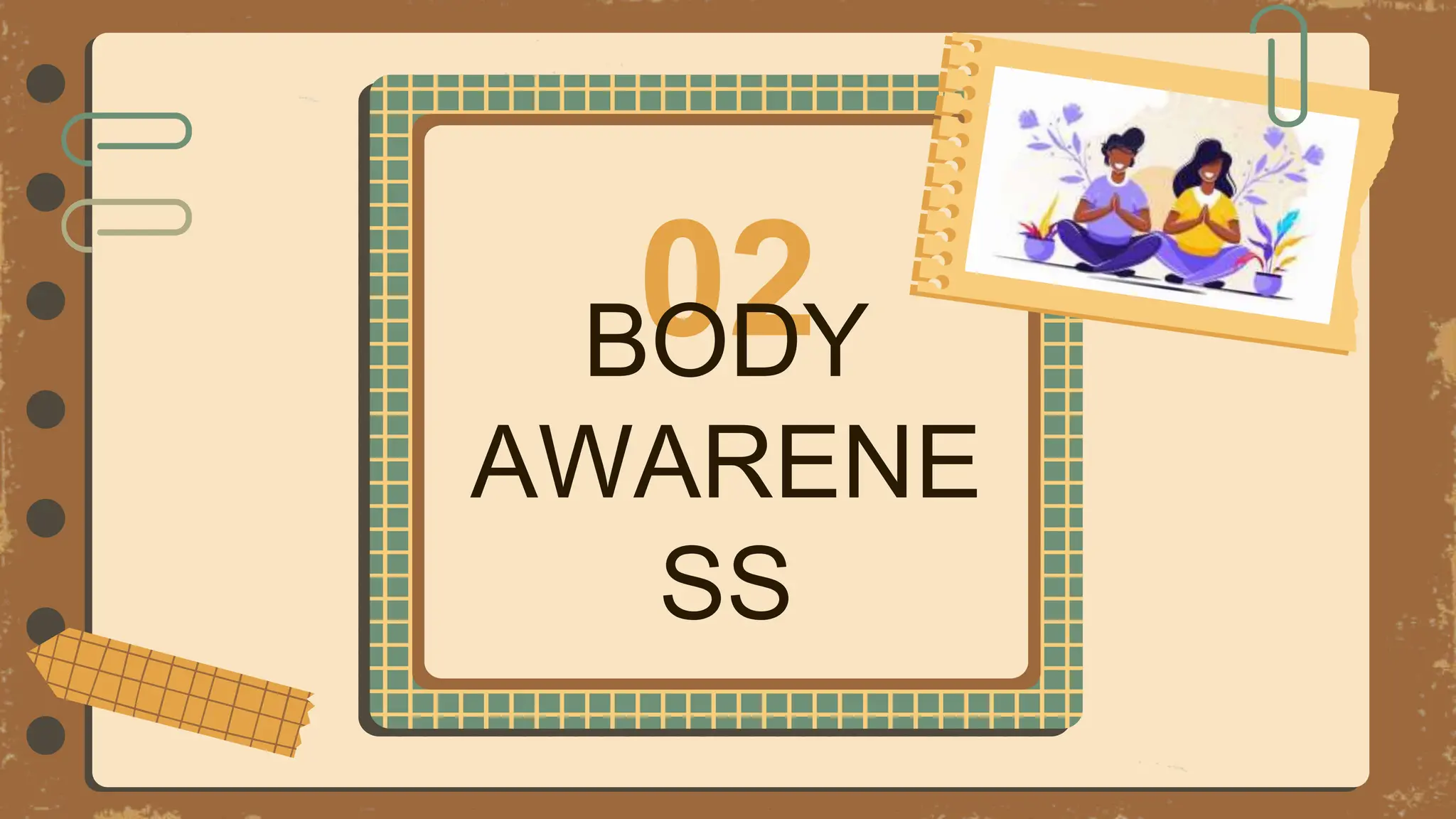
Body awareness is how conscious and connected you are to your own body.
It’s also known as kinesthesia, or the awareness of the position and
movement of body parts in relation to muscles and joints.
Body awareness helps us to understand how to relate to objects and people
at home, at school and outdoors. For example, proper body awareness tells
us how far to reach for objects or how close to stand next to a person.
Body awareness can also extend to your body’s cues. When you recognize
that you’re hungry, thirsty, or tired, you’re exercising body awareness.
● This is also the case with more complex cues, like when you’re at your
max during a workout, when you’re feeling lonely and in need of some
social time.
Fine and gross motor development are important in body
awareness.
Gross motor development occurs when the large muscle groups like
arms and legs get stronger.
Fine motor development refers to the growth of the smaller muscle
groups, like fingers.
Balance is also important. We would not expect a one-year-old to be able to
balance on a beam, yet a twelve-year-old would probably be fairly good at it.
Balancing on a beam requires body awareness. It takes time, growth, and
practice for body awareness to fully emerge.
Benefits of Body Awareness
Body awareness has several benefits that range from physical to emotional health.
• Better balance and stability
• Weight management
• Pain management
• Identifying and meeting your needs
• Improved mental and emotional well-being
SPATIAL
AWARENES
S
03
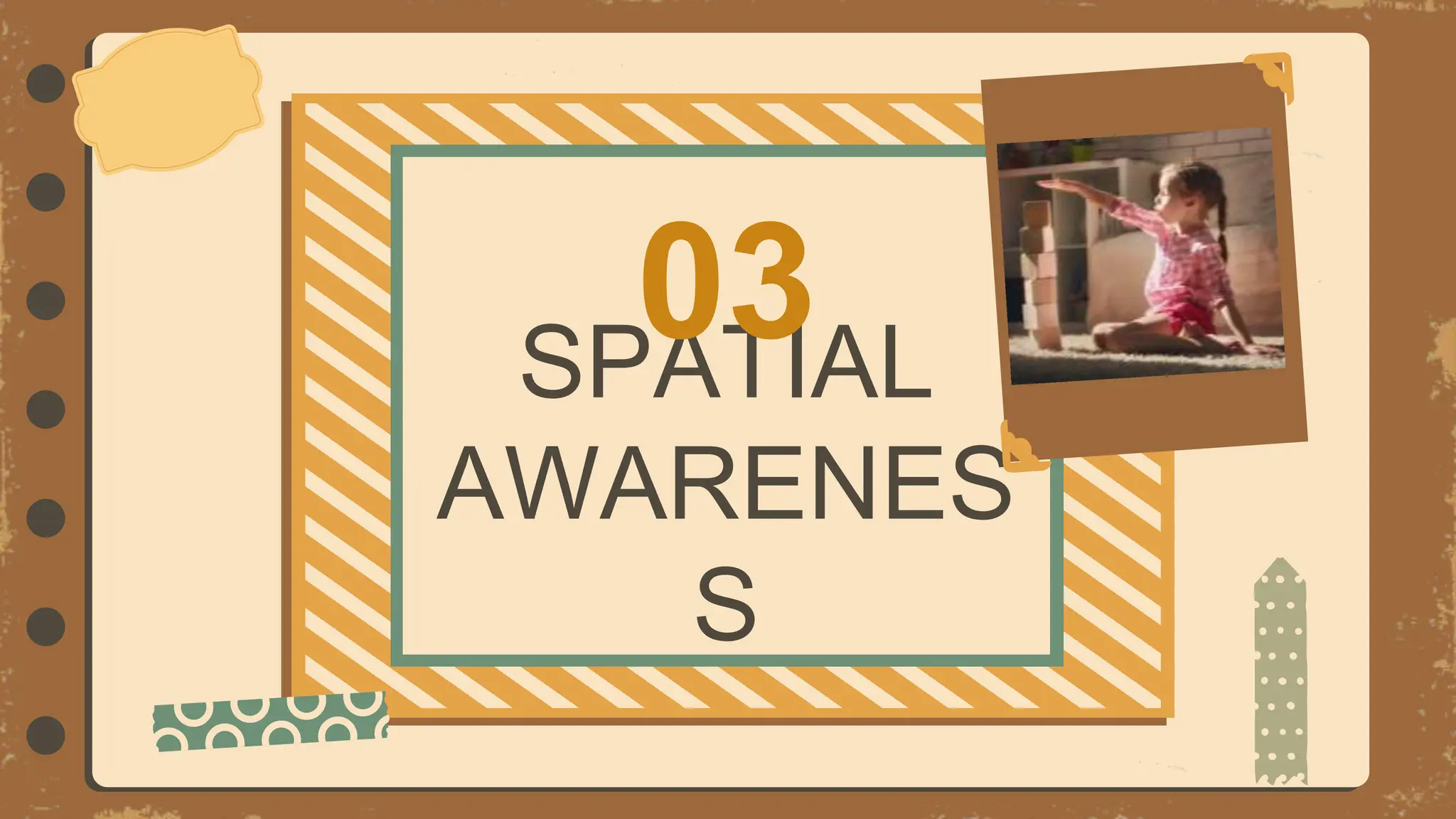
Spatial awareness refers to your ability to be aware of objects in space and your body’s
position in relation to them.
Spatial awareness is the ability to understand and interact with the environment
around you.
Whether it be avoiding obstacles when walking, reaching out to grab a pencil or
determining left from right these are all examples of tasks that require spatial
awareness.
Developing the skills to express and understand spatial skills are the first step in
understanding spatial ability and awareness such as math skills, visual perceptual
skills, and body awareness.
Why is it important?
Spatial Awareness
Spatial awareness allows us to be conscious of the things in our environment as well as our
position relative to them. This ability is important for several reasons, such as:
• Location. Spatial awareness gives context to the location of an object. For example,
knowing that a cup is on a table as opposed to under it.
• Movement. Having spatial awareness can inform you of how people and objects move
through the environment. This can help you navigate your surroundings.
• Social. Spatial awareness can affect social functions like maintenance of personal space.
• Reading and writing. A spatial understanding is needed for understanding sentence
structure and grammar.
• Mathematics. Some mathematical concepts also require spatial awareness. Examples
include geometry and ordering or arranging numbers.
5 activities to help encourage the
development of spatial awareness:
1. Obstacle Courses: The ability to negotiate an obstacle course requires a
significant amount of spatial awareness. Vary the courses grading them according
to the child’s ability to move over, under and around objects.
2. Build and Create: Use Legos, blocks, and puzzles. Research has shown that
parents who participated in guided block play with their children had significantly
higher proportions of spatial talk.
3. Practice completing patterns: You could try Follow the Path or Patterns, Patterns,
Patterns
4. Movement Games: Participate in any type of movement games where children
have to move around obstacles or friends.
5. Provide verbal descriptions: Offer many opportunities for children to hear
descriptions of where they are or where objects are in relationship to each other.
We conclude that Spatial
awareness is a central
element of our daily lives. It
helps us understand, interact
and appreciate the places we
live. Body awareness is a
form of mindfulness that
helps you take better care of
yourself, maximize exercise
time and minimize risk for
injury. The more in tune you
are with your body, the more
optimally it functions.
CONCLUSI
ON
CREDITS: This presentation template was created by
Slidesgo, including icons by Flaticon, and
infographics & images by Freepik
Thank
s
REFERENCES:
https://www.healthline.com/health/mind-
body/body-awareness#physical-
exercises
https://www.healthline.com/health/spatia
l-awareness#takeaway
https://www.yourtherapysource.com/blo
g1/2017/07/30/5-ways-to-develop-spatial-
awareness/
https://www.acefitness.org/education-
and-resources/professional/expert-
articles/6294/body-awareness-for-
beginners/
For listening!

Body-and-Spatial-Awareness-GROUP2-BPE22.pptx

  • 2.
    0 1 Objectives Table of contents 0 2 0 3 0 4 SpatialAwareness Body Awareness Conclusion
  • 3.
    Objectives 01 • To definethe Body Awareness and Spatial Awareness • To understand the benefits of Body Awareness • To know the importance of Spatial Awareness • To identify the activities that helps to develop Spatial Awareness
  • 4.
  • 5.
    Body awareness ishow conscious and connected you are to your own body. It’s also known as kinesthesia, or the awareness of the position and movement of body parts in relation to muscles and joints. Body awareness helps us to understand how to relate to objects and people at home, at school and outdoors. For example, proper body awareness tells us how far to reach for objects or how close to stand next to a person. Body awareness can also extend to your body’s cues. When you recognize that you’re hungry, thirsty, or tired, you’re exercising body awareness. ● This is also the case with more complex cues, like when you’re at your max during a workout, when you’re feeling lonely and in need of some social time.
  • 6.
    Fine and grossmotor development are important in body awareness. Gross motor development occurs when the large muscle groups like arms and legs get stronger. Fine motor development refers to the growth of the smaller muscle groups, like fingers. Balance is also important. We would not expect a one-year-old to be able to balance on a beam, yet a twelve-year-old would probably be fairly good at it. Balancing on a beam requires body awareness. It takes time, growth, and practice for body awareness to fully emerge.
  • 7.
    Benefits of BodyAwareness Body awareness has several benefits that range from physical to emotional health. • Better balance and stability • Weight management • Pain management • Identifying and meeting your needs • Improved mental and emotional well-being
  • 8.
  • 9.
    Spatial awareness refersto your ability to be aware of objects in space and your body’s position in relation to them. Spatial awareness is the ability to understand and interact with the environment around you. Whether it be avoiding obstacles when walking, reaching out to grab a pencil or determining left from right these are all examples of tasks that require spatial awareness. Developing the skills to express and understand spatial skills are the first step in understanding spatial ability and awareness such as math skills, visual perceptual skills, and body awareness.
  • 10.
    Why is itimportant? Spatial Awareness Spatial awareness allows us to be conscious of the things in our environment as well as our position relative to them. This ability is important for several reasons, such as: • Location. Spatial awareness gives context to the location of an object. For example, knowing that a cup is on a table as opposed to under it. • Movement. Having spatial awareness can inform you of how people and objects move through the environment. This can help you navigate your surroundings. • Social. Spatial awareness can affect social functions like maintenance of personal space. • Reading and writing. A spatial understanding is needed for understanding sentence structure and grammar. • Mathematics. Some mathematical concepts also require spatial awareness. Examples include geometry and ordering or arranging numbers.
  • 11.
    5 activities tohelp encourage the development of spatial awareness: 1. Obstacle Courses: The ability to negotiate an obstacle course requires a significant amount of spatial awareness. Vary the courses grading them according to the child’s ability to move over, under and around objects. 2. Build and Create: Use Legos, blocks, and puzzles. Research has shown that parents who participated in guided block play with their children had significantly higher proportions of spatial talk. 3. Practice completing patterns: You could try Follow the Path or Patterns, Patterns, Patterns 4. Movement Games: Participate in any type of movement games where children have to move around obstacles or friends. 5. Provide verbal descriptions: Offer many opportunities for children to hear descriptions of where they are or where objects are in relationship to each other.
  • 12.
    We conclude thatSpatial awareness is a central element of our daily lives. It helps us understand, interact and appreciate the places we live. Body awareness is a form of mindfulness that helps you take better care of yourself, maximize exercise time and minimize risk for injury. The more in tune you are with your body, the more optimally it functions. CONCLUSI ON
  • 13.
    CREDITS: This presentationtemplate was created by Slidesgo, including icons by Flaticon, and infographics & images by Freepik Thank s REFERENCES: https://www.healthline.com/health/mind- body/body-awareness#physical- exercises https://www.healthline.com/health/spatia l-awareness#takeaway https://www.yourtherapysource.com/blo g1/2017/07/30/5-ways-to-develop-spatial- awareness/ https://www.acefitness.org/education- and-resources/professional/expert- articles/6294/body-awareness-for- beginners/ For listening!