Board Orientation 
2014-2015
Mission and Purpose 
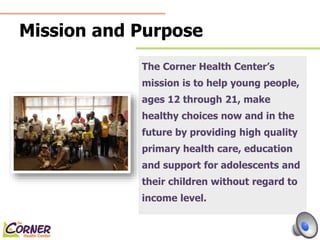
The Corner Health Center’s 
mission is to help young people, 
ages 12 through 21, make 
healthy choices now and in the 
future by providing high quality 
primary health care, education 
and support for adolescents and 
their children without regard to 
income level.
Organizational Governance 
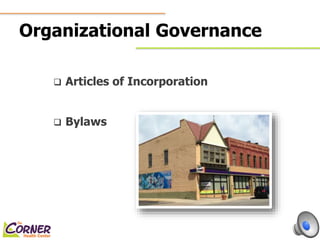
 Articles of Incorporation 
 Bylaws
10 Basic Board Responsibilities* 
 Determine mission and purposes 
 Select the chief executive 
 Support and evaluate the chief executive 
 Ensure effective planning 
 Monitor and strengthen programs and services 
 Ensure adequate financial resources 
 Protect assets and provide financial oversight 
 Build a competent board 
 Ensure legal and ethical integrity 
 Enhance the organizations public standing 
*From 2009 BoardSource Ten Basic Responsibilities of Nonprofit Boards
Strategic Plan 2011 - 2014 
1) Recognition for excellence in primary care 
2) Effectively using partnerships to advance our 
mission 
3) Ready for national health reform 
4) Increase private giving 
5) Economic stability 
6) Infrastructure to support operations and 
preserve our building
Board Member Expectations 
Desired Competencies/ 
Characteristics 
Directors are selected for their passion and enthusiasm 
for the Corner and its mission. 
Meetings 
The board meets 8 times per year on the fourth 
Monday, 6:15 – 8 p.m. (September–November, 
January- May). 
Committees 
Directors are each expected to participate in a 
committee of their preference. 
Time Commitment 
Directors will need to spend about 3-5 hours per month 
during the months they meet in board meetings, 
committees, reviewing materials. 
Travel 
Board Directors are expected to attend monthly 
meetings in person, occasionally it may be possible to 
participate by phone. 
Fundraising 
The Corner raises funds from individual donors and local 
funders and expects each board member to make an 
annual contribution at whatever level they can.
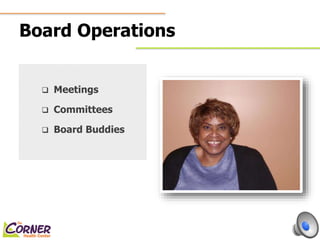
Board Operations 
 Meetings 
 Committees 
 Board Buddies
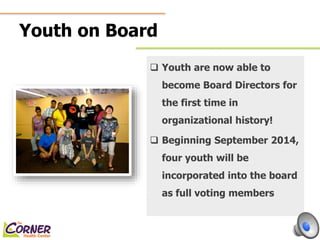
Youth on Board 
 Youth are now able to 
become Board Directors for 
the first time in 
organizational history! 
 Beginning September 2014, 
four youth will be 
incorporated into the board 
as full voting members
Youth Decision Making 
 All Board members should engage in equal 
partnership with youth 
 Create a culture that honors youth as full 
members of our community 
 Involvement should include: 
1) Right to raise issues 
2) Challenge assumptions 
3) Provide input 
4) Conduct research 
5) Vote on decisions 
6) Reflect on experience
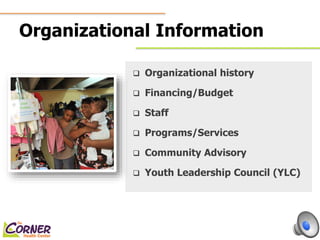
Organizational Information 
 Organizational history 
 Financing/Budget 
 Staff 
 Programs/Services 
 Community Advisory 
 Youth Leadership Council (YLC)
Effective Practices/ 
Board Development 
 Bylaws changes 
 Filling board vacancies 
 Board development 
 New Center training 
 BoardSource 
 Board evaluation
Orientation Feedback 
Please click on the link below to take a 
brief survey on the board orientation 
presentation. 
https://www.surveymonkey.com/s/ 
CHCboardorientationfeedback

Board Orientation

  • 1.
  • 2.
    Mission and Purpose The Corner Health Center’s mission is to help young people, ages 12 through 21, make healthy choices now and in the future by providing high quality primary health care, education and support for adolescents and their children without regard to income level.
  • 3.
    Organizational Governance Articles of Incorporation  Bylaws
  • 4.
    10 Basic BoardResponsibilities*  Determine mission and purposes  Select the chief executive  Support and evaluate the chief executive  Ensure effective planning  Monitor and strengthen programs and services  Ensure adequate financial resources  Protect assets and provide financial oversight  Build a competent board  Ensure legal and ethical integrity  Enhance the organizations public standing *From 2009 BoardSource Ten Basic Responsibilities of Nonprofit Boards
  • 5.
    Strategic Plan 2011- 2014 1) Recognition for excellence in primary care 2) Effectively using partnerships to advance our mission 3) Ready for national health reform 4) Increase private giving 5) Economic stability 6) Infrastructure to support operations and preserve our building
  • 6.
    Board Member Expectations Desired Competencies/ Characteristics Directors are selected for their passion and enthusiasm for the Corner and its mission. Meetings The board meets 8 times per year on the fourth Monday, 6:15 – 8 p.m. (September–November, January- May). Committees Directors are each expected to participate in a committee of their preference. Time Commitment Directors will need to spend about 3-5 hours per month during the months they meet in board meetings, committees, reviewing materials. Travel Board Directors are expected to attend monthly meetings in person, occasionally it may be possible to participate by phone. Fundraising The Corner raises funds from individual donors and local funders and expects each board member to make an annual contribution at whatever level they can.
  • 7.
    Board Operations Meetings  Committees  Board Buddies
  • 8.
    Youth on Board  Youth are now able to become Board Directors for the first time in organizational history!  Beginning September 2014, four youth will be incorporated into the board as full voting members
  • 9.
    Youth Decision Making  All Board members should engage in equal partnership with youth  Create a culture that honors youth as full members of our community  Involvement should include: 1) Right to raise issues 2) Challenge assumptions 3) Provide input 4) Conduct research 5) Vote on decisions 6) Reflect on experience
  • 10.
    Organizational Information Organizational history  Financing/Budget  Staff  Programs/Services  Community Advisory  Youth Leadership Council (YLC)
  • 11.
    Effective Practices/ BoardDevelopment  Bylaws changes  Filling board vacancies  Board development  New Center training  BoardSource  Board evaluation
  • 12.
    Orientation Feedback Pleaseclick on the link below to take a brief survey on the board orientation presentation. https://www.surveymonkey.com/s/ CHCboardorientationfeedback

Editor's Notes

  • #2 Welcome/Introductions: Welcome to the Corner Board! I am Courtney Vanderlaan, a current MSW intern at the Corner, and I will be the narrator for this part of your board orientation. We have developed this power point to cover some of the basic knowledge that is important for every nonprofit board member. We have also included some specific overview information regarding the Corner Health Center that will help you be an effective board member. Closer to your first board meeting, you will be invited to an ‘in person’ board orientation that will give you an opportunity to meet other new board members and ask any questions you may have. Several of the slides include active links to documents that are available on the board web page and will provide more detail on various topics we are covering.
  • #3 As a board member, it is important to be familiar with the Corner’s mission. While you don’t have to memorize it, it is good for board members to be able to paraphrase the mission. The organizational mission is part of our incorporation papers filed when the Corner began. We are known as a 501(c)3, or ‘charitable’ organization, sometimes also referred to as a ‘nonprofit’ or ‘tax exempt’. We do not pay taxes on any profit and use our surplus revenues to achieve our goals. “While nonprofit organizations are permitted to generate surplus revenues, they must be retained by the organization for its self-preservation, expansion, or plans. Nonprofit organizations have controlling members or a board of directors. Designation as a nonprofit does not mean that the organization does not intend to make a profit, but rather that the organization has no owners, and that the funds realized in the operation of the organization will not be used to benefit any owners.” (wikipedia)
  • #4 In the United States, nonprofit organizations are formed by filing bylaws and/or articles of incorporation in the state in which they expect to operate. The act of incorporating creates a legal entity, enabling the organization to be treated as a corporation by law, and to enter into business dealings, form contracts, and own property as any other individual or for-profit corporation may do. The two major types of nonprofit organizations are membership and board-only. A membership organization’s members elect the board and have regular meetings and power to amend the bylaws. A board-only organization typically has a self-selected board that meets and has the power to amend the bylaws. The Corner is a ‘board-only’ organization. The Corner was incorporated in 1980. Bylaws establish the basic rules by which a board operates and include such things as the size of the board, election of new board members, officers, frequency of meetings and the hiring of an Executive Director to run the organization. Our by-laws and any amendments are approved by the board. The most recent revision to the bylaws was in November of 2013 to allow for youth board members. You can access the articles of incorporation and current bylaws on the board web page or by clicking the links on this page.
  • #5 For nonprofit organizations, the board has the responsibility for governance and certain fundamental responsibilities. Members of high-performing boards ask good and timely questions and are more strategic than operational in their work; they don’t manage programs or implement their own policies. They depend on good managers, especially the chief executive, to be effective.
  • #6 In order to fulfill its responsibility for effective planning, the Corner board adopted a strategic plan in 2011.   The strategic plan is very ‘big picture’, helping the board and staff to focus on the future and steering the organization in a positive direction. It responds to critical issues and changes that we are facing as an organization.   Our strategic plan includes measurable goals, and the board receives updates on our progress toward accomplishing these goals at its regular meetings.   For the past three years, the final annual board meeting has been focused on a strategic plan update. These meetings have included discussion of specific actions that need to be taken to assure our continued progress as well as new and emerging issues and opportunities.   You can see the full strategic plan and goals on the board web page and by clicking the link on this page.
  • #7 Here you will see the basic expectations of each board member regarding desired competencies and characteristics, meetings, committees, time commitments, travel, and fundraising.
  • #8 This is Gloria Jackson, our incoming Board President. For each meeting: Packets will be sent out a week ahead of the meeting with an email message. Some additional materials may be distributed at the meetings. RSVPs are important in order to ensure there will be a quorum (as defined in the bylaws) for voting. There is a standard agenda format. Usually meetings will include one or more presentations by staff on relevant topics, programs, or services, followed by discussion. For convenience, dinner is served, and board members may contribute toward the cost. Committees: A handout describing committee choices is on the board webpage and may be accessed through the link on this slide. All board members are encouraged to participate on a committee. There are both standing and ad hoc committee opportunities as determined by the bylaws and the board President. The board president appoints committee members, taking into account individual preferences. Board Buddies Have been established as a way to update board members who were absent at a meeting. Each member has a designated ‘buddy’. They are responsible for updating them after any meeting they miss.
  • #9 In the Fall of 2012, Corner staff and Trusteeship Committee Members began exploring the idea of incorporating Youth Members onto the Board of Directors.   This initiative came out of a “desire by Corner staff and the Trusteeship Committee to increase the Corner Health Center’s commitment to their mission of serving and empowering youth to lead healthy lives through including young people in the decision-making processes that affect the care they receive.”   Corner Staff and Trusteeship Committee Members worked together on the process of drafting and editing bylaw revisions that would require the addition of Youth Members, aged 16 to 21, to the Board of Directors. Once these changes were approved, we began planning for a successful implementation of ‘youth on board.’   In January 2014, interested youth were invited to attend at least one monthly Board Meeting to observe. After visiting, youth who wished to become candidates for a Board Member position were nominated. In June, the Board voted on 8 new board members, including 4 youth. All new board members begin their terms in September 2014.
  • #10 The board decided to hold an extra board meeting in June for board development on successfully including youth. John Weiss from the Neutral Zone, a nationally recognized expert in working with youth, led a 3-hour session for board members (including newly elected), and staff. Further work is being done to provide additional support to our new youth board members to make sure that they have the tools they need to be successful in their new roles and also to make sure that the board is prepared for the transition. The trusteeship committee will evaluate the success of this initiative during the year.
  • #11 It is helpful for board members to have additional information on the organization, so on the board web page and through the links included on this page, you will find some helpful documents including: Organizational history Organizational chart Staff contact list Link to our website information on programs and services. In September, the board approves the annual budget for the new fiscal year (which will run October 1, 2014 through September 30, 2015). We will do a brief training session as part of that meeting to orient new members to our budget revenues and expenses. The Corner supports two groups that provide input on improving our programs and services and meeting community needs--the Community Advisory and the Youth Leadership Council. The Community Advisory meets twice a year and includes community members who are interested in supporting the Corner. The Youth Leadership Council includes young people in our patient age range. Besides providing input, the YLC is a youth-run program who implements projects that benefit the Corner and the Ypsilanti community. Through the Youth Leadership Council, youth have the opportunity to develop leadership skills that will help them in future careers.
  • #12 The board Trusteeship Committee is responsible for board membership, board development, and changes to the bylaws.   The Corner has a membership in BoardSource, a great source of board development publications and trainings. The New Center in Ann Arbor often offers board member trainings as well.   Toward the end of each year, the Trusteeship Committee conducts a board self assessment of effectiveness. The results of this survey are then used to plan for the following year.
  • #13 Thank you for completing this board orientation. Please connect to the feedback link on the bottom of the slide to let us know if it was useful and how we can make it better. You will be asked just 3 brief questions.