Blocking their escape: forced labour
and the abolition of the Overseas
Domestic Workers visa
Nick Clark
Working Lives Research Institute
Migrant domestic workers
52,000

“domestic personnel” (LFS)
33,500 employees
excludes “off the books”, undocumented, staff of
contractors/agencies, au pairs (live-in carers?)
10,100 MDWs admitted on visas (2009)
6,600 granted visa renewals (2009)
5% apply for ILR
Overseas Domestic Worker Visa

18-65 , employed as a domestic worker for
min. one year prior to application
travel to UK in company of employer
work full time as a domestic worker only
no recourse to public funds
up to 12 months (renewable)
can change employers
may apply for ILR after 5 years
UK Government
positions
Visa: “I am... proposing to remove the route for domestic
workers in private households, or reform it... by
removing their right to switch employer and to settle
here. Their assignments should be strictly temporary”
Theresa May

Convention: “both the British government and the CBI
spoke against the text (the only two negative speeches
in the entire debate). The government… on the spurious
grounds that the convention would 'criminalise the
elderly' because health and safety regulations (which
are part of the criminal law) would have to be extended
to cover private homes” TUC Report on ILO Conference
Government assertions
ILO Convention 2011
"The UK already provides comprehensive employment
and social protections to domestic workers and we do
not consider it appropriate or practical to extend criminal
health and safety law, including inspections, to private
households employing domestic workers."
BIS Spokesman, The Guardian 15-6-11

“like other workers, most domestic workers benefit from
the national minimum wage, statutory sick pay, paid
annual leave and protection from discrimination and
unfair dismissal, as well as other protections.”
Ed Davey MP, BIS Minister, Westminster Hall 29-6-11
Government assertions
Employment Related Settlement:
“the National Referral Mechanism (NRM) for identifying
victims of trafficking was established [in April 2009],
which provides a mechanism for responding to
exploitation of overseas domestic workers”
“there is suspicion that the [ODW Visa] route enables
people to be brought here to be abused or exploited
while on UK soil.”
Consultation paper on Employment Related Settlement,
UKBA, June 2011
Sources
Responses to Forced Labour in Europe
Joseph Rowntree Foundation

Migrant Domestic Workers Employment
Rights
Nuffield Foundation

JRF Forced Labour programme
Domestic work & forced
labour in Europe
ECHR cases: Kawogo (UK) & Siliadin (Fr)
“no charges… brought under section 4 of the
Immigration and Asylum (Treatment of Claimants) Act
2004. The reason given was that “essentially they [the
Dhanjis] did not commit the cross-border element.””
(ECHR Statement of Facts June 2010)
“carrying out household tasks and looking after children
throughout the day could not by themselves constitute
working conditions incompatible with human dignity, this
being the lot of many mothers” (Versailles Court of
Appeal 2003);
Domestic work & forced
labour in Europe
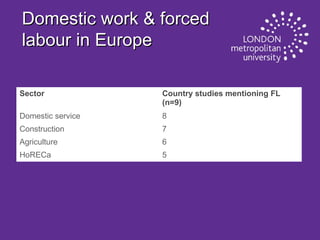
Sector

Country studies mentioning FL
(n=9)

Domestic service

8

Construction

7

Agriculture

6

HoRECa

5
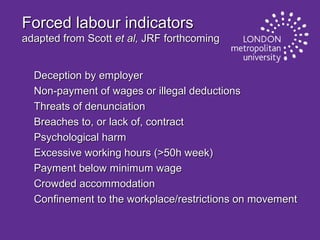
Forced labour indicators
adapted from Scott et al, JRF forthcoming
Deception by employer
Non-payment of wages or illegal deductions
Threats of denunciation
Breaches to, or lack of, contract
Psychological harm
Excessive working hours (>50h week)
Payment below minimum wage
Crowded accommodation
Confinement to the workplace/restrictions on movement
Employment rights in UK
Visa requirements (employed, NMW, statement
of terms)
Working time: 48 hours does not apply
Neil Carberry CBI, ref ILO Convention: “The proposed
convention would undermine the principle of EU law that
an individual should be protected against being forced to
work long hours but can choose to work longer if they
wish.”

Health & Safety: no inspections of private
households
National Minimum Wage: “family worker
exception”
Family worker exception
resident in family home of the employer
Not member of that family, but treated as such,
provision of accommodation, meals
sharing of tasks and leisure activities

No deduction or payment to employer for
accommodation or meals;
had the work been done by a member of the
employer’s family, it would not be treated as
being performed under a worker’s contract or as
being work...
Family worker exception
“there was sharing of tasks, in particular cooking and clearing up
after meals. Otherwise the claimant did the bulk of the work. As
regards leisure activities the claimant shared these with the children
to some extent.” (extract from Tribunal judgement 2010).
“the fact that during the latter part of her time working for the
Respondents in the UK she herself withdrew more and more from
spending time with [the family] in our judgement is not relevant”
(extract from Tribunal judgement 2010).
“We do not consider that there is any lack of clarity about the way
the NMW legislation applies to migrant domestic workers… NMW
will be enforced if appropriate.” (E-mail to researchers from
National Minimum Wage, Local Compliance dated 4 April 2011).
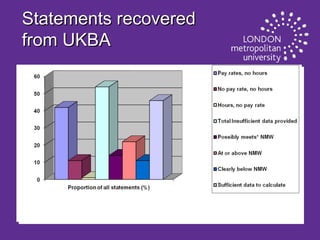
Statements recovered
from UKBA
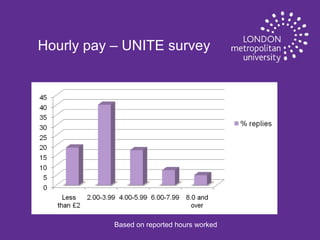
Hourly pay – UNITE survey

Based on reported hours worked
Manufacturing precarity through
tax evasion
16 interviewees mention problems with payslips
“I want to pay tax, because I want to be legal, don’t want
to be here illegal. I work here, everyone is paying tax, I
should pay the same. That’s why I applied my selfemployed. If employer don’t want to pay, I will pay.”
[Filipina, Female, 50-59, has ILR]
“I understand what they mean [re part payment in cash]
because you know, they don't want to pay extra tax, you
know. I have agreed because, you know, there is no
choice.” [Filipina, Female, 30-39]
Escape
Kalayaan conclude that NRM not suitable – of 157
cases identified as having been trafficked, 102 chose
not to use the NRM, preferring to seek other
employment, even on an undocumented basis, because
“their overriding need in spite of their experiences was
to support their families and pay off debts in their
countries of origin” (Lalani, 2011).
“I am legal in this country – you are not the only
employer”. Female, Filipina, 30-39.
“Now I am not scared – I was scared but now I
understand, I can speak out.” Female, Moroccan, 40-49
“Sometimes I get upset [about low pay and
unpaid hours of work], but it is okay because I
am waiting for my five years. Then I will be
indefinite and then bye-bye” Female, Filipina,
30-39
Conclusions
MDWs experience multiple FL indicators
Not currently protected by visa regime,
NMW, WTD or NRM
Most effective redress is capacity to
change employers, while staying within
the law
Removing visa will not remove the
workers, simply their employment rights

Blocking their escape

  • 1.
    Blocking their escape:forced labour and the abolition of the Overseas Domestic Workers visa Nick Clark Working Lives Research Institute
  • 2.
    Migrant domestic workers 52,000 “domesticpersonnel” (LFS) 33,500 employees excludes “off the books”, undocumented, staff of contractors/agencies, au pairs (live-in carers?) 10,100 MDWs admitted on visas (2009) 6,600 granted visa renewals (2009) 5% apply for ILR
  • 3.
    Overseas Domestic WorkerVisa 18-65 , employed as a domestic worker for min. one year prior to application travel to UK in company of employer work full time as a domestic worker only no recourse to public funds up to 12 months (renewable) can change employers may apply for ILR after 5 years
  • 4.
    UK Government positions Visa: “Iam... proposing to remove the route for domestic workers in private households, or reform it... by removing their right to switch employer and to settle here. Their assignments should be strictly temporary” Theresa May Convention: “both the British government and the CBI spoke against the text (the only two negative speeches in the entire debate). The government… on the spurious grounds that the convention would 'criminalise the elderly' because health and safety regulations (which are part of the criminal law) would have to be extended to cover private homes” TUC Report on ILO Conference
  • 5.
    Government assertions ILO Convention2011 "The UK already provides comprehensive employment and social protections to domestic workers and we do not consider it appropriate or practical to extend criminal health and safety law, including inspections, to private households employing domestic workers." BIS Spokesman, The Guardian 15-6-11 “like other workers, most domestic workers benefit from the national minimum wage, statutory sick pay, paid annual leave and protection from discrimination and unfair dismissal, as well as other protections.” Ed Davey MP, BIS Minister, Westminster Hall 29-6-11
  • 6.
    Government assertions Employment RelatedSettlement: “the National Referral Mechanism (NRM) for identifying victims of trafficking was established [in April 2009], which provides a mechanism for responding to exploitation of overseas domestic workers” “there is suspicion that the [ODW Visa] route enables people to be brought here to be abused or exploited while on UK soil.” Consultation paper on Employment Related Settlement, UKBA, June 2011
  • 7.
    Sources Responses to ForcedLabour in Europe Joseph Rowntree Foundation Migrant Domestic Workers Employment Rights Nuffield Foundation JRF Forced Labour programme
  • 8.
    Domestic work &forced labour in Europe ECHR cases: Kawogo (UK) & Siliadin (Fr) “no charges… brought under section 4 of the Immigration and Asylum (Treatment of Claimants) Act 2004. The reason given was that “essentially they [the Dhanjis] did not commit the cross-border element.”” (ECHR Statement of Facts June 2010) “carrying out household tasks and looking after children throughout the day could not by themselves constitute working conditions incompatible with human dignity, this being the lot of many mothers” (Versailles Court of Appeal 2003);
  • 9.
    Domestic work &forced labour in Europe Sector Country studies mentioning FL (n=9) Domestic service 8 Construction 7 Agriculture 6 HoRECa 5
  • 10.
    Forced labour indicators adaptedfrom Scott et al, JRF forthcoming Deception by employer Non-payment of wages or illegal deductions Threats of denunciation Breaches to, or lack of, contract Psychological harm Excessive working hours (>50h week) Payment below minimum wage Crowded accommodation Confinement to the workplace/restrictions on movement
  • 11.
    Employment rights inUK Visa requirements (employed, NMW, statement of terms) Working time: 48 hours does not apply Neil Carberry CBI, ref ILO Convention: “The proposed convention would undermine the principle of EU law that an individual should be protected against being forced to work long hours but can choose to work longer if they wish.” Health & Safety: no inspections of private households National Minimum Wage: “family worker exception”
  • 12.
    Family worker exception residentin family home of the employer Not member of that family, but treated as such, provision of accommodation, meals sharing of tasks and leisure activities No deduction or payment to employer for accommodation or meals; had the work been done by a member of the employer’s family, it would not be treated as being performed under a worker’s contract or as being work...
  • 13.
    Family worker exception “therewas sharing of tasks, in particular cooking and clearing up after meals. Otherwise the claimant did the bulk of the work. As regards leisure activities the claimant shared these with the children to some extent.” (extract from Tribunal judgement 2010). “the fact that during the latter part of her time working for the Respondents in the UK she herself withdrew more and more from spending time with [the family] in our judgement is not relevant” (extract from Tribunal judgement 2010). “We do not consider that there is any lack of clarity about the way the NMW legislation applies to migrant domestic workers… NMW will be enforced if appropriate.” (E-mail to researchers from National Minimum Wage, Local Compliance dated 4 April 2011).
  • 14.
  • 15.
    Hourly pay –UNITE survey Based on reported hours worked
  • 16.
    Manufacturing precarity through taxevasion 16 interviewees mention problems with payslips “I want to pay tax, because I want to be legal, don’t want to be here illegal. I work here, everyone is paying tax, I should pay the same. That’s why I applied my selfemployed. If employer don’t want to pay, I will pay.” [Filipina, Female, 50-59, has ILR] “I understand what they mean [re part payment in cash] because you know, they don't want to pay extra tax, you know. I have agreed because, you know, there is no choice.” [Filipina, Female, 30-39]
  • 17.
    Escape Kalayaan conclude thatNRM not suitable – of 157 cases identified as having been trafficked, 102 chose not to use the NRM, preferring to seek other employment, even on an undocumented basis, because “their overriding need in spite of their experiences was to support their families and pay off debts in their countries of origin” (Lalani, 2011). “I am legal in this country – you are not the only employer”. Female, Filipina, 30-39. “Now I am not scared – I was scared but now I understand, I can speak out.” Female, Moroccan, 40-49
  • 18.
    “Sometimes I getupset [about low pay and unpaid hours of work], but it is okay because I am waiting for my five years. Then I will be indefinite and then bye-bye” Female, Filipina, 30-39
  • 19.
    Conclusions MDWs experience multipleFL indicators Not currently protected by visa regime, NMW, WTD or NRM Most effective redress is capacity to change employers, while staying within the law Removing visa will not remove the workers, simply their employment rights