Curriculum and Syllabus | 2018 Regulation
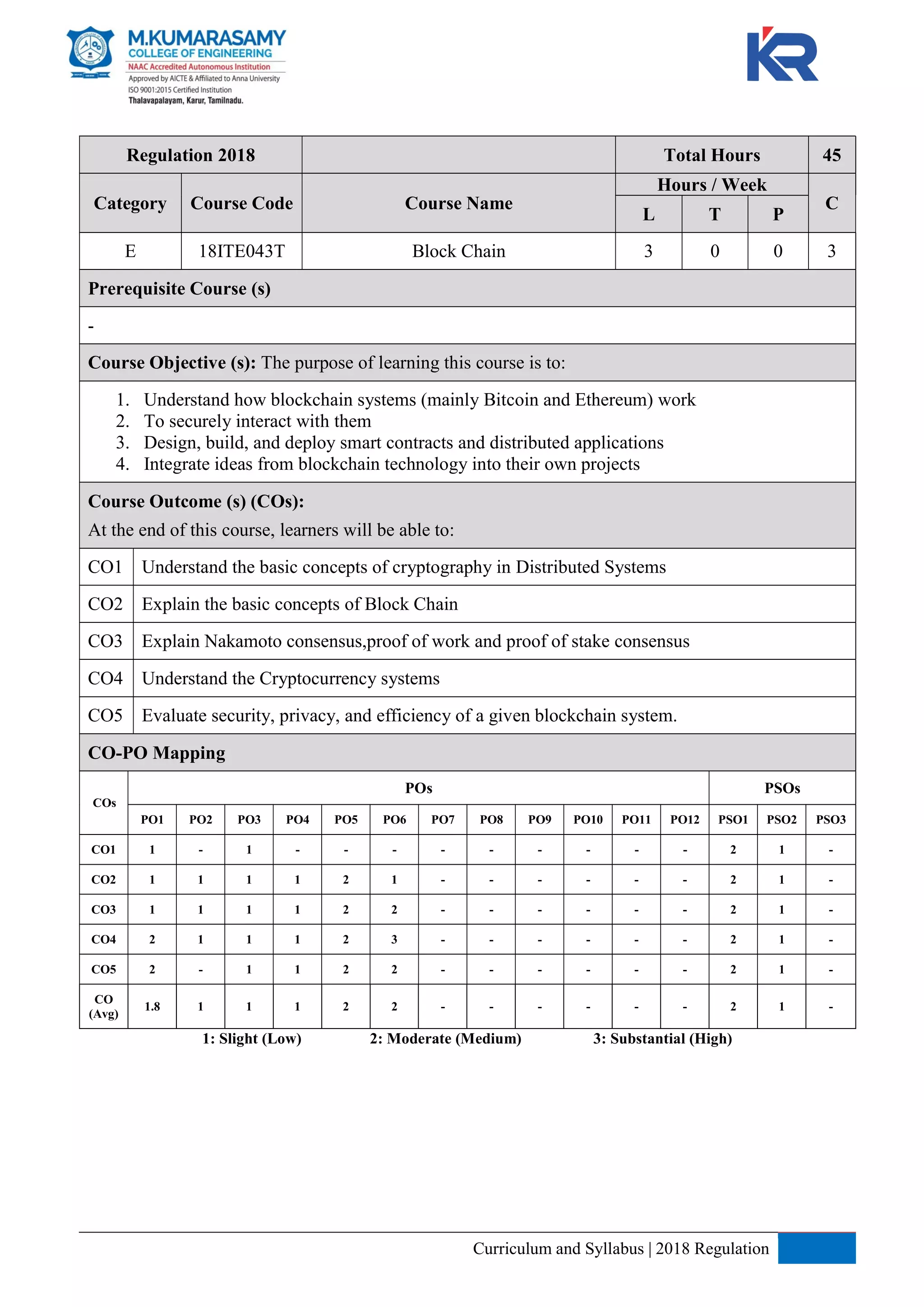
Regulation 2018 Total Hours 45
Category Course Code Course Name
Hours / Week
C
L T P
E 18ITE043T Block Chain 3 0 0 3
Prerequisite Course (s)
-
Course Objective (s): The purpose of learning this course is to:
1. Understand how blockchain systems (mainly Bitcoin and Ethereum) work
2. To securely interact with them
3. Design, build, and deploy smart contracts and distributed applications
4. Integrate ideas from blockchain technology into their own projects
Course Outcome (s) (COs):
At the end of this course, learners will be able to:
CO1 Understand the basic concepts of cryptography in Distributed Systems
CO2 Explain the basic concepts of Block Chain
CO3 Explain Nakamoto consensus,proof of work and proof of stake consensus
CO4 Understand the Cryptocurrency systems
CO5 Evaluate security, privacy, and efficiency of a given blockchain system.
CO-PO Mapping
COs
POs PSOs
PO1 PO2 PO3 PO4 PO5 PO6 PO7 PO8 PO9 PO10 PO11 PO12 PSO1 PSO2 PSO3
CO1 1 - 1 - - - - - - - - - 2 1 -
CO2 1 1 1 1 2 1 - - - - - - 2 1 -
CO3 1 1 1 1 2 2 - - - - - - 2 1 -
CO4 2 1 1 1 2 3 - - - - - - 2 1 -
CO5 2 - 1 1 2 2 - - - - - - 2 1 -
CO
(Avg)
1.8 1 1 1 2 2 - - - - - - 2 1 -
1: Slight (Low) 2: Moderate (Medium) 3: Substantial (High)
Curriculum and Syllabus | 2018 Regulation
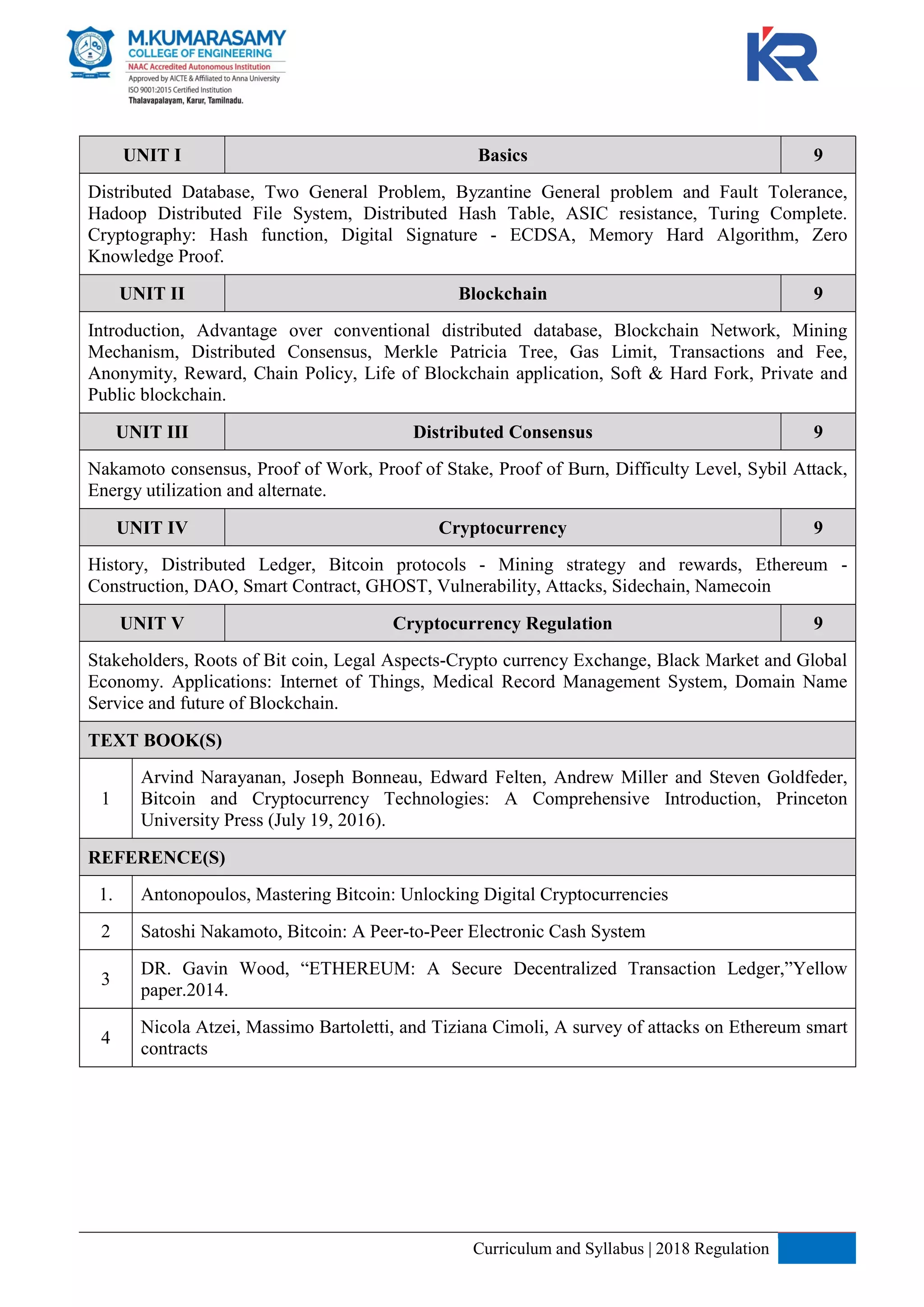
UNIT I Basics 9
Distributed Database, Two General Problem, Byzantine General problem and Fault Tolerance,
Hadoop Distributed File System, Distributed Hash Table, ASIC resistance, Turing Complete.
Cryptography: Hash function, Digital Signature - ECDSA, Memory Hard Algorithm, Zero
Knowledge Proof.
UNIT II Blockchain 9
Introduction, Advantage over conventional distributed database, Blockchain Network, Mining
Mechanism, Distributed Consensus, Merkle Patricia Tree, Gas Limit, Transactions and Fee,
Anonymity, Reward, Chain Policy, Life of Blockchain application, Soft & Hard Fork, Private and
Public blockchain.
UNIT III Distributed Consensus 9
Nakamoto consensus, Proof of Work, Proof of Stake, Proof of Burn, Difficulty Level, Sybil Attack,
Energy utilization and alternate.
UNIT IV Cryptocurrency 9
History, Distributed Ledger, Bitcoin protocols - Mining strategy and rewards, Ethereum -
Construction, DAO, Smart Contract, GHOST, Vulnerability, Attacks, Sidechain, Namecoin
UNIT V Cryptocurrency Regulation 9
Stakeholders, Roots of Bit coin, Legal Aspects-Crypto currency Exchange, Black Market and Global
Economy. Applications: Internet of Things, Medical Record Management System, Domain Name
Service and future of Blockchain.
TEXT BOOK(S)
1
Arvind Narayanan, Joseph Bonneau, Edward Felten, Andrew Miller and Steven Goldfeder,
Bitcoin and Cryptocurrency Technologies: A Comprehensive Introduction, Princeton
University Press (July 19, 2016).
REFERENCE(S)
1. Antonopoulos, Mastering Bitcoin: Unlocking Digital Cryptocurrencies
2 Satoshi Nakamoto, Bitcoin: A Peer-to-Peer Electronic Cash System
3
DR. Gavin Wood, “ETHEREUM: A Secure Decentralized Transaction Ledger,”Yellow
paper.2014.
4
Nicola Atzei, Massimo Bartoletti, and Tiziana Cimoli, A survey of attacks on Ethereum smart
contracts

BLOCK CHAIN SYLLABUS.pdf

  • 1.
    Curriculum and Syllabus| 2018 Regulation Regulation 2018 Total Hours 45 Category Course Code Course Name Hours / Week C L T P E 18ITE043T Block Chain 3 0 0 3 Prerequisite Course (s) - Course Objective (s): The purpose of learning this course is to: 1. Understand how blockchain systems (mainly Bitcoin and Ethereum) work 2. To securely interact with them 3. Design, build, and deploy smart contracts and distributed applications 4. Integrate ideas from blockchain technology into their own projects Course Outcome (s) (COs): At the end of this course, learners will be able to: CO1 Understand the basic concepts of cryptography in Distributed Systems CO2 Explain the basic concepts of Block Chain CO3 Explain Nakamoto consensus,proof of work and proof of stake consensus CO4 Understand the Cryptocurrency systems CO5 Evaluate security, privacy, and efficiency of a given blockchain system. CO-PO Mapping COs POs PSOs PO1 PO2 PO3 PO4 PO5 PO6 PO7 PO8 PO9 PO10 PO11 PO12 PSO1 PSO2 PSO3 CO1 1 - 1 - - - - - - - - - 2 1 - CO2 1 1 1 1 2 1 - - - - - - 2 1 - CO3 1 1 1 1 2 2 - - - - - - 2 1 - CO4 2 1 1 1 2 3 - - - - - - 2 1 - CO5 2 - 1 1 2 2 - - - - - - 2 1 - CO (Avg) 1.8 1 1 1 2 2 - - - - - - 2 1 - 1: Slight (Low) 2: Moderate (Medium) 3: Substantial (High)
  • 2.
    Curriculum and Syllabus| 2018 Regulation UNIT I Basics 9 Distributed Database, Two General Problem, Byzantine General problem and Fault Tolerance, Hadoop Distributed File System, Distributed Hash Table, ASIC resistance, Turing Complete. Cryptography: Hash function, Digital Signature - ECDSA, Memory Hard Algorithm, Zero Knowledge Proof. UNIT II Blockchain 9 Introduction, Advantage over conventional distributed database, Blockchain Network, Mining Mechanism, Distributed Consensus, Merkle Patricia Tree, Gas Limit, Transactions and Fee, Anonymity, Reward, Chain Policy, Life of Blockchain application, Soft & Hard Fork, Private and Public blockchain. UNIT III Distributed Consensus 9 Nakamoto consensus, Proof of Work, Proof of Stake, Proof of Burn, Difficulty Level, Sybil Attack, Energy utilization and alternate. UNIT IV Cryptocurrency 9 History, Distributed Ledger, Bitcoin protocols - Mining strategy and rewards, Ethereum - Construction, DAO, Smart Contract, GHOST, Vulnerability, Attacks, Sidechain, Namecoin UNIT V Cryptocurrency Regulation 9 Stakeholders, Roots of Bit coin, Legal Aspects-Crypto currency Exchange, Black Market and Global Economy. Applications: Internet of Things, Medical Record Management System, Domain Name Service and future of Blockchain. TEXT BOOK(S) 1 Arvind Narayanan, Joseph Bonneau, Edward Felten, Andrew Miller and Steven Goldfeder, Bitcoin and Cryptocurrency Technologies: A Comprehensive Introduction, Princeton University Press (July 19, 2016). REFERENCE(S) 1. Antonopoulos, Mastering Bitcoin: Unlocking Digital Cryptocurrencies 2 Satoshi Nakamoto, Bitcoin: A Peer-to-Peer Electronic Cash System 3 DR. Gavin Wood, “ETHEREUM: A Secure Decentralized Transaction Ledger,”Yellow paper.2014. 4 Nicola Atzei, Massimo Bartoletti, and Tiziana Cimoli, A survey of attacks on Ethereum smart contracts