Untangling strong and weak ties
in blended assessment in the
corporate sector
6th International Conference “ICT for Language Learning”
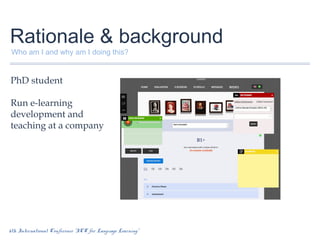
Rationale & background
Who am I and why am I doing this?

PhD student
Run e-learning
development and
teaching at a company

6th International Conference “ICT for Language Learning”
Rationale & background
Who am I and why am I doing this?

PhD student
Run e-learning
development and
teaching at a company
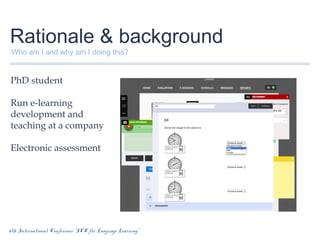
Electronic assessment

6th International Conference “ICT for Language Learning”
Rationale & background
Who am I and why am I doing this?

PhD student
Run e-learning
development and
teaching at a company
Electronic assessment
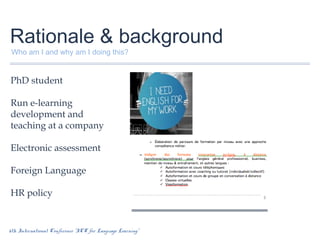
Foreign Language
HR policy

6th International Conference “ICT for Language Learning”
Problem
Research questions

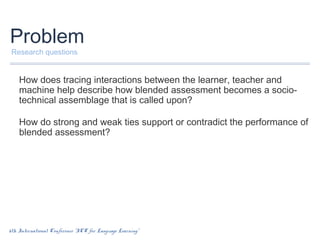
How does tracing interactions between the learner, teacher and
machine help describe how blended assessment becomes a sociotechnical assemblage that is called upon?
How do strong and weak ties support or contradict the performance of
blended assessment?

6th International Conference “ICT for Language Learning”
E-assessment

What is e-assessment? What is blended assessment?

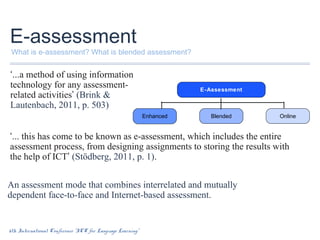
‘...a method of using information
technology for any assessmentrelated activities’ (Brink &
Lautenbach, 2011, p. 503)

E-Assessment

Enhanced

Blended

Online

‘... this has come to be known as e-assessment, which includes the entire
assessment process, from designing assignments to storing the results with
the help of ICT’ (Stödberg, 2011, p. 1).
An assessment mode that combines interrelated and mutually
dependent face-to-face and Internet-based assessment.

6th International Conference “ICT for Language Learning”
E-assessment
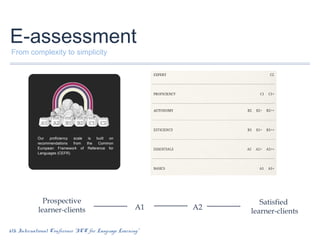
From complexity to simplicity

Our
proficiency
scale
is
built
on
recommendations
from
the
Common
European Framework of Reference for
Languages (CEFR).

Prospective
learner-clients

A1

6th International Conference “ICT for Language Learning”

A2

Satisfied
learner-clients
E-assessment
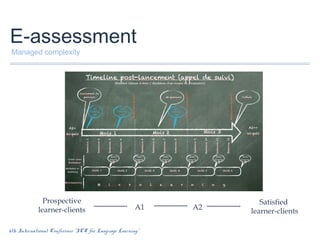
Managed complexity

Prospective
learner-clients

A1

6th International Conference “ICT for Language Learning”

A2

Satisfied
learner-clients
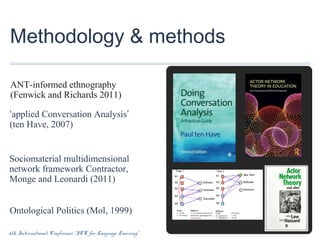
Methodology & methods
ANT-informed ethnography
(Fenwick and Richards 2011)
‘applied Conversation Analysis’
(ten Have, 2007)

Sociomaterial multidimensional
network framework Contractor,
Monge and Leonardi (2011)
Ontological Politics (Mol, 1999)
6th International Conference “ICT for Language Learning”
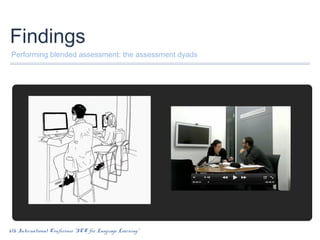
Findings
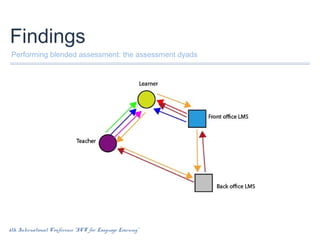
Performing blended assessment: the assessment dyads

6th International Conference “ICT for Language Learning”
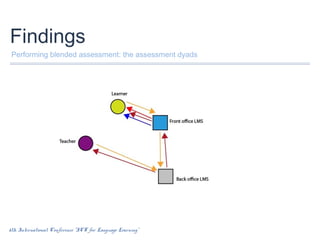
Findings
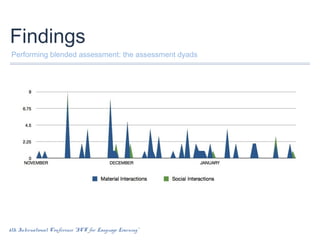
Performing blended assessment: the assessment dyads

6th International Conference “ICT for Language Learning”
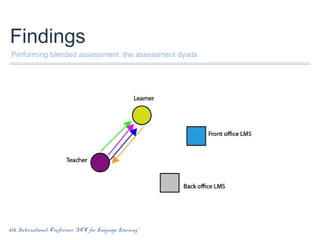
Findings
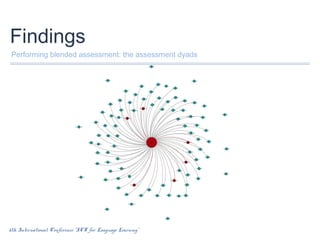
Performing blended assessment: the assessment dyads

6th International Conference “ICT for Language Learning”
Findings
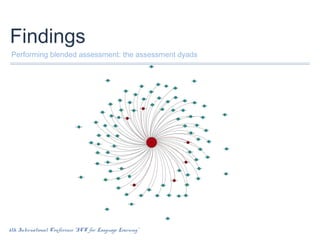
Performing blended assessment: the assessment dyads

6th International Conference “ICT for Language Learning”
Findings
Performing blended assessment: the assessment dyads

6th International Conference “ICT for Language Learning”
Findings
Performing blended assessment: the assessment dyads

6th International Conference “ICT for Language Learning”
Findings
Performing blended assessment: the assessment dyads

6th International Conference “ICT for Language Learning”
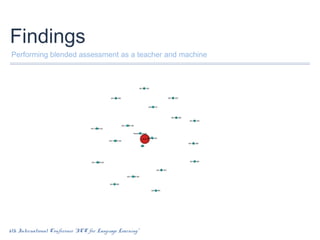
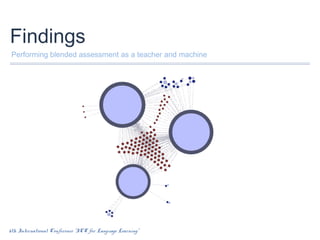
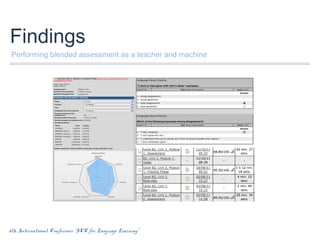
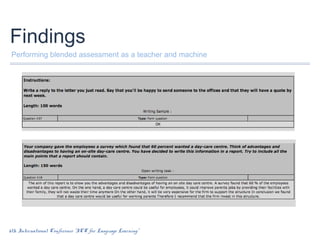
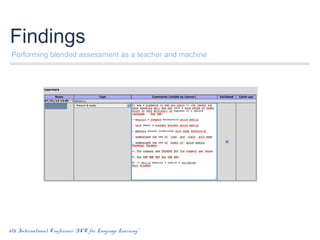
Findings
Performing blended assessment as a teacher and machine

6th International Conference “ICT for Language Learning”
Findings
Performing blended assessment as a teacher and machine

6th International Conference “ICT for Language Learning”
Findings
Performing blended assessment as a teacher and a learner

L: hhh It was a little bit hard to uh:: manage this situation
because uh::::: I liked this girl and [uh:::]
T:

[hmm↓]

L: and she thought we:::: cheated on her
T: Yeah↓ We cheated her.
L: We cheated her?
T: Yeah it's [um]L:

[CHEATED↓] it's not cheaton me? Can I [say

T:

[ To cheat on someone is normally

L: °ah oui°
T: and, it's °yeah.°
L: Okay all right No this wasn't
T: ((laughs))
L: it wasn't (inaudible)
T: ((laughs))< not in this context> ((laughs)) You said she –
L: (5.2)

to do with eh: a relationship
Findings
Performing blended assessment as a teacher and machine

6th International Conference “ICT for Language Learning”
Findings
Performing blended assessment as a teacher and machine

6th International Conference “ICT for Language Learning”
Findings
Performing blended assessment as a teacher and machine

6th International Conference “ICT for Language Learning”
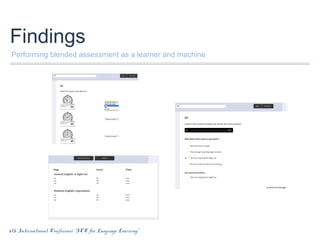
Findings
Performing blended assessment as a learner and machine

6th International Conference “ICT for Language Learning”
Future directions
More ethnographic understanding
A framework for assessment that moves between
‘connoisseurship’ and ‘psychometric’ testing cultures
http://okeeffe.free.fr/network/index.html

6th International Conference “ICT for Language Learning”

Blended assessment

  • 1.
    Untangling strong andweak ties in blended assessment in the corporate sector 6th International Conference “ICT for Language Learning”
  • 2.
    Rationale & background Whoam I and why am I doing this? PhD student Run e-learning development and teaching at a company 6th International Conference “ICT for Language Learning”
  • 3.
    Rationale & background Whoam I and why am I doing this? PhD student Run e-learning development and teaching at a company Electronic assessment 6th International Conference “ICT for Language Learning”
  • 4.
    Rationale & background Whoam I and why am I doing this? PhD student Run e-learning development and teaching at a company Electronic assessment Foreign Language HR policy 6th International Conference “ICT for Language Learning”
  • 5.
    Problem Research questions How doestracing interactions between the learner, teacher and machine help describe how blended assessment becomes a sociotechnical assemblage that is called upon? How do strong and weak ties support or contradict the performance of blended assessment? 6th International Conference “ICT for Language Learning”
  • 6.
    E-assessment What is e-assessment?What is blended assessment? ‘...a method of using information technology for any assessmentrelated activities’ (Brink & Lautenbach, 2011, p. 503) E-Assessment Enhanced Blended Online ‘... this has come to be known as e-assessment, which includes the entire assessment process, from designing assignments to storing the results with the help of ICT’ (Stödberg, 2011, p. 1). An assessment mode that combines interrelated and mutually dependent face-to-face and Internet-based assessment. 6th International Conference “ICT for Language Learning”
  • 7.
    E-assessment From complexity tosimplicity Our proficiency scale is built on recommendations from the Common European Framework of Reference for Languages (CEFR). Prospective learner-clients A1 6th International Conference “ICT for Language Learning” A2 Satisfied learner-clients
  • 8.
    E-assessment Managed complexity Prospective learner-clients A1 6th InternationalConference “ICT for Language Learning” A2 Satisfied learner-clients
  • 9.
    Methodology & methods ANT-informedethnography (Fenwick and Richards 2011) ‘applied Conversation Analysis’ (ten Have, 2007) Sociomaterial multidimensional network framework Contractor, Monge and Leonardi (2011) Ontological Politics (Mol, 1999) 6th International Conference “ICT for Language Learning”
  • 10.
    Findings Performing blended assessment:the assessment dyads 6th International Conference “ICT for Language Learning”
  • 11.
    Findings Performing blended assessment:the assessment dyads 6th International Conference “ICT for Language Learning”
  • 12.
    Findings Performing blended assessment:the assessment dyads 6th International Conference “ICT for Language Learning”
  • 13.
    Findings Performing blended assessment:the assessment dyads 6th International Conference “ICT for Language Learning”
  • 14.
    Findings Performing blended assessment:the assessment dyads 6th International Conference “ICT for Language Learning”
  • 15.
    Findings Performing blended assessment:the assessment dyads 6th International Conference “ICT for Language Learning”
  • 16.
    Findings Performing blended assessment:the assessment dyads 6th International Conference “ICT for Language Learning”
  • 17.
    Findings Performing blended assessmentas a teacher and machine 6th International Conference “ICT for Language Learning”
  • 18.
    Findings Performing blended assessmentas a teacher and machine 6th International Conference “ICT for Language Learning”
  • 19.
    Findings Performing blended assessmentas a teacher and a learner L: hhh It was a little bit hard to uh:: manage this situation because uh::::: I liked this girl and [uh:::] T: [hmm↓] L: and she thought we:::: cheated on her T: Yeah↓ We cheated her. L: We cheated her? T: Yeah it's [um]L: [CHEATED↓] it's not cheaton me? Can I [say T: [ To cheat on someone is normally L: °ah oui° T: and, it's °yeah.° L: Okay all right No this wasn't T: ((laughs)) L: it wasn't (inaudible) T: ((laughs))< not in this context> ((laughs)) You said she – L: (5.2) to do with eh: a relationship
  • 20.
    Findings Performing blended assessmentas a teacher and machine 6th International Conference “ICT for Language Learning”
  • 21.
    Findings Performing blended assessmentas a teacher and machine 6th International Conference “ICT for Language Learning”
  • 22.
    Findings Performing blended assessmentas a teacher and machine 6th International Conference “ICT for Language Learning”
  • 23.
    Findings Performing blended assessmentas a learner and machine 6th International Conference “ICT for Language Learning”
  • 24.
    Future directions More ethnographicunderstanding A framework for assessment that moves between ‘connoisseurship’ and ‘psychometric’ testing cultures http://okeeffe.free.fr/network/index.html 6th International Conference “ICT for Language Learning”

Editor's Notes

  • #2 ■ a statement of the research question(s) and/or purpose(s) ■ a rationale for the study (i.e., information about why the question was asked, the problem the research was meant to investigate or address, and the research and theory that came beforehand) ■ a description of the methods used to collect data to address the question(s) ■ a description of the methods used to analyze the data collected to address the question(s) ■ results of these analyses ■ conclusions that the researchers have drawn based on the results ■ implications of those conclusions for practice ■ limitations of the study ■ directions for future research
  • #7 Such broad definitions are helpful but can obscure the wide range of activities that go into creating, deploying and analyzing e-assessment. Even the most electronic of assessments involve decisions made by humans at almost every stage and these are difficult to trace.
  • #8 Such broad definitions are helpful but can obscure the wide range of activities that go into creating, deploying and analyzing e-assessment. Even the most electronic of assessments involve decisions made by humans at almost every stage and these are difficult to trace.
  • #9 Such broad definitions are helpful but can obscure the wide range of activities that go into creating, deploying and analyzing e-assessment. Even the most electronic of assessments involve decisions made by humans at almost every stage and these are difficult to trace.
  • #10 This allows for temporary stabilization of the shape and dynamics of the different types of sociomaterial relationships between human and non-humans in blended assessment.