CHAPTER 2 1


TRANSPHARMERS                  - BlOREACTORS FOR
PHARMACEUTICAL PRODUCTS


         The application of transgenic technology to commercially impor-
tant livestock is expected to generate major effects in agriculture and
medicine. Three areas of development have been the focus of intensive
investigation: (1) For improved desirable traits, such as increased growth
rate, feed conversion, reduction of fat, improved quality of meat and milk.
Growth hormone transgenes have been inserted into genomes of pig,
sheep, and cow; (2) For improved resistance to diseases - A number of
genes contributing to the immune system (such as heavy and light chains
of an antibody that binds to a specific antigen) can be introduced to confer
in vivo immunization to transgenic animals; (3) To raise transgenic animals
for the production of pharmaceutical proteins - The concept of using farm
animals as bioreactors has raised the prospect of a revolutionary role of
livestock species. The list of proteins includes human lactoferrin, human
collagen, ttj-antitrypsin, blood coagulation factor, anticlotting agents, and
others.
         The prospect of producing pharmacologically active proteins in the
milk of transgenic livestock is appealing for several reasons. (1) Trans-
genic animals may ultimately be a low-cost method of producing recombi-
nant proteins than mammalian cell culture. Lines of transgenic livestock,
although are costly to establish, can be multiplied and expanded rapidly
and easily. In contrast, the maintenance of large-scale mammalian cell
culture requires continuous high expense. (2) Unlike microbial systems
that are not capable of posttranslational processing, transgenic animals
produce bioactive complex proteins with an efficient system of post-
modification. (3) Recovery and purification of active proteins from milk is
relatively simple. The volume of milk production is large, and the yield of
198   The ABCs of Gene Cloning


protein may be potentially high, rendering the process economically feasi-
ble.


21.1 General Procedure For Production of Transgenic
Animals

         In a general scheme, the gene of a desired protein is constructed in
a suitable vector carrying the regulatory sequence of a milk protein which
to direct the expression in mammary tissues. Promoters that have been
used often include those of the genes of P-lactoglobulin and P-casein
(major proteins found in milk). The recombinant DNA is then introduced
into the pronuclei of fertilized eggs at an early stage by microinjection.
The injected DNA is usually integrated as multiple tandem copies at ran-
dom locations. The transformed egg cell is then implanted into the uterus
of a surrogate animal to give birth to transgenic offspring. The transgenic
animal can be raised for milking the expressed protein for processing and
purification. Stable transmission of the transgene to succeeding genera-
tions is a critical factor in establishing transgenic lines of the livestock.
Although it is not as frequent, transgenes can also be introduced using nu-
clear transfer techniques (see Sections 22.2).


21.2. Transgenic Sheep for a^-Antitrypsin

         The raise of transgenic sheep for the production of ttj-antitrypsin
has been described (Wright et al. 1991. Bio/Technology 9, 830-834). Hu-
man tti-antitrypsin (HttjAT) is a glycoprotein with a molecular weight of
54 kD, consisting of 394 amino acids, with 12% carbohydrates. The pro-
tein is synthesized in the liver and secreted in the plasma with a serum
concentration of ~2 mg per ml. Human ttjAT is a potent inhibitor of a
wide range of serine proteases, a class of enzymes, if leave unchecked, can
cause excessive tissue damage. Individuals deficient in the protein risk the
development of emphysema.
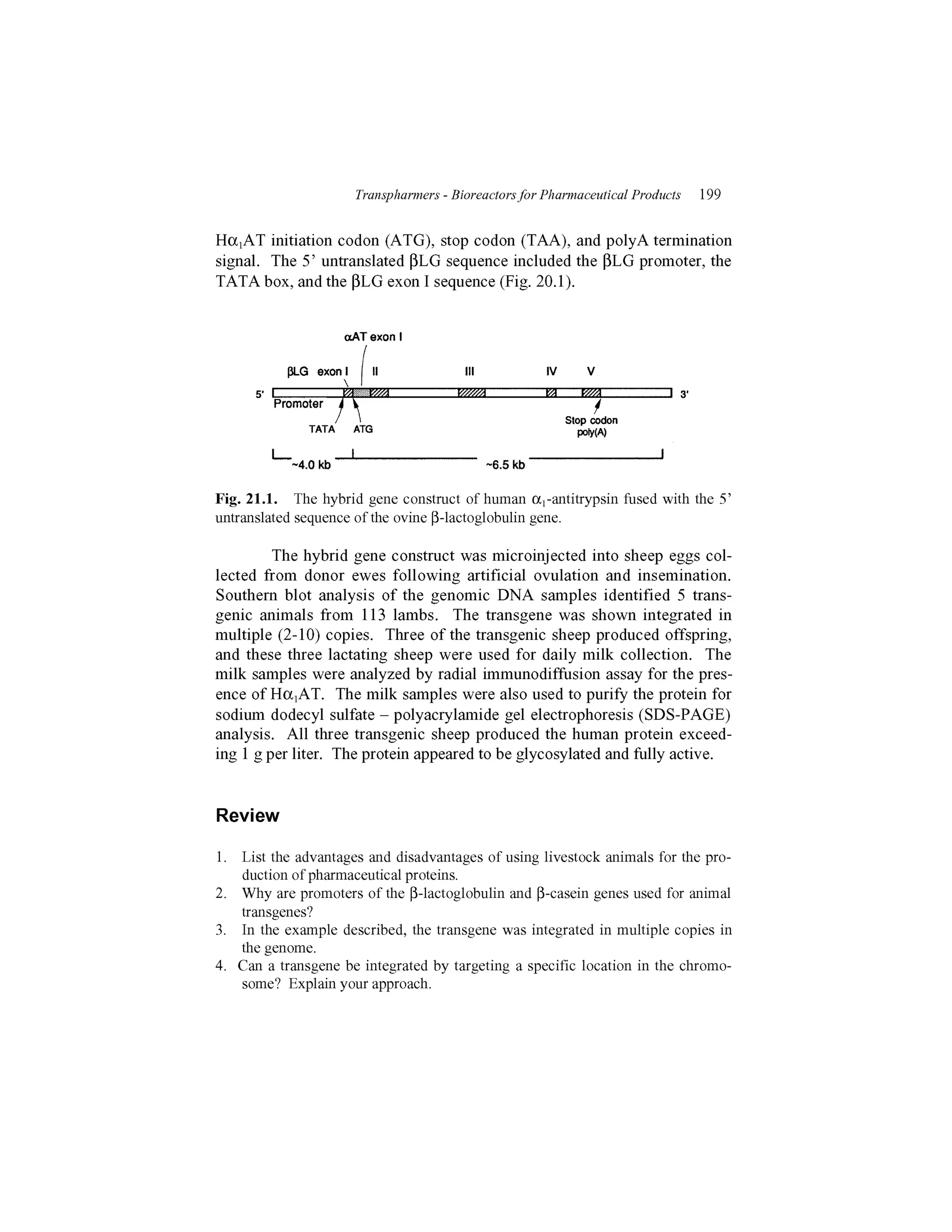
         In the study, a hybrid gene was constructed by fusing the HttjAT
gene to the 5' untranslated sequence of the ovine P-lactoglobulin (PLG)
gene. The HttjAT gene consisted of five exons (I, II, III, IV, and V) and
four introns. In the gene construct, the first HttjAT intron (between exons
I and II) sequence was deleted. This HttjAT minigene therefore consisted
of exons I and II fused, and exons III, IV and V interrupted by introns, the
Transpharmers - Bioreactors for Pharmaceutical       Products   199


HttiAT initiation codon (ATG), stop codon (TAA), and polyA termination
signal. The 5' untranslated PLG sequence included the PLG promoter, the
TATA box, and the PLG exon I sequence (Fig. 20.1).


                        (xAT exon I

           ^Q    exon I    | II              III             IV

         Promoter
                    ^                                             Stop codon
                TATA      ATG                                       poWA)


            -4.0 kb                                -6.5 kb

Fig. 21.1. The hybrid gene construct of human tti-antitrypsin fused with the 5'
untranslated sequence of the ovine P-lactoglobulin gene.

         The hybrid gene construct was microinjected into sheep eggs col-
lected from donor ewes following artificial ovulation and insemination.
Southern blot analysis of the genomic DNA samples identified 5 trans-
genic animals from 113 lambs. The transgene was shown integrated in
multiple (2-10) copies. Three of the transgenic sheep produced offspring,
and these three lactating sheep were used for daily milk collection. The
milk samples were analyzed by radial immunodiffusion assay for the pres-
ence of HttjAT. The milk samples were also used to purify the protein for
sodium dodecyl sulfate - polyacrylamide gel electrophoresis (SDS-PAGE)
analysis. All three transgenic sheep produced the human protein exceed-
ing 1 g per liter. The protein appeared to be glycosylated and fully active.


Review

1. List the advantages and disadvantages of using Hvestock animals for the pro-
   duction of pharmaceutical proteins.
2. Why are promoters of the P-lactoglobulin and P-casein genes used for animal
   transgenes?
3. In the example described, the transgene was integrated in multiple copies in
   the genome.
4. Can a transgene be integrated by targeting a specific location in the chromo-
   some? Explain your approach.

Bl oreactors

  • 1.
    CHAPTER 2 1 TRANSPHARMERS - BlOREACTORS FOR PHARMACEUTICAL PRODUCTS The application of transgenic technology to commercially impor- tant livestock is expected to generate major effects in agriculture and medicine. Three areas of development have been the focus of intensive investigation: (1) For improved desirable traits, such as increased growth rate, feed conversion, reduction of fat, improved quality of meat and milk. Growth hormone transgenes have been inserted into genomes of pig, sheep, and cow; (2) For improved resistance to diseases - A number of genes contributing to the immune system (such as heavy and light chains of an antibody that binds to a specific antigen) can be introduced to confer in vivo immunization to transgenic animals; (3) To raise transgenic animals for the production of pharmaceutical proteins - The concept of using farm animals as bioreactors has raised the prospect of a revolutionary role of livestock species. The list of proteins includes human lactoferrin, human collagen, ttj-antitrypsin, blood coagulation factor, anticlotting agents, and others. The prospect of producing pharmacologically active proteins in the milk of transgenic livestock is appealing for several reasons. (1) Trans- genic animals may ultimately be a low-cost method of producing recombi- nant proteins than mammalian cell culture. Lines of transgenic livestock, although are costly to establish, can be multiplied and expanded rapidly and easily. In contrast, the maintenance of large-scale mammalian cell culture requires continuous high expense. (2) Unlike microbial systems that are not capable of posttranslational processing, transgenic animals produce bioactive complex proteins with an efficient system of post- modification. (3) Recovery and purification of active proteins from milk is relatively simple. The volume of milk production is large, and the yield of
  • 2.
    198 The ABCs of Gene Cloning protein may be potentially high, rendering the process economically feasi- ble. 21.1 General Procedure For Production of Transgenic Animals In a general scheme, the gene of a desired protein is constructed in a suitable vector carrying the regulatory sequence of a milk protein which to direct the expression in mammary tissues. Promoters that have been used often include those of the genes of P-lactoglobulin and P-casein (major proteins found in milk). The recombinant DNA is then introduced into the pronuclei of fertilized eggs at an early stage by microinjection. The injected DNA is usually integrated as multiple tandem copies at ran- dom locations. The transformed egg cell is then implanted into the uterus of a surrogate animal to give birth to transgenic offspring. The transgenic animal can be raised for milking the expressed protein for processing and purification. Stable transmission of the transgene to succeeding genera- tions is a critical factor in establishing transgenic lines of the livestock. Although it is not as frequent, transgenes can also be introduced using nu- clear transfer techniques (see Sections 22.2). 21.2. Transgenic Sheep for a^-Antitrypsin The raise of transgenic sheep for the production of ttj-antitrypsin has been described (Wright et al. 1991. Bio/Technology 9, 830-834). Hu- man tti-antitrypsin (HttjAT) is a glycoprotein with a molecular weight of 54 kD, consisting of 394 amino acids, with 12% carbohydrates. The pro- tein is synthesized in the liver and secreted in the plasma with a serum concentration of ~2 mg per ml. Human ttjAT is a potent inhibitor of a wide range of serine proteases, a class of enzymes, if leave unchecked, can cause excessive tissue damage. Individuals deficient in the protein risk the development of emphysema. In the study, a hybrid gene was constructed by fusing the HttjAT gene to the 5' untranslated sequence of the ovine P-lactoglobulin (PLG) gene. The HttjAT gene consisted of five exons (I, II, III, IV, and V) and four introns. In the gene construct, the first HttjAT intron (between exons I and II) sequence was deleted. This HttjAT minigene therefore consisted of exons I and II fused, and exons III, IV and V interrupted by introns, the
  • 3.
    Transpharmers - Bioreactorsfor Pharmaceutical Products 199 HttiAT initiation codon (ATG), stop codon (TAA), and polyA termination signal. The 5' untranslated PLG sequence included the PLG promoter, the TATA box, and the PLG exon I sequence (Fig. 20.1). (xAT exon I ^Q exon I | II III IV Promoter ^ Stop codon TATA ATG poWA) -4.0 kb -6.5 kb Fig. 21.1. The hybrid gene construct of human tti-antitrypsin fused with the 5' untranslated sequence of the ovine P-lactoglobulin gene. The hybrid gene construct was microinjected into sheep eggs col- lected from donor ewes following artificial ovulation and insemination. Southern blot analysis of the genomic DNA samples identified 5 trans- genic animals from 113 lambs. The transgene was shown integrated in multiple (2-10) copies. Three of the transgenic sheep produced offspring, and these three lactating sheep were used for daily milk collection. The milk samples were analyzed by radial immunodiffusion assay for the pres- ence of HttjAT. The milk samples were also used to purify the protein for sodium dodecyl sulfate - polyacrylamide gel electrophoresis (SDS-PAGE) analysis. All three transgenic sheep produced the human protein exceed- ing 1 g per liter. The protein appeared to be glycosylated and fully active. Review 1. List the advantages and disadvantages of using Hvestock animals for the pro- duction of pharmaceutical proteins. 2. Why are promoters of the P-lactoglobulin and P-casein genes used for animal transgenes? 3. In the example described, the transgene was integrated in multiple copies in the genome. 4. Can a transgene be integrated by targeting a specific location in the chromo- some? Explain your approach.