The document proposes a peer-to-peer electronic cash system called Bitcoin that uses cryptographic proof instead of a trusted third party to allow any two willing parties to transact directly. It addresses the double-spending problem through a peer-to-peer network that timestamps transactions by hashing them into an ongoing chain of proof-of-work blocks. As long as the majority of computing power on the network is controlled by honest nodes, they will generate the longest chain and outpace attackers attempting to modify past transactions.
![2. Transactions
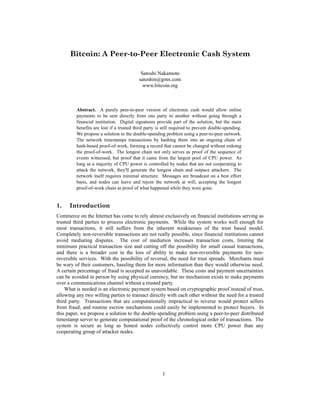
We define an electronic coin as a chain of digital signatures. Each owner transfers the coin to the
next by digitally signing a hash of the previous transaction and the public key of the next owner
and adding these to the end of the coin. A payee can verify the signatures to verify the chain of
ownership.
The problem of course is the payee can't verify that one of the owners did not double-spend
the coin. A common solution is to introduce a trusted central authority, or mint, that checks every
transaction for double spending. After each transaction, the coin must be returned to the mint to
issue a new coin, and only coins issued directly from the mint are trusted not to be double-spent.
The problem with this solution is that the fate of the entire money system depends on the
company running the mint, with every transaction having to go through them, just like a bank.
We need a way for the payee to know that the previous owners did not sign any earlier
transactions. For our purposes, the earliest transaction is the one that counts, so we don't care
about later attempts to double-spend. The only way to confirm the absence of a transaction is to
be aware of all transactions. In the mint based model, the mint was aware of all transactions and
decided which arrived first. To accomplish this without a trusted party, transactions must be
publicly announced [1], and we need a system for participants to agree on a single history of the
order in which they were received. The payee needs proof that at the time of each transaction, the
majority of nodes agreed it was the first received.
3. Timestamp Server
The solution we propose begins with a timestamp server. A timestamp server works by taking a
hash of a block of items to be timestamped and widely publishing the hash, such as in a
newspaper or Usenet post [2-5]. The timestamp proves that the data must have existed at the
time, obviously, in order to get into the hash. Each timestamp includes the previous timestamp in
its hash, forming a chain, with each additional timestamp reinforcing the ones before it.
2
Block
Item Item ...
Hash
Block
Item Item ...
Hash
Transaction
Owner 1's
Public Key
Owner 0's
Signature
Hash
Transaction
Owner 2's
Public Key
Owner 1's
Signature
Hash
Verify
Transaction
Owner 3's
Public Key
Owner 2's
Signature
Hash
Verify
Owner 2's
Private Key
Owner 1's
Private Key
Sign
Sign
Owner 3's
Private Key](https://image.slidesharecdn.com/bitcoin-230517170119-b47ee6f1/85/bitcoin-pdf-2-320.jpg)
![4. Proof-of-Work
To implement a distributed timestamp server on a peer-to-peer basis, we will need to use a proof-
of-work system similar to Adam Back's Hashcash [6], rather than newspaper or Usenet posts.
The proof-of-work involves scanning for a value that when hashed, such as with SHA-256, the
hash begins with a number of zero bits. The average work required is exponential in the number
of zero bits required and can be verified by executing a single hash.
For our timestamp network, we implement the proof-of-work by incrementing a nonce in the
block until a value is found that gives the block's hash the required zero bits. Once the CPU
effort has been expended to make it satisfy the proof-of-work, the block cannot be changed
without redoing the work. As later blocks are chained after it, the work to change the block
would include redoing all the blocks after it.
The proof-of-work also solves the problem of determining representation in majority decision
making. If the majority were based on one-IP-address-one-vote, it could be subverted by anyone
able to allocate many IPs. Proof-of-work is essentially one-CPU-one-vote. The majority
decision is represented by the longest chain, which has the greatest proof-of-work effort invested
in it. If a majority of CPU power is controlled by honest nodes, the honest chain will grow the
fastest and outpace any competing chains. To modify a past block, an attacker would have to
redo the proof-of-work of the block and all blocks after it and then catch up with and surpass the
work of the honest nodes. We will show later that the probability of a slower attacker catching up
diminishes exponentially as subsequent blocks are added.
To compensate for increasing hardware speed and varying interest in running nodes over time,
the proof-of-work difficulty is determined by a moving average targeting an average number of
blocks per hour. If they're generated too fast, the difficulty increases.
5. Network
The steps to run the network are as follows:
1) New transactions are broadcast to all nodes.
2) Each node collects new transactions into a block.
3) Each node works on finding a difficult proof-of-work for its block.
4) When a node finds a proof-of-work, it broadcasts the block to all nodes.
5) Nodes accept the block only if all transactions in it are valid and not already spent.
6) Nodes express their acceptance of the block by working on creating the next block in the
chain, using the hash of the accepted block as the previous hash.
Nodes always consider the longest chain to be the correct one and will keep working on
extending it. If two nodes broadcast different versions of the next block simultaneously, some
nodes may receive one or the other first. In that case, they work on the first one they received,
but save the other branch in case it becomes longer. The tie will be broken when the next proof-
of-work is found and one branch becomes longer; the nodes that were working on the other
branch will then switch to the longer one.
3
Block
Prev Hash Nonce
Tx Tx ...
Block
Prev Hash Nonce
Tx Tx ...](https://image.slidesharecdn.com/bitcoin-230517170119-b47ee6f1/85/bitcoin-pdf-3-320.jpg)
![New transaction broadcasts do not necessarily need to reach all nodes. As long as they reach
many nodes, they will get into a block before long. Block broadcasts are also tolerant of dropped
messages. If a node does not receive a block, it will request it when it receives the next block and
realizes it missed one.
6. Incentive
By convention, the first transaction in a block is a special transaction that starts a new coin owned
by the creator of the block. This adds an incentive for nodes to support the network, and provides
a way to initially distribute coins into circulation, since there is no central authority to issue them.
The steady addition of a constant of amount of new coins is analogous to gold miners expending
resources to add gold to circulation. In our case, it is CPU time and electricity that is expended.
The incentive can also be funded with transaction fees. If the output value of a transaction is
less than its input value, the difference is a transaction fee that is added to the incentive value of
the block containing the transaction. Once a predetermined number of coins have entered
circulation, the incentive can transition entirely to transaction fees and be completely inflation
free.
The incentive may help encourage nodes to stay honest. If a greedy attacker is able to
assemble more CPU power than all the honest nodes, he would have to choose between using it
to defraud people by stealing back his payments, or using it to generate new coins. He ought to
find it more profitable to play by the rules, such rules that favour him with more new coins than
everyone else combined, than to undermine the system and the validity of his own wealth.
7. Reclaiming Disk Space
Once the latest transaction in a coin is buried under enough blocks, the spent transactions before
it can be discarded to save disk space. To facilitate this without breaking the block's hash,
transactions are hashed in a Merkle Tree [7][2][5], with only the root included in the block's hash.
Old blocks can then be compacted by stubbing off branches of the tree. The interior hashes do
not need to be stored.
A block header with no transactions would be about 80 bytes. If we suppose blocks are
generated every 10 minutes, 80 bytes * 6 * 24 * 365 = 4.2MB per year. With computer systems
typically selling with 2GB of RAM as of 2008, and Moore's Law predicting current growth of
1.2GB per year, storage should not be a problem even if the block headers must be kept in
memory.
4
Block
Block
Block Header (Block Hash)
Prev Hash Nonce
Hash01
Hash0 Hash1 Hash2 Hash3
Hash23
Root Hash
Hash01
Hash2
Tx3
Hash23
Block Header (Block Hash)
Root Hash
Transactions Hashed in a Merkle Tree After Pruning Tx0-2 from the Block
Prev Hash Nonce
Hash3
Tx0 Tx1 Tx2 Tx3](https://image.slidesharecdn.com/bitcoin-230517170119-b47ee6f1/85/bitcoin-pdf-4-320.jpg)
![10. Privacy
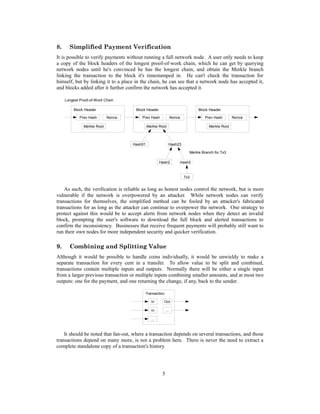
The traditional banking model achieves a level of privacy by limiting access to information to the
parties involved and the trusted third party. The necessity to announce all transactions publicly
precludes this method, but privacy can still be maintained by breaking the flow of information in
another place: by keeping public keys anonymous. The public can see that someone is sending
an amount to someone else, but without information linking the transaction to anyone. This is
similar to the level of information released by stock exchanges, where the time and size of
individual trades, the "tape", is made public, but without telling who the parties were.
As an additional firewall, a new key pair should be used for each transaction to keep them
from being linked to a common owner. Some linking is still unavoidable with multi-input
transactions, which necessarily reveal that their inputs were owned by the same owner. The risk
is that if the owner of a key is revealed, linking could reveal other transactions that belonged to
the same owner.
11. Calculations
We consider the scenario of an attacker trying to generate an alternate chain faster than the honest
chain. Even if this is accomplished, it does not throw the system open to arbitrary changes, such
as creating value out of thin air or taking money that never belonged to the attacker. Nodes are
not going to accept an invalid transaction as payment, and honest nodes will never accept a block
containing them. An attacker can only try to change one of his own transactions to take back
money he recently spent.
The race between the honest chain and an attacker chain can be characterized as a Binomial
Random Walk. The success event is the honest chain being extended by one block, increasing its
lead by +1, and the failure event is the attacker's chain being extended by one block, reducing the
gap by -1.
The probability of an attacker catching up from a given deficit is analogous to a Gambler's
Ruin problem. Suppose a gambler with unlimited credit starts at a deficit and plays potentially an
infinite number of trials to try to reach breakeven. We can calculate the probability he ever
reaches breakeven, or that an attacker ever catches up with the honest chain, as follows [8]:
p = probability an honest node finds the next block
q = probability the attacker finds the next block
qz = probability the attacker will ever catch up from z blocks behind
qz=
{ 1 if p≤q
q/ p
z
if pq}
6
Identities Transactions Trusted
Third Party
Counterparty Public
Identities Transactions Public
New Privacy Model
Traditional Privacy Model](https://image.slidesharecdn.com/bitcoin-230517170119-b47ee6f1/85/bitcoin-pdf-6-320.jpg)
![References
[1] W. Dai, "b-money," http://www.weidai.com/bmoney.txt, 1998.
[2] H. Massias, X.S. Avila, and J.-J. Quisquater, "Design of a secure timestamping service with minimal
trust requirements," In 20th Symposium on Information Theory in the Benelux, May 1999.
[3] S. Haber, W.S. Stornetta, "How to time-stamp a digital document," In Journal of Cryptology, vol 3, no
2, pages 99-111, 1991.
[4] D. Bayer, S. Haber, W.S. Stornetta, "Improving the efficiency and reliability of digital time-stamping,"
In Sequences II: Methods in Communication, Security and Computer Science, pages 329-334, 1993.
[5] S. Haber, W.S. Stornetta, "Secure names for bit-strings," In Proceedings of the 4th ACM Conference
on Computer and Communications Security, pages 28-35, April 1997.
[6] A. Back, "Hashcash - a denial of service counter-measure,"
http://www.hashcash.org/papers/hashcash.pdf, 2002.
[7] R.C. Merkle, "Protocols for public key cryptosystems," In Proc. 1980 Symposium on Security and
Privacy, IEEE Computer Society, pages 122-133, April 1980.
[8] W. Feller, "An introduction to probability theory and its applications," 1957.
9](https://image.slidesharecdn.com/bitcoin-230517170119-b47ee6f1/85/bitcoin-pdf-9-320.jpg)


