1
FINANZAS-FISCAL-LEGAL CORPORATIVO
Bitcoin-backed lending. Some Mexican tax considerations.
Background.
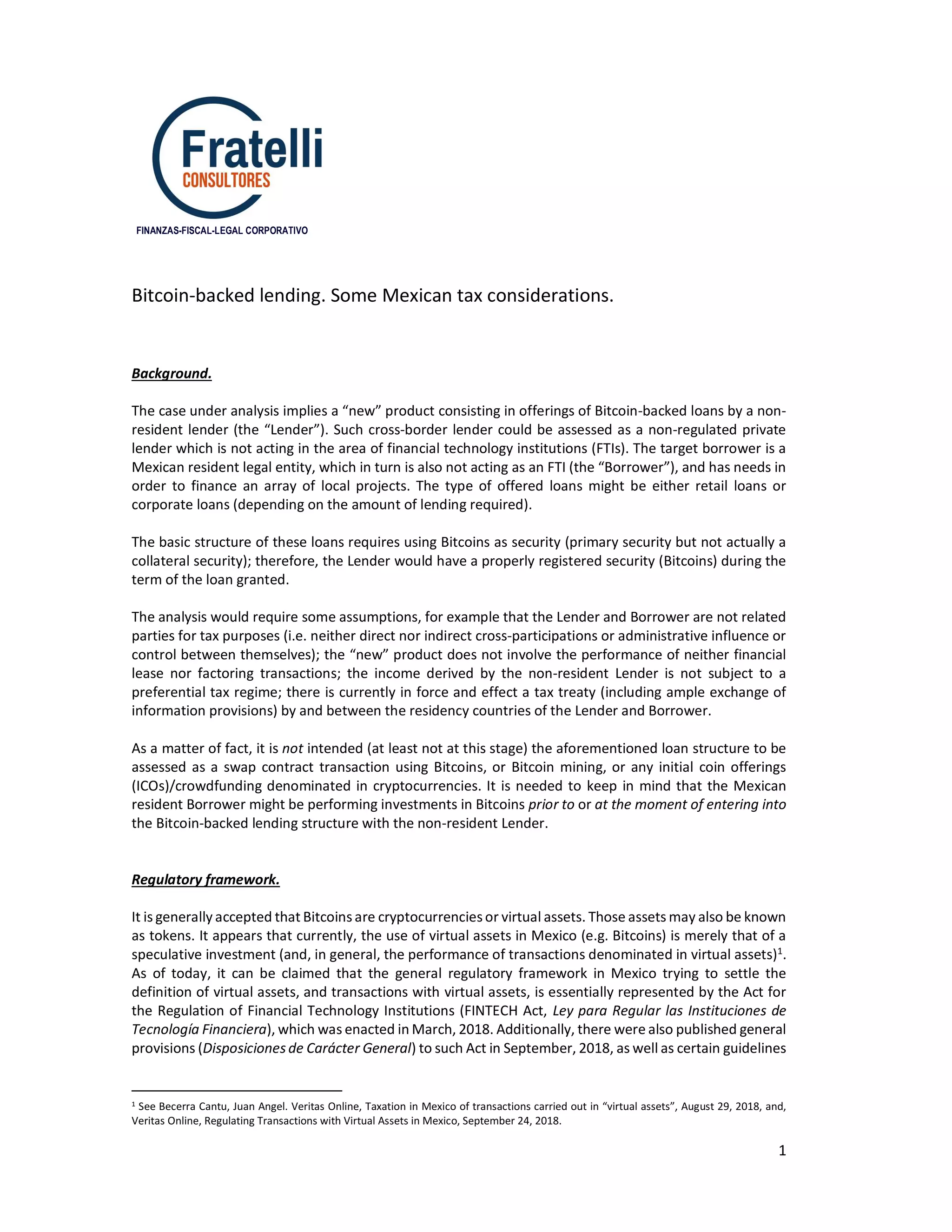
The case under analysis implies a “new” product consisting in offerings of Bitcoin-backed loans by a non-
resident lender (the “Lender”). Such cross-border lender could be assessed as a non-regulated private
lender which is not acting in the area of financial technology institutions (FTIs). The target borrower is a
Mexican resident legal entity, which in turn is also not acting as an FTI (the “Borrower”), and has needs in
order to finance an array of local projects. The type of offered loans might be either retail loans or
corporate loans (depending on the amount of lending required).
The basic structure of these loans requires using Bitcoins as security (primary security but not actually a
collateral security); therefore, the Lender would have a properly registered security (Bitcoins) during the
term of the loan granted.
The analysis would require some assumptions, for example that the Lender and Borrower are not related
parties for tax purposes (i.e. neither direct nor indirect cross-participations or administrative influence or
control between themselves); the “new” product does not involve the performance of neither financial
lease nor factoring transactions; the income derived by the non-resident Lender is not subject to a
preferential tax regime; there is currently in force and effect a tax treaty (including ample exchange of
information provisions) by and between the residency countries of the Lender and Borrower.
As a matter of fact, it is not intended (at least not at this stage) the aforementioned loan structure to be
assessed as a swap contract transaction using Bitcoins, or Bitcoin mining, or any initial coin offerings
(ICOs)/crowdfunding denominated in cryptocurrencies. It is needed to keep in mind that the Mexican
resident Borrower might be performing investments in Bitcoins prior to or at the moment of entering into
the Bitcoin-backed lending structure with the non-resident Lender.
Regulatory framework.
It is generally accepted that Bitcoinsare cryptocurrenciesor virtual assets. Those assets may also be known
as tokens. It appears that currently, the use of virtual assets in Mexico (e.g. Bitcoins) is merely that of a
speculative investment (and, in general, the performance of transactions denominated in virtual assets)1.
As of today, it can be claimed that the general regulatory framework in Mexico trying to settle the
definition of virtual assets, and transactions with virtual assets, is essentially represented by the Act for
the Regulation of Financial Technology Institutions (FINTECH Act, Ley para Regular las Instituciones de
Tecnología Financiera), which was enacted in March, 2018. Additionally, there were also published general
provisions (Disposiciones de Carácter General) to such Act in September, 2018, as well as certain guidelines
1
See Becerra Cantu, Juan Angel. Veritas Online, Taxation in Mexico of transactions carried out in “virtual assets”, August 29, 2018, and,
Veritas Online, Regulating Transactions with Virtual Assets in Mexico, September 24, 2018.
2
FINANZAS-FISCAL-LEGAL CORPORATIVO
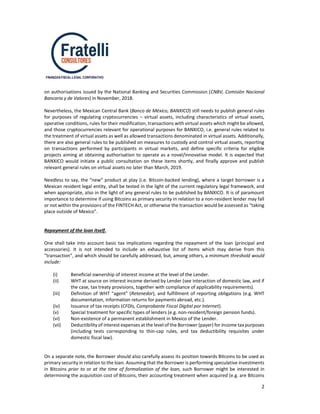
on authorisations issued by the National Banking and Securities Commission (CNBV, Comisión Nacional
Bancaria y de Valores) in November, 2018.
Nevertheless, the Mexican Central Bank (Banco de México, BANXICO) still needs to publish general rules
for purposes of regulating cryptocurrencies – virtual assets, including characteristics of virtual assets,
operative conditions, rules for their modification, transactions with virtual assets which might be allowed,
and those cryptocurrencies relevant for operational purposes for BANXICO, i.e. general rules related to
the treatment of virtual assets as well as allowed transactions denominated in virtual assets. Additionally,
there are also general rules to be published on measures to custody and control virtual assets, reporting
on transactions performed by participants in virtual markets, and define specific criteria for eligible
projects aiming at obtaining authorisation to operate as a novel/innovative model. It is expected that
BANXICO would initiate a public consultation on these items shortly, and finally approve and publish
relevant general rules on virtual assets no later than March, 2019.
Needless to say, the “new” product at play (i.e. Bitcoin-backed lending), where a target borrower is a
Mexican resident legal entity, shall be tested in the light of the current regulatory legal framework, and
when appropriate, also in the light of any general rules to be published by BANXICO. It is of paramount
importance to determine if using Bitcoins as primary security in relation to a non-resident lender may fall
or not within the provisions of the FINTECH Act, or otherwise the transaction would be assessed as “taking
place outside of Mexico”.
Repayment of the loan itself.
One shall take into account basic tax implications regarding the repayment of the loan (principal and
accessories). It is not intended to include an exhaustive list of items which may derive from this
“transaction”, and which should be carefully addressed, but, among others, a minimum threshold would
include:
(i) Beneficial ownership of interest income at the level of the Lender.
(ii) WHT at source on interest income derived by Lender (see interaction of domestic law, and if
the case, tax treaty provisions, together with compliance of applicability requirements).
(iii) Definition of WHT “agent” (Retenedor), and fulfillment of reporting obligations (e.g. WHT
documentation, information returns for payments abroad, etc.).
(iv) Issuance of tax receipts (CFDIs, Comprobante Fiscal Digital por Internet).
(v) Special treatment for specific types of lenders (e.g. non-resident/foreign pension funds).
(vi) Non-existence of a permanent establishment in Mexico of the Lender.
(vii) Deductibility of interest expenses at the level of the Borrower (payer) for income taxpurposes
(including tests corresponding to thin-cap rules, and tax deductibility requisites under
domestic fiscal law).
On a separate note, the Borrower should also carefully assess its position towards Bitcoins to be used as
primary security in relation to the loan. Assuming that the Borrower is performing speculative investments
in Bitcoins prior to or at the time of formalization of the loan, such Borrower might be interested in
determining the acquisition cost of Bitcoins, their accounting treatment when acquired (e.g. are Bitcoins
3
FINANZAS-FISCAL-LEGAL CORPORATIVO
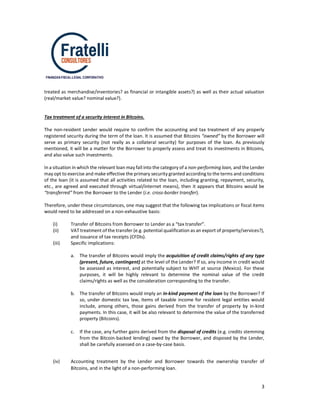
treated as merchandise/inventories? as financial or intangible assets?) as well as their actual valuation
(real/market value? nominal value?).
Tax treatment of a security interest in Bitcoins.
The non-resident Lender would require to confirm the accounting and tax treatment of any properly
registered security during the term of the loan. It is assumed that Bitcoins “owned” by the Borrower will
serve as primary security (not really as a collateral security) for purposes of the loan. As previously
mentioned, it will be a matter for the Borrower to properly assess and treat its investments in Bitcoins,
and also value such investments.
In a situation in which the relevant loan may fall into the category of a non-performing loan, and the Lender
may opt to exercise and make effective the primary security granted according to the terms and conditions
of the loan (it is assumed that all activities related to the loan, including granting, repayment, security,
etc., are agreed and executed through virtual/internet means), then it appears that Bitcoins would be
“transferred” from the Borrower to the Lender (i.e. cross-border transfer).
Therefore, under these circumstances, one may suggest that the following tax implications or fiscal items
would need to be addressed on a non-exhaustive basis:
(i) Transfer of Bitcoins from Borrower to Lender as a “tax transfer”.
(ii) VAT treatment of the transfer (e.g. potential qualification as an export of property/services?),
and issuance of tax receipts (CFDIs).
(iii) Specific implications:
a. The transfer of Bitcoins would imply the acquisition of credit claims/rights of any type
(present, future, contingent) at the level of the Lender? If so, any income in credit would
be assessed as interest, and potentially subject to WHT at source (Mexico). For these
purposes, it will be highly relevant to determine the nominal value of the credit
claims/rights as well as the consideration corresponding to the transfer.
b. The transfer of Bitcoins would imply an in-kind payment of the loan by the Borrower? If
so, under domestic tax law, items of taxable income for resident legal entities would
include, among others, those gains derived from the transfer of property by in-kind
payments. In this case, it will be also relevant to determine the value of the transferred
property (Bitcoins).
c. If the case, any further gains derived from the disposal of credits (e.g. credits stemming
from the Bitcoin-backed lending) owed by the Borrower, and disposed by the Lender,
shall be carefully assessed on a case-by-case basis.
(iv) Accounting treatment by the Lender and Borrower towards the ownership transfer of
Bitcoins, and in the light of a non-performing loan.
4
FINANZAS-FISCAL-LEGAL CORPORATIVO
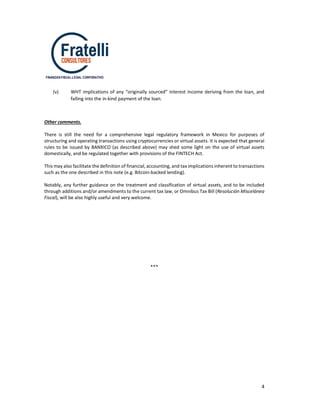
(v) WHT implications of any “originally sourced” interest income deriving from the loan, and
falling into the in-kind payment of the loan.
Other comments.
There is still the need for a comprehensive legal regulatory framework in Mexico for purposes of
structuring and operating transactions using cryptocurrencies or virtual assets. It is expected that general
rules to be issued by BANXICO (as described above) may shed some light on the use of virtual assets
domestically, and be regulated together with provisions of the FINTECH Act.
This may also facilitate the definition of financial, accounting, and tax implications inherent to transactions
such as the one described in this note (e.g. Bitcoin-backed lending).
Notably, any further guidance on the treatment and classification of virtual assets, and to be included
through additions and/or amendments to the current tax law, or Omnibus Tax Bill (Resolución Miscelánea
Fiscal), will be also highly useful and very welcome.
***

Bitcoin backed lending. Mexico tax implications

  • 1.
    1 FINANZAS-FISCAL-LEGAL CORPORATIVO Bitcoin-backed lending.Some Mexican tax considerations. Background. The case under analysis implies a “new” product consisting in offerings of Bitcoin-backed loans by a non- resident lender (the “Lender”). Such cross-border lender could be assessed as a non-regulated private lender which is not acting in the area of financial technology institutions (FTIs). The target borrower is a Mexican resident legal entity, which in turn is also not acting as an FTI (the “Borrower”), and has needs in order to finance an array of local projects. The type of offered loans might be either retail loans or corporate loans (depending on the amount of lending required). The basic structure of these loans requires using Bitcoins as security (primary security but not actually a collateral security); therefore, the Lender would have a properly registered security (Bitcoins) during the term of the loan granted. The analysis would require some assumptions, for example that the Lender and Borrower are not related parties for tax purposes (i.e. neither direct nor indirect cross-participations or administrative influence or control between themselves); the “new” product does not involve the performance of neither financial lease nor factoring transactions; the income derived by the non-resident Lender is not subject to a preferential tax regime; there is currently in force and effect a tax treaty (including ample exchange of information provisions) by and between the residency countries of the Lender and Borrower. As a matter of fact, it is not intended (at least not at this stage) the aforementioned loan structure to be assessed as a swap contract transaction using Bitcoins, or Bitcoin mining, or any initial coin offerings (ICOs)/crowdfunding denominated in cryptocurrencies. It is needed to keep in mind that the Mexican resident Borrower might be performing investments in Bitcoins prior to or at the moment of entering into the Bitcoin-backed lending structure with the non-resident Lender. Regulatory framework. It is generally accepted that Bitcoinsare cryptocurrenciesor virtual assets. Those assets may also be known as tokens. It appears that currently, the use of virtual assets in Mexico (e.g. Bitcoins) is merely that of a speculative investment (and, in general, the performance of transactions denominated in virtual assets)1. As of today, it can be claimed that the general regulatory framework in Mexico trying to settle the definition of virtual assets, and transactions with virtual assets, is essentially represented by the Act for the Regulation of Financial Technology Institutions (FINTECH Act, Ley para Regular las Instituciones de Tecnología Financiera), which was enacted in March, 2018. Additionally, there were also published general provisions (Disposiciones de Carácter General) to such Act in September, 2018, as well as certain guidelines 1 See Becerra Cantu, Juan Angel. Veritas Online, Taxation in Mexico of transactions carried out in “virtual assets”, August 29, 2018, and, Veritas Online, Regulating Transactions with Virtual Assets in Mexico, September 24, 2018.
  • 2.
    2 FINANZAS-FISCAL-LEGAL CORPORATIVO on authorisationsissued by the National Banking and Securities Commission (CNBV, Comisión Nacional Bancaria y de Valores) in November, 2018. Nevertheless, the Mexican Central Bank (Banco de México, BANXICO) still needs to publish general rules for purposes of regulating cryptocurrencies – virtual assets, including characteristics of virtual assets, operative conditions, rules for their modification, transactions with virtual assets which might be allowed, and those cryptocurrencies relevant for operational purposes for BANXICO, i.e. general rules related to the treatment of virtual assets as well as allowed transactions denominated in virtual assets. Additionally, there are also general rules to be published on measures to custody and control virtual assets, reporting on transactions performed by participants in virtual markets, and define specific criteria for eligible projects aiming at obtaining authorisation to operate as a novel/innovative model. It is expected that BANXICO would initiate a public consultation on these items shortly, and finally approve and publish relevant general rules on virtual assets no later than March, 2019. Needless to say, the “new” product at play (i.e. Bitcoin-backed lending), where a target borrower is a Mexican resident legal entity, shall be tested in the light of the current regulatory legal framework, and when appropriate, also in the light of any general rules to be published by BANXICO. It is of paramount importance to determine if using Bitcoins as primary security in relation to a non-resident lender may fall or not within the provisions of the FINTECH Act, or otherwise the transaction would be assessed as “taking place outside of Mexico”. Repayment of the loan itself. One shall take into account basic tax implications regarding the repayment of the loan (principal and accessories). It is not intended to include an exhaustive list of items which may derive from this “transaction”, and which should be carefully addressed, but, among others, a minimum threshold would include: (i) Beneficial ownership of interest income at the level of the Lender. (ii) WHT at source on interest income derived by Lender (see interaction of domestic law, and if the case, tax treaty provisions, together with compliance of applicability requirements). (iii) Definition of WHT “agent” (Retenedor), and fulfillment of reporting obligations (e.g. WHT documentation, information returns for payments abroad, etc.). (iv) Issuance of tax receipts (CFDIs, Comprobante Fiscal Digital por Internet). (v) Special treatment for specific types of lenders (e.g. non-resident/foreign pension funds). (vi) Non-existence of a permanent establishment in Mexico of the Lender. (vii) Deductibility of interest expenses at the level of the Borrower (payer) for income taxpurposes (including tests corresponding to thin-cap rules, and tax deductibility requisites under domestic fiscal law). On a separate note, the Borrower should also carefully assess its position towards Bitcoins to be used as primary security in relation to the loan. Assuming that the Borrower is performing speculative investments in Bitcoins prior to or at the time of formalization of the loan, such Borrower might be interested in determining the acquisition cost of Bitcoins, their accounting treatment when acquired (e.g. are Bitcoins
  • 3.
    3 FINANZAS-FISCAL-LEGAL CORPORATIVO treated asmerchandise/inventories? as financial or intangible assets?) as well as their actual valuation (real/market value? nominal value?). Tax treatment of a security interest in Bitcoins. The non-resident Lender would require to confirm the accounting and tax treatment of any properly registered security during the term of the loan. It is assumed that Bitcoins “owned” by the Borrower will serve as primary security (not really as a collateral security) for purposes of the loan. As previously mentioned, it will be a matter for the Borrower to properly assess and treat its investments in Bitcoins, and also value such investments. In a situation in which the relevant loan may fall into the category of a non-performing loan, and the Lender may opt to exercise and make effective the primary security granted according to the terms and conditions of the loan (it is assumed that all activities related to the loan, including granting, repayment, security, etc., are agreed and executed through virtual/internet means), then it appears that Bitcoins would be “transferred” from the Borrower to the Lender (i.e. cross-border transfer). Therefore, under these circumstances, one may suggest that the following tax implications or fiscal items would need to be addressed on a non-exhaustive basis: (i) Transfer of Bitcoins from Borrower to Lender as a “tax transfer”. (ii) VAT treatment of the transfer (e.g. potential qualification as an export of property/services?), and issuance of tax receipts (CFDIs). (iii) Specific implications: a. The transfer of Bitcoins would imply the acquisition of credit claims/rights of any type (present, future, contingent) at the level of the Lender? If so, any income in credit would be assessed as interest, and potentially subject to WHT at source (Mexico). For these purposes, it will be highly relevant to determine the nominal value of the credit claims/rights as well as the consideration corresponding to the transfer. b. The transfer of Bitcoins would imply an in-kind payment of the loan by the Borrower? If so, under domestic tax law, items of taxable income for resident legal entities would include, among others, those gains derived from the transfer of property by in-kind payments. In this case, it will be also relevant to determine the value of the transferred property (Bitcoins). c. If the case, any further gains derived from the disposal of credits (e.g. credits stemming from the Bitcoin-backed lending) owed by the Borrower, and disposed by the Lender, shall be carefully assessed on a case-by-case basis. (iv) Accounting treatment by the Lender and Borrower towards the ownership transfer of Bitcoins, and in the light of a non-performing loan.
  • 4.
    4 FINANZAS-FISCAL-LEGAL CORPORATIVO (v) WHTimplications of any “originally sourced” interest income deriving from the loan, and falling into the in-kind payment of the loan. Other comments. There is still the need for a comprehensive legal regulatory framework in Mexico for purposes of structuring and operating transactions using cryptocurrencies or virtual assets. It is expected that general rules to be issued by BANXICO (as described above) may shed some light on the use of virtual assets domestically, and be regulated together with provisions of the FINTECH Act. This may also facilitate the definition of financial, accounting, and tax implications inherent to transactions such as the one described in this note (e.g. Bitcoin-backed lending). Notably, any further guidance on the treatment and classification of virtual assets, and to be included through additions and/or amendments to the current tax law, or Omnibus Tax Bill (Resolución Miscelánea Fiscal), will be also highly useful and very welcome. ***