THE BITCOIN
Presented By
Mohamed Sakr
Menatallah Mohamed
Mohamed Sayed
Ayman Fahmy
AGENDA
• Introduction
• The Block Chain
• Bitcoin Price Volatility
• Egyptian View on the Bitcoin
• Global View of the Bitcoin
• How to Buy a Bitcoin
• Endorsements of the Bitcoin
• The Dark side of the Bitcoin
• Regulations
• Conclusion
INTRODUCTION
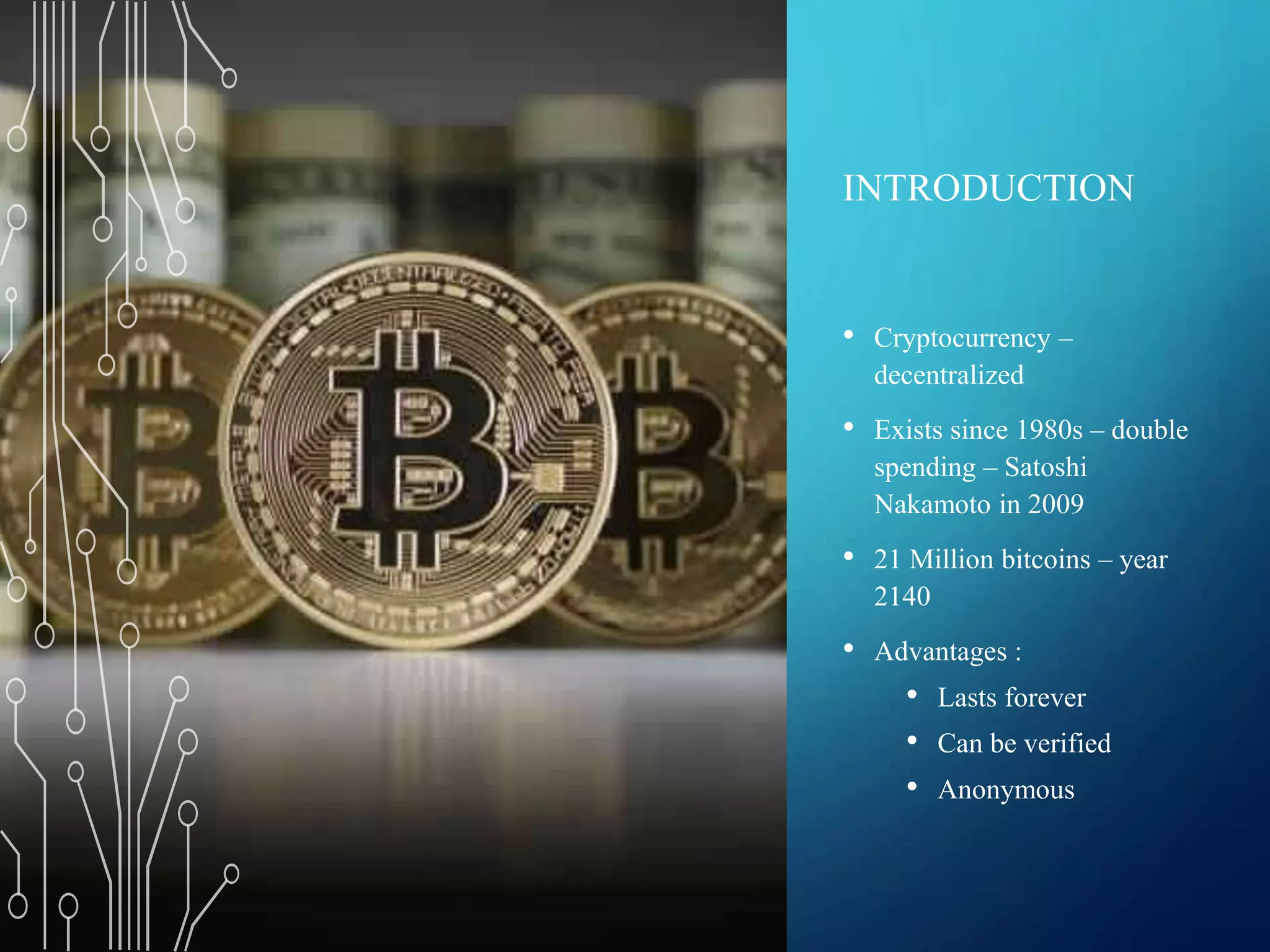
• Cryptocurrency –
decentralized
• Exists since 1980s – double
spending – Satoshi
Nakamoto in 2009
• 21 Million bitcoins – year
2140
• Advantages :
• Lasts forever
• Can be verified
• Anonymous
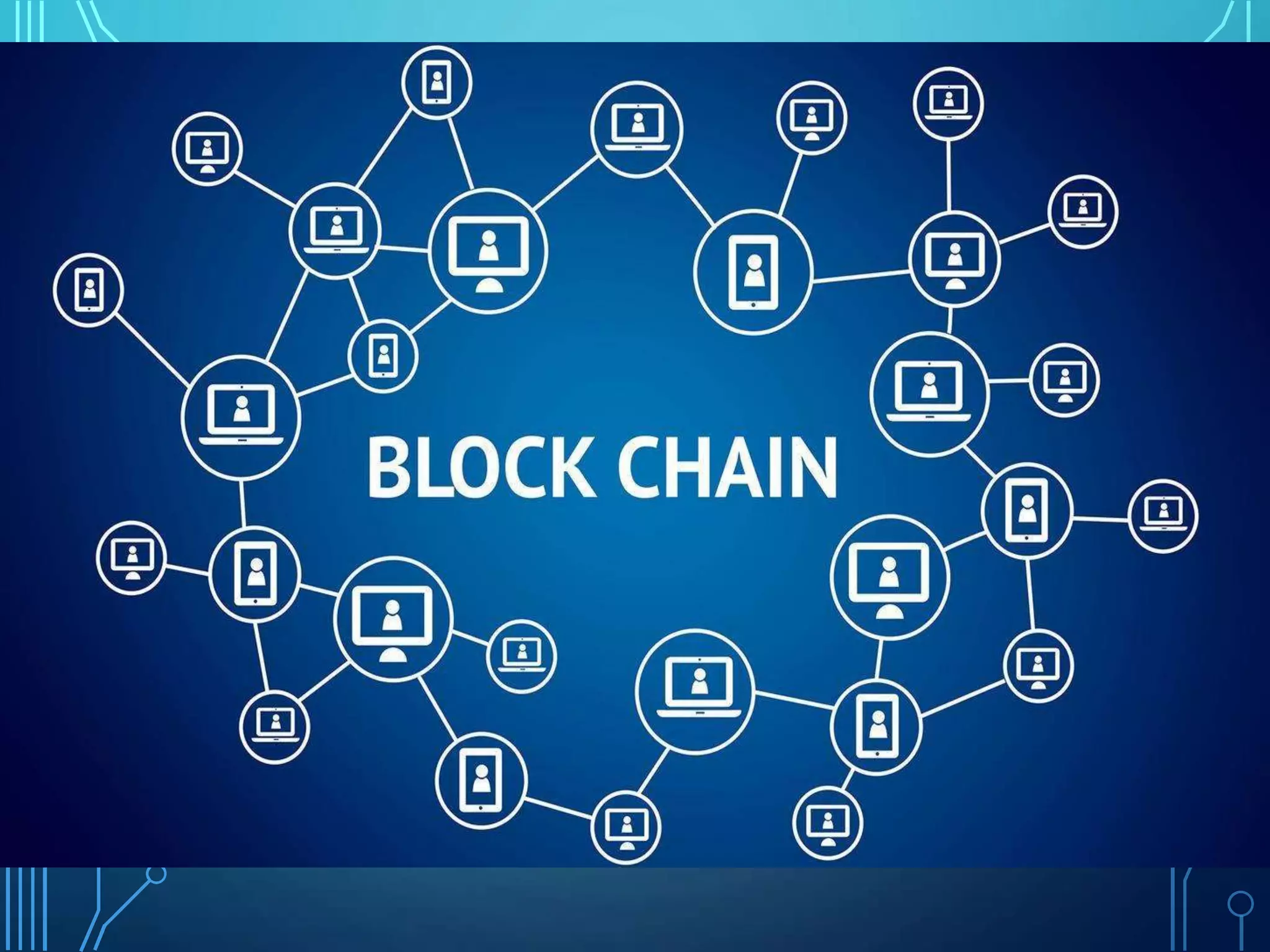
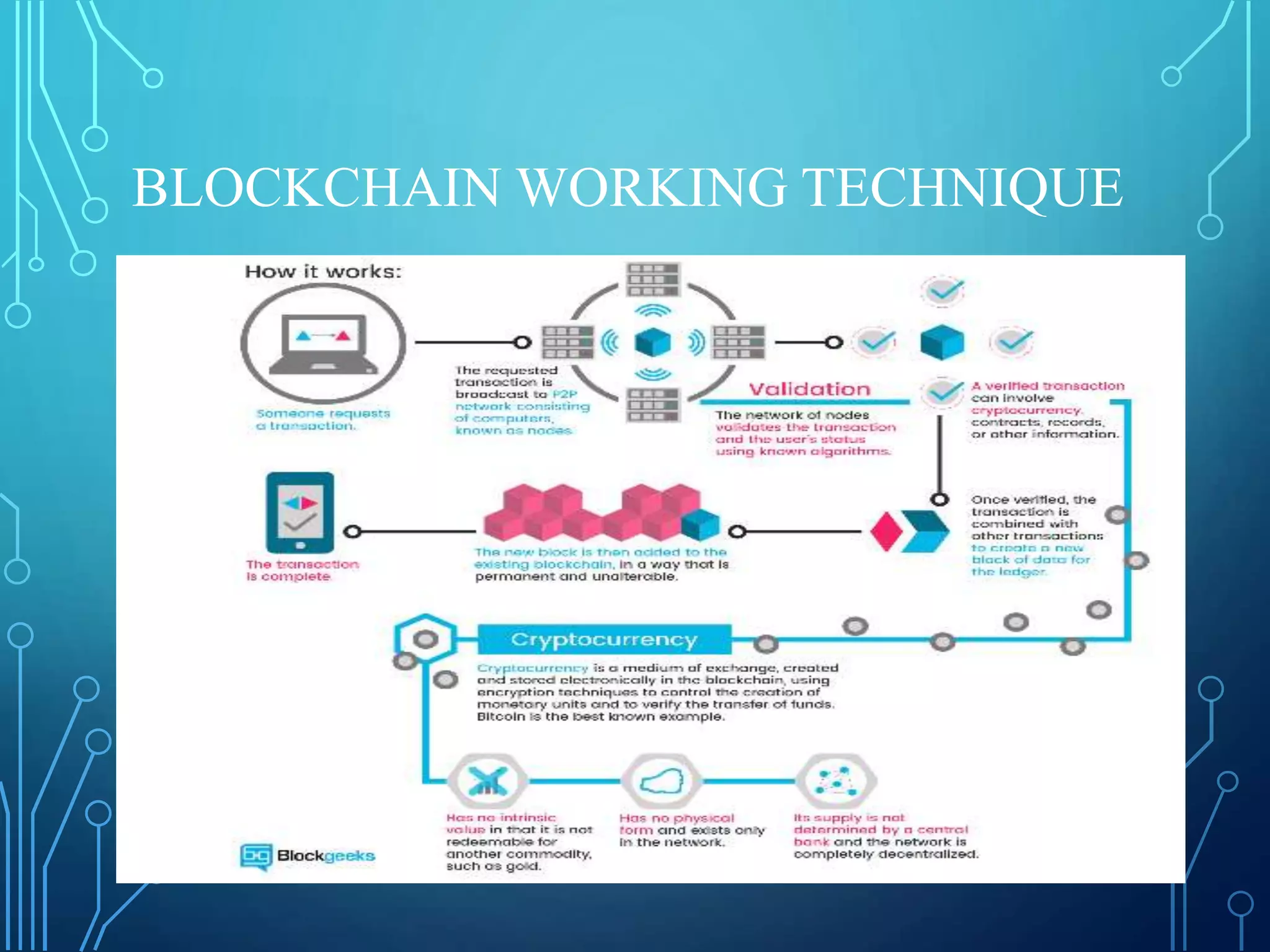
BLOCKCHAIN WORKING TECHNIQUE
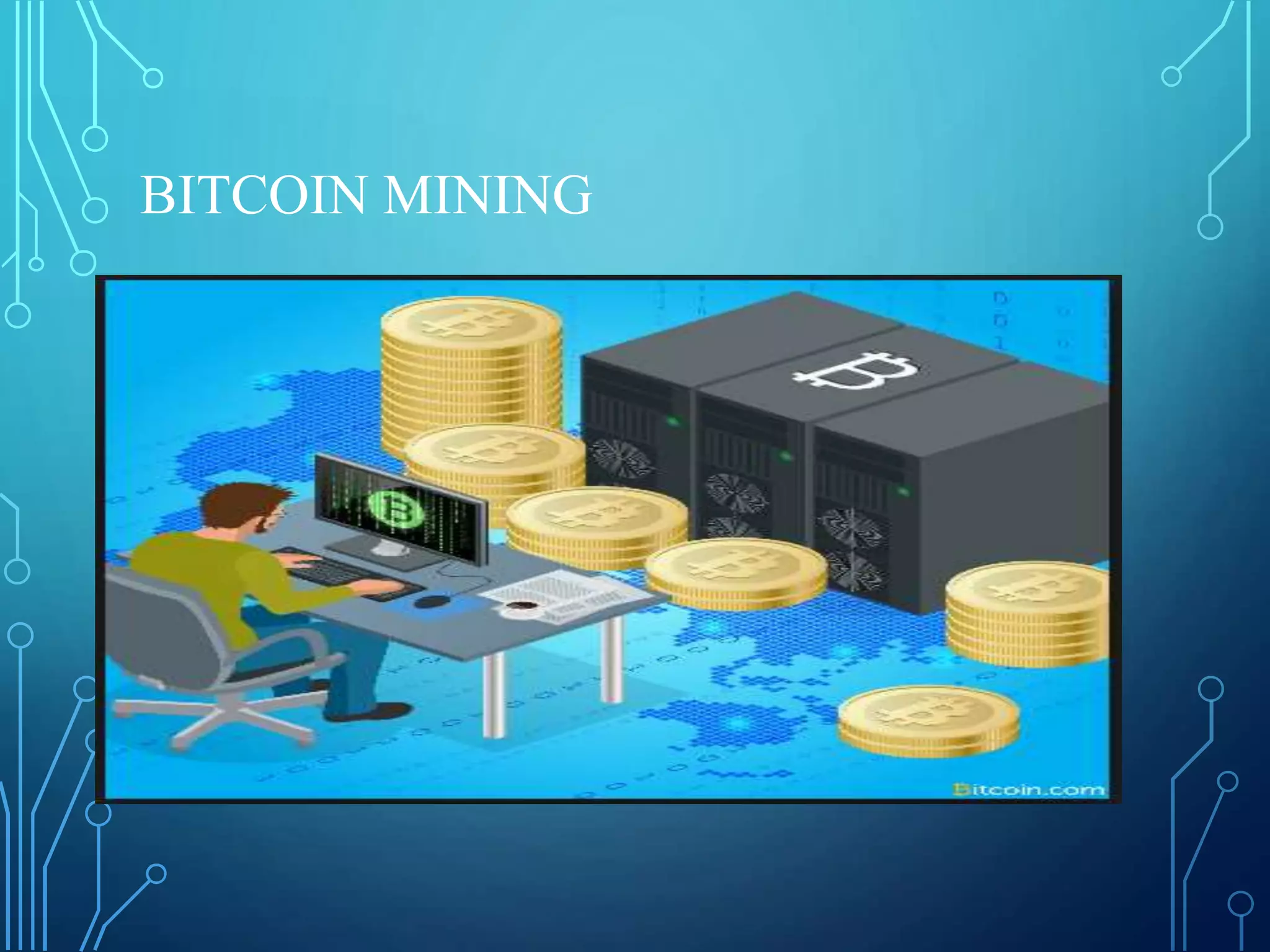
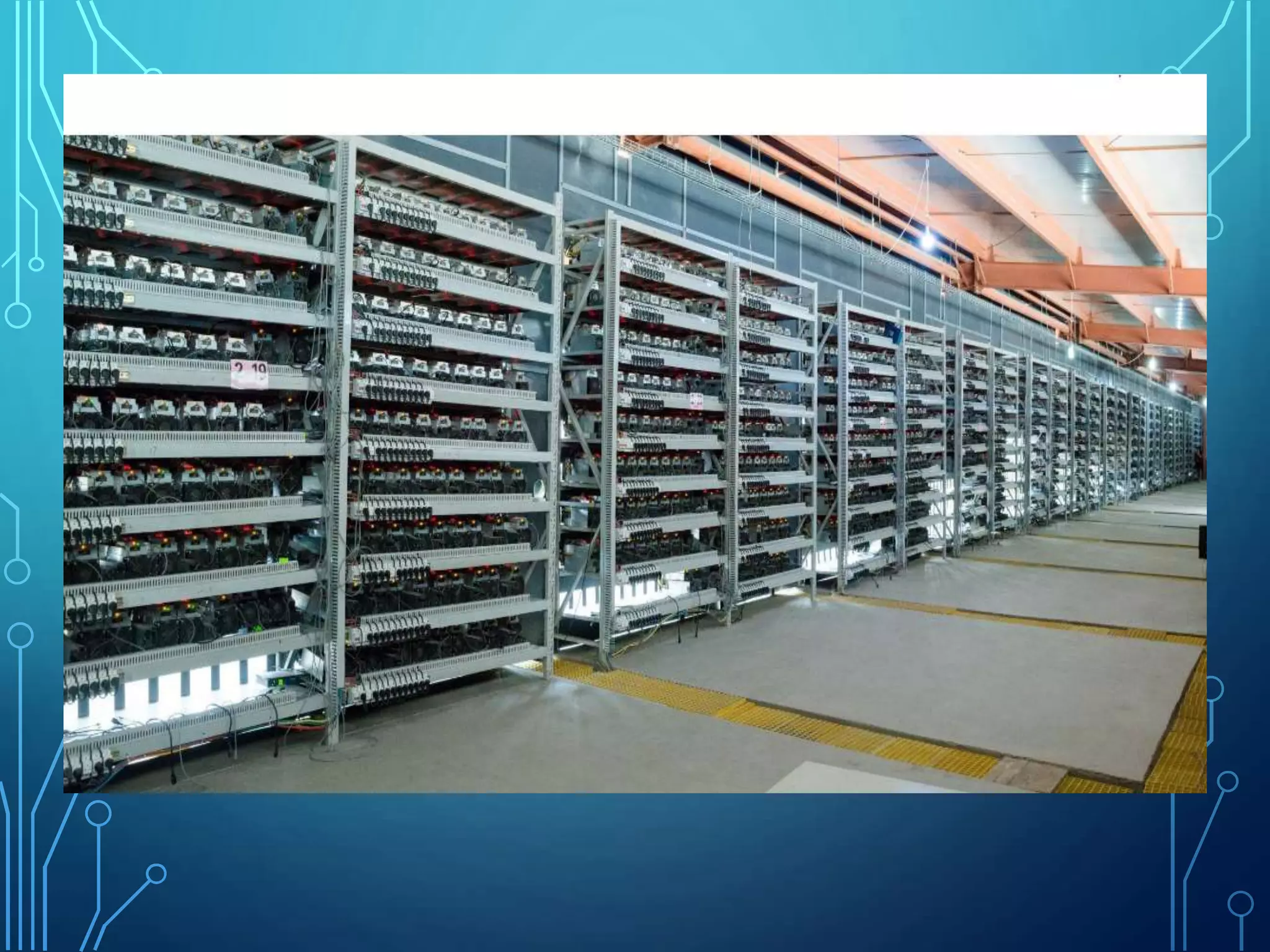
BITCOIN MINING
BITCOIN PRICE VOLATILITY
BITCOIN
PRICE
VOLATILITY
• Highly speculative , market
largely unregulated
• Quick profits ~ day traders
gain money by tracking its
short term trends
• Interest from different
countries
VOLATILITY REASONS
• News effect
• Government Regulations
• Security Breaches
• No clear store for value ~ question of assets
• Tax treatment
EGYPTIAN VIEW OF BITCOIN
STATUS IN
EGYPT
• not authorized or
supervised by the
authorities
• no current rules
• Dealing in foreign
exchanges limited to banks
accredited
STATUS IN EGYPT CONTINUED
• Ethereum & hardware
• Computer enthusiasts + Forex Traders + Another Source
of Money
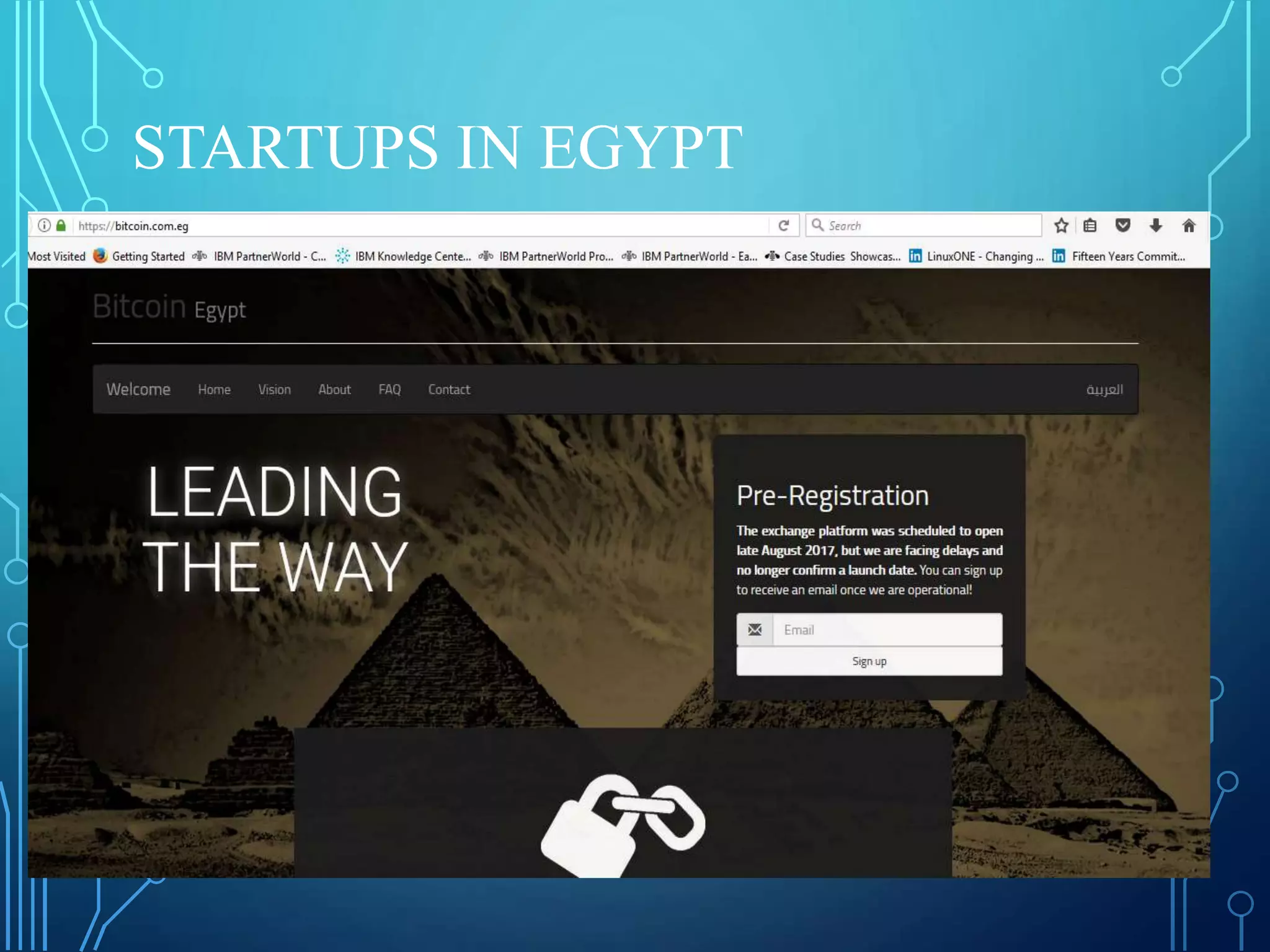
STARTUPS IN EGYPT
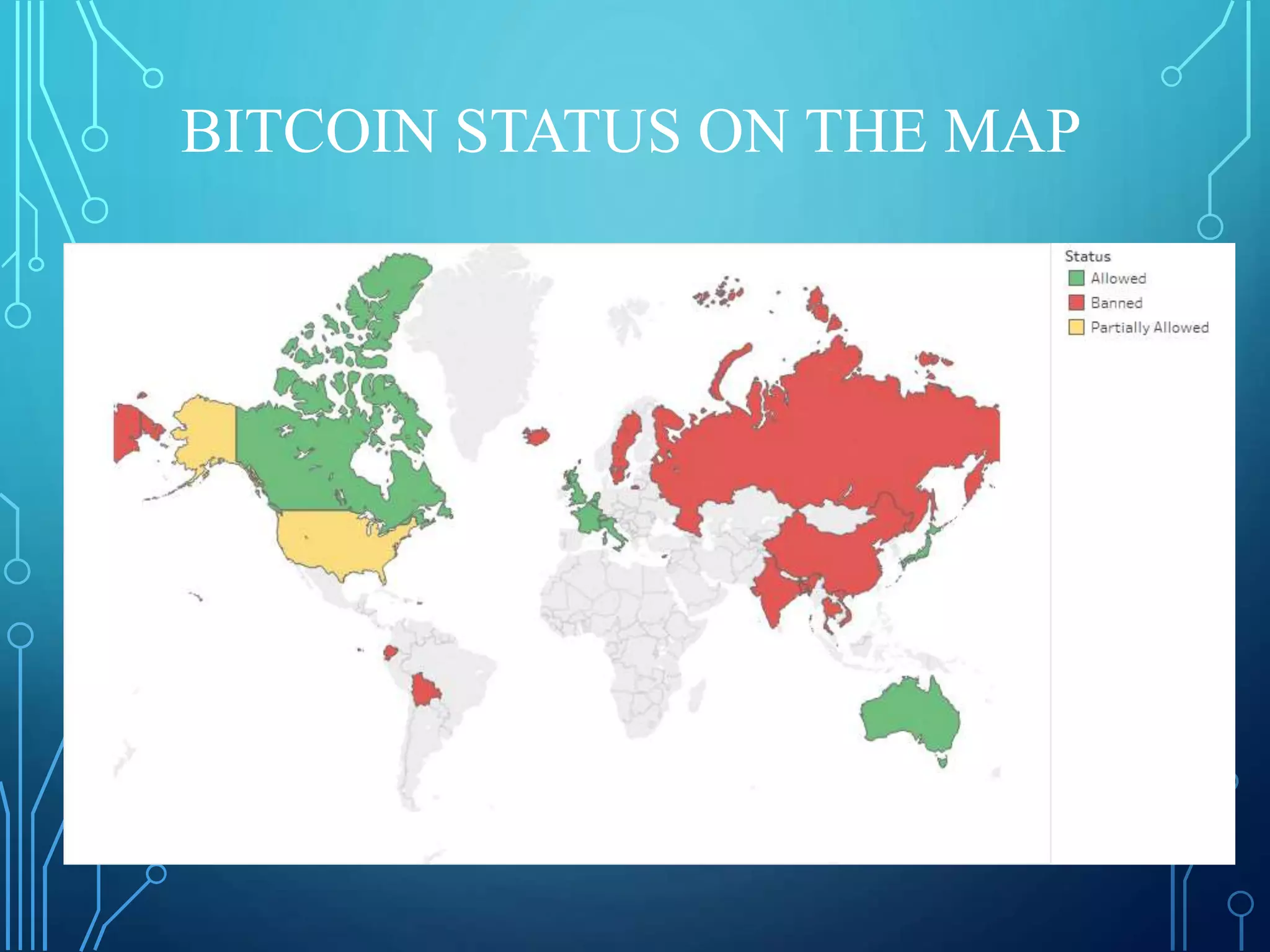
GLOBAL VIEW OF
BITCOIN
STATUS AND ENDORSEMENTS
BITCOIN STATUS ON THE MAP
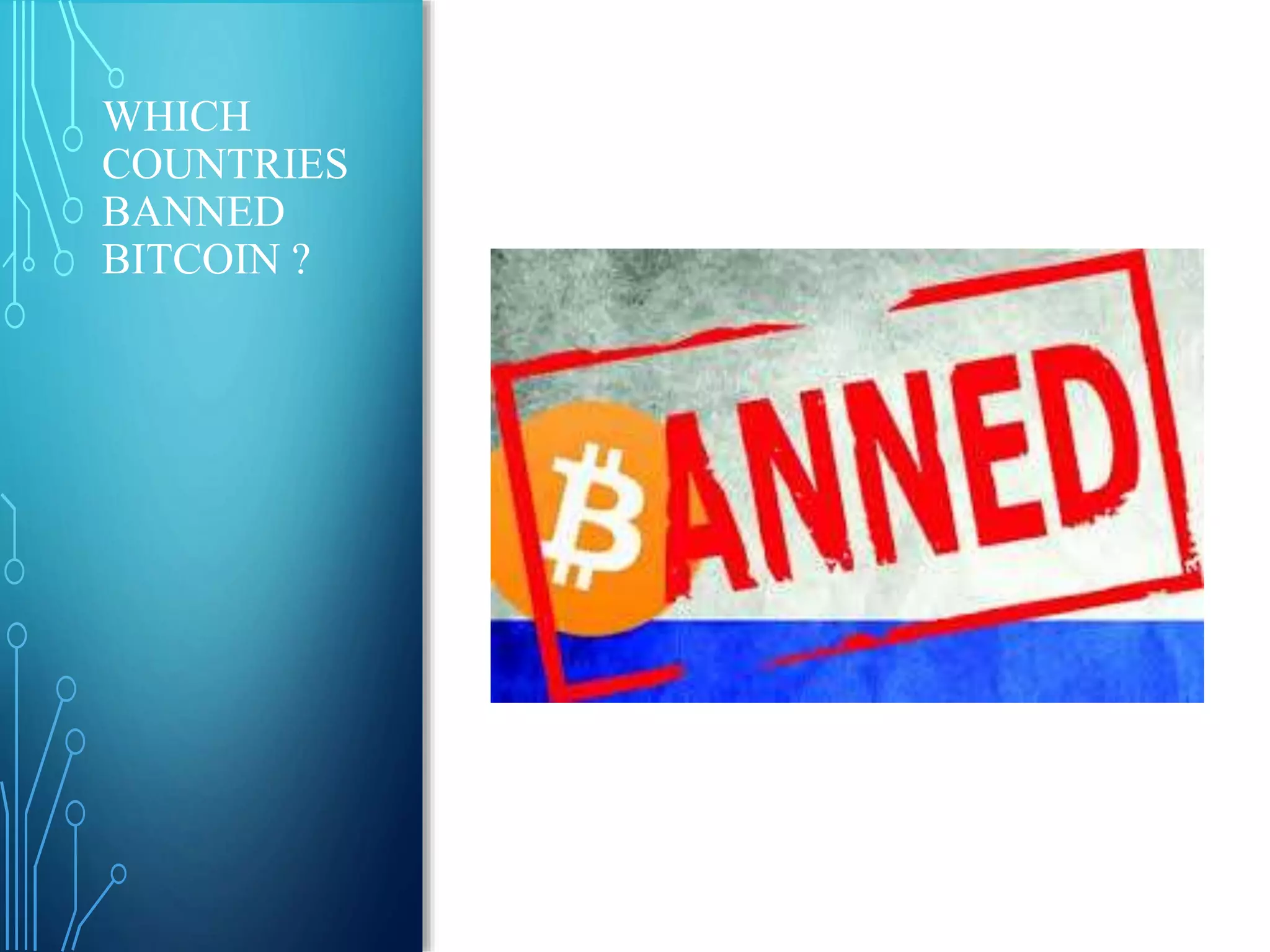
WHICH
COUNTRIES
BANNED
BITCOIN ?
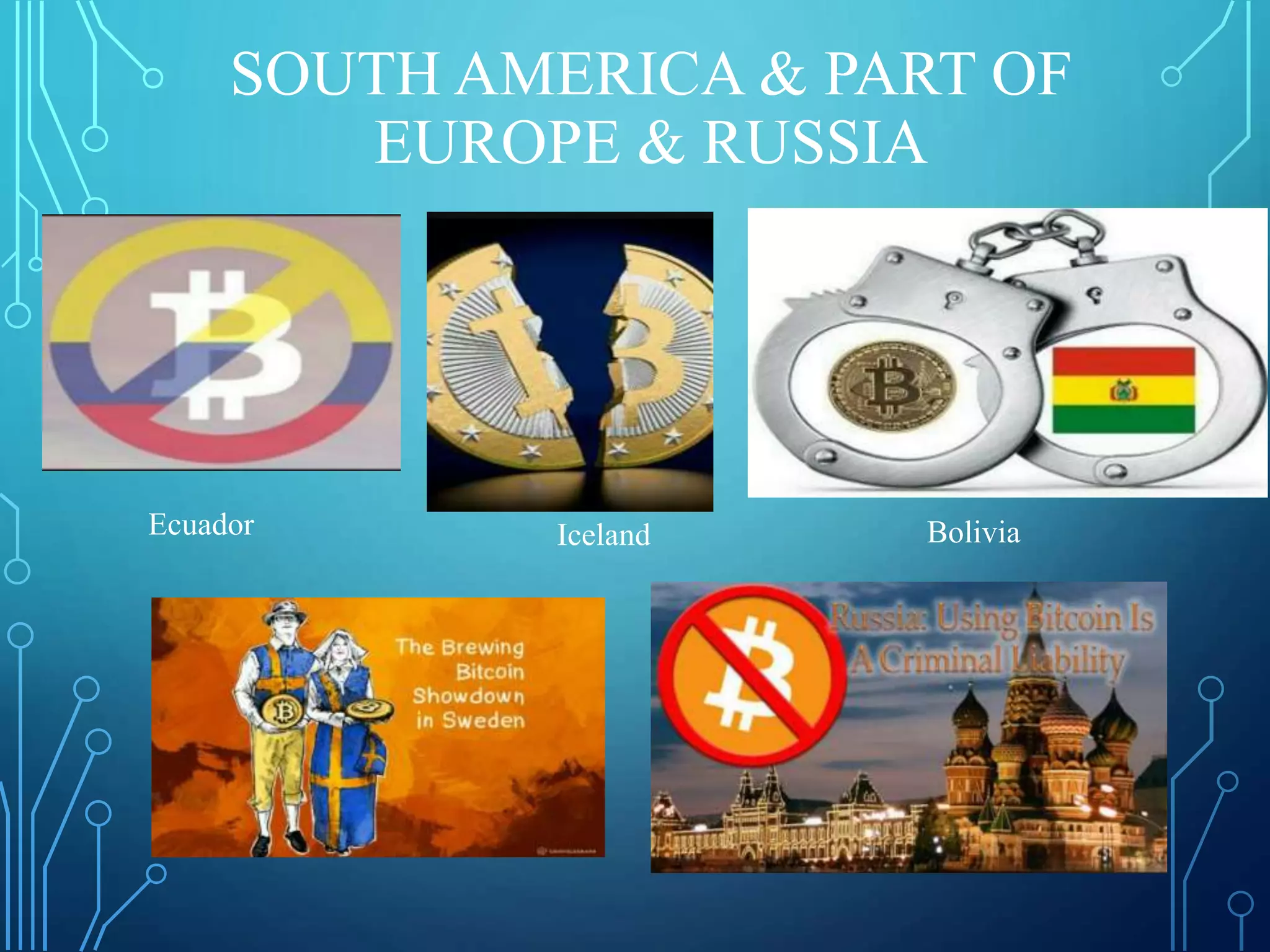
SOUTH AMERICA & PART OF
EUROPE & RUSSIA
Ecuador Iceland Bolivia
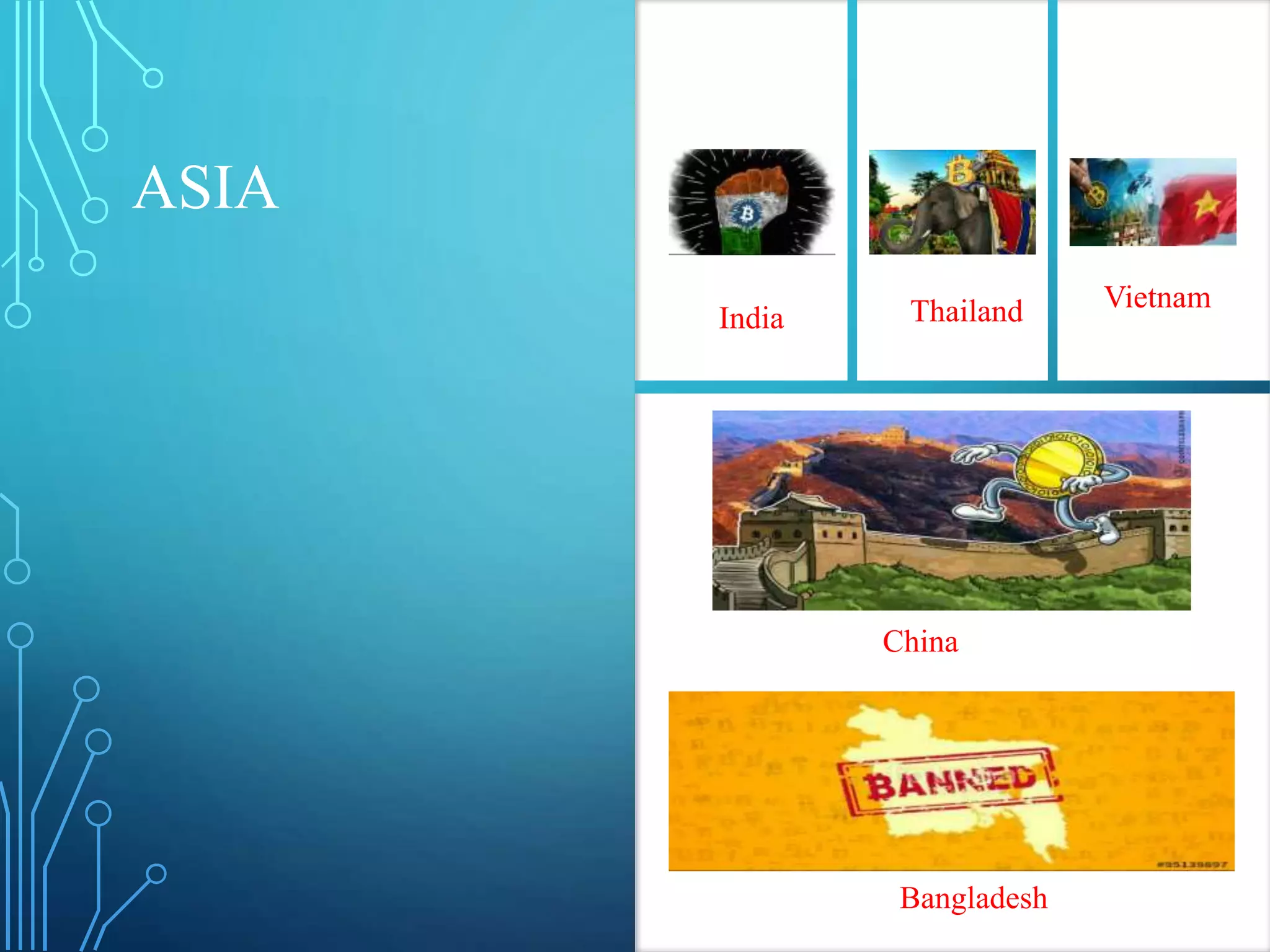
ASIA
India Thailand
China
Vietnam
Bangladesh
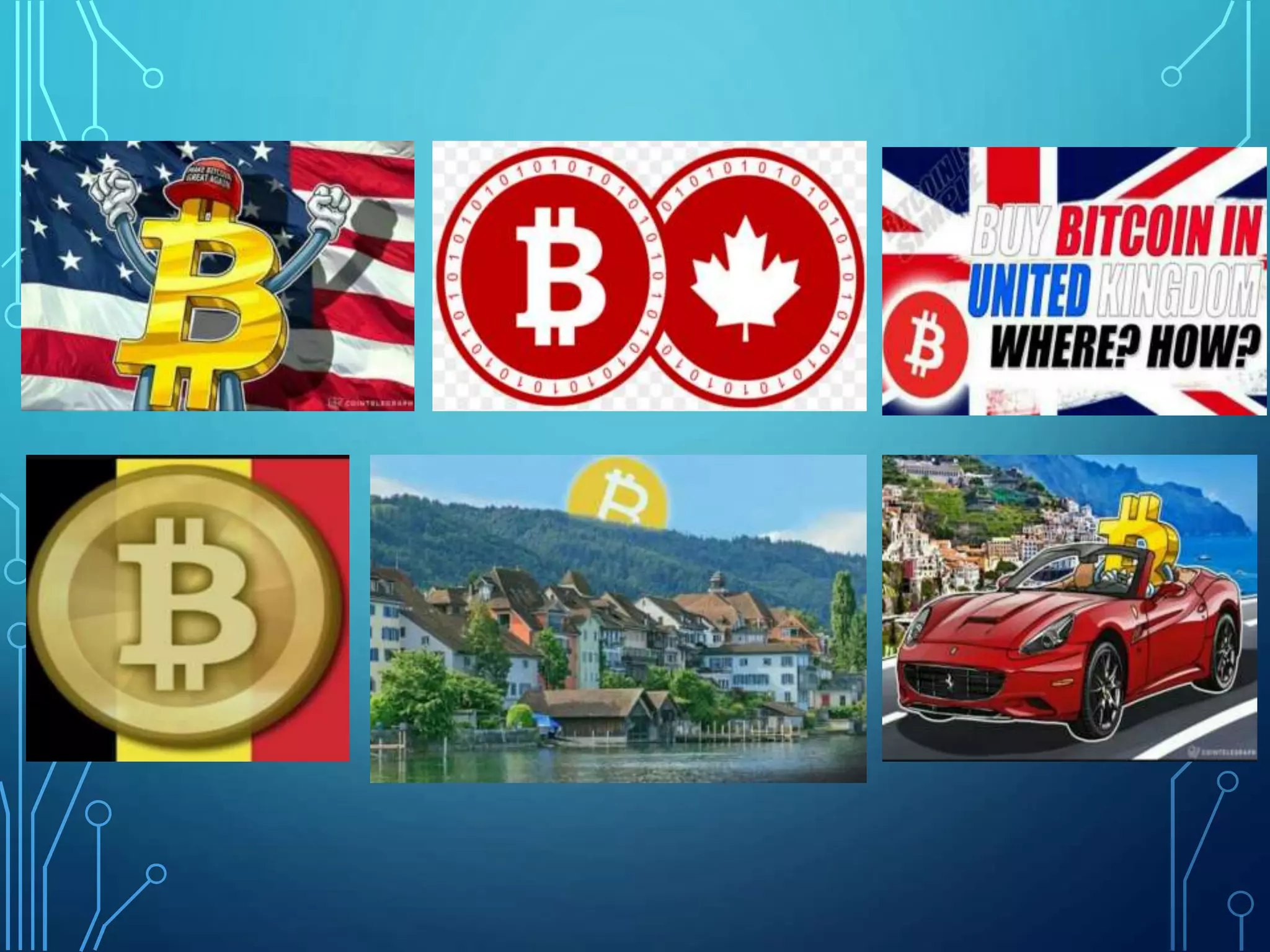
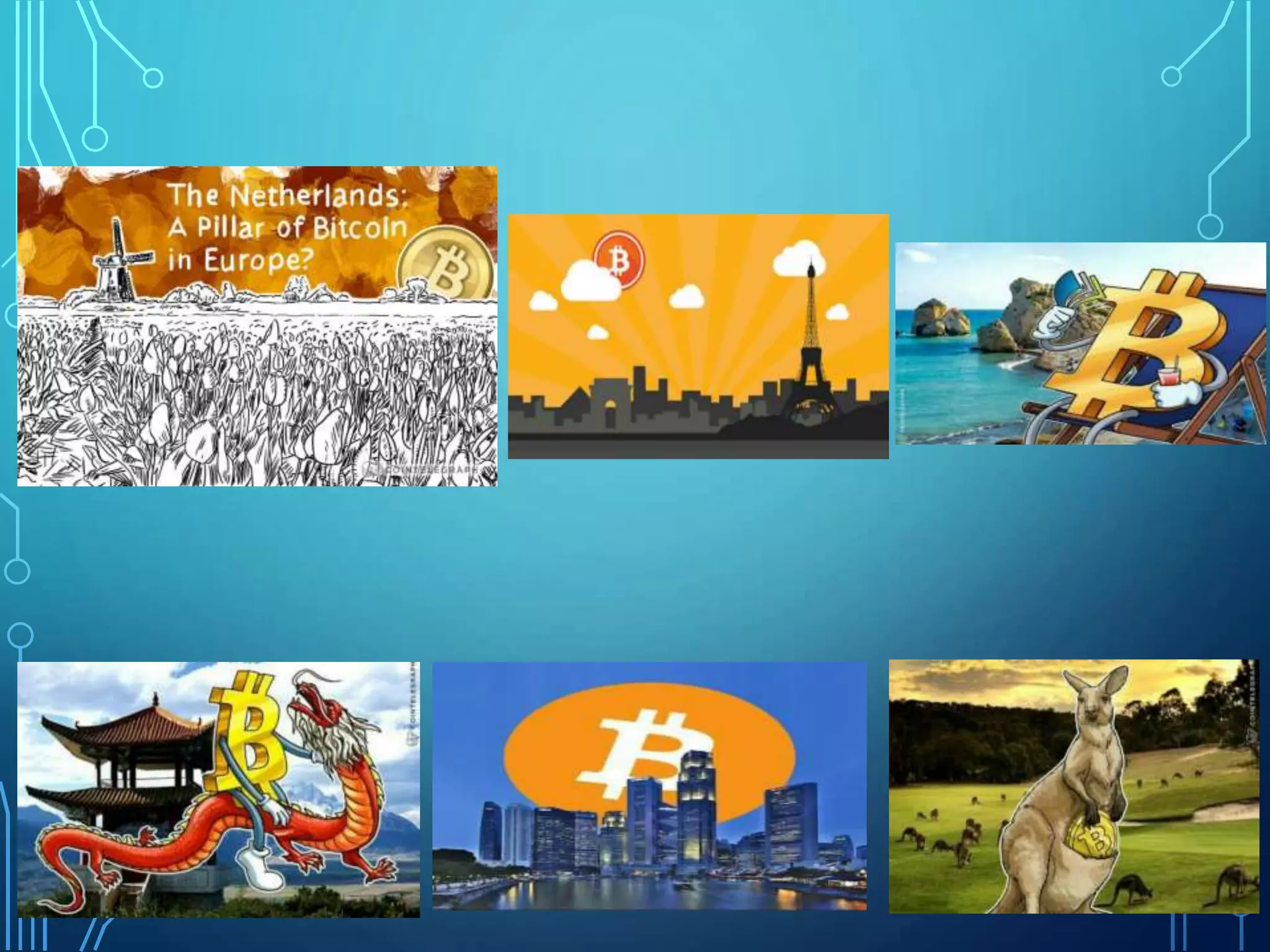
WHICH
COUNTRIES
ALLOW
BITCOIN ?
HOW TO BUY A BITCOIN ?
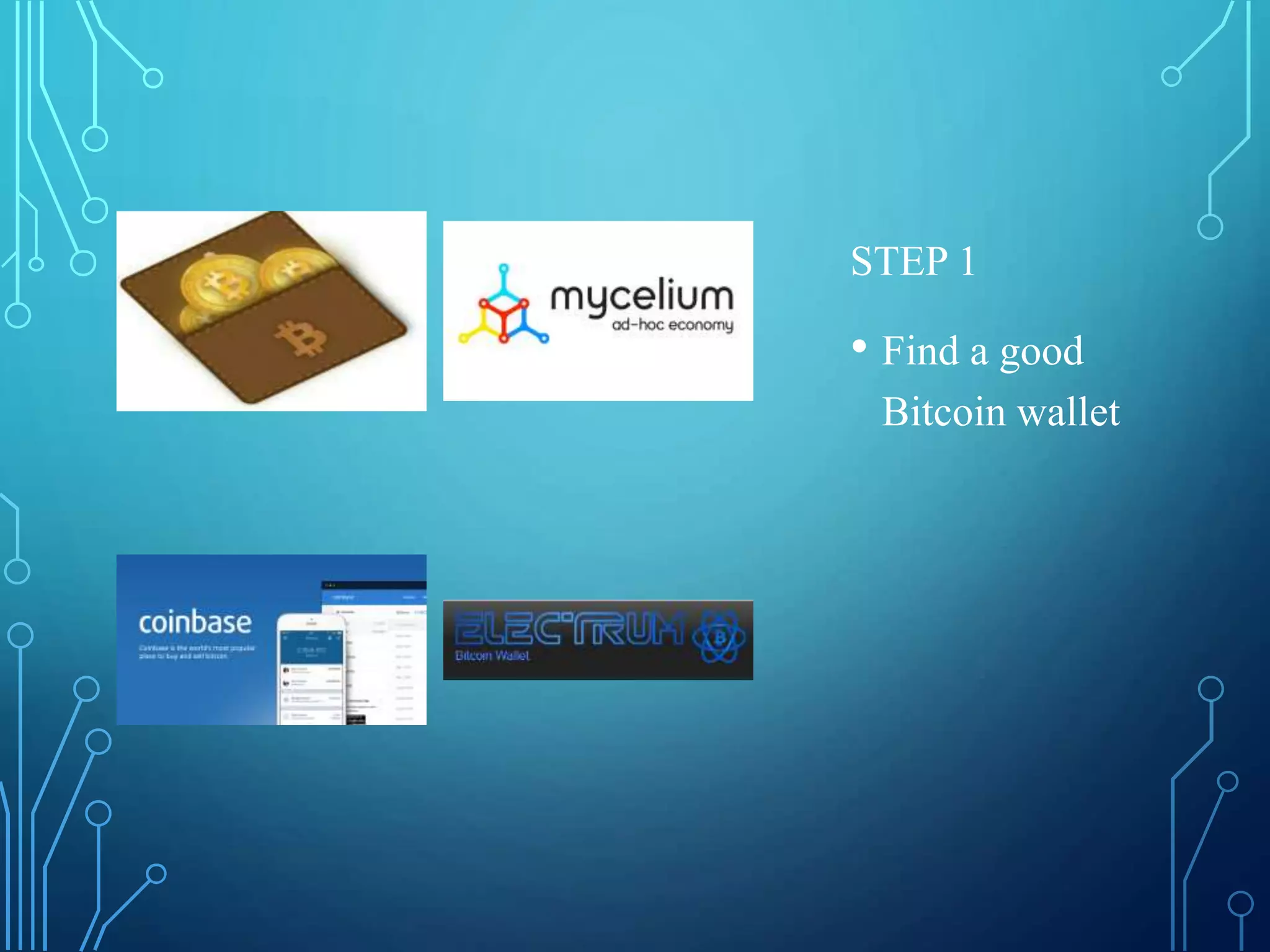
STEP 1
• Find a good
Bitcoin wallet
STEP 2
• Choose the right Bitcoin
exchange
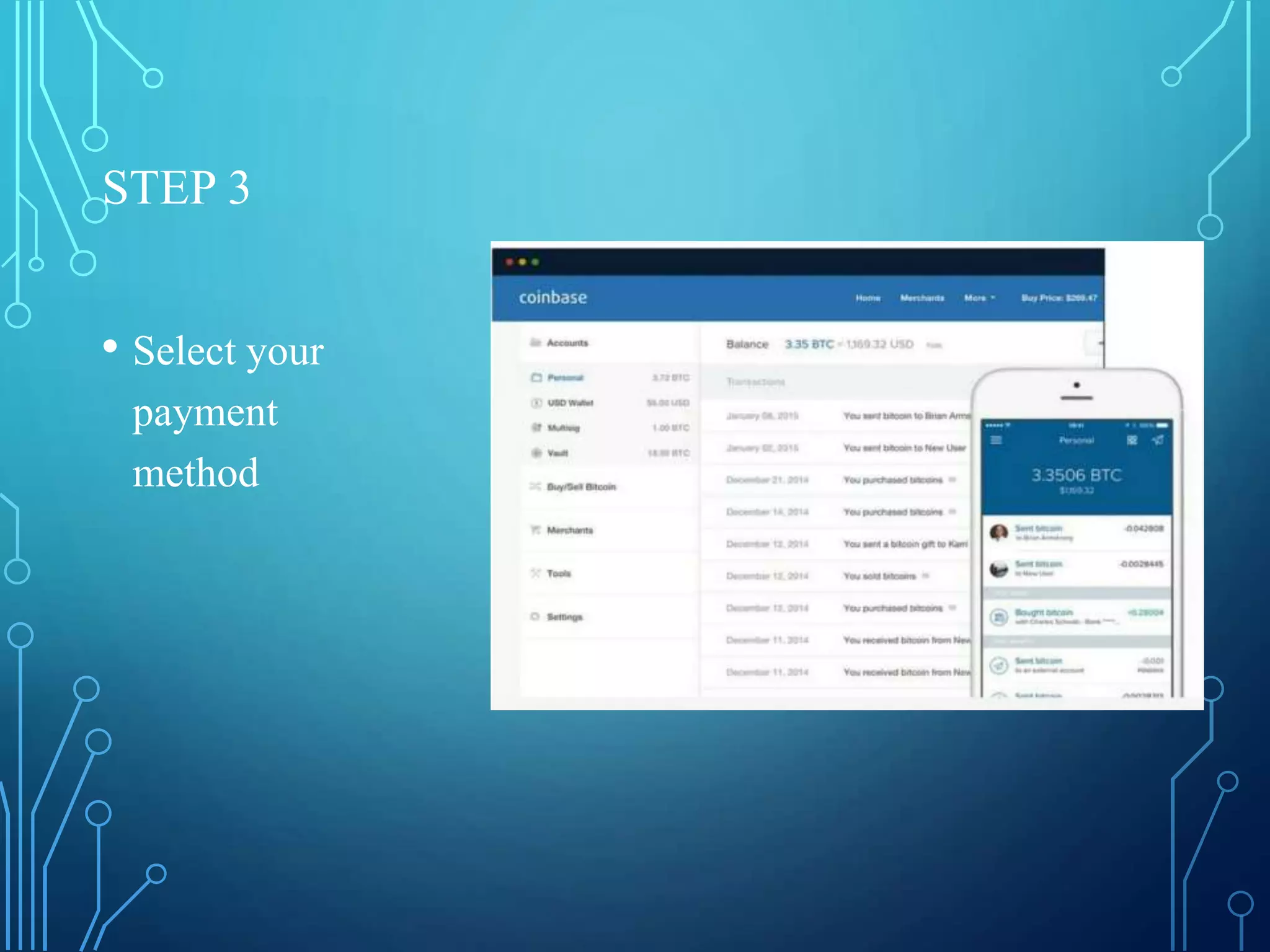
STEP 3
• Select your
payment
method
STEP 4 & STEP 5
• Buy some Bitcoins and store
them in your wallet
• Start doing something with
Bitcoin
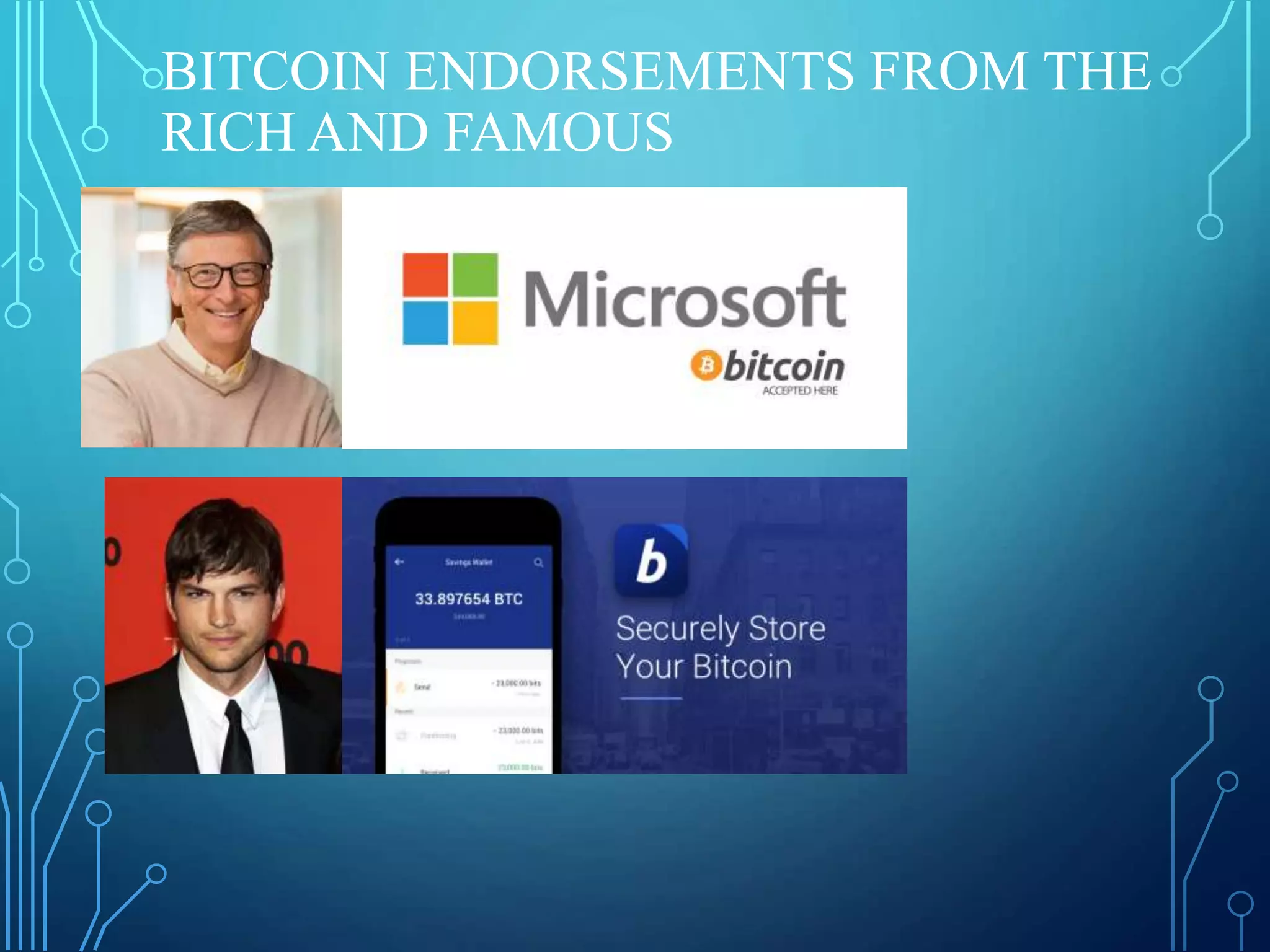
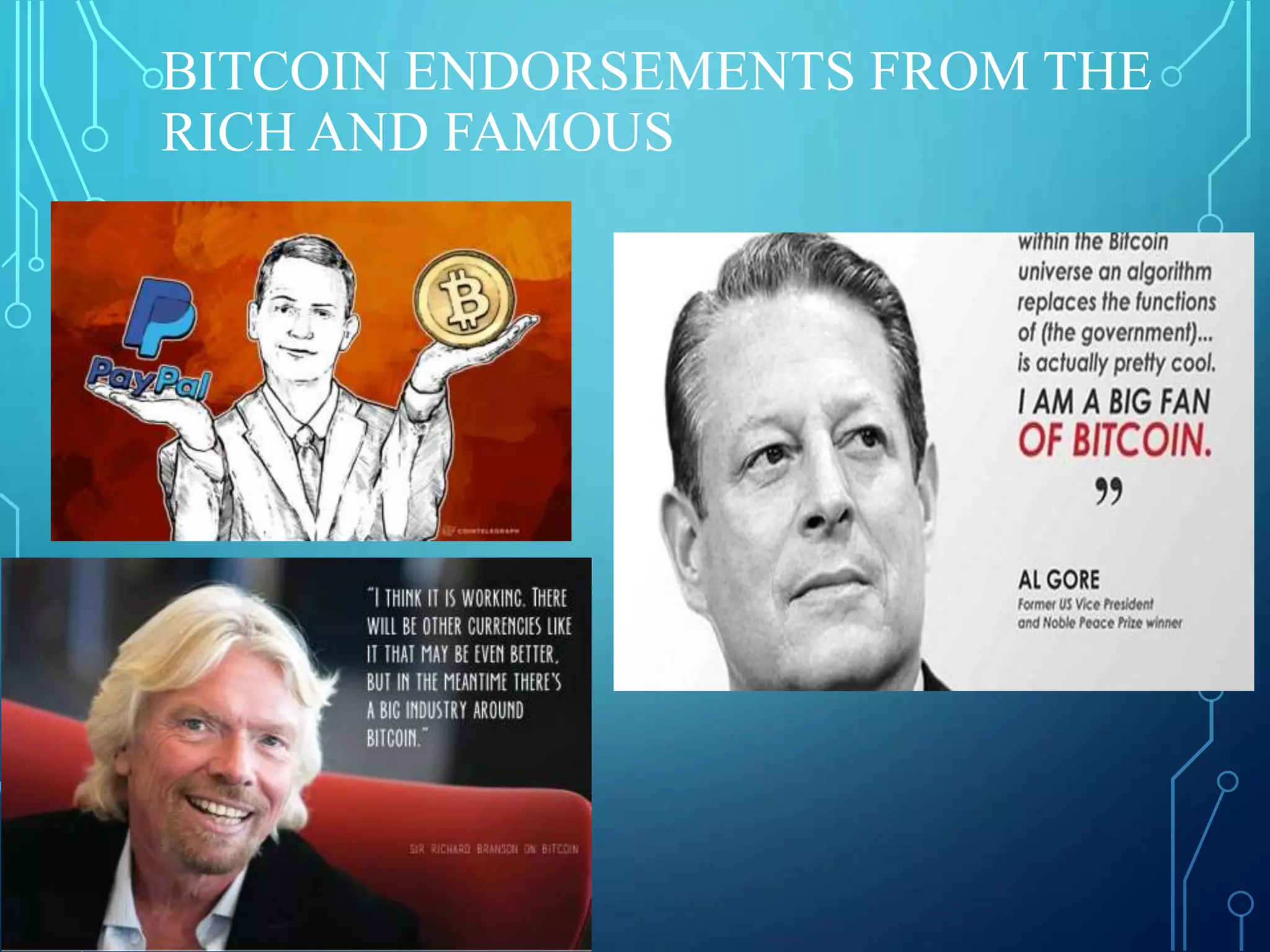
BITCOIN ENDORSEMENTS FROM THE
RICH AND FAMOUS
BITCOIN ENDORSEMENTS FROM THE
RICH AND FAMOUS
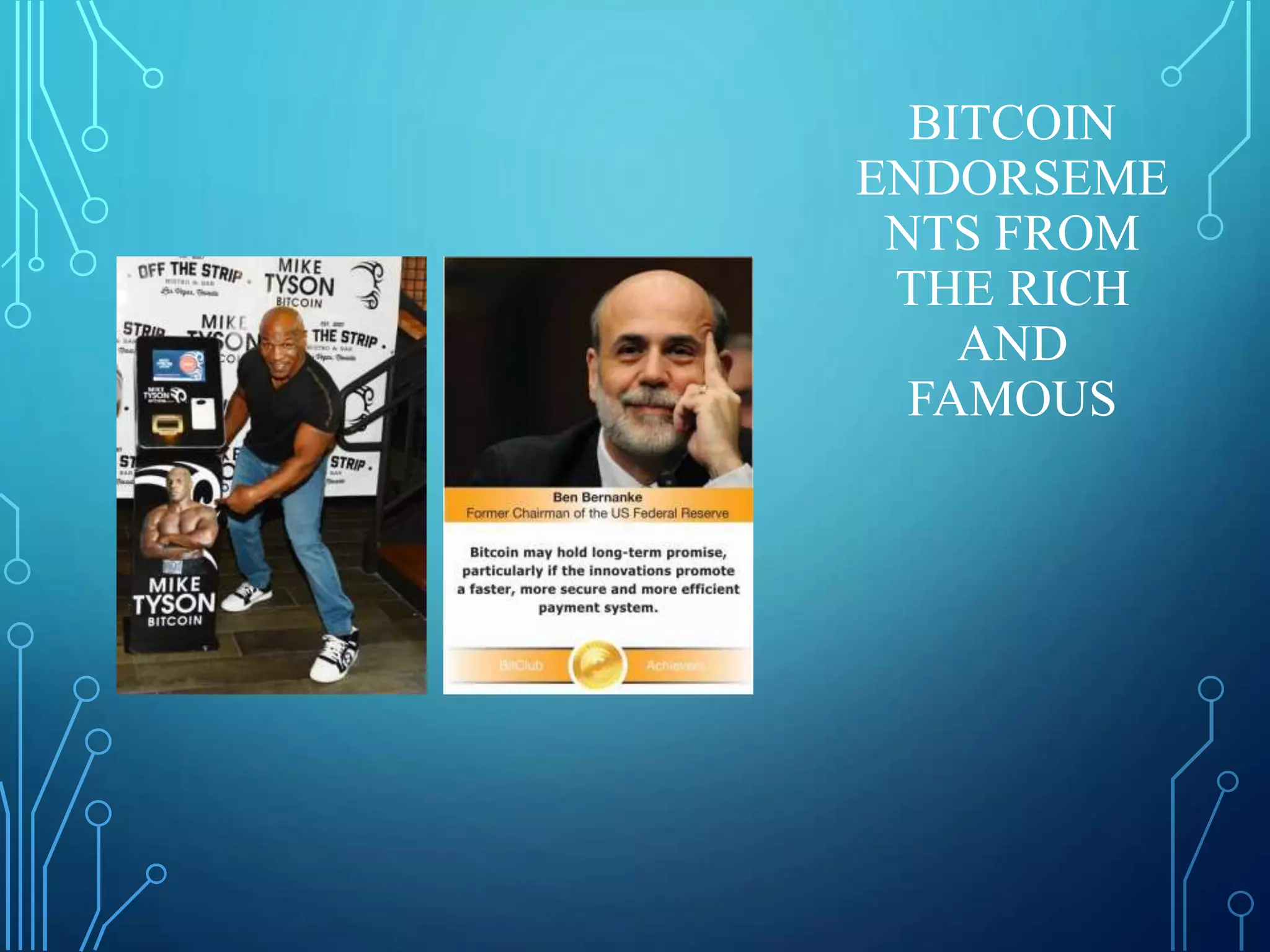
BITCOIN
ENDORSEME
NTS FROM
THE RICH
AND
FAMOUS
THE DARK SIDE OF THE
BITCOIN
WHAT MAKES
BITCOINS
ATTRACTIVE FOR
ILLEGALACTIVITY?
RANSOMWARE
ATTACKS ARE
ON THE RISE
• As a conclusion on
the argument is
Bitcoin could be
used for illegal
activity or not
• One second please!
Some people see
that Bitcoin
shouldn’t be used
for illegal
activities…why?
Bitcoin States Regulations
APPLICABLE LAWS
“
”
Whoever Makes, Issues, Circulates, Or
Pays Out Any Note, Check,
Memorandum, Token, Or Other
Obligation, Intended To Circulate As
Money Or To Be Received Or Used In
Lieu Of Lawful Money Of The United
States, Shall Be Fined Under This Title
Or Imprisoned Not More Than Six
Months, Or Both.
Argument
Congress Did Not Anticipate
Bitcoin And It Is Thus Not Within
The Scope Of The Stamp
Payments Act.
The Stamp Payments Act 1862
APPLICABLE LAWS
THE SECURITIES ACT
• The use of Bitcoin as an investment tool has
brought it to the attention of the Securities and
Exchange Commission (“SEC”),
• The exchanges would have to register with the
agency, file public reports (which would provide
better information to purchasers and the
government) and be liable for instances of fraud
Argument
Is it Currency or Security
The Electronic Funds Transfer Act ( EFTA)
• (EFTA) Regulates financial institutions that both hold accounts
belonging to customers and perform electronic funds transfers
• Requires those institutions to take consumer protection measures
such as reversal rights on transactions
Argument
• Bitcoin system itself does not qualify as a financial institution~ a
decentralized program on which users may transact with each other
directly.
• Yet, Bitcoin exchanges may fall under the purview of the EFTA
BITCOIN & FEDERAL AGENCIES
FinCEN ( Financial Crimes Enfoncement Networks )
• On March 18, 2013, the FinCEN issued guidance
clarifying that certain businesses or individuals who
use or make a business of exchanging, accepting, and
transmitting virtual currencies were subject to the
requirements of the Bank secrecy Act (BSA). The
anti-money laundering and counter-terrorism
financing law.
• Some observers believe this administrative ruling
might expand the reach of FinCEN registration
requirements to Bitcoin processors which route
Bitcoin from customers to merchants, creating
reporting and compliance standards on essentially
any company that transfers Bitcoin in commerce.
THE FEDERAL BUREAU
OF INVESTIGATION (FBI)
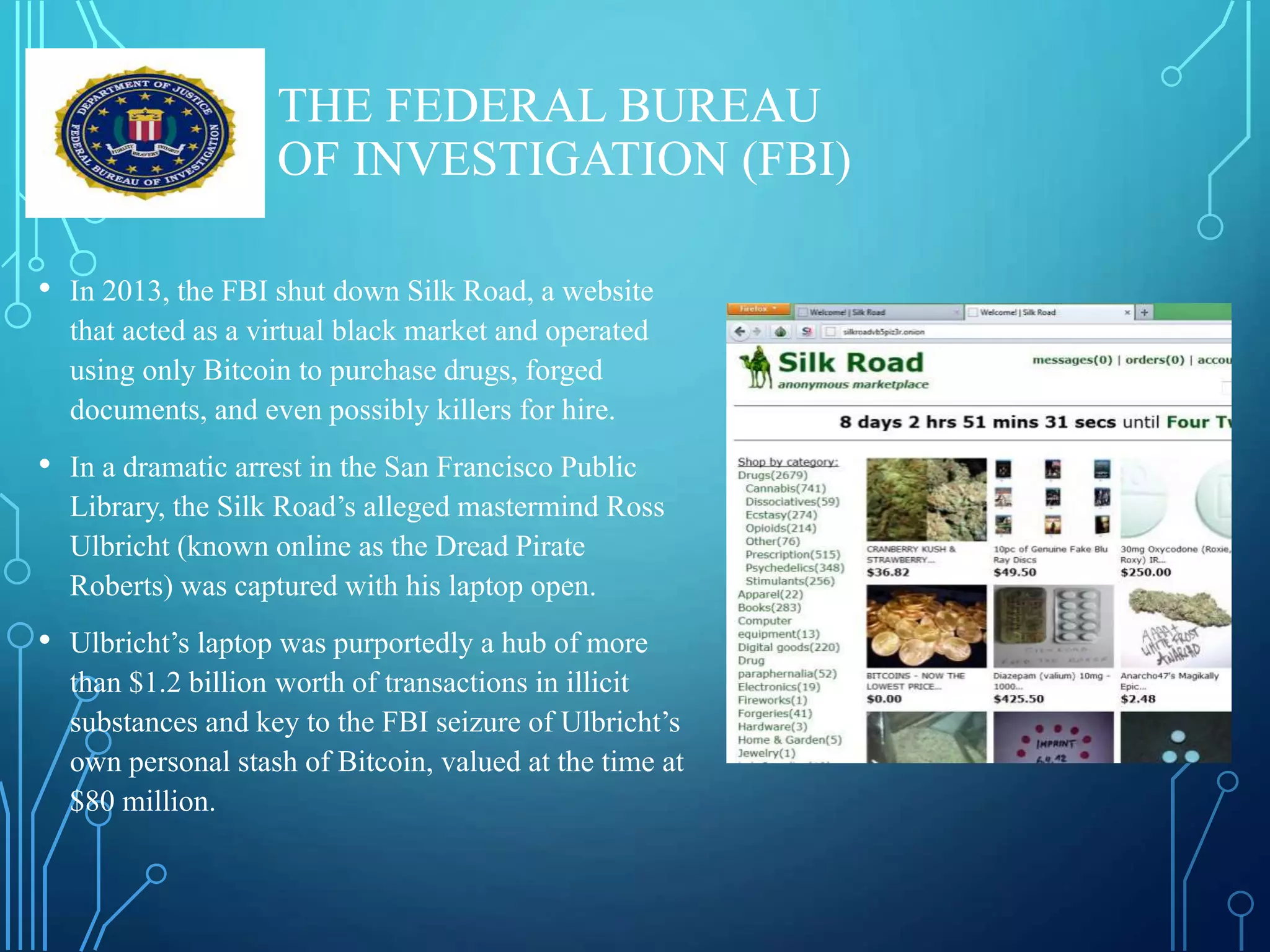
• In 2013, the FBI shut down Silk Road, a website
that acted as a virtual black market and operated
using only Bitcoin to purchase drugs, forged
documents, and even possibly killers for hire.
• In a dramatic arrest in the San Francisco Public
Library, the Silk Road’s alleged mastermind Ross
Ulbricht (known online as the Dread Pirate
Roberts) was captured with his laptop open.
• Ulbricht’s laptop was purportedly a hub of more
than $1.2 billion worth of transactions in illicit
substances and key to the FBI seizure of Ulbricht’s
own personal stash of Bitcoin, valued at the time at
$80 million.
The IRS (Internal Revenue Service Tax Agency )
• On March 25, 2014 the IRS issued a notice stating that for federal tax purposes,
the IRS would treat virtual currency as property, rather than currency.
• Treating Bitcoin as property has profound implications for Bitcoin transactions
as it creates new income tax liabilities
• For instance, if an individual acquired a Bitcoin for one dollar and subsequently
used it to purchase a three-dollar cup of coffee, this transaction would trigger two
dollars in capital gains for the purchaser of coffee (because his original
investment was one dollar) and three dollars of gross income for the coffee seller.
Simply tracking this sort of information might be prohibitively difficult or
tedious.
CONSUMER
FINANCIAL
PROTECTION
BUREAU
• Although the CFPB has not taken any direct action to
regulate Bitcoin yet, in August 2014 the CFPB issued a
consumer advisory statement warning the public of the risk
of Bitcoin.
• The advisory warned consumers about potential hackers,
that Bitcoin offered fewer protections as compared to
banks or debit and credit card providers, and had
potentially higher costs and scams.
• The CFPB has also begun accepting complaints about
virtual currency products and services, including wallets
and exchanges.
SUGGESTIONS FOR THE FUTURE
• First, regulators must seek to create a system where Bitcoins are treated only
as a currency, allowing consumers and merchants to feel more comfortable
relying on Bitcoin as a medium of exchange.
• To accomplish this goal, the IRS’s current policy of treating Bitcoin as
property must change.
Suggestions For The Future
• Second goal is to tie the Bitcoin user identities
with real identities to remove the mystery in the
transactions
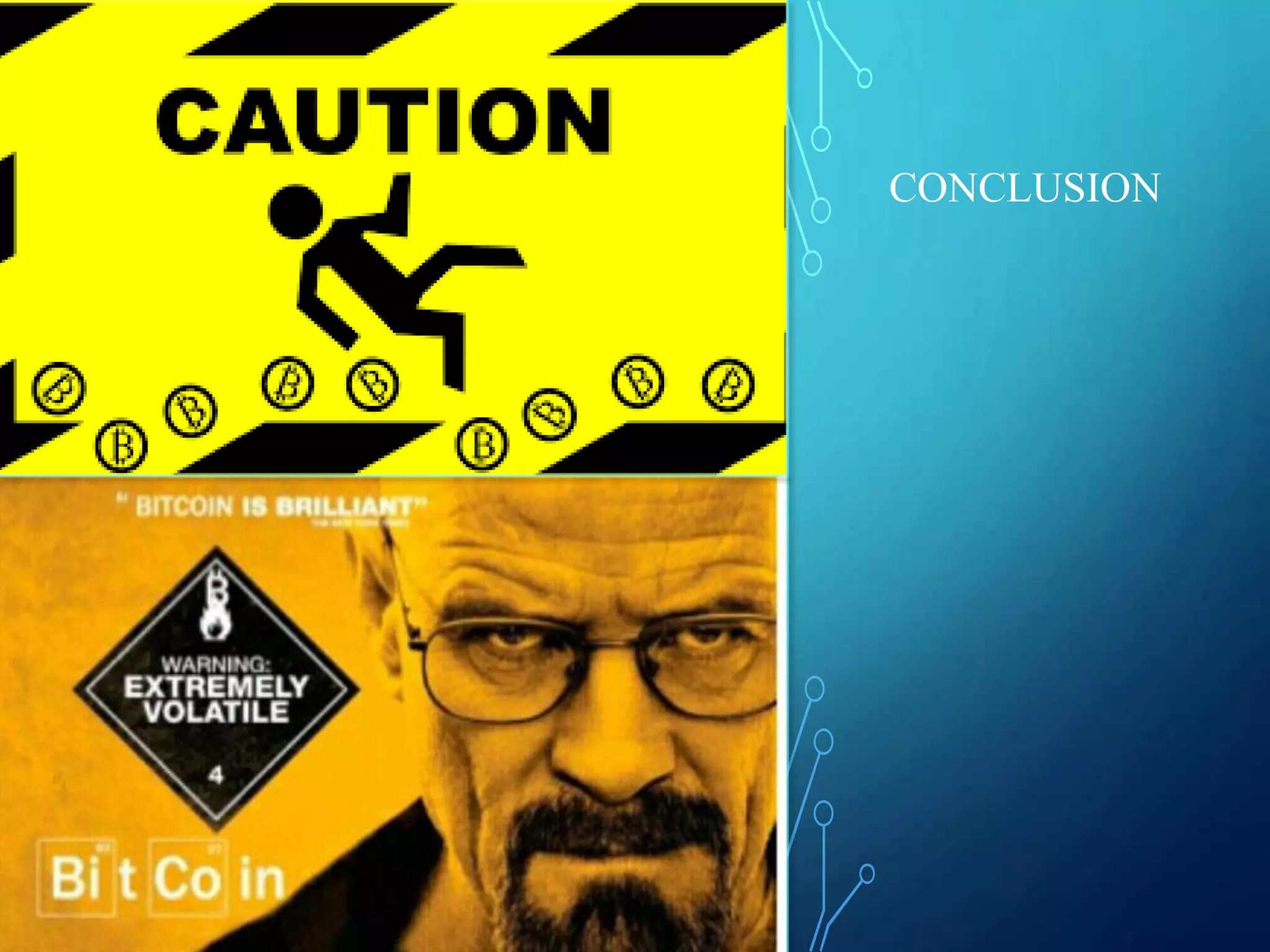
CONCLUSION

The Bitcoin Overview

  • 1.
    THE BITCOIN Presented By MohamedSakr Menatallah Mohamed Mohamed Sayed Ayman Fahmy
  • 2.
    AGENDA • Introduction • TheBlock Chain • Bitcoin Price Volatility • Egyptian View on the Bitcoin • Global View of the Bitcoin • How to Buy a Bitcoin • Endorsements of the Bitcoin • The Dark side of the Bitcoin • Regulations • Conclusion
  • 3.
    INTRODUCTION • Cryptocurrency – decentralized •Exists since 1980s – double spending – Satoshi Nakamoto in 2009 • 21 Million bitcoins – year 2140 • Advantages : • Lasts forever • Can be verified • Anonymous
  • 5.
  • 7.
  • 9.
  • 10.
    BITCOIN PRICE VOLATILITY • Highly speculative, market largely unregulated • Quick profits ~ day traders gain money by tracking its short term trends • Interest from different countries
  • 12.
    VOLATILITY REASONS • Newseffect • Government Regulations • Security Breaches • No clear store for value ~ question of assets • Tax treatment
  • 13.
  • 14.
    STATUS IN EGYPT • notauthorized or supervised by the authorities • no current rules • Dealing in foreign exchanges limited to banks accredited
  • 15.
    STATUS IN EGYPTCONTINUED • Ethereum & hardware • Computer enthusiasts + Forex Traders + Another Source of Money
  • 16.
  • 17.
  • 18.
  • 19.
  • 20.
    SOUTH AMERICA &PART OF EUROPE & RUSSIA Ecuador Iceland Bolivia
  • 21.
  • 22.
  • 25.
    HOW TO BUYA BITCOIN ?
  • 26.
    STEP 1 • Finda good Bitcoin wallet
  • 27.
    STEP 2 • Choosethe right Bitcoin exchange
  • 28.
    STEP 3 • Selectyour payment method
  • 29.
    STEP 4 &STEP 5 • Buy some Bitcoins and store them in your wallet • Start doing something with Bitcoin
  • 30.
    BITCOIN ENDORSEMENTS FROMTHE RICH AND FAMOUS
  • 31.
    BITCOIN ENDORSEMENTS FROMTHE RICH AND FAMOUS
  • 32.
  • 33.
    THE DARK SIDEOF THE BITCOIN
  • 34.
  • 35.
    RANSOMWARE ATTACKS ARE ON THERISE • As a conclusion on the argument is Bitcoin could be used for illegal activity or not • One second please! Some people see that Bitcoin shouldn’t be used for illegal activities…why?
  • 36.
  • 37.
  • 38.
    “ ” Whoever Makes, Issues,Circulates, Or Pays Out Any Note, Check, Memorandum, Token, Or Other Obligation, Intended To Circulate As Money Or To Be Received Or Used In Lieu Of Lawful Money Of The United States, Shall Be Fined Under This Title Or Imprisoned Not More Than Six Months, Or Both. Argument Congress Did Not Anticipate Bitcoin And It Is Thus Not Within The Scope Of The Stamp Payments Act. The Stamp Payments Act 1862
  • 39.
    APPLICABLE LAWS THE SECURITIESACT • The use of Bitcoin as an investment tool has brought it to the attention of the Securities and Exchange Commission (“SEC”), • The exchanges would have to register with the agency, file public reports (which would provide better information to purchasers and the government) and be liable for instances of fraud Argument Is it Currency or Security
  • 40.
    The Electronic FundsTransfer Act ( EFTA) • (EFTA) Regulates financial institutions that both hold accounts belonging to customers and perform electronic funds transfers • Requires those institutions to take consumer protection measures such as reversal rights on transactions Argument • Bitcoin system itself does not qualify as a financial institution~ a decentralized program on which users may transact with each other directly. • Yet, Bitcoin exchanges may fall under the purview of the EFTA
  • 41.
  • 42.
    FinCEN ( FinancialCrimes Enfoncement Networks ) • On March 18, 2013, the FinCEN issued guidance clarifying that certain businesses or individuals who use or make a business of exchanging, accepting, and transmitting virtual currencies were subject to the requirements of the Bank secrecy Act (BSA). The anti-money laundering and counter-terrorism financing law. • Some observers believe this administrative ruling might expand the reach of FinCEN registration requirements to Bitcoin processors which route Bitcoin from customers to merchants, creating reporting and compliance standards on essentially any company that transfers Bitcoin in commerce.
  • 43.
    THE FEDERAL BUREAU OFINVESTIGATION (FBI) • In 2013, the FBI shut down Silk Road, a website that acted as a virtual black market and operated using only Bitcoin to purchase drugs, forged documents, and even possibly killers for hire. • In a dramatic arrest in the San Francisco Public Library, the Silk Road’s alleged mastermind Ross Ulbricht (known online as the Dread Pirate Roberts) was captured with his laptop open. • Ulbricht’s laptop was purportedly a hub of more than $1.2 billion worth of transactions in illicit substances and key to the FBI seizure of Ulbricht’s own personal stash of Bitcoin, valued at the time at $80 million.
  • 44.
    The IRS (InternalRevenue Service Tax Agency ) • On March 25, 2014 the IRS issued a notice stating that for federal tax purposes, the IRS would treat virtual currency as property, rather than currency. • Treating Bitcoin as property has profound implications for Bitcoin transactions as it creates new income tax liabilities • For instance, if an individual acquired a Bitcoin for one dollar and subsequently used it to purchase a three-dollar cup of coffee, this transaction would trigger two dollars in capital gains for the purchaser of coffee (because his original investment was one dollar) and three dollars of gross income for the coffee seller. Simply tracking this sort of information might be prohibitively difficult or tedious.
  • 45.
    CONSUMER FINANCIAL PROTECTION BUREAU • Although theCFPB has not taken any direct action to regulate Bitcoin yet, in August 2014 the CFPB issued a consumer advisory statement warning the public of the risk of Bitcoin. • The advisory warned consumers about potential hackers, that Bitcoin offered fewer protections as compared to banks or debit and credit card providers, and had potentially higher costs and scams. • The CFPB has also begun accepting complaints about virtual currency products and services, including wallets and exchanges.
  • 46.
    SUGGESTIONS FOR THEFUTURE • First, regulators must seek to create a system where Bitcoins are treated only as a currency, allowing consumers and merchants to feel more comfortable relying on Bitcoin as a medium of exchange. • To accomplish this goal, the IRS’s current policy of treating Bitcoin as property must change.
  • 47.
    Suggestions For TheFuture • Second goal is to tie the Bitcoin user identities with real identities to remove the mystery in the transactions
  • 48.

Editor's Notes

  • #39 As the Stamp Payments Act provides criminal penalties, a court might narrowly interpret it to conclude that Congress did not anticipate Bitcoin and it is thus not within the scope of the Stamp Payments Act. There have been no published court opinions interpreting the Stamp Payments Act since 1899 and it is unlikely it will be revived to outlaw Bitcoin.