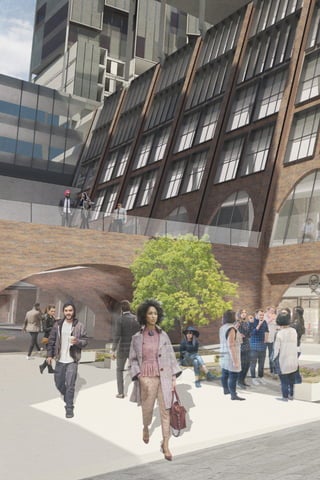
B I S H O P S G A T E
G O O D S Y A R D
M A S T E R P L A N
GARY LI NAHYUNG KIM NOOPUR SUCKHLECHA CHARMAINE YAU
S Y L K
TABLE OF CONTENTS
OVERVIEW
EXECUTIVE SUMMARY
THE MASTER PLAN
IMPLEMENTATION
CREDITS
00 CONTEXT
00 EXISTING SITE CONDITIONS
00 EXISTING DEVELOPER PROPOSAL
00 FRAMEWORK
00 OVERALL PLAN
00 PUBLIC REALM
00 LANDSCAPE
00 BLOCK A
00 BLOCK BCD
00 SUSTAINABILITY
00 NEXT STEPS
00 CONCLUSION
EXECUTIVE SUMMARY
This urban design proposal for the Bishopsgate Goodsyard is meant to
consideralltheongoingandfuturesocial,cultural,andpoliticalfactorsthat
might affect London. The premise of this proposal is a REVITALIZATION
AND EXTENSION of the city of London into its surrounding neighborhoods.
The main goals for the overall vision for the site is a RECONNECTION of the
Bishopsgate Goodsyard through the urban fabric of London. This URBAN
SOLUTION will support London’s primary goal of solving its housing crisis.
It will REEVALUATE the existing proposals to the Bishopsgate Goodsyard
and INTEGRATE the surrounding contextual factors to create a greater
sense of community.
With all the ongoing changes in today’s society it is no longer suitable
for urban designers to consider only the existing conditions or design
for profit. But as London continues to grow, it is critical to design an
architecture that is for the people, creating a sense of EVERLASTING AND
ADAPTING PLACE.
07
EXECUTIVESUMMARY
OVERVIEW
BARBICAN
BROADGATE
TOWER
ST. PAUL’S
CATHEDRAL
LLOYD’S OF
LONDON
C I T Y O F
L O N D O N
HACKNEY
THE G
RIVER THAMES
LIVERPOOL
STREET
STATION
CONTEXT
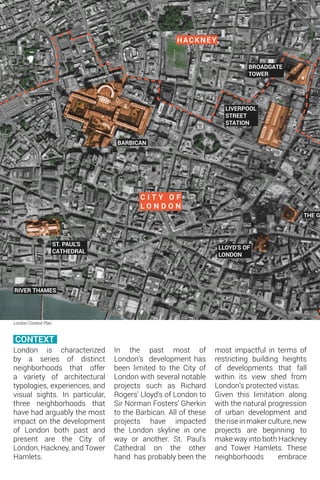
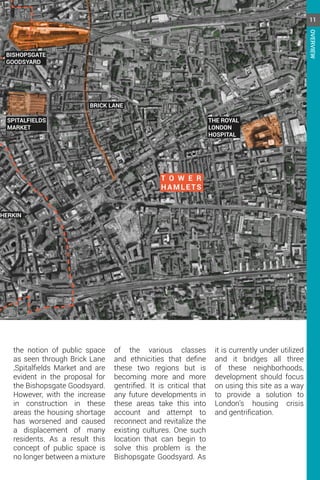
London is characterized
by a series of distinct
neighborhoods that offer
a variety of architectural
typologies, experiences, and
visual sights. In particular,
three neighborhoods that
have had arguably the most
impact on the development
of London both past and
present are the City of
London, Hackney, and Tower
Hamlets.
In the past most of
London’s development has
been limited to the City of
London with several notable
projects such as Richard
Rogers’ Lloyd’s of London to
Sir Norman Fosters’ Gherkin
to the Barbican. All of these
projects have impacted
the London skyline in one
way or another. St. Paul’s
Cathedral on the other
hand has probably been the
London Context Plan
most impactful in terms of
restricting building heights
of developments that fall
within its view shed from
London’s protected vistas.
Given this limitation along
with the natural progression
of urban development and
the rise in maker culture, new
projects are beginning to
make way into both Hackney
and Tower Hamlets. These
neighborhoods embrace
BISHOPSGATE
GOODSYARD
BRICK LANE
SPITALFIELDS
MARKET
T O W E R
HAMLE TS
GHERKIN
THE ROYAL
LONDON
HOSPITAL
the notion of public space
as seen through Brick Lane
,Spitalfields Market and are
evident in the proposal for
the Bishopsgate Goodsyard.
However, with the increase
in construction in these
areas the housing shortage
has worsened and caused
a displacement of many
residents. As a result this
concept of public space is
no longer between a mixture
of the various classes
and ethnicities that define
these two regions but is
becoming more and more
gentrified. It is critical that
any future developments in
these areas take this into
account and attempt to
reconnect and revitalize the
existing cultures. One such
location that can begin to
solve this problem is the
Bishopsgate Goodsyard. As
it is currently under utilized
and it bridges all three
of these neighborhoods,
development should focus
on using this site as a way
to provide a solution to
London’s housing crisis
and gentrification.
11
OVERVIEW
BROADGATE
TOWER
161 M
PRINCIPAL
PLACE
175 M
BLOSSOM
STREET
40 M
THE STAGE
130 M
HIGHGATE
HOTEL
106 M
BISHOPSGATE
GOODSYARD
?? M
SPITALFIELDS
MARKET
50 M
PROJECT AREA
Project Area Developments
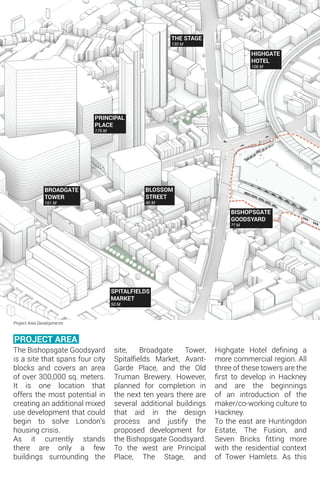
The Bishopsgate Goodsyard
is a site that spans four city
blocks and covers an area
of over 300,000 sq. meters.
It is one location that
offers the most potential in
creating an additional mixed
use development that could
begin to solve London’s
housing crisis.
As it currently stands
there are only a few
buildings surrounding the
site, Broadgate Tower,
Spitalfields Market, Avant-
Garde Place, and the Old
Truman Brewery. However,
planned for completion in
the next ten years there are
several additional buildings
that aid in the design
process and justify the
proposed development for
the Bishopsgate Goodsyard.
To the west are Principal
Place, The Stage, and
Highgate Hotel defining a
more commercial region. All
three of these towers are the
first to develop in Hackney
and are the beginnings
of an introduction of the
maker/co-working culture to
Hackney.
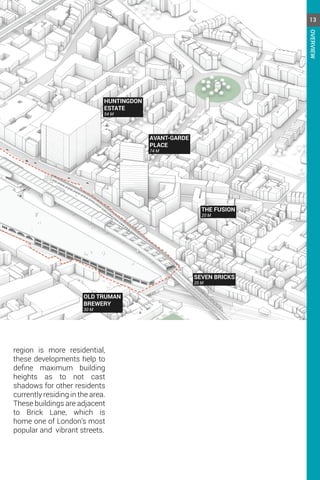
To the east are Huntingdon
Estate, The Fusion, and
Seven Bricks fitting more
with the residential context
of Tower Hamlets. As this
HUNTINGDON
ESTATE
54 M
AVANT-GARDE
PLACE
74 M
THE FUSION
20 M
SEVEN BRICKS
20 M
OLD TRUMAN
BREWERY
30 M
region is more residential,
these developments help to
define maximum building
heights as to not cast
shadows for other residents
currently residing in the area.
These buildings are adjacent
to Brick Lane, which is
home one of London’s most
popular and vibrant streets.
13
OVERVIEW
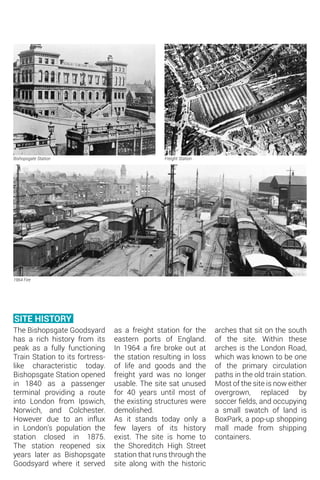
The Bishopsgate Goodsyard
has a rich history from its
peak as a fully functioning
Train Station to its fortress-
like characteristic today.
Bishopsgate Station opened
in 1840 as a passenger
terminal providing a route
into London from Ipswich,
Norwich, and Colchester.
However due to an influx
in London’s population the
station closed in 1875.
The station reopened six
years later as Bishopsgate
Goodsyard where it served
Bishopsgate Station
1964 Fire
Freight Station
SITE HISTORY
as a freight station for the
eastern ports of England.
In 1964 a fire broke out at
the station resulting in loss
of life and goods and the
freight yard was no longer
usable. The site sat unused
for 40 years until most of
the existing structures were
demolished.
As it stands today only a
few layers of its history
exist. The site is home to
the Shoreditch High Street
station that runs through the
site along with the historic
arches that sit on the south
of the site. Within these
arches is the London Road,
which was known to be one
of the primary circulation
paths in the old train station.
Most of the site is now either
overgrown, replaced by
soccer fields, and occupying
a small swatch of land is
BoxPark, a pop-up shopping
mall made from shipping
containers.
BET
HNAL
GREE
N ROAD
A1029
B135 SCLATER ROAD
CYGNETSTREET
BACON STREET
BRICKLANE
CHESIRE
STREET
GRIMSBY
STREET
BETH
NAL
GRE
EN
ROA
D
A10
29
BRICK
LANE
REDCHUR
CH STREET
OLD NICHOL
STREET
WHITBY
STREET
B122
CLUBROW
CHANCE
STREET
EBORSTREET
SHOREDITCHHIGHSTREET
A10
HOLYWELL LANE
KINGJOHNCOURT
GRE
AT
EAS
TER
N
STR
EET
COM
MER
CIAL
STR
EET
QUAKER STREET
WHELERSTREET
FLEUR DE LIS STREET
ELDERSTREET
BLOSSOM
STREET
CALVIN STREET
GREYEAGLE
STREET
CORBET PLACE
COM
MER
CIAL
STR
EET
FOLGATE STREET
JEROMESTREET
BUXTON STREET
BRICKLANE
QUAKER STREET
A10
WORSHIP
STREET
SHOREDIT
CHHIGHSTREET
BETH
NAL GREE
N ROAD
A1029
B135 SCLATER ROAD
CYGNETSTREET
BACON STREET
BRICKLANE
CHESIRE
STREET
GRIMSBY
STREET
BETH
NAL GRE
EN ROAD
A10
29
BRICK
LANE
REDCHUR
CH STREET
OLD NICHOL
STREET
WHITBY
STREET
B122
CLUBROW
CHANCE
STREET
EBORSTREET
SHOREDITCHHIGHSTREET
A10
HOLYWELL LANE
KINGJOHNCOURT
GRE
AT
EAS
TER
N
STR
EET
COM
MER
CIAL
STR
EET
QUAKER STREET
WHELERSTREET
FLEUR DE LIS STREET
ELDERSTREET
BLOSSOM
STREET
CALVIN STREET
GREYEAGLE
STREET
CORBET PLACE
COM
MER
CIAL
STR
EET
FOLGATE STREET
JEROMESTREET
BUXTON STREET
BRICKLANE
QUAKER STREET
A10
WORSHIP
STREET
SHOREDIT
CHHIGH
STREET
BETH
NAL GREE
N ROAD
A1029
B135 SCLATER ROAD
CYGNETSTREET
BACON STREET
BRICKLANE
CHESIRE
STREET
GRIMSBY
STREET
BETH
NAL GRE
EN ROAD
A10
29
BRICK
LANE
REDCHUR
CH STREET
OLD NICHOL
STREET
WHITBY
STREET
B122
CLUBROW
CHANCE
STREET
EBORSTREET
SHOREDITCHHIGHSTREET
A10
HOLYWELL LANE
KINGJOHNCOURT
GRE
AT
EAS
TER
N
STR
EET
COM
MER
CIAL
STR
EET
QUAKER STREET
WHELERSTREET
FLEUR DE LIS STREET
ELDERSTREET
BLOSSOM
STREET
CALVIN STREET
GREYEAGLE
STREET
CORBET PLACE
COM
MER
CIAL
STR
EET
FOLGATE STREET
JEROMESTREET
BUXTON STREET
BRICKLANE
QUAKER STREET
A10
WORSHIP
STREET
SHOREDIT
CHHIGH
STREET
ViewtoCentral
London
View to Tower Bridge
BET
HNAL
GREE
N ROAD
A1029
B135 SCLATER ROAD
CYGNETSTREET
BACON STREET
BRICKLANE
CHESIRE
STREET
GRIMSBY
STREET
BETH
NAL
GRE
EN
ROA
D
A10
29
BRICK
LANE
REDCHUR
CH STREET
OLD NICHOL
STREET
WHITBY
STREET
B122
CLUBROW
CHANCE
STREET
EBORSTREET
SHOREDITCHHIGHSTREET
A10
HOLYWELL LANE
KINGJOHNCOURT
GRE
AT
EAS
TER
N
STR
EET
COM
MER
CIAL
STR
EET
QUAKER STREET
WHELERSTREET
FLEUR DE LIS STREET
ELDERSTREET
BLOSSOM
STREET
CALVIN STREET
GREYEAGLE
STREET
CORBET PLACE
COM
MER
CIAL
STR
EET
FOLGATE STREET
JEROMESTREET
BUXTON STREET
BRICKLANE
QUAKER STREET
A10
WORSHIP
STREET
SHOREDIT
CHHIGHSTREET
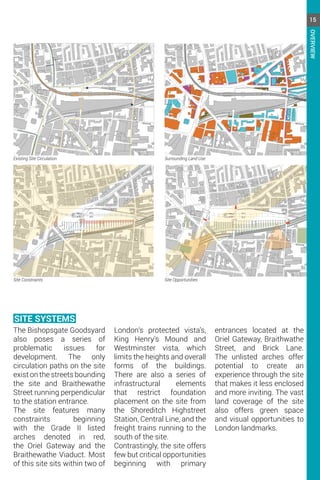
The Bishopsgate Goodsyard
also poses a series of
problematic issues for
development. The only
circulation paths on the site
exist on the streets bounding
the site and Braithewathe
Street running perpendicular
to the station entrance.
The site features many
constraints beginning
with the Grade II listed
arches denoted in red,
the Oriel Gateway and the
Braithewathe Viaduct. Most
of this site sits within two of
Existing Site Circulation
Site Constraints
Surrounding Land Use
Site Opportunities
SITE SYSTEMS
London‘s protected vista’s,
King Henry’s Mound and
Westminster vista, which
limits the heights and overall
forms of the buildings.
There are also a series of
infrastructural elements
that restrict foundation
placement on the site from
the Shoreditch Highstreet
Station, Central Line, and the
freight trains running to the
south of the site.
Contrastingly, the site offers
few but critical opportunities
beginning with primary
entrances located at the
Oriel Gateway, Braithwathe
Street, and Brick Lane.
The unlisted arches offer
potential to create an
experience through the site
that makes it less enclosed
and more inviting. The vast
land coverage of the site
also offers green space
and visual opportunities to
London landmarks.
15
OVERVIEW
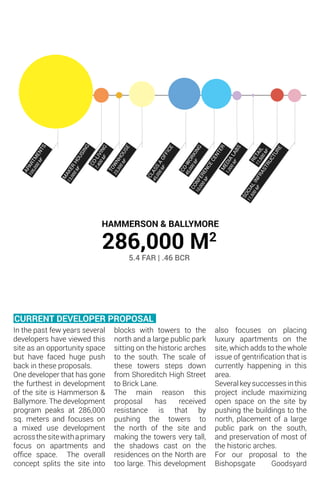
286,000 M2
5.4 FAR | .46 BCR
Apartments
85,000
SQ. M.
Maker
Housing
13,000
SQ. M.
Co-Living
7,400
SQ. M.
Townhouse
33,300
SQ. M.
Class A Office
25,000
SQ. M.
Co-Working
25,000
SQ. M.
Retail
11,500
SQ. M.
Conference
Center
10,000
SQ. M.
Media
Labs
1,000
SQ. M.
Social
Infrastructure
11,500
SQ. M.
APARTM
ENTS
105,000M2
M
AKER
HOUSING
13,000M2
CO-LIVING
7,400M2
TOW
NHOUSE
23,300M2
CLASS
A
OFFICE
45,000M2
CO-W
ORKING
45,000M2
CONFERENCECENTER
10,000M2
M
EDIA
LABS
1,000M2
RETAIL
11,500M2
SOCIALINFRASTRUCTURE
11,500M2
HAMMERSON & BALLYMORE
In the past few years several
developers have viewed this
site as an opportunity space
but have faced huge push
back in these proposals.
One developer that has gone
the furthest in development
of the site is Hammerson &
Ballymore. The development
program peaks at 286,000
sq. meters and focuses on
a mixed use development
acrossthesitewithaprimary
focus on apartments and
office space. The overall
concept splits the site into
CURRENT DEVELOPER PROPOSAL
blocks with towers to the
north and a large public park
sitting on the historic arches
to the south. The scale of
these towers steps down
from Shoreditch High Street
to Brick Lane.
The main reason this
proposal has received
resistance is that by
pushing the towers to
the north of the site and
making the towers very tall,
the shadows cast on the
residences on the North are
too large. This development
also focuses on placing
luxury apartments on the
site, which adds to the whole
issue of gentrification that is
currently happening in this
area.
Several key successes in this
project include maximizing
open space on the site by
pushing the buildings to the
north, placement of a large
public park on the south,
and preservation of most of
the historic arches.
For our proposal to the
Bishopsgate Goodsyard
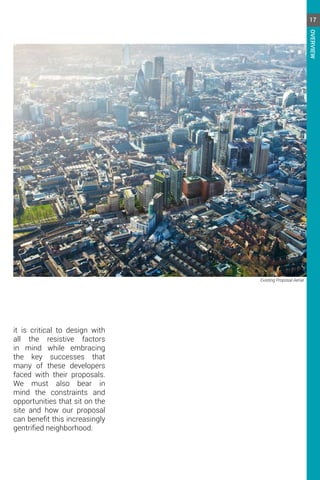
Existing Proposal Aerial
it is critical to design with
all the resistive factors
in mind while embracing
the key successes that
many of these developers
faced with their proposals.
We must also bear in
mind the constraints and
opportunities that sit on the
site and how our proposal
can benefit this increasingly
gentrified neighborhood.
17
OVERVIEW
THE MASTER PLAN
Existing Conditions
Site Circulation
Extension of Urban Grid
Overall Building Organization
PARTI
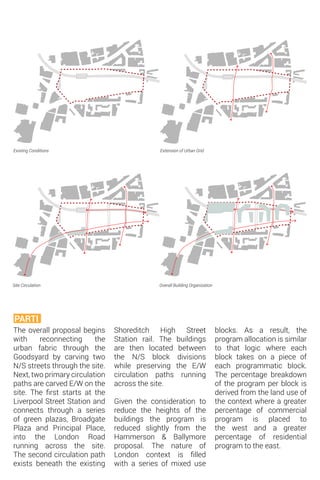
The overall proposal begins
with reconnecting the
urban fabric through the
Goodsyard by carving two
N/S streets through the site.
Next, two primary circulation
paths are carved E/W on the
site. The first starts at the
Liverpool Street Station and
connects through a series
of green plazas, Broadgate
Plaza and Principal Place,
into the London Road
running across the site.
The second circulation path
exists beneath the existing
Shoreditch High Street
Station rail. The buildings
are then located between
the N/S block divisions
while preserving the E/W
circulation paths running
across the site.
Given the consideration to
reduce the heights of the
buildings the program is
reduced slightly from the
Hammerson & Ballymore
proposal. The nature of
London context is filled
with a series of mixed use
blocks. As a result, the
program allocation is similar
to that logic where each
block takes on a piece of
each programmatic block.
The percentage breakdown
of the program per block is
derived from the land use of
the context where a greater
percentage of commercial
program is placed to
the west and a greater
percentage of residential
program to the east.
APARTMENTS
MAKER HOUSING
TOWNHOUSES
CO-LIVING
CLASS A OFFICES
COWORKING OFFICES
CONFERENCE CENTER
MEDIA LABS
RETAIL
SOCIAL INFRASTRUCTURE
Program Distribution
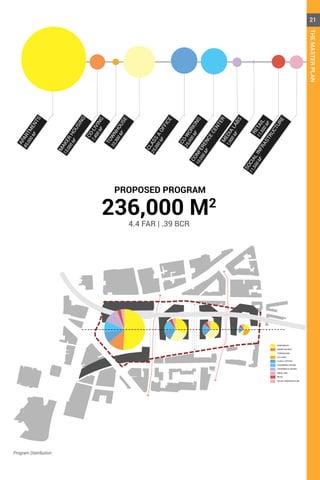
236,000 M2
4.4 FAR | .39 BCR
PROPOSED PROGRAM
APARTM
ENTS
85,000M2
M
AKER
HOUSING
13,000M2
CO-LIVING
7,400M2
TOW
NHOUSE
33,300M2
CLASS
A
OFFICE
25,000M2
CO-W
ORKING
25,000M2
CONFERENCECENTER
10,000M2
M
EDIA
LABS
1,000M2
RETAIL
11,500M2
SOCIALINFRASTRUCTURE
11,500M2
21
THEMASTERPLAN
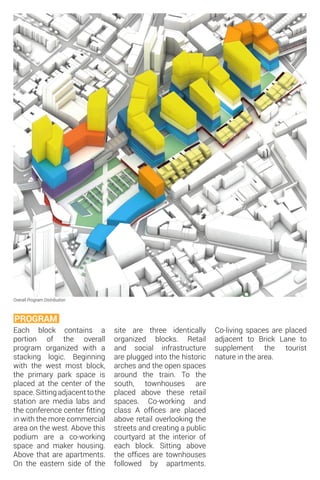
Overall Program Distribution
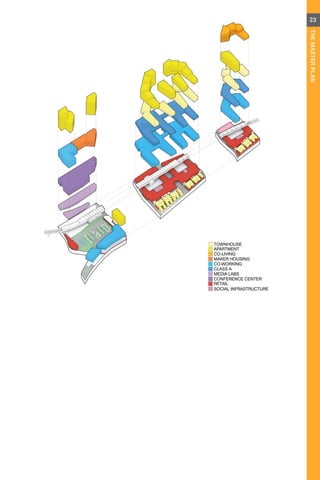
Each block contains a
portion of the overall
program organized with a
stacking logic. Beginning
with the west most block,
the primary park space is
placed at the center of the
space. Sitting adjacent to the
station are media labs and
the conference center fitting
in with the more commercial
area on the west. Above this
podium are a co-working
space and maker housing.
Above that are apartments.
On the eastern side of the
PROGRAM
site are three identically
organized blocks. Retail
and social infrastructure
are plugged into the historic
arches and the open spaces
around the train. To the
south, townhouses are
placed above these retail
spaces. Co-working and
class A offices are placed
above retail overlooking the
streets and creating a public
courtyard at the interior of
each block. Sitting above
the offices are townhouses
followed by apartments.
Co-living spaces are placed
adjacent to Brick Lane to
supplement the tourist
nature in the area.
TOWNHOUSE
APARTMENT
CO-LIVING
MAKER HOUSING
CO-WORKING
CLASS A
MEDIA LABS
CONFERENCE CENTER
RETAIL
SOCIAL INFRASTRUCTURE
23
THEMASTERPLAN
IMPLEMENTATION
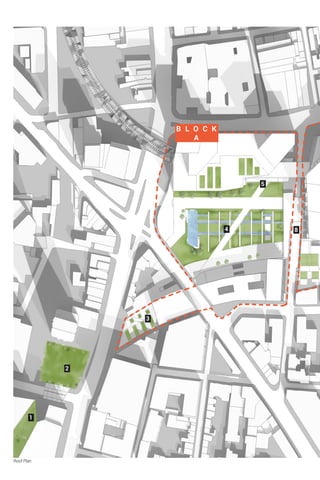
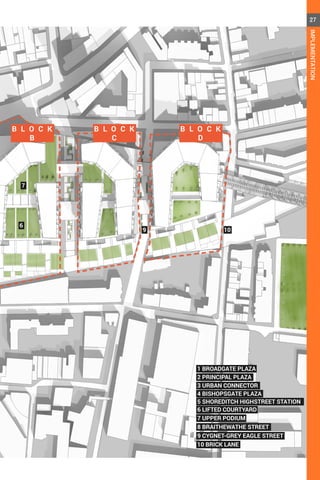
B L O C K
A
1
2
3
4
5
8
Roof Plan
B L O C K
B
B L O C K
C
B L O C K
D
6
7 UPPER PODIUM
8 BRAITHEWATHE STREET
9 CYGNET-GREY EAGLE STREET
10 BRICK LANE
6 LIFTED COURTYARD
4 BISHOPSGATE PLAZA
5 SHOREDITCH HIGHSTREET STATION
3 URBAN CONNECTOR
2 PRINCIPAL PLAZA
1 BROADGATE PLAZA
7
9 10
27
IMPLEMENTATION
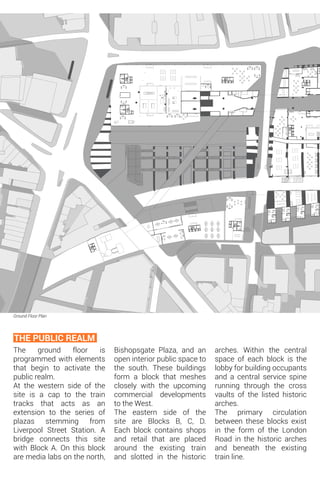
Ground Floor Plan
The ground floor is
programmed with elements
that begin to activate the
public realm.
At the western side of the
site is a cap to the train
tracks that acts as an
extension to the series of
plazas stemming from
Liverpool Street Station. A
bridge connects this site
with Block A. On this block
are media labs on the north,
THE PUBLIC REALM
Bishopsgate Plaza, and an
open interior public space to
the south. These buildings
form a block that meshes
closely with the upcoming
commercial developments
to the West.
The eastern side of the
site are Blocks B, C, D.
Each block contains shops
and retail that are placed
around the existing train
and slotted in the historic
arches. Within the central
space of each block is the
lobby for building occupants
and a central service spine
running through the cross
vaults of the listed historic
arches.
The primary circulation
between these blocks exist
in the form of the London
Road in the historic arches
and beneath the existing
train line.
29
IMPLEMENTATION
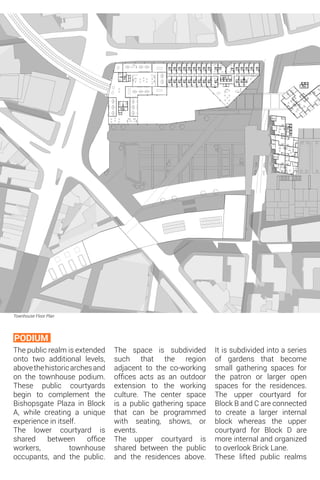
Townhouse Floor Plan
The public realm is extended
onto two additional levels,
abovethehistoricarchesand
on the townhouse podium.
These public courtyards
begin to complement the
Bishopsgate Plaza in Block
A, while creating a unique
experience in itself.
The lower courtyard is
shared between office
workers, townhouse
occupants, and the public.
PODIUM
The space is subdivided
such that the region
adjacent to the co-working
offices acts as an outdoor
extension to the working
culture. The center space
is a public gathering space
that can be programmed
with seating, shows, or
events.
The upper courtyard is
shared between the public
and the residences above.
It is subdivided into a series
of gardens that become
small gathering spaces for
the patron or larger open
spaces for the residences.
The upper courtyard for
Block B and C are connected
to create a larger internal
block whereas the upper
courtyard for Block D are
more internal and organized
to overlook Brick Lane.
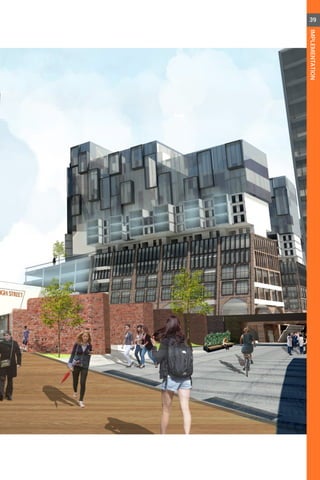
These lifted public realms
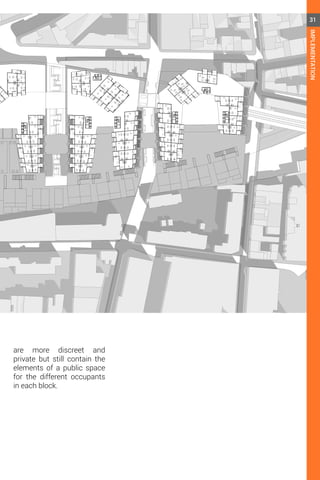
are more discreet and
private but still contain the
elements of a public space
for the different occupants
in each block.
31
IMPLEMENTATION
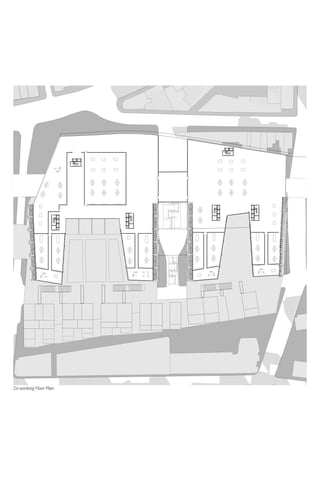
Co-working Floor Plan
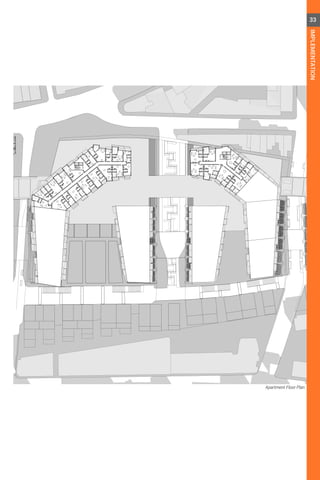
Apartment Floor Plan
33
IMPLEMENTATION
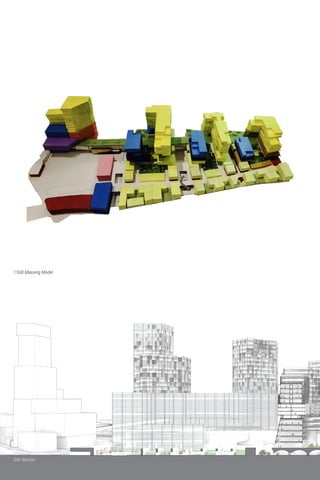
Site Section
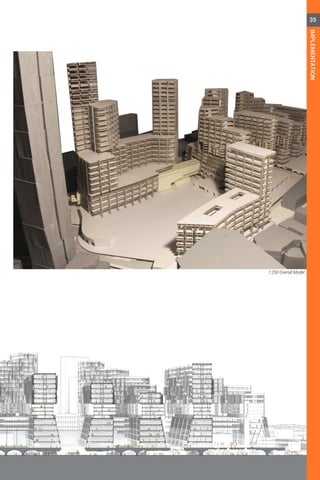
1:500 Massing Model
1:250 Overall Model
35
IMPLEMENTATION
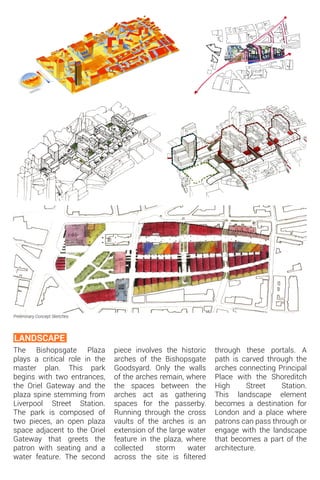
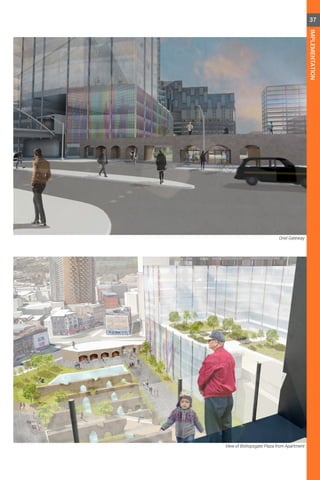
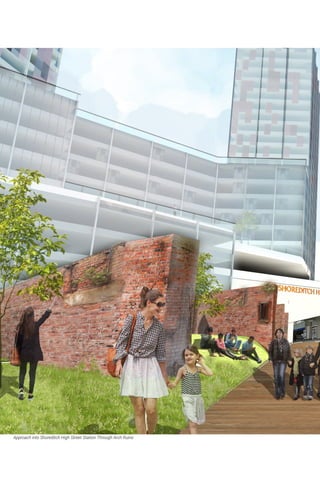
The Bishopsgate Plaza
plays a critical role in the
master plan. This park
begins with two entrances,
the Oriel Gateway and the
plaza spine stemming from
Liverpool Street Station.
The park is composed of
two pieces, an open plaza
space adjacent to the Oriel
Gateway that greets the
patron with seating and a
water feature. The second
Preliminary Concept Sketches
LANDSCAPE
piece involves the historic
arches of the Bishopsgate
Goodsyard. Only the walls
of the arches remain, where
the spaces between the
arches act as gathering
spaces for the passerby.
Running through the cross
vaults of the arches is an
extension of the large water
feature in the plaza, where
collected storm water
across the site is filtered
through these portals. A
path is carved through the
arches connecting Principal
Place with the Shoreditch
High Street Station.
This landscape element
becomes a destination for
London and a place where
patrons can pass through or
engage with the landscape
that becomes a part of the
architecture.
Oriel Gateway
View of Bishopsgate Plaza from Apartment
37
IMPLEMENTATION
Approach into Shoreditch High Street Station Through Arch Ruins
39
IMPLEMENTATION
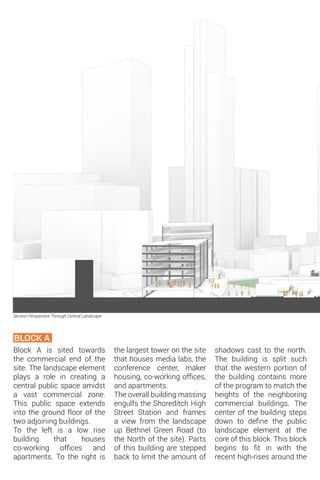
Block A is sited towards
the commercial end of the
site. The landscape element
plays a role in creating a
central public space amidst
a vast commercial zone.
This public space extends
into the ground floor of the
two adjoining buildings.
To the left is a low rise
building that houses
co-working offices and
apartments. To the right is
BLOCK A
Section Perspective Through Central Landscape
the largest tower on the site
that houses media labs, the
conference center, maker
housing, co-working offices,
and apartments.
The overall building massing
engulfs the Shoreditch High
Street Station and frames
a view from the landscape
up Bethnel Green Road (to
the North of the site). Parts
of this building are stepped
back to limit the amount of
shadows cast to the north.
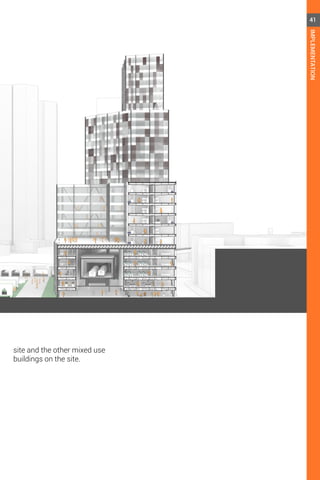
The building is split such
that the western portion of
the building contains more
of the program to match the
heights of the neighboring
commercial buildings. The
center of the building steps
down to define the public
landscape element at the
core of this block. This block
begins to fit in with the
recent high-rises around the
site and the other mixed use
buildings on the site.
41
IMPLEMENTATION
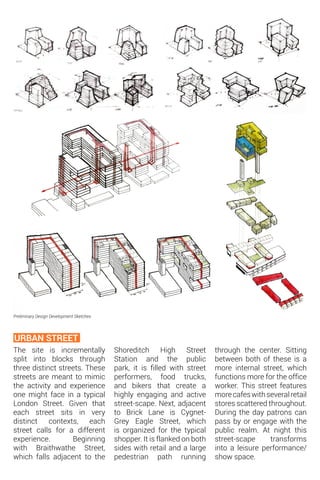
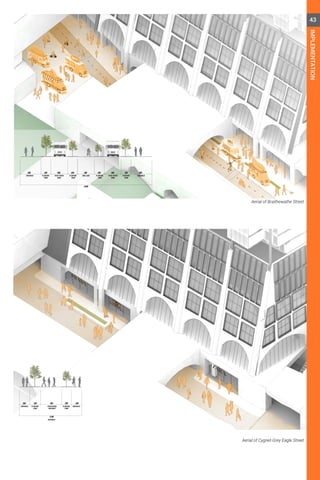
The site is incrementally
split into blocks through
three distinct streets. These
streets are meant to mimic
the activity and experience
one might face in a typical
London Street. Given that
each street sits in very
distinct contexts, each
street calls for a different
experience. Beginning
with Braithwathe Street,
which falls adjacent to the
URBAN STREET
Preliminary Design Development Sketches
Shoreditch High Street
Station and the public
park, it is filled with street
performers, food trucks,
and bikers that create a
highly engaging and active
street-scape. Next, adjacent
to Brick Lane is Cygnet-
Grey Eagle Street, which
is organized for the typical
shopper. It is flanked on both
sides with retail and a large
pedestrian path running
through the center. Sitting
between both of these is a
more internal street, which
functions more for the office
worker. This street features
morecafeswithseveralretail
stores scattered throughout.
During the day patrons can
pass by or engage with the
public realm. At night this
street-scape transforms
into a leisure performance/
show space.
BIKE LANE PLANTING
ZONE
PLANTING
ZONE
PLANTING
ZONE
FOOD TRUCK
ZONE
SIDEWALK
3M
24M
2M 2M 9M
FOOD TRUCK
ZONE
9M 9M
SIDEWALK
9M 2M
PLANTING
ZONE
2M
PLANTING
ZONE
2M
PLANTING
ZONE
2M 2M
PEDESTRIAN
WALKWAY
4M
SIDEWALK
SIDEWALK SIDEWALK
12M
2M
Aerial of Braithewathe Street
Aerial of Cygnet-Grey Eagle Street
43
IMPLEMENTATION
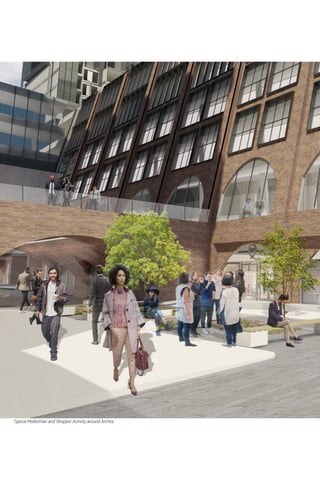
Typical Pedestrian and Shopper Activity around Arches
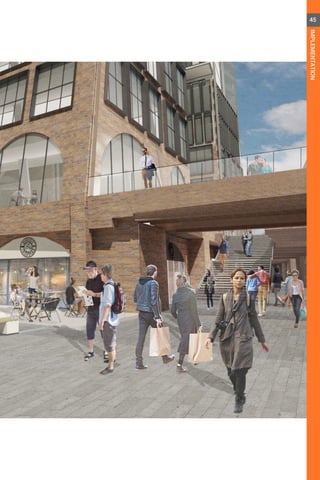
45
IMPLEMENTATION
TOWNHOUSE ARCHES LEVEL
TOWNHOUSE PODIUM LEVEL
GROUND FLOOR
GROUND FLOOR
MICRO STUDIO STUDIO ONE BEDROOM TWO BEDROOM THREE BEDROOM FOUR BEDROOM FIVE BEDROOM
FIRST FLOOR SECOND FLOOR THIRD FLOOR
FIRST FLOOR
SECOND FLOOR
THIRD FLOOR
TOWNHOUSE ARCHES LE
TOWNHOUSE PODIUM L
GROUND FLOOR
GROUND FLOOR
MICRO STUDIO STUDIO
FIRST FLOOR
SECOND FLOOR
THIRD FLOOR
TO
GROUND FLOOR
G
FIRST FLOOR
TOWNHOUSE ARCHES LEVEL
TOWNHOUSE PODIUM LEVEL
GROUND FLOOR
MICRO STUDIO STUDIO ONE BEDROOM TWO BEDROOM THREE BEDROOM FOUR BEDROOM FIVE BEDROOM
FIRST FLOOR SECOND FLOOR THIRD FLOOR
TOWNHOUSE ARCHES LEVEL
TOWNHOUSE PODIUM LEVEL
GROUND FLOOR
GROUND FLOOR
MICRO STUDIO STUDIO ONE BEDROOM TWO BEDROOM THREE BEDROOM FOUR BEDROOM
FIRST FLOOR SECOND FLOOR THIRD
FIRST FLOOR
SECOND FLOOR
THIRD FLOOR
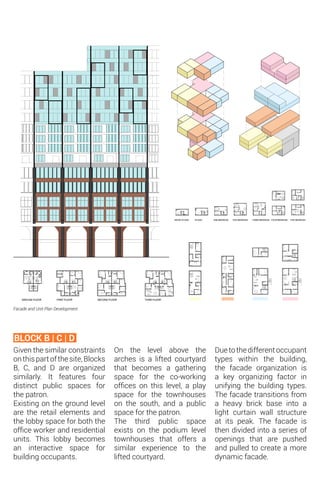
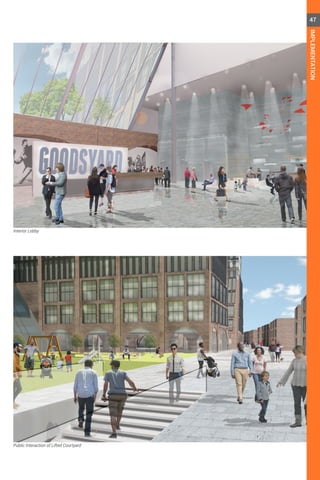
Given the similar constraints
onthispartofthesite,Blocks
B, C, and D are organized
similarly. It features four
distinct public spaces for
the patron.
Existing on the ground level
are the retail elements and
the lobby space for both the
office worker and residential
units. This lobby becomes
an interactive space for
building occupants.
BLOCK B | C | D
Facade and Unit Plan Development
On the level above the
arches is a lifted courtyard
that becomes a gathering
space for the co-working
offices on this level, a play
space for the townhouses
on the south, and a public
space for the patron.
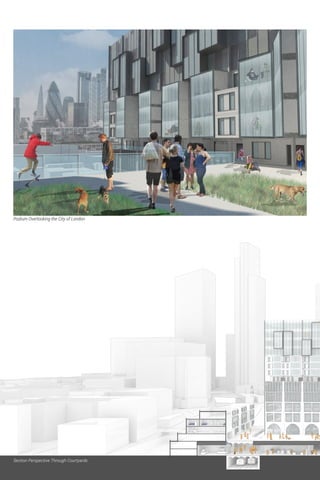
The third public space
exists on the podium level
townhouses that offers a
similar experience to the
lifted courtyard.
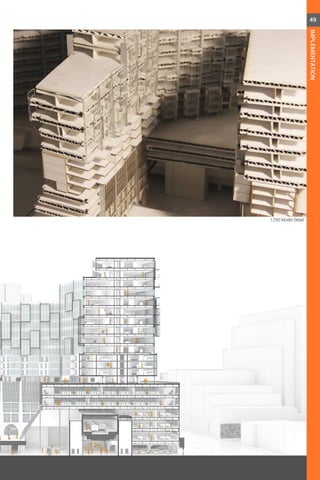
Duetothedifferentoccupant
types within the building,
the facade organization is
a key organizing factor in
unifying the building types.
The facade transitions from
a heavy brick base into a
light curtain wall structure
at its peak. The facade is
then divided into a series of
openings that are pushed
and pulled to create a more
dynamic facade.
Interior Lobby
Public Interaction of Lifted Courtyard
47
IMPLEMENTATION
Podium Overlooking the City of London
Section Perspective Through Courtyards
1:250 Model Detail
49
IMPLEMENTATION
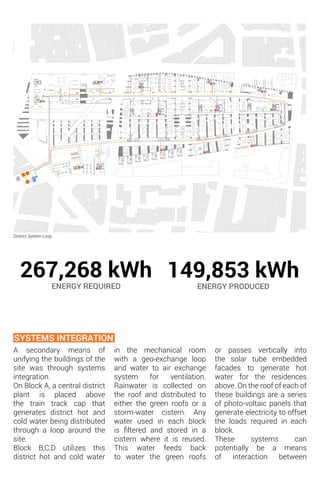
149,853 kWh
ENERGY PRODUCED
267,268 kWh
ENERGY REQUIRED
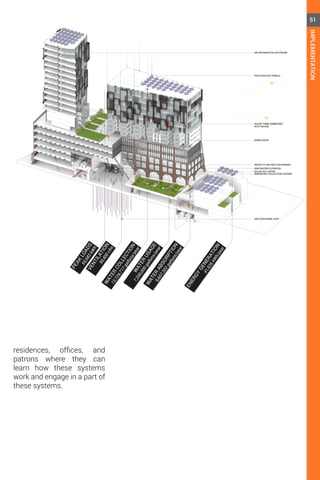
A secondary means of
unifying the buildings of the
site was through systems
integration.
On Block A, a central district
plant is placed above
the train track cap that
generates district hot and
cold water being distributed
through a loop around the
site.
Block B,C,D utilizes this
district hot and cold water
SYSTEMS INTEGRATION
District System Loop
in the mechanical room
with a geo-exchange loop
and water to air exchange
system for ventilation.
Rainwater is collected on
the roof and distributed to
either the green roofs or a
storm-water cistern. Any
water used in each block
is filtered and stored in a
cistern where it is reused.
This water feeds back
to water the green roofs
or passes vertically into
the solar tube embedded
facades to generate hot
water for the residences
above. On the roof of each of
these buildings are a series
of photo-voltaic panels that
generate electricity to offset
the loads required in each
block.
These systems can
potentially be a means
of interaction between
GEO-EXCHANGE LOOP
RAINWATER COLLECTION CISTERN
GREYWATER FILTRATION
SOLAR HOT WATER
WATER TO AIR HEAT EXCHANGER
GREEN ROOF
SOLAR TUBES EMBEDDED
INTO FACADE
PHOTOVOLTAIC PANELS
AIR DISTRIBUTION DUCTWORK
ENERGY
GENERATION
41,626kWh/year
W
ATER
USAGE
7,200,000gallons/year
W
ATER
COLLECTION
13,724,717gallons/year
PEAK
LOADS
55,683kWh
VENTILATION
30,400cfm
W
ATER
ABSORPTION
9,607,302gallons/year
residences, offices, and
patrons where they can
learn how these systems
work and engage in a part of
these systems.
51
IMPLEMENTATION
Night Time Aerial View of Bishopsgate Goodsyard
53
IMPLEMENTATION
This proposal primarily envisions the Bishopsgate Goodsyard as a
gateway for the future expansion of London. It suggests a community
similar to the dense urban environment experienced in the City of London
that begins to understand all the complex societal issues progressing in
London. While there are many urban design solutions to this underutilized
space, this solution presents an opportunity and re-imagination of the
potential the Bishopsgate Goodsyard has in both solving the existing
issues and creating a community for the diverse population London has
to offer while mitigating the many constraints present on this site.
CONCLUSION
55
IMPLEMENTATION
CREDITS
SYLK
PROJECT TEAM
STAKEHOLDERS
ADVISORS
GARY
LI
JOHNATHAN
KLINE
Fifth Year Architecture Student
Project Team Carnegie Mellon University
School of Architecture
Current Project Developer
SOA Urban Design Faculty
Fifth Year Architecture Student Fifth Year Architecture StudentFourth Year Architecture Student
CHARMAINE
YAU
NAHYUNG
KIM
NOOPUR
SUCKHLECHA
59
CREDITS
Bishopsgate Goodsyard

Bishopsgate Goodsyard

  • 1.
    B I SH O P S G A T E G O O D S Y A R D M A S T E R P L A N GARY LI NAHYUNG KIM NOOPUR SUCKHLECHA CHARMAINE YAU S Y L K
  • 3.
    TABLE OF CONTENTS OVERVIEW EXECUTIVESUMMARY THE MASTER PLAN IMPLEMENTATION CREDITS 00 CONTEXT 00 EXISTING SITE CONDITIONS 00 EXISTING DEVELOPER PROPOSAL 00 FRAMEWORK 00 OVERALL PLAN 00 PUBLIC REALM 00 LANDSCAPE 00 BLOCK A 00 BLOCK BCD 00 SUSTAINABILITY 00 NEXT STEPS 00 CONCLUSION
  • 5.
  • 7.
    This urban designproposal for the Bishopsgate Goodsyard is meant to consideralltheongoingandfuturesocial,cultural,andpoliticalfactorsthat might affect London. The premise of this proposal is a REVITALIZATION AND EXTENSION of the city of London into its surrounding neighborhoods. The main goals for the overall vision for the site is a RECONNECTION of the Bishopsgate Goodsyard through the urban fabric of London. This URBAN SOLUTION will support London’s primary goal of solving its housing crisis. It will REEVALUATE the existing proposals to the Bishopsgate Goodsyard and INTEGRATE the surrounding contextual factors to create a greater sense of community. With all the ongoing changes in today’s society it is no longer suitable for urban designers to consider only the existing conditions or design for profit. But as London continues to grow, it is critical to design an architecture that is for the people, creating a sense of EVERLASTING AND ADAPTING PLACE. 07 EXECUTIVESUMMARY
  • 9.
  • 10.
    BARBICAN BROADGATE TOWER ST. PAUL’S CATHEDRAL LLOYD’S OF LONDON CI T Y O F L O N D O N HACKNEY THE G RIVER THAMES LIVERPOOL STREET STATION CONTEXT London is characterized by a series of distinct neighborhoods that offer a variety of architectural typologies, experiences, and visual sights. In particular, three neighborhoods that have had arguably the most impact on the development of London both past and present are the City of London, Hackney, and Tower Hamlets. In the past most of London’s development has been limited to the City of London with several notable projects such as Richard Rogers’ Lloyd’s of London to Sir Norman Fosters’ Gherkin to the Barbican. All of these projects have impacted the London skyline in one way or another. St. Paul’s Cathedral on the other hand has probably been the London Context Plan most impactful in terms of restricting building heights of developments that fall within its view shed from London’s protected vistas. Given this limitation along with the natural progression of urban development and the rise in maker culture, new projects are beginning to make way into both Hackney and Tower Hamlets. These neighborhoods embrace
  • 11.
    BISHOPSGATE GOODSYARD BRICK LANE SPITALFIELDS MARKET T OW E R HAMLE TS GHERKIN THE ROYAL LONDON HOSPITAL the notion of public space as seen through Brick Lane ,Spitalfields Market and are evident in the proposal for the Bishopsgate Goodsyard. However, with the increase in construction in these areas the housing shortage has worsened and caused a displacement of many residents. As a result this concept of public space is no longer between a mixture of the various classes and ethnicities that define these two regions but is becoming more and more gentrified. It is critical that any future developments in these areas take this into account and attempt to reconnect and revitalize the existing cultures. One such location that can begin to solve this problem is the Bishopsgate Goodsyard. As it is currently under utilized and it bridges all three of these neighborhoods, development should focus on using this site as a way to provide a solution to London’s housing crisis and gentrification. 11 OVERVIEW
  • 12.
    BROADGATE TOWER 161 M PRINCIPAL PLACE 175 M BLOSSOM STREET 40M THE STAGE 130 M HIGHGATE HOTEL 106 M BISHOPSGATE GOODSYARD ?? M SPITALFIELDS MARKET 50 M PROJECT AREA Project Area Developments The Bishopsgate Goodsyard is a site that spans four city blocks and covers an area of over 300,000 sq. meters. It is one location that offers the most potential in creating an additional mixed use development that could begin to solve London’s housing crisis. As it currently stands there are only a few buildings surrounding the site, Broadgate Tower, Spitalfields Market, Avant- Garde Place, and the Old Truman Brewery. However, planned for completion in the next ten years there are several additional buildings that aid in the design process and justify the proposed development for the Bishopsgate Goodsyard. To the west are Principal Place, The Stage, and Highgate Hotel defining a more commercial region. All three of these towers are the first to develop in Hackney and are the beginnings of an introduction of the maker/co-working culture to Hackney. To the east are Huntingdon Estate, The Fusion, and Seven Bricks fitting more with the residential context of Tower Hamlets. As this
  • 13.
    HUNTINGDON ESTATE 54 M AVANT-GARDE PLACE 74 M THEFUSION 20 M SEVEN BRICKS 20 M OLD TRUMAN BREWERY 30 M region is more residential, these developments help to define maximum building heights as to not cast shadows for other residents currently residing in the area. These buildings are adjacent to Brick Lane, which is home one of London’s most popular and vibrant streets. 13 OVERVIEW
  • 14.
    The Bishopsgate Goodsyard hasa rich history from its peak as a fully functioning Train Station to its fortress- like characteristic today. Bishopsgate Station opened in 1840 as a passenger terminal providing a route into London from Ipswich, Norwich, and Colchester. However due to an influx in London’s population the station closed in 1875. The station reopened six years later as Bishopsgate Goodsyard where it served Bishopsgate Station 1964 Fire Freight Station SITE HISTORY as a freight station for the eastern ports of England. In 1964 a fire broke out at the station resulting in loss of life and goods and the freight yard was no longer usable. The site sat unused for 40 years until most of the existing structures were demolished. As it stands today only a few layers of its history exist. The site is home to the Shoreditch High Street station that runs through the site along with the historic arches that sit on the south of the site. Within these arches is the London Road, which was known to be one of the primary circulation paths in the old train station. Most of the site is now either overgrown, replaced by soccer fields, and occupying a small swatch of land is BoxPark, a pop-up shopping mall made from shipping containers.
  • 15.
    BET HNAL GREE N ROAD A1029 B135 SCLATERROAD CYGNETSTREET BACON STREET BRICKLANE CHESIRE STREET GRIMSBY STREET BETH NAL GRE EN ROA D A10 29 BRICK LANE REDCHUR CH STREET OLD NICHOL STREET WHITBY STREET B122 CLUBROW CHANCE STREET EBORSTREET SHOREDITCHHIGHSTREET A10 HOLYWELL LANE KINGJOHNCOURT GRE AT EAS TER N STR EET COM MER CIAL STR EET QUAKER STREET WHELERSTREET FLEUR DE LIS STREET ELDERSTREET BLOSSOM STREET CALVIN STREET GREYEAGLE STREET CORBET PLACE COM MER CIAL STR EET FOLGATE STREET JEROMESTREET BUXTON STREET BRICKLANE QUAKER STREET A10 WORSHIP STREET SHOREDIT CHHIGHSTREET BETH NAL GREE N ROAD A1029 B135 SCLATER ROAD CYGNETSTREET BACON STREET BRICKLANE CHESIRE STREET GRIMSBY STREET BETH NAL GRE EN ROAD A10 29 BRICK LANE REDCHUR CH STREET OLD NICHOL STREET WHITBY STREET B122 CLUBROW CHANCE STREET EBORSTREET SHOREDITCHHIGHSTREET A10 HOLYWELL LANE KINGJOHNCOURT GRE AT EAS TER N STR EET COM MER CIAL STR EET QUAKER STREET WHELERSTREET FLEUR DE LIS STREET ELDERSTREET BLOSSOM STREET CALVIN STREET GREYEAGLE STREET CORBET PLACE COM MER CIAL STR EET FOLGATE STREET JEROMESTREET BUXTON STREET BRICKLANE QUAKER STREET A10 WORSHIP STREET SHOREDIT CHHIGH STREET BETH NAL GREE N ROAD A1029 B135 SCLATER ROAD CYGNETSTREET BACON STREET BRICKLANE CHESIRE STREET GRIMSBY STREET BETH NAL GRE EN ROAD A10 29 BRICK LANE REDCHUR CH STREET OLD NICHOL STREET WHITBY STREET B122 CLUBROW CHANCE STREET EBORSTREET SHOREDITCHHIGHSTREET A10 HOLYWELL LANE KINGJOHNCOURT GRE AT EAS TER N STR EET COM MER CIAL STR EET QUAKER STREET WHELERSTREET FLEUR DE LIS STREET ELDERSTREET BLOSSOM STREET CALVIN STREET GREYEAGLE STREET CORBET PLACE COM MER CIAL STR EET FOLGATE STREET JEROMESTREET BUXTON STREET BRICKLANE QUAKER STREET A10 WORSHIP STREET SHOREDIT CHHIGH STREET ViewtoCentral London View to Tower Bridge BET HNAL GREE N ROAD A1029 B135 SCLATER ROAD CYGNETSTREET BACON STREET BRICKLANE CHESIRE STREET GRIMSBY STREET BETH NAL GRE EN ROA D A10 29 BRICK LANE REDCHUR CH STREET OLD NICHOL STREET WHITBY STREET B122 CLUBROW CHANCE STREET EBORSTREET SHOREDITCHHIGHSTREET A10 HOLYWELL LANE KINGJOHNCOURT GRE AT EAS TER N STR EET COM MER CIAL STR EET QUAKER STREET WHELERSTREET FLEUR DE LIS STREET ELDERSTREET BLOSSOM STREET CALVIN STREET GREYEAGLE STREET CORBET PLACE COM MER CIAL STR EET FOLGATE STREET JEROMESTREET BUXTON STREET BRICKLANE QUAKER STREET A10 WORSHIP STREET SHOREDIT CHHIGHSTREET The Bishopsgate Goodsyard also poses a series of problematic issues for development. The only circulation paths on the site exist on the streets bounding the site and Braithewathe Street running perpendicular to the station entrance. The site features many constraints beginning with the Grade II listed arches denoted in red, the Oriel Gateway and the Braithewathe Viaduct. Most of this site sits within two of Existing Site Circulation Site Constraints Surrounding Land Use Site Opportunities SITE SYSTEMS London‘s protected vista’s, King Henry’s Mound and Westminster vista, which limits the heights and overall forms of the buildings. There are also a series of infrastructural elements that restrict foundation placement on the site from the Shoreditch Highstreet Station, Central Line, and the freight trains running to the south of the site. Contrastingly, the site offers few but critical opportunities beginning with primary entrances located at the Oriel Gateway, Braithwathe Street, and Brick Lane. The unlisted arches offer potential to create an experience through the site that makes it less enclosed and more inviting. The vast land coverage of the site also offers green space and visual opportunities to London landmarks. 15 OVERVIEW
  • 16.
    286,000 M2 5.4 FAR| .46 BCR Apartments 85,000 SQ. M. Maker Housing 13,000 SQ. M. Co-Living 7,400 SQ. M. Townhouse 33,300 SQ. M. Class A Office 25,000 SQ. M. Co-Working 25,000 SQ. M. Retail 11,500 SQ. M. Conference Center 10,000 SQ. M. Media Labs 1,000 SQ. M. Social Infrastructure 11,500 SQ. M. APARTM ENTS 105,000M2 M AKER HOUSING 13,000M2 CO-LIVING 7,400M2 TOW NHOUSE 23,300M2 CLASS A OFFICE 45,000M2 CO-W ORKING 45,000M2 CONFERENCECENTER 10,000M2 M EDIA LABS 1,000M2 RETAIL 11,500M2 SOCIALINFRASTRUCTURE 11,500M2 HAMMERSON & BALLYMORE In the past few years several developers have viewed this site as an opportunity space but have faced huge push back in these proposals. One developer that has gone the furthest in development of the site is Hammerson & Ballymore. The development program peaks at 286,000 sq. meters and focuses on a mixed use development acrossthesitewithaprimary focus on apartments and office space. The overall concept splits the site into CURRENT DEVELOPER PROPOSAL blocks with towers to the north and a large public park sitting on the historic arches to the south. The scale of these towers steps down from Shoreditch High Street to Brick Lane. The main reason this proposal has received resistance is that by pushing the towers to the north of the site and making the towers very tall, the shadows cast on the residences on the North are too large. This development also focuses on placing luxury apartments on the site, which adds to the whole issue of gentrification that is currently happening in this area. Several key successes in this project include maximizing open space on the site by pushing the buildings to the north, placement of a large public park on the south, and preservation of most of the historic arches. For our proposal to the Bishopsgate Goodsyard
  • 17.
    Existing Proposal Aerial itis critical to design with all the resistive factors in mind while embracing the key successes that many of these developers faced with their proposals. We must also bear in mind the constraints and opportunities that sit on the site and how our proposal can benefit this increasingly gentrified neighborhood. 17 OVERVIEW
  • 19.
  • 20.
    Existing Conditions Site Circulation Extensionof Urban Grid Overall Building Organization PARTI The overall proposal begins with reconnecting the urban fabric through the Goodsyard by carving two N/S streets through the site. Next, two primary circulation paths are carved E/W on the site. The first starts at the Liverpool Street Station and connects through a series of green plazas, Broadgate Plaza and Principal Place, into the London Road running across the site. The second circulation path exists beneath the existing Shoreditch High Street Station rail. The buildings are then located between the N/S block divisions while preserving the E/W circulation paths running across the site. Given the consideration to reduce the heights of the buildings the program is reduced slightly from the Hammerson & Ballymore proposal. The nature of London context is filled with a series of mixed use blocks. As a result, the program allocation is similar to that logic where each block takes on a piece of each programmatic block. The percentage breakdown of the program per block is derived from the land use of the context where a greater percentage of commercial program is placed to the west and a greater percentage of residential program to the east.
  • 21.
    APARTMENTS MAKER HOUSING TOWNHOUSES CO-LIVING CLASS AOFFICES COWORKING OFFICES CONFERENCE CENTER MEDIA LABS RETAIL SOCIAL INFRASTRUCTURE Program Distribution 236,000 M2 4.4 FAR | .39 BCR PROPOSED PROGRAM APARTM ENTS 85,000M2 M AKER HOUSING 13,000M2 CO-LIVING 7,400M2 TOW NHOUSE 33,300M2 CLASS A OFFICE 25,000M2 CO-W ORKING 25,000M2 CONFERENCECENTER 10,000M2 M EDIA LABS 1,000M2 RETAIL 11,500M2 SOCIALINFRASTRUCTURE 11,500M2 21 THEMASTERPLAN
  • 22.
    Overall Program Distribution Eachblock contains a portion of the overall program organized with a stacking logic. Beginning with the west most block, the primary park space is placed at the center of the space. Sitting adjacent to the station are media labs and the conference center fitting in with the more commercial area on the west. Above this podium are a co-working space and maker housing. Above that are apartments. On the eastern side of the PROGRAM site are three identically organized blocks. Retail and social infrastructure are plugged into the historic arches and the open spaces around the train. To the south, townhouses are placed above these retail spaces. Co-working and class A offices are placed above retail overlooking the streets and creating a public courtyard at the interior of each block. Sitting above the offices are townhouses followed by apartments. Co-living spaces are placed adjacent to Brick Lane to supplement the tourist nature in the area.
  • 23.
    TOWNHOUSE APARTMENT CO-LIVING MAKER HOUSING CO-WORKING CLASS A MEDIALABS CONFERENCE CENTER RETAIL SOCIAL INFRASTRUCTURE 23 THEMASTERPLAN
  • 25.
  • 26.
    B L OC K A 1 2 3 4 5 8 Roof Plan
  • 27.
    B L OC K B B L O C K C B L O C K D 6 7 UPPER PODIUM 8 BRAITHEWATHE STREET 9 CYGNET-GREY EAGLE STREET 10 BRICK LANE 6 LIFTED COURTYARD 4 BISHOPSGATE PLAZA 5 SHOREDITCH HIGHSTREET STATION 3 URBAN CONNECTOR 2 PRINCIPAL PLAZA 1 BROADGATE PLAZA 7 9 10 27 IMPLEMENTATION
  • 28.
    Ground Floor Plan Theground floor is programmed with elements that begin to activate the public realm. At the western side of the site is a cap to the train tracks that acts as an extension to the series of plazas stemming from Liverpool Street Station. A bridge connects this site with Block A. On this block are media labs on the north, THE PUBLIC REALM Bishopsgate Plaza, and an open interior public space to the south. These buildings form a block that meshes closely with the upcoming commercial developments to the West. The eastern side of the site are Blocks B, C, D. Each block contains shops and retail that are placed around the existing train and slotted in the historic arches. Within the central space of each block is the lobby for building occupants and a central service spine running through the cross vaults of the listed historic arches. The primary circulation between these blocks exist in the form of the London Road in the historic arches and beneath the existing train line.
  • 29.
  • 30.
    Townhouse Floor Plan Thepublic realm is extended onto two additional levels, abovethehistoricarchesand on the townhouse podium. These public courtyards begin to complement the Bishopsgate Plaza in Block A, while creating a unique experience in itself. The lower courtyard is shared between office workers, townhouse occupants, and the public. PODIUM The space is subdivided such that the region adjacent to the co-working offices acts as an outdoor extension to the working culture. The center space is a public gathering space that can be programmed with seating, shows, or events. The upper courtyard is shared between the public and the residences above. It is subdivided into a series of gardens that become small gathering spaces for the patron or larger open spaces for the residences. The upper courtyard for Block B and C are connected to create a larger internal block whereas the upper courtyard for Block D are more internal and organized to overlook Brick Lane. These lifted public realms
  • 31.
    are more discreetand private but still contain the elements of a public space for the different occupants in each block. 31 IMPLEMENTATION
  • 32.
  • 33.
  • 34.
  • 35.
  • 36.
    The Bishopsgate Plaza playsa critical role in the master plan. This park begins with two entrances, the Oriel Gateway and the plaza spine stemming from Liverpool Street Station. The park is composed of two pieces, an open plaza space adjacent to the Oriel Gateway that greets the patron with seating and a water feature. The second Preliminary Concept Sketches LANDSCAPE piece involves the historic arches of the Bishopsgate Goodsyard. Only the walls of the arches remain, where the spaces between the arches act as gathering spaces for the passerby. Running through the cross vaults of the arches is an extension of the large water feature in the plaza, where collected storm water across the site is filtered through these portals. A path is carved through the arches connecting Principal Place with the Shoreditch High Street Station. This landscape element becomes a destination for London and a place where patrons can pass through or engage with the landscape that becomes a part of the architecture.
  • 37.
    Oriel Gateway View ofBishopsgate Plaza from Apartment 37 IMPLEMENTATION
  • 38.
    Approach into ShoreditchHigh Street Station Through Arch Ruins
  • 39.
  • 40.
    Block A issited towards the commercial end of the site. The landscape element plays a role in creating a central public space amidst a vast commercial zone. This public space extends into the ground floor of the two adjoining buildings. To the left is a low rise building that houses co-working offices and apartments. To the right is BLOCK A Section Perspective Through Central Landscape the largest tower on the site that houses media labs, the conference center, maker housing, co-working offices, and apartments. The overall building massing engulfs the Shoreditch High Street Station and frames a view from the landscape up Bethnel Green Road (to the North of the site). Parts of this building are stepped back to limit the amount of shadows cast to the north. The building is split such that the western portion of the building contains more of the program to match the heights of the neighboring commercial buildings. The center of the building steps down to define the public landscape element at the core of this block. This block begins to fit in with the recent high-rises around the
  • 41.
    site and theother mixed use buildings on the site. 41 IMPLEMENTATION
  • 42.
    The site isincrementally split into blocks through three distinct streets. These streets are meant to mimic the activity and experience one might face in a typical London Street. Given that each street sits in very distinct contexts, each street calls for a different experience. Beginning with Braithwathe Street, which falls adjacent to the URBAN STREET Preliminary Design Development Sketches Shoreditch High Street Station and the public park, it is filled with street performers, food trucks, and bikers that create a highly engaging and active street-scape. Next, adjacent to Brick Lane is Cygnet- Grey Eagle Street, which is organized for the typical shopper. It is flanked on both sides with retail and a large pedestrian path running through the center. Sitting between both of these is a more internal street, which functions more for the office worker. This street features morecafeswithseveralretail stores scattered throughout. During the day patrons can pass by or engage with the public realm. At night this street-scape transforms into a leisure performance/ show space.
  • 43.
    BIKE LANE PLANTING ZONE PLANTING ZONE PLANTING ZONE FOODTRUCK ZONE SIDEWALK 3M 24M 2M 2M 9M FOOD TRUCK ZONE 9M 9M SIDEWALK 9M 2M PLANTING ZONE 2M PLANTING ZONE 2M PLANTING ZONE 2M 2M PEDESTRIAN WALKWAY 4M SIDEWALK SIDEWALK SIDEWALK 12M 2M Aerial of Braithewathe Street Aerial of Cygnet-Grey Eagle Street 43 IMPLEMENTATION
  • 44.
    Typical Pedestrian andShopper Activity around Arches
  • 45.
  • 46.
    TOWNHOUSE ARCHES LEVEL TOWNHOUSEPODIUM LEVEL GROUND FLOOR GROUND FLOOR MICRO STUDIO STUDIO ONE BEDROOM TWO BEDROOM THREE BEDROOM FOUR BEDROOM FIVE BEDROOM FIRST FLOOR SECOND FLOOR THIRD FLOOR FIRST FLOOR SECOND FLOOR THIRD FLOOR TOWNHOUSE ARCHES LE TOWNHOUSE PODIUM L GROUND FLOOR GROUND FLOOR MICRO STUDIO STUDIO FIRST FLOOR SECOND FLOOR THIRD FLOOR TO GROUND FLOOR G FIRST FLOOR TOWNHOUSE ARCHES LEVEL TOWNHOUSE PODIUM LEVEL GROUND FLOOR MICRO STUDIO STUDIO ONE BEDROOM TWO BEDROOM THREE BEDROOM FOUR BEDROOM FIVE BEDROOM FIRST FLOOR SECOND FLOOR THIRD FLOOR TOWNHOUSE ARCHES LEVEL TOWNHOUSE PODIUM LEVEL GROUND FLOOR GROUND FLOOR MICRO STUDIO STUDIO ONE BEDROOM TWO BEDROOM THREE BEDROOM FOUR BEDROOM FIRST FLOOR SECOND FLOOR THIRD FIRST FLOOR SECOND FLOOR THIRD FLOOR Given the similar constraints onthispartofthesite,Blocks B, C, and D are organized similarly. It features four distinct public spaces for the patron. Existing on the ground level are the retail elements and the lobby space for both the office worker and residential units. This lobby becomes an interactive space for building occupants. BLOCK B | C | D Facade and Unit Plan Development On the level above the arches is a lifted courtyard that becomes a gathering space for the co-working offices on this level, a play space for the townhouses on the south, and a public space for the patron. The third public space exists on the podium level townhouses that offers a similar experience to the lifted courtyard. Duetothedifferentoccupant types within the building, the facade organization is a key organizing factor in unifying the building types. The facade transitions from a heavy brick base into a light curtain wall structure at its peak. The facade is then divided into a series of openings that are pushed and pulled to create a more dynamic facade.
  • 47.
    Interior Lobby Public Interactionof Lifted Courtyard 47 IMPLEMENTATION
  • 48.
    Podium Overlooking theCity of London Section Perspective Through Courtyards
  • 49.
  • 50.
    149,853 kWh ENERGY PRODUCED 267,268kWh ENERGY REQUIRED A secondary means of unifying the buildings of the site was through systems integration. On Block A, a central district plant is placed above the train track cap that generates district hot and cold water being distributed through a loop around the site. Block B,C,D utilizes this district hot and cold water SYSTEMS INTEGRATION District System Loop in the mechanical room with a geo-exchange loop and water to air exchange system for ventilation. Rainwater is collected on the roof and distributed to either the green roofs or a storm-water cistern. Any water used in each block is filtered and stored in a cistern where it is reused. This water feeds back to water the green roofs or passes vertically into the solar tube embedded facades to generate hot water for the residences above. On the roof of each of these buildings are a series of photo-voltaic panels that generate electricity to offset the loads required in each block. These systems can potentially be a means of interaction between
  • 51.
    GEO-EXCHANGE LOOP RAINWATER COLLECTIONCISTERN GREYWATER FILTRATION SOLAR HOT WATER WATER TO AIR HEAT EXCHANGER GREEN ROOF SOLAR TUBES EMBEDDED INTO FACADE PHOTOVOLTAIC PANELS AIR DISTRIBUTION DUCTWORK ENERGY GENERATION 41,626kWh/year W ATER USAGE 7,200,000gallons/year W ATER COLLECTION 13,724,717gallons/year PEAK LOADS 55,683kWh VENTILATION 30,400cfm W ATER ABSORPTION 9,607,302gallons/year residences, offices, and patrons where they can learn how these systems work and engage in a part of these systems. 51 IMPLEMENTATION
  • 52.
    Night Time AerialView of Bishopsgate Goodsyard
  • 53.
  • 55.
    This proposal primarilyenvisions the Bishopsgate Goodsyard as a gateway for the future expansion of London. It suggests a community similar to the dense urban environment experienced in the City of London that begins to understand all the complex societal issues progressing in London. While there are many urban design solutions to this underutilized space, this solution presents an opportunity and re-imagination of the potential the Bishopsgate Goodsyard has in both solving the existing issues and creating a community for the diverse population London has to offer while mitigating the many constraints present on this site. CONCLUSION 55 IMPLEMENTATION
  • 57.
  • 59.
    SYLK PROJECT TEAM STAKEHOLDERS ADVISORS GARY LI JOHNATHAN KLINE Fifth YearArchitecture Student Project Team Carnegie Mellon University School of Architecture Current Project Developer SOA Urban Design Faculty Fifth Year Architecture Student Fifth Year Architecture StudentFourth Year Architecture Student CHARMAINE YAU NAHYUNG KIM NOOPUR SUCKHLECHA 59 CREDITS