Elizabeth Bishop
A unique poetic voice
• she created a unique
blend of precision learned
from Marianne Moore and
personal revelation she
learned from Robert
Lowell. 
CONTROVERSIAL INTERPRETATIONS
These two quite
different poets
influenced even
their critical
appraisal
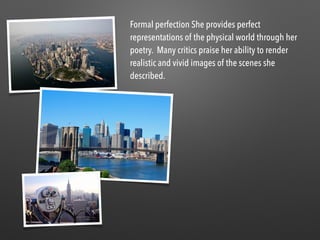
Formal perfection She provides perfect
representations of the physical world through her
poetry.  Many critics praise her ability to render
realistic and vivid images of the scenes she
described. 
Other critics point out the personal and emotional side of Bishop’s
poetry.  They thought her poetry belonged to “confessional poetry” ,
quite popular between early 1940’s and early 1970’s with a particular
focus on personal experiences or emotions. 
Even though the poet stated that her
poetry is outside confessional poetry she
relied on personal experiences as subjects
in much of her poetry as her travel
experiences.
• Three main themes: her unsettled
childhood and relationships with her
family, the loneliness she felt
throughout her life, and an instability
and lack of structure.  She expressed
these themes through submerging her
emotions deep into the terms and
language she uses. 
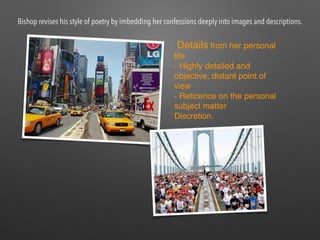
Bishop revises his style of poetry by imbedding her confessions deeply into images and descriptions.
—Details from her personal
life
- Highly detailed and
objective, distant point of
view
- Reticence on the personal
subject matter
Discretion.
Bishop revises his style of poetry by imbedding her confessions deeply into images and descriptions.

Bishop

  • 1.
  • 2.
    • she createda unique blend of precision learned from Marianne Moore and personal revelation she learned from Robert Lowell.  CONTROVERSIAL INTERPRETATIONS These two quite different poets influenced even their critical appraisal
  • 3.
    Formal perfection Sheprovides perfect representations of the physical world through her poetry.  Many critics praise her ability to render realistic and vivid images of the scenes she described. 
  • 4.
    Other critics pointout the personal and emotional side of Bishop’s poetry.  They thought her poetry belonged to “confessional poetry” , quite popular between early 1940’s and early 1970’s with a particular focus on personal experiences or emotions.  Even though the poet stated that her poetry is outside confessional poetry she relied on personal experiences as subjects in much of her poetry as her travel experiences.
  • 5.
    • Three mainthemes: her unsettled childhood and relationships with her family, the loneliness she felt throughout her life, and an instability and lack of structure.  She expressed these themes through submerging her emotions deep into the terms and language she uses.  Bishop revises his style of poetry by imbedding her confessions deeply into images and descriptions.
  • 6.
    —Details from herpersonal life - Highly detailed and objective, distant point of view - Reticence on the personal subject matter Discretion. Bishop revises his style of poetry by imbedding her confessions deeply into images and descriptions.