BIS Scheme-X
Certification forVariable
Frequency Drives (VFDs):
A Guide for Foreign
Manufacturers
U N D E R S TA N D I N G C O M P L I A N C E R E Q U I R E M E N T S
F O R I N T E R N AT I O N A L V F D P R O D U C E R S
Objective and Scope
CertificationPurpose
The presentation guides foreign manufacturers on obtaining BIS Scheme-X
certification for VFDs in India.
Target Audience
International manufacturers, exporters, and compliance officers ensuring
product conformity with Indian standards.
Scope Coverage
Covers certification framework, technical documentation, audit procedures,
and benefits of BIS certification.
Benefits of Certification
Ensures legal market access, enhances credibility, and helps avoid
regulatory penalties in India.
Overview of BISScheme-X
Certification Framework
BIS Scheme-X is a certification framework under BIS Conformity Assessment
Regulations, 2018, aimed at machinery and electrical equipment.
Types of Certification
Scheme-X offers a Licence to use BIS Standard Mark for 3 to 6 years and a
Certificate of Conformity for specific lots or prototypes.
Mandatory Compliance
Effective August 28, 2025, certification is mandatory for VFDs and similar
equipment before sale or distribution in India.
Streamlined Process
Scheme-X replaces fragmented certification regimes providing a
streamlined process aligned with Indian and global standards.
6.
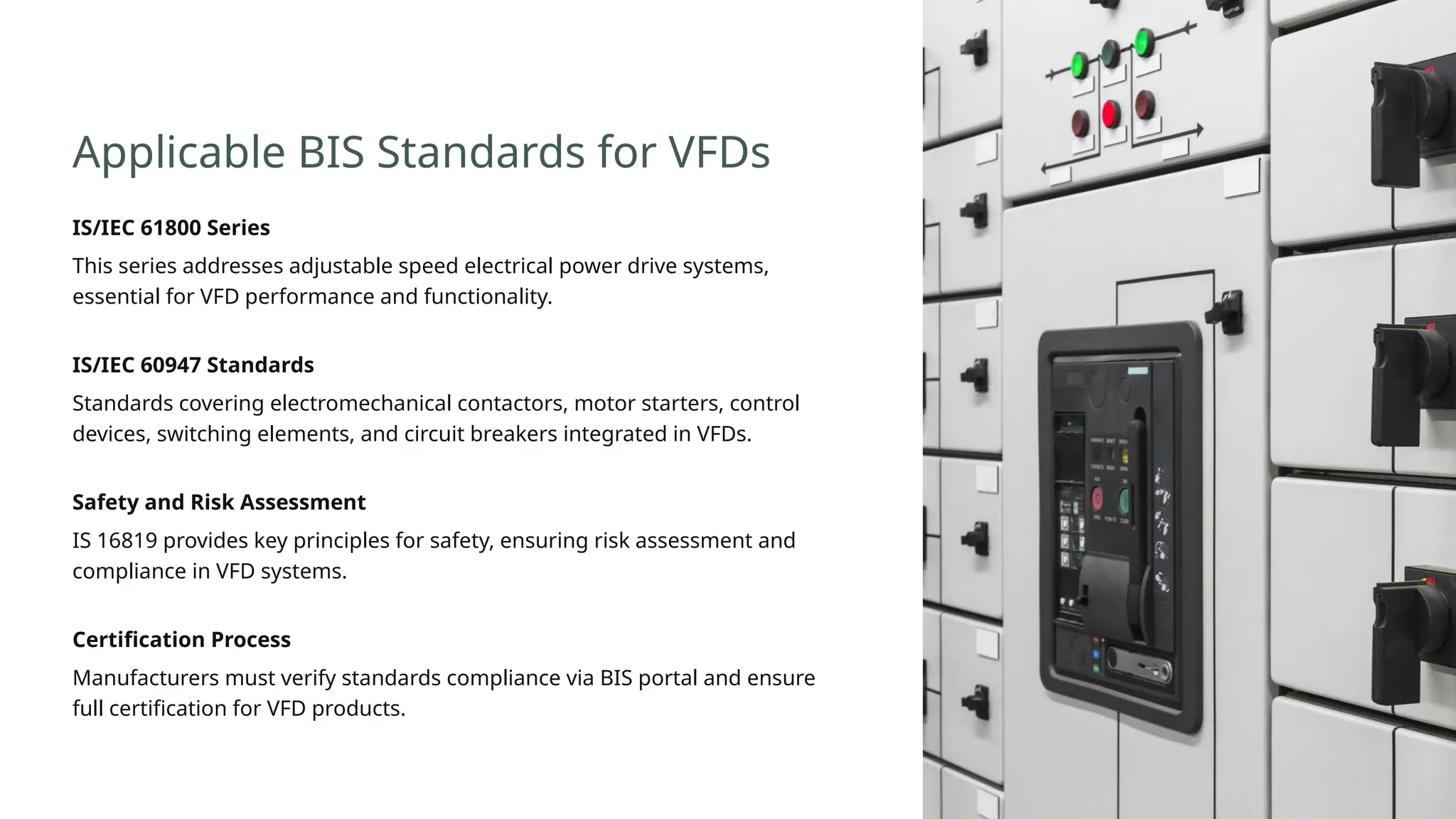
Applicable BIS Standardsfor VFDs
IS/IEC 61800 Series
This series addresses adjustable speed electrical power drive systems,
essential for VFD performance and functionality.
IS/IEC 60947 Standards
Standards covering electromechanical contactors, motor starters, control
devices, switching elements, and circuit breakers integrated in VFDs.
Safety and Risk Assessment
IS 16819 provides key principles for safety, ensuring risk assessment and
compliance in VFD systems.
Certification Process
Manufacturers must verify standards compliance via BIS portal and ensure
full certification for VFD products.
OTR Compliance forForeign
Manufacturers
OTR Safety Compliance
OTR mandates uniform safety compliance for machinery and electrical
equipment including variable frequency drives.
Certification Requirements
Foreign manufacturers must submit a Technical File and Product
Compliance Report under Scheme-X for certification.
Audit Process
Certification involves desk and site audits assessing infrastructure, quality
systems, and documentation alignment.
Legal Market Access
Compliance with OTR ensures legal access to the Indian market and
adherence to stringent safety benchmarks.
9.
Foreign Manufacturers
Certification Scheme
(FMCS)
FMCSCompliance Requirements
Foreign manufacturers must appoint an Authorized
Indian Representative and provide a performance bank
guarantee.
Quality and Testing Standards
Manufacturers must have sufficient in-house testing
facilities and support sample testing and site inspections.
Market Access and Enforcement
Non-compliance with FMCS leads to denial of market
entry and enforcement actions on importers and
distributors.
Step-by-Step Certification Procedure
DocumentSubmission
Manufacturers submit Form-I with Technical File and Product Compliance
Report to initiate certification.
Desk Audit Process
BIS reviews submitted documents and raises queries, which must be
addressed within 15 days.
Site Audit Verification
A BIS team conducts a four-day site audit to verify manufacturing setup and
quality systems.
Certification Granting
Upon successful evaluation, BIS grants Standard Mark License or Certificate
of Conformity (CoC).
Technical File Requirements
ComprehensiveDocumentation
The Technical File must include detailed product descriptions, specifications,
and photographs to meet certification requirements.
Safety and Compliance
Inclusion of safety validations, design drawings, and risk assessments is
essential to demonstrate compliance with standards.
Test Reports and Quality Assurance
Test reports from recognized laboratories and quality assurance procedures
verify product performance and manufacturing processes.
Impact on Certification Outcome
Completeness and accuracy of the Technical File directly influence the
results of desk and site audits during certification.
Compliance Deadlines andBenefits
Certification Deadline
The Omnibus Technical Regulation enforcement date is August 28, 2025,
requiring early certification initiation.
License Validity and Renewal
Scheme-X licenses last 3 to 6 years and can be renewed after re-assessment
to maintain compliance.
Strategic Certification Benefits
BIS certification grants legal market access, boosts credibility, and aligns
products with global safety standards.
Consumer Trust and Market Protection
Certified products earn consumer trust and are protected from
enforcement actions ensuring smooth market entry.
Next Steps forManufacturers
Certification Preparation
Manufacturers must gather technical documents and conduct internal audits
to meet BIS Scheme-X requirements on time.
Authorized Representative Appointment
Appointing an Authorized Indian Representative ensures smooth
communication and compliance with BIS regulations.
Site Audit Readiness
Preparing for site audits by BIS or consultants is essential to demonstrate
manufacturing process compliance.
Stay Updated with BIS
Manufacturers should monitor BIS notifications and certification guideline
amendments to maintain compliance.
#3
This presentation aims to provide a comprehensive guide for foreign manufacturers seeking BIS Scheme-X certification for Variable Frequency Drives (VFDs) intended for the Indian market. The objective is to clarify the certification process, applicable standards, and regulatory requirements under the Omnibus Technical Regulation (OTR). The target audience includes international manufacturers, exporters, and compliance officers responsible for ensuring product conformity with Indian safety and quality standards. The scope of the presentation encompasses the certification framework, technical documentation, audit procedures, and strategic benefits of obtaining BIS certification. By aligning with BIS Scheme-X, foreign manufacturers can ensure legal market access, enhance product credibility, and avoid regulatory penalties.
#4
---
This slide references information from the following file: https://alephindia.in/bis-certification-scheme-x-machinery-and-electrical-equipment.php
Overview of BIS Scheme-X, Applicable BIS Standards for VFDs
#5
---
This slide references information from the following file: https://alephindia.in/bis-certification-scheme-x-machinery-and-electrical-equipment.php
BIS Scheme-X is a product certification framework introduced under the BIS Conformity Assessment Regulations, 2018. It is specifically designed for machinery and electrical equipment covered under the Omnibus Technical Regulation (OTR) 2024. The scheme offers two types of certifications: a Licence to use the BIS Standard Mark, valid for 3 to 6 years, and a Certificate of Conformity (CoC) for specific lots or prototypes. Effective from August 28, 2025, Scheme-X mandates certification for VFDs and similar equipment before they can be sold or distributed in India. The scheme ensures uniform compliance with Indian safety standards and aligns domestic regulations with global benchmarks. It replaces fragmented certification regimes and provides a streamlined process for manufacturers.
#6
---
This slide references information from the following file: https://alephindia.in/bis-certification-scheme-x-machinery-and-electrical-equipment.php
Variable Frequency Drives (VFDs) are subject to several Indian Standards under Scheme-X. These include IS/IEC 61800 series, which specifically address adjustable speed electrical power drive systems. Additionally, IS/IEC 60947-4-1 covers electromechanical contactors and motor starters, while IS/IEC 60947-5-1 pertains to control circuit devices and switching elements. IS/IEC 60947-2 is relevant for circuit breakers if integrated into the VFD system. For safety and risk assessment, IS 16819 provides foundational principles. These standards ensure that VFDs meet essential performance and safety requirements. Manufacturers must verify the applicable standards via the BIS portal and ensure full compliance during the certification process.
#7
---
This slide references information from the following file: https://www.diligencecertification.com/bis-guidelines-for-scheme-x/
OTR Compliance for Foreign Manufacturers, Foreign Manufacturers Certification Scheme (FMCS)
#8
---
This slide references information from the following file: https://www.diligencecertification.com/bis-guidelines-for-scheme-x/
The Omnibus Technical Regulation (OTR) mandates uniform safety compliance for machinery and electrical equipment, including VFDs. Foreign manufacturers must demonstrate conformity to Indian Standards and essential safety requirements. Certification under Scheme-X requires submission of a Technical File and a Product Compliance Report. The Technical File must include product specifications, safety validations, design drawings, and test reports. The certification process involves both desk and site audits conducted by BIS. These audits assess the manufacturer’s infrastructure, quality systems, and alignment with submitted documentation. Compliance with OTR is essential for legal market access and ensures that products meet stringent safety benchmarks.
#9
---
This slide references information from the following file: https://www.diligencecertification.com/bis-guidelines-for-scheme-x/
Foreign manufacturers must comply with the Foreign Manufacturers Certification Scheme (FMCS) to obtain BIS certification under Scheme-X. Key requirements include appointing an Authorized Indian Representative (AIR), submitting a performance bank guarantee, and facilitating sample testing and site inspections. The manufacturer must have adequate in-house manufacturing and testing capabilities. FMCS ensures that foreign entities adhere to Indian regulatory standards and maintain consistent product quality. Without FMCS compliance, products will be denied entry into the Indian market. Importers and distributors must verify that their overseas partners are fully certified to avoid supply chain disruptions and enforcement actions.
#10
---
This slide references information from the following file: https://www.dhruvaadvisors.com/wp-content/uploads/2025/07/OTR-Implementation-Guidelines.pdf
Step-by-Step Certification Procedure
#11
---
This slide references information from the following file: https://www.dhruvaadvisors.com/wp-content/uploads/2025/07/OTR-Implementation-Guidelines.pdf
The BIS Scheme-X certification process involves several key steps. First, the manufacturer submits Form-I along with the Technical File and Product Compliance Report. BIS conducts a desk audit to review the documentation and may raise queries, which must be addressed within 15 days. Next, a site audit is conducted over four man-days by a BIS team to verify the manufacturing setup, safety features, and quality systems. The audit findings are evaluated, and if the product meets all applicable standards, BIS grants either a Licence to use the Standard Mark or a Certificate of Conformity (CoC). This structured process ensures that products conform to Indian safety and performance requirements.
#12
---
This slide references information from the following file: https://www.dhruvaadvisors.com/wp-content/uploads/2025/07/OTR-Implementation-Guidelines.pdf
Technical File Requirements
#13
---
This slide references information from the following file: https://www.dhruvaadvisors.com/wp-content/uploads/2025/07/OTR-Implementation-Guidelines.pdf
The Technical File is a critical component of the BIS Scheme-X certification process. It must include a detailed product description, specifications, and photographs. Safety validations, design drawings, and risk assessments are essential to demonstrate compliance with Indian Standards. Test reports from BIS-recognized laboratories must be included to verify product performance. Additionally, the file should contain information on in-house quality assurance procedures and manufacturing processes. The completeness and accuracy of the Technical File directly impact the outcome of the desk and site audits. Manufacturers must ensure that all documentation aligns with BIS guidelines to facilitate smooth certification.
#14
---
This slide references information from the following file: https://alephindia.in/bis-certification-scheme-x-machinery-and-electrical-equipment.php
Compliance Deadlines and Benefits
#15
---
This slide references information from the following file: https://alephindia.in/bis-certification-scheme-x-machinery-and-electrical-equipment.php
The enforcement date for the Omnibus Technical Regulation (OTR) is August 28, 2025. Manufacturers must initiate the certification process well in advance to meet this deadline. Licences under Scheme-X are valid for 3 to 6 years and can be renewed upon re-assessment. Obtaining BIS certification offers several strategic benefits, including legal access to the Indian market, enhanced product credibility, and alignment with global safety norms. Certified products gain consumer trust and are protected from enforcement actions. Early compliance also ensures uninterrupted market entry and avoids last-minute certification bottlenecks.
#16
---
This slide references information from the following file: https://www.asa.in/wp-content/uploads/2025/04/Bureau-of-Indian-Standards-2025-Final.pdf
Next Steps for Manufacturers
#17
---
This slide references information from the following file: https://www.asa.in/wp-content/uploads/2025/04/Bureau-of-Indian-Standards-2025-Final.pdf
Foreign manufacturers of Variable Frequency Drives (VFDs) must begin preparations for BIS Scheme-X certification immediately. This includes gathering technical documentation, conducting internal audits, and engaging with BIS or authorized consultants. Appointing an Authorized Indian Representative (AIR) and ensuring readiness for site audits are crucial steps. Manufacturers should also stay updated with BIS notifications and amendments to the certification guidelines. By proactively aligning with Scheme-X requirements, manufacturers can secure market access, build brand reputation, and contribute to safer industrial practices in India.