Click on a lesson name to select.
Chapter 17 Organizing Life’s Diversity
Section 1: The History of Classification
Section 2: Modern Classification
Section 3: Domains and Kingdoms
Early Systems of Classification
 Biologists use a
system of
classification to
organize
information about
the diversity of
living things.
17.1 The History of Classification
Organizing Life’s Diversity
Chapter 17
Organizing Life’s Diversity
Chapter 17
Aristotle’s System
 More than 2000 years ago, Aristotle developed
the first widely accepted system of biological
classification.
Organizing Life’s Diversity
 Aristotle classified organisms as either animals
or plants.
17.1 The History of Classification
Chapter 17
Organizing Life’s Diversity
 Animals were classified according to the
presence or absence of “red blood.”
 Animals were further grouped according to
their habitats and morphology.
 Plants were classified by average size and
structure as trees, shrubs, or herbs.
17.1 The History of Classification
Chapter 17
Linnaeus’s System
Organizing Life’s Diversity
 Linnaeus’s system of classification was the
first formal system of taxonomy.
Bird of prey Wading bird
Perching bird
17.1 The History of Classification
Chapter 17
Binomial Nomenclature
Organizing Life’s Diversity
 Linnaeus’s method of naming organisms,
called binomial nomenclature, gives each
species a scientific name with two parts.
 The first part is the genus name, and the
second part is the specific epithet, or specific
name, that identifies the species.
17.1 The History of Classification
Chapter 17
 Biologists use
scientific names for
species because
common names
vary in their use.
Organizing Life’s Diversity
Ursus americanus
American black bear
17.1 The History of Classification
Chapter 17
 When writing a scientific name, scientists use these rules:
Organizing Life’s Diversity
 The first letter of the genus name always is
capitalized, but the rest of the genus name and all
letters of the specific epithet are lowercase.
 If a scientific name is written in a printed book or
magazine, it should be italicized.
 When a scientific name is written by hand, both parts
of the name should be underlined.
 After the scientific name has been written completely,
the genus name will be abbreviated to the first letter
in later appearances (e.g., C. cardinalis).
17.1 The History of Classification
Chapter 17
Taxonomic Categories
Organizing Life’s Diversity
 The taxonomic categories
used by scientists are part
of a nested-hierarchal
system.
 Each category is
contained within
another, and they
are arranged from broadest to most specific.
17.1 The History of Classification
Chapter 17
Species and Genus
Organizing Life’s Diversity
 A named group of organisms is called a taxa.
 A genus (plural, genera) is a group of species
that are closely related and share a common
ancestor.
17.1 The History of Classification
Chapter 17
 A family is the next higher taxon, consisting
of similar, related genera.
Family
Organizing Life’s Diversity
17.1 The History of Classification
Chapter 17
Higher Taxa
Organizing Life’s Diversity
 An order contains related families.
 A class contains related orders.
 A phylum or division contains related classes.
 The taxon of related phyla or divisions is a
kingdom.
 The domain is the broadest of all the taxa and
contains one or more kingdoms.
17.1 The History of Classification
Chapter 17
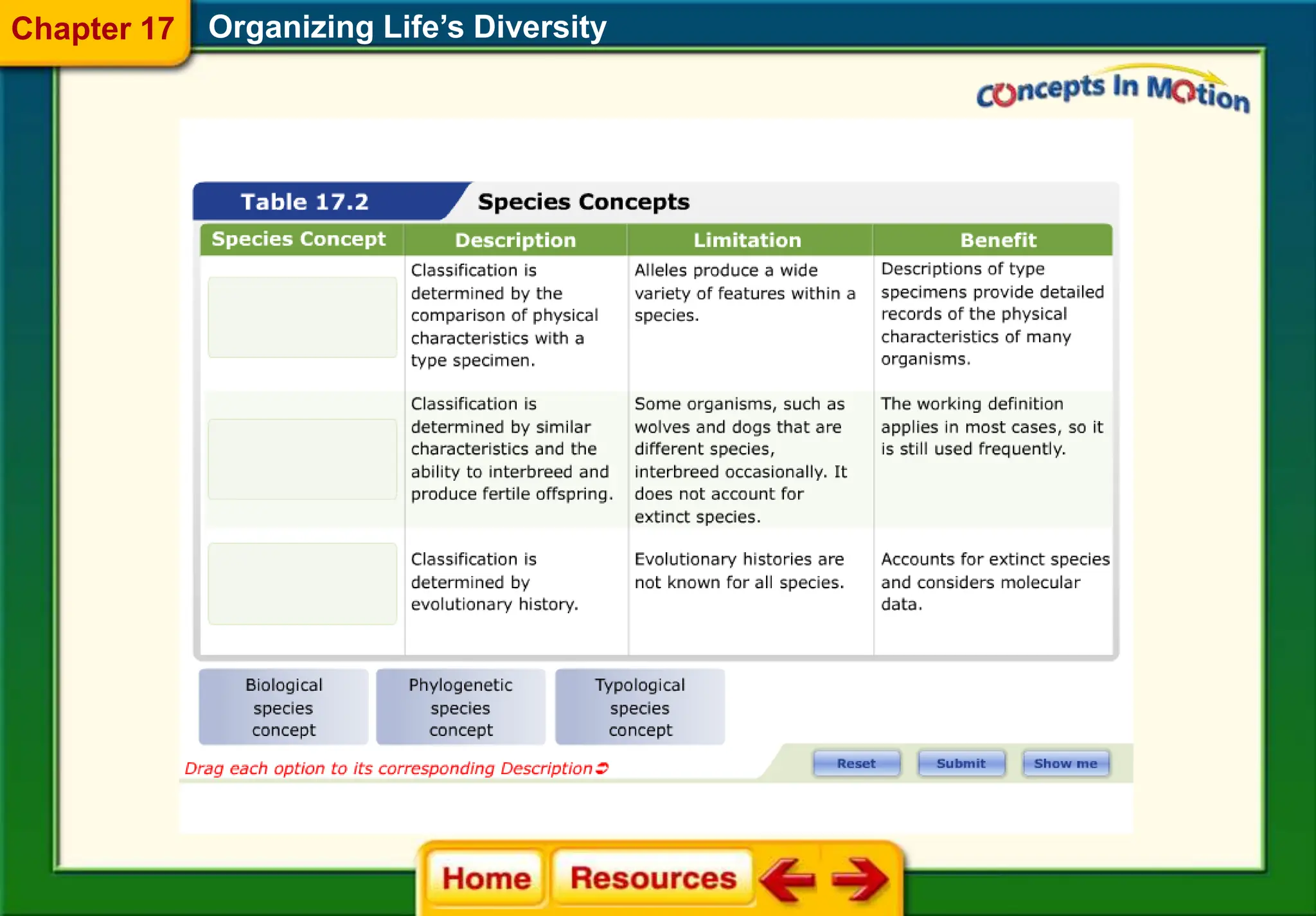
Typological Species Concept
17.2 Modern Classification
Organizing Life’s Diversity
 Aristotle and Linnaeus thought of each species
as a distinctly different group of organisms
based on physical similarities.
 Based on the idea that species are unchanging,
distinct, and natural types.
Chapter 17
Biological Species Concept
Organizing Life’s Diversity
 The biological species concept defines a
species as a group of organisms that is able
to interbreed and produce fertile offspring in
a natural setting.
17.2 Modern Classification
Chapter 17
Phylogenic Species Concept
Organizing Life’s Diversity
 Phylogeny is the evolutionary history of a
species.
 The phylogenic species concept defines a
species as a cluster of organisms that is distinct
from other clusters and shows evidence of a
pattern of ancestry and descent.
17.2 Modern Classification
Chapter 17
Organizing Life’s Diversity
17.2 Modern Classification
Chapter 17
Organizing Life’s Diversity
Chapter 17
Characters
 To classify a species, scientists construct
patterns of descent by using characters.
Organizing Life’s Diversity
 Characters can be morphological or
biochemical.
17.2 Modern Classification
Chapter 17
Morphological Characters
 Shared morphological characters suggest that
species are related closely and evolved from a
recent common ancestor.
Organizing Life’s Diversity
 Analogous characters are those that have
the same function but different underlying
construction.
 Homologous characters might perform different
functions, but show an anatomical similarity
inherited from a common ancestor.
17.2 Modern Classification
Chapter 17
Birds and Dinosaurs
Organizing Life’s Diversity
 Compare birds and dinosaurs:
 Hollow bones
 Theropods have leg,
wrist, hip, and shoulder
structures similar to birds.
 Some theropods may
have had feathers.
Haliaeetus leucocephalus
Oviraptor philoceratops
17.2 Modern Classification
Chapter 17
Biochemical Characters
Organizing Life’s Diversity
 Scientists use biochemical characters, such
as amino acids and nucleotides, to help them
determine evolutionary relationships among
species.
 DNA and RNA analyses are powerful tools for
reconstructing phylogenies.
17.2 Modern Classification
Chapter 17
Organizing Life’s Diversity
 The similar appearance of chromosomes among
chimpanzees,
gorillas, and
orangutans
suggests a
shared
ancestry.
17.2 Modern Classification
Chapter 17
Molecular Clocks
Organizing Life’s Diversity
 Scientists use molecular
clocks to compare the DNA
sequences or amino acid
sequences of genes that
are shared by different
species.
17.2 Modern Classification
Chapter 17
Organizing Life’s Diversity
 The differences between
the genes indicate the
presence of mutations.
 The more mutations that
have accumulated, the
more time that has
passed since divergence.
17.2 Modern Classification
Chapter 17
The Rate of Mutation is Affected
Organizing Life’s Diversity
17.2 Modern Classification
 Type of mutation
 Where the mutation is in the genome
 Type of protein that the mutation affects
 Population in which the mutation occurs
Chapter 17
Phylogenetic Reconstruction
Organizing Life’s Diversity
 Cladistics reconstructs phylogenies based on
shared characters.
 Scientists consider two main types of characters
when doing cladistic analysis.
 An ancestral character is found within the entire
line of descent of a group of organisms.
 Derived characters are present members of one
group of the line but not in the common ancestor.
17.2 Modern Classification
Chapter 17
Organizing Life’s Diversity
Chapter 17
Cladograms
Organizing Life’s Diversity
 The greater the
number of derived
characters shared
by groups, the more
recently the groups
share a common
ancestor.
17.2 Modern Classification
Chapter 17
Organizing Life’s Diversity
Chapter 17
Organizing Life’s Diversity
Chapter 17
Grouping Species
 The broadest category in the classification used
by most biologists is the domain.
17.3 Domains and Kingdoms
Organizing Life’s Diversity
 The most widely used biological classification
system has six kingdoms and three domains.
 The three domains are Bacteria, Archaea, and
Eukarya.
 The six kingdoms are Bacteria, Archaea, Protists,
Fungi, Plantae, and Animalia.
Chapter 17
Domain Bacteria
 Eubacteria are prokaryotes
whose cell walls contain
peptidoglycan.
Organizing Life’s Diversity
 Eubacteria are a diverse
group that can survive in
many different environments.
17.3 Domains and Kingdoms
Classifying Using
Biotechnology
Chapter 17
Domain Archaea
 Archaea are thought to be more ancient than
bacteria and yet more closely related to our
eukaryote ancestors.
Organizing Life’s Diversity
 Archaea are diverse in shape and nutrition
requirements.
 They are called extremophiles because they
can live in extreme environments.
17.3 Domains and Kingdoms
Chapter 17
Domain Eukarya
 All eukaryotes are classified in Domain
Eukarya.
Organizing Life’s Diversity
 Domain Eukarya contains Kingdom Protista,
Kingdom Fungi, Kingdom Plantae, and
Kingdom Animalia.
17.3 Domains and Kingdoms
Chapter 17
Kingdom Protista
Organizing Life’s Diversity
 Protists are
classified into three
different groups—
plantlike, animal-
like, and funguslike.
 Protists are eukaryotic organisms that can be
unicellular, colonial,
or multicellular.
17.3 Domains and Kingdoms
Chapter 17
Kingdom Fungi
Organizing Life’s Diversity
 A fungus is a unicellular or multicellular
eukaryote that absorbs
nutrients from organic
materials in its
environment.
 Member of Kingdom
Fungi are
heterotrophic, lack motility, and have cell walls.
17.3 Domains and Kingdoms
Chapter 17
Kingdom Plantae
 Members of Kingdom Plantae form the base
of all terrestrial habitats.
Organizing Life’s Diversity
 All plants are
multicellular and have
cell walls composed of
cellulose.
 Most plants are
autotrophs, but some are heterotrophic.
17.3 Domains and Kingdoms
Chapter 17
Kingdom Animalia
 All animals are heterotrophic, multicellular
eukaryotes.
Organizing Life’s Diversity
 Animal organs often are
organized into complex
organ systems.
 They live in the water,
on land, and in the air.
17.3 Domains and Kingdoms
Chapter 17
Organizing Life’s Diversity
17.3 Domains and Kingdoms
Chapter 17
Organizing Life’s Diversity
Chapter 17
Viruses—An Exception
 A virus is a nucleic acid surrounded by a
protein coat.
Organizing Life’s Diversity
 Viruses do not possess cells, nor are they
cells, and are not considered to be living.
 Because they are nonliving, they usually
are not placed in the biological classification
system.
17.3 Domains and Kingdoms
Chapter 17
Chapter Resource Menu
Chapter Diagnostic Questions
Formative Test Questions
Chapter Assessment Questions
Standardized Test Practice
biologygmh.com
Glencoe Biology Transparencies
Image Bank
Vocabulary
Animation
Click on a hyperlink to view the corresponding feature.
Organizing Life’s Diversity
Chapter 17
1. A
2. B
3. C
4. D
A
B
C
D
0% 0%
0%
0%
On what characteristics did Linnaeus base
his system of classification?
A. red blood and bloodless
B. evolutionary history
C. behavior and habitat
D. body structure
Organizing Life’s Diversity
Chapter 17
Chapter Diagnostic
Questions
1. A
2. B
3. C
4. D
A
B
C
D
0% 0%
0%
0%
Organizing Life’s Diversity
Chapter 17
Chapter Diagnostic
Questions
What is the term for a named group of
organisms?
A. genus
B. family
C. phylum
D. taxon
1. A
2. B
3. C
4. D
A
B
C
D
0% 0%
0%
0%
Organizing Life’s Diversity
Chapter 17
Chapter Diagnostic
Questions
Determine which scientific specialist studies
classifications and identifies new species.
A. ecologist
B. evolutionary geneticist
C. systematist
D. biologist
1. A
2. B
3. C
4. D
A
B
C
D
0% 0%
0%
0%
Organizing Life’s Diversity
Chapter 17
Which was the first formal system of
organizing organisms according to a set
of criteria?
A. classification
B. nomenclature
C. systematics
D. taxonomy
17.1 Formative
Questions
1. A
2. B
3. C
4. D
A
B
C
D
0% 0%
0%
0%
Organizing Life’s Diversity
Chapter 17
17.1 Formative
Questions
Which was a limitation of Linnaeus’ system
of classification?
A. It did not include
evolutionary relationships.
B. It did not use binomial
nomenclature to
name organisms.
C. It identified and classified
species based on
natural relationships.
D. It was based on morphology
and behavior of organisms.
1. A
2. B
3. C
4. D
A
B
C
D
0% 0%
0%
0%
Organizing Life’s Diversity
Chapter 17
17.1 Formative
Questions
Which of these is the highest level of
classification?
A. class
B. family
C. order
D. phylum
1. A
2. B
3. C
4. D
A
B
C
D
0% 0%
0%
0%
Organizing Life’s Diversity
Chapter 17
17.1 Formative
Questions
Which branch of biology combines taxonomy
with paleontology, molecular biology and
comparative anatomy?
A. biotechnology
B. evolution
C. morphology
D. systematics
1. A
2. B
3. C
4. D
A
B
C
D
0% 0%
0%
0%
Organizing Life’s Diversity
Chapter 17
Llamas and Alpacas are classified as different species,
yet they can interbreed and produce fertile offspring.
For which species concept does this represent a
limitation?
A. biological species concept
B. genetic species concept
C. phylogenic species concept
D. taxonomic species concept
17.2 Formative
Questions
1. A
2. B
3. C
4. D
A
B
C
D
0% 0%
0%
0%
Organizing Life’s Diversity
Chapter 17
17.2 Formative
Questions
Which species concept defines a species in
terms of patterns of ancestry and descent?
A. ancestral
species concept
B. evolutionary
species concept
C. phylogenic
species concept
D. typological
species concept
1. A
2. B
3. C
4. D
A
B
C
D
0% 0%
0%
0%
Organizing Life’s Diversity
Chapter 17
17.2 Formative
Questions
Which inherited features are not used
by scientists to construct patterns of
evolutionary descent?
A. analogous characters
B. biochemical characters
C. homologous characters
D. morphological characters
1. A
2. B
3. C
4. D
A
B
C
D
0% 0%
0%
0%
Organizing Life’s Diversity
Chapter 17
17.2 Formative
Questions
A. Creating a comprehensive
molecular clock.
B. Constructing a
comprehensive tree of life.
C. Developing a dichotomous
all known species.
D. Properly naming all known
organisms.
Which task will require collaboration among
systematists, molecular biologists, earth scientists and
computer scientists?
1. A
2. B
3. C
4. D
A
B
C
D
0% 0%
0%
0%
Organizing Life’s Diversity
Chapter 17
The five-kingdom classification system had to
be changed to a three-domain, six-kingdom
system because of the discovery of _______.
A. fungi
B. protists
C. archaebacteria
D. prokaryotes
17.3 Formative
Questions
1. A
2. B
3. C
4. D
A
B
C
D
0% 0%
0%
0%
Organizing Life’s Diversity
Chapter 17
17.3 Formative
Questions
Which is a characteristic of the species
classified in Domain Archaea?
A. They are anaerobic.
B. They are autotrophic.
C. They are extremophiles.
D. Their cell walls
contain peptidoglycan.
1. A
2. B
3. C
4. D
A
B
C
D
0% 0%
0%
0%
Organizing Life’s Diversity
Chapter 17
17.3 Formative
Questions
Which kingdom contains heterotrophic,
multicellular eukaryotes?
A. Animalia
B. Fungi
C. Plantae
D. Protista
1. A
2. B
3. C
4. D
A
B
C
D
0% 0%
0%
0%
Organizing Life’s Diversity
Chapter 17
17.3 Formative
Questions
Which cell wall material distinguishes all
of the organisms in Kingdom Plantae?
A. cellulose
B. chitin
C. hyphae
D. peptidoglycan
1. A
2. B
3. C
4. D
A
B
C
D
0% 0%
0%
0%
Organizing Life’s Diversity
Chapter 17
17.3 Formative
Questions
Which group of dissimilar organisms were
placed into the same kingdom partly because
they don’t fit into any other kingdoms?
A. eubacteria
B. eukaryotes
C. fungi
D. protists
1. A
2. B
3. C
4. D
A
B
C
D
0% 0%
0%
0%
Organizing Life’s Diversity
Chapter 17
What does this image represent?
A. phylogeny of species
B. molecular clock
C. cladogram
D. tree of life
Chapter Assessment
Questions
1. A
2. B
3. C
4. D
A
B
C
D
0% 0%
0%
0%
Organizing Life’s Diversity
Chapter 17
Chapter Assessment
Questions
What do the colored bands in the
figure represent?
A. mutations
B. molecular clock
C. time
D. gene
1. A
2. B
3. C
4. D
A
B
C
D
0% 0%
0%
0%
Organizing Life’s Diversity
Chapter 17
Chapter Assessment
Questions
Which is not one of the three domains?
A. Archaea
B. Bacteria
C. Eukarya
D. Fungi
1. A
2. B
3. C
4. D
A
B
C
D
0% 0%
0%
0%
Organizing Life’s Diversity
Chapter 17
For which organism would it be best for
scientists to use the scientific name rather
than the common name?
A. great blue heron
B. bottlenose dolphin
C. sea horse
D. whitetail deer
Standardized Test
Practice
1. A
2. B
3. C
A
B
C
0% 0%
0%
Organizing Life’s Diversity
Chapter 17
Standardized Test
Practice
Which pair of organisms is more closely
related?
A. 1 and 2
B. 2 and 3
C. 1 and 3
1. Quercus alba
2. Cornus alba
3. Quercus rubra
1. A
2. B
3. C
4. D
A
B
C
D
0% 0%
0%
0%
Organizing Life’s Diversity
Chapter 17
Standardized Test
Practice
How do systematists use this model
to determine the degree of relationship
among species?
A. It shows the chromosomal
structure of different species.
B. It shows the genetic makeup
of a common ancestor.
C. It shows the rate of mutation
for different species.
D. It shows the relative time of
divergence of a species.
1. A
2. B
3. C
4. D
A
B
C
D
0% 0%
0%
0%
Organizing Life’s Diversity
Chapter 17
Standardized Test
Practice
Which two groups share the most derived
characters?
A. sponges and
cnidarians
B. arthropods
and echinoderms
C. arthropods
and chordates
D. echinoderms
and chordates
1. A
2. B
3. C
4. D
A
B
C
D
0% 0%
0%
0%
Organizing Life’s Diversity
Chapter 17
Standardized Test
Practice
Why aren’t mushrooms classified as plants?
A. They are heterotrophs.
B. They don’t have
cell walls.
C. They don’t absorb
nutrients from their
environment.
D. They lack motility—
the ability to move.
Organizing Life’s Diversity
Glencoe Biology Transparencies
Chapter 17
Organizing Life’s Diversity
Image Bank
Chapter 17
classification
taxonomy
binomial
nomenclature
taxon
genus
family
order
class
phylum
division
kingdom
domain
Organizing Life’s Diversity
Vocabulary
Section 1
Chapter 17
phylogeny
character
molecular clock
cladistics
cladogram
Organizing Life’s Diversity
Vocabulary
Section 2
Chapter 17
eubacteria
Archaea
protist
fungus
Organizing Life’s Diversity
Vocabulary
Section 3
Chapter 17
Organizing Life’s Diversity
Animation
 The Cladistic Model
 Evolutionary Trees
 Visualizing the Tree of Life
Chapter 17
Organizing Life’s Diversity
Chapter 17
Organizing Life’s Diversity
Chapter 17
Organizing Life’s Diversity
Chapter 17

Biology Ch. 17.ppt. Materi pokok, bahan pembelajaran

  • 2.
    Click on alesson name to select. Chapter 17 Organizing Life’s Diversity Section 1: The History of Classification Section 2: Modern Classification Section 3: Domains and Kingdoms
  • 3.
    Early Systems ofClassification  Biologists use a system of classification to organize information about the diversity of living things. 17.1 The History of Classification Organizing Life’s Diversity Chapter 17
  • 4.
  • 5.
    Aristotle’s System  Morethan 2000 years ago, Aristotle developed the first widely accepted system of biological classification. Organizing Life’s Diversity  Aristotle classified organisms as either animals or plants. 17.1 The History of Classification Chapter 17
  • 6.
    Organizing Life’s Diversity Animals were classified according to the presence or absence of “red blood.”  Animals were further grouped according to their habitats and morphology.  Plants were classified by average size and structure as trees, shrubs, or herbs. 17.1 The History of Classification Chapter 17
  • 7.
    Linnaeus’s System Organizing Life’sDiversity  Linnaeus’s system of classification was the first formal system of taxonomy. Bird of prey Wading bird Perching bird 17.1 The History of Classification Chapter 17
  • 8.
    Binomial Nomenclature Organizing Life’sDiversity  Linnaeus’s method of naming organisms, called binomial nomenclature, gives each species a scientific name with two parts.  The first part is the genus name, and the second part is the specific epithet, or specific name, that identifies the species. 17.1 The History of Classification Chapter 17
  • 9.
     Biologists use scientificnames for species because common names vary in their use. Organizing Life’s Diversity Ursus americanus American black bear 17.1 The History of Classification Chapter 17
  • 10.
     When writinga scientific name, scientists use these rules: Organizing Life’s Diversity  The first letter of the genus name always is capitalized, but the rest of the genus name and all letters of the specific epithet are lowercase.  If a scientific name is written in a printed book or magazine, it should be italicized.  When a scientific name is written by hand, both parts of the name should be underlined.  After the scientific name has been written completely, the genus name will be abbreviated to the first letter in later appearances (e.g., C. cardinalis). 17.1 The History of Classification Chapter 17
  • 11.
    Taxonomic Categories Organizing Life’sDiversity  The taxonomic categories used by scientists are part of a nested-hierarchal system.  Each category is contained within another, and they are arranged from broadest to most specific. 17.1 The History of Classification Chapter 17
  • 12.
    Species and Genus OrganizingLife’s Diversity  A named group of organisms is called a taxa.  A genus (plural, genera) is a group of species that are closely related and share a common ancestor. 17.1 The History of Classification Chapter 17
  • 13.
     A familyis the next higher taxon, consisting of similar, related genera. Family Organizing Life’s Diversity 17.1 The History of Classification Chapter 17
  • 14.
    Higher Taxa Organizing Life’sDiversity  An order contains related families.  A class contains related orders.  A phylum or division contains related classes.  The taxon of related phyla or divisions is a kingdom.  The domain is the broadest of all the taxa and contains one or more kingdoms. 17.1 The History of Classification Chapter 17
  • 15.
    Typological Species Concept 17.2Modern Classification Organizing Life’s Diversity  Aristotle and Linnaeus thought of each species as a distinctly different group of organisms based on physical similarities.  Based on the idea that species are unchanging, distinct, and natural types. Chapter 17
  • 16.
    Biological Species Concept OrganizingLife’s Diversity  The biological species concept defines a species as a group of organisms that is able to interbreed and produce fertile offspring in a natural setting. 17.2 Modern Classification Chapter 17
  • 17.
    Phylogenic Species Concept OrganizingLife’s Diversity  Phylogeny is the evolutionary history of a species.  The phylogenic species concept defines a species as a cluster of organisms that is distinct from other clusters and shows evidence of a pattern of ancestry and descent. 17.2 Modern Classification Chapter 17
  • 18.
    Organizing Life’s Diversity 17.2Modern Classification Chapter 17
  • 19.
  • 20.
    Characters  To classifya species, scientists construct patterns of descent by using characters. Organizing Life’s Diversity  Characters can be morphological or biochemical. 17.2 Modern Classification Chapter 17
  • 21.
    Morphological Characters  Sharedmorphological characters suggest that species are related closely and evolved from a recent common ancestor. Organizing Life’s Diversity  Analogous characters are those that have the same function but different underlying construction.  Homologous characters might perform different functions, but show an anatomical similarity inherited from a common ancestor. 17.2 Modern Classification Chapter 17
  • 22.
    Birds and Dinosaurs OrganizingLife’s Diversity  Compare birds and dinosaurs:  Hollow bones  Theropods have leg, wrist, hip, and shoulder structures similar to birds.  Some theropods may have had feathers. Haliaeetus leucocephalus Oviraptor philoceratops 17.2 Modern Classification Chapter 17
  • 23.
    Biochemical Characters Organizing Life’sDiversity  Scientists use biochemical characters, such as amino acids and nucleotides, to help them determine evolutionary relationships among species.  DNA and RNA analyses are powerful tools for reconstructing phylogenies. 17.2 Modern Classification Chapter 17
  • 24.
    Organizing Life’s Diversity The similar appearance of chromosomes among chimpanzees, gorillas, and orangutans suggests a shared ancestry. 17.2 Modern Classification Chapter 17
  • 25.
    Molecular Clocks Organizing Life’sDiversity  Scientists use molecular clocks to compare the DNA sequences or amino acid sequences of genes that are shared by different species. 17.2 Modern Classification Chapter 17
  • 26.
    Organizing Life’s Diversity The differences between the genes indicate the presence of mutations.  The more mutations that have accumulated, the more time that has passed since divergence. 17.2 Modern Classification Chapter 17
  • 27.
    The Rate ofMutation is Affected Organizing Life’s Diversity 17.2 Modern Classification  Type of mutation  Where the mutation is in the genome  Type of protein that the mutation affects  Population in which the mutation occurs Chapter 17
  • 28.
    Phylogenetic Reconstruction Organizing Life’sDiversity  Cladistics reconstructs phylogenies based on shared characters.  Scientists consider two main types of characters when doing cladistic analysis.  An ancestral character is found within the entire line of descent of a group of organisms.  Derived characters are present members of one group of the line but not in the common ancestor. 17.2 Modern Classification Chapter 17
  • 29.
  • 30.
    Cladograms Organizing Life’s Diversity The greater the number of derived characters shared by groups, the more recently the groups share a common ancestor. 17.2 Modern Classification Chapter 17
  • 31.
  • 32.
  • 33.
    Grouping Species  Thebroadest category in the classification used by most biologists is the domain. 17.3 Domains and Kingdoms Organizing Life’s Diversity  The most widely used biological classification system has six kingdoms and three domains.  The three domains are Bacteria, Archaea, and Eukarya.  The six kingdoms are Bacteria, Archaea, Protists, Fungi, Plantae, and Animalia. Chapter 17
  • 34.
    Domain Bacteria  Eubacteriaare prokaryotes whose cell walls contain peptidoglycan. Organizing Life’s Diversity  Eubacteria are a diverse group that can survive in many different environments. 17.3 Domains and Kingdoms Classifying Using Biotechnology Chapter 17
  • 35.
    Domain Archaea  Archaeaare thought to be more ancient than bacteria and yet more closely related to our eukaryote ancestors. Organizing Life’s Diversity  Archaea are diverse in shape and nutrition requirements.  They are called extremophiles because they can live in extreme environments. 17.3 Domains and Kingdoms Chapter 17
  • 36.
    Domain Eukarya  Alleukaryotes are classified in Domain Eukarya. Organizing Life’s Diversity  Domain Eukarya contains Kingdom Protista, Kingdom Fungi, Kingdom Plantae, and Kingdom Animalia. 17.3 Domains and Kingdoms Chapter 17
  • 37.
    Kingdom Protista Organizing Life’sDiversity  Protists are classified into three different groups— plantlike, animal- like, and funguslike.  Protists are eukaryotic organisms that can be unicellular, colonial, or multicellular. 17.3 Domains and Kingdoms Chapter 17
  • 38.
    Kingdom Fungi Organizing Life’sDiversity  A fungus is a unicellular or multicellular eukaryote that absorbs nutrients from organic materials in its environment.  Member of Kingdom Fungi are heterotrophic, lack motility, and have cell walls. 17.3 Domains and Kingdoms Chapter 17
  • 39.
    Kingdom Plantae  Membersof Kingdom Plantae form the base of all terrestrial habitats. Organizing Life’s Diversity  All plants are multicellular and have cell walls composed of cellulose.  Most plants are autotrophs, but some are heterotrophic. 17.3 Domains and Kingdoms Chapter 17
  • 40.
    Kingdom Animalia  Allanimals are heterotrophic, multicellular eukaryotes. Organizing Life’s Diversity  Animal organs often are organized into complex organ systems.  They live in the water, on land, and in the air. 17.3 Domains and Kingdoms Chapter 17
  • 41.
    Organizing Life’s Diversity 17.3Domains and Kingdoms Chapter 17
  • 42.
  • 43.
    Viruses—An Exception  Avirus is a nucleic acid surrounded by a protein coat. Organizing Life’s Diversity  Viruses do not possess cells, nor are they cells, and are not considered to be living.  Because they are nonliving, they usually are not placed in the biological classification system. 17.3 Domains and Kingdoms Chapter 17
  • 44.
    Chapter Resource Menu ChapterDiagnostic Questions Formative Test Questions Chapter Assessment Questions Standardized Test Practice biologygmh.com Glencoe Biology Transparencies Image Bank Vocabulary Animation Click on a hyperlink to view the corresponding feature. Organizing Life’s Diversity Chapter 17
  • 45.
    1. A 2. B 3.C 4. D A B C D 0% 0% 0% 0% On what characteristics did Linnaeus base his system of classification? A. red blood and bloodless B. evolutionary history C. behavior and habitat D. body structure Organizing Life’s Diversity Chapter 17 Chapter Diagnostic Questions
  • 46.
    1. A 2. B 3.C 4. D A B C D 0% 0% 0% 0% Organizing Life’s Diversity Chapter 17 Chapter Diagnostic Questions What is the term for a named group of organisms? A. genus B. family C. phylum D. taxon
  • 47.
    1. A 2. B 3.C 4. D A B C D 0% 0% 0% 0% Organizing Life’s Diversity Chapter 17 Chapter Diagnostic Questions Determine which scientific specialist studies classifications and identifies new species. A. ecologist B. evolutionary geneticist C. systematist D. biologist
  • 48.
    1. A 2. B 3.C 4. D A B C D 0% 0% 0% 0% Organizing Life’s Diversity Chapter 17 Which was the first formal system of organizing organisms according to a set of criteria? A. classification B. nomenclature C. systematics D. taxonomy 17.1 Formative Questions
  • 49.
    1. A 2. B 3.C 4. D A B C D 0% 0% 0% 0% Organizing Life’s Diversity Chapter 17 17.1 Formative Questions Which was a limitation of Linnaeus’ system of classification? A. It did not include evolutionary relationships. B. It did not use binomial nomenclature to name organisms. C. It identified and classified species based on natural relationships. D. It was based on morphology and behavior of organisms.
  • 50.
    1. A 2. B 3.C 4. D A B C D 0% 0% 0% 0% Organizing Life’s Diversity Chapter 17 17.1 Formative Questions Which of these is the highest level of classification? A. class B. family C. order D. phylum
  • 51.
    1. A 2. B 3.C 4. D A B C D 0% 0% 0% 0% Organizing Life’s Diversity Chapter 17 17.1 Formative Questions Which branch of biology combines taxonomy with paleontology, molecular biology and comparative anatomy? A. biotechnology B. evolution C. morphology D. systematics
  • 52.
    1. A 2. B 3.C 4. D A B C D 0% 0% 0% 0% Organizing Life’s Diversity Chapter 17 Llamas and Alpacas are classified as different species, yet they can interbreed and produce fertile offspring. For which species concept does this represent a limitation? A. biological species concept B. genetic species concept C. phylogenic species concept D. taxonomic species concept 17.2 Formative Questions
  • 53.
    1. A 2. B 3.C 4. D A B C D 0% 0% 0% 0% Organizing Life’s Diversity Chapter 17 17.2 Formative Questions Which species concept defines a species in terms of patterns of ancestry and descent? A. ancestral species concept B. evolutionary species concept C. phylogenic species concept D. typological species concept
  • 54.
    1. A 2. B 3.C 4. D A B C D 0% 0% 0% 0% Organizing Life’s Diversity Chapter 17 17.2 Formative Questions Which inherited features are not used by scientists to construct patterns of evolutionary descent? A. analogous characters B. biochemical characters C. homologous characters D. morphological characters
  • 55.
    1. A 2. B 3.C 4. D A B C D 0% 0% 0% 0% Organizing Life’s Diversity Chapter 17 17.2 Formative Questions A. Creating a comprehensive molecular clock. B. Constructing a comprehensive tree of life. C. Developing a dichotomous all known species. D. Properly naming all known organisms. Which task will require collaboration among systematists, molecular biologists, earth scientists and computer scientists?
  • 56.
    1. A 2. B 3.C 4. D A B C D 0% 0% 0% 0% Organizing Life’s Diversity Chapter 17 The five-kingdom classification system had to be changed to a three-domain, six-kingdom system because of the discovery of _______. A. fungi B. protists C. archaebacteria D. prokaryotes 17.3 Formative Questions
  • 57.
    1. A 2. B 3.C 4. D A B C D 0% 0% 0% 0% Organizing Life’s Diversity Chapter 17 17.3 Formative Questions Which is a characteristic of the species classified in Domain Archaea? A. They are anaerobic. B. They are autotrophic. C. They are extremophiles. D. Their cell walls contain peptidoglycan.
  • 58.
    1. A 2. B 3.C 4. D A B C D 0% 0% 0% 0% Organizing Life’s Diversity Chapter 17 17.3 Formative Questions Which kingdom contains heterotrophic, multicellular eukaryotes? A. Animalia B. Fungi C. Plantae D. Protista
  • 59.
    1. A 2. B 3.C 4. D A B C D 0% 0% 0% 0% Organizing Life’s Diversity Chapter 17 17.3 Formative Questions Which cell wall material distinguishes all of the organisms in Kingdom Plantae? A. cellulose B. chitin C. hyphae D. peptidoglycan
  • 60.
    1. A 2. B 3.C 4. D A B C D 0% 0% 0% 0% Organizing Life’s Diversity Chapter 17 17.3 Formative Questions Which group of dissimilar organisms were placed into the same kingdom partly because they don’t fit into any other kingdoms? A. eubacteria B. eukaryotes C. fungi D. protists
  • 61.
    1. A 2. B 3.C 4. D A B C D 0% 0% 0% 0% Organizing Life’s Diversity Chapter 17 What does this image represent? A. phylogeny of species B. molecular clock C. cladogram D. tree of life Chapter Assessment Questions
  • 62.
    1. A 2. B 3.C 4. D A B C D 0% 0% 0% 0% Organizing Life’s Diversity Chapter 17 Chapter Assessment Questions What do the colored bands in the figure represent? A. mutations B. molecular clock C. time D. gene
  • 63.
    1. A 2. B 3.C 4. D A B C D 0% 0% 0% 0% Organizing Life’s Diversity Chapter 17 Chapter Assessment Questions Which is not one of the three domains? A. Archaea B. Bacteria C. Eukarya D. Fungi
  • 64.
    1. A 2. B 3.C 4. D A B C D 0% 0% 0% 0% Organizing Life’s Diversity Chapter 17 For which organism would it be best for scientists to use the scientific name rather than the common name? A. great blue heron B. bottlenose dolphin C. sea horse D. whitetail deer Standardized Test Practice
  • 65.
    1. A 2. B 3.C A B C 0% 0% 0% Organizing Life’s Diversity Chapter 17 Standardized Test Practice Which pair of organisms is more closely related? A. 1 and 2 B. 2 and 3 C. 1 and 3 1. Quercus alba 2. Cornus alba 3. Quercus rubra
  • 66.
    1. A 2. B 3.C 4. D A B C D 0% 0% 0% 0% Organizing Life’s Diversity Chapter 17 Standardized Test Practice How do systematists use this model to determine the degree of relationship among species? A. It shows the chromosomal structure of different species. B. It shows the genetic makeup of a common ancestor. C. It shows the rate of mutation for different species. D. It shows the relative time of divergence of a species.
  • 67.
    1. A 2. B 3.C 4. D A B C D 0% 0% 0% 0% Organizing Life’s Diversity Chapter 17 Standardized Test Practice Which two groups share the most derived characters? A. sponges and cnidarians B. arthropods and echinoderms C. arthropods and chordates D. echinoderms and chordates
  • 68.
    1. A 2. B 3.C 4. D A B C D 0% 0% 0% 0% Organizing Life’s Diversity Chapter 17 Standardized Test Practice Why aren’t mushrooms classified as plants? A. They are heterotrophs. B. They don’t have cell walls. C. They don’t absorb nutrients from their environment. D. They lack motility— the ability to move.
  • 69.
    Organizing Life’s Diversity GlencoeBiology Transparencies Chapter 17
  • 70.
  • 71.
  • 72.
  • 73.
  • 74.
    Organizing Life’s Diversity Animation The Cladistic Model  Evolutionary Trees  Visualizing the Tree of Life Chapter 17
  • 75.
  • 76.
  • 77.