Download to read offline
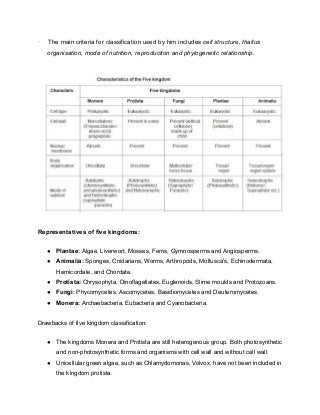


BIOLOGICAL CLASSIFICATION Biological classification is the scientific ordering of organism in a hierarchical series of groups, on the basis of their relationship- morphological, evolutionary and others. Advantages of Biological classification: · It makes their study convenient. · It facilitates identification of organisms. · It revels relationship among the various groups of organisms. · It also enables the biologist to interpret the orderly visible structure of the fossil organism. · It gives information about the plants and animals which do not occur in one’s own locality. · It revels evolutionary trends by showing gradually increasing complexity of structure in the various groups of organisms. Aristotle was the earliest to attempts a more scientific basis for classification. He used simple morphological (study of external structure of organism) characters to classify plants into tress, shrub and herbs. He also divided animals on the basis of presence of red blood cells into two groups, those which had red blood (Enaima) and those that did not (Ananima). TWO KINGDOM CLASSIFICCATION: · Two kingdom classification is given by Swedist Naturalist Carolus Linnaeus. · In this classification the organisms are classified into two kingdoms Plantae and Animalia. · In this classification bacteria and fungi were placed in the plant kingdom, Unicellular eukaryotes (protistans) were placed among animals. · Euglena is a unicellular eukaryotic organism placed into both plant and animal kingdom, because euglena behaves like plant in presence of sun light (photosynthetic) and in absence of sunlight they behave like animal (parasite). THREE KINGDOM CLASSIFICATION: · Three kingdom classification is proposed by Ernst Hackle. · He introduced a new kingdom ‘Protista’. · He classified organisms into Plantae, Animalia and Protista. · He placed unicellular eukaryotes in a separate kingdom Protista. · In this kingdom bacteria, fungi, diatoms and protozoans are placed into kingdom Protista. FOUR KINGDOM CLASSIFICATION: · Four kingdom classification is proposed by Herbert F. Copeland. · He introduced another new kingdom known as Monera. · He classified organism into Plantae, Animalia, Protista and Monera. · He placed bacteria and blue green algae in this kingdom. · In this kingdom fungi are placed into kingdom Plantae, unicellular eukaryotes into Protista and bacteria into kingdom Monera. DRAWBACKS OF TWO KINGDOM CLASSIFICATION: · This system does not distinguish between the eukaryotes and prokaryotes, unicellular and multicellular organisms and photosynthetic (green algae) and non-photosynthetic (fungi) organisms. · Euglena has both animal and plant features. Euglena has dual mode of nutrition called mixotrophic nutrition. · Chlamydomonas is a unicellular motile


