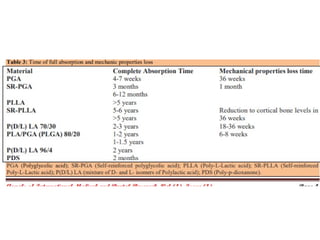
Biodegradable implants, especially made from polymers like polyglycolic acid (PGA) and poly-l-lactic acid (PLLA), offer significant advantages in orthopedic procedures by gradually degrading and transferring load to healing tissues, thus reducing the need for secondary surgeries. These implants are designed to minimize foreign body reactions and have similar mechanical properties to bone, although they may cause tissue reactions and other complications. Recent advancements aim to improve the degradation characteristics and biocompatibility of these materials to enhance patient outcomes in fractures and soft tissue repairs.

![• This leads to production of a thin macrophage layer with incidentally
multinucleated giant cells surrounded by a mild connective tissue capsule.
• ] That is responsible for many adverse effects.](https://image.slidesharecdn.com/biodegradableimplants-240902140908-87dbec18/85/BIODEGRADABLE-IMPLANTS-IN-ORTHOPAEDICS-PPT-12-320.jpg)
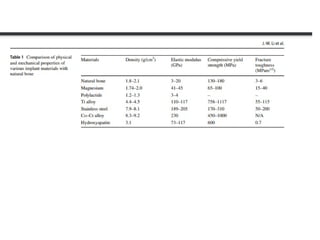
![• In 1966, PLLA sutures were frst used as an implant in animals and were
found to be non-toxic and to degrade gradually .
• Eppley et al.retrospectively analyzed the clinical curative efects of
craniofacial reconstruction with poly-l-lactic-polyglycolic implants.
• The results showed that postoperative implants can stabilize the affected
area, while having low propensity for foreign body reactions and good
patient recovery .
• In anterior cruciate ligament (ACL) injury there is a change in
metalloproteinase (MMPs) secretion by cartilage tissue, synovial
membrane and the intra-articular ligament that increases matrix
metalloproteinase-2 in synovial fuid, thus hindering self-healing of the
ligament [20]. If not treated in time, it may lead to premature
degeneration of the knee .](https://image.slidesharecdn.com/biodegradableimplants-240902140908-87dbec18/85/BIODEGRADABLE-IMPLANTS-IN-ORTHOPAEDICS-PPT-40-320.jpg)
![• One patient developed localized pain and swelling at 14 weeks after
surgery, but responded well to antimicrobial treatment.
• The remaining patients recovered favorably.
• It has also been reported that use of PLLA screws to repair meniscus
injuries can efectively reduce the risk of neurovascular damage .
• Anterior cervical decompression with PLLA screw fxation for bone grafting
can successfully treat cervical spondylosis.
• The screws were absorbed as predicted, grafts fused well with adjacent
vertebrae, and only a few complications ensued [29].
•](https://image.slidesharecdn.com/biodegradableimplants-240902140908-87dbec18/85/BIODEGRADABLE-IMPLANTS-IN-ORTHOPAEDICS-PPT-43-320.jpg)
![• Use of a degradable poly (l-lactic acid)/poly (glycolic acid) screw to treat
patients with osteochondritis dissecans was associated with adequate
stability to area postoperatively without development of infammatory
reactions like recurrent effusion, warmth or erythema during screw
degradation .
• Park et al used poly (lactic-co-glycolic acid) screws and plates to treat
rabbit mandibles, and reported that all fractured sites had new bone
formation without infammation at 8 and 10 weeks postoperatively.
• Wang et al. retrospectively analyzed the clinical efficacy and complication
rate of degradable INION [synthesized from PLLA, PLDLA, polyglycolic acid
(PGA) and trimethylene carbonate (TMC)] screws and metal screws, which
were all used to treat elderly patients with tibial plateau fractures
complicated by osteoporosis.](https://image.slidesharecdn.com/biodegradableimplants-240902140908-87dbec18/85/BIODEGRADABLE-IMPLANTS-IN-ORTHOPAEDICS-PPT-45-320.jpg)
![• In addition, use of vascularized bone grafts with high-purity magnesium
screws after fixation can significantly improve hip joint function in
osteonecrosis patients .
• Implanting MgCa0.8 screws into rabbit tibia was well tolerated and had
good biocompatibility postoperatively.
• However, it degraded fast, which potentially contributed to its lack of
mechanical properties (Fig. 6) [40].
• Thomann et al. [41] implanted MgCa0.8 implants coated with MgF2 into
the tibia bone marrow cavity of New Zealand white rabbits.](https://image.slidesharecdn.com/biodegradableimplants-240902140908-87dbec18/85/BIODEGRADABLE-IMPLANTS-IN-ORTHOPAEDICS-PPT-51-320.jpg)
![• The implants were well tolerated in vivo and had slower degradation
postoperatively.
• Compared with uncoated implants, coated implants were stronger at
6 months after surgery.
• Adam et al. [42] further proved that use of MgCa0.8 implants was non-
toxic to animal](https://image.slidesharecdn.com/biodegradableimplants-240902140908-87dbec18/85/BIODEGRADABLE-IMPLANTS-IN-ORTHOPAEDICS-PPT-52-320.jpg)
![• Witte et al. [47] conducted in vitro and in vivo experiments using two
magnesium alloy implants.
• This group found that the implant corrosion rate in vivo was four orders of
magnitude less than observed in vitro.
• Thus, this study showed that the conclusions drawn from in vitro corrosion
tests of magnesium alloys cannot be used to predict the in vivo corrosion rate .
• Three months after removal of magnesium alloy screws that had been
diferences between groups (Table 10).
• Tensile experiments showed that anti-pull-out and tensile strengths of
magnesium alloy intramedullary nail were better than PLLA intramedullary nail
(Table 11).
• The animal experiments showed that use of fuoride to coat the magnesium
alloy screw not only enhanced the biocompatibility and corrosion resistance of
the screw, but also stimulated new bone formation (Fig. 8) [50].](https://image.slidesharecdn.com/biodegradableimplants-240902140908-87dbec18/85/BIODEGRADABLE-IMPLANTS-IN-ORTHOPAEDICS-PPT-56-320.jpg)
![• . One survey found that patients who smoked tobacco and those with
diabetes or immunodefciency had a longer bone healing time.
• Too fast a degradation of the implant will compromise its mechanical
properties, resulting in failure of the surgical intervention.
• Use of PLLA screws to conduct ACL reconstruction is advantageous
compared with surgical steel or titanium screws [11, 14].
• However, some patients will develop cyst phenomenon, which may
result from a foreign body reaction caused by screw damage [18, 26],
tibial tunnel caused by synovial joint fuid leakage [57], failure of the
implant to match the diameter of the bone tunnel, placement of the
implant in the eccentric position of the bone tunnel [58] or uneven
torsional force on the screw [59].](https://image.slidesharecdn.com/biodegradableimplants-240902140908-87dbec18/85/BIODEGRADABLE-IMPLANTS-IN-ORTHOPAEDICS-PPT-60-320.jpg)
![• Use of magnesium alloy implants for fracture treatment also has some
shortcomings.
• Too rapid a degradation of the magnesium alloy implant leads to
insufcient mechanical properties and poor bone healing around the
fracture [61].
• During implant degradation a considerable quantity of degradation
products attach to the fracture and slow healing.
• Further, the corrosion resistance of magnesium alloy is poor, with fast
corrosion producing a large amount of harmful hydrogen.
• Additionally, if the magnesium ion content in the body exceeds normal
physiological levels, it may lead to respiratory diseases, muscle paralysis,
hypotension and other symptoms of hypomagnesaemia .](https://image.slidesharecdn.com/biodegradableimplants-240902140908-87dbec18/85/BIODEGRADABLE-IMPLANTS-IN-ORTHOPAEDICS-PPT-62-320.jpg)
![• When patients with syndesmosis injury were treated with PLA screws,
there was sufficient fatigue and failure strength to repair the syndesmosis
injury postoperatively [11]. Zhao et al. [12] used PLA screws and titanium
alloy lag screws in patients with ankle fractures, and observed no
significant difference in treatment effect or healing time compared with
the metal group (Tables 5 and 6). Patients treated with PLA screws had
good outcomes. The callus grew well, the fracture ends accorded well,
there was no delayed union or nonunion of bones, and ankle function
restored effectively.](https://image.slidesharecdn.com/biodegradableimplants-240902140908-87dbec18/85/BIODEGRADABLE-IMPLANTS-IN-ORTHOPAEDICS-PPT-68-320.jpg)