The bike is a concrete image of how sentences
work. This presentation, given at ATEG’s 2006
conference, shows you how to use the bike to
teach sentence structure. The slides are
examples of the kind of instruction found in
An Easy Guide to Writing
by Pamela Dykstra
Prentice Hall, 2006
ISBN: 0 -13 –184954 - 9
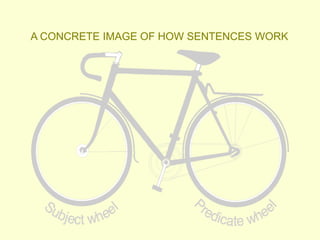
A CONCRETE IMAGE OF HOW SENTENCES WORK
What’s a sentence?
• Here are three sentences:
– He smiles.
– Autumn leaves twirled gently to the ground.
– The park district will open an outdoor ice skating
rink in November.
Length does not determine what is and is not a
sentence. Regardless of how long or short a group of
words is, it needs two parts to be a sentence: a subject
and a predicate.
•The subject tells us who or what.
•The predicate tells us what about it. It
usually contains a verb!
A sentence must also complete a thought!
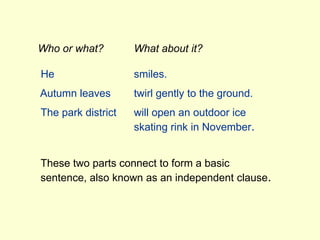
Who or what? What about it?
He smiles.
Autumn leaves twirl gently to the ground.
The park district will open an outdoor ice
skating rink in November.
These two parts connect to form a basic
sentence, also known as an independent clause.
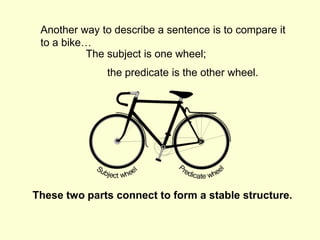
Another way to describe a sentence is to compare it
to a bike…
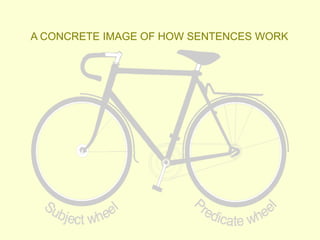
These two parts connect to form a stable structure.
The subject is one wheel;
the predicate is the other wheel.
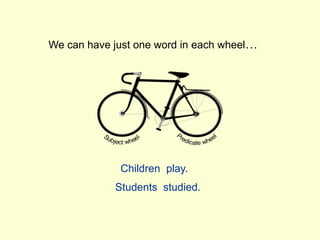
We can have just one word in each wheel…
Students studied.
Children play.
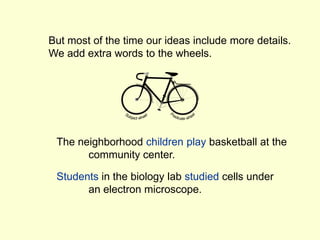
But most of the time our ideas include more details.
We add extra words to the wheels.
Students in the biology lab studied cells under
an electron microscope.
The neighborhood children play basketball at the
community center.
Old magazines are stacked under the kitchen
table.
The weekend seminar explains how to start a
small business.
Meditation helps create a peaceful mind and
healthy body.
We can expand the wheels by adding
adjectives:
We can expand the wheels by adding
adverbs:
Airline employees worked diligently to reschedule
our flights.
We carefully loaded the van with furniture.
The driver realized immediately that he had
missed the exit.
We can also add prepositional phrases:
The windows rattled in the winter storm.
We loaded our hamburgers with ketchup, mustard,
and onion.
Some car dealers make most of their profit on
parts and services.
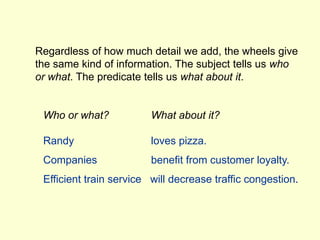
Regardless of how much detail we add, the wheels give
the same kind of information. The subject tells us who
or what. The predicate tells us what about it.
Who or what? What about it?
Randy loves pizza.
Companies benefit from customer loyalty.
Efficient train service will decrease traffic congestion.
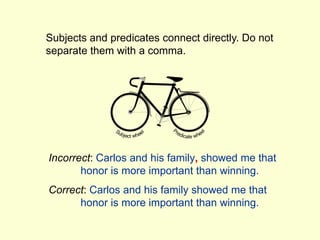
Subjects and predicates connect directly. Do not
separate them with a comma.
Incorrect: Carlos and his family, showed me that
honor is more important than winning.
Correct: Carlos and his family showed me that
honor is more important than winning.
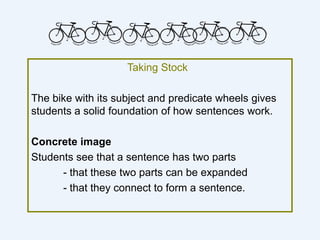
Taking Stock
The bike with its subject and predicate wheels gives
students a solid foundation of how sentences work.
Concrete image
Students see that a sentence has two parts
- that these two parts can be expanded
- that they connect to form a sentence.
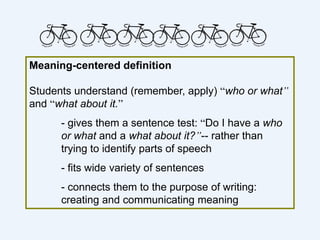
Meaning-centered definition
Students understand (remember, apply) “who or what”
and “what about it.”
- gives them a sentence test: “Do I have a who
or what and a what about it?”-- rather than
trying to identify parts of speech
- fits wide variety of sentences
- connects them to the purpose of writing:
creating and communicating meaning
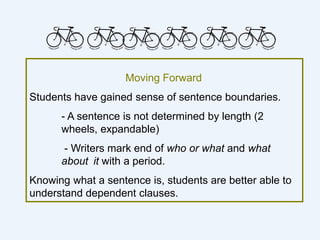
Moving Forward
Students have gained sense of sentence boundaries.
- A sentence is not determined by length (2
wheels, expandable)
- Writers mark end of who or what and what
about it with a period.
Knowing what a sentence is, students are better able to
understand dependent clauses.
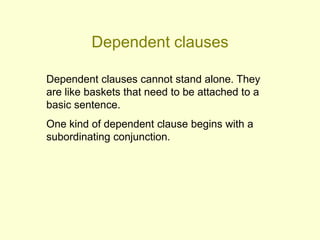
Dependent clauses
Dependent clauses cannot stand alone. They
are like baskets that need to be attached to a
basic sentence.
One kind of dependent clause begins with a
subordinating conjunction.
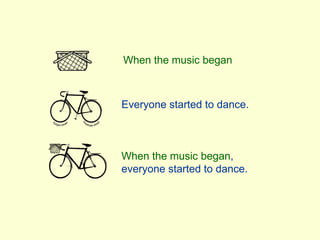
When the music began
Everyone started to dance.
When the music began,
everyone started to dance.
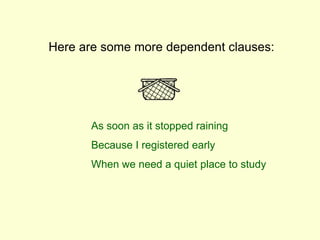
Here are some more dependent clauses:
As soon as it stopped raining
Because I registered early
When we need a quiet place to study
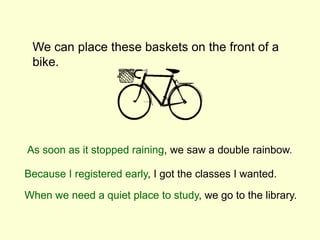
We can place these baskets on the front of a
bike.
As soon as it stopped raining, we saw a double rainbow.
When we need a quiet place to study, we go to the library.
Because I registered early, I got the classes I wanted.
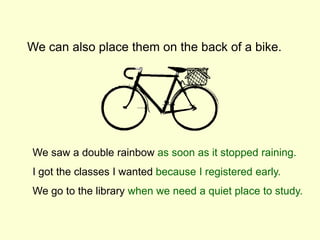
We can also place them on the back of a bike.
We saw a double rainbow as soon as it stopped raining.
I got the classes I wanted because I registered early.
We go to the library when we need a quiet place to study.
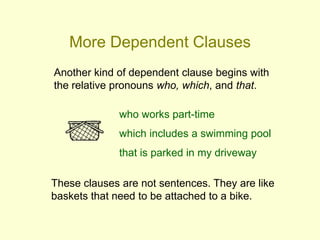
More Dependent Clauses
who works part-time
which includes a swimming pool
that is parked in my driveway
Another kind of dependent clause begins with
the relative pronouns who, which, and that.
These clauses are not sentences. They are like
baskets that need to be attached to a bike.
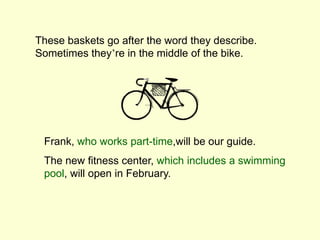
These baskets go after the word they describe.
Sometimes they’re in the middle of the bike.
Frank, who works part-time,will be our guide.
The new fitness center, which includes a swimming
pool, will open in February.
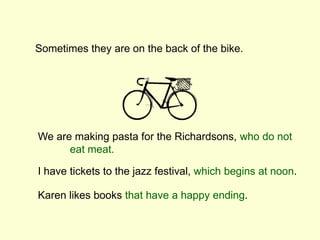
Sometimes they are on the back of the bike.
Karen likes books that have a happy ending.
We are making pasta for the Richardsons, who do not
eat meat.
I have tickets to the jazz festival, which begins at noon.
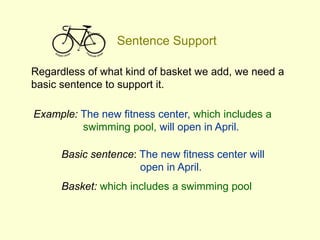
Example: The new fitness center, which includes a
swimming pool, will open in April.
Regardless of what kind of basket we add, we need a
basic sentence to support it.
Sentence Support
Basic sentence: The new fitness center will
open in April.
Basket: which includes a swimming pool
Taking Stock
The baskets help students see that
- dependent clauses are not sentences
- they need to be attached to a sentence
Moving Forward
The basket is also useful when explaining fragments
and sentence variety.
Fragments
A fragment is just a part of a sentence. It may
lack a subject or a predicate. Often it’s a
disconnected basket.
As soon as I understood the problem. I thought of a
solution.
I was not responsible. When I was sixteen.
The village will enlarge the parking lot. Which
serves weekday commuters.
Let’s rent the same movie. That we saw last
weekend.
Disconnected dependent clauses
Disconnected description and detail
It was an easy task. Especially for someone so small.
The corporation provides employees with benefits.
Like medical insurance and a pension.
We have ordered everything on the menu. Except
fried buffalo wings.
We put an ad in the Lake Norman Times. Our local
newspaper.
I sprinted down the street. Trying to catch the train.
The scientists continued their research. Hoping to
find a cure.
To celebrate their anniversary. They are going to
Asheville for the weekend.
We walked up sixteen flights of stairs. To prove to
ourselves we could do it.
Disconnected -ing and –to fragments
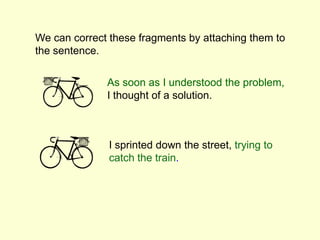
As soon as I understood the problem,
I thought of a solution.
We can correct these fragments by attaching them to
the sentence.
I sprinted down the street, trying to
catch the train.
Baskets are excellent ways to create sentence
variety. Once we have a stable structure, we can
add a variety of baskets on the front, in the
middle, or on the back.
Sentence Variety
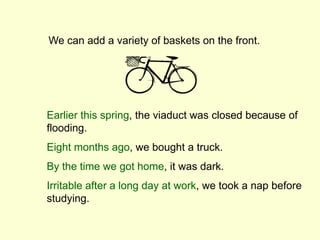
Earlier this spring, the viaduct was closed because of
flooding.
Eight months ago, we bought a truck.
By the time we got home, it was dark.
Irritable after a long day at work, we took a nap before
studying.
We can add a variety of baskets on the front.
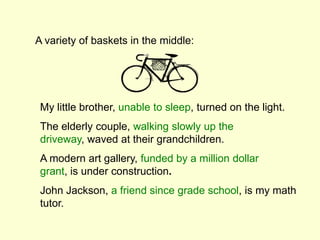
A variety of baskets in the middle:
My little brother, unable to sleep, turned on the light.
The elderly couple, walking slowly up the
driveway, waved at their grandchildren.
A modern art gallery, funded by a million dollar
grant, is under construction.
John Jackson, a friend since grade school, is my math
tutor.
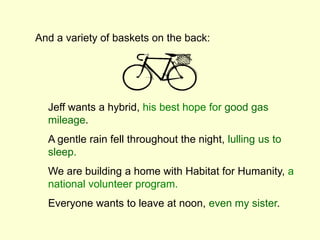
Jeff wants a hybrid, his best hope for good gas
mileage.
A gentle rain fell throughout the night, lulling us to
sleep.
We are building a home with Habitat for Humanity, a
national volunteer program.
Everyone wants to leave at noon, even my sister.
And a variety of baskets on the back:
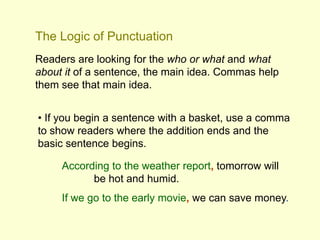
• If you begin a sentence with a basket, use a comma
to show readers where the addition ends and the
basic sentence begins.
The Logic of Punctuation
Readers are looking for the who or what and what
about it of a sentence, the main idea. Commas help
them see that main idea.
If we go to the early movie, we can save money.
According to the weather report, tomorrow will
be hot and humid.
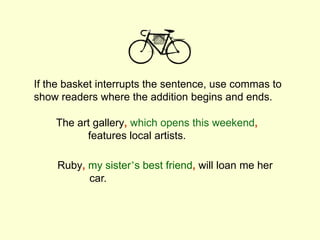
If the basket interrupts the sentence, use commas to
show readers where the addition begins and ends.
The art gallery, which opens this weekend,
features local artists.
Ruby, my sister’s best friend, will loan me her
car.
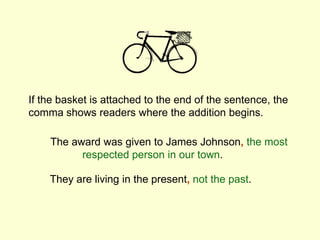
If the basket is attached to the end of the sentence, the
comma shows readers where the addition begins.
They are living in the present, not the past.
The award was given to James Johnson, the most
respected person in our town.
SUMMARY
The bike helps students see how sentences work
- how the whole communicates meaning
- how the parts relate to the whole
- how punctuation signals these connections.
Students see how the whole communicates
meaning and how the parts relate to the whole.
The subject is one wheel, giving the who or
what. The predicate is the other wheel, giving
the what about it. These two parts connect to
form a stable structure, which can then carry
additions (baskets). These additions are like
baskets that can be placed on the front, the
middle, or the back of the bike.
Students see how punctuation signals these
connections. Students learn, for
example, that commas are used to mark
additions so readers can see the basic
sentence, the main idea of the sentence.
Through similar explanations and concrete
illustrations, students realize that
punctuation is not a list of arbitrary rules to
be inserted on top of sentences; it is system
of signs telling readers how to read the
writer’s thoughts.
BIKE STRENGTHS
- Concrete (similar to diagramming)
- Emphasizes Who or what/What about it
definition
- Focuses on the essential – doesn’t lose
students with overwhelming detail
- Can be used with traditional terminology
A CONCRETE IMAGE OF HOW SENTENCES WORK

Bike Sentences Power Point

  • 1.
    The bike isa concrete image of how sentences work. This presentation, given at ATEG’s 2006 conference, shows you how to use the bike to teach sentence structure. The slides are examples of the kind of instruction found in An Easy Guide to Writing by Pamela Dykstra Prentice Hall, 2006 ISBN: 0 -13 –184954 - 9
  • 2.
    A CONCRETE IMAGEOF HOW SENTENCES WORK
  • 3.
    What’s a sentence? •Here are three sentences: – He smiles. – Autumn leaves twirled gently to the ground. – The park district will open an outdoor ice skating rink in November.
  • 4.
    Length does notdetermine what is and is not a sentence. Regardless of how long or short a group of words is, it needs two parts to be a sentence: a subject and a predicate. •The subject tells us who or what. •The predicate tells us what about it. It usually contains a verb! A sentence must also complete a thought!
  • 5.
    Who or what?What about it? He smiles. Autumn leaves twirl gently to the ground. The park district will open an outdoor ice skating rink in November. These two parts connect to form a basic sentence, also known as an independent clause.
  • 6.
    Another way todescribe a sentence is to compare it to a bike… These two parts connect to form a stable structure. The subject is one wheel; the predicate is the other wheel.
  • 7.
    We can havejust one word in each wheel… Students studied. Children play.
  • 8.
    But most ofthe time our ideas include more details. We add extra words to the wheels. Students in the biology lab studied cells under an electron microscope. The neighborhood children play basketball at the community center.
  • 9.
    Old magazines arestacked under the kitchen table. The weekend seminar explains how to start a small business. Meditation helps create a peaceful mind and healthy body. We can expand the wheels by adding adjectives:
  • 10.
    We can expandthe wheels by adding adverbs: Airline employees worked diligently to reschedule our flights. We carefully loaded the van with furniture. The driver realized immediately that he had missed the exit.
  • 11.
    We can alsoadd prepositional phrases: The windows rattled in the winter storm. We loaded our hamburgers with ketchup, mustard, and onion. Some car dealers make most of their profit on parts and services.
  • 12.
    Regardless of howmuch detail we add, the wheels give the same kind of information. The subject tells us who or what. The predicate tells us what about it. Who or what? What about it? Randy loves pizza. Companies benefit from customer loyalty. Efficient train service will decrease traffic congestion.
  • 13.
    Subjects and predicatesconnect directly. Do not separate them with a comma. Incorrect: Carlos and his family, showed me that honor is more important than winning. Correct: Carlos and his family showed me that honor is more important than winning.
  • 14.
    Taking Stock The bikewith its subject and predicate wheels gives students a solid foundation of how sentences work. Concrete image Students see that a sentence has two parts - that these two parts can be expanded - that they connect to form a sentence.
  • 15.
    Meaning-centered definition Students understand(remember, apply) “who or what” and “what about it.” - gives them a sentence test: “Do I have a who or what and a what about it?”-- rather than trying to identify parts of speech - fits wide variety of sentences - connects them to the purpose of writing: creating and communicating meaning
  • 16.
    Moving Forward Students havegained sense of sentence boundaries. - A sentence is not determined by length (2 wheels, expandable) - Writers mark end of who or what and what about it with a period. Knowing what a sentence is, students are better able to understand dependent clauses.
  • 17.
    Dependent clauses Dependent clausescannot stand alone. They are like baskets that need to be attached to a basic sentence. One kind of dependent clause begins with a subordinating conjunction.
  • 18.
    When the musicbegan Everyone started to dance. When the music began, everyone started to dance.
  • 19.
    Here are somemore dependent clauses: As soon as it stopped raining Because I registered early When we need a quiet place to study
  • 20.
    We can placethese baskets on the front of a bike. As soon as it stopped raining, we saw a double rainbow. When we need a quiet place to study, we go to the library. Because I registered early, I got the classes I wanted.
  • 21.
    We can alsoplace them on the back of a bike. We saw a double rainbow as soon as it stopped raining. I got the classes I wanted because I registered early. We go to the library when we need a quiet place to study.
  • 22.
    More Dependent Clauses whoworks part-time which includes a swimming pool that is parked in my driveway Another kind of dependent clause begins with the relative pronouns who, which, and that. These clauses are not sentences. They are like baskets that need to be attached to a bike.
  • 23.
    These baskets goafter the word they describe. Sometimes they’re in the middle of the bike. Frank, who works part-time,will be our guide. The new fitness center, which includes a swimming pool, will open in February.
  • 24.
    Sometimes they areon the back of the bike. Karen likes books that have a happy ending. We are making pasta for the Richardsons, who do not eat meat. I have tickets to the jazz festival, which begins at noon.
  • 25.
    Example: The newfitness center, which includes a swimming pool, will open in April. Regardless of what kind of basket we add, we need a basic sentence to support it. Sentence Support Basic sentence: The new fitness center will open in April. Basket: which includes a swimming pool
  • 26.
    Taking Stock The basketshelp students see that - dependent clauses are not sentences - they need to be attached to a sentence Moving Forward The basket is also useful when explaining fragments and sentence variety.
  • 27.
    Fragments A fragment isjust a part of a sentence. It may lack a subject or a predicate. Often it’s a disconnected basket.
  • 28.
    As soon asI understood the problem. I thought of a solution. I was not responsible. When I was sixteen. The village will enlarge the parking lot. Which serves weekday commuters. Let’s rent the same movie. That we saw last weekend. Disconnected dependent clauses
  • 29.
    Disconnected description anddetail It was an easy task. Especially for someone so small. The corporation provides employees with benefits. Like medical insurance and a pension. We have ordered everything on the menu. Except fried buffalo wings. We put an ad in the Lake Norman Times. Our local newspaper.
  • 30.
    I sprinted downthe street. Trying to catch the train. The scientists continued their research. Hoping to find a cure. To celebrate their anniversary. They are going to Asheville for the weekend. We walked up sixteen flights of stairs. To prove to ourselves we could do it. Disconnected -ing and –to fragments
  • 31.
    As soon asI understood the problem, I thought of a solution. We can correct these fragments by attaching them to the sentence. I sprinted down the street, trying to catch the train.
  • 32.
    Baskets are excellentways to create sentence variety. Once we have a stable structure, we can add a variety of baskets on the front, in the middle, or on the back. Sentence Variety
  • 33.
    Earlier this spring,the viaduct was closed because of flooding. Eight months ago, we bought a truck. By the time we got home, it was dark. Irritable after a long day at work, we took a nap before studying. We can add a variety of baskets on the front.
  • 34.
    A variety ofbaskets in the middle: My little brother, unable to sleep, turned on the light. The elderly couple, walking slowly up the driveway, waved at their grandchildren. A modern art gallery, funded by a million dollar grant, is under construction. John Jackson, a friend since grade school, is my math tutor.
  • 35.
    Jeff wants ahybrid, his best hope for good gas mileage. A gentle rain fell throughout the night, lulling us to sleep. We are building a home with Habitat for Humanity, a national volunteer program. Everyone wants to leave at noon, even my sister. And a variety of baskets on the back:
  • 36.
    • If youbegin a sentence with a basket, use a comma to show readers where the addition ends and the basic sentence begins. The Logic of Punctuation Readers are looking for the who or what and what about it of a sentence, the main idea. Commas help them see that main idea. If we go to the early movie, we can save money. According to the weather report, tomorrow will be hot and humid.
  • 37.
    If the basketinterrupts the sentence, use commas to show readers where the addition begins and ends. The art gallery, which opens this weekend, features local artists. Ruby, my sister’s best friend, will loan me her car.
  • 38.
    If the basketis attached to the end of the sentence, the comma shows readers where the addition begins. They are living in the present, not the past. The award was given to James Johnson, the most respected person in our town.
  • 39.
    SUMMARY The bike helpsstudents see how sentences work - how the whole communicates meaning - how the parts relate to the whole - how punctuation signals these connections.
  • 40.
    Students see howthe whole communicates meaning and how the parts relate to the whole. The subject is one wheel, giving the who or what. The predicate is the other wheel, giving the what about it. These two parts connect to form a stable structure, which can then carry additions (baskets). These additions are like baskets that can be placed on the front, the middle, or the back of the bike.
  • 41.
    Students see howpunctuation signals these connections. Students learn, for example, that commas are used to mark additions so readers can see the basic sentence, the main idea of the sentence. Through similar explanations and concrete illustrations, students realize that punctuation is not a list of arbitrary rules to be inserted on top of sentences; it is system of signs telling readers how to read the writer’s thoughts.
  • 42.
    BIKE STRENGTHS - Concrete(similar to diagramming) - Emphasizes Who or what/What about it definition - Focuses on the essential – doesn’t lose students with overwhelming detail - Can be used with traditional terminology
  • 43.
    A CONCRETE IMAGEOF HOW SENTENCES WORK