3
5
52
57
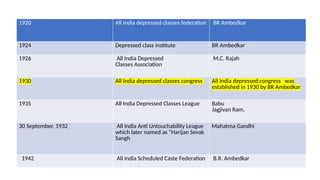
1920 All India depressed classes federation BR Ambedkar
1924 Depressed class institute BR Ambedkar
1926 All India Depressed
Classes Association
M.C. Rajah
1930 All India depressed classes congress All India depressed congress was
established in 1930 by BR Ambedkar
1935 All India Depressed Classes League Babu
Jagjivan Ram.
30 September, 1932 All India Anti Untouchability League
which later named as “Harijan Sevak
Sangh
Mahatma Gandhi
1942 All India Scheduled Caste Federation B.R. Ambedkar
60
61
62
64
68
69
71
79
80
81
82
83
93
91
93
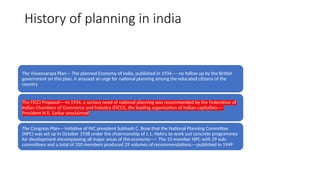
History of planning in india
The Visvesvaraya Plan--- The planned Economy of India, published in 1934---- no follow up by the British
government on this plan, it aroused an urge for national planning among the educated citizens of the
country
The FICCI Proposal----In 1934, a serious need of national planning was recommended by the Federation of
Indian Chambers of Commerce and Industry (FICCI), the leading organisation of Indian capitalists----
President N.R. Sarkar proclaimed
The Congress Plan--- initiative of INC president Subhash C. Bose that the National Planning Committee
(NPC) was set up in October 1938 under the chairmanship of J. L. Nehru to work out concrete programmes
for development encompassing all major areas of the economy----- The 15-member NPC with 29 sub-
committees and a total of 350 members produced 29 volumes of recommendations.---published in 1949
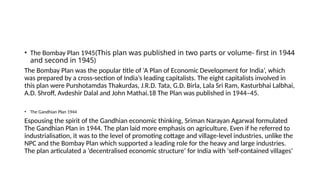
• The Bombay Plan 1945(This plan was published in two parts or volume- first in 1944
and second in 1945)
The Bombay Plan was the popular title of ‘A Plan of Economic Development for India’, which
was prepared by a cross-section of India’s leading capitalists. The eight capitalists involved in
this plan were Purshotamdas Thakurdas, J.R.D. Tata, G.D. Birla, Lala Sri Ram, Kasturbhai Lalbhai,

A.D. Shroff, Avdeshir Dalal and John Mathai.18 The Plan was published in 1944–45.
• The Gandhian Plan 1944
Espousing the spirit of the Gandhian economic thinking, Sriman Narayan Agarwal formulated
The Gandhian Plan in 1944. The plan laid more emphasis on agriculture. Even if he referred to
industrialisation, it was to the level of promoting cottage and village-level industries, unlike the
NPC and the Bombay Plan which supported a leading role for the heavy and large industries.
The plan articulated a ‘decentralised economic structure’ for India with ‘self-contained villages’
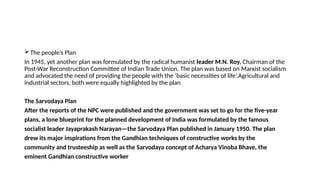
The people’s Plan
In 1945, yet another plan was formulated by the radical humanist leader M.N. Roy, Chairman of the
Post-War Reconstruction Committee of Indian Trade Union. The plan was based on Marxist socialism
and advocated the need of providing the people with the ‘basic necessities of life’.Agricultural and
industrial sectors, both were equally highlighted by the plan
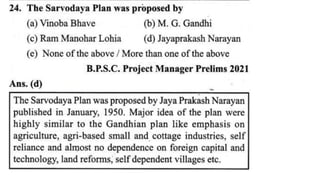
The Sarvodaya Plan
After the reports of the NPC were published and the government was set to go for the five-year
plans, a lone blueprint for the planned development of India was formulated by the famous
socialist leader Jayaprakash Narayan—the Sarvodaya Plan published in January 1950. The plan
drew its major inspirations from the Gandhian techniques of constructive works by the
community and trusteeship as well as the Sarvodaya concept of Acharya Vinoba Bhave, the
eminent Gandhian constructive worker
. Who authored the book, 'Planned Economy for India'?
(a) M. Visvesvaraya
(b) J.R.D. Tata
(c) G.B. Birla
(d) Pattabhi Sitaramayya
M.P.P.C.S. (Pre) 2018
Ans. (a)
M. Visvesvaraya authored the book ‘Planned Economy for
India’. He was the first to advocate the idea of planning for
India. In this book, he proposed a ten-year plan with the aim
of doubling the income of the country. His main emphasis
was on industrialization so as to reduce the population's
dependent on agriculture.
QUESTIONS ON HISTORY OF PLANNING
'National Planning Committee' was set up by :
(a) Jawaharlala Nehru
(b) A. Dalal
(c) Subhash Chandra Bose
(d) Lal Bahadur Shastri
M.P.P.C.S. (Pre) 2013
Ans. (c)
National Planning Committee was constituted by the then
President of the Congress (Subhash Chandra Bose) in Octo-
ber, 1938. Bose requested Pandit Jawaharlal Nehru to become
its Chairman.
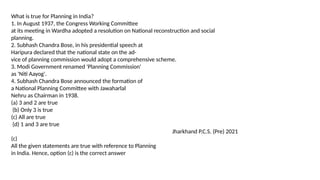
What is true for Planning in India?
1. In August 1937, the Congress Working Committee
at its meeting in Wardha adopted a resolution on National reconstruction and social
planning.
2. Subhash Chandra Bose, in his presidential speech at
Haripura declared that the national state on the ad-
vice of planning commission would adopt a comprehensive scheme.
3. Modi Government renamed 'Planning Commission'
as 'Niti Aayog'.
4. Subhash Chandra Bose announced the formation of
a National Planning Committee with Jawaharlal
Nehru as Chairman in 1938.
(a) 3 and 2 are true
(b) Only 3 is true
(c) All are true
(d) 1 and 3 are true
Jharkhand P.C.S. (Pre) 2021
(c)
All the given statements are true with reference to Planning
in India. Hence, option (c) is the correct answer
The Gandhian Plan was expounded in 1944 by :
(a) N.R. Sarkar
(b) Kasturi Bhai Lal Bhai
(c) Jayprakash Narayan
(d) Shriman Narayan Agarwal
U.P.P.C.S. (Pre) (Re-Exam) 2015
Ans. (d)
Who amongst the following drafted the 'Sarvodaya Plan'?
(a) M.N. Roy
(b) Jai Prakash Narayan
(c) Morarji Desai
(d) Shriman Narayan Agarwal
M.P. P.C.S. (Pre) 2013
Ans. (b)
In 1950, Jai Prakash Narayan drafted the 'Sarvodaya Plan'
inspired by Gandhian ideals to chart a future map for India's
development and 1954 onwards, he dedicated his life to the
Sarvodaya Movement to establish true socialism.
.Who opposed Planned Development in India?
(a) Mahatma Gandhi
(b) Jawaharlal Nehru
(c) Indira Gandhi
(d) Rajiv Gandhi
U.P.P.C.S. (Pre) 2019
Ans. (a)
Among the given options, Mahatma Gandhi opposed
Planned Development in India. Mahatma Gandhi’s
conception of self-reliance was of simple living and self-
sufficiency. His basic idea was to use local resources and a
local workforce for the production of commodities for local
consumption to the extent possible, with minimal
dependence on the outside world.
NEED OF PLANNING COMMISSION
AS early as 1946, before the transfer of power, a Planning Advisory Board was appointed, which
recommended the appointment of a Planning Commission to devote full attention to the task of
planned development. As aresult, the Planning Cornmission Was constituted in15 March, 1950 by a
resolution of the Government of India.
It was decided that the state has to play an important role in bringing socio-economic
transformation, as required by the Directive Principles of State Policy.
The role of the Planning Commission is directly related to the tasks assigned to the government by
the Indian Constitution in its Directive Principles ,especially those relating to economic and social
Development. The Directive Principles of State Policy urge upon the state to secure citizens' right to
adequate means of livelihood and control the inequalities in the ownership of wealth and means Of
prodction. In this context, the state is required to ensure growth in production, and its equitable
distribution among the various sections of society
TYPES OF PLANNING
• 1. Imperative Planning The planning process followed by the state economies (i.e., the socialist or
communist) is known as the imperative planning. Such planning is also called as directive or target
planning. Such planning had two main variants.
 In the socialist system, all economic decisions were centralised in the hands of the state with collective
ownership of resources(except labour).
 In the communist system (i.e., China of the past) all resources were to be owned and utilised by the state
(including labour). Thus, communist China was the purest example of such planning
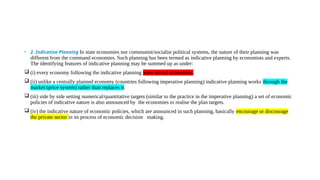
• 2. Indicative Planning In state economies nor communist/socialist political systems, the nature of their planning was
different from the command economies. Such planning has been termed as indicative planning by economists and experts.
The identifying features of indicative planning may be summed up as under:
 (i) every economy following the indicative planning were mixed economies.
 (ii) unlike a centrally planned economy (countries following imperative planning) indicative planning works through the
market (price system) rather than replaces it.
 (iii) side by side setting numerical/quantitative targets (similar to the practice in the imperative planning) a set of economic
policies of indicative nature is also announced by the economies to realise the plan targets.
 (iv) the indicative nature of economic policies, which are announced in such planning, basically encourage or discourage
the private sector in its process of economic decision making.
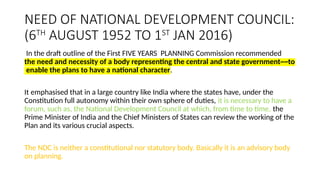
NEED OF NATIONAL DEVELOPMENT COUNCIL:
(6TH
AUGUST 1952 TO 1ST
JAN 2016)
In the draft outline of the First FIVE YEARS PLANNING Commission recommended
the need and necessity of a body representing the central and state government~~to
enable the plans to have a national character.
It emphasised that in a large country like India where the states have, under the
Constitution full autonomy within their own sphere of duties, it is necessary to have a
forum, such as, the National Development Council at which, from time to time, the
Prime Minister of India and the Chief Ministers of States can review the working of the
Plan and its various crucial aspects.
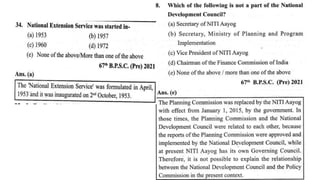
The NDC is neither a constitutional nor statutory body. Basically it is an advisory body
on planning.
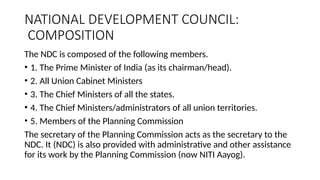
NATIONAL DEVELOPMENT COUNCIL:
COMPOSITION
The NDC is composed of the following members.
• 1. The Prime Minister of India (as its chairman/head).
• 2. All Union Cabinet Ministers
• 3. The Chief Ministers of all the states.
• 4. The Chief Ministers/administrators of all union territories.
• 5. Members of the Planning Commission
The secretary of the Planning Commission acts as the secretary to the
NDC. It (NDC) is also provided with administrative and other assistance
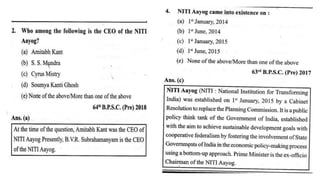
for its work by the Planning Commission (now NITI Aayog).
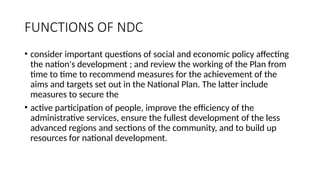
FUNCTIONS OF NDC
• consider important questions of social and economic policy affecting
the nation's development ; and review the working of the Plan from
time to time to recommend measures for the achievement of the
aims and targets set out in the National Plan. The latter include
measures to secure the
• active participation of people, improve the efficiency of the
administrative services, ensure the fullest development of the less
advanced regions and sections of the community, and to build up
resources for national development.
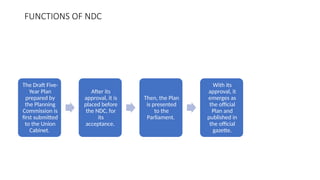
FUNCTIONS OF NDC
The Draft Five-
Year Plan
prepared by
the Planning
Commission is
first submitted
to the Union
Cabinet.
After its
approval, it is
placed before
the NDC, for
its
acceptance.
Then, the Plan
is presented
to the
Parliament.
With its
approval, it
emerges as
the official
Plan and
published in
the official
gazette.
QUESTIONS ON NDC
1 . National Development Council was constituted on :
(a) 16 August 1950
(b) 1 April 1951
(c) 6 August 1952
(d) 16 August 1952
U.P.P.C.S. (Spl.) (Pre) 2008
U.P.P.S.C. (R.I.) 2014
U.P.P.C.S. (Mains) 2016
Ans. (c)
National Development Council is mainly concerned with:
(a) approval of Five Year Plans
(b) implementation of rural development schemes
(c) preparation of development projects
(d) centre-state financial relations
U.P.P.C.S.(Pre) 2001, 2003
Ans. (a)
Which is the final authority in India to approve Five Year
Plans?
(a) Union Council of Ministers
(b) Planning Commission
(c) Prime Minister
(d) National Development Council
M.P.P.C.S. (Pre) 2008
UPSC 2002
U.P.P.C.S. (Mains) 2004
Chhattisgarh P.C.S. (Pre) 2003
Ans. (d)
National Development Council :
(a) Prepares the general draft of Five Year Plans
(b) Moniters the implementation of Five Year Plans
(c) Reviews the National Plans
(d) Sets the target for every sector of the Plan
R.A.S./R.T.S. (Pre) 1992
Ans. (c)
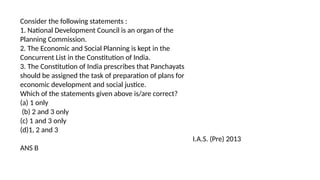
Consider the following statements :
1. National Development Council is an organ of the
Planning Commission.
2. The Economic and Social Planning is kept in the
Concurrent List in the Constitution of India.
3. The Constitution of India prescribes that Panchayats
should be assigned the task of preparation of plans for
economic development and social justice.
Which of the statements given above is/are correct?
(a) 1 only
(b) 2 and 3 only
(c) 1 and 3 only
(d)1, 2 and 3
I.A.S. (Pre) 2013
ANS B
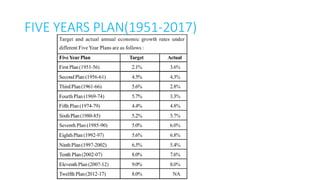
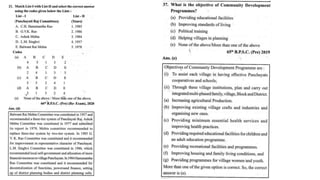
FIVE YEARS PLAN(1951-2017)
FIFTH D P DHAR
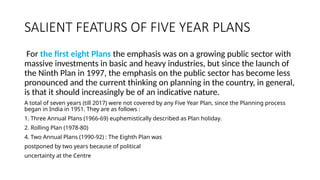
SALIENT FEATURS OF FIVE YEAR PLANS
For the first eight Plans the emphasis was on a growing public sector with
massive investments in basic and heavy industries, but since the launch of
the Ninth Plan in 1997, the emphasis on the public sector has become less
pronounced and the current thinking on planning in the country, in general,
is that it should increasingly be of an indicative nature.
A total of seven years (till 2017) were not covered by any Five Year Plan, since the Planning process
began in India in 1951. They are as follows :
1. Three Annual Plans (1966-69) euphemistically described as Plan holiday.
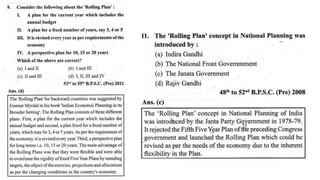
2. Rolling Plan (1978-80)
4. Two Annual Plans (1990-92) : The Eighth Plan was
postponed by two years because of political
uncertainty at the Centre
What was the priority of the First Five Year Plan?
(a) Industrialization
(b) Urbanization
(c) Development of Agriculture
(d) Spread of Education
U.P.P.C.S. (Mains) 2011
Ans. (c)
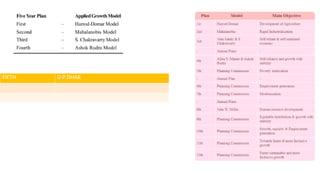
First Plan (1951-56) was based on Harrod-Domar Model. The
Plan mainly focussed on development of agriculture. It was
a successful plan primarily because of good harvests in the
last two years of the plan.
. First Five Year Plan of India was based on the :
(a) Harrod-Domar Model
(b(c) Dadabhai Naoroji Model
(d) J.L. Nehru Model
(e) None of the above/More than one of the above
60th to 62nd B.P.S.C. (Pre) 2016
Ans. (a)
The First Five Year Plan was launched in 1951 which mainly
focussed on development of the primary sector. This plan
was based on the Harrod-Domar model with few
modifications. Influx of refugees, severe food shortage and
mounting inflation confronted the country at the onset of
the First Five Year Plan.) Mahalanobis Model
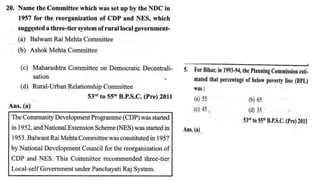
community (BLOCK/BDO)development
programme/PEOPLE PROGRAM
At the initial
stage in 1952
there were55
community
projects in 3
blocks.
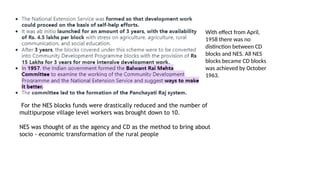
For the NES blocks funds were drastically reduced and the number of
multipurpose village level workers was brought down to 10.
NES was thought of as the agency and CD as the method to bring about
socio - economic transformation of the rural people
With effect from April,
1958 there was no
distinction between CD
blocks and NES. All NES
blocks became CD blocks
was achieved by October
1963.
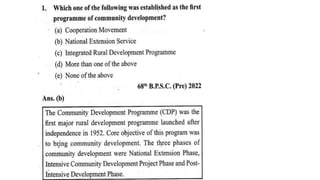
Ans =b
BPSC 68TH
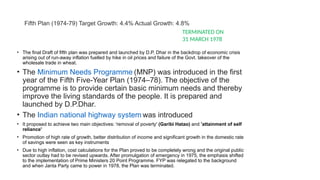
Fifth Plan (1974-79) Target Growth: 4.4% Actual Growth: 4.8%
• The final Draft of fifth plan was prepared and launched by D.P. Dhar in the backdrop of economic crisis
arising out of run-away inflation fuelled by hike in oil prices and failure of the Govt. takeover of the
wholesale trade in wheat.
• The Minimum Needs Programme (MNP) was introduced in the first
year of the Fifth Five-Year Plan (1974–78). The objective of the
programme is to provide certain basic minimum needs and thereby
improve the living standards of the people. It is prepared and
launched by D.P.Dhar.
• The Indian national highway system was introduced
• It proposed to achieve two main objectives: 'removal of poverty' (Garibi Hatao) and 'attainment of self
reliance'
• Promotion of high rate of growth, better distribution of income and significant growth in the domestic rate
of savings were seen as key instruments
• Due to high inflation, cost calculations for the Plan proved to be completely wrong and the original public
sector outlay had to be revised upwards. After promulgation of emergency in 1975, the emphasis shifted
to the implementation of Prime Ministers 20 Point Programme. FYP was relegated to the background
and when Janta Party came to power in 1978, the Plan was terminated.
TERMINATED ON
31 MARCH 1978
BIHAR SPECIAL ALL SUBJECTS BPSC MCQ.pptx

BIHAR SPECIAL ALL SUBJECTS BPSC MCQ.pptx

  • 4.
  • 6.
  • 19.
  • 23.
  • 24.
    1920 All Indiadepressed classes federation BR Ambedkar 1924 Depressed class institute BR Ambedkar 1926 All India Depressed Classes Association M.C. Rajah 1930 All India depressed classes congress All India depressed congress was established in 1930 by BR Ambedkar 1935 All India Depressed Classes League Babu Jagjivan Ram. 30 September, 1932 All India Anti Untouchability League which later named as “Harijan Sevak Sangh Mahatma Gandhi 1942 All India Scheduled Caste Federation B.R. Ambedkar
  • 25.
  • 26.
  • 28.
  • 29.
  • 35.
  • 37.
  • 38.
  • 42.
  • 45.
  • 46.
  • 47.
  • 48.
  • 52.
  • 53.
  • 54.
  • 61.
    History of planningin india The Visvesvaraya Plan--- The planned Economy of India, published in 1934---- no follow up by the British government on this plan, it aroused an urge for national planning among the educated citizens of the country The FICCI Proposal----In 1934, a serious need of national planning was recommended by the Federation of Indian Chambers of Commerce and Industry (FICCI), the leading organisation of Indian capitalists---- President N.R. Sarkar proclaimed The Congress Plan--- initiative of INC president Subhash C. Bose that the National Planning Committee (NPC) was set up in October 1938 under the chairmanship of J. L. Nehru to work out concrete programmes for development encompassing all major areas of the economy----- The 15-member NPC with 29 sub- committees and a total of 350 members produced 29 volumes of recommendations.---published in 1949
  • 62.
    • The BombayPlan 1945(This plan was published in two parts or volume- first in 1944 and second in 1945) The Bombay Plan was the popular title of ‘A Plan of Economic Development for India’, which was prepared by a cross-section of India’s leading capitalists. The eight capitalists involved in this plan were Purshotamdas Thakurdas, J.R.D. Tata, G.D. Birla, Lala Sri Ram, Kasturbhai Lalbhai, A.D. Shroff, Avdeshir Dalal and John Mathai.18 The Plan was published in 1944–45. • The Gandhian Plan 1944 Espousing the spirit of the Gandhian economic thinking, Sriman Narayan Agarwal formulated The Gandhian Plan in 1944. The plan laid more emphasis on agriculture. Even if he referred to industrialisation, it was to the level of promoting cottage and village-level industries, unlike the NPC and the Bombay Plan which supported a leading role for the heavy and large industries. The plan articulated a ‘decentralised economic structure’ for India with ‘self-contained villages’
  • 63.
    The people’s Plan In1945, yet another plan was formulated by the radical humanist leader M.N. Roy, Chairman of the Post-War Reconstruction Committee of Indian Trade Union. The plan was based on Marxist socialism and advocated the need of providing the people with the ‘basic necessities of life’.Agricultural and industrial sectors, both were equally highlighted by the plan The Sarvodaya Plan After the reports of the NPC were published and the government was set to go for the five-year plans, a lone blueprint for the planned development of India was formulated by the famous socialist leader Jayaprakash Narayan—the Sarvodaya Plan published in January 1950. The plan drew its major inspirations from the Gandhian techniques of constructive works by the community and trusteeship as well as the Sarvodaya concept of Acharya Vinoba Bhave, the eminent Gandhian constructive worker
  • 64.
    . Who authoredthe book, 'Planned Economy for India'? (a) M. Visvesvaraya (b) J.R.D. Tata (c) G.B. Birla (d) Pattabhi Sitaramayya M.P.P.C.S. (Pre) 2018 Ans. (a) M. Visvesvaraya authored the book ‘Planned Economy for India’. He was the first to advocate the idea of planning for India. In this book, he proposed a ten-year plan with the aim of doubling the income of the country. His main emphasis was on industrialization so as to reduce the population's dependent on agriculture.
  • 65.
    QUESTIONS ON HISTORYOF PLANNING 'National Planning Committee' was set up by : (a) Jawaharlala Nehru (b) A. Dalal (c) Subhash Chandra Bose (d) Lal Bahadur Shastri M.P.P.C.S. (Pre) 2013 Ans. (c) National Planning Committee was constituted by the then President of the Congress (Subhash Chandra Bose) in Octo- ber, 1938. Bose requested Pandit Jawaharlal Nehru to become its Chairman.
  • 66.
    What is truefor Planning in India? 1. In August 1937, the Congress Working Committee at its meeting in Wardha adopted a resolution on National reconstruction and social planning. 2. Subhash Chandra Bose, in his presidential speech at Haripura declared that the national state on the ad- vice of planning commission would adopt a comprehensive scheme. 3. Modi Government renamed 'Planning Commission' as 'Niti Aayog'. 4. Subhash Chandra Bose announced the formation of a National Planning Committee with Jawaharlal Nehru as Chairman in 1938. (a) 3 and 2 are true (b) Only 3 is true (c) All are true (d) 1 and 3 are true Jharkhand P.C.S. (Pre) 2021 (c) All the given statements are true with reference to Planning in India. Hence, option (c) is the correct answer
  • 67.
    The Gandhian Planwas expounded in 1944 by : (a) N.R. Sarkar (b) Kasturi Bhai Lal Bhai (c) Jayprakash Narayan (d) Shriman Narayan Agarwal U.P.P.C.S. (Pre) (Re-Exam) 2015 Ans. (d)
  • 68.
    Who amongst thefollowing drafted the 'Sarvodaya Plan'? (a) M.N. Roy (b) Jai Prakash Narayan (c) Morarji Desai (d) Shriman Narayan Agarwal M.P. P.C.S. (Pre) 2013 Ans. (b) In 1950, Jai Prakash Narayan drafted the 'Sarvodaya Plan' inspired by Gandhian ideals to chart a future map for India's development and 1954 onwards, he dedicated his life to the Sarvodaya Movement to establish true socialism.
  • 69.
    .Who opposed PlannedDevelopment in India? (a) Mahatma Gandhi (b) Jawaharlal Nehru (c) Indira Gandhi (d) Rajiv Gandhi U.P.P.C.S. (Pre) 2019 Ans. (a) Among the given options, Mahatma Gandhi opposed Planned Development in India. Mahatma Gandhi’s conception of self-reliance was of simple living and self- sufficiency. His basic idea was to use local resources and a local workforce for the production of commodities for local consumption to the extent possible, with minimal dependence on the outside world.
  • 70.
    NEED OF PLANNINGCOMMISSION AS early as 1946, before the transfer of power, a Planning Advisory Board was appointed, which recommended the appointment of a Planning Commission to devote full attention to the task of planned development. As aresult, the Planning Cornmission Was constituted in15 March, 1950 by a resolution of the Government of India. It was decided that the state has to play an important role in bringing socio-economic transformation, as required by the Directive Principles of State Policy. The role of the Planning Commission is directly related to the tasks assigned to the government by the Indian Constitution in its Directive Principles ,especially those relating to economic and social Development. The Directive Principles of State Policy urge upon the state to secure citizens' right to adequate means of livelihood and control the inequalities in the ownership of wealth and means Of prodction. In this context, the state is required to ensure growth in production, and its equitable distribution among the various sections of society
  • 71.
    TYPES OF PLANNING •1. Imperative Planning The planning process followed by the state economies (i.e., the socialist or communist) is known as the imperative planning. Such planning is also called as directive or target planning. Such planning had two main variants.  In the socialist system, all economic decisions were centralised in the hands of the state with collective ownership of resources(except labour).  In the communist system (i.e., China of the past) all resources were to be owned and utilised by the state (including labour). Thus, communist China was the purest example of such planning
  • 72.
    • 2. IndicativePlanning In state economies nor communist/socialist political systems, the nature of their planning was different from the command economies. Such planning has been termed as indicative planning by economists and experts. The identifying features of indicative planning may be summed up as under:  (i) every economy following the indicative planning were mixed economies.  (ii) unlike a centrally planned economy (countries following imperative planning) indicative planning works through the market (price system) rather than replaces it.  (iii) side by side setting numerical/quantitative targets (similar to the practice in the imperative planning) a set of economic policies of indicative nature is also announced by the economies to realise the plan targets.  (iv) the indicative nature of economic policies, which are announced in such planning, basically encourage or discourage the private sector in its process of economic decision making.
  • 73.
    NEED OF NATIONALDEVELOPMENT COUNCIL: (6TH AUGUST 1952 TO 1ST JAN 2016) In the draft outline of the First FIVE YEARS PLANNING Commission recommended the need and necessity of a body representing the central and state government~~to enable the plans to have a national character. It emphasised that in a large country like India where the states have, under the Constitution full autonomy within their own sphere of duties, it is necessary to have a forum, such as, the National Development Council at which, from time to time, the Prime Minister of India and the Chief Ministers of States can review the working of the Plan and its various crucial aspects. The NDC is neither a constitutional nor statutory body. Basically it is an advisory body on planning.
  • 74.
    NATIONAL DEVELOPMENT COUNCIL: COMPOSITION TheNDC is composed of the following members. • 1. The Prime Minister of India (as its chairman/head). • 2. All Union Cabinet Ministers • 3. The Chief Ministers of all the states. • 4. The Chief Ministers/administrators of all union territories. • 5. Members of the Planning Commission The secretary of the Planning Commission acts as the secretary to the NDC. It (NDC) is also provided with administrative and other assistance for its work by the Planning Commission (now NITI Aayog).
  • 75.
    FUNCTIONS OF NDC •consider important questions of social and economic policy affecting the nation's development ; and review the working of the Plan from time to time to recommend measures for the achievement of the aims and targets set out in the National Plan. The latter include measures to secure the • active participation of people, improve the efficiency of the administrative services, ensure the fullest development of the less advanced regions and sections of the community, and to build up resources for national development.
  • 76.
    FUNCTIONS OF NDC TheDraft Five- Year Plan prepared by the Planning Commission is first submitted to the Union Cabinet. After its approval, it is placed before the NDC, for its acceptance. Then, the Plan is presented to the Parliament. With its approval, it emerges as the official Plan and published in the official gazette.
  • 77.
    QUESTIONS ON NDC 1. National Development Council was constituted on : (a) 16 August 1950 (b) 1 April 1951 (c) 6 August 1952 (d) 16 August 1952 U.P.P.C.S. (Spl.) (Pre) 2008 U.P.P.S.C. (R.I.) 2014 U.P.P.C.S. (Mains) 2016 Ans. (c)
  • 78.
    National Development Councilis mainly concerned with: (a) approval of Five Year Plans (b) implementation of rural development schemes (c) preparation of development projects (d) centre-state financial relations U.P.P.C.S.(Pre) 2001, 2003 Ans. (a)
  • 79.
    Which is thefinal authority in India to approve Five Year Plans? (a) Union Council of Ministers (b) Planning Commission (c) Prime Minister (d) National Development Council M.P.P.C.S. (Pre) 2008 UPSC 2002 U.P.P.C.S. (Mains) 2004 Chhattisgarh P.C.S. (Pre) 2003 Ans. (d)
  • 80.
    National Development Council: (a) Prepares the general draft of Five Year Plans (b) Moniters the implementation of Five Year Plans (c) Reviews the National Plans (d) Sets the target for every sector of the Plan R.A.S./R.T.S. (Pre) 1992 Ans. (c)
  • 81.
    Consider the followingstatements : 1. National Development Council is an organ of the Planning Commission. 2. The Economic and Social Planning is kept in the Concurrent List in the Constitution of India. 3. The Constitution of India prescribes that Panchayats should be assigned the task of preparation of plans for economic development and social justice. Which of the statements given above is/are correct? (a) 1 only (b) 2 and 3 only (c) 1 and 3 only (d)1, 2 and 3 I.A.S. (Pre) 2013 ANS B
  • 82.
  • 83.
  • 84.
    SALIENT FEATURS OFFIVE YEAR PLANS For the first eight Plans the emphasis was on a growing public sector with massive investments in basic and heavy industries, but since the launch of the Ninth Plan in 1997, the emphasis on the public sector has become less pronounced and the current thinking on planning in the country, in general, is that it should increasingly be of an indicative nature. A total of seven years (till 2017) were not covered by any Five Year Plan, since the Planning process began in India in 1951. They are as follows : 1. Three Annual Plans (1966-69) euphemistically described as Plan holiday. 2. Rolling Plan (1978-80) 4. Two Annual Plans (1990-92) : The Eighth Plan was postponed by two years because of political uncertainty at the Centre
  • 86.
    What was thepriority of the First Five Year Plan? (a) Industrialization (b) Urbanization (c) Development of Agriculture (d) Spread of Education U.P.P.C.S. (Mains) 2011 Ans. (c) First Plan (1951-56) was based on Harrod-Domar Model. The Plan mainly focussed on development of agriculture. It was a successful plan primarily because of good harvests in the last two years of the plan.
  • 87.
    . First FiveYear Plan of India was based on the : (a) Harrod-Domar Model (b(c) Dadabhai Naoroji Model (d) J.L. Nehru Model (e) None of the above/More than one of the above 60th to 62nd B.P.S.C. (Pre) 2016 Ans. (a) The First Five Year Plan was launched in 1951 which mainly focussed on development of the primary sector. This plan was based on the Harrod-Domar model with few modifications. Influx of refugees, severe food shortage and mounting inflation confronted the country at the onset of the First Five Year Plan.) Mahalanobis Model
  • 88.
    community (BLOCK/BDO)development programme/PEOPLE PROGRAM Atthe initial stage in 1952 there were55 community projects in 3 blocks.
  • 89.
    For the NESblocks funds were drastically reduced and the number of multipurpose village level workers was brought down to 10. NES was thought of as the agency and CD as the method to bring about socio - economic transformation of the rural people With effect from April, 1958 there was no distinction between CD blocks and NES. All NES blocks became CD blocks was achieved by October 1963.
  • 90.
  • 91.
    Fifth Plan (1974-79)Target Growth: 4.4% Actual Growth: 4.8% • The final Draft of fifth plan was prepared and launched by D.P. Dhar in the backdrop of economic crisis arising out of run-away inflation fuelled by hike in oil prices and failure of the Govt. takeover of the wholesale trade in wheat. • The Minimum Needs Programme (MNP) was introduced in the first year of the Fifth Five-Year Plan (1974–78). The objective of the programme is to provide certain basic minimum needs and thereby improve the living standards of the people. It is prepared and launched by D.P.Dhar. • The Indian national highway system was introduced • It proposed to achieve two main objectives: 'removal of poverty' (Garibi Hatao) and 'attainment of self reliance' • Promotion of high rate of growth, better distribution of income and significant growth in the domestic rate of savings were seen as key instruments • Due to high inflation, cost calculations for the Plan proved to be completely wrong and the original public sector outlay had to be revised upwards. After promulgation of emergency in 1975, the emphasis shifted to the implementation of Prime Ministers 20 Point Programme. FYP was relegated to the background and when Janta Party came to power in 1978, the Plan was terminated. TERMINATED ON 31 MARCH 1978