Disparity Study Data, Methods,
Findings & Conclusions
Cleveland, Ohio
5 February 2013
Jon Wainwright, Ph.D. Colette Holt, Esq.
Sr. Vice President, NERA Colette Holt & Associates
Prepared for the City of Cleveland
1
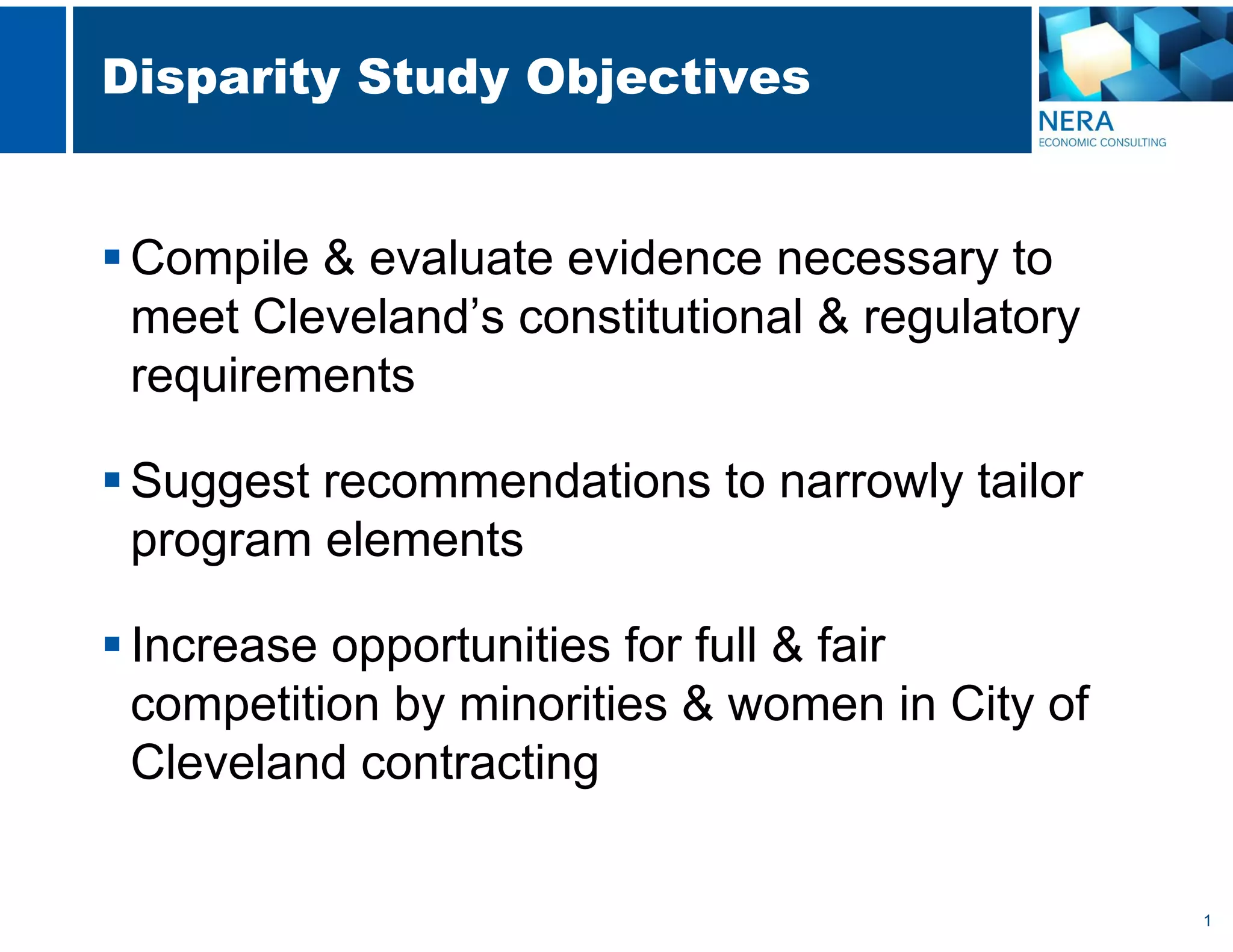
Disparity Study Objectives
Compile & evaluate evidence necessary to
meet Cleveland’s constitutional & regulatory
requirements
Suggest recommendations to narrowly tailor
program elements
Increase opportunities for full & fair
competition by minorities & women in City of
Cleveland contracting
2
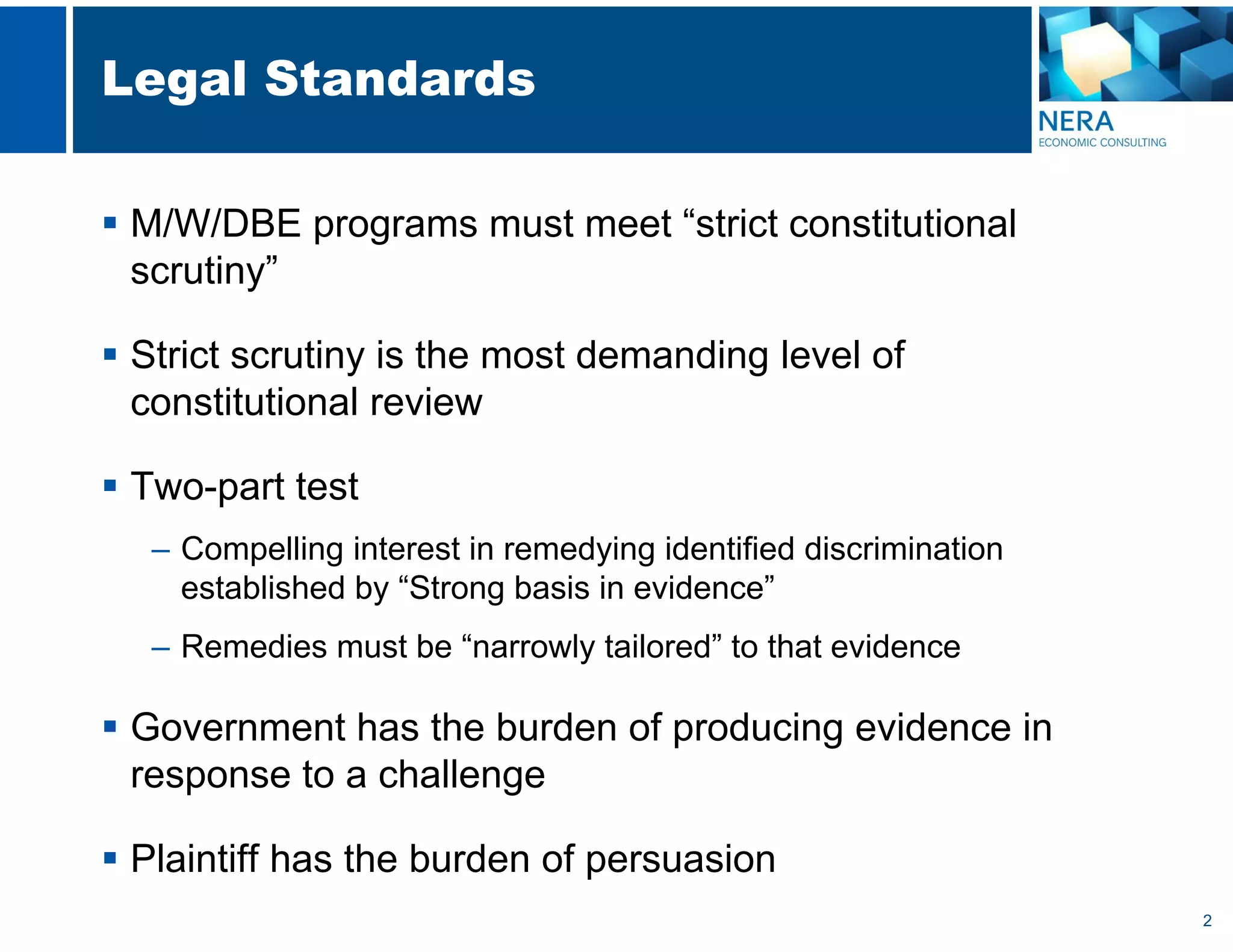
Legal Standards
 M/W/DBE programs must meet “strict constitutional
scrutiny”
 Strict scrutiny is the most demanding level of
constitutional review
 Two-part test
– Compelling interest in remedying identified discrimination
established by “Strong basis in evidence”
– Remedies must be “narrowly tailored” to that evidence
 Government has the burden of producing evidence in
response to a challenge
 Plaintiff has the burden of persuasion
3
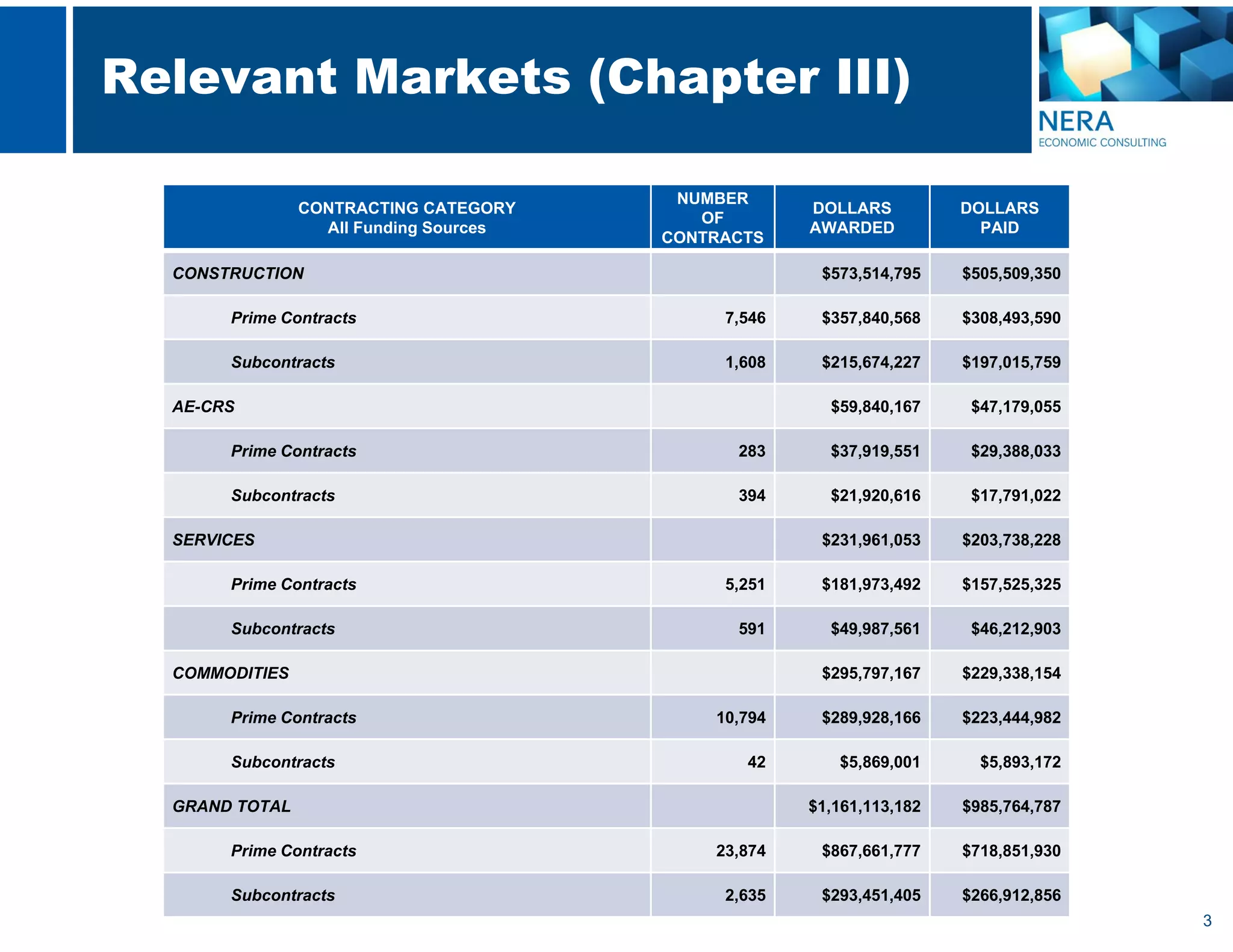
Relevant Markets (Chapter III)
CONTRACTING CATEGORY
All Funding Sources
NUMBER
OF
CONTRACTS
DOLLARS
AWARDED
DOLLARS
PAID
CONSTRUCTION $573,514,795 $505,509,350
Prime Contracts 7,546 $357,840,568 $308,493,590
Subcontracts 1,608 $215,674,227 $197,015,759
AE-CRS $59,840,167 $47,179,055
Prime Contracts 283 $37,919,551 $29,388,033
Subcontracts 394 $21,920,616 $17,791,022
SERVICES $231,961,053 $203,738,228
Prime Contracts 5,251 $181,973,492 $157,525,325
Subcontracts 591 $49,987,561 $46,212,903
COMMODITIES $295,797,167 $229,338,154
Prime Contracts 10,794 $289,928,166 $223,444,982
Subcontracts 42 $5,869,001 $5,893,172
GRAND TOTAL $1,161,113,182 $985,764,787
Prime Contracts 23,874 $867,661,777 $718,851,930
Subcontracts 2,635 $293,451,405 $266,912,856
4
Relevant Markets (Chapter III)
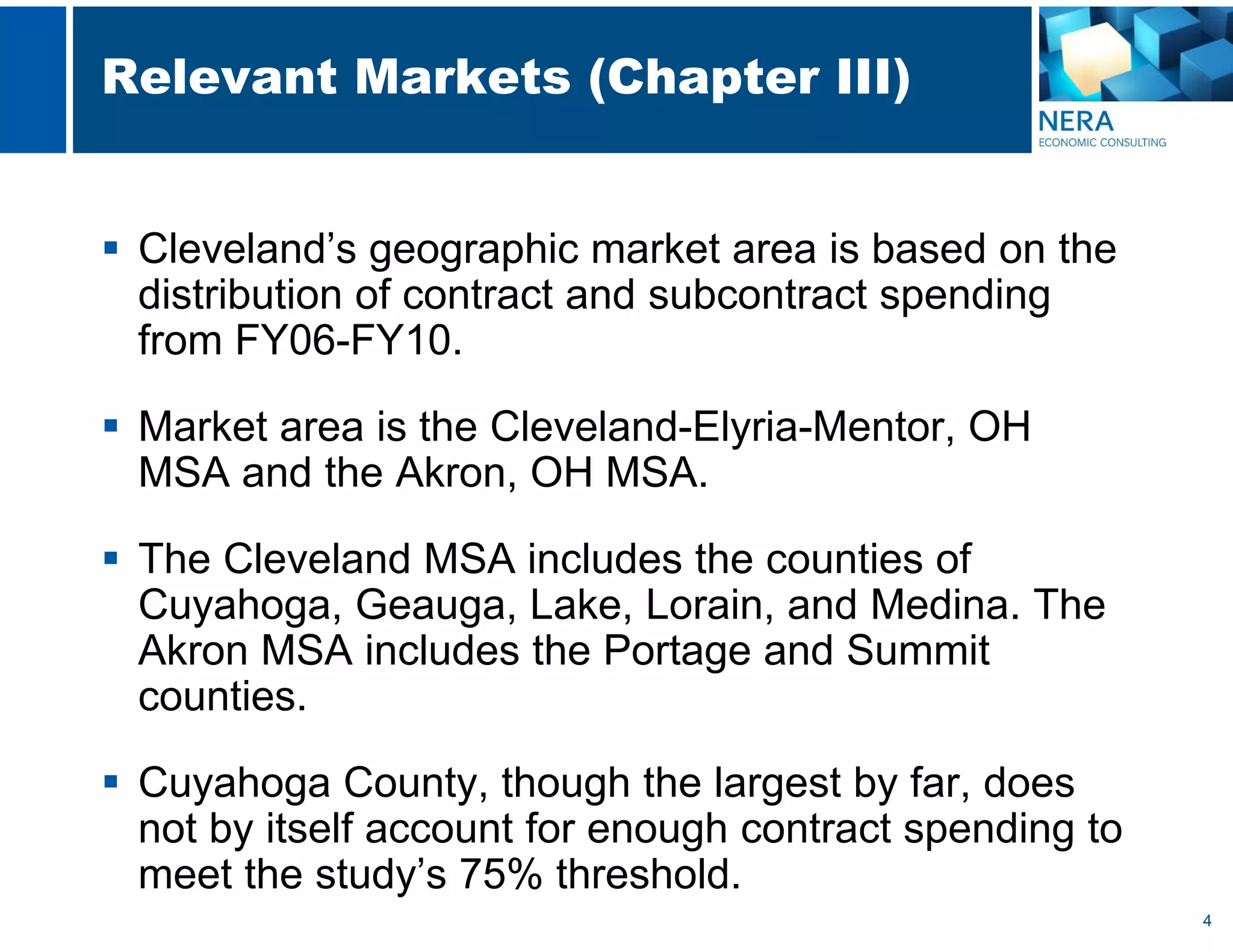
 Cleveland’s geographic market area is based on the
distribution of contract and subcontract spending
from FY06-FY10.
 Market area is the Cleveland-Elyria-Mentor, OH
MSA and the Akron, OH MSA.
 The Cleveland MSA includes the counties of
Cuyahoga, Geauga, Lake, Lorain, and Medina. The
Akron MSA includes the Portage and Summit
counties.
 Cuyahoga County, though the largest by far, does
not by itself account for enough contract spending to
meet the study’s 75% threshold.
5
M/W/DBE Availability (Chapter IV)
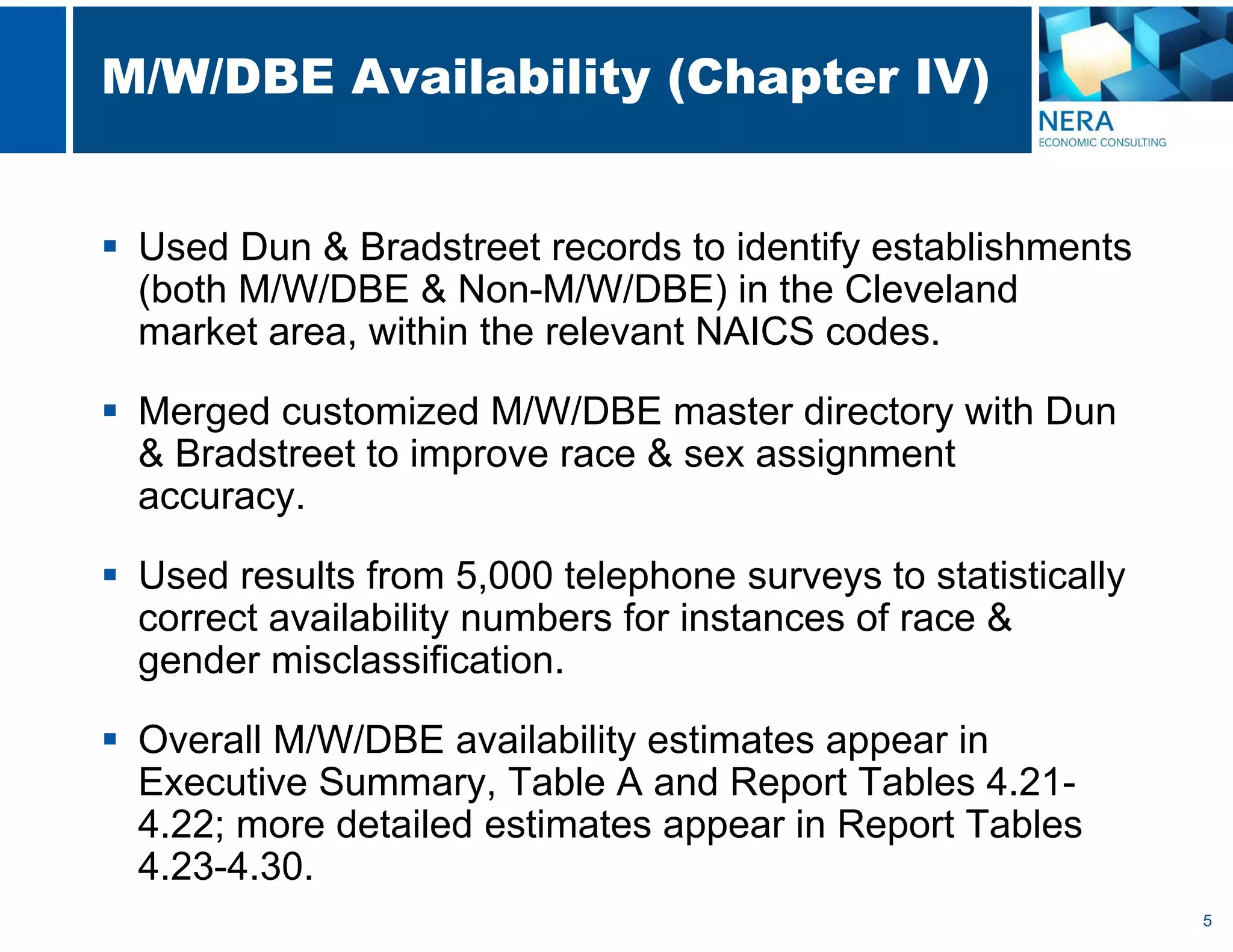
 Used Dun & Bradstreet records to identify establishments
(both M/W/DBE & Non-M/W/DBE) in the Cleveland
market area, within the relevant NAICS codes.
 Merged customized M/W/DBE master directory with Dun
& Bradstreet to improve race & sex assignment
accuracy.
 Used results from 5,000 telephone surveys to statistically
correct availability numbers for instances of race &
gender misclassification.
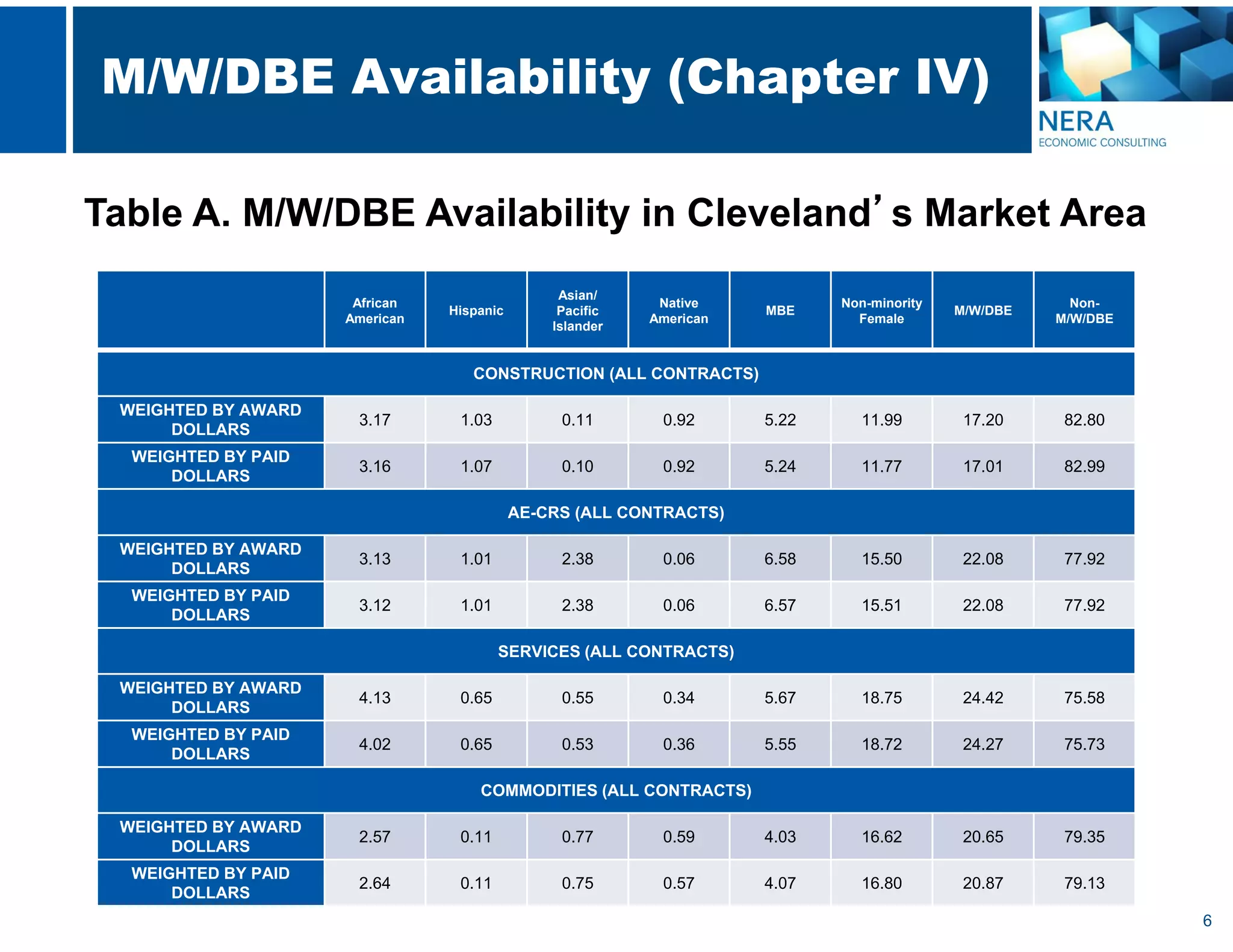
 Overall M/W/DBE availability estimates appear in
Executive Summary, Table A and Report Tables 4.21-
4.22; more detailed estimates appear in Report Tables
4.23-4.30.
6
M/W/DBE Availability (Chapter IV)
Table A. M/W/DBE Availability in Cleveland’s Market Area
African
American
Hispanic
Asian/
Pacific
Islander
Native
American
MBE
Non-minority
Female
M/W/DBE
Non-
M/W/DBE
CONSTRUCTION (ALL CONTRACTS)
WEIGHTED BY AWARD
DOLLARS
3.17 1.03 0.11 0.92 5.22 11.99 17.20 82.80
WEIGHTED BY PAID
DOLLARS
3.16 1.07 0.10 0.92 5.24 11.77 17.01 82.99
AE-CRS (ALL CONTRACTS)
WEIGHTED BY AWARD
DOLLARS
3.13 1.01 2.38 0.06 6.58 15.50 22.08 77.92
WEIGHTED BY PAID
DOLLARS
3.12 1.01 2.38 0.06 6.57 15.51 22.08 77.92
SERVICES (ALL CONTRACTS)
WEIGHTED BY AWARD
DOLLARS
4.13 0.65 0.55 0.34 5.67 18.75 24.42 75.58
WEIGHTED BY PAID
DOLLARS
4.02 0.65 0.53 0.36 5.55 18.72 24.27 75.73
COMMODITIES (ALL CONTRACTS)
WEIGHTED BY AWARD
DOLLARS
2.57 0.11 0.77 0.59 4.03 16.62 20.65 79.35
WEIGHTED BY PAID
DOLLARS
2.64 0.11 0.75 0.57 4.07 16.80 20.87 79.13
7
Market-Based Disparities
(Chapter V)
Construction Goods & Services
Wages
Business
Owner
Earnings
Business
Formation
Rate
Wages
Business
Owner
Earnings
Business
Formation
Rate
African
American
Adverse Adverse
Not
Adverse
Adverse Adverse Adverse
Hispanic Adverse Adverse
Not
Adverse
Adverse Adverse Adverse
Asian/Pacific
Islander
Adverse Adverse Adverse Adverse Adverse
Not
Adverse
Native
American
Adverse
Not
Adverse
Adverse Adverse Adverse
Not
Adverse
Non-minority
Female
Adverse Adverse Adverse Adverse Adverse Adverse
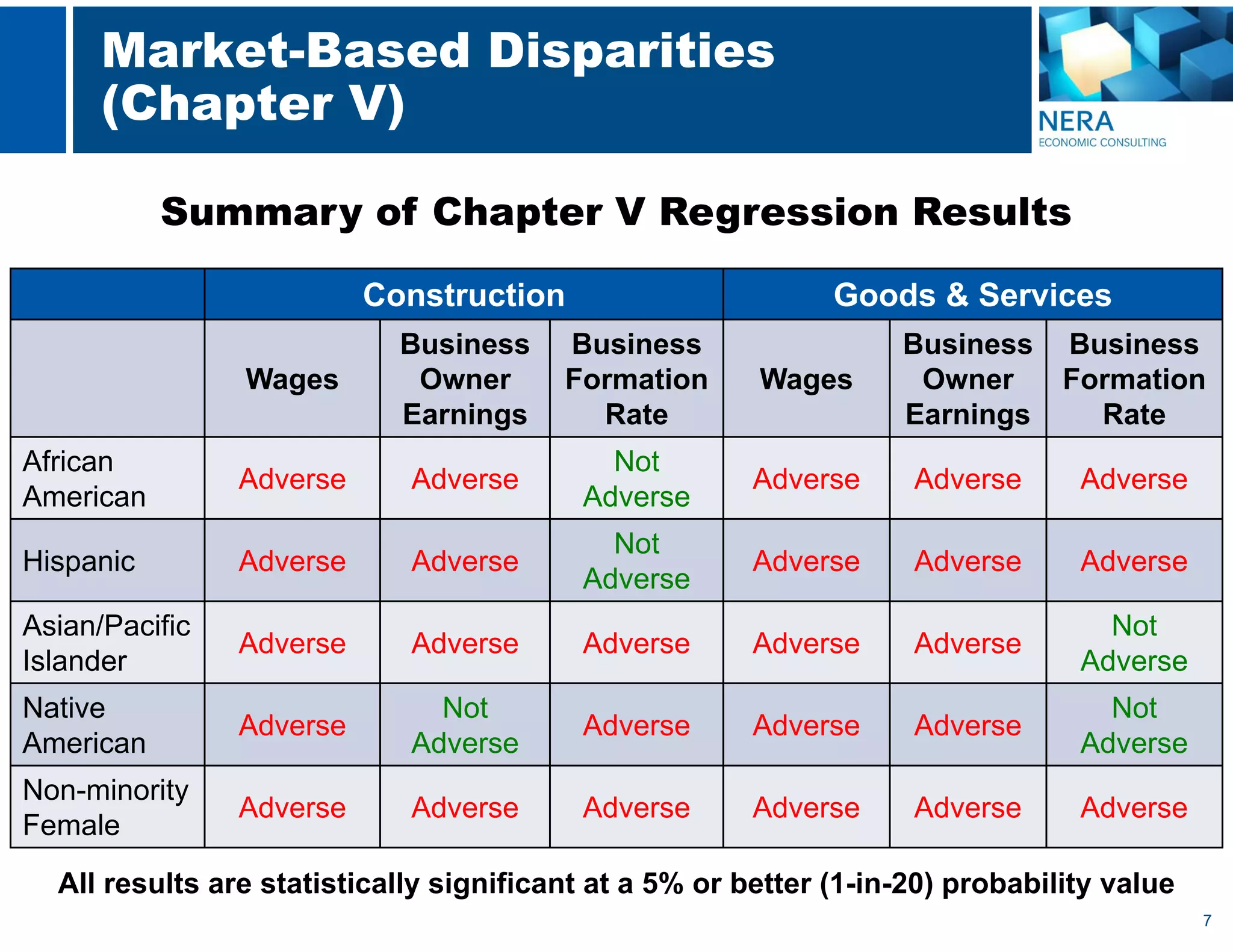
All results are statistically significant at a 5% or better (1-in-20) probability value
Summary of Chapter V Regression Results
8
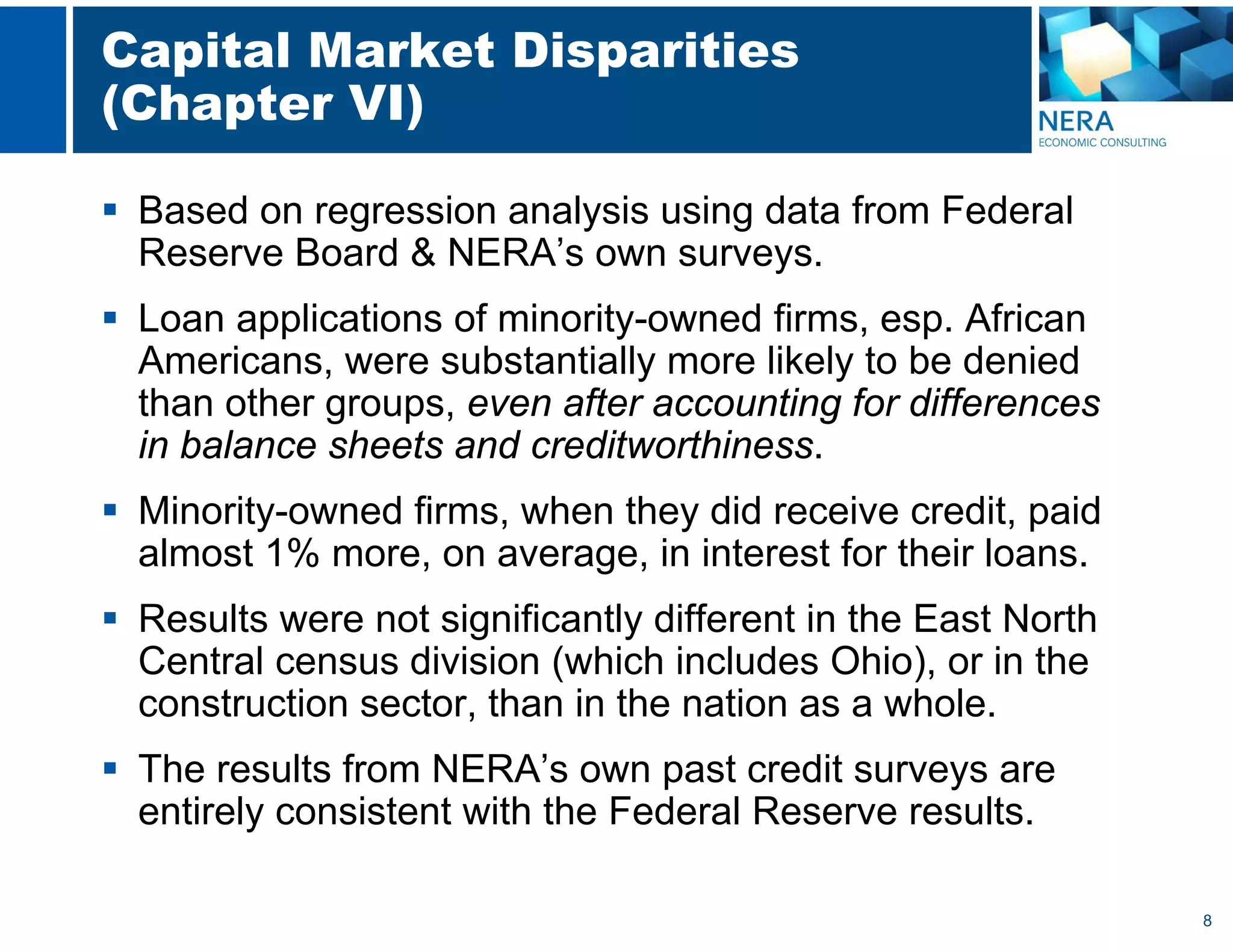
Capital Market Disparities
(Chapter VI)
 Based on regression analysis using data from Federal
Reserve Board & NERA’s own surveys.
 Loan applications of minority-owned firms, esp. African
Americans, were substantially more likely to be denied
than other groups, even after accounting for differences
in balance sheets and creditworthiness.
 Minority-owned firms, when they did receive credit, paid
almost 1% more, on average, in interest for their loans.
 Results were not significantly different in the East North
Central census division (which includes Ohio), or in the
construction sector, than in the nation as a whole.
 The results from NERA’s own past credit surveys are
entirely consistent with the Federal Reserve results.
9
Disparities in City Contracting
(Chapter VII)
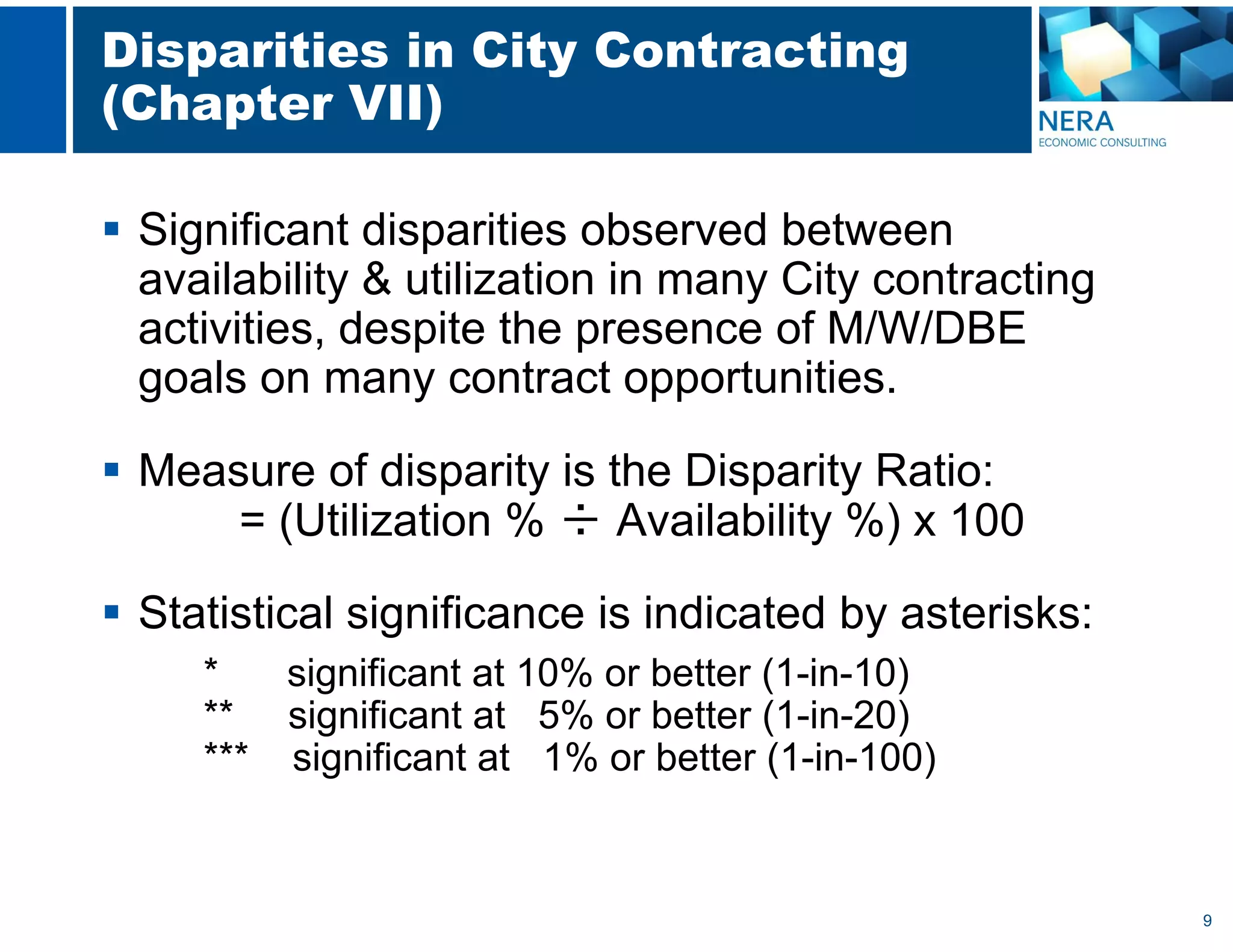
 Significant disparities observed between
availability & utilization in many City contracting
activities, despite the presence of M/W/DBE
goals on many contract opportunities.
 Measure of disparity is the Disparity Ratio:
= (Utilization % ÷ Availability %) x 100
 Statistical significance is indicated by asterisks:
* significant at 10% or better (1-in-10)
** significant at 5% or better (1-in-20)
*** significant at 1% or better (1-in-100)
10
Disparities in City Contracting
(Chapter VII)
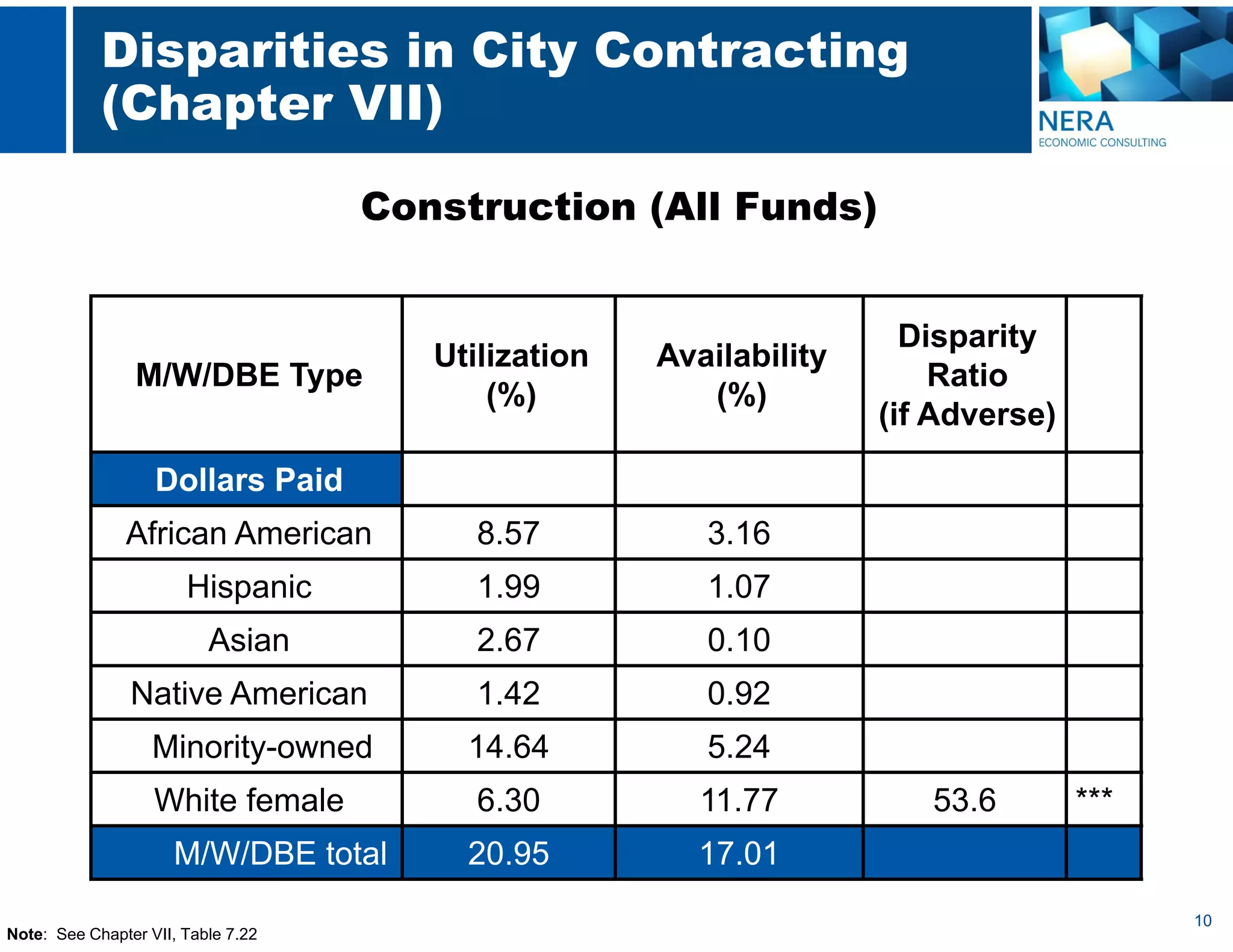
Construction (All Funds)
M/W/DBE Type
Utilization
(%)
Availability
(%)
Disparity
Ratio
(if Adverse)
Dollars Paid
African American 8.57 3.16
Hispanic 1.99 1.07
Asian 2.67 0.10
Native American 1.42 0.92
Minority-owned 14.64 5.24
White female 6.30 11.77 53.6 ***
M/W/DBE total 20.95 17.01
Note: See Chapter VII, Table 7.22
11
Disparities in City Contracting
(Chapter VII)
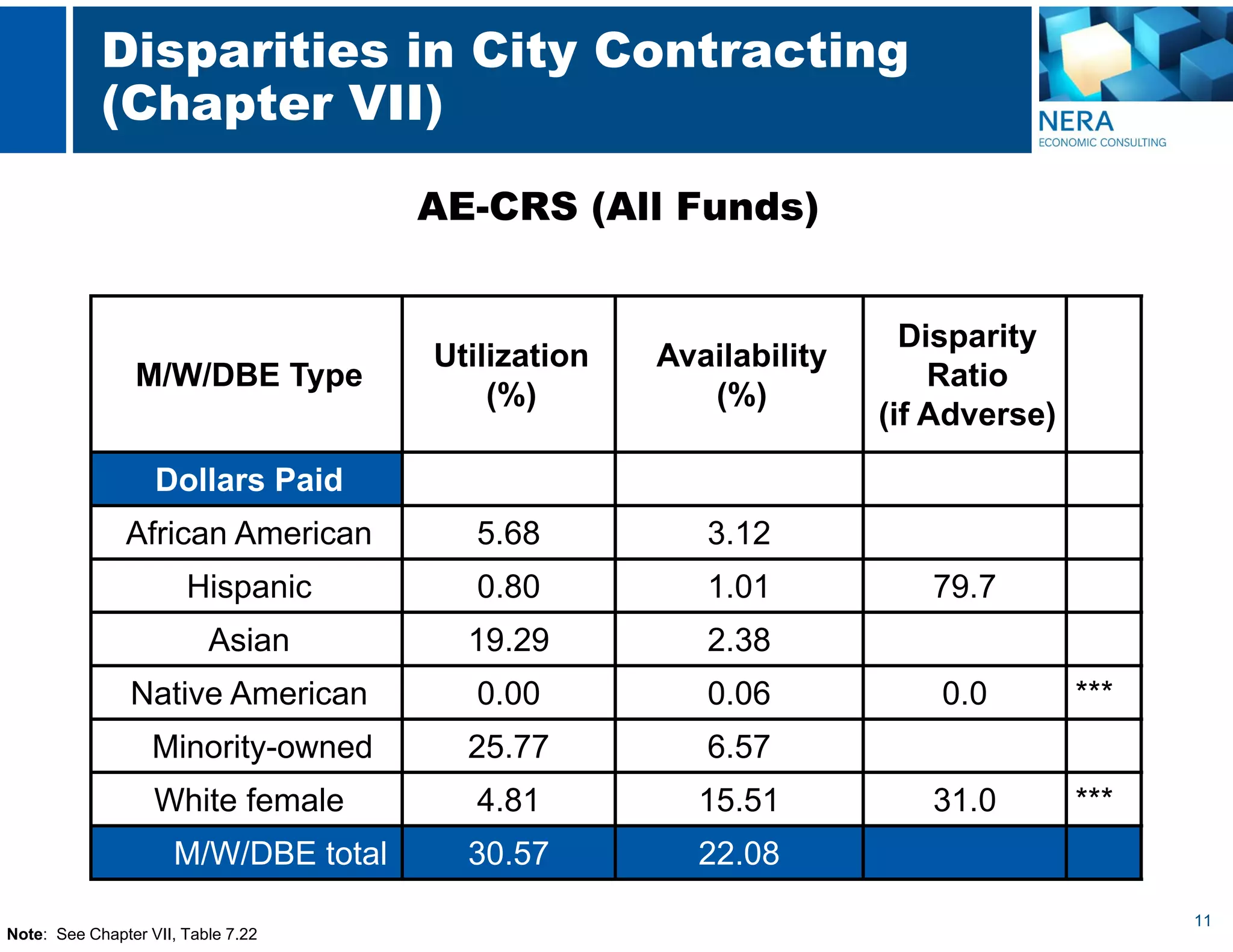
AE-CRS (All Funds)
M/W/DBE Type
Utilization
(%)
Availability
(%)
Disparity
Ratio
(if Adverse)
Dollars Paid
African American 5.68 3.12
Hispanic 0.80 1.01 79.7
Asian 19.29 2.38
Native American 0.00 0.06 0.0 ***
Minority-owned 25.77 6.57
White female 4.81 15.51 31.0 ***
M/W/DBE total 30.57 22.08
Note: See Chapter VII, Table 7.22
12
Disparities in City Contracting
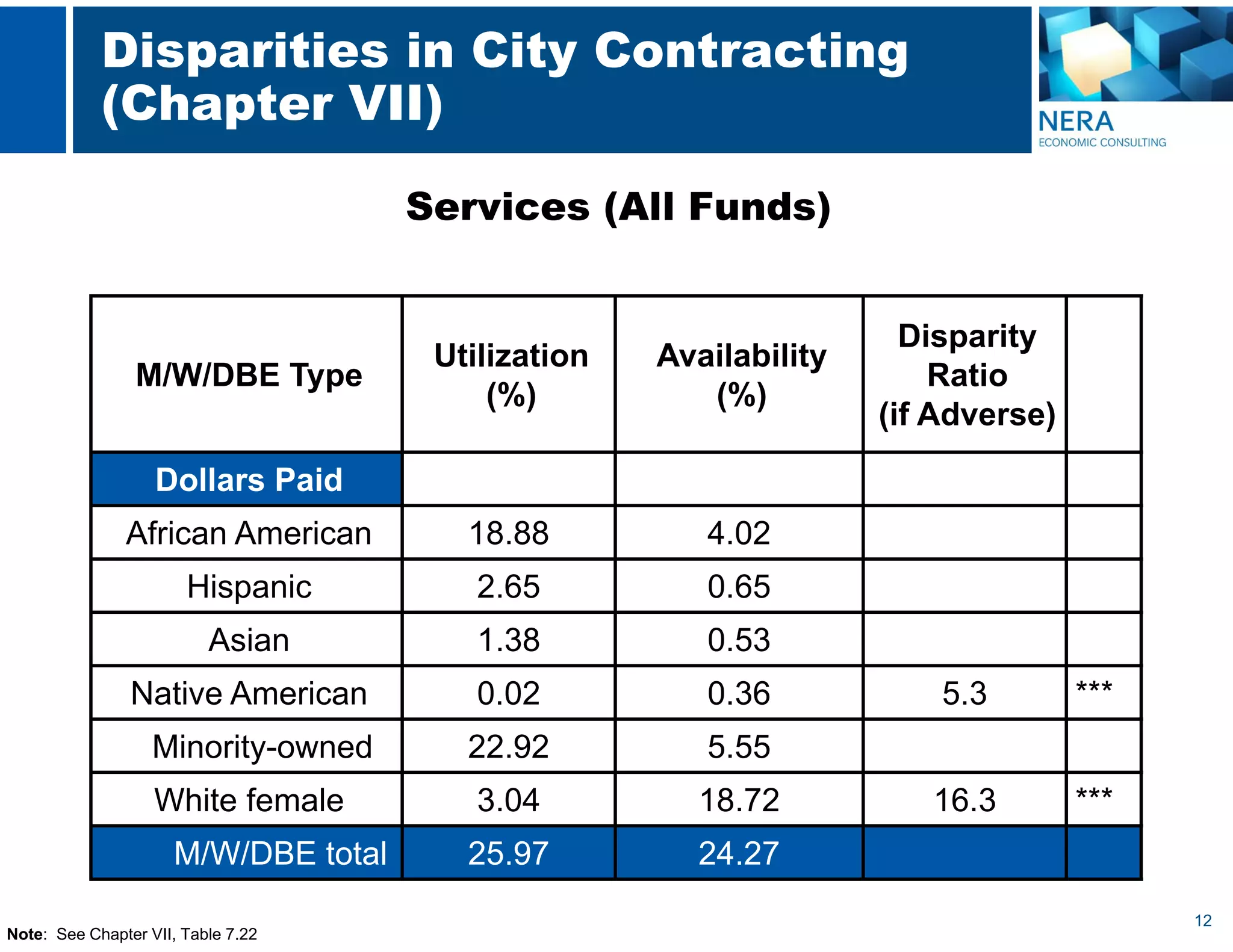
(Chapter VII)
Services (All Funds)
M/W/DBE Type
Utilization
(%)
Availability
(%)
Disparity
Ratio
(if Adverse)
Dollars Paid
African American 18.88 4.02
Hispanic 2.65 0.65
Asian 1.38 0.53
Native American 0.02 0.36 5.3 ***
Minority-owned 22.92 5.55
White female 3.04 18.72 16.3 ***
M/W/DBE total 25.97 24.27
Note: See Chapter VII, Table 7.22
13
Disparities in City Contracting
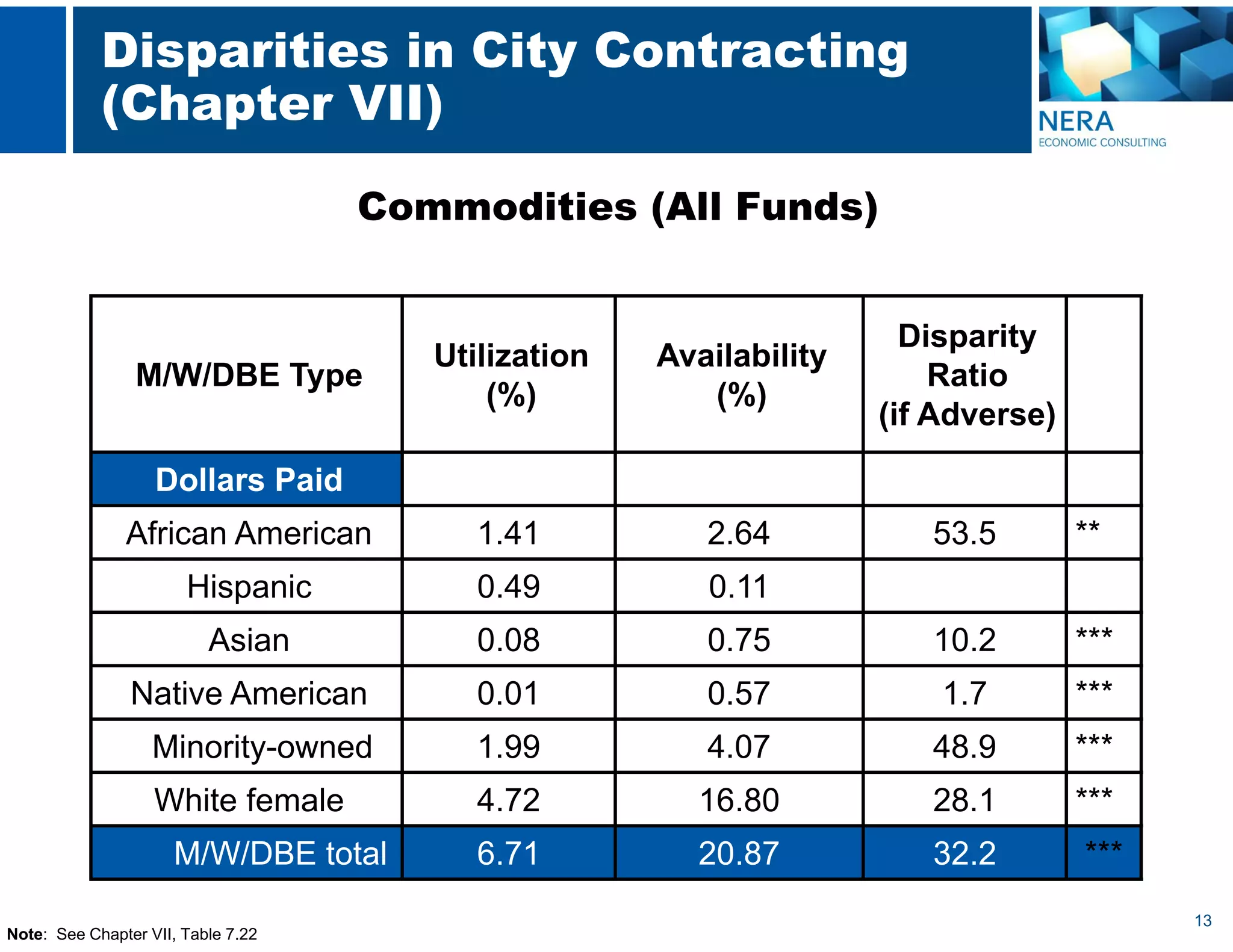
(Chapter VII)
Commodities (All Funds)
M/W/DBE Type
Utilization
(%)
Availability
(%)
Disparity
Ratio
(if Adverse)
Dollars Paid
African American 1.41 2.64 53.5 **
Hispanic 0.49 0.11
Asian 0.08 0.75 10.2 ***
Native American 0.01 0.57 1.7 ***
Minority-owned 1.99 4.07 48.9 ***
White female 4.72 16.80 28.1 ***
M/W/DBE total 6.71 20.87 32.2 ***
Note: See Chapter VII, Table 7.22
14
Anecdotal Evidence (Chapter VIII)
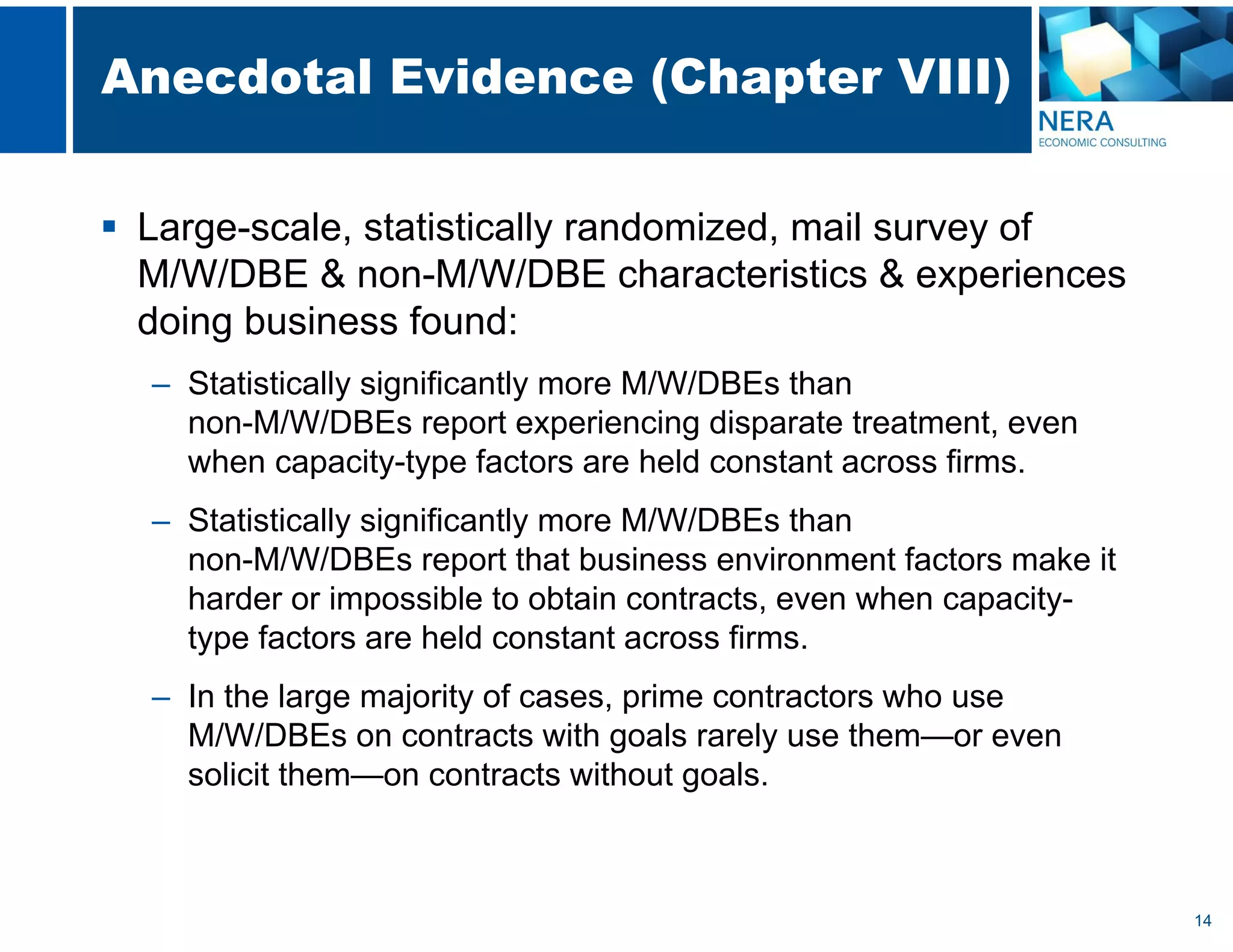
 Large-scale, statistically randomized, mail survey of
M/W/DBE & non-M/W/DBE characteristics & experiences
doing business found:
– Statistically significantly more M/W/DBEs than
non-M/W/DBEs report experiencing disparate treatment, even
when capacity-type factors are held constant across firms.
– Statistically significantly more M/W/DBEs than
non-M/W/DBEs report that business environment factors make it
harder or impossible to obtain contracts, even when capacity-
type factors are held constant across firms.
– In the large majority of cases, prime contractors who use
M/W/DBEs on contracts with goals rarely use them—or even
solicit them—on contracts without goals.
15
Anecdotal Evidence (Chapter VIII)
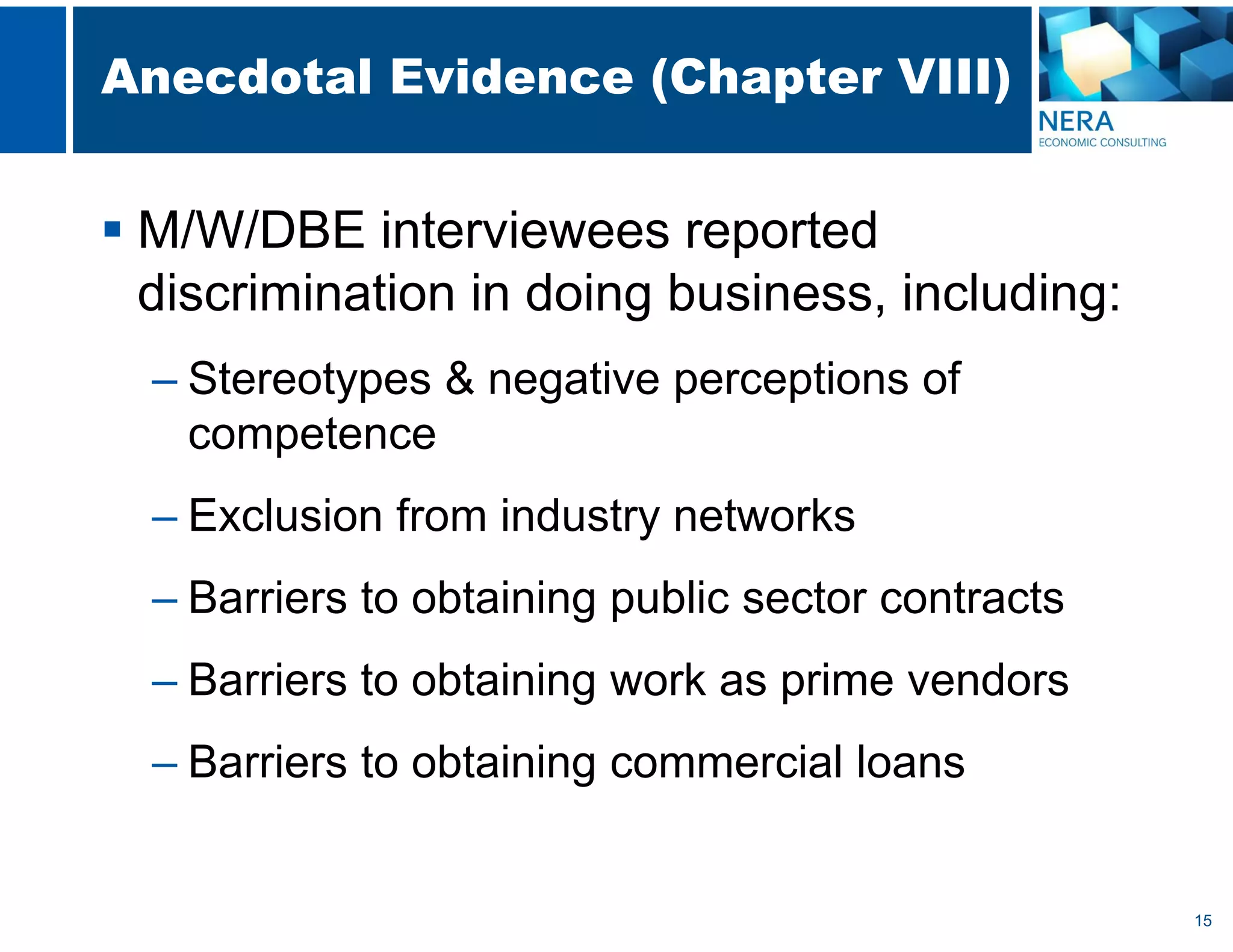
 M/W/DBE interviewees reported
discrimination in doing business, including:
– Stereotypes & negative perceptions of
competence
– Exclusion from industry networks
– Barriers to obtaining public sector contracts
– Barriers to obtaining work as prime vendors
– Barriers to obtaining commercial loans
16
M/F/DBE & CSB Program Overview &
Feedback Interviews (Chapter IX)
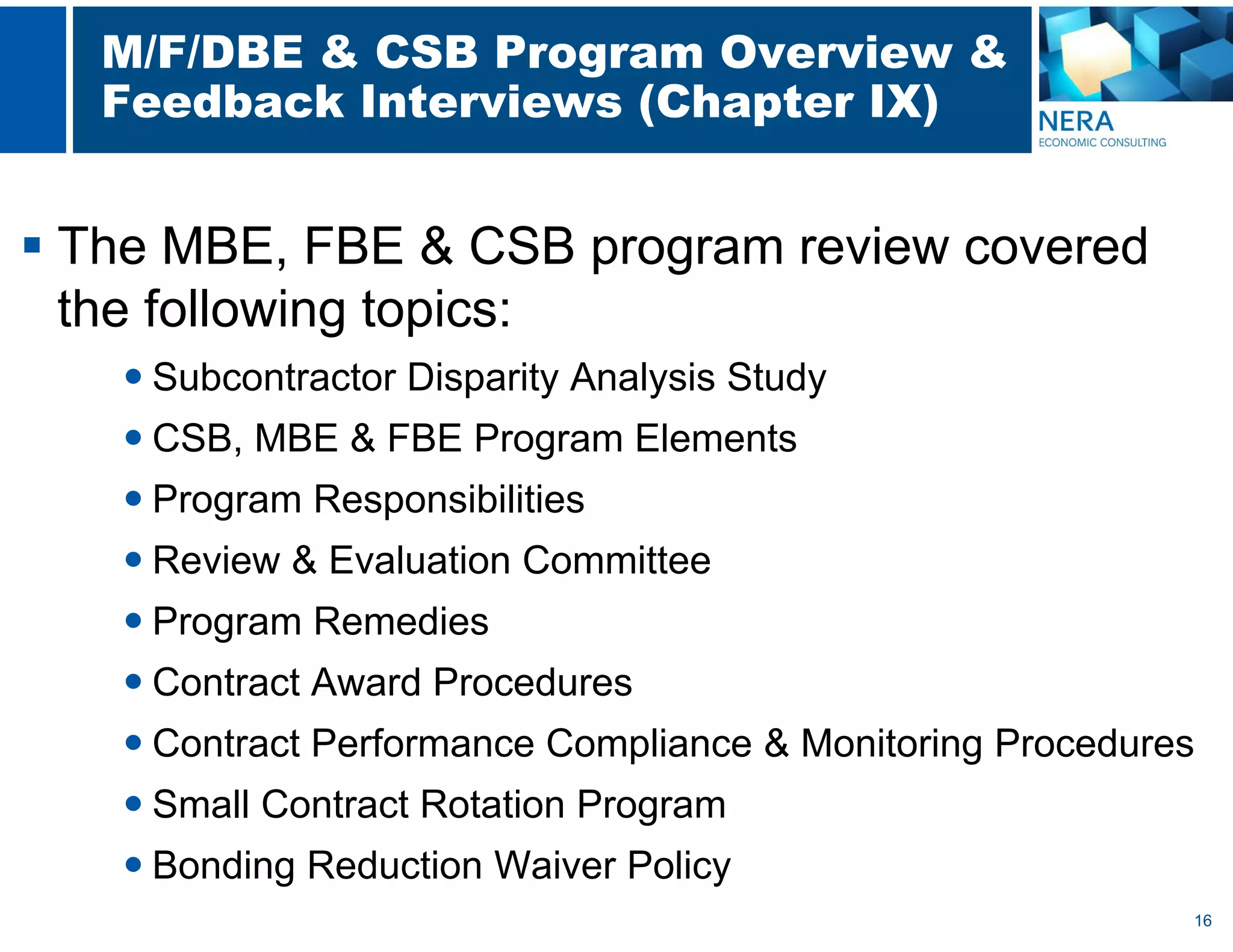
 The MBE, FBE & CSB program review covered
the following topics:
 Subcontractor Disparity Analysis Study
 CSB, MBE & FBE Program Elements
 Program Responsibilities
 Review & Evaluation Committee
 Program Remedies
 Contract Award Procedures
 Contract Performance Compliance & Monitoring Procedures
 Small Contract Rotation Program
 Bonding Reduction Waiver Policy
17
M/F/DBE & CSB Program Overview &
Feedback Interviews (Chapter IX)
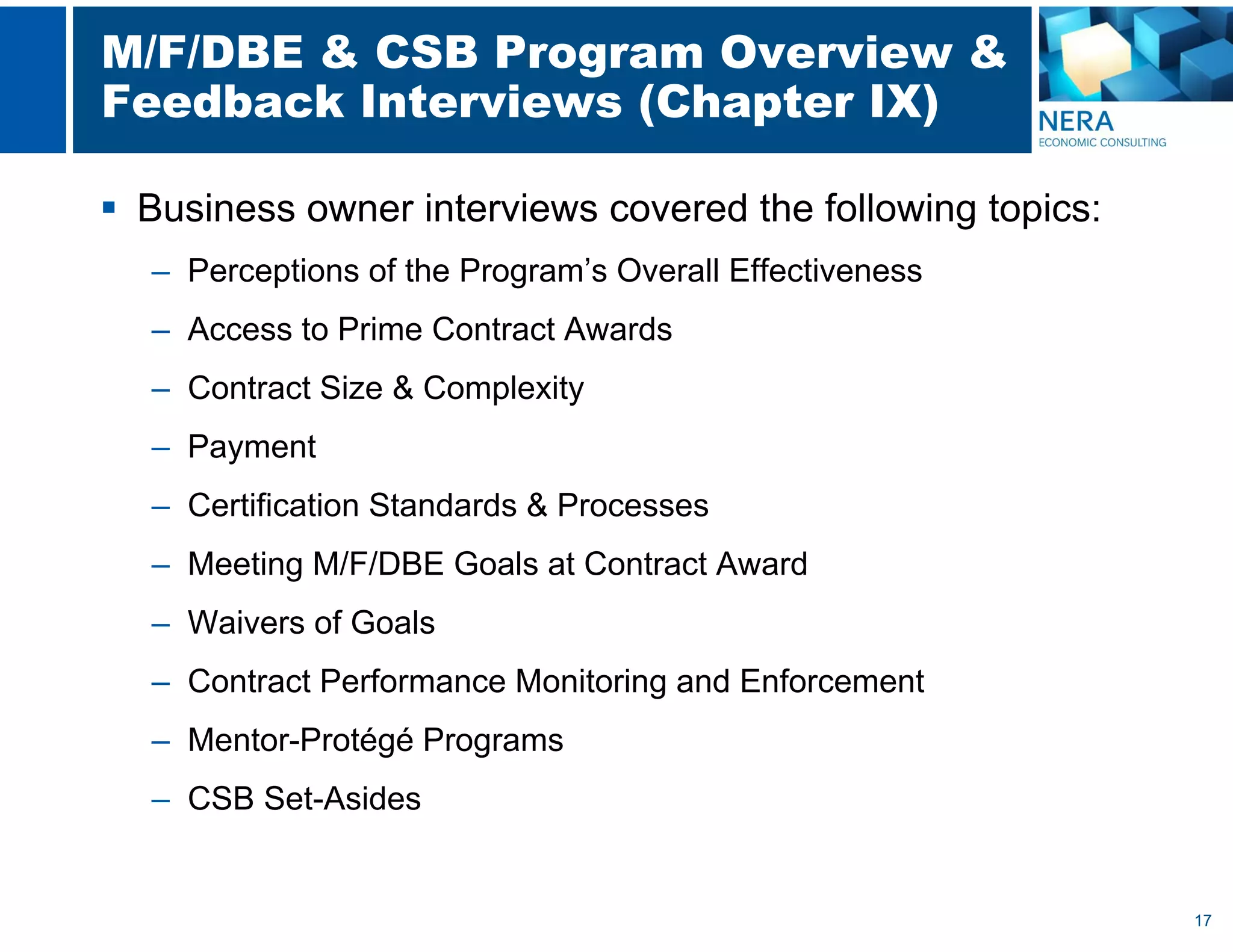
 Business owner interviews covered the following topics:
– Perceptions of the Program’s Overall Effectiveness
– Access to Prime Contract Awards
– Contract Size & Complexity
– Payment
– Certification Standards & Processes
– Meeting M/F/DBE Goals at Contract Award
– Waivers of Goals
– Contract Performance Monitoring and Enforcement
– Mentor-Protégé Programs
– CSB Set-Asides
18
Recommendations
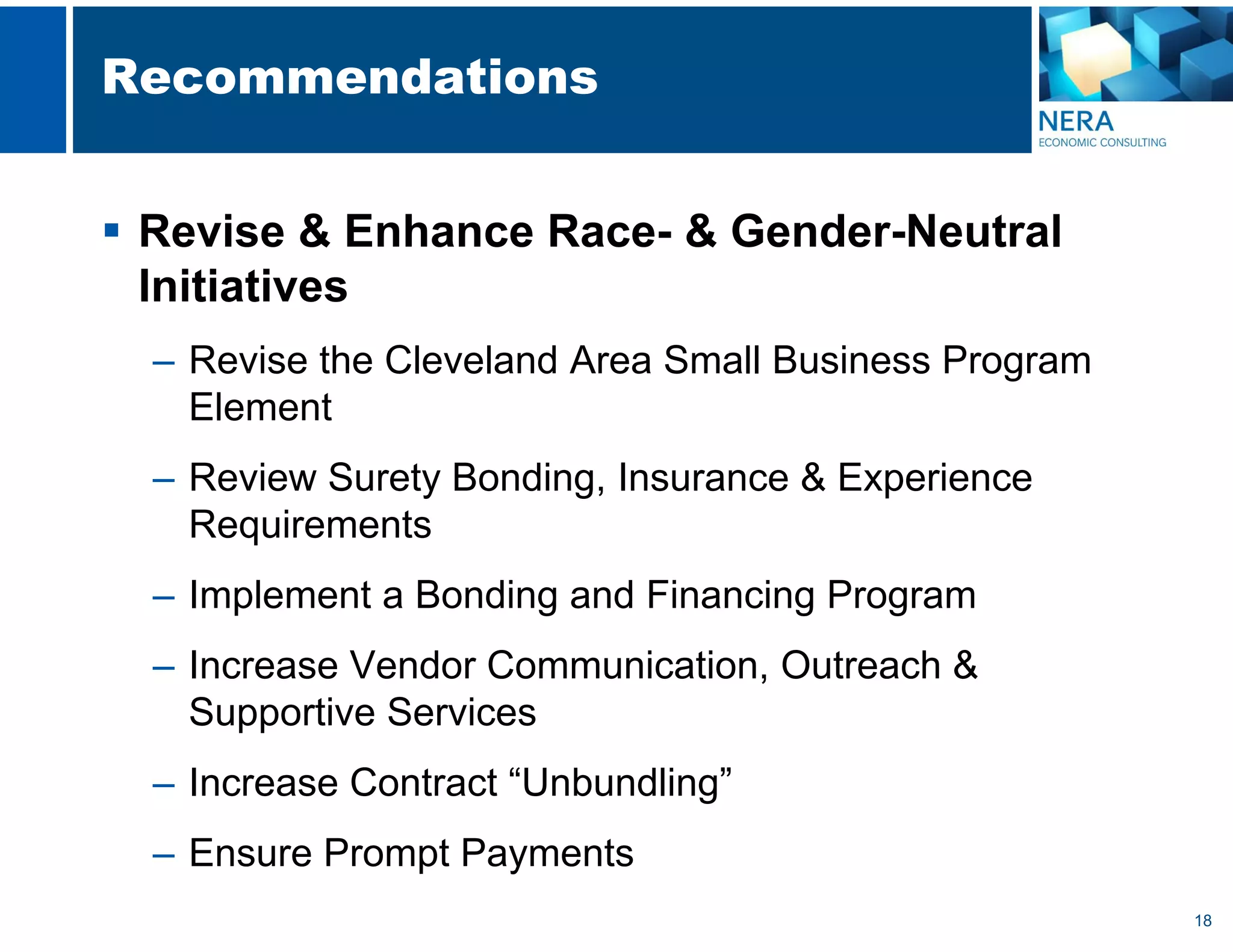
 Revise & Enhance Race- & Gender-Neutral
Initiatives
– Revise the Cleveland Area Small Business Program
Element
– Review Surety Bonding, Insurance & Experience
Requirements
– Implement a Bonding and Financing Program
– Increase Vendor Communication, Outreach &
Supportive Services
– Increase Contract “Unbundling”
– Ensure Prompt Payments
19
Recommendations
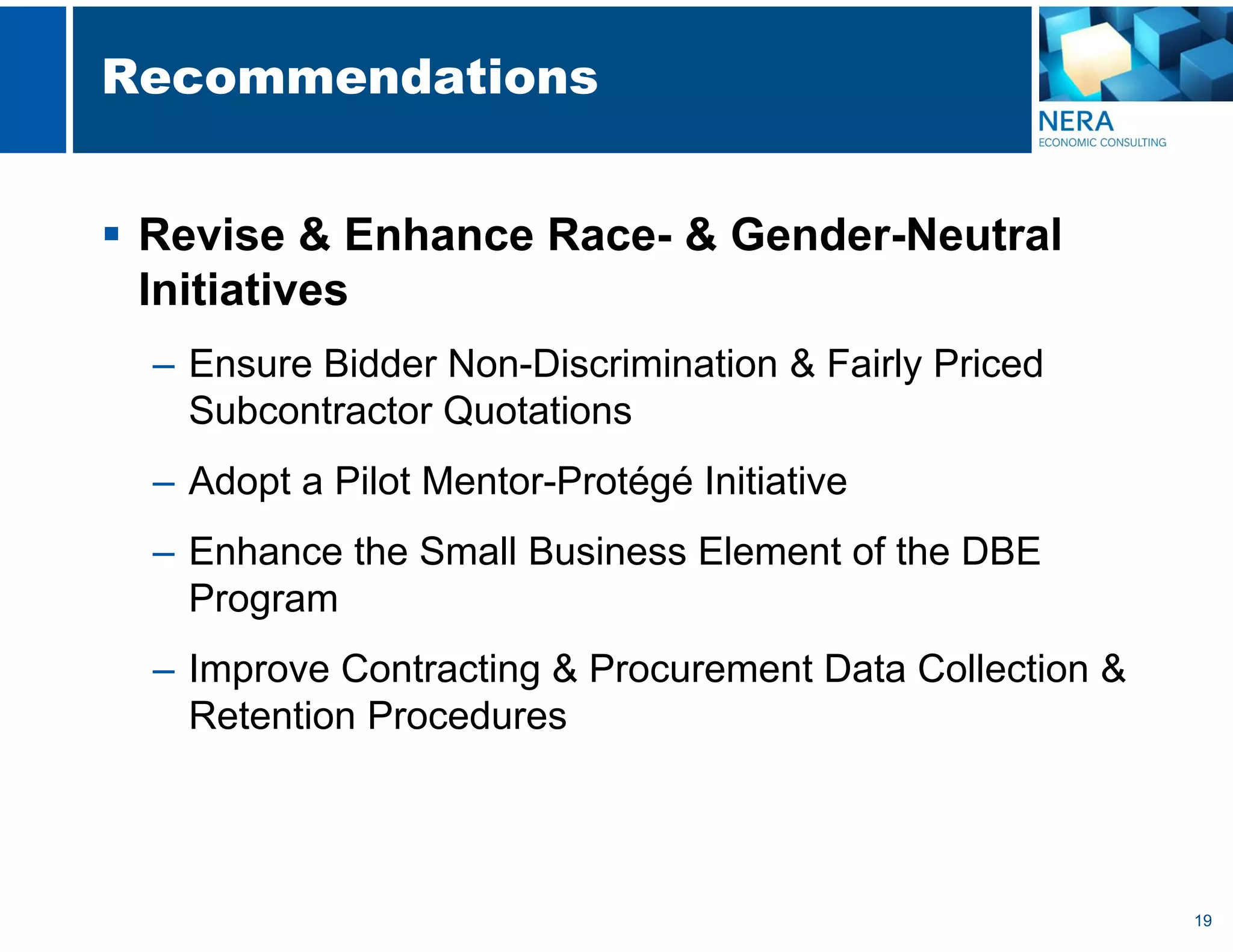
 Revise & Enhance Race- & Gender-Neutral
Initiatives
– Ensure Bidder Non-Discrimination & Fairly Priced
Subcontractor Quotations
– Adopt a Pilot Mentor-Protégé Initiative
– Enhance the Small Business Element of the DBE
Program
– Improve Contracting & Procurement Data Collection &
Retention Procedures
20
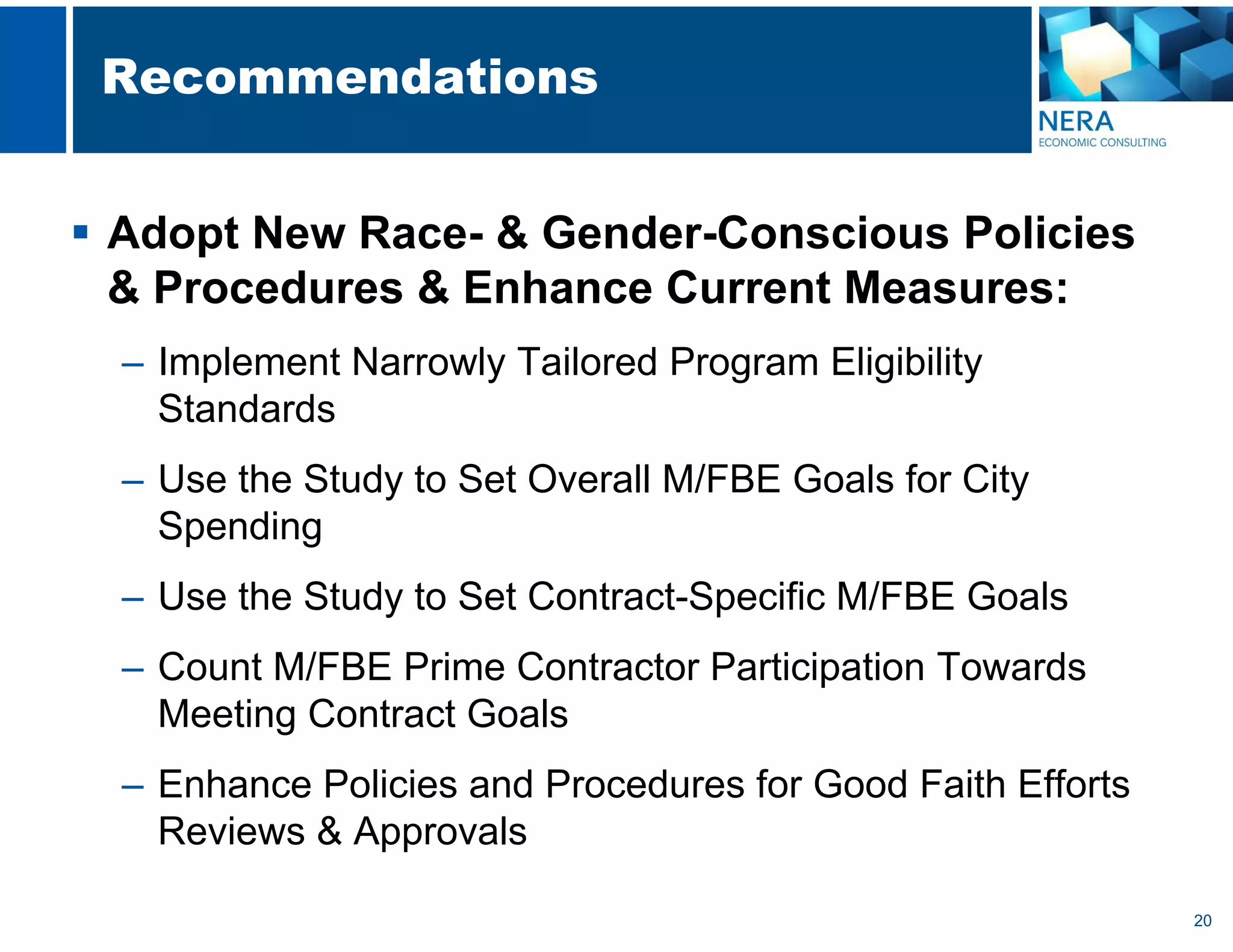
Recommendations
 Adopt New Race- & Gender-Conscious Policies
& Procedures & Enhance Current Measures:
– Implement Narrowly Tailored Program Eligibility
Standards
– Use the Study to Set Overall M/FBE Goals for City
Spending
– Use the Study to Set Contract-Specific M/FBE Goals
– Count M/FBE Prime Contractor Participation Towards
Meeting Contract Goals
– Enhance Policies and Procedures for Good Faith Efforts
Reviews & Approvals
21
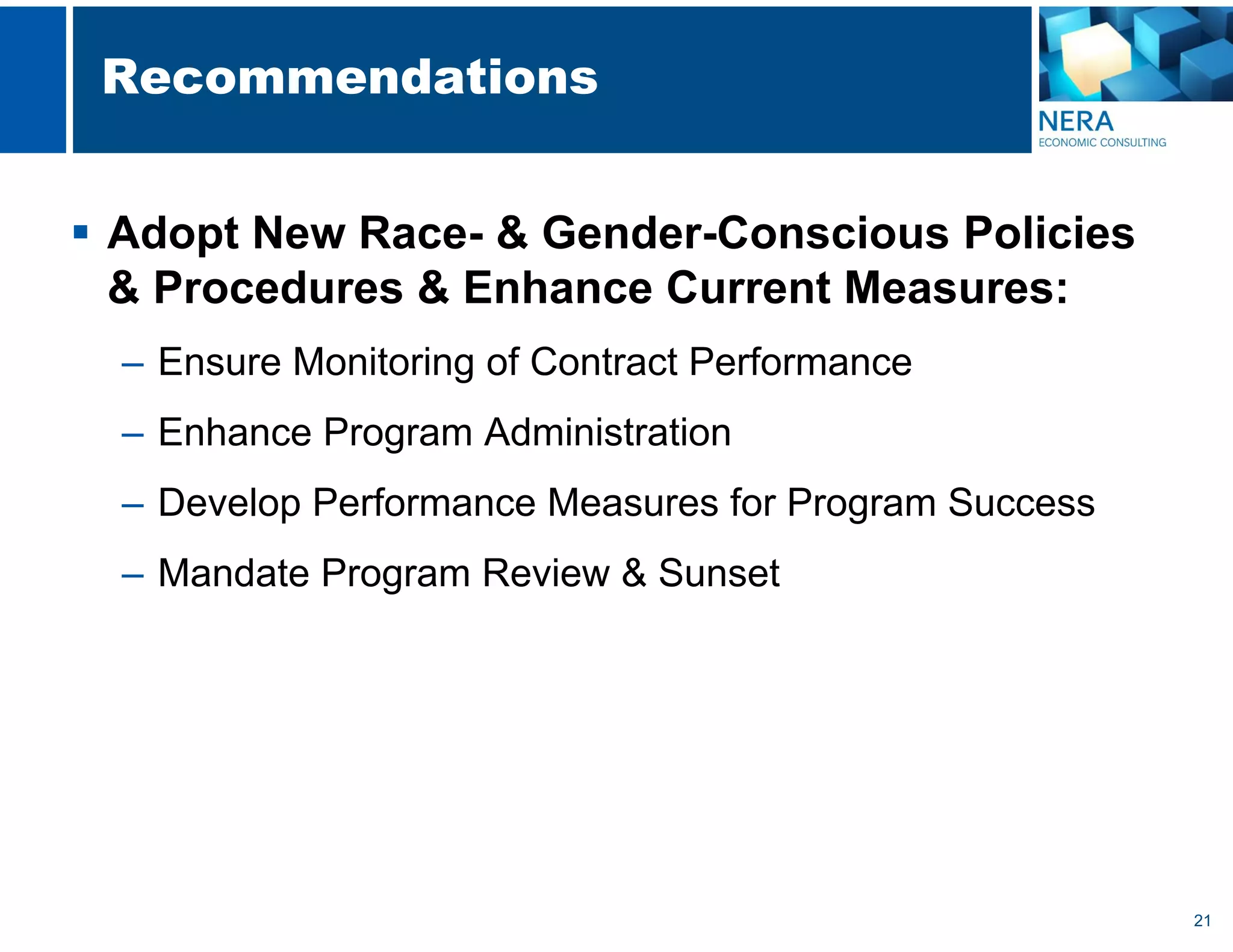
Recommendations
 Adopt New Race- & Gender-Conscious Policies
& Procedures & Enhance Current Measures:
– Ensure Monitoring of Contract Performance
– Enhance Program Administration
– Develop Performance Measures for Program Success
– Mandate Program Review & Sunset

Big Ideas for Small Business: NERA Cleveland Final Presentation- short version

  • 1.
    Disparity Study Data,Methods, Findings & Conclusions Cleveland, Ohio 5 February 2013 Jon Wainwright, Ph.D. Colette Holt, Esq. Sr. Vice President, NERA Colette Holt & Associates Prepared for the City of Cleveland
  • 2.
    1 Disparity Study Objectives Compile& evaluate evidence necessary to meet Cleveland’s constitutional & regulatory requirements Suggest recommendations to narrowly tailor program elements Increase opportunities for full & fair competition by minorities & women in City of Cleveland contracting
  • 3.
    2 Legal Standards  M/W/DBEprograms must meet “strict constitutional scrutiny”  Strict scrutiny is the most demanding level of constitutional review  Two-part test – Compelling interest in remedying identified discrimination established by “Strong basis in evidence” – Remedies must be “narrowly tailored” to that evidence  Government has the burden of producing evidence in response to a challenge  Plaintiff has the burden of persuasion
  • 4.
    3 Relevant Markets (ChapterIII) CONTRACTING CATEGORY All Funding Sources NUMBER OF CONTRACTS DOLLARS AWARDED DOLLARS PAID CONSTRUCTION $573,514,795 $505,509,350 Prime Contracts 7,546 $357,840,568 $308,493,590 Subcontracts 1,608 $215,674,227 $197,015,759 AE-CRS $59,840,167 $47,179,055 Prime Contracts 283 $37,919,551 $29,388,033 Subcontracts 394 $21,920,616 $17,791,022 SERVICES $231,961,053 $203,738,228 Prime Contracts 5,251 $181,973,492 $157,525,325 Subcontracts 591 $49,987,561 $46,212,903 COMMODITIES $295,797,167 $229,338,154 Prime Contracts 10,794 $289,928,166 $223,444,982 Subcontracts 42 $5,869,001 $5,893,172 GRAND TOTAL $1,161,113,182 $985,764,787 Prime Contracts 23,874 $867,661,777 $718,851,930 Subcontracts 2,635 $293,451,405 $266,912,856
  • 5.
    4 Relevant Markets (ChapterIII)  Cleveland’s geographic market area is based on the distribution of contract and subcontract spending from FY06-FY10.  Market area is the Cleveland-Elyria-Mentor, OH MSA and the Akron, OH MSA.  The Cleveland MSA includes the counties of Cuyahoga, Geauga, Lake, Lorain, and Medina. The Akron MSA includes the Portage and Summit counties.  Cuyahoga County, though the largest by far, does not by itself account for enough contract spending to meet the study’s 75% threshold.
  • 6.
    5 M/W/DBE Availability (ChapterIV)  Used Dun & Bradstreet records to identify establishments (both M/W/DBE & Non-M/W/DBE) in the Cleveland market area, within the relevant NAICS codes.  Merged customized M/W/DBE master directory with Dun & Bradstreet to improve race & sex assignment accuracy.  Used results from 5,000 telephone surveys to statistically correct availability numbers for instances of race & gender misclassification.  Overall M/W/DBE availability estimates appear in Executive Summary, Table A and Report Tables 4.21- 4.22; more detailed estimates appear in Report Tables 4.23-4.30.
  • 7.
    6 M/W/DBE Availability (ChapterIV) Table A. M/W/DBE Availability in Cleveland’s Market Area African American Hispanic Asian/ Pacific Islander Native American MBE Non-minority Female M/W/DBE Non- M/W/DBE CONSTRUCTION (ALL CONTRACTS) WEIGHTED BY AWARD DOLLARS 3.17 1.03 0.11 0.92 5.22 11.99 17.20 82.80 WEIGHTED BY PAID DOLLARS 3.16 1.07 0.10 0.92 5.24 11.77 17.01 82.99 AE-CRS (ALL CONTRACTS) WEIGHTED BY AWARD DOLLARS 3.13 1.01 2.38 0.06 6.58 15.50 22.08 77.92 WEIGHTED BY PAID DOLLARS 3.12 1.01 2.38 0.06 6.57 15.51 22.08 77.92 SERVICES (ALL CONTRACTS) WEIGHTED BY AWARD DOLLARS 4.13 0.65 0.55 0.34 5.67 18.75 24.42 75.58 WEIGHTED BY PAID DOLLARS 4.02 0.65 0.53 0.36 5.55 18.72 24.27 75.73 COMMODITIES (ALL CONTRACTS) WEIGHTED BY AWARD DOLLARS 2.57 0.11 0.77 0.59 4.03 16.62 20.65 79.35 WEIGHTED BY PAID DOLLARS 2.64 0.11 0.75 0.57 4.07 16.80 20.87 79.13
  • 8.
    7 Market-Based Disparities (Chapter V) ConstructionGoods & Services Wages Business Owner Earnings Business Formation Rate Wages Business Owner Earnings Business Formation Rate African American Adverse Adverse Not Adverse Adverse Adverse Adverse Hispanic Adverse Adverse Not Adverse Adverse Adverse Adverse Asian/Pacific Islander Adverse Adverse Adverse Adverse Adverse Not Adverse Native American Adverse Not Adverse Adverse Adverse Adverse Not Adverse Non-minority Female Adverse Adverse Adverse Adverse Adverse Adverse All results are statistically significant at a 5% or better (1-in-20) probability value Summary of Chapter V Regression Results
  • 9.
    8 Capital Market Disparities (ChapterVI)  Based on regression analysis using data from Federal Reserve Board & NERA’s own surveys.  Loan applications of minority-owned firms, esp. African Americans, were substantially more likely to be denied than other groups, even after accounting for differences in balance sheets and creditworthiness.  Minority-owned firms, when they did receive credit, paid almost 1% more, on average, in interest for their loans.  Results were not significantly different in the East North Central census division (which includes Ohio), or in the construction sector, than in the nation as a whole.  The results from NERA’s own past credit surveys are entirely consistent with the Federal Reserve results.
  • 10.
    9 Disparities in CityContracting (Chapter VII)  Significant disparities observed between availability & utilization in many City contracting activities, despite the presence of M/W/DBE goals on many contract opportunities.  Measure of disparity is the Disparity Ratio: = (Utilization % ÷ Availability %) x 100  Statistical significance is indicated by asterisks: * significant at 10% or better (1-in-10) ** significant at 5% or better (1-in-20) *** significant at 1% or better (1-in-100)
  • 11.
    10 Disparities in CityContracting (Chapter VII) Construction (All Funds) M/W/DBE Type Utilization (%) Availability (%) Disparity Ratio (if Adverse) Dollars Paid African American 8.57 3.16 Hispanic 1.99 1.07 Asian 2.67 0.10 Native American 1.42 0.92 Minority-owned 14.64 5.24 White female 6.30 11.77 53.6 *** M/W/DBE total 20.95 17.01 Note: See Chapter VII, Table 7.22
  • 12.
    11 Disparities in CityContracting (Chapter VII) AE-CRS (All Funds) M/W/DBE Type Utilization (%) Availability (%) Disparity Ratio (if Adverse) Dollars Paid African American 5.68 3.12 Hispanic 0.80 1.01 79.7 Asian 19.29 2.38 Native American 0.00 0.06 0.0 *** Minority-owned 25.77 6.57 White female 4.81 15.51 31.0 *** M/W/DBE total 30.57 22.08 Note: See Chapter VII, Table 7.22
  • 13.
    12 Disparities in CityContracting (Chapter VII) Services (All Funds) M/W/DBE Type Utilization (%) Availability (%) Disparity Ratio (if Adverse) Dollars Paid African American 18.88 4.02 Hispanic 2.65 0.65 Asian 1.38 0.53 Native American 0.02 0.36 5.3 *** Minority-owned 22.92 5.55 White female 3.04 18.72 16.3 *** M/W/DBE total 25.97 24.27 Note: See Chapter VII, Table 7.22
  • 14.
    13 Disparities in CityContracting (Chapter VII) Commodities (All Funds) M/W/DBE Type Utilization (%) Availability (%) Disparity Ratio (if Adverse) Dollars Paid African American 1.41 2.64 53.5 ** Hispanic 0.49 0.11 Asian 0.08 0.75 10.2 *** Native American 0.01 0.57 1.7 *** Minority-owned 1.99 4.07 48.9 *** White female 4.72 16.80 28.1 *** M/W/DBE total 6.71 20.87 32.2 *** Note: See Chapter VII, Table 7.22
  • 15.
    14 Anecdotal Evidence (ChapterVIII)  Large-scale, statistically randomized, mail survey of M/W/DBE & non-M/W/DBE characteristics & experiences doing business found: – Statistically significantly more M/W/DBEs than non-M/W/DBEs report experiencing disparate treatment, even when capacity-type factors are held constant across firms. – Statistically significantly more M/W/DBEs than non-M/W/DBEs report that business environment factors make it harder or impossible to obtain contracts, even when capacity- type factors are held constant across firms. – In the large majority of cases, prime contractors who use M/W/DBEs on contracts with goals rarely use them—or even solicit them—on contracts without goals.
  • 16.
    15 Anecdotal Evidence (ChapterVIII)  M/W/DBE interviewees reported discrimination in doing business, including: – Stereotypes & negative perceptions of competence – Exclusion from industry networks – Barriers to obtaining public sector contracts – Barriers to obtaining work as prime vendors – Barriers to obtaining commercial loans
  • 17.
    16 M/F/DBE & CSBProgram Overview & Feedback Interviews (Chapter IX)  The MBE, FBE & CSB program review covered the following topics:  Subcontractor Disparity Analysis Study  CSB, MBE & FBE Program Elements  Program Responsibilities  Review & Evaluation Committee  Program Remedies  Contract Award Procedures  Contract Performance Compliance & Monitoring Procedures  Small Contract Rotation Program  Bonding Reduction Waiver Policy
  • 18.
    17 M/F/DBE & CSBProgram Overview & Feedback Interviews (Chapter IX)  Business owner interviews covered the following topics: – Perceptions of the Program’s Overall Effectiveness – Access to Prime Contract Awards – Contract Size & Complexity – Payment – Certification Standards & Processes – Meeting M/F/DBE Goals at Contract Award – Waivers of Goals – Contract Performance Monitoring and Enforcement – Mentor-Protégé Programs – CSB Set-Asides
  • 19.
    18 Recommendations  Revise &Enhance Race- & Gender-Neutral Initiatives – Revise the Cleveland Area Small Business Program Element – Review Surety Bonding, Insurance & Experience Requirements – Implement a Bonding and Financing Program – Increase Vendor Communication, Outreach & Supportive Services – Increase Contract “Unbundling” – Ensure Prompt Payments
  • 20.
    19 Recommendations  Revise &Enhance Race- & Gender-Neutral Initiatives – Ensure Bidder Non-Discrimination & Fairly Priced Subcontractor Quotations – Adopt a Pilot Mentor-Protégé Initiative – Enhance the Small Business Element of the DBE Program – Improve Contracting & Procurement Data Collection & Retention Procedures
  • 21.
    20 Recommendations  Adopt NewRace- & Gender-Conscious Policies & Procedures & Enhance Current Measures: – Implement Narrowly Tailored Program Eligibility Standards – Use the Study to Set Overall M/FBE Goals for City Spending – Use the Study to Set Contract-Specific M/FBE Goals – Count M/FBE Prime Contractor Participation Towards Meeting Contract Goals – Enhance Policies and Procedures for Good Faith Efforts Reviews & Approvals
  • 22.
    21 Recommendations  Adopt NewRace- & Gender-Conscious Policies & Procedures & Enhance Current Measures: – Ensure Monitoring of Contract Performance – Enhance Program Administration – Develop Performance Measures for Program Success – Mandate Program Review & Sunset