Introduction
Seven Resolutions for True Tracking and
Monitoring
Workforce
Overview of Resolution 36944 (7/19/12)
• Establish a 27% aspirational goal for minorities and
women on City-funded construction projects for
apprentices and journey-level workers.
• Require contractors to submit a workforce plan for
subcontracts over $100,000 and prime contracts
over $200,000.
• Establish a post-project contractor report that
provides details of utilization of state certified firms,
minority and women workforce participation, and
construction manager project review.
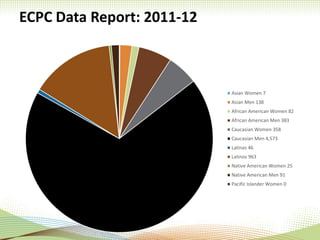
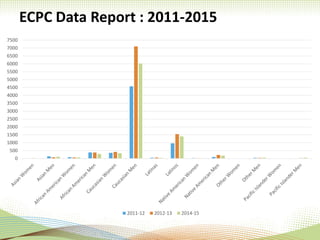
Asian Women 7
Asian Men 138
African American Women 82
African American Men 383
Caucasian Women 358
Caucasian Men 4,573
Latinas 46
Latinos 963
Native American Women 25
Native American Men 91
Pacific Islander Women 0
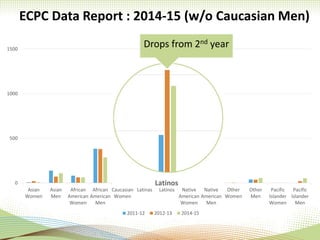
ECPC Data Report: 2011-12
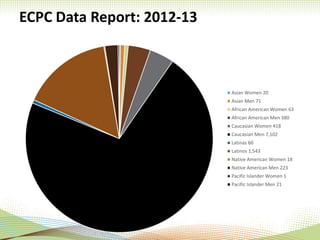
Asian Women 20
Asian Men 71
African American Women 63
African American Men 380
Caucasian Women 418
Caucasian Men 7,102
Latinas 60
Latinos 1,543
Native American Women 18
Native American Men 223
Pacific Islander Women 1
Pacific Islander Men 21
ECPC Data Report: 2012-13
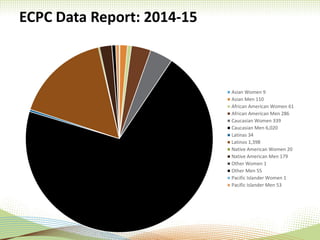
Asian Women 9
Asian Men 110
African American Women 61
African American Men 286
Caucasian Women 339
Caucasian Men 6,020
Latinas 34
Latinos 1,398
Native American Women 20
Native American Men 179
Other Women 1
Other Men 55
Pacific Islander Women 1
Pacific Islander Men 53
ECPC Data Report: 2014-15
ECPC Data Report : 2011-2015
0
500
1000
1500
2000
2500
3000
3500
4000
4500
5000
5500
6000
6500
7000
7500
2011-12 2012-13 2014-15
ECPC Data Report : 2014-15 (w/o Caucasian Men)
0
500
1000
1500
Asian
Women
Asian
Men
African
American
Women
African
American
Men
Caucasian
Women
Latinas Latinos Native
American
Women
Native
American
Men
Other
Women
Other
Men
Pacific
Islander
Women
Pacific
Islander
Men
2011-12 2012-13 2014-15
ECPC Data Report : 2014-15 (w/o Caucasian Men)
0
500
1000
1500
Asian
Women
Asian
Men
African
American
Women
African
American
Men
Caucasian
Women
Latinas Latinos Native
American
Women
Native
American
Men
Other
Women
Other
Men
Pacific
Islander
Women
Pacific
Islander
Men
2011-12 2012-13 2014-15
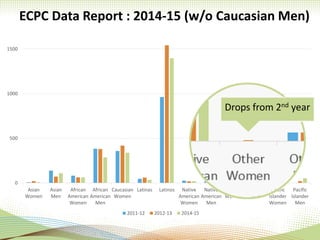
Drops from 2nd year
ECPC Data Report : 2014-15 (w/o Caucasian Men)
0
500
1000
1500
Asian
Women
Asian
Men
African
American
Women
African
American
Men
Caucasian
Women
Latinas Latinos Native
American
Women
Native
American
Men
Other
Women
Other
Men
Pacific
Islander
Women
Pacific
Islander
Men
2011-12 2012-13 2014-15
Drops from 2nd year
ECPC Data Report : 2014-15 (w/o Caucasian Men)
0
500
1000
1500
Asian
Women
Asian
Men
African
American
Women
African
American
Men
Caucasian
Women
Latinas Latinos Native
American
Women
Native
American
Men
Other
Women
Other
Men
Pacific
Islander
Women
Pacific
Islander
Men
2011-12 2012-13 2014-15
Drops each year
ECPC Data Report : 2014-15 (w/o Caucasian Men)
0
500
1000
1500
Asian
Women
Asian
Men
African
American
Women
African
American
Men
Caucasian
Women
Latinas Latinos Native
American
Women
Native
American
Men
Other
Women
Other
Men
Pacific
Islander
Women
Pacific
Islander
Men
2011-12 2012-13 2014-15
Drops each year
ECPC Data Report : 2014-15 (w/o Caucasian Men)
0
500
1000
1500
Asian
Women
Asian
Men
African
American
Women
African
American
Men
Caucasian
Women
Latinas Latinos Native
American
Women
Native
American
Men
Other
Women
Other
Men
Pacific
Islander
Women
Pacific
Islander
Men
2011-12 2012-13 2014-15
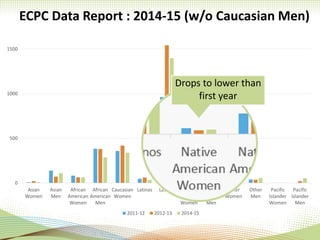
Drops to lower than
first year
ECPC Data Report : 2014-15 (w/o Caucasian Men)
0
500
1000
1500
Asian
Women
Asian
Men
African
American
Women
African
American
Men
Caucasian
Women
Latinas Latinos Native
American
Women
Native
American
Men
Other
Women
Other
Men
Pacific
Islander
Women
Pacific
Islander
Men
2011-12 2012-13 2014-15
Drops to lower than
first year
ECPC Data Report : 2014-15 (w/o Caucasian Men)
0
500
1000
1500
Asian
Women
Asian
Men
African
American
Women
African
American
Men
Caucasian
Women
Latinas Latinos Native
American
Women
Native
American
Men
Other
Women
Other
Men
Pacific
Islander
Women
Pacific
Islander
Men
2011-12 2012-13 2014-15
Drops from 2nd year
ECPC Data Report : 2014-15 (w/o Caucasian Men)
0
500
1000
1500
Asian
Women
Asian
Men
African
American
Women
African
American
Men
Caucasian
Women
Latinas Latinos Native
American
Women
Native
American
Men
Other
Women
Other
Men
Pacific
Islander
Women
Pacific
Islander
Men
2011-12 2012-13 2014-15
Drops to lower than
first year
ECPC Data Report : 2014-15 (w/o Caucasian Men)
0
500
1000
1500
Asian
Women
Asian
Men
African
American
Women
African
American
Men
Caucasian
Women
Latinas Latinos Native
American
Women
Native
American
Men
Other
Women
Other
Men
Pacific
Islander
Women
Pacific
Islander
Men
2011-12 2012-13 2014-15
Drops from 2nd year
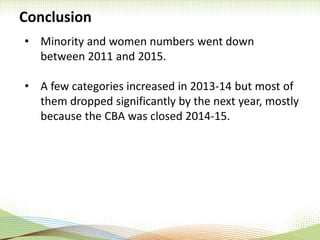
Conclusion
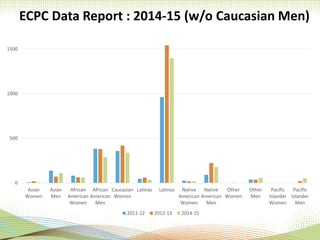
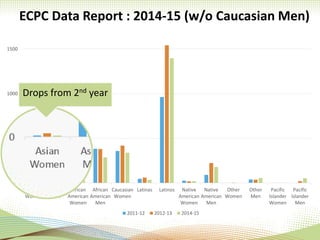
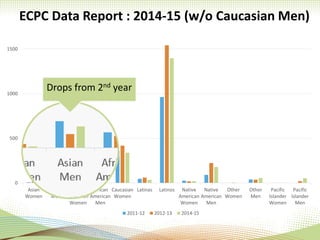
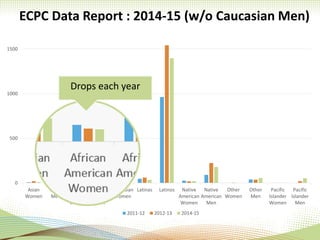
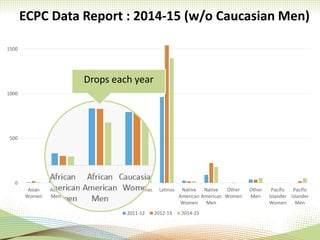
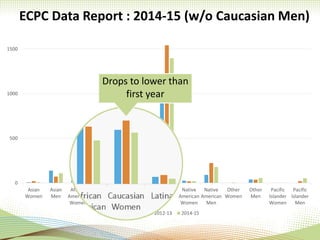
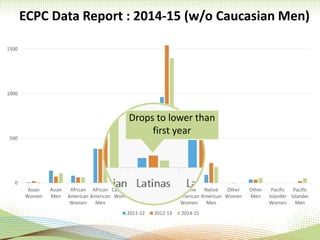
• Minority and women numbers went down
between 2011 and 2015.
• A few categories increased in 2013-14 but most of
them dropped significantly by the next year, mostly
because the CBA was closed 2014-15.
Conclusion
• In 2012-13, there were 2.5x more White men than
all other categories combined.
• The only category that comes close are Latino men
and there are still 5x more White men than them.
• Altogether, there were 9,306 men compared to
166 women. That’s more than 56x more men than
women.
Conclusion
• The category that
consistently drops is African
American men and women.
• CBA projects account for a large portion of the
numbers. Without those projects, these numbers
would be much more dismal.
Fair Contracting Forum Reporting
Overview of Resolution 36718 (7/29/09)
• Established to support and promote accountable,
transparent, fair, effective and efficient contracting
practices.
• Provide oversight and greater community input
regarding the City’s procurement practices.
• The City will conduct a disparity study over the next
year. Another study to be done never was.
• The Fair Contracting forum will report to Council on
an annual basis.
Conclusion
• This was created to look at this data, which hasn’t
been done.
• No conclusions have been made to address the
disparities. The City has not moved in a positive
direction and has been ineffective.
Prime Contractor Development
Overview of Resolution 36944 (7/19/12)
• Accept recommendations for a strategy to increase
minority-owned, women-owned, and emerging
small business utilization in City contracting.
• Establish a program for projects, $1 million and less
that creates access to contracting opportunities for
certified firms.
• Set in place a business development course for
program participants to enhance their business and
contracting skills.
Overview of Resolution 36944 (7/19/12)
• Establish a mechanism to track the success of the
program participants.
• Work with interested parties to set performance
goals for MBE/WBE participation.
• Establish metrics for program performance and
report results back to Council.
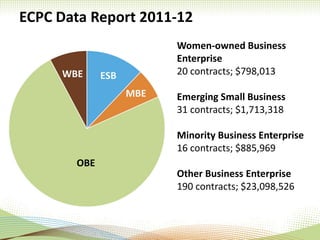
ECPC Data Report 2011-12
Women-owned Business
Enterprise
20 contracts; $798,013
Emerging Small Business
31 contracts; $1,713,318
Minority Business Enterprise
16 contracts; $885,969
Other Business Enterprise
190 contracts; $23,098,526
OBE
WBE ESB
MBE
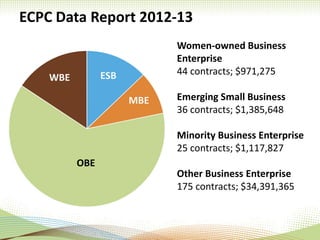
ECPC Data Report 2012-13
Women-owned Business
Enterprise
44 contracts; $971,275
Emerging Small Business
36 contracts; $1,385,648
Minority Business Enterprise
25 contracts; $1,117,827
Other Business Enterprise
175 contracts; $34,391,365
OBE
WBE ESB
MBE
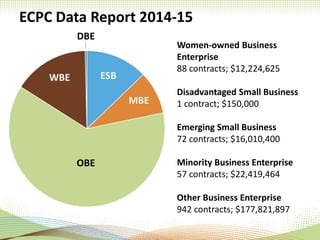
ECPC Data Report 2014-15
Women-owned Business
Enterprise
88 contracts; $12,224,625
Disadvantaged Small Business
1 contract; $150,000
Emerging Small Business
72 contracts; $16,010,400
Minority Business Enterprise
57 contracts; $22,419,464
Other Business Enterprise
942 contracts; $177,821,897
OBE
WBE ESB
MBE
DBE
Conclusion
• The gap between OBE and all others is significant and
increases exponentially each year.
• WBE contracts doubled in size each year. By 2014-15,
they’re at 88. However, OBE had 942 contracts which is
nearly 10x more than WBE.
• The previous year, OBE was only about 4x more than
WBE.
• 2014-15 could just have had more contracts altogether
and MBW and WBE actually fell behind in comparison
to OBE.
Minority Evaluation
Overview of Resolution 36757 (12/16/09)
• Making sure minorities and women are in the
evaluation process.
• Bureaus to include at least one minority evaluator
provided by the Alliance of Minority Chambers on all
contractor evaluation and selection panels.
• One minority panelist on a panel of five or
fewer members
• Three minority panelists for panels of 9 to 11
members
Overview of Resolution 36757 (12/16/09)
• The Alliance will work with other Portland based
minority business associations including the Oregon
and the National Association of Minority
Entrepreneurs.
Subcontractor Utilization
Overview of Resolution 36944 (7/19/12)
• Create an inclusion plan for certified firms to
participate as subcontractors on City construction
projects.
• Establish internal City criteria for construction
projects that may lend themselves to utilize a
procurement process other than low bid.
• Establish criteria to eliminate unnecessary contract
bundling and reduce the effects of justified bundling
to improve opportunities for certified firms.
Overview of Administrative Rule 1.23 (10/14/15)
• Establish practices and procedures for implementing
the Subcontractor Equity Program targeted toward
providing employment opportunities for
D/M/W/ESBS on City projects. SEP is meant to
replace the Good Faith Effort program.
• Those bidding on City projects are required to
comply with SEP and must submit documentation
showing that efforts have been made to contract
with D/M/W/ESB Subcontractors. This will apply to
all City public works and improvement contracts that
exceed $150,000 with exceptions.
Overview of Administrative Rule 1.23 (10/14/15)
• Subcontractors and Suppliers, Procurement Services
shall:
• Set goals for D/M/W/ESB subcontractor and supplier
utilization as a percentage of total Hard Construction
Costs.
• Require all Bidders to perform a Good Faith Effort on all
subcontracting opportunities regardless of value.
• Establish metrics for program performance.
• Encourage contractors to diversify their D/M/W/ESB
subcontractor utilization from all available types of work.
• Determine whether the Bidder meets the requirements
of the Program based upon submittal documents.
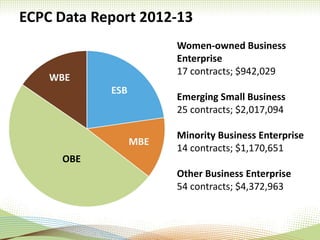
ECPC Data Report 2012-13
Women-owned Business
Enterprise
17 contracts; $942,029
Emerging Small Business
25 contracts; $2,017,094
Minority Business Enterprise
14 contracts; $1,170,651
Other Business Enterprise
54 contracts; $4,372,963
OBE
WBE
ESB
MBE
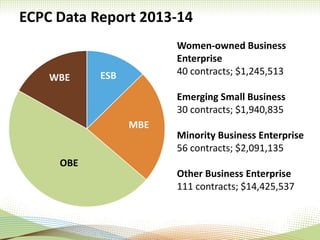
ECPC Data Report 2013-14
Women-owned Business
Enterprise
40 contracts; $1,245,513
Emerging Small Business
30 contracts; $1,940,835
Minority Business Enterprise
56 contracts; $2,091,135
Other Business Enterprise
111 contracts; $14,425,537
OBE
WBE ESB
MBE
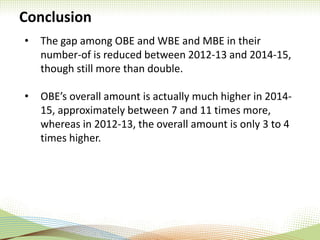
Conclusion
• The gap among OBE and WBE and MBE in their
number-of is reduced between 2012-13 and 2014-15,
though still more than double.
• OBE’s overall amount is actually much higher in 2014-
15, approximately between 7 and 11 times more,
whereas in 2012-13, the overall amount is only 3 to 4
times higher.
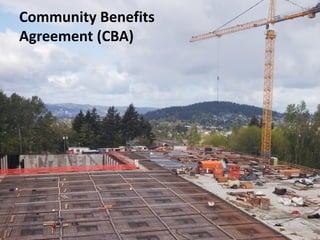
Community Benefits
Agreement (CBA)
Overview of Resolution 36954 (9/5/12)
• CBA was designed to minimize labor disruption on
large scale public works projects and increase
opportunities for minority, women and
disadvantaged owned businesses.
• Portland Water Bureau piloted this program on the
Kelly Butte Reservoir and Interstate Maintenance
Facility Renovation projects.
Overview of Resolution 36954 (9/5/12)
• A powerful tool in promoting the inclusion of under-
represented people.
• The City’s 2009 Disparity Study showed statistically
significant underutilization of minority owned
primed contractors on City projects.
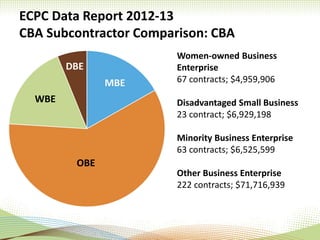
ECPC Data Report 2012-13
CBA Subcontractor Comparison: CBA
Women-owned Business
Enterprise
67 contracts; $4,959,906
Disadvantaged Small Business
23 contract; $6,929,198
Minority Business Enterprise
63 contracts; $6,525,599
Other Business Enterprise
222 contracts; $71,716,939
OBE
WBE
MBE
DBE
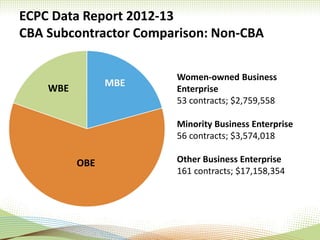
ECPC Data Report 2012-13
CBA Subcontractor Comparison: Non-CBA
Women-owned Business
Enterprise
53 contracts; $2,759,558
Minority Business Enterprise
56 contracts; $3,574,018
Other Business Enterprise
161 contracts; $17,158,354
OBE
WBE
MBE
Conclusion
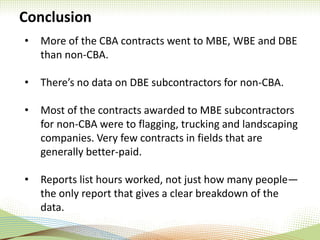
• More of the CBA contracts went to MBE, WBE and DBE
than non-CBA.
• There’s no data on DBE subcontractors for non-CBA.
• Most of the contracts awarded to MBE subcontractors
for non-CBA were to flagging, trucking and landscaping
companies. Very few contracts in fields that are
generally better-paid.
• Reports list hours worked, not just how many people—
the only report that gives a clear breakdown of the
data.
Professional Technical, Expert Services (PTE):
Overview of Resolution 36944 (7/19/12)
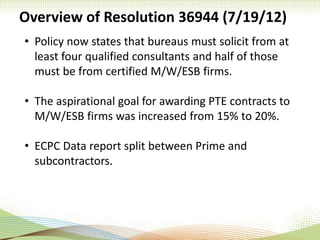
• Policy now states that bureaus must solicit from at
least four qualified consultants and half of those
must be from certified M/W/ESB firms.
• The aspirational goal for awarding PTE contracts to
M/W/ESB firms was increased from 15% to 20%.
• ECPC Data report split between Prime and
subcontractors.
Conclusion
• Most of the consultants are outreach coordinators that
are generally ineffective.
Contractor Prequalification
Overview of Resolution 36944 (7/19/12)
• The elimination of prequalification for construction
projects under $250,000 has occurred with the
creation of a City-wide Prequalification Board.
Conclusion
• This issue has not been resolved.
Workforce Recommendations
ECPC Workforce Recommendations
1. Develop, implement, and readily share a consistent
method to report workforce data on all City
contracts, on a monthly basis. At minimum, the
report should include:
• Race, gender, and age of all workers
• Address
• Veteran’s status
• Craft/Occupation, including level (e.g., apprentice,
journey level)
• Hours worked on the job
• Employer
• Starting Wage/Ending Wage
• Total earned on the job
• Dates worked on the job
ECPC Workforce Recommendations
2. Develop and implement a retention program to
assist apprentices and others with limited work
experience to transition from apprentice to
journey level status.
3. When applicable, require contractors to recruit
candidates from the public workforce system –
WorkSource Portland Metro.
ECPC Workforce Recommendations
4. Support and invest in training for women and
racial minorities in the construction trades by
supporting qualified programs with a successful
track record in training these populations.
How to Attain Purpose
Overview of Ordinance 187030 (2/15/15)
To provide guidance to City Council to improve
DMWESB utilization/participation in City of Portland
construction projects by collaborating with the City of
Portland Procurement Services and bureaus.
Recommendations
1. Set a hard a goal of minimum 15% MWESB goal for all
City of Portland projects.
2. Revise or provide a better definition of “Qualifications”
for small business in PTE contracts.
3. Disaggregate point system provided for minority
participation.
4. Require Prompt Pay for M/WBE professional services
firms.
5. Develop a contracting, utilization, and tracking system
for small business participation and awards as prime
and subcontractors.
6. Provide ECPC a City project list of future contracting
opportunities.
Council Presentation_ECPC 2016_new

Council Presentation_ECPC 2016_new

  • 2.
  • 3.
    Seven Resolutions forTrue Tracking and Monitoring
  • 4.
  • 5.
    Overview of Resolution36944 (7/19/12) • Establish a 27% aspirational goal for minorities and women on City-funded construction projects for apprentices and journey-level workers. • Require contractors to submit a workforce plan for subcontracts over $100,000 and prime contracts over $200,000. • Establish a post-project contractor report that provides details of utilization of state certified firms, minority and women workforce participation, and construction manager project review.
  • 6.
    Asian Women 7 AsianMen 138 African American Women 82 African American Men 383 Caucasian Women 358 Caucasian Men 4,573 Latinas 46 Latinos 963 Native American Women 25 Native American Men 91 Pacific Islander Women 0 ECPC Data Report: 2011-12
  • 7.
    Asian Women 20 AsianMen 71 African American Women 63 African American Men 380 Caucasian Women 418 Caucasian Men 7,102 Latinas 60 Latinos 1,543 Native American Women 18 Native American Men 223 Pacific Islander Women 1 Pacific Islander Men 21 ECPC Data Report: 2012-13
  • 8.
    Asian Women 9 AsianMen 110 African American Women 61 African American Men 286 Caucasian Women 339 Caucasian Men 6,020 Latinas 34 Latinos 1,398 Native American Women 20 Native American Men 179 Other Women 1 Other Men 55 Pacific Islander Women 1 Pacific Islander Men 53 ECPC Data Report: 2014-15
  • 9.
    ECPC Data Report: 2011-2015 0 500 1000 1500 2000 2500 3000 3500 4000 4500 5000 5500 6000 6500 7000 7500 2011-12 2012-13 2014-15
  • 10.
    ECPC Data Report: 2014-15 (w/o Caucasian Men) 0 500 1000 1500 Asian Women Asian Men African American Women African American Men Caucasian Women Latinas Latinos Native American Women Native American Men Other Women Other Men Pacific Islander Women Pacific Islander Men 2011-12 2012-13 2014-15
  • 11.
    ECPC Data Report: 2014-15 (w/o Caucasian Men) 0 500 1000 1500 Asian Women Asian Men African American Women African American Men Caucasian Women Latinas Latinos Native American Women Native American Men Other Women Other Men Pacific Islander Women Pacific Islander Men 2011-12 2012-13 2014-15 Drops from 2nd year
  • 12.
    ECPC Data Report: 2014-15 (w/o Caucasian Men) 0 500 1000 1500 Asian Women Asian Men African American Women African American Men Caucasian Women Latinas Latinos Native American Women Native American Men Other Women Other Men Pacific Islander Women Pacific Islander Men 2011-12 2012-13 2014-15 Drops from 2nd year
  • 13.
    ECPC Data Report: 2014-15 (w/o Caucasian Men) 0 500 1000 1500 Asian Women Asian Men African American Women African American Men Caucasian Women Latinas Latinos Native American Women Native American Men Other Women Other Men Pacific Islander Women Pacific Islander Men 2011-12 2012-13 2014-15 Drops each year
  • 14.
    ECPC Data Report: 2014-15 (w/o Caucasian Men) 0 500 1000 1500 Asian Women Asian Men African American Women African American Men Caucasian Women Latinas Latinos Native American Women Native American Men Other Women Other Men Pacific Islander Women Pacific Islander Men 2011-12 2012-13 2014-15 Drops each year
  • 15.
    ECPC Data Report: 2014-15 (w/o Caucasian Men) 0 500 1000 1500 Asian Women Asian Men African American Women African American Men Caucasian Women Latinas Latinos Native American Women Native American Men Other Women Other Men Pacific Islander Women Pacific Islander Men 2011-12 2012-13 2014-15 Drops to lower than first year
  • 16.
    ECPC Data Report: 2014-15 (w/o Caucasian Men) 0 500 1000 1500 Asian Women Asian Men African American Women African American Men Caucasian Women Latinas Latinos Native American Women Native American Men Other Women Other Men Pacific Islander Women Pacific Islander Men 2011-12 2012-13 2014-15 Drops to lower than first year
  • 17.
    ECPC Data Report: 2014-15 (w/o Caucasian Men) 0 500 1000 1500 Asian Women Asian Men African American Women African American Men Caucasian Women Latinas Latinos Native American Women Native American Men Other Women Other Men Pacific Islander Women Pacific Islander Men 2011-12 2012-13 2014-15 Drops from 2nd year
  • 18.
    ECPC Data Report: 2014-15 (w/o Caucasian Men) 0 500 1000 1500 Asian Women Asian Men African American Women African American Men Caucasian Women Latinas Latinos Native American Women Native American Men Other Women Other Men Pacific Islander Women Pacific Islander Men 2011-12 2012-13 2014-15 Drops to lower than first year
  • 19.
    ECPC Data Report: 2014-15 (w/o Caucasian Men) 0 500 1000 1500 Asian Women Asian Men African American Women African American Men Caucasian Women Latinas Latinos Native American Women Native American Men Other Women Other Men Pacific Islander Women Pacific Islander Men 2011-12 2012-13 2014-15 Drops from 2nd year
  • 20.
    Conclusion • Minority andwomen numbers went down between 2011 and 2015. • A few categories increased in 2013-14 but most of them dropped significantly by the next year, mostly because the CBA was closed 2014-15.
  • 21.
    Conclusion • In 2012-13,there were 2.5x more White men than all other categories combined. • The only category that comes close are Latino men and there are still 5x more White men than them. • Altogether, there were 9,306 men compared to 166 women. That’s more than 56x more men than women.
  • 22.
    Conclusion • The categorythat consistently drops is African American men and women. • CBA projects account for a large portion of the numbers. Without those projects, these numbers would be much more dismal.
  • 23.
  • 24.
    Overview of Resolution36718 (7/29/09) • Established to support and promote accountable, transparent, fair, effective and efficient contracting practices. • Provide oversight and greater community input regarding the City’s procurement practices. • The City will conduct a disparity study over the next year. Another study to be done never was. • The Fair Contracting forum will report to Council on an annual basis.
  • 25.
    Conclusion • This wascreated to look at this data, which hasn’t been done. • No conclusions have been made to address the disparities. The City has not moved in a positive direction and has been ineffective.
  • 26.
  • 27.
    Overview of Resolution36944 (7/19/12) • Accept recommendations for a strategy to increase minority-owned, women-owned, and emerging small business utilization in City contracting. • Establish a program for projects, $1 million and less that creates access to contracting opportunities for certified firms. • Set in place a business development course for program participants to enhance their business and contracting skills.
  • 28.
    Overview of Resolution36944 (7/19/12) • Establish a mechanism to track the success of the program participants. • Work with interested parties to set performance goals for MBE/WBE participation. • Establish metrics for program performance and report results back to Council.
  • 29.
    ECPC Data Report2011-12 Women-owned Business Enterprise 20 contracts; $798,013 Emerging Small Business 31 contracts; $1,713,318 Minority Business Enterprise 16 contracts; $885,969 Other Business Enterprise 190 contracts; $23,098,526 OBE WBE ESB MBE
  • 30.
    ECPC Data Report2012-13 Women-owned Business Enterprise 44 contracts; $971,275 Emerging Small Business 36 contracts; $1,385,648 Minority Business Enterprise 25 contracts; $1,117,827 Other Business Enterprise 175 contracts; $34,391,365 OBE WBE ESB MBE
  • 31.
    ECPC Data Report2014-15 Women-owned Business Enterprise 88 contracts; $12,224,625 Disadvantaged Small Business 1 contract; $150,000 Emerging Small Business 72 contracts; $16,010,400 Minority Business Enterprise 57 contracts; $22,419,464 Other Business Enterprise 942 contracts; $177,821,897 OBE WBE ESB MBE DBE
  • 32.
    Conclusion • The gapbetween OBE and all others is significant and increases exponentially each year. • WBE contracts doubled in size each year. By 2014-15, they’re at 88. However, OBE had 942 contracts which is nearly 10x more than WBE. • The previous year, OBE was only about 4x more than WBE. • 2014-15 could just have had more contracts altogether and MBW and WBE actually fell behind in comparison to OBE.
  • 33.
  • 34.
    Overview of Resolution36757 (12/16/09) • Making sure minorities and women are in the evaluation process. • Bureaus to include at least one minority evaluator provided by the Alliance of Minority Chambers on all contractor evaluation and selection panels. • One minority panelist on a panel of five or fewer members • Three minority panelists for panels of 9 to 11 members
  • 35.
    Overview of Resolution36757 (12/16/09) • The Alliance will work with other Portland based minority business associations including the Oregon and the National Association of Minority Entrepreneurs.
  • 36.
  • 37.
    Overview of Resolution36944 (7/19/12) • Create an inclusion plan for certified firms to participate as subcontractors on City construction projects. • Establish internal City criteria for construction projects that may lend themselves to utilize a procurement process other than low bid. • Establish criteria to eliminate unnecessary contract bundling and reduce the effects of justified bundling to improve opportunities for certified firms.
  • 38.
    Overview of AdministrativeRule 1.23 (10/14/15) • Establish practices and procedures for implementing the Subcontractor Equity Program targeted toward providing employment opportunities for D/M/W/ESBS on City projects. SEP is meant to replace the Good Faith Effort program. • Those bidding on City projects are required to comply with SEP and must submit documentation showing that efforts have been made to contract with D/M/W/ESB Subcontractors. This will apply to all City public works and improvement contracts that exceed $150,000 with exceptions.
  • 39.
    Overview of AdministrativeRule 1.23 (10/14/15) • Subcontractors and Suppliers, Procurement Services shall: • Set goals for D/M/W/ESB subcontractor and supplier utilization as a percentage of total Hard Construction Costs. • Require all Bidders to perform a Good Faith Effort on all subcontracting opportunities regardless of value. • Establish metrics for program performance. • Encourage contractors to diversify their D/M/W/ESB subcontractor utilization from all available types of work. • Determine whether the Bidder meets the requirements of the Program based upon submittal documents.
  • 40.
    ECPC Data Report2012-13 Women-owned Business Enterprise 17 contracts; $942,029 Emerging Small Business 25 contracts; $2,017,094 Minority Business Enterprise 14 contracts; $1,170,651 Other Business Enterprise 54 contracts; $4,372,963 OBE WBE ESB MBE
  • 41.
    ECPC Data Report2013-14 Women-owned Business Enterprise 40 contracts; $1,245,513 Emerging Small Business 30 contracts; $1,940,835 Minority Business Enterprise 56 contracts; $2,091,135 Other Business Enterprise 111 contracts; $14,425,537 OBE WBE ESB MBE
  • 42.
    Conclusion • The gapamong OBE and WBE and MBE in their number-of is reduced between 2012-13 and 2014-15, though still more than double. • OBE’s overall amount is actually much higher in 2014- 15, approximately between 7 and 11 times more, whereas in 2012-13, the overall amount is only 3 to 4 times higher.
  • 43.
  • 44.
    Overview of Resolution36954 (9/5/12) • CBA was designed to minimize labor disruption on large scale public works projects and increase opportunities for minority, women and disadvantaged owned businesses. • Portland Water Bureau piloted this program on the Kelly Butte Reservoir and Interstate Maintenance Facility Renovation projects.

  • 45.
    Overview of Resolution36954 (9/5/12) • A powerful tool in promoting the inclusion of under- represented people. • The City’s 2009 Disparity Study showed statistically significant underutilization of minority owned primed contractors on City projects.
  • 46.
    ECPC Data Report2012-13 CBA Subcontractor Comparison: CBA Women-owned Business Enterprise 67 contracts; $4,959,906 Disadvantaged Small Business 23 contract; $6,929,198 Minority Business Enterprise 63 contracts; $6,525,599 Other Business Enterprise 222 contracts; $71,716,939 OBE WBE MBE DBE
  • 47.
    ECPC Data Report2012-13 CBA Subcontractor Comparison: Non-CBA Women-owned Business Enterprise 53 contracts; $2,759,558 Minority Business Enterprise 56 contracts; $3,574,018 Other Business Enterprise 161 contracts; $17,158,354 OBE WBE MBE
  • 48.
    Conclusion • More ofthe CBA contracts went to MBE, WBE and DBE than non-CBA. • There’s no data on DBE subcontractors for non-CBA. • Most of the contracts awarded to MBE subcontractors for non-CBA were to flagging, trucking and landscaping companies. Very few contracts in fields that are generally better-paid. • Reports list hours worked, not just how many people— the only report that gives a clear breakdown of the data.

  • 49.
  • 50.
    Overview of Resolution36944 (7/19/12) • Policy now states that bureaus must solicit from at least four qualified consultants and half of those must be from certified M/W/ESB firms. • The aspirational goal for awarding PTE contracts to M/W/ESB firms was increased from 15% to 20%. • ECPC Data report split between Prime and subcontractors.
  • 51.
    Conclusion • Most ofthe consultants are outreach coordinators that are generally ineffective.
  • 52.
  • 53.
    Overview of Resolution36944 (7/19/12) • The elimination of prequalification for construction projects under $250,000 has occurred with the creation of a City-wide Prequalification Board. Conclusion • This issue has not been resolved.
  • 54.
  • 55.
    ECPC Workforce Recommendations 1.Develop, implement, and readily share a consistent method to report workforce data on all City contracts, on a monthly basis. At minimum, the report should include: • Race, gender, and age of all workers • Address • Veteran’s status • Craft/Occupation, including level (e.g., apprentice, journey level) • Hours worked on the job • Employer • Starting Wage/Ending Wage • Total earned on the job • Dates worked on the job
  • 56.
    ECPC Workforce Recommendations 2.Develop and implement a retention program to assist apprentices and others with limited work experience to transition from apprentice to journey level status. 3. When applicable, require contractors to recruit candidates from the public workforce system – WorkSource Portland Metro.
  • 57.
    ECPC Workforce Recommendations 4.Support and invest in training for women and racial minorities in the construction trades by supporting qualified programs with a successful track record in training these populations.
  • 58.
  • 59.
    Overview of Ordinance187030 (2/15/15) To provide guidance to City Council to improve DMWESB utilization/participation in City of Portland construction projects by collaborating with the City of Portland Procurement Services and bureaus.
  • 60.
    Recommendations 1. Set ahard a goal of minimum 15% MWESB goal for all City of Portland projects. 2. Revise or provide a better definition of “Qualifications” for small business in PTE contracts. 3. Disaggregate point system provided for minority participation. 4. Require Prompt Pay for M/WBE professional services firms. 5. Develop a contracting, utilization, and tracking system for small business participation and awards as prime and subcontractors. 6. Provide ECPC a City project list of future contracting opportunities.