Big Data Analytics: Future of Almost
Everything
Department of Computer Applications
School of Physical Sciences
Sikkim University Presented By - :
Robin Gurung
14UCA015
Introduction
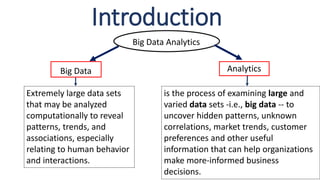
Extremely large data sets
that may be analyzed
computationally to reveal
patterns, trends, and
associations, especially
relating to human behavior
and interactions.
is the process of examining large and
varied data sets -i.e., big data -- to
uncover hidden patterns, unknown
correlations, market trends, customer
preferences and other useful
information that can help organizations
make more-informed business
decisions.
Big Data Analytics
Big Data Analytics
Introduction Continued.
•Big data was a serious problem just a few years ago.
When data volumes started skyrocketing in the early
2000s.
•Emerge of Advance Analytics changed the perspective
of users for big data.
•can study big data to understand the current state of
the business and track still-evolving aspects such as
customer behavior.
Introduction continued
• The volume of the big data is calculated in
ZetaBytes(ZB).
early in year 2009 it was 2.3 ZetaBytes.
2.3 X 10,00,000 GB (Gigabytes) = 23,00,000.
As the year passed 2.3 (ZB) produced in single month.
Single week.
Single day.
Single hour.
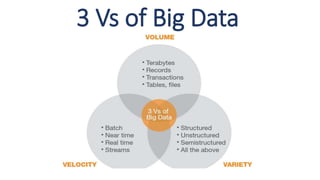
3 Vs of Big Data
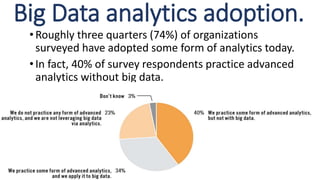
Big Data analytics adoption.
•Roughly three quarters (74%) of organizations
surveyed have adopted some form of analytics today.
•In fact, 40% of survey respondents practice advanced
analytics without big data.
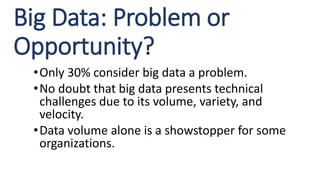
Big Data: Problem or
Opportunity?
•Only 30% consider big data a problem.
•No doubt that big data presents technical
challenges due to its volume, variety, and
velocity.
•Data volume alone is a showstopper for some
organizations.
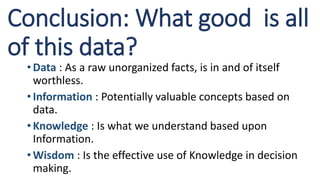
Conclusion: What good is all
of this data?
•Data : As a raw unorganized facts, is in and of itself
worthless.
•Information : Potentially valuable concepts based on
data.
•Knowledge : Is what we understand based upon
Information.
•Wisdom : Is the effective use of Knowledge in decision
making.
References
• https://tdwi.org/research/2011/09/best-practices-report-q4-big-
data-analytics/asset.aspx?tc=assetpg .TDWI survey report of 2009.
• https://www.sas.com/en_in/home.html SAS survey report of 2011.
• Lohr S (2012) The age of big data. New York Times, pp 11 .
• Gantz J, Reinsel D (2011) Extracting value from chaos. IDC iView, pp
1–12.
THANK YOU

Big data Analytics

  • 1.
    Big Data Analytics:Future of Almost Everything Department of Computer Applications School of Physical Sciences Sikkim University Presented By - : Robin Gurung 14UCA015
  • 2.
    Introduction Extremely large datasets that may be analyzed computationally to reveal patterns, trends, and associations, especially relating to human behavior and interactions. is the process of examining large and varied data sets -i.e., big data -- to uncover hidden patterns, unknown correlations, market trends, customer preferences and other useful information that can help organizations make more-informed business decisions. Big Data Analytics Big Data Analytics
  • 3.
    Introduction Continued. •Big datawas a serious problem just a few years ago. When data volumes started skyrocketing in the early 2000s. •Emerge of Advance Analytics changed the perspective of users for big data. •can study big data to understand the current state of the business and track still-evolving aspects such as customer behavior.
  • 4.
    Introduction continued • Thevolume of the big data is calculated in ZetaBytes(ZB). early in year 2009 it was 2.3 ZetaBytes. 2.3 X 10,00,000 GB (Gigabytes) = 23,00,000. As the year passed 2.3 (ZB) produced in single month. Single week. Single day. Single hour.
  • 5.
    3 Vs ofBig Data
  • 6.
    Big Data analyticsadoption. •Roughly three quarters (74%) of organizations surveyed have adopted some form of analytics today. •In fact, 40% of survey respondents practice advanced analytics without big data.
  • 7.
    Big Data: Problemor Opportunity? •Only 30% consider big data a problem. •No doubt that big data presents technical challenges due to its volume, variety, and velocity. •Data volume alone is a showstopper for some organizations.
  • 9.
    Conclusion: What goodis all of this data? •Data : As a raw unorganized facts, is in and of itself worthless. •Information : Potentially valuable concepts based on data. •Knowledge : Is what we understand based upon Information. •Wisdom : Is the effective use of Knowledge in decision making.
  • 10.
    References • https://tdwi.org/research/2011/09/best-practices-report-q4-big- data-analytics/asset.aspx?tc=assetpg .TDWIsurvey report of 2009. • https://www.sas.com/en_in/home.html SAS survey report of 2011. • Lohr S (2012) The age of big data. New York Times, pp 11 . • Gantz J, Reinsel D (2011) Extracting value from chaos. IDC iView, pp 1–12.
  • 11.