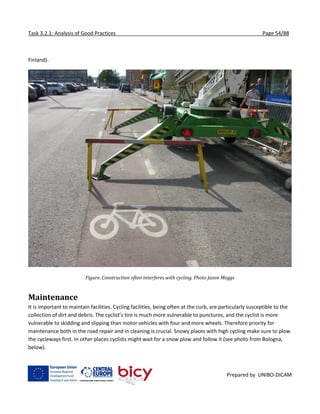
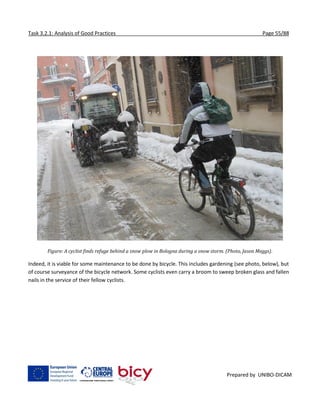
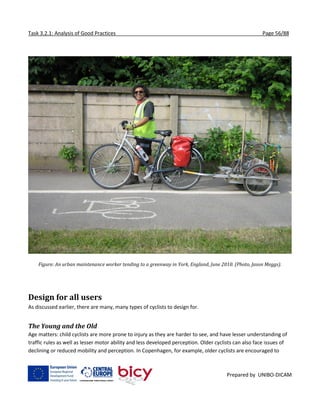
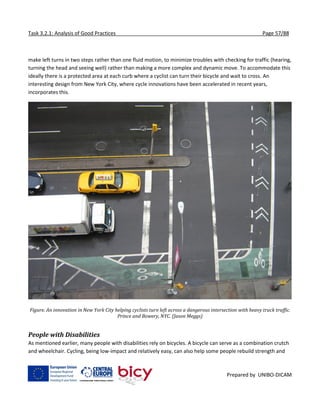
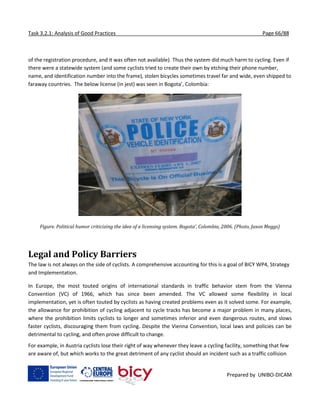
WP3.2.1
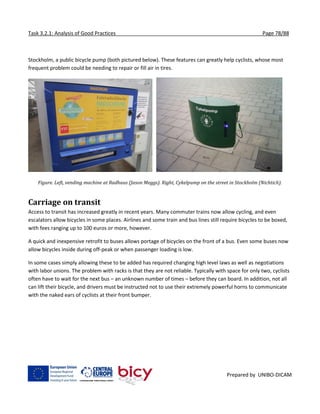
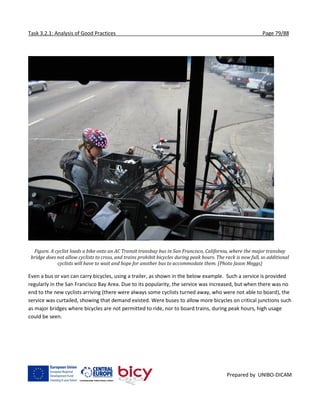
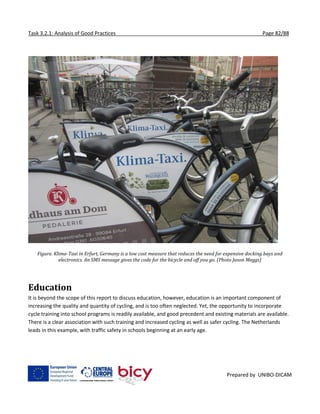
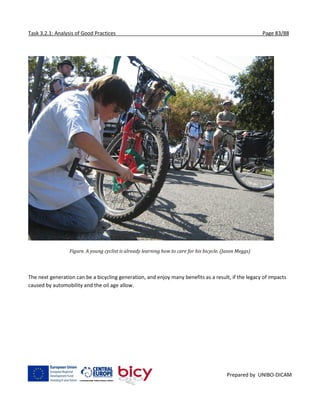
Jason Meggs
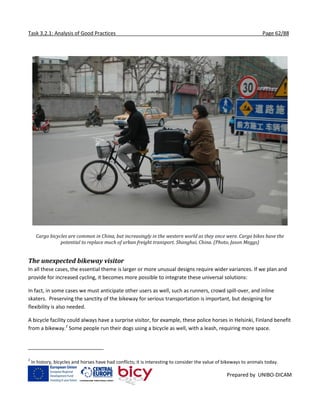
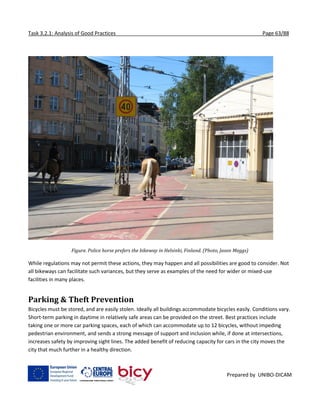
Anton Pashkevich
Frederico Rupi
UNIBO-DICAM
BICY Project, Central Europe
Programme, ERDF
January 30, 2012
Best Practices in Cycling
Task 3.2.1: Analysis of Good Practices Page 2/88
Prepared by UNIBO-DICAM
Best Practices in Bicycle Transport
BICY PROJECT TASK 3.21 – COMMON INDICATORS: ANALYSIS OF GOOD PRACTICES
FINAL REVISION: 30 JANUARY, 2012; BY JASON MEGGS, ANTON PASHKEVICH & FREDERICO RUPI
Abstract
Abstract – This report summarises data on cycling from leading European countries, regions and cities, and
provides examples of best practices from around the world. The report describes transport related policies in
cities with high bicycle usage but presents also best practice assessment methods. However, despite
numerous studies carried out in the Netherlands, Denmark and Germany, there is little numerical data
available that would allow to relate the quantity and quality of cycling infrastructure with bicycle usage. In
particular, correlations between the quantitative evolution of cycling infrastructure and bicycle usage are
scarce. The results from a large scale bicycle infrastructure and policy assessment in the Netherlands are
reported. A discussion of North American cycling is also presented. Regarding the BICY project, this report is an
important input as it provides indicators and benchmarking by cities and countries that are worldwide leading
in cycling use and provides suggestions for assessment methodologies. This report will be updated as the
project evolves.
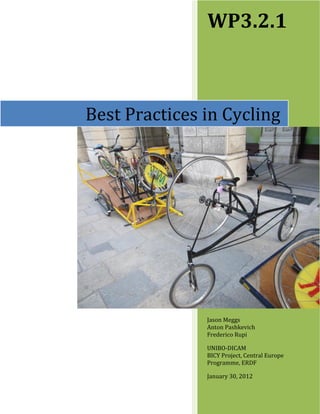
Cover photo: Mobile bicycle repair stand and carriage of experimental bikes, Vienna Bike Festival.
(Photo by Jason Meggs)
BICY, implemented in the
Central Europe Programme
(www.central2013.eu),
is co-financed by the
European Regional Development
Fund (ERDF)
Task 3.2.1: Analysis of Good Practices Page 3/88
Prepared by UNIBO-DICAM
Contents
Abstract ....................................................................................................................................................................2
Cycles Arise...............................................................................................................................................................6
What are best practices?......................................................................................................................................9
What Cyclists Want................................................................................................................................................ 10
Different Bikes, and Different Bikers................................................................................................................. 12
Know Thy Market............................................................................................................................................... 14
Methods of Increasing Cycling .............................................................................................................................. 15
The Importance of Bicycle Culture and Mass Cycling Events............................................................................ 16
Safety is a Selling Point...................................................................................................................................... 19
Safety in Numbers: the progressive safety benefits of increased cycling..................................................... 21
Helmets and hard-heads ............................................................................................................................... 21
Negative Images In Question......................................................................................................................... 21
Image of Fun.................................................................................................................................................. 23
Cycling history and the influence of bicycle culture.............................................................................................. 23
Learning from the Worst Practice Examples: What not to do ...................................................................... 27
Learning from the Netherlands: Dutch bicycle use in a European perspective................................................. 28
Cycling cities .................................................................................................................................................. 33
The requirements for bicycle-friendly travel infrastructure ......................................................................... 36
Monitoring & Evaluation ....................................................................................................................................... 37
Best Practices in Monitoring ............................................................................................................................. 37
Public Bicycle Counters.................................................................................................................................. 38
The Copenhagen Wheel ................................................................................................................................ 39
Evaluation Methods........................................................................................................................................... 40
Conflict Studies.............................................................................................................................................. 40
Task 3.2.1: Analysis of Good Practices Page 4/88
Prepared by UNIBO-DICAM
BYPAD: Bicycle Policy Audit........................................................................................................................... 40
The Cycle Balance Evaluation Method .............................................................................................................. 41
History and Aims............................................................................................................................................ 41
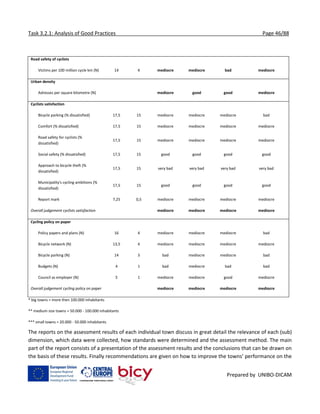
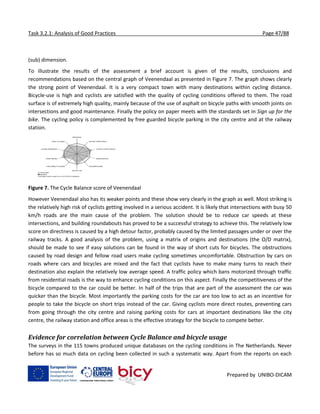
The four surveys of the Cycle Balance........................................................................................................... 42
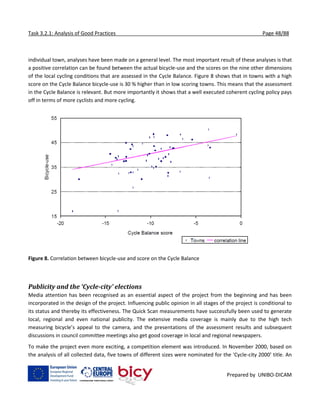
Evidence for correlation between Cycle Balance and bicycle usage............................................................. 47
Publicity and the ‘Cycle-city’ elections.......................................................................................................... 48
Facilities Design ..................................................................................................................................................... 49
National and International Standards ............................................................................................................... 49
Minimize Conflicts ............................................................................................................................................. 50
Low Cost and Expedient Measures ................................................................................................................... 51
Construction ...................................................................................................................................................... 53
Maintenance...................................................................................................................................................... 54
Design for all users ............................................................................................................................................ 56
The Young and the Old .................................................................................................................................. 56
People with Disabilities ................................................................................................................................. 57
It’s the little things that count....................................................................................................................... 58
HPV and Recumbent Bicycles........................................................................................................................ 59
Cargo Bicycles................................................................................................................................................ 60
The unexpected bikeway visitor.................................................................................................................... 62
Parking & Theft Prevention ............................................................................................................................... 63
Legal and Policy Barriers........................................................................................................................................ 66
Accepting Cycling............................................................................................................................................... 67
Freedom to Free-flow........................................................................................................................................ 67
Eliminate stopping wherever possible .......................................................................................................... 67
Red Lights for Cycling..................................................................................................................................... 68
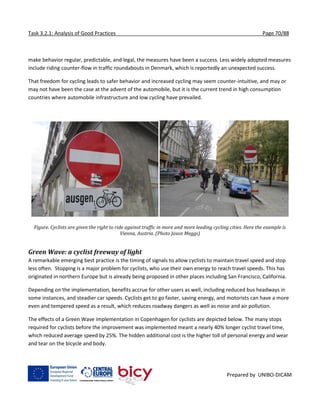
Riding both ways where cars may not........................................................................................................... 69
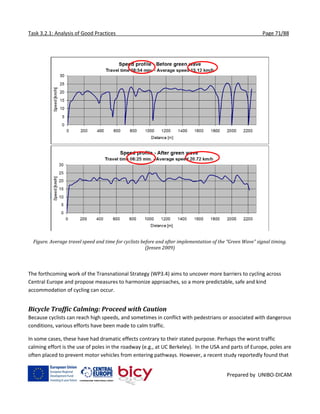
Green Wave: a cyclist freeway of light.......................................................................................................... 70
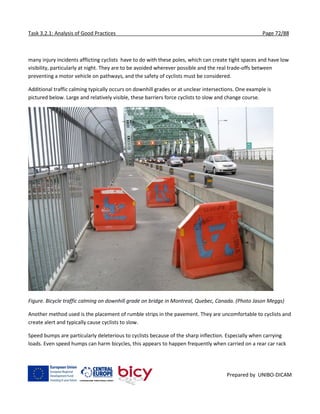
Bicycle Traffic Calming: Proceed with Caution.............................................................................................. 71
Task 3.2.1: Analysis of Good Practices Page 5/88
Prepared by UNIBO-DICAM
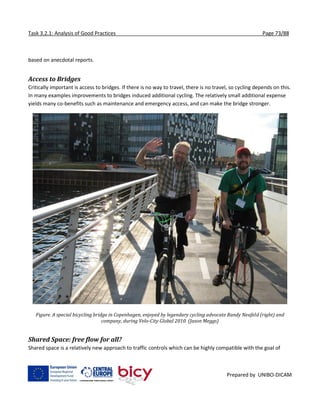
Access to Bridges........................................................................................................................................... 73
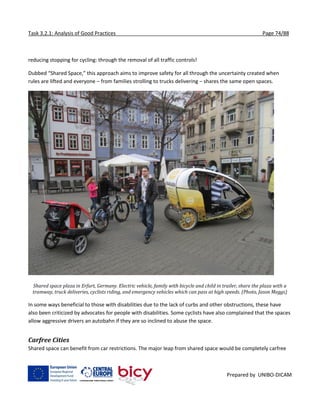
Shared Space: free flow for all?..................................................................................................................... 73
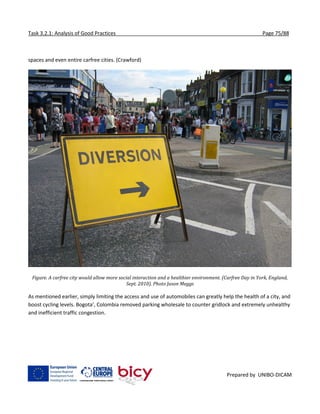
Carfree Cities ................................................................................................................................................. 74
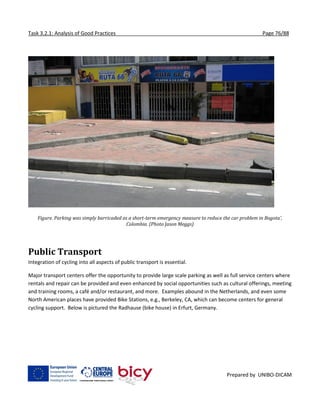
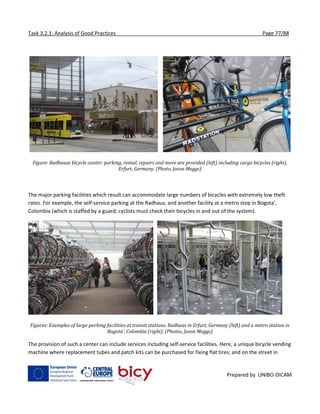
Public Transport..................................................................................................................................................... 76
Carriage on transit............................................................................................................................................. 78
Bike Share Systems............................................................................................................................................ 80
Education............................................................................................................................................................... 82
References............................................................................................................................................................. 85
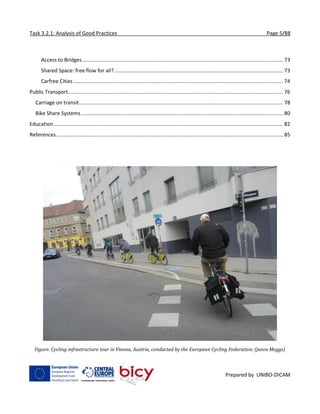
Figure. Cycling infrastructure tour in Vienna, Austria, conducted by the European Cycling Federation. (Jason Meggs)
Task 3.2.1: Analysis of Good Practices Page 6/88
Prepared by UNIBO-DICAM
Cycles Arise
For generations, the perennial question in the bicycle transport world has been:
“How can we increase cycling?”
Thus arises the core mission of the BICY project.
This question is cyclical, as is the amount of cycling (bi-cycling), itself; each year cycling rises and falls with
repeating trends such as weather patterns and the calendars of work and school. Economic fluctuations,
particularly oil prices, have also played a major role since the 1970s in the activity around bicycle transport and
its adoption. Concerns about environmental pollution, energy security, public health, and climate change
certainly play an active role with both policy makers and individuals’ choices alike.
In history as well, cycling has fluctuated greatly. The advent of the bicycle was the single biggest revolution in
transport since the horse and buggy. It transformed economies and social mores in kind. It was a catalyst in
radically changing the role of women, and paved the way – literally and figuratively – for the automobile.
During the 1890s, the “Bicycle Boom” saw tremendous energy and innovation focused on bicycle technology,
with hundreds if not thousands of small artisan shops working night and day to perfect bicycle technology in
both Europe and North America.
The first cars, motorcycles and even airplanes came from this effort – from small bicycle manufacturers – as did
such essential innovations in transport as the pneumatic tire, the ball bearing, and eventually, paved roads,
which cyclists en masse demanded. Even the first transport engineering program in the USA was begun by
cyclists, organized at the Massachusetts Institute of Technology (MIT) by the League of American Wheelmen
(LAW), now the League of American Bicyclists (LAB).
Cities were already changing for this wondrous new invention, along with society and the entire economy. The
advent of the bicycle had great promise. Shanghai, China was an early adopter and the first named “Bicycle
City” owing to the flocks of cyclists enjoying its exceptionally flat conditions, but other places throughout the
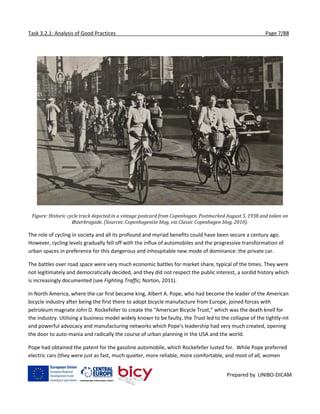
Netherlands as well as Copenhagen, Denmark, now world leaders, already had cycle tracks in the early to mid
1900s (see Figure 1, below). Laws were changed near and far to allow – and also to limit – cycling, resulting in
great advocacy efforts to protect the “freedom of the wheel”.
Doctors battled over whether cycling was healthful or harmful. Public Transport operators found ways to include
cycling as luggage, sometimes directed by legislation. Militaries recognized the bicycle as a stealthy and swift
means of transport for field soldiers. Growing cities considered ring roads designed just for cycling. It all sounds
very much like the situation today; in a very real sense we are going “back to the future.”
Task 3.2.1: Analysis of Good Practices Page 7/88
Prepared by UNIBO-DICAM
Figure: Historic cycle track depicted in a vintage postcard from Copenhagen. Postmarked August 5, 1938 and taken on
Østerbrogade. (Sources: Copenhagenize blog, via Classic Copenhagen blog, 2010).
The role of cycling in society and all its profound and myriad benefits could have been secure a century ago.
However, cycling levels gradually fell off with the influx of automobiles and the progressive transformation of
urban spaces in preference for this dangerous and inhospitable new mode of dominance: the private car.
The battles over road space were very much economic battles for market share, typical of the times. They were
not legitimately and democratically decided, and they did not respect the public interest, a sordid history which
is increasingly documented (see Fighting Traffic; Norton, 2011).
In North America, where the car first became king, Albert A. Pope, who had become the leader of the American
bicycle industry after being the first there to adopt bicycle manufacture from Europe, joined forces with
petroleum magnate John D. Rockefeller to create the “American Bicycle Trust,” which was the death knell for
the industry. Utilising a business model widely known to be faulty, the Trust led to the collapse of the tightly-nit
and powerful advocacy and manufacturing networks which Pope’s leadership had very much created, opening
the door to auto-mania and radically the course of urban planning in the USA and the world.
Pope had obtained the patent for the gasoline automobile, which Rockefeller lusted for. While Pope preferred
electric cars (they were just as fast, much quieter, more reliable, more comfortable, and most of all, women
Task 3.2.1: Analysis of Good Practices Page 8/88
Prepared by UNIBO-DICAM
preferred them), the lucrative potential of the partnership took precedence. Rockefeller stood to win riches
beyond anyone’s wildest dreams (and remains the wealthiest person in history as a result). Facing a tremendous
inability to market half his goods – gasoline – finally there would be a market for it. After “cracking” oil, roughly
half was gasoline, but due to the lack of applications it was considered waste and dumped into rivers or burned
away. (Today, gasoline would in theory never be approved by regulators due to its danger and toxicity.)
Together, Pope and Rockefeller ventured forth to riches, hoping to secure the place of the gasoline automobile
and to explicitly close the door on the bicycle age. The Bicycle Trust saw the American bicycle industry collapse,
in the process purchasing all patents from dying competitors, freezing innovation on the bicycle for generations.
Of hundreds of small artisans, only one American independent bicycle company survived, that of the Schwinn
family. Thus rose the oil age.
This kind of economic warfare for market share was de rigeur of the time; globally, similar stories are well
known in the public transport world in the years since. In fact, in one of the best-known tales, General Motors
was convicted of conspiracy in a court of law for dismantling interurban rail, despite the lax laws of the day. Thus
we can only imagine what the potential of the bicycle was, but the widespread fervor and adoption of bicycling
at the time, which is growing again today, shows great promise for its renewed success.
Today, the future of cycling is brighter every day. There is a desperate need to revisit that terrible juncture when
cycling declined, and usher in the bicycle age that could and would have been, had the public interest been
protected.
To illustrate that public interest, we need only account for some of the disasters which have stemmed from
allowing automobiles to rule the city. Disease and death caused by the hegemony of automobility is the leading
global health and environmental problem:
 Illness, death and daily suffering from pervasive traffic-originated air and noise pollution;
 Death and disability from hundreds of millions of traffic injuries and fatalities – the number one cause of
preventable death for children, adolescents and young adults;
 Death and disease from pandemic health problems caused by inactivity;
 Social malignancies and institutionalized suffering due to severed communities, lack of access to jobs
and services, and lack of public spaces and healthy places in which to live;
 Destruction of habitat and species extinction;
 Accelerated extraction of resources;
Task 3.2.1: Analysis of Good Practices Page 9/88
Prepared by UNIBO-DICAM
 Conversion of farmland for dispersed suburban and even exurban developments;
 Competition between food and fuel as peak oil progresses and biofuels are attempted;
All these crises and more are widely recognized by policy makers and the public alike. The terrible threat of
climate change adds great fuel to this fire; transport accounts for an overwhelming proportion of greenhouse
gasses, needlessly emitted. Needlessly because: All this can be greatly avoided for we do have alternatives, and
cycling will by necessity be continue to be a leading answer to these pervasive problems.
What is the full potential of the bicycle? It remains to be found, but given that most automobile trips can be
accomplished by cycling, often faster, and certainly with greater economic and social benefits – even after
generations of developing for the car –the sky (and a cleaner one at that) is clearly the limit.
The WP3 effort of the BICY project takes a scientific approach to the question of allowing that important
potential increase in cycling to unfold and to flourish.
What are best practices?
The concepts of “best practices” and its friends the “early innovators” have flourished in the bicycle world by
necessity due to the focused efforts globally to find solutions for cycling and the steady advances in the bicycle
world. This has succumbed to the point that some critics say “best practices” are misleading, even
counterproductive, because there is no one-size-fits-all solution. In fact there is truth to this, but it is not a whole
truth. Cultural, economic, and other differences are substantial between places. However, the human use of a
bicycle in all its forms is proscribed by certain limits and characteristics. Even the many designs of the bicycle
share certain fundamental physical norms.
A true investigation and accounting for all best practices globally is far beyond the scope of this or any report.
However, an effort will be made to first account for the leading cycling successes of Europe; and then to discuss
the practicalities and some inspiring examples in many key categories of integrating cycling into everyday life:
 Facilities design and standards
 Laws and policies
 Safety and its perception
 Methods of increasing cycling
 Bicycle parking, portage and storage
 Diversity in the bicycle world: varied bikes and varied bikers
Task 3.2.1: Analysis of Good Practices Page 10/88
Prepared by UNIBO-DICAM
What Cyclists Want
As core goal of the BICY project is to increase cycling throughout Central Europe, the beguiling question is
constant: what do cyclists want? The detailed mobility survey of Work Package (WP) 3.2.3 certainly aims to
discover this in a contemporary and uniform manner.
Without a doubt, the vast majority of current and potential cyclists prefer comfortable and convenient cycling
infrastructure. A survey of any successful cycling city shows a well-developed network of well-maintained and
well-designed bikeways (although locals may differ!). A pitfall in today's resurgence of cycling, however, is a lack
of standards and expertise, leading to poorly designed and incomplete networks that can actually endanger
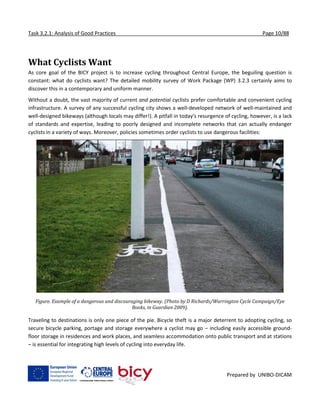
cyclists in a variety of ways. Moreover, policies sometimes order cyclists to use dangerous facilities:
Figure. Example of a dangerous and discouraging bikeway. (Photo by D Richards/Warrington Cycle Campaign/Eye
Books, in Guardian 2009).
Traveling to destinations is only one piece of the pie. Bicycle theft is a major deterrent to adopting cycling, so
secure bicycle parking, portage and storage everywhere a cyclist may go – including easily accessible ground-
floor storage in residences and work places, and seamless accommodation onto public transport and at stations
– is essential for integrating high levels of cycling into everyday life.
Task 3.2.1: Analysis of Good Practices Page 11/88
Prepared by UNIBO-DICAM
Cyclists want a minimum of inconvenience, a minimum of effort, and maximum opportunity.
Another important piece of the puzzle is environmental. There is only so much we can control about the climate
and topography, however the highest cycling cities are notably flat. Cold weather, rain and snow also deter
cycling, however many do cycle in those conditions, and heat can also discourage cycling, possibly even moreso
than cold (in Copenhagen, 70% cycle in winter). Would it make sense to provide weather-protected cycle tracks
in cities? Given the enormous investment in special grade-separated travel ways and multi-level parking facilities
for motorized transport, this array of “luxury” cycling possibilities is worthy of consideration.
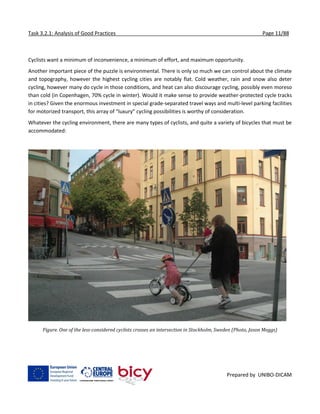
Whatever the cycling environment, there are many types of cyclists, and quite a variety of bicycles that must be
accommodated:
Figure. One of the less-considered cyclists crosses an intersection in Stockholm, Sweden (Photo, Jason Meggs)
Task 3.2.1: Analysis of Good Practices Page 12/88
Prepared by UNIBO-DICAM
Different Bikes, and Different Bikers
As the WP3 actions help reveal, there are many kinds of cyclists. Some are touring for pleasure. Some are
engaged in vigorous athletics, even cycling hundreds of kilometers in a single day. Yet most are utility cyclists,
going about their daily business, including shopping and child care. Among these everyday cyclists there is again
a wide range of typology. The cyclist who commutes 10km or more can be very different from the one who
merely toodles around the neighborhood shopping and doing other errands. Some cyclists are afflicted with
disabilities (indeed, some people with disabilities find a bicycle is their only option). The kind of cycling these
different groups does is important when designing facilities and when choosing regulations and laws for cycling.
The typology of cyclists has been studied in a variety of ways (Christmas 2010; Gatersleben 2010; Davies 2001
and 1997; Lindelöw 2009; Heinen; Michler; and others), which is critical to account for in all phases of increasing
and providing for cycling. These academic treatises only begin to describe the diversity of cycling.
Unlike the motor vehicle world, where behavior and facilities is relatively uniform despite many differing
individual types of drivers and vehicles, cyclists come in many stripes, with different types of bicycles and very
different cycling behavioral styles. This further differentiation among cyclists, critical in providing facilities and
services, as well as in marketing to individual needs and preferences, must be accounted for.
A fast cyclist traveling to mountain tops and back in a single day is a very different transport creature than a
grandmother doing shopping about the neighborhood with her grandchildren. The return and rise of utility
cycling, including portage of large loads using cargo bicycles, is another serious consideration when designing for
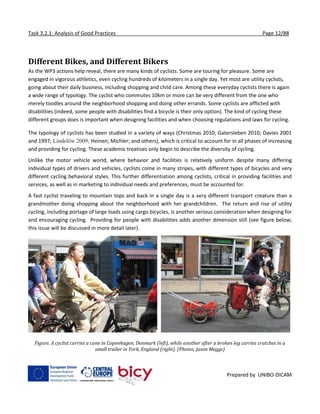
and encouraging cycling. Providing for people with disabilities adds another dimension still (see figure below;
this issue will be discussed in more detail later).
Figure. A cyclist carries a cane in Copenhagen, Denmark (left), while another after a broken leg carries crutches in a
small trailer in York, England (right). (Photos, Jason Meggs)
Task 3.2.1: Analysis of Good Practices Page 13/88
Prepared by UNIBO-DICAM
Unlike motor vehicles, where all share similar power and have roughly the same size, the cycle world is more
analogous to running than to driving a vehicle in some respects, owing in part to the factor of physical ability. A
fast and particularly a longer-distance cyclist typically wants the fewest barriers, and as cyclists gain speed, many
feel comfortable enough riding on roadways to do so, even if there are cycling facilities provided. Most cyclists
prefer protected facilities, however, which is thus essential to the goal of increasing cycling as we have shown in
the Common Indicator Report (WP3.2.3). Therefore, it is best to provide for both. This is further discussed in the
sections on facilities design and laws.
Moreover, bicycles themselves take many forms. Today in top cycling cities it is not uncommon – in fact in top
cycling cities it is now very common – to see a parent using a cargo bicycle, perhaps even towing a trailer, for
kids, groceries, spouses and even dogs, as the following figure helps illustrate.
Figure. Kids in cargo bikes, Amsterdam, Netherlands. (Photo by Workcycles, Wikipedia commons).
Thus it is critically important to “know the market” as one says, and to tailor policies to that market. For
example, it is increasingly recognized that women on average will not cycle without provided accommodations,
Task 3.2.1: Analysis of Good Practices Page 14/88
Prepared by UNIBO-DICAM
but given these, women on average will cycle more than men. In contrast more hostile environments typically
see fewer than 20% of women cycling.
Know Thy Market
We want to increase cycling. Therefore it must be something people know they want.
A top consideration in transport choice is cost. Typically the top costs are money and time. The value of time in
transport decisions increases with wealth. Marketing cycling needs to understand what people value. In fact
many appeals in the past have come from environmentalist perspectives. Yet in many studies, we find few
people have been so motivated by environmental considerations as to change behavior for them, certainly not
in a major way such as a modal shift (Flamm, 2012).
Fortunately, the cost of cycling is superior to other options for many urban trips. Yet there are additional hurdles
to adoption: the perception of safety; finding the right bicycle and learning the many “ins and outs” of using it
for everyday travel; and the experience on the road, which is too often harsh.
A final and far from least consideration of the market is individual social status. Although cycling has good
representation across classes, the inherent power imbalance compared to an automobile is a serious barrier to
entry for many, many people. In the world of cars, for example, recent initiatives to make a low-cost car (e.g.,
the Nano) have been failing to achieve expectations of market penetration in large part due to low-status
perceptions. For generations, many individuals buying cars have sought the most expensive possible in order to
feel superior status. Yet this too is changing. “Peak car” is said to have arrived, and values in the new generation
are shifting. Smaller, utilitarian items such as smart phones and yes, bicycles, have grown in their “coolness
factor” in recent years.
A huge part of the reason facilities for cycling are so strongly correlated to increased cycling is that they provide
a feeling of inclusion: of belonging, of being validated by the external environment and society at large. Another
leading reason is that they make people feel safer, even if they come with new types of safety problems, most
notably at intersections.
In continuing the discussion of typology when marketing cycling, it is noteworthy that the City of Portland has
identified “four types of cyclists,” and the largest group is “interested but concerned” as shown in the Figure
below. (Geller, 2011)
Task 3.2.1: Analysis of Good Practices Page 15/88
Prepared by UNIBO-DICAM
Figure. “Four types of Cyclists” illustrates the importance of addressing public safety concerns in order to increase cycling.
(Geller 2011)
Although this survey is from the USA, it is from a leading bicycle city there and is good general counsel for
European cities as well. Many surveys and inquiries confirm that fear of traffic is a leading reason for not trying
cycling, or for stopping (such as after suffering a collision with a car).
As the Copenhagen bicycle report (Bicycle Account, 2010) proclaims:
Sense of safety vs. Actual safety
The City of Copenhagen makes a distinction between actual safety and cyclists’ sense of safety in traffic. Actual
safety refers to the number of serious casualties involving cyclists in Copenhagen. Sense of safety refers to the
individual’s subjective perception of how safe it feels to cycle. Both factors are crucial in our effort to become the
world’s best city for cycling.
Methods of Increasing Cycling
Approaches to increasing cycling include promotions including contests and experiential events; education; and
provision of facilities. Restrictions on motor vehicles also have a very strong effect, both for encouraging a shift
to other modes due to the increased difficulty of driving, and by creating a safer and more comfortable
environment due to reduced motor vehicle traffic.
Perhaps the best-known type of promotion is the “Bike to Work Day”, usually held as an annual event. Although
commute trips are only about 1/5 of all travel, this is typically the most regular trip. In theory, converting
commuters to cycling will in turn increase non-work cycling. Large scale efforts typically include contests, and
Task 3.2.1: Analysis of Good Practices Page 16/88
Prepared by UNIBO-DICAM
individual outreach such as “Bike buddies,” where experienced cyclists volunteer to mentor new cyclists. When
registration is offered, a source of survey data is generated which can help show the pattern of cycling over
time.
A related event which focused on social networking to promote cycling, and targeted all kinds of cycling (not just
commuting) is the “1,000 New Cyclists Campaign” in Oakland, California. Launched on the Climate Action Day of
Oct. 10, 2010 (10-10-10, which invokes 1,000 as 10 times 10 times 10 is 1,000), the kick-off meeting generated a
slew of ideas for real actions that could increase cycling on a person-to-person basis. (Meggs 2010)
Financial incentives are an equity measure which may also encourage new cycling. In tax codes and workplace
incentives, commuter cycling can be honored through equal financial consideration. Typically work places
provide parking for private automobiles, a major subsidy to those who drive. Measures such as “parking cash-
out” and direct bonuses for cycling help close the gap for those who make the positive contribution of not
driving.
A number of scientific studies and surveys have attempted to find the effect of various measures on cycling
rates. It is known that provisions for cycling are associated strongly with increased cycling. Certainly providing
free-flow (less stopping) is a major incentive, discussed below.
A literature search on this topic was published in 2008 with regard to the BYPAD project (Kurt 2008)
Certainly infrastructure is strongly correlated with cycling in European cities, wherever the car exists. Separation
and the feeling of protection is preferred by the masses as discussed elsewhere.
One of the newest and most promising measures is that of experiential measures, with the best known or even
seminal event originating in Bogota’, Colombia, and known as Ciclovía. A new generation of special events
reclaiming urban space for human activity – and certainly cycling – has blossomed as a direct result.
The Importance of Bicycle Culture and Mass Cycling Events
After an all-time low just before the peak of North American oil production in 1972, the United States has seen a
steady rise in cycling and cycling culture, particularly after with the advent of the Critical Mass movement
(September 25, 1992), which sees its 20th
anniversary this year and still attracts thousands of riders on a monthly
basis. Although controversial due to the lack of organized leadership and lack of permits, the “organized
coincidence” has incontrovertably helped establish cycling on the transportation scene, where it had all but
disappeared. Today, official events such as Ciclovías and other mass roadway closures to feature walking and
cycling are becoming common, following the lead of Bogotá, Colombia; and a next generation unofficial event,
distinguishing itself from the more controversial Critical Masses, has arisen. The new form of public “bike-in”
known as Bike Party, has quickly grown; the original ride in San Jose attracts over 3,000 diverse cyclists monthly.
Task 3.2.1: Analysis of Good Practices Page 17/88
Prepared by UNIBO-DICAM
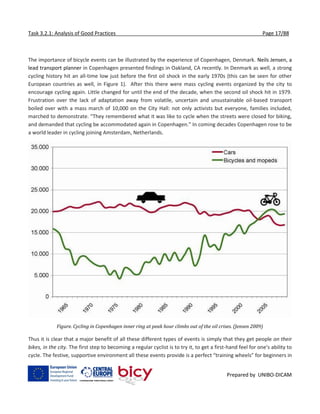
The importance of bicycle events can be illustrated by the experience of Copenhagen, Denmark. Neils Jensen, a
lead transport planner in Copenhagen presented findings in Oakland, CA recently. In Denmark as well, a strong
cycling history hit an all-time low just before the first oil shock in the early 1970s (this can be seen for other
European countries as well, in Figure 1). After this there were mass cycling events organized by the city to
encourage cycling again. Little changed for until the end of the decade, when the second oil shock hit in 1979.
Frustration over the lack of adaptation away from volatile, uncertain and unsustainable oil-based transport
boiled over with a mass march of 10,000 on the City Hall: not only activists but everyone, families included,
marched to demonstrate. “They remembered what it was like to cycle when the streets were closed for biking,
and demanded that cycling be accommodated again in Copenhagen.” In coming decades Copenhagen rose to be
a world leader in cycling joining Amsterdam, Netherlands.
Figure. Cycling in Copenhagen inner ring at peak hour climbs out of the oil crises. (Jensen 2009)
Thus it is clear that a major benefit of all these different types of events is simply that they get people on their
bikes, in the city. The first step to becoming a regular cyclist is to try it, to get a first-hand feel for one's ability to
cycle. The festive, supportive environment all these events provide is a perfect “training wheels” for beginners in
Task 3.2.1: Analysis of Good Practices Page 18/88
Prepared by UNIBO-DICAM
particular, and the friendships made and social exchanges of learning, creativity, and information, build a cycling
community where once was only isolation and a sense of violent persecution and systemic, and deadly,
discrimination amongst the few who dared cycle. Even Critical Mass, which has experienced occasional
disturbances, is seen as much safer than everyday street cycling: speeds are low, there are no cars, and energy is
saved by not having to stop frequently.
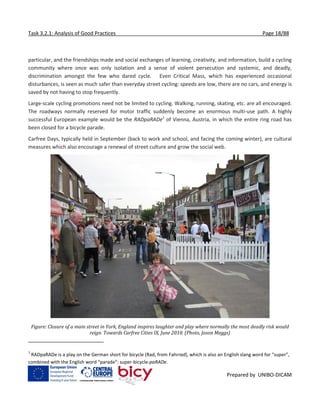
Large-scale cycling promotions need not be limited to cycling. Walking, running, skating, etc. are all encouraged.
The roadways normally reserved for motor traffic suddenly become an enormous multi-use path. A highly
successful European example would be the RADpaRADe1
of Vienna, Austria, in which the entire ring road has
been closed for a bicycle parade.
Carfree Days, typically held in September (back to work and school, and facing the coming winter), are cultural
measures which also encourage a renewal of street culture and grow the social web.
Figure: Closure of a main street in York, England inspires laughter and play where normally the most deadly risk would
reign. Towards Carfree Cities IX, June 2010. (Photo, Jason Meggs)
1
RADpaRADe is a play on the German short for bicycle (Rad, from Fahrrad), which is also an English slang word for “super”,
combined with the English word “parade”: super-bicycle-paRADe.
Task 3.2.1: Analysis of Good Practices Page 19/88
Prepared by UNIBO-DICAM
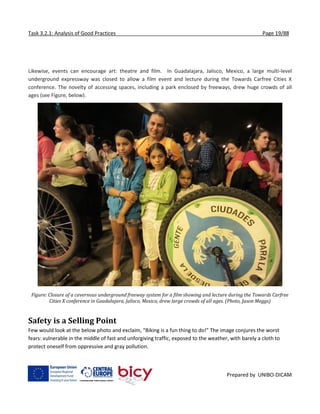
Likewise, events can encourage art: theatre and film. In Guadalajara, Jalisco, Mexico, a large multi-level
underground expressway was closed to allow a film event and lecture during the Towards Carfree Cities X
conference. The novelty of accessing spaces, including a park enclosed by freeways, drew huge crowds of all
ages (see Figure, below).
Figure: Closure of a cavernous underground freeway system for a film showing and lecture during the Towards Carfree
Cities X conference in Guadalajara, Jalisco, Mexico, drew large crowds of all ages. (Photo, Jason Meggs)
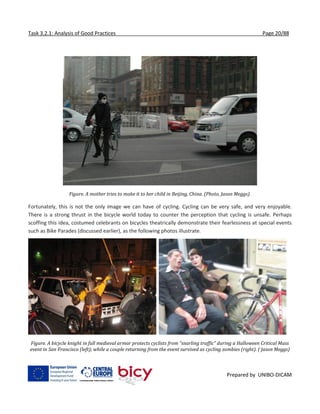
Safety is a Selling Point
Few would look at the below photo and exclaim, “Biking is a fun thing to do!” The image conjures the worst
fears: vulnerable in the middle of fast and unforgiving traffic, exposed to the weather, with barely a cloth to
protect oneself from oppressive and gray pollution.
Task 3.2.1: Analysis of Good Practices Page 20/88
Prepared by UNIBO-DICAM
Figure. A mother tries to make it to her child in Beijing, China. (Photo, Jason Meggs).
Fortunately, this is not the only image we can have of cycling. Cycling can be very safe, and very enjoyable.
There is a strong thrust in the bicycle world today to counter the perception that cycling is unsafe. Perhaps
scoffing this idea, costumed celebrants on bicycles theatrically demonstrate their fearlessness at special events
such as Bike Parades (discussed earlier), as the following photos illustrate.
Figure. A bicycle knight in full medieval armor protects cyclists from “snarling traffic” during a Halloween Critical Mass
event in San Francisco (left); while a couple returning from the event survived as cycling zombies (right). ( Jason Meggs)
Task 3.2.1: Analysis of Good Practices Page 21/88
Prepared by UNIBO-DICAM
The debate over whether cycling, on balance, is even good for us seems firmly settled. For example, a recent
major review focusing on the Netherlands, an area where cycling is relatively very well understood, found “on
average, the estimated health benefits of cycling were substantially larger than the risks relative to car driving
for individuals shifting their mode of transport”. (Hartog, 2010) These benefits should only increase as cycling
increases.
Safety in Numbers: the progressive safety benefits of increased cycling
Doubling cycling in a low cycling city might only mean an increase of 1% of all trips. However, thanks to the
landmark study of Safety in Numbers (Jacobsen, 2003), which found reported injuries inversely proportional to
the 0.4 power of the amount of walking or bicycling, “consistent across geographic areas, from specific
intersections to cities and countries.”
Since that time, in every city reviewed, it has been seen that large increases in bicycling result in greatly reduced
risk. In numerous North American cities, for example, injuries and fatalities remained flat despite multiplication
of cycling levels. For example, in Portland, Oregon, injury rates declined precipitously, with absolute injuries
holding essentially constant while bicycling levels, inferred from bridge counts, quintupled 1991-2007 (City of
Portland).
Likewise, internationally, city after city that boasts large increases in bicycling also sees major reductions in
serious injuries (Pucher 2010).
Helmets and hard-heads
The issue of helmets is controversial and well illustrative of the shift. A longstanding debate on helmets has
come to the forefront recently as efforts to deal with cycling injuries and fatalities led to laws requiring helmets.
In fact this complex debate is too multifaceted to address here, but it is now firmly established that helmet laws
have a net negative safety benefit because they discourage cycling, and because the efficacy of helmets is in
question. Major organizations including the European Cycling Federation have come out strongly against
mandatory helmet laws. Proponents of cycling without helmets point out that more people are injured falling
down stairs. In the big picture, the more cycling, the more health benefits and in fact, the safer each cyclist is, so
discouraging cycling with helmet requirements in fact may cause enormous suffering, death and disease in a full
accounting. Safety in Numbers helps illustrate the gains.
Negative Images In Question
Certainly the serious effects of traffic dangers must be addressed and reduced. However, if a culture of fear
pervades, cycling will not escape it, new adopters will not begin to cycle, and on balance the result will be much
more harmful. However some cyhcling advocates need to express their loss and the harm they face.
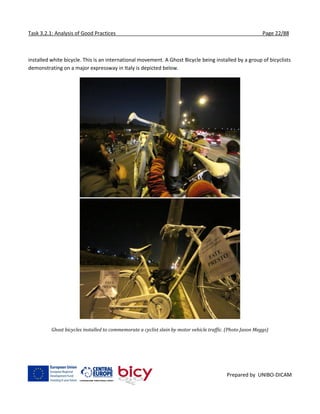
One example is the campaign of Ghost Bikes, marking where cyclists have been killed with a permanently
Task 3.2.1: Analysis of Good Practices Page 22/88
Prepared by UNIBO-DICAM
installed white bicycle. This is an international movement. A Ghost Bicycle being installed by a group of bicyclists
demonstrating on a major expressway in Italy is depicted below.
Ghost bicycles installed to commemorate a cyclist slain by motor vehicle traffic. (Photo Jason Meggs)
Task 3.2.1: Analysis of Good Practices Page 23/88
Prepared by UNIBO-DICAM
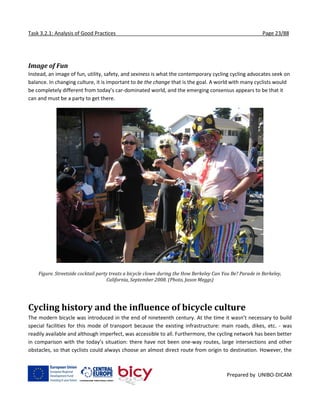
Image of Fun
Instead, an image of fun, utility, safety, and sexiness is what the contemporary cycling cycling advocates seek on
balance. In changing culture, it is important to be the change that is the goal. A world with many cyclists would
be completely different from today’s car-dominated world, and the emerging consensus appears to be that it
can and must be a party to get there.
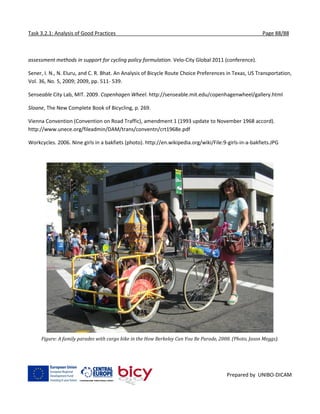
Figure. Streetside cocktail party treats a bicycle clown during the How Berkeley Can You Be? Parade in Berkeley,
California, September 2008. (Photo, Jason Meggs)
Cycling history and the influence of bicycle culture
The modern bicycle was introduced in the end of nineteenth century. At the time it wasn’t necessary to build
special facilities for this mode of transport because the existing infrastructure: main roads, dikes, etc. - was
readily available and although imperfect, was accessible to all. Furthermore, the cycling network has been better
in comparison with the today’s situation: there have not been one-way routes, large intersections and other
obstacles, so that cyclists could always choose an almost direct route from origin to destination. However, the
Task 3.2.1: Analysis of Good Practices Page 24/88
Prepared by UNIBO-DICAM
road surface quality has been worse. During the following years, the bicycle technology has been able to
improve the comfort of cyclists. The first attempts have been pneumatic tires created by Dunlop.
The appearance of the car cardinally changed the aligning of forces on the road. Initially, the number of cars in
the first years after their invention was extremely small: for example, on the Dutch roads in 1930 there were
67 000 cars versus 2.5 million bicycles. But with the widespread introduction of the car, the road network
changed considerably. The amount of accidents have increased on account of different speeds and masses of
the various road users. Thereby, the new roads and other facilities were designed in the following way: bicycle
traffic has been separated from motorized traffic by road marking; consequently, the flow of the cars had to be
uninterrupted, but the network had to be designed to prevent conflict points between bicycles and cars.
From the fifties onwards also cycle tracks for recreational have been constructed. These were separate cycle
tracks in attractive recreational areas, partially financed by specific grants. Cohesion with the “utilitarian” cycle
tracks was not a goal in itself and was often excluded from the grant system.
The energy crisis of the seventies and the environmental awareness greatly encouraged the interest in bicycle
traffic. Demonstration project in Den Haag and Tilburg, which showed the importance directness, comfort and
reduced waiting at traffic lights, proved that good bicycle facilities served more purposes than road safety alone.
The demonstration project in Delft also revealed that a cycle network approach could significantly improve the
competitive position of bicycling compared to other means of transport. It also appeared that in situations of
high bicycle usage, a neglect of providing competitive cycling infrastructure led to a loss of bicycle share in the
modal split. In other words, continuous attention to cycling policy is vital. Since the seventies many cities in the
Netherlands (and other EU countries) have adopted bicycle-friendly policy. However, many did not or
introduced pro cycling policies much later. This would explain, in part, the large the difference in bicycle usage
among cities within the Netherlands.
Such findings have been confirmed by studies performed by the Stichting Historie der Techniek (SHT, Foundation
for the History of Technology) in 1999. This study on cycling history was based on an investigation of three Dutch
cities known for their relatively high share of bicycle use (Amsterdam, Eindhoven and Enschede) and an urban
region with a low share of bicycle use (South-East Limburg: Kerkrade-Heerlen). In surrounding countries five
cities were studied: cycling city Copenhagen, the bicycle-free city of Manchester and finally Antwerp, Basel and
Hannover – cities with a medium bicycle usage. Records of transport related data and policies allowed to
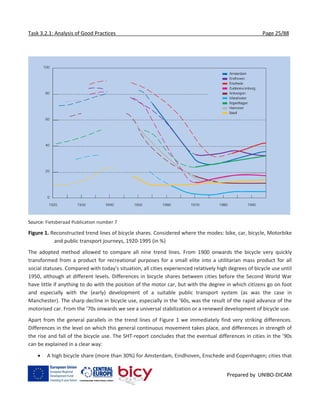
reconstruct their cycling history. In particular, efforts were made to reconstruct comparable trend lines of
bicycle use in each of these cities (see Figure 1) which clearly shows the historically rooted differences.
The trend lines of Figure 1 are based on various data sources, assumptions and estimates, which may influence
the overall result. The dashed lines indicate that estimates have played a more important part. During WW2 not
even estimates were feasible.
Task 3.2.1: Analysis of Good Practices Page 25/88
Prepared by UNIBO-DICAM
Source: Fietsberaad Publication number 7
Figure 1. Reconstructed trend lines of bicycle shares. Considered where the modes: bike, car, bicycle, Motorbike
and public transport journeys, 1920-1995 (in %)
The adopted method allowed to compare all nine trend lines. From 1900 onwards the bicycle very quickly
transformed from a product for recreational purposes for a small elite into a utilitarian mass product for all
social statuses. Compared with today's situation, all cities experienced relatively high degrees of bicycle use until
1950, although at different levels. Differences in bicycle shares between cities before the Second World War
have little if anything to do with the position of the motor car, but with the degree in which citizens go on foot
and especially with the (early) development of a suitable public transport system (as was the case in
Manchester). The sharp decline in bicycle use, especially in the ’60s, was the result of the rapid advance of the
motorised car. From the ’70s onwards we see a universal stabilization or a renewed development of bicycle use.
Apart from the general parallels in the trend lines of Figure 1 we immediately find very striking differences.
Differences in the level on which this general continuous movement takes place, and differences in strength of
the rise and fall of the bicycle use. The SHT-report concludes that the eventual differences in cities in the ’90s
can be explained in a clear way:
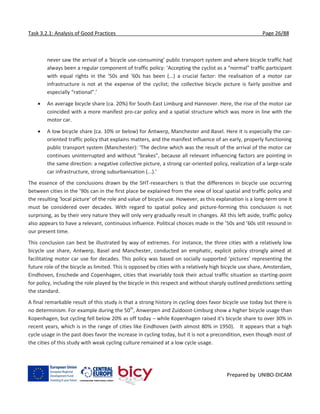
 A high bicycle share (more than 30%) for Amsterdam, Eindhoven, Enschede and Copenhagen; cities that
Task 3.2.1: Analysis of Good Practices Page 26/88
Prepared by UNIBO-DICAM
never saw the arrival of a ‘bicycle use-consuming’ public transport system and where bicycle traffic had
always been a regular component of traffic policy: ‘Accepting the cyclist as a “normal” traffic participant
with equal rights in the ’50s and ’60s has been (...) a crucial factor: the realisation of a motor car
infrastructure is not at the expense of the cyclist; the collective bicycle picture is fairly positive and
especially “rational”.’
 An average bicycle share (ca. 20%) for South-East Limburg and Hannover. Here, the rise of the motor car
coincided with a more manifest pro-car policy and a spatial structure which was more in line with the
motor car.
 A low bicycle share (ca. 10% or below) for Antwerp, Manchester and Basel. Here it is especially the car-
oriented traffic policy that explains matters, and the manifest influence of an early, properly functioning
public transport system (Manchester): ‘The decline which was the result of the arrival of the motor car
continues uninterrupted and without “brakes”, because all relevant influencing factors are pointing in
the same direction: a negative collective picture, a strong car-oriented policy, realization of a large-scale
car infrastructure, strong suburbanisation (...).’
The essence of the conclusions drawn by the SHT-researchers is that the differences in bicycle use occurring
between cities in the ’90s can in the first place be explained from the view of local spatial and traffic policy and
the resulting ‘local picture’ of the role and value of bicycle use. However, as this explanation is a long-term one it
must be considered over decades. With regard to spatial policy and picture-forming this conclusion is not
surprising, as by their very nature they will only very gradually result in changes. All this left aside, traffic policy
also appears to have a relevant, continuous influence. Political choices made in the ’50s and ’60s still resound in
our present time.
This conclusion can best be illustrated by way of extremes. For instance, the three cities with a relatively low
bicycle use share, Antwerp, Basel and Manchester, conducted an emphatic, explicit policy strongly aimed at
facilitating motor car use for decades. This policy was based on socially supported ‘pictures’ representing the
future role of the bicycle as limited. This is opposed by cities with a relatively high bicycle use share, Amsterdam,
Eindhoven, Enschede and Copenhagen, cities that invariably took their actual traffic situation as starting-point
for policy, including the role played by the bicycle in this respect and without sharply outlined predictions setting
the standard.
A final remarkable result of this study is that a strong history in cycling does favor bicycle use today but there is
no determinism. For example during the 50th
, Anwerpen and Zuidoost-Limburg show a higher bicycle usage than
Kopenhagen, but cycling fell below 20% as off today – while Kopenhagen raised it's bicycle share to over 30% in
recent years, which is in the range of cities like Eindhoven (with almost 80% in 1950). It appears that a high
cycle usage in the past does favor the increase in cycling today, but it is not a precondition, even though most of
the cities of this study with weak cycling culture remained at a low cycle usage.
Task 3.2.1: Analysis of Good Practices Page 27/88
Prepared by UNIBO-DICAM
Learning from the Worst Practice Examples: What not to do
The U.S.A. is the leading car-oriented country on earth, but even it is now changing. How the U.S.A. turned away
from the bicycle, and how it is adopting cycling again, can be instructive to global audiences including Central
Europe, where rapid motorization has already taken hold, even in New Member States.
Although historic cycling usage is difficult to ascertain, as we have seen – and in fact, simply understanding
contemporary cycling is difficult, with few records of actual cycling use and limited monitoring – there are some
strong indications as the following source attests: “apparently, only one urban traffic count included bicycles. In
1906, several years past the peak of the biking craze, Minneapolis’ City Engineer found that bicycles accounted
for more than a fifth of downtown traffic, four times as much as cars.” (McShane, 1988)
There is also information about the number of units sold. “United States manufacturers alone produced and sold
2,000,000 bicycles in 1897...27.7 bicycles were sold per 1,000 people.” (Sloan) In contrast, “in 1898 there was
one car to every 18,000 people in America. Twenty-five years later (1923) there was one car to every
eight.”(Gibson) So near the turn of the Century, in 1898, if we count only one year’s bicycle sales, not including
imports, bicycles outnumbered cars 500 to 1.
Unfortunately for the world, although cycling rates were high in the U.S.A. after the bicycle boom of the 1890s
and for decades more, cycling steadily suffered with the rise of the private automobile. Yet, even after the
advent of mass production, there was still significant use of the bicycle through the end of the second World
War, when rationing of oil boosted cycling. After the war, however, the goal of automobile-based transport was
championed and heavily invested in: the invention of car-based suburbs and the interstate freeway system were
direct results.
Yet the USA did not have to go the car route. Cities were already changing to accommodate cycling. Market
forces were key actors. The influence of petroleum companies was seen – as mentioned, in fact John D.
Rockefeller was directly involved in the consolidation and collapse of the American bicycle industry. (Meggs,
2005) Indeed, a protracted campaign to institutionalize the automobile was neither ethical nor even
democratic. (Norton, 2011)
In contrast to the advanced cycling cities of Europe described earlier, the United States, which now stands as by
far the most car-dependent and car-oriented nation, has kept cycling rates lower than 1% for generations while
investing enormously in car-based transport infrastructure to the exclusion and detriment of both cycling and
walking and many other aspects of life. Entire neighborhoods have been destroyed to make way for elevated
freeways, and downtowns have been gutted to provide parking, destroying destinations simply in trying to get
to them. Over 60% of the land in such a downtown might be dedicated to parking and streets, leaving an empty
shell of a city – as if bombed by car. In Los Angeles, there are eight parking places for each car, in order to handle
peak loads as traffic shifts from one area to another.
The result of this has been a nation heavily in debt for oil, where illnesses related to pollution and lack of activity
Task 3.2.1: Analysis of Good Practices Page 28/88
Prepared by UNIBO-DICAM
have reached epidemic levels.
The 2012 Benchmarking Report for Bicycling and Walking in the United States certainly had its share of bad
news, such as:
 Cycling and walking levels fell 66% between 1960 and 2009, while obesity levels increased by 156%.
 Percent of children who walk or bike to school fell 75% between 1960 and 2009, while childhood obesity
rose 276% during that same period.
 Canadians walk or bike for 12% of daily trips. Americans are the same. Netherlands 51%; Denmark 34%.
 While biking and walking comprise 12% of all US trips and 14% of fatalities, facilities get less than 2% of
US federal transportation funds.
Today's Europe, including New Member States, has followed a similar trajectory toward car dependence, but at
a lower rate, which is a concern for the future of cycling..
Yet there hope, as these trends can reverse. The peak in automobile ownership and distance traveled appears
to have is a bicycle renaissance in North America, from Guadalajara, Jalisco, México; to Montréal, Quebéc,
Canada, with European examples inspiring changes across the continent. Today innovations in North America
likewise inform European advances.
Learning from the Netherlands: Dutch bicycle use in a European
perspective
It is well established that the Netherlands is Europe’s leading cycling nation, long a beacon of hope to car-
dominated places around the globe.
However, when comparing the figures it must be emphasized that there is a lack of reliable
international/European statistics showing comparable figures per country for bicycle use. In 2006, largely
through searching on the Internet, a number of figures relating to the use of bicycles in European cities and
countries were compiled. A typical statistics (see Fig.2) shows the bicycle share of all journeys (by inhabitants of
the city or country concerned).
Task 3.2.1: Analysis of Good Practices Page 29/88
Prepared by UNIBO-DICAM
Source: Cycling in the Netherlands 2009 [3]
Figure 2. Bicycle share in all journeys in some other European countries
Some statistics claim that the Netherlands is the only European nation with more bicycles than people (Figure
3). On average, the Dutch own 1.11 bicycles per person and the number of bicycles sold in the Netherlands is
also high: 1.2 million bicycles in 2005, for 16 million residents. In absolute terms, more bicycles are only sold in
various European countries with considerably higher populations: 4.9 million bicycles in Germany (for 82 million
inhabitants), 3.2 million bicycles sold in France and 2.5 million in Great Britain (both 60 million inhabitants).
Task 3.2.1: Analysis of Good Practices Page 30/88
Prepared by UNIBO-DICAM
Source: Cycling in the Netherlands 2009 [3]
Figure 3. Bicycle ownership in a number of European countries in 2004
Averaging over the entire population of each country, the European Conference of the Ministers of Transport
(2004) estimated that per capita cycling per day ranges from 0.1 km in Spain, Greece and Portugal to 2.5 km in
the Netherlands (Figure 4). Denmark (1.6 km) and Germany (0.9 km) immediately follow the Netherlands in
distance cycled per inhabitant. The USA and the UK are both at the low end of the spectrum, averaging 0.1 km
and 0.2 km of cycling per person per day, respectively.
Task 3.2.1: Analysis of Good Practices Page 31/88
Prepared by UNIBO-DICAM
Source: Pucher, John and Buehler, Ralph (2008) [1]
Figure 4. Kilometers cycled per inhabitant per day in Europe and the USA
Analysis of national aggregate data for the past few decades confirms a rebound in cycling in the Netherlands,
Denmark and Germany since the 1970s. As shown in Figure 5, average daily kilometres cycled per inhabitant
rose in all three countries from 1978 to 2005: from 0.6 to 1.0 in Germany, from 1.3 to 1.6 in Denmark and from
1.7 to 2.5 in the Netherlands. In both the Netherlands and Denmark, the strongest growth in cycling was from
the mid-1970s until the early 1990s. By comparison, average daily kilometers cycled in the UK have fallen almost
continuously since 1978, declining by a third: from 0.3 to 0.2.
Task 3.2.1: Analysis of Good Practices Page 32/88
Prepared by UNIBO-DICAM
Source: Pucher, John and Buehler, Ralph (2008) [1]
Figure 5. Trend in kilometers cycled per inhabitant per day in the Netherlands, Denmark, Germany and the UK
(1978–2005).
As all the graphs showed us, the country of the highest bicycle use in the world is the Netherland. Table 1
presents the data about the development of passenger kilometers by bicycles and by car in the Netherlands.
However, the numbers of deceased cyclists and car occupants are reduced with increase of the amount of
passenger kilometers which is indicated the good road safety policy during these years.
Table 1. Number of passenger kilometers and number of deceased cyclists and car occupants in 1980 and 2001
1980 2001 2005
Passenger km by bicycles 9,9 billion 13,1 billion 14,4 billion
Passenger km by car 107,1 billion 141,6 billion 148,8 billion
No. of deceased cyclists 426 195 181
No. of deceased car occupants 910 477 371
Task 3.2.1: Analysis of Good Practices Page 33/88
Prepared by UNIBO-DICAM
The all above-mentioned information about bicycle use in different countries tells us that Holland takes a
leading position in the bicycle policy now. The evidences of this fact are the highest bicycle share in all journeys,
the highest kilometers cycled per inhabitant per day in Europe and other indicators. Also, it tells us that the most
progressive ideas in the topic of bicycle policy are situated in the Netherlands.
Cycling cities
The national averages hide large variations in cycling levels between cities within each country (Figure 3). Still,
with only a few exceptions, even the most bike-oriented cities in the UK, Australia, Canada and the USA have
lower bike shares than the least bike-oriented cities in the Netherlands, Denmark and Germany. No British,
Canadian, Australian or American city even approaches the bike share of, trips in most Dutch and Danish cities.
Only a few German cities have bike mode shares lower than 5%, while most Canadian, Australian and American
cities, and most British cities, do. Table 2 shows the bicycle share of ten cities with a respectable bicycle use –
even though the top cycling cities in the Netherlands alone have a considerably higher level of bicycle than
those from neighboring countries.
cities inhabitants
bicycle % in all
inhabitants’ trips
Groningen 182.000 37%
Zwolle 116.000 36%
Münster 272.000 36%
Veenendaal 62.000 32%
Kopenhagen 502.000 32%
Enschede 154.000 31%
Amsterdam 747.000 28%
Odense 187.000 26%
Freiburg (im Breisgau) 218.000 22%
Gent 237.000 17%
Table 2. Bicycle use in ten European top ‘cycling cities’
Source: Fietsberaad Publication number 7
The Netherlands, Denmark, Germany and Belgium are the countries showing the highest bicycle use in Europe.
The ten cities discussed here belong to the top as far as bicycle use is concerned. Groningen and Zwolle are in
fact the Netherlands’ top cities, with Veenendaal and Enschede following behind. The cycling share in the
Task 3.2.1: Analysis of Good Practices Page 34/88
Prepared by UNIBO-DICAM
Netherland is particularly outstanding at the city level (see Fig. 6, next page):
 In the Netherlands the bicycle share has been approximately 26 % over the last decades. The top
municipalities score between 35% and 40%; cities with the lowest bicycle use figure between 15% and
20%.
 In Denmark the bicycle share is almost 20%. The differences in bicycle use among the larger cities are
relatively small. Bicycle use is generally found on the level of 20% of all trips.
 In Germany cycling has in average a share of 10% of all trips is by bicycle. The western federal states
know a higher average bicycle use, especially Nordrhein-Westfalen. Beside Munster and Freiburg there
are far more cities with bicycle shares between 20% and 30%.
 Belgium has an average bicycle share of 8%. Many cities in Flanders approach the level of Ghent: almost
15%. Some sources give a higher share to the city of Bruges - almost 20%.
Although average bicycle use in other European countries is much lower one can find some striking exceptions:
 Average bicycle use in Great-Britain is only 2%, but there are several isolated cities with a much higher
degree of bicycle use (York and Hull 11%, Oxford and especially Cambridge nearing 20%).
 Ireland scores 3% - 4%, with virtually no upward extremes (Dublin 5% at most).
 In Sweden bicycle use averages 7% of all trips; for cities this is 10%. Extremes: Lund a nd Malmo 20%.
The small city of Vasteras (115,000 inhabitants) has an incredible 33% bicycle share according to a
source quoted time and time again.
 In Czechia, as in more Eastern European countries, there are a few cities with a robust level of bicycle
use (Ostrava, Olomouc and Ceske Budejovice, between 5% and 10%) . There are few outstanding cities
like Prostejov with 20%. However, average bicycle use is in general below 5%.
 Austria has an average bicycle share of 9%, with Graz (14%) and Salzburg (19%) as extremes.
 Switzerland scores almost 10% bicycle use, with several cities at a higher level, such as Bern (15%),
Basel (17%) and especially Winterthur (ca. 20%).
 France has a low average bicycle use (5%) with few exceptions: Strasbourg 12%, Avignon 10%.
 Although in Italy the average bicycle use is at approximately 5%, aquite a few exceptions can be found:
Especially the Po Plains, with places like Parma (over 15%) and Ferrara (approx. 30%) are the best-known
examples. Another outstanding Italian city is Florence with over 20%.
Task 3.2.1: Analysis of Good Practices Page 35/88
Prepared by UNIBO-DICAM
Source: Pucher, John and Buehler, Ralph (2008) [1]
Figure 6. Bike share of trips in selected cities in the Netherlands, Denmark, Germany, the UK, Canada, the USA
and Australia (2000–2005). Note: UK data are for counties.
Task 3.2.1: Analysis of Good Practices Page 36/88
Prepared by UNIBO-DICAM
This summary clearly indicates how much bicycle use varies within Europe on the country and especially on city
level. The level of Dutch bicycle finds no comparison in Europe, even though Denmark is closing up in recent
years. From a more regional perspective the German region of Nordrhein-Westfalen is approaching cycling
levels of Flanders. Another, simultaneous conclusion is that even in non-bicycle countries there is a number of
cities with respectable levels of bicycle use, such as in Great-Britain, Czechia, Sweden and Italy.
The requirements for bicycle-friendly travel infrastructure
It is worthwhile to review the design rules of bicycle infrastructure that led to a success for bicycles in the
Netherlands. There is a vast amount of literature on bicycle track and bicycle facilities design. Many quantitative
measures do respect national regulations. Here we shall give a short list of some qualitative aspects that are
deemed important to mention.
In order to create a bicycle facilities, designers must pay special attention to the bicycle-cyclist system and the
technical and physical properties of the bicycle and cyclist. Here is a brief priority list of aspects that should be
taken into account when designing a bicycle-friendly infrastructure:
 ensure the required section of free space;
 make it possible for two cyclists to ride side by side;
 minimize the resistance cyclists experience when riding;
 take the limits of physical and mental capacity into account (optimize the mental capacity);
 take the vulnerability of cyclists into account;
 take cyclists’ perception into account;
 ensure a complete and comprehensible infrastructure.
The above-mentioned quality preferences can be transformed into 5 main requirements for a bicycle-friendly
infrastructure:
 perception and being able to ride side by side create requirements in the area of attractiveness and
comfort;
 the minimization of resistance creates requirements in the area of comfort and directness;
 the optimization of mental capacity and the section of free space create requirements in the area of
comfort and safety;
 the vulnerability of cyclists creates requirements in the area of safety;
 the need for a complete, comprehensible bicycle infrastructure creates requirements in the area of
cohesion.
Task 3.2.1: Analysis of Good Practices Page 37/88
Prepared by UNIBO-DICAM
Various studies have shown that a good-quality cycling infrastructure actually leads to a higher proportion of
bicycles in the modal split. One of the most recent studies in this area is ‘Fietsbalans’ (Bicycle Balance) which will
be addressed in detail in the next section under monitoring and evaluation.
Monitoring & Evaluation
Understanding cycling requires data – and in the past this data has been difficult to find, often very limited or
inadequate, and rarely comparable with other data sources. As an example, some methods of counting bicycles
agglomerate cycling with taxi and motorcycle use, making it impossible to gauge true cycling. In most mode
share methods, only work trips are counted, and then only the mode for the longest distance. Thus, a cyclist
who pedals 2 km to a transit stop, and travels 5 km by public transport, is not counted as a cyclist. Non-work
trips are not counted, although they comprise approximately four times as many trips, including many short and
local trips which are bikeable.
Standards have been proposed by various initiatives. The BICY project led a round table discussion at the Velo-
City Global conference in Seville, Spain, 2011 (Schweizer 2011).
Evaluation is also critical. These two actions intersect where monitoring informs evaluation, however, evaluation
can stem from non-data sources or for evaluation-specific sampling.
Best Practices in Monitoring
In the past, traffic counts of cycling were generally rare, as indicated in the historic cycling rates in Figure 1. But
monitoring can include much more than the number of cyclists. The quality of route, the type of cyclist, the
characteristics of airborne contaminants cyclists are exposed to, noise levels, and more, are of interest.
The Cycle Balance, detailed herein, is a major contribution to the field of monitoring and evaluation.
In many places, due to lack of automated methods of counting, and still for lack of budget, counting of bicycles
has been done manually, often by volunteers. Berkeley, California has a long record of this, with over ten years
of annual counts conducted by numerous volunteers led by the local advocacy organizations.
More advanced cycling cities have established regular counting of cyclists and some even generate annuals
reports. Copenhagen is a leading example in Europe, while Portland, Oregon leads in the USA (Portland, 2011).
San Francisco is another, with annual counts at 33 locations. In the USA the National Bicycle Documentation
Project is one large effort to create standards and regular counting of cyclists nationwide across all states, which
describes itself: “The basic assumptions of the methodology are that, in order to estimate existing and future
bicycle and pedestrian demand and activity, agencies nationwide need to start conducting counts and surveys in
a consistent manner similar to those being used by ITE and other groups for motor vehicle models.”
Task 3.2.1: Analysis of Good Practices Page 38/88
Prepared by UNIBO-DICAM
Another similar major effort from the United States was conducted in San Diego :
The Seamless Travel Project, which is coordinated with the National Bicycle & Pedestrian Documentation Project, is
the largest and longest combined count and survey effort in the U.S. focusing only on bicyclists and pedestrians.
This study was designed to evaluate existing bicycle and pedestrian data sources and collection methods; conduct
comprehensive counts and surveys of bicyclists and pedestrians in a consistent manner; conduct counts and surveys
using San Diego County as a model community; analyze how bicycle and pedestrian activity levels relate to facility
quality and factors such as land use and demographics; identify factors that are highly correlated with increased
bicycling and walking; and, evaluate how the transit-linkage (bicycle and pedestrian connections to transit) can be
improved. The paper includes a synthesis of published research, primary data collection, count and survey results,
and development of a predictive model. (Jones, 2009)
In recent years, a host of electronic bicyclist-counting devices have been introduced. Prices range several
thousand to nearly 30,000 euros. These include public information models which are posted publicly, to remind
people on a daily basis of the cumulative amount of cycling taking place.
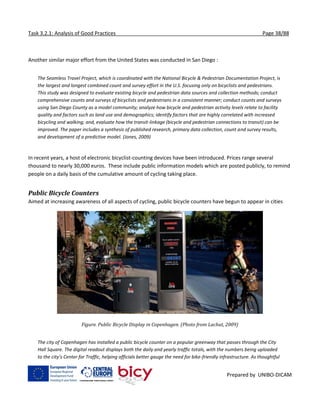
Public Bicycle Counters
Aimed at increasing awareness of all aspects of cycling, public bicycle counters have begun to appear in cities
Figure. Public Bicycle Display in Copenhagen. (Photo from Lachut, 2009)
The city of Copenhagen has installed a public bicycle counter on a popular greenway that passes through the City
Hall Square. The digital readout displays both the daily and yearly traffic totals, with the numbers being uploaded
to the city’s Center for Traffic, helping officials better gauge the need for bike-friendly infrastructure. As thoughtful
Task 3.2.1: Analysis of Good Practices Page 39/88
Prepared by UNIBO-DICAM
add-on, the unit includes a free air pump as well. To bring greater attention to the project, the city will be giving
away a brand new bicycle to the 500,000th person to pedal by. (Lachut, 2009)
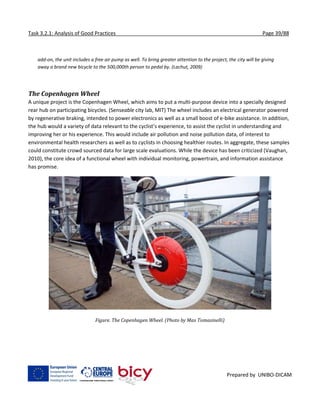
The Copenhagen Wheel
A unique project is the Copenhagen Wheel, which aims to put a multi-purpose device into a specially designed
rear hub on participating bicycles. (Senseable city lab, MIT) The wheel includes an electrical generator powered
by regenerative braking, intended to power electronics as well as a small boost of e-bike assistance. In addition,
the hub would a variety of data relevant to the cyclist’s experience, to assist the cyclist in understanding and
improving her or his experience. This would include air pollution and noise pollution data, of interest to
environmental health researchers as well as to cyclists in choosing healthier routes. In aggregate, these samples
could constitute crowd sourced data for large scale evaluations. While the device has been criticized (Vaughan,
2010), the core idea of a functional wheel with individual monitoring, powertrain, and information assistance
has promise.
Figure. The Copenhagen Wheel. (Photo by Max Tomasinelli)
Task 3.2.1: Analysis of Good Practices Page 40/88
Prepared by UNIBO-DICAM
Evaluation Methods
There are many approaches to evaluation, with some highly developed, such as the Cycle Balance in
Netherlands, which deserve mention.
Conflict Studies
Method developed by Lunds Technical University, Sweden Systematic registration of conflicts between road
users can give an indication of the number of accidents in the long run. Results from conflict studies can quickly
describe safety implications of new designs - not waiting 3-5 years collecting accident information from police.
Registration only by trained and experienced personnel. Everything is videofilmed. (Described by Niels, 2009)
BYPAD: Bicycle Policy Audit
A well-established method of evaluation, which BICY has aimed to approximate with its SWOT analysis
(WP3.1.10), is the Bicycle Policy Audit (BYPAD). BYPAD was “developed by an international consortium of bicycle
experts as part of an EU-funded project.” The website and public version of the BYPAD Manual are referenced
in this document.
The BYPAD Facts page on the BYPAD website describes:
BYPAD is a flexible tool and can be implemented in towns, cities & agglomerations and regions.
BYPAD has already been carried out by over 140 cities, towns and 20 regions in 25 countries.
More than 90 BYPAD auditors from 21 different EU countries have been trained and certified in order to
guide the towns, cities and regions to implement BYPAD. Check the website for the contact details of the
national auditors.
After the implementation of the audit all cities and regions receive from their national auditor the official
BYPAD certificate together with a bicycle action plan.
Examples of good practices are exchanged and spread through the good-practise database and/or the
BYPAD-newsletter.
BYPAD regional workshops and international seminars ensure regular and intensive exchange of
information between the BYPAD auditors, towns, cities and regions and all those active/interested in the
field of cycling policy. Check the website regularly for the upcoming events.
Although not intended for quantitative analysis, the BYPAD summary rankings provide numerical results for each
question, each summary category, and finally an average across all rankings. These public rankings result from
numerical assignment to thematic areas or issues.
Task 3.2.1: Analysis of Good Practices Page 41/88
Prepared by UNIBO-DICAM
In the BYPAD Manual, the rankings are defined:
Level 0: no cycling
Level 1: Ad-hoc approach
Level 2: Isolated approach
Level 3: System oriented approach
Level 4: Integrated approach
Rankings may be given as integers (with a fraction, e.g., 3.75) so are not limited to only five outcomes per
category/question.
A graphical representation of averages for many BYPAD-evaluated cities is provided below (Figure).
Figure. Official BYPAD Audit rankings for numerous cities. [2]
The Cycle Balance Evaluation Method
History and Aims
Task 3.2.1: Analysis of Good Practices Page 42/88
Prepared by UNIBO-DICAM
The Dutch Cyclists’ Union (Fietsersbond) asserts the interests of cyclists in the Netherlands and is dedicated to
achieve more and better conditions for cycling. It strives to make the bicycle more competitive with other
modes of transport over short distances. In terms of time, as well as in terms of safety and comfort. Their main
measures of cycling infrastructure are: directness, attractiveness, comfort, safety of route and a coherent cycling
network. [5]
As a result of the high bicycle-use, Dutch government, private organisations and companies invest a lot of time
and money in support of cycling. There are for example over 20 000 km of bicycle lane and bicycle path along
Dutch roads and the capacity of bicycle parking facilities at railway stations alone is almost 300 000. Strangely
enough the effectiveness and efficiency of all these efforts have never been assessed in a quantitative fashion.
In order to fill this gap, the Fietsersbond developed the Cycle Balance (Fietsbalans). This benchmarking project is
funded by the Ministry of Transport, Public Works and Water Management. Impartial assessment of local cycling
conditions is used as strategy to improve local cycling policies. [5]
The project, which started in the summer of 1999, has two main objectives:
 The primary objective of the project is to stimulate local authorities to adopt a (still) better cycling
policy, using benchmarking techniques. The aim of benchmarking is to learn from others by comparing
the performance of one town to that of others and look for best practices.
 The secondary objective of the project is to enhance the position and strength of the local Fietsersbond
branches. As most decisions that influence cycling conditions are made on a local level, it is important
that the Fietsersbond local branches are recognized by local councils and civil servants as knowledgeable
and influential partners that represent the interests of cyclists. Therefore, the Cycle Balance is used to
establish a cooperative environment in which discussion is based on facts rather than emotions.
By 2002 the project has been executed in 115 towns which include all Dutch towns with over 100 000
inhabitants and cover almost 50 % of all Dutch cyclists.
The four surveys of the Cycle Balance
The Cycle Balance assesses ten different dimensions (and 24 sub-dimensions) of the local conditions for cyclists
(Table 3). These dimensions provide a good mixture of policy results, policy effects and policy process.
Task 3.2.1: Analysis of Good Practices Page 43/88
Prepared by UNIBO-DICAM
Table 3. The ten dimensions of assessment in the Cycle Balance
1. Directness 6. Bicycle use
2. Comfort (obstruction) 7. Road safety of cyclists
3. Comfort (road surface) 8. Urban density
4. Attractiveness 9. Cyclists satisfaction
5. Competitiveness compared to the car 10. Cycling policy on paper
The original idea when designing the project was to use existing data as much as possible. These data had to be
relevant, comparable, reliable and generate information on a local level. Very few existing databases met these
conditions. More then anticipated, the team had to collect the relevant data themselves. The research part of
the project contains of four surveys.
A questionnaire for the municipality is used to assess the local authorities cycling policy on paper. A good cycling
policy focuses on the cyclist and therefore meets with certain quality requirements.
A questionnaire on cyclists satisfaction is used to assess if the cycling conditions meet with the requirements of
the day-to-day cyclists. After all, the cyclist is the customer! Stimulating bicycle use is more likely to be
successful if the cycling conditions meet their needs.
Some data on local cycling conditions data are available in national databases of organizations like Statistics
Netherlands. With these data relevant assessment units are calculated on bicycle use, road safety and urban
density. Innovative analysis methods are applied as much as possible.
The Quick Scan Indicator for Cycling Infrastructure is used to assess the quality of the local cycling infrastructure.
This is without a doubt the most innovative and appealing of the four surveys. According to a fixed method of
random sampling 12 to 16 routes are selected in and around the city centre, giving a representative picture of
how cyclists move around in the town. These routes go from randomly selected residential houses to the main
destinations for cyclists and vice versa.
A specially designed measuring bike registers on a laptop computer time, distance, speed, sound and vibrations
(and thus indirectly also stops, waiting time et cetera), see Fig below. A video camera records at the same time
the road profile, type of intersection, type of road surface, manoeuvres and obstacles.
Task 3.2.1: Analysis of Good Practices Page 44/88
Prepared by UNIBO-DICAM
Figure 6. Dutch bicycle infrastructure measurement bike.
These data are connected by a special computer program so that for example ‘the average vibration disturbance
of cycle tracks with asphalt paving’ and ‘the average waiting time at intersections with traffic lights’ can be
determined. A car drives the same routes as the bicycles to determine the competitiveness of the bicycle, both
in time and in cost.
The assessment of participating towns
For each of the participating towns a comprehensive report is made on the results of the assessment, giving an
adequate, objective and comprehensive picture of the local cycling conditions. It contains a reliable assessment
of the local cycling conditions on 10 dimensions (and 24 sub-dimensions). The results are compared with:
 existing and developed standards;
 average scores of all 100 towns and towns of roughly the same size;
 the best scoring towns.
In this way, the towns gain clear understanding of the strong and weak aspects of their cycling policy and are
able to compare their efforts and results with those of other (comparable) towns. They can reliably determine
which aspects most urgently need improvement. Table 2 shows the assessed (sub)dimensions, the indicators
that are used, the standards and intervals that are used and the average assessment results. Unfortunately it has
not been made public how exactly the indicators have been numerically determined.
Task 3.2.1: Analysis of Good Practices Page 45/88
Prepared by UNIBO-DICAM
Table 4. General overview of the Cycle Balance assessment results 2000
Assessed (sub)dimension
Standard Interval Overall
Average
Average big
towns*
Average
medium size
towns**
Average small
towns***
Directness
Detour factor (ratio) 1,25 0,1 mediocre mediocre very good mediocre
Delay (sec/km) 16,5 10 good mediocre good very good
Actual cycling speed (km/h) 15,5 1 mediocre mediocre mediocre good
Overall judgement directness mediocre mediocre mediocre mediocre
Comfort (obstruction)
Chance of stopping (N/km) 0,75 0,5 mediocre bad mediocre good
Slow cycling and walking (% of time) 7,5 5 mediocre mediocre mediocre mediocre
Traffic-obstruction (v-Fv) 1,75 1,5 mediocre mediocre mediocre mediocre
Infrastructural impediment (v-Fi) 0,75 0,5 mediocre mediocre mediocre bad
No right of way (N/km) 2,5 1 mediocre mediocre mediocre bad
Turning off(N/km) 2 0,5 mediocre mediocre mediocre bad
Overall judgement comfort (obstruction) mediocre bad mediocre mediocre
Comfort (road surface)
Hindrance caused by vibrations (v-Ft) 100 40 mediocre mediocre mediocre bad
Attractiveness
Noise pollution (v-Fg) 130 40 mediocre bad mediocre good
Competitiveness
Journey time ratio (ratio) 1 0,1 good good mediocre mediocre
Journey bikes faster (% of journeys) 70 20 mediocre mediocre bad mediocre
Costs per journey (cents) 100 30 bad good bad very bad
Overall judgement Competitiveness mediocre good mediocre bad
Bicycle use
Share in trips to 7.5 km (%) 43 4 mediocre mediocre bad mediocre
Task 3.2.1: Analysis of Good Practices Page 46/88
Prepared by UNIBO-DICAM
Road safety of cyclists
Victims per 100 million cycle km (N) 14 4 mediocre mediocre bad mediocre
Urban density
Adresses per square kilometre (N) mediocre good good mediocre
Cyclists satisfaction
Bicycle parking (% dissatisfied) 17,5 15 mediocre mediocre mediocre bad
Comfort (% dissatisfied) 17,5 15 mediocre mediocre mediocre mediocre
Road safety for cyclists (%
dissatisfied)
17,5 15 mediocre mediocre mediocre mediocre
Social safety (% dissatisfied) 17,5 15 good good good good
Approach to bicycle theft (%
dissatisfied)
17,5 15 very bad very bad very bad very bad
Municipality's cycling ambitions (%
dissatisfied)
17,5 15 good good good good
Report mark 7,25 0,5 mediocre mediocre mediocre mediocre
Overall judgement cyclists satisfaction mediocre mediocre mediocre mediocre
Cycling policy on paper
Policy papers and plans (N) 16 4 mediocre mediocre mediocre bad
Bicycle network (N) 13,5 4 mediocre mediocre mediocre mediocre
Bicycle parking (N) 14 3 bad mediocre mediocre bad
Budgets (N) 4 1 bad mediocre bad bad
Council as employer (N) 5 1 mediocre mediocre good mediocre
Overall judgement cycling policy on paper mediocre mediocre mediocre mediocre
* big towns = more then 100.000 inhabitants
** medium size towns = 50.000 - 100.000 inhabitants
*** small towns = 20.000 - 50.000 inhabitants
The reports on the assessment results of each individual town discuss in great detail the relevance of each (sub)
dimension, which data were collected, how standards were determined and the assessment method. The main
part of the report consists of a presentation of the assessment results and the conclusions that can be drawn on
the basis of these results. Finally recommendations are given on how to improve the towns’ performance on the
Task 3.2.1: Analysis of Good Practices Page 47/88
Prepared by UNIBO-DICAM
(sub) dimension.
To illustrate the results of the assessment a brief account is given of the results, conclusions and
recommendations based on the central graph of Veenendaal as presented in Figure 7. The graph shows clearly
the strong point of Veenendaal. It is a very compact town with many destinations within cycling distance.
Bicycle-use is high and cyclists are satisfied with the quality of cycling conditions offered to them. The road
surface is of extremely high quality, mainly because of the use of asphalt on bicycle paths with smooth joints on
intersections and good maintenance. Finally the policy on paper meets with the standards set in Sign up for the
bike. The cycling policy is complemented by free guarded bicycle parking in the city centre and at the railway
station.
Figure 7. The Cycle Balance score of Veenendaal
However Veenendaal also has its weaker points and these show very clearly in the graph as well. Most striking is
the relatively high risk of cyclists getting involved in a serious accident. It is likely that intersections with busy 50
km/h roads are the main cause of the problem. The solution should be to reduce car speeds at these
intersections, and building roundabouts has proved to be a successful strategy to achieve this. The relatively low
score on directness is caused by a high detour factor, probably caused by the limited passages under or over the
railway tracks. A good analysis of the problem, using a matrix of origins and destinations (the O/D matrix),
should be made to see if easy solutions can be found in the way of short cuts for bicycles. The obstructions
caused by road design and fellow road users make cycling sometimes uncomfortable. Obstruction by cars on
roads where cars and bicycles are mixed and the fact that cyclists have to make many turns to reach their
destination also explain the relatively low average speed. A traffic policy which bans motorized through traffic
from residential roads is the way to enhance cycling conditions on this aspect. Finally the competitiveness of the
bicycle compared to the car could be better. In half of the trips that are part of the assessment the car was
quicker than the bicycle. Most importantly the parking costs for the car are too low to act as an incentive for
people to take the bicycle on short trips instead of the car. Giving cyclists more direct routes, preventing cars
from going through the city centre and raising parking costs for cars at important destinations like the city
centre, the railway station and office areas is the effective strategy for the bicycle to compete better.
Evidence for correlation between Cycle Balance and bicycle usage
The surveys in the 115 towns produced unique databases on the cycling conditions in The Netherlands. Never
before has so much data on cycling been collected in such a systematic way. Apart from the reports on each
Task 3.2.1: Analysis of Good Practices Page 48/88
Prepared by UNIBO-DICAM
individual town, analyses have been made on a general level. The most important result of these analyses is that
a positive correlation can be found between the actual bicycle-use and the scores on the nine other dimensions
of the local cycling conditions that are assessed in the Cycle Balance. Figure 8 shows that in towns with a high
score on the Cycle Balance bicycle-use is 30 % higher than in low scoring towns. This means that the assessment
in the Cycle Balance is relevant. But more importantly it shows that a well executed coherent cycling policy pays
off in terms of more cyclists and more cycling.
Figure 8. Correlation between bicycle-use and score on the Cycle Balance
Publicity and the ‘Cycle-city’ elections
Media attention has been recognised as an essential aspect of the project from the beginning and has been
incorporated in the design of the project. Influencing public opinion in all stages of the project is conditional to
its status and thereby its effectiveness. The Quick Scan measurements have successfully been used to generate
local, regional and even national publicity. The extensive media coverage is mainly due to the high tech
measuring bicycle’s appeal to the camera, and the presentations of the assessment results and subsequent
discussions in council committee meetings also get good coverage in local and regional newspapers.
To make the project even more exciting, a competition element was introduced. In November 2000, based on
the analysis of all collected data, five towns of different sizes were nominated for the ‘Cycle-city 2000’ title. An
Task 3.2.1: Analysis of Good Practices Page 49/88
Prepared by UNIBO-DICAM
independent jury declared the town of Veenendaal the winner. The jury praised Veenendaal for it’soverall
coherent policy and for the high quality of the infrastructure and other facilities for cyclists. But especially the
fact that Veenendaal was not known for it’s excellence clinched it for Veenendaal. In December 2002 a jury
chose the town of Groningen as Cycle-city 2002 (Fietsstad 2002, see Fig. 5) from six nominated towns. The main
consideration of the jury was that the excellent competitiveness of the bicycle did not only lead to a very high
modal share for the bicycle (47%) but also to a low modal share for the car (23%) in inner city transport. The
publicity and interest these Cycle-city elections have generated has been used to communicate the good
practices that can be found in the nominated towns. The main focus of communication has been on traffic and
transport professionals, civil servants and local politicians of other towns so they cal learn from these excellent
achievements.
The special focus on publicity in the project has paid off. The project is a household name for everyone involved
in bicycle planning. It is known to the relevant target groups: civil servants, aldermen, council members, (other)
professionals. Participating towns are eager to get the final results and new towns still show interest to
participate. Several of these have already indicated that they want to use the results to revise their cycling
policy. The bicycle in general and the Cyclists Union in particular have also benefited from all the media
attention.
Facilities Design
There is great diversity in the world of cycling facilities, and while this has led to much innovation, it has also led
to perilously bad and often dangerous travel environments, tragic irony given the goal of the facilities should be
to make everyone be and feel safe to cycle. Perhaps the most infamous “crap cycle ways” in Europe are those of
London, where some 30-40 districts have each invented their own approach. Yet these problems can be found
across Europe. Thus there is a crying need for standards.
A primary challenge has certainly been that there are so many types of cyclists, and so many environments to
accommodate cyclists in. Often roadway space is constrained and the political will to provide first-class facilities
for cycling has been lacking. Thus great flexibility and long term scalability, to accommodate an ever-growing
cycling population, are both needed.
National and International Standards
In terms of facilities design, standards for cycling facilities can vary widely and tend to be chosen at the country
level. The recent release of design standards in Germany include provision for riding two-abreast.
Large scale standards can be problematic as well, however. In the USA, the Manual on Uniform Traffic Control
Devices (MUTCD) has been very slow to change for cycling. Cycle tracks have only recently become allowed.
Typically a new innovation must be vetted through experimentation that can last years, and may only be tried in
Task 3.2.1: Analysis of Good Practices Page 50/88
Prepared by UNIBO-DICAM
a maximum of two places . An example would be red colored bikeways in Oakland. At this time there is only
“Interim Approval” for green colored bikeways. (FHWA 2011)
Standards for design of cycling infrastructure are in constant development. In Europe, the new German Bicycle
Strategy 2012 has just been released. Each country typically has its own process. While there can be national
standards, in many cases bikeways have been designed as a creative local process without expertise. In
In North America, the United States relies heavily on the MUTCD, which imposes a great deal of constraint on
innovation nationally. New best practices are typically only approved in a maximum of two instances, and it can
take years of committee work to approve a new change. Politically this can be a slow process, given the variety
of barriers to institutional adoption on the road to eventual physical integration including cultural and political
barriers. For example, colored cycling lanes in Oakland, California. In many cases laws must be changed to allow
cycling to be better accommodated, protected, and respected.
In California, Chapter 1000 of the CalTrans Highway Design Manual has been a standard that many places have
looked to. It includes recommended widths for paths and lanes, as well as a discussion of sight lines. However
much more can be described. In the past the TRB Highway Design Manual has been a widespread standard as
well, although even in 2000 it quoted limited information on cycling from the 1980s.
Minimize Conflicts
Perhaps the single biggest mistake of facilities design has been the increasing of conflicts, which lead to fatal and
serious injury traffic collisions.
One leading example is the “door zone.” When bikeways are placed near car doors, cyclists are forced to play
“Russian Roulette” as there is no warning when a door is opened. Deaths and serious injuries occur regularly due
to the door zone problem.
Another major conflict is caused when cyclists are forced in and out of traffic, and wherever merging occurs. This
is the major weakness of cycle tracks, and in fact cities with cycle tracks are still grappling with deaths caused by
right-turning vehicles that do not see or expect cyclists.
Task 3.2.1: Analysis of Good Practices Page 51/88
Prepared by UNIBO-DICAM
Figure. Cyclists in Vienna, Austria are directed to the opposite side of the street temporarily to avoid a bus zone. In the
process however, a serious potential conflict point is created. (Photo Jason Meggs)
Low Cost and Expedient Measures
It is crucial for cities to realize that urban cycling facilities can be achieved at low cost if they are incorporated
into every new project. Whenever a street is repaved, a signalization is implemented or changed, or an
intersection otherwise redesigned, a major opportunity exists. The basic provision of bikeways requires only
markings, and paint is cheap –although it does not last.
An example of a quick provision of a bicycle box is below:
Task 3.2.1: Analysis of Good Practices Page 52/88
Prepared by UNIBO-DICAM
Figure: A quick an inexpensive paint job in Edinburgh, Scotland, gives cyclists a “bike box” which helps reduce conflicts at
intersections. The quick and cheap use of paint, however, means the box is degrading quickly. (Photo, Jason Meggs).
Moreover, rapid conversion of road space to provide bike lanes or even to provide cycle track can be
accomplished with minimal expense, given existing viable surfaces. Repainting, and/or providing limited
amounts of curbway, is a viable option to consider. Road diets (for example, converting a highway with 2-lanes
in each direction, to one with 1-lane, a center turn lane, and bike lanes at each side) have been shown to have
no negative impacts on traffic flows for many situations even with average daily traffic (ADT) of 20,000 and
more.
The below example from Montreal, Quebec, Canada, illustrates a relatively low-cost conversion of a street that
was unnecessarily wide. In the process of such “road diet” and related conversion measures, traffic becomes
more predictable and more compliant. The deadly “double jeopardy” which vulnerable users face on two-lane
Task 3.2.1: Analysis of Good Practices Page 53/88
Prepared by UNIBO-DICAM
roads, where aggressive and speeding drivers jockey and change lanes to maintain speed, is eliminated.
Emergency services gain a free lane in center for faster response time. Noise pollution is reduced. In all, a much
more neighborhood-friendly option with reasons to be done even if cycling were not a goal.
Figure: A relatively inexpensive and quick conversion of existing road space to include a bike path in Montreal, Canada.
(Photo, Jason Meggs).
Construction
During construction, access for cyclists is essential and often forgotten. This can become quite dangerous,
particularly when unclear divisions between heavy work and travel way are made. Cycles are much more able to
permeate boundaries such as cones and so clear warnings need to be given.
The below example shows a common example of construction negating the needs of cyclists (from Helsinki,
Task 3.2.1: Analysis of Good Practices Page 54/88
Prepared by UNIBO-DICAM
Finland).
Figure. Construction often interferes with cycling. Photo Jason Meggs
Maintenance
It is important to maintain facilities. Cycling facilities, being often at the curb, are particularly susceptible to the
collection of dirt and debris. The cyclist’s tire is much more vulnerable to punctures, and the cyclist is more
vulnerable to skidding and slipping than motor vehicles with four and more wheels. Therefore priority for
maintenance both in the road repair and in cleaning is crucial. Snowy places with high cycling make sure to plow
the cycleways first. In other places cyclists might wait for a snow plow and follow it (see photo from Bologna,
below).
Task 3.2.1: Analysis of Good Practices Page 55/88
Prepared by UNIBO-DICAM
Figure: A cyclist finds refuge behind a snow plow in Bologna during a snow storm. (Photo, Jason Meggs).
Indeed, it is viable for some maintenance to be done by bicycle. This includes gardening (see photo, below), but
of course surveyance of the bicycle network. Some cyclists even carry a broom to sweep broken glass and fallen
nails in the service of their fellow cyclists.
Task 3.2.1: Analysis of Good Practices Page 56/88
Prepared by UNIBO-DICAM
Figure: An urban maintenance worker tending to a greenway in York, England, June 2010. (Photo, Jason Meggs).
Design for all users
As discussed earlier, there are many, many types of cyclists to design for.
The Young and the Old
Age matters: child cyclists are more prone to injury as they are harder to see, and have lesser understanding of
traffic rules as well as lesser motor ability and less developed perception. Older cyclists can also face issues of
declining or reduced mobility and perception. In Copenhagen, for example, older cyclists are encouraged to
Task 3.2.1: Analysis of Good Practices Page 57/88
Prepared by UNIBO-DICAM
make left turns in two steps rather than one fluid motion, to minimize troubles with checking for traffic (hearing,
turning the head and seeing well) rather than making a more complex and dynamic move. To accommodate this
ideally there is a protected area at each curb where a cyclist can turn their bicycle and wait to cross. An
interesting design from New York City, where cycle innovations have been accelerated in recent years,
incorporates this.
Figure. An innovation in New York City helping cyclists turn left across a dangerous intersection with heavy truck traffic.
Prince and Bowery, NYC. (Jason Meggs)
People with Disabilities
As mentioned earlier, many people with disabilities rely on bicycles. A bicycle can serve as a combination crutch
and wheelchair. Cycling, being low-impact and relatively easy, can also help some people rebuild strength and
Task 3.2.1: Analysis of Good Practices Page 58/88
Prepared by UNIBO-DICAM
ability if at a critical stage of recovery. Cycling helps prevent disability by keeping aging folks below the
“Disability Threshold” through regular exercise.
On the other hand, bicycles sometimes complicate the urban environment, and can cause confusion for blind
folks or obstruction for people in wheelchairs. Placement of bicycle parking, and cyclists themselves through
education, must protect these needs.
Figure. A paper sign affixed to an antique gateway asking that bicycles not be parked there, to preserve the way for
people with disabilities. Bologna, Italy. (Photo, Jason Meggs)
In fact there are special bicycles designed for those with disabilities. In particular cycles with hand cranks. In
some places there are centers where such bikes are housed and can be borrowed or rented. One example is the
Adaptive Cycling Program of BORP in Berkeley, California, at Aquatic Park, where people can take out
handcycles, and tandems, to allow many people with disabilities to practice and enjoy cycling in a natural
environment.
It’s the little things that count
Sometimes this is so. A tiny touch in Dresden makes it much easier and cleaner for a cyclist to remain mounted
while waiting for a traffic signal to change. For some people, particularly with mobility impairments, this type of
feature can be a real benefit and make cycling a much more friendly experience. It can be uncomfortable for
some, particularly with joint or back pain, to mount and dismount repeatedly. (See photo, below).
Task 3.2.1: Analysis of Good Practices Page 59/88
Prepared by UNIBO-DICAM
Figure. A bicycle hand hold allows a cyclist to avoid dismounting when waiting for a light. Pictured here is professor Gerd-
Axel Ahrens of the Central MeetBike project. Dresden, Germany. (Jason Meggs)
HPV and Recumbent Bicycles
Unusual sizes of bicycles do exist and parking them is not always easy. A diversity of parking places helps allow
for parking unusual bicycles. Likewise, wider spaces for turning, wider curb cuts, and wider lanes assist with such
unusual cycles (e.g., the Conference Bike, which seats 7 passengers in a circle facing one another).
Task 3.2.1: Analysis of Good Practices Page 60/88
Prepared by UNIBO-DICAM
Cargo Bicycles
A final group for consideration here, of the many possible subgroups, are those who carry loads or have unusual
bicycle designs such as recumbent bicycles and tricycles. Cargo bicycles are on the rise, an important trend
encouraged by the EU project CycleLogistics. Cargo bicycles could carry a large portion of urban freight, as well
as local delivery; this was the case in the past and is currently the case in some parts of the world such as Rio.
Cargo delivery, as it increases toward its full potential, will substantially reduce danger, noise, vibration, and
other pollution including greenhouse gas emissions, while benefitting the economy by creating more local jobs,
reducing wear on roads, reducing blockages of traffic for delivery, reducing health costs, shifting some shopping
trips by car to delivery bikes, and reducing the draining of local funds for finite and expensive foreign imports of
petroleum.
Figure. Cargo bicycle in Bogota’, Colombia. “Deposit here potatoes, bananas and carbon”, a reference to power by food
which reduces carbon emissions. September 2006. (Photo, Jason Meggs).
Task 3.2.1: Analysis of Good Practices Page 61/88
Prepared by UNIBO-DICAM
However, accommodation of cargo bicycles requires additional space considerations in parking, buildings and on
the road. Such provision is not inconsistent with the general need to increase accommodations for cycling. Such
bicycles may need wider travel ways, varied means of parking, and longer signal timing in the case of slow,
heavy loads. Electric assist has tremendous potential not only for cargo delivery but for personal transport; a
lightweight cargo tricycle could in theory provide the benefits of a car, including protection from rain, along with
the ability to carry children and groceries. Yet such a vehicle could be much less expensive and use much less
energy and resources because of the lighter design which requires much lighter battery system.
China is famous for its cargo bicycle loads, but in history many used these across the world, and they are
definitely staging a major come-back. This resurgence has even been called a “Cargo Bike Renaissance”.
Cargo bicycles are common in China, but increasingly in the western world as they once were. Cargo bikes have the
potential to replace much of urban freight transport. Shanghai, China. (Photo, Jason Meggs)
Task 3.2.1: Analysis of Good Practices Page 62/88
Prepared by UNIBO-DICAM
Cargo bicycles are common in China, but increasingly in the western world as they once were. Cargo bikes have the
potential to replace much of urban freight transport. Shanghai, China. (Photo, Jason Meggs)
The unexpected bikeway visitor
In all these cases, the essential theme is larger or more unusual designs require wider variances. If we plan and
provide for increased cycling, it becomes more possible to integrate these universal solutions:
In fact, in some cases we must anticipate other users as well, such as runners, crowd spill-over, and inline
skaters. Preserving the sanctity of the bikeway for serious transportation is important, but designing for
flexibility is also needed.
A bicycle facility could always have a surprise visitor, for example, these police horses in Helsinki, Finland benefit
from a bikeway.2
Some people run their dogs using a bicycle as well, with a leash, requiring more space.
2
In history, bicycles and horses have had conflicts; it is interesting to consider the value of bikeways to animals today.
Task 3.2.1: Analysis of Good Practices Page 63/88
Prepared by UNIBO-DICAM
Figure. Police horse prefers the bikeway in Helsinki, Finland. (Photo, Jason Meggs)
While regulations may not permit these actions, they may happen and all possibilities are good to consider. Not
all bikeways can facilitate such variances, but they serve as examples of the need for wider or mixed-use
facilities in many places.
Parking & Theft Prevention
Bicycles must be stored, and are easily stolen. Ideally all buildings accommodate bicycles easily. Conditions vary.
Short-term parking in daytime in relatively safe areas can be provided on the street. Best practices include
taking one or more car parking spaces, each of which can accommodate up to 12 bicycles, without impeding
pedestrian environment, and sends a strong message of support and inclusion while, if done at intersections,
increases safety by improving sight lines. The added benefit of reducing capacity for cars in the city moves the
city that much further in a healthy direction.
Task 3.2.1: Analysis of Good Practices Page 64/88
Prepared by UNIBO-DICAM
Stand-alone self-service parking can be done wrong. It is important that the parking be visible, and near
entrances, or cyclists will not see it and will not use it. A bicycle is a personal extension, just a bit moreso than a
briefcase, and cyclists don’t like to part with them unnecessarily. Convenience is of course a major factor.
One type of parking that is ubiquitous and harmful is the “wheel stand” parking. Cyclists are unable to secure
their frame (wheels or easily removed) and the torque on the wheel slowly loosens spokes and causes wheels to
catastrophically fail over time, even while riding, which it goes without saying can be deadly.
The consensus in the bicycle world is that stand-up parking is preferred. The debate now centers on whether
short loops (“ribbon racks”) or longer racks (shoe-horn shaped, which provide two points of contact) are
superior. In fact a mix of both is best due to the differing designs. Many bicycles cannot squeeze into ribbon
racks. Other bicycles need the support. A long-rack can be places parallel to pedestrian flows and reduce the
impact of standing parked bicycles in the pedestrian environment. A varied approach with due consideration for
all is needed.
An important place for a major parking facility is a public transport station, discussed below.
Eyes on the bicycles, including video surveillance, is always highly recommended. In fact, many bicycles are
stolen in broad daylight.
Ground level indoor secure parking is also critically important. Not all cyclists can carry their bicycles up and
down stairs, let alone when loaded with luggage etc. These can be required in building codes (e.g., Berkeley,
California General Plan).
A secure cage or room with a door wide enough for a cargo bicycle is an important feature in all modern
construction, and can be provided in older construction in many cases. In parking lots shipping containers or
other lightweight construction can provide parking using existing surface parking for motor vehicles. A roof is
always helpful to prevent snowed-in bicycles and the steady destruction of the machine from rust in rain.
As a next best option, courtyards are semi-protected and many windows face them (see photo from
Copenhagen student housing, below).
Task 3.2.1: Analysis of Good Practices Page 65/88
Prepared by UNIBO-DICAM
Figure. Copenhagen student housing bicycle parking in courtyard. (Photo, Jason Meggs)
Education is key. Ideally all new cyclists would be given a course in locking bicycles. A study done in Berkeley,
California by the police found that nearly 9/10 bicycles reported stolen were not locked or essentially not
locked. The method of locking a bicycle has a huge effect on successfully retaining the bicycle. A strong lock
through a secure part of the bicycle, attached to a secure object, is essential, and it is easy to miss one or more
of those three key points.
Licensing and registration have been attempted. This is not recommended except as a voluntary and preferably
international effort. The California example is one of true disaster. The law was only enforced locally, so a thief
need only carry the bicycle across city lines to be safe. Moreover, even locally, police could not look up a bicycle
so during an enforcement stop in the field, there was no way to know if the owner was in possession. This
encouraged bike thieves to steal licensed bikes over unlicensed ones, the opposite of the evident intent of the
law. Still worse, the law allowed police to confiscate bicycles that were not registered (and many did not know
Task 3.2.1: Analysis of Good Practices Page 66/88
Prepared by UNIBO-DICAM
of the registration procedure, and it was often not available). Thus the system did much harm to cycling. Even if
there were a statewide system (and some cyclists tried to create their own by etching their phone number,
name, and identification number into the frame), stolen bicycles sometimes travel far and wide, even shipped to
faraway countries. The below license (in jest) was seen in Bogota’, Colombia:
Figure. Political humor criticizing the idea of a licensing system. Bogota’, Colombia, 2006. (Photo, Jason Meggs)
Legal and Policy Barriers
The law is not always on the side of cyclists. A comprehensive accounting for this is a goal of BICY WP4, Strategy
and Implementation.
In Europe, the most touted origins of international standards in traffic behavior stem from the Vienna
Convention (VC) of 1966, which has since been amended. The VC allowed some flexibility in local
implementation, yet is often touted by cyclists as having created problems even as it solved some. For example,
the allowance for prohibition of cycling adjacent to cycle tracks has become a major problem in many places,
where the prohibition limits cyclists to longer and sometimes inferior and even dangerous routes, and slows
faster cyclists, discouraging them from cycling. Despite the Vienna Convention, local laws and policies can be
detrimental to cycling, and often prove difficult to change.
For example, in Austria cyclists lose their right of way whenever they leave a cycling facility, something that few
are aware of, but which works to the great detriment of any cyclist should an incident such as a traffic collision
Task 3.2.1: Analysis of Good Practices Page 67/88
Prepared by UNIBO-DICAM
end up in a court of law.
In Austria as well, it is presently illegal to ride two abreast, anywhere in the country, even on a wide separated
one-way cycle track or a low traffic road with long sight-lines. In contrast, Germany's new design standards
provide recommended facilities to allow side-by-side cycling. Allowing cyclists to ride abreast is an important
social benefit which humanizes and encourages cycling, giving it more life. It is also an important safety and
navigational right because cyclists traveling together must communicate in motion, just as passengers in a car
are able to. There is no other mode which is forced to face one anothers’ back when traveling; in every other
mode a conversation can be enjoyed. Why not so for cycling?
In the Czech Republic, owing to the Vienna Convention, cyclists are not allowed to ride on street where a cycle
track exists, and the cycle tracks are said by advocates to impede and endanger cyclists by their design. Cyclists
end up stopping at every block and never have priority (see discussion of the importance of free-flow, below).
In Slovakia and too many other places, there are no local or national funds dedicated for cycling and no
systematic approach to provision of infrastructure and promotion.
In Poland, numerous cycling advocates have stated that cycling after more than one beer is treated more
severely than driving a car after drinking. A traffic stop for a cyclist can resullt in immediate imprisonment;
reportedly over 2,000 cyclists are in Polish jails at this time for drinking at least one drink before cycling. One
cycling advocate has conducted research with Police Departments and found that from a policy standpoint this
does not make sense; driving a car drunk is more dangerous than cycling drunk, and yet there are very few killed
in Poland by drunk drivers, let alone by cyclists. Yet aggressive driving is not targeted for enforcement. Results of
this inquiry are expected from the EU project VOCA (Volunteers of Cycling Academy).
Accepting Cycling
Best practices in leadership countries are tending more and more to relaxing rules for cyclists, recognizing that
there are many kinds of cyclists and that they have more flexibility and utility for local maneuvers than a car, and
impose a much smaller burden in terms of danger, space requirements, and more. In many countries, cyclists
are being given rights to maneuver that motor vehicles do not have.
Freedom to Free-flow
Major barriers to bicycle travel which are in kind, major discouragements which reduce cycling, include detours,
dangerous to cross and impassible highways, one-way streets, and any place where stopping is needlessly
required.
Eliminate stopping wherever possible
Task 3.2.1: Analysis of Good Practices Page 68/88
Prepared by UNIBO-DICAM
Relaxing the requirements for cyclists to stop at stop signs and red traffic signals is another trend which
demonstrates many benefits. To change a law regarding existing traffic controls can be a very low-cost and
widely beneficial measure. France has begun allowing cyclists to turn right when facing a red light. Previously
hundreds of cyclists a year were given citations fo this behavior. In the USA, where stop signs are used at great
frequency as low cost (but high externality) traffic calming, one state (Idaho) has allowed cyclists to treat stop
signs, as well as red lights, as yield signs, for more than 25 years. Since then many other states have considered
or begun the process of passing similar laws, with great support from the cycling community. Contrary to many
intuitive assumptions, allowing cyclists when to stop improves their safety and increases cycling (Meggs 2011).
Stopping frequently is a primary discouragement to cycling (Rietveld 2004); it costs a great deal of extra time
and energy (Fajans 2001), and imposes additional stress on the body which can lead to injury (Meggs 2010).
Cyclists will choose routes with fewer required stopping points, where available. (Sener) Indeed, Sener found
that avoiding frequent stops was of great import to cyclists, second only to avoiding “heavy traffic.” Rietveld
found 0.3 fewer stops per km along a route meant a 4.9% higher share of bicycling.
In pursuit of this goal, the notion of a “Bicycle Boulevard” has been created in the USA, where removing stop
signs is a primary goal. (De Robertis 2000). This is to be accomplished through traffic reduction measures and
the use of small roundabouts (neighborhood traffic circles) with the additional benefit of traffic calming and the
facilitation of smooth cycling interactions at intersections with high bicycle flows. At major intersections, special
bicycle crossings are the goal.
Europe has been more sparing with stop signs, frequently preferring yielding, which also reduces harmful
emissions and noise from motor vehicles, saves fuel energy, reduces roadway wear and tear, as well as reducing
wear and tear on vehicles themselves. However, frequent stopping can still be found in places and best practices
will avoid hard stops where possible, particularly on cycling routes.
Red Lights for Cycling
In some parts of Europe, bicycle signals have been used in large numbers. In Dresden, eastern Germany, in
pursuit of safety, signal timing for bicycle signals differs from that of adjacent signals for motor vehicles. This can
be confusing as it stops cyclists before the signals for motor vehicles, and often when most cyclists could still
finish crossing. This can give the impression of secondary treatment and unnecessary delay. In some places
bicycle signals are paired in groups in hopes of increasing cyclist awareness of them.
In the USA, in contrast, where bicycle signals have only begun to be employed3
, safety for cyclists focuses on
extending the yellow phase to allow cyclists to complete their crossing of the intersection before cross-traffic
3
The campaign to allow bicycle signals in California took years, due to opposition from the State Police.
Task 3.2.1: Analysis of Good Practices Page 69/88
Prepared by UNIBO-DICAM
begins. It is important to allow for all cyclists, such as by allowing fast cyclists who travel near car speeds on road
to follow main signals, while giving fair warning to slower cyclists that the safe time to cross has closed.
Figure. Cyclists can now find special bicycle signals in more and more leading cycling cities. These can create special
privileges and solve safety problems, but can also be misused and discourage cycling. Edinburgh. (Photo Jason Meggs)
Signals can solve safety problems and give special privileges to cyclists, but they can be misused as well. Use
sparingly in accordance with the goal of eliminating stopping for cyclists wherever possible.
Riding both ways where cars may not
In countries including the Netherlands, Germany, Austria and France, among others, where one-way streets are
barriers to cycling, signage such as “Bikes Free” (Rad Frei, or “Ausgen”) are posted, giving cyclists the right to
ride counter-flow, sometimes with a counter-flow lane (or even just a short one that ends), and sometimes with
no lane. This is important because “going around the block” can be a burden that few cyclists will accept, so to
Task 3.2.1: Analysis of Good Practices Page 70/88
Prepared by UNIBO-DICAM
make behavior regular, predictable, and legal, the measures have been a success. Less widely adopted measures
include riding counter-flow in traffic roundabouts in Denmark, which is reportedly an unexpected success.
That freedom for cycling leads to safer behavior and increased cycling may seem counter-intuitive, and may or
may not have been the case at the advent of the automobile, but it is the current trend in high consumption
countries where automobile infrastructure and low cycling have prevailed.
Figure. Cyclists are given the right to ride against traffic in more and more leading cycling cities. Here the example is
Vienna, Austria. (Photo Jason Meggs)
Green Wave: a cyclist freeway of light
A remarkable emerging best practice is the timing of signals to allow cyclists to maintain travel speed and stop
less often. Stopping is a major problem for cyclists, who use their own energy to reach travel speeds. This has
originated in northern Europe but is already being proposed in other places including San Francisco, California.
Depending on the implementation, benefits accrue for other users as well, including reduced bus headways in
some instances, and steadier car speeds. Cyclists get to go faster, saving energy, and motorists can have a more
even and tempered speed as a result, which reduces roadway dangers as well as noise and air pollution.
The effects of a Green Wave implementation in Copenhagen for cyclists are depicted below. The many stops
required for cyclists before the improvement was implemented meant a nearly 40% longer cyclist travel time,
which reduced average speed by 25%. The hidden additional cost is the higher toll of personal energy and wear
and tear on the bicycle and body.
Task 3.2.1: Analysis of Good Practices Page 71/88
Prepared by UNIBO-DICAM
Figure. Average travel speed and time for cyclists before and after implementation of the “Green Wave” signal timing.
(Jensen 2009)
The forthcoming work of the Transnational Strategy (WP3.4) aims to uncover more barriers to cycling across
Central Europe and propose measures to harmonize approaches, so a more predictable, safe and kind
accommodation of cycling can occur.
Bicycle Traffic Calming: Proceed with Caution
Because cyclists can reach high speeds, and sometimes in conflict with pedestrians or associated with dangerous
conditions, various efforts have been made to calm traffic.
In some cases, these have had dramatic effects contrary to their stated purpose. Perhaps the worst traffic
calming effort is the use of poles in the roadway (e.g., at UC Berkeley). In the USA and parts of Europe, poles are
often placed to prevent motor vehicles from entering pathways. However, a recent study reportedly found that
Task 3.2.1: Analysis of Good Practices Page 72/88
Prepared by UNIBO-DICAM
many injury incidents afflicting cyclists have to do with these poles, which can create tight spaces and have low
visibility, particularly at night. They are to be avoided wherever possible and the real trade-offs between
preventing a motor vehicle on pathways, and the safety of cyclists must be considered.
Additional traffic calming typically occurs on downhill grades or at unclear intersections. One example is
pictured below. Large and relatively visible, these barriers force cyclists to slow and change course.
Figure. Bicycle traffic calming on downhill grade on bridge in Montreal, Quebec, Canada. (Photo Jason Meggs)
Another method used is the placement of rumble strips in the pavement. They are uncomfortable to cyclists and
create alert and typically cause cyclists to slow.
Speed bumps are particularly deleterious to cyclists because of the sharp inflection. Especially when carrying
loads. Even speed humps can harm bicycles, this appears to happen frequently when carried on a rear car rack
Task 3.2.1: Analysis of Good Practices Page 73/88
Prepared by UNIBO-DICAM
based on anecdotal reports.
Access to Bridges
Critically important is access to bridges. If there is no way to travel, there is no travel, so cycling depends on this.
In many examples improvements to bridges induced additional cycling. The relatively small additional expense
yields many co-benefits such as maintenance and emergency access, and can make the bridge stronger.
Figure. A special bicycling bridge in Copenhagen, enjoyed by legendary cycling advocate Randy Neufeld (right) and
company, during Velo-City Global 2010. (Jason Meggs)
Shared Space: free flow for all?
Shared space is a relatively new approach to traffic controls which can be highly compatible with the goal of
Task 3.2.1: Analysis of Good Practices Page 74/88
Prepared by UNIBO-DICAM
reducing stopping for cycling: through the removal of all traffic controls!
Dubbed “Shared Space,” this approach aims to improve safety for all through the uncertainty created when
rules are lifted and everyone – from families strolling to trucks delivering – shares the same open spaces.
Shared space plaza in Erfurt, Germany. Electric vehicle, family with bicycle and child in trailer, share the plaza with a
tramway, truck deliveries, cyclists riding, and emergency vehicles which can pass at high speeds. (Photo, Jason Meggs)
In some ways beneficial to those with disabilities due to the lack of curbs and other obstructions, these have
also been criticized by advocates for people with disabilities. Some cyclists have also complained that the spaces
allow aggressive drivers an autobahn if they are so inclined to abuse the space.
Carfree Cities
Shared space can benefit from car restrictions. The major leap from shared space would be completely carfree
Task 3.2.1: Analysis of Good Practices Page 75/88
Prepared by UNIBO-DICAM
spaces and even entire carfree cities. (Crawford)
Figure. A carfree city would allow more social interaction and a healthier environment. (Carfree Day in York, England,
Sept. 2010). Photo Jason Meggs
As mentioned earlier, simply limiting the access and use of automobiles can greatly help the health of a city, and
boost cycling levels. Bogota’, Colombia removed parking wholesale to counter gridlock and extremely unhealthy
and inefficient traffic congestion.
Task 3.2.1: Analysis of Good Practices Page 76/88
Prepared by UNIBO-DICAM
Figure. Parking was simply barricaded as a short-term emergency measure to reduce the car problem in Bogota’,
Colombia. (Photo Jason Meggs)
Public Transport
Integration of cycling into all aspects of public transport is essential.
Major transport centers offer the opportunity to provide large scale parking as well as full service centers where
rentals and repair can be provided and even enhanced by social opportunities such as cultural offerings, meeting
and training rooms, a café and/or restaurant, and more. Examples abound in the Netherlands, and even some
North American places have provided Bike Stations, e.g., Berkeley, CA, which can become centers for general
cycling support. Below is pictured the Radhause (bike house) in Erfurt, Germany.
Task 3.2.1: Analysis of Good Practices Page 77/88
Prepared by UNIBO-DICAM
Figure: Radhause bicycle center: parking, rental, repairs and more are provided (left) including cargo bicycles (right).
Erfurt, Germany. (Photo, Jason Meggs)
The major parking facilities which result can accommodate large numbers of bicycles with extremely low theft
rates. For example, the self-service parking at the Radhaus, and another facility at a metro stop in Bogota’,
Colombia (which is staffed by a guard; cyclists must check their bicycles in and out of the system).
Figures: Examples of large parking facilities at transit stations. Radhaus in Erfurt, Germany (left) and a metro station in
Bogota’, Colombia (right). (Photos, Jason Meggs)
The provision of such a center can include services including self-service facilities. Here, a unique bicycle vending
machine where replacement tubes and patch kits can be purchased for fixing flat tires; and on the street in
Task 3.2.1: Analysis of Good Practices Page 78/88
Prepared by UNIBO-DICAM
Stockholm, a public bicycle pump (both pictured below). These features can greatly help cyclists, whose most
frequent problem could be needing to repair or fill air in tires.
Figure. Left, vending machine at Radhaus (Jason Meggs). Right, Cykelpump on the street in Stockholm (Nichtich).
Carriage on transit
Access to transit has increased greatly in recent years. Many commuter trains now allow cycling, and even
escalators allow bicycles in some places. Airlines and some train and bus lines still require bicycles to be boxed,
with fees ranging up to 100 euros or more, however.
A quick and inexpensive retrofit to buses allows portage of bicycles on the front of a bus. Even some buses now
allow bicycles inside during off-peak or when passenger loading is low.
In some cases simply allowing these to be added has required changing high level laws as well as negotiations
with labor unions. The problem with racks is that they are not reliable. Typically with space for only two, cyclists
often have to wait for the next bus – an unknown number of times – before they can board. In addition, not all
can lift their bicycle, and drivers must be instructed not to use their extremely powerful horns to communicate
with the naked ears of cyclists at their front bumper.
Task 3.2.1: Analysis of Good Practices Page 79/88
Prepared by UNIBO-DICAM
Figure. A cyclist loads a bike onto an AC Transit transbay bus in San Francisco, California, where the major transbay
bridge does not allow cyclists to cross, and trains prohibit bicycles during peak hours. The rack is now full, so additional
cyclists will have to wait and hope for another bus to accommodate them. (Photo Jason Meggs)
Even a bus or van can carry bicycles, using a trailer, as shown in the below example. Such a service is provided
regularly in the San Francisco Bay Area. Due to its popularity, the service was increased, but when there was no
end to the new cyclists arriving (there were always some cyclists turned away, who were not able to board), the
service was curtailed, showing that demand existed. Were buses to allow more bicycles on critical junctions such
as major bridges where bicycles are not permitted to ride, nor to board trains, during peak hours, high usage
could be seen.
Task 3.2.1: Analysis of Good Practices Page 80/88
Prepared by UNIBO-DICAM
Figure. Space for 36 bicycles in one short van trailer, plus room for luggage and more. Austria. (Jason Meggs)
Bike Share Systems
In a sense, bike share systems are a form of public transport, a bit like a taxi, but with a docking station. The rise
of bike sharing has done wonders for the bicycle world, now found in over 100 cities. Bike share systems also
provide a direct connection to users, which allows the potential for meaningful data to be found. A recent study
in Barcelona did just this, with a finding that bicycles are healthy to ride on balance.
A key problem with the systems is redistribution. It is important to know that the high tech models today have a
low-tech mechanical alternative (locking bays that use a key). The disadvantage here, as found in Bologna, Italy,
Task 3.2.1: Analysis of Good Practices Page 81/88
Prepared by UNIBO-DICAM
is that the bicycles must be returned to the point of origin. The trouble of redistribution is a particular problem
for some major systems such as Velib in Paris and the BIXY system in Montreal (see below, a trailer collecting
bicycles – one wonders why the locking stations aren’t easily lifted onto a trailer, or even come with wheels, to
reduce the idle time and labor involved).
Figure. Bike share system in Montereal, Canada, suffers from major redistribution problem. (Photo Jason Meggs)
It is important that the systems be clear to use, reliable, and inexpensive. Accessibility to all is also important
(the Bologna system is only for official residents with a permit, which impedes its utility and adoption).
A new measure is the use of SMS codes to unlock the bicycles, and the use of public areas without stands. This
greatly reduces the cost, although increases the potential for theft. On balance, it can be the best option
particularly for a low cost solution. Pictured below are the Klima-Taxis using this method, found in Erfurt,
Germany.
Task 3.2.1: Analysis of Good Practices Page 82/88
Prepared by UNIBO-DICAM
Figure. Klima-Taxi in Erfurt, Germany is a low cost measure that reduces the need for expensive docking bays and
electronics. An SMS message gives the code for the bicycle and off you go. (Photo Jason Meggs)
Education
It is beyond the scope of this report to discuss education, however, education is an important component of
increasing the quality and quantity of cycling, and is too often neglected. Yet, the opportunity to incorporate
cycle training into school programs is readily available, and good precedent and existing materials are available.
There is a clear association with such training and increased cycling as well as safer cycling. The Netherlands
leads in this example, with traffic safety in schools beginning at an early age.
Task 3.2.1: Analysis of Good Practices Page 83/88
Prepared by UNIBO-DICAM
Figure. A young cyclist is already learning how to care for his bicycle. (Jason Meggs)
The next generation can be a bicycling generation, and enjoy many benefits as a result, if the legacy of impacts
caused by automobility and the oil age allow.
Task 3.2.1: Analysis of Good Practices Page 84/88
Prepared by UNIBO-DICAM
Conclusions
This report illustrates the historical development of cycling culture in European cities and relates it to today’s
bicycle usage, and discusses in overview some of the inspiring and important new trends in best practices
around the world.
It has been shown that a strong cycling history does in most cases result in a high bicycle usage today, but there
are also exceptions.
The differences in bicycle usage are highlighted on country and city level. The Netherlands has the highest
bicycle usage on the national and city level. Netherland's consequent application of cycling policy has been
explained in more detail.
Furthermore, the Netherlands have also developed the most sophisticated bicycle policy evaluation scheme, the
‘Fietsbalans’ (Bicycle Balance) , which has been outlined in this report. The Bicycle Balance has been presented
for the lead-city in the Netherlands. But the most significant result is the demonstrated positive (almost linear)
correlation between the Bicycle Balance and bicycle usage.
Speaking from the scientific approach of this BICY Project Work Package (WP3), unfortunately it is not possible
to obtain from the Bicycle Balance the bicycle infrastructure requirements . This is because the Bicycle Balance
indicator takes also several “non-physical” quantities into account, such as cycling policy implementation. The
exact calculation of the Bicycle Balance has not been published, but data and methods could be obtained from
the The Dutch Cyclists’ Union (Most manuals are in Dutch language). This is in fact a task undertaken and to be
accomplished within the BICY project.
The use of Best Practices in this report directly and importantly helps inform WP4, Stategy and Implementation.
Moreover, it is a strong basis for all WP3 actions culminating in the Transnational Strategy.
In proceeding, it is critical that we market cycling successfully and tailor it to the many kinds of cycling, fast and
slow, big and small, old and young, male and female. To do so will require that facilities that truly make sense,
and are in accord with the highest achievable best practices, are used.
A bicycling world is closer than one might have thought just a few short years ago. The time has arrived when
rapid adoption can bring us closer to the healthier and more sustainable place we could have been long ago.
Task 3.2.1: Analysis of Good Practices Page 85/88
Prepared by UNIBO-DICAM
References
Alliance for Walking & Cycling. 2012. Bicycling and Walking in the United States: 2012 Benchmarking Report.
Downloaded January 24, 2012.www.PeoplePoweredMovement.org/benchmarking
Bicycle Boulevard Guidelines - City of Berkeley, CA. , 2000.
BYPAD Project website, accessed Jan. 25, 2011. http://www.bypad.org/
BYPAD manual. Cycling: The European Approach. Available for download from:
http://bypad.org/docs/BYPAD_Cycling_The_European_approach.pdf
City of Copenhagen. Copenhagen, City of Cyclists: Bicycle Account 2010. http://www.kk.dk/CityofCyclists/
City of Portland Office of Transportation. 2008. PORTLAND BICYCLE COUNTS 2008.
http://www.portlandonline.com/transportation/index.cfm?c=44671
Christmas et al (2010) Cycling, Safety and Sharing the Road: Qualitative Research with Cyclists and Other Road
Users. http://www.dft.gov.uk/publications/rsrr-theme1-report-17/
Crawford, Joel. Carfree cities books and website. http://carfree.com/
CycleLogistics EU Project. http://cyclelogistics.eu/
Davies, D,Gray, S,Gardner, G,Harland, G (2001) A quantitative study of attitudes of individuals to cycling. TRL481.
Transport Research Laboratory, UK.
Davies, DG,Halliday, ME,Mayes, M,Pocock, RL (1997) Attitude to cycling: a qualitative study and conceptual
framework. TRL266. Transport Research Laboratory, UK.
David Lindelöw (2009) "Strategier för ett ökat gående och cyklande".
http://www.lu.se/o.o.i.s?id=12588&postid=1515498
Design Manual for bicycle traffic, CROW Record 25, Ede, NL
Fajans, J., and M. Curry. Why Bicyclists Hate Stop Signs. Access, No. 18, 2001, pp. 28-31.
Fietsberaad 2006, Continuous and integral: The cycling policies of Groningen and other European cycling cities,
Fietsberaad Publication No. 7, Amsterdam.
Task 3.2.1: Analysis of Good Practices Page 86/88
Prepared by UNIBO-DICAM
FHWA. Interim Approval for Optional Use of Green Colored Pavement for Bike Lanes (IA-14). April 15, 2011.
http://mutcd.fhwa.dot.gov/resources/interim_approval/ia14/index.htm
Flamm, Bradley J.; Asha Weinstein Agrawal. Constraints to green vehicle ownership: A focus group study.
Transportation Research Part D 17 (2012) 108–115
Gatersleben, B. and Haddad, H. (2010). Who is the typical bicyclist? Transportation Research, Part F, 13, 41-48.
Gibson, The Motor Car and its Story, p. 79.
Geller, Roger. 2011. Four Types of Cyclists (Updated).
http://www.portlandonline.com/transportation/index.cfm?c=44671&a=237507
Guardian, The. Crap cycle lanes. 21 October 2009.
http://www.guardian.co.uk/environment/gallery/2009/oct/20/crap-cycle-lanes#/?picture=354515426&index=0
Vaughan, Adam. The bike wheel that’s too clever for its own good. The Guardian UK Green Living Blog. Aug. 19,
2010. http://www.guardian.co.uk/environment/green-living-blog/2010/aug/19/copenhagen-wheel-cycling-bike
Heinen, Eva. In research on commuting in the Netherlands, Eva Heinen distinguished between, non-, part time,
and full time cyclists:http://www.sciencedirect.com/science/article/pii/S1361920910001306
Hartog, Jeroen Johan de; Hanna Boogaard, Hans Nijland, and Gerard Hoek. Do the Health Benefits of Cycling
Outweigh the Risks? Environmental Health Perspectives • volume 118 , number 8, August 2010
Jacobsen, P. L. Safety in Numbers: More Walkers and Bicyclists, Safer Walking and Bicycling. Injury Prevention,
Vol. 9, No. 3, 2003, pp. 205-9.
Jensen, Niels. 2009. How Copenhagen became a cycling city. http://www.gmfus.org/galleries/cdp-
tcn/Jensen__How_Copenhagen_Became_a_Cycling_City.pdf
Jones, Michael; Lauren Buckland. Estimating Bicycle and Pedestrian Demand in San Diego. Submitted August 1,
2007. http://www.tsc.berkeley.edu/news/08-2609.pdf
Kurt, Van Hout. July 2008. BYPAD Manual: Annex I: Literature search bicycle use and influencing factors in
Europe. EIE-programme 05/016 Intelligent Energy Europe.
Lachut, Scott. Copenhagen’s Public Bicycle Counter. July 8, 2009. http://www.psfk.com/2009/07/copenhagens-
public-bicycle-counter.html
McShane, Asphalt Path, p. 56, citing Annual Report of the City Engineer of Minneapolis (Minneapolis, 1906), 16 -
17 as cited in Eric H. Monkkonen, America Becomes Urban: The Development of U.S. Cities and Towns, 1780 –
Task 3.2.1: Analysis of Good Practices Page 87/88
Prepared by UNIBO-DICAM
1880 (Berkeley: University of California Press, 1988), 291.
Meggs, Jason N. 2005. Wherever the Wheel? Into the thickets of bicycling’s dive, 1890-1920.
Meggs, Jason N. 2010. One-thousand new cyclists. http://meggsreport.com/
Meggs, Jason N. 2011. The Idaho Law: allowing safer choice and happier travel. Septemberr 29, 2011.
http://meggsreport.com/the-idaho-law-allowing-safer-choice-and-happier-travel/
Michler, Robin conducted research on “vehicular” cycling versus other approaches in the
USA. https://cdr.lib.unc.edu/record;jsessionid=3A8ED03A895A86C7B1BFE6F431BB97F0?id=uuid%3Af2618950-
326a-4e29-8161-9978d0c55af3
Ministry of Transport, Public Works and Water Management Directorate-General for Passenger Transport 2009,
Cycling in the Netherlands, Ministry of Transport, Public Works and Water Management Directorate-General for
Passenger Transport, Den Haag.
National Bicycle and Pedestrian Documentation Project. http://bikepeddocumentation.org/
Nichtich. Cykelpump. Wikipedia Commons. http://commons.wikimedia.org/wiki/File:Cykelpump-Stockholm.jpg
Norton, Peter D. Fighting Traffic: The Dawn of the Motor Age in the American City. 2011.
Portland Bureau of Transportation. 2012. 2011 Bicycle Counts Report.
http://www.portlandonline.com/transportation/index.cfm?a=386265&c=44671
Pucher, John and Buehler, Ralph (2008) 'Making Cycling Irresistible: Lessons from The Netherlands, Denmark and
Germany', Transport Reviews, 28:4, 495 — 528
Pucher, J., J. Dill, and S. Handy. Infrastructure, Programs, and Policies to Increase Bicycling: An International
Review. Preventive Medicine, Vol. 50, No. Supplement 1, 2010, pp. S106-S125.
RIETVELD, P., and V. Daniel. Determinants of Bicycle use: Do Municipal Policies Matter? Transportation Research
Part A: Policy and Practice, Vol. 38, No. 7, 2004, pp. 531 - 550.
De Robertis, M. BERKELEY'S BICYCLE BOULEVARD NETWORK - TRB Transportation Research Information
Services.
Rodney Tolley (ed.) (2003), Sustaining sustainable transport: planning for walking and cycling in urban
environments , Cambridge (UK), Woodhead Publishing Limited, 507-524
Schweizer, Joerg; Silvia Bertoni, Anton Pashkevich, Jason Meggs. 2011. Round table: Rapid, quantitative
Task 3.2.1: Analysis of Good Practices Page 88/88
Prepared by UNIBO-DICAM
assessment methods in support for cycling policy formulation. Velo-City Global 2011 (conference).
Sener, I. N., N. Eluru, and C. R. Bhat. An Analysis of Bicycle Route Choice Preferences in Texas, US Transportation,
Vol. 36, No. 5, 2009; 2009, pp. 511- 539.
Senseable City Lab, MIT. 2009. Copenhagen Wheel. http://senseable.mit.edu/copenhagenwheel/gallery.html
Sloane, The New Complete Book of Bicycling, p. 269.
Vienna Convention (Convention on Road Traffic), amendment 1 (1993 update to November 1968 accord).
http://www.unece.org/fileadmin/DAM/trans/conventn/crt1968e.pdf
Workcycles. 2006. Nine girls in a bakfiets (photo). http://en.wikipedia.org/wiki/File:9-girls-in-a-bakfiets.JPG
Figure: A family parades with cargo bike in the How Berkeley Can You Be Parade, 2008. (Photo, Jason Meggs).

BICY-Best-Practices-in-Bicycle-Planning

  • 1.
    WP3.2.1 Jason Meggs Anton Pashkevich FredericoRupi UNIBO-DICAM BICY Project, Central Europe Programme, ERDF January 30, 2012 Best Practices in Cycling
  • 2.
    Task 3.2.1: Analysisof Good Practices Page 2/88 Prepared by UNIBO-DICAM Best Practices in Bicycle Transport BICY PROJECT TASK 3.21 – COMMON INDICATORS: ANALYSIS OF GOOD PRACTICES FINAL REVISION: 30 JANUARY, 2012; BY JASON MEGGS, ANTON PASHKEVICH & FREDERICO RUPI Abstract Abstract – This report summarises data on cycling from leading European countries, regions and cities, and provides examples of best practices from around the world. The report describes transport related policies in cities with high bicycle usage but presents also best practice assessment methods. However, despite numerous studies carried out in the Netherlands, Denmark and Germany, there is little numerical data available that would allow to relate the quantity and quality of cycling infrastructure with bicycle usage. In particular, correlations between the quantitative evolution of cycling infrastructure and bicycle usage are scarce. The results from a large scale bicycle infrastructure and policy assessment in the Netherlands are reported. A discussion of North American cycling is also presented. Regarding the BICY project, this report is an important input as it provides indicators and benchmarking by cities and countries that are worldwide leading in cycling use and provides suggestions for assessment methodologies. This report will be updated as the project evolves. Cover photo: Mobile bicycle repair stand and carriage of experimental bikes, Vienna Bike Festival. (Photo by Jason Meggs) BICY, implemented in the Central Europe Programme (www.central2013.eu), is co-financed by the European Regional Development Fund (ERDF)
  • 3.
    Task 3.2.1: Analysisof Good Practices Page 3/88 Prepared by UNIBO-DICAM Contents Abstract ....................................................................................................................................................................2 Cycles Arise...............................................................................................................................................................6 What are best practices?......................................................................................................................................9 What Cyclists Want................................................................................................................................................ 10 Different Bikes, and Different Bikers................................................................................................................. 12 Know Thy Market............................................................................................................................................... 14 Methods of Increasing Cycling .............................................................................................................................. 15 The Importance of Bicycle Culture and Mass Cycling Events............................................................................ 16 Safety is a Selling Point...................................................................................................................................... 19 Safety in Numbers: the progressive safety benefits of increased cycling..................................................... 21 Helmets and hard-heads ............................................................................................................................... 21 Negative Images In Question......................................................................................................................... 21 Image of Fun.................................................................................................................................................. 23 Cycling history and the influence of bicycle culture.............................................................................................. 23 Learning from the Worst Practice Examples: What not to do ...................................................................... 27 Learning from the Netherlands: Dutch bicycle use in a European perspective................................................. 28 Cycling cities .................................................................................................................................................. 33 The requirements for bicycle-friendly travel infrastructure ......................................................................... 36 Monitoring & Evaluation ....................................................................................................................................... 37 Best Practices in Monitoring ............................................................................................................................. 37 Public Bicycle Counters.................................................................................................................................. 38 The Copenhagen Wheel ................................................................................................................................ 39 Evaluation Methods........................................................................................................................................... 40 Conflict Studies.............................................................................................................................................. 40
  • 4.
    Task 3.2.1: Analysisof Good Practices Page 4/88 Prepared by UNIBO-DICAM BYPAD: Bicycle Policy Audit........................................................................................................................... 40 The Cycle Balance Evaluation Method .............................................................................................................. 41 History and Aims............................................................................................................................................ 41 The four surveys of the Cycle Balance........................................................................................................... 42 Evidence for correlation between Cycle Balance and bicycle usage............................................................. 47 Publicity and the ‘Cycle-city’ elections.......................................................................................................... 48 Facilities Design ..................................................................................................................................................... 49 National and International Standards ............................................................................................................... 49 Minimize Conflicts ............................................................................................................................................. 50 Low Cost and Expedient Measures ................................................................................................................... 51 Construction ...................................................................................................................................................... 53 Maintenance...................................................................................................................................................... 54 Design for all users ............................................................................................................................................ 56 The Young and the Old .................................................................................................................................. 56 People with Disabilities ................................................................................................................................. 57 It’s the little things that count....................................................................................................................... 58 HPV and Recumbent Bicycles........................................................................................................................ 59 Cargo Bicycles................................................................................................................................................ 60 The unexpected bikeway visitor.................................................................................................................... 62 Parking & Theft Prevention ............................................................................................................................... 63 Legal and Policy Barriers........................................................................................................................................ 66 Accepting Cycling............................................................................................................................................... 67 Freedom to Free-flow........................................................................................................................................ 67 Eliminate stopping wherever possible .......................................................................................................... 67 Red Lights for Cycling..................................................................................................................................... 68 Riding both ways where cars may not........................................................................................................... 69 Green Wave: a cyclist freeway of light.......................................................................................................... 70 Bicycle Traffic Calming: Proceed with Caution.............................................................................................. 71
  • 5.
    Task 3.2.1: Analysisof Good Practices Page 5/88 Prepared by UNIBO-DICAM Access to Bridges........................................................................................................................................... 73 Shared Space: free flow for all?..................................................................................................................... 73 Carfree Cities ................................................................................................................................................. 74 Public Transport..................................................................................................................................................... 76 Carriage on transit............................................................................................................................................. 78 Bike Share Systems............................................................................................................................................ 80 Education............................................................................................................................................................... 82 References............................................................................................................................................................. 85 Figure. Cycling infrastructure tour in Vienna, Austria, conducted by the European Cycling Federation. (Jason Meggs)
  • 6.
    Task 3.2.1: Analysisof Good Practices Page 6/88 Prepared by UNIBO-DICAM Cycles Arise For generations, the perennial question in the bicycle transport world has been: “How can we increase cycling?” Thus arises the core mission of the BICY project. This question is cyclical, as is the amount of cycling (bi-cycling), itself; each year cycling rises and falls with repeating trends such as weather patterns and the calendars of work and school. Economic fluctuations, particularly oil prices, have also played a major role since the 1970s in the activity around bicycle transport and its adoption. Concerns about environmental pollution, energy security, public health, and climate change certainly play an active role with both policy makers and individuals’ choices alike. In history as well, cycling has fluctuated greatly. The advent of the bicycle was the single biggest revolution in transport since the horse and buggy. It transformed economies and social mores in kind. It was a catalyst in radically changing the role of women, and paved the way – literally and figuratively – for the automobile. During the 1890s, the “Bicycle Boom” saw tremendous energy and innovation focused on bicycle technology, with hundreds if not thousands of small artisan shops working night and day to perfect bicycle technology in both Europe and North America. The first cars, motorcycles and even airplanes came from this effort – from small bicycle manufacturers – as did such essential innovations in transport as the pneumatic tire, the ball bearing, and eventually, paved roads, which cyclists en masse demanded. Even the first transport engineering program in the USA was begun by cyclists, organized at the Massachusetts Institute of Technology (MIT) by the League of American Wheelmen (LAW), now the League of American Bicyclists (LAB). Cities were already changing for this wondrous new invention, along with society and the entire economy. The advent of the bicycle had great promise. Shanghai, China was an early adopter and the first named “Bicycle City” owing to the flocks of cyclists enjoying its exceptionally flat conditions, but other places throughout the Netherlands as well as Copenhagen, Denmark, now world leaders, already had cycle tracks in the early to mid 1900s (see Figure 1, below). Laws were changed near and far to allow – and also to limit – cycling, resulting in great advocacy efforts to protect the “freedom of the wheel”. Doctors battled over whether cycling was healthful or harmful. Public Transport operators found ways to include cycling as luggage, sometimes directed by legislation. Militaries recognized the bicycle as a stealthy and swift means of transport for field soldiers. Growing cities considered ring roads designed just for cycling. It all sounds very much like the situation today; in a very real sense we are going “back to the future.”
  • 7.
    Task 3.2.1: Analysisof Good Practices Page 7/88 Prepared by UNIBO-DICAM Figure: Historic cycle track depicted in a vintage postcard from Copenhagen. Postmarked August 5, 1938 and taken on Østerbrogade. (Sources: Copenhagenize blog, via Classic Copenhagen blog, 2010). The role of cycling in society and all its profound and myriad benefits could have been secure a century ago. However, cycling levels gradually fell off with the influx of automobiles and the progressive transformation of urban spaces in preference for this dangerous and inhospitable new mode of dominance: the private car. The battles over road space were very much economic battles for market share, typical of the times. They were not legitimately and democratically decided, and they did not respect the public interest, a sordid history which is increasingly documented (see Fighting Traffic; Norton, 2011). In North America, where the car first became king, Albert A. Pope, who had become the leader of the American bicycle industry after being the first there to adopt bicycle manufacture from Europe, joined forces with petroleum magnate John D. Rockefeller to create the “American Bicycle Trust,” which was the death knell for the industry. Utilising a business model widely known to be faulty, the Trust led to the collapse of the tightly-nit and powerful advocacy and manufacturing networks which Pope’s leadership had very much created, opening the door to auto-mania and radically the course of urban planning in the USA and the world. Pope had obtained the patent for the gasoline automobile, which Rockefeller lusted for. While Pope preferred electric cars (they were just as fast, much quieter, more reliable, more comfortable, and most of all, women
  • 8.
    Task 3.2.1: Analysisof Good Practices Page 8/88 Prepared by UNIBO-DICAM preferred them), the lucrative potential of the partnership took precedence. Rockefeller stood to win riches beyond anyone’s wildest dreams (and remains the wealthiest person in history as a result). Facing a tremendous inability to market half his goods – gasoline – finally there would be a market for it. After “cracking” oil, roughly half was gasoline, but due to the lack of applications it was considered waste and dumped into rivers or burned away. (Today, gasoline would in theory never be approved by regulators due to its danger and toxicity.) Together, Pope and Rockefeller ventured forth to riches, hoping to secure the place of the gasoline automobile and to explicitly close the door on the bicycle age. The Bicycle Trust saw the American bicycle industry collapse, in the process purchasing all patents from dying competitors, freezing innovation on the bicycle for generations. Of hundreds of small artisans, only one American independent bicycle company survived, that of the Schwinn family. Thus rose the oil age. This kind of economic warfare for market share was de rigeur of the time; globally, similar stories are well known in the public transport world in the years since. In fact, in one of the best-known tales, General Motors was convicted of conspiracy in a court of law for dismantling interurban rail, despite the lax laws of the day. Thus we can only imagine what the potential of the bicycle was, but the widespread fervor and adoption of bicycling at the time, which is growing again today, shows great promise for its renewed success. Today, the future of cycling is brighter every day. There is a desperate need to revisit that terrible juncture when cycling declined, and usher in the bicycle age that could and would have been, had the public interest been protected. To illustrate that public interest, we need only account for some of the disasters which have stemmed from allowing automobiles to rule the city. Disease and death caused by the hegemony of automobility is the leading global health and environmental problem:  Illness, death and daily suffering from pervasive traffic-originated air and noise pollution;  Death and disability from hundreds of millions of traffic injuries and fatalities – the number one cause of preventable death for children, adolescents and young adults;  Death and disease from pandemic health problems caused by inactivity;  Social malignancies and institutionalized suffering due to severed communities, lack of access to jobs and services, and lack of public spaces and healthy places in which to live;  Destruction of habitat and species extinction;  Accelerated extraction of resources;
  • 9.
    Task 3.2.1: Analysisof Good Practices Page 9/88 Prepared by UNIBO-DICAM  Conversion of farmland for dispersed suburban and even exurban developments;  Competition between food and fuel as peak oil progresses and biofuels are attempted; All these crises and more are widely recognized by policy makers and the public alike. The terrible threat of climate change adds great fuel to this fire; transport accounts for an overwhelming proportion of greenhouse gasses, needlessly emitted. Needlessly because: All this can be greatly avoided for we do have alternatives, and cycling will by necessity be continue to be a leading answer to these pervasive problems. What is the full potential of the bicycle? It remains to be found, but given that most automobile trips can be accomplished by cycling, often faster, and certainly with greater economic and social benefits – even after generations of developing for the car –the sky (and a cleaner one at that) is clearly the limit. The WP3 effort of the BICY project takes a scientific approach to the question of allowing that important potential increase in cycling to unfold and to flourish. What are best practices? The concepts of “best practices” and its friends the “early innovators” have flourished in the bicycle world by necessity due to the focused efforts globally to find solutions for cycling and the steady advances in the bicycle world. This has succumbed to the point that some critics say “best practices” are misleading, even counterproductive, because there is no one-size-fits-all solution. In fact there is truth to this, but it is not a whole truth. Cultural, economic, and other differences are substantial between places. However, the human use of a bicycle in all its forms is proscribed by certain limits and characteristics. Even the many designs of the bicycle share certain fundamental physical norms. A true investigation and accounting for all best practices globally is far beyond the scope of this or any report. However, an effort will be made to first account for the leading cycling successes of Europe; and then to discuss the practicalities and some inspiring examples in many key categories of integrating cycling into everyday life:  Facilities design and standards  Laws and policies  Safety and its perception  Methods of increasing cycling  Bicycle parking, portage and storage  Diversity in the bicycle world: varied bikes and varied bikers
  • 10.
    Task 3.2.1: Analysisof Good Practices Page 10/88 Prepared by UNIBO-DICAM What Cyclists Want As core goal of the BICY project is to increase cycling throughout Central Europe, the beguiling question is constant: what do cyclists want? The detailed mobility survey of Work Package (WP) 3.2.3 certainly aims to discover this in a contemporary and uniform manner. Without a doubt, the vast majority of current and potential cyclists prefer comfortable and convenient cycling infrastructure. A survey of any successful cycling city shows a well-developed network of well-maintained and well-designed bikeways (although locals may differ!). A pitfall in today's resurgence of cycling, however, is a lack of standards and expertise, leading to poorly designed and incomplete networks that can actually endanger cyclists in a variety of ways. Moreover, policies sometimes order cyclists to use dangerous facilities: Figure. Example of a dangerous and discouraging bikeway. (Photo by D Richards/Warrington Cycle Campaign/Eye Books, in Guardian 2009). Traveling to destinations is only one piece of the pie. Bicycle theft is a major deterrent to adopting cycling, so secure bicycle parking, portage and storage everywhere a cyclist may go – including easily accessible ground- floor storage in residences and work places, and seamless accommodation onto public transport and at stations – is essential for integrating high levels of cycling into everyday life.
  • 11.
    Task 3.2.1: Analysisof Good Practices Page 11/88 Prepared by UNIBO-DICAM Cyclists want a minimum of inconvenience, a minimum of effort, and maximum opportunity. Another important piece of the puzzle is environmental. There is only so much we can control about the climate and topography, however the highest cycling cities are notably flat. Cold weather, rain and snow also deter cycling, however many do cycle in those conditions, and heat can also discourage cycling, possibly even moreso than cold (in Copenhagen, 70% cycle in winter). Would it make sense to provide weather-protected cycle tracks in cities? Given the enormous investment in special grade-separated travel ways and multi-level parking facilities for motorized transport, this array of “luxury” cycling possibilities is worthy of consideration. Whatever the cycling environment, there are many types of cyclists, and quite a variety of bicycles that must be accommodated: Figure. One of the less-considered cyclists crosses an intersection in Stockholm, Sweden (Photo, Jason Meggs)
  • 12.
    Task 3.2.1: Analysisof Good Practices Page 12/88 Prepared by UNIBO-DICAM Different Bikes, and Different Bikers As the WP3 actions help reveal, there are many kinds of cyclists. Some are touring for pleasure. Some are engaged in vigorous athletics, even cycling hundreds of kilometers in a single day. Yet most are utility cyclists, going about their daily business, including shopping and child care. Among these everyday cyclists there is again a wide range of typology. The cyclist who commutes 10km or more can be very different from the one who merely toodles around the neighborhood shopping and doing other errands. Some cyclists are afflicted with disabilities (indeed, some people with disabilities find a bicycle is their only option). The kind of cycling these different groups does is important when designing facilities and when choosing regulations and laws for cycling. The typology of cyclists has been studied in a variety of ways (Christmas 2010; Gatersleben 2010; Davies 2001 and 1997; Lindelöw 2009; Heinen; Michler; and others), which is critical to account for in all phases of increasing and providing for cycling. These academic treatises only begin to describe the diversity of cycling. Unlike the motor vehicle world, where behavior and facilities is relatively uniform despite many differing individual types of drivers and vehicles, cyclists come in many stripes, with different types of bicycles and very different cycling behavioral styles. This further differentiation among cyclists, critical in providing facilities and services, as well as in marketing to individual needs and preferences, must be accounted for. A fast cyclist traveling to mountain tops and back in a single day is a very different transport creature than a grandmother doing shopping about the neighborhood with her grandchildren. The return and rise of utility cycling, including portage of large loads using cargo bicycles, is another serious consideration when designing for and encouraging cycling. Providing for people with disabilities adds another dimension still (see figure below; this issue will be discussed in more detail later). Figure. A cyclist carries a cane in Copenhagen, Denmark (left), while another after a broken leg carries crutches in a small trailer in York, England (right). (Photos, Jason Meggs)
  • 13.
    Task 3.2.1: Analysisof Good Practices Page 13/88 Prepared by UNIBO-DICAM Unlike motor vehicles, where all share similar power and have roughly the same size, the cycle world is more analogous to running than to driving a vehicle in some respects, owing in part to the factor of physical ability. A fast and particularly a longer-distance cyclist typically wants the fewest barriers, and as cyclists gain speed, many feel comfortable enough riding on roadways to do so, even if there are cycling facilities provided. Most cyclists prefer protected facilities, however, which is thus essential to the goal of increasing cycling as we have shown in the Common Indicator Report (WP3.2.3). Therefore, it is best to provide for both. This is further discussed in the sections on facilities design and laws. Moreover, bicycles themselves take many forms. Today in top cycling cities it is not uncommon – in fact in top cycling cities it is now very common – to see a parent using a cargo bicycle, perhaps even towing a trailer, for kids, groceries, spouses and even dogs, as the following figure helps illustrate. Figure. Kids in cargo bikes, Amsterdam, Netherlands. (Photo by Workcycles, Wikipedia commons). Thus it is critically important to “know the market” as one says, and to tailor policies to that market. For example, it is increasingly recognized that women on average will not cycle without provided accommodations,
  • 14.
    Task 3.2.1: Analysisof Good Practices Page 14/88 Prepared by UNIBO-DICAM but given these, women on average will cycle more than men. In contrast more hostile environments typically see fewer than 20% of women cycling. Know Thy Market We want to increase cycling. Therefore it must be something people know they want. A top consideration in transport choice is cost. Typically the top costs are money and time. The value of time in transport decisions increases with wealth. Marketing cycling needs to understand what people value. In fact many appeals in the past have come from environmentalist perspectives. Yet in many studies, we find few people have been so motivated by environmental considerations as to change behavior for them, certainly not in a major way such as a modal shift (Flamm, 2012). Fortunately, the cost of cycling is superior to other options for many urban trips. Yet there are additional hurdles to adoption: the perception of safety; finding the right bicycle and learning the many “ins and outs” of using it for everyday travel; and the experience on the road, which is too often harsh. A final and far from least consideration of the market is individual social status. Although cycling has good representation across classes, the inherent power imbalance compared to an automobile is a serious barrier to entry for many, many people. In the world of cars, for example, recent initiatives to make a low-cost car (e.g., the Nano) have been failing to achieve expectations of market penetration in large part due to low-status perceptions. For generations, many individuals buying cars have sought the most expensive possible in order to feel superior status. Yet this too is changing. “Peak car” is said to have arrived, and values in the new generation are shifting. Smaller, utilitarian items such as smart phones and yes, bicycles, have grown in their “coolness factor” in recent years. A huge part of the reason facilities for cycling are so strongly correlated to increased cycling is that they provide a feeling of inclusion: of belonging, of being validated by the external environment and society at large. Another leading reason is that they make people feel safer, even if they come with new types of safety problems, most notably at intersections. In continuing the discussion of typology when marketing cycling, it is noteworthy that the City of Portland has identified “four types of cyclists,” and the largest group is “interested but concerned” as shown in the Figure below. (Geller, 2011)
  • 15.
    Task 3.2.1: Analysisof Good Practices Page 15/88 Prepared by UNIBO-DICAM Figure. “Four types of Cyclists” illustrates the importance of addressing public safety concerns in order to increase cycling. (Geller 2011) Although this survey is from the USA, it is from a leading bicycle city there and is good general counsel for European cities as well. Many surveys and inquiries confirm that fear of traffic is a leading reason for not trying cycling, or for stopping (such as after suffering a collision with a car). As the Copenhagen bicycle report (Bicycle Account, 2010) proclaims: Sense of safety vs. Actual safety The City of Copenhagen makes a distinction between actual safety and cyclists’ sense of safety in traffic. Actual safety refers to the number of serious casualties involving cyclists in Copenhagen. Sense of safety refers to the individual’s subjective perception of how safe it feels to cycle. Both factors are crucial in our effort to become the world’s best city for cycling. Methods of Increasing Cycling Approaches to increasing cycling include promotions including contests and experiential events; education; and provision of facilities. Restrictions on motor vehicles also have a very strong effect, both for encouraging a shift to other modes due to the increased difficulty of driving, and by creating a safer and more comfortable environment due to reduced motor vehicle traffic. Perhaps the best-known type of promotion is the “Bike to Work Day”, usually held as an annual event. Although commute trips are only about 1/5 of all travel, this is typically the most regular trip. In theory, converting commuters to cycling will in turn increase non-work cycling. Large scale efforts typically include contests, and
  • 16.
    Task 3.2.1: Analysisof Good Practices Page 16/88 Prepared by UNIBO-DICAM individual outreach such as “Bike buddies,” where experienced cyclists volunteer to mentor new cyclists. When registration is offered, a source of survey data is generated which can help show the pattern of cycling over time. A related event which focused on social networking to promote cycling, and targeted all kinds of cycling (not just commuting) is the “1,000 New Cyclists Campaign” in Oakland, California. Launched on the Climate Action Day of Oct. 10, 2010 (10-10-10, which invokes 1,000 as 10 times 10 times 10 is 1,000), the kick-off meeting generated a slew of ideas for real actions that could increase cycling on a person-to-person basis. (Meggs 2010) Financial incentives are an equity measure which may also encourage new cycling. In tax codes and workplace incentives, commuter cycling can be honored through equal financial consideration. Typically work places provide parking for private automobiles, a major subsidy to those who drive. Measures such as “parking cash- out” and direct bonuses for cycling help close the gap for those who make the positive contribution of not driving. A number of scientific studies and surveys have attempted to find the effect of various measures on cycling rates. It is known that provisions for cycling are associated strongly with increased cycling. Certainly providing free-flow (less stopping) is a major incentive, discussed below. A literature search on this topic was published in 2008 with regard to the BYPAD project (Kurt 2008) Certainly infrastructure is strongly correlated with cycling in European cities, wherever the car exists. Separation and the feeling of protection is preferred by the masses as discussed elsewhere. One of the newest and most promising measures is that of experiential measures, with the best known or even seminal event originating in Bogota’, Colombia, and known as Ciclovía. A new generation of special events reclaiming urban space for human activity – and certainly cycling – has blossomed as a direct result. The Importance of Bicycle Culture and Mass Cycling Events After an all-time low just before the peak of North American oil production in 1972, the United States has seen a steady rise in cycling and cycling culture, particularly after with the advent of the Critical Mass movement (September 25, 1992), which sees its 20th anniversary this year and still attracts thousands of riders on a monthly basis. Although controversial due to the lack of organized leadership and lack of permits, the “organized coincidence” has incontrovertably helped establish cycling on the transportation scene, where it had all but disappeared. Today, official events such as Ciclovías and other mass roadway closures to feature walking and cycling are becoming common, following the lead of Bogotá, Colombia; and a next generation unofficial event, distinguishing itself from the more controversial Critical Masses, has arisen. The new form of public “bike-in” known as Bike Party, has quickly grown; the original ride in San Jose attracts over 3,000 diverse cyclists monthly.
  • 17.
    Task 3.2.1: Analysisof Good Practices Page 17/88 Prepared by UNIBO-DICAM The importance of bicycle events can be illustrated by the experience of Copenhagen, Denmark. Neils Jensen, a lead transport planner in Copenhagen presented findings in Oakland, CA recently. In Denmark as well, a strong cycling history hit an all-time low just before the first oil shock in the early 1970s (this can be seen for other European countries as well, in Figure 1). After this there were mass cycling events organized by the city to encourage cycling again. Little changed for until the end of the decade, when the second oil shock hit in 1979. Frustration over the lack of adaptation away from volatile, uncertain and unsustainable oil-based transport boiled over with a mass march of 10,000 on the City Hall: not only activists but everyone, families included, marched to demonstrate. “They remembered what it was like to cycle when the streets were closed for biking, and demanded that cycling be accommodated again in Copenhagen.” In coming decades Copenhagen rose to be a world leader in cycling joining Amsterdam, Netherlands. Figure. Cycling in Copenhagen inner ring at peak hour climbs out of the oil crises. (Jensen 2009) Thus it is clear that a major benefit of all these different types of events is simply that they get people on their bikes, in the city. The first step to becoming a regular cyclist is to try it, to get a first-hand feel for one's ability to cycle. The festive, supportive environment all these events provide is a perfect “training wheels” for beginners in
  • 18.
    Task 3.2.1: Analysisof Good Practices Page 18/88 Prepared by UNIBO-DICAM particular, and the friendships made and social exchanges of learning, creativity, and information, build a cycling community where once was only isolation and a sense of violent persecution and systemic, and deadly, discrimination amongst the few who dared cycle. Even Critical Mass, which has experienced occasional disturbances, is seen as much safer than everyday street cycling: speeds are low, there are no cars, and energy is saved by not having to stop frequently. Large-scale cycling promotions need not be limited to cycling. Walking, running, skating, etc. are all encouraged. The roadways normally reserved for motor traffic suddenly become an enormous multi-use path. A highly successful European example would be the RADpaRADe1 of Vienna, Austria, in which the entire ring road has been closed for a bicycle parade. Carfree Days, typically held in September (back to work and school, and facing the coming winter), are cultural measures which also encourage a renewal of street culture and grow the social web. Figure: Closure of a main street in York, England inspires laughter and play where normally the most deadly risk would reign. Towards Carfree Cities IX, June 2010. (Photo, Jason Meggs) 1 RADpaRADe is a play on the German short for bicycle (Rad, from Fahrrad), which is also an English slang word for “super”, combined with the English word “parade”: super-bicycle-paRADe.
  • 19.
    Task 3.2.1: Analysisof Good Practices Page 19/88 Prepared by UNIBO-DICAM Likewise, events can encourage art: theatre and film. In Guadalajara, Jalisco, Mexico, a large multi-level underground expressway was closed to allow a film event and lecture during the Towards Carfree Cities X conference. The novelty of accessing spaces, including a park enclosed by freeways, drew huge crowds of all ages (see Figure, below). Figure: Closure of a cavernous underground freeway system for a film showing and lecture during the Towards Carfree Cities X conference in Guadalajara, Jalisco, Mexico, drew large crowds of all ages. (Photo, Jason Meggs) Safety is a Selling Point Few would look at the below photo and exclaim, “Biking is a fun thing to do!” The image conjures the worst fears: vulnerable in the middle of fast and unforgiving traffic, exposed to the weather, with barely a cloth to protect oneself from oppressive and gray pollution.
  • 20.
    Task 3.2.1: Analysisof Good Practices Page 20/88 Prepared by UNIBO-DICAM Figure. A mother tries to make it to her child in Beijing, China. (Photo, Jason Meggs). Fortunately, this is not the only image we can have of cycling. Cycling can be very safe, and very enjoyable. There is a strong thrust in the bicycle world today to counter the perception that cycling is unsafe. Perhaps scoffing this idea, costumed celebrants on bicycles theatrically demonstrate their fearlessness at special events such as Bike Parades (discussed earlier), as the following photos illustrate. Figure. A bicycle knight in full medieval armor protects cyclists from “snarling traffic” during a Halloween Critical Mass event in San Francisco (left); while a couple returning from the event survived as cycling zombies (right). ( Jason Meggs)
  • 21.
    Task 3.2.1: Analysisof Good Practices Page 21/88 Prepared by UNIBO-DICAM The debate over whether cycling, on balance, is even good for us seems firmly settled. For example, a recent major review focusing on the Netherlands, an area where cycling is relatively very well understood, found “on average, the estimated health benefits of cycling were substantially larger than the risks relative to car driving for individuals shifting their mode of transport”. (Hartog, 2010) These benefits should only increase as cycling increases. Safety in Numbers: the progressive safety benefits of increased cycling Doubling cycling in a low cycling city might only mean an increase of 1% of all trips. However, thanks to the landmark study of Safety in Numbers (Jacobsen, 2003), which found reported injuries inversely proportional to the 0.4 power of the amount of walking or bicycling, “consistent across geographic areas, from specific intersections to cities and countries.” Since that time, in every city reviewed, it has been seen that large increases in bicycling result in greatly reduced risk. In numerous North American cities, for example, injuries and fatalities remained flat despite multiplication of cycling levels. For example, in Portland, Oregon, injury rates declined precipitously, with absolute injuries holding essentially constant while bicycling levels, inferred from bridge counts, quintupled 1991-2007 (City of Portland). Likewise, internationally, city after city that boasts large increases in bicycling also sees major reductions in serious injuries (Pucher 2010). Helmets and hard-heads The issue of helmets is controversial and well illustrative of the shift. A longstanding debate on helmets has come to the forefront recently as efforts to deal with cycling injuries and fatalities led to laws requiring helmets. In fact this complex debate is too multifaceted to address here, but it is now firmly established that helmet laws have a net negative safety benefit because they discourage cycling, and because the efficacy of helmets is in question. Major organizations including the European Cycling Federation have come out strongly against mandatory helmet laws. Proponents of cycling without helmets point out that more people are injured falling down stairs. In the big picture, the more cycling, the more health benefits and in fact, the safer each cyclist is, so discouraging cycling with helmet requirements in fact may cause enormous suffering, death and disease in a full accounting. Safety in Numbers helps illustrate the gains. Negative Images In Question Certainly the serious effects of traffic dangers must be addressed and reduced. However, if a culture of fear pervades, cycling will not escape it, new adopters will not begin to cycle, and on balance the result will be much more harmful. However some cyhcling advocates need to express their loss and the harm they face. One example is the campaign of Ghost Bikes, marking where cyclists have been killed with a permanently
  • 22.
    Task 3.2.1: Analysisof Good Practices Page 22/88 Prepared by UNIBO-DICAM installed white bicycle. This is an international movement. A Ghost Bicycle being installed by a group of bicyclists demonstrating on a major expressway in Italy is depicted below. Ghost bicycles installed to commemorate a cyclist slain by motor vehicle traffic. (Photo Jason Meggs)
  • 23.
    Task 3.2.1: Analysisof Good Practices Page 23/88 Prepared by UNIBO-DICAM Image of Fun Instead, an image of fun, utility, safety, and sexiness is what the contemporary cycling cycling advocates seek on balance. In changing culture, it is important to be the change that is the goal. A world with many cyclists would be completely different from today’s car-dominated world, and the emerging consensus appears to be that it can and must be a party to get there. Figure. Streetside cocktail party treats a bicycle clown during the How Berkeley Can You Be? Parade in Berkeley, California, September 2008. (Photo, Jason Meggs) Cycling history and the influence of bicycle culture The modern bicycle was introduced in the end of nineteenth century. At the time it wasn’t necessary to build special facilities for this mode of transport because the existing infrastructure: main roads, dikes, etc. - was readily available and although imperfect, was accessible to all. Furthermore, the cycling network has been better in comparison with the today’s situation: there have not been one-way routes, large intersections and other obstacles, so that cyclists could always choose an almost direct route from origin to destination. However, the
  • 24.
    Task 3.2.1: Analysisof Good Practices Page 24/88 Prepared by UNIBO-DICAM road surface quality has been worse. During the following years, the bicycle technology has been able to improve the comfort of cyclists. The first attempts have been pneumatic tires created by Dunlop. The appearance of the car cardinally changed the aligning of forces on the road. Initially, the number of cars in the first years after their invention was extremely small: for example, on the Dutch roads in 1930 there were 67 000 cars versus 2.5 million bicycles. But with the widespread introduction of the car, the road network changed considerably. The amount of accidents have increased on account of different speeds and masses of the various road users. Thereby, the new roads and other facilities were designed in the following way: bicycle traffic has been separated from motorized traffic by road marking; consequently, the flow of the cars had to be uninterrupted, but the network had to be designed to prevent conflict points between bicycles and cars. From the fifties onwards also cycle tracks for recreational have been constructed. These were separate cycle tracks in attractive recreational areas, partially financed by specific grants. Cohesion with the “utilitarian” cycle tracks was not a goal in itself and was often excluded from the grant system. The energy crisis of the seventies and the environmental awareness greatly encouraged the interest in bicycle traffic. Demonstration project in Den Haag and Tilburg, which showed the importance directness, comfort and reduced waiting at traffic lights, proved that good bicycle facilities served more purposes than road safety alone. The demonstration project in Delft also revealed that a cycle network approach could significantly improve the competitive position of bicycling compared to other means of transport. It also appeared that in situations of high bicycle usage, a neglect of providing competitive cycling infrastructure led to a loss of bicycle share in the modal split. In other words, continuous attention to cycling policy is vital. Since the seventies many cities in the Netherlands (and other EU countries) have adopted bicycle-friendly policy. However, many did not or introduced pro cycling policies much later. This would explain, in part, the large the difference in bicycle usage among cities within the Netherlands. Such findings have been confirmed by studies performed by the Stichting Historie der Techniek (SHT, Foundation for the History of Technology) in 1999. This study on cycling history was based on an investigation of three Dutch cities known for their relatively high share of bicycle use (Amsterdam, Eindhoven and Enschede) and an urban region with a low share of bicycle use (South-East Limburg: Kerkrade-Heerlen). In surrounding countries five cities were studied: cycling city Copenhagen, the bicycle-free city of Manchester and finally Antwerp, Basel and Hannover – cities with a medium bicycle usage. Records of transport related data and policies allowed to reconstruct their cycling history. In particular, efforts were made to reconstruct comparable trend lines of bicycle use in each of these cities (see Figure 1) which clearly shows the historically rooted differences. The trend lines of Figure 1 are based on various data sources, assumptions and estimates, which may influence the overall result. The dashed lines indicate that estimates have played a more important part. During WW2 not even estimates were feasible.
  • 25.
    Task 3.2.1: Analysisof Good Practices Page 25/88 Prepared by UNIBO-DICAM Source: Fietsberaad Publication number 7 Figure 1. Reconstructed trend lines of bicycle shares. Considered where the modes: bike, car, bicycle, Motorbike and public transport journeys, 1920-1995 (in %) The adopted method allowed to compare all nine trend lines. From 1900 onwards the bicycle very quickly transformed from a product for recreational purposes for a small elite into a utilitarian mass product for all social statuses. Compared with today's situation, all cities experienced relatively high degrees of bicycle use until 1950, although at different levels. Differences in bicycle shares between cities before the Second World War have little if anything to do with the position of the motor car, but with the degree in which citizens go on foot and especially with the (early) development of a suitable public transport system (as was the case in Manchester). The sharp decline in bicycle use, especially in the ’60s, was the result of the rapid advance of the motorised car. From the ’70s onwards we see a universal stabilization or a renewed development of bicycle use. Apart from the general parallels in the trend lines of Figure 1 we immediately find very striking differences. Differences in the level on which this general continuous movement takes place, and differences in strength of the rise and fall of the bicycle use. The SHT-report concludes that the eventual differences in cities in the ’90s can be explained in a clear way:  A high bicycle share (more than 30%) for Amsterdam, Eindhoven, Enschede and Copenhagen; cities that
  • 26.
    Task 3.2.1: Analysisof Good Practices Page 26/88 Prepared by UNIBO-DICAM never saw the arrival of a ‘bicycle use-consuming’ public transport system and where bicycle traffic had always been a regular component of traffic policy: ‘Accepting the cyclist as a “normal” traffic participant with equal rights in the ’50s and ’60s has been (...) a crucial factor: the realisation of a motor car infrastructure is not at the expense of the cyclist; the collective bicycle picture is fairly positive and especially “rational”.’  An average bicycle share (ca. 20%) for South-East Limburg and Hannover. Here, the rise of the motor car coincided with a more manifest pro-car policy and a spatial structure which was more in line with the motor car.  A low bicycle share (ca. 10% or below) for Antwerp, Manchester and Basel. Here it is especially the car- oriented traffic policy that explains matters, and the manifest influence of an early, properly functioning public transport system (Manchester): ‘The decline which was the result of the arrival of the motor car continues uninterrupted and without “brakes”, because all relevant influencing factors are pointing in the same direction: a negative collective picture, a strong car-oriented policy, realization of a large-scale car infrastructure, strong suburbanisation (...).’ The essence of the conclusions drawn by the SHT-researchers is that the differences in bicycle use occurring between cities in the ’90s can in the first place be explained from the view of local spatial and traffic policy and the resulting ‘local picture’ of the role and value of bicycle use. However, as this explanation is a long-term one it must be considered over decades. With regard to spatial policy and picture-forming this conclusion is not surprising, as by their very nature they will only very gradually result in changes. All this left aside, traffic policy also appears to have a relevant, continuous influence. Political choices made in the ’50s and ’60s still resound in our present time. This conclusion can best be illustrated by way of extremes. For instance, the three cities with a relatively low bicycle use share, Antwerp, Basel and Manchester, conducted an emphatic, explicit policy strongly aimed at facilitating motor car use for decades. This policy was based on socially supported ‘pictures’ representing the future role of the bicycle as limited. This is opposed by cities with a relatively high bicycle use share, Amsterdam, Eindhoven, Enschede and Copenhagen, cities that invariably took their actual traffic situation as starting-point for policy, including the role played by the bicycle in this respect and without sharply outlined predictions setting the standard. A final remarkable result of this study is that a strong history in cycling does favor bicycle use today but there is no determinism. For example during the 50th , Anwerpen and Zuidoost-Limburg show a higher bicycle usage than Kopenhagen, but cycling fell below 20% as off today – while Kopenhagen raised it's bicycle share to over 30% in recent years, which is in the range of cities like Eindhoven (with almost 80% in 1950). It appears that a high cycle usage in the past does favor the increase in cycling today, but it is not a precondition, even though most of the cities of this study with weak cycling culture remained at a low cycle usage.
  • 27.
    Task 3.2.1: Analysisof Good Practices Page 27/88 Prepared by UNIBO-DICAM Learning from the Worst Practice Examples: What not to do The U.S.A. is the leading car-oriented country on earth, but even it is now changing. How the U.S.A. turned away from the bicycle, and how it is adopting cycling again, can be instructive to global audiences including Central Europe, where rapid motorization has already taken hold, even in New Member States. Although historic cycling usage is difficult to ascertain, as we have seen – and in fact, simply understanding contemporary cycling is difficult, with few records of actual cycling use and limited monitoring – there are some strong indications as the following source attests: “apparently, only one urban traffic count included bicycles. In 1906, several years past the peak of the biking craze, Minneapolis’ City Engineer found that bicycles accounted for more than a fifth of downtown traffic, four times as much as cars.” (McShane, 1988) There is also information about the number of units sold. “United States manufacturers alone produced and sold 2,000,000 bicycles in 1897...27.7 bicycles were sold per 1,000 people.” (Sloan) In contrast, “in 1898 there was one car to every 18,000 people in America. Twenty-five years later (1923) there was one car to every eight.”(Gibson) So near the turn of the Century, in 1898, if we count only one year’s bicycle sales, not including imports, bicycles outnumbered cars 500 to 1. Unfortunately for the world, although cycling rates were high in the U.S.A. after the bicycle boom of the 1890s and for decades more, cycling steadily suffered with the rise of the private automobile. Yet, even after the advent of mass production, there was still significant use of the bicycle through the end of the second World War, when rationing of oil boosted cycling. After the war, however, the goal of automobile-based transport was championed and heavily invested in: the invention of car-based suburbs and the interstate freeway system were direct results. Yet the USA did not have to go the car route. Cities were already changing to accommodate cycling. Market forces were key actors. The influence of petroleum companies was seen – as mentioned, in fact John D. Rockefeller was directly involved in the consolidation and collapse of the American bicycle industry. (Meggs, 2005) Indeed, a protracted campaign to institutionalize the automobile was neither ethical nor even democratic. (Norton, 2011) In contrast to the advanced cycling cities of Europe described earlier, the United States, which now stands as by far the most car-dependent and car-oriented nation, has kept cycling rates lower than 1% for generations while investing enormously in car-based transport infrastructure to the exclusion and detriment of both cycling and walking and many other aspects of life. Entire neighborhoods have been destroyed to make way for elevated freeways, and downtowns have been gutted to provide parking, destroying destinations simply in trying to get to them. Over 60% of the land in such a downtown might be dedicated to parking and streets, leaving an empty shell of a city – as if bombed by car. In Los Angeles, there are eight parking places for each car, in order to handle peak loads as traffic shifts from one area to another. The result of this has been a nation heavily in debt for oil, where illnesses related to pollution and lack of activity
  • 28.
    Task 3.2.1: Analysisof Good Practices Page 28/88 Prepared by UNIBO-DICAM have reached epidemic levels. The 2012 Benchmarking Report for Bicycling and Walking in the United States certainly had its share of bad news, such as:  Cycling and walking levels fell 66% between 1960 and 2009, while obesity levels increased by 156%.  Percent of children who walk or bike to school fell 75% between 1960 and 2009, while childhood obesity rose 276% during that same period.  Canadians walk or bike for 12% of daily trips. Americans are the same. Netherlands 51%; Denmark 34%.  While biking and walking comprise 12% of all US trips and 14% of fatalities, facilities get less than 2% of US federal transportation funds. Today's Europe, including New Member States, has followed a similar trajectory toward car dependence, but at a lower rate, which is a concern for the future of cycling.. Yet there hope, as these trends can reverse. The peak in automobile ownership and distance traveled appears to have is a bicycle renaissance in North America, from Guadalajara, Jalisco, México; to Montréal, Quebéc, Canada, with European examples inspiring changes across the continent. Today innovations in North America likewise inform European advances. Learning from the Netherlands: Dutch bicycle use in a European perspective It is well established that the Netherlands is Europe’s leading cycling nation, long a beacon of hope to car- dominated places around the globe. However, when comparing the figures it must be emphasized that there is a lack of reliable international/European statistics showing comparable figures per country for bicycle use. In 2006, largely through searching on the Internet, a number of figures relating to the use of bicycles in European cities and countries were compiled. A typical statistics (see Fig.2) shows the bicycle share of all journeys (by inhabitants of the city or country concerned).
  • 29.
    Task 3.2.1: Analysisof Good Practices Page 29/88 Prepared by UNIBO-DICAM Source: Cycling in the Netherlands 2009 [3] Figure 2. Bicycle share in all journeys in some other European countries Some statistics claim that the Netherlands is the only European nation with more bicycles than people (Figure 3). On average, the Dutch own 1.11 bicycles per person and the number of bicycles sold in the Netherlands is also high: 1.2 million bicycles in 2005, for 16 million residents. In absolute terms, more bicycles are only sold in various European countries with considerably higher populations: 4.9 million bicycles in Germany (for 82 million inhabitants), 3.2 million bicycles sold in France and 2.5 million in Great Britain (both 60 million inhabitants).
  • 30.
    Task 3.2.1: Analysisof Good Practices Page 30/88 Prepared by UNIBO-DICAM Source: Cycling in the Netherlands 2009 [3] Figure 3. Bicycle ownership in a number of European countries in 2004 Averaging over the entire population of each country, the European Conference of the Ministers of Transport (2004) estimated that per capita cycling per day ranges from 0.1 km in Spain, Greece and Portugal to 2.5 km in the Netherlands (Figure 4). Denmark (1.6 km) and Germany (0.9 km) immediately follow the Netherlands in distance cycled per inhabitant. The USA and the UK are both at the low end of the spectrum, averaging 0.1 km and 0.2 km of cycling per person per day, respectively.
  • 31.
    Task 3.2.1: Analysisof Good Practices Page 31/88 Prepared by UNIBO-DICAM Source: Pucher, John and Buehler, Ralph (2008) [1] Figure 4. Kilometers cycled per inhabitant per day in Europe and the USA Analysis of national aggregate data for the past few decades confirms a rebound in cycling in the Netherlands, Denmark and Germany since the 1970s. As shown in Figure 5, average daily kilometres cycled per inhabitant rose in all three countries from 1978 to 2005: from 0.6 to 1.0 in Germany, from 1.3 to 1.6 in Denmark and from 1.7 to 2.5 in the Netherlands. In both the Netherlands and Denmark, the strongest growth in cycling was from the mid-1970s until the early 1990s. By comparison, average daily kilometers cycled in the UK have fallen almost continuously since 1978, declining by a third: from 0.3 to 0.2.
  • 32.
    Task 3.2.1: Analysisof Good Practices Page 32/88 Prepared by UNIBO-DICAM Source: Pucher, John and Buehler, Ralph (2008) [1] Figure 5. Trend in kilometers cycled per inhabitant per day in the Netherlands, Denmark, Germany and the UK (1978–2005). As all the graphs showed us, the country of the highest bicycle use in the world is the Netherland. Table 1 presents the data about the development of passenger kilometers by bicycles and by car in the Netherlands. However, the numbers of deceased cyclists and car occupants are reduced with increase of the amount of passenger kilometers which is indicated the good road safety policy during these years. Table 1. Number of passenger kilometers and number of deceased cyclists and car occupants in 1980 and 2001 1980 2001 2005 Passenger km by bicycles 9,9 billion 13,1 billion 14,4 billion Passenger km by car 107,1 billion 141,6 billion 148,8 billion No. of deceased cyclists 426 195 181 No. of deceased car occupants 910 477 371
  • 33.
    Task 3.2.1: Analysisof Good Practices Page 33/88 Prepared by UNIBO-DICAM The all above-mentioned information about bicycle use in different countries tells us that Holland takes a leading position in the bicycle policy now. The evidences of this fact are the highest bicycle share in all journeys, the highest kilometers cycled per inhabitant per day in Europe and other indicators. Also, it tells us that the most progressive ideas in the topic of bicycle policy are situated in the Netherlands. Cycling cities The national averages hide large variations in cycling levels between cities within each country (Figure 3). Still, with only a few exceptions, even the most bike-oriented cities in the UK, Australia, Canada and the USA have lower bike shares than the least bike-oriented cities in the Netherlands, Denmark and Germany. No British, Canadian, Australian or American city even approaches the bike share of, trips in most Dutch and Danish cities. Only a few German cities have bike mode shares lower than 5%, while most Canadian, Australian and American cities, and most British cities, do. Table 2 shows the bicycle share of ten cities with a respectable bicycle use – even though the top cycling cities in the Netherlands alone have a considerably higher level of bicycle than those from neighboring countries. cities inhabitants bicycle % in all inhabitants’ trips Groningen 182.000 37% Zwolle 116.000 36% Münster 272.000 36% Veenendaal 62.000 32% Kopenhagen 502.000 32% Enschede 154.000 31% Amsterdam 747.000 28% Odense 187.000 26% Freiburg (im Breisgau) 218.000 22% Gent 237.000 17% Table 2. Bicycle use in ten European top ‘cycling cities’ Source: Fietsberaad Publication number 7 The Netherlands, Denmark, Germany and Belgium are the countries showing the highest bicycle use in Europe. The ten cities discussed here belong to the top as far as bicycle use is concerned. Groningen and Zwolle are in fact the Netherlands’ top cities, with Veenendaal and Enschede following behind. The cycling share in the
  • 34.
    Task 3.2.1: Analysisof Good Practices Page 34/88 Prepared by UNIBO-DICAM Netherland is particularly outstanding at the city level (see Fig. 6, next page):  In the Netherlands the bicycle share has been approximately 26 % over the last decades. The top municipalities score between 35% and 40%; cities with the lowest bicycle use figure between 15% and 20%.  In Denmark the bicycle share is almost 20%. The differences in bicycle use among the larger cities are relatively small. Bicycle use is generally found on the level of 20% of all trips.  In Germany cycling has in average a share of 10% of all trips is by bicycle. The western federal states know a higher average bicycle use, especially Nordrhein-Westfalen. Beside Munster and Freiburg there are far more cities with bicycle shares between 20% and 30%.  Belgium has an average bicycle share of 8%. Many cities in Flanders approach the level of Ghent: almost 15%. Some sources give a higher share to the city of Bruges - almost 20%. Although average bicycle use in other European countries is much lower one can find some striking exceptions:  Average bicycle use in Great-Britain is only 2%, but there are several isolated cities with a much higher degree of bicycle use (York and Hull 11%, Oxford and especially Cambridge nearing 20%).  Ireland scores 3% - 4%, with virtually no upward extremes (Dublin 5% at most).  In Sweden bicycle use averages 7% of all trips; for cities this is 10%. Extremes: Lund a nd Malmo 20%. The small city of Vasteras (115,000 inhabitants) has an incredible 33% bicycle share according to a source quoted time and time again.  In Czechia, as in more Eastern European countries, there are a few cities with a robust level of bicycle use (Ostrava, Olomouc and Ceske Budejovice, between 5% and 10%) . There are few outstanding cities like Prostejov with 20%. However, average bicycle use is in general below 5%.  Austria has an average bicycle share of 9%, with Graz (14%) and Salzburg (19%) as extremes.  Switzerland scores almost 10% bicycle use, with several cities at a higher level, such as Bern (15%), Basel (17%) and especially Winterthur (ca. 20%).  France has a low average bicycle use (5%) with few exceptions: Strasbourg 12%, Avignon 10%.  Although in Italy the average bicycle use is at approximately 5%, aquite a few exceptions can be found: Especially the Po Plains, with places like Parma (over 15%) and Ferrara (approx. 30%) are the best-known examples. Another outstanding Italian city is Florence with over 20%.
  • 35.
    Task 3.2.1: Analysisof Good Practices Page 35/88 Prepared by UNIBO-DICAM Source: Pucher, John and Buehler, Ralph (2008) [1] Figure 6. Bike share of trips in selected cities in the Netherlands, Denmark, Germany, the UK, Canada, the USA and Australia (2000–2005). Note: UK data are for counties.
  • 36.
    Task 3.2.1: Analysisof Good Practices Page 36/88 Prepared by UNIBO-DICAM This summary clearly indicates how much bicycle use varies within Europe on the country and especially on city level. The level of Dutch bicycle finds no comparison in Europe, even though Denmark is closing up in recent years. From a more regional perspective the German region of Nordrhein-Westfalen is approaching cycling levels of Flanders. Another, simultaneous conclusion is that even in non-bicycle countries there is a number of cities with respectable levels of bicycle use, such as in Great-Britain, Czechia, Sweden and Italy. The requirements for bicycle-friendly travel infrastructure It is worthwhile to review the design rules of bicycle infrastructure that led to a success for bicycles in the Netherlands. There is a vast amount of literature on bicycle track and bicycle facilities design. Many quantitative measures do respect national regulations. Here we shall give a short list of some qualitative aspects that are deemed important to mention. In order to create a bicycle facilities, designers must pay special attention to the bicycle-cyclist system and the technical and physical properties of the bicycle and cyclist. Here is a brief priority list of aspects that should be taken into account when designing a bicycle-friendly infrastructure:  ensure the required section of free space;  make it possible for two cyclists to ride side by side;  minimize the resistance cyclists experience when riding;  take the limits of physical and mental capacity into account (optimize the mental capacity);  take the vulnerability of cyclists into account;  take cyclists’ perception into account;  ensure a complete and comprehensible infrastructure. The above-mentioned quality preferences can be transformed into 5 main requirements for a bicycle-friendly infrastructure:  perception and being able to ride side by side create requirements in the area of attractiveness and comfort;  the minimization of resistance creates requirements in the area of comfort and directness;  the optimization of mental capacity and the section of free space create requirements in the area of comfort and safety;  the vulnerability of cyclists creates requirements in the area of safety;  the need for a complete, comprehensible bicycle infrastructure creates requirements in the area of cohesion.
  • 37.
    Task 3.2.1: Analysisof Good Practices Page 37/88 Prepared by UNIBO-DICAM Various studies have shown that a good-quality cycling infrastructure actually leads to a higher proportion of bicycles in the modal split. One of the most recent studies in this area is ‘Fietsbalans’ (Bicycle Balance) which will be addressed in detail in the next section under monitoring and evaluation. Monitoring & Evaluation Understanding cycling requires data – and in the past this data has been difficult to find, often very limited or inadequate, and rarely comparable with other data sources. As an example, some methods of counting bicycles agglomerate cycling with taxi and motorcycle use, making it impossible to gauge true cycling. In most mode share methods, only work trips are counted, and then only the mode for the longest distance. Thus, a cyclist who pedals 2 km to a transit stop, and travels 5 km by public transport, is not counted as a cyclist. Non-work trips are not counted, although they comprise approximately four times as many trips, including many short and local trips which are bikeable. Standards have been proposed by various initiatives. The BICY project led a round table discussion at the Velo- City Global conference in Seville, Spain, 2011 (Schweizer 2011). Evaluation is also critical. These two actions intersect where monitoring informs evaluation, however, evaluation can stem from non-data sources or for evaluation-specific sampling. Best Practices in Monitoring In the past, traffic counts of cycling were generally rare, as indicated in the historic cycling rates in Figure 1. But monitoring can include much more than the number of cyclists. The quality of route, the type of cyclist, the characteristics of airborne contaminants cyclists are exposed to, noise levels, and more, are of interest. The Cycle Balance, detailed herein, is a major contribution to the field of monitoring and evaluation. In many places, due to lack of automated methods of counting, and still for lack of budget, counting of bicycles has been done manually, often by volunteers. Berkeley, California has a long record of this, with over ten years of annual counts conducted by numerous volunteers led by the local advocacy organizations. More advanced cycling cities have established regular counting of cyclists and some even generate annuals reports. Copenhagen is a leading example in Europe, while Portland, Oregon leads in the USA (Portland, 2011). San Francisco is another, with annual counts at 33 locations. In the USA the National Bicycle Documentation Project is one large effort to create standards and regular counting of cyclists nationwide across all states, which describes itself: “The basic assumptions of the methodology are that, in order to estimate existing and future bicycle and pedestrian demand and activity, agencies nationwide need to start conducting counts and surveys in a consistent manner similar to those being used by ITE and other groups for motor vehicle models.”
  • 38.
    Task 3.2.1: Analysisof Good Practices Page 38/88 Prepared by UNIBO-DICAM Another similar major effort from the United States was conducted in San Diego : The Seamless Travel Project, which is coordinated with the National Bicycle & Pedestrian Documentation Project, is the largest and longest combined count and survey effort in the U.S. focusing only on bicyclists and pedestrians. This study was designed to evaluate existing bicycle and pedestrian data sources and collection methods; conduct comprehensive counts and surveys of bicyclists and pedestrians in a consistent manner; conduct counts and surveys using San Diego County as a model community; analyze how bicycle and pedestrian activity levels relate to facility quality and factors such as land use and demographics; identify factors that are highly correlated with increased bicycling and walking; and, evaluate how the transit-linkage (bicycle and pedestrian connections to transit) can be improved. The paper includes a synthesis of published research, primary data collection, count and survey results, and development of a predictive model. (Jones, 2009) In recent years, a host of electronic bicyclist-counting devices have been introduced. Prices range several thousand to nearly 30,000 euros. These include public information models which are posted publicly, to remind people on a daily basis of the cumulative amount of cycling taking place. Public Bicycle Counters Aimed at increasing awareness of all aspects of cycling, public bicycle counters have begun to appear in cities Figure. Public Bicycle Display in Copenhagen. (Photo from Lachut, 2009) The city of Copenhagen has installed a public bicycle counter on a popular greenway that passes through the City Hall Square. The digital readout displays both the daily and yearly traffic totals, with the numbers being uploaded to the city’s Center for Traffic, helping officials better gauge the need for bike-friendly infrastructure. As thoughtful
  • 39.
    Task 3.2.1: Analysisof Good Practices Page 39/88 Prepared by UNIBO-DICAM add-on, the unit includes a free air pump as well. To bring greater attention to the project, the city will be giving away a brand new bicycle to the 500,000th person to pedal by. (Lachut, 2009) The Copenhagen Wheel A unique project is the Copenhagen Wheel, which aims to put a multi-purpose device into a specially designed rear hub on participating bicycles. (Senseable city lab, MIT) The wheel includes an electrical generator powered by regenerative braking, intended to power electronics as well as a small boost of e-bike assistance. In addition, the hub would a variety of data relevant to the cyclist’s experience, to assist the cyclist in understanding and improving her or his experience. This would include air pollution and noise pollution data, of interest to environmental health researchers as well as to cyclists in choosing healthier routes. In aggregate, these samples could constitute crowd sourced data for large scale evaluations. While the device has been criticized (Vaughan, 2010), the core idea of a functional wheel with individual monitoring, powertrain, and information assistance has promise. Figure. The Copenhagen Wheel. (Photo by Max Tomasinelli)
  • 40.
    Task 3.2.1: Analysisof Good Practices Page 40/88 Prepared by UNIBO-DICAM Evaluation Methods There are many approaches to evaluation, with some highly developed, such as the Cycle Balance in Netherlands, which deserve mention. Conflict Studies Method developed by Lunds Technical University, Sweden Systematic registration of conflicts between road users can give an indication of the number of accidents in the long run. Results from conflict studies can quickly describe safety implications of new designs - not waiting 3-5 years collecting accident information from police. Registration only by trained and experienced personnel. Everything is videofilmed. (Described by Niels, 2009) BYPAD: Bicycle Policy Audit A well-established method of evaluation, which BICY has aimed to approximate with its SWOT analysis (WP3.1.10), is the Bicycle Policy Audit (BYPAD). BYPAD was “developed by an international consortium of bicycle experts as part of an EU-funded project.” The website and public version of the BYPAD Manual are referenced in this document. The BYPAD Facts page on the BYPAD website describes: BYPAD is a flexible tool and can be implemented in towns, cities & agglomerations and regions. BYPAD has already been carried out by over 140 cities, towns and 20 regions in 25 countries. More than 90 BYPAD auditors from 21 different EU countries have been trained and certified in order to guide the towns, cities and regions to implement BYPAD. Check the website for the contact details of the national auditors. After the implementation of the audit all cities and regions receive from their national auditor the official BYPAD certificate together with a bicycle action plan. Examples of good practices are exchanged and spread through the good-practise database and/or the BYPAD-newsletter. BYPAD regional workshops and international seminars ensure regular and intensive exchange of information between the BYPAD auditors, towns, cities and regions and all those active/interested in the field of cycling policy. Check the website regularly for the upcoming events. Although not intended for quantitative analysis, the BYPAD summary rankings provide numerical results for each question, each summary category, and finally an average across all rankings. These public rankings result from numerical assignment to thematic areas or issues.
  • 41.
    Task 3.2.1: Analysisof Good Practices Page 41/88 Prepared by UNIBO-DICAM In the BYPAD Manual, the rankings are defined: Level 0: no cycling Level 1: Ad-hoc approach Level 2: Isolated approach Level 3: System oriented approach Level 4: Integrated approach Rankings may be given as integers (with a fraction, e.g., 3.75) so are not limited to only five outcomes per category/question. A graphical representation of averages for many BYPAD-evaluated cities is provided below (Figure). Figure. Official BYPAD Audit rankings for numerous cities. [2] The Cycle Balance Evaluation Method History and Aims
  • 42.
    Task 3.2.1: Analysisof Good Practices Page 42/88 Prepared by UNIBO-DICAM The Dutch Cyclists’ Union (Fietsersbond) asserts the interests of cyclists in the Netherlands and is dedicated to achieve more and better conditions for cycling. It strives to make the bicycle more competitive with other modes of transport over short distances. In terms of time, as well as in terms of safety and comfort. Their main measures of cycling infrastructure are: directness, attractiveness, comfort, safety of route and a coherent cycling network. [5] As a result of the high bicycle-use, Dutch government, private organisations and companies invest a lot of time and money in support of cycling. There are for example over 20 000 km of bicycle lane and bicycle path along Dutch roads and the capacity of bicycle parking facilities at railway stations alone is almost 300 000. Strangely enough the effectiveness and efficiency of all these efforts have never been assessed in a quantitative fashion. In order to fill this gap, the Fietsersbond developed the Cycle Balance (Fietsbalans). This benchmarking project is funded by the Ministry of Transport, Public Works and Water Management. Impartial assessment of local cycling conditions is used as strategy to improve local cycling policies. [5] The project, which started in the summer of 1999, has two main objectives:  The primary objective of the project is to stimulate local authorities to adopt a (still) better cycling policy, using benchmarking techniques. The aim of benchmarking is to learn from others by comparing the performance of one town to that of others and look for best practices.  The secondary objective of the project is to enhance the position and strength of the local Fietsersbond branches. As most decisions that influence cycling conditions are made on a local level, it is important that the Fietsersbond local branches are recognized by local councils and civil servants as knowledgeable and influential partners that represent the interests of cyclists. Therefore, the Cycle Balance is used to establish a cooperative environment in which discussion is based on facts rather than emotions. By 2002 the project has been executed in 115 towns which include all Dutch towns with over 100 000 inhabitants and cover almost 50 % of all Dutch cyclists. The four surveys of the Cycle Balance The Cycle Balance assesses ten different dimensions (and 24 sub-dimensions) of the local conditions for cyclists (Table 3). These dimensions provide a good mixture of policy results, policy effects and policy process.
  • 43.
    Task 3.2.1: Analysisof Good Practices Page 43/88 Prepared by UNIBO-DICAM Table 3. The ten dimensions of assessment in the Cycle Balance 1. Directness 6. Bicycle use 2. Comfort (obstruction) 7. Road safety of cyclists 3. Comfort (road surface) 8. Urban density 4. Attractiveness 9. Cyclists satisfaction 5. Competitiveness compared to the car 10. Cycling policy on paper The original idea when designing the project was to use existing data as much as possible. These data had to be relevant, comparable, reliable and generate information on a local level. Very few existing databases met these conditions. More then anticipated, the team had to collect the relevant data themselves. The research part of the project contains of four surveys. A questionnaire for the municipality is used to assess the local authorities cycling policy on paper. A good cycling policy focuses on the cyclist and therefore meets with certain quality requirements. A questionnaire on cyclists satisfaction is used to assess if the cycling conditions meet with the requirements of the day-to-day cyclists. After all, the cyclist is the customer! Stimulating bicycle use is more likely to be successful if the cycling conditions meet their needs. Some data on local cycling conditions data are available in national databases of organizations like Statistics Netherlands. With these data relevant assessment units are calculated on bicycle use, road safety and urban density. Innovative analysis methods are applied as much as possible. The Quick Scan Indicator for Cycling Infrastructure is used to assess the quality of the local cycling infrastructure. This is without a doubt the most innovative and appealing of the four surveys. According to a fixed method of random sampling 12 to 16 routes are selected in and around the city centre, giving a representative picture of how cyclists move around in the town. These routes go from randomly selected residential houses to the main destinations for cyclists and vice versa. A specially designed measuring bike registers on a laptop computer time, distance, speed, sound and vibrations (and thus indirectly also stops, waiting time et cetera), see Fig below. A video camera records at the same time the road profile, type of intersection, type of road surface, manoeuvres and obstacles.
  • 44.
    Task 3.2.1: Analysisof Good Practices Page 44/88 Prepared by UNIBO-DICAM Figure 6. Dutch bicycle infrastructure measurement bike. These data are connected by a special computer program so that for example ‘the average vibration disturbance of cycle tracks with asphalt paving’ and ‘the average waiting time at intersections with traffic lights’ can be determined. A car drives the same routes as the bicycles to determine the competitiveness of the bicycle, both in time and in cost. The assessment of participating towns For each of the participating towns a comprehensive report is made on the results of the assessment, giving an adequate, objective and comprehensive picture of the local cycling conditions. It contains a reliable assessment of the local cycling conditions on 10 dimensions (and 24 sub-dimensions). The results are compared with:  existing and developed standards;  average scores of all 100 towns and towns of roughly the same size;  the best scoring towns. In this way, the towns gain clear understanding of the strong and weak aspects of their cycling policy and are able to compare their efforts and results with those of other (comparable) towns. They can reliably determine which aspects most urgently need improvement. Table 2 shows the assessed (sub)dimensions, the indicators that are used, the standards and intervals that are used and the average assessment results. Unfortunately it has not been made public how exactly the indicators have been numerically determined.
  • 45.
    Task 3.2.1: Analysisof Good Practices Page 45/88 Prepared by UNIBO-DICAM Table 4. General overview of the Cycle Balance assessment results 2000 Assessed (sub)dimension Standard Interval Overall Average Average big towns* Average medium size towns** Average small towns*** Directness Detour factor (ratio) 1,25 0,1 mediocre mediocre very good mediocre Delay (sec/km) 16,5 10 good mediocre good very good Actual cycling speed (km/h) 15,5 1 mediocre mediocre mediocre good Overall judgement directness mediocre mediocre mediocre mediocre Comfort (obstruction) Chance of stopping (N/km) 0,75 0,5 mediocre bad mediocre good Slow cycling and walking (% of time) 7,5 5 mediocre mediocre mediocre mediocre Traffic-obstruction (v-Fv) 1,75 1,5 mediocre mediocre mediocre mediocre Infrastructural impediment (v-Fi) 0,75 0,5 mediocre mediocre mediocre bad No right of way (N/km) 2,5 1 mediocre mediocre mediocre bad Turning off(N/km) 2 0,5 mediocre mediocre mediocre bad Overall judgement comfort (obstruction) mediocre bad mediocre mediocre Comfort (road surface) Hindrance caused by vibrations (v-Ft) 100 40 mediocre mediocre mediocre bad Attractiveness Noise pollution (v-Fg) 130 40 mediocre bad mediocre good Competitiveness Journey time ratio (ratio) 1 0,1 good good mediocre mediocre Journey bikes faster (% of journeys) 70 20 mediocre mediocre bad mediocre Costs per journey (cents) 100 30 bad good bad very bad Overall judgement Competitiveness mediocre good mediocre bad Bicycle use Share in trips to 7.5 km (%) 43 4 mediocre mediocre bad mediocre
  • 46.
    Task 3.2.1: Analysisof Good Practices Page 46/88 Prepared by UNIBO-DICAM Road safety of cyclists Victims per 100 million cycle km (N) 14 4 mediocre mediocre bad mediocre Urban density Adresses per square kilometre (N) mediocre good good mediocre Cyclists satisfaction Bicycle parking (% dissatisfied) 17,5 15 mediocre mediocre mediocre bad Comfort (% dissatisfied) 17,5 15 mediocre mediocre mediocre mediocre Road safety for cyclists (% dissatisfied) 17,5 15 mediocre mediocre mediocre mediocre Social safety (% dissatisfied) 17,5 15 good good good good Approach to bicycle theft (% dissatisfied) 17,5 15 very bad very bad very bad very bad Municipality's cycling ambitions (% dissatisfied) 17,5 15 good good good good Report mark 7,25 0,5 mediocre mediocre mediocre mediocre Overall judgement cyclists satisfaction mediocre mediocre mediocre mediocre Cycling policy on paper Policy papers and plans (N) 16 4 mediocre mediocre mediocre bad Bicycle network (N) 13,5 4 mediocre mediocre mediocre mediocre Bicycle parking (N) 14 3 bad mediocre mediocre bad Budgets (N) 4 1 bad mediocre bad bad Council as employer (N) 5 1 mediocre mediocre good mediocre Overall judgement cycling policy on paper mediocre mediocre mediocre mediocre * big towns = more then 100.000 inhabitants ** medium size towns = 50.000 - 100.000 inhabitants *** small towns = 20.000 - 50.000 inhabitants The reports on the assessment results of each individual town discuss in great detail the relevance of each (sub) dimension, which data were collected, how standards were determined and the assessment method. The main part of the report consists of a presentation of the assessment results and the conclusions that can be drawn on the basis of these results. Finally recommendations are given on how to improve the towns’ performance on the
  • 47.
    Task 3.2.1: Analysisof Good Practices Page 47/88 Prepared by UNIBO-DICAM (sub) dimension. To illustrate the results of the assessment a brief account is given of the results, conclusions and recommendations based on the central graph of Veenendaal as presented in Figure 7. The graph shows clearly the strong point of Veenendaal. It is a very compact town with many destinations within cycling distance. Bicycle-use is high and cyclists are satisfied with the quality of cycling conditions offered to them. The road surface is of extremely high quality, mainly because of the use of asphalt on bicycle paths with smooth joints on intersections and good maintenance. Finally the policy on paper meets with the standards set in Sign up for the bike. The cycling policy is complemented by free guarded bicycle parking in the city centre and at the railway station. Figure 7. The Cycle Balance score of Veenendaal However Veenendaal also has its weaker points and these show very clearly in the graph as well. Most striking is the relatively high risk of cyclists getting involved in a serious accident. It is likely that intersections with busy 50 km/h roads are the main cause of the problem. The solution should be to reduce car speeds at these intersections, and building roundabouts has proved to be a successful strategy to achieve this. The relatively low score on directness is caused by a high detour factor, probably caused by the limited passages under or over the railway tracks. A good analysis of the problem, using a matrix of origins and destinations (the O/D matrix), should be made to see if easy solutions can be found in the way of short cuts for bicycles. The obstructions caused by road design and fellow road users make cycling sometimes uncomfortable. Obstruction by cars on roads where cars and bicycles are mixed and the fact that cyclists have to make many turns to reach their destination also explain the relatively low average speed. A traffic policy which bans motorized through traffic from residential roads is the way to enhance cycling conditions on this aspect. Finally the competitiveness of the bicycle compared to the car could be better. In half of the trips that are part of the assessment the car was quicker than the bicycle. Most importantly the parking costs for the car are too low to act as an incentive for people to take the bicycle on short trips instead of the car. Giving cyclists more direct routes, preventing cars from going through the city centre and raising parking costs for cars at important destinations like the city centre, the railway station and office areas is the effective strategy for the bicycle to compete better. Evidence for correlation between Cycle Balance and bicycle usage The surveys in the 115 towns produced unique databases on the cycling conditions in The Netherlands. Never before has so much data on cycling been collected in such a systematic way. Apart from the reports on each
  • 48.
    Task 3.2.1: Analysisof Good Practices Page 48/88 Prepared by UNIBO-DICAM individual town, analyses have been made on a general level. The most important result of these analyses is that a positive correlation can be found between the actual bicycle-use and the scores on the nine other dimensions of the local cycling conditions that are assessed in the Cycle Balance. Figure 8 shows that in towns with a high score on the Cycle Balance bicycle-use is 30 % higher than in low scoring towns. This means that the assessment in the Cycle Balance is relevant. But more importantly it shows that a well executed coherent cycling policy pays off in terms of more cyclists and more cycling. Figure 8. Correlation between bicycle-use and score on the Cycle Balance Publicity and the ‘Cycle-city’ elections Media attention has been recognised as an essential aspect of the project from the beginning and has been incorporated in the design of the project. Influencing public opinion in all stages of the project is conditional to its status and thereby its effectiveness. The Quick Scan measurements have successfully been used to generate local, regional and even national publicity. The extensive media coverage is mainly due to the high tech measuring bicycle’s appeal to the camera, and the presentations of the assessment results and subsequent discussions in council committee meetings also get good coverage in local and regional newspapers. To make the project even more exciting, a competition element was introduced. In November 2000, based on the analysis of all collected data, five towns of different sizes were nominated for the ‘Cycle-city 2000’ title. An
  • 49.
    Task 3.2.1: Analysisof Good Practices Page 49/88 Prepared by UNIBO-DICAM independent jury declared the town of Veenendaal the winner. The jury praised Veenendaal for it’soverall coherent policy and for the high quality of the infrastructure and other facilities for cyclists. But especially the fact that Veenendaal was not known for it’s excellence clinched it for Veenendaal. In December 2002 a jury chose the town of Groningen as Cycle-city 2002 (Fietsstad 2002, see Fig. 5) from six nominated towns. The main consideration of the jury was that the excellent competitiveness of the bicycle did not only lead to a very high modal share for the bicycle (47%) but also to a low modal share for the car (23%) in inner city transport. The publicity and interest these Cycle-city elections have generated has been used to communicate the good practices that can be found in the nominated towns. The main focus of communication has been on traffic and transport professionals, civil servants and local politicians of other towns so they cal learn from these excellent achievements. The special focus on publicity in the project has paid off. The project is a household name for everyone involved in bicycle planning. It is known to the relevant target groups: civil servants, aldermen, council members, (other) professionals. Participating towns are eager to get the final results and new towns still show interest to participate. Several of these have already indicated that they want to use the results to revise their cycling policy. The bicycle in general and the Cyclists Union in particular have also benefited from all the media attention. Facilities Design There is great diversity in the world of cycling facilities, and while this has led to much innovation, it has also led to perilously bad and often dangerous travel environments, tragic irony given the goal of the facilities should be to make everyone be and feel safe to cycle. Perhaps the most infamous “crap cycle ways” in Europe are those of London, where some 30-40 districts have each invented their own approach. Yet these problems can be found across Europe. Thus there is a crying need for standards. A primary challenge has certainly been that there are so many types of cyclists, and so many environments to accommodate cyclists in. Often roadway space is constrained and the political will to provide first-class facilities for cycling has been lacking. Thus great flexibility and long term scalability, to accommodate an ever-growing cycling population, are both needed. National and International Standards In terms of facilities design, standards for cycling facilities can vary widely and tend to be chosen at the country level. The recent release of design standards in Germany include provision for riding two-abreast. Large scale standards can be problematic as well, however. In the USA, the Manual on Uniform Traffic Control Devices (MUTCD) has been very slow to change for cycling. Cycle tracks have only recently become allowed. Typically a new innovation must be vetted through experimentation that can last years, and may only be tried in
  • 50.
    Task 3.2.1: Analysisof Good Practices Page 50/88 Prepared by UNIBO-DICAM a maximum of two places . An example would be red colored bikeways in Oakland. At this time there is only “Interim Approval” for green colored bikeways. (FHWA 2011) Standards for design of cycling infrastructure are in constant development. In Europe, the new German Bicycle Strategy 2012 has just been released. Each country typically has its own process. While there can be national standards, in many cases bikeways have been designed as a creative local process without expertise. In In North America, the United States relies heavily on the MUTCD, which imposes a great deal of constraint on innovation nationally. New best practices are typically only approved in a maximum of two instances, and it can take years of committee work to approve a new change. Politically this can be a slow process, given the variety of barriers to institutional adoption on the road to eventual physical integration including cultural and political barriers. For example, colored cycling lanes in Oakland, California. In many cases laws must be changed to allow cycling to be better accommodated, protected, and respected. In California, Chapter 1000 of the CalTrans Highway Design Manual has been a standard that many places have looked to. It includes recommended widths for paths and lanes, as well as a discussion of sight lines. However much more can be described. In the past the TRB Highway Design Manual has been a widespread standard as well, although even in 2000 it quoted limited information on cycling from the 1980s. Minimize Conflicts Perhaps the single biggest mistake of facilities design has been the increasing of conflicts, which lead to fatal and serious injury traffic collisions. One leading example is the “door zone.” When bikeways are placed near car doors, cyclists are forced to play “Russian Roulette” as there is no warning when a door is opened. Deaths and serious injuries occur regularly due to the door zone problem. Another major conflict is caused when cyclists are forced in and out of traffic, and wherever merging occurs. This is the major weakness of cycle tracks, and in fact cities with cycle tracks are still grappling with deaths caused by right-turning vehicles that do not see or expect cyclists.
  • 51.
    Task 3.2.1: Analysisof Good Practices Page 51/88 Prepared by UNIBO-DICAM Figure. Cyclists in Vienna, Austria are directed to the opposite side of the street temporarily to avoid a bus zone. In the process however, a serious potential conflict point is created. (Photo Jason Meggs) Low Cost and Expedient Measures It is crucial for cities to realize that urban cycling facilities can be achieved at low cost if they are incorporated into every new project. Whenever a street is repaved, a signalization is implemented or changed, or an intersection otherwise redesigned, a major opportunity exists. The basic provision of bikeways requires only markings, and paint is cheap –although it does not last. An example of a quick provision of a bicycle box is below:
  • 52.
    Task 3.2.1: Analysisof Good Practices Page 52/88 Prepared by UNIBO-DICAM Figure: A quick an inexpensive paint job in Edinburgh, Scotland, gives cyclists a “bike box” which helps reduce conflicts at intersections. The quick and cheap use of paint, however, means the box is degrading quickly. (Photo, Jason Meggs). Moreover, rapid conversion of road space to provide bike lanes or even to provide cycle track can be accomplished with minimal expense, given existing viable surfaces. Repainting, and/or providing limited amounts of curbway, is a viable option to consider. Road diets (for example, converting a highway with 2-lanes in each direction, to one with 1-lane, a center turn lane, and bike lanes at each side) have been shown to have no negative impacts on traffic flows for many situations even with average daily traffic (ADT) of 20,000 and more. The below example from Montreal, Quebec, Canada, illustrates a relatively low-cost conversion of a street that was unnecessarily wide. In the process of such “road diet” and related conversion measures, traffic becomes more predictable and more compliant. The deadly “double jeopardy” which vulnerable users face on two-lane
  • 53.
    Task 3.2.1: Analysisof Good Practices Page 53/88 Prepared by UNIBO-DICAM roads, where aggressive and speeding drivers jockey and change lanes to maintain speed, is eliminated. Emergency services gain a free lane in center for faster response time. Noise pollution is reduced. In all, a much more neighborhood-friendly option with reasons to be done even if cycling were not a goal. Figure: A relatively inexpensive and quick conversion of existing road space to include a bike path in Montreal, Canada. (Photo, Jason Meggs). Construction During construction, access for cyclists is essential and often forgotten. This can become quite dangerous, particularly when unclear divisions between heavy work and travel way are made. Cycles are much more able to permeate boundaries such as cones and so clear warnings need to be given. The below example shows a common example of construction negating the needs of cyclists (from Helsinki,
  • 54.
    Task 3.2.1: Analysisof Good Practices Page 54/88 Prepared by UNIBO-DICAM Finland). Figure. Construction often interferes with cycling. Photo Jason Meggs Maintenance It is important to maintain facilities. Cycling facilities, being often at the curb, are particularly susceptible to the collection of dirt and debris. The cyclist’s tire is much more vulnerable to punctures, and the cyclist is more vulnerable to skidding and slipping than motor vehicles with four and more wheels. Therefore priority for maintenance both in the road repair and in cleaning is crucial. Snowy places with high cycling make sure to plow the cycleways first. In other places cyclists might wait for a snow plow and follow it (see photo from Bologna, below).
  • 55.
    Task 3.2.1: Analysisof Good Practices Page 55/88 Prepared by UNIBO-DICAM Figure: A cyclist finds refuge behind a snow plow in Bologna during a snow storm. (Photo, Jason Meggs). Indeed, it is viable for some maintenance to be done by bicycle. This includes gardening (see photo, below), but of course surveyance of the bicycle network. Some cyclists even carry a broom to sweep broken glass and fallen nails in the service of their fellow cyclists.
  • 56.
    Task 3.2.1: Analysisof Good Practices Page 56/88 Prepared by UNIBO-DICAM Figure: An urban maintenance worker tending to a greenway in York, England, June 2010. (Photo, Jason Meggs). Design for all users As discussed earlier, there are many, many types of cyclists to design for. The Young and the Old Age matters: child cyclists are more prone to injury as they are harder to see, and have lesser understanding of traffic rules as well as lesser motor ability and less developed perception. Older cyclists can also face issues of declining or reduced mobility and perception. In Copenhagen, for example, older cyclists are encouraged to
  • 57.
    Task 3.2.1: Analysisof Good Practices Page 57/88 Prepared by UNIBO-DICAM make left turns in two steps rather than one fluid motion, to minimize troubles with checking for traffic (hearing, turning the head and seeing well) rather than making a more complex and dynamic move. To accommodate this ideally there is a protected area at each curb where a cyclist can turn their bicycle and wait to cross. An interesting design from New York City, where cycle innovations have been accelerated in recent years, incorporates this. Figure. An innovation in New York City helping cyclists turn left across a dangerous intersection with heavy truck traffic. Prince and Bowery, NYC. (Jason Meggs) People with Disabilities As mentioned earlier, many people with disabilities rely on bicycles. A bicycle can serve as a combination crutch and wheelchair. Cycling, being low-impact and relatively easy, can also help some people rebuild strength and
  • 58.
    Task 3.2.1: Analysisof Good Practices Page 58/88 Prepared by UNIBO-DICAM ability if at a critical stage of recovery. Cycling helps prevent disability by keeping aging folks below the “Disability Threshold” through regular exercise. On the other hand, bicycles sometimes complicate the urban environment, and can cause confusion for blind folks or obstruction for people in wheelchairs. Placement of bicycle parking, and cyclists themselves through education, must protect these needs. Figure. A paper sign affixed to an antique gateway asking that bicycles not be parked there, to preserve the way for people with disabilities. Bologna, Italy. (Photo, Jason Meggs) In fact there are special bicycles designed for those with disabilities. In particular cycles with hand cranks. In some places there are centers where such bikes are housed and can be borrowed or rented. One example is the Adaptive Cycling Program of BORP in Berkeley, California, at Aquatic Park, where people can take out handcycles, and tandems, to allow many people with disabilities to practice and enjoy cycling in a natural environment. It’s the little things that count Sometimes this is so. A tiny touch in Dresden makes it much easier and cleaner for a cyclist to remain mounted while waiting for a traffic signal to change. For some people, particularly with mobility impairments, this type of feature can be a real benefit and make cycling a much more friendly experience. It can be uncomfortable for some, particularly with joint or back pain, to mount and dismount repeatedly. (See photo, below).
  • 59.
    Task 3.2.1: Analysisof Good Practices Page 59/88 Prepared by UNIBO-DICAM Figure. A bicycle hand hold allows a cyclist to avoid dismounting when waiting for a light. Pictured here is professor Gerd- Axel Ahrens of the Central MeetBike project. Dresden, Germany. (Jason Meggs) HPV and Recumbent Bicycles Unusual sizes of bicycles do exist and parking them is not always easy. A diversity of parking places helps allow for parking unusual bicycles. Likewise, wider spaces for turning, wider curb cuts, and wider lanes assist with such unusual cycles (e.g., the Conference Bike, which seats 7 passengers in a circle facing one another).
  • 60.
    Task 3.2.1: Analysisof Good Practices Page 60/88 Prepared by UNIBO-DICAM Cargo Bicycles A final group for consideration here, of the many possible subgroups, are those who carry loads or have unusual bicycle designs such as recumbent bicycles and tricycles. Cargo bicycles are on the rise, an important trend encouraged by the EU project CycleLogistics. Cargo bicycles could carry a large portion of urban freight, as well as local delivery; this was the case in the past and is currently the case in some parts of the world such as Rio. Cargo delivery, as it increases toward its full potential, will substantially reduce danger, noise, vibration, and other pollution including greenhouse gas emissions, while benefitting the economy by creating more local jobs, reducing wear on roads, reducing blockages of traffic for delivery, reducing health costs, shifting some shopping trips by car to delivery bikes, and reducing the draining of local funds for finite and expensive foreign imports of petroleum. Figure. Cargo bicycle in Bogota’, Colombia. “Deposit here potatoes, bananas and carbon”, a reference to power by food which reduces carbon emissions. September 2006. (Photo, Jason Meggs).
  • 61.
    Task 3.2.1: Analysisof Good Practices Page 61/88 Prepared by UNIBO-DICAM However, accommodation of cargo bicycles requires additional space considerations in parking, buildings and on the road. Such provision is not inconsistent with the general need to increase accommodations for cycling. Such bicycles may need wider travel ways, varied means of parking, and longer signal timing in the case of slow, heavy loads. Electric assist has tremendous potential not only for cargo delivery but for personal transport; a lightweight cargo tricycle could in theory provide the benefits of a car, including protection from rain, along with the ability to carry children and groceries. Yet such a vehicle could be much less expensive and use much less energy and resources because of the lighter design which requires much lighter battery system. China is famous for its cargo bicycle loads, but in history many used these across the world, and they are definitely staging a major come-back. This resurgence has even been called a “Cargo Bike Renaissance”. Cargo bicycles are common in China, but increasingly in the western world as they once were. Cargo bikes have the potential to replace much of urban freight transport. Shanghai, China. (Photo, Jason Meggs)
  • 62.
    Task 3.2.1: Analysisof Good Practices Page 62/88 Prepared by UNIBO-DICAM Cargo bicycles are common in China, but increasingly in the western world as they once were. Cargo bikes have the potential to replace much of urban freight transport. Shanghai, China. (Photo, Jason Meggs) The unexpected bikeway visitor In all these cases, the essential theme is larger or more unusual designs require wider variances. If we plan and provide for increased cycling, it becomes more possible to integrate these universal solutions: In fact, in some cases we must anticipate other users as well, such as runners, crowd spill-over, and inline skaters. Preserving the sanctity of the bikeway for serious transportation is important, but designing for flexibility is also needed. A bicycle facility could always have a surprise visitor, for example, these police horses in Helsinki, Finland benefit from a bikeway.2 Some people run their dogs using a bicycle as well, with a leash, requiring more space. 2 In history, bicycles and horses have had conflicts; it is interesting to consider the value of bikeways to animals today.
  • 63.
    Task 3.2.1: Analysisof Good Practices Page 63/88 Prepared by UNIBO-DICAM Figure. Police horse prefers the bikeway in Helsinki, Finland. (Photo, Jason Meggs) While regulations may not permit these actions, they may happen and all possibilities are good to consider. Not all bikeways can facilitate such variances, but they serve as examples of the need for wider or mixed-use facilities in many places. Parking & Theft Prevention Bicycles must be stored, and are easily stolen. Ideally all buildings accommodate bicycles easily. Conditions vary. Short-term parking in daytime in relatively safe areas can be provided on the street. Best practices include taking one or more car parking spaces, each of which can accommodate up to 12 bicycles, without impeding pedestrian environment, and sends a strong message of support and inclusion while, if done at intersections, increases safety by improving sight lines. The added benefit of reducing capacity for cars in the city moves the city that much further in a healthy direction.
  • 64.
    Task 3.2.1: Analysisof Good Practices Page 64/88 Prepared by UNIBO-DICAM Stand-alone self-service parking can be done wrong. It is important that the parking be visible, and near entrances, or cyclists will not see it and will not use it. A bicycle is a personal extension, just a bit moreso than a briefcase, and cyclists don’t like to part with them unnecessarily. Convenience is of course a major factor. One type of parking that is ubiquitous and harmful is the “wheel stand” parking. Cyclists are unable to secure their frame (wheels or easily removed) and the torque on the wheel slowly loosens spokes and causes wheels to catastrophically fail over time, even while riding, which it goes without saying can be deadly. The consensus in the bicycle world is that stand-up parking is preferred. The debate now centers on whether short loops (“ribbon racks”) or longer racks (shoe-horn shaped, which provide two points of contact) are superior. In fact a mix of both is best due to the differing designs. Many bicycles cannot squeeze into ribbon racks. Other bicycles need the support. A long-rack can be places parallel to pedestrian flows and reduce the impact of standing parked bicycles in the pedestrian environment. A varied approach with due consideration for all is needed. An important place for a major parking facility is a public transport station, discussed below. Eyes on the bicycles, including video surveillance, is always highly recommended. In fact, many bicycles are stolen in broad daylight. Ground level indoor secure parking is also critically important. Not all cyclists can carry their bicycles up and down stairs, let alone when loaded with luggage etc. These can be required in building codes (e.g., Berkeley, California General Plan). A secure cage or room with a door wide enough for a cargo bicycle is an important feature in all modern construction, and can be provided in older construction in many cases. In parking lots shipping containers or other lightweight construction can provide parking using existing surface parking for motor vehicles. A roof is always helpful to prevent snowed-in bicycles and the steady destruction of the machine from rust in rain. As a next best option, courtyards are semi-protected and many windows face them (see photo from Copenhagen student housing, below).
  • 65.
    Task 3.2.1: Analysisof Good Practices Page 65/88 Prepared by UNIBO-DICAM Figure. Copenhagen student housing bicycle parking in courtyard. (Photo, Jason Meggs) Education is key. Ideally all new cyclists would be given a course in locking bicycles. A study done in Berkeley, California by the police found that nearly 9/10 bicycles reported stolen were not locked or essentially not locked. The method of locking a bicycle has a huge effect on successfully retaining the bicycle. A strong lock through a secure part of the bicycle, attached to a secure object, is essential, and it is easy to miss one or more of those three key points. Licensing and registration have been attempted. This is not recommended except as a voluntary and preferably international effort. The California example is one of true disaster. The law was only enforced locally, so a thief need only carry the bicycle across city lines to be safe. Moreover, even locally, police could not look up a bicycle so during an enforcement stop in the field, there was no way to know if the owner was in possession. This encouraged bike thieves to steal licensed bikes over unlicensed ones, the opposite of the evident intent of the law. Still worse, the law allowed police to confiscate bicycles that were not registered (and many did not know
  • 66.
    Task 3.2.1: Analysisof Good Practices Page 66/88 Prepared by UNIBO-DICAM of the registration procedure, and it was often not available). Thus the system did much harm to cycling. Even if there were a statewide system (and some cyclists tried to create their own by etching their phone number, name, and identification number into the frame), stolen bicycles sometimes travel far and wide, even shipped to faraway countries. The below license (in jest) was seen in Bogota’, Colombia: Figure. Political humor criticizing the idea of a licensing system. Bogota’, Colombia, 2006. (Photo, Jason Meggs) Legal and Policy Barriers The law is not always on the side of cyclists. A comprehensive accounting for this is a goal of BICY WP4, Strategy and Implementation. In Europe, the most touted origins of international standards in traffic behavior stem from the Vienna Convention (VC) of 1966, which has since been amended. The VC allowed some flexibility in local implementation, yet is often touted by cyclists as having created problems even as it solved some. For example, the allowance for prohibition of cycling adjacent to cycle tracks has become a major problem in many places, where the prohibition limits cyclists to longer and sometimes inferior and even dangerous routes, and slows faster cyclists, discouraging them from cycling. Despite the Vienna Convention, local laws and policies can be detrimental to cycling, and often prove difficult to change. For example, in Austria cyclists lose their right of way whenever they leave a cycling facility, something that few are aware of, but which works to the great detriment of any cyclist should an incident such as a traffic collision
  • 67.
    Task 3.2.1: Analysisof Good Practices Page 67/88 Prepared by UNIBO-DICAM end up in a court of law. In Austria as well, it is presently illegal to ride two abreast, anywhere in the country, even on a wide separated one-way cycle track or a low traffic road with long sight-lines. In contrast, Germany's new design standards provide recommended facilities to allow side-by-side cycling. Allowing cyclists to ride abreast is an important social benefit which humanizes and encourages cycling, giving it more life. It is also an important safety and navigational right because cyclists traveling together must communicate in motion, just as passengers in a car are able to. There is no other mode which is forced to face one anothers’ back when traveling; in every other mode a conversation can be enjoyed. Why not so for cycling? In the Czech Republic, owing to the Vienna Convention, cyclists are not allowed to ride on street where a cycle track exists, and the cycle tracks are said by advocates to impede and endanger cyclists by their design. Cyclists end up stopping at every block and never have priority (see discussion of the importance of free-flow, below). In Slovakia and too many other places, there are no local or national funds dedicated for cycling and no systematic approach to provision of infrastructure and promotion. In Poland, numerous cycling advocates have stated that cycling after more than one beer is treated more severely than driving a car after drinking. A traffic stop for a cyclist can resullt in immediate imprisonment; reportedly over 2,000 cyclists are in Polish jails at this time for drinking at least one drink before cycling. One cycling advocate has conducted research with Police Departments and found that from a policy standpoint this does not make sense; driving a car drunk is more dangerous than cycling drunk, and yet there are very few killed in Poland by drunk drivers, let alone by cyclists. Yet aggressive driving is not targeted for enforcement. Results of this inquiry are expected from the EU project VOCA (Volunteers of Cycling Academy). Accepting Cycling Best practices in leadership countries are tending more and more to relaxing rules for cyclists, recognizing that there are many kinds of cyclists and that they have more flexibility and utility for local maneuvers than a car, and impose a much smaller burden in terms of danger, space requirements, and more. In many countries, cyclists are being given rights to maneuver that motor vehicles do not have. Freedom to Free-flow Major barriers to bicycle travel which are in kind, major discouragements which reduce cycling, include detours, dangerous to cross and impassible highways, one-way streets, and any place where stopping is needlessly required. Eliminate stopping wherever possible
  • 68.
    Task 3.2.1: Analysisof Good Practices Page 68/88 Prepared by UNIBO-DICAM Relaxing the requirements for cyclists to stop at stop signs and red traffic signals is another trend which demonstrates many benefits. To change a law regarding existing traffic controls can be a very low-cost and widely beneficial measure. France has begun allowing cyclists to turn right when facing a red light. Previously hundreds of cyclists a year were given citations fo this behavior. In the USA, where stop signs are used at great frequency as low cost (but high externality) traffic calming, one state (Idaho) has allowed cyclists to treat stop signs, as well as red lights, as yield signs, for more than 25 years. Since then many other states have considered or begun the process of passing similar laws, with great support from the cycling community. Contrary to many intuitive assumptions, allowing cyclists when to stop improves their safety and increases cycling (Meggs 2011). Stopping frequently is a primary discouragement to cycling (Rietveld 2004); it costs a great deal of extra time and energy (Fajans 2001), and imposes additional stress on the body which can lead to injury (Meggs 2010). Cyclists will choose routes with fewer required stopping points, where available. (Sener) Indeed, Sener found that avoiding frequent stops was of great import to cyclists, second only to avoiding “heavy traffic.” Rietveld found 0.3 fewer stops per km along a route meant a 4.9% higher share of bicycling. In pursuit of this goal, the notion of a “Bicycle Boulevard” has been created in the USA, where removing stop signs is a primary goal. (De Robertis 2000). This is to be accomplished through traffic reduction measures and the use of small roundabouts (neighborhood traffic circles) with the additional benefit of traffic calming and the facilitation of smooth cycling interactions at intersections with high bicycle flows. At major intersections, special bicycle crossings are the goal. Europe has been more sparing with stop signs, frequently preferring yielding, which also reduces harmful emissions and noise from motor vehicles, saves fuel energy, reduces roadway wear and tear, as well as reducing wear and tear on vehicles themselves. However, frequent stopping can still be found in places and best practices will avoid hard stops where possible, particularly on cycling routes. Red Lights for Cycling In some parts of Europe, bicycle signals have been used in large numbers. In Dresden, eastern Germany, in pursuit of safety, signal timing for bicycle signals differs from that of adjacent signals for motor vehicles. This can be confusing as it stops cyclists before the signals for motor vehicles, and often when most cyclists could still finish crossing. This can give the impression of secondary treatment and unnecessary delay. In some places bicycle signals are paired in groups in hopes of increasing cyclist awareness of them. In the USA, in contrast, where bicycle signals have only begun to be employed3 , safety for cyclists focuses on extending the yellow phase to allow cyclists to complete their crossing of the intersection before cross-traffic 3 The campaign to allow bicycle signals in California took years, due to opposition from the State Police.
  • 69.
    Task 3.2.1: Analysisof Good Practices Page 69/88 Prepared by UNIBO-DICAM begins. It is important to allow for all cyclists, such as by allowing fast cyclists who travel near car speeds on road to follow main signals, while giving fair warning to slower cyclists that the safe time to cross has closed. Figure. Cyclists can now find special bicycle signals in more and more leading cycling cities. These can create special privileges and solve safety problems, but can also be misused and discourage cycling. Edinburgh. (Photo Jason Meggs) Signals can solve safety problems and give special privileges to cyclists, but they can be misused as well. Use sparingly in accordance with the goal of eliminating stopping for cyclists wherever possible. Riding both ways where cars may not In countries including the Netherlands, Germany, Austria and France, among others, where one-way streets are barriers to cycling, signage such as “Bikes Free” (Rad Frei, or “Ausgen”) are posted, giving cyclists the right to ride counter-flow, sometimes with a counter-flow lane (or even just a short one that ends), and sometimes with no lane. This is important because “going around the block” can be a burden that few cyclists will accept, so to
  • 70.
    Task 3.2.1: Analysisof Good Practices Page 70/88 Prepared by UNIBO-DICAM make behavior regular, predictable, and legal, the measures have been a success. Less widely adopted measures include riding counter-flow in traffic roundabouts in Denmark, which is reportedly an unexpected success. That freedom for cycling leads to safer behavior and increased cycling may seem counter-intuitive, and may or may not have been the case at the advent of the automobile, but it is the current trend in high consumption countries where automobile infrastructure and low cycling have prevailed. Figure. Cyclists are given the right to ride against traffic in more and more leading cycling cities. Here the example is Vienna, Austria. (Photo Jason Meggs) Green Wave: a cyclist freeway of light A remarkable emerging best practice is the timing of signals to allow cyclists to maintain travel speed and stop less often. Stopping is a major problem for cyclists, who use their own energy to reach travel speeds. This has originated in northern Europe but is already being proposed in other places including San Francisco, California. Depending on the implementation, benefits accrue for other users as well, including reduced bus headways in some instances, and steadier car speeds. Cyclists get to go faster, saving energy, and motorists can have a more even and tempered speed as a result, which reduces roadway dangers as well as noise and air pollution. The effects of a Green Wave implementation in Copenhagen for cyclists are depicted below. The many stops required for cyclists before the improvement was implemented meant a nearly 40% longer cyclist travel time, which reduced average speed by 25%. The hidden additional cost is the higher toll of personal energy and wear and tear on the bicycle and body.
  • 71.
    Task 3.2.1: Analysisof Good Practices Page 71/88 Prepared by UNIBO-DICAM Figure. Average travel speed and time for cyclists before and after implementation of the “Green Wave” signal timing. (Jensen 2009) The forthcoming work of the Transnational Strategy (WP3.4) aims to uncover more barriers to cycling across Central Europe and propose measures to harmonize approaches, so a more predictable, safe and kind accommodation of cycling can occur. Bicycle Traffic Calming: Proceed with Caution Because cyclists can reach high speeds, and sometimes in conflict with pedestrians or associated with dangerous conditions, various efforts have been made to calm traffic. In some cases, these have had dramatic effects contrary to their stated purpose. Perhaps the worst traffic calming effort is the use of poles in the roadway (e.g., at UC Berkeley). In the USA and parts of Europe, poles are often placed to prevent motor vehicles from entering pathways. However, a recent study reportedly found that
  • 72.
    Task 3.2.1: Analysisof Good Practices Page 72/88 Prepared by UNIBO-DICAM many injury incidents afflicting cyclists have to do with these poles, which can create tight spaces and have low visibility, particularly at night. They are to be avoided wherever possible and the real trade-offs between preventing a motor vehicle on pathways, and the safety of cyclists must be considered. Additional traffic calming typically occurs on downhill grades or at unclear intersections. One example is pictured below. Large and relatively visible, these barriers force cyclists to slow and change course. Figure. Bicycle traffic calming on downhill grade on bridge in Montreal, Quebec, Canada. (Photo Jason Meggs) Another method used is the placement of rumble strips in the pavement. They are uncomfortable to cyclists and create alert and typically cause cyclists to slow. Speed bumps are particularly deleterious to cyclists because of the sharp inflection. Especially when carrying loads. Even speed humps can harm bicycles, this appears to happen frequently when carried on a rear car rack
  • 73.
    Task 3.2.1: Analysisof Good Practices Page 73/88 Prepared by UNIBO-DICAM based on anecdotal reports. Access to Bridges Critically important is access to bridges. If there is no way to travel, there is no travel, so cycling depends on this. In many examples improvements to bridges induced additional cycling. The relatively small additional expense yields many co-benefits such as maintenance and emergency access, and can make the bridge stronger. Figure. A special bicycling bridge in Copenhagen, enjoyed by legendary cycling advocate Randy Neufeld (right) and company, during Velo-City Global 2010. (Jason Meggs) Shared Space: free flow for all? Shared space is a relatively new approach to traffic controls which can be highly compatible with the goal of
  • 74.
    Task 3.2.1: Analysisof Good Practices Page 74/88 Prepared by UNIBO-DICAM reducing stopping for cycling: through the removal of all traffic controls! Dubbed “Shared Space,” this approach aims to improve safety for all through the uncertainty created when rules are lifted and everyone – from families strolling to trucks delivering – shares the same open spaces. Shared space plaza in Erfurt, Germany. Electric vehicle, family with bicycle and child in trailer, share the plaza with a tramway, truck deliveries, cyclists riding, and emergency vehicles which can pass at high speeds. (Photo, Jason Meggs) In some ways beneficial to those with disabilities due to the lack of curbs and other obstructions, these have also been criticized by advocates for people with disabilities. Some cyclists have also complained that the spaces allow aggressive drivers an autobahn if they are so inclined to abuse the space. Carfree Cities Shared space can benefit from car restrictions. The major leap from shared space would be completely carfree
  • 75.
    Task 3.2.1: Analysisof Good Practices Page 75/88 Prepared by UNIBO-DICAM spaces and even entire carfree cities. (Crawford) Figure. A carfree city would allow more social interaction and a healthier environment. (Carfree Day in York, England, Sept. 2010). Photo Jason Meggs As mentioned earlier, simply limiting the access and use of automobiles can greatly help the health of a city, and boost cycling levels. Bogota’, Colombia removed parking wholesale to counter gridlock and extremely unhealthy and inefficient traffic congestion.
  • 76.
    Task 3.2.1: Analysisof Good Practices Page 76/88 Prepared by UNIBO-DICAM Figure. Parking was simply barricaded as a short-term emergency measure to reduce the car problem in Bogota’, Colombia. (Photo Jason Meggs) Public Transport Integration of cycling into all aspects of public transport is essential. Major transport centers offer the opportunity to provide large scale parking as well as full service centers where rentals and repair can be provided and even enhanced by social opportunities such as cultural offerings, meeting and training rooms, a café and/or restaurant, and more. Examples abound in the Netherlands, and even some North American places have provided Bike Stations, e.g., Berkeley, CA, which can become centers for general cycling support. Below is pictured the Radhause (bike house) in Erfurt, Germany.
  • 77.
    Task 3.2.1: Analysisof Good Practices Page 77/88 Prepared by UNIBO-DICAM Figure: Radhause bicycle center: parking, rental, repairs and more are provided (left) including cargo bicycles (right). Erfurt, Germany. (Photo, Jason Meggs) The major parking facilities which result can accommodate large numbers of bicycles with extremely low theft rates. For example, the self-service parking at the Radhaus, and another facility at a metro stop in Bogota’, Colombia (which is staffed by a guard; cyclists must check their bicycles in and out of the system). Figures: Examples of large parking facilities at transit stations. Radhaus in Erfurt, Germany (left) and a metro station in Bogota’, Colombia (right). (Photos, Jason Meggs) The provision of such a center can include services including self-service facilities. Here, a unique bicycle vending machine where replacement tubes and patch kits can be purchased for fixing flat tires; and on the street in
  • 78.
    Task 3.2.1: Analysisof Good Practices Page 78/88 Prepared by UNIBO-DICAM Stockholm, a public bicycle pump (both pictured below). These features can greatly help cyclists, whose most frequent problem could be needing to repair or fill air in tires. Figure. Left, vending machine at Radhaus (Jason Meggs). Right, Cykelpump on the street in Stockholm (Nichtich). Carriage on transit Access to transit has increased greatly in recent years. Many commuter trains now allow cycling, and even escalators allow bicycles in some places. Airlines and some train and bus lines still require bicycles to be boxed, with fees ranging up to 100 euros or more, however. A quick and inexpensive retrofit to buses allows portage of bicycles on the front of a bus. Even some buses now allow bicycles inside during off-peak or when passenger loading is low. In some cases simply allowing these to be added has required changing high level laws as well as negotiations with labor unions. The problem with racks is that they are not reliable. Typically with space for only two, cyclists often have to wait for the next bus – an unknown number of times – before they can board. In addition, not all can lift their bicycle, and drivers must be instructed not to use their extremely powerful horns to communicate with the naked ears of cyclists at their front bumper.
  • 79.
    Task 3.2.1: Analysisof Good Practices Page 79/88 Prepared by UNIBO-DICAM Figure. A cyclist loads a bike onto an AC Transit transbay bus in San Francisco, California, where the major transbay bridge does not allow cyclists to cross, and trains prohibit bicycles during peak hours. The rack is now full, so additional cyclists will have to wait and hope for another bus to accommodate them. (Photo Jason Meggs) Even a bus or van can carry bicycles, using a trailer, as shown in the below example. Such a service is provided regularly in the San Francisco Bay Area. Due to its popularity, the service was increased, but when there was no end to the new cyclists arriving (there were always some cyclists turned away, who were not able to board), the service was curtailed, showing that demand existed. Were buses to allow more bicycles on critical junctions such as major bridges where bicycles are not permitted to ride, nor to board trains, during peak hours, high usage could be seen.
  • 80.
    Task 3.2.1: Analysisof Good Practices Page 80/88 Prepared by UNIBO-DICAM Figure. Space for 36 bicycles in one short van trailer, plus room for luggage and more. Austria. (Jason Meggs) Bike Share Systems In a sense, bike share systems are a form of public transport, a bit like a taxi, but with a docking station. The rise of bike sharing has done wonders for the bicycle world, now found in over 100 cities. Bike share systems also provide a direct connection to users, which allows the potential for meaningful data to be found. A recent study in Barcelona did just this, with a finding that bicycles are healthy to ride on balance. A key problem with the systems is redistribution. It is important to know that the high tech models today have a low-tech mechanical alternative (locking bays that use a key). The disadvantage here, as found in Bologna, Italy,
  • 81.
    Task 3.2.1: Analysisof Good Practices Page 81/88 Prepared by UNIBO-DICAM is that the bicycles must be returned to the point of origin. The trouble of redistribution is a particular problem for some major systems such as Velib in Paris and the BIXY system in Montreal (see below, a trailer collecting bicycles – one wonders why the locking stations aren’t easily lifted onto a trailer, or even come with wheels, to reduce the idle time and labor involved). Figure. Bike share system in Montereal, Canada, suffers from major redistribution problem. (Photo Jason Meggs) It is important that the systems be clear to use, reliable, and inexpensive. Accessibility to all is also important (the Bologna system is only for official residents with a permit, which impedes its utility and adoption). A new measure is the use of SMS codes to unlock the bicycles, and the use of public areas without stands. This greatly reduces the cost, although increases the potential for theft. On balance, it can be the best option particularly for a low cost solution. Pictured below are the Klima-Taxis using this method, found in Erfurt, Germany.
  • 82.
    Task 3.2.1: Analysisof Good Practices Page 82/88 Prepared by UNIBO-DICAM Figure. Klima-Taxi in Erfurt, Germany is a low cost measure that reduces the need for expensive docking bays and electronics. An SMS message gives the code for the bicycle and off you go. (Photo Jason Meggs) Education It is beyond the scope of this report to discuss education, however, education is an important component of increasing the quality and quantity of cycling, and is too often neglected. Yet, the opportunity to incorporate cycle training into school programs is readily available, and good precedent and existing materials are available. There is a clear association with such training and increased cycling as well as safer cycling. The Netherlands leads in this example, with traffic safety in schools beginning at an early age.
  • 83.
    Task 3.2.1: Analysisof Good Practices Page 83/88 Prepared by UNIBO-DICAM Figure. A young cyclist is already learning how to care for his bicycle. (Jason Meggs) The next generation can be a bicycling generation, and enjoy many benefits as a result, if the legacy of impacts caused by automobility and the oil age allow.
  • 84.
    Task 3.2.1: Analysisof Good Practices Page 84/88 Prepared by UNIBO-DICAM Conclusions This report illustrates the historical development of cycling culture in European cities and relates it to today’s bicycle usage, and discusses in overview some of the inspiring and important new trends in best practices around the world. It has been shown that a strong cycling history does in most cases result in a high bicycle usage today, but there are also exceptions. The differences in bicycle usage are highlighted on country and city level. The Netherlands has the highest bicycle usage on the national and city level. Netherland's consequent application of cycling policy has been explained in more detail. Furthermore, the Netherlands have also developed the most sophisticated bicycle policy evaluation scheme, the ‘Fietsbalans’ (Bicycle Balance) , which has been outlined in this report. The Bicycle Balance has been presented for the lead-city in the Netherlands. But the most significant result is the demonstrated positive (almost linear) correlation between the Bicycle Balance and bicycle usage. Speaking from the scientific approach of this BICY Project Work Package (WP3), unfortunately it is not possible to obtain from the Bicycle Balance the bicycle infrastructure requirements . This is because the Bicycle Balance indicator takes also several “non-physical” quantities into account, such as cycling policy implementation. The exact calculation of the Bicycle Balance has not been published, but data and methods could be obtained from the The Dutch Cyclists’ Union (Most manuals are in Dutch language). This is in fact a task undertaken and to be accomplished within the BICY project. The use of Best Practices in this report directly and importantly helps inform WP4, Stategy and Implementation. Moreover, it is a strong basis for all WP3 actions culminating in the Transnational Strategy. In proceeding, it is critical that we market cycling successfully and tailor it to the many kinds of cycling, fast and slow, big and small, old and young, male and female. To do so will require that facilities that truly make sense, and are in accord with the highest achievable best practices, are used. A bicycling world is closer than one might have thought just a few short years ago. The time has arrived when rapid adoption can bring us closer to the healthier and more sustainable place we could have been long ago.
  • 85.
    Task 3.2.1: Analysisof Good Practices Page 85/88 Prepared by UNIBO-DICAM References Alliance for Walking & Cycling. 2012. Bicycling and Walking in the United States: 2012 Benchmarking Report. Downloaded January 24, 2012.www.PeoplePoweredMovement.org/benchmarking Bicycle Boulevard Guidelines - City of Berkeley, CA. , 2000. BYPAD Project website, accessed Jan. 25, 2011. http://www.bypad.org/ BYPAD manual. Cycling: The European Approach. Available for download from: http://bypad.org/docs/BYPAD_Cycling_The_European_approach.pdf City of Copenhagen. Copenhagen, City of Cyclists: Bicycle Account 2010. http://www.kk.dk/CityofCyclists/ City of Portland Office of Transportation. 2008. PORTLAND BICYCLE COUNTS 2008. http://www.portlandonline.com/transportation/index.cfm?c=44671 Christmas et al (2010) Cycling, Safety and Sharing the Road: Qualitative Research with Cyclists and Other Road Users. http://www.dft.gov.uk/publications/rsrr-theme1-report-17/ Crawford, Joel. Carfree cities books and website. http://carfree.com/ CycleLogistics EU Project. http://cyclelogistics.eu/ Davies, D,Gray, S,Gardner, G,Harland, G (2001) A quantitative study of attitudes of individuals to cycling. TRL481. Transport Research Laboratory, UK. Davies, DG,Halliday, ME,Mayes, M,Pocock, RL (1997) Attitude to cycling: a qualitative study and conceptual framework. TRL266. Transport Research Laboratory, UK. David Lindelöw (2009) "Strategier för ett ökat gående och cyklande". http://www.lu.se/o.o.i.s?id=12588&postid=1515498 Design Manual for bicycle traffic, CROW Record 25, Ede, NL Fajans, J., and M. Curry. Why Bicyclists Hate Stop Signs. Access, No. 18, 2001, pp. 28-31. Fietsberaad 2006, Continuous and integral: The cycling policies of Groningen and other European cycling cities, Fietsberaad Publication No. 7, Amsterdam.
  • 86.
    Task 3.2.1: Analysisof Good Practices Page 86/88 Prepared by UNIBO-DICAM FHWA. Interim Approval for Optional Use of Green Colored Pavement for Bike Lanes (IA-14). April 15, 2011. http://mutcd.fhwa.dot.gov/resources/interim_approval/ia14/index.htm Flamm, Bradley J.; Asha Weinstein Agrawal. Constraints to green vehicle ownership: A focus group study. Transportation Research Part D 17 (2012) 108–115 Gatersleben, B. and Haddad, H. (2010). Who is the typical bicyclist? Transportation Research, Part F, 13, 41-48. Gibson, The Motor Car and its Story, p. 79. Geller, Roger. 2011. Four Types of Cyclists (Updated). http://www.portlandonline.com/transportation/index.cfm?c=44671&a=237507 Guardian, The. Crap cycle lanes. 21 October 2009. http://www.guardian.co.uk/environment/gallery/2009/oct/20/crap-cycle-lanes#/?picture=354515426&index=0 Vaughan, Adam. The bike wheel that’s too clever for its own good. The Guardian UK Green Living Blog. Aug. 19, 2010. http://www.guardian.co.uk/environment/green-living-blog/2010/aug/19/copenhagen-wheel-cycling-bike Heinen, Eva. In research on commuting in the Netherlands, Eva Heinen distinguished between, non-, part time, and full time cyclists:http://www.sciencedirect.com/science/article/pii/S1361920910001306 Hartog, Jeroen Johan de; Hanna Boogaard, Hans Nijland, and Gerard Hoek. Do the Health Benefits of Cycling Outweigh the Risks? Environmental Health Perspectives • volume 118 , number 8, August 2010 Jacobsen, P. L. Safety in Numbers: More Walkers and Bicyclists, Safer Walking and Bicycling. Injury Prevention, Vol. 9, No. 3, 2003, pp. 205-9. Jensen, Niels. 2009. How Copenhagen became a cycling city. http://www.gmfus.org/galleries/cdp- tcn/Jensen__How_Copenhagen_Became_a_Cycling_City.pdf Jones, Michael; Lauren Buckland. Estimating Bicycle and Pedestrian Demand in San Diego. Submitted August 1, 2007. http://www.tsc.berkeley.edu/news/08-2609.pdf Kurt, Van Hout. July 2008. BYPAD Manual: Annex I: Literature search bicycle use and influencing factors in Europe. EIE-programme 05/016 Intelligent Energy Europe. Lachut, Scott. Copenhagen’s Public Bicycle Counter. July 8, 2009. http://www.psfk.com/2009/07/copenhagens- public-bicycle-counter.html McShane, Asphalt Path, p. 56, citing Annual Report of the City Engineer of Minneapolis (Minneapolis, 1906), 16 - 17 as cited in Eric H. Monkkonen, America Becomes Urban: The Development of U.S. Cities and Towns, 1780 –
  • 87.
    Task 3.2.1: Analysisof Good Practices Page 87/88 Prepared by UNIBO-DICAM 1880 (Berkeley: University of California Press, 1988), 291. Meggs, Jason N. 2005. Wherever the Wheel? Into the thickets of bicycling’s dive, 1890-1920. Meggs, Jason N. 2010. One-thousand new cyclists. http://meggsreport.com/ Meggs, Jason N. 2011. The Idaho Law: allowing safer choice and happier travel. Septemberr 29, 2011. http://meggsreport.com/the-idaho-law-allowing-safer-choice-and-happier-travel/ Michler, Robin conducted research on “vehicular” cycling versus other approaches in the USA. https://cdr.lib.unc.edu/record;jsessionid=3A8ED03A895A86C7B1BFE6F431BB97F0?id=uuid%3Af2618950- 326a-4e29-8161-9978d0c55af3 Ministry of Transport, Public Works and Water Management Directorate-General for Passenger Transport 2009, Cycling in the Netherlands, Ministry of Transport, Public Works and Water Management Directorate-General for Passenger Transport, Den Haag. National Bicycle and Pedestrian Documentation Project. http://bikepeddocumentation.org/ Nichtich. Cykelpump. Wikipedia Commons. http://commons.wikimedia.org/wiki/File:Cykelpump-Stockholm.jpg Norton, Peter D. Fighting Traffic: The Dawn of the Motor Age in the American City. 2011. Portland Bureau of Transportation. 2012. 2011 Bicycle Counts Report. http://www.portlandonline.com/transportation/index.cfm?a=386265&c=44671 Pucher, John and Buehler, Ralph (2008) 'Making Cycling Irresistible: Lessons from The Netherlands, Denmark and Germany', Transport Reviews, 28:4, 495 — 528 Pucher, J., J. Dill, and S. Handy. Infrastructure, Programs, and Policies to Increase Bicycling: An International Review. Preventive Medicine, Vol. 50, No. Supplement 1, 2010, pp. S106-S125. RIETVELD, P., and V. Daniel. Determinants of Bicycle use: Do Municipal Policies Matter? Transportation Research Part A: Policy and Practice, Vol. 38, No. 7, 2004, pp. 531 - 550. De Robertis, M. BERKELEY'S BICYCLE BOULEVARD NETWORK - TRB Transportation Research Information Services. Rodney Tolley (ed.) (2003), Sustaining sustainable transport: planning for walking and cycling in urban environments , Cambridge (UK), Woodhead Publishing Limited, 507-524 Schweizer, Joerg; Silvia Bertoni, Anton Pashkevich, Jason Meggs. 2011. Round table: Rapid, quantitative
  • 88.
    Task 3.2.1: Analysisof Good Practices Page 88/88 Prepared by UNIBO-DICAM assessment methods in support for cycling policy formulation. Velo-City Global 2011 (conference). Sener, I. N., N. Eluru, and C. R. Bhat. An Analysis of Bicycle Route Choice Preferences in Texas, US Transportation, Vol. 36, No. 5, 2009; 2009, pp. 511- 539. Senseable City Lab, MIT. 2009. Copenhagen Wheel. http://senseable.mit.edu/copenhagenwheel/gallery.html Sloane, The New Complete Book of Bicycling, p. 269. Vienna Convention (Convention on Road Traffic), amendment 1 (1993 update to November 1968 accord). http://www.unece.org/fileadmin/DAM/trans/conventn/crt1968e.pdf Workcycles. 2006. Nine girls in a bakfiets (photo). http://en.wikipedia.org/wiki/File:9-girls-in-a-bakfiets.JPG Figure: A family parades with cargo bike in the How Berkeley Can You Be Parade, 2008. (Photo, Jason Meggs).