
Vad är Bibliotek 2.0? PD Isto Huvila Informationsförvaltning | Åbo Akademi
Helsingfors stadsbiblioteks  vision 2010 Det gränslösa biblioteket – en källa till bildning och upplevelser genom hela livet.
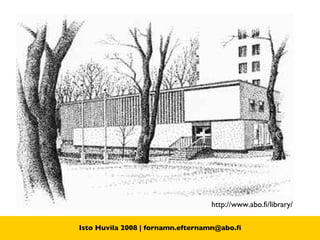
http://www.abo.fi/library/
 
Användarstudier
Web 2.0 ” Netvärk som platform” för datorprogram (webboperativsystem) Änvandarna ‘äger’ data på en webbplats och har kontroll på den.  Deltagandeorienterad arkitektur som uppmanar användarna skapa mervärde på de resurserna de använder. Kontrast jämfört med den hierarkiska kontrollen som karakteriserar traditionella datorprogram där användarroller är starkt definierade Rikt, interaktivt och användarvänligt användargränssnitt Social networking egenskaper
 
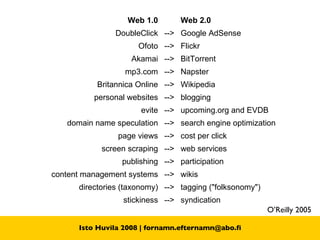
O’Reilly 2005 syndication --> stickiness tagging ("folksonomy") --> directories (taxonomy) wikis --> content management systems participation --> publishing web services --> screen scraping cost per click --> page views search engine optimization --> domain name speculation upcoming.org and EVDB --> evite blogging --> personal websites Wikipedia --> Britannica Online Napster --> mp3.com BitTorrent --> Akamai Flickr --> Ofoto Google AdSense  --> DoubleClick Web 2.0   Web 1.0
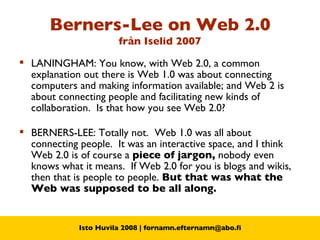
Berners-Lee on Web 2.0 från  Iselid 2007 LANINGHAM: You know, with Web 2.0, a common explanation out there is Web 1.0 was about connecting computers and making information available; and Web 2 is about connecting people and facilitating new kinds of collaboration.  Is that how you see Web 2.0? BERNERS-LEE: Totally not.  Web 1.0 was all about connecting people.  It was an interactive space, and I think Web 2.0 is of course a  piece of jargon,  nobody even knows what it means.  If Web 2.0 for you is blogs and wikis, then that is people to people.  But that was what the Web was supposed to be all along.
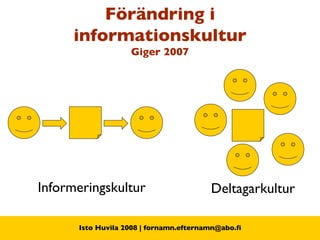
Förändring i informationskultur Giger 2007 Informeringskultur Deltagarkultur
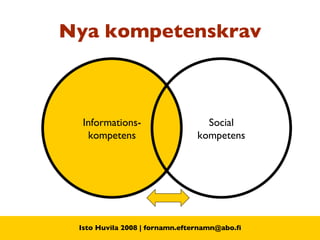
Nya kompetenskrav Informations- kompetens Social kompetens
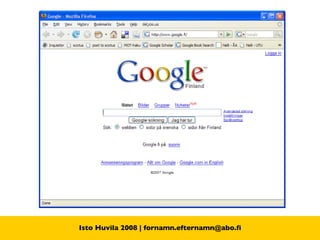
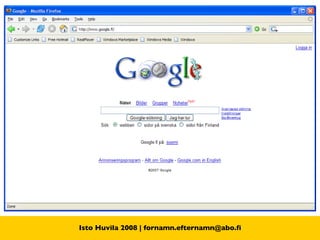
Bibliotek i Google-världen baserad på Berndtson 2007 Styrkor av bibliotek Personal, dvs personlig kontakt både på biblioteket och på nätet Våra lokaler, dvs det fysiska biblioteket Bibliotek möjliggör, användarna gör Styrkor av Google Enkelhet  Relevanta träffar  Sökfokusering


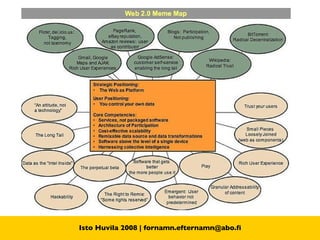
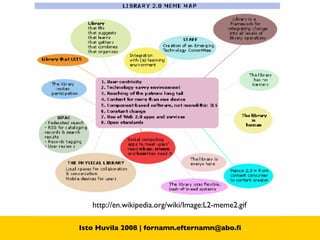
http://en.wikipedia.org/wiki/Image:L2-meme2.gif
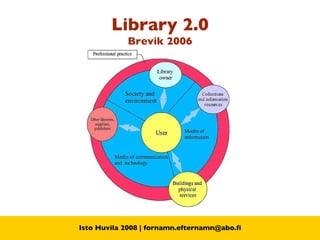
Bibliotek  2.0 Library 2.0 describes a subset of library services designed to meet user needs caused by the direct and peripheral effects of Web 2.0. (Habib 2006) Library 2.0 simply means making your library's space (virtual and physical) more interactive, collaborative, and driven by community needs. Examples of where to start include blogs, gaming nights for teens, and collaborative photo sites. The basic drive is to get people back into the library by making the library relevant to what they want and need in their daily lives...to make the library a destination and not an afterthought. (Houghton-Jan 2005) Library 2.0 is the natural evolution of library services to a level where the library user is in control of how and when she gets access to the services she needs and wants. (Brevik)
Bibliotek  2.0 The principles of Library 2.0 seek to put users in touch with information and entertainment wherever they may be, breaking down the barriers of space, time and outdated policy. It is a user-centered paradigm focusing on knowledge, experience, collaboration, the creation of new content and encouraging the heart. (Stephens) Library 2.0 is very much influenced by technology-driven, two-way, social interactions between staff and staff or staff and patrons.  L2 has provided a framework within which we've been able to re-evaluate virtually every aspect of classical librarianship with the end goal of usability and findability in mind. (Blyberg)
11 reasons why Library 2.0 exists and matters Blyberg 2006 L2 is partially a response to a Post-Google world  L2 requires internal reorganization  L2 requires a fundamental change in a library’s mission  L2 requires a fundamental change in how we handle “authority”  L2 requires technological agility  L2 challenges library orthodoxy on almost every level  L2 requires a radical change in the way ILSs and vendors work  L2 both enables and requires libraries to work together  L2 is actually happening  L2 is revolutionary  L2 is essential for survival/pertinence
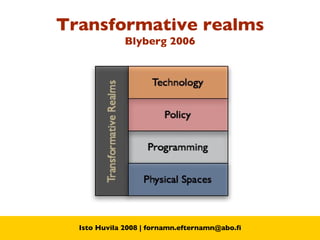
Transformative realms Blyberg 2006
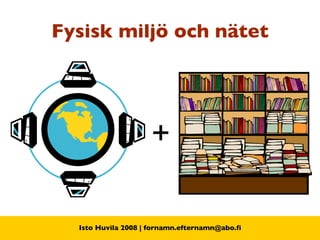
Fysisk miljö och nätet +
Library 2.0 Brevik 2006
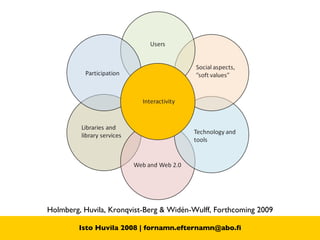
Holmberg, Huvila, Kronqvist-Berg & Widén-Wulff, Forthcoming 2009
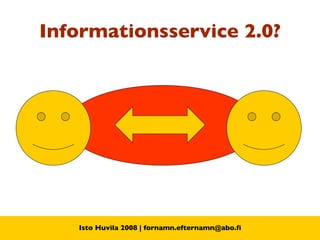
Informationsservice 2.0?

Bibliotek2.0

  • 1.
    Vad är Bibliotek2.0? PD Isto Huvila Informationsförvaltning | Åbo Akademi
  • 2.
    Helsingfors stadsbiblioteks vision 2010 Det gränslösa biblioteket – en källa till bildning och upplevelser genom hela livet.
  • 3.
  • 4.
  • 5.
  • 6.
    Web 2.0 ”Netvärk som platform” för datorprogram (webboperativsystem) Änvandarna ‘äger’ data på en webbplats och har kontroll på den. Deltagandeorienterad arkitektur som uppmanar användarna skapa mervärde på de resurserna de använder. Kontrast jämfört med den hierarkiska kontrollen som karakteriserar traditionella datorprogram där användarroller är starkt definierade Rikt, interaktivt och användarvänligt användargränssnitt Social networking egenskaper
  • 7.
  • 8.
    O’Reilly 2005 syndication--> stickiness tagging ("folksonomy") --> directories (taxonomy) wikis --> content management systems participation --> publishing web services --> screen scraping cost per click --> page views search engine optimization --> domain name speculation upcoming.org and EVDB --> evite blogging --> personal websites Wikipedia --> Britannica Online Napster --> mp3.com BitTorrent --> Akamai Flickr --> Ofoto Google AdSense --> DoubleClick Web 2.0   Web 1.0
  • 9.
    Berners-Lee on Web2.0 från Iselid 2007 LANINGHAM: You know, with Web 2.0, a common explanation out there is Web 1.0 was about connecting computers and making information available; and Web 2 is about connecting people and facilitating new kinds of collaboration. Is that how you see Web 2.0? BERNERS-LEE: Totally not. Web 1.0 was all about connecting people. It was an interactive space, and I think Web 2.0 is of course a piece of jargon, nobody even knows what it means. If Web 2.0 for you is blogs and wikis, then that is people to people. But that was what the Web was supposed to be all along.
  • 10.
    Förändring i informationskulturGiger 2007 Informeringskultur Deltagarkultur
  • 11.
    Nya kompetenskrav Informations-kompetens Social kompetens
  • 12.
    Bibliotek i Google-världenbaserad på Berndtson 2007 Styrkor av bibliotek Personal, dvs personlig kontakt både på biblioteket och på nätet Våra lokaler, dvs det fysiska biblioteket Bibliotek möjliggör, användarna gör Styrkor av Google Enkelhet Relevanta träffar Sökfokusering
  • 13.
  • 14.
  • 15.
  • 16.
  • 17.
  • 18.
    Bibliotek 2.0Library 2.0 describes a subset of library services designed to meet user needs caused by the direct and peripheral effects of Web 2.0. (Habib 2006) Library 2.0 simply means making your library's space (virtual and physical) more interactive, collaborative, and driven by community needs. Examples of where to start include blogs, gaming nights for teens, and collaborative photo sites. The basic drive is to get people back into the library by making the library relevant to what they want and need in their daily lives...to make the library a destination and not an afterthought. (Houghton-Jan 2005) Library 2.0 is the natural evolution of library services to a level where the library user is in control of how and when she gets access to the services she needs and wants. (Brevik)
  • 19.
    Bibliotek 2.0The principles of Library 2.0 seek to put users in touch with information and entertainment wherever they may be, breaking down the barriers of space, time and outdated policy. It is a user-centered paradigm focusing on knowledge, experience, collaboration, the creation of new content and encouraging the heart. (Stephens) Library 2.0 is very much influenced by technology-driven, two-way, social interactions between staff and staff or staff and patrons.  L2 has provided a framework within which we've been able to re-evaluate virtually every aspect of classical librarianship with the end goal of usability and findability in mind. (Blyberg)
  • 20.
    11 reasons whyLibrary 2.0 exists and matters Blyberg 2006 L2 is partially a response to a Post-Google world L2 requires internal reorganization L2 requires a fundamental change in a library’s mission L2 requires a fundamental change in how we handle “authority” L2 requires technological agility L2 challenges library orthodoxy on almost every level L2 requires a radical change in the way ILSs and vendors work L2 both enables and requires libraries to work together L2 is actually happening L2 is revolutionary L2 is essential for survival/pertinence
  • 21.
  • 22.
  • 23.
  • 24.
    Holmberg, Huvila, Kronqvist-Berg& Widén-Wulff, Forthcoming 2009
  • 25.