Contents
• A frameworkfor describing search methods is
provided and several general purpose search
techniques are discussed.
• All are varieties of Heuristic Search:
– Generate and test
– Hill Climbing
– Best First Search
– Problem Reduction
– Constraint Satisfaction
– Means-ends analysis
3.
Generate-and-Test
• Algorithm:
1. Generatea possible solution. For some problems,
this means generating a particular point in the
problem space. For others it means generating a
path from a start state
2. Test to see if this is actually a solution by
comparing the chosen point or the endpoint of
the chosen path to the set of acceptable goal
states.
3. If a solution has been found, quit, Otherwise
return to step 1.
4.
Generate-and-Test
• It isa depth first search procedure since complete
solutions must be generated before they can be tested.
• In its most systematic form, it is simply an exhaustive
search of the problem space.
• Operate by generating solutions randomly.
• Also called as British Museum algorithm
• If a sufficient number of monkeys were placed in front
of a set of typewriters, and left alone long enough, then
they would eventually produce all the works of
shakespeare.
• Dendral: which infers the struture of organic compounds
using NMR spectrogram. It uses plan-generate-test.
5.
Hill Climbing
• Isa variant of generate-and test in which feedback
from the test procedure is used to help the
generator decide which direction to move in search
space.
• The test function is augmented with a heuristic
function that provides an estimate of how close a
given state is to the goal state.
• Computation of heuristic function can be done with
negligible amount of computation.
• Hill climbing is often used when a good heuristic
function is available for evaluating states but when no
other useful knowledge is available.
6.
Simple Hill Climbing
•Algorithm:
1. Evaluate the initial state. If it is also goal state, then
return it and quit. Otherwise continue with the initial
state as the current state.
2. Loop until a solution is found or until there are no new
operators left to be applied in the current state:
a. Select an operator that has not yet been applied to the
current state and apply it to produce a new state
b. Evaluate the new state
i. If it is the goal state, then return it and quit.
ii. If it is not a goal state but it is better than the current state,
then make it the current state.
iii. If it is not better than the current state, then continue in the
loop.
7.
Simple Hill Climbing
•The key difference between Simple Hill
climbing and Generate-and-test is the
use of evaluation function as a way to
inject task specific knowledge into the
control process.
• Is on state better than another ? For
this algorithm to work, precise
definition of better must be provided.
8.
Steepest-Ascent Hill Climbing
•This is a variation of simple hill climbing
which considers all the moves from the
current state and selects the best one
as the next state.
• Also known as Gradient search
9.
Algorithm: Steepest-Ascent Hill
Climbing
1.Evaluate the initial state. If it is also a goal state,
then return it and quit. Otherwise, continue with
the initial state as the current state.
2. Loop until a solution is found or until a complete
iteration produces no change to current state:
a. Let SUCC be a state such that any possible successor of
the current state will be better than SUCC
b. For each operator that applies to the current state do:
i. Apply the operator and generate a new state
ii. Evaluate the new state. If is is a goal state, then return it and
quit. If not, compare it to SUCC. If it is better, then set
SUCC to this state. If it is not better, leave SUCC alone.
c. If the SUCC is better than the current state, then set
current state to SYCC,
10.
Hill-climbing
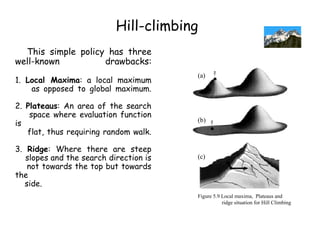
This simple policyhas three
well-known drawbacks:
1. Local Maxima: a local maximum
as opposed to global maximum.
2. Plateaus: An area of the search
space where evaluation function
is
flat, thus requiring random walk.
3. Ridge: Where there are steep
slopes and the search direction is
not towards the top but towards
the
side.
(a)
(b)
(c)
Figure 5.9 Local maxima, Plateaus and
ridge situation for Hill Climbing
11.
Hill-climbing
• In eachof the previous cases (local maxima, plateaus &
ridge), the algorithm reaches a point at which no progress
is being made.
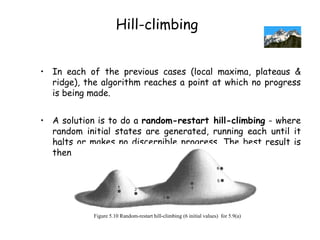
• A solution is to do a random-restart hill-climbing - where
random initial states are generated, running each until it
halts or makes no discernible progress. The best result is
then chosen.
Figure 5.10 Random-restart hill-climbing (6 initial values) for 5.9(a)
12.
Simulated Annealing
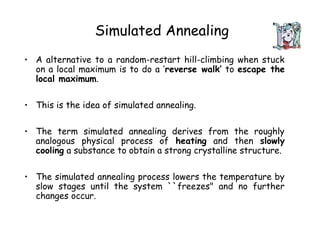
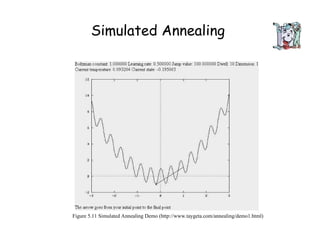
• Aalternative to a random-restart hill-climbing when stuck
on a local maximum is to do a ‘reverse walk’ to escape the
local maximum.
• This is the idea of simulated annealing.
• The term simulated annealing derives from the roughly
analogous physical process of heating and then slowly
cooling a substance to obtain a strong crystalline structure.
• The simulated annealing process lowers the temperature by
slow stages until the system ``freezes" and no further
changes occur.
Simulated Annealing
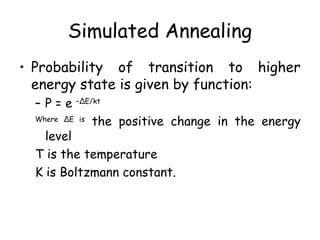
• Probabilityof transition to higher
energy state is given by function:
– P = e –∆E/kt
Where ∆E is
the positive change in the energy
level
T is the temperature
K is Boltzmann constant.
15.
Differences
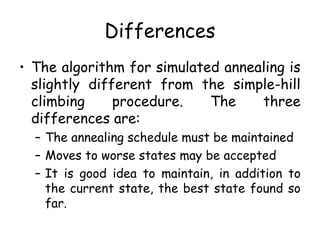
• The algorithmfor simulated annealing is
slightly different from the simple-hill
climbing procedure. The three
differences are:
– The annealing schedule must be maintained
– Moves to worse states may be accepted
– It is good idea to maintain, in addition to
the current state, the best state found so
far.
16.
Algorithm: Simulate Annealing
1.Evaluate the initial state. If it is also a goal state, then return it and
quit. Otherwise, continue with the initial state as the current state.
2. Initialize BEST-SO-FAR to the current state.
3. Initialize T according to the annealing schedule
4. Loop until a solution is found or until there are no new operators left
to be applied in the current state.
a. Select an operator that has not yet been applied to the current state and
apply it to produce a new state.
b. Evaluate the new state. Compute:
• ∆E = ( value of current ) – ( value of new state)
• If the new state is a goal state, then return it and quit.
• If it is a goal state but is better than the current state, then make it the
current state. Also set BEST-SO-FAR to this new state.
• If it is not better than the current state, then make it the current state with
probability p’ as defined above. This step is usually implemented by invoking a
random number generator to produce a number in the range [0, 1]. If the
number is less than p’, then the move is accepted. Otherwise, do nothing.
c. Revise T as necessary according to the annealing schedule
5. Return BEST-SO-FAR as the answer
17.
Simulate Annealing:
Implementation
• Itis necessary to select an annealing
schedule which has three components:
– Initial value to be used for temperature
– Criteria that will be used to decide when
the temperature will be reduced
– Amount by which the temperature will be
reduced.
18.
Best First Search
•Combines the advantages of bith DFS and
BFS into a single method.
• DFS is good because it allows a solution to be
found without all competing branches having
to be expanded.
• BFS is good because it does not get branches
on dead end paths.
• One way of combining the tow is to follow a
single path at a time, but switch paths
whenever some competing path looks more
promising than the current one does.
19.
BFS
• At eachstep of the BFS search process, we select the most
promising of the nodes we have generated so far.
• This is done by applying an appropriate heuristic function to
each of them.
• We then expand the chosen node by using the rules to generate
its successors
• Similar to Steepest ascent hill climbing with two exceptions:
– In hill climbing, one move is selected and all the others are
rejected, never to be reconsidered. This produces the straightline
behaviour that is characteristic of hill climbing.
– In BFS, one move is selected, but the others are kept around so
that they can be revisited later if the selected path becomes less
promising. Further, the best available state is selected in the BFS,
even if that state has a value that is lower than the value of the
state that was just explored. This contrasts with hill climbing,
which will stop if there are no successor states with better values
than the current state.
20.
OR-graph
• It issometimes important to search graphs so that duplicate
paths will not be pursued.
• An algorithm to do this will operate by searching a directed
graph in which each node represents a point in problem space.
• Each node will contain:
– Description of problem state it represents
– Indication of how promising it is
– Parent link that points back to the best node from which it came
– List of nodes that were generated from it
• Parent link will make it possible to recover the path to the goal
once the goal is found.
• The list of successors will make it possible, if a better path is
found to an already existing node, to propagate the improvement
down to its successors.
• This is called OR-graph, since each of its branhes represents an
alternative problem solving path
21.
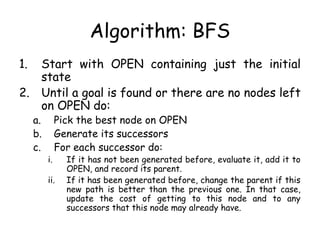
Implementation of ORgraphs
• We need two lists of nodes:
– OPEN – nodes that have been generated and have
had the heuristic function applied to them but
which have not yet been examined. OPEN is
actually a priority queue in which the elements
with the highest priority are those with the most
promising value of the heuristic function.
– CLOSED- nodes that have already been examined.
We need to keep these nodes in memory if we want
to search a graph rather than a tree, since
whenver a new node is generated, we need to check
whether it has been generated before.
22.
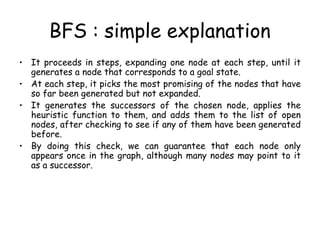
Algorithm: BFS
1. Startwith OPEN containing just the initial
state
2. Until a goal is found or there are no nodes left
on OPEN do:
a. Pick the best node on OPEN
b. Generate its successors
c. For each successor do:
i. If it has not been generated before, evaluate it, add it to
OPEN, and record its parent.
ii. If it has been generated before, change the parent if this
new path is better than the previous one. In that case,
update the cost of getting to this node and to any
successors that this node may already have.
23.
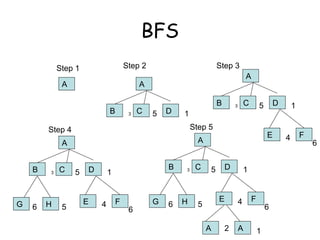
BFS : simpleexplanation
• It proceeds in steps, expanding one node at each step, until it
generates a node that corresponds to a goal state.
• At each step, it picks the most promising of the nodes that have
so far been generated but not expanded.
• It generates the successors of the chosen node, applies the
heuristic function to them, and adds them to the list of open
nodes, after checking to see if any of them have been generated
before.
• By doing this check, we can guarantee that each node only
appears once in the graph, although many nodes may point to it
as a successor.
24.
BFS
Step 1 Step2 Step 3
Step 4 Step 5
A A
B C D
3 5 1
A
B C D
3 5 1
E F
4
6
A
B C D
3 5 1
E F
4
6
G H
6 5
A
B C D
3 5 1
E F
4
6
G H
6 5
A A
2 1
25.
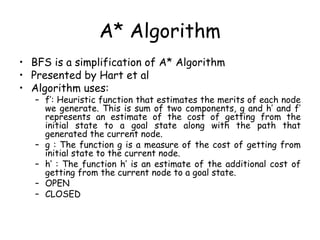
A* Algorithm
• BFSis a simplification of A* Algorithm
• Presented by Hart et al
• Algorithm uses:
– f’: Heuristic function that estimates the merits of each node
we generate. This is sum of two components, g and h’ and f’
represents an estimate of the cost of getting from the
initial state to a goal state along with the path that
generated the current node.
– g : The function g is a measure of the cost of getting from
initial state to the current node.
– h’ : The function h’ is an estimate of the additional cost of
getting from the current node to a goal state.
– OPEN
– CLOSED
26.
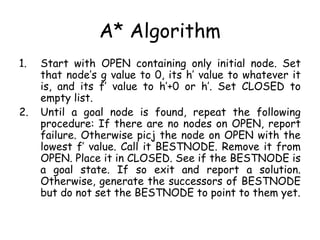
A* Algorithm
1. Startwith OPEN containing only initial node. Set
that node’s g value to 0, its h’ value to whatever it
is, and its f’ value to h’+0 or h’. Set CLOSED to
empty list.
2. Until a goal node is found, repeat the following
procedure: If there are no nodes on OPEN, report
failure. Otherwise picj the node on OPEN with the
lowest f’ value. Call it BESTNODE. Remove it from
OPEN. Place it in CLOSED. See if the BESTNODE is
a goal state. If so exit and report a solution.
Otherwise, generate the successors of BESTNODE
but do not set the BESTNODE to point to them yet.
27.
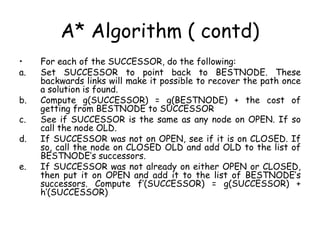
A* Algorithm (contd)
• For each of the SUCCESSOR, do the following:
a. Set SUCCESSOR to point back to BESTNODE. These
backwards links will make it possible to recover the path once
a solution is found.
b. Compute g(SUCCESSOR) = g(BESTNODE) + the cost of
getting from BESTNODE to SUCCESSOR
c. See if SUCCESSOR is the same as any node on OPEN. If so
call the node OLD.
d. If SUCCESSOR was not on OPEN, see if it is on CLOSED. If
so, call the node on CLOSED OLD and add OLD to the list of
BESTNODE’s successors.
e. If SUCCESSOR was not already on either OPEN or CLOSED,
then put it on OPEN and add it to the list of BESTNODE’s
successors. Compute f’(SUCCESSOR) = g(SUCCESSOR) +
h’(SUCCESSOR)
28.
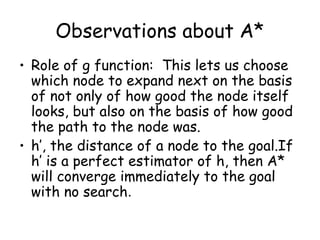
Observations about A*
•Role of g function: This lets us choose
which node to expand next on the basis
of not only of how good the node itself
looks, but also on the basis of how good
the path to the node was.
• h’, the distance of a node to the goal.If
h’ is a perfect estimator of h, then A*
will converge immediately to the goal
with no search.
29.
Graceful Decay of
Admissibility
•If h’ rarely overestimates h by more than δ,
then A* algorithm will rarely find a solution
whose cost is more than δ greater than the
cost of the optimal solution.
• Under certain conditions, the A* algorithm
can be shown to be optimal in that it
generates the fewest nodes in the process of
finding a solution to a problem.
30.
Agendas
• An Agendais a list of tasks a system
could perform.
• Associated with each task there are
usually two things:
– A list of reasons why the task is being
proposed (justification)
– Rating representing the overall weight of
evidence suggesting that the task would be
useful.
31.
Algorithm: Agenda drivenSearch
1. Do until a goal state is reached or the agenda is empty:
a. Choose the most promising task from the agenda.
b. Execute the task by devoting to it the number of resources
determined by its importance. The important resources to
consider are time and space. Executing the task will probably
generate additional tasks (successor nodes). For each of them do
the followings:
i. See if it is already on the agenda. If so, then see if this same reason
for doing it is already on its list of justifications. If so, ignore this
current evidence. If this justification was not already present, add it
to the list. If the task was not on the agenda, insert it.
ii. Compute the new task’s rating, combining the evidence from all its
justifications. Not all justifications need have equal weight. It is
often useful to associate with each justification a measure of how
strong the reason it is. These measures are then combined at this
step to produce an overall rating for the task.
32.
Chatbot
Person: I don’twant to read any more about
china. Give me something else.
Computer: OK. What else are you interested in?
Person: How about Italy? I think I’d find Italy
interesting.
Computer : What things about Italy are you
interested in reading about?
Person: I think I’d like to start with its history.
Computer: why don’t you want to read any more
about China?
33.
Example for Agenda:AM
• Mathematics discovery program developed by Lenat
( 77, 82)
• AM was given small set of starting facts about
number theory and a set of operators it could use to
develop new ideas.
• These operators included such things as “ Find
examples of a concept you already know”.
• AM’s goal was to generate new “interesting”
Mathematical concepts.
• It succeeded in discovering such things as prime
numbers and Goldbach’s conjecture.
• AM used task agenda.
34.
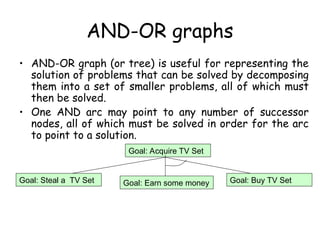
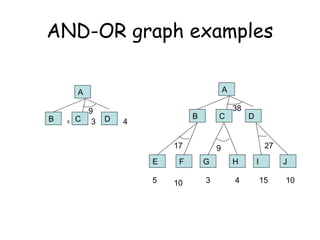
AND-OR graphs
• AND-ORgraph (or tree) is useful for representing the
solution of problems that can be solved by decomposing
them into a set of smaller problems, all of which must
then be solved.
• One AND arc may point to any number of successor
nodes, all of which must be solved in order for the arc
to point to a solution.
Goal: Acquire TV Set
Goal: Steal a TV Set Goal: Earn some money Goal: Buy TV Set
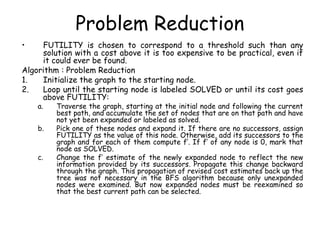
Problem Reduction
• FUTILITYis chosen to correspond to a threshold such than any
solution with a cost above it is too expensive to be practical, even if
it could ever be found.
Algorithm : Problem Reduction
1. Initialize the graph to the starting node.
2. Loop until the starting node is labeled SOLVED or until its cost goes
above FUTILITY:
a. Traverse the graph, starting at the initial node and following the current
best path, and accumulate the set of nodes that are on that path and have
not yet been expanded or labeled as solved.
b. Pick one of these nodes and expand it. If there are no successors, assign
FUTILITY as the value of this node. Otherwise, add its successors to the
graph and for each of them compute f’. If f’ of any node is 0, mark that
node as SOLVED.
c. Change the f’ estimate of the newly expanded node to reflect the new
information provided by its successors. Propagate this change backward
through the graph. This propagation of revised cost estimates back up the
tree was not necessary in the BFS algorithm because only unexpanded
nodes were examined. But now expanded nodes must be reexamined so
that the best current path can be selected.
37.
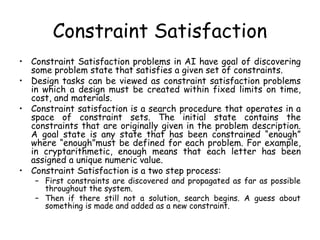
Constraint Satisfaction
• ConstraintSatisfaction problems in AI have goal of discovering
some problem state that satisfies a given set of constraints.
• Design tasks can be viewed as constraint satisfaction problems
in which a design must be created within fixed limits on time,
cost, and materials.
• Constraint satisfaction is a search procedure that operates in a
space of constraint sets. The initial state contains the
constraints that are originally given in the problem description.
A goal state is any state that has been constrained “enough”
where “enough”must be defined for each problem. For example,
in cryptarithmetic, enough means that each letter has been
assigned a unique numeric value.
• Constraint Satisfaction is a two step process:
– First constraints are discovered and propagated as far as possible
throughout the system.
– Then if there still not a solution, search begins. A guess about
something is made and added as a new constraint.
38.
Algorithm: Constraint
Satisfaction
1. Propagateavailable constraints. To do this first set OPEN to set of all
objects that must have values assigned to them in a complete solution. Then
do until an inconsistency is detected or until OPEN is empty:
a. Select an object OB from OPEN. Strengthen as much as possible the set of
constraints that apply to OB.
b. If this set is different from the set that was assigned the last time OB was
examined or if this is the first time OB has been examined, then add to OPEN all
objects that share any constraints with OB.
c. Remove OB from OPEN.
2. If the union of the constraints discovered above defines a solution, then quit
and report the solution.
3. If the union of the constraints discovered above defines a contradiction, then
return the failure.
4. If neither of the above occurs, then it is necessary to make a guess at
something in order to proceed. To do this loop until a solution is found or all
possible solutions have been eliminated:
a. Select an object whose value is not yet determined and select a way of
strengthening the constraints on that object.
b. Recursively invoke constraint satisfaction with the current set of constraints
augmented by strengthening constraint just selected.
39.
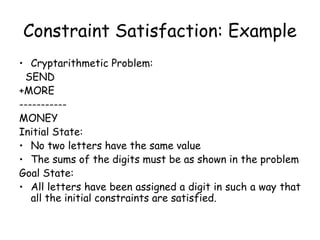
Constraint Satisfaction: Example
•Cryptarithmetic Problem:
SEND
+MORE
-----------
MONEY
Initial State:
• No two letters have the same value
• The sums of the digits must be as shown in the problem
Goal State:
• All letters have been assigned a digit in such a way that
all the initial constraints are satisfied.
40.
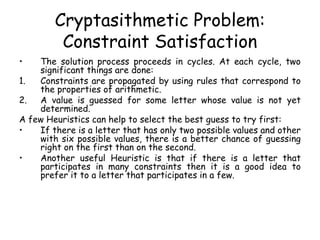
Cryptasithmetic Problem:
Constraint Satisfaction
•The solution process proceeds in cycles. At each cycle, two
significant things are done:
1. Constraints are propagated by using rules that correspond to
the properties of arithmetic.
2. A value is guessed for some letter whose value is not yet
determined.
A few Heuristics can help to select the best guess to try first:
• If there is a letter that has only two possible values and other
with six possible values, there is a better chance of guessing
right on the first than on the second.
• Another useful Heuristic is that if there is a letter that
participates in many constraints then it is a good idea to
prefer it to a letter that participates in a few.
41.
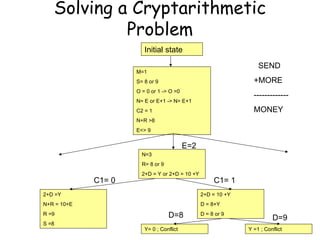
Solving a Cryptarithmetic
Problem
Initialstate
M=1
S= 8 or 9
O = 0 or 1 -> O =0
N= E or E+1 -> N= E+1
C2 = 1
N+R >8
E<> 9
N=3
R= 8 or 9
2+D = Y or 2+D = 10 +Y
2+D =Y
N+R = 10+E
R =9
S =8
2+D = 10 +Y
D = 8+Y
D = 8 or 9
Y= 0 ; Conflict Y =1 ; Conflict
E=2
C1= 0 C1= 1
D=8 D=9
SEND
+MORE
-------------
MONEY
42.
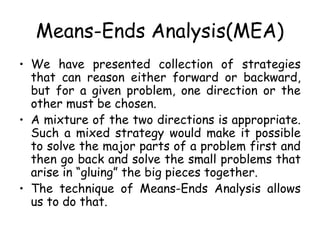
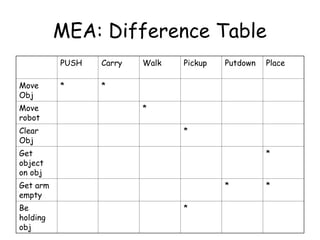
Means-Ends Analysis(MEA)
• Wehave presented collection of strategies
that can reason either forward or backward,
but for a given problem, one direction or the
other must be chosen.
• A mixture of the two directions is appropriate.
Such a mixed strategy would make it possible
to solve the major parts of a problem first and
then go back and solve the small problems that
arise in “gluing” the big pieces together.
• The technique of Means-Ends Analysis allows
us to do that.
43.
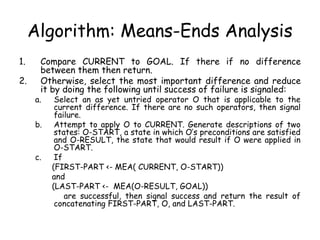
Algorithm: Means-Ends Analysis
1.Compare CURRENT to GOAL. If there if no difference
between them then return.
2. Otherwise, select the most important difference and reduce
it by doing the following until success of failure is signaled:
a. Select an as yet untried operator O that is applicable to the
current difference. If there are no such operators, then signal
failure.
b. Attempt to apply O to CURRENT. Generate descriptions of two
states: O-START, a state in which O’s preconditions are satisfied
and O-RESULT, the state that would result if O were applied in
O-START.
c. If
(FIRST-PART <- MEA( CURRENT, O-START))
and
(LAST-PART <- MEA(O-RESULT, GOAL))
are successful, then signal success and return the result of
concatenating FIRST-PART, O, and LAST-PART.
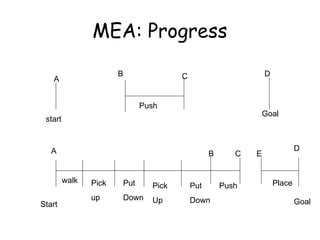
44.
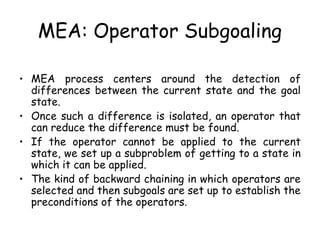
MEA: Operator Subgoaling
•MEA process centers around the detection of
differences between the current state and the goal
state.
• Once such a difference is isolated, an operator that
can reduce the difference must be found.
• If the operator cannot be applied to the current
state, we set up a subproblem of getting to a state in
which it can be applied.
• The kind of backward chaining in which operators are
selected and then subgoals are set up to establish the
preconditions of the operators.
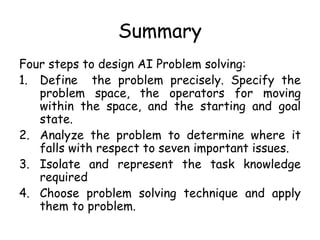
Summary
Four steps todesign AI Problem solving:
1. Define the problem precisely. Specify the
problem space, the operators for moving
within the space, and the starting and goal
state.
2. Analyze the problem to determine where it
falls with respect to seven important issues.
3. Isolate and represent the task knowledge
required
4. Choose problem solving technique and apply
them to problem.
49.
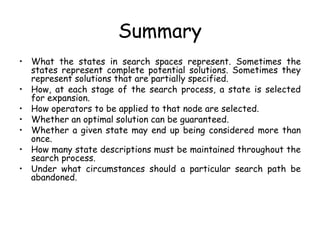
Summary
• What thestates in search spaces represent. Sometimes the
states represent complete potential solutions. Sometimes they
represent solutions that are partially specified.
• How, at each stage of the search process, a state is selected
for expansion.
• How operators to be applied to that node are selected.
• Whether an optimal solution can be guaranteed.
• Whether a given state may end up being considered more than
once.
• How many state descriptions must be maintained throughout the
search process.
• Under what circumstances should a particular search path be
abandoned.


![Algorithm: Simulate Annealing
1. Evaluate the initial state. If it is also a goal state, then return it and
quit. Otherwise, continue with the initial state as the current state.
2. Initialize BEST-SO-FAR to the current state.
3. Initialize T according to the annealing schedule
4. Loop until a solution is found or until there are no new operators left
to be applied in the current state.
a. Select an operator that has not yet been applied to the current state and
apply it to produce a new state.
b. Evaluate the new state. Compute:
• ∆E = ( value of current ) – ( value of new state)
• If the new state is a goal state, then return it and quit.
• If it is a goal state but is better than the current state, then make it the
current state. Also set BEST-SO-FAR to this new state.
• If it is not better than the current state, then make it the current state with
probability p’ as defined above. This step is usually implemented by invoking a
random number generator to produce a number in the range [0, 1]. If the
number is less than p’, then the move is accepted. Otherwise, do nothing.
c. Revise T as necessary according to the annealing schedule
5. Return BEST-SO-FAR as the answer](https://image.slidesharecdn.com/chapter03-heuristicsearch-250224051302-d270422f/85/Chapter-03-artifi-HEURISTIC-SEARCH-ppt-16-320.jpg)