

The Science and Practice of
Inshifting

Copyright © SatoriWest
11/10/13


Borrowed from Buddhism



Incorporated into psychology treatments



Extensively researched

Copyright © SatoriWest

11/10/13
6-8 Weeks of Regular Practice



Reduces rumination- meaning it helps you stop
chewing over your problems and making yourself
sick.



Reduces stress, depression, anxiety and physical
distress.



It lifts and gives you more stable moods.


Copyright © SatoriWest

11/10/13
6-8 Weeks of Regular Practice

 


Improved memory and focus and information
processing speed.



More cognitive flexibility- meaning you can think
more creatively and get unstuck from habits of
thinking and behavior.

 


The better you are at being aware, the more
predictive it is of relationship satisfaction.

 
Copyright © SatoriWest

11/10/13
6-8 Weeks of Regular Practice



Improved ability to be in relationships, deal
with better communication, better at
expressing yourself in a variety of social
situations.



Improves self-insight, morality and intuition.



Physically, it can improve your health, raise
your immunity and give you a greater sense of
physical wellbeing.
Copyright © SatoriWest

11/10/13


Mindfulness taken to advanced stages.



A method of brain training that shows your brain how
to know or ”see” itself—which is a miraculous
experience.



Self-development leading to fulfillment of your
highest human potential.



(Inshifting uses “awareness” instead of “mindfulness”
because “mind” is defined as thoughts, ideas,
images, sense of self and sense of time, etc.)
Copyright © SatoriWest

11/10/13
There are two opposing systems of control
in the brain.
These systems affect how you experience
and what you do.
There is one for the lower brain and one
for the higher brain.
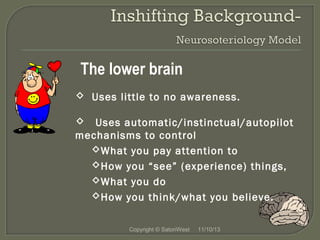
The lower brain
 Uses little to no awareness.
 Uses automatic/instinctual/autopilot
mechanisms to control
What you pay attention to
How you “see” (experience) things,
What you do
How you think/what you believe.
Copyright © SatoriWest

11/10/13
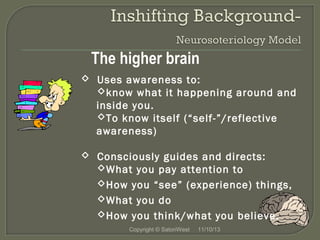
The higher brain
 Uses awareness to:
know what it happening around and
inside you.
To know itself (“self-”/reflective
awareness)
 Consciously guides and directs:
What you pay attention to
How you “see” (experience) things,
What you do
How you think/what you believe.
Copyright © SatoriWest

11/10/13
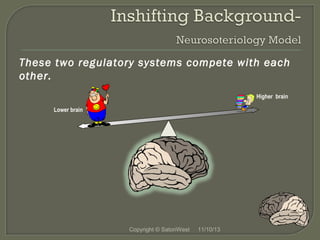
These two regulatory systems compete with each
other.
Higher brain
Lower brain

Copyright © SatoriWest

11/10/13
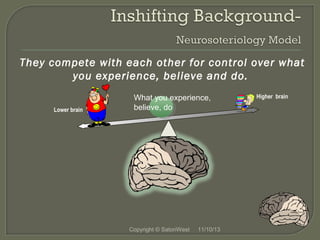
They compete with each other for control over what
you experience, believe and do.
Lower brain

What you experience,
believe, do

Copyright © SatoriWest

11/10/13

Higher brain


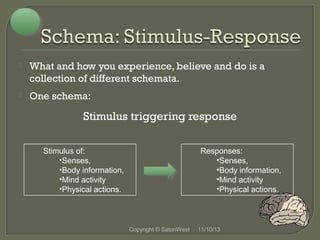
What and how you experience, believe and do is a
collection of different schemata.



One schema:

Stimulus triggering response
Stimulus of:
•Senses,
•Body information,
•Mind activity
•Physical actions.

Responses:
•Senses,
•Body information,
•Mind activity
•Physical actions.

Copyright © SatoriWest

11/10/13
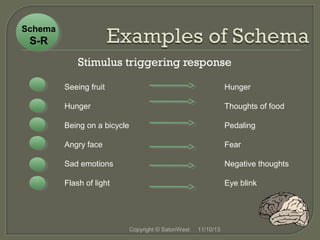
Schema

S-R

Stimulus triggering response
Seeing fruit

Hunger

Hunger

Thoughts of food

Being on a bicycle

Pedaling

Angry face

Fear

Sad emotions

Negative thoughts

Flash of light

Eye blink

Copyright © SatoriWest

11/10/13
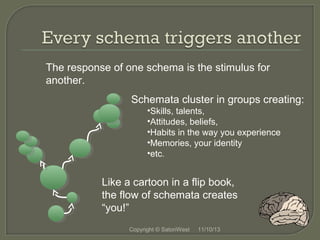
The response of one schema is the stimulus for
another.
Schemata cluster in groups creating:
•Skills, talents,
•Attitudes, beliefs,
•Habits in the way you experience
•Memories, your identity
•etc.

Like a cartoon in a flip book,
the flow of schemata creates
“you!”
Copyright © SatoriWest

11/10/13
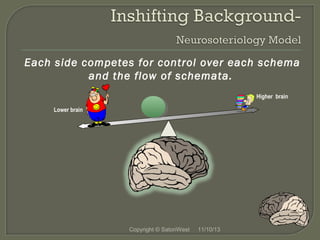
Each side competes for control over each schema
and the flow of schemata.
Higher brain
Lower brain

Copyright © SatoriWest

11/10/13
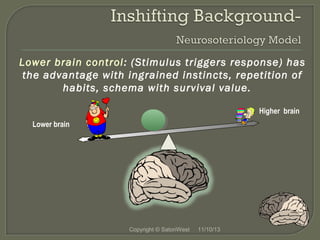
Lower brain control : (Stimulus triggers response) has
the advantage with ingrained instincts, repetition of
habits, schema with survival value.
Higher brain
Lower brain

Copyright © SatoriWest

11/10/13
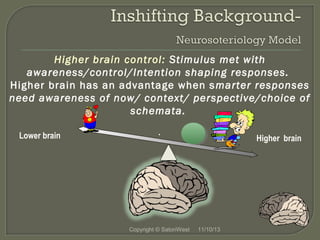
Higher brain control: Stimulus met with
awareness/control/Intention shaping responses.
Higher brain has an advantage when s marter responses
need awareness of now/ context/ perspective/choice of
schemata.
Lower brain

.

Copyright © SatoriWest

Higher brain

11/10/13
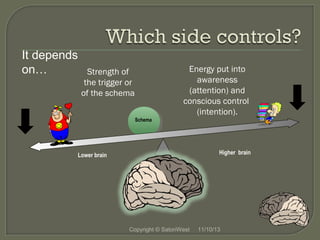
It depends
on…

Energy put into
awareness
(attention) and
conscious control
(intention).

Strength of
the trigger or
of the schema
Schema

Higher brain

Lower brain

Copyright © SatoriWest

11/10/13
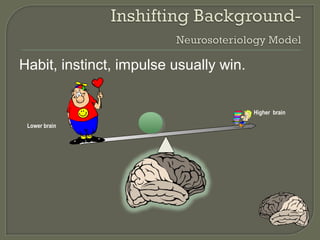
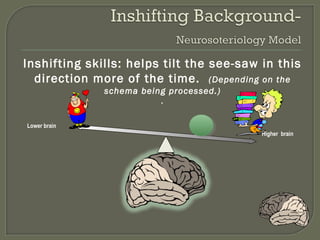
Habit, instinct, impulse usually win.
Higher brain
Lower brain
Inshifting skills: helps tilt the see-saw in this
direction more of the time. (Depending on the
schema being processed.)
.
Lower brain
Higher brain
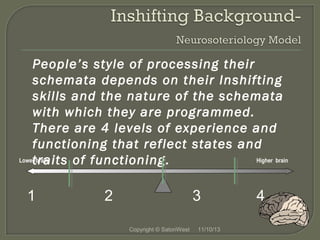
People’s style of processing their
schemata depends on their Inshifting
skills and the nature of the schemata
with which they are programmed.
There are 4 levels of experience and
functioning that reflect states and
Lower brain
Higher brain
traits of functioning.

1

2

3
Copyright © SatoriWest

11/10/13

4
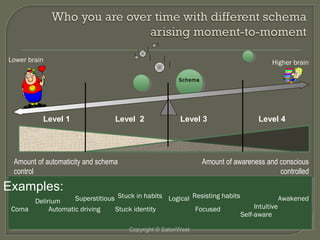
Lower brain

Higher brain
Schema

Level 1

Level 2

Level 3

Amount of automaticity and schema
control

Level 4

Amount of awareness and conscious
controlled

Examples:

Superstitious Stuck in habits Logical Resisting habits
Delirium
Coma
Automatic driving
Stuck identity
Focused
Copyright © SatoriWest

Intuitive
Self-aware

Awakened
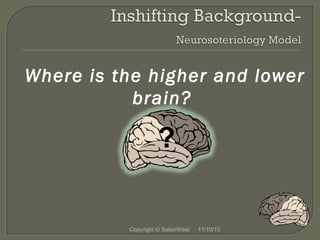
Where is the higher and lower
brain?

?

Copyright © SatoriWest

11/10/13
Higher Brain
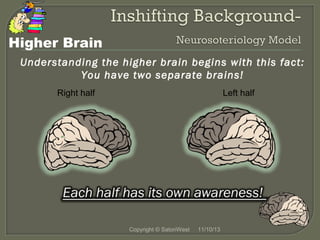
Understanding the higher brain begins with this fact:
You have two separate brains!
Right half

Left half

Copyright © SatoriWest

11/10/13
Higher Brain
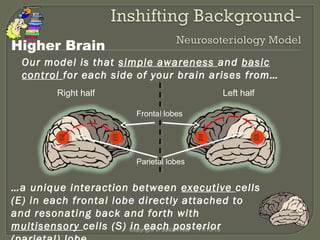
Our model is that simple awareness and basic
control for each side of your brain arises from…
Right half

Left half
Frontal lobes

Parietal lobes

…a unique interaction between executive cells
(E) in each frontal lobe directly attached to
and resonating back and forth with
multisensory cells (S) Copyright © SatoriWest 11/10/13
in each posterior
Higher Brain
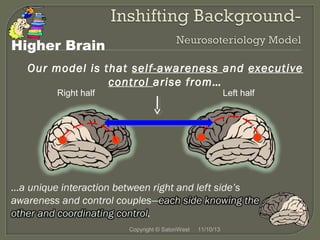
Our model is that self-awareness and executive
control arise from…
Right half

Left half

Copyright © SatoriWest

11/10/13
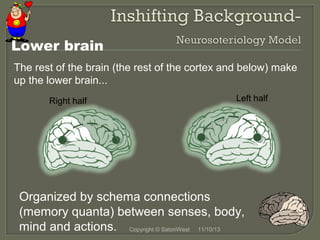
Lower brain
The rest of the brain (the rest of the cortex and below) make
up the lower brain...
Right half

Left half

Organized by schema connections
(memory quanta) between senses, body,
mind and actions. Copyright © SatoriWest 11/10/13
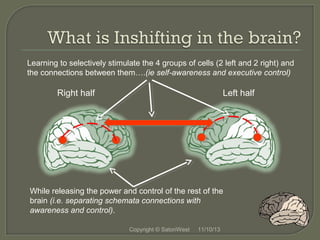
Learning to selectively stimulate the 4 groups of cells (2 left and 2 right) and
the connections between them….(ie self-awareness and executive control)

Right half

Left half

While releasing the power and control of the rest of the
brain (i.e. separating schemata connections with
awareness and control).
Copyright © SatoriWest

11/10/13
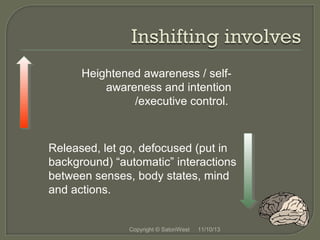
Heightened awareness / selfawareness and intention
/executive control.

Released, let go, defocused (put in
background) “automatic” interactions
between senses, body states, mind
and actions.

Copyright © SatoriWest

11/10/13
Are there tools or
reference points that you
can use to Inshift?

Copyright © SatoriWest

11/10/13
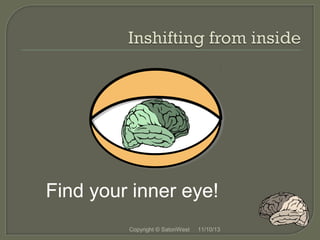
Find your inner eye!
Copyright © SatoriWest

11/10/13
Copyright © SatoriWest

11/10/13
What is your reality…right
now?
Does it go any higher?
Copyright © SatoriWest

11/10/13
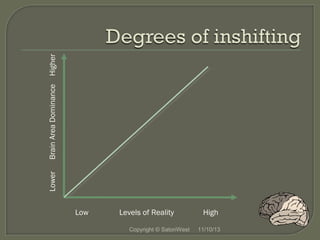
Higher
Brain Area Dominance
Lower
Low

Levels of Reality
Copyright © SatoriWest

High
11/10/13
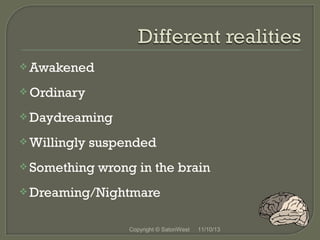
 Awakened
 Ordinary
 Daydreaming
 Willingly

suspended

 Something

wrong in the brain

 Dreaming/Nightmare

Copyright © SatoriWest

11/10/13
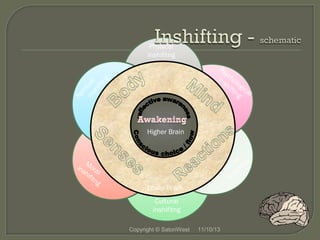
Physical
inshifitng

Sp
i ri
in tua
sh l
i fi
tn
g

Ps
yc
ins hol
hi ogi
fti ca
ng l

Higher Brain

M
ins ora
hif l
itn
g

l
cia itng
So hif
s
in

Lower Brain
Cultural
inshifitng
Copyright © SatoriWest

11/10/13
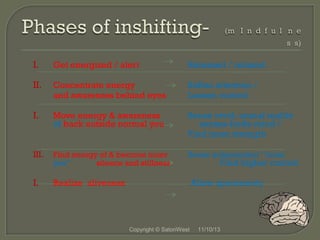
I.

Get energized / alert

Released / relaxed

II.

Concentrate energy
and awareness behind eyes

Soften attention /
Loosen control

Move energy & awareness
of back outside normal you

Sense vivid, unreal reality
senses-body-mind /
Find inner strength

Find energy of & become inner
you”
silence and stillness

Sense independent “outer

Realize aliveness

Allow spontaneity


I.
 
III.
 

I.

Copyright © SatoriWest

Find higher control

11/10/13
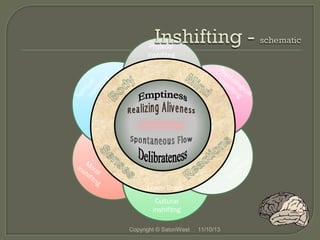
Physical
inshifitng

Sp
i ri
in tua
sh l
i fi
tn
g

Ps
yc
ins hol
hi ogi
fti ca
ng l

M
ins ora
hif l
itn
g

l
cia itng
So hif
s
in

Lower Brain
Cultural
inshifitng
Copyright © SatoriWest

11/10/13
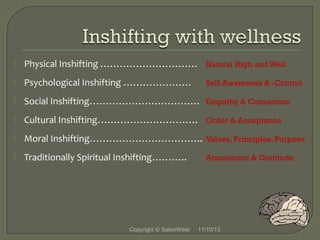


Physical Inshifting ………………………… Natural High and Well



Psychological Inshifting …………………



Social Inshifting……………………………. Empathy & Connection



Cultural Inshifting…………………………. Order & Acceptance



Moral Inshifting…………………………….. Values, Principles, Purpose



Traditionally Spiritual Inshifting………..

Copyright © SatoriWest

Self-Awareness & -Control

Amazement & Gratitude

11/10/13
 Physical inshifting:
 Meds
 Natural remedies
 Health: Diet, Exercise, Yoga, Fasting

 Psychological inshifting :
 Self-learning paradigms
 Psychotherapy
 Self-assessment

 Social inshifting :
 Learning interdependence skills,
 Building empowering networks

 Cultural inshifting :
 Financial Order
 Home and Life Order
 Disaster Planning

 Moral inshifting :
 Clarify values,
 LifeAwakening Plan: purpose, principles

 Traditionally spiritual inshifting :
 Mindfulness meditation, Religion
 Gratitude, apology repentance and amends, art and beauty,

Copyright © SatoriWest

11/10/13
• Beyond Illness Focus total recovery resilience and wellness
• Hope

abnormal to spiritual

• Empowerment Potential of psychiatric struggle
• Normalcy Everyone struggles

Copyright © SatoriWest

11/10/13
Awakening

Wellness
Cosmic Consciousness
Meditation / Yoga

Neurofeedback
Heaven within
Enlightenment
Medication/Naturopathics

Psychotherapy
Paradise on Earth
Copyright © SatoriWest 11/10/13
?
Copyright © SatoriWest

11/10/13

Beyond Mindfulness

  • 1.
    The Science andPractice of Inshifting Copyright © SatoriWest 11/10/13
  • 2.
     Borrowed from Buddhism  Incorporatedinto psychology treatments  Extensively researched Copyright © SatoriWest 11/10/13
  • 3.
    6-8 Weeks ofRegular Practice  Reduces rumination- meaning it helps you stop chewing over your problems and making yourself sick.  Reduces stress, depression, anxiety and physical distress.  It lifts and gives you more stable moods.     Copyright © SatoriWest 11/10/13
  • 4.
    6-8 Weeks ofRegular Practice    Improved memory and focus and information processing speed.  More cognitive flexibility- meaning you can think more creatively and get unstuck from habits of thinking and behavior.    The better you are at being aware, the more predictive it is of relationship satisfaction.   Copyright © SatoriWest 11/10/13
  • 5.
    6-8 Weeks ofRegular Practice  Improved ability to be in relationships, deal with better communication, better at expressing yourself in a variety of social situations.  Improves self-insight, morality and intuition.  Physically, it can improve your health, raise your immunity and give you a greater sense of physical wellbeing. Copyright © SatoriWest 11/10/13
  • 6.
     Mindfulness taken toadvanced stages.  A method of brain training that shows your brain how to know or ”see” itself—which is a miraculous experience.  Self-development leading to fulfillment of your highest human potential.  (Inshifting uses “awareness” instead of “mindfulness” because “mind” is defined as thoughts, ideas, images, sense of self and sense of time, etc.) Copyright © SatoriWest 11/10/13
  • 7.
    There are twoopposing systems of control in the brain. These systems affect how you experience and what you do. There is one for the lower brain and one for the higher brain.
  • 8.
    The lower brain Uses little to no awareness.  Uses automatic/instinctual/autopilot mechanisms to control What you pay attention to How you “see” (experience) things, What you do How you think/what you believe. Copyright © SatoriWest 11/10/13
  • 9.
    The higher brain Uses awareness to: know what it happening around and inside you. To know itself (“self-”/reflective awareness)  Consciously guides and directs: What you pay attention to How you “see” (experience) things, What you do How you think/what you believe. Copyright © SatoriWest 11/10/13
  • 10.
    These two regulatorysystems compete with each other. Higher brain Lower brain Copyright © SatoriWest 11/10/13
  • 11.
    They compete witheach other for control over what you experience, believe and do. Lower brain What you experience, believe, do Copyright © SatoriWest 11/10/13 Higher brain
  • 12.
     What and howyou experience, believe and do is a collection of different schemata.  One schema: Stimulus triggering response Stimulus of: •Senses, •Body information, •Mind activity •Physical actions. Responses: •Senses, •Body information, •Mind activity •Physical actions. Copyright © SatoriWest 11/10/13
  • 13.
    Schema S-R Stimulus triggering response Seeingfruit Hunger Hunger Thoughts of food Being on a bicycle Pedaling Angry face Fear Sad emotions Negative thoughts Flash of light Eye blink Copyright © SatoriWest 11/10/13
  • 14.
    The response ofone schema is the stimulus for another. Schemata cluster in groups creating: •Skills, talents, •Attitudes, beliefs, •Habits in the way you experience •Memories, your identity •etc. Like a cartoon in a flip book, the flow of schemata creates “you!” Copyright © SatoriWest 11/10/13
  • 15.
    Each side competesfor control over each schema and the flow of schemata. Higher brain Lower brain Copyright © SatoriWest 11/10/13
  • 16.
    Lower brain control: (Stimulus triggers response) has the advantage with ingrained instincts, repetition of habits, schema with survival value. Higher brain Lower brain Copyright © SatoriWest 11/10/13
  • 17.
    Higher brain control:Stimulus met with awareness/control/Intention shaping responses. Higher brain has an advantage when s marter responses need awareness of now/ context/ perspective/choice of schemata. Lower brain . Copyright © SatoriWest Higher brain 11/10/13
  • 18.
    It depends on… Energy putinto awareness (attention) and conscious control (intention). Strength of the trigger or of the schema Schema Higher brain Lower brain Copyright © SatoriWest 11/10/13
  • 19.
    Habit, instinct, impulseusually win. Higher brain Lower brain
  • 20.
    Inshifting skills: helpstilt the see-saw in this direction more of the time. (Depending on the schema being processed.) . Lower brain Higher brain
  • 21.
    People’s style ofprocessing their schemata depends on their Inshifting skills and the nature of the schemata with which they are programmed. There are 4 levels of experience and functioning that reflect states and Lower brain Higher brain traits of functioning. 1 2 3 Copyright © SatoriWest 11/10/13 4
  • 22.
    Lower brain Higher brain Schema Level1 Level 2 Level 3 Amount of automaticity and schema control Level 4 Amount of awareness and conscious controlled Examples: Superstitious Stuck in habits Logical Resisting habits Delirium Coma Automatic driving Stuck identity Focused Copyright © SatoriWest Intuitive Self-aware Awakened
  • 23.
    Where is thehigher and lower brain? ? Copyright © SatoriWest 11/10/13
  • 24.
    Higher Brain Understanding thehigher brain begins with this fact: You have two separate brains! Right half Left half Copyright © SatoriWest 11/10/13
  • 25.
    Higher Brain Our modelis that simple awareness and basic control for each side of your brain arises from… Right half Left half Frontal lobes Parietal lobes …a unique interaction between executive cells (E) in each frontal lobe directly attached to and resonating back and forth with multisensory cells (S) Copyright © SatoriWest 11/10/13 in each posterior
  • 26.
    Higher Brain Our modelis that self-awareness and executive control arise from… Right half Left half Copyright © SatoriWest 11/10/13
  • 27.
    Lower brain The restof the brain (the rest of the cortex and below) make up the lower brain... Right half Left half Organized by schema connections (memory quanta) between senses, body, mind and actions. Copyright © SatoriWest 11/10/13
  • 28.
    Learning to selectivelystimulate the 4 groups of cells (2 left and 2 right) and the connections between them….(ie self-awareness and executive control) Right half Left half While releasing the power and control of the rest of the brain (i.e. separating schemata connections with awareness and control). Copyright © SatoriWest 11/10/13
  • 29.
    Heightened awareness /selfawareness and intention /executive control. Released, let go, defocused (put in background) “automatic” interactions between senses, body states, mind and actions. Copyright © SatoriWest 11/10/13
  • 30.
    Are there toolsor reference points that you can use to Inshift? Copyright © SatoriWest 11/10/13
  • 31.
    Find your innereye! Copyright © SatoriWest 11/10/13
  • 32.
  • 33.
    What is yourreality…right now? Does it go any higher? Copyright © SatoriWest 11/10/13
  • 34.
    Higher Brain Area Dominance Lower Low Levelsof Reality Copyright © SatoriWest High 11/10/13
  • 35.
     Awakened  Ordinary Daydreaming  Willingly suspended  Something wrong in the brain  Dreaming/Nightmare Copyright © SatoriWest 11/10/13
  • 36.
    Physical inshifitng Sp i ri in tua shl i fi tn g Ps yc ins hol hi ogi fti ca ng l Higher Brain M ins ora hif l itn g l cia itng So hif s in Lower Brain Cultural inshifitng Copyright © SatoriWest 11/10/13
  • 37.
    I. Get energized /alert Released / relaxed II. Concentrate energy and awareness behind eyes Soften attention / Loosen control Move energy & awareness of back outside normal you Sense vivid, unreal reality senses-body-mind / Find inner strength Find energy of & become inner you” silence and stillness Sense independent “outer Realize aliveness Allow spontaneity   I.   III.   I. Copyright © SatoriWest Find higher control 11/10/13
  • 38.
    Physical inshifitng Sp i ri in tua shl i fi tn g Ps yc ins hol hi ogi fti ca ng l M ins ora hif l itn g l cia itng So hif s in Lower Brain Cultural inshifitng Copyright © SatoriWest 11/10/13
  • 39.
     Physical Inshifting …………………………Natural High and Well  Psychological Inshifting …………………  Social Inshifting……………………………. Empathy & Connection  Cultural Inshifting…………………………. Order & Acceptance  Moral Inshifting…………………………….. Values, Principles, Purpose  Traditionally Spiritual Inshifting……….. Copyright © SatoriWest Self-Awareness & -Control Amazement & Gratitude 11/10/13
  • 40.
     Physical inshifting: Meds  Natural remedies  Health: Diet, Exercise, Yoga, Fasting  Psychological inshifting :  Self-learning paradigms  Psychotherapy  Self-assessment  Social inshifting :  Learning interdependence skills,  Building empowering networks  Cultural inshifting :  Financial Order  Home and Life Order  Disaster Planning  Moral inshifting :  Clarify values,  LifeAwakening Plan: purpose, principles  Traditionally spiritual inshifting :  Mindfulness meditation, Religion  Gratitude, apology repentance and amends, art and beauty, Copyright © SatoriWest 11/10/13
  • 41.
    • Beyond IllnessFocus total recovery resilience and wellness • Hope abnormal to spiritual • Empowerment Potential of psychiatric struggle • Normalcy Everyone struggles Copyright © SatoriWest 11/10/13
  • 42.
    Awakening Wellness Cosmic Consciousness Meditation /Yoga Neurofeedback Heaven within Enlightenment Medication/Naturopathics Psychotherapy Paradise on Earth Copyright © SatoriWest 11/10/13
  • 43.

Editor's Notes

  • #43 Early on in human development, people discovered amazing inner states of being, that led to bliss, insights into the universe and a certain inner peace. People who discovered them said that they were healed of emotional and physical suffering. They reported various lessons and ways to achieve these states. Religion was psychology and psychiatry. Religion was the main path to these states.