2022
[PROJECT OF BUSINESS ETHICS]
In today’s business environment, it’s more role than ever to strive for strong ethical
behavior. Never before has information been so widely available news of even minor
indiscretions can spread rapidly.
ASSIGNMENT
Student name Mr Kevin Ally Protegene UWIMANA
Student id 01222112106
Department Faculty of hospitality and tourism
Program MBA in Hospitality management
Module Business ethics
Lecturer Dr. Madhumita Roy
Class ODL
Date 12 /09/2029
Total Marks
The role of business ethics in organization. Page 1
Table of Contents
1. THE ROLE OF BUSINESS ETHICS IN ORGANIZATIONAL........................................................2
1.1 INTRODUCTION .............................................................................................................................2
1.2 ROLE OF ETHICS IN ORGANIZATIONAL FUNCTIONING.........................................................5
1.3 IMPORTANCE OF WORKPLACE ETHICS.....................................................................................7
1.4GUIDING PRINCIPLES OF ORGANIZATIONAL ETHICS .............................................................9
1.5 RESPONSIBLE OF ORGANIZATIONAL MANAGEMENT............................................................12
1.6 ETHICS AND THE STATUTORY REGULATIONS........................................................................16
1.7 CONLUSION.................................................................................................................................. 22
1.7 Reference: ....................................................................................................................................... 23
The role of business ethics in organization. Page 2
1. THE ROLE OF BUSINESS ETHICS IN ORGANIZATIONAL.
1.1 INTRODUCTION
In today’s business environment, it’s more role than ever to strive for strong ethical
behavior. Never before has information been so widely available news of even minor
indiscretions can spread rapidly. Lawmakers, regulators, and the public expect businesses
to perform under the highest ethical standards. When companies operate without
transparency, honesty, and kindness, they risk legal and financial repercussions as well as
loss of credibility in the eyes of customers and other stakeholders.
An organization is generally defined as a group, in number from two people to tens of
thousands of people, who intentionally aims to accomplish a shared common goal or a set
of goals. In order to achieve shared goals, the organization acts as a system composed of,
1. Inputs such as resources both human and monetary
2. Processes such as strategies to accomplish goals
3. Outputs such as products and services
4. Outcomes such as end results or benefits to consumers
The ethics of the organization refers to the active attempt of the organization to define its
mission and core principles, to identify values which can cause tension, to seek best
solutions to these tensions, and to manage the operations which maintain its values.
Ethics in the functioning of the organization means the application of ethical values and
morals to everyday processes, behaviors, and policies of the organization. It is a practice
The role of business ethics in organization. Page 3
which is applied uniformly to everyone employed in the organization, regardless of the
position, level of responsibility, and range of responsibilities. It is related to all the
organizational disciplines such as human resource management, production, sales and
marketing, and finance etc. In the organizational context, ethics is non-negotiable.
Providing a comprehensive and simple definition for ethics is very difficult task since the
ethics is concerned with such matters as value, belief, trust, good and bad, and honesty and
dishonesty etc. and all these words themselves need to be define.
Some of the reputed definitions of ethics are:
1. Ethics is collection of principles and values which specify the goodness or badness
of behavior of an individual, a group, or an organization,
2. Ethics is principles and methods which specify the standards of goodness or
badness,
3. Ethics is method to encounter bad or good matters with the observance of spiritual
duties and responsibilities. The important thing regarding ethics is the human
understanding of the admirable, logical and acceptable behavior.
Organizational ethics can also be defined as the principles and standards which determine
acceptable conduct in the organization. Ethics is very important in organizational dealings
since it builds trust and confidence in the relationships. Ethics is essential for the
organization as well as for its success. Organization with codes of ethics realizes that these
efforts can improve reputation, positively affect employees’ commitment to work and
enhance customers’ loyalty. Organizational ethics is particularly important in dealing with
customers.
The role of business ethics in organization. Page 4
Although several people use the terms ‘ethics’ and ‘morality’ interchangeably, the two
terms do not mean the same thing. While the ethics is a system of moral principles and
methods of applying them, the morality is the differentiation of intentions, decisions, and
actions between those which are right and those which are wrong. Management can
promote ethical behavior by employees by limiting their opportunity to engage in
misconduct. Incidences of unethical behavior can be reduced by ethical policies, formal
codes of ethics, and ethics training programs informing employees what is expected of
them and providing punishments for those who fail to comply.
Ethics refers to a code of conduct which guides the employees in dealing with others and it
is non-negotiable. The morality rules and ethical behavior codes of the organization apply
uniformly to all the employees alike. Ethical behavior and undertakings relate to actions,
which are characterized by honesty, integrity, morality, and good management practices.
Ethics are the values the organization demonstrates in its goals, policies, and practices and.
It is the heart of the workplace culture. Organization which has ethical workplace culture
outperforms the competitors and peers in all the categories that matter.
Broadly speaking, organizational ethics is concerned with standards and principles for
human behavior within the organizational structure to avoid harmful behavior and to
promote those behaviors which ensure an ambiance of fairness, trust, honesty and respect.
The common ground which the organizational ethics shares with business ethics and
practical ethics is the pursuit of what is right and just.
The role of business ethics in organization. Page 5
1.2 ROLE OF ETHICS IN ORGANIZATIONAL FUNCTIONING
Ethical behavior is based on values such as trustworthiness, respect, responsibility, caring,
fairness and justice, and good citizenship. It also depends on the adherence to moral rules.
Organizational values tell what is important and this, in turn, helps in making decisions
about right and wrong. Morals are the rules for deciding what is good and what is bad.
Core ethical values of the of organizational ethics
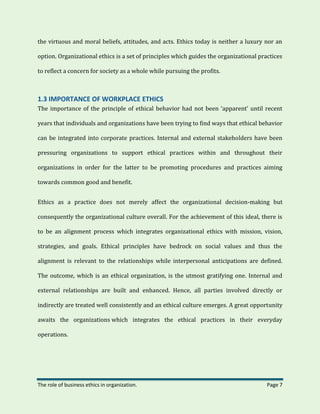
The six core ethical values of the organizational ethics which influences the ethical
behavior are given below and shown in Fig 1.
1. Trustworthiness – It is the broadest and most complicated of the core ethical
values. It is a broad value concerned with all the qualities and behaviors which
makes a person worthy of trust especially integrity, honesty, promise keeping, and
loyalty.
2. Respect – Respect focuses on the moral obligation to honor the essential worth and
dignity of the individual. It is expressed in terms of positive qualities such as civility,
courtesy, dignity, autonomy, tolerance, and acceptance. It also involves prohibitions
against such conduct as violence, humiliation, manipulation, and exploitation etc.
3. Responsibility – It speaks of the moral obligations to be accountable, perusal of
excellence, and exercising of self-restraint.
4. Fairness and justice – Fairness and justice embodies concern with equity, equality,
impartiality, proportionality, openness, and due process.
The role of business ethics in organization. Page 6
5. Caring – It is the central value relating to sincere and abiding concern for the
wellbeing of others. Concepts of charity, kindness, compassion, empathy, and
sharing are included under caring.
6. Citizenship – The concept of citizenship includes civic virtues and duties which
prescribe how the organization ought to behave as part of a community. The
exercise of good citizenship requires doing one’s share to make society work and
demonstrating a concern for future generations. A good citizen, for example,
respects the regulatory norms, reports crimes, serves on juries, votes, pays taxes,
and protects the environment.
Fig 1 Core ethical values of the organizational ethics
Ethics and the notion of ethical behavior and value systems in the organizational setting
have become an organizational precedence in the present century. Ethos was first
discussed in the ancient Greek philosophic circles, where it was a principle characterizing
The role of business ethics in organization. Page 7
the virtuous and moral beliefs, attitudes, and acts. Ethics today is neither a luxury nor an
option. Organizational ethics is a set of principles which guides the organizational practices
to reflect a concern for society as a whole while pursuing the profits.
1.3 IMPORTANCE OF WORKPLACE ETHICS
The importance of the principle of ethical behavior had not been ‘apparent’ until recent
years that individuals and organizations have been trying to find ways that ethical behavior
can be integrated into corporate practices. Internal and external stakeholders have been
pressuring organizations to support ethical practices within and throughout their
organizations in order for the latter to be promoting procedures and practices aiming
towards common good and benefit.
Ethics as a practice does not merely affect the organizational decision-making but
consequently the organizational culture overall. For the achievement of this ideal, there is
to be an alignment process which integrates organizational ethics with mission, vision,
strategies, and goals. Ethical principles have bedrock on social values and thus the
alignment is relevant to the relationships while interpersonal anticipations are defined.
The outcome, which is an ethical organization, is the utmost gratifying one. Internal and
external relationships are built and enhanced. Hence, all parties involved directly or
indirectly are treated well consistently and an ethical culture emerges. A great opportunity
awaits the organizations which integrates the ethical practices in their everyday
operations.
The role of business ethics in organization. Page 8
The following are Importance of workplace ethics
1. Workplace ethics promotes teamwork and cooperation. An organization that
introduces the workplace ethics program aligns the behavior of employees. As a
result, this fosters openness, partnership, and trust. Moreover, when employees
know supervisors’ expectations they perform better in their jobs.
2. Workplace ethics fosters a positive public image. Workplace ethics help an
organization establish a positive reputation in the eyes of the public. This is
especially important for non-profit organizations and high-profile companies that
rely more on private donations and government grants. Such donors need to be
aware of how these firms plan to use their money.
3. Workplace ethics protect company assets. A company can prevent property theft
and falsification of documents by implementation of workplace ethical standards.
Work ethics also help to protect an organization from loss of income due to
employees taking false sick leave.
4. Workplace ethics provides emotional security. Recognizing the importance of ethics
at the workplace helps employees to feel secure, because there is no harassment
from other workers and the supervisors treat employees with respect. In case these
ethics are violated, disciplinary actions are taken to foster a better working
environment.
5. Organizational ethics examines ethical problems which arise in the organizational
environment. Ethical behavior is very important when dealing with the stakeholders
who have a claim on and a stake in the organization. The main stakeholder groups
are shareholders, managers, employees, suppliers and distributors, customers,
The role of business ethics in organization. Page 9
community, society, and nation. Stakeholders can directly benefit or suffer loss by
the actions of the organization. Hence, the business ethics of the organization is very
important to them.
Ethics consists of the standards of behavior to which the employees hold themselves in
their personal and professional lives. It establishes the levels of honesty, empathy, and
trustworthiness and other virtues by which they identify their personal behavior and their
public reputation. In their professional lives, ethics guides their interactions with
customers, clients, colleagues, employees, and shareholders affected by the business
practices in the same way the ethics set norms in the personal lives for the ways for the
interaction with the family and friends.
1.4GUIDING PRINCIPLES OF ORGANIZATIONAL ETHICS
Organizational ethics includes both corporate and business ethics, and, put in another way,
both the corporate values and the financial practices of the organization. It relates to all
aspects of the organization including mission, vision, governance, and leadership. Within
the industry, organizational ethics encompasses the professional and moral codes of the
organizational conduct and it can reflect the conduct toward employees, customers,
suppliers, contractors, or any other stakeholders. While compliance programs are
important, the organizational ethics strategy is to be broader than just the compliance
programs which typically focus on statutory and regulatory requirements.
Organizational ethics includes all those actions which are embedded into several issues
such as informed consent, research, marketing, access, conflict of interest, financial
management, and public policy etc. They provide a means for them to be addressed by
The role of business ethics in organization. Page 10
individuals within the organization. There are guiding principles which are to be used to
guide ethical organizational behavior which are to be considered, implicitly or explicitly, in
every decision made by the organization and its representatives.
The guiding principles include:
1. Carrying out of the duties in a faithful and disciplined manner,
2. Honesty in financial dealings
3. Giving work output which is of high quality
4. Fulfilling of duties towards fellow employees
5. Respecting the organizational codes of conduct
6. Respecting the disciplines connected with various organizational
7. Fairness in dealings with people both inside and outside the organization standards
8. Fair distribution of scarce resources
9. Complying regulatory norms without any violations
10. Fulfilling duties towards community and preservation of environment.
Although a relatively new concept, organizational ethics actually fits easily into the
framework of the traditional ethical principles of respect for persons, beneficence, and
justice. Respect is earned by organizational senior management personnel who model
ethical behavior, and by employees who replicate these behaviors. Beneficence is achieved
by organizations recruiting and maintaining ethical employees, developing an ethical
culture, and implementing programs in an ethical manner.
Organizational ethics is different than the personal ethics since in several organizations,
there is more than one person involved. Whether a small or a large organization, it is a
The role of business ethics in organization. Page 11
group of people joining hand and force to run the organization and create revenue. The
success or failure of the organization can affect the shareholders, stakeholders and even
the society where the organization operates. Ethical standard formulates the organizational
culture, influences the employees’ working spirit, shows a good image to the public,
develops trusts from the customers, and has advantage from potential customers and / or
potential business partners. When people argue that ethics are not to be the primary focus
for the organizational management, they are certainly wrong. Trust is what leads other
organizations to choose one organization to be its partner, which keeps a customer loyal to
a brand, and which attract potential customer to try out a product. And undoubtedly,
people are more willing to trust the organization which is known for its ethical culture.
Ethical organizations have more advantage over their competitors. Organizations which
violate the ethical standards can face the judgement of law, and / or criticism of the public.
Legally, an act is not a criminal act until proven guilty for example several organizations
abide the law, but their actions are those which cannot be called ethical. This includes for
an example lying about the capability of the products etc. Violation of the organizational
ethics can exists in several forms such as bribery, sexual harassment, patent or copyright
infringement, lying and deceit about product performance and safety, deliberate use of
harmful substances, intentional environmental pollution, discrimination, dangerous
working condition, and violations of promises etc.
For clarifying the roles within an organization, the principle of ‘ethics starts at the top’
holds firm. It is reasonable to think that the task of ethics management involves leadership
personnel to initiate the inclusive process of defining the organizational guiding values, to
The role of business ethics in organization. Page 12
create an environment which sustains ethically sound behavior, and to instill a sense of
shared accountability among employees. This conceptual understanding focuses attention
on the downstream effects of an effective organizational ethics action plan to include but
not limited to the policy-making, moral awareness, moral distress, ethical climate,
trustworthiness, compliance, integrity, self-evaluation, and measures to assess corporate
social responsibility in maintaining the common goal. In order to engage in the realm of
ethics, the task of the organization is to develop both short term and long term goals and
programs which support and nurture ethical behavior at all the levels of the employees.
1.5 RESPONSIBLE OF ORGANIZATIONAL MANAGEMENT
Organizational management is responsible for practices such as creating the foundations
for the resourceful and ethical performance of the organization. It is one of the most
powerful and important aspects of human activities in the organization. Organization
invests tremendous amounts of funds on training effective leaders given that the long term
survival as well as growth of organization starts with ethical leadership. It is common
knowledge that integrating ethics into the organization requires true leaders who are
promoting the organizational ethical mission, vision, goals, and objectives. The ethical
leaders are to continuously assess the employees’ needs and expectations, motivate them
and direct them, in an effort to reach and materialize the shared mission and vision. Ethical
leaders are the key to communicate organizational values and beliefs. To take the
organizations on excellence path, a blend of strategy and culture is needed which effective
leadership can achieve. Strategic thinking and cultural building can be built up by leader’s
The role of business ethics in organization. Page 13
moral principles and integrity. Leadership makes real difference between success and
failure.
The most important responsibility of the organizational management is to create, install,
and nurture organizational culture, which is based on values and principles. This can be
accomplished by taking into account four essential elements.
First, leadership is to instill shared core values, such as honesty, respect, responsibility,
fairness, and compassion and these are to be the ones which are driving decision-making
within the organization.
Second, the organization is to have a common and shared language which all the employees
understand and feel comfortable to discuss even sensitive or challenging issues. This
language is the language of ethics, which is to be deeply integrated in the organizational
infrastructure.
Third, organizational management commitment for the efficient, effective, and purposeful
delivery of the ethical program, while rewarding the individuals who abide by the ethical
policies, makes the program stronger while the ethical culture is deeply installed. Fourth,
facing up to the challenges which can surface, the procedures and policies can be carried
out to satisfy the common benefit of the stakeholders and the organization, while neither
management nor the employees feel intimidated or stressed by the challenge or options
available for decision- making to be achieved.
There are certain parameters, which influence the extensive level and degree to which
ethics is applied in the organization. These include globalization, technology, intangible
The role of business ethics in organization. Page 14
assets, and talent management etc. In addition, there are factors, which restrict ethical
intentions and behavior such as increasing competition, pressure for profits and return on
investment, high corruption levels in the society, values and morals not considered
important by younger generations, the expectancy of fast money and profits, and disregard
for social responsibility, honesty, and integrity.
However, organizations which are inclined in performing according to ethical standards,
morals and values, have recognized the importance and significance that ethical
procedures and policies are communicated and practiced throughout the entire
organization, while at the same time becoming a priority for the administration of the
organization. These standards are to be modeled and practiced while having the
commitment of the administration of the organization. Moreover, there is a requirement
for the establishment of a formal code of ethics outlining the policies, regulations, and
expectations for all stakeholders.
The code of ethics is to be thoroughly communicated throughout the organization in formal
an informal ways (written and oral communication) while making sure that there is
provision for guidance and support in cases of dilemmas or insecurities. The organization
is to provide a thorough training program to prepare the employees for the policies,
practices, and expectations in order to increase employee ‘ethical awareness’ and to ‘define
criteria for ethical decision-making within the organization’.
Additionally, when designing ethical programmers, it is necessary to assign the leading role
for the ethical implementation throughout the organization to an ethics manager who is to
undertake the role of a guide towards ethical decision-making and practices. Also, the
The role of business ethics in organization. Page 15
ethics manager is to encourage accountability and ownership towards the ethical program
throughout the organization. The ethics manager is to design response and enforcement
methodologies through the provision of rewards. Further, investigations and provision of
consequences in cases of behaviors, which are not in accordance to the ethical program, are
to be reinforced by the ethics manager, while evaluating the programmed when the need
arises for reevaluation and redesigning of sections of the program.
The role of ethics in management is also dependent on the level of responsibility the
organization is willing to take. The pro-active mode characterizes the organization which
believes strongly in its mission as moral (or at least for the benefit of society). It responds
as a trend setter to some of the ethical dilemmas. The re-active mode, characterizes the
organizations which are aware of social responsibility, respond to immediate situations
rather than anticipating them. The passive mode leads the organization to deviant behavior
by refusing responsibility. There are two main extremes found in the corporate world,
profit on one side and human safety, which constitute an ethical spectrum.
Managers in organizations face ethical issues every day of their working lives. There is
seldom a decision they face which does not have an ethical dimension or facet to it. In
addition to facing ethical aspects in their decision making, they confront ethical issues as
they carry out their leadership responsibilities. Whether they be engaged in planning,
organizing, motivating, communicating, or some other management role, they face the fact
that matters of right and wrong, fairness and unfairness, and justice or lack of justice creep
into their decisions, actions or behaviors. Furthermore, it does not matter what level of
The role of business ethics in organization. Page 16
management is under consideration – top, middle, or lower; managers at all levels, and in
all functions, face situations wherein ethical considerations play a major role.
1.6 ETHICS AND THE STATUTORY REGULATIONS
Ethics and the statutory regulations are the systems defining the rules of conduct. Majority
of the people in the organization know why the statutory regulations are to be adhered to.
Statutory regulations are important social rules with serious penalties. The regulations tell
what are allowed and what are not allowed to be done, and breaking of the regulations
frequently leads to punishment. There is indeed a considerable overlap between ethics and
the regulations. In practice, the statutory regulations are essentially an institutionalization
of ethics into specific social rules, regulations, and proscriptions. Nevertheless, they are not
equivalent. Fig 2 shows relationship between ethics and regulations.
Fig 2 Relationship between ethics and regulations
The statutory regulations can be said to be a definition of the minimum acceptable
standards of behavior. However, the statutory regulations, whether in the organizational
dealings or elsewhere, do not explicitly forbid many morally contestable issues. Similarly, it
is possible to think of issues which are covered by the statutory regulations, but which are
The role of business ethics in organization. Page 17
not really about ethics. In one sense then, the domain of organizational ethics can be said to
begin ‘where the statutory regulations ends’. Organizational ethics is primarily concerned
with those issues, which are either not covered by the statutory regulations, or where there
is no definite consensus on whether something is right or wrong.
Statutory regulations are public’s agency for translating morality into explicit social
guidelines and practices, but for most of the issues of interest to organizational ethics, the
statutory regulations typically does not presently provide any guidance. For this reason, it
is frequently said that organizational ethics is about the ‘grey areas’ of its operation, or
about going ‘beyond the statutory regulations minimum’. Moreover, ‘ethical’
responsibilities are depicted as those which are above and beyond statutory
responsibilities.
The influence of the organization on the society is greater than ever before. Organization
affects the life of the people living in the communities around it. Several issues can arise in
the communities because of the functioning of the organization. Organizational ethics helps
to understand the reasons of arising of the issues and the methods to address them.
Further, malpractices have the potential to inflict enormous harm on the individuals, the
communities, and the environment. Organizational ethics help in understanding more
about the causes and consequences of these malpractices, and search for methods to
improve the human condition in the communities.
Further, the demands being placed on the organizations to be ethical by their various
stakeholders are constantly becoming more complex and more challenging. Organizational
ethics provides the means to appreciate and understand these challenges more clearly, so
The role of business ethics in organization. Page 18
that the organizations can meet these ethical expectations more effectively. Also, ethics can
help to improve ethical decision making by providing management with the appropriate
knowledge and tools which allow them to correctly identify, diagnose, and provide
solutions to the ethical problems and dilemmas they are confronted with. In addition,
ethics provides management with a way of looking at the reasons behind such problems,
and the ways in which such problems can be dealt with.
Ethics also has influence on the stakeholders. The main stakeholder groups are
shareholders, senior management personnel, employees, customers, suppliers and
distributors, community, and society. Shareholders always want the organization to
achieve maximum profits. Hence, they pay attention to the organization and its
management. They want to ensure that management and employees behave ethically and
that they care about the reputation of the organization.
Senior management personnel are crucial since they are responsible for the profitable
operation of the organization. They are not to behave unethically or to pursue goals which
threaten the organizational interests. They have to act ethically with regard to the needs of
people in the organization and the community. They are to provide a safe and healthy
working environment of work. Finally, they are to provide a reasonable balance for
employees between their private life and their work and protect them against harmful
practices at work. Management is frequently confronted with ethical problems in the work
place involving employees.
The role of business ethics in organization. Page 19
There are many ways, in which senior management influence the employees to behave
ethically. There are five steps which are needed to establish an ethical workplace. These
are:
1. Framing of the corporate values and making sure that all the employees
2. Making sure the management itself act with integrity and ensure that employees
3. Demonstration of appreciation and gratitude strengthens of the organization
4. Work for success of the organization through the employees
5. Making sure the decisions made reflect the ethical standards and values.
Employees work for financial gain. Management frequently set various conditions to
employment, such as a dress code and respectful behavior. Employees have to be loyal to
the organization they work for. Ethical conduct enables them to integrate their personal
goals with the organizational objectives. Organizations with an ethical approach believe
that the employees are more committed to the organizational success. With ethical
approach, they work harder for the achievement of the organizational objectives. Ethics in
the organization attracts talent and ensures motivation amongst the employees. However,
employees are to be treated fairly, with dignity and respect. Hence, management is to act
ethically towards employees and meet their expectations by creating a structure which
fairly rewards them for their work.
Organizational ethics is especially important in dealing with customers since they are the
most critical stakeholders. Organization needs satisfied customers. When customers are
satisfied, they are loyal to the organization and to the organizational products. Customers
are satisfied if the organization follows all the ethical norms and values. Customers have
The role of business ethics in organization. Page 20
more trust and confidence in the marketing personnel who follow ethical rules. Therefore,
the only way to survive in the market is to be honest and fair.
Organizations interact with their suppliers and distributors. Ethical suppliers supply high
quality products and seek long-term profitability. Suppliers expect to be paid fairly and
without delay for their inputs. Distributors expect to receive high quality products at
agreed-upon prices. The most important issues connected with the payments or the
qualities of products are governed by the terms of the legal contracts, whereas many other
issues are dependent on business ethics. The organization is to treat the suppliers with
fairness and integrity and build mutually beneficial relationships, regardless of the value of
the transaction or the length of the association. In addition, organization is to monitor the
suppliers and distributors that they adhere to the principles defined in the code of conduct
and take appropriate action if behaviors are contrary to these principles.
Community refers to the location, in which the organization is located. The community
provides the organization with the utilities and the work force which allow it to function.
The organization contributes to the economy of the region in which it operates and very
often determines the prosperity of the community surrounding it. It is very important to
build positive relationships within the communities. The local traditions, customs, and
cultures are to be respected. The organization is needed to resolve the community issues
amicably. The organization is not to attempt to improve its profits by engaging in actions
which can hurt the community surrounding it.
The important benefits of ethic management in working environment of the organization
The role of business ethics in organization. Page 21
The important benefits of ethic management in working environment of the organization
include:
1. Effective coordination of the behaviors and the values of the line managers
2. Prevents development of close personal relationship at the work place
3. Prevents corruption since organization values prevents the employees from taking
bribes,
4. Improves attitude with colleagues and customers,
5. There is reduction in the unwanted behaviors
6. Improvement in the obligation feeling increases the faithfulness towards the
organization,
7. Improvements in discipline and regularity,
8. Improvements towards compliance towards meeting the goals of the organization,
9. Prevention of tension at the workplace leading to peaceful working,
10. Improvement in addressing the customer related issues resulting improved
customer satisfaction,
11. Prevention of personalized negative or positive feelings with employees
12. Improvements in the organizational effectiveness and productivity,
13. Service life becomes more useful and purposeful,
14. Provides a descent picture of the organization to the outside world.
The role of business ethics in organization. Page 22
1.7 CONLUSION
A company that has established behavioral policies can improve its reputation and help
ensure its long-term success. Therefore, for your organization to establish proper ethics
and behavior in the workplace it is important to specify what is acceptable and
unacceptable behavior for its employees. This should be established when hiring new
employees and continue through each step as they are introduced to your business. Polices
can be specified by including them in an employee manual and stipulating them in the job
description where you summarize the expected conduct. The manual can as well address
topics like language, harassment and work attire. Workers who decide not to follow the
highlighted codes of conduct may receive verbal and written warnings and eventually lead
to termination.
Improving workplace ethics and stressing integrity is important for the future success of
the company. Most business owners are busy focusing on the skills and productivity of
prospective employees but forget to emphasize integrity, honesty, and forthright behavior.
Stressing integrity to your employees leads them to become transparent in their actions. An
environment of integrity can be created at the hiring stage by ensuring that the human
resource department addresses this principle during the interview.
The role of business ethics in organization. Page 23
1.7 Reference:
A Culture of Ethical Behavior Is Essential to Business Success
Houston Chronicle, “The Advantages of Ethical Behavior in Business”
Industry Week, “Is Ethics in Business Possible?”
Investopedia, “The Importance of Business Ethics”
Medium, “6 Steps for Implementing a Corporate Social Responsibility Effectively”
The Street, “What Is Business Ethics? Definition, Overview, and Example”

B.ETHICS By Kevin..pdf

  • 1.
    2022 [PROJECT OF BUSINESSETHICS] In today’s business environment, it’s more role than ever to strive for strong ethical behavior. Never before has information been so widely available news of even minor indiscretions can spread rapidly. ASSIGNMENT Student name Mr Kevin Ally Protegene UWIMANA Student id 01222112106 Department Faculty of hospitality and tourism Program MBA in Hospitality management Module Business ethics Lecturer Dr. Madhumita Roy Class ODL Date 12 /09/2029 Total Marks
  • 2.
    The role ofbusiness ethics in organization. Page 1 Table of Contents 1. THE ROLE OF BUSINESS ETHICS IN ORGANIZATIONAL........................................................2 1.1 INTRODUCTION .............................................................................................................................2 1.2 ROLE OF ETHICS IN ORGANIZATIONAL FUNCTIONING.........................................................5 1.3 IMPORTANCE OF WORKPLACE ETHICS.....................................................................................7 1.4GUIDING PRINCIPLES OF ORGANIZATIONAL ETHICS .............................................................9 1.5 RESPONSIBLE OF ORGANIZATIONAL MANAGEMENT............................................................12 1.6 ETHICS AND THE STATUTORY REGULATIONS........................................................................16 1.7 CONLUSION.................................................................................................................................. 22 1.7 Reference: ....................................................................................................................................... 23
  • 3.
    The role ofbusiness ethics in organization. Page 2 1. THE ROLE OF BUSINESS ETHICS IN ORGANIZATIONAL. 1.1 INTRODUCTION In today’s business environment, it’s more role than ever to strive for strong ethical behavior. Never before has information been so widely available news of even minor indiscretions can spread rapidly. Lawmakers, regulators, and the public expect businesses to perform under the highest ethical standards. When companies operate without transparency, honesty, and kindness, they risk legal and financial repercussions as well as loss of credibility in the eyes of customers and other stakeholders. An organization is generally defined as a group, in number from two people to tens of thousands of people, who intentionally aims to accomplish a shared common goal or a set of goals. In order to achieve shared goals, the organization acts as a system composed of, 1. Inputs such as resources both human and monetary 2. Processes such as strategies to accomplish goals 3. Outputs such as products and services 4. Outcomes such as end results or benefits to consumers The ethics of the organization refers to the active attempt of the organization to define its mission and core principles, to identify values which can cause tension, to seek best solutions to these tensions, and to manage the operations which maintain its values. Ethics in the functioning of the organization means the application of ethical values and morals to everyday processes, behaviors, and policies of the organization. It is a practice
  • 4.
    The role ofbusiness ethics in organization. Page 3 which is applied uniformly to everyone employed in the organization, regardless of the position, level of responsibility, and range of responsibilities. It is related to all the organizational disciplines such as human resource management, production, sales and marketing, and finance etc. In the organizational context, ethics is non-negotiable. Providing a comprehensive and simple definition for ethics is very difficult task since the ethics is concerned with such matters as value, belief, trust, good and bad, and honesty and dishonesty etc. and all these words themselves need to be define. Some of the reputed definitions of ethics are: 1. Ethics is collection of principles and values which specify the goodness or badness of behavior of an individual, a group, or an organization, 2. Ethics is principles and methods which specify the standards of goodness or badness, 3. Ethics is method to encounter bad or good matters with the observance of spiritual duties and responsibilities. The important thing regarding ethics is the human understanding of the admirable, logical and acceptable behavior. Organizational ethics can also be defined as the principles and standards which determine acceptable conduct in the organization. Ethics is very important in organizational dealings since it builds trust and confidence in the relationships. Ethics is essential for the organization as well as for its success. Organization with codes of ethics realizes that these efforts can improve reputation, positively affect employees’ commitment to work and enhance customers’ loyalty. Organizational ethics is particularly important in dealing with customers.
  • 5.
    The role ofbusiness ethics in organization. Page 4 Although several people use the terms ‘ethics’ and ‘morality’ interchangeably, the two terms do not mean the same thing. While the ethics is a system of moral principles and methods of applying them, the morality is the differentiation of intentions, decisions, and actions between those which are right and those which are wrong. Management can promote ethical behavior by employees by limiting their opportunity to engage in misconduct. Incidences of unethical behavior can be reduced by ethical policies, formal codes of ethics, and ethics training programs informing employees what is expected of them and providing punishments for those who fail to comply. Ethics refers to a code of conduct which guides the employees in dealing with others and it is non-negotiable. The morality rules and ethical behavior codes of the organization apply uniformly to all the employees alike. Ethical behavior and undertakings relate to actions, which are characterized by honesty, integrity, morality, and good management practices. Ethics are the values the organization demonstrates in its goals, policies, and practices and. It is the heart of the workplace culture. Organization which has ethical workplace culture outperforms the competitors and peers in all the categories that matter. Broadly speaking, organizational ethics is concerned with standards and principles for human behavior within the organizational structure to avoid harmful behavior and to promote those behaviors which ensure an ambiance of fairness, trust, honesty and respect. The common ground which the organizational ethics shares with business ethics and practical ethics is the pursuit of what is right and just.
  • 6.
    The role ofbusiness ethics in organization. Page 5 1.2 ROLE OF ETHICS IN ORGANIZATIONAL FUNCTIONING Ethical behavior is based on values such as trustworthiness, respect, responsibility, caring, fairness and justice, and good citizenship. It also depends on the adherence to moral rules. Organizational values tell what is important and this, in turn, helps in making decisions about right and wrong. Morals are the rules for deciding what is good and what is bad. Core ethical values of the of organizational ethics The six core ethical values of the organizational ethics which influences the ethical behavior are given below and shown in Fig 1. 1. Trustworthiness – It is the broadest and most complicated of the core ethical values. It is a broad value concerned with all the qualities and behaviors which makes a person worthy of trust especially integrity, honesty, promise keeping, and loyalty. 2. Respect – Respect focuses on the moral obligation to honor the essential worth and dignity of the individual. It is expressed in terms of positive qualities such as civility, courtesy, dignity, autonomy, tolerance, and acceptance. It also involves prohibitions against such conduct as violence, humiliation, manipulation, and exploitation etc. 3. Responsibility – It speaks of the moral obligations to be accountable, perusal of excellence, and exercising of self-restraint. 4. Fairness and justice – Fairness and justice embodies concern with equity, equality, impartiality, proportionality, openness, and due process.
  • 7.
    The role ofbusiness ethics in organization. Page 6 5. Caring – It is the central value relating to sincere and abiding concern for the wellbeing of others. Concepts of charity, kindness, compassion, empathy, and sharing are included under caring. 6. Citizenship – The concept of citizenship includes civic virtues and duties which prescribe how the organization ought to behave as part of a community. The exercise of good citizenship requires doing one’s share to make society work and demonstrating a concern for future generations. A good citizen, for example, respects the regulatory norms, reports crimes, serves on juries, votes, pays taxes, and protects the environment. Fig 1 Core ethical values of the organizational ethics Ethics and the notion of ethical behavior and value systems in the organizational setting have become an organizational precedence in the present century. Ethos was first discussed in the ancient Greek philosophic circles, where it was a principle characterizing
  • 8.
    The role ofbusiness ethics in organization. Page 7 the virtuous and moral beliefs, attitudes, and acts. Ethics today is neither a luxury nor an option. Organizational ethics is a set of principles which guides the organizational practices to reflect a concern for society as a whole while pursuing the profits. 1.3 IMPORTANCE OF WORKPLACE ETHICS The importance of the principle of ethical behavior had not been ‘apparent’ until recent years that individuals and organizations have been trying to find ways that ethical behavior can be integrated into corporate practices. Internal and external stakeholders have been pressuring organizations to support ethical practices within and throughout their organizations in order for the latter to be promoting procedures and practices aiming towards common good and benefit. Ethics as a practice does not merely affect the organizational decision-making but consequently the organizational culture overall. For the achievement of this ideal, there is to be an alignment process which integrates organizational ethics with mission, vision, strategies, and goals. Ethical principles have bedrock on social values and thus the alignment is relevant to the relationships while interpersonal anticipations are defined. The outcome, which is an ethical organization, is the utmost gratifying one. Internal and external relationships are built and enhanced. Hence, all parties involved directly or indirectly are treated well consistently and an ethical culture emerges. A great opportunity awaits the organizations which integrates the ethical practices in their everyday operations.
  • 9.
    The role ofbusiness ethics in organization. Page 8 The following are Importance of workplace ethics 1. Workplace ethics promotes teamwork and cooperation. An organization that introduces the workplace ethics program aligns the behavior of employees. As a result, this fosters openness, partnership, and trust. Moreover, when employees know supervisors’ expectations they perform better in their jobs. 2. Workplace ethics fosters a positive public image. Workplace ethics help an organization establish a positive reputation in the eyes of the public. This is especially important for non-profit organizations and high-profile companies that rely more on private donations and government grants. Such donors need to be aware of how these firms plan to use their money. 3. Workplace ethics protect company assets. A company can prevent property theft and falsification of documents by implementation of workplace ethical standards. Work ethics also help to protect an organization from loss of income due to employees taking false sick leave. 4. Workplace ethics provides emotional security. Recognizing the importance of ethics at the workplace helps employees to feel secure, because there is no harassment from other workers and the supervisors treat employees with respect. In case these ethics are violated, disciplinary actions are taken to foster a better working environment. 5. Organizational ethics examines ethical problems which arise in the organizational environment. Ethical behavior is very important when dealing with the stakeholders who have a claim on and a stake in the organization. The main stakeholder groups are shareholders, managers, employees, suppliers and distributors, customers,
  • 10.
    The role ofbusiness ethics in organization. Page 9 community, society, and nation. Stakeholders can directly benefit or suffer loss by the actions of the organization. Hence, the business ethics of the organization is very important to them. Ethics consists of the standards of behavior to which the employees hold themselves in their personal and professional lives. It establishes the levels of honesty, empathy, and trustworthiness and other virtues by which they identify their personal behavior and their public reputation. In their professional lives, ethics guides their interactions with customers, clients, colleagues, employees, and shareholders affected by the business practices in the same way the ethics set norms in the personal lives for the ways for the interaction with the family and friends. 1.4GUIDING PRINCIPLES OF ORGANIZATIONAL ETHICS Organizational ethics includes both corporate and business ethics, and, put in another way, both the corporate values and the financial practices of the organization. It relates to all aspects of the organization including mission, vision, governance, and leadership. Within the industry, organizational ethics encompasses the professional and moral codes of the organizational conduct and it can reflect the conduct toward employees, customers, suppliers, contractors, or any other stakeholders. While compliance programs are important, the organizational ethics strategy is to be broader than just the compliance programs which typically focus on statutory and regulatory requirements. Organizational ethics includes all those actions which are embedded into several issues such as informed consent, research, marketing, access, conflict of interest, financial management, and public policy etc. They provide a means for them to be addressed by
  • 11.
    The role ofbusiness ethics in organization. Page 10 individuals within the organization. There are guiding principles which are to be used to guide ethical organizational behavior which are to be considered, implicitly or explicitly, in every decision made by the organization and its representatives. The guiding principles include: 1. Carrying out of the duties in a faithful and disciplined manner, 2. Honesty in financial dealings 3. Giving work output which is of high quality 4. Fulfilling of duties towards fellow employees 5. Respecting the organizational codes of conduct 6. Respecting the disciplines connected with various organizational 7. Fairness in dealings with people both inside and outside the organization standards 8. Fair distribution of scarce resources 9. Complying regulatory norms without any violations 10. Fulfilling duties towards community and preservation of environment. Although a relatively new concept, organizational ethics actually fits easily into the framework of the traditional ethical principles of respect for persons, beneficence, and justice. Respect is earned by organizational senior management personnel who model ethical behavior, and by employees who replicate these behaviors. Beneficence is achieved by organizations recruiting and maintaining ethical employees, developing an ethical culture, and implementing programs in an ethical manner. Organizational ethics is different than the personal ethics since in several organizations, there is more than one person involved. Whether a small or a large organization, it is a
  • 12.
    The role ofbusiness ethics in organization. Page 11 group of people joining hand and force to run the organization and create revenue. The success or failure of the organization can affect the shareholders, stakeholders and even the society where the organization operates. Ethical standard formulates the organizational culture, influences the employees’ working spirit, shows a good image to the public, develops trusts from the customers, and has advantage from potential customers and / or potential business partners. When people argue that ethics are not to be the primary focus for the organizational management, they are certainly wrong. Trust is what leads other organizations to choose one organization to be its partner, which keeps a customer loyal to a brand, and which attract potential customer to try out a product. And undoubtedly, people are more willing to trust the organization which is known for its ethical culture. Ethical organizations have more advantage over their competitors. Organizations which violate the ethical standards can face the judgement of law, and / or criticism of the public. Legally, an act is not a criminal act until proven guilty for example several organizations abide the law, but their actions are those which cannot be called ethical. This includes for an example lying about the capability of the products etc. Violation of the organizational ethics can exists in several forms such as bribery, sexual harassment, patent or copyright infringement, lying and deceit about product performance and safety, deliberate use of harmful substances, intentional environmental pollution, discrimination, dangerous working condition, and violations of promises etc. For clarifying the roles within an organization, the principle of ‘ethics starts at the top’ holds firm. It is reasonable to think that the task of ethics management involves leadership personnel to initiate the inclusive process of defining the organizational guiding values, to
  • 13.
    The role ofbusiness ethics in organization. Page 12 create an environment which sustains ethically sound behavior, and to instill a sense of shared accountability among employees. This conceptual understanding focuses attention on the downstream effects of an effective organizational ethics action plan to include but not limited to the policy-making, moral awareness, moral distress, ethical climate, trustworthiness, compliance, integrity, self-evaluation, and measures to assess corporate social responsibility in maintaining the common goal. In order to engage in the realm of ethics, the task of the organization is to develop both short term and long term goals and programs which support and nurture ethical behavior at all the levels of the employees. 1.5 RESPONSIBLE OF ORGANIZATIONAL MANAGEMENT Organizational management is responsible for practices such as creating the foundations for the resourceful and ethical performance of the organization. It is one of the most powerful and important aspects of human activities in the organization. Organization invests tremendous amounts of funds on training effective leaders given that the long term survival as well as growth of organization starts with ethical leadership. It is common knowledge that integrating ethics into the organization requires true leaders who are promoting the organizational ethical mission, vision, goals, and objectives. The ethical leaders are to continuously assess the employees’ needs and expectations, motivate them and direct them, in an effort to reach and materialize the shared mission and vision. Ethical leaders are the key to communicate organizational values and beliefs. To take the organizations on excellence path, a blend of strategy and culture is needed which effective leadership can achieve. Strategic thinking and cultural building can be built up by leader’s
  • 14.
    The role ofbusiness ethics in organization. Page 13 moral principles and integrity. Leadership makes real difference between success and failure. The most important responsibility of the organizational management is to create, install, and nurture organizational culture, which is based on values and principles. This can be accomplished by taking into account four essential elements. First, leadership is to instill shared core values, such as honesty, respect, responsibility, fairness, and compassion and these are to be the ones which are driving decision-making within the organization. Second, the organization is to have a common and shared language which all the employees understand and feel comfortable to discuss even sensitive or challenging issues. This language is the language of ethics, which is to be deeply integrated in the organizational infrastructure. Third, organizational management commitment for the efficient, effective, and purposeful delivery of the ethical program, while rewarding the individuals who abide by the ethical policies, makes the program stronger while the ethical culture is deeply installed. Fourth, facing up to the challenges which can surface, the procedures and policies can be carried out to satisfy the common benefit of the stakeholders and the organization, while neither management nor the employees feel intimidated or stressed by the challenge or options available for decision- making to be achieved. There are certain parameters, which influence the extensive level and degree to which ethics is applied in the organization. These include globalization, technology, intangible
  • 15.
    The role ofbusiness ethics in organization. Page 14 assets, and talent management etc. In addition, there are factors, which restrict ethical intentions and behavior such as increasing competition, pressure for profits and return on investment, high corruption levels in the society, values and morals not considered important by younger generations, the expectancy of fast money and profits, and disregard for social responsibility, honesty, and integrity. However, organizations which are inclined in performing according to ethical standards, morals and values, have recognized the importance and significance that ethical procedures and policies are communicated and practiced throughout the entire organization, while at the same time becoming a priority for the administration of the organization. These standards are to be modeled and practiced while having the commitment of the administration of the organization. Moreover, there is a requirement for the establishment of a formal code of ethics outlining the policies, regulations, and expectations for all stakeholders. The code of ethics is to be thoroughly communicated throughout the organization in formal an informal ways (written and oral communication) while making sure that there is provision for guidance and support in cases of dilemmas or insecurities. The organization is to provide a thorough training program to prepare the employees for the policies, practices, and expectations in order to increase employee ‘ethical awareness’ and to ‘define criteria for ethical decision-making within the organization’. Additionally, when designing ethical programmers, it is necessary to assign the leading role for the ethical implementation throughout the organization to an ethics manager who is to undertake the role of a guide towards ethical decision-making and practices. Also, the
  • 16.
    The role ofbusiness ethics in organization. Page 15 ethics manager is to encourage accountability and ownership towards the ethical program throughout the organization. The ethics manager is to design response and enforcement methodologies through the provision of rewards. Further, investigations and provision of consequences in cases of behaviors, which are not in accordance to the ethical program, are to be reinforced by the ethics manager, while evaluating the programmed when the need arises for reevaluation and redesigning of sections of the program. The role of ethics in management is also dependent on the level of responsibility the organization is willing to take. The pro-active mode characterizes the organization which believes strongly in its mission as moral (or at least for the benefit of society). It responds as a trend setter to some of the ethical dilemmas. The re-active mode, characterizes the organizations which are aware of social responsibility, respond to immediate situations rather than anticipating them. The passive mode leads the organization to deviant behavior by refusing responsibility. There are two main extremes found in the corporate world, profit on one side and human safety, which constitute an ethical spectrum. Managers in organizations face ethical issues every day of their working lives. There is seldom a decision they face which does not have an ethical dimension or facet to it. In addition to facing ethical aspects in their decision making, they confront ethical issues as they carry out their leadership responsibilities. Whether they be engaged in planning, organizing, motivating, communicating, or some other management role, they face the fact that matters of right and wrong, fairness and unfairness, and justice or lack of justice creep into their decisions, actions or behaviors. Furthermore, it does not matter what level of
  • 17.
    The role ofbusiness ethics in organization. Page 16 management is under consideration – top, middle, or lower; managers at all levels, and in all functions, face situations wherein ethical considerations play a major role. 1.6 ETHICS AND THE STATUTORY REGULATIONS Ethics and the statutory regulations are the systems defining the rules of conduct. Majority of the people in the organization know why the statutory regulations are to be adhered to. Statutory regulations are important social rules with serious penalties. The regulations tell what are allowed and what are not allowed to be done, and breaking of the regulations frequently leads to punishment. There is indeed a considerable overlap between ethics and the regulations. In practice, the statutory regulations are essentially an institutionalization of ethics into specific social rules, regulations, and proscriptions. Nevertheless, they are not equivalent. Fig 2 shows relationship between ethics and regulations. Fig 2 Relationship between ethics and regulations The statutory regulations can be said to be a definition of the minimum acceptable standards of behavior. However, the statutory regulations, whether in the organizational dealings or elsewhere, do not explicitly forbid many morally contestable issues. Similarly, it is possible to think of issues which are covered by the statutory regulations, but which are
  • 18.
    The role ofbusiness ethics in organization. Page 17 not really about ethics. In one sense then, the domain of organizational ethics can be said to begin ‘where the statutory regulations ends’. Organizational ethics is primarily concerned with those issues, which are either not covered by the statutory regulations, or where there is no definite consensus on whether something is right or wrong. Statutory regulations are public’s agency for translating morality into explicit social guidelines and practices, but for most of the issues of interest to organizational ethics, the statutory regulations typically does not presently provide any guidance. For this reason, it is frequently said that organizational ethics is about the ‘grey areas’ of its operation, or about going ‘beyond the statutory regulations minimum’. Moreover, ‘ethical’ responsibilities are depicted as those which are above and beyond statutory responsibilities. The influence of the organization on the society is greater than ever before. Organization affects the life of the people living in the communities around it. Several issues can arise in the communities because of the functioning of the organization. Organizational ethics helps to understand the reasons of arising of the issues and the methods to address them. Further, malpractices have the potential to inflict enormous harm on the individuals, the communities, and the environment. Organizational ethics help in understanding more about the causes and consequences of these malpractices, and search for methods to improve the human condition in the communities. Further, the demands being placed on the organizations to be ethical by their various stakeholders are constantly becoming more complex and more challenging. Organizational ethics provides the means to appreciate and understand these challenges more clearly, so
  • 19.
    The role ofbusiness ethics in organization. Page 18 that the organizations can meet these ethical expectations more effectively. Also, ethics can help to improve ethical decision making by providing management with the appropriate knowledge and tools which allow them to correctly identify, diagnose, and provide solutions to the ethical problems and dilemmas they are confronted with. In addition, ethics provides management with a way of looking at the reasons behind such problems, and the ways in which such problems can be dealt with. Ethics also has influence on the stakeholders. The main stakeholder groups are shareholders, senior management personnel, employees, customers, suppliers and distributors, community, and society. Shareholders always want the organization to achieve maximum profits. Hence, they pay attention to the organization and its management. They want to ensure that management and employees behave ethically and that they care about the reputation of the organization. Senior management personnel are crucial since they are responsible for the profitable operation of the organization. They are not to behave unethically or to pursue goals which threaten the organizational interests. They have to act ethically with regard to the needs of people in the organization and the community. They are to provide a safe and healthy working environment of work. Finally, they are to provide a reasonable balance for employees between their private life and their work and protect them against harmful practices at work. Management is frequently confronted with ethical problems in the work place involving employees.
  • 20.
    The role ofbusiness ethics in organization. Page 19 There are many ways, in which senior management influence the employees to behave ethically. There are five steps which are needed to establish an ethical workplace. These are: 1. Framing of the corporate values and making sure that all the employees 2. Making sure the management itself act with integrity and ensure that employees 3. Demonstration of appreciation and gratitude strengthens of the organization 4. Work for success of the organization through the employees 5. Making sure the decisions made reflect the ethical standards and values. Employees work for financial gain. Management frequently set various conditions to employment, such as a dress code and respectful behavior. Employees have to be loyal to the organization they work for. Ethical conduct enables them to integrate their personal goals with the organizational objectives. Organizations with an ethical approach believe that the employees are more committed to the organizational success. With ethical approach, they work harder for the achievement of the organizational objectives. Ethics in the organization attracts talent and ensures motivation amongst the employees. However, employees are to be treated fairly, with dignity and respect. Hence, management is to act ethically towards employees and meet their expectations by creating a structure which fairly rewards them for their work. Organizational ethics is especially important in dealing with customers since they are the most critical stakeholders. Organization needs satisfied customers. When customers are satisfied, they are loyal to the organization and to the organizational products. Customers are satisfied if the organization follows all the ethical norms and values. Customers have
  • 21.
    The role ofbusiness ethics in organization. Page 20 more trust and confidence in the marketing personnel who follow ethical rules. Therefore, the only way to survive in the market is to be honest and fair. Organizations interact with their suppliers and distributors. Ethical suppliers supply high quality products and seek long-term profitability. Suppliers expect to be paid fairly and without delay for their inputs. Distributors expect to receive high quality products at agreed-upon prices. The most important issues connected with the payments or the qualities of products are governed by the terms of the legal contracts, whereas many other issues are dependent on business ethics. The organization is to treat the suppliers with fairness and integrity and build mutually beneficial relationships, regardless of the value of the transaction or the length of the association. In addition, organization is to monitor the suppliers and distributors that they adhere to the principles defined in the code of conduct and take appropriate action if behaviors are contrary to these principles. Community refers to the location, in which the organization is located. The community provides the organization with the utilities and the work force which allow it to function. The organization contributes to the economy of the region in which it operates and very often determines the prosperity of the community surrounding it. It is very important to build positive relationships within the communities. The local traditions, customs, and cultures are to be respected. The organization is needed to resolve the community issues amicably. The organization is not to attempt to improve its profits by engaging in actions which can hurt the community surrounding it. The important benefits of ethic management in working environment of the organization
  • 22.
    The role ofbusiness ethics in organization. Page 21 The important benefits of ethic management in working environment of the organization include: 1. Effective coordination of the behaviors and the values of the line managers 2. Prevents development of close personal relationship at the work place 3. Prevents corruption since organization values prevents the employees from taking bribes, 4. Improves attitude with colleagues and customers, 5. There is reduction in the unwanted behaviors 6. Improvement in the obligation feeling increases the faithfulness towards the organization, 7. Improvements in discipline and regularity, 8. Improvements towards compliance towards meeting the goals of the organization, 9. Prevention of tension at the workplace leading to peaceful working, 10. Improvement in addressing the customer related issues resulting improved customer satisfaction, 11. Prevention of personalized negative or positive feelings with employees 12. Improvements in the organizational effectiveness and productivity, 13. Service life becomes more useful and purposeful, 14. Provides a descent picture of the organization to the outside world.
  • 23.
    The role ofbusiness ethics in organization. Page 22 1.7 CONLUSION A company that has established behavioral policies can improve its reputation and help ensure its long-term success. Therefore, for your organization to establish proper ethics and behavior in the workplace it is important to specify what is acceptable and unacceptable behavior for its employees. This should be established when hiring new employees and continue through each step as they are introduced to your business. Polices can be specified by including them in an employee manual and stipulating them in the job description where you summarize the expected conduct. The manual can as well address topics like language, harassment and work attire. Workers who decide not to follow the highlighted codes of conduct may receive verbal and written warnings and eventually lead to termination. Improving workplace ethics and stressing integrity is important for the future success of the company. Most business owners are busy focusing on the skills and productivity of prospective employees but forget to emphasize integrity, honesty, and forthright behavior. Stressing integrity to your employees leads them to become transparent in their actions. An environment of integrity can be created at the hiring stage by ensuring that the human resource department addresses this principle during the interview.
  • 24.
    The role ofbusiness ethics in organization. Page 23 1.7 Reference: A Culture of Ethical Behavior Is Essential to Business Success Houston Chronicle, “The Advantages of Ethical Behavior in Business” Industry Week, “Is Ethics in Business Possible?” Investopedia, “The Importance of Business Ethics” Medium, “6 Steps for Implementing a Corporate Social Responsibility Effectively” The Street, “What Is Business Ethics? Definition, Overview, and Example”