Best episode ever
Angular 2 from the perspective of an Angular 1 developer
Peter Bouda
MAJ Digital
peter@majdigital.ch
Why there must be new episodes
● Shiny new JS things: ES2015, TypeScript
● Let there be React!
● Component types confusion: directives, services,
factories, providers, controllers, …
Preparation
● Some Angular Best Practices
● Module Loader
● TypeScript migration
● Component Directives
● Use Upgrade Adapter → Hybrid applications!
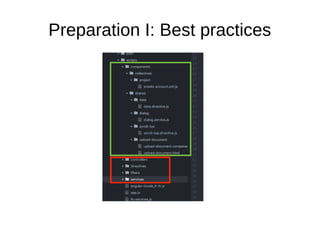
Preparation I: Best practices
● The Rule of 1
● Folder-by-Features Structure
● Modularity
– Many Small, Self Contained Modules
– Create an App Module
– Keep the App Module Thin
– Feature Areas are Modules
– Reusable Blocks are Modules
– Module Dependencies
Preparation I: Best practices
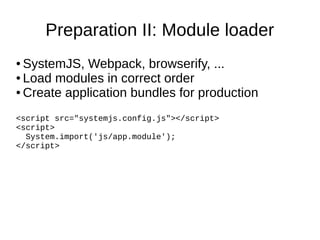
Preparation II: Module loader
● SystemJS, Webpack, browserify, ...
● Load modules in correct order
● Create application bundles for production
<script src="systemjs.config.js"></script>
<script>
System.import('js/app.module');
</script>
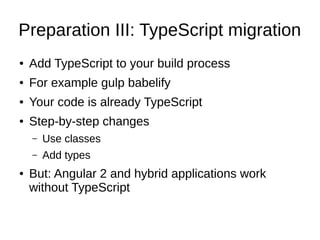
Preparation III: TypeScript migration
● Add TypeScript to your build process
● For example gulp babelify
● Your code is already TypeScript
● Step-by-step changes
– Use classes
– Add types
● But: Angular 2 and hybrid applications work
without TypeScript
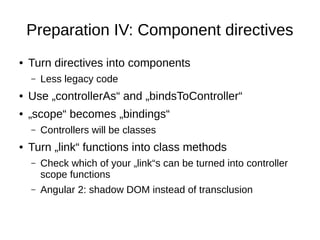
Preparation IV: Component directives
● Turn directives into components
– Less legacy code
● Use „controllerAs“ and „bindsToController“
● „scope“ becomes „bindings“
– Controllers will be classes
● Turn „link“ functions into class methods
– Check which of your „link“s can be turned into controller
scope functions
– Angular 2: shadow DOM instead of transclusion
Preparation V: Upgrade adapter
● Mix Angular 1 and Angular 2 components
– Dependency injection works just fine!
● Create a central module with singleton
import { UpgradeAdapter } from '@angular/upgrade';
const upgradeAdapter = new UpgradeAdapter();
● Bootstrap via upgradeAdapter in app module
upgradeAdapter.bootstrap(document.documentElement,
['app']);
● Import upgradeAdapter where you need it
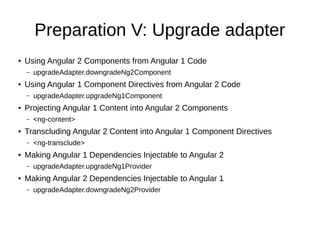
Preparation V: Upgrade adapter
● Using Angular 2 Components from Angular 1 Code
– upgradeAdapter.downgradeNg2Component
● Using Angular 1 Component Directives from Angular 2 Code
– upgradeAdapter.upgradeNg1Component
● Projecting Angular 1 Content into Angular 2 Components
– <ng-content>
● Transcluding Angular 2 Content into Angular 1 Component Directives
– <ng-transclude>
● Making Angular 1 Dependencies Injectable to Angular 2
– upgradeAdapter.upgradeNg1Provider
● Making Angular 2 Dependencies Injectable to Angular 1
– upgradeAdapter.downgradeNg2Provider
Hands-on!
github.com/pbouda/angular-es6-boilerplate
Thanks for participating!
peter@majdigital.ch

Best episode ever: Angular 2 from the perspective of an Angular 1 developer

  • 1.
    Best episode ever Angular2 from the perspective of an Angular 1 developer Peter Bouda MAJ Digital peter@majdigital.ch
  • 2.
    Why there mustbe new episodes ● Shiny new JS things: ES2015, TypeScript ● Let there be React! ● Component types confusion: directives, services, factories, providers, controllers, …
  • 3.
    Preparation ● Some AngularBest Practices ● Module Loader ● TypeScript migration ● Component Directives ● Use Upgrade Adapter → Hybrid applications!
  • 4.
    Preparation I: Bestpractices ● The Rule of 1 ● Folder-by-Features Structure ● Modularity – Many Small, Self Contained Modules – Create an App Module – Keep the App Module Thin – Feature Areas are Modules – Reusable Blocks are Modules – Module Dependencies
  • 5.
  • 6.
    Preparation II: Moduleloader ● SystemJS, Webpack, browserify, ... ● Load modules in correct order ● Create application bundles for production <script src="systemjs.config.js"></script> <script> System.import('js/app.module'); </script>
  • 7.
    Preparation III: TypeScriptmigration ● Add TypeScript to your build process ● For example gulp babelify ● Your code is already TypeScript ● Step-by-step changes – Use classes – Add types ● But: Angular 2 and hybrid applications work without TypeScript
  • 8.
    Preparation IV: Componentdirectives ● Turn directives into components – Less legacy code ● Use „controllerAs“ and „bindsToController“ ● „scope“ becomes „bindings“ – Controllers will be classes ● Turn „link“ functions into class methods – Check which of your „link“s can be turned into controller scope functions – Angular 2: shadow DOM instead of transclusion
  • 9.
    Preparation V: Upgradeadapter ● Mix Angular 1 and Angular 2 components – Dependency injection works just fine! ● Create a central module with singleton import { UpgradeAdapter } from '@angular/upgrade'; const upgradeAdapter = new UpgradeAdapter(); ● Bootstrap via upgradeAdapter in app module upgradeAdapter.bootstrap(document.documentElement, ['app']); ● Import upgradeAdapter where you need it
  • 10.
    Preparation V: Upgradeadapter ● Using Angular 2 Components from Angular 1 Code – upgradeAdapter.downgradeNg2Component ● Using Angular 1 Component Directives from Angular 2 Code – upgradeAdapter.upgradeNg1Component ● Projecting Angular 1 Content into Angular 2 Components – <ng-content> ● Transcluding Angular 2 Content into Angular 1 Component Directives – <ng-transclude> ● Making Angular 1 Dependencies Injectable to Angular 2 – upgradeAdapter.upgradeNg1Provider ● Making Angular 2 Dependencies Injectable to Angular 1 – upgradeAdapter.downgradeNg2Provider
  • 11.
  • 12.