Biogeodynamics and Earth System
Sciences Summer School (BESS)Sciences Summer School (BESS)
Data Assimilation for the Lorenz
(1963) Model using Ensemble
d E t d d K l Filtand Extended Kalman Filter
D. Pasetto (a) and C. Vitolo (b)
Advisor M.Ghil, ENS & UCLA
(a) Universita' di Padova (Italy)
(b) Imperial College London (UK)
Data Assimilation for the Lorenz model using
Ensemble and Extended Kalman FilterEnsemble and Extended Kalman Filter
OUTLINE
Data AssimilationData Assimilation
Kalman Filter (EnKF and EKF)
Lorenz ModelLorenz Model
Results of Sensitivity Tests
Future Challenges
DATA ASSIMILATIONSS O
Data Assimilation is usually defined as
”Estimation and prediction (analysis) of an unknown trueEstimation and prediction (analysis) of an unknown true
state by combining observations and system dynamics
(model output)”( p )
It is needed in order to:
- Reduce uncertainties and biases
- Improve forecasting
- Estimate initial state of a system (e g hydrologic system)Estimate initial state of a system (e.g. hydrologic system)
from multiple sources of information
- Permit forecast adjustmentsPermit forecast adjustments
EXAMPLE
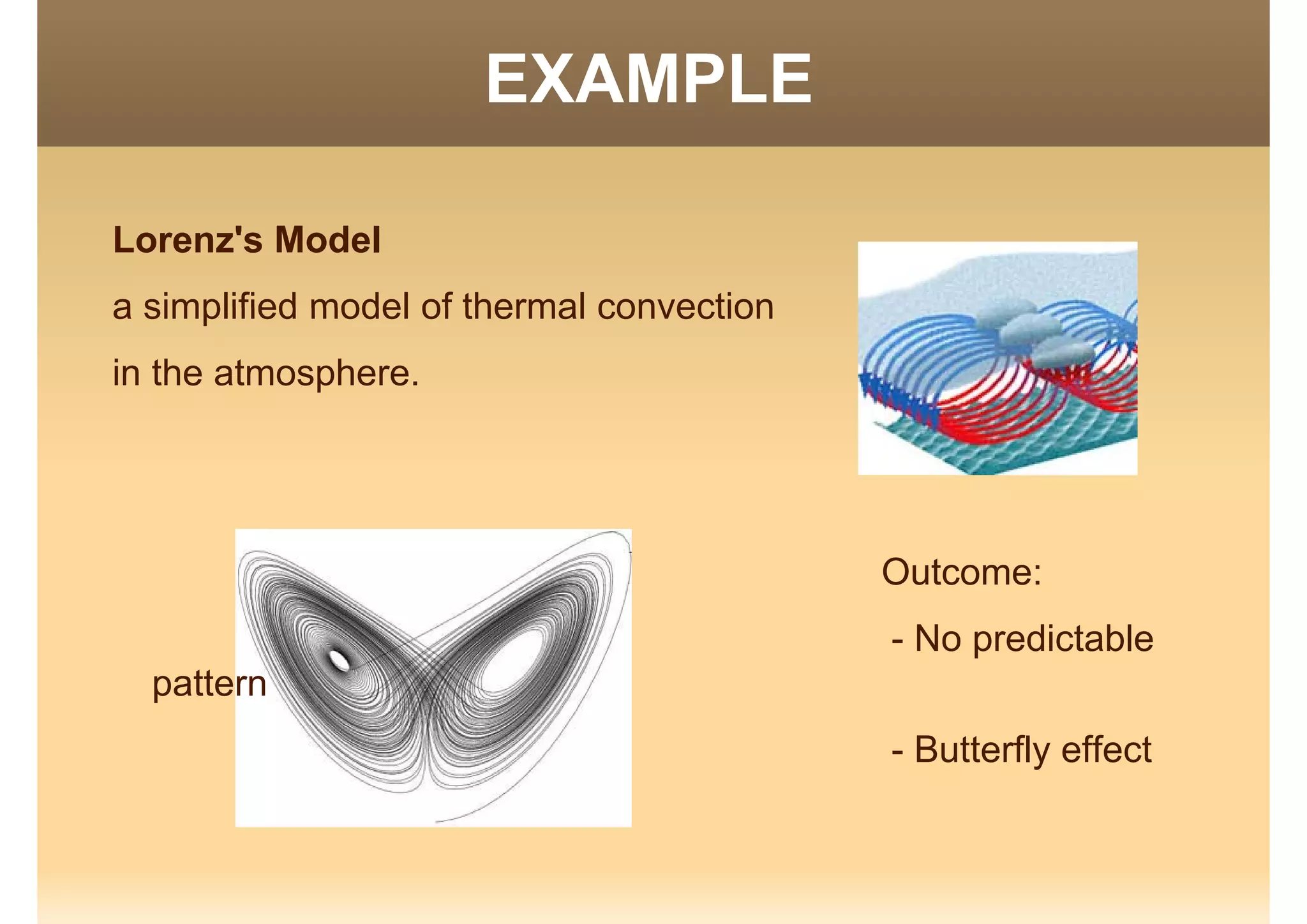
Lorenz's Model
a simplified model of thermal convectiona simplified model of thermal convection
in the atmosphere.
Outcome:
- No predictable
pattern
- Butterfly effect
A BIT OF MATHS...O S
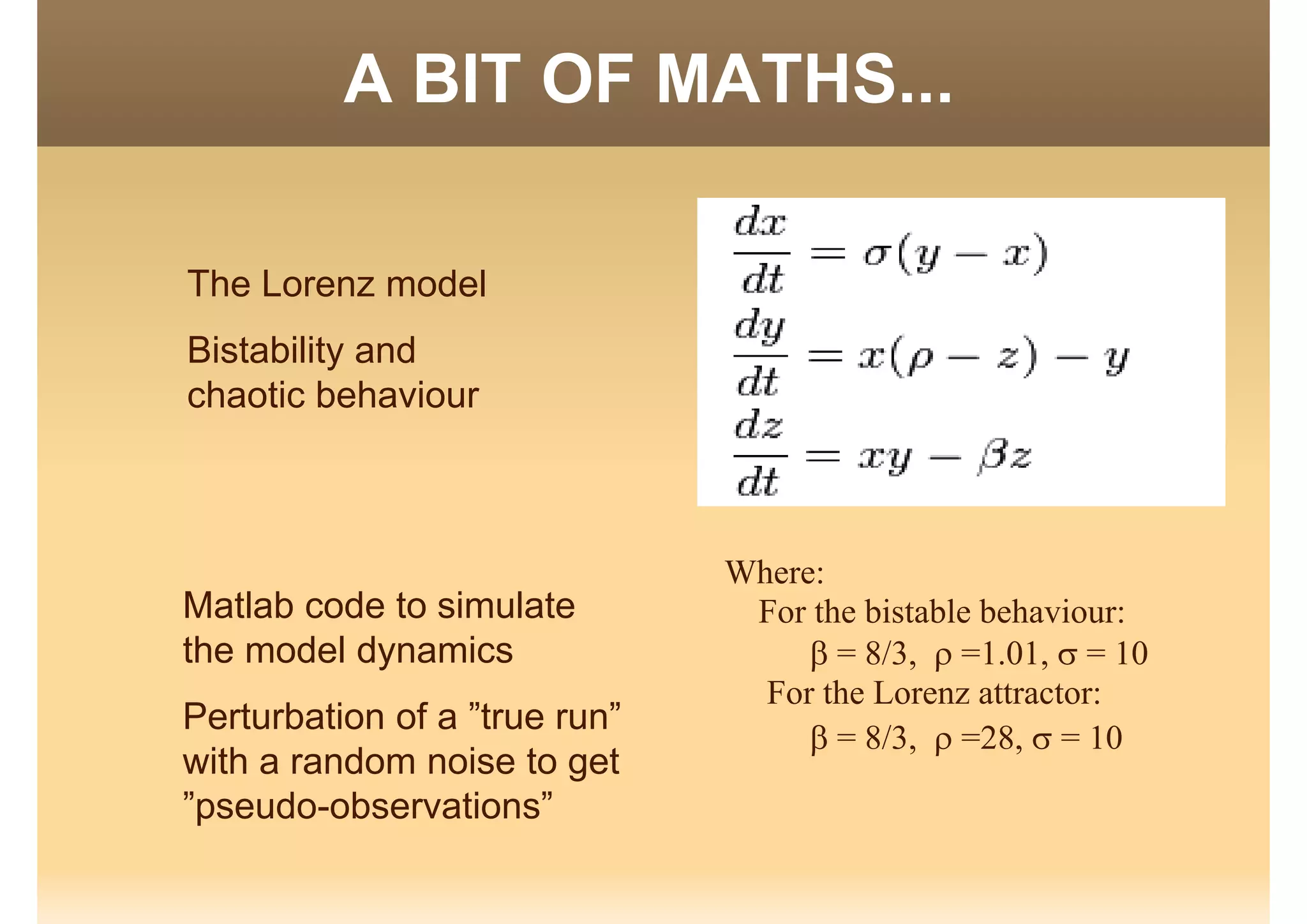
The Lorenz model
Bistability and
chaotic behaviour
Where:
For the bistable behaviour:Matlab code to simulate For the bistable behaviour:
 = 8/3,  =1.01,  = 10
For the Lorenz attractor:
Matlab code to simulate
the model dynamics
Perturbation of a ”true run”
 = 8/3,  =28,  = 10
Perturbation of a true run
with a random noise to get
”pseudo-observations”p
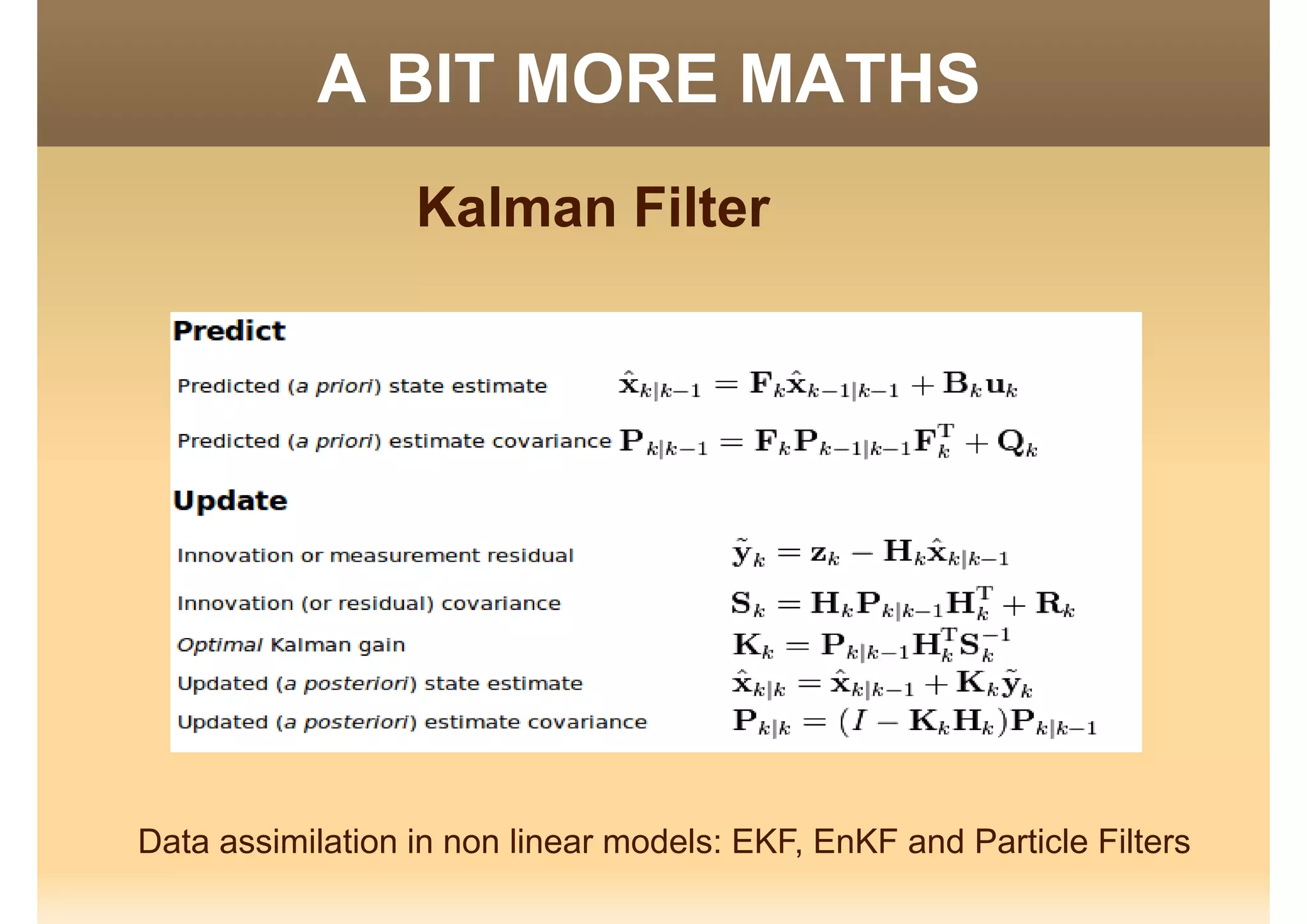
A BIT MORE MATHSO S
Kalman FilterKalman Filter
Data assimilation in non linear models: EKF, EnKF and Particle Filters
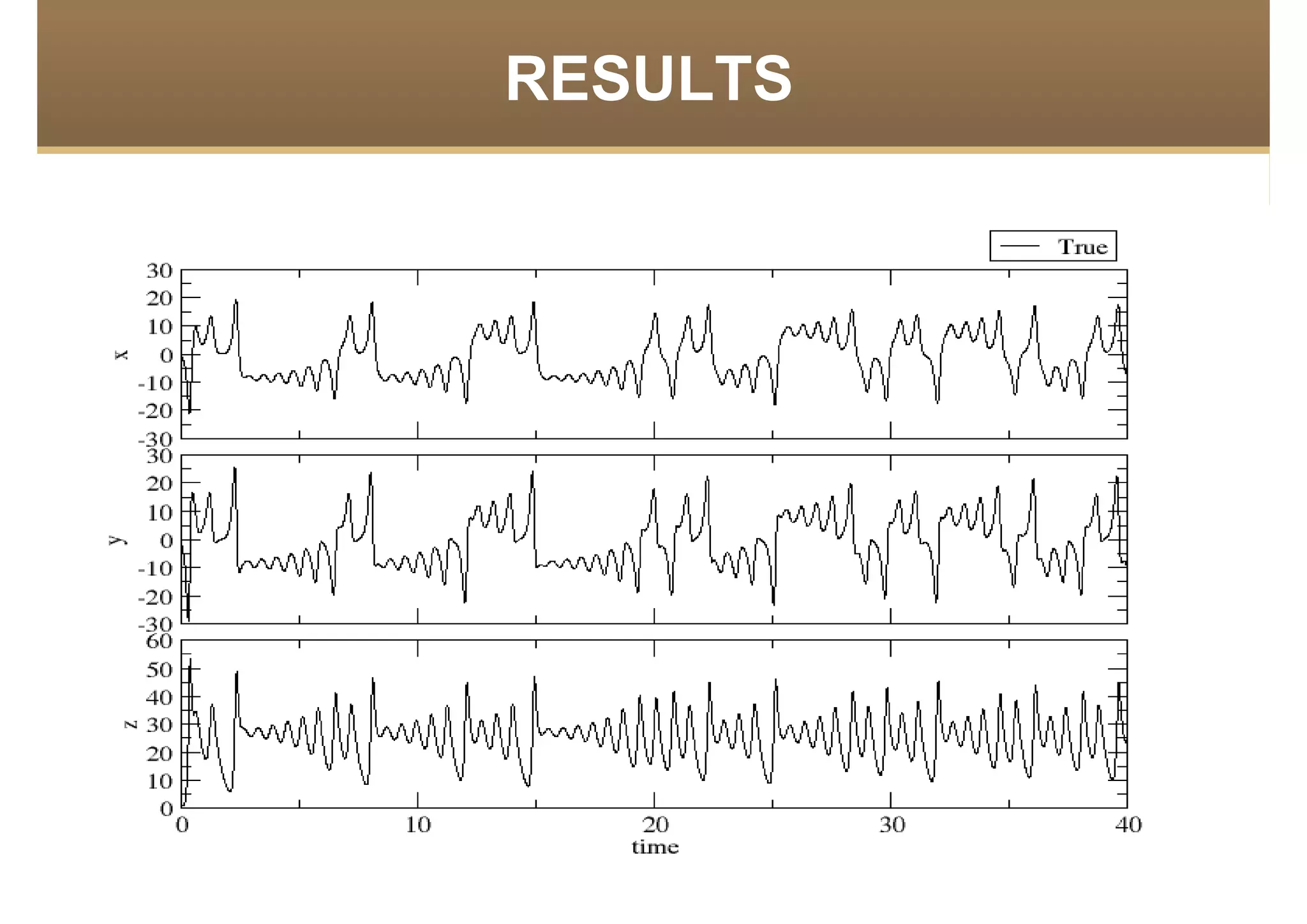
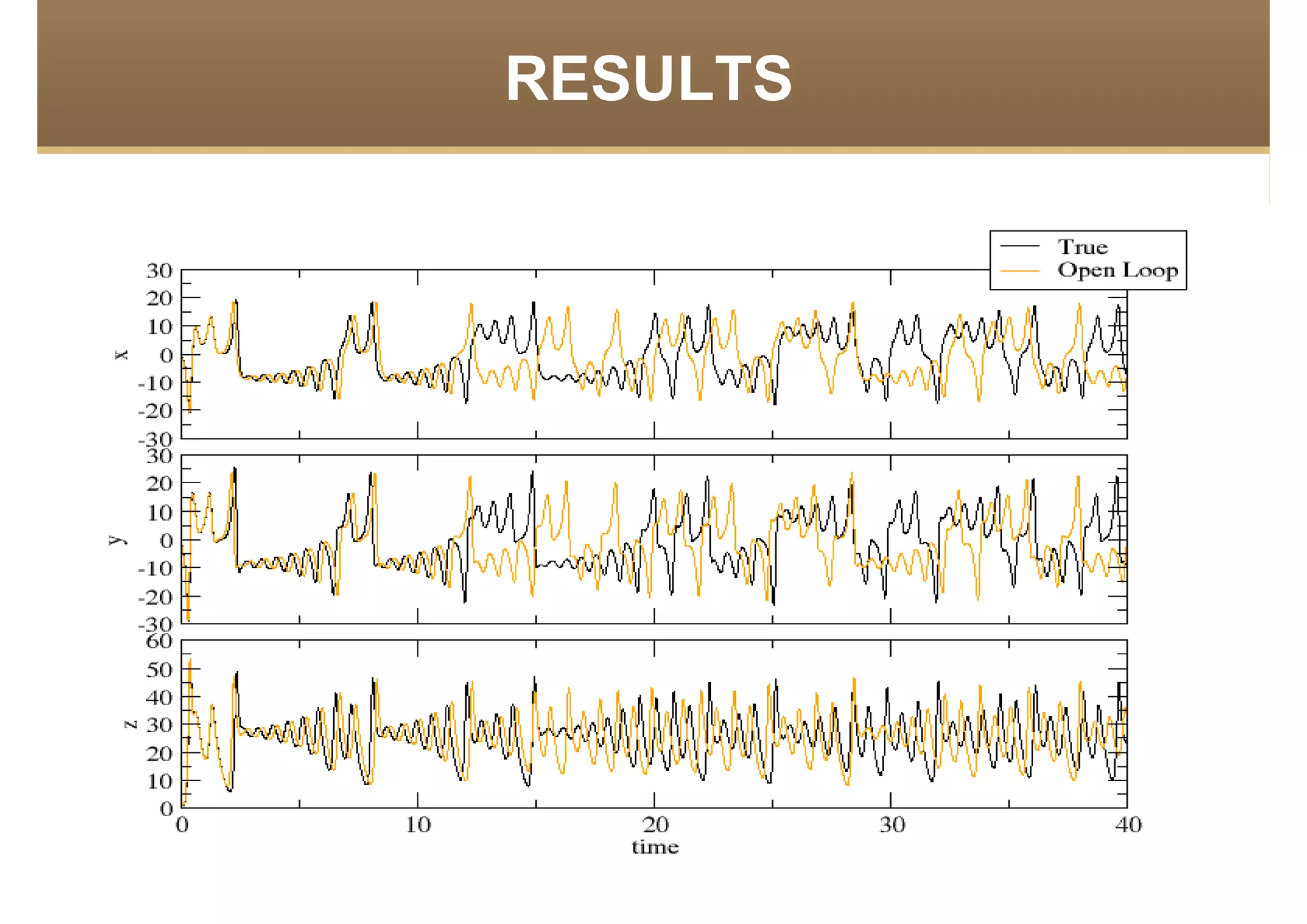
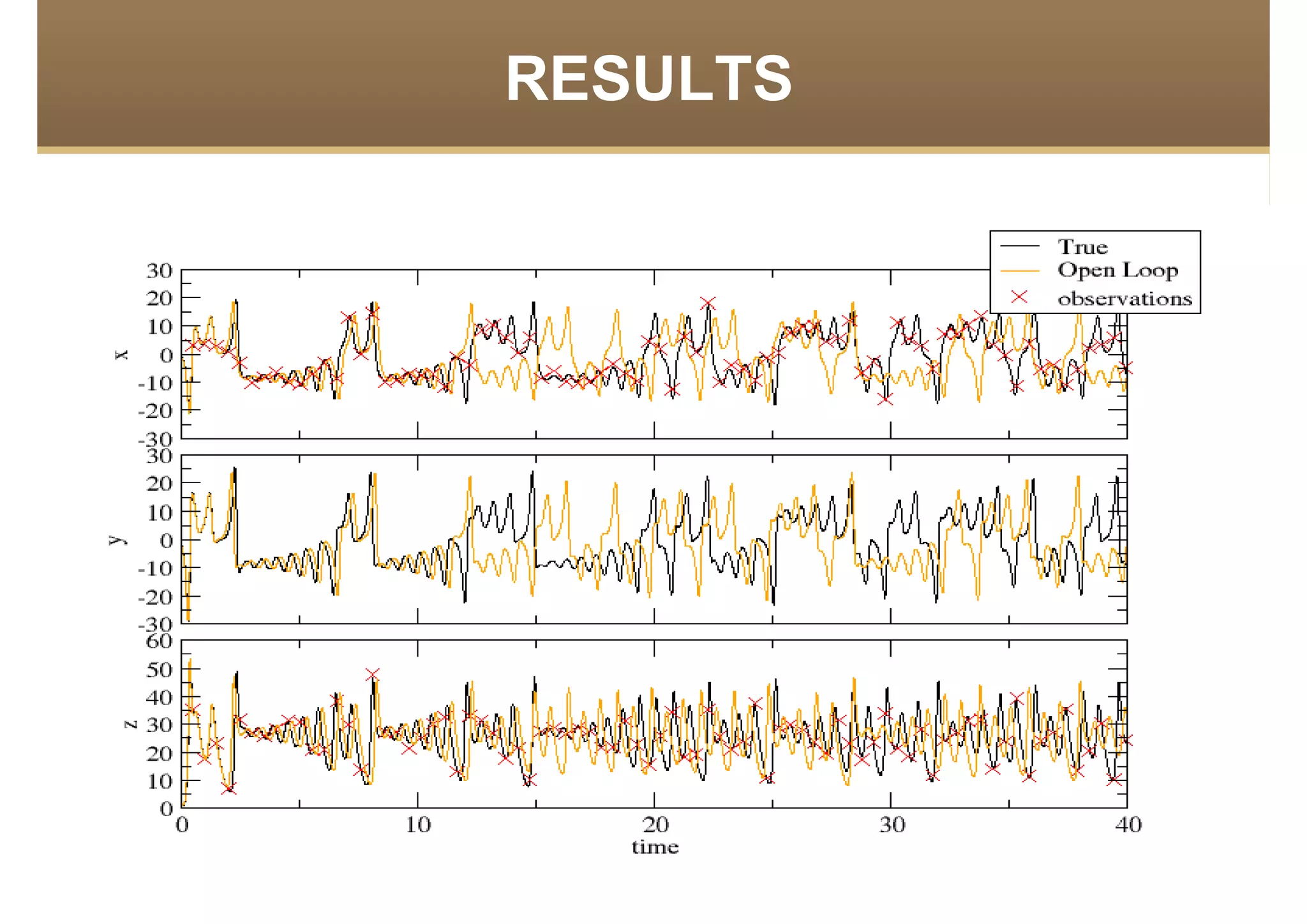
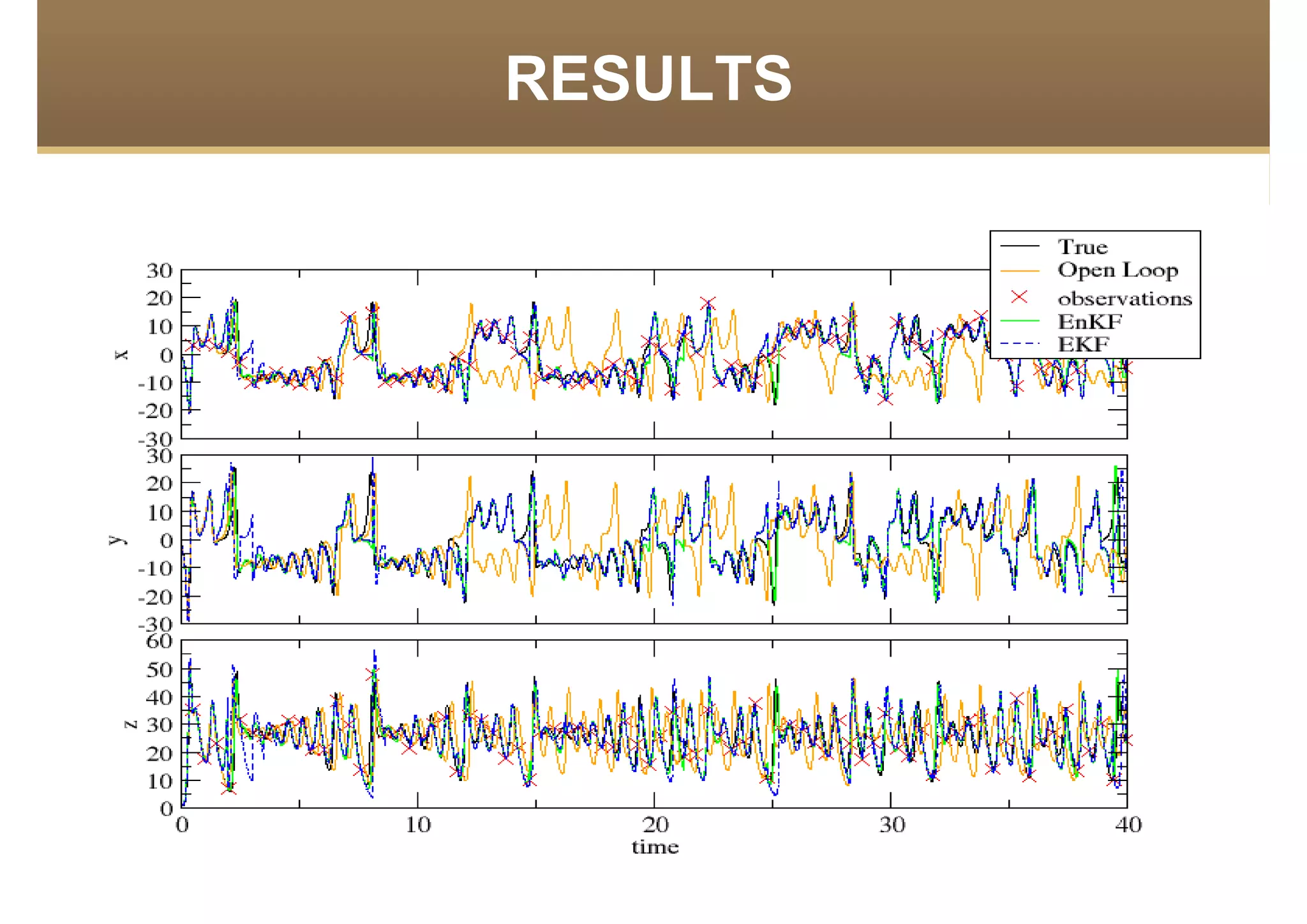
RESULTS
RESULTS
RESULTS
RESULTS
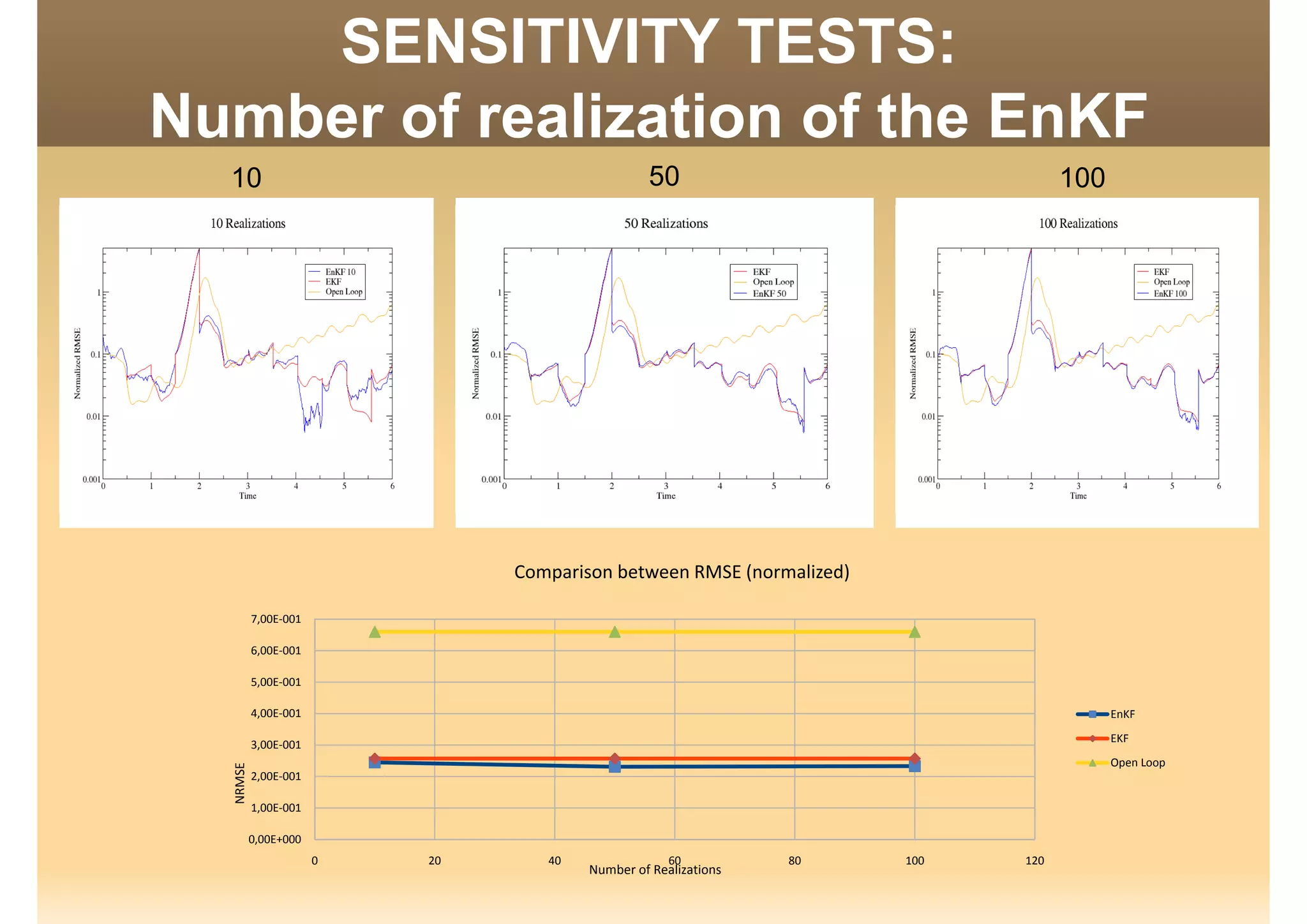
SENSITIVITY TESTS:
N b f li ti f th E KFNumber of realization of the EnKF
10 50 100
7 00E 001
Comparison between RMSE (normalized)
4,00E‐001
5,00E‐001
6,00E‐001
7,00E‐001
EnKF  
1,00E‐001
2,00E‐001
3,00E‐001
,
NRMSE
EKF  
Open Loop
0 20 40 60 80 100 120
0,00E+000
Number of Realizations
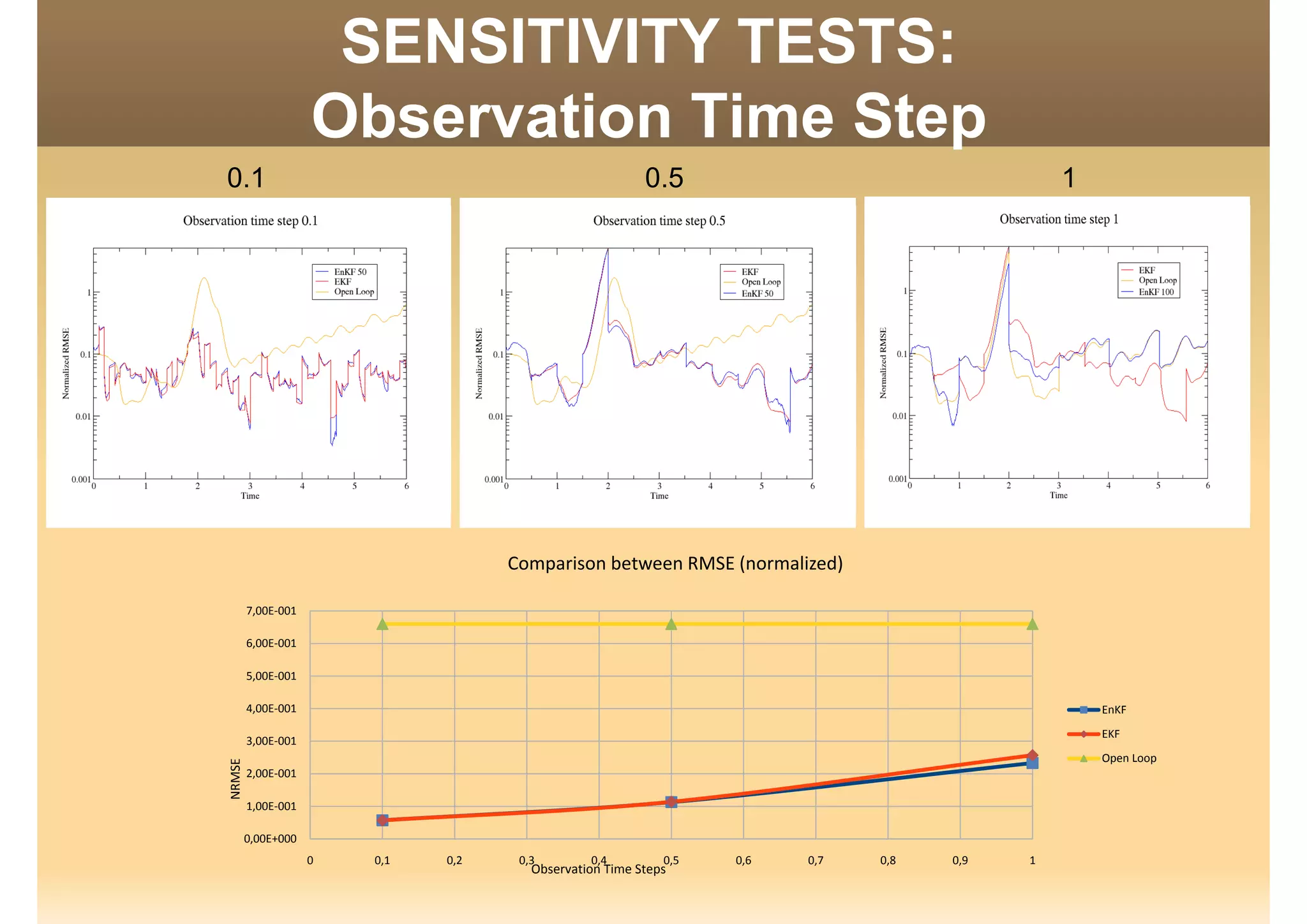
SENSITIVITY TESTS:
Ob ti Ti StObservation Time Step
0.1 0.5 1
7,00E‐001
Comparison between RMSE (normalized)
4,00E‐001
5,00E‐001
6,00E‐001
,
EnKF  
1,00E‐001
2,00E‐001
3,00E‐001
NRMSE
EKF  
Open Loop
0 0,1 0,2 0,3 0,4 0,5 0,6 0,7 0,8 0,9 1
0,00E+000
Observation Time Steps
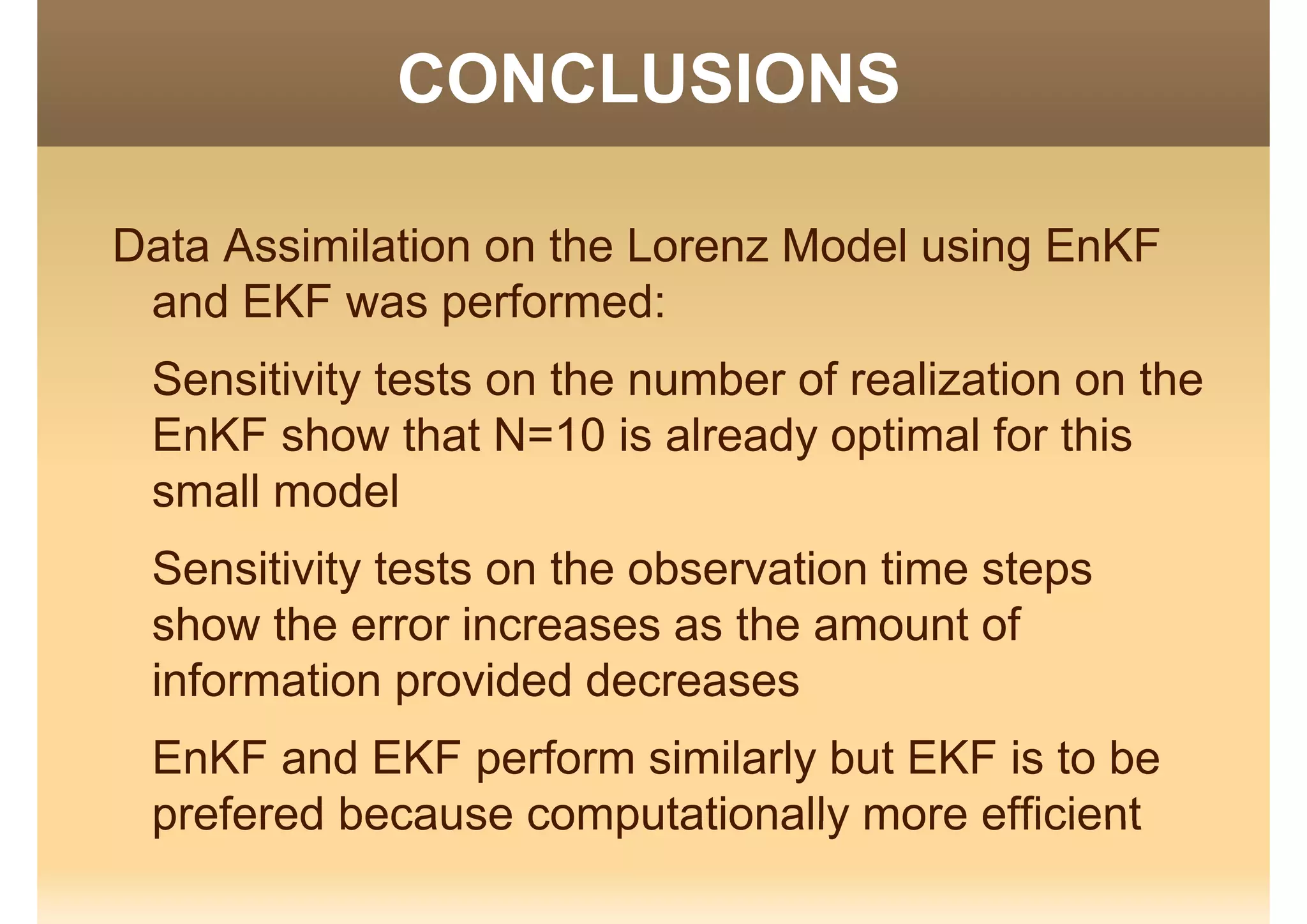
CONCLUSIONSCO C US O S
Data Assimilation on the Lorenz Model using EnKF
and EKF was performed:and EKF was performed:
Sensitivity tests on the number of realization on the
EnKF show that N=10 is already optimal for this
small model
Sensitivity tests on the observation time steps
sho the error increases as the amo nt ofshow the error increases as the amount of
information provided decreases
EnKF and EKF perform similarly but EKF is to be
prefered because computationally more efficientprefered because computationally more efficient
FUTURE CHALLENGESU U C G S
Further sensitivity tests
(e.g. ”bistable dynamics”)
Parameter estimationParameter estimation
Utilize Data Assimilation for ”real
problems” (e.g. Weather predictions)
Data Assimilation for the Lorenz model using
Ensemble and Extended Kalman FilterEnsemble and Extended Kalman Filter
Thanks for your attentionThanks for your attention

Data Assimilation for the Lorenz (1963) Model using Ensemble and Extended Kalman Filter

  • 1.
    Biogeodynamics and EarthSystem Sciences Summer School (BESS)Sciences Summer School (BESS) Data Assimilation for the Lorenz (1963) Model using Ensemble d E t d d K l Filtand Extended Kalman Filter D. Pasetto (a) and C. Vitolo (b) Advisor M.Ghil, ENS & UCLA (a) Universita' di Padova (Italy) (b) Imperial College London (UK)
  • 2.
    Data Assimilation forthe Lorenz model using Ensemble and Extended Kalman FilterEnsemble and Extended Kalman Filter OUTLINE Data AssimilationData Assimilation Kalman Filter (EnKF and EKF) Lorenz ModelLorenz Model Results of Sensitivity Tests Future Challenges
  • 3.
    DATA ASSIMILATIONSS O DataAssimilation is usually defined as ”Estimation and prediction (analysis) of an unknown trueEstimation and prediction (analysis) of an unknown true state by combining observations and system dynamics (model output)”( p ) It is needed in order to: - Reduce uncertainties and biases - Improve forecasting - Estimate initial state of a system (e g hydrologic system)Estimate initial state of a system (e.g. hydrologic system) from multiple sources of information - Permit forecast adjustmentsPermit forecast adjustments
  • 4.
    EXAMPLE Lorenz's Model a simplifiedmodel of thermal convectiona simplified model of thermal convection in the atmosphere. Outcome: - No predictable pattern - Butterfly effect
  • 5.
    A BIT OFMATHS...O S The Lorenz model Bistability and chaotic behaviour Where: For the bistable behaviour:Matlab code to simulate For the bistable behaviour:  = 8/3,  =1.01,  = 10 For the Lorenz attractor: Matlab code to simulate the model dynamics Perturbation of a ”true run”  = 8/3,  =28,  = 10 Perturbation of a true run with a random noise to get ”pseudo-observations”p
  • 6.
    A BIT MOREMATHSO S Kalman FilterKalman Filter Data assimilation in non linear models: EKF, EnKF and Particle Filters
  • 7.
  • 8.
  • 9.
  • 10.
  • 11.
    SENSITIVITY TESTS: N bf li ti f th E KFNumber of realization of the EnKF 10 50 100 7 00E 001 Comparison between RMSE (normalized) 4,00E‐001 5,00E‐001 6,00E‐001 7,00E‐001 EnKF   1,00E‐001 2,00E‐001 3,00E‐001 , NRMSE EKF   Open Loop 0 20 40 60 80 100 120 0,00E+000 Number of Realizations
  • 12.
    SENSITIVITY TESTS: Ob tiTi StObservation Time Step 0.1 0.5 1 7,00E‐001 Comparison between RMSE (normalized) 4,00E‐001 5,00E‐001 6,00E‐001 , EnKF   1,00E‐001 2,00E‐001 3,00E‐001 NRMSE EKF   Open Loop 0 0,1 0,2 0,3 0,4 0,5 0,6 0,7 0,8 0,9 1 0,00E+000 Observation Time Steps
  • 13.
    CONCLUSIONSCO C USO S Data Assimilation on the Lorenz Model using EnKF and EKF was performed:and EKF was performed: Sensitivity tests on the number of realization on the EnKF show that N=10 is already optimal for this small model Sensitivity tests on the observation time steps sho the error increases as the amo nt ofshow the error increases as the amount of information provided decreases EnKF and EKF perform similarly but EKF is to be prefered because computationally more efficientprefered because computationally more efficient
  • 14.
    FUTURE CHALLENGESU UC G S Further sensitivity tests (e.g. ”bistable dynamics”) Parameter estimationParameter estimation Utilize Data Assimilation for ”real problems” (e.g. Weather predictions)
  • 15.
    Data Assimilation forthe Lorenz model using Ensemble and Extended Kalman FilterEnsemble and Extended Kalman Filter Thanks for your attentionThanks for your attention