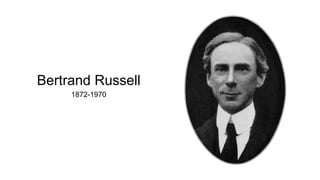
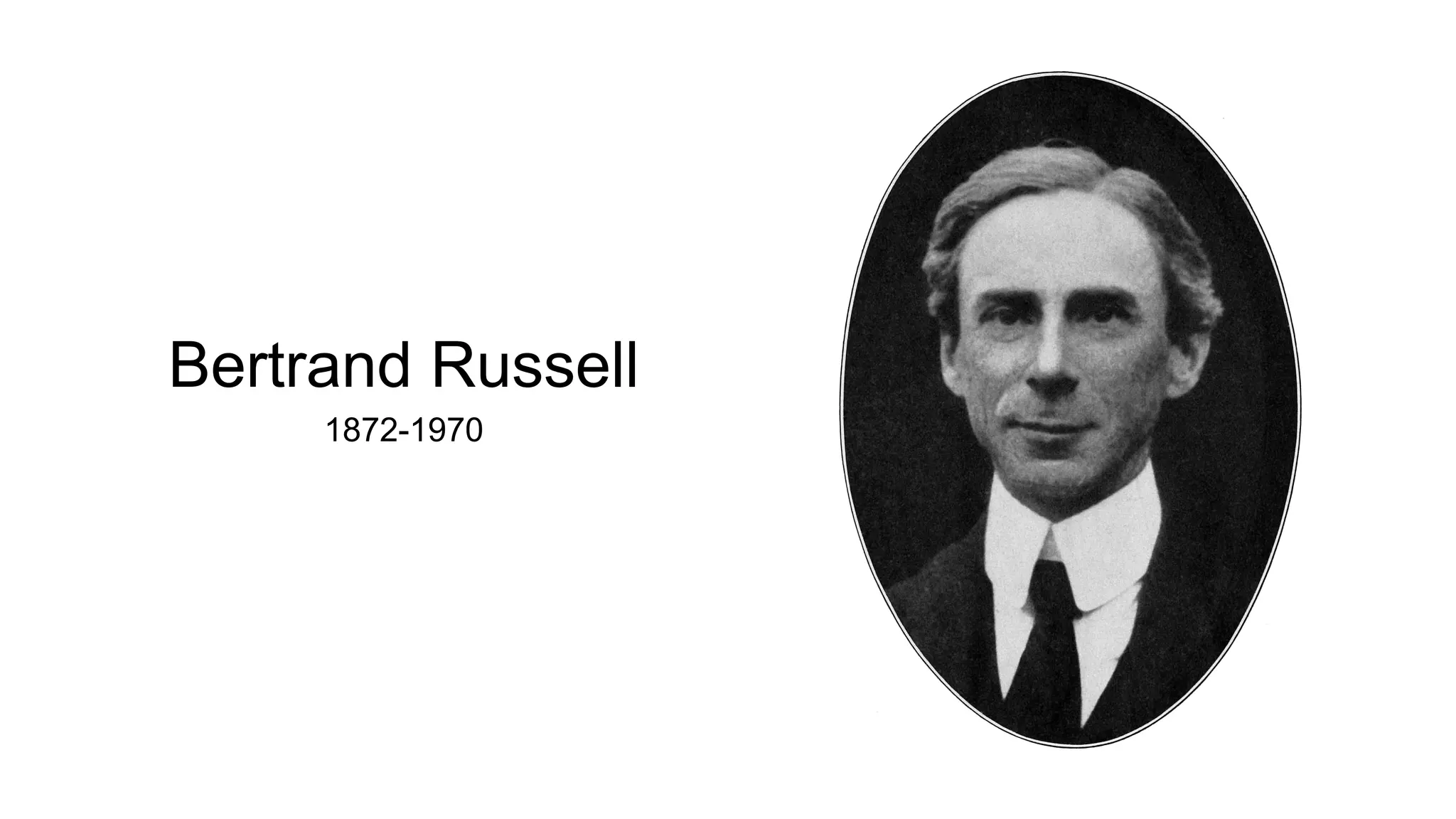
Bertrand Russell
1872-1970
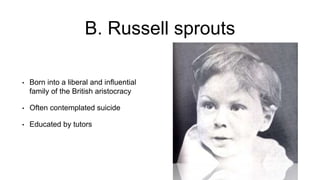
B. Russell sprouts
• Born into a liberal and influential
family of the British aristocracy
• Often contemplated suicide
• Educated by tutors
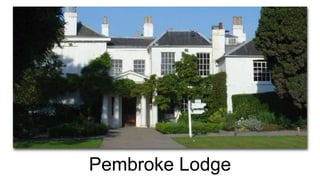
Pembroke Lodge
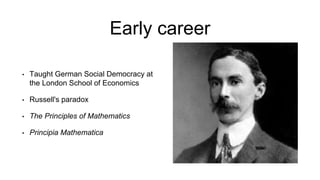
Early career
• Taught German Social Democracy at
the London School of Economics
• Russell's paradox
• The Principles of Mathematics
• Principia Mathematica
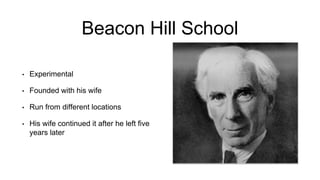
Beacon Hill School
• Experimental
• Founded with his wife
• Run from different locations
• His wife continued it after he left five
years later
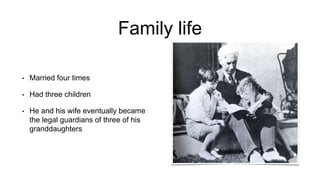
Family life
• Married four times
• Had three children
• He and his wife eventually became
the legal guardians of three of his
granddaughters
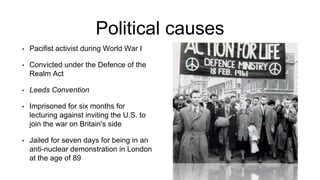
Political causes
• Pacifist activist during World War I
• Convicted under the Defence of the
Realm Act
• Leeds Convention
• Imprisoned for six months for
lecturing against inviting the U.S. to
join the war on Britain's side
• Jailed for seven days for being in an
anti-nuclear demonstration in London
at the age of 89
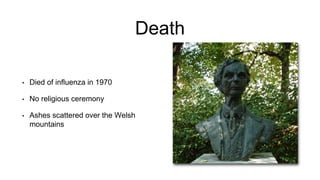
Death
• Died of influenza in 1970
• No religious ceremony
• Ashes scattered over the Welsh
mountains
Analytic philosophy
• Favored clarity in arguments
• Did not think there should be separate methods for philosophy
• Occam's Razor
Russell's teapot
• Burden of proof
• Teapot orbiting around the sun between Earth and Mars
"Bertrand Russell - Biographical". Nobelprize.org. Nobel Media AB 2014. Web. 26 Feb 2015.
Derbyshire, John. "Chasing down the ghost in the machine: losing consciousness in Arizona." The
American Spectator June 2014: 20+. Gale Biography In Context. Web. 27 Feb. 2015.
Ferguson, Kitty. The Music of Pythagoras. New York: Walker Publishing Company, Inc., 2008.
Print.
Irvine, Andrew David, "Bertrand Russell", The Stanford Encyclopedia of Philosophy (Winter 2014
Edition), Edward N. Zalta (ed.).
Russell, Bertrand. Autobiography. Psychology Press, 1998. Print.
---. "Civil disobedience." New Statesman [1996] 8 Nov. 2013: 35+. Gale Biography In Context. Web.
27 Feb. 2015.

Bertrand Russell

  • 1.
  • 2.
    B. Russell sprouts •Born into a liberal and influential family of the British aristocracy • Often contemplated suicide • Educated by tutors
  • 3.
  • 4.
    Early career • TaughtGerman Social Democracy at the London School of Economics • Russell's paradox • The Principles of Mathematics • Principia Mathematica
  • 5.
    Beacon Hill School •Experimental • Founded with his wife • Run from different locations • His wife continued it after he left five years later
  • 6.
    Family life • Marriedfour times • Had three children • He and his wife eventually became the legal guardians of three of his granddaughters
  • 7.
    Political causes • Pacifistactivist during World War I • Convicted under the Defence of the Realm Act • Leeds Convention • Imprisoned for six months for lecturing against inviting the U.S. to join the war on Britain's side • Jailed for seven days for being in an anti-nuclear demonstration in London at the age of 89
  • 8.
    Death • Died ofinfluenza in 1970 • No religious ceremony • Ashes scattered over the Welsh mountains
  • 9.
    Analytic philosophy • Favoredclarity in arguments • Did not think there should be separate methods for philosophy • Occam's Razor
  • 10.
    Russell's teapot • Burdenof proof • Teapot orbiting around the sun between Earth and Mars
  • 11.
    "Bertrand Russell -Biographical". Nobelprize.org. Nobel Media AB 2014. Web. 26 Feb 2015. Derbyshire, John. "Chasing down the ghost in the machine: losing consciousness in Arizona." The American Spectator June 2014: 20+. Gale Biography In Context. Web. 27 Feb. 2015. Ferguson, Kitty. The Music of Pythagoras. New York: Walker Publishing Company, Inc., 2008. Print. Irvine, Andrew David, "Bertrand Russell", The Stanford Encyclopedia of Philosophy (Winter 2014 Edition), Edward N. Zalta (ed.). Russell, Bertrand. Autobiography. Psychology Press, 1998. Print. ---. "Civil disobedience." New Statesman [1996] 8 Nov. 2013: 35+. Gale Biography In Context. Web. 27 Feb. 2015.