Beringia II the way of fisrt americans Xue xue zhu 1r Btx D 2011/2012 INS MÀRIUS TORRES
INDEX 3- who were paleoindians? 3.1  when and how arrived until there? 3.2  what’s they food ? 4- End of Pleinstone Age 4.1 what’s the consequences happen in that moment? 4.2 who was the factory of extinct of animal? 5- Discovery 5.1 how we know about these information?
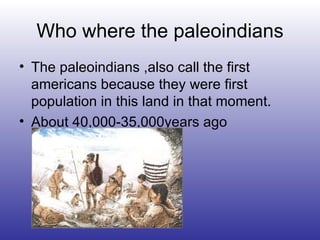
Who where the paleoindians The paleoindians ,also call the first americans because they were first population in this land in that moment. About 40,000-35,000years ago
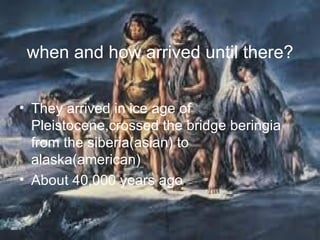
when and how arrived until there? They arrived in ice age of Pleistocene,crossed the bridge beringia from the siberia(asian) to alaska(american) About 40,000 years ago .
What’s they food? They hunt any animals for feed . The main animal they hunt were: horse and bison. However in this moment , the mammuts and the wolves were extinct ,so they didn’t hunt that kind of animals.
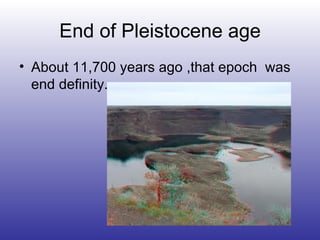
End of Pleistocene age About 11,700 years ago ,that epoch  was end definity.
what’s the consequences happen in that moment? the many animals were extinct or to be extinct. It made an biggest problem for paleoindians with his foods. So many paleoindians were dealth from this cause.
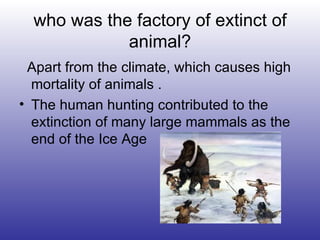
who was the factory of extinct of animal? Apart from the climate, which causes high mortality of animals . The  human hunting contributed to the extinction of many large mammals as the end of the Ice Age
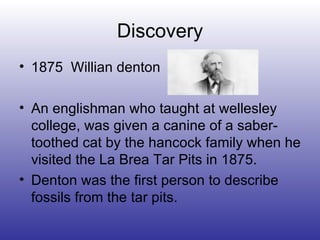
Discovery 1875  Willian denton  An englishman who taught at wellesley college, was given a canine of a saber-toothed cat by the hancock family when he visited the La Brea Tar Pits in 1875. Denton was the first person to describe fossils from the tar pits.
how we know about these information? Excavations 1900-present In 1913, the Hancock family gave the newly established Los Angeles county Museum sole right to excavate fossils from the tar pits for two years. Led by L.E Wyman, excavators earned $3.50 a day,decent wages for 1913. In 1969 the pit 91 excavation was reopened with the intent of collecting all the fossils and not just the large vertebrates . As a result the list of species doubled and now over 600specis of plants and animals are known from Ranchi La Brea. The sediment surrounding the larger bones contains microfossils visible only under a magnifier. These include seeds,shells ,insect parts, and bones of tiny animals.
Excavation 1900-present Project 23 excavations  In 2006 LACMA built an underground parking garage and encountered 16 new asphaltic fossil deposits. These were recovered in 23 large wooden “tree”boxes-hence “project 23”-and are currently by Page Museum paleontologists. Many exciting fossils are discovered daily in the project 23 excavations. For detaild see our blog “the excavatrix”

Beringia ii

  • 1.
    Beringia II theway of fisrt americans Xue xue zhu 1r Btx D 2011/2012 INS MÀRIUS TORRES
  • 2.
    INDEX 3- whowere paleoindians? 3.1 when and how arrived until there? 3.2 what’s they food ? 4- End of Pleinstone Age 4.1 what’s the consequences happen in that moment? 4.2 who was the factory of extinct of animal? 5- Discovery 5.1 how we know about these information?
  • 3.
    Who where thepaleoindians The paleoindians ,also call the first americans because they were first population in this land in that moment. About 40,000-35,000years ago
  • 4.
    when and howarrived until there? They arrived in ice age of Pleistocene,crossed the bridge beringia from the siberia(asian) to alaska(american) About 40,000 years ago .
  • 5.
    What’s they food?They hunt any animals for feed . The main animal they hunt were: horse and bison. However in this moment , the mammuts and the wolves were extinct ,so they didn’t hunt that kind of animals.
  • 6.
    End of Pleistoceneage About 11,700 years ago ,that epoch was end definity.
  • 7.
    what’s the consequenceshappen in that moment? the many animals were extinct or to be extinct. It made an biggest problem for paleoindians with his foods. So many paleoindians were dealth from this cause.
  • 8.
    who was thefactory of extinct of animal? Apart from the climate, which causes high mortality of animals . The human hunting contributed to the extinction of many large mammals as the end of the Ice Age
  • 9.
    Discovery 1875 Willian denton An englishman who taught at wellesley college, was given a canine of a saber-toothed cat by the hancock family when he visited the La Brea Tar Pits in 1875. Denton was the first person to describe fossils from the tar pits.
  • 10.
    how we knowabout these information? Excavations 1900-present In 1913, the Hancock family gave the newly established Los Angeles county Museum sole right to excavate fossils from the tar pits for two years. Led by L.E Wyman, excavators earned $3.50 a day,decent wages for 1913. In 1969 the pit 91 excavation was reopened with the intent of collecting all the fossils and not just the large vertebrates . As a result the list of species doubled and now over 600specis of plants and animals are known from Ranchi La Brea. The sediment surrounding the larger bones contains microfossils visible only under a magnifier. These include seeds,shells ,insect parts, and bones of tiny animals.
  • 11.
    Excavation 1900-present Project23 excavations In 2006 LACMA built an underground parking garage and encountered 16 new asphaltic fossil deposits. These were recovered in 23 large wooden “tree”boxes-hence “project 23”-and are currently by Page Museum paleontologists. Many exciting fossils are discovered daily in the project 23 excavations. For detaild see our blog “the excavatrix”