Beloved Communities
 The story of your name: Who named you? Where does it come from? Does it hold meaning?
 The story of a community to which you belong: Defining “community” however you like, tell us
a little bit about who that community is and what role you play in it.
 The story of your name: Who named you? Where does it come from? Does it hold meaning?
 The story of a community to which you belong: Defining “community” however you like, tell us
a little bit about who that community is and what role you play in it.
 The story of your gift: What’s something that you contribute (or have contributed) to your
community? How have you used your gift to help sustain, make change in, or make for your
community? Has sharing your gift changed you?
SOCIAL JUSTICE AND THE RHETORICAL SITUATION: A MODEL FOR UNDERSTANDING CHANGE-MAKING
Rhetoric: The study of how we use symbols to change our shared social world.
SOCIAL JUSTICE AND THE RHETORICAL SITUATION: A MODEL FOR UNDERSTANDING CHANGE-MAKING
The four parts of a rhetorical situation:
• Exigence
“An imperfection marked by urgency; it is a defect, an obstacle, something waiting to be done, a
thing which is other than it should be.”
• Rhetorical audience
Able to take part in the discourse and empowered to make change.
• Context: resources and limitations
All the things that influence whether and how the rhetorical audience can or can’t, does or
doesn’t, make the change.
• Vision of change
An image of how our world would have to be changed in order to resolve that urgent
imperfection.
SOCIAL JUSTICE AND THE RHETORICAL SITUATION: A MODEL FOR UNDERSTANDING CHANGE-MAKING
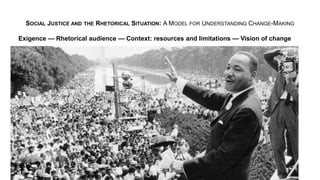
Exigence — Rhetorical audience — Context: resources and limitations — Vision of change
SOCIAL JUSTICE AND THE RHETORICAL SITUATION: A MODEL FOR UNDERSTANDING CHANGE-MAKING
Exigence — Rhetorical audience — Context: resources and limitations — Vision of change
The Beloved Community
(from “I Have a Dream” (1963))
“And when this happens, when we allow freedom to ring,
when we let it ring from every village and every hamlet,
from every state and every city, we will be able to speed up
that day when all of God’s children, black men and white
men, Jews and Gentiles, Protestants and Catholics, will be
able to join hands and sing in the words of the old Negro
spiritual, “Free at last! free at last! thank God Almighty, we
are free at last!”
SOCIAL JUSTICE AND THE RHETORICAL SITUATION: A MODEL FOR UNDERSTANDING CHANGE-MAKING
Exigence — Rhetorical audience — Context: resources and limitations — Vision of change
The Beloved Community
(from earlier King writings)
“It is an overflowing love which seeks nothing in return.”
“It is this type of spirit and this type of love that can
transform opposers into friends. It is this type of
understanding goodwill that will transform the deep gloom
of the old age into the exuberant gladness of the new age.
It is this love which will bring about miracles in the hearts
of men.”
Why?
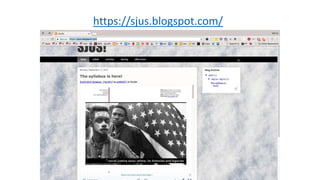
https://sjus.blogspot.com/

Beloved Communities

  • 1.
  • 2.
     The storyof your name: Who named you? Where does it come from? Does it hold meaning?  The story of a community to which you belong: Defining “community” however you like, tell us a little bit about who that community is and what role you play in it.
  • 3.
     The storyof your name: Who named you? Where does it come from? Does it hold meaning?  The story of a community to which you belong: Defining “community” however you like, tell us a little bit about who that community is and what role you play in it.  The story of your gift: What’s something that you contribute (or have contributed) to your community? How have you used your gift to help sustain, make change in, or make for your community? Has sharing your gift changed you?
  • 4.
    SOCIAL JUSTICE ANDTHE RHETORICAL SITUATION: A MODEL FOR UNDERSTANDING CHANGE-MAKING Rhetoric: The study of how we use symbols to change our shared social world.
  • 5.
    SOCIAL JUSTICE ANDTHE RHETORICAL SITUATION: A MODEL FOR UNDERSTANDING CHANGE-MAKING The four parts of a rhetorical situation: • Exigence “An imperfection marked by urgency; it is a defect, an obstacle, something waiting to be done, a thing which is other than it should be.” • Rhetorical audience Able to take part in the discourse and empowered to make change. • Context: resources and limitations All the things that influence whether and how the rhetorical audience can or can’t, does or doesn’t, make the change. • Vision of change An image of how our world would have to be changed in order to resolve that urgent imperfection.
  • 6.
    SOCIAL JUSTICE ANDTHE RHETORICAL SITUATION: A MODEL FOR UNDERSTANDING CHANGE-MAKING Exigence — Rhetorical audience — Context: resources and limitations — Vision of change
  • 7.
    SOCIAL JUSTICE ANDTHE RHETORICAL SITUATION: A MODEL FOR UNDERSTANDING CHANGE-MAKING Exigence — Rhetorical audience — Context: resources and limitations — Vision of change The Beloved Community (from “I Have a Dream” (1963)) “And when this happens, when we allow freedom to ring, when we let it ring from every village and every hamlet, from every state and every city, we will be able to speed up that day when all of God’s children, black men and white men, Jews and Gentiles, Protestants and Catholics, will be able to join hands and sing in the words of the old Negro spiritual, “Free at last! free at last! thank God Almighty, we are free at last!”
  • 8.
    SOCIAL JUSTICE ANDTHE RHETORICAL SITUATION: A MODEL FOR UNDERSTANDING CHANGE-MAKING Exigence — Rhetorical audience — Context: resources and limitations — Vision of change The Beloved Community (from earlier King writings) “It is an overflowing love which seeks nothing in return.” “It is this type of spirit and this type of love that can transform opposers into friends. It is this type of understanding goodwill that will transform the deep gloom of the old age into the exuberant gladness of the new age. It is this love which will bring about miracles in the hearts of men.”
  • 9.
  • 10.